

All states are not equal. There is obviously a difference between a global superpower of almost 350 million people and Norway, with a population of 5.5 million people. Still, both are states, both are in the Arctic, and both face geographically determined security issues in their immediate Arctic domain. It is thus both highly relevant and instructive to compare how these two states have approached their respective Arctic security dynamics. Whereas Norway and Norwegian politicians and bureaucrats in many ways responded to international attention and shifts by emphasising the High North and taking lead on a range of security initiatives (or governance initiatives) in the Arctic, US interest in Arctic security affairs over the last two decades has been a conundrum. The Arctic has not played the same vital security role in North America as it historically has for the Nordic states or even Russia.
The US Arctic Context
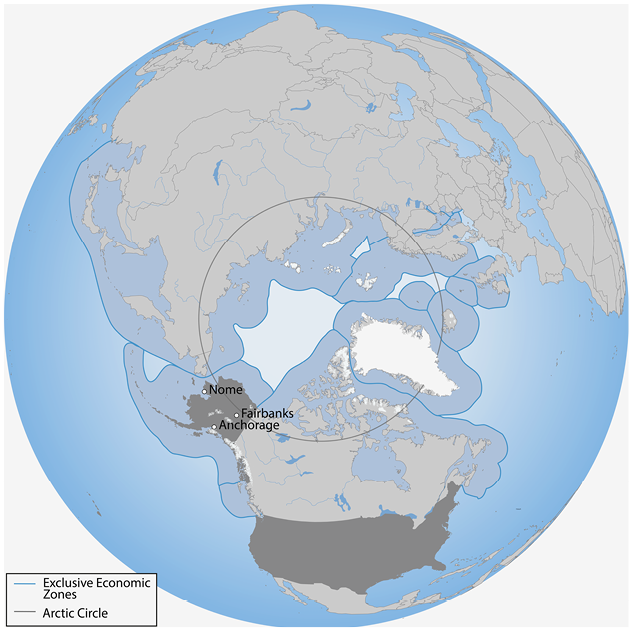
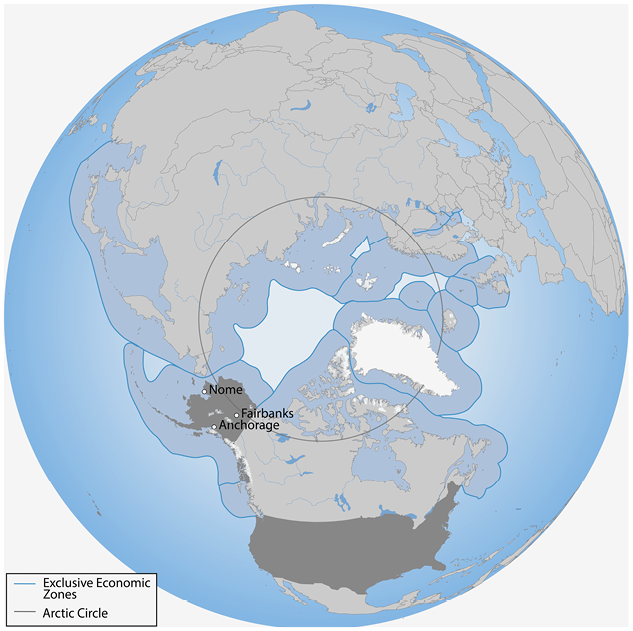
In a US Arctic context, the Arctic refers to Alaska and the Beringia regional space. Alaska has, however, only to a limited extent attracted the attention of federal decision makers in Washington, DC, or in the so-called lower forty-eight (see Figure 6.1). Alaska has ‘only’ a population of around 730,000 and most do not reside in the northern parts of the state. The strategies of US presidential administrations since the mid 2010s seem to reflect this as they have focused more on climatic and industrial considerations than on security and defence. Commentators thus declared that the USA’s ostensible lack of interest in security changes in the Arctic until the mid 2010s has made it a ‘reluctant Arctic actor’ in the post-Cold War era (Huebert Reference Huebert2009; Herrmann Reference Herrmann2019; Conley et al. Reference Conley, Melino, Tsafos and Williams2020; Nilsson Reference Nilsson2018).
Map of the Arctic with the USA and Alaska highlighted.
However, over the last decade, the USA has paid increasing attention to great power politics in the various subarctic and Arctic regions. This has materialised on many levels: US troops are exercising in various parts of the Arctic to showcase readiness and Arctic capabilities, each branch of the US military has launched new or updated Arctic strategic documents, and US politicians have been increasingly vocal about Arctic security concerns and the USA’s need to engage with the circumpolar region more strategically. We must study the various approaches, or levels, to the USA’s Arctic security engagement. Given the global role of the USA in international relations, the Arctic serves as a particularly interesting policy domain where the domestic (i.e., Alaska) meets the immediate-near abroad (i.e., Canada/the North American continent), as well as the wider systemic (i.e., the role of European and Asian actors in defining US security priorities).
Alaska, Homeland Defence, and Canada
The USA’s first engagement with circumpolar security issues in the Arctic region from a state perspective occurred during the US Civil War, when Confederate ships disrupted Union maritime commercial activity (Carroll Reference Carroll2010). In 1867, then-Secretary of State William Seward purchased the territory of Alaska as a means to strengthen US trade relations (Caswell Reference Caswell1951: 220). In July 1918, President Woodrow Wilson sent a contingent of 5,000 US Army troops, known as the Polar Bear Expedition, to fight the Bolsheviks in Northern Russia as part of the allied intervention into the Russian Civil War (Willett Reference Willett2003: xix).
During World War II, the allied forces’ Arctic convoys’ protection of friendly maritime traffic in the North Atlantic and Arctic oceans was essential to the Soviet Union’s war efforts under the US Lend-Lease Act. The US Armed Forces also used Greenland and Iceland as transit points after the USA’s entry into World War II (Edwards Reference Edwards2002: xi–xii). In the Pacific, the Japanese Empire attacked the US territories of Unalaska, Attu, and Kiska during World War II (Roucek Reference Roucek1951). Alaska only acquired its status as a US state in 1959.
The Cold War ushered in a bipolar system whereby the USA and the Soviet Union competed for regional influence. Key to this ambition was the nuclear arms race, and given the geographic proximity of the two superpowers, they prioritised undersea and aerospace capabilities as the shortest missile attack route between them was across the North Pole (Weir Reference Weir2002; Grossman Reference Grossman1946). As outlined, parts of the Arctic have long been a base for the Soviet Union’s (and later Russia’s) sea-based nuclear-deterrent in the Northern Fleet (J. Kjellén Reference Kjellén2022). After World War II, the USA and Soviet Union began conducting bomber missions along the North American Arctic coast to deter each other.
Official Arctic strategy began under President Richard Nixon. His 1971 National Security Decision Memorandum 144 stated that the US would ‘promote mutually beneficial international cooperation in the Arctic; and will at the same time provide for the protection of essential security interests’ (National Security Council 1971). Congress’s Arctic Research and Policy Act of 1984 expanded on this policy and declared, ‘as the Nation’s only common border with the Soviet Union, the Arctic is critical to national defense’ but also stressed the need for cooperation with Arctic-rim countries in research and controlling pollution (National Science Foundation 1984).
The first comprehensive US Arctic security policy was issued in 2009, shortly before President George W. Bush left office. The principal interests listed in National Security Presidential Directive-66 / Homeland Security Presidential Directive-25 (NSPD-66/HSPD-25) are ‘missile defense and early warning, deployment of sea and air systems for strategic sealift, strategic deterrence, maritime presence, and maritime operations, and freedom of navigation and overflight’ (The White House 2009). Former President Barack Obama’s visit to Alaska in 2015 marked the first time a sitting president travelled north of the Arctic Circle in the USA (Eilperin Reference Eilperin2015).
While the US government began publishing a series of strategic documents to address the issues raised in the Presidential Directive during the Obama administration, the security rhetoric concerning the Arctic only began to noticeably escalate during Donald Trump’s first presidency (2017–2021). President Trump’s musings in purchasing Greenland (Neuman Reference Neuman2019), and then Secretary of State Michael Pompeo’s refusal to sign the 2019 Arctic Council declaration – officially due to its mention of climate change (The Guardian 2019) but unofficially due to tensions with Russia and China – exemplified a new, assertive US approach towards Arctic security. From 2017 to 2018, the Trump administration applied its view of great power competition to the Arctic in its overarching ‘America First’ strategy. It was not – as had been the case during the Obama administration – predominantly concerned with climate change adaptation and mitigation. Trump’s Arctic strategy included an increased focus on military presence in various domains, particularly in the North Atlantic and European Arctic regions (Office of the Under Secretary of Defense for Policy 2019).
One significant driver of US attention to Arctic security in an Alaskan context has been concerns about homeland security and homeland defence. Alaska is currently home to nine military installations, including Joint Base Elmendorf-Richardson, Eielson Air Force Base, Clear Space Base, Fort Wainwright, Fort Greely, and Coast Guard Stations Kodiak, Valdez, and Juneau. Over the last decade, the US military has elevated the importance of Alaska by investing in personnel, assets, and infrastructure. These include, for example, the deployment of fifty-four fifth-generation F-35 aircraft to Eielson Air Force Base, the renaming of US Army Alaska to the 11th Airborne Division (‘Arctic Angels’), and over USD 350 million in funding to upgrade military infrastructure across the state from 2023 to 2024 (The Associated Press 2022; Fernandez Reference Fernandez2023).
Moreover, the US Coast Guard – part of the Department of Homeland Security (but part of the Department of the Navy in wartime) – concentrates on homeland security challenges with a particular Alaskan component, including emergency response, law enforcement, and fishing inspections. The US Coast Guard released an Implementation Plan in 2023 for the 2019 Arctic Strategic Outlook. These documents note that ‘Russia and China’s persistent challenges to the rules-based international order around the globe cause concern of similar infringement to the continued peaceful stability of the Arctic region’ but also that ‘US Coast Guard and the Russian Border Guard have a history of practical cooperation and [we] should endeavour to maintain that collaboration’ (US Coast Guard 2019: 10). Today, US–Russian Coast Guard joint exercises have been paused but the two sides maintain essential areas of cooperation in search and rescue and emergency response.
Some analysts have argued that the USA has yet to make additional significant investments in the North in terms of civilian infrastructure, military capabilities, and warning systems (Conley et al. Reference Conley, Melino, Tsafos and Williams2020: 4–6). For example, inadequate land (e.g., road network and construction) and maritime (deepwater port and search and rescue vessel) infrastructures pose challenges for Alaskan residents and local-, state-, and national-level officials. The US military has also encountered difficulties in procuring cold-weather gear and funding cold-weather operations training, challenging its operational capability (Science Daily Reference Daily2021).
The US Coast Guard has struggled for years to acquire the funds to construct three icebreaker ‘polar security cutters’ (US Coast Guard 2024). However, two are currently being designed, with the first ships due for service in the 2030s. These developments come after US Coast Guard calls for new assets for over a decade (Humpert Reference Humpert2024a). Moreover, by end of 2025, the Trump administration signed an agreement with Finland over the delivery of up to eleven medium class icebreakers (‘Arctic Security Cutters’) to be constructed in Helsinki and Texas (Humpert Reference Humpert2025).
In the federal US system, getting priority for Arctic security issues is naturally in constant competition with a range of other issues. The Alaskan representation in Washington, DC has had a focus on Arctic security issues over the last two decades. In 2017, Senator Sullivan notably called on President Trump to pay attention to Russian military posturing in the vicinity of Alaska: ‘What has been our national security strategy in the Arctic? Well, I think until recently, from the US perspective, from the [Pentagon] perspective, it really hasn’t existed’ (Gramer Reference Gramer2017). Both Senators Sullivan and Murkowski expressed alarm over Russian and Chinese military vessels operating together near the Aleutian Islands in 2023. ‘This is a stark reminder of Alaska’s proximity to both China and Russia, as well as the essential role our state plays in our national defence and territorial sovereignty. Incursions like this are why we are working so hard to secure funding and resources to expand our military’s capacity and capabilities in Alaska’, said Murkowski of the 2023 occurrence (Murkowski Reference Murkowski2023a).
Another relevant aspect in an Alaskan/homeland context is the relationship the USA has with Canada in the North. The security relations between these states are intertwined, almost to the extent that they are difficult to distinguish (at least in the case of Canada). As outlined in the previous chapter, NORAD provides the framework for cooperation, although the interlinkages also permeate many other security spheres such as coast guard cooperation, surveillance, and special operations (Government of Canada 2014).
However, in 1985, an incident occurred when the US Coast Guard icebreaker Polar Sea transited the Northwest passage from Greenland to Alaska on a resupply mission without seeking permission from the Canadian government. While the Canadian government had been informed of the voyage, it had severely underestimated the public outcry that was to ensue (Lackenbauer Reference Lackenbauer2010). The 1988 Agreement on Arctic Cooperation was drafted in response and ‘pledges that all navigation by US icebreakers within waters claimed by Canada to be internal will be undertaken with the consent of the Government of Canada’ (Canada–United States Reference States1988). This represented, in the words of then-Prime Minister Brian Mulroney ‘a practical solution that is consistent with the requirements of Canadian sovereignty in the Arctic’ (Canada–USA 1989). Taken together, these Arctic disputes have contributed to what Whitney Lackenbauer terms ‘sovereignty anxiety’, that is the perception that Canada is struggling to uphold its sovereignty in the Arctic; thus, it is prone to security threats in the region (Lackenbauer Reference Lackenbauer and Kraska2011b; Østhagen and Lackenbauer Reference Østhagen, Lackenbauer, Goodsite and Swanström2023).Footnote 1
Also, as previously outlined, the only maritime boundary dispute that remains in the Arctic concerns delineation in the Beaufort Sea between Canada and the USA. The Beaufort Sea is the shallow portion of the Arctic Ocean located between Alaska’s and Canada’s High Arctic islands just north of the Mackenzie River Delta. The dispute over the location of the boundary began in 1976, when the USA protested against the line that Canada was using when issuing oil and gas concessions (McDorman Reference McDorman2009: 184). The dispute centres on the wording of the treaty concluded between Russia and Great Britain in 1825 (Great Britain–Russia Reference Britain–Russia1825). The USA took on Russia’s treaty rights when it purchased Alaska in 1867, and Canada acquired Britain’s rights in 1880. In the late 1970s, Canada and the USA unsuccessfully sought to resolve the Beaufort Sea dispute.
Beginning in the early 2000s, another collaborative attempt with a renewed Arctic focus was made (Boswell Reference Boswell2008; Griffiths Reference Griffiths2010). This was a partnership born of necessity as both countries required a complete scientific picture of the seabed to determine the geographic extent of their sovereign rights to an extended continental shelf more than 200 NM from shore and neither of them had two icebreakers that were capable of the task. As argued by James Baker and Michael Byers (Reference Byers2012), this collaborative mapping may also have opened the door to a resolution of the boundary dispute by showing that the continental shelf in the Beaufort Sea might stretch to 350 NM or even farther from the shore. In March 2010, the Canadian government signalled its desire to ‘work with other northern countries to settle boundary disagreements’ (Government of Canada 2010). However, discussions were suspended at some point in 2011 after the two countries decided that they would need more scientific information on the existence and location of hydrocarbon reserves before negotiating a boundary (Byers and Østhagen Reference Byers and Østhagen2017). World oil prices dropped sharply in 2014; in 2015, Shell shut down its activity north of Alaska, without having made noteworthy findings. Then, in December 2016, both the Canadian and US sides of the Beaufort Sea were put off limits for further oil and gas development as a result of a moratorium announced by the Obama administration and the new Trudeau government (Reuters 2016).
Since the USA has not ratified the Law of the Sea Convention, despite, for example, Senator Murkowski for years arguing that it should (Murkowski Reference Murkowski2023c), it cannot submit claims for an extended continental shelf to the CLCS. Instead, in 2023, it unilaterally claimed an extended continental shelf in the Bering Sea and the Chukchi Sea (US Department of State 2023), sparking negative reactions, with Russia threatening to withdraw from the Law of the Sea (Todorov Reference Todorov2024), and some scholars questioning the effects the act might have on general adherence to the Law of the Sea (Solski Reference Solski2024). At the same time, the move also seemed to spark renewed interest in negotiations on the maritime boundary dispute with Canada, as a joint task force was created in October 2024 (Edvardsen and Molid Martinussen Reference Edvardsen and Annie Molid Martinussen2024b). However, with Donald Trump returning to the White House at the end of January 2025, efforts to find joint solutions with Canada in the North seem to be off the agenda.
Russia and Supporting European Allies
There is a difference between what the USA engages in domestically or in its immediate abroad surrounding Alaska and how its Arctic interests have materialised in the European part of the Arctic. As examined in the previous chapter, the USA, having recognised the geostrategic importance of Iceland during World War II, established the Iceland Defence Force in 1951 and signed a bilateral defence pact in 1961 that permitted US military personnel and basing rights in Iceland. The Barents Sea was eventually deemed integral for the Soviet nuclear triad (Breemer Reference Breemer1989), which prompted a continued US presence ranging from participation in exercises to military operations and storage of military equipment in Norway (Skogrand and Tamnes Reference Skogrand and Tamnes2001).
When the Cold War ended, that part of the Arctic also lost some of its strategic significance for the USA. Russia, experiencing socioeconomic distress after the dissolution of the Soviet Union, could neither afford to sustain a high number of military personnel in the Arctic, nor properly maintain its nuclear-armed ballistic submarines (Bowermaster Reference Bowermaster1993). Russia therefore gradually diminished its security footprint in the Arctic as new security issues, such as the wars in Chechnya, came to prominence. Russia’s reduced military presence in the Arctic may also explain the US shift away from Arctic security capabilities and relative absence from the region in the first decade of the post-Cold War era (Huebert Reference Huebert2013b). However, as Arctic states’ foreign and security policies became tied to the ‘Arctic spirit of cooperation’ (Devyatkin Reference Devyatkin2023), the USA also engaged in these issues – at least on a foreign policy level. As the Arctic Council continued to grow in political prominence, then-Secretary of State Hillary Clinton became the first US Secretary to attend a Ministerial Meeting, in Nuuk, Greenland in 2011 (Arctic Council 2011b).
Following the Russian annexation of Crimea in 2014, the USA launched the European Deterrence Initiative (first named Reassurance) within three months. This initiative aimed to increase the US military presence in Europe, thereby strengthening its capacity, visibility, and preparedness to discourage further Russian aggression. Significant investments were made in European military infrastructure, with a focus on nations along Russia’s periphery such as Norway, Poland, and the Baltic states. The overarching goal was to deter Russia while reassuring NATO members. In 2018, the US Navy reinstated its Second Fleet, specifically designated for naval strike operations in the North Atlantic (Maritime Executive Reference Executive2019). This revival not only bolstered the region’s defence but also served as a formidable deterrent with an augmented fleet of high-quality vessels. Prioritising forward deterrence and control of transatlantic sea lanes of communication re-emerged as crucial aspects of US security concerns.
The tense security relations that followed between the West and Russia led the USA to also look north and counter the Russian presence there by increasing its military exercises and/or maritime security operations in the Barents Sea. For example, during the Trident Juncture exercise in 2018, the largest military exercise in Northern Europe in decades, USS Harry S. Truman became the first aircraft carrier of a Western state to sail above the Arctic Circle since the end of the Cold War (Eckstein Reference Eckstein2018). As outlined in the previous chapter on Norway, B1 bombers, Seawolf-class submarines, and US Marines have all been increasingly active in Norway and the European Arctic as part of military exercises or as ‘rotating forces’ (Nilsen Reference Nilsen2021a; Marines 2020; Trevithick Reference Trevithick2020).
The USA also entered into the Supplementary Defense Cooperation Agreement with Norway in 2021 and subsequently with Finland and Sweden in 2023. The agreements allow US forces to establish military strongholds on the participating countries’ territories. By aiming to enhance force readiness and reduce reaction time, the US posture in Northern Europe signified a shorter strategic warning time between US and Russian forces in potential stand-offs, crises, or armed conflicts. This was interpreted as a response to the Russian annexation of Crimea in 2014 and the resumption of perceiving Russia as a potential threat in the North Atlantic (Østhagen Reference Østhagen2021a).
This situation has arisen not only because the Nordic or North Atlantic states have requested help in deterring Russia, but also because of US national interests: the forces of the Russian Northern Fleet are described as a potential threat to the USA (Devyatkin Reference Devyatkin2019). The activity of the US Sixth Fleet in the Barents Sea, the reactivation of the US Second Fleet in 2018, and increased US participation in NATO exercises in Norway since 2014 – such as Cold Response and Trident Juncture – are examples of the USA’s ability and willingness to engage in security activities in parts of the Arctic as required (Wegge Reference Wegge2023). However, this stands somewhat in contrast to engagement in Alaska, as described previously. US engagement in the European Arctic is influenced by the presence of Russia’s military presence and strategic weapons systems on the Kola Peninsula.
China and Strategic Competition
It is at the same time apparent that another primary driver for US security strategy and presence in the Arctic is China. China’s vocal interest in the Arctic has elicited security reactions particularly from the USA. During the Trump presidency, a 2019 DoD report to Congress concerning the Arctic avoided the terms ‘climate change’ and ‘global warming’ in favour of ‘changing physical environment’ and made over a dozen references to China (Office of the Under Secretary of Defense for Policy 2019). Similarly, the Strategic Outlook for the Arctic published by the US Navy in 2019 mentioned ‘environmental change’, such as thinning ice, but paid more attention to the geopolitical situation and great power competition (US Navy 2019).
An example of this China-obsession came with the Pompeo speech in Finland (US Department of State 2019). The speech was seen as undermining the efforts of all Arctic states – including the USA and Russia – to exalt the track record of mutually beneficial cooperation in the region (Devyatkin Reference Devyatkin2023). There seems to have been a concern that China’s involvement in the Arctic is a means to gain access to regional resources and new shipping lanes, but that the long-term aim may be to add a military component to its Arctic presence.
This dynamic, which can arguably be interpreted is a consequence of the wider systemic rivalry between the USA and China, has prompted the USA’s desire to contain China’s global expansion as China grows its worldwide military and diplomatic power (Sørensen Reference Sørensen2019). This seems to have had less to do with aggressive Chinese activity in the Arctic and more to do with a wider policy of restricting China’s global expansion in as many domains as possible as a consequence of the emerging bipolar system. Meanwhile, the Pentagon warned in 2019 that Chinese ‘civilian research could support a strengthened Chinese military presence in the Arctic Ocean, which could include deploying submarines to the region as a deterrent against nuclear attacks’ (Office of the Under Secretary of Defense for Policy 2019).
Both the first Trump and the Biden administration thus paid great attention to China and Russia’s influences on Arctic security and their strategic rhetoric assertively challenges the USA’s perceived competitors in the Arctic region (The White House 2022b). Although the rhetoric was slightly toned down, and the opposition to climate change statements was gone, the Biden administration (2021–2025) did not diverge from this new US security approach in the North. The Biden administration released a National Strategy for the Arctic Region in 2022 (updating the 2013 one) as well as an Implementation Plan for the Strategy in 2023. The 2022 National Strategy is advanced across four pillars: ‘Security, Climate Change and Environmental Protection, Sustainable Economic Development, and International Cooperation and Governance.’ It also warns about China’s ‘dual-use research with intelligence or military applications in the Arctic’ (The White House 2022c).
Russia’s invasion of Ukraine is mentioned in the National Strategy as the reason behind fractured international cooperation and Russia’s Arctic militarisation is seen as a catalyst for NATO unity. However, the Strategy places great importance on how China ‘seeks to increase its influence in the Arctic through an expanded slate of economic, diplomatic, scientific, and military activities’ and expresses alarm over Chinese icebreaker and naval vessels. The National Strategy also notes the ‘risks of further militarization or unintended conflict, including those resulting from geopolitical tensions with Russia or the People’s Republic of China’ (The White House 2022c).
Further, in 2024, the US Department of Defense released its fourth Arctic Strategy (the others came in 2013, 2016, and 2019), stating that the ‘Arctic serves as an avenue for power projection to Europe and is vital to the defense of Atlantic sea lines of communication between North America and Europe’ (US Department of Defense 2024a, 2); and particularly focusing on the role of China and Russia:
PRC and Russian activities in the Arctic – including their growing cooperation – the enlargement of NATO, and the increasing effects of climate change herald a new, more dynamic Arctic security environment. These changes, as well as the growing cooperation between Russia and the PRC, have the potential to alter the Arctic’s stability and threat picture.
US Arctic officials have thus increasingly named China (as well as China’s confluence with Russia) as security risks to the USA in the Arctic. Former State Department Arctic Coordinator DeHart stated that Chinese investments in the Arctic were ‘definitely a concern’ and should be ‘looked at through a national security lens’ (AFSA 2021). Iris Ferguson, former Deputy Assistant Secretary of Defense for Arctic and Global Resilience, stated, ‘We’re seeing increased geopolitical activity by Russia, as well as China, in the region’ (Garamone Reference Garamone2022). Ted Stevens Center for Arctic Security Studies Director Randy ‘Church’ Kee noted that ‘increased activities in the Arctic from both China and Russia represent a set of security and defense challenges that potentially hold US national interests at some level of risk’ (Kee Reference Kee2021).Footnote 2 Finally, in the Pentagon’s 2024 Arctic Strategy, a clear assertion of the fears related to China is stated:
Although the vast majority of the Arctic is under the jurisdiction of sovereign states, the PRC seeks to promote the Arctic region as a ‘global commons’ in order to shift Arctic governance in its favor. The PRC’s 2018 Arctic Policy claims non-Arctic states should contribute to the region’s ‘shared future for mankind’ due to the Arctic’s global significance. Its ‘Polar Silk Road’ has been used to gain a footing in the Arctic by pursuing investments in infrastructure and natural resources, including in the territory of NATO allies.
Others warn about China’s long-term geoeconomic interests and actions, calling for a different way of conceptualising ‘threats’ from China in the Arctic (Brady Reference Brady2017: 254–67; Doshi, Dale-Huang, and Gaoqi Reference Doshi, Dale-Huang and Gaoqi2021: 10–13; Sun Reference Sun2020). Stephanie Pezard et al. concluded that the actions and related effects of Chinese actors have been rather limited. At the same time, China is increasingly attempting to gain influence in various branches of Arctic economic activity. From a US perspective, the scholars recommended several pathways to dealing with China in the Arctic: cooperation with Russia, increased involvement in Greenland, and fostering local awareness of the sensitive nature of investments and involvement (Pezard et al. Reference Pezard, Flanagan, Harold, Chindea, Sacks, Tingstad, Finazzo and Kim2022: 85–92).
The problem here, however, is the lack of specificity concerning the ‘China threat’. Which particular part of the Arctic and/or which activity is in focus is seldom outlined. At the same time, it did become clear from 2020 onwards that China was indeed interested in showing an Arctic presence by participating in military exercises primarily organised by Russia in the Bering Sea/Strait domain, which also – from 2021 – includes a Chinese signalling component off the coast of Alaska.
Writ large, Russian military exercises interfering with Alaskan fishers have caused concern over the violation of US rights, as well as the fear of conflict escalation between the fishers and the Russian Navy (M. Baker Reference Baker2020; The Associated Press 2020b). Then, in both 2021 and 2022, the US Coast Guard encountered Chinese and Russian warships operating together off the coast of the Aleutian Islands (Bye Reference Bye2022; Mahadzir Reference Mahadzir2023). After a 2023 Russian–Chinese naval exercise near Alaska, US news outlets stoked concern about the event, calling it an ‘aggressive manoeuvre’ and a ‘close call’ (Armbruster Reference Armbruster2023), also showcasing how Alaskan security issues had received wider US attention. Moreover, for the first time, in the summer of 2024 Chinese and Russian bombers conducted joint operations in the Alaska Air Defense Identification Zone, albeit without violating US airspace (H. Williams, Bingen, and MacKenzie Reference Williams, Bingen and MacKenzie2024).
In September 2024, coast guard vessels from both countries conducted joint operations in the same region (Xiao Reference Xiao2024). The degree to which a Chinese–Russian Arctic partnership exists remains unclear, but the potential for the states to collaborate influences US Arctic security policy and fuels federal attention on Arctic security issues. We return to these dynamics in the next chapter, looking at the Bering Sea security subregional complex. Here it is still worth noting that we cannot discount how this increased Chinese physical presence (albeit from non-existent or low levels) in the North Pacific off the coast of Alaska seems to have further triggered US policymakers into focusing on China in the Arctic. As Trump returned to the White House in January 2025, the Arctic seemed to be high on the administration’s agenda.
The Greenland Drama
As mentioned, during Donald Trump’s first term as president (2017–2021), someone must have notified him about great power rivalry in the Arctic. Suddenly, he raised the Arctic on the agenda of American foreign and security policy. The second Trump administration continued with this, particularly with an emphasis on the need to acquire more control over Greenland.
In December 2024, incoming President Donald Trump reignited his ambition for US control over Greenland. On 22 December, Trump publicly declared American ownership of Greenland an ‘absolute necessity’ for national security and global freedom, coinciding with his appointment of Ken Howery as ambassador to Denmark (Armstrong Reference Armstrong2024). This echoed his earlier, unsuccessful 2019 bid to purchase the island. Greenland’s leadership swiftly rejected the notion. Greenlandic Prime Minister Mute Egede reaffirmed the island’s sovereignty, stating, ‘Greenland is ours. We are not for sale and will never be for sale.’ Denmark’s Prime Minister Mette Frederiksen also dismissed the idea as ‘absurd’, emphasising openness to cooperation but not territorial negotiation.
Despite diplomatic pushbacks, Trump’s efforts intensified. In early 2025, he asserted that the USA would ‘go as far as we have to go’ to gain control of Greenland (Brennan Reference Brennan2025). Reports emerged in August 2025 alleging covert US influence operations in Greenland. Danish broadcaster DR revealed that three Americans linked to Trump were attempting to sway Greenlanders towards secession from Denmark, compiling lists of pro-Trump supporters and exploiting internal tensions (Kirby Reference Kirby2025). Danish Foreign Minister Lars Løkke Rasmussen summoned the US chargé d’affaires to protest what he called unacceptable interference in the Kingdom’s internal affairs. Prime Minister Frederiksen echoed the sentiment, warning against undermining Greenlandic democracy. While Vice President JD Vance’s March 2025 visit to Greenland was officially diplomatic, Danish officials viewed it as a pressure tactic. The controversy escalated into a rare diplomatic rebuke, signalling Denmark’s alarm over US ambitions.
As described in Chapter 3, Greenland is a separate country, but not a separate state. Originally, the Norse settlements on Greenland were part of Norway and thus also became part of Denmark-Norway from 1380. When Norway became independent in 1814, Greenland, Iceland, and the Faroe Islands remained under Danish control. Today, Greenland is still part of the Kingdom of Denmark (Rigsfællesskabet) but has extensive autonomy and can decide on most policy areas without interference from Copenhagen. For example, Greenland left the EU in 1985, of which Denmark is still a part.
Greenland is also important for the United States. Geographically, the world’s largest island is part of the North American continent and thus a piece of the North American defence system. The United States has therefore maintained its military base Pituffik (formerly Thule) in the very north-east of the island since 1951. Today, the base is part of the US Space Force and important for monitoring rocket and space activity. The island could also become an important link in maintaining supply lines from the US east coast to northern Europe. In addition, Greenland has critical minerals that can be very valuable. It is therefore perhaps not completely surprising that a populist US administration muses about control, arguing that Denmark has not looked after either the people or the resource potential of the world’s largest island. Greenland is, after all, part of the North American continent, and American presidents have expressed interest in the island a number of times in the past (in 1867, 1910, 1946, and 1955).
From a Greenlandic perspective, however, there are other interests at stake. The dream of independence is alive and well but not shared by everyone. Independence also raises a number of questions. Who will cover the large deficit needed to run services for the 57,000 citizens on the island? Who will be responsible for defence? Relations between the authorities in Copenhagen and Nuuk have not always been good and discussions about independence from the Kingdom have arisen periodically (Jacobsen and Lyngholm Lindbjerg Reference Jacobsen, Lyngholm Lindbjerg, Jacobsen, Wæver and Gad2024). This has become more acute as interest in the Arctic has increased. US interference in this domestic political issue is fuelling the fire. It is still unlikely that Greenland will become part of the USA. However, should a form of independence become an option, closer cooperation, both economically and militarily, with both Canada and the USA could be a natural development.
However, despite both the strategic relevance and economic potential associated with Greenland, the Trump administration (and analysts in Trump’s wake) arguably overestimates the geopolitical importance of Greenland. The administration has mused about Greenland’s strategic position for shipping and resource development and for countering both Russia and China in the Arctic. However, if you are to take the ‘shortcut’ between Europe and Asia via the Arctic Ocean then Greenland is far from the route you are using. Kirkenes, in North Norway, on the other hand, is centrally located. Should sea transport increase further across the Arctic Ocean, Greenland is unlikely to become a central part of that activity (unlike, for example, Svalbard). If you on the other hand are interested in extracting oil, gas, or minerals, then some mining projects in Greenland may be attractive, but there are other places where it is perhaps easier and cheaper to extract the same resources. The idea of Greenland as a ‘treasure chest’ of mineral resources is both inaccurate and ignores the fact that the Greenlandic population has often been critical of large-scale mining.
The USA has also thrown in the pretext that they must control the island for their own security because China has shown interest there, while Russia is ‘only’ 1,000 kilometres away as the crow flies. But being mindful of geography and geopolitics, per the fundamental point in this book, this argument also does not hold up under scrutiny. There are no Chinese advances in Greenland. And Greenland is not particularly more strategically important for dealing with Russia in the North than other parts of the Arctic. If the focus is on Russia, both Alaska and Northern Norway are more important and face more immediate security challenges. The biggest challenge seen through American eyes would be ballistic missiles or bombers from Russia, but these are handled via the American Pituffik base and NORAD (with Canada). Greenland is therefore only a small, and not the most central, part of the larger geopolitical picture in the Arctic.
Despite these nuances and the immediate and continued backlash to Trump’s statements from not only Greenlandic and Danish officials, but also other European allies, the administration does not seem to have given up on the notion of more control on or over Greenland. Trump’s interest in Greenland is linked to his, and the USA’s, increased interest in the Arctic, as outlined here. Despite the fact that the USA is a superpower, its presence and capabilities in its part of the Arctic – northern Alaska – have not been a priority. The country has only one fully functional icebreaker, while China, which is not near the Arctic Ocean, has four. China’s growing interest in the Arctic in particular has led to a new American outlook of the North.
The interest in Greenland is also a clear sign of the US’s foreign policy doctrine under Trump’s second administration: ‘America First’. Not as a doctrine that considers what goes against America’s long-term strategic interests, but as a doctrine that speaks to Trump’s voters and fan base. These people are perhaps unlikely to care about melting ice in the Arctic or the relationship with Danish authorities in Copenhagen. On the other hand, they respond positively to the image of a strong leader who promotes American interests first. Relatedly, it is clear that the Trump administration wants to put pressure on European countries to force a new normal where Europe takes responsibility for its own security and carries more of the economic burden. As Vice President Vance said in his meeting with Ukrainian President Zelensky in February 2025: ‘You have to be thankful’ (Maher and Liptak Reference Maher and Liptak2025). Thus, issues such as the Kingdom of Denmark having to pay more for the defence of Greenland become an important signpost.
However, what is being discussed is the territory of another state and assumedly also a close ally. The Trump administration’s approach thus seems counterproductive. By sending his son Eric on a four-hour ‘vacation trip’ to Nuuk before he was inaugurated as president, sending Vice President Vance to the Pituffik Space Base in March, and at the same time threatening to use force to get what he wants, Trump created a negative backlash in both Nuuk and Copenhagen. The suggestion of using pressurising tools such as economic sanctions or even military presence is even more serious. If, in the worst-case scenario, the Trump administration was to actually use military force and extract an agreement that benefits the USA, it would undermine both the NATO alliance and the world order that the USA benefits from. An annexation would severely damage the foundation for cooperation between Europe and the USA. It would also likely create strong internal backlash from the American political system and the American Armed Forces.
In essence, the Trump debacle concerning Greenland underlines two things. First, it marks how the USA has fully taken up its role as an Arctic country and increasingly wants to engage in Arctic security issues (both in practice and rhetorically). Second, this debacle also highlights what seems to be a symptom of a larger trend in the increased interest in Arctic geopolitics and security, namely, to ignore the particularities of Arctic geography to the peril of policy decisions.
If China truly was the dominant worry for the Trump administration in an Arctic security context, more attention should arguably have been placed on Alaska and increased Chinese–Russian activity in that vicinity. As Trump invited Russian President Putin to Anchorage, Alaska for a hastily put together summit to discuss an end to the Ukraine war, five Chinese research vessels were operating in international waters off Alaska (Chan Reference Chan2025). The message was clear: China is able to operate in distant waters close to the American homeland and pose security challenges in new arenas. This, however, had little to do with Greenland, located more than 4,000 kilometres away on the other side of the Arctic.
A Reluctant Arctic Actor No More
It is apparent that a shift in the US federal government’s Arctic security interests and engagement occurred from 2017 to 2018. Statements from top politicians, new strategies launched by various branches of the Armed Forces, and investments – albeit modest – in Arctic capabilities in Alaska all materialised around this time. This is in contrast to the decade before, when there was much discussion about the Arctic from environmental and resource perspectives, but limited engagement in terms of security initiatives and investments. Ergo, the USA was dubbed a ‘reluctant Arctic actor’ (Huebert Reference Huebert2013b), probably in no small part due to the physical and ‘mental’ distance between the lower forty-eight and the state of Alaska.
What caused this shift? So far, this chapter has outlined aspects of US history in terms of Arctic security, the range of different state and federal actors engaged in Arctic security policy decision-making, and various scales of US security interests and engagement over the last two decades. From these accounts, it is clear that Russia is the primary antagonist for the USA in an Arctic regional context. This was the case during the Cold War, and Russia’s military, economic, and political resurgence in the Arctic since around 2007 has also been the primary driver for Alaskan and homeland security concerns. Senators from that state, alongside various sections of the Armed Forces, have focused on the possible threat emanating from just across the Bering Strait as well as from Russia’s strategic arsenal located on the Kola Peninsula.
Despite regional security relations across the circumpolar region having remained amicable in recent decades, increased tensions since 2014, especially in the North Atlantic, prompted the USA to revisit its security strategy for the Arctic. US naval activity and increased US participation in NATO exercises in Norway demonstrate the USA’s increased security presence in the Nordic NATO context. This security shift occurred after relations between Russia and the other Arctic states deteriorated due to the 2014 Ukraine crisis. US engagement came about both as a realisation of the need to manage a possible emerging threat from Russia in the North Atlantic and because NATO allies – especially Norway – have been calling for increased US engagement in European Arctic defence (Heier Reference Heier2018).
Still, Russia’s modernisation of its Arctic military capacities (in line with its politically stated goals) started before 2014. In 2008, Norway launched what it called a Core Area Initiative in NATO, in order to get the alliance – and primarily the USA – to focus more on traditional questions of territorial defence, due to increasing concerns over Russian military build-up in the European Arctic. Russian strategic investments and activity did not, however, spur the USA into publishing a range of Arctic security documents, statements, and strategies. Around the same time, the USA left Keflavik air base in Iceland, deactivated the Second Fleet with responsibilities for the Atlantic, and – under President Obama – Hillary Clinton and Sergey Lavrov literally pressed the reset button on relations. Similarly, Alaskan calls for focus on Arctic security issues were not met until they acquired a Chinese flair. Such was the case after the Russian–Chinese naval exercises near Alaska from 2021 to 2023 and the Alaskan senators’ subsequent reactions.
However, as showcased, China’s increased engagement in the Arctic due to its heightened global prominence and cooperation with Russia has been a central, if not a primary, factor in increased US attention on the Arctic. It is perhaps telling that in the Pentagon’s 2024 Arctic Strategy, the first actor it focuses on in a separate heading is China, not Russia (US Department of Defense 2024b). However, some have cautioned about the ‘limited value of the Arctic as a realm of Sino-American competition’ (Lajeunesse and Choi Reference Lajeunesse and Choi2022). From a China-centric perspective, ‘the level of access and target density [in the Arctic] simply do not exist’ (Lajeunesse and Choi Reference Lajeunesse and Choi2022: 1065). This is consistent with the relatively low level of Chinese strategic engagement with the Arctic. However, it is clear that China represents a long-term strategic challenge for the USA in the Arctic, as in other parts of the world. From a US-centric perspective, China’s limited presence and growing interest in the Arctic is enough to warrant a reluctant-no-more US Arctic security strategy.
In other words, China’s engagement in the Arctic has been a central factor underpinning increased US security engagement in the Arctic – especially when compared to US strategy vis-à-vis Russia. The effects of the war in Ukraine impact Chinese–Russian cooperation in the Arctic and Western perceptions of their partnership (Hsiung Reference Hsiung2022). Rhetoric has increased in strategic documents and public statements about dangerous Russian–Chinese confluence and how China’s interests do not necessarily align with the interests of Western Arctic states (Clark Reference Clark2024).
This falls in line with other strategic studies of US foreign policy shifts, focusing on the global or structural level as a decisive factor in understanding US policies (Homolar Reference Homolar2011). In contrast, perhaps, to the other Arctic states, the USA – whether it wants to be or not – is entangled in a systemic outlook that forces certain priorities. That is not to say that there is no agency involved. The actions taken by the first Trump administration and its officials in focusing explicitly on China in the Arctic were examples of agency by US actors, shifting focus away from cooperation on ‘soft’ policy issues to ‘hard’ security matters in an Arctic context.
At the same time, Russia’s full-scale invasion of Ukraine in 2022 shifted attention in the Arctic towards Russia. Putin’s decision to send troops into Ukraine in 2022 led to the seven other Arctic states condemning Russia’s military actions and the suspension of regional cooperation in various forums, such as the Arctic Council. In 2022, the White House announced the termination of scientific cooperation with Russian government-affiliated institutions (The White House 2022a). Further sanctions and suspensions of dialogue were imposed on Russia. The accession of Finland and Sweden to NATO means that US security engagement in the European Arctic is unlikely to be reduced in years to come – in contrast to the rest of Europe and despite general calls from the USA for European partners to share more of the regional security burden.
The US security footprint, namely what it spends funding on and where it trains its Arctic-positioned troops, is conversely, heavily skewed towards Russia-focused deterrence activity, especially in the North Atlantic and European Arctic. That, however, might change, due to increased Sino–Russian military activity just off the coast of Alaska (Tingstad, Pezard, and Shokh Reference Tingstad, Pezard and Shokh2024b). The 2022 war in Ukraine further severely affected Arctic security, but it too can be seen in the context of intensifying USA–China competition and has led to a new level of Chinese–Russian collaboration (Chen Reference Chen2023).
In sum, despite a change in US Arctic security concerns after 2014 in the context of the Ukraine crisis, what truly seems to have spurred the USA into a new Arctic modus operandi – at least in terms of policy statements and speeches – is increased global competition with China. That does not discount the other drivers examined in this chapter: the role of Alaska in US security considerations; security and safety concerns in the Bering Sea/Strait region; the pull factor of European NATO allies arguing for a more determined presence to deter Russia in the European Arctic; the push factor in terms of US security concerns linked with Russian Arctic rearmament and the nuclear triad; and the decline in cooperation given increasingly tense security relations with Russia.
Still, the USA is a different actor altogether to the other seven Arctic states. Its global posture and enduring status as the world’s only superpower imply a different range and breadth of security concerns. Former President Obama and security analysts have referred to Russia as a regional power (Borger Reference Borger2014; O’Brien Reference O’Brien2023). China, however, prompts a different response from the USA, starting with Obama’s ‘Pivot to Asia’. Arctic security concerns would no doubt have become more important even without the rise of China. However, one cannot understand statements such as President Trump’s Greenland purchase proposal, former State Secretary Pompeo’s 2019 Rovaniemi speech, or how the Biden administration maintained some of Trump’s security rhetoric concerning the Arctic without taking into account the Chinese dimension.
Looking at the previous chapters and what has been outlined in this one, if we take the case of Norway, its foreign and security policy decisions in the High North are, of course, influenced by developments at the other levels of analysis (Østhagen Reference Østhagen2021a). The balance of power and tensions between the USA, China, and Russia at the international level have direct consequences for Norwegian practices, especially as it relates to Russia–NATO dynamics. Also, at the regional Arctic level, the various circumpolar agreements and dynamics within the Arctic region – such as the Arctic Council’s work, the Ilulissat declarations of 2008 and 2018, and discussions of how to improve regional security relations – have an impact on High North security dynamics and Norway’s immediate foreign policy. Initiatives and developments on the Arctic level can spur actions or impact the Norway–Russia bilateral relationship (for example, the 2010 boundary agreement). However, North Atlantic security dynamics are only to a limited extent impacted by USA–China relations and related global struggles. These dynamics materialise more prominently in the Bering Sea/Strait region.
Similarly, looking at the USA and its Arctic security practices, although it obviously has a global outlook on security interests and engagements, in an Arctic context the USA is also restricted by geography, as geography defines its scope for action. This action revolves around the Bering Sea and Bering Strait, as a domain where increased Russian–Chinese activity is spurring concern and a security response. In the same domain, the USA and Russia did – up until 2022 – initiate bilateral efforts to manage increased Bering Strait traffic and improve coast guard information sharing and emergency response. And it was not accidental that Trump and Putin met in Alaska in 2025, as they mused restarting economic cooperation in that part of the Arctic (Nichols and Ayaydin Reference Nichols and Ayaydin2025).
In essence, describing the national level is more complex than can be explained solely by dynamics at another level (Østhagen and Rottem Reference Østhagen, Vigeland Rottem and Østhagen2023). Clearly, a state’s deliberations on the development of foreign policy consist of more than just a balance of power and/or common interests. The relationships in the North between Norway and Russia and the USA and Russia are examples of activity at the national level that is not necessarily characterised by either a systemic balance of power or regional cooperation but includes a bit of both. The national perspective taking into account the immediate security practices that emanate from the near abroad seems a more instructive approach to uncover the developments of Arctic geopolitics, than broad-sweeping regional generalisations.
What this and the previous chapter have done is thus to showcase the differences between two Arctic coastal states, both of which have a considerable population in the Arctic and have placed emphasis on their northern regions in various policy documents and security initiatives over the last decade. Still, all states are not equal. The differences between Norway’s and the USA’s Arctic security interests, approaches, and tangible engagements vary according to size, reach, and power. Norway has been working to get the USA engaged in its near abroad to manage an increasingly antagonistic Russia. The USA does not need Norway to reciprocate, despite Norwegian troops flying to Alaska to participate in special forces exercises (US Department of War 2025).
At the same time, geography, regional constructs, and regional security complexes do come into play. Alaska and its role in US security concerns, as well as the geographic domain that it lies in, infer certain security dynamics that the USA increasingly cannot ignore. As such, the USA is more similar to Norway than one might initially assume. Even the world’s only superpower cannot escape the dictates of geography and the concerns that arise from the geopolitical alliance between Russia and China in that specific domain. Exactly how we can theorise these trends, and the relationships between geography, security, and the Arctic, or subarctic, regions, this book now turns to.

 Open access