INTRODUCTION
Species are fundamental units of biological studies, and still no uniform guidelines exist for determining species boundaries in an objective manner. Although morphology has been commonly used to delineate species, the development of genetic tools has allowed researchers to use such data to infer species limits, where other lines of evidence (morphology in particular) may underestimate or overestimate species diversity. The advent of molecular tools has offered an unprecedented opportunity within parasitology to add new components to our discovery and description of parasite biodiversity, including the potential recognition of cryptic species (Pérez-Ponce de León and Nadler, Reference Pérez-Ponce de León and Nadler2010; Nadler and Pérez-Ponce de León, Reference Nadler and Pérez-Ponce de León2011; Poulin, Reference Poulin2011). This possibility challenges our capacity to establish reliable estimates of parasite diversity (Poulin, Reference Poulin2014). DNA sequences of trematodes, where more cryptic species are found than in any other helminth taxa for a given sampling effort (Poulin, Reference Poulin2011), have accumulated rapidly in the last decade, and even though a large proportion of taxonomic papers on trematodes do not use genetic data, some authors have recently advocated the need to generate sequence data from as many host species/parasite species/geographic location combinations as possible (Blasco-Costa et al. Reference Blasco-Costa, Cutmore, Miller and Nolan2016a ). In particular, a large genomic library of mitochondrial and nuclear genes has been developed for some trematodes whose metacercariae are commonly found in fish; that includes members of the Clinostomidae and Diplostomatidae, where molecular data have proven very useful in evaluating the taxonomic status of parasites, detecting cryptic species and linking larval forms in intermediate hosts (fish) with adults in their definitive hosts (birds) (e.g. Caffara et al. Reference Caffara, Locke, Gustinelli, Marcogliese and Fiovaranti2011; Locke et al. Reference Locke, McLaughlin, Lapierre, Johnson and Marcogliese2011, Reference Locke, Caffara, Marcogliese and Fioravanti2015a , Reference Locke, Al-Nasiri, Caffara, Drago, Kalbe, Lapierre, McLaughlin, Nie, Overstreet, Souza, Takemoto and Marcogliese b ; Chibwana et al. Reference Chibwana, Blasco-Costa, Georgieva, Hosea, Nkwengulila, Scholz and Kostadinova2013, Reference Chibwana, Nkwengulila, Locke, McLughlin and Marcogliese2015; Georgieva et al. Reference Georgieva, Soldánová, Pérez-del-Olmo, Dangel, Sitko, Sures and Kostadinova2013; Sereno-Uribe et al. Reference Sereno-Uribe, Pinacho-Pinacho, García-Varela and Pérez-Ponce de León2013; Blasco-Costa et al. Reference Blasco-Costa, Faltynková, Georgieva, Skírnisson, Scholz and Kostadinova2014, Reference Blasco-Costa, Poulin and Presswell2016b ; García-Varela et al. Reference García-Varela, Sereno-Uribe, Pinacho-Pinacho, Domínguez- Domínguez and Pérez-Ponce de León2016a , Reference García-Varela, Sereno-Uribe, Pinacho-Pinacho, Hernández- Cruz and Pérez-Ponce de León b ).
The cosmopolitan trematode, genus Clinostomum comprises species whose adult forms are usually found in the mouth cavity and oesophagus of 12 bird families distributed worldwide (Matthews and Cribb, Reference Matthews and Cribb1998; Caffara et al. Reference Caffara, Locke, Gustinelli, Marcogliese and Fiovaranti2011; Locke et al. Reference Locke, Caffara, Marcogliese and Fioravanti2015a ). Matthews and Cribb (Reference Matthews and Cribb1998) pointed out that assessing the validity of species described within Clinostomum has been made difficult by the fact that many species were described inadequately, either solely from metacercariae, or even one from a cercaria, and not from gravid adults. In recent years, molecular methods have been used to obtain information that, in combination with morphology, has been very useful to distinguish among species of Clinostomum (e.g. Dzikowski et al. Reference Dzikowski, Levy, Poore, Flowers and Paperna2004; Gustinelli et al. Reference Gustinelli, Caffara, Florio, Otachi, Wathuta and Fiovaranti2010; Caffara et al. Reference Caffara, Locke, Gustinelli, Marcogliese and Fiovaranti2011, Reference Caffara, Bruni, Paoletti, Gustinelli and Fioravanti2013, Reference Caffara, Davidovich, Falk, Smirnov, Ofek, Cummings, Gustinelli and Fioravanti2014; Sereno-Uribe et al. Reference Sereno-Uribe, Pinacho-Pinacho, García-Varela and Pérez-Ponce de León2013; Athokpam et al. Reference Athokpam, Jyrwa and Tandon2014; Senapin et al. Reference Senapin, Phiwsaiya, Laosinchai, Kowasupat, Ruenwongsa and Panijpan2014; Locke et al. Reference Locke, Caffara, Marcogliese and Fioravanti2015a ; Pinto et al. Reference Pinto, Caffara, Fioravanti and Melo2015). A large database of mitochondrial and nuclear DNA sequences of Clinostomum individuals is now available, improving our ability to produce a more reliable estimate of species diversity in the genus. Locke et al. (Reference Locke, Caffara, Marcogliese and Fioravanti2015a ) conducted a large-scale molecular survey of Clinostomum metacercariae with sequences obtained from the DNA barcode region of cytochrome c oxidase subunit I (COI), and the internal transcribed spacers (ITS1 and ITS2), from specimens collected in different parts of the world. Eight candidate species that remain to be described were recognized with varying degrees of confidence as groups delineated by the Automatic Barcode Gap Discovery (ABGD) and the algorithm of Ratnasingham and Hebert (Reference Ratnasingham and Hebert2013) which is an online resource only implemented for COI sequences, with ITS and other data considered as supporting evidence. Seven of the eight species occur across the Americas. Specimens from Middle-America were not sampled extensively by Locke et al. (Reference Locke, Caffara, Marcogliese and Fioravanti2015a ), however, and this is an area where we have conducted intensive survey work recent years, allowing us to complement their large-scale survey with numerous sequences from a relatively restricted geographic range.
We are engaged in a two-part study that aims to provide empirical evidence to address Matthews and Cribb's (Reference Matthews and Cribb1998) suggestion that putative species of Clinostomum should be subjected to a molecular analysis to determine species boundaries, and the extent to which morphological characters are reliable. Our first step, reported here, is to thoroughly characterize the genetic diversity of Middle-American Clinostomum using a dataset of two unlinked loci (mitochondrial and nuclear). Our goals are to: (1) establish a primary species delimitation hypothesis through DNA sequence analysis following a unified species concept (de Queiroz, Reference de Queiroz2007); (2) explore the primary species hypothesis through a species delimitation method such as ABGD, and validate it through a coalescent species tree analysis; and (3) show potential patterns of host specificity of the metacercariae of Middle-American Clinostomum, and discuss the importance of accurate species delimitation for assessments of host specificity. Our study of Clinostomum provides a case study with broad applications to other taxa.
MATERIALS AND METHODS
Samples collected
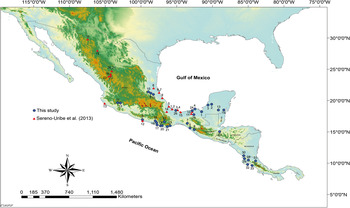
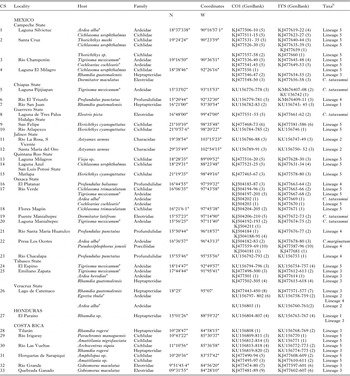
Individuals of Clinostomum were collected from February 2013 through February 2015 in their definitive (fish-eating birds), and second intermediate hosts (fish), in 26 localities across Southern Mexico, one locality in Honduras, and six localities in Costa Rica (Fig. 1). Information regarding host species, localities, geographical coordinates and GenBank accession numbers are provided in Table 1. Birds were captured with a shotgun and immediately kept in ice. Fish were captured with seine nets and electrofishing, transported to the laboratory, sacrificed with an overdose of anaesthetic (sodium pentobarbital) and immediately examined. Hosts were necropsied and all internal organs were examined for parasites under a dissecting microscope a few hours after their capture. Collected trematodes were preserved in 100% ethanol for DNA extraction and sequencing (Table 1).
Map of Middle-America showing the 33 sampling localities of Clinostomum spp. across Central and Southern Mexico, Honduras and Costa Rica. Also shown are the 22 localities sampled by Sereno-Uribe et al. (Reference Sereno-Uribe, Pinacho-Pinacho, García-Varela and Pérez-Ponce de León2013).

Specimens of Clinostomum spp. collected in this study including collection sites (CS), locality (by state of the Mexican Republic), host species, geographical coordinates and GenBank accession number (with number of isolates sequenced per gene). The collection site number for each locality corresponds with the number in Figure 1

a Species of definitive hosts where adults were collected.
b Lineages and species correspond with the results of the phylogenetic tree based on COI obtained in this study.
Extraction, amplification and sequencing of DNA
Specimens were placed individually in tubes and digested overnight at 56 °C in a solution containing 10 mm Tris–HCl (pH 7·6), 20 mm NaCl, 100 mm Na2 EDTA (pH 8·0), 1% Sarkosyl and 0·1 mg mL−1 proteinase K. Following digestion, DNA was extracted from the supernatant using the DNAzol reagent (Molecular Research Center, Cincinnati, Ohio) according to the manufacturer's instructions. The COI (~474 bp) and the ITS1–5·8S–ITS2 (ITS) (~1200 bp) were amplified using the polymerase chain reaction (PCR). A fragment of COI was amplified using primers modified from Moszczynska et al. (Reference Moszczynska, Locke, McLaughlin, Marcogliese and Crease2009), with the forward primer 527F 5′–ATTCG(R)TTAAAT(Y)TKTGTGA–3′ and the reverse primer 528R 5′–CCAAAC(Y)AACAC(M)GACAT–3′ (Sereno-Uribe et al. Reference Sereno-Uribe, Pinacho-Pinacho, García-Varela and Pérez-Ponce de León2013). The ITS was amplified using the forward primer BD1 5′–GTCGTAACAAGGTTTCCGTA–3′ and the reverse primer BD2 5′–ATCTAGACCGGACTAGGCTGTG–3′ (Luton et al. Reference Luton, Walker and Blair1992). PCR reactions and cycling conditions followed those described in Sereno-Uribe et al. (Reference Sereno-Uribe, Pinacho-Pinacho, García-Varela and Pérez-Ponce de León2013). Sequencing reactions were performed using ABI Big Dye (Applied Biosystems, Boston, Massachusetts) terminator sequencing chemistry, and reaction products were separated and detected using an ABI 3730 capillary DNA sequencer. Contigs were assembled and base-calling differences resolved using Codoncode Aligner version 3.5·4 (Codoncode Corporation, Dedham, Massachusetts). Sequences of both molecular markers were deposited in the GenBank database (Table 1).
COI phylogenetic analyses
Sequences obtained in the current research were aligned with other sequences available in GenBank, i.e. C. marginatum (COI: JF718596–JF718619, HQ439564–HQ439577, HQ439579–HQ439586, JX630991–JX630997), C. complanatum (COI: JF718584, JF718588–JF718595), C. cutaneum (KP110515–KP110516), C. phalacrocoracis (COI: KJ786967–KJ786974), C. attenuatum (KP150305–06), C. philippinense (KP110523), C. tataxumui (COI: JX630998–JX631044) and Clinostomum sp. (COI: KJ818259–KJ818264) from experimental infections in Poecilia reticulata in Minas Gerais, Brazil (Pinto et al. Reference Pinto, Caffara, Fioravanti and Melo2015). Sequences of the eight putative species of Clinostomum from the study of Locke et al. (Reference Locke, Caffara, Marcogliese and Fioravanti2015a ) were also included: COI: KP110525–KP110543. Additionally, we added the sequence of Euclinostomum sp. as the only other member of the family Clinostomatidae for which sequences are available (COI: KC894795–KC894797) from three osphronemid fish, Trichopsis vittata, T. schalleri and Betta imbellis, in Thailand (Senapin et al. Reference Senapin, Phiwsaiya, Laosinchai, Kowasupat, Ruenwongsa and Panijpan2014) (Supplementary Table S1). This species, and the strigeids Alaria mustelae (JF904529) and Diplostomum baeri (GQ292501) were used as outgroups for rooting the trees. Alignment was constructed using the software Clustal W (Thompson et al. Reference Thompson, Higgins and Gibson1994) with default parameters and adjusted manually with the MacClade program (Maddison and Maddison, Reference Maddison and Maddison2002). The COI dataset was analysed through Bayesian inference (BI). The best-fitting model (TPM1uf + I + G) was identified with the Akaike Information Criterion (AIC) implemented in jModelTest v0.1.1 (Posada, Reference Posada2008). For the BI analyses, the implemented model was GTR + I + G, because the less complex TPM1uf + I + G models are not implemented in MrBayes. BI analysis was performed using MrBayes 3.1.2 (Huelsenbeck and Ronquist, Reference Huelsenbeck and Ronquist2001), with two runs and four chains (one cold, three heated) per run. The Metropolis-coupled Markov chain Monte Carlo (MC3) were run for 10 million generations, sampled every 1000 generations, and the first 2500 samples were discarded as burn-in (25%). The outputs of MrBayes were examined with Tracer v1·4 (Rambaut and Drummond, Reference Rambaut and Drummond2007) to check for convergence of different parameters, to determine the approximate number of generations at which log-likelihood values stabilized, to identify the effective sample size (EES > 200) for each parameter, and the estimated magnitude of model parameters in individual and combined runs. Topological convergence in the two independent MCMC runs was checked with the ‘compare plot’ in AWTY (Wilgenbusch et al. Reference Wilgenbusch, Warren and Swofford2004). The initial 25% of MC3s was verified to include all the generations before stationarity was achieved. Posterior probabilities (PPs) of clades were obtained from the 50% majority rule consensus of sampled trees after excluding the initial 25% as burn-in. Trees were visualized using FigTree program version 1.3.1 (Rambaut, Reference Rambaut2006). Unique haplotypes of COI from all localities as well as unique haplotypes for sequences available from the GenBank dataset were identified using DnaSP v.5 (Librado and Rozas, Reference Librado and Rozas2009) and NETWORK v. 4.2.0.1 (Bandelt et al. Reference Bandelt, Forster and Rohl1999; www.fluxusengineering.com). The intra and interspecific genetic variations were determined using the Tamura-Nei distance (TrN) with the program MEGA v. 5 (Tamura et al. Reference Tamura, Peterson, Peterson, Stecher, Nei and Kumar2011).
Automatic Barcode Gap Discovery
We analysed the COI sequences using the ABGD to identify putative species, a method originally proposed by Puillandre et al. (Reference Puillandre, Lambert, Brouillet and Achaz2012). This method automatically finds the distance at which a barcode gap occurs and sorts the sequences into putative species based on this distance, i.e. ABGD clusters sequences into candidate species based on the differences obtained among pairwise distances; in that way one of the aims of the method is to statistically infer the barcode gap from the data, and to partition the dataset into the maximum number of species (Puillandre et al. Reference Puillandre, Lambert, Brouillet and Achaz2012). The COI alignment was then uploaded at the website: http://wwwabi.snv.jussieu.fr/public/abgd/abgdweb.html. The analysis was run with the default settings [P min = 0·001, P max = 0·1, Steps = 10, X (relative gap width) = 1·5, Nb bins = 20], and pairwise differences were estimated with the TrN distance to contrast the result of ABGD with respect to the primary species delimitation hypothesis obtained with the COI Bayesian phylogenetic analysis. The relative gap width was subsequently modified first to 1 and then 0·5, to explore the potential effect on the number of recursive partitions and the number of species for partition.
ITS sequences and concatenated analysis
A subset of ITS sequences was obtained comprising individuals from the five COI lineages (on average, 30 specimens per lineage), and were aligned with other sequences available in GenBank, i.e. C. attenuatum (KP150307), C. detruncatum (KP110517–KP110519), C. marginatum (ITS: JN108032, JF718620, JF718622, JF718630–JF718643, JX631045–JX631049, JX631074–JX631101), C. complanatum (ITS: AY245701, FJ609420, JF718621, JF718623–JF718629), C. phalacrocoracis (ITS: FJ609422–FJ609423), C. cutaneum (ITS: FJ609421, GQ339114), C. philippinense (KP110570), C. tataxumui (ITS: JX631050–JX631073, X631102–JX631140) and Clinostomum sp. (ITS: KJ789384–KJ789387). Also, ITS sequences from the study of Locke et al. (Reference Locke, Caffara, Marcogliese and Fioravanti2015a ) were included: ITS: KP110571–KP110587. Additionally, the sequence of Euclinostomum sp. (ITS: KC894798–KC894801) from Senapin et al. (Reference Senapin, Phiwsaiya, Laosinchai, Kowasupat, Ruenwongsa and Panijpan2014), and those of the strigeids Alaria mustelae (JF769478) and D. baeri (AY123042) were included as outgroups for rooting the trees (Supplementary Table S1). The ITS dataset was analysed through BI. The best-fitting model (TVM + G) was identified with the AIC implemented in jModelTest v0.1.1 (Posada, Reference Posada2008). For the BI analyses, the implemented model was GTR + G, because the less complex TVM + G models are not implemented in MrBayes. BI analysis was performed using MrBayes 3.1.2 (Huelsenbeck and Ronquist, Reference Huelsenbeck and Ronquist2001) with the same parameters as for the COI tree. As we did for COI sequences, unique genotypes of ITS from all localities as well as unique genotypes for sequences available from the GenBank dataset were identified using DnaSP v.5. (Librado and Rozas, Reference Librado and Rozas2009) and NETWORK v. 4.2.0.1 (Bandelt et al. Reference Bandelt, Forster and Rohl1999; www.fluxusengineering.com). Finally, the concatenated (COI + ITS) datasets were analysed through BI with the same parameters, and with substitution models for each partition corresponding to each dataset.
Species tree estimation
To account for stochastic differences in the coalescent history of the mitochondrial and nuclear genes, the evolutionary history of clinostomids, including our samples from Middle-America, was reconstructed through the Species Tree Ancestral Reconstruction analysis using the program *BEAST (Heled and Drummond, Reference Heled and Drummond2010) as implemented in BEAST 2 (Bouckaert et al. Reference Bouckaert, Heled, Kühnert, Vaughan, Wu, Xie, Suchard, Rambaut and Drummond2014). *BEAST operates under a Bayesian framework and uses sequence information from different loci, and multiple individuals per taxon, to estimate the species tree, coestimating the posterior distribution of species and gene trees using a coalescent model. Based on the premise that multiple samples per species are necessary to complete the estimation and this may have a detrimental effect on inferring species topology (Heled and Drummond, Reference Heled and Drummond2010), we excluded the following species from the analysis because only one sequence for both molecular markers was available: Clinostomum philippinense, C. attenuatum, C. detruncatum, Clinostomum sp. 6 Locke et al. (Reference Locke, Caffara, Marcogliese and Fioravanti2015a ) and Clinostomum sp. 4 Locke et al. (Reference Locke, Caffara, Marcogliese and Fioravanti2015a ). Following the methodology described in Prévot et al. (Reference Prévot, Jordaens, Sonet and Backeljau2013), we ran the *BEAST analysis for 100 000 000 generations with a sample frequency of 10 000 using a lognormal clock (without fossil calibrations) and a mean rate fixed to one. Based on results from jModelTest v0.1.1 (Posada, Reference Posada2008), models of DNA sequence evolution were assigned to each partition. The Yule tree prior was used for species-level analyses, while default values were used for remaining priors. The final *BEAST species tree was reconstructed using TreeAnnotator v. 2.1.2 (Bouckaert et al. Reference Bouckaert, Heled, Kühnert, Vaughan, Wu, Xie, Suchard, Rambaut and Drummond2014), and it was a maximum clade credibility tree with median node heights after burn-in of 15% trees. Nodal support was determined using PPs.
RESULTS
Thirty-three localities, including 26 across southern Mexico, one in Honduras and six in Costa Rica, were sampled to collect metacercariae and/or adults of Clinostomum spp. in their second intermediate and/or definitive hosts (Fig. 1); in total, we analysed specimens from 23 fish species belonging to six families (Cichlidae, Eleotridae, Heptapteridae, Poeciliidae, Characidae and Profundulidae) in freshwater and estuarine habitats, and five bird species (all belonging to the family Ardeidae) (Table 1). In some cases both fish and birds were sampled at the same locality, but in most of them only fish were collected. Sequences of COI (n = 213) were obtained from 168 metacercariae and 45 adults of Middle-American Clinostomum. The final alignment (including outgroups) consisted of 370 sequences of COI, including data from Genbank.
Phylogenetic analysis of COI
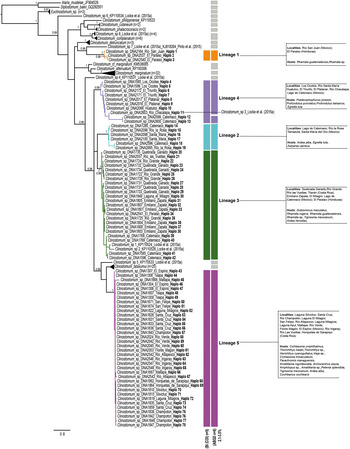
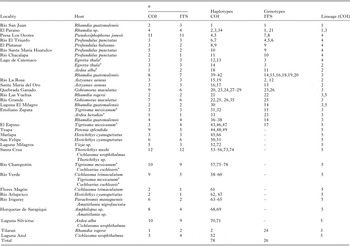
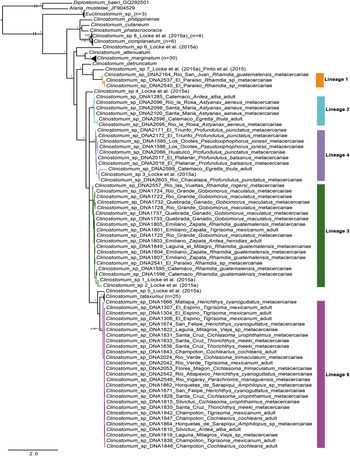
The alignment of the COI dataset contained no gaps and was 474 bp in length with 210 variable sites. Seventy-eight unique haplotypes were found among the 213 sequences of Middle-American Clinostomum generated in this study (Table 2). Base frequencies were A = 0·18, C = 0·12, G = 0·25 and T = 44. Overall genetic divergence ranged from 0 to 26·9% among the 370 COI sequences of Clinostomum spp. Among the lineages and species of Clinostomum occurring in Middle-America, genetic divergence varied between 0·9 and 23% (Supplementary Table S2). The lower divergence values correspond to those of Clinostomum sp. 1 and Clinostomum sp. 2 of Locke et al. (Reference Locke, Caffara, Marcogliese and Fioravanti2015a ) with respect to the other isolates of Lineage 3, a result that shows conspecificity. However, only considering Lineage 3 as a whole, genetic divergence among Middle-American Clinostomum varies from 9 to 23% (Supplementary Table S2). Further phylogenetic analysis considered only unique haplotypes. The 78 haplotypes of our samples are clustered in five lineages that seem to represent independent evolutionary units since they form reciprocally monophyletic groups (Fig. 2), and this constitutes the primary species hypothesis for the specimens of Middle-American Clinostomum. Two of these lineages contain few haplotypes; Lineage 1 includes three haplotypes (1–3) and Lineage 2 includes six (14–19). However, the other three lineages contain ten or more haplotypes, with ten for Lineage 4 (4–13), 23 for Lineage 3 (20–42) and 36 (43–78) for Lineage 5. Interestingly, three of the ten candidate species of Clinostomum in Locke et al. (Reference Locke, Caffara, Marcogliese and Fioravanti2015a ) are nested within lineages uncovered in our study (Fig. 2). Clinostomum sp. 1 (1 COI sequence of a metacercaria from Rhamdia guatemalensis from Yucatan, Mexico) and Clinostomum sp. 2 (5 COI sequences of metacercariae from Scycidium salvini from Oaxaca, Mexico) cluster within Lineage 3 (39 COI sequences), while Clinostomum sp. 3 (1 COI sequence of a metacercaria from Poecilia mexicana from Veracruz, Mexico) clusters within Lineage 4 (28 COI sequences).
Phylogram for Clinostomum spp. derived from partial sequences of the mitochondrial COI gene (474 bp) using BI analysis (50% majority rule tree). Sequences generated in this study were aligned with available sequences for Clinostomum in GenBank. Nodal support values next to the branches correspond to the PPs (⩾0·95). The scale bar represents the number of nucleotide substitutions per site. Column in colour correspond with the five genetic lineages of 78 unique COI haplotypes. The second column shows the estimated entities through the ABGD method for partitions with pairwise distance of TrN between 1·3 and 3·5%. The intermediate and definitive hosts as well as the localities for each lineage are included.

Locality, host, sample size (n), number of unique haplotypes and genotypes corresponding to COI lineages for the Middle-American specimens of Clinostomum sp. detected in this study
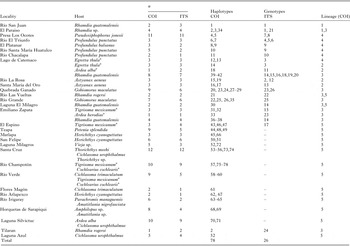
For ITS, a subsample of the five COI lineages was sequenced (not all localities represented).
a Adult specimens in fish-eating birds.
Species delimitation through ABGD
The ABGD was used as a species delimitation tool, to explore the primary species hypothesis obtained through the Bayesian COI phylogenetic analysis (Fig. 2). The 20 recursive steps in the ABGD analysis resulted in ten different sequence partitions (Supplementary Fig. S1), ranging from two to 74 groups (=species). However, the best correspondence between number of species obtained by ABGD and those from the phylogenetic analyses was found in the sequence partitions 7–8, with 21 groups for the outgroups (Alaria, Diplostomum and Euclinostomum) and Clinostomum spp. The gap width and the prior of maximum intraspecific divergence (P max) were modified, and the result did not varied. All the other partitions were not considered due to the excessive splitting or lumping of identified COI lineages, respectively (Supplementary Fig. S1). Of the 21 groups differentiated by genetic divergence values between 2·1 and 3·5%, six (instead of five from the COI Bayesian analysis) were recovered for the Middle-American samples of Clinostomum herein studied (see Supplementary Fig. S1). Lineage 4 from the phylogenetic circumscription is split into two species in ABGD, with haplotypes 12 and 13, representing samples of adult Clinostomum from the fish-eating bird Egretta thula from Catemaco Lake in Mexico, as a separate species.
Concatenated analyses (COI + ITS)
To further corroborate the primary species hypothesis from a single-locus analysis (COI), a nuclear gene was incorporated into the analysis. A subsample (n = 150) that included specimens from the five lineages recovered by COI was sequenced for the ITS (ITS1, 5·8S and ITS2), and a phylogenetic tree was constructed (Supplementary Fig. S2). The final alignment (including outgroups) consisted of 307 sequences of ITS, including the data from GenBank. In total, 26 unique genotypes were obtained for the ITS dataset (Table 2). Further phylogenetic analysis considered only those sequences. The alignment of the ITS sequences was 1098 bp in length, with 297 variable sites. Gaps were treated as missing data in phylogenetic analysis. Base frequencies were A = 0·23, C = 0·21, G = 0·25 and T = 0·30. Overall ITS sequence divergence among species and lineages of Clinostomum ranged from 0 to 9%. BI recovered relationships similar to those of the COI tree, although only three lineages instead of five were found within Middle-American Clinostomum (Supplementary Fig. S2). Due to the different number of lineages of Middle-American Clinostomum uncovered by the mitochondrial and the nuclear genes, a concatenated analysis of both datasets was performed. The alignment consisted of 144 sequences with 1572 bp length. Figure 3 depicts the BI tree where five lineages are recovered for samples of Clinostomum from Middle-America. Relationships are supported by relatively high PP values.
Tree (50% majority rule) inferred from the concatenated (COI + ITS) datasets for Clinostomum using BI analysis. The alignment consisted of sequences generated in this study for samples of Clinostomum from Middle-America, and those available in GenBank. The scale bar represents the number of nucleotide substitutions per site. Nodal support values next to the branches correspond to the Bayesian PPs (⩾0·95). Column in colour correspond with the five genetic lineages.

Species tree analysis
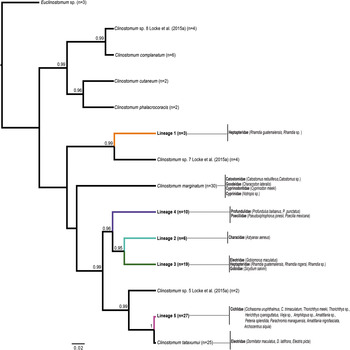
A Species Tree Ancestral Reconstruction (*BEAST) was run to look for congruence between the BI tree topologies of the COI and ITS datasets. Figure 4 depicts the final *BEAST species tree as a maximum clade credibility tree. This tree clearly distinguishes the five putative species of Middle-American Clinostomum from the morphologically described species and candidate species recognized by Locke et al. (Reference Locke, Caffara, Marcogliese and Fioravanti2015a ). The species tree also shows that the five genetic lineages uncovered here do not form a monophyletic group, but are nested with other species occurring in the Nearctic and Neotropical biogeographical regions. Lineage 1 from heptapterids from Mexico and Honduras is the sister taxa of Clinostomum sp. 7 of Locke et al. (Reference Locke, Caffara, Marcogliese and Fioravanti2015a ), a species found in Brazil and Bolivia. A second group consists of Lineage 4 from profundulids and poeciliids in Mexico as the sister taxon of Lineage 3 from eleotrids and heptapterids in Mexico and Lineage 2 from characids in Mexico. A third group consists of Clinostomum sp. 5 of Locke et al. (Reference Locke, Caffara, Marcogliese and Fioravanti2015a ), from a cichlid in Bolivia, as the sister taxon of C. tataxumui from Mexican eleotrids plus Lineage 5 found in cichlids across Mexico and Costa Rica. The latter two groups are the sister group of C. marginatum that includes samples that distribute from Canada to Central Mexico (Fig. 4).
Maximum clade credibility tree of Clinostomum spp. based on COI and ITS1–5·8S–ITS2 using Bayesian coalescence. Main lineages are denoted as 1–5, and colours follow those in Figs 2 and 3. Note that the following species were excluded to avoid a detrimental effect on inferring species topology because only one sequence was available: Clinostomum philippinense, C. attenuatum, C. detruncatum, Clinostomum sp. 6 Locke et al. (Reference Locke, Caffara, Marcogliese and Fioravanti2015a ) and Clinostomum sp. 4 Locke et al. (Reference Locke, Caffara, Marcogliese and Fioravanti2015a ). The number of concatenated ITS and COI sequences per species (n) follows the species name. Putative species of Clinostomum sp. of Locke et al. (Reference Locke, Caffara, Marcogliese and Fioravanti2015a ) are indicated. Bayesian PPs ⩾0·95 are shown above the node.

Host association and host specificity of the metacercariae
The host families from which the metacercariae of Middle-American Clinostomum were collected were mapped onto the species tree (Fig. 4). Based on this result, and irrespective of host sample size and geographical distribution, it seems that the metacercariae of Middle-American Clinostomum uncovered in our study exhibit some level of specificity for particular host groups. In some cases metacercariae are restricted to a particular locality, and in other cases they are found across a wide geographic range, with host specificity patterns independent of geographical distribution (see Figs 2 and 4). Lineage 1 was found in heptapterids (R. guatemalensis and Rhamdia sp., from Mexico and Honduras); lineage 2 was only found in Astyanax aeneus (Characidae) in western Mexico; lineage 3 seems to be the least host-specific since it was found in eleotrids from Costa Rica, and heptapterids and gobiids from Mexico; lineage 4 was only found in cyprinodontiform fish (poeciliids and profundulids) in Mexico; and finally, lineage 5 was only found in cichlids (at least 12 species) across a wide geographic range comprising central Mexico southwards to Costa Rica.
DISCUSSION
Clinostomum is widely distributed across Middle-America; the metacercariae allocated to this genus have been recorded (either as Clinostomum complanatum or Clinostomum sp.) in at least 76 fish species belonging to 13 families, in two localities of Nicaragua, six in Costa Rica and 101 across Mexico (Aguirre-Macedo et al. Reference Aguirre-Macedo, Scholz, González-Solís, Vidal-Martínez, Posel, Arjona-Torres, Siu-Estrada and Dumailo2001; Pérez-Ponce de León et al. Reference Pérez Ponce de León, García Prieto and Mendoza-Garfías2007; Sandlund et al. Reference Sandlund, Daverdin, Choudhury, Brooks and Diserud2010); in contrast, adults have only been found in ten species of fish-eating birds in 11 localities of Mexico (see Sereno-Uribe et al. Reference Sereno-Uribe, Pinacho-Pinacho, García-Varela and Pérez-Ponce de León2013 and references therein). In a recent study aiming to identify the species of Clinostomum across Mexico, Sereno-Uribe et al. (Reference Sereno-Uribe, Pinacho-Pinacho, García-Varela and Pérez-Ponce de León2013) showed that the species C. marginatum (and not C. complanatum) is found in northern areas of Mexico, and a second species genetically and morphologically distinct, C. tataxumui, was described from southern areas corresponding to Middle-America. In the present study, extensive samples of Clinostomum spp. were obtained in that geographic region, and numerous individuals were sequenced for both mitochondrial and nuclear genes, and analysed in combination with those available in the GenBank dataset from the rest of the world. The level of genetic divergence uncovered was unexpected since we had recently established the presence of just the two aforementioned species of Clinostomum across Mexico. To our surprise, both nuclear and mitochondrial molecular markers revealed divergence levels indicating greater diversity than previously thought, with the potential existence of independent evolutionary units, or species. We used COI as a proxy to obtain a primary species hypothesis.
High levels of genetic divergence were found among COI lineages, reaching up to 26·9%; typical pairwise divergence at the COI gene among trematode congeners varies between 3·9 and 25% (Moszczynska et al. Reference Moszczynska, Locke, McLaughlin, Marcogliese and Crease2009; Herrmann et al. Reference Herrmann, Poulin, Keeney and Blasco-Costa2014; Vilas et al. Reference Vilas, Criscione and Blouin2015). For instance, in diplostomids, for which a large genetic library has been built (Locke et al. Reference Locke, McLaughlin, Dayanandan and Marcogliese2010, Reference Locke, Al-Nasiri, Caffara, Drago, Kalbe, Lapierre, McLaughlin, Nie, Overstreet, Souza, Takemoto and Marcogliese2015b ; Georgieva et al. Reference Georgieva, Soldánová, Pérez-del-Olmo, Dangel, Sitko, Sures and Kostadinova2013; Blasco-Costa et al. Reference Blasco-Costa, Faltynková, Georgieva, Skírnisson, Scholz and Kostadinova2014), molecular prospecting studies show similar levels of genetic divergence for this molecular marker. Georgieva et al. (Reference Georgieva, Soldánová, Pérez-del-Olmo, Dangel, Sitko, Sures and Kostadinova2013) found a range for average divergence between 4·6 and 14·9% among Palaearctic Diplostomum spp.; Chibwana et al. (Reference Chibwana, Blasco-Costa, Georgieva, Hosea, Nkwengulila, Scholz and Kostadinova2013) found interspecific divergences between 11·7 and 14·8% among African diplostomids; Otachi et al. (Reference Otachi, Locke, Jirsa, Fellner-Franck and Marcogliese2014) recorded divergence levels between 7·2 and 15·8% among species of Tylodelphys in Kenya; and finally, Pinto et al. (Reference Pinto, Caffara, Fioravanti and Melo2015) found variation levels between 21·3 and 28·1% between samples of Clinostomum recovered from a freshwater poeciliid fish in Brazil, and sequences available in GenBank for other congeners. Clearly, using COI pairwise distance thresholds (i.e. a certain percentage of base pair differences) for initial assessment of species diversity based on sequence data appears reasonable because high levels of divergence are unlikely among individuals of single species. However, this approach is problematic for species delimitation because critical assumptions implicit in these benchmark comparisons may be violated. Modern taxonomic approaches show that the use of a subjective genetic threshold alone in supporting the delimitation of putative species is not satisfactory, and at least evidence of reciprocal monophyly of lineages through phylogenetic analyses of more than one locus must be found as a starting point to delineate species by hypothesis-testing and operational procedures, including explicitly evolutionary methods (see Nadler and Pérez-Ponce de León, Reference Nadler and Pérez-Ponce de León2011; Blasco-Costa et al. Reference Blasco-Costa, Cutmore, Miller and Nolan2016a ). The aforementioned studies used a hypothesis-testing procedure through proper phylogenetic analyses, in addition to pairwise divergence values.
A single gene-tree (COI) was estimated using BI; the primary species hypothesis was drawn from the haplotype groups recovered from that analysis. As a result, five putative species were recognized; following the ‘unified species concept’ of de Queiroz (Reference de Queiroz2007), we consider species as ‘lineages evolving separately from others’. However, we acknowledge that the best practice to infer more robust species limits in parasitic organisms would be to use different lines of evidence, i.e. molecular, morphological, ecological (host associations), and biogeographical (geographical distribution) through an integrative taxonomic approach. Regarding the analysis of molecular data, it might be necessary first to explore the resulting hypotheses of species delimitation through phylogenetic methods and pairwise divergence, with other methods available in the taxonomic literature (see Puillandre et al. Reference Puillandre, Lambert, Brouillet and Achaz2012; Camargo and Sites, Reference Camargo, Sites and Pavlinov2013; Carstens et al. Reference Carstens, Pelletier, Reid and Satler2013; Flot, Reference Flot2015), but this should be determined on a case by case basis because it is possible that in some trematode groups researchers may fail to recognize candidate species through these methods (see Carstens et al. Reference Carstens, Pelletier, Reid and Satler2013). Certainly, the extent to which these methods provide compelling evidence to discriminate among trematode species has not been explored in great detail, as very few empirical studies are available. Martínez-Aquino et al. (Reference Martínez-Aquino, Ceccarelli and Pérez-Ponce de León2013) used the General Mixed Yule Coalescent model (GMYC) to establish species boundaries among populations of the allocreadiid Margotrema spp. in central Mexico. Blasco-Costa et al. (Reference Blasco-Costa, Faltynková, Georgieva, Skírnisson, Scholz and Kostadinova2014) provided eight lines of evidence to delineate species of Diplostomum in Iceland. In addition to phylogenetic inference, these authors followed a character-based DNA barcoding approach to identify diagnostic characters discriminating the novel Icelandic lineages through the CAOS (Characteristic Attribute Organization System) framework and further estimated a species tree topology from mitochondrial and nuclear gene trees under a Bayesian multispecies coalescent model. Herrmann et al. (Reference Herrmann, Poulin, Keeney and Blasco-Costa2014) used multi-locus data and implemented the Bayesian species delimitation method, with distinct COI lineages as the maximum putative number of species, to delineate two cryptic species of Stegodexamene anguillae in New Zealand. Locke et al. (Reference Locke, Caffara, Marcogliese and Fioravanti2015a , Reference Locke, Al-Nasiri, Caffara, Drago, Kalbe, Lapierre, McLaughlin, Nie, Overstreet, Souza, Takemoto and Marcogliese b ) applied the ABGD and the Barcode Index Numbers (BINs) to establish species limits among larval clinostomids and diplostomids, respectively. Pérez-Ponce de León et al. (Reference Pérez-Ponce de León, Martínez-Aquino and Mendoza-Garfias2015) used a multispecies coalescent analysis (species tree) approach from a dataset combining nuclear and mitochondrial genes to determine the species limits of two new species of Phyllodistomum.
In our study, a distance-based algorithm (ABGD) (Puillandre et al. Reference Puillandre, Lambert, Brouillet and Achaz2012) was used as a method to explore the primary species hypothesis obtained through the COI phylogenetic circumscription of Middle-American species of Clinostomum. In principle, a set of a priori threshold values was considered for delineating genetically distinct species (Puillandre et al. Reference Puillandre, Lambert, Brouillet and Achaz2012) and this was used to partition the data into groups of sequences, each representing a hypothetical species. Even though the gap width and the prior of maximum intraspecific divergence were modified, only one additional species was recognized using ABGD among the Middle-American samples. Six to seven of the ten partitions were not even considered due to excessive splitting (up to 81 species) or lumping (two species) of identified COI lineages (see Supplementary Fig. S2). In this way, ABGD species delineation tool recognized six instead of five species. Irrespective of the gap width used (X = 1·5, 1, 0·5 and variation of priors of maximum intraspecific divergence), two particular haplotypes (12 and 13 from adult specimens collected in fish-eating birds in Catemaco, Veracruz), are separated as putative species from Lineage 4 considering the pairwise distance (see Fig. 2). The genetic divergence value obtained through the TrN model between these two haplotypes, and those included in Lineage 4 varies between 10·4 and 12·6%, while the divergence among all the other haplotypes (4–11) only varies from 0·4 to 4·2%. However, the COI Bayesian analysis, and the concatenated analysis of the COI and ITS datasets (Fig. 3), unequivocally recognized five putative species among the Middle-American samples of Clinostomum. These two haplotypes recognized by ABGD are not recovered as a reciprocally monophyletic group in the COI and the COI + ITS concatenated analysis, and the nodal support of the Bayesian analysis shows that altogether form a well-supported monophyletic group. For that reason we reject their validity as a separate species. In our opinion, ABGD should not be used as the only method to establish species boundaries among trematodes because species diversity might be overestimated. This method should be used in combination with a phylogenetic analysis preferably of two unlinked loci. We further validated the species delineation by undertaking a concatenated analysis and a final assessment was achieved through a species tree analysis. Our study was fundamentally aimed at documenting current species diversity among these trematodes. Still, the five putative species uncovered here require proper description; this will follow in a separate contribution with formal description, and name, of the species based on adult characters, complemented with a characterization of their metacercariae. Fortunately, we obtained adult individuals from fish-eating birds for four of the five lineages herein validated as putative species, and we were able to establish a link between metacercariae and adults. The detailed morphological study that will follow as the second part of the study will determine if particular traits are reliable to separate the putative species. Characters such as the organization of the genital complex, body width, distance between suckers, and position of the genital pore seem reliable, but still species of Clinostomum are very similar to each other and differ only in relatively minor characters of the adults (Matthews and Cribb, Reference Matthews and Cribb1998) and metacercariae (Caffara et al. Reference Caffara, Locke, Gustinelli, Marcogliese and Fiovaranti2011). Interestingly, our relatively small-scale study of Clinostomum in Middle-America yielded five putative species that include three of the eight congeneric species recognized by Locke et al. (Reference Locke, Caffara, Marcogliese and Fioravanti2015a ) in their large-scale study. As a result, at least ten additional species have to be added to the genus Clinostomum, currently composed by 15 valid species, raising the number to 25.
Patterns of host specificity of the metacercariae
Hosts belonging to six fish families (Cichlidae, Characidae, Eleotridae, Heptapteridae, Poecilidae and Profundulidae) were studied in each sampled locality (data not shown), but irrespective of host sample size which greatly varied among localities, the metacercariae of the five lineages herein uncovered seem to show some fidelity for a particular family of freshwater fish. Mapping the second intermediate host onto the species tree suggests that metacercariae of the five putative species of Middle-American Clinostomum exhibit some level of host specificity to fish taxa with distinct ecological and phylogenetic affinities (Fig. 4). Overall, host specificity in clinostomid metacercariae in Middle-American fish seems to be more strongly related to the physiological compatibility of host and parasite than to ecological factors. Locke et al. (Reference Locke, McLaughlin, Dayanandan and Marcogliese2010) observed this pattern among diplostomid metacercariae in sympatric fish along the St. Lawrence River, Canada. In our study, in one particular locality, Laguna el Milagro, Campeche (collection site 4, see Table 1, Fig. 1), three fish species occurring in sympatry were studied, i.e. the Mayan cichlid Cichlasoma urophthalmus, the Guatemalan chulin R. guatemalensis, and the fat sleeper goby Dormitator maculatus. These hosts were infected with Lineage 5, Lineage 3 and Clinostomum tataxumui, respectively. Without molecular or experimental evidence regarding the life cycle, these three lineages would probably have been considered as a single species, and because they represent larval forms, they would be designated as Clinostomum sp. Taxonomic surveys provide the data for interpretation of host specificity. In this context, since host specificity is a fundamental property of parasitic organisms (Poulin et al. Reference Poulin, Krasnov and Mouillot2011), the use of objective tools to delimitate parasite species is crucial to its accurate measurement. This corresponds with the scenario described by Poulin and Keeney (Reference Poulin and Keeney2008) in that morphologically identical individuals included under one species name may consist of several different isolated gene pools. This idea lead these authors to conclude that even though morphological species descriptions remain essential, the specificity of most parasite taxa will need to be reassessed by using both morphological and genetic data.
Concluding remarks
Our data suggest high levels of genetic diversity in Clinostomum across a range spanning from Mexico southwards to Costa Rica. Five putative species are recognized. Based on our results we predict that an even larger hidden diversity remains to be discovered within Clinostomum at least in the Americas, particularly if a large number of specimens are sequenced from a wide geographic range as suggested by Blasco-Costa et al. (Reference Blasco-Costa, Cutmore, Miller and Nolan2016a ). This study originally aimed to obtain genetic data to show that the species of Clinostomum occurring in Middle-America was C. tataxumui, the species we recently described from Southern Mexico. Unexpectedly, we discovered several genetic lineages. Based on the fact that Clinostomum individuals are commonly found in freshwater fishes across the Americas, we contend that if a more extensive sequencing effort is made, the result will be an increase in the number of species recognized. In trematodes such as Clinostomum, where high levels of genetic variation are found among individuals, we recommend the use of a species delimitation method to explore species circumscription based on single-locus or even multilocus phylogenetic analyses, and the use of several lines of evidence to further corroborate the species hypothesis (de Queiroz, Reference de Queiroz2007) such as interruption of gene flow, phenotypic variation and ecological niche differentiation. For parasitic organisms, where a test of reproductive isolation is methodologically complicated, patterns of host association and biogeography are informative. Such approach will certainly contribute towards reliable parasite biodiversity estimates. Our study also illustrates one of the key uses of molecular markers in parasite species identification (Criscione et al. Reference Criscione, Poulin and Blouin2005), i.e. the partial elucidation of life cycles by establishing the species that may serve as intermediate or paratenic hosts for larval stages. Adult specimens were obtained from the mouth cavity and oesophagus of five bird species from at least ten localities across Mexico, and molecular data now allow us to link adults and metacercariae of at least four of the five putative species herein validated. The next step in our research, as mentioned before, is to properly describe (and name) these four lineages and collect more data from fish-eating birds in the search for adults of the lineage known solely from metacercariae. This will provide also an opportunity for a closer look at the diagnostic morphological characters used to delimit species in sexually mature specimens, and find those that are reliable for species identification (see Matthews and Cribb, Reference Matthews and Cribb1998). Still, much remains to be learned about host specificity patterns of clinostomids on a world-wide scale. The study of a wide array of definitive hosts, as well as the first intermediate hosts (gastropods), will be crucial to our understanding of the evolutionary biology and biogeography of this parasitic group.
SUPPLEMENTARY MATERIAL
The supplementary material for this article can be found at http://dx.doi.org/10.1017/S0031182016001517.
ACKNOWLEDGEMENTS
We are grateful to Arturo Angulo and Carlos Garita-Alvarado for their help during fieldwork in Costa Rica through the collecting permit issued by the Costa Rican government, and Leopoldo Andrade and Eduardo Hernández for their help during field work in Mexico. We also thank Luis García Prieto for providing specimens deposited at the CNHE. Specimens in Mexico were collected under the Cartilla Nacional de Colector Científico (FAUT 0202 and 0057) issued by the Secretaría del Medio Ambiente y Recursos Naturales (SEMARNAT), to MGV and GPPL, respectively. CDPP thanks the support of the Programa de Posgrado en Ciencias Biológicas, UNAM and CONACYT for granting a scholarship to complete his PhD program.
FINANCIAL SUPPORT
This paper was written during the sabbatical leave of G. P. P. L. to the Department of Zoology, University of Otago, New Zealand. Thanks are due to Dirección General de Asuntos del Personal Académico (DGAPA-UNAM) and CONACyT (Consejo Nacional de Ciencia y Tecnología), for their financial support to travel to New Zealand. This research was supported by grants from the Programa de Apoyo a Proyectos de Investigación e Inovación Tecnológica (PAPIIT-UNAM) IN204514 and IN206716 to G. P. P. L. and M. G. V., respectively, and CONACYT 179048 to M. G. V.). We also thank CONACYT for supporting the development of the Mexican Barcode of Life (MEXBOL) network through grant 251085 to Virginia León.