


Despite the importance of the Judgement of Paris in the story of the Trojan War, the Iliad has only one explicit reference to it. This occurs, rather out of the blue, in the final book of the poem in a dispute among the gods about the treatment of Hector's body (24.25–30). Achilles keeps dragging the body around behind his chariot, but Apollo protects it with his golden aegis (24.18–21). Apollo then speaks among the gods and attacks the conduct of Achilles (24.33–54), claiming at the end that he offends the dumb earth (24.54). Other gods too have their concerns about what is going on, and they keep trying to get Hermes to snatch the body away (24.23–4). The three most powerful divine enemies of Troy, however, Hera, Poseidon and Athena, will have none of this.Footnote 2 They remain as hostile to Troy and Priam and his people as they ever were, and it is in this context that the Judgement of Paris is mentioned:
ἔνθ' ἄλλοις μὲν πᾶσιν ἑήνδανɛν, οὐδέ πoθ' Ἥρῃ
οὐδὲ Ποσɛιδάων' οὐδὲ γλαυκώπιδι κούρῃ,
ἀλλ' ἔχον ὥς σϕιν πρῶτον ἀπήχθɛτο Ἴλιος ἱρὴ
καὶ Πρίαμος καὶ λαὸς Ἀλɛξάνδρου ἕνɛκ' ἄτης,
ὃς νɛίκɛσσɛ θɛάς, ὅτɛ οἱ μέσσαυλον ἵκοντο,
τὴν δ' ᾔνησ' ἥ οἱ πόρɛ μαχλοσύνην ἀλɛγɛινήν.
(24.25–30)And this was pleasing to all the others, but never to Hera
nor to Poseidon, nor to the flashing-eyed maiden,
but they remained hostile to sacred Ilios as in the beginning,
and to Priam and to his people, because of Alexander's folly,
he who insulted the goddesses when they came to his inner courtyard
and praised her who provided his grievous lust.
Since ancient times much ink has been spilt on this passage, not least because it occurs so late in the work. The debate about it is described at some length in Nicholas Richardson's commentary (ad 24.23–30),Footnote 3 and so it need not be rehearsed in full here. The main concerns about the passage, first raised by Aristarchus, are listed by Richardson as follows: ‘(a) it is absurd to speak of all the gods agreeing, and then exclude three of the most powerful deities; (b) the judgement of Paris is nowhere else mentioned by Homer, whereas it ought to have been referred to more often as an explanation of the goddesses’ hostility; (c) νɛίκɛσσɛ (29) is misused, since it cannot mean ‘judged’; (d) μαχλοσύνη (30) means γυναικομανία, whereas what Aphrodite gave to Paris was not this but Helen, the most beautiful woman of the time; and the word is in any case Hesiodic (cf. Hes. fr. 132 M–W)’. These are by no means the only objections to the passage, all of which are cited by Richardson. One concern added in the scholia was the fact that Poseidon's hatred of Troy arose from his treatment by Laomedon (21.441–60), not from the divine beauty contest.
Some of the defenders of the passage, notably Reinhardt, Griffin, Davies and Macleod, concerned themselves with its relevance in the broader context of the whole poem.Footnote 4 Reinhardt argued that the story of the Judgement lies behind it in a fundamental way, and that there could be no Iliad without it (‘Ohne Parisurteil keine Ilias’, 32). His view was that there is no real benefit for the poet in spelling out the spiteful motivation of the two goddesses earlier in the work because it would introduce a folklore element into an essentially Olympian struggle. Davies offered a critique of Reinhardt and raised the question of why the reference to the Judgement is in the poem at all, if it can simply lie behind it (as it does, happily enough, for the first twenty-three books). He offers an ingenious argument to explain the passage – that the Judgement is fundamentally connected to the main themes that are begun in Book 1: ‘If the first book of the Iliad showed human quarrels persisting and divine strife easily quelled, the antithesis is largely reversed in the last. On the mortal level Achilles abandons his anger and becomes finally reconciled with Priam and with humanity. On the divine level the first explicit mention of the Judgement reminds us of grudges and resentments which are not resolved, but linger on relentlessly and inexorably, to issue in the destruction of Troy’ (59–60). Richardson's own cautious conclusion is that ‘it is probably fair to say that the passage as a whole should be regarded as part of the original poem, despite some doubts over 29–30’ (278).
Most critical attention, therefore, has been devoted, either to dismissing the passage outright, after Aristarchus, or to considering its place in the poem as a whole. Surprisingly little work has been done on exploring the passage specifically within the context of Book 24, even though there are many other references to the broader story of Troy and the Trojan war at the end of the poem. As we will see, the numerous allusions to other parts of the saga are not usually as explicit as our reference to the divine beauty contest; and some of them are frustratingly elliptical. But they do add up to a considerable interest in the wider narrative of the city and the regions around it. Some of the references look back to the earlier life of Troy before the war began, as with the present passage. And others seem to assume a detailed knowledge of the fall of Troy, and so take us forward to its imminent doom at the hands of the Greeks. The central argument to be put in this article, therefore, is that the reference to the Judgement of Paris is part of a wider pattern of allusion to the whole saga of Troy and the Trojan War in Book 24. The Iliad's conclusion has a sustained interest both in revisiting the origins of the conflict, and in anticipating the final destruction of the city.
I begin, therefore, not with the beginnings of Hera's and Athena's hostility to Troy in the Judgement of Paris, as above, but with an earlier event in mythic history. In response to the hostile outburst of Apollo at the treatment of Hector's body by Achilles, Hera draws a comparison between Achilles, who is the child of a goddess, and Hector, who is the child of a mortal woman (24.58–9). This in turn leads to her mention of the upbringing of Thetis, and her betrothal and wedding to the warrior Peleus:
αὐτὰρ Ἀχιλλɛύς ἐστι θɛᾶς γόνος, ἣν ἐγὼ αὐτὴ
θρέψα τɛ καὶ ἀτίτηλα καὶ ἀνδρὶ πόρον παράκοιτιν,
Πηλέι, ὃς πɛρὶ κῆρι ϕίλος γένɛτ' ἀθανάτοισι.
πάντɛς δ' ἀντιάασθɛ, θɛοί, γάμου· ἐν δὲ σὺ τοῖσι
δαίνυ' ἔχων ϕόρμιγγα, κακῶν ἕταρ', αἰὲν ἄπιστɛ.
(24.59–63)But Achilles is the child of a goddess whom I myself
nurtured and brought up, and gave to a husband as his wife,
to Peleus, who was dear to the hearts of the immortals.
And you were all present at the wedding, you gods, and among them you
sat at the feast with your lyre, companion of evils, forever faithless.
Reference to the wedding of Peleus and Thetis here is particularly important because it was at this event that the squabble between the three goddesses began. We will have a little bit more to say about this aspect in a moment. Unlike the reference to the Judgement of Paris (24.25–30), which has not been mentioned previously, the betrothal and marriage of Thetis to Peleus have already been spelt out in some detail earlier in the text. In her plea to Hephaestus for armour for Achilles, Thetis laments the fact that Zeus gave her many woes, and that she had to suffer the bed of a mortal man, who is now in painful old age (18.428–35). She says that she bore a son and afterward sent him to Troy with the ships, from where he will never return to the house of Peleus (18.435–41). Book 24 is especially concerned to re-emphasize the shared grief of the parents at the loss of their only son because his doom is so much the closer after the death of Hector. Thetis grieves for his death while he still lives (24.83–6, 128–37); and the grief of Peleus is visualized by Achilles and Priam when they meet later for the ransom exchange (24.486–9, 534–42). Thus the reference to Peleus in the speech of Hera (24.60–1) is in keeping with the prominence of the grieving old man figure in the final book.
The surprising news is that Hera brought up the young Thetis, and has a real goodwill towards her. Apollonius (4.790–8), and Apollodorus (3.13.5) both mention this story, and it may have been included in the Cypria, where we learn that Thetis resisted marrying Zeus as a favour to Hera.Footnote 5 But it comes out of the blue as far as the Iliad is concerned, especially after the display of apparent tension between the two goddesses in Book 1 (517–67, esp. 555–9). At the beginning of the poem Zeus accedes to a request from Thetis to support the Trojans, although he does so with some anxiety about Hera's likely response (1.518–21). Hera perceives what has happened at their meeting, and makes complaint (1.540–3, 552–9), only to be put in her place by Zeus (1.561–7). The earlier part of the Iliad, therefore, does not prepare us for Hera's claim in the final book that she brought up Thetis. The surrounding narrative of Book 24, however, is a little more helpful. Shortly after making her claim about bringing up Thetis, Hera has the opportunity to act out her goodwill towards her when she arrives on Olympus (24.101–2). She greets her warmly there, and places a golden cup in her hand for her to drink. Hera's enunciation of her fondness for Thetis (24.59–61) thus prepares the way for her actual arrival among the gods, and the warm welcome that she receives (24.101–2). It is worth noting that B.K. Braswell dealt with the apparent inconsistency in the poem as a whole by arguing that Hera's nurturing of Thetis is probably a Homeric invention: ‘The poet has invented the detail of Hera's raising Thetis to provide an element of obligation in the relation of the older goddess to the younger … we suspect mythological innovation because it is a detail not found elsewhere and is precisely of the kind that would have been invented to suit a passing need, namely to provide a motive in the context.’Footnote 6
Editorial concern about the apparent textual inconsistency in Books 1 and 24 has tended to overshadow the rather more obvious fact that the early part of the final book has a considerable interest in the very beginnings of the Trojan saga. Particularly significant is Hera's reference to the actual wedding of the pair, the fact that all the gods were present, and that Apollo himself was there with his lyre (24.62–3). Elsewhere in the Iliad the emphasis is largely on the betrothal and marriage of the pair as parents of Achilles, rather than the actual wedding. The juxtaposition of the Judgement (24.25–30) and the wedding (24.62–3) seems to be very important. By the time that Zeus responds to the feisty enunciations of Apollo and Hera with a firm injunction of his own on how things will proceed (24.65–76), we have had two significant allusions to early stages of the saga of Troy. In the Cypria these two events are fundamentally connected, because the trouble between the three goddesses broke out at the wedding.Footnote 7 Homer's knowledge of the story about the strife at the wedding is never made clear, but the close proximity of the two events here in Iliad 24 seems to suggest that he was well acquainted with it. What we can certainly say is that the first part of the final book has an early interest in the origins of the war in the divine sphere. Paris' choice of Aphrodite as the winner of the contest, on the promise of receiving Helen as his bride, not only begins a new phase in the dispute between the goddesses, but also brings his own city into the sights of the Greeks.
In addition to these references to important events before the war, Book 24 seems to reveal a considerable interest in the background story of Troy itself, especially to the line of earlier kings before Priam. These are mostly bare allusions, without any attached narrative, unlike the references to specific narratives that we have just been considering. More expansive narratives of the earlier kings are told elsewhere in the poem, especially the speech of Aeneas to Achilles about the background history of Troy (20.215–41). Dardanus, Ilus and Laomedon are the three kings mentioned in Book 24, although there is quite a bit of difference in the character of the references. Collectively, however, they do signify a sustained level of interest in the broader story of Troy and the region around it in the final part of the poem.
In his account of the life of the city, Aeneas tells Achilles of the part played by Dardanus, the son of Zeus, as the founder of Dardania on Mount Ida, prior to the establishment of Troy (20.215–18). We learn shortly afterwards that Zeus loved Dardanus above all the children who were born to him from mortal women (20.303–5). The patronymic Δαρδανίδης is used of two Trojan kings in the Iliad. In Book 11 (166, 372) it describes Ilus, the son of Tros and thus the great-grandson of Dardanus (20.230–2); and it also describes Priam on six occasions prior to the final book (3.303, 5.159, 7.366, 13.376, 21.34 and 22.352). The genealogical distance between Dardanus and Priam is a full five generations (Dardanus–Erichthonius–Tros–Ilus–Laomedon–Priam, 20.215–240), and so the patronymic is very extended in his case.Footnote 8
The sustained interest in Dardanus–Priam in the poem as a whole is even more emphatic in the final book where the patronymic is used four times at crucial points in the narrative (24.171, 354, 629, 631). The first of these is in the vocative in the speech of Iris to Priam where she gives him reassurance and tells him not to be afraid (θάρσɛι, Δαρδανίδη Πρίαμɛ, ϕρɛσί, μηδέ τι τάρβɛι, 24.171). The second, another vocative, lies in the speech of Idaeus, who catches sight of Hermes as they venture out to Achilles' camp. When the herald sees him standing there in the gloom, he verbalizes his anxiety to Priam as ‘son of Dardanus’ (ϕράζɛο, Δαρδανίδη, 24.354). The poet clearly has an interest in associating the two men as the first and the last in the long line of kings as he embarks on his heroic quest.
The most significant use of the patronymic in the Iliad, however, is when Achilles and Priam gaze upon one another after the meal that they share:
ἦ τοι Δαρδανίδης Πρίαμος θαύμαζ' Ἀχιλῆα,
ὅσσος ἔην οἷός τɛ· θɛοῖσι γὰρ ἄντα ἐῴκɛι·
αὐτὰρ ὁ Δαρδανίδην Πρίαμον θαύμαζɛν Ἀχιλλɛύς,
ɛἰσορόων ὄψίν τ' ἀγαθὴν καὶ μῦθον ἀκούων.
(24.629–32)Then indeed Priam, the son of Dardanus, wondered at Achilles,
how big he was and how fair; for plainly he seemed like the gods.
And Achilles in turn wondered at Priam, the son of Dardanus,
gazing on his noble appearance, and listening to his words.
As Richardson points out (ad loc.), the repetition of the full patronymic helps provide the reason for the wonder of Achilles as he looks across at him. Dardanus, the originator of Trojan identity, is evoked twice in quick succession to describe the last king of Troy. It is as if Achilles looks across at the whole history of Troy, from Dardanus in the beginning to Priam at the end. There seems to be a conscious interest in extending and broadening our sense of the life of the city, from its earliest origins with Dardanus on the ridges of Ida (20.218) to the final doom hanging over Priam's Troy.
Book 24 also alludes to two other early kings, Ilus and Laomedon, respectively the grandfather and father of Priam. The tomb of Ilus, the son of Tros, and brother of Assaracus and Ganymede (20.231–2), is referred to at a crucial moment in the description of Priam's ransom journey. It is also mentioned earlier in the poem (10.415, 11.166, 372), and is one of a number of significant landmarks outside of the city.Footnote 9 In Book 24 it takes on an added level of significance because it helps to identify the end of Trojan territory. When Priam and Idaeus have ‘driven past the great tomb of Ilus, they stopped the mules and horses in the river for them to drink; for by this time darkness had fallen upon the earth’ (24.349–51). It is at this point that the herald notices Hermes standing before them, and the two old men stand there in fear and confusion. Thus the two early kings, Ilus and Dardanus, are mentioned in quick succession (24.349 [Ilus], 354 [Dardanus]). The tomb of Ilus, the river and the darkness all help to signify the point in his mission where Priam will need Hermes to provide safe passage. The fact that it is the tomb of Priam's grandfather, the eponymous king of Ilios (hence the Iliad), clearly gives the landmark a special cultural significance.
Ilus' son, Laomedon, is actually the subject of more attention in the narrative of the Iliad than his father, not that we learn very much about him either (the main references are 5.269 and 640–54, 6.23, 7.452–3, 20.236–7, 21.441–60).Footnote 10 Laomedon was the perfidious king who refused to pay Poseidon and Apollo for their work at Troy. He compounded his folly by refusing to pay Heracles for his labours at Troy in killing the monster which the gods sent to be a plague on the city. Heracles duly raised a small force and sacked Laomedon's Troy (5.638–42). Laomedon himself is not explicitly mentioned in Book 24, but he is the subject of an oblique allusion as the reason for Poseidon's hostility to Troy (at 24.26). A little earlier in the poem (21.441–60), Poseidon says that he finds it hard to understand Apollo's continued support for the Trojan cause: ‘Don't you remember all the evils that we two, alone of all the gods, suffered at Ilios?’ (21.442–3). He then proceeds to list all the bad treatment that they endured at the hands of the king. As we have seen, the reference to Poseidon's hatred for Troy (24.26) is wedged uncomfortably between Hera's hostility for the city (24.25) and that of Athena (24.26). The two goddesses are motivated by Paris' choice of Aphrodite as victor in the Judgement, whereas Poseidon is still driven by Laomedon's offensive conduct. The oblique reference to Laomedon also has the effect of reminding us that Troy was sacked a generation ago, as the gods gather for the final destruction of the place.Footnote 11
Within Book 24, therefore, we have references to three earlier kings of Troy. These have the effect of complementing the account of Aeneas in Book 20 (215–41). Dardanus, the founder of Dardania on Mount Ida, he who established the line of kings, is mentioned four times through the patronymic (24.171, 354, 629, 631; cf. 20.215–19, 303–5). His great-grandson Ilus is alluded to through the significant marker of his tomb (24.349; cf. 20.232–6). And his son Laomedon, the father of Priam, is alluded to, but not named, as the reason for Poseidon's hostility to Troy (24.26; cf. 20.236–9, 21.441–60). There is a sense that as he ventures out to Achilles' camp, Priam carries with him not just the whole weight of his people but also the whole history and identity of his regal line.
Another important reference to the pre-Trojan War period, this time during the earlier kingship of Priam himself, is Helen's allusion to her journey with Paris to Troy (24.764–6). In her lament for the dead Hector – the final speech in the Iliad – Helen offers some detail about their passage from Sparta to Troy: ‘he (Paris) who brought me here to Troy. Would that I had died before then. For this is now the twentieth year since I departed from there and have been gone from my native land’ (24.764–6). This is the tenth year of the Trojan War (2.134, 295, 328–9), and so a period of twenty years since Helen's departure is problematic, to say the least. Twenty years may simply be Homer's way of saying ‘a very long time’ (Richardson), or ‘10 + ’ years (Macleod).Footnote 12 If that is the case then the reference presumably helps us to account for the time spent gathering the Greek forces together and actually getting them to Troy. The Greek poets and mythmakers do favour ten-year blocks in their myths, and Richardson (ad 24.765–7) points to other references to twenty as a kind of standard figure in Homer.
The passage, however, is made more problematic by the fact that a series of stories was told in Cyclic epic explaining a delay in the Greek arrival at Troy after Helen's departure with Paris. These included the military campaign against Telephus in Mysia, accounts of Achilles on Scyros and the winds at Aulis. Proclus gives us a brief account of some of the stories in his summary of the Cypria, but it is unclear whether Homer knew them.Footnote 13 My own view is that there is more to what Helen says in the present passage than a vague statement of a long time. It does seem to be significant that the extraordinary reference to the period of twenty years falls within this book rather than earlier in the poem. The wedding of Peleus and Thetis (24.62–3) and the allusion to the Judgement of Paris at the beginning of the final book (24.25–30) clearly complement Helen's reference to her journey from Sparta at the end of the same book, not least because the earlier mythical events lead directly to the later one. This mythical ‘coupling’ is a characteristic of Book 24, as we have already seen with Hera's reference to the childhood and wedding of Thetis (24.59–61), and the warm greeting that she gives her when she reaches Olympus (24.101–2).Footnote 14 Helen is a figure of great importance at the end of the Iliad, both as the woman over whom the war is fought, and as the final speaker in the poem, one who reflects on the origins and course of the conflict.
Two other figures referred to in the final book from earlier in the war are Troilus and Mestor, the sons of Priam (24.257–8), neither of whom is mentioned elsewhere in Homer. When he is preparing for his ransom mission Priam castigates his surviving sons, and compares them unfavourably to those who have died – Mestor, Troilus and Hector (24.253–64). We learn nothing about the first two figures, other than the fact that they are dead, and that they are now much revered by their father. Mestor does not appear again in any early accounts of the war for Troy, but Apollodorus tells us that he was killed by Achilles as part of the raid on Aeneas' cattle on Mount Ida. Aeneas escaped, but Achilles killed the cowherds and also killed Mestor, the son of Priam, and proceeded to drive away the cattle (Apollod. Epit. 3.32; cf. Il. 20.90–3, 188–94). Proclus tells us that the Cypria contained a narrative of the raid on Aeneas' cattle, but he makes no mention of Mestor.Footnote 15 The death of Troilus at Achilles' hands, however, was contained in the Cypria, and surviving vases also indicate that it was a popular theme in early Greek art.Footnote 16 As we have just seen with the reference to Helen's journey to Troy, it is unclear what stories Homer is thinking of when he mentions Mestor and Troilus in the final book. But again it does seem to be significant that the close of the poem consciously reflects upon them as part of a wider interest in the earlier stages of the war.
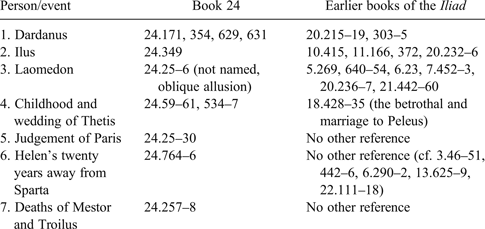
In the following chart, therefore, we may observe the series of allusions in Book 24 to earlier people and past events, together with the main references to these same events from earlier in the text:
References to past people and events in the story of Troy in Iliad 24
In addition to this sustained interest in earlier stages of the war for Troy, the final book of the Iliad is characterized by its anticipation of significant events to come. The Iliad is quite different from the Odyssey in this regard, in the light of its fundamental concern with what is about to happen after the close of the poem itself.Footnote 17 The two principal events foreshadowed are the death of Achilles and the fall of Troy. The fates of these two are rather skilfully linked together throughout the poem. Achilles and the Trojans are both protected by divine workmanship – Achilles by the armour of Hephaestus (18.368–617 etc.), and the people of Troy by the walls of Poseidon (21.441–7; and Apollo, 7.446–53). Notwithstanding this divine goodwill, the invulnerability of Achilles and the Trojans is imperfect, and the final part of the Iliad emphatically anticipates the doom that they face.Footnote 18 Both will fall to acts of divinely inspired treachery, Achilles to an arrow in the heel (Apollo/Paris), and Troy to the Wooden Horse, although the Iliad offers us next to nothing on these two episodes.Footnote 19
After the death of Patroclus is announced to him, and he sets a determined course on revenge, Achilles is told by Thetis that he is destined to die shortly after the death of Hector (18.95–6; cf. 19.408–9, 22.357–60). Book 24 reiterates this fate in an emphatic way. When Iris goes into the sea to rouse Thetis to Olympus to meet with Zeus, she is already grieving for her son who was ‘to perish in deep-soiled Troy, far from his homeland’ (24.85–6).Footnote 20 And when she comes to urge him to accept the ransom, she is explicit that ‘death and mighty fate stand right beside’ him (24.131–2). The funeral and cremation of Hector at the end of the poem have the effect of anticipating both the associated doom of Achilles, and the fall of the city which Hector had defended so resolutely when he was alive.
Indeed, the fall of Troy is anticipated throughout the Iliad, even before the death of Hector (for some of the main references to the destruction of the city, see 4.163–5, 6.447–9, 20.313–17, 21.374–6, 22.59–71, 24.244–6, 380–5, 551, 725–45).Footnote 21 By the time that Andromache begins her lament at the funeral of Hector, she is already foreshadowing the likely fates of individual Trojans after the city's fall (24.725–45, on which see below). The principal device, however, by which Troy is taken – the ruse of the Wooden Horse – is not described in the Iliad. Other early epics took a great deal more interest in this story. It was told in Cyclic epic, in the Little Iliad and in the Iliou Persis, and there are also three references to it in the Odyssey (4.266–89, 8.499–520, 11.523–32).Footnote 22 One assumes that the poet of the Iliad knew the story of the Horse well enough, but chose to omit it from his narrative. In some ways it is a surprising omission, given the Iliad's interest in the imminent fall of Troy. But it has been well documented by many scholars just how severe the Iliad can be in its treatment of myth.Footnote 23 The Wooden Horse is an Odyssean triumph, but it does nothing for Achilles and his brand of heroism.
This article has argued, however, that the final book of the Iliad displays a considerable interest in some of the main stories in the saga of Troy – the Judgement of Paris, the wedding of Peleus and Thetis and the voyage of Helen to the Troad; and that it alludes throughout to some of the earlier kings. It would not be totally surprising, therefore, to find some kind of hint about the role of the Horse in the city's destruction; and a separate argument for such a foreshadowing has recently been put.Footnote 24 G.F. Franko argues that there are three references to the Horse in the subtext of the last two books – at the end of the funeral games for Patroclus (23.689–91) and at the very end of the poem (24.778–9, 24.804). His argument clearly has some considerable relevance to the main thrust of this article, and so a brief summary of its main points is needed.
In the first of the passages mentioned, a Greek called Epeius suddenly appears in the boxing contest at Patroclus' funeral. He proceeds to knock out his opponent Euryalus when he is off his guard (23.689–91). Franko argues that the sudden reference to Epeius here anticipates his later role as the builder of the Wooden Horse, as set out in the Little Iliad (see above, n. 22). Indeed, he claims that even the manner of his victory in the contest, where he catches his opponent off guard, further anticipates the defeat of Troy by means of the Horse: ‘Epeios attacks when his opponent has let down his guard, not unlike the unwary Trojans’ (122). The second reference is Priam's command to his people to bring wood into the city without any fear of a cunning ambush on the part of the Argives (πυκινὸν λόχον, 24.779). Franko argues that ‘Homer invites us to connect these lines with more than just Odysseus, for Priam's injunction to haul lumber into the city without fear identifies for the audience the very material of the city-sacking pukinon lochon and indicates that the Trojans themselves will incautiously bring this ambush inside their walls. From Priam's utterance the fate of Troy is sealed’ (122–3). Third is the final word of the poem (ἱπποδάμοιο, ‘breaker of horses’, 24.804) which, Franko argues, ‘leaves the audience with the ironic foreshadowing of the inability of the Trojans without Hector to master that most fatal horse’ (123).
This is very much an argument from silence, and the evidence put forward is hardly compelling, especially in isolation from the broader context of Book 24. None the less, the mere appearance of Epeius at this point in the Iliad does seem to be important in view of his role in the Odyssey as the builder of the Horse (8.492–3, 11.523). The argument may also have more weight when one bears in mind the sustained interest in the broader saga at the end of the Iliad. We will see in a moment, moreover, that references to Astyanax and Cassandra in Book 24 seem to evoke their individual fates in the fall of Troy. These latent references to the Wooden Horse – if that is what they are –would be in keeping with this broader pattern of allusion. It is probably best to say that it would be foolish to deny the possibility that the story of the Horse lies within the subtext of the narrative in the final book, in the manner of Franko's argument.
The possible fate of the boy Astyanax is enunciated twice by Andromache in the final books of the poem. The first of these comes shortly after Hector's death when she is revived after falling down in grief at the sight of his body being dragged by Achilles' horses to the ships (22.487–507). And the second is uttered as part of her goos at her husband's funeral (24.725–45). Initially, her concern is with how Astyanax will be treated within the aristocratic world of Trojan society now that he has no father. She foresees a rather brutal fall from the regal luxury he enjoyed when his father was still alive. He is imagined bowing to all and pleading for the basic necessities of life, and getting beaten out of the banquet by another boy whose father still lives. If this is not bleak enough, she then has an even darker vision at the very end of the poem where she looks to his fate after the fall of the city. She envisages him following her into slavery, and having to labour at unpleasant tasks for an unkind master (24.732–4). Then she imagines him being killed in the fall of the city:
… ἤ τις Ἀχαιῶν
ῥίψɛι χɛιρὸς ἑλὼν ἀπὸ πύργου, λυγρὸν ὄλɛθρον,
χωόμɛνος, ᾧ δή που ἀδɛλϕɛὸν ἔκτανɛν Ἕκτωρ
ἢ πατέρ', ἠὲ καὶ υἱόν …
(24.734–7)… or else one of the Achaeans
will seize you by the arm and hurl you from the wall, a miserable death,
someone angered perhaps because Hector slew his brother,
or his father, or his son …
The manner of Astyanax's death, being thrown from the walls of the city by the conquering Greeks, is the traditional end for the boy, one which is found in the Cyclic poems and in later sources (the most renowned extant version is Euripides' Trojan Women, 721–5, 1133–5). There is, however, some variability in the tradition. In the Little Iliad Neoptolemus throws him from the walls, grabbing him by the foot (not by the arm, as in Il. 24.735).Footnote 25 In this version it seems that his murder is perpetrated by Neoptolemus himself in a personal desire to kill the son of Hector (not by a combined decision of all the Greeks, as in Euripides). In the Iliou Persis Proclus tells us only that the boy is killed by Odysseus.Footnote 26 Presumably his fate was to be thrown from the walls, but that is not actually stated. Aristarchus thought that the tradition of Astyanax's death came from the Iliadic passage. Nor is Richardson convinced that Homer is familiar with the tradition of the boy's death: ‘that a child should be thrown from the walls in vengeance would, one imagines, not be so uncommon in a sack (cf. bT 735, Eust. 1373.43), and need not reflect a precisely formed tradition’.Footnote 27 Macleod took a different view that ‘the story must have been known to Homer: it is very unlikely that he should have invented ad hoc this form of death for the child’.Footnote 28 In view of the consistent pattern of allusion in the final book, it does seem to me most likely, pace Aristarchus and Richardson, that Homer is quite familiar with the story of Astyanax's death from the walls of Troy and duly refers to it.
One might follow the same approach in the case of the prophetic figure of Cassandra, who is given a brief speaking role in the final book (24.704–6). Cassandra has been mentioned previously in the Iliad at 13.365–82 as the object of Othryoneus' marital suit. He had come from Cabesus to fight at Troy, and had said that he would drive the Greeks from Trojan land in return for the hand of Cassandra, ‘the most beautiful of Priam's daughters’ (13.365; cf. 13.376–82). Priam agrees to these terms, but Othryoneus is killed beforehand by Idomeneus (13.370–2). In the final book Cassandra is ‘like golden Aphrodite’, and has gone up on to Pergamus (24.699–700). From there she catches sight of her father, standing on his chariot, and with him the herald Idaeus, the crier of the city, driving the wagon. She sees Hector's body on the mule wagon, utters a funereal cry (κώκυσέν, 703) and then calls out for all the people to come and look on Hector, who was a ‘great joy’ (μέγα χάρμα) to the city and all its people (24.704–6). They all duly gather by the gates to greet Priam bringing home the dead man (24.707–9).
This rather haunting passage treats Cassandra much more emphatically than earlier in the poem where she makes no actual appearance. Again, we can identify Book 24's interest in the broader tradition of the myth of Troy, beyond the narrower focus of action earlier in the poem. The usual questions raise themselves, however, about whether or not Homer knew other stories about Cassandra. These include later narratives of her prophetic capabilities, her rape at Athena's altar by Locrian Ajax and her murder by Clytemnestra. The last of these at least is found in Book 11 of the Odyssey (421–3) in which the shade of Agamemnon tells Odysseus that Clytemnestra killed the girl.
Prophetic vision, on the other hand, which is a distinguishing characteristic of Cassandra in myth, is pushed to the margins of the Iliad; and it has been convincingly argued that this helps to distinguish it from the works of the Epic Cycle.Footnote 29 The treatment of Cassandra in the present passage seems only to hint at some power in the art of prophecy.Footnote 30 Richardson is cautious about springing to any conclusion, but his best sense of it on this occasion is that her prophetic powers do lie behind the text: ‘We cannot tell whether the poet really does have in mind her prophetic gifts, or whether her role as announcer of sad news may have helped to foster the later tradition of her as prophetess of doom. As often, however, one is inclined to think that the poet knows more than he tells us, and to read the scene in the light of what we ourselves know from later tradition.’ We might add that Cassandra's presence specifically on Pergamus, the citadel at Troy (24.700), the site of Apollo's temple (4.507–8, 5.445–6, 460, 7.21), seems also to support the notion of an implicit allusion to her prophetic powers.
It may be overstating the matter to say that Cassandra links the events of Book 24 to later ones (in the way that she helps to connect the Agamemnon to the Libation Bearers of Aeschylus; see Aesch. Ag. 1280–5), but there is certainly a hint of that function. Her cameo role obviously takes place in the context of the doom hanging over Troy in Iliad 24, and this seems to anticipate her own miserable fate as the rape victim of Locrian Ajax. The rape at the altar is referred to in Proclus' summary of the Iliou Persis, where we learn that he forcibly dragged her away as she held on to the wooden statue of Athena.Footnote 31 Ajax in turn managed to escape from the angry Greeks by taking refuge at Athena's altar, only to be killed by Athena herself on the journey home. Cassandra's presence on the citadel, the site also of Athena's temple (6.88, with Kirk's note, and 6.297), seems to anticipate her terrible fate there, apparently described in graphic detail in the Iliou Persis (and in Virgil's Aeneid, 2.402–6). Thus the brief allusions to both Astyanax and Cassandra in the final book seem to foreshadow the horrors of infanticide and rape in the broader story of the fall of Troy. These episodes were clearly fleshed out in the Epic Cycle, but they also seem to have been known well enough to Homer in the final book of the Iliad.
Finally, two other brief allusions in Book 24 to later episodes in the saga of Troy are also worth noting, although these provide us with minimal detail, and are rather weaker examples of the broad pattern of references that we have been considering. The first is a short reference to the sending of treasure abroad to protect the wealth of Troy; and the second is an anticipation of the journey to Greece of the Trojan women. The former is alluded to by Hermes when he meets Priam on his ransom mission: ‘are you sending out these numerous beautiful treasures to foreign people where they may remain safe for you, or are you already fleeing sacred Ilios in fear?’ (24.381–4). This particular reference seems to anticipate the story of Polydorus, as told in Euripides' Hecuba, who is sent to the Thracian king Polymestor with gold, in case Troy should fall. When Troy does fall Polymestor kills the boy and keeps the gold, only to meet his match in the figure of Polydorus' mother Hecuba. Unlike most of the episodes that we have been considering in this article, however, there is no reference to this story in the Epic Cycle, and it may be that the whole narrative was a Euripidean innovation built on this reference (and presumably the reference to Polydorus as the youngest son of Priam, 20.407–10). Indeed Richardson points out that ‘to take Troy's treasures abroad for possible safe-keeping, becomes the opening motif of Euripides’ Hecuba, where Priam sends his son Poludoros with the gold of Troy to Polumestor of Thrace before the city's fall (Hec. 1–12; cf. bT)’. The other reference is to the fate of the Trojan women, including Andromache herself, which she utters in her lament at Hector's funeral: ‘for you (Hector) have perished, you who watched over (the city) and protected it and supported its noble wives and little children. And these will soon be riding in the hollow ships, and I with them’ (24.729–32). The allocation of the women as prizes to the Greek princes becomes an important subject matter in later literature, most notably Euripides' Trojan Women. Andromache is usually the prize of Achilles' son Neoptolemus, and in Virgil's Aeneid Aeneas meets up with her in Greece during his search for a new home (3.300–47).Footnote 32
Some of the key references to future events in the saga of Troy at the close of the Iliad can therefore be set out as follows:
References to future events and people in the story of Troy in Iliad 23 and 24

Before concluding, I will add some observations about the importance of topographical references in the broad mythological sweep that we have been exploring in this article. One of the characteristics of Book 24 is its interest in the immediate area outside of the city walls, and the regions beyond. As far as place names are concerned, other than Troy itself, reference is made to the following: Samos and Imbros (24.78), Thrace (24.234), Mysia (24.278), the Hellespont (24.346), Lesbos, Phrygia and the Hellespont (24.544–5), and Samos, Imbros and Lemnos (24.753). There are also a number of references to features of the broader landscape outside the city where no place name is given (24.12–13, dawn shining over the sea and the beaches; 24.96, Iris going into the sea; 24.202, Priam's renown among strangers and among those he rules; 24.695, dawn spreading over all the earth). It is important to note that the final book of the Iliad has both a broad temporal focus, before and after the wrath of Achilles, and a wide geographical interest in the region beyond the city.
The main landmark mentioned in this context is Mount Ida, which takes on some considerable significance at the end of the Iliad.Footnote 33 Hecuba urges Priam, before he goes out on his mission, to pour a libation to father Zeus (24.287–91) and then ‘make a prayer to the son of Cronos, the dark-misted, the god of Ida, who looks down on all the land of Troy’ (24.290–1). Priam proceeds to do just that: ‘Father Zeus, you who rule from Ida, most glorious, greatest’ (24.308). The mountain also plays a key role as the source of wood for the two cremations that take place, those of Patroclus (23.110–28, esp. 117–24) and Hector. In the final book the Trojans are confined within the walls of the city and rather fearful of trying to gather the appropriate supply from Ida (Priam to Achilles, 24.662–3). Achilles' guarantee of holding back the Greeks (24.669–70) gives them the opportunity to gather their wood from the mountain (ἐξ ὄρɛος, 24.663), which they then do for nine days (24.784). The restoration of the proper processes of funerary ritual, therefore, which is a keynote of Iliad 24, is allowed to take place through the generous act of Achilles (24.656–8, 669–70), and the gathering of the wood on Ida is an important part of this renewal. The significance of Mount Ida even comes through in the name of Priam's herald, Idaeus, who accompanies the king on his dangerous mission (24.325, 470). The fondness of the Trojans for their mountain, and their origins there before the establishment of the city (in the time of Dardanus [20.215–19, as above]) seem to be carried in the name of Priam's old attendant.Footnote 34 The king is Δαρδανίδης and the herald is Idaeus, both of which allude to the origins of the city on Mount Ida.
It does seem appropriate, therefore, given Ida's status as a sacred space in the life of the Trojans, that the war has its origins there. It is a place where the noble youth of Troy spend time as herdsmen and shepherds (11.104–6, 20.90–3 and 188–94).Footnote 35 Paris spent time as a herdsman on the mountain in his youth, and it was here that the Judgement of Paris took place.Footnote 36 Proclus tells us that in the Cypria Hermes conducted the three goddesses to Ida upon the instructions of Zeus. It is significant in this context that the sole reference to the Judgement of Paris in Iliad 24, with which we began this article, alludes to the location where the beauty contest took place. The goddesses are referred to as coming to his μέσσαυλος (24.29), his ‘inner courtyard’ for cattle (Macleod, ad loc). The reference to the setting of the Judgement of Paris on Mount Ida, not only takes us back to where it all started, but it also fits into the general emphasis on the mountain in the psyche and identity of the Trojans. It is the first important allusion to Ida among many in the final book of the poem.
To conclude. This article has explored the single reference to the Judgement of Paris within its context in the final book of the Iliad. It has argued that the passage is accompanied by many other such allusions, some looking back to the period before the wrath of Achilles, and some looking forward to particular narratives after the funeral of Hector. The evidence is by no means compelling in every case, but there does appear to be a consistent pattern of allusion to the broader story of Troy, and the region beyond, in Iliad 24. It is Homer's way of closing his epic. The reference to the Judgement, therefore, should not really be read in isolation from its immediate context, any more than should Helen's reflection on her twenty years away from Sparta, or Andromache's anxiety about the death of her son, or Cassandra's sudden appearance on Pergamus. They are all part of the same coherent creative process, not random allusions to other mythical episodes.
There are, of course, implications in all of this for the relationship between the Iliad, and what we know about the Epic Cycle, not least because so many of the episodes that we have considered seem to have been included in the Cycle. This article has certainly made no claims about Homeric ‘sources’, or speculated on what might lie behind the Iliad, preferring to make its case at the level of myth, rather than possible poetic or textual relationships. Much of the debate surrounding Neoanalysis has been focussed on the relationship between the Iliad and the Aethiopis (or the so-called ‘Memnonis’), which, according to Proclus, contained narrative patterns that bear resemblance to the Iliad. These included a sequence of battlefield deaths – Antilochus is killed by Memnon, the Aethiopian king, then Memnon by Achilles, and then Achilles himself by Apollo and Paris.Footnote 37 The Aethiopis, as it happens, is not mentioned in this article, but the Cypria is significant in the first part of it, and the Little Iliad and Iliou Persis in the second. There is no convincing case to be made that the Cypria stands behind the Iliad in view of the late date for the poem, and the fact that it seems to be a kind of mythological introduction to the Iliad itself.Footnote 38 But it is important to distinguish between the Cypria as a text and the mythical narratives which it described.Footnote 39 Whereas the poem is almost certainly post-Iliadic, many of the episodes within it are traditional and go right back into the pre-Homeric world. This article has argued that Homer's rather austere way of keeping some narratives to the margins of the Iliad, what Dowden calls a ‘policy of exclusion’, is accompanied by a policy of allusion.Footnote 40 Some traditional narratives are kept out of the poem, only to be alluded to in the barest of ways. The Judgement of Paris is an example of this, but not the only one.Footnote 41 The end of the Iliad reveals this characteristic rather clearly in its interest in the saga of Troy as a whole, from the wedding of Peleus and Thetis right up to the fall of the city.


