INTRODUCTION
Coral reefs around the world are under increasing threat from anthropogenic activities. Increased turbidity and sedimentation caused by dredging, land reclamation, maritime construction and poor watershed management, are among some of the main threats to reef corals, particularly when exceeding the magnitude, frequency and duration of natural sediment disturbances as caused by storms and river plumes (PIANC, 2010; Erftemeijer et al., unpublished results). Potential impacts of increased levels of turbidity and sedimentation on a reef include reduced light availability, smothering and burial of coral polyps, reduced feeding efficiency, tissue necrosis and population explosions of bacteria in coral mucus (e.g. Rogers, Reference Rogers1990; Rice & Hunter, Reference Rice and Hunter1992; Riegl, Reference Riegl1995; Fabricius, Reference Fabricius2005). As sediment stress increases, the response of corals shifts from photo-physiological effects, changes in polyp activity and mucus production at the level of individual coral polyps, to colour changes, bleaching and partial tissue necrosis at the colony level. Ultimately, severe and long-lasting stress from sustained sediment disturbances may result in wide-spread coral mortality, changes in community structure and major decreases in density, diversity and coral cover of entire reef systems (Gilmour et al., Reference Gilmour, Cooper, Fabricius and Smith2006). High levels of sedimentation may also hamper the successful settlement of coral larvae (Babcock & Davies, Reference Babcock and Davies1991; Babcock & Smith, Reference Babcock, Smith, Moosa, Soemodihardjo, Soegiarto, Romimohtarto, Nontji, Soekarno and Suharsono2000; Goh & Lee, Reference Goh and Lee2008).
While the effects of sediment stress on mature corals and larval settlement are relatively well studied, surprisingly little is known about the effects of high suspended sediment loads on the success of sexual reproduction of corals including gametogenesis, fertilization, embryo development and larval survival (Erftemeijer et al., unpublished results). In some coral species (‘brooders’), fertilization takes place within the mature polyp where the effects of increased loads of suspended sediment on fertilization success are probably small. The majority of corals, however, are hermaphroditic broadcast spawners with fertilization occurring in the water column (Baird et al., Reference Baird, Guest and Willis2009). Thus for most coral species abiotic factors such as environmental variability and disturbance (including high turbidity) are likely to exert a major influence on fertilization and recruitment success (Richmond & Hunter, Reference Richmond and Hunter1990). Synchronized mass spawning of populations of corals is likely to be adaptive if it increases fertilization success and subsequent recruitment rates (Babcock et al., Reference Babcock, Bull, Harrison, Heyward, Oliver, Wallace and Willis1986). The timing of mass spawning events within species is usually highly predictable at least at a local scale (Guest et al., Reference Guest, Baird, Clifton and Heyward2008). In Singapore waters, multi-specific, synchronous spawning by broadcasting corals was first documented in 2002 and the peak of spawning activity occurs in late March/early April, typically 3 to 6 nights after the full moon (Guest et al., Reference Guest, Baird, Goh and Chou2005). Sediment disturbances (e.g. from dredging) during such events could potentially compromise fertilization success, but this has been poorly studied to date.
Singapore is a small, industrialized and heavily populated island, located approximately 1° north of the equator. Chronic levels of sedimentation resulting from dredge and fill operations and runoff over the last 30–40 years have resulted in underwater visibility being reduced from 10 m recorded in the early 1960s to a contemporary average of 2 m (Chou, Reference Chou1996) and sedimentation rates ranging from 5–45 mg cm−2 day−1 at reef sites south of mainland Singapore (Low & Chou, Reference Low, Chou, Sudara, Wilkinson and Chou1994). Despite there being high levels of sedimentation and turbidity in the coastal waters, reasonably diverse coral communities can be found around many of the islands to the south of the mainland (Huang et al., Reference Huang, Tun, Chou and Todd2009). Here we describe the results of a laboratory experiment on the effect of increased suspended sediment concentrations on the fertilization success in the common lettuce coral Pectinia lactuca (Pallas, 1766) from Singapore's sedimented waters.
MATERIALS AND METHODS
This research was carried out as part of the SECORE (Sexual Coral Reproduction) Project, a network of public aquaria and research institutions aimed at applying sexual reproduction techniques to enhance sustainability among in situ and ex situ coral populations (Petersen et al., Reference Petersen, Laterveer, Van Bergen, Hatta, Hebbinghaus, Janse, Jones, Richter, Ziegler, Visser and Schuhmacher2006; www.secore.org). From 30 March–8 April 2010, the 5th SECORE training workshop was organized at St John's Island in Singapore to disseminate and exchange sexual reproduction techniques and experiences among public aquaria and coral scientists.
Pectinia lactuca, a hermaphroditic broadcast spawner, is relatively common on lower reef slopes in Singapore, where it is well-adapted to low light conditions (Veron, Reference Veron2000). The species is reported as particularly susceptible to bleaching and disease and has been listed as ‘vulnerable’ in the IUCN Red List of Threatened Species (Sheppard et al., Reference Sheppard, Fenner, Edwards, Abrar and Ochavillo2008).
Thirteen gravid colonies or colony fragments of Pectinia lactuca were collected from the southern-most reef off Singapore (Raffles Lighthouse: 1°10′N 103°45′E), during the week preceding the full moon of 30 March 2010. Colonies selected for collection were located at least 5 m apart to minimize chances of genetically identical colonies, which would compromise the chances of successful fertilization. The collected colonies were carefully transported in containers with seawater to the laboratory of the Tropical Marine Science Institute (TMSI) at St John's Island, where they were kept outdoors in flow through sand filtered seawater (SFSW) in a shaded 1800 l volume tank. Each night at sunset (approximately 19:00 h) each colony or fragment was isolated in plastic containers that were kept floating within the larger tank. These tanks had small holes at the base to allow moderate water exchange, but did not allow gametes to flow out of the tank during spawning. Colonies were monitored for bundle release at 30 m intervals until approximately 2230 or until spawning occurred.
Nine of the colonies spawned in the tanks on the 5th night after the full moon (4 April) at approximately 21:00 h. Egg–sperm bundles were carefully collected from the water surface in the tanks using a pipette, according to the methods of Negri & Heyward (Reference Negri and Heyward2000). Following their collection, eggs and sperm from the different colonies were separated and rinsed repeatedly with 0.2 µm SFSW to remove sperm and subsequently maintained in separate stock solutions for use in the experiment. Eggs and sperm were not mixed together at all before being added to the sediment suspension.
Gamete-free seawater treatments with three concentrations of suspended sediment were prepared several hours prior to the experiment. Sediment treatment solutions were 6 mg/l (controls), 43 mg/l (medium) and 169 mg/l (high), corresponding to measured turbidity levels of 4 nephelometric turbidity units (NTU) (control), 39 NTU (medium) and 154 NTU (high). Such high turbidity levels correspond to (peak) levels measured during natural disturbance events (medium) and dredging operations (high) (Orpin et al., Reference Orpin, Ridd, Thomas, Anthony, Marshall and Oliver2004; Wolanski et al., Reference Wolanski, Fabricius, Spagnol and Brinkman2005). The sediment treatment solutions were prepared using ambient seawater and sediment samples collected locally from a sheltered but well-flushed, non-polluted bay on St John's Island. Coarser sediment fractions from these samples were removed prior to the experiment (through a repeated process of agitation, settlement and siphoning off the supernatant), until nearly all sediment would remain in suspension for at least 10–20 minutes following agitation. As such, the suspended sediments used for the experiment consisted primarily of fine sand and silt fractions. The relatively high ratio (1.1–1.5) of suspended sediment concentration (mg/l) to NTU as used in our experiment indicates that it was somewhat coarse (i.e. poor in clay fractions).
Eggs derived from 3 of the spawned colonies were crossed with sperm from at least 4 of the other colonies. Approximately, 50 eggs were placed into replicate 15 ml glass test vials (diameter 2.5 cm, height 5 cm) with seawater solutions of known suspended sediment concentrations. To each of 7 replicate 15 ml glass test vials (diameter 2.5 cm, height 5 cm) per sediment treatment, 50 eggs and 0.25 ml of sperm solution were added to create a working fertilization solution of 106 cells/ml. Vials were loosely capped and placed (floating) in a temperature-controlled (~29°C) seawater tank system. During the first hour, all vials were gently agitated by hand at 10-minute intervals to keep the sediment in suspension. After 12 hours, the percentage of eggs that were fertilized and successfully developed into surviving embryos was assessed using a stereo microscope.
To describe the normal embryogenic cycle, samples were taken from a stock of developing embryos approximately hourly following fertilization and were photographed and examined under a dissecting microscope to monitor embryogenesis. A few developmental abnormalities (sensu Humphrey et al., Reference Humphrey, Weber, Lott, Cooper and Fabricius2008) were observed in some of the embryos, these were noted, but were not systematically quantified to allow testing for significance.
Comparisons of fertilization success between the different treatments were statistically tested by a one-way analysis of variance (ANOVA) followed by a Tukey (honestly significant difference) multiple comparison test (P < 0.05). Data are presented as means ± standard error (SE).
RESULTS
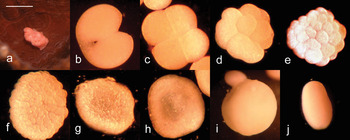
Spawning and embryo development followed a pattern similar to that of other scleractinian coral species (Okubo & Motokawa, Reference Okubo and Motokawa2007) (Figure 1). Pectinia lactuca colonies released large (up to 1 cm diameter), unevenly sized, buoyant egg–sperm bundles with spherical evenly sized oocytes (approximately 350 µm diameter) (Figure 1a). Fertilized eggs began first cleavage to become two blastomeres at around 1 hour after fertilization (Figure 1b). Second and third cleavage continued to produce 4 and 8 cell embryos after 2 hours and embryos with at least 32 cells were present 3 hours after fertilization (Figure 1c–e). At 4.5 hours post-fertilization, most embryos had become balls consisting of many cells (known as a morula) (Figure 1f). At 5.5 hours post-fertilization embryos had taken on the distinctive convex–concave ‘prawn chip’ shape (Figure 1g) and this was followed by a ‘bowl shape’ at around 9.5 hours post-fertilization, marking the beginning of gastrulation (Figure 1h). Between 12 and 18 hours embryos completed gastrulation, became ball shaped and began to exhibit rotary motion (Figure 1i). By 18 hours most larvae had become elongated ‘planulae’ and were rapidly motile (Figure 1j).
Spawning and development of Pectinia lactuca embryo from first cleavage at 1 hour post-fertilization until 18 hours post-fertilization. Scale bars: (a) approximately 5 mm; (b-j) approximately 150 µm (photographs: Jamie Craggs).

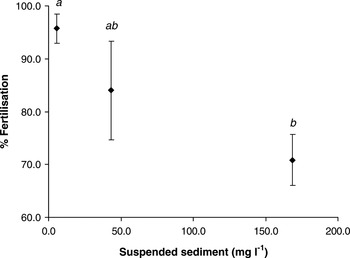
Increasing sediment concentrations had a marked effect on fertilization success (Figure 2). The controls were characterized by high levels of fertilization and subsequent 12 hour-old embryo survival (95.7 ± 2.8%). Sediment treatments significantly (F = 3.194, P < 0.05) affected fertilization success, reducing it to 84.0 ± 9.8% at 43 mg l−1 suspended sediments, and 70.9 ± 4.8% at 169 mg l−1 (Figure 2). Post-hoc testing (Tukey) revealed significant differences between ‘high’ sediment treatments and controls, but ‘medium’ sediment treatments were not statistically significant from both control and ‘high’ treatments due to high variance in the data for the ‘medium’ treatment level (Table 1). Sediment treatments had no apparent effect on embryogenesis (based on qualitative observations only) with developmental abnormalities generally rare in all test vials.
Percentage of fertilization in gametes of the coral Pectinia lactuca in response to exposure to three levels of suspended sediment. Values are means ± SE, N = 7. The relationship between suspended sediment concentration and % fertilization was significant (analysis of variation; P=0.039; F value = 3.194; mean square = 1082.476).

Results of one-way analysis of variance for differences in fertilization success among two sediment treatments and control (N = 9) and results of Tukey's post-hoc test. *, denotes significance at P < 0.05.

DISCUSSION
Previous studies have shown that corals experience reductions in fecundity and reproductive effort when subjected to reductions in water quality (e.g. elevated turbidity, sedimentation and nutrients) (Kojis & Quinn, Reference Kojis and Quinn1984; Tomascik & Sander, Reference Tomascik and Sander1987; Ward & Harrison, Reference Ward and Harrison2000). For example, in Papua New Guinea, fecundity in the brooding coral Acropora palifera was negatively correlated with depth, turbidity and sedimentation (Kojis & Quinn, Reference Kojis and Quinn1984). Similarly, in Barbados, Tomascik & Sander (Reference Tomascik and Sander1987) found in the gonochoric brooder Porites porites, that colonies exposed to elevated turbidity and eutrophication, contained lower numbers of larvae compared to colonies on a less disturbed reef. However, little is still known about the effects of reduced water quality on fertilization success and embryo development.
Our results for Pectinia lactuca indicate that turbidity indeed significantly affected fertilization success in this coral species, with significantly lower fertilization (and subsequent embryo survival) under the highest turbidity treatment. The ‘medium’ and ‘high’ sediment treatments used here correspond to (peak) turbidity levels that corals may experience during natural disturbance events (e.g. storms or river plumes), or dredging operations (PIANC, 2010). Significant declines in fertilization success were reported for Acropora millepora at suspended sediment levels ≥100 mg l−1 compared to lower levels ranging from 0–50 mg l−1 with approximately 36% fertilization at the highest tested suspended sediment levels of 200 mg l−1 (Humphrey et al., Reference Humphrey, Weber, Lott, Cooper and Fabricius2008). Similarly, a significant drop in fertilization success was found for A. digitifera with only 30–40% success found in suspended sediment treatments of 50–100 mg l−1 compared to 80–90% fertilization in controls 6 hours after mixing gametes (Gilmour, Reference Gilmour1999).
The exact mechanism of the interference of suspended sediment particles with the fertilization of coral eggs (beyond the scope of the present study) is not understood. For the effects of turbidity on fertilization of fish eggs it has been suggested that sediment particles may directly affect sperm mobility and sperm–micropyle encounter rates or that micropyle may be blocked by a coating of sediment particles (Galbraith et al., Reference Galbraith, MacIsaac, Macdonald and Farrell2006), although the recent discovery of a non-adhesive region around the micropyle in eggs of Pacific herring (Clupea pallasi) suggests that sediment particles are unlikely to interfere with sperm access to the micropyle and micropylar channel, at least in this species (Griffin et al., 2009). Microbes and contaminants associated with sediment particles (e.g. when resuspended during dredging) may further contribute to reduced fertilization and larval survival in corals (Negri & Heyward, Reference Negri and Heyward2000, Reference Negri and Heyward2001). The sediment type (size fraction etc.) may also influence the effect on fertilization, although this factor was not tested during the present study.
Mortality of embryos within our ‘small volume’ sampling vials may have introduced some additional mortality (as methodological artefact) not due to the sediment treatment, although this was probably acceptably low due to the relatively short duration (12 hours) of the experiment. This risk might be further reduced in future experiments by carrying out the treatments in a flow-through set-up. ‘Kreisel’ systems that allow for gentle stirring, as used successfully by SECORE for the rearing of coral larvae, may be ideal for this purpose (see: www.secore.org).
Successful fertilization, high larval survival and recruitment are essential to the persistence of healthy coral reefs. The finding that high levels of turbidity negatively affect fertilization success in Singapore's waters implies that dredging activities during the major spawning period may be detrimental to the persistence of local reefs. Dredging activities are essential to the maintenance of Singapore as one of the world's busiest ports and to the continuation of other maritime activities such as the offshore oil refining industry. However, as the major spawning period in Singapore is relatively short (approximately 1 week following the March or April full moon), dredging activities could conceivably be reduced or halted during this short period to minimize impacts of (even short-term) increases in turbidity on coral reproduction and recruitment.
ACKNOWLEDGEMENTS
We acknowledge Ecoshape–Building with Nature for their financial support for the SECORE coral breeding workshop (30 March–8 April 2010) in Singapore. The Tropical Marine Science Institute of the National University of Singapore and Underwater World Singapore are thanked for help with preparations, facilities and logistics during the workshop. Astrid Kramer (Hydronamic) participated in the laboratory experiments and data analysis. We appreciate the help of all other participants of the 5th SECORE workshop with the field and laboratory work. The authors acknowledge the support & contributions of the Singapore–Delft Water Alliance (SDWA) and Singapore Ministry of Education Academic Research Fund Tier 1 FRC Grant (Grant number: R-154-000-432-112). The research presented here was carried out as part of the SDWA Marine & Coastal Research Programme (Theme 2): ‘Dredging and infrastructure development near critical marine ecosystems’ (R-264-001-001-272) and presented at the Euro ISRS Symposium 2010: ‘Reefs in a Changing Environment’, 13–17 December 2010, Wageningen, The Netherlands. We thank Bert Hoeksema and Pippa Mansell for allowing us to submit our paper for publication in this special issue of JMBA.