Introduction
CLIENTELISM is common in much of the modern world. But the modern practice of clientelism rarely involves direct contact between politicians and voters. Instead, most clientelist exchange is carried out by intermediaries. Such brokers may be party activists, employers, chiefs, religious leaders, strongmen, landlords, criminal bosses, or civil society leaders, to name just a few. Although most of the literature implicitly recognizes this variation, we know little about the relative effectiveness of these brokers. Footnote 1 Addressing this gap can help explain variation in the incidence of clientelism across settings, as well as the differential effects of clientelism on accountability, governance, and corruption.
Borrowing from long-standing insights in the clientelism literature, we develop a simple theoretical framework for exploring why some clientelist brokers are better than others at mobilizing political support. In brief, we argue that the effectiveness of a particular broker depends on two main factors. First, brokers are more effective to the extent that voters are structurally dependent on the broker for their material well-being. This dependence enables brokers to wield more consequential, credible inducements to motivate voter compliance. Second, brokers who are well positioned to monitor voter behavior are more effective. Maintaining close proximity to voters and interacting with them regularly helps to mitigate the commitment problem that lies at the heart of clientelist exchange.
We apply our theoretical framework to compare the effectiveness of two of the most common brokers worldwide: employers and party activists. Footnote 2 We place special emphasis on employers because they are not only widely used to mobilize voters, but also woefully understudied. Footnote 3 We argue that employers are especially effective vote brokers, given their ability to exert significant leverage over their clients. They can threaten to fire employees, withhold (or increase) wages, or limit work hours. Indeed, in the modern world workers are particularly dependent on their employers for their livelihoods. Employers are also well positioned to penetrate the social networks of their employees, which helps employers to monitor vote behavior. Their daily, long-term interactions with their employees increase their credibility and reduce monitoring costs, which helps enforce clientelist arrangements.
To test our argument, we conduct two surveys: one of 4,200 individuals in Russia after regional elections in October 2014 and another of 1,400 individuals in Venezuela after parliamentary elections in January 2016. Russia and Venezuela are prominent authoritarian regimes in which employers and party activists are commonly used as vote brokers. But the two countries have different historical legacies, economic structures, and in particular, patterns of party development. For example, as a country with a recent history of strong grassroots party mobilization, Venezuela emerges as a hard case to test our argument that employers outperform party activists at turning out the vote. Variation along these dimensions helps us determine whether our findings on broker effectiveness travel across distinct political settings.
Our empirical approach relies primarily on a factorial framing experiment that prompts respondents to think hypothetically about their propensity to turn out after being mobilized by a given broker using a given inducement, but we also supplement our experimental findings with observational analyses of direct survey questions about respondents’ actual experiences with these mobilization techniques. Our experiments reveal that Russians and Venezuelans are, on average, more responsive to turnout appeals by employers than to appeals by party activists. In Russia, our experiment reveals that respondents who receive the employer-as-broker treatment are 6.1 percent more likely to vote than those who receive the partisan mobilization treatment. In Venezuela, where parties have significant grassroots capacity, employers still appear better at mobilizing voters. Venezuelan respondents who receive the employer treatment are 9.3 percent more likely to vote compared to those that receive the party treatment. These findings are consistent with observational data showing that both Russians and Venezuelans report higher actual turnout after being mobilized by employers.
We then take advantage of rich data on the characteristics of Russian workplaces to examine the conditions under which employers are effective at mobilizing votes. Our subgroup analysis shows that both leverage and monitoring ability drive the relative effectiveness of vote brokers. We first find evidence that the average voter responds more to employer-based mobilization when he or she fears losing his or her job, worries about finding comparable employment on the labor market, and relies on his or her employer for key in-kind benefits, such as health insurance and childcare. Thus, employers who have the most leverage over their employees are the most effective at mobilizing votes. Next, our analysis reveals that strong social ties developed in the workplace ease monitoring problems and lead to more effective mobilization by employers. Voters who have a personal relationship with their employer and those who have worked longer at the same job are more responsive to workplace-based voting inducements.
While we find that employers are more effective at mobilizing the average respondent to vote, we also recognize that other brokers may be more effective at rallying particular subgroups of voters, especially in contexts in which few voters are employed or in which employers lack leverage and monitoring capacity. We focus on the average respondent as a first cut. In addition, we leave identifying the conditions under which politicians choose to mobilize voters using employers or party activists to future research.
Our work makes several contributions to the study of clientelism. There is a large literature on the causes of clientelism, but fewer studies examine its effectiveness. To our knowledge, our study is among the first to explicitly compare the effectiveness of different types of brokers and selective inducements using individual-level data. Our research sheds light on what makes clientelism work by highlighting the identity of the broker as a crucial determinant of clientelism’s effectiveness. Furthermore, by studying the relative effectiveness of different brokers, our work helps to explain why clientelism is prevalent in some countries, but not others. Not all politicians have equally effective brokers at their disposal. When such brokers are absent, politicians may have to opt for other, more programmatic strategies to win elections.
Our research demonstrates why scholars should pay more attention to employers as clientelist brokers. Although the older literature on clientelism focuses heavily on some types of employers (particularly in agriculture), party activists receive pride of place in recent work. And yet, as this article indicates, employer-based clientelism is not only common, but also relatively effective for mobilizing typical voters in the modern world. In fact, employer-based clientelism presents a challenge to those who argue that clientelism will recede with economic modernization. Footnote 4 Although modernization may undermine traditional hierarchies, the expansion of the formal sector creates new ones. Our work suggests that given the significant leverage and monitoring ability that employers wield over workers, employer-based clientelism may become even more common in the developing world.
Vote Brokers and the Study of Clientelism
Clientelism, the exchange of selective inducements for political support, is a common tactic that politicians use to mobilize votes. Footnote 5 Although they also make programmatic appeals to the public, politicians across the developing world rely on clientelist networks to buy off, cajole, and/or intimidate voters. Though much of the literature on clientelism focuses on attempts to influence vote choice, Footnote 6 recent work shows that using selective incentives to induce turnout can be just as common as vote buying, if not more. Footnote 7 In this article, we focus on turnout rather than vote choice.
Scholars have emphasized that clientelist mobilization can entail different types of selective inducements. Most studies focus on positive inducements such as vote buying, Footnote 8 but a growing literature also explores the impact of negative inducements, such as coercion and threats. Footnote 9 These inducements, are often explored in isolation from each other, but in this article we examine the impact of different types of positive and negative inducements on turnout in a single analysis.
Many studies acknowledge that clientelism must be mediated by an intermediary who presents the selective inducement to the voter. By far the most common brokers discussed in the literature are party activists or independent brokers affiliated with parties. Footnote 10 But clientelism can be brokered by many different types of intermediaries, including traditional leaders, Footnote 11 landowners, Footnote 12 strongmen, Footnote 13 gangs and warlords, Footnote 14 state employees, Footnote 15 unions, Footnote 16 civil society leaders, Footnote 17 and employers. Footnote 18 While some comparativists have come to recognize the range of possible brokers, Footnote 19 there are far fewer systematic studies that exploit variation in brokers to explore electoral clientelism. Moreover, almost all empirical studies of electoral clientelism focus on a single type of broker, but in this article we examine the relative impact of different types of brokers with a special emphasis on employers and party activists.
In addition, most studies focus on the prevalence of electoral clientelism and seek to determine what types of voters are targeted with what types of inducements. The vast majority of the empirical literature on clientelism seeks to identify the conditions that make it more likely to occur. Scholars have identified socioeconomic factors, Footnote 20 the ideological orientations of voters, Footnote 21 ballot structure, Footnote 22 and norms of reciprocity Footnote 23 as important correlates of vote buying. Others have examined what types of voters are targeted with threats or coercion. Footnote 24
But there are far fewer studies about the relative effectiveness of different types of brokers and clientelistic strategies. Footnote 25 The relatively few existing studies on effectiveness of electoral clientelism tend to focus on positive inducements. Recent work examines how the effectiveness of vote buying is conditioned by social structure, Footnote 26 the type of gift offered, Footnote 27 the size of precincts, Footnote 28 and the ability of politicians to monitor brokers. Footnote 29 Other work questions whether vote buying helps to turn out the vote. Footnote 30 The impact of negative inducements on turnout is much less studied. Footnote 31
Studies of clientelism in Venezuela have centered on party activists and state officials, but to our knowledge, none explores employers as brokers. Footnote 32 Studies in Russia have examined the prevalence of electoral mobilization by employers, party activists, and state officials, but not the effectiveness of these strategies. Footnote 33
By focusing on the effectiveness rather than the prevalence of electoral clientelism, and by exploring the impact of different types of selective inducements offered by different types of brokers in a single analysis, our work is distinct from much recent literature.
A Special Focus on Parties and Employers as Vote Brokers
In the remainder of this article, we compare the relative effectiveness of party activists to another prominent broker—employers. Party activists are one of the most widespread clientelist brokers and by far the most studied. Employers, for their part, are probably the second most common brokers around the world. Historical evidence indicates that employer-based clientelism was common in settings as diverse as the United States, Footnote 34 Imperial Germany, Footnote 35 and early twentieth–century Chile. Footnote 36 The practice persists in contemporary times, as well. Isabela Mares, Aurelian Muntean, and Tsveta Petrova find that 11 percent of Bulgarian voters and 5 percent of Romanian voters were pressured by their employers to vote in the 2013 parliamentary election. Footnote 37
Workplace mobilization is well established in contemporary Russia. During the 2011 parliamentary election campaign, for example, 25 percent of employees were asked by their employers to turn out. Footnote 38 Russia’s largest vote monitoring organization, golos, aggregated hundreds of citizen reports of intimidation in the workplace during the 2011–12 election cycle and concludes in its final report, “Once again, administrative pressure on voters was actively used in these elections … including pressure on the employees of individual enterprises and organizations with the goal of securing votes for V. Putin.” Footnote 39 More recent surveys, such as the 2016 Russian Election Study, find that 15 percent of employees were asked by their employers to vote during those elections.
Workplace mobilization in Russia takes many forms, including political rallies, coercion, turnout buying, and violations of the secret ballot. Although the practice happens in many different workplaces, recent research finds that employer-based mobilization occurs most often in firms that are either large or state-owned, or that possess immobile assets. Footnote 40 Most workplace mobilization in Russia is carried out, implicitly or explicitly, in favor of regime candidates.
There is less research on workplace mobilization in Venezuela, but available evidence indicates that the practice is common there, as well. Since at least 2004, members of Hugo Chávez and Nicolás Maduro’s governments have made clear that public employees are expected to support the government at election time. Footnote 41 During the 2015 parliamentary elections, the ruling United Socialist Party of Venezuela (psuv) required public sector employers to involve workers in turnout mobilization. Called the “1X10 Campaign,” each party activist and public sector employee was required to mobilize an additional ten voters. Footnote 42 In the Venezuelan postelection survey analyzed in this article, 42 percent of employed voters reported that their employer had asked them to vote. And consistent with the anecdotal evidence cited above, our survey finds that nearly half of public sector workers experienced some form of workplace mobilization. The practice still occurs quite widely in the private sector as well, affecting 35 percent of workers there.
The prevalence of workplace mobilization in the Venezuelan public sector indicates that the practice is primarily perpetrated by the regime, but we cannot exclude the possibility that the opposition also engages in workplace mobilization. Future research could profit by understanding how and when the opposition is able to make use of this type of clientelism.
Although other types of brokers may be more prevalent than parties and employers in certain settings—for instance, traditional leaders are common brokers in Africa—parties and employers are not specific to particular locations. They are used as brokers in many different countries, which makes it easier to generalize conclusions about their effectiveness. And while we would also like to study location-specific brokers, the limitations of resources and sample size force us to restrict our analytic focus in the countries we study. Therefore, in both Russia and Venezuela we focus on the three brokers that are most commonly used in each country: party activists, employers, and local government officials in Russia, and party activists, employers, and neighborhood leaders in Venezuela.
Why Are Some Types Of Brokers More Effective Than Others?
To understand why some types of brokers are more effective at getting the average voter to turn out, it is instructive to begin by examining what we know about the effectiveness of clientelism. Scholars have developed different theories of what makes clientelism work. The most common view is that successful clientelism results from an instrumental exchange. Footnote 43 Brokers induce voter compliance through the conditional use of future rewards and punishments. Footnote 44 By exploiting voters’ own self-interest, brokers convince them to engage in political behavior that they might otherwise not undertake. A voter’s behavior is then contingent on the expectation of future rewards or punishments. As we argue below, different types of brokers are likely to vary significantly in the extent to which they are able to motivate such instrumental compliance.
An alternative view posits that brokers leverage voters’ feelings of intrinsic reciprocity or moral obligation. Footnote 45 Scholars argue that vote buying is most effective at mobilizing votes when targeted individuals derive pleasure from helping those politicians or brokers who offered them material compensation. Vote buying becomes self-enforcing when clients feel a strong obligation to return favors to their patrons. Footnote 46 A related view is that vote buying conveys information about candidates. Some argue that politicians offer handouts to inform voters about their ability to deliver particularistic services after the election. Footnote 47 The goal may not be to mobilize individual votes, but instead to foster wider perceptions of competence and trustworthiness.
Both information- and reciprocity-based theories have produced important insights, but they are less useful in helping us understand differences across classes of brokers. All brokers, it would seem, might use clientelism to convey information about politicians, and intrinsic reciprocity is a characteristic that varies across clients (or societies), not patrons. In addition, information- and reciprocity-based theories of clientelism struggle to explain the use of negative inducements, such as intimidation or threats to withdraw benefits, which are an important component of clientelist mobilization in much of the world. As such, we focus on political clientelism as rooted in instrumental exchange between brokers and voters.
Leverage
One important determinant of broker effectiveness is leverage. To enforce clientelist exchange, brokers must be well positioned to credibly offer (or threaten) consequential inducements. Where does this leverage come from? We argue that what matters most in determining lever-age is the extent to which clients are structurally dependent on patrons for some benefit—economic, political, or social—that is important to their well-being.
The more a client has to depend on a patron to get by, the more likely a “captive electoral base” will emerge. Footnote 48 Clients who rely heavily on brokers have less autonomy to defect from clientelist bargains. Footnote 49 Resisting the entreaties of clientelist exchange often requires outside options: voters must have other ways to secure the benefits that brokers provide, whether they be jobs, income, or access to state services. Without these other avenues, brokers occupy a monopolistic position in meting out rewards and punishments, resulting in high levels of voter compliance. This reading of dependence draws on a number of older definitions of clientelism that assume some degree of social, economic, or political hierarchy between patrons and clients. Footnote 50 Such asymmetries have played a less prominent role in some recent treatments of clientelism, Footnote 51 but we argue that this consideration of hierarchy is crucial for understanding the origins of leverage.
Brokers who command consequential sources of leverage over clients will be more effective at enforcing clientelist exchange. And on this score, the main factor that distinguishes effective brokers from ineffective brokers is credibility. Any broker could conceivably offer a large amount of money or threaten severe social sanction, but only some types of brokers are able to make such inducements credible.
Some types of brokers have structural advantages that give them, in most conceivable settings, significant leverage over clients. Landlords, for example, can credibly threaten to evict. Footnote 52 Traditional leaders, by virtue of their social standing, can credibly threaten meaningful social sanction. Footnote 53 Local strongmen and gangs can credibly threaten physical coercion. Footnote 54 Low-level government officials can threaten withdrawal of social benefits.
Employers, an important focus of our study, wield consequential levers of influence over their employees. They can offer significant positive inducements, such as increases in wages or benefits. But their real advantage is the power of the negative inducements they can deploy— they can withhold wages, trim benefits, or even fire workers.
Available data indicate that employers use such negative inducements in both Venezuela and Russia. In Venezuela, researchers find that those who signed a leaked anti-Chávez petition in 2004 (the Maisanta list) suffered earnings and job loss as a result. Footnote 55 Using list experiments to account for social desirability bias, in earlier work we estimate that as many as 17 percent of employed voters experienced coercion in the workplace during the 2012 Russian presidential campaign. Footnote 56 Data from crowd-sourced election complaints reveal that 83 percent of workplace violations during the 2011 State Duma election involved some type of intimidation. Footnote 57 In 50 percent of these reports, managers simply ordered their employees to vote. In 38 percent of the reports, they explicitly threatened dismissal or a reduction in salary/benefits.
Party activists, by contrast, usually lack such sticks. In most cases they cannot credibly threaten sanctions that would approach the magnitude of job loss. And the modest positive inducements that they more commonly offer also pale in comparison to the benefit of job security. Activists have to invest significant resources to gain anything approaching the degree of leverage that employers have by virtue of their position. Susan Stokes describes British parties in the nineteenth century collecting information on voters’ debts, crimes, and infidelities to use as leverage in their interactions with voters. Footnote 58
Employers also have a comparative advantage in making their offers credible. They are engaged in repeated, long-term interactions with their employees. Such iteration instills an understanding that defections will result in punishment or exclusion from future benefit streams. Footnote 59 Workers know that they will have to interact with their bosses in the future, and cannot avoid punishment by evading or ignoring their employers. In other words, compliance with the clientelist bargain is easier to enforce in the workplace. By contrast, voters are unlikely to find threats by party activists to be very credible, and if they encounter activists only infrequently, promises of future benefits may ring hollow. In sum, employers have ample political leverage over workers and are likely to be particularly effective clientelist vote mobilizers.
Monitoring
Inducing dependence and enjoying resource advantages may not be sufficient to enforce a bargain. It is well known that clientelist exchange can be stymied by a monitoring problem. With the secret ballot, politicians find it difficult to determine whether voters are voting as directed. Turnout-based clientelism makes this an easier problem to solve, since monitoring turnout is easier than monitoring vote choice. Footnote 60 But monitoring turnout is not costless. Vote brokers still need to gather information on whether voters turned out. At the very least, brokers need to imply that this information is being gathered.
The ability to monitor clients, even under a secret ballot, has been shown to increase the effectiveness of clientelism. Footnote 61 Where does monitoring ability come from? First, close proximity between brokers and clients improves the amount and quality of information used to track client political behavior. Footnote 62 Dense social networks transmit political information and cues, as well as facilitate group monitoring. Footnote 63 Second, repeated interactions help decrease monitoring and enforcement costs. When clientelist exchanges take place as a one-shot game, brokers lose the ability to observe which voters comply with their end of the bargain. Allen Hicken argues that repeated interactions help brokers learn what works over time with different sets of voters and to calibrate the size of offers needed to be made. Footnote 64
Socially embedded brokers, such as neighborhood and civil society leaders, have advantages on this dimension. But it is important to note that since many people’s social networks are intertwined with their workplace, employers share similar advantages. Sociologists have found that the workplace is a key site for the formation of “core discussion networks.” Footnote 65 Coworkers can be confidantes for many employed voters. Indeed, evidence from a March 2018 postelection survey in Russia confirms the finding: 13 percent of respondents believed their coworkers and supervisors could surmise their vote choice without being directly told. Footnote 66 As noted above, repeated interactions facilitate employers’ ability to gather detailed information on their employees’ political behavior. By interacting on a near-daily basis regardless of electoral cycles, employers have more opportunities to learn whether their employees vote in elections, attend political rallies, or contribute to campaigns.
Stokes has argued that grassroots parties with tentacle-like organizations that penetrate the social networks of voters are able to successfully monitor voter behavior. Footnote 67 In such settings, parties may have monitoring capacity that matches that of employers. But as an empirical matter, such organizations are rare in much of the developing world. Footnote 68 Political leaders often do not prioritize long-term party development, preferring to quickly activate brokers and networks only during preelection periods. After the polls close, party cells often lay dormant. The number of full-time activists capable of gathering information and sustaining interactions with voters is minimal. Given the built-in social networks that exist in the workplace, employers may be better placed to monitor voters in much of the developing world.
To summarize, we argue that employers have inherent structural advantages that give them superior leverage over a typical client. But when it comes to monitoring, their relative advantages depend more on contextual factors, although in most settings their monitoring capacity is likely greater than parties. Footnote 69
Two Framing Experiments On Brokered Mobilization
To examine the relative effectiveness of different brokers, we employ framing experiments embedded in surveys in Russia and Venezuela. These are good cases for examining the questions posed in this article. Both countries have prominent authoritarian regimes that hold elections at regular intervals. Clientelism is also common in elections at various levels, and several different types of brokers—employers, local officials, neighborhood leaders, hospital directors, council heads, schoolteachers, and party activists—are regularly employed in both. Footnote 70 Furthermore, in both countries there are several well-regarded survey firms with extensive experience conducting complex surveys, including split-sample randomizations.
Nevertheless, the two countries differ in analytically useful ways. First, Russia is a postcommunist country with a long history of politics in the workplace. Footnote 71 Venezuela, by contrast, does not have a history of communist rule, so employers cannot draw on legacies of workplace mobilization. Second, parties in Venezuela have stronger grassroots organizations than in Russia, which are put to great use to mobilize voters during elections. Footnote 72 This makes Venezuela a particularly hard case to test our argument, given the increased attention and resources devoted to developing party structures there. In addition, the two countries differ in economic structure. Although private sector employment strictly dominates in both countries, Footnote 73 at the time of the survey, Venezuela was experiencing a much higher rate of unemployment and poverty than Russia. These differences allow us to explore whether broker effectiveness depends on particular historical legacies, political party development, or economic structure.
Our survey in Russia consists of 4,200 face-to-face interviews conducted in twenty regions that held regional (executive and/or legislative) elections in September 2014. Footnote 74 Surveys were carried out in October 2014, three weeks after the elections. The survey includes a base sample of 3,360 respondents. This base sample contains a representative sample of five hundred respondents from four regions, and a random sample of eighty-five respondents from another sixteen regions. An additional oversample of 840 employed respondents was added to the base sample. Of these oversampled respondents, we required that no fewer than 240 individuals were working in heavy industry, oil/gas extraction, and mining. Footnote 75 As a robustness check, we present results from the framing experiment and observational analysis with and without the oversample of employed respondents in the supplementary material. Footnote 76
Our survey in Venezuela includes responses from 1,400 face-to-face interviews in nine regions of the country. We used a stratified sampling procedure based on geography and habitation to achieve a nationally representative sample. The country was divided into thirty-six strata based on these two criteria, from which 173 sample points were randomly selected. In addition, we oversampled four hundred employed respondents distributed proportionally from the sample points.
Because clientelist appeals are not randomly assigned, it is a challenge to study their effectiveness. Brokers may selectively target individuals, which makes it hard to assess the causal effect of clientelist appeals. Footnote 77 Adopting an experimental design that randomly assigns voters to receive different types of appeals from different brokers is impractical and would raise ethical concerns about electoral interference. To address these difficulties, scholars have resorted to a series of indirect experimental approaches, including informational campaigns Footnote 78 and framing experiments. Footnote 79 We adopt the latter approach. The assumption that all respondents are equally likely to receive each treatment allows for randomization and better causal inference but may be more plausible for some types of respondents than others. We relax this assumption in the observational analysis, but at the usual cost of weaker causal inference.
For our main analyses, we implement a framing experiment using a factorial design in which we manipulate 1) type of vote broker and 2) mobilizational technique. Each respondent was asked:
Imagine that during the next election campaign [voter broker here] approaches you and [technique here]. Given this, how likely would you be to vote in these elections? Footnote 80
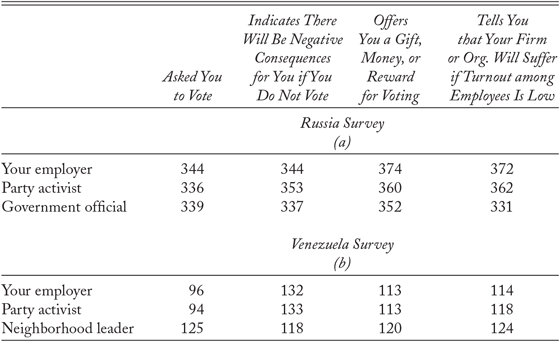
Respondents were asked to rate their likelihood of voting on a five-point scale ranging from “definitely will not vote” to “definitely will vote.” Respondents were randomly assigned to one of twelve combinations of broker and technique as depicted in Table 1. Footnote 81 In the Russia survey, each group comprised between 331 and 372 respondents; in the Venezuela survey, each group comprised between 94 and 133 respondents. Covariate balance checks presented in the supplementary material indicate that the randomization was successful for both surveys. Footnote 82
Survey Coverage

We invoke three brokers in the experiment: in Russia we use employers, party activists, and government officials; in Venezuela we use employers, party activists, and so-called neighborhood leaders. Employers are common vote brokers in Russia and Venezuela and are the main subject of our research.
In addition to the anecdotes discussed above, our postelection surveys uncover a substantial incidence of political mobilization by employers. In Russia, 52 percent of employed respondents experience at least one of the following political activities in their workplace: seeing campaign posters, management discussing elections with employees, receiving agitation materials, management-provided transportation to the polls, management asking employees to agitate, or management publicly endorsing a candidate. Footnote 83 In Venezuela the numbers are just as high, with 51 percent of those employed experiencing any number of the same political activities by employers. Also, workplace mobilization is actively covered by media outlets, making most citizens at least some-what aware of it around elections.
The next treatment references party activists because they are the vote brokers most commonly discussed in the literature and are also commonly employed in both countries. Surveys have found party officials in Russia to be key sources of information for voters, while they also distribute inducements. Footnote 84 In Venezuela, the Bolivarian Movement and its psuv party have developed extensive grassroots structures to direct government spending. Footnote 85 Our surveys confirm the active roles parties play during elections; roughly 27 percent of Russians and 26 percent of Venezuelans interacted with a party activist during their country’s electoral campaign.
For the Russia survey, we include local government officials as the third broker because they are common intermediaries, especially outside major cities where the heads of local districts are frequently tasked with mobilizing rural voters. In Venezuela, clientelist exchange is often brokered by neighborhood leaders who are recruited by parties to mobilize candidates. Footnote 86 Access to the misiones, or government-run social programs, often hinges on an individual’s relationship with these neighborhood organizations. We include neighborhood leaders as the third broker in the Venezuela experiment. Footnote 87
We also include four mobilizational tactics as treatments. Footnote 88 One clientelist appeal is related to positive inducements, two methods are related to negative inducements, and one is a simple mobilizational appeal. The positive inducement explicitly mentions the use of a “gift, money, or reward” in exchange for voting in elections. In doing so, we follow much of the literature, which often measures vote buying using survey prompts that communicate a general payoff in return for political support. Footnote 89 The first negative inducement frame focuses on individualized threats. We conceptualize this individualized threat as a person exchanging political support to maintain the status quo and to prevent the loss of something of value. The second negative treatment focuses on collective threats against the voter’s workplace or organization. Would political support not be offered, the loss would be inflicted on the respondent and other members of their collective. We also include a treatment in which each broker asks the voter to turn out.
It is important to note that employers asking their employees to vote can be construed as a form of implicit coercion, although a weaker one than if a direct threat is involved. Inherent asymmetries in the employer-employee relationship make these entreaties implicitly coercive. Indeed, our surveys indicate that most respondents in both countries take a negative view of this type of workplace mobilization.
Our design is best suited to comparing the relative effectiveness of brokers and inducements. We conceive the simple-ask treatment by party activists as the baseline. We are aware of no studies that find that being asked to turn out by a party activist depresses turnout—most find the opposite. Thus, any effects relative to this baseline category should be low estimates of broker effectiveness. In any case, our focus is on the relative effectiveness of different brokers across the fixed set of strategies used.
Our scenarios are hypothetical and we do not observe actual voting behavior. At the same time, the main effect of the hypothetical prompt should be to increase variance in responses and to increase the number of noncommittal (“maybe I would vote, maybe I would not”) responses, since we are asking respondents to speculate about future behavior. This should make it harder to find a statistically significant effect for a given treatment. Moreover, although most Russians and Venezuelans do not directly experience clientelism in every election, these practices are common and average citizens would be aware of them.
Note that even hypothetical framing experiments do not completely resolve potential problems of social desirability bias. Respondents could be wary of admitting that illegal practices, such as turnout buying, might sway their behavior. They also could believe it more socially desirable to respond to collective rather than individual threats. Footnote 90 Even here, several factors reduce our concerns about social desirability bias. Our results hold among more educated respondents (see the supplementary material), who are usually viewed as more sensitive to concerns about social desirability, Footnote 91 and we find that levels of nonresponse are low. Footnote 92 Some voters may frown upon mobilization by certain employers, party activists, or local leaders, but the practice is not illegal in Russia and is often discussed in the media. More generally, recent survey research on Russia indicates that social desirability bias is less common than often perceived. Footnote 93
Results: Comparing Effectiveness across Brokers
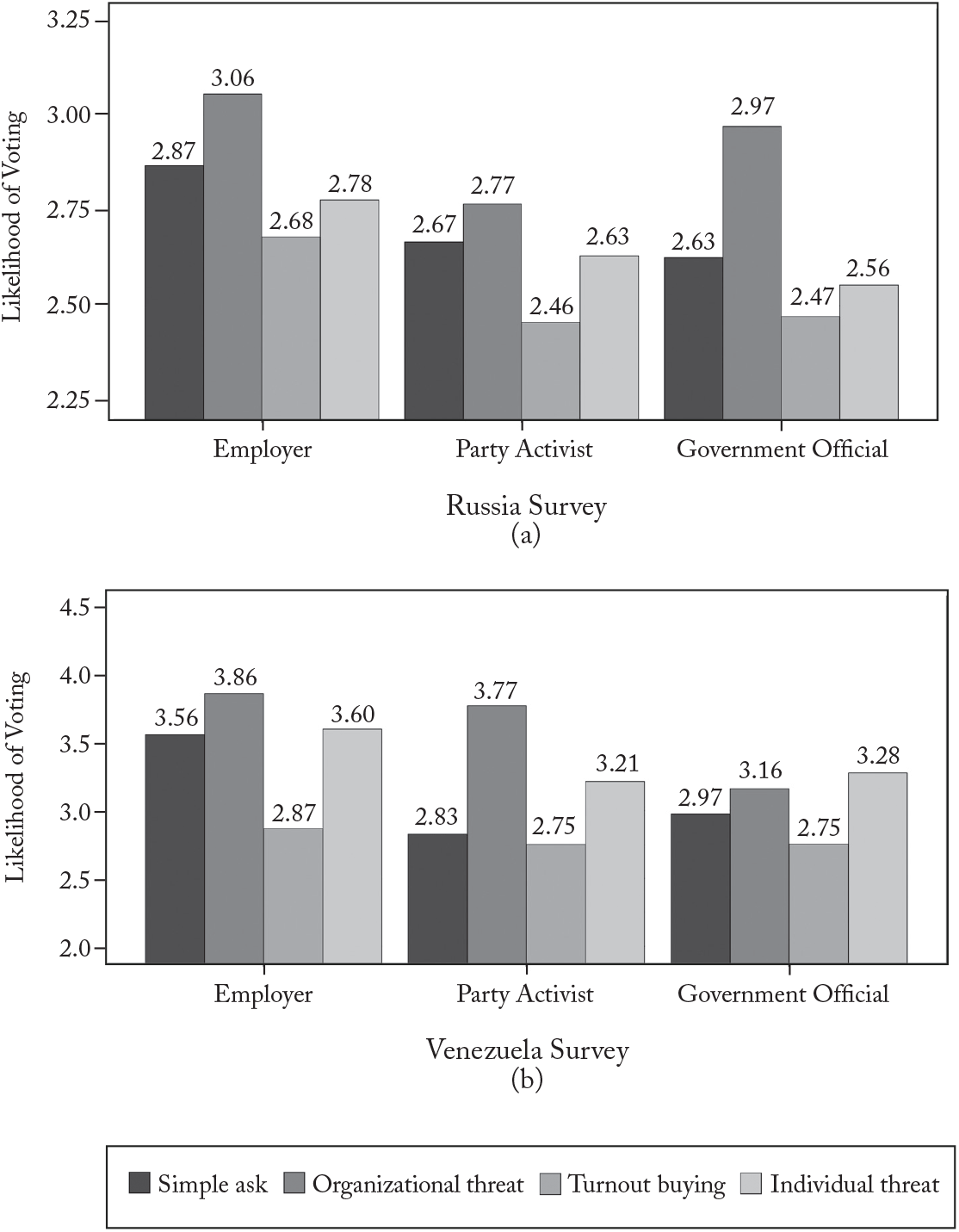
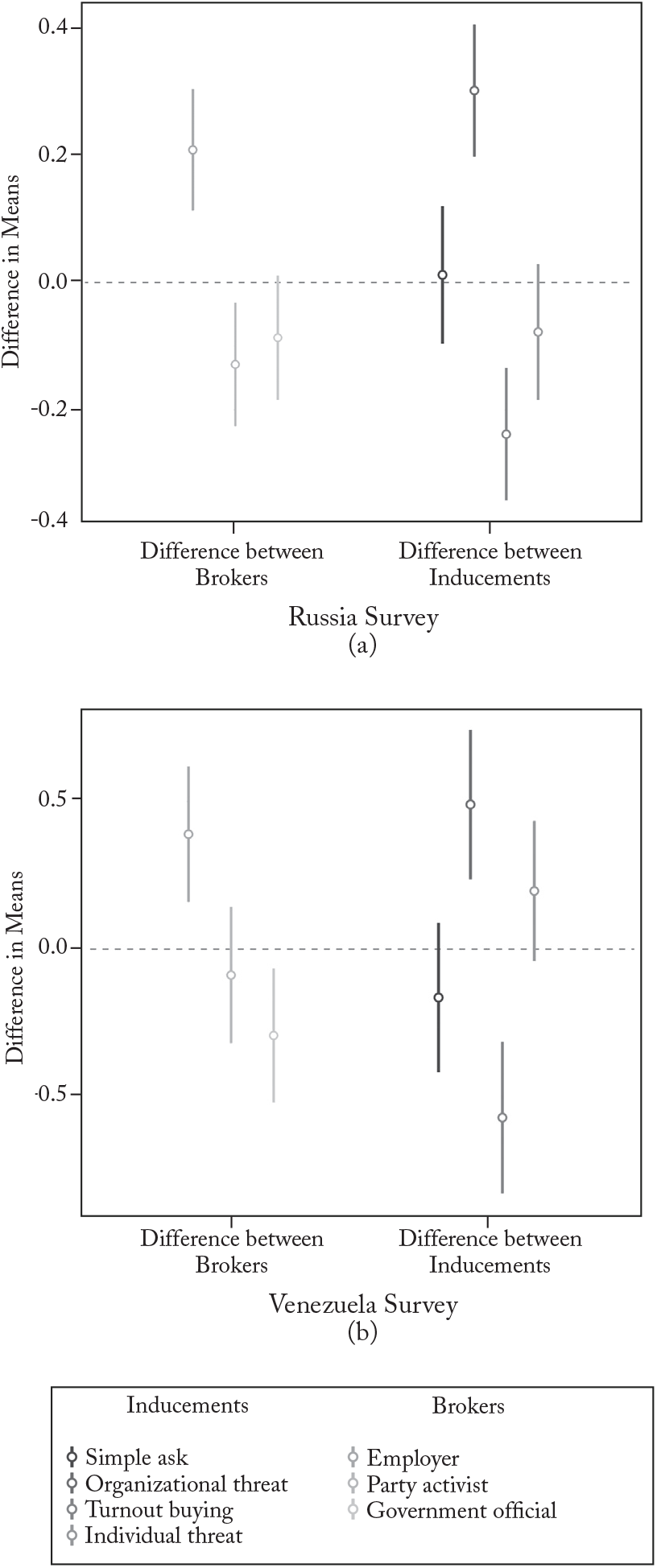
Figures 1 and 2 show the main results of the survey experiment. Because the employer treatment is less relevant for nonemployed voters, we limit the sample in our main analyses to the subset of respondents who report that they were employed. Footnote 94 Given our theoretical focus on brokers, we focus primarily on the interpretation of those results. The y-axis of the panels in Figure 1 shows the mean response on the turnout propensity scale (responses range from 1 to 5). The first and most important result is that the average respondent in both countries is more responsive to mobilizational appeals by employers. Because we use a factorial design to assign respondents to a treatment, we can simplify the presentation of the individual broker (and strategy) treatments. Figure 2 collapses the treatment groups based on each axis in the factorial. This is a standard approach to analyzing data generated using conjoint analysis. Footnote 95 The figures demonstrate that the employer advantage over the two types of activists is statistically significant in both countries.
Clientelism Effectiveness across Brokersa

Differences in Meansa

Among those who receive the employer treatment in Russia, the mean response on the five-point scale of turnout propensity is 2.85, while the mean response among those who receive either the party activist treatment or the government official treatment is 2.64. The difference is 0.21, which is statistically significant, and translates into a 4.2 percent increase (.21/5) in turnout propensity over nonemployer brokers. However, since the turnout propensity variable is an ordinal scale, this quantity cannot be directly interpreted as a 4.2 percent increase in the probability of turning out. Rather, it makes more sense to evaluate effects across the range of turnout propensity.
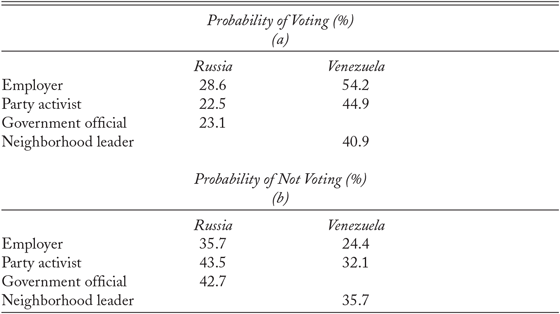
One simple way to do this is by examining changes in predicted probabilities from an ordered logit model in which the dependent variable is turnout propensity and the independent variable is a binary indicator for whether the respondent receives the employer treatment. Table 2 shows these quantities. We see that receiving the employer treatment increases the likelihood of respondents answering that they will be likely to turn out (response category 4 or 5) by five to six percentage points. Similar effect sizes are found in the Venezuela experiment. Respondents who receive the employer treatment are 9.3 percent more likely to answer that they would turn out than those that receive the party activist treatment. The difference between the employer and neighborhood leader treatments is even larger.
Substantive Effects: Predicted Probabilities by Broker Treatment a

a This table presents the predicted probabilities from individual ordered logit models that regress the respondents’ likelihood of voting in the survey experiment on binary indicators for each broker treatment status. The probabilities in panel (a) are the total of the predicted values for outcomes 4 and 5 (with 5 signifying “definitely will vote”). The probabilities in panel (b) are the total of the predicted values for outcomes 1 and 2 (with 1 signifying “definitely will not vote”). The sample is a subset of only employed respondents.
These effect sizes are substantial. As many studies demonstrate, it is difficult to increase turnout by large amounts.Footnote 96 Modest but precisely estimated effect sizes are common in the literature. Our results indicate that employer-based clientelist appeals have sizable effects on turnout. We also find that the other brokers we include in the design are roughly comparable to party activists in terms of their ability to mobilize voters. Government officials slightly outperform party activists in Russia, while neighborhood leaders slightly underperform party activists in Venezuela. These differences are less precisely estimated, and we interpret them in more detail below.
Although employers outperform party activists in both countries, it is interesting to note that party activists appear to be considerably more effective in Venezuela. Party mobilization is more common in Venezuela, which could make these prompts more realistic for Venezuelan respondents. It may also be the case that Venezuelan party activists are more credible representatives of the state than Russian activists, which would make their inducements more credible.
In Tables A3 and A7 in the supplementary material, we show that the main effects are not contingent on the type of sample analyzed in the two countries.Footnote 97 First, when the entire sample of respondents is analyzed and includes a control for being employed, we find employers are more effective brokers. Interestingly, the same is true when comparing whether respondents are employed in the public or private sector.Footnote 98 Second, although government employees appear to respond more strongly to the hypothetical invocation of employer-based mobilization, we also find strong evidence that private sector employers command sizable political influence. Third, we show that the sampling procedure used in Russia and Venezuela is not driving the results: employers demonstrate greater mobilizational capacity in both the more representative (original) samples and the oversamples of those employed.
Although our focus in this article is on the relative effectiveness of brokers, the survey experiments also shed interesting light on how well different types of selective inducements function for mobilizing voters. First, across both surveys, organizational threats strongly outperform individual threats (and all other types of inducements). Russian respondents who receive the organizational threat treatment are eight percentage points more likely to respond that they are likely or very likely to vote; in Venezuela, those who receive this treatment are fourteen percentage points more likely to respond similarly.
These findings make sense in light of the theoretical propositions sketched above. For one, organizational threats are more credible than inducements toward individuals. As other scholars point out, monitoring a collective’s voting behavior is easier than monitoring an individual’s.Footnote 99 Observing the voting returns of a municipality or small town is straightforward. Monitoring the voting behavior of some other collectives—for example, firms, schools, hospitals—is more difficult, but the task may be simplified if employees live close together and correspond loosely to one or a small number of precincts, as is often the case with large firms.
Perhaps surprisingly, we also find that providing gifts and/or patronage is a relatively ineffective way of mobilizing voters, even compared to simply asking voters to turn out and irrespective of the type of broker used. These findings largely accord with recent studies arguing that without strong monitoring capacity, electoral handouts often do not change electoral outcomes.Footnote 100 Another explanation for this null result in Russia is that the median voter is too wealthy for preelectoral gifts to make much of an impact. In fact, we do find evidence that poorer respondents in both surveys respond to positive inducements by turning out. In tables A5 and A9 of the supplementary material, we interact the turnout-buying treatment with indicators for education and income.Footnote 101 In general, the less educated and less wealthy the respondent, the more effective all types of inducements are, including attempts at turnout buying.
Variation across these inducements also may help to explain the relative effectiveness of other brokers we employ in the experiment. The survey results indicate, for example, that government officials in Russia derive their mobilizing power mainly from making organizational threats, which is reasonable given that their leverage comes in the form of budget allocations. Officials are less able to use inducements that potentially require increased monitoring capacity, such as wielding positive and negative inducements to individuals. This makes sense given officials’ limited penetration of social networks and visibility in neighborhoods. Alternatively, we find that party activists in Venezuela command more leverage through organizational threats, while neighborhood leaders enjoy more success through mobilizing voters when more monitoring capacity is required.
Robustness Check: Observational Data on Broker Effectiveness
The findings from the survey experiment support our contention that employers are, on average, more effective vote mobilizers than other brokers. But we would be more confident in our findings if we could corroborate them with another, separate piece of evidence. Fortunately, both our surveys include a series of direct questions about individuals’ experiences with mobilization by different kinds of brokers, as well as direct questions about their decision to turn out. We use these questions to examine the correlation between turnout and being mobilized in the workplace, conditional on potential confounders.
In the supplementary material, we model whether respondents actually turned out in the Russian regional (Table A11) and Venezuelan elections (Table A14).Footnote 102 We specifically look at the effect of having been mobilized by an employer, a party activist, or a government official (Russia) or a neighborhood leader (Venezuela). The models control for a large number of demographic factors that could potentially influence both being mobilized by various actors and an individual’s baseline propensity to turn out. We also alternate sample restrictions between the full sample and only those employed.
In both countries we see that being mobilized in the workplace is positively correlated with higher turnout. Depending on the model used and the country studied, the estimates range from a five percentage-point increase to a fourteen percentage-point increase. Although being mobilized by a party activist is also positively correlated with turnout, the magnitude of the effect is smaller than for employers. These differences hold even when including indicators of mobilization by the three brokers in the same model, though the estimates are less precisely estimated.Footnote 103
On their own, these correlations are only suggestive. Workplace mobilization is not randomly assigned and there are many potential endogeneity problems. Nevertheless, it is noteworthy that the findings remain robust and significant while controlling for a considerable number of important confounders. And it is especially noteworthy that these findings are consistent with the findings from the survey experiment. Employers in both countries appear to be more effective than parties at mobilizing the average voter.
Results: Mechanisms
Our data allow us to probe some of the mechanisms that make workplace mobilization effective. Our theory predicts that the mobilizational superiority that employers enjoy over other brokers stems from the unique characteristics of the workplace. Employers have greater leverage over workers (for example, through control over hiring and firing decisions), engage in more sustained, repeated interaction with their employees, and can draw on the dense social networks of the workplace. Using data from the Russia survey, we put these mechanisms to the test by asking employed respondents detailed information about their job and social relationships at work.Footnote 104
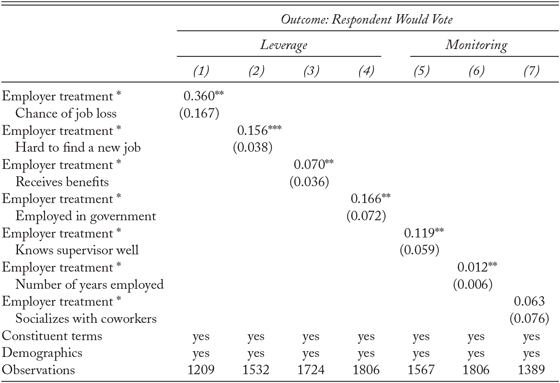
In Table 3, we group the mechanisms into two broad categories (leverage and monitoring)105 and limit the sample to respondents who receive either the employer or political party broker treatments in the experiment.Footnote 106 Once again, we collapse the data along the broker dimension, creating a binary indicator for whether a respondent receives any of the inducement treatments from an employer as broker. All models use ordinary least squares and include basic demographic characteristics as controls (age, gender, education, etc.), and we limit the sample to the employed population.Footnote 107
Examining Mechanisms: Russia Survey Experiment a

a The outcome variable is the willingness to turnout outcome (five-point scale) from the survey experiment. The sample includes only respondents who received the employer or political party broker treatment. The employer treatment collapses the data along the inducement treatment arm of the factorial design used in the experiment. The sample is limited to only those who are employed. Chance of job loss measures the probability a respondent believes he or she will lose his or her job in the next twelve months. Hard to find a new job uses a five-point scale to capture the likelihood that if he or she were to lose his or her job, a respondent could find a similar one; higher values indicate more difficulty. Receives benefits captures the number of in-kind benefits (health care, education, transportation subsidies, etc.) respondents received from their employer. Higher values on the three-point scale used in knows supervisor well indicate better familiarity with one’s boss. Number of years employed measures the length of time at one’s work. Socializes with coworkers captures whether respondents spend time with colleagues outside work. All models include the constituent terms and basic demographic characteristics (gender, age, education, size of settlement, and an indicator for government employment). Models are estimated via ols and cluster errors at the region level.
***p < 0.01, **p < 0.05, *p < 0.1
First, we observe greater effectiveness of employer-based mobilization where employers command more leverage over their workers and can make promises of future rewards and sanctions more credible. Table 3 shows positive interactions between the employer treatment and measures of respondents’ worries about losing their job (column 1) and their self-reported difficulty of finding a new job in the event of job loss (column 2). Employer-based mobilization is more effective among respondents who are more vulnerable to job loss and thus dependent on their employer. We see in column 3 that employers are more effective at mobilizing the vote among respondents who receive in-kind benefits from their workplace like health insurance, childcare, and transportation vouchers. Job loss would be more devastating for those who depend on their employer not only for salary, but also for important social services. Government employees (column 4) are also more likely to respond to workplace mobilization. Government workers who often rely on political patronage and have skills that are not transferable to the private sector would find job loss particularly catastrophic.
The right-hand columns in Table 3 show evidence for the monitoring mechanism. Finding proxies for the monitoring capacity of employers is somewhat harder, but we do find evidence that employees who know their supervisor personally (column 5) are more responsive to the employer treatment. Employers who have social ties to their employees should find it easier to learn how they vote. We see in column 6 that long-serving employees of a firm or organization are more responsive to the employer treatment. These employees are more likely to be embedded in workplace social networks, which improves the ability of employers to monitor voting behavior. Column 7 shows that we find positive but insignificant effects on the interaction with a measure of coworker socializing. The greater the density of workplace social networks, the more information on voting behavior is likely to spread.
Taken together, we find that both leverage and monitoring ability influence the relative effectiveness of employers. Indeed, Figure 3 demonstrates that the magnitudes of the effects along the two dimensions are similar. The y-axis plots the marginal effects for the employer treatment conditional on different values for indicators of leverage and monitoring. We see that employers who wield influence over citizens’ future economic security are well positioned to mobilize voters as are those in workplaces with strong social networks.
Mechanisms: Conditional Effect of Employer Treatment Across Subgroupsa

Of course, it is theoretically possible that a party could develop the strong grassroots organizations necessary to monitor voter behavior as well as, or even better than, employers. But such strong organizations are rare in much of the world while employment is a near-universal (and increasingly widespread) phenomenon. Thus, to the extent that employers have an observed advantage in monitoring, it is likely due to contextual factors. But employers do have a clear theoretical advantage when it comes to leverage. It is hard to imagine many practical circumstances in which party activists could offer the significant inducements that employers are able to deploy. For these reasons, we are left to conclude that the most general advantage of employers is their hierarchical relationship with employees.
External Validity and Related Concerns
Our results emerge from Russia and Venezuela, two undemocratic countries with recent histories of electoral subversion. That the basic findings from Russia extend to Venezuela suggests that workplace clientelism is not limited to settings with a legacy of state socialism. Nonetheless, we expect that our results may be more applicable to countries with weak legal protections for workers, a high degree of economic dependence on the state, and weak accountability mechanisms. These are topics for future research.
In addition, that workplace mobilization can only be directed at employed voters has important implications for external validity. The practice will be less useful in countries where few voters are employed outside the home. In such settings, politicians will necessarily have to rely on other brokers to reach voters who cannot be mobilized in the workplace. Practically speaking, employer-based clientelism will likely be most prevalent in middle-income countries, especially those with large public sectors.
At the same time, it is worth noting that party-based clientelism requires significant investments in mobilizational infrastructure. It is not costless to mobilize via parties. Thus, even where many voters are unemployed, politicians will find it advantageous to mobilize via the existing hierarchies of the workplace. For example, in Russia, even though only 53 percent of the adult population is formally employed, a full 10 percent of the adult population reports being mobilized by an employer during the 2016 State Duma elections. Fourteen percent was mobilized by a party activist. In Venezuela, our survey indicates that just 37 percent of the adult population is formally employed, and yet 18 percent of the total sample experienced mobilization by employers. Twentysix percent experienced mobilization by party activists. Thus, in both countries the sheer extensiveness of workplace mobilization makes the practice highly significant, even if many (or most) voters are outside the workforce. We leave for future research the question of how politicians decide whether to mobilize via parties or firms.
One key result from our study is that organizational threats by employers are especially effective, which raises a question about the degree to which employers can efficiently target their messaging to supporters given that their pool of workers may have diverse political leanings. A politically diverse workforce could make some employers less effective at mobilizing, especially since acquiring individual-level information is costly. Many firms may not confront this problem. For instance, firms operating in certain sectors draw on a (relatively) homogenous pool of workers (for example, in small towns or in the public sector). In addition, the results indicate that individualized strategies can also be quite effective in the workplace, which we interpret as evidence that employers do not mobilize their workers exclusively in the aggregate. While upper management may have difficulty gathering information and microtargeting mobilizational appeals, middle managers, line supervisors, and the like are in good positions to gather political information and to target supporters (or opponents). Indeed, evidence from Russia indicates that middle management plays an important role in mobilizing workers. In this regard, employers may be no worse than party activists at efficiently targeting their appeals.
Another topic for future research concerns the role of employment in the informal sector. Our theory and empirics focus on formal employment, but employment in the informal sector is widespread in most developing countries. On the one hand, lack of legal protections and transparency could make informal sector workers more vulnerable to pressure by those who pay their wages. On the other hand, greater flexibilities in the informal labor market could make threats of job loss less salient. Future research could profit by examining how clientelism works in the informal labor market.
Additionally, our findings come from settings with moderate levels of grassroots party organization. The extent of workplace mobilization is likely to depend on the availability and effectiveness of alternative clientelist networks. Preexisting party organizations are one such alternative. Vladimir Putin’s regime did not inherit such organizations from its predecessor, but has nonetheless built a party whose organizational capacity is considerably greater than many other ruling parties in modern autocracies.Footnote 108 We have shown that our findings are similar in Venezuela, where regime leaders have invested even more heavily in local party organization.109 But even in Venezuela, the organizational complexity of the ruling party is significantly lower than in some highly mobilizational autocracies, such as classical communist regimes. We leave it for future research to consider how our findings will apply in settings with very high levels of party capacity.
Conclusion
Our research makes several contributions to the study of clientelism. First, we hope that scholars will devote greater attention to identifying the determinants of the effectiveness of clientelism. We have many excellent studies of the prevalence of clientelism, but far fewer about its effectiveness. We find that in Russia and Venezuela, different types of brokers, appeals, and targets have different effects on voter turnout, which suggests that there is a rich menu of clientelist mobilizational strategies available to politicians whose effects we are only beginning to understand.
Second, our work joins a small but growing literature that looks beyond party brokers to consider a broader range of potential brokers, including employers, chiefs, landlords, and local notables.110 In particular, our research suggests that scholars of clientelism should pay more attention to employers as vote brokers. Much of the literature suggests that clientelism will recede with modernization, as the marginal cost of buying votes increases.111 But intimidation especially workplace mobilization, may not decline as a country industrializes. Indeed, as the formal sector expands in developing countries, electoral intimidation in the workplace may become a more common tool of electoral subversion.
This analytical turn also has implications for our understanding of how political parties develop in weakly institutionalized societies. If other avenues are available to efficiently mobilize voters, politicians need not invest in strong parties to carry the mantle.Footnote 112 Instead, candidates may rely on employers and other preexisting clientelist brokers to act as operational substitutes, thus undermining the development of strong, programmatic parties. Finally, this focus on employers has implications not only for academic studies of clientelism, but also for efforts to promote electoral integrity.113 For example, since state-dependent firms are more likely to engage in workplace mobilization, policy initiatives to reduce this practice must target the nexus of business-state relations.
Supplementary Material
Supplementary material for this article can be found at https://doi.org/10.1017/S0043887119000078.
Data
Replication data for this article can be found at https://doi.org/10.7910/DVN/YSVMS2.
Acknowledgements
We thank Aleksei Grazhdankin, Henry Hale, Alexander Hertel-Fernandez, Marko Klasnja, Holger Kern, Calvin Gardner, Scott Gehlbach, Eric Kramon, Noam Lupu, Itumeleng Makgetla, Anton Shirikov, and seminar participants at Columbia University, Georgetown University, the University of Washington, the University of Wisconsin-Madison, Yale University, the ponars annual meeting, the Southern Political Science Association, the American Political Science Association, and the International Center for the Study of Institutions and Development at the Higher School of Economics in Moscow.
Funding
This article was prepared within the framework of the hse University Basic Research Program and funded by the Russian Academic Excellence Project ‘5-100’. It was also funded by the US National Science Foundation (award number 1322732 “Collaborative Research: Voter Mobilization and Electoral Subversion in the Workplace”), and a grant from the University of Wisconsin-Milwaukee’s Research Growth Initiative.
Authors
Timothy Frye is the Marshall D. Shulman Professor in the department of political science at Columbia University and research director of the International Center for the Study of Institutions and Development at the Higher School of Economics in Moscow. His most recent book is Property Rights and Property Wrongs: How Power, Institutions, and Norms Shape Economic Coercion (2017). He can be reached at tmf2@columbia.edu.
Ora John Reuter is an associate professor of political science at the University of Wisconsin-Milwaukee and a senior research fellow at the Higher School of Economics in Moscow. He is the author of The Origins of Dominant Parties: Building Authoritarian Institutions in Post-Soviet Russia (2017). His research focuses on authoritarianism and Russian politics. He can be reached at reutero@uwm.edu.
David Szakonyi is an assistant professor of political science at the George Washington University, an academy scholar at Harvard University, and a research fellow at the Higher School of Economics in Moscow. His research interests include nonmarket strategy, political economy, corruption, and corporate governance, with current projects under way in Russia and the United States. He can be reached at dszakonyi@email.gwu.edu.