Introduction
Sex on college campuses has fascinated scholars, reporters, and the public since the advent of coeducational higher education in the middle of the nineteenth century (Eschbach Reference Eschbach2016; Horowitz Reference Horowitz1985; Lowe Reference Lowe2005; Nathanson Reference Nathanson1991; Solomon Reference Solomon1985). But the emergence of rape on campus as a public problem—a problem to be taken seriously not just by isolated victims but also by feminists speaking out on behalf of college women and, eventually, by politicians, university staff, and administrators—is relatively recent. Early research on campus rape, such as Mary P. Koss and colleagues’ (Reference Koss, Gidycz and Wisniewski1987) national study of campus sexual assault or Peggy Reeves Sanday’s (Reference Sanday1990) ethnographic work on fraternity gang rape, indicates that by the mid-1980s, scholars took the issue of nonconsensual sex on campus and its ramifications very seriously. Distinct from the mostly quantitative campus rape literature on sexual behaviors, experiences of rape, and factors associated with perpetration of and vulnerability to sexual violence, this article reveals the changing social constructions of campus rape as a public problem.Footnote 1 It does so through a detailed examination of newspaper reporting on this issue as it unfolded at Columbia University and Barnard College between 1955 and 1990. The iconic and relatively constant assumed actors have been a young woman and a man who assaulted or was alleged to have assaulted her. But around these two poles have rotated a range of other actors and institutions, from police and other judicial and law enforcement authorities, student journalists, different kinds of feminists, university faculty, student groups, university administrators, and health professionals and institutions. Adapting Joseph R. Gusfield’s (Reference Gusfield1981) classic formulation of public problem construction, we show the ways these actors and institutions have struggled over (1) ownership of how the problem should be defined and described, (2) attribution of responsibility for addressing the problem, and (3) prescriptions for what is to be done.
Our findings show how beginning in the late 1960s and early 1970s, the simultaneous swelling of the women’s liberation movement and the exponential integration of women into previously male-dominated institutions of higher education and medicine catalyzed the creation of new kinds of knowledge, institutions, and expertise to “more effectively” respond to and even reduce rape on college campuses. Before the women’s liberation movement, rape on and near campuses was understood as one symptom of the more general problem of crime in cities and the United States at large. Rape was addressed by embodied structures of masculine power such as police, campus security, and related groups as a gendered crime committed against unprotected women by implicitly racialized outsiders—people from adjacent, largely black and brown communities referred to by journalists as “hoodlums” and “thugs.” The rise of women in higher education and medicine and their development and application of feminist knowledge led to an increasingly feminist analysis of institutions and relationships. These women used the organizational and conceptual frameworks they had developed to advance women- and victim-centered resources to address rape. In doing so, they expanded the meaning of rape, in theory and practice, by establishing it as a women’s issue, just one of many forms of sexual violence, and a women’s health problem. Old constructions of the social problem were not thrown by the wayside—rape was still seen as a crime—but new constructions were layered on. Ultimately, new antiviolence theory and practice led to the institutionalization of responses to rape and other forms of sexual violence on college campuses and broadened understandings of “victims” (or “survivors”) and “perpetrators.” Whereas in the earliest period, rape was viewed as an instantiation of urban crime and thereby institutionalized within police precincts, by the early to mid-1970s, women’s centers, women’s counseling and health services, and rape crisis programs shifted the institutional sites of responses to rape on campus. Shifting ownership from the criminal justice system to these new spaces meant that new forms of knowledge and expertise became critical for attributing responsibility and prescribing solutions. Earlier formulations of the pathological criminal did not disappear, but they were no longer primarily located within the image of an implicitly racialized other. Indeed, the idea of the “perpetrator” remained, conceptualizing those who commit rape as a pathological kind of person, like a “criminal.” But now, perpetrators could be same-race acquaintances, not just black and brown strangers. Most actors continued to conceive of victims as a kind of gendered “prey,” but feminist knowledge fostered a much more structural understanding of victimization. Health and gender layered over crime and punishment to call into question assumptions about the race of those who experience and enact rape and other forms of sexual violence and fundamentally transformed how we understand rape on campus, and beyond.
Methods
Theories of social problems (Gusfield Reference Gusfield1981; Hilgartner and Bosk Reference Hilgartner and Bosk1988; Spector and Kitsuse Reference Spector and Kitsuse1977) were the seeds from which we developed the following empirical questions: What key individuals and institutions took ownership of conceptualizing rape? How did those who took ownership label and count the problem, what did they believe caused the problem, and how have these processes changed over time? What was the relationship between the ownership of definition of the problem, attribution of responsibility for its management/resolution, and prescriptions for what ought to be done? Gusfield’s formulation of public problems was particularly useful for generating questions and analyzing data as it proposes a structure for analysis of public problems as “an arena of conflict” (Gusfield Reference Gusfield1981: 15) rather than as possessing a “natural history,” as had been implied by earlier authors (Blumer Reference Blumer1971; Fuller and Myers Reference Fuller and Myers1941; Spector and Kitsuse Reference Spector and Kitsuse1977).
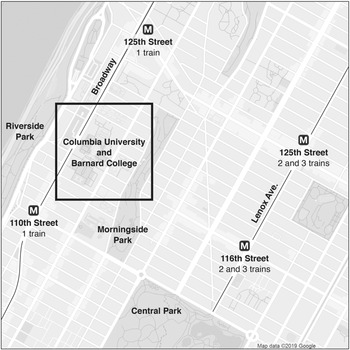
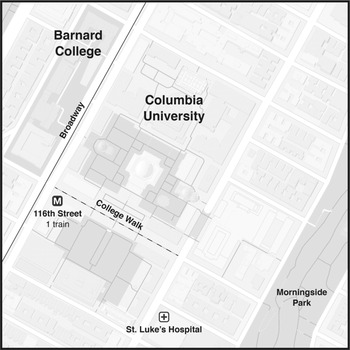
The settings for our study are Columbia University and Barnard College. Technically independent, these institutions have distinct administrations, institutional identities, and cultures. But Columbia and Barnard are also interdependent institutions, closely affiliated neighbors for more than a century: students live across the street from one another and extensively cross-register for courses, so Columbia and Barnard share both student bodies and physical spaces. Located in Morningside Heights, they neighbor Harlem, a neighborhood that, for much of the twentieth century, has been “the capital of black America” (Gill Reference Gill2011: 385) (see Figures 1 and 2). The racial and ethnic makeup of areas adjacent to Columbia and Barnard played a key role in shaping understandings of and responses to rape on campus, accounting in part for the early identification of rape as a crime committed by an implicitly racialized “other.” Also relevant to our study, Columbia’s undergraduate college began admitting women in fall of 1983, resulting in an expanded responsibility on the part of Columbia College for the well-being of undergraduate women in addition to undergraduate men (Rosenwein Reference Rosenwein1982). Our case study of Barnard and Columbia is unique in several respects: these are elite schools; they occupy an urban campus that borders a predominantly black neighborhood; and Columbia was relatively late in becoming fully coeducational. It fits nonetheless within a broad set of processes: the emergence of a kind of policing in the postwar period through the 1990s, the rise of women scholars and feminist knowledge, and the rising organizational responsibility and complexity of universities for their increasingly diverse student bodies. All these more general factors are important for making sense of the emergence and transformation of rape on university campuses as a public problem.
Harlem, in northern Manhattan, New York, where Columbia University and Barnard College are located; marked locations are referred to later in the article.

Campuses of Columbia University and Barnard College; marked locations are referred to later in the article.

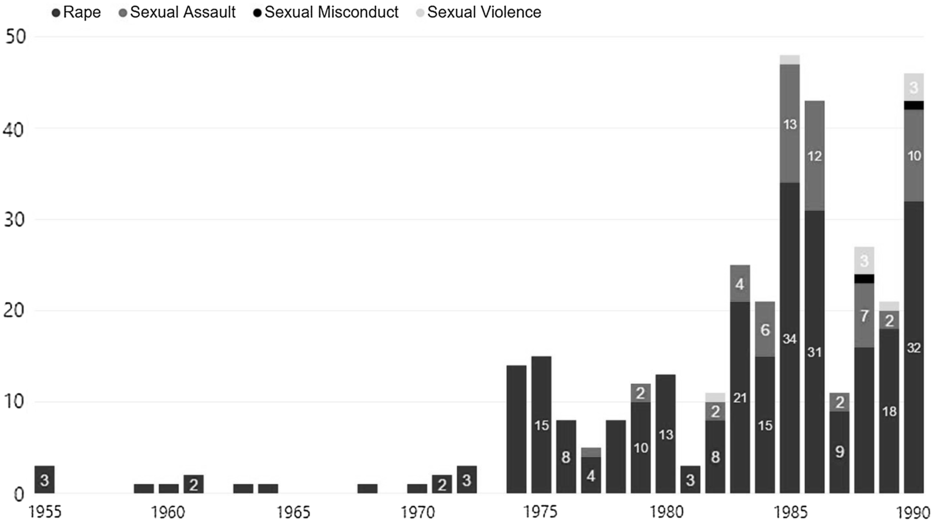
To begin answering our empirical questions, we searched thousands of articles and performed an analysis, guided by sociological theory, of the resulting 46 articles from The New York Times and 304 articles and advertisements from the campus newspaper, the Columbia Daily Spectator, henceforth referred to as the Columbia Spectator or just the Spectator. Articles analyzed contain the search terms rape, sexual assault, sexual violence, and/or sexual misconduct and were published between 1955 and August 1990 (see Figure 3). We chose to focus our analysis on articles from The New York Times and Columbia Spectator for several reasons. The New York Times is the major paper of record in public discourse in the city of New York and the Spectator has as its core purpose reporting on campus and other events of interest to the Columbia community. As such, these sources would cover those social problems that rose to the level of public problems and would capture their “arena of conflict” structures. As our analysis shows, we are attentive to not only what is covered but also what is not covered within these papers. Our start date is 1955 because that is when the first articles on rape on or near the Columbia/Barnard campus were published. And we chose August 1990 as our endpoint because in July 1990, Governor Mario Cuomo signed a law that required New York colleges to give students information about sexual assault. This moment marked a significant shift in legal requirements of colleges to provide their students with information related to rape and sexual assault on campus. A relatively new and powerful actor—the state—entered more forcefully into the mix of contestants for ownership of rape on campus, an actor with the authority to fix responsibility on colleges and universities to respond.
Columbia Daily Spectator articles containing our search terms from 1955 to 1990.

We augmented our analysis of these newspaper reports with discussions with critical actors involved in the processes of interest. This was a validity check on what we’d found, and a way for us to explore any nonreported issues. We conducted three in-depth, knowledgeable informant interviews after the majority of our textual analysis was complete, with individuals whose names we encountered in Columbia Spectator articles. These individuals were Doris Bertocci, clinical social worker at the Mental Health Division of the University Student Health Service from 1968 to 1990 and founder of the Task Force Against Sexual Assault; Temma Kaplan, historian and director of the Barnard Women’s Center from 1983 to 1991; and Eleanor Schuker, psychiatrist, former consultant to the Women’s Counseling Project in the 1970s, and a founder of the St. Luke’s Rape Intervention Program. We were unable to identify any actors involved in these processes before 1968. Limitations of our methods and sources are addressed in our discussion and conclusion.
Findings
Rape as Crime on Campus
Beginning in the mid-1950s, national and campus newspapers covered rape on and near campuses as just one symptom of broader crime problems in cities and the United States at large; rape in the 1950s and 1960s was collapsed into the larger problem of urban crime. In 1955, a Columbia Spectator series on crime in Morningside Heights (Pimsleur Reference Pimsleur1955a, Reference Pimsleur1955b, Reference Pimsleur1955c) used statistics from the Federal Bureau of Investigation (FBI) national reporting service, the New York State Department of Correction, and the 24th Precinct of the New York City Police Department (NYPD) to report that “[s]ince 1950 crime across the nation has jumped 20 per cent while the population has risen five per cent. Closely paralleling the nationwide trend, the crime rate also reached an all-time high in both the State and City of New York in 1954.… Major crimes jumped six per cent…. The major crimes, Part I offenses, or simply ‘felonies’ include homocide [sic], rape, robbery, aggravated assault, grand larceny, burglary and auto theft” (ibid. Reference Pimsleur1955b). According to a 1958 New York Times article, then police Commissioner Stephen P. Kennedy reported at a gathering of Morningside Heights residents, “This is not a bright picture … and it is not confined to your area alone. But it emphasizes most dramatically the necessity for a complete and continuing development of the Police Department and for complete and continuing cooperation between the law-abiding members of the community and the police” (New York Times 1958). The counted and perceived crime problem on campuses sparked a host of discussions about who was understood to commit crimes, relationships with neighboring communities, policing, campus security, and personal responsibility.
The understanding communicated by reporters was that the urban campus was dangerous. “Hoodlums” and “thugs,” nonstudents from adjacent communities, were portrayed as drug addicts, thieves, rapists, and murderers who were a threat to the university’s students, personnel, property, and reputation (New York Times 1958; Pimsleur Reference Pimsleur1955c). In a 1960 Spectator article on crime in Morningside Heights, student journalists described the problem in the Columbia/Barnard neighborhood relative to that in other parts of the city (Young and Cott Reference Young and Cott1960):
Crime is a problem in every urban community, and Morningside Heights is no different from other city neighborhoods. But when compared with residents of other parts of New York City, the people on the Heights are peaceful and law abiding. Captain Michael Codd of the 24th Precinct, which includes Morningside Heights as well as more jungle-like neighborhoods to the south, is an optimist. “This is a relatively peaceful and quiet area,” he told Spectator recently, maintaining that there are “no significant crime or juvenile delinquency problems” in the Community [sic].
Crimes, almost by definition, were committed by a lawless “other,” alien in his location in the borderlands represented by Morningside Park, Riverside Park, 110th and 125th streets, the boundaries between what commentators called the “peaceful and law abiding” Morningside Heights and the “jungle-like” neighborhoods of Harlem to the east and Manhattan Valley to the south. These neighborhoods had transformed as part of the Great Migration (Gill Reference Gill2011), and the words “hoodlums,” “thugs,” and the phrase “jungle-like” explicitly denigrated and dehumanized a population in Central Harlem that, in 1960, was nearly entirely black (> 95%) and in Manhattan Valley was significantly Latinx and black (38.70% and 26.15%, respectively) (Social Explorer 2018a, 2018b). By contrast, the “peaceful and law abiding” Morningside Heights includes Columbia’s campus, which in 1964 was 99.5% white (Agelasto Reference Agelasto1967). Student journalists used racialized language to imply that crimes on campus were committed not by white acquaintances, but by black strangers in neighboring communities.Footnote 2
Rape on campus and other locally proximate crime problems were taken to be within the realm of law enforcement’s expertise and responsibility, thereby acting as impetuses for policing and security solutions; these events were interpreted by the NYPD as an opportunity to extend its authority, increase its funding, and bolster its organizational capacity. The earliest articles that mention rape on campus suggest the NYPD responded to increased crime rates by asking for a bigger budget, specifically to increase the sizes of the Juvenile Aid Bureau and Narcotic Squad and to fund a larger police force, strategic patrol of the neighborhood, and foot and motor patrol of parks (New York Times 1958; Pimsleur Reference Pimsleur1955a, Reference Pimsleur1955b; Trainin Reference Trainin1963). At least some of the department’s response appears to have been prompted by residents’ requests and protests (Pimsleur Reference Pimsleur1955c). Beginning in 1970, crime in Morningside Heights began to decline according to statistics released by the 26th precinct of the NYPD and private security force Morningside Heights, Inc. Sergeant Edward Sullivan attributed the improvement to a larger police force, the work of and coordination with private security forces, and NYPD innovations: “the department now has a system where patrolmen visit neighborhood high schools each day, allow qualified citizens to take over desk jobs to free police for patrolling duties, and man a high visibility patrol of 15 men assigned to special high crime areas within the precinct” (Perrin Reference Perrin1974). Most of The New York Times’s and Spectators’s coverage of police innovations do not describe Columbia or Morningside Heights community buy-in or engagement with processes of implementation. Ownership of “crime,” including rape, on campus, attributions of causality, and political responsibility for finding solutions were concentrated in the hands of the police. Alternative voices were invisible and unheard within the public discourse and reporting of newspapers.
While the larger question of Columbia University’s expansion into neighboring communities is outside the scope of this article, it is important to note that several articles framed such expansion as helping bring law and order to a disordered and dangerous set of places (Columbia Daily Spectator 1963, 1964, 1965c). Spectator articles from 1963 to 1965 describe Columbia’s purchase of the Bryn Mawr hotel, a rent-controlled, single-room-occupancy building that housed primarily poor black people. According to Spectator writers, Bryn Mawr was “crime-ridden” (Drosnin Reference Drosnin1964a), “a center of crime on Morningside” (Dolin Reference Dolin1965). The campus newspaper covered instances of found dead bodies, probable drug overdoses, assault, bribery, attempted rape, and drug distribution, as well as twenty-four-hour police surveillance of the building in response to alleged crimes (Drosnin Reference Drosnin1964a, Reference Drosnin1964b; Shapiro Reference Shapiro1963b). Records of crimes in the building were used as justification for Columbia’s decision to shut down Bryn Mawr and pursue the court-ordered eviction of its residents (Columbia Daily Spectator 1965c; Shapiro Reference Shapiro1963a). In response, residents organized against Columbia’s full control of the building as the Tri-Community Organization in late 1964 (Drosnin Reference Drosnin1964c). Shortly after, they picketed at the New York County civil court, which was hearing the case to allow Columbia to have total control of the building and evict its residents (Mandelbaum Reference Mandelbaum1964). By the mid-1960s, Columbia’s expansion was interpreted by some students, faculty, and community members to be a racist initiative (Columbia Daily Spectator 1965a); several years before the nationally reported 1968 student occupation of Columbia’s administration building,Footnote 3 community members, activists, and journalists were engaging in conversations about and organizing against the university’s activities of purchasing properties adjacent to campus and displacing local residents who were overwhelmingly poor and not white. In February 1965, Columbia was granted control of Bryn Mawr. The judge’s decision said the former building manager failed to address crime in the residence and described Bryn Mawr as “a haven for degradation dangerous to the entire community” (ibid. 1965b). After a lengthy legal battle, Bryn Mawr was ultimately demolished to make way for new Barnard dormitories (ibid. 1966). Columbia had effectively mobilized the frameworks of crime and degeneracy to eliminate housing for the local poor black population. The resulting spatial reconstructions of the neighborhood worked with and alongside policing as a way to address and control “criminality.”
In addition to increased and innovative policing, campus-specific security developed to address the perceived campus crime problem. Mention of rape and campus security between 1961 and 1974 in the Spectator and New York Times is sparse and irregular compared to later periods. The mid-1970s saw more regular media coverage of campus-specific security efforts, particularly after two reports of dramatic crimes, both of which occurred on Sunday, October 13, 1974. The Spectator reported that at 3:30 a.m. that morning, a Columbia football player was mugged at gunpoint on College Walk, a central walkway through the mall of Columbia’s campus (Mishkin Reference Mishkin1974) (see Figure 2). Fourteen hours later, a Barnard sophomore was raped in Morningside Park (Bennett Reference Bennett1974b). A transfer student, new to the city, this woman took the incorrect train uptown and ended up on Lenox Avenue instead of Broadway (see Figure 1). At around 5:30 p.m., she walked through Harlem and Morningside Park to get to campus. On her way through the park, she was, according to her account, robbed and raped by three black men, then raped again by another black man. The woman was treated at St. Luke’s Hospital on campus and questioned by police, who “confirmed the incident took place” (ibid.), a necessary step from the police perspective, at least, in legitimizing that a crime had been committed. An article on the incident quotes the woman: “‘At first, I thought that they ought to bomb Harlem,’ she said. ‘Then I thought that maybe we all ought to be Communists, so that no one would be raised to do something like this’” (ibid.). In these accounts, the narrative of danger to women represented by “outsiders” and alien spaces into which women (innocently, inadvertently, or foolishly) strayed changed little between 1961 and 1974. Danger to a man and football player in the middle of the Columbia campus was something new.
Interestingly, a week prior to these events, the Spectator published an article titled “‘Where Evil Lurks’ Morningside Park: The Myth Approaches Reality” (Bennett Reference Bennett1974a). The article describes the dangers of being mugged or “ripped off” in Morningside Park, prompting NYPD to have the registrar’s office post a sign before orientation that read “Do not enter Morningside Park.” The article quotes Sergeant Sullivan:
“Most of the people who get into trouble in the park have taken the wrong subway uptown,” he said. He explained that the confusion arises when students take the Lenox Avenue line, rather than the Broadway Local. After they have gotten out of the train at Lenox Avenue and 116th Street, they realize their error, he said, but too many of the students then attempt to cross Morningside Park toward Morningside Heights and the Columbia campus. Sullivan said that students who mistakenly travel to 116th Street and Lenox Avenue should take the train downtown again and take the Broadway Local uptown.
The young woman who was raped in Morningside Park said she missed those warnings (ibid. Reference Bennett1974b). However well-intentioned, the warnings likely reinforced the image of Columbia as a safe space where rapes and muggings did not happen, surrounded by a “jungle” where they did, an image quickly shattered by the case of the unfortunate football player, one week later.
Following the Morningside Park rape and College Walk mugging, authors of Spectator articles, including an editorial and letters to the editor, raised questions about the quality of Columbia’s security program and officers (Columbia Daily Spectator 1974a; Columbia Spectator Editorial Board 1974; Rothkopf Reference Rothkopf1974).Footnote 4 Some who wrote in condemned security for poor coverage of campus at late night hours, which these critics understood to permit the mugging on College Walk as well as crime incidents off and near campus. Others defended the campus security system, arguing that a fraternity party diverted the attention of multiple security officers; nevertheless, they still wanted the force to be held accountable for leaving College Walk unpatrolled for at least half an hour. All agreed something must be done to protect students—men and women—and that the current system of policing was not effective at confronting the risks that surrounded them from the neighborhood outside the campus.
In late October 1974, University Security developed a study to investigate and improve placement of their officers and coordination with other unspecified security forces (presumably Morningside Heights, Inc.) and the police (Columbia Daily Spectator 1974a). The study found flaws in security, such as guards sleeping and absent from assigned posts (Janison Reference Janison1975). Structural changes were suggested in the study report, including improved lighting on College Walk and a student clerk to take care of the security office’s paperwork. The report also recommended an educational campaign to be directed at security guards and students: better training for guards, and campaigns to make students more security aware, to encourage them to lock dormitory doors and voluntarily show IDs when they enter residential buildings. Danger continued to be construed as “crime” committed by outsiders to the college, to be resolved not by changing social conditions from which “outsiders” came, as was suggested by the female rape victim cited earlier, but by lighting up the campus, presumably to prevent prowlers from lurking unseen; by changing the behavior of individual students; and by ensuring the wakefulness of their guards. Yet this represented a pivot as responsibility for such policing of crime was seen as “internal” to campus, through its security force. Further, responsibility expanded to students, who had to be educated about security and risks, and to take actions like not walking through some parks, locking their doors, using their IDs, and becoming increasingly aware and vigilant.
Cracks in the façade of institutionalized masculine hegemony, particularly police and campus security, over the problem of rape on the Columbia campus continued to expand in 1980, precipitated by a second high-profile rape of a Barnard student in October of that year. This time, the victim was not somewhere “dangerous”; she was raped in her dorm room by a stranger who had followed another resident into the building (Savitt Reference Savitt1980a). Similar to the 1974 mugging on college walk, this incident demonstrated, for many, the potential danger of life on an urban campus and the need for vigilant campus security systems. In response, Barnard temporarily increased its security budget and implemented new security measures, including a twenty-four-hour desk attendant and uniformed guards (Savitt Reference Savitt1980a, Reference Savitt1980b). Unnamed temporary “security consultants” were hired to study crime and security at Columbia and Barnard to make recommendations for improved campus security operations. Residential Life Staff (1980) demanded that these independent consultants collaborate with students throughout their study and that Columbia security collaborate with students once the consultants released their recommendations. The woman who was raped and the Editorial Board of the Spectator, 25 percent of whom were women, demanded a permanent increase in campus security, expressing frustration that the school wasn’t willing to commit to a larger budget and increase stationing of guards for longer than a semester (Columbia Spectator Editorial Board 1980; Zimmerman Reference Zimmerman1980a). The Columbia Spectator Editorial Board (1980) wrote: “It seems that whenever Barnard is faced with a shortcoming, the official response is usually one that serves the school’s image more than the students’ needs.” Security guards also criticized Barnard for its lack of a comprehensive security policy, mismanagement and poor supervision, and not enough personnel to provide adequate security services (Zimmerman Reference Zimmerman1980b). The unnamed consultants and a student committee they worked with ended up recommending twenty-four-hour guards in Columbia-owned housing, dormitory identification cards, installation of phones with panic buttons linked to campus security, better lighting, and improved grillwork on gates (New York Times 1981). It’s not clear how other students responded to these specific recommendations, but their implementation, particularly the installation of emergency phones at Barnard, garnered criticism from at least one Spectator journalist, a Barnard student, who reported that these phones had never been used or evaluated as of September 1982 (Trabitz Reference Trabitz1982). Nevertheless, rape had burst the bonds of its exclusive ownership by the male-dominated forces of law and order and entered a new realm of contested meanings advanced by a more diverse set of actors, including, in particular, outside “experts” and students. Rape had become a broader arena of struggle.
Rape as Structural Violence against Women
In the early 1970s, women students, faculty, and staff began to more forcefully use their positions and voice their interests in the developing discourse on rape. Their way was prepared by the feminisms that emerged throughout the country in the late 1960s and early 1970s and by profound, highly contested shifts in the social and legal construction of gender that accompanied legal victories for women’s autonomy in Griswold v. Connecticut and Roe v. Wade. As in other parts of the United States, women at Barnard and at Columbia’s gender-integrated graduate and professional schools formed consciousness-raising groups and issue-specific committees (Kaplan Reference Kaplan2017; Rosenberg Reference Rosenberg2004).Footnote 5 Over time, those groups mobilized to become organized centers of activism, addressing a range of “women’s issues,” including rape and sexual violence more broadly.
While some women’s liberation feminists were silent on issues of race, black feminists were highly active and had some influence at Barnard and Columbia, including on issues of sexual violence. Celestine Ware, for example, was one of the first critical authors of work on abortion and a founding member of New York Radical Feminists; this group actively engaged with Barnard College affiliates on a range of issues related to race, gender, and sexuality. And women like Florynce Kennedy, a lawyer, civil rights activist, and feminist speaker, worked with and at times against Columbia University to enact a series of reforms on issues similar to those of concern to Ware. Kennedy had graduated from Columbia’s School of General Studies in 1949, and its law school in 1951. The Barnard Organization of Soul Sisters (BOSS) was established in 1968 by a group of black women students who wanted to improve the quality of life for black students. BOSS was not initially a self-identified feminist organization, but they consistently advocated for black and “Third World” women and called upon Barnard to address racism and sexism on campus, including harassment at the hands of campus security. While some feminist voices on campus were primarily concerned with the experiences of the more abstracted sense of “women,” which in practice largely meant white women, black feminist and civil rights leaders such as Kennedy, Ware, and members of BOSS also raised a more intersectional consciousness within the growing concern of “violence against women” and its relationship to state violence against blackness.
The year 1971 marks the first Spectator coverage of antirape work framed as a question of women’s liberation, not as a police matter. The occasion was the 1971 “Women’s Liberation Conference” organized by Barnard and Columbia Women’s Liberation and a collective of feminist groups in New York City called Women’s Strike Coalition (Robinson Reference Robinson1971). At the conference, a workshop on rape and sex crimes was held side by side with workshops on family, women and war, and self-defense. The day also included opening speaker Florence Luscomb, a former suffragette, who argued that the women’s liberation movement could not be understood without understanding past women’s movements. The closing speaker, Kate Millett, author of Sexual Politics and recent graduate of the English and comparative literature PhD program at Columbia, argued that the sexual revolution needed “to change the situation of male domination and female subordination. To undermine patriarchy, you must undermine the basic structure on which it is built—the basic construct of masculine and feminine” (ibid.). Feminist women offered an understanding of rape that was radically different than that of the police commissioner or sergeant cited earlier, and their solutions were framed more around revolution than the restoration of law and order.
The solutions advocated by Columbia and Barnard’s organized women’s groups at that time were considerably tamer than the revolutionary language at the Women’s Liberation Conference would suggest, and they did nothing to disrupt the notion that rape on campus occurs at the hands of strangers in the night. Following the 1974 Morningside Park rape incident, numerous rape prevention events were held on campus. A karate demonstration event at Barnard along with films and other educational events were sponsored by the Ad Hoc Committee on Rape, the Women’s Counseling Center, Barnard Women’s Center, and Barnard’s activities council (Columbia Daily Spectator 1974b, 1975a, 1975b; Laks Reference Laks1975). These events, each hosted by institutional centers, committees, and councils, provided women with self-protection reminders and skill-building resources. By implication, these events claimed ownership of rape as a women’s issue. This was both a critical and an unfortunate outcome, first requiring the reinscription of women as victims of sexual violence, then simultaneously “empowering” women and making them responsible for their own protection.
Placing rape prevention in the hands of women, particularly students, was a type of highly individualistic “empowerment.” Self-protection and skill-building events for women were, as Catherine Jacquet (Reference Jacquet2016) has argued, a reclamation of agency and power by training to physically resist and retaliate against gender-based violence in ways that do not rely on an institution or the state. Training women in martial arts, advocating militancy and self-sufficiency for women was radical at the time. According to Maria Bevacqua, the idea was that “through the practice of self-defense, women might reverse or resist their socialized passivity and dependency on men, which contribute to the problem of rape” (Bevacqua Reference Bevacqua2000: 67) on an individual level. In this sense, these events supported the shift in power around the issue of rape from more patriarchal institutions like policing to women both as individuals and activists. In this sense, they represent both the empowerment of women and the thinking of classic post-1960s liberal feminism. Critically, such empowerment was often located within the individual. Situating responsibility upon the potential victim was a far cry from overturning of the patriarchy, a core theme and ambition of the Women’s Liberation Conference. Indeed, this approach can be read as perpetuating a long-standing, highly problematic tradition of placing the burden for regulation of sexual conduct on the woman (Nathanson Reference Nathanson1991). It further did not consider how presenting the risk of rape as protecting women from an implicitly racialized “other” had intersectional impacts on women of color, queer people, or others. The Spectator and New York Times do not report any comparable events or campus resources for undergraduate men, at that time the exclusive denizens of Columbia’s undergraduate college. Presumably, undergraduate men were not regarded as “at risk,” either as victims or as those who might commit assaults. Questions of sexuality and the potential for women to commit assaults and/or same-gender assault were rarely raised, which is why they are not addressed in this article. Seeing as these events were occurring at the same time as calls for the improvement of campus security, we understand them to be simultaneously reclamations of power and replications of an old tradition of allocating the burden of sexual assault prevention on women.
Two of the centers that hosted skill-building self-protection events, the Barnard Women’s Center and the Women’s Counseling Project, were formed in 1971, only a few years prior to the antirape events described in the preceding text, to serve the needs of women at Barnard and beyond. In 1971, the Task Force on Barnard and the Educated Woman recommended the formation of a Barnard Women’s Center, “to combat injustices against women and explore the existing societal myths about masculinity and femininity” (Hochberger Reference Hochberger1971). The Women’s Counseling Project was formed as a resource for birth control and abortion-related information for students and community members, but ended up providing counseling for a wide range of women’s issues (Columbia Daily Spectator 1971). While neither of these groups was formed to address rape and other forms of sexual violence, both provided resources related to sexual violence to women on campus, including educational programming as a form of rape prevention. These organizations, the women who both helped found and participated within them, and feminist scholar/activists began to frame rape as a women’s and women’s health issue. And in doing this work, they initiated the struggle over ownership of the definition and description of the problem of rape and other forms of sexual violence, attribution of responsibility for addressing it, and prescriptions for what ought to be done.
Rape as a Women’s Health Issue
In 1976 as in 1974, women’s activities of resolution were triggered by incidents of rape on the Columbia campus. Prompted by the trauma experienced by a student who was raped by a “knife wielding attacker” (Van Buskirk Reference Van Buskirk1977) on campus in the summer of 1976, the Women’s Counseling Project and neighboring St. Luke’s Hospital joined together in July 1977 to establish a rape crisis center. By this time, there were rape crisis centers in most states (Bevacqua Reference Bevacqua2000). According to a 1977 Spectator article, “a group of concerned community members is now aiding as many as 15 persons a month through the after-trauma of a forced sexual attack. Dr. Eleanor Schuker, attending psychiatrist at St. Luke’s Hospital and the Columbia Health Service, estimated that, ‘Of the 10 to 15 victims treated each month at the hospital, 10 to 20 per cent are Barnard students’” (Van Buskirk Reference Van Buskirk1977). The St. Luke’s Rape Intervention Program, now in 2019 called the Crime Victim’s Treatment Center, addressed rape as a women’s health issue by providing advocacy services to emergency room patients—students and nonstudents—who had been raped and training to advocates and health care providers (Schuker Reference Schuker2017). Volunteer advocates included women from Barnard, the Barnard Women’s Center, and the Women’s Counseling Project, who perhaps found out about the volunteer opportunity through Dr. Schuker herself or through advertisements placed in the Spectator (Columbia Daily Spectator 1979, 1980).
The Rape Intervention Program’s establishment marked a new era of faculty, staff, and women students’ engagement with the question of rape. While the program’s focus was primarily rape and its bodily and psychological sequelae, program staff and volunteers encountered cases of assault, harassment, and abuse as well. This experience shaped Dr. Schuker and her colleagues’ understanding of rape, harassment, abuse, and stalking as interrelated forms of sexual violence, bound together by the roles of gender and power in their enactment. Cases of sexual violence also forced attention to the possibility of violence from within the campus, as well as from outside. The traumas resulting from these experiences were understood, by Schuker at least, as addressable through mental health care (Schuker Reference Schuker2017).
In 1980, three years after the formation of the Rape Intervention Program and three years before Columbia College became coeducational, Columbia established a Task Force Against Sexual Assault (Bertocci Reference Bertocci2017b). The task force was the brainchild of clinical social worker Doris Bertocci at the Mental Health Division of the Columbia University Student Health Service. Its members included Columbia and Barnard administrators, faculty, students, and representatives of the Rape Intervention Program of St. Luke’s and Roosevelt Hospital (Lee Reference Lee1990; Lynch Reference Lynch1984a). The task force’s aim was to address the problem of “sexual abuse on campus” (Bertocci Reference Bertocci2017b), meaning that “committed by/experienced by Columbia/Barnard students either on or off campus/university property” (Bertocci Reference Bertocci2017a).Footnote 6 The timing of its invention, its membership, its stated aim, and the activities undertaken all support two inferences: that the concept of sexual violence, which includes rape, had a foothold outside of the feminist antiviolence movement and that this task force was not created in response to an epidemic of stranger rape, but to a new consciousness on the part of at least some members of the Columbia community that there was a danger within. Rape and other forms of sexual violence—assault, stalking, and abuse—were sometimes attributable to members of the campus community and the university more generally as a gendered institution, not solely to strangers from neighboring places and spaces.
Though the work of the task force in the 1980s was less explicitly feminist than antiviolence work at Columbia and Barnard in the 1970s, we might better understand shifts in perceived dangers to women by contemplating Barnard’s 1982 “Scholar and Feminist” conference and its historical context. Interestingly, this event did not show up in our article search, but the now famous conference was hosted by the Barnard Women’s Center between the Task Force Against Sexual Assault’s creation and its first programs. That the conference was not covered by the Spectator but has such significant meaning in retrospect is of interest both on substantive and methodological grounds. Methodologically, it points to the selection process of media producers and importance of augmenting official document searches with other sources. Substantively, it suggests the existence of multiple schools of thought and activism in feminist antiviolence movements—some involving faculty, some involving community members, some involving students, and some involving combinations of all three. And, as in most movements, these multiple constituencies’ ideas and approaches did not always align.
The conference on sexuality, led by Carole Vance, was a boiling point in the American feminist “sex wars.” According to Vance (Reference Vance1992), as the New Right latched onto issues related to (women’s) sexuality (e.g., abortion, teen pregnancy, single motherhood) as part and parcel of their broader “moral” agenda, the theoretical and political possibilities for understanding and expanding women’s sexuality narrowed. Some feminists, particularly antipornography feminists, further narrowed these possibilities, putting forth a “grandiose and overstated,” “monolithic account” (ibid.: xviii) of pornography and other sexist medias’ promotion of sexual violence. The 1982 “Scholar and Feminist” conference set out to recenter thinking about the tensions between pleasure and danger in women’s sexuality, which women’s liberation feminists had set out to do over a decade earlier (ibid.; Echols Reference Echols2016). A committee of twenty-nine feminists spent almost a year planning the event. Just days before the conference, antipornography feminists called Barnard administrators and trustees to protest what they believed to be “antifeminist” views espoused by “sexual perverts” (Vance Reference Vance1992: xxi). Barnard administrators confiscated the conference diary that was to be disseminated to attendees. The antipornography feminists continued their protest outside of the conference, handing out literature that condemned the conference and individual organizers. The conference carried on, with presentations and workshops on schools of feminist thought and practice, state regulation of sexuality, sexuality in children, and more. According to Alice Echols (Reference Echols2016), in its aftermath, the conference provided a framework for expanding definitions of positive sexuality and womanhood to include consensual sexual “transgressions.” The conference was critical to expanding consciousness that rape does not only happen at the hands of strangers and that people should not be held responsible for preventing their own experiences of sexual violence. Yet, while critical to that feminist intellectual moment—and with important consequences for the structure of the university because of faculty engagement—the Barnard conference seems not to have had an immediate impact on student discourse about rape and other forms of sexual violence at the time; this contribution went unreported in the student newspaper.
While this conference was a radical episode, the day-to-day institutionalmanagement of campus rape remained, predictably, fairly tame. The standing Task Force Against Sexual Assault largely confined its actions to education and research. It aimed to be a central source of information about sexual assault on campus and to coordinate information dissemination with campus security and police (Lynch Reference Lynch1984a; Zeiger Reference Zeiger1983). As described by its founder, Doris Bertocci (Reference Bertocci2017b), the task force collected data on sexual assaults, made students aware of rape and counseling services, and developed antiassault programming, such as brochures on campus safety and trainings for faculty and staff on how to counsel students who are assaulted. Bertocci and her colleagues developed a public health program that made sexual assault of members of the campus community a responsibility of the university, expanding its purview beyond protective services to include sexual health services as well. The task force, in effect, took partial ownership and responsibility for understanding and addressing sexual assault on campus, and through data collection and analysis worked to determine who else should be responsible for addressing the problem and what they ought to do to prevent it.
The task force’s first major action was the creation and distribution of a pamphlet, “Campus Alert,” which contained information on assault risks and resources (Columbia Daily Spectator 1983). “Campus Alert” was published in September 1983, the month Columbia College welcomed its first coed class, though this should not necessarily be taken to indicate coeducation was the driver of the pamphlet’s publication; in the spring of 1984, the Spectator reported disagreement between Columbia administrators about whether coeducation was a driver of shifts in responses to campus sexual assault (Lynch Reference Lynch1984b). The pamphlet was available at Columbia and Barnard’s health services and included a “liberal definition” of rape, emergency phone numbers, a list of health and counseling resources available to people who experienced assault, and a call to report assaults to the task force using an anonymous, confidential questionnaire (Zeiger Reference Zeiger1983). “Campus Alert” signaled that the “campus” could no longer be considered a totally safe space. While fifteen to twenty years earlier, “acquaintances” were not considered capable of committing rape, in 1983, peers around campus were recognized as a source of risk to women. The publication of “Campus Alert” also indicated that the university would take some responsibility for collecting data and disseminating information on rape experienced by its community members.
The second major action of the task force covered by the Spectator was solicitation of confidential reports of sexual assaults on campus from health services, the Office for Student Services, and St. Luke’s, and dissemination of its findings to the Columbia/Barnard community through an official report, an announcement to Columbia and Barnard students, and mandatory dorm meetings (Lynch Reference Lynch1984a, Reference Lynch1984b). According to the Spectator, members of the task force hoped that the anonymous, confidential questionnaire would help them collect data to better understand the problem of rape on campus in order to prevent it, as well as make those who had experienced sexual assault and rape aware of counseling services available to them on campus (Zeiger Reference Zeiger1983). This is the Spectator’s first mention of data collection and information sharing as a strategy to address rape. In April 1984, the task force released an announcement that nineteen Columbia affiliates were assaulted between January 1983 and February 1984 (Lynch Reference Lynch1984a). Two of the 1983 assaults were reported by men who had been assaulted and six of the assaults were committed by acquaintances. The announcement noted that numbers reported were much lower than the actual incidence of assault, though it’s not clear on what basis this claim was made. The announcement also noted that data did not indicate an increase in assault since Columbia College went coed in September 1983. Descriptions of the task force’s findings were posted as leaflets on campus and published by the Spectator with the intention of increasing awareness of the problem of sexual assault and debunking myths about it, for example, that people who commit sexual assault are strangers to victims and that men can’t be raped. The report was also discussed at mandatory dorm and fraternity meetings led by Jane MacDonald, the Columbia College assistant dean for residence halls, and a campus crime prevention officer (ibid. Reference Lynch1984b). Students took this time as an opportunity to ask why they hadn’t heard about these assault incidents sooner—some of the information wasn’t available until the task force solicited it—and criticized campus security for not being alert, professional, or physically fit to ensure the safety of people on campus. This was a hybrid moment, where responsibility was located both with policing and with self-empowered students: students demanded more effective security and access to information to take responsibility for their own safety. These information frames seem to emerge as higher education, rape crisis, and mental health professionals suggested that policing can’t do it all.
The Task Force Against Sexual Assault’s third major action was the January 1985 publication of an eleven-page report containing recommendations for addressing sexual assault issues on campus (Oswald Reference Oswald1985a, Reference Oswald1985b). The report recommended a permanent Health and Safety Project that would develop educational programs and distribute materials to prevent sexual assault, consistent with the task force’s approach to addressing sexual assault as a public health problem. University administrator Vice President for Student Services Robert Cooper established a Health and Safety Project led by Doris Bertocci (ibid. Reference Oswald1985b). Some task force members were frustrated by Cooper’s decision as they believed he wasn’t hearing the task force’s recommendation that an outside expert was needed because no one at the university had the necessary time or expertise to effectively staff the project. In our interview with Doris Bertocci (Reference Bertocci2017b), she described Cooper as trying to sweep the issue under the rug by placing all responsibility for campus rape with the Mental Health Division of Student Health Services. We were unable to interview Robert Cooper about the Health and Safety Project.
In early 1986, the task force’s public health work collecting data on sexual assaults became difficult as St. Luke’s decided to stop giving information on assaults to the task force (Just Reference Just1986). Ellen Doherty, coordinator of St. Luke’s Rape Intervention Program, explained to a Spectator journalist that her staff voted to stop releasing information to the task force after three years because they felt it might compromise patient confidentiality. Further, they claimed not to have agreed to supply information on assault indefinitely. According to the same article, Bertocci was frustrated with the program’s decision because it conflicted with the task force’s purposes, which were to receive information, compile reports, and help students take the problem of sexual assault seriously. At the time, Bertocci expressed concern, “Prevention efforts may be affected by the non-cooperation” (ibid.). In a letter to the editor, Doherty (Reference Doherty1986) explained the Rape Intervention Program’s decision: “We supplied the Task Force with information to help them establish that sexual assault is a health risk at Columbia. Indeed under New York State Law, rape is not a crime that must be reported to anyone. If the Task Force wants information, and if Columbia students, faculty and staff wish to supply it, such a system can be developed.” She assured readers that the Rape Intervention Program would continue to provide services.
The task force is not reported as attempting to develop such a system for collecting data on assaults until April 1990. It was then that the task force piloted a survey questionnaire at a Columbia-Barnard Take Back the Night rally, which at that time only allowed women to participate (Lee Reference Lee1990). Three hundred questionnaires were used to help the task force develop a more extensive survey that was to be distributed in the fall of 1990. Student representatives from Take Back the Night, Columbia College Women’s Center, University Residence Halls, and the Engineering Student Council worked with the task force and then assistant professor of sociology Eric Hirsch to develop the questionnaire. This pilot was meant to solicit feedback on questions and identify potential biases, with a larger survey planned for the near future. According to a Spectator article, Director of Health Education Ann Williams, a former nurse and Columbia doctoral student who began working with the task force shortly after she was hired in 1985 (Pomper Reference Pomper1986), explained that development of the survey was prompted by both outside forces and the task force’s own belief in the importance of collecting data on sexual assault. Outside forces included the New York State Governor’s Task Force on Rape and Sexual Assault, which asked some New York schools, including Columbia, to keep statistics on sexual assault and eventually developed legislation that required colleges to give students information about sexual assault (Fermaglich Reference Fermaglich1990; Shimkin Reference Shimkin1990). Again, Governor Mario Cuomo signed this legislation into law in July 1990. There is no record in the Spectator of the Columbia-Barnard Task Force finishing development and distribution of the more extensive survey.
By its establishment and actions, the Task Force Against Sexual Assault signaled that exclusive ownership of sexual assault on campus by the forces of “law and order” would no longer go uncontested, so too with the image of the campus as a safe space surrounded by an urban “jungle.” The possibility of those near and within committing violent acts was, for the first time, seriously acknowledged. Individual women staff and faculty led acts of innovation, such as the establishment of St. Luke’s Rape Intervention Program and the task force. Spectator articles and our conversation with Doris Bertocci indicate that the level of institutional support for the task force’s work was mixed. The university did not openly argue with the task force’s recommendations, nor with what students wanted to know about incidents of sexual assault, where and when they were happening on and near campus. But university administrators could and indeed did situate the task force’s longer-term recommended strategy, the Health and Safety Project, in the Mental Health Division of Student Health Services, arguably depoliticizing sexual assault as a mental health problem (implicitly the problem of health professionals and the assaulted) rather than a gender-stratification problem. One could also understand this, however, as a more survivor-centered approach, focusing on healing and wellness. Regardless, the responsible actors, the relevant knowledge, and the institutional obligations had all begun to fundamentally transform.
Discussion
The most marked and consequential change in understandings of rape at Columbia and Barnard as portrayed by Columbia Spectator student journalists was the movement of sexual danger, or the perception of danger, from outside the campus to within it, accompanied by a two-dimensional shift in the perceived identity of the causal agent, from stranger to acquaintance and from marked black to unmarked. Danger within presented far more complex problems of resolution than danger from outside. This movement, amounting to the erasure of imagined boundaries between safe and unsafe spaces, was accompanied by a significant expansion in claims to ownership of rape as a public problem and in prescribed and actual activities of resolution. The category of “rape” was transformed from being solely a criminal problem to both a criminal problem and a subcategory of the more general problem of sexual (or gendered-based) violence. This expansion was shaped by events and understandings of those events in the world outside of Columbia and Barnard, as well as within its boundaries.
Rape in the 1950s and 1960s was collapsed into the larger problem of urban crime. Ownership was asserted by the criminal justice system, and rape in the neighborhood of Columbia/Barnard was framed as requiring a build-up of external police force along with internal security. This framing began to change, albeit slowly, with the emergence of women’s liberation feminisms, signaled most prominently on the campus by the “Women’s Liberation Conference” in 1971. Strikingly, however, the initial translation of feminism into new claims of ownership and responsibility was largely individualistic: rape was framed as a problem that women as individuals and potential victims must be educated and equipped with skills to confront and as a health problem owned by medical and mental health professionals, most of whom were women. Patriarchy and women’s subordination frames were not invoked as useful for addressing rape, at least not as portrayed by Spectator student journalists. Violence continued to be construed as emanating from outside the campus, from implicitly racialized black and brown strangers. Those few black feminist voices like Celestine Ware, Florynce Kennedy, and BOSS, who were actively raising racial and intersectional concerns, were overwhelmingly sidelined and mostly ignored.
Not until the early 1980s did there begin to be inklings of a “perpetrator” within and of rape as a more structural and institutional problem of patriarchy, signaled by the establishment of a university Task Force on Sexual Assault aimed at addressing the problem of “sexual abuse on campus.” From that time forward, the imagined location of danger, previously outside the campus, was also within. This period in the mid-1980s also marked the mushrooming of ownership claims: first, the entry of the university as a major actor and claims maker in the field of rape on campus; second, a proliferation of task forces and committees initiated by other university-based actors; and third, the beginnings of state regulatory intervention.
Our analysis reveals the emergence of contention over the relevant expertise required to explain and address rape on campus. In the 1950s and 1960s, criminal law and police experience were critical to understanding and addressing rape. An intersectional analysis is particularly helpful here. Those who committed assault were imagined not as socially proximate men, but instead as pathological criminals who might jump out of bushes to attack their unfortunate victims. These men, particularly within our context of Morningside Heights, were from the surrounding “jungle-like” communities of Harlem and Manhattan Valley. They were best addressed within a “law and order” framework. Such an approach allowed for no real conceptualization of rape as something that could happen within “normal” intimate relationships or among peers, nor was there a great deal of attention to the experience of the person attacked. One could do little to address this experience other than tame the “jungle.”
This perspective was challenged by black feminist scholars and activists, but their impact was limited as other actors—institutions, white feminists, and some antiviolence activists—did not engage their critiques and insights. Yet the perspective eventually changed with the emergence of feminist scholars, activists, and women’s health professionals who reframed rape not simply as a problem with a racialized “other” whose pathology victimized women, but instead as a women’s problem, one of the many forms of sexual violence, and a health problem. Rape shifted from strictly a problem of violent men to primarily a problem of women-victims in need of medical attention, counseling, and lessons in self-protection. Instead of passive victims of outsiders, women were imagined to be individually and collectively empowered. Such transformations were located both in health institutions that claimed medical expertise and formally organized women’s centers that promoted a kind of localized women-centered knowledge. By the mid-1980s, sexual violence had pivoted from being a problem of pathological criminals to, potentially, a “normal” problem of everyday relationships and contexts that were marked by patriarchal institutional structures. The understanding of a “perpetrator” who commits such violence as a kind of pathological person would still strongly remain, even to this current day. Yet as the perpetrator shifted from an implicitly racialized outsider to acquaintances, police knowledge became less central to the expertise necessary for the management of sexual violence.
We understand this transformation from the perspective of field construction. Over time, we witness the creation of multiple overlapping social spaces for the discussion of rape on campus, spaces that attracted an ever-increasing number and diversity of actors: police, campus security officers, health care professionals, university administrators, faculty, staff, and students. These actors occupied “several distinct social worlds” (Star and Griesemer Reference Star and Griesemer1989: 388), but were increasingly constrained to come together in institutional centers, task forces, committees, and the like. Our analysis makes clear that these actors by no means invariably shared the same understanding of the problem that they meant to address. The fact that student reporters ignored the critical Barnard conference in the 1980s reflects this phenomenon. How then did these different constituencies communicate with each other and, even from time to time, cooperate? We suggest the usefulness of conceptualizing rape as a “boundary object.” Boundary objects may be concrete, material objects, for example, a stuffed bird in a natural history museum, but equally they may be theories or ideas; they are defined not by their materiality but by their status as an object of common action: “they have different meanings in different social worlds but their structure is common enough to more than one world to make them recognizable, a means of translation” (ibid.: 393). A boundary object is subject to a high level of interpretive flexibility as it moves rhetorically and otherwise within its local field of action. In other words, the critical actors working to address rape may use similar language to describe the problem, but what they mean, both cognitively and emotionally, may be quite different. The concept of rape and the broader, more loosely structured concept of sexual violence enable communication without pinning individual actors down to specific viewpoints. Such “categorical ambiguity” (Khan et al. Reference Khan, Hirsch, Wamboldt and Mellins2018) can be socially productive, especially in a shifting terrain of understanding and institutional responsibility.
There are four major limitations to our work. First, Columbia College became coeducational in 1983. We say little about the impact of this event on attention to rape because little specific, identifiable impact was reflected in our principal source, the Columbia Daily Spectator. Second, Columbia University and Barnard College are not representative of colleges and universities in the United States. They are elite urban campuses. Although we believe that the social processes we describe are likely to have occurred in some form or other on other campuses, their details may well be entirely different. Third, we do not describe the emergence of sexual harassment as a public problem, in part because at Columbia and Barnard during our period, harassment’s conceptualization and management were distinct and institutionally separate from those of rape. Fourth, our empirical focus on the Columbia Daily Spectator, supplemented by articles from The New York Times and by interviews with three central participants in the events we describe, has critical limitations. Such an analysis privileges the voices and perspectives of journalists and what editors chose to publish, as well as the perspective of powerful institutionally positioned actors. So there are important voices missing from our story: those who were not publicly involved in managing or shaping the management of rape, and those whose voices were ignored or marginalized by the Spectator. Though we have tried to bring in some of these voices, our narrative cannot capture behind the scenes or marginalized work, in part because our focus is on the public emergence of campus rape as an ever-shifting social problem.
As an implication, both the substantive history of sexual violence on college campuses and its theoretical unravelling would benefit enormously from comparative research across a more diverse and representative range of college campuses. Equally important would be presenting the fuller range of voices and perspectives that brought rape to light as a public problem and proposed what might be done about it. Finally, since 1990, when we end our own story, public controversy around sexual violence on campus and elsewhere has increased immeasurably, and the voice of the state has entered into these controversies in significant ways. Our narrative and theorizing would benefit from being brought up to date in light of the history we have already provided.
Conclusion
The goal of this article has been to trace the history of a public problem—rape on and around the campuses of Columbia University and Barnard College in New York City—and to delineate how the parameters of this problem shifted over time as new voices took up the problem and new meanings emerged. Our aim, in contrast to the bulk of a very large literature on sex on college campuses, was not to document students’ sexual behaviors, but to show how rape was imagined and managed on one large urban university campus. We bring systematic, cross-disciplinary historical and sociological perspectives to bear on questions that have been highly mediatized in recent years: the meanings of sexuality in academic settings, the allocation of responsibility for its management, and the identity and social location of “perpetrators” and “victims.” Pieces of this history have been told before (Bevacqua Reference Bevacqua2000; Sanday Reference Sanday1990), but they have remained disconnected and undertheorized. Conceptualizing our story as an account of changes in who is identified as “owning” the problem of sexual violence on campus, what causes the problem, and who is tasked with solving it has enabled us to demonstrate how actors, actor categories, and forms of knowledge and expertise are layered over time such that old actor categories and prior understandings did not wholly disappear, but were added to and elaborated as new actors entered the scene, complicated it, and asserted new forms of expertise. Perhaps most striking was the layering and to some degree supplanting of the white, masculine, heterosexual voices representing “law and order” that dominated the early period of our narrative by those of women and—more muted in our story—black feminists. Ultimately, the work of these feminists and health professionals, their interrogating assumptions about sexual violence on campus and race of those who experience and enact it fundamentally changed how we understand rape on campus, and beyond.
Acknowledgments
The project described was supported by Award Number P2CHD058486 to the Columbia Population Research Center (CPRC) from the Eunice Kennedy Shriver National Institute of Child Health and Human Development. We gratefully acknowledge CPRC and the Columbia University Institute for Social and Economic Research and Policy for funding this project. We would like to thank the many people who have provided incredibly valuable feedback on our study and article from its earliest to final stages: Merlin Chowkwanyun, Jonathan R. Cole, Matthew Desmond, Gil Eyal, Eric Hirsch, Jennifer S. Hirsch, Myra Marx Ferree, Adam Reich, Eleanor Schuker, Harriet Zuckerman, and members of Shamus Khan’s advisee group. We are grateful for the support of the Sexual Health Initiative to Foster Transformation, which was funded by the Office of the President of Columbia University from multiple sources. We thank, in particular, Leigh Reardon for her extensive administrative support. We are also thankful for the help of Karel Vollrath and J. Dakota Brown in developing this article’s figures. And finally, we thank the anonymous reviewers whose feedback was crucial to strengthening our analysis.