


1. INTRODUCTION
In mainstream phonological theory, the observation that syllables tend to start with a consonant has achieved the status of a universal restriction whose validity is generally taken for granted. In its most frequently employed formulation, this requirement takes the form of an Optimality Theoretic (OT; Prince & Smolensky Reference Prince and Smolensky1993) constraint Onset. A common formalization of Onset, which punishes syllables that begin with a vowel, is given in (1).
(1) Onset (Kager Reference Kager1999: 93)
*[σV
In many languages, this constraint is unviolable except in word- or phrase-initial position. An example of this pattern is given in (2).
(2) KiKerewe (Odden Reference Odden1995: 90)
ebi-tooke ‘bananas’ ebi-a-la >eby-aala ‘fingers’
omu-tima ‘heart’ omu-aga >omw-aaga ‘compulsion’
In KiKerewe, glide insertion prevents onsetless syllables word-medially, but nothing prevents them in initial position. Similar patterns occur in numerous other unrelated languages (see Smith Reference Smith2002).
The Onset constraint is generally assumed to have prosodic motivation. When onsetless syllables occur, they often appear to suffer from some sort of prosodic deficiency (e.g. Downing Reference Downing1998). For example, onsetless vowels may not be counted for prosodic processes such as reduplication, stress, and tone. Many authors therefore assume that vowel-initial syllables are somehow ill-formed. As we shall see, however, these claims of prosodic deficiency are in some instances misleading, and unable to capture all of the relevant facts. KiKerewe presents a striking example. In this language, onsetless syllables are banned, as shown in (2), except in word-initial position. Additionally, onsetless syllables are incapable of bearing high tone, and they fail to induce compensatory lengthening when they form glides at vowel hiatus. Odden (Reference Odden1995) and Downing (Reference Downing1998) claim that these facts are attributable to extra-prosodicity. At the same time, Odden (Reference Odden1996) himself presents data in which onsetless syllables in KiKerewe are copied normally into reduplicated forms. Thus, it appears that there is an inherent contradiction in the behavior of onsetless syllables in a single language.
This paper will show that such contradictions are difficult to reconcile with established views of prosodic constituency, and advocate an alternative in which the ambiguous behavior of onsetless vowels may be derived directly from our theory of representation. The Onset Prominence (OP; Schwartz Reference Schwartz2010a, Reference Schwartzb) representational environment builds on recent insights into the structural nature of segmental phonology, in particular manner of articulation (Steriade Reference Steriade, Huffman and Krakow1993, Golston & van der Hulst Reference Golston, Hulst, Hermans and Oostendorp1999, Pöchtrager Reference Pöchtrager2006). The crucial feature of the OP environment is that both segments and prosodic constituents are built from the same hierarchical structure shown in (3), which illustrates the series of phonetic events associated with a stop–vowel sequence in initial position.
(3) Basic CV structure from which OP representations are derived

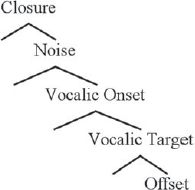
The hierarchy shown in (3) produces a fixed sequence, each level of which is defined as a specific phonetic event. The first relevant phonetic property in this sequence is the closure (Closure) of the stop. The release of the stop, assuming it is oral, produces a portion of aperiodic noise (Noise), which may be modulated in terms of place-dependent spectral properties. Noise is followed by a significant rise in amplitude as the vocoid begins (Vocalic Onset), after which we may observe a portion of relatively stable formant frequencies (Vocalic Target).Footnote 2 This is followed by a decrease in amplitude (Offset). A stop–vowel sequence will contain all four layers of the structure in (3). Place and laryngeal specifications attach to the terminal nodes.Footnote 3
The key to the OP account of initial vowels is the Vocalic Onset (VO) node. VO represents a point of overlap between what is traditionally considered an onset and what is traditionally considered a rhyme. The ambiguous affiliation of the VO node allows for a parametric view of the prosodic behavior of onsetless vowels. Initial vowels containing the VO node act as well-formed prosodic constituents. Those without VO are prosodically inactive. We will see that certain phenomena claimed to be associated with prosodic inertness, including the failure to undergo compensatory lengthening and the lack of tone-bearing ability (but not invisibility for tone assignment) found in KiKerewe, are better analyzed in terms of the prosodically active initial vowel. With regard to the prohibition on tone bearing, VO-specified vowels may be thought to contain a ‘built-in consonant’, and consonants are generally disallowed as tone-bearing units. With regard to the lack of lengthening, we claim that it falls out from the standard phonotactic mechanism in the OP environment, by which a non-initial vowel without VO is absorbed into an initial vowel containing the higher-level VO node. In other words, there is no compensatory lengthening since there is nothing to compensate for – the initial vowel is already a well-formed constituent.
Our account of initial vowels based on VO parameters closely parallels previous explanations of onsetless syllables that rely on an ‘empty onset’ position (e.g. Marlett & Stemberger Reference Marlett and Stemberger1983 for Seri). The VO-specified vowel corresponds to the empty onset, while the vowel without VO lacks the extra structural position. This paper improves on this analysis in two ways. First, to my knowledge, the empty onset approach has not been applied to the data examined in this paper. Secondly, the OP environment offers a welcome insight into the empty onset perspective, since it derives the representational parameter from independent principles. In other words, OP provides an explanation of the evolution (see Blevins Reference Blevins2004) of empty onsets.Footnote 4 Consequently, we will not comment further on analyses employing an empty onset, since in essence we adopt the empty onset approach, while offering a new view on what an ‘onset’ is and how it is represented.
The rest of this paper will proceed as follows. Section 2 will provide a brief outline of the Onset Prominence representational environment, which will be further developed in the empirical sections that follow. Section 3 will concentrate on KiKerewe compensatory lengthening and the inability of KiKerewe onsetless syllables to bear high tone. Section 4 will show the OP perspective on VC syllabification in Eastern Arrernte. Section 5 illustrates how Tashlhiyt Berber versification facts are difficult to reconcile with established approaches to syllabification, and presents the OP perspective on the problem. Section 6 describes two phonetic studies of initial vowels produced by Polish speakers, which support the claim that onsetless vowels in Polish must be specified for the VO node. Section 7 presents examples of prosodically inert onsetless syllables without VO specification. Finally, Section 8 will discuss the place of the OP framework within the larger context of modern phonological theory.
2. THE ONSET PROMINENCE REPRESENTATIONAL ENVIRONMENT
This section will provide a brief introduction to the OP representational postulates necessary for an account of onsetless syllables. Two notions will be crucial for our discussion. First, the OP environment contains an important ambiguity with regard to the ‘segmental’ affiliation of the initial portion of vowels. This ambiguity will create parameters that are crucial for our analysis. Secondly, it will be necessary to illustrate two phonotactic mechanisms, Absorption and Submersion, which govern the formation of prosodic constituents from individual ‘segmental’ structures.
2.1 Ambiguity in constituent structure
In the CV sequence that the structure in (3) represents, the initial portion of vowels contains an inherent perceptual ambiguity with regard to the traditional categories ‘consonant’ and ‘vowel’. Acoustically, this transition is characterized by the high amplitude periodicity and robust formant structure commonly associated with vowels. Yet listeners rely on acoustic cues at vowel onset for the identification of the previous consonant (e.g. Wright Reference Wright, Hayes, Kirchner and Steriade2004). In other words, a single portion of the acoustic signal may be shared by more than one ‘segment’. Researchers have been aware of the ‘linearity problem’ in speech perception for decades (see e.g. Wright, Frisch & Pisoni Reference Wright, Frisch and Pisoni1997); yet for the most part, phonological analyses continue to be expressed in terms of a linear string.
In the hierarchy in (3), vowels are split into two layers: Vocalic Onset (VO) and Vocalic Target (VT). This configuration captures the inherent ambiguity of VO with regard to the consonant–vowel distinction. On its own, VO represents the class of approximants and glides. In larger structures, VO may or may not be contained in higher-level obstruents, or it may itself dominate VT. The latter of these ambiguities creates parametric settings for the representation of initial vowels, shown in (4).
(4) VO parameters for vowels in the OP environment
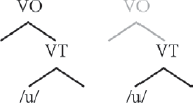
On the left we see a VO-specified vowel, containing a ‘built-in consonant’, which may act as a well-formed prosodic constituent. The structure on the right is posited for those onsetless vowels that are invisible for prosodic processes. The faded node in the structure on the right indicates the relative position in the OP hierarchy – the vowel resides on the lowest level, under the VO node.Footnote 5
2.2 Absorption and submersion
From the hierarchy in (3) we derive distinctions in manner of articulation and sonority. The relations between manner and prosodic constituency may be seen in (5), a representation of the English word quick.
(5) Segmental structures and the Onset hierarchy in English quick
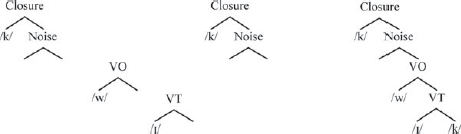
On the right, we see the entire constituent, while on the left we see the individual segmental structures that emerge. The initial /k/ is extracted from the top two layers of structure, containing the closure and release burst of the stop. The /w/ is housed at the Vocalic Onset layer denoting the beginning high-amplitude periodicity and formant structure. The vowel attaches at the bottom of the tree. In other words, stops are the highest-level structures, followed by fricatives, sonorant consonants, and vowels. We shall address the final /k/ in quick shortly.
In its most basic form, OP constituent formation entails the Absorption of a lower-level vowel into a preceding higher-level consonant to form a CV. Sonorant consonants may also be absorbed into higher-level obstruents to produce rising sonority onset clusters.Footnote 6 The motivation for this absorption process should be clear from the structures in (5) above. Without absorption, the individual segmental structures in quick would be forced to stand alone as prosodic constituents. Since none of /k/, /w/ and /ɪ/ may constitute well-formed ‘syllables’ in English, absorption serves to satisfy the language's prosodic minimality requirements.Footnote 7
Absorption is the fundamental process that builds prosodic constituents from segmental structures. It may be expected to occur whenever structural configurations allow it. As we shall see, however, under certain conditions absorption may be restricted when it would result in melodic ambiguity. One such restriction will play a key role in our account of syllabification in Eastern Arrernte (Breen & Pensalfini Reference Breen and Pensalfini1999), a language claimed to contain exclusively onsetless syllables.
The position of the final /k/ in quick may be attributed to a Submersion process, which like absorption may be motivated by prosodic minimality requirements.
(6) Submersion of final /k/ in English quick

This is shown in (6). As a stop, the final /k/ is specified for Closure, the highest level of the OP hierarchy, and may not be absorbed into the preceding structure. Since it may not stand alone as a constituent, it is submerged underneath the preceding rhyme to give us the right-hand structure in (6). This submersion process may be seen as a form of recursion reminiscent of the proposal in van der Hulst (Reference Hulst and van der Hulst2010). Additional discussion will follow in Section 8.
The processes of absorption and submersion, combined with the parameter of VO specification for initial vowels, provide us with the necessary tools to explain the behavior of onsetless vowels in KiKerewe, which we address in the next section.
3. VO SPECIFICATION IN KIKEREWE ONSETLESS SYLLABLES
This section will examine two phenomena associated with onsetless syllables in KiKerewe, a Bantu language spoken in Tanzania, described by Odden (Reference Odden1995, Reference Odden1996). In Section 3.1 we will address why glide formation at vowel hiatus does not result in the compensatory lengthening of the second vowel when the first vowel is onsetless. Then, Section 3.2 discusses why onsetless syllables in KiKerewe cannot bear high tone. In the OP environment both of these facts may be captured by the claim that initial vowels in the language are specified for the VO node and act as well-formed prosodic constituents.
3.1 Onsetless syllables and compensatory lengthening
KiKerewe is characterized by a common pattern in which all syllables must have consonantal onsets, except in initial position. When the concatenation of morphological units would create a V + V sequence and an onsetless syllable, the first vowel is typically turned into a glide (deletion is also possible), a process accompanied by compensatory lengthening of the vowel that remains. Onsetless vowels, however, do not undergo lengthening of any kind. This is illustrated by the data in (7).
(7) KiKerewe glide formation, with or without compensatory lengthening
tu-tééká ‘we cook (habitual)’
tu-ka-tééka ‘we cooked (remote)’
tw-aa-tééká ‘we just cooked’
o-tééká ‘you (sg) cook (habitual)’
o-ka-tééka ‘you (sg) cooked (remote)’
wa-tééká ‘you (sg) just cooked’
In these data, the round vowel in the subject prefixes tu- and o- forms a glide /w/ when preceding the tense prefix -a-. In the case of tu-, which is consonant-initial, glide formation is accompanied by lengthening of -a- in tw-aa-tééká. When an onsetless vowel o- forms a glide, no lengthening occurs and we get wa-tééká. A related phenomenon described by Odden is that while KiKerewe supports a vowel length distinction, onsetless syllables are never long.
In Odden's (Reference Odden1995) analysis of twaatééká, glide formation entails the delinking of the /u/ from its lexically assigned mora. The mora attaches to the /a/, providing extra length. The lack of lengthening in watééká is attributed to a deficiency in the prosodic status of the vowel-initial prefix /o/. Odden (Reference Odden1995) considers two representations, one in which a syllable node lacks a mora and the other in which a mora is not dominated by a syllable. He eventually opts for the moraic, non-syllabic representation. That is, an initial vowel constitutes a mora but not a syllable. For Odden, these onsetless vowels may surface as extraprosodic moras in phrase-initial position.
As it happens, this analysis is not compatible with KiKerewe reduplication data presented by Odden (Reference Odden1996) himself in a later paper. An example involving numerals is presented in (8).
(8) Reduplication in KiKerewe numerals (Odden Reference Odden1996: 117)
muka-a-ga ‘six’ mukaaga-muka-a-ga ‘six by six’
mu-sa-anzu ‘seven’ musaanzu-mu-sa-anzu ‘seven by seven’
muna-a-na ‘eight’ munaana-muna-a-na ‘eight by eight’
iku-mi ‘ten’ ikum-iiku-mi ‘ten by ten’
Note that in the form ikumi-ikumi ‘ten by ten’, the initial /i/ from the base form is copied normally into the reduplicant. Accepting Odden's representations for initial vowels would thus necessitate the stipulation that KiKerewe reduplication may operate on prosodically ill-formed syllables. By contrast, the OP environment offers an explanation that is compatible with the reduplication data. Onsetless syllables' failure to undergo compensatory lengthening is a natural product of absorption. We shall now turn to an illustration of how this works in KiKerewe.
In the OP environment, a single representational assumption accounts for all the KiKerewe lengthening facts: word-initial vowels are specified for the VO node, while word-internal vowels are not. To see the consequences of this, let us first examine the case where compensatory lengthening does not occur: when the vowel that forms the glide is word-initial. Consider the form wa-tééká, which derives from o-a-tééká. The vowel /o/ is reinterpreted as a glide [w]. If, as we claim, the initial /o/ is specified for the VO node, its structure may absorb the following /a/. That is, we are observing the standard mechanism by which a lower-level vowel (the /a/) attaches to a higher layer of structure (the VO in /o/). Under absorption, the two structures merge normally, as we see in (9).
(9) Absorption of /a/ into initial /o/ resulting in glide formation without lengthening
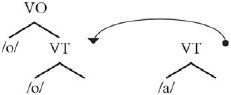
One aspect of these structures in (9) that requires comment is the formation of the glide [w] from the input /o/. In the structure of the initial /o/, the labial specification is spread over both VT and VO layers. That is, a single ‘segment’ occupies two nodes in the tree. After absorption, the VO still contains the labial specification from the /o/, while the VT houses conflicting specifications for /o/ and /a/. Since the labial specification is already placed comfortably on VO, it need not be realized on VT, and the absorbed sequence surfaces as [wa] rather than [wo] – the glide formation falls out directly from the absorption process. In essence, glide formation is a non-problem in this non-linear environment – what may be perceived and transcribed is [wa] is the natural output of absorption.Footnote 8
With regard to the initial /o/ shown in (9) above, it must be emphasized that although it occupies two nodes in the structural hierarchy, it does not represent a long vowel. This is due to the crucial design feature in the OP environment by which vocalic portions of the acoustic signal are split into VO and VT nodes in the representational hierarchy. Long vowels, as we shall see next, require additional nodes under the VT layer.
Let us now turn to the lengthening of vowels, which in the OP environment results from Submersion. In (10) we see two consecutive non-initial vowel structures that lack the VO layer.
(10) Lengthening of consecutive vowel structures by means of submersion
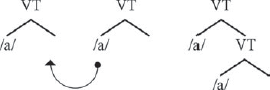
Absorption is impossible in this case since the structures are at the same (VT) level. As a result the second vowel is submerged under the first, producing a two-layer VT structure: a long vowel.
With this view of lengthening in mind, we may now examine the KiKerewe form tw-aa-tééká, derived from tu-a-tééká, in which it appears as though the formation of the [w] from /u/ has been ‘compensated for’ by the lengthening of the /a/. Since the /u/ is non-initial, it does not contain VO. As a result the /a/ is submerged under it rather than absorbed into it, producing a two-layer structure under the VT node. This two-layer structure is then absorbed into the initial /t/, as shown in (11).
(11) Lengthening and glide formation in tw-aa-tééká
The interpretation of the /u/ as the glide [w] is attributable to a process by which place specifications rise to the highest available node in the constituent. This mechanism, which could be seen to represent anticipatory coarticulation, results in the configuration we see on the right in (11), with a labial glide followed by a long /a/. At its present state of development, the OP framework has concentrated on structural aspects of manner of articulation. The details of place specifications and their mobility throughout the structures remains a task for the future.
Close examination of the structures in (11) will reveal that constituent formation must proceed from right to left. The long vowel is formed first, after which the two-layer VT structure is absorbed into the /t/. This directionality is posited under the assumption that listeners form phonological constituents on the basis of what they hear. To clarify this claim, we may consider two possible inputs: fried and Friday. The /d/ in fried is parsed as a coda, while in Friday the /d/ is an onset. Assuming right-to-left directionality, the constituent affiliation of the /d/ is immediately apparent. Having parsed the final vowel in Friday, listeners immediately know that the /d/ is an onset. Right-to-left constituent formation in OP is necessitated by the fact that a segment's affiliation is determined with respect to what it precedes. If syllabification were to proceed from left to right, the affiliation of the /d/ could not be determined until after the final vowel has been parsed.
To summarize our analysis so far, the lengthening facts in KiKerewe may be accounted for as follows within the OP environment. Under the assumption that initial vowels are specified for VO, the lengthening (and lack thereof) is to be understood in terms of the interaction between the submersion and absorption processes. When the first vowel contains VO, absorption occurs normally, without the submersion that would add another layer of structure under the VT node, and lengthening does not occur. Long vowels are formed by means of submersion. Absorption is impossible with two consecutive vowels lacking VO. Meanwhile, glide formation is the natural interpretation of the melodic distribution over the VO and VT nodes.
3.2 High tone and onsetless syllables in KiKerewe
The other major issue identified with onsetless syllables in KiKerewe is that they cannot be specified for high tone. In the data in (12), the consonant-initial subject prefixes ba- and tu- are assigned high tone (which spreads one syllable to the right by a Tone Doubling process in the language), while the vowel-initial prefixes o- and a- are not. In these forms, onsetless syllables cannot bear high tone.
(12) Lack of high tone specification on onsetless vowels in KiKerewe (Odden Reference Odden1995: 97)
bá-ká-luunduma ‘if they growl’
tú-ká-luunduma ‘if we growl’
o-ká-lúúnduma ‘if you growl’
a-ká-lúúnduma ‘if he growls’
Just like with the lack of lengthening, Odden attributes onsetless syllables' lack of tone-bearing ability to their putative extra-prosodic status. Downing (Reference Downing1998) seeks to build on the extroprosodic analysis. She tries to show, in terms of OT constraints, how extraprosodic candidates might emerge as optimal. Downing's analysis relies on the conjunction of Onset with a constraint, Align-TD, which requires the alignment of tone assignment domains with morphological boundaries. Downing's constraint conjunction, Onset∩Align-TD, optimizes tone domains that begin with a consonant. In her analysis, this conjunction must be ranked above the faithfulness constraint, Max M-P, which requires all segments in the lexical stem to be present in the prosodic stem. With faithfulness at the bottom of the ranking, the language should also be free to eliminate initial vowels for reduplication. As we saw in the data in (8), however, initial vowels in KiKerewe are copied normally into reduplicated forms.
In sum, both Odden's and Downing's accounts of KiKerewe onsetless syllables rely on the assumption that these syllables are prosodically deficient. However, the reduplication data are extremely problematic for this approach. One wonders how it is that onsetless syllables may be ill-formed for length and tone-bearing ability, but well-formed for reduplication. To explain these facts, Downing would require the introduction of a new prosodic domain for reduplication whose Alignment constraint is ranked below the lowest-ranking Max M-P. This would raise the question why tone alignment should take precedence over reduplication alignment. In addition, the analysis would suffer from a great degree of disunity, since in essence we would have to claim that the language has multiple species of onsetless syllable. Ultimately, solutions involving Onset and Alignment constraints are not satisfying for the KiKerewe data. It would be preferable, if possible, to provide a unified explanation for the diverse behavior of KiKerewe onsetless syllables. Such an account falls out directly from the Onset Prominence representational environment. We have already seen how this works for the lengthening facts. Now we shall briefly address the question of onsetless syllables' inability to bear high tone.
Our fundamental claim for KiKerewe is that all initial vowels are specified for the VO node. I would like to suggest that the inability of onsetless vowels to bear tone follows naturally from the fact that they are specified for VO. That is, we might propose a constraint against high tone on vowels specified with VO, as shown in (13).
(13) Prohibited structure with high tone on VO
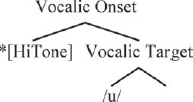
Simply stated, VO-specified vowels may be seen to contain a ‘built-in consonant’ (or empty onset) that ensures their prosodic well-formedness. Tone is not typically associated with consonants, so initial vowels' lack of tone-bearing ability in KiKerewe is to be expected. In Section 6, we shall see how VO-specified onsetless vowels often form a constituent boundary, since they may not be absorbed into the preceding structure.
Our representational postulate carries with it a testable prediction for experimental study: initial vowels in KiKerewe should receive some sort of phonetic marking. A common strategy for marking vowels at prosodic boundaries is glottalization, most frequently seen as irregularities in the periodicity of the waveform (Dilley, Shattuck-Hufnagel & Ostendorf Reference Dilley, Shattuck-Hufnagel and Ostendorf1996). In addition, glottal stops may be perceived on the basis of a drop in pitch (Hillenbrand & Houde Reference Hillenbrand and Houde1996). If it is indeed a drop in pitch that marks the onsetless syllable, then we might expect that specification for high tone should be impossible.
In sum, our account of KiKerewe showed how the VO specification interacts with the OP mechanisms of absorption and submersion, providing a unified account of the diverse prosodic behavior exhibited by onsetless syllables in the language. The lack of compensatory lengthening and tone-bearing ability fall out naturally from the extra node of structure on initial vowels, as do the reduplication facts, which are problematic for earlier accounts that appealed to the ‘prosodic deficiency’ of onsetless syllables.
4. EASTERN ARRERNTE SYLLABIFICATION
Eastern Arrernte, an aboriginal language of Australia, has been put forward as a counter-example to the universality of consonantal onsets. Breen & Pensalfini (Reference Breen and Pensalfini1999) claim that this language is best analyzed containing only vowel-initial syllables. They present evidence from stress assignment, reduplication, and language games, illustrating that a traditional approach employing a universal CV requires a more complex analysis than one based on VC syllabification. A single example will suffice to illustrate the challenge of this language for CV-based syllabification: the form itirem ‘thinking’ (Breen & Pensalfini Reference Breen and Pensalfini1999: 8). To establish VC syllabification, Breen & Pensalfini point to the language game known as Rabbit Talk, in which the initial sequence /it/ is transposed to the end of the word, yielding irimit. Without VC syllabification, it is unclear how we could derive the /it/ that gets moved; a rule that says ‘transpose the first two segments’ would not work, since other forms exist in which VCC sequences are transposed. This language thus challenges traditional syllabic analyses that make use of Onset and NoCoda constraints, since the data suggest that constraints requiring codas and banning consonantal onsets may be in force.Footnote 9
In the OP environment, however, VC syllabification in Eastern Arrermte does not pose a problem. If vowel-initial syllables are specified for the VO node, they should be able to function as well-formed constituents.
To prohibit consonantal onsets and derive VC syllabification in Eastern Arrernte, we need to prevent absorption in cases where it would be possible in other languages. This step may be motivated if we assume that both vowels and consonants are specified with the VO layer. Consider (14), in which the sequence of segmental structures for the form itirem is shown.
(14) Sequence of segmental structures in itirem
While to this point we have focused on VO-specification in vowels, it is worth reflecting on why consonants in Eastern Arrernte may also be claimed to contain the extra node of structure. The reason for this may be found in the rich system of place contrasts found in the consonant systems of EA and related languages. If listeners in these languages are to be successful in identifying consonant place of articulation, they must rely upon formant transitions on neighboring vowels (Wright Reference Wright, Hayes, Kirchner and Steriade2004). VO-specification for consonants builds these transitions into the representation of consonants themselves, providing representational housing for the variety of place specifications in Eastern Arrernte.
In the string in (14) above, both the consonants and the vowels are specified with the VO node. If absorption of the second /i/ into the /t/ were to occur, it would entail the merger of two VO nodes: one for the consonant and one for the vowel. Such a configuration would place a greater functional load on the VO node of the new constituent, since two active layers of the hierarchy are absorbed into one. As a result, the segmental affiliation of the VO may be difficult to parse – a truly ‘complex onset’ would result. In other words, the syllabification facts in Eastern Arrernte may be attributable to a *ComplexOnset constraint, a commonly encountered prohibition across languages, which we might reformulate here for OP representations. A violating structure would contain more than one segment's melodic material on a single VO node.
The OP environment provides a useful perspective on the perceptual considerations inherent in this type of restriction. Consider English, which allows ‘complex onsets’ but bans certain stop–sonorant clusters such as *tl and *bw. In the OP environment, such prohibitions fall out naturally from the fact that absorption would result in ambiguity on the VO level. Both /t/ and /l/ may be associated with a High F3 (Harris et al. Reference Harris, Hoffman, Liberman, Delattre and Cooper1958, Stevens Reference Stevens, Hardcastle, Laver and Gibbon1997) on the CV transition, while /b/ and /w/ are marked by a lowered F2. If these structures are absorbed, listeners may have a hard time parsing the segmental affiliation of the formant transition. This is illustrated in (15), which shows a prohibited *tl onset cluster in English. Note that this kind of ambiguity is difficult to express with traditional representations based on a linear string. In the OP environment, on the other hand, the VO node is a built-in element of both members of the cluster, and the functional difficulty is predicted.
(15) Initial absorbed *tl cluster
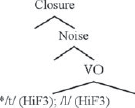
Returning to Eastern Arrernte, we note that this language is even more restrictive – absorption is banned to prevent any configuration in which VO contains more than one segment's melodic specifications.
In the absence of absorption, syllabification in Eastern Arrernte can proceed in one of two ways. One possibility is that, analogous to the final /k/ in English quick shown in (5) above, the consonants are submerged under the vocalic structures, as shown in (16).
(16) Eastern Arrernte itirem with submerged codas
Another possibility is presented in (17), in which the initial vowels and the coda consonants are adjoined at a higher level of structure. For now, we shall not provide this higher node with a concrete label. For the purposes of this illustration it is sufficient to label the node with the symbols for the segments appearing in the constituent.
(17) Eastern Arrernte itirem with adjoined codas
To make the adjunction in (17) possible, the vowel structures must undergo Promotion so their top layer is on the level that is usually occupied by Closure in stops.
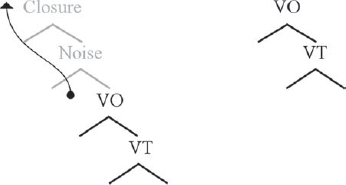
In the absence of the Closure and Noise nodes associated with obstruents, vowels and sonorant consonants may be promoted to occupy the empty levels, so that each tree begins at the top of the hierarchy. The promotion process is shown in (18).Footnote 10 The issue of promotion will arise again in Section 6. It will be suggested that promoting lower-level structures serves to block absorption at prosodic boundaries and prevent the application of sandhi processes.
(18) Promotion of an initial vowel
Returning to Eastern Arrernte syllabification, the discussion thus far reveals no basis upon which to choose between (16) and (17), the two different mechanisms by which ‘codas’ may be derived in the OP environment. However, phonetic data presented by Tabain, Breen & Butcher (Reference Tabain, Breen and Butcher2004) may be quite instructive in this regard. The numerous contrasting places of articulation in Eastern Arrernte and related languages suggest that listeners may need to rely heavily not only on CV transitions, but also on VC cues, for consonant identification. Tabain et al. (Reference Tabain, Breen and Butcher2004) test this hypothesis by comparing the acoustic properties of CV and VC transitions in English and a number of Aboriginal languages. Their data show that VC transitions in Arrernte and other Australian languages, unlike most European languages, are on a par with CV transitions in terms of acoustic stability. These results suggest that in such rich place systems as Eastern Arrernte, VC transitions should be relatively robust. As a result, we should be inclined to choose adjunction, as shown in (17) above, to represent Eastern Arrernte coda formation. Under this view, the relative prominence of VC transitions is reflected in the fact that these cues are housed higher in the OP hierarchy than they would be if codas were submerged.Footnote 11
In sum, we have seen that the OP environment allows us to reconcile the putative universality of consonantal ‘onsets’ with the evidence that Eastern Arrernte contains only vowel-initial syllables. This unusual pattern, which is a consequence of a prohibition on the absorption of segmental trees, may be motivated under the assumption that both vowels and consonants are specified for VO. In addition, we have seen that in the OP environment, these claims produce structures that are suggestive of the phonetic properties of CV and VC transitions in Eastern Arrernte and related languages.
5. TASHLHIYT BERBER VERSIFICATION
Another language in which the behavior of onsetless syllables has interesting implications for the OP framework is Tashlhiyt Berber. Of particular interest are versification data described in Dell & Elmedlaoui (Reference Dell and Elmedlaoui1988) and Ridouane (Reference Ridouane2008). Stated briefly, the versification facts are difficult to reconcile with previously proposed syllabification algorithms (Dell & Elmedlaoui Reference Dell and Elmedlaoui1985) based on a segmental string and sonority-based peak assignment. Tashlhiyt Berber is of course well-known as one of the few languages claimed to admit any segment type, including obstruents, into the peak position of a syllable. In the OP environment, there is no such thing as a peak, and constituent formation is due to the mechanisms described in the previous sections. In the absence of peaks, and peak assignment, the problems inherent in the previous accounts of Tashlhiyt Berber syllabification may be avoided.
Clements' (Reference Clements and Roca1997) constraint-based analysis of Tashlhiyt Berber illustrates the difficulties for sonority-based peak assignment. Tashlhiyt Berber, like many other languages, requires consonantal onsets, except in phrase-initial position. To deal with this, Clements, following McCarthy & Prince (Reference McCarthy and Prince1993), ranks an alignment constraint, Align-L, above Onset. For an input such as /rʃq/ ‘be happy’, syllabified r.ʃq, with the rhotic and the stop as syllabic peaks, this system requires the grammar to evaluate a candidate containing what Clements (Reference Clements and Roca1997: 305) refers to as an ‘epenthetic place holder’. This is illustrated in (19).
(19) Align > > Onset for r.ʃq (after Clements Reference Clements and Roca1997: 305)
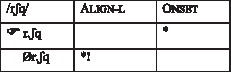
The winning candidate incurs one Onset violation but satisfies Align, while the candidate with the place holder violates the higher ranking Alignment constraint and is eliminated. The main problem with Clements' analysis stems from his constraints governing peak assignment. Clements ranks the constraint against stops as syllabic peaks, *P/t, above Onset. This ranking, however, is not successful at arriving at the winning candidate r.ʃq, in which the fricative is syllabified as an onset and not a peak. The tableau in (20) illustrates.
(20) Incorrect prediction of *P/t > > Onset
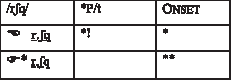
In (20), the winning candidate is r.ʃq with two onsetless syllables – the fricative is syllabified as a peak. This is the incorrect form.Footnote 12 The second syllable of the correct form is an ‘onset–peak’ sequence, ʃq.
These difficulties with sonority-based peak assignment in Tashlhiyt Berber syllabification may be observed in falling sonority syllables that are made up of two segments. Such syllables show an interesting weight discrepancy in Tashlhiyt Berber versification. The basic observation is that they are heavy in phrase-initial position but light elsewhere. Thus, in Dell & Elmedlaoui (Reference Dell and Elmedlaoui1988), initial /lx/ is heavy, while non-initial /nb/ is light. From the point of view of traditional syllable positions, /lx/ is heavy because /x/ is syllabified as a coda, while /nb/ is light because it does not have a coda – /b/ is syllabified as a peak. The key fact here is that according to the traditional view, heavy /lx/ is onsetless. Since an onsetless syllable may contribute to weight in Tashlhiyt Berber versification, we should expect to find other Onset violations in the language. Yet onsetless syllables appear only in phrase-initial position. While it is clear that Tashlhiyt Berber has a preference for consonantal onsets, the versification facts undermine the prosodic motivation for an Onset constraint. If a constraint Onset as it is commonly formulated is applicable in Tashlhiyt Berber, it must have some other motivation than to produce well-formed prosodic constituents.
In the OP environment, this versification discrepancy in Tashlhiyt Berber is explained by appealing to the non-linear arrangement of segmental melody and structure. Briefly stated, in the onsetless heavy /lx/, the /l/ is distributed over two layers of structure. That is, what might appear to be an onsetless syllable in Tashlhiyt Berber, regardless of whether is vowel-initial or consonant-initial, is characterized by a configuration in which the initial segment occupies multiple nodes. This is illustrated in (21).
(21) Heavy (left) vs. light /lx/ syllable in Tashlhiyt Berber
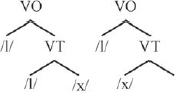
On the left we see the heavy /lx/ syllable that appears only in phrase-initial position. On the right is the light version of the same segmental sequence that would appear elsewhere. In the heavy /lx/, the structure for the /l/ is comparable to that of initial vowels in KiKerewe and Eastern Arrernte, with a single segment occupying VO and VT nodes.Footnote 13 What is clear from (21) is that the initial segment in a phrase-initial constituent enjoys a privileged structural status in Tashlhiyt Berber. The OP environment offers useful tools with which to represent this, without the need for constraints such as Onset or Align. At the same time, since the hierarchical split between VO and VT has origins in phonetic considerations (see Section 2 above), it may be accepted as something more than a stipulation.
6. VO SPECIFICATION AND GLOTTALIZATION IN POLISH INITIAL VOWELS
The fundamental claim of this paper is that the Vocalic Onset layer of structure may be present in the representation of vowels in a given language. We have shown how this representational parameter allows for a unified account of diverse and problematic phenomena from KiKerewe, Eastern Arrernte, and Tashlhiyt Berber. Stated briefly, certain vowels appear to be preceded by a built-in ‘onset’ that is generally not represented in segmental transcription. The representational parameters are assumed to have evolved from perceptual ambiguities associated with the initial portion of vowels. As yet, however, we have not addressed the question of whether and how VO specification may be realized phonetically. We will now turn to this issue.
One language in which there is reason to assume that initial vowels contain VO specification is Polish. On the prosodic level, this claim is supported by stress assignment facts in the language. Native Polish words (when they do not contain enclitics) have penultimate stress, a pattern that also holds for vowel-initial two-syllable words such as okno ‘window’. The initial vowel clearly counts for stress assignment.
Additionally, Rubach & Booij (Reference Rubach and Booij1990) note that there is no ‘resyllabification’ across word boundaries in Polish, which suggests that word-initial vowels resist absorption into a preceding final consonant. This is in contrast to a language like English, in which a phrase like find out is frequently indistinguishable from fine doubt, indicating that the initial vowel in out has acquired an ‘onset’. This difference between English and Polish is shown in (22).
(22) An absorbable (right) and sandhi-blocking k#a sequence
On the left we see the Polish pattern in which a VO-specified initial vowel has been promoted to the level of Closure and is not subject to the absorption we observe in the English pattern on the right. In examining the configuration on the left in (22), we note that the initial vowel now occupies the same level as Closure, preventing absorption, and ensuring that the vowel defines a constituent boundary. The promotion of ‘higher sonority’ elements may be seen as a blocker of sandhi processes that would resyllabify such sequences, which we may assume to be present in English but largely absent in Polish.Footnote 14 A comparison of /t#j/ sequences in the two languages supports this claim. English typically shows consonant mutation, as in gotcha from got you, indicating that the /t/ and /j/ have been joined into a single ‘onset’. In a similar sequence in Polish, kot jest ‘the cat is’, the /t/ resists a similar mutation, presumably because the /j/ has been promoted, preventing absorption into the /t/.
A common strategy for marking boundaries of vowel-initial constituents is glottalization, and we may note that initial vowels in Polish are typically pronounced with a glottal attack, or preceded by a full glottal stop (Dukiewicz & Sawicka Reference Dukiewicz and Sawicka1995). These facts suggest that Polish initial vowels contain a ‘built-in consonant’. Additionally, we should expect glottalization to be more widespread than in a language like English, where it appears to be limited to the boundaries of larger prosodic domains (Dilley et al. Reference Dilley, Shattuck-Hufnagel and Ostendorf1996). To investigate this claim, two phonetic studies have been carried out.
In the first, described in Schwartz (Reference Schwartz2012c), the interaction between initial glottalization and final devoicing in Polish-accented English is investigated. A group of eight native speakers of Polish read English sentences containing sequences of the type George often, in which a word-final voiced obstruent was followed by a word-initial vowel. Polish interference in this context should be observable in the devoicing of the final obstruent, as well as the glottalization of the initial vowel. The goal of this study was to investigate a possible link between the two types of L1 influence. The sentence list was also read by two native speakers of American English. Acoustic measurements were made of glottalization duration, as well as the durational ratio between the vowel and word-final consonant, a primary cue for final voice contrasts in English (Port & Dalby Reference Port and Dalby1982). The Polish speakers produced a total of 320 C#V tokens for analysis, which on the basis of glottalization duration, were divided into three types. Type 1 represented minimal glottalization, and was comprised of glottal closure measurements of less than 40 ms. Type 2 included glottalization measurements between 40 ms and 79 ms, while Type 3 covered glottal closures of over 80 ms. From the eight speakers analyzed in the group data, there were 112 tokens of Type 1, 119 tokens of Type 2, and 89 tokens of Type 3.
The results showed that as the duration of glottalization on the vowel increased, there was a greater tendency for final devoicing as defined by a lower V/C ratio (p <.01). These results are summarized in the table in (23).
(23) Group results of glottalization/final devoicing study described in Schwartz (Reference Schwartz2012c)

It is also worth noting that while 65% of the Polish speakers' tokens showed Type 2 or Type 3 glottalization (over 40 ms), the native speaker control subjects resyllabified the sequences in over 90% of the cases, producing no visible glottalization at all in 37 out of 40 tokens. These results may be claimed to support the representational configurations for Polish and English initial vowels proposed in (22) above.
The second study, described in Schwartz (Reference Schwartz2013), examines glottalization across vowel hiatus in Polish. Nineteen native speakers of Polish recorded sentence lists containing vowel hiatus at word and morpheme boundaries. In total, 646 tokens of hiatus were analyzed. On the basis of variable realization of glottalization (Redi & Shattuck-Hufnagel Reference Redi and Stephanie2001), a ‘Glottalization Score’ was assigned to each token. The scale ranged from 3 points for full and measureable closure, 2 points for noticeable creak or laryngealization visible as irregularity in the periodicity of the vocal wave, 1 point for visible drops in pitch or amplitude (Hillenbrand & Houde Reference Hillenbrand and Houde1996), and 0 points for no visible signs of glottalization. For word-boundary hiatus, some degree of glottalization (score of 1 or more) was observed in nearly 76% of the tokens (91% for nouns, 68% for adjectives, 59% for prepositions). Even word-internally before unstressed vowels, 25% of the tokens showed visible glottalization. Further analysis of the tokens assigned a Glottalization Score of 0 suggests that vowel hiatus in Polish may also be marked by changes in spectral balance that are not visible on an unfiltered acoustic display. Spectral balance is a well-known cue for stress (Sluijter & van Heuven Reference Sluijter and van Heuven1996), so an increase in high-frequency energy in the second half of a vowel sequence may be interpreted as an attempt by speakers to enhance the prominence of the word-initial vowel.
The results of the glottalization studies are consistent with the VO parameter setting proposed for Polish initial vowels. Vocalic Onset specification is also compatible with the prosodic role of initial vowels for stress, and fits nicely with Dogil's (Reference Dogil and van der Hulst1999) finding that initial syllables in Polish are marked by secondary stress. We have also seen that VO parameter settings in the OP environment are conducive to the formulation of concrete hypotheses for experimental study. We should expect that VO-specified initial vowels are more likely to show some kind of phonetic marking than vowels lacking the extra node. We have examined one such marking involving glottalization, though we may speculate that the VO node may be preserved by any number of phonetic tools, such as gliding (cf. dialectal Polish łokno [wokno] for standard okno ‘window’), or voice quality and pitch effects associated with laryngeal setting or airstream mechanisms (Ladefoged & Maddieson Reference Ladefoged and Maddieson1996).
6.1 A brief excursus into Polish morphology
We turn now to the implications of the OP hierarchy for the relationship between phonology and morphology. As explained in Section 2 above, VO parameter settings evolve from a built-in ambiguity within the Onset Prominence hierarchy. We shall see here, in a brief examination of a coronal palatalization process in Polish, that VO specification, or the lack thereof, provides the flexibility to represent the simultaneous coexistence of phonological and morphological rules, without the need to resort to intermediate representations such as those employed in Lexical Phonology or the derivational variety of OT.
Palatalization processes are commonly encountered in a number of familiar languages. The basic description of these processes is that front vowels condition alternations, usually analyzed as the spreading of some palatal prime, such as a feature [–back] feature. While this description appears to be fairly straightforward, it offers no explanation for the fact that some front vowels induce palatalization and some do not. As an example, consider data from Polish in (24), which has an alternation between /t/ and pre-palatal /tɕ/. In the following data, the mutated alternant /tɕ/ appears before the locative-vocative ending -e, but not before the diminutive suffix -ek, even though both morphemes begin with the vowel /e/.
(24) Polish /t/∼/tɕ/ alternation in nominal paradigms
kot ‘cat (nom)’
kotek ‘little cat (nom)’ kotka ‘little cat (gen)’
kotɕe (orth. kocie) ‘cat (loc-voc)’
One possible explanation of these data is attributable to Gussmann (Reference Gussmann2007), who posits two different representations for /e/, one that conditions the alternation and one that does not. For Gussmann, the representational difference between the two /e/s arises from dependency relations among the melodic primes that define the vowel's place of articulation. Unfortunately, Gussmann makes no attempt to explain how a system with two representationally distinct yet phonetically indistinguishable vowels may evolve.
In the OP environment, the built-in ambiguity with regard to vowel representations allows us to capture the two different /e/s in Polish. This is shown in (25).
(25) Loc-voc sg ending -e (left) and diminutive suffix -ek in Polish
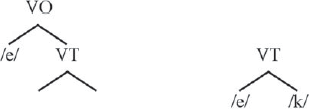
On the left we see a VO-specified -e in the locative-vocative ending with the consonant mutation. On the right is the diminutive suffix -ek that lacks the VO node. The concatenation of segmental structures forming the words kocie and kotek is shown in (26).
(26) /t/ + /e/ >/tɕ/ in kocie (left) and /t/ + /e/ in kotek
In kotek, the VO node is not part of the vowel's specification and the preceding stop is unaffected by absorption. The absorption in kocie entails the incorporation of the VO node with palatal specification into the obstruent structure, yielding the mutated alternant /tɕ/. The -e in kotek is an example of the well-known Slavic yer vowels (e.g. Carlton Reference Carlton1990) that alternate with zero in morphological paradigms (cf. kotka in the data in (24) above). A crucial fact in support of the representational differences proposed here is that yers never appear word-initially, where we should expect VO to be realized.
The perspective on Polish coronal palatalization contrasts with that of Rubach (e.g. Reference Rubach2003), whose linear view of the segmental string requires him to propose different levels of derivation, one at which the mutation takes place, and one at which it is prevented. The representational hierarchy of the OP environment is grounded in phonetic principles (see Section 2 above) and offers a simpler grammar and an explanation based on a single ambiguity. In addition, to my knowledge, Rubach offers no explanation why yers cannot occur word-initially.
While a full account of the complex set of palatalization processes in Polish is beyond the scope of this paper, we may see here how OP offers an environment in which purely phonological representational materials may be used to model the interaction between phonology and morphology. Note in (26) above that there is no need to refer to any intermediate levels of representation. A single concatenation produces both kotek and kocie.
7. ONSETLESS VOWELS WITHOUT VO
To this point we have focused our attention on onsetless syllables that are specified with VO and appear to behave as well-formed prosodic constituents. We now briefly turn our attention to cases of prosodically inert onsetless syllables, whose behavior is somewhat more straightforward. A typical pattern, found in reduplication processes, is that onsetless vowels are not copied into the reduplicant, as in the examples from Timugon Murut (McCarthy & Prince Reference McCarthy and Prince1993) given in (27).
(27) Reduplication in Timugon Murut (McCarthy & Prince Reference McCarthy and Prince1993: 134)
limo ∼ li-limo ‘five/about five’ abalan ∼ a-ba-balan ‘bathes/often bathes’
In the first example the initial syllable /li/ is copied into the reduplicant, while in the second example it is the first onsetful syllable that is copied. In (28) we see the proposed constituent structures of the bases of the two forms.
(28) Base forms for reduplication in abalan and limo
On the left is abalan and on the right is limo. Note that unlike the vowels in the cases we have seen thus far, the initial /a/ in abalan lacks the VO node. To account for the reduplication pattern, we need nothing more than a constraint that defines a minimal constituent for prosodic purposes. We formulate this in (29).
(29) MinimalConstituent (MC)
A prosodically active constituent must contain a VT node and at least one higher layer of structure.
With this constraint in force, any vowel-initial syllable lacking the VO node should be prosodically inert. If abalan were syllabified differently, with /ab/ as the first syllable, the MC constraint would still be violated, since the constituent would not contain any structure higher than VT. Note also that Onset and Align constraints are superfluous in this environment.
This account of prosodically inert initial vowels may be extended to cases in which onsetless syllables are invisible for stress assignment. Onset-sensitive stress is quite uncommon cross-linguistically, a fact that is reflected in the traditional view (see e.g. Hyman Reference Hyman1985, Hayes Reference Hayes1989) that onset consonants are prosodically inactive. Nevertheless, there are several well-documented cases of onset-sensitive stress (see e.g. Gordon Reference Gordon2005, Topintzi Reference Topintzi.2010), so any representational theory must have a way of modeling it. One pattern that may be found is initial stress, except when the initial syllable is onsetless, as illustrated in the examples from Iowa-Ota (Topintzi Reference Topintzi.2010: 58) in (30).Footnote 15 As with the reduplication pattern discussed earlier, the initial vowel is assumed to violate MC and is ignored by the stress assigning mechanism.Footnote 16
(30) Onset sensitive stress in Iowa-Ota (Topintzi Reference Topintzi.2010: 58)
ˈpe.ce ‘fire’
ˈhe.ro.ta ‘morning’
a.ˈha.ta ‘outide’
i.ˈt&phosuph;a ‘there’
One final example of prosodically inactive onsetless syllables is IsiXhosa (Downing Reference Downing1998), in which onsetless syllables affect both reduplication patterns and tone association. Reduplication is similar to the Timugon Murut pattern examined earlier. In addition, onsetless syllables in this language may be invisible for tone assignment processes. The data from IsiXhosa presented by Downing show that whereas onsetless syllables are without exception invisible for reduplication, there is variation in their status with regard to tone assignment mechanism. Before we proceed, it is important to note that the tone assignment algorithm described here is a distinct phenomenon from the lack of tone-bearing ability described by Odden (Reference Odden1995) for KiKerewe.
In IsiXhosa, high tone in four-syllable stems is assigned to the antepenultimate syllable, while in three-syllable stems it is assigned to the penultimate syllable. However, in vowel-initial four-syllable stems, either the penult or the antepenult may bear the tone. The example in (31) illustrates the variation.
(31) Reduplication and tone association in IsiXhosa (Downing Reference Downing1998)
ndi-y-onwabísa ∼ ndi-y-onwábisa ‘make happy’
ndi-y-o-nwabi-nwabísa ∼ ndi-y-o-nwabi-nwábisa
The onsetless /o/ in the stem is ignored in the reduplicated forms, while its status for tone is ambiguous. High tone on the antepenult indicates that the stem patterns with consonant-initial, four-syllable stems. When high tone occurs on the penult, we assume that the onsetless vowel is prosodically invisible and the stem is treated as a three-syllable stem for tone association, just as it is for reduplication. Downing notes that McCarthy & Prince's (Reference McCarthy and Prince1993) perspective on reduplication, in which the infixing pattern on vowel-initial stems is motivated by the Onset constraint, makes no predictions concerning tone association. She favors an analysis based on the assumption that onsetless syllables are extraprosodic, an insight that is captured here. Onsetless vowels are extraprosodic when they are not specified for VO.
An issue that Downing (Reference Downing1998) does not really address is why tonal behavior, but not reduplication, may be ambiguous. Optimal candidates are arrived at in her analysis by positing separate prosodic constituents to define the domains for reduplication and tone assignment. The ambiguity of tone in this account derives from the choice of domain, but there is little description of these domains in her analysis. The focus on why onsetless syllables are invisible for tone says nothing about why they may count for tone but be invisible for reduplication. From the OP perspective, the conflict between tone and possible f0 effects on VO (see example (13) above) provides an interesting perspective on this question. Tone is essentially a vocalic phenomenon that tends to be concentrated on the VT level. As a result, vowels that lack VO in IsiXhosa may still be visible for tone assignment even when they are ignored for reduplication.
8. ONSET PROMINENCE WITHIN THE CONTEXT OF MODERN PHONOLOGICAL THEORY
We have come to the end of the main empirical part of this paper. We have seen that the Onset Prominence representational environment offers an insightful perspective on the ambiguous behavior of onsetless syllables. The hierarchical approach of OP to both segmental representation and prosodic constituency enables a deeper understanding of the facts than analyses based on a linear string of segments. At the same time, the hierarchy is grounded in phonetic principles, allowing for the formulation of new hypotheses for experimental phonetic study. Since the Onset Prominence environment represents a young and somewhat eclectic phonological framework, to conclude this paper it might be useful to place the theory into the larger context of modern phonology. We will consider parallels between OP and Aperture Theory (Steriade Reference Steriade, Huffman and Krakow1993), stricture-based models (Golston & van der Hulst Reference Golston, Hulst, Hermans and Oostendorp1999), recursive models of syllable and foot structure (van der Hulst Reference Hulst and van der Hulst2010), and recent work that challenges the validity of the prosodic hierarchy.
One major aspect of the OP environment is its hierarchical approach in which there is not a one-to-one alignment between segments and prosodic positions. In this regard OP shares an important assumption with Steriade's (Reference Steriade, Huffman and Krakow1993) Aperture Theory: the idea that a single ‘segment’ may occupy more than one prosodic position. In Aperture Theory, each skeletal position (or root node) is associated with one degree of vocal tract opening, eliminating the need for the manner features [sonorant] and [continuant]. These settings include A0 for minimal aperture in the oral closure of stops and nasal consonants, Af for intermediate aperture producing the turbulent airstream necessary for fricative production, and Amax for approximants. In this model, the differences among stops, fricatives, and approximants are defined on the basis of which aperture settings define the articulation. Crucially, stops are made up of two positions, A0 and Amax, corresponding to closure and release, while fricatives contain only Af. These settings allow Steriade (Reference Steriade, Huffman and Krakow1993) to explain why pre-nasalization and post-nasalization tend to be limited to stops. Since stops contain two root nodes, they are capable of being part nasal and part oral. Steriade presents extensive evidence to defend her claim. She shows that so-called pre-nasal fricatives are better analyzed either as fully nasal fricatives or as pre-nasal affricates, which like stops have two separate aperture settings. She also notes that languages do not contrast pre-nasal affricates and pre-nasal fricatives, as well as the tendency for intrusive stop insertion in nasal–fricative sequences. Finally she shows that post-nasal segments are limited to non-continuants.
The generalizations associated with pre-nasalization and post-nasalization are easily expressible within the OP environment, since just as in Aperture Theory, stops are divided up into multiple structural positions. Onset Prominence Closure corresponds of course to A0, while VO in consonants provides a parallel with Amax. At the same time, however, there are important differences between the two models. Aperture theory is at heart a theory of segmental representation that makes no obvious predictions about constituent structure in phonology. Thus, although manner and sonority are captured by the model's aperture settings, it is not clear how this might translate into a theory of consonant clusters suggested by the OP representations in (5) and (15) above. In this connection, it is interesting to note that Aperture Theory never gained much momentum as a model of phonotactics and phonological licensing. In later work in the 1990s, Steriade (Reference Steriade1997) herself argues against ‘licensing by prosody’ (e.g. Îto Reference Îto1988) in favor of constraints on the perceptibility of auditory cues. By abandoning linearity, the OP environment allows us to reconcile ‘licensing by prosody’ with ‘licensing by cue’, refining prosodic structure to make it more compatible with perceptual considerations.
Probably the most important design feature of the Onset Prominence framework is the fact that segmental representations and prosodic constituency are constructed from the same materials. We therefore assume that prosodic structure must be an underlying aspect of individual segments (or the other way around). This closely parallels a proposal put forward in Golston & van der Hulst (Reference Golston, Hulst, Hermans and Oostendorp1999), in which the sonority sequencing generalization is directly encoded within the syllabic positions Onset, Nucleus, and Coda. Their fundamental claim is that ‘stricture is structure’, and they propose a configuration in which Onsets contain three consecutive nodes, one for stops, one for fricatives, and one for sonorant consonants.Footnote 17 Under this view, the linear order of segments need not be specified, since it may be read directly off the manner specifications inherent in the syllabic constituents. This is of course a reversal of the traditional view, according to which an ordered sequence of segments is organized into syllables. In many respects, the OP environment may be seen as a direct descendent of the Golston & van der Hulst proposal. However, an important distinction is that OP does not recognize a separate onset constituent. The benefits of this strategy are seen in our analysis of onsetless syllables, since the parameter settings employed in the OP account are the product of an ambiguity that is built into the framework. It is unclear how Golston & van der Hulst, for whom the onset is a primitive and unambiguous prosodic unit, would explain the data investigated in this paper.
In the OP environment, codas and long vowels may result from a process of Submersion. This was seen in the final /k/ in quick (Section 2 above), as well as vowel lengthening in KiKerewe twaatééká (Section 3 above). When the highest node of a segmental structure is at the same or higher level than the constituent to its left, it is not absorbable. It is then submerged under the preceding structure. This process opens up the possibility of recursion discussed in van der Hulst (Reference Hulst and van der Hulst2010), who investigates analogies between phonology and syntax. He proposes a configuration in which both codas and unstressed syllables in a trochaic foot are complements to the nucleus. In doing so he makes a revealing argument against the traditional view that there is no recursion in phonological constituency.
This analogy indeed invites the question why ‘complements’ within the syllable are not syllables, just like the complements in syntactic phrases? It would seem that the apparent lack of recursion within the syllable is an artifact of using the labels that we traditionally use. If the right labels are used we see that … ‘codas’ are ‘syllables inside syllables’. (van der Hulst Reference Hulst and van der Hulst2010: 309–310)
The OP environment takes this argument to its logical conclusion, offering new labels for constituent structure according to independent phonetic principles. The result is that syllables are not primitive. They are derived units in which recursive structures may indeed be found.
In phonological theory, one may observe a divide between scholars interested in the representation of phonological entities and those focusing on the computational principles involved in the processing of linguistic units. To study computation, it must at some point become necessary to accept a given set of representations. Unfortunately, many scholars working within Optimality Theory employ constraints that drive grammatical computation without first inquiring into the validity of the representations those constraints are based on. Accepting a set of representations, however, is a risky enterprise. The Onset constraint is a good example. Smith (Reference Smith2012) shows how traditional formulations of Onset are unable to capture the ambiguous behavior of pre-vocalic glides in Korean. To remedy this, she has to propose two onset-related constraint families, one that demands onsets in the first place, and another that punishes high sonority onsets. Similarly, Yip (Reference Yip2003) analyzes the ambiguous behavior of pre-vocalic glides in both Mandarin and English, and argues against an onset constituent.
[T]he use of the constraint Onset does not, as far as I can see, make any claims about syllable-internal constituent structure at all: it just demands a certain sort of start to a syllable. It is a useful shorthand, nothing more. (Yip Reference Yip2003: 812)
Onset Prominence seeks to remedy this problem, directly addressing the question of what an ‘onset’ is and how it is represented.
An additional representational hypothesis that is often accepted without question is the prosodic hierarchy as exemplified in Nespor & Vogel (Reference Nespor and Irene1986). The various domains of the hierarchy, including syllables, feet, prosodic words, phonological phrases, and utterances, are crucial for the operation of the family of Alignment constraints proposed in McCarthy & Prince (Reference McCarthy and Prince1993), and widely employed in both phonological and morphological analyses. To implement an Alignment-based analysis requires that such domains be adopted. Yet recent work (see e.g. Raimy & Cairns Reference Raimy and Cairns2009) has questioned common assumptions about the representation of prosodic structure.
One such assumption deriving from the prosodic hierarchy is syllable integrity (SI). Since syllables are the building blocks of feet, under SI any configuration in which a single syllable is shared by more than one foot should be prohibited. However, there is evidence that just such a configuration may indeed exist (Everett Reference Everett1996). In Southern Paiute (Cairns Reference Cairns2002), long vowels (and diphthongs) appear to be tautosyllabic, yet stress may fall on either half of the vowel. Since in the OP environment syllables are not primitive units, violations of SI should not be problematic. Indeed, one of the mechanisms posited for Eastern Arrernte, Adjunction (see example (17) above), should produce a configuration where either half of a long vowel may be expected to attract stress, since both halves of the vowel would be housed at the same level of the OP hierarchy.
Scheer (Reference Scheer, Hartmann, Hegedüs and Riemsdijk2008, Reference Scheer2009) also questions the validity of the prosodic hierarchy, arguing that it is diacritic rather than phonological in nature. He shows that the symbols denoting constituents such as ‘prosodic word’ or ‘phonological phrase’ are fundamentally indistinct from boundary marks employed in SPE. They specify where phonological processes may occur, but they are not objects that phonology knows how to manipulate. Scheer (Reference Scheer, Hartmann, Hegedüs and Riemsdijk2008, Reference Scheer2009) refocuses attention on the boundaries between domains, arguing that they must be interpretable by the phonological module. In his proposal, boundary parameters are established with respect to an ‘initial CV’ (e.g. Scheer Reference Scheer2004) unit.
A detailed comparison of OP with the ‘initial CV’ proposal is beyond the scope of this paper. Nevertheless, in the OP environment, a ‘phonological’ account of the representation of boundaries may be easily implemented. As suggested in Section 6.1 above (especially example (22)), the boundaries between domains may be read directly off the constituent structures – the top node of a non-absorbed tree is ‘initial’ while the bottom node of any structure is ‘final’. Differences in behavior at domain boundaries reflect language-specific parameter settings with regard to Absorption and Submersion, which determine the application or non-application of various sandhi processes. The Onset Prominence representational environment, since it incorporates prosodic constituency directly into segmental representations, offers the possibility of building a ‘phonological’ prosodic hierarchy. Onset Prominence representations make numerous predictions for experimental research, which may help us gain a richer view of the phonetics–phonology relationship than the one afforded by diacritic marks, or seemingly arbitrary domains such as ‘prosodic word’ and ‘phonological phrase’.
Another important aspect of the theory is that representational ambiguities may be derived from perceptual considerations associated with the lack of linearity in the speech signal (see e.g. Wright et al. Reference Wright, Frisch and Pisoni1997). Seemingly under the influence of segmental transcription, theorists have been reluctant to incorporate ambiguity into the architecture of phonological representations. This is surprising, considering the ambiguous nature of the acoustic signal. Syntactic theory is equipped with tools for the representation of structural ambiguity. I see no reason why phonological theory should not be endowed with same capacity. Thanks to the fact that it incorporates speech's lack of linearity into a phonological framework, the OP environment may be worth pursuing as a model of the relationship between phonology and phonetics.


