The Mamlūk historical tradition's depiction of al-Ḥākim bi-Amr Allah (386-411/996-1021), the fifth Caliph of the Fāṭimid dynasty of Egypt (296-556/909-1171), is a contradictory amalgamation of awe, confusion, and horror. Al-Ḥākim assumes effective political power by murdering Barjawān, his guardian and tutor, who was pivotal to securing the young Caliph's succession in the face of powerful military opposition.Footnote 1 Then we are witness to al-Ḥākim's steady decline into a kind of psychosis or madness. He sits alone in the candlelight or darkness for years and orders the sūqs (markets) to remain open throughout the night.Footnote 2 His policies range from the patently absurd (e.g. banning cobblers from making women's shoes to keep them indoors or the killing of all dogs) to the outright tyrannical (e.g. forcing Jews and Christian to wear ten pound weights around their necks).Footnote 3 The sources express horror when recounting al-Ḥākim's sudden killing sprees,Footnote 4 but even his greatest critics acknowledge his selfless generosity.Footnote 5 Most compilers assert that he proclaimed his own divinity and authorised missionaries to spread this message, while others deny this allegation, pointing towards his persecution of the early Druze.Footnote 6 In the end, we are shown al-Ḥākim riding into the hills surrounding Cairo in solitary contemplation only to vanish into thin air.
The story is remarkably vivid and literary. It is also embedded in a complex historiographical tradition which is strikingly contradictory with contemporary and near contemporary sources at a loss to explain the rational basis of al-Ḥākim's actions. Typical descriptions (in positive and negative accounts alike) emphasise his charity and kindness alongside his crueltyFootnote 7 with some dismissing him as a madmanFootnote 8 and others simply observing that he was given to very strange behaviour.Footnote 9
I. Modern Attempts at Historical Reconstruction
Modern scholarship dealing with the figure of al-Ḥākim conforms to one of two tendencies. The first closely follows the source material and conveys al-Ḥākim as an erratic lunatic whose reign spanned the apex of Fāṭimid power and (possibly) created the conditions that led to its collapse. Kennedy maintains that a long period of peace between the Fāṭimids and the Byzantines beginning in 390/1000 was “one of the reasons why al-Ḥākim's government survived despite the ruler's eccentricities”.Footnote 10 Al-Ḥākim's lunacy contributed to an uncertain and fearful atmosphere which enabled him to dispose of enemies (or friends) at will with no salient opposition so that, “after a quarter of a century of al-Ḥākim's mad rule, the Fāṭimid state seems to have been as powerful as ever”.Footnote 11 Canard notes that the main characteristic of al-Ḥākim's reign was “a tyrannical and cruel despotism with intervals of liberality and humility”.Footnote 12 His legal and religious measures followed only “his own caprice and mood of the moment . . . alternating harshness and liberalism, to end finally in the madness of the last years of his reign”.Footnote 13 Graefe ascribes al-Ḥākim's insanity to “an extraordinary religious fanaticism . . . complicated by a sense of unrestricted power . . . and a boundless capriciousness, with which cruel traits were strongly mingled”.Footnote 14 The views espoused by Kennedy, Canard, and Graefe are representative of the majority of modern scholarly and classical historical interpretations of al-Ḥākim's reign.Footnote 15
The second tendency breaks from the overt judgment of the sources and brings forth rational explanations for the Caliph's puzzling behaviour. In his study of al-Ḥākim's legal rulings, Halm decodes a logic related to climatic conditions and a conscious religious programme.Footnote 16 Müller goes even further along this line of reasoning and – rejecting the view that al-Ḥākim was murdered – argues that that he likely retired into concealment in accord with his ascetic religious tendencies.Footnote 17 Dozy admires al-Ḥākim for his staunch idealism,Footnote 18 while Hodgson argues that al-Ḥākim gave “an unusual impetus and consistency to that side of the Ismā‘īlī vision which concerned equal social justice for common people rather than the universal establishment of a conventional Sharī‘a which still allowed gross inequalities”.Footnote 19 Sanders's view is a hybrid of Halm and Hodgson as she suggests that “the overall evidence [regarding al-Ḥākim] points to an overriding concern with urban and communal life that persisted throughout his reign . . . What mattered to al-Ḥākim was communal life in an urban landscape that he had come to understand as a single ritual city”.Footnote 20 Assaad selectively rejects the historicity of the most egregious and puzzling of al-Ḥākim's actions, depicting the Caliph as a typical albeit dynamic ruler.Footnote 21
Despite these attempts at historical reconstruction, the true motives and mental health of al-Ḥākim remain obscure. Part of the problem rests with the scarcity of extant sources from the Fāṭimid period and the strong bias of those which do survive. The most elaborate accounts of Fāṭimid history are preserved in the works of Qāḍī al-Nu'mān (d. 974/363) who died prior to al-Ḥākim's rise to power. The extant sections of Musabbiḥī's (d. 430/1029) Akhbār al-Miṣr do not treat al-akim's murder or offer a detailed discussion of his reign.Footnote 22 Other early accounts were authored by Hilāl b. Ibrāhīm al-Ṣābi’ (d. 448/1056) and Muḥammad al-Quḍā‘ī (d. 457/1064). The former was a Baghdādī bureaucrat who “was very hostile to the Fāṭimids and took part in the ‘Abbāsid anti-Fāṭimid propaganda”.Footnote 23 The latter could be expected to be more neutral as “a Shāfi‘ī qāḍī who made his career in the Fāṭimid administration”.Footnote 24 The works of both these authors are non-extant for the time in question and are only accessible through extensive quotations in historical works dating from the Mamlūk period, in particular Sibṭ b. al-Jawzī's Mir'āt al-zamān and Ibn Taghrībirdī's al-Nujūm al-zāhira. Footnote 25 The only surviving contemporary source was compiled by Yaḥyā b. Sa‘īd al-Anṭākī (d. 458/066), a Melkite Christian who fled Egypt for Antioch in 405/1014-15 during a brief period of leniency in al-Ḥākim's reign.Footnote 26
The scarcity of primary texts and the historiographical problems prevalent in those preserved in later works make a definitive assessment of al-Ḥākim's reign virtually impossible. We are left to posit rational explanations for his actions or debate the relative merits of his madness with little potential for a clear resolution. The medieval accounts which we do possess are primarily Mamlūk historical reconstructions of earlier source materialFootnote 27 but little attention has been paid to the original motives or intentions of Mamlūk historians/compilers themselves.Footnote 28 What compelled them to include or exclude particular episodes from al-Ḥākim's life? Did these historians conceive of their works as ‘factual’ representations of the past or were they writing with multiple purposes in mind? This paper addresses these questions by focusing on the choices made by a wide range of Mamlūk scholars in the construction of their historical narratives surrounding al-Ḥākim. It concludes that descriptions of al-Ḥākim's reign may have been designed partly (if not primarily) as conduits (or morality plays) embodying the societal mores of the broader Islamic world.
II. Theory and Method
In Islamic Revolution and Historical Memory, Jacob Lassner traces the development of polemical ‘history’ during the early ‘Abbāsid period and questions the ability of modern historians to differentiate between an ‘objective’ history and polemic. He argues that modern historical analysis should focus on the ideological debates that characterised specific historical periods. Without such analysis, a large part of early Islamic historiography is reduced to a confused and impenetrable group of texts littered with references whose original meaning is forever lost. Lassner asserts that ‘Abbāsid history was written by apologists in a dynamic process that required the reader's direct participation.Footnote 29 Propagandists “wove strands of historical fact into a large fabric of their own making”.Footnote 30 The result was a tapestry of historical references which apologists “authenticated . . . by drawing on vivid historical memories”.Footnote 31 The interpretation of such a literary creation required a type of knowledge prevalent in society as a whole. The account's validity rested on its subtle understatement. “It encouraged the reader to combine historical memory with powers of observation and reason in order to discover the truth for himself. Upon discovering the truth in this fashion, the reader was likely to defend its tenacity”.Footnote 32 The apologist/historian sought a balance between the blatant exposure of his personal ideological inclinations and the danger of obscurity under a multitude of references.
Despite the polemical intentions of ‘Abbāsid apologists, most of their accounts retained “the kernel of a historical truth”.Footnote 33 An educated scholar of the time would have been able to differentiate between polemical claims and historical information. Within a few centuries of a given event, however, the type of information needed for an effective critique of early ‘Abbāsid historiography was no longer available; “without an adequate mechanism to store contemporary readings of historical texts, the revival of earlier interpretations became increasingly difficult”.Footnote 34 Later historians felt compelled to explain curious references and strange reports, and inadvertently forwarded images of the past distorted by contemporary lenses.Footnote 35 The process accelerated over time as “philological and historical memories grew dim and still dimmer, so that logical connections were indeed lost”.Footnote 36 While it is true that stock themes and motifs were frequently utilised to fill gaps in historical accounts which lacked a logical flow,Footnote 37 historians often crafted those connections in a tendentious manner that highlighted the polemical debates of their own time.
This study generalises many of Lassner's methodological assumptions, arguing that medieval compilers/historians were subject to and influenced by a multitude of factors which were manifest in their treatment of different types of material. Lassner has shed light on the polemical motivations underlying ‘Abbāsid historical narratives, primarily the quest for political legitimacy (i.e. the running debate between the ‘Abbāsids and their ‘Alid rivals). Little has shown a similar tendency towards the reworking of source texts in the conscious construction of narratives amongst Mamlūk historians.Footnote 38 This study focuses on the Mamlūk treatment of a different type of historical material, namely accounts dealing with an eccentric member of an extinct dynasty which posed no challenge to the legitimacy of the Mamlūk state. The nature of the subject matter allowed compilers/historians a significant freedom in the crafting of their narratives. The central question, then, is the following: How did Mamlūk compilers sift through the source material to create their individual accounts?
The remainder of this paper will presents a textual analysis of three important events in al-Ḥākim's reign (i.e. the murder of Barjawān in 390/999, the looting of Fusṭāṭ in 410/1020, and the Caliph's disappearance/murder in 411/1021) as preserved in a range of Mamlūk historical works.Footnote 39 The next part of this study will focus on the Mamlūk historical narratives themselves with a particular emphasis on the depictions of important figures (e.g. al-Ḥākim, Barjawān, Sitt al-Mulk). This will be followed (in the final section) by a discussion of the possible intentions/motives behind the variant (and often contradictory) depictions of episodes from al-Ḥākim's life alongside a critical examination of the source texts.
III. The Historical Cases
The subsequent analysis centres on three historical episodes of seminal importance in al-Ḥākim's life. The murder of BarjawānFootnote 40 in 390/1000 signals the young Caliph's seizure of political power and is often mentioned as the first manifestation of his madness. The looting of Fusṭāṭ in 410/1020 by black slave soldiers provides a perfect opportunity for a compiler to condemn (explicitly) or defend (by omission) the Caliph. Finally, al-Ḥākim's disappearance/murder in 411/1021 is discussed in every historical chronicle, permitting a direct comparison of all the selected compilers. Each of the sections below will begin with a summary of the specific incident in question. This will be followed by a brief discussion of sources and an assessment of the ways in which compilers chose to construct their accounts.
A. Barjawān's Murder
Abū al-Futūḥ al-Barjawān was a eunuch slave of uncertain ethnic origins in the service of al-Ḥākim's father, the Caliph al-‘Azīz.Footnote 41 Eventually, he was appointed guardian of the young heir-apparent and played a central role in his succession to the Caliphate in 386/996. In the aftermath of a power struggle between the Turkish and the Kutāma Berber factions within the army, culminating in the death of the regent Ibn ‘Ammār in 387/997, Barjawān became the effective ruler of the state and assumed the title of wāsiṭa. He held the position until 390/1000 when he was murdered on al-Ḥākim's orders. Of the seven selected Mamlūk historians, only fourFootnote 42 discuss Barjawān's murder and none cite their sources.
1. Ibn al-Dawādārī and Ibn Kathīr
The accounts of Barjawān's murder preserved in the works of Ibn al-Dawādārī and Ibn Kathīr are primarily distinguished by their succinctness. Ibn al-Dawādārī's rendering of the episode reflects positively on al-Ḥākim by not according him a role in his protector's death. The text simply states that “Barjawān the servant was killed”. It focuses primarily on the vast wealth accumulated by the eunuch during his brief sojourn in power. A long inventory of luxury goods is mentioned, suggesting a lavish lifestyle and implying a serious abuse of power. The reader feels no sympathy or compassion for the murdered Barjawān whose humanity is reduced to little more than a closet full of silk waistbands and bottles of musk. As a whole, the account intimates a misuse of illegitimately acquired power and thereby justifies al-Ḥākim's decision to strip him of authority and execute him for insubordination.
Ibn Kathīr begins in a manner similar to Ibn al-Dawādārī, identifying Barjawān as al-Ḥākim's regent and a slave previously in the service of al-‘Azīz. Then the account notes the growth in the eunuch's power but does so without condemning him in any explicit manner. The text states that “he became the effective ruler commanding great obedience in the state” but there is no mention of his despotism, autocracy, or tyranny. Unlike Ibn al-Dawādārī's account, al-Ḥākim is identified in Ibn Kathīr's account as the primary agent in Barjawān's murder. The text ends with a very brief note about Barjawān's inheritance.
Overall, Ibn al-Dawādārī's version of events – though sparse – accords no blame to al-Ḥākim for his actions vis-à-vis Barjawān. If anything, there is a suggestion that the murder was justified due to the old eunuch's abuse of power and position. Ibn Kathīr's assessment, on the other hand, is more non-committal towards Barjawān, minimising the magnitude of his corruption and the criminality of his seizure of power. As opposed to Ibn al-Dawādārī, Ibn Kathīr identifies al-Ḥākim with the actual murder so that neither man emerges from the incident unblemished.
2. Al-Nuwayrī and al-Maqrīzī
Al-Nuwayrī and al-Maqrīzī present accounts of the murder which contain similar information but portray diametrically opposed polemics. After citing different dates for the incident (13th Rabī‘ II 390/1000 for al-Nuwayrī and 16th Rabī‘ I 390/1000 for al-Maqrīzī), both texts turn to the details of the murder and its specific causes.
Al-Nuwayrī begins by citing the reasons for the murder. While he acknowledges Barjawān's seizure of power, he also emphasises his fatherly love for the young al-Ḥākim. Specifically, Barjawān prohibits the Caliph from riding out into the city out of fear for his safety and from offering inappropriate gifts due to concerns about possible future indebtedness. Al-Nuwayrī observes that al-Ḥākim was manipulated by a servant named Raydān, who intimated that Barjawān was plotting to seize power in a manner reminiscent of Kāfūr, the slave responsible for the downfall of the Ikhshīdid dynasty in Egypt. The eunuch is eventually killed by Raydān in “the Garden of the Pearl” in full view of al-Ḥākim and crying out that he has been betrayed.
Al-Maqrīzī's narrative starts out with the murder itself which takes place in the “Garden of Figs and Grapes” at the hands of Zaydān (as opposed to Raydān) with the Caliph's back turned to the action. The account then shifts to a justification of the murder, emphasising Barjawān's infatuation with song and his neglect of key administrative duties. He is characterised as a haughty and proud autocrat intent on depriving al-Ḥākim of his legitimate political authority. Finally, al-Maqrīzī accentuates Barjawān's bad manners and uncouth behaviour in the Caliph's presence, recounting an instance when he approached al-Ḥākim with his feet on the neck of his mount, disgracefully exposing the sole of his shoe to the person of the Caliph.
Al-Nuwayrī and al-Maqrīzī's accounts of the people's reaction to Barjawān's murder are also relatively similar. According to al-Nuwayrī, the people worry that al-Ḥākim had been manipulated by a small group of advisors and lackeys. By contrast, al-Maqrīzī portrays the situation as one of confusion with the Turks and Berbers particularly worried about the tenu-ous balance of military power. In both accounts, people take up arms and surround the Caliphal palace. Al-Ḥākim addresses the crowd, informing them that Barjawān was his slave and that he chose to kill him because he “disapproved” of his conduct. Al-Maqrīzī's version of the speech is more detailed and includes reassurances to the various military factions with particular praise lavished on the Turks who had allied themselves with Barjawān.
The difference in polemic between the two narratives is self-evident. In the case of al-Nuwayrī, a respected caring tutor – albeit with some autocratic tendencies – is killed by a manipulated child. Al-Ḥākim's presence at the murder and his orders to sever the eunuch's head suggest a chilling cruelty. Al-Maqrīzī's account portrays Barjawān as a neglectful guardian and tutor whose behaviour is harmful to the state and a personal affront to the Caliph. He orders the murder only after repeated attempts fail to effect a change in his behaviour. Al-Ḥākim's humanity is further emphasised in this version of the incident by the fact that (a) his back is turned at the time of the murder (i.e. he is unable to witness the death of his protector) and (b) he is neither accused of treachery by the dying man nor does he order the severing of his head. The difference in perspective between the two authors is further reinforced by their descriptions of Barjawān's material wealth with al-Nuwayrī de-emphasising its scope and al-Maqrīzī offering a long and detailed inventory.
3. General ConclusionsFootnote 43
A source-critical analysis of the variant accounts of Barjawān's murder is difficult because none of the compilers explicitly cite their informants. Al-Anṭākī's chronicle may be eliminated from consideration because it shares no common features with any of the narratives summarised above.Footnote 44 It should be noted, however, that the inventory of goods al-Nuwayrī ascribes to al-Barjawān is identical to that of Ibn Kathīr and a subset of the list found in Ibn al-Dawādārī. This suggests that all three compilers had access to at least one common source (possibly through different recensions). Ibn al-Dawādārī chose to make it the centrepiece of his account, while al-Nuwayrī and Ibn Kathīr considered it a secondary piece of information and significantly reduced its importance.
A more interesting question arises in the comparison of al-Nuwayrī and al-Maqrīzī. Specifically, why do they present such similar information in such radically different forms? Since there is no question that al-Maqrīzī was acquainted with al-Nuwayrī's work,Footnote 45 it is possible that his account was a conscious constructed response to the Nihāyat al-arab. Variations with regards to the name of al-Ḥākim's slave (Raydān v. Zaydān)Footnote 46 and the location of the murder (‘Garden of the Pearl’ v. ‘Garden of Figs and Grapes’), however, suggest the compilers could choose from different versions of the event (likely authored by Hilāl al-Ṣābi' and al-Quḍā‘ī) to construct a wide range of narratives embodying distinct perspectives. The reasons for and implications of these choices will be discussed in greater detail later in this study.
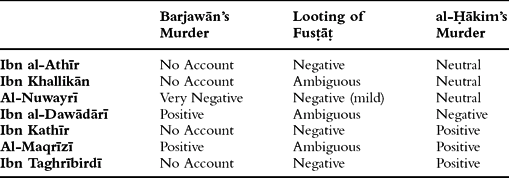
We would be amiss to not address the absence of Barjawān's murder from the works of three of the seven selected compilers (i.e. Ibn al-Athīr, Ibn Khallikān, and Ibn Taghrībirdī). The decision to omit an incident that reflects poorly on an historical figure may be construed as a conscious attempt to perpetuate a positive image.Footnote 47 Often, however, an event (i.e. Barjawān's murder) can be glossed in a variety of ways, shifting the blame from one agent or actor to another. In such cases, the omission of a particular incident may result from doubts surrounding the veracity of the account, a lack of space, or a judgment against its importance. It is not necessarily part of a larger decision to portray a historical personality in an overwhelmingly negative or positive light. Al-Maqrīzī and al-Nuwayrī's accounts demonstrate that considerable latitude was available to compilers in their presentation of Barjawān's murder. Consequently, a polemical motive should not be read into the omission of the incident by three of the selected compilers.
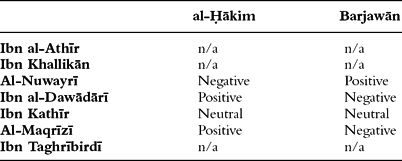
The portrayal of the main characters in the murder of Barjawān

B. The looting of Fusṭāṭ
In 410/1019, the city of FusṭāṭFootnote 48 was savagely ransacked by a contingent of Fāṭimid soldiers for three consecutive days. The order to plunder allegedly came from al-Ḥākim who was exacting revenge for either (a) the population's obstinate refusal to respond to missionary activities being carried out on his behalf or (b) its continued circulation of personal attacks against his person and family. When the soldiers finally withdrew, a large section of the city had been plundered or burned to the ground and – according to some accounts – many women and children had been captured, raped, and enslaved. FourFootnote 49 of the seven selected compilers offer accounts of the incident but only Ibn Taghrībirdī cites an authority (Hilāl al-Ṣābi').Footnote 50
1. Ibn al-Athīr
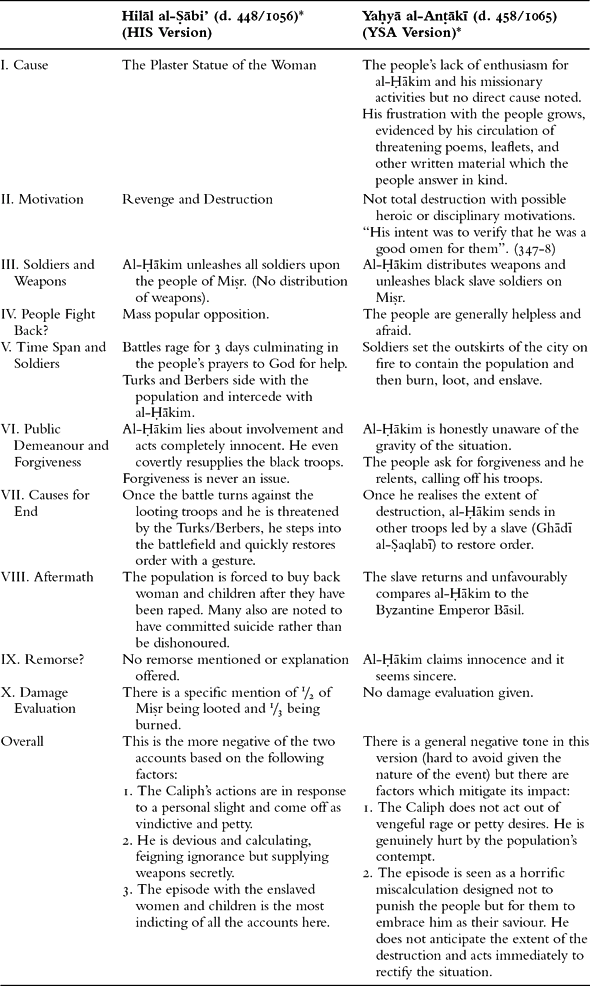
Ibn al-Athīr offers the shortest version of the looting episode, effectively summarising the major elements found in the other accounts. Al-Ḥākim's anger is linked to the population's construction of a female statue holding a note that contains curses directed at the Fāṭimids which is placed in an open city street. Ibn al-Athīr does not specify the reasons for the people's hatred of al-Ḥākim, only alluding to “the wickedness of his actions”. Once al-Ḥākim discovers that the woman is a fake, he unleashes his troops on Fusṭāṭ and permits them to burn and loot at will. The people try to resist with help from the Turks and Berbers. After three days, they write to al-Ḥākim and plead for forgiveness, but he refuses to reign in his soldiers. He finally restrains the troops after the situation begins to spiral out of control. Ibn al-Athīr places a particular emphasis on the rapes of Fusṭāṭī women and children and notes (with horror) that male relatives were forced to ransom their female kin from the slave soldiers.
The polemic in Ibn al-Athīr's account is surprisingly subtle. Al-Ḥākim is depicted as cruel, vindictive, and evil but his actions are implicitly understandable when viewed in a broader context. His anger is a natural (and reasonable) consequence of the malicious accusations against him and his family. Initially, he does not direct his wrath against the general population of Fusṭāṭ; rather he summons the statue which he mistakes for a woman. It is only after he realises that he has been duped that the soldiers are unleashed with a license for destruction that is difficult to justify. Ibn al-Athīr does not identify the direct cause for the construction of the statue, thereby dividing the overall responsibility for the disaster between the people (who insulted al-Ḥākim) and al-Ḥākim (who overreacted). In asking for the Caliph's pardon, the people of Fusṭāṭ explicitly acknowledge their partial accountability in the affair. Al-Ḥākim's refusal, however, evidences a stunning cruelty and a lack of the forbearance befitting a just sovereign. On the whole, the reputations of both al-Ḥākim and the people of Fusṭāṭ are sullied by the ignominious disaster.
Whereas the other compilers treat the looting incident as a distinct independent event, Ibn al-Athīr subsumes it in a larger passage dealing with al-Ḥākim's subsequent disappearance/murder. Specifically, he finds a reason for the Caliph's murder in the revulsion generated by the enslavement and rape of Fusṭāṭī women and children. He states that the people's “loathing for and hatred of him increased” before branching off into another set of explanations for the Caliph's murder. Since the account's primary importance rests in its explanatory value, Ibn al-Athīr pares it down to the absolute minimum.
2. Al-Nuwayrī, Ibn Kathīr, and Ibn Taghrībirdī
The accounts recorded by al-Nuwayrī, Ibn Kathīr, and Ibn Taghrībirdī are nearly identical in structure but differ in their depth of detail and their portrayal of al-Ḥākim. Al-Nuwayrī's version is unique in that is does not mention the history of bad relations between the Caliph and the inhabitants of Fusṭāṭ. After al-Ḥākim happens upon the statue in the street and reads the note, he unleashes his black slave soldiers upon the city. We are never informed of the circumstances surrounding the statue's construction. In his description of the battles between al-Ḥākim's soldiers and the city's inhabitants, al-Nuwayrī makes no mention of the Turks or the Berbers. The Caliph finally decides to call off the troops when the destruction becomes excessive. The affair ends when al-Ḥākim sends ‘Adī, a slave military commander, to Fusṭāṭ to restore order. When the officer returns to the palace, he offers a damaging assessment of al-Ḥākim's actions concluding with an unfavourable comparison to the Byzantine Emperor. Needless to say, ‘Adī is executed on the spot for his public insubordination. Al-Nuwayrī's account does not discuss the aftermath of the incident and, in particular, he does not mention the enslavement and rape of Fusṭāṭī women and children.
Unlike Ibn al-Athīr, al-Nuwayrī does not accord any blame to the general population. He does not detail the construction of the statue or discuss the hatred between the people and the Caliph. In al-Nuwayrī's account, the fact that the Turks and the Berbers do not side with the Fusṭāṭīs reflects favourably on al-Ḥākim as he is neither blamed nor threatened by key segments of the military.Footnote 51 The Caliph also benefits in this portrayal from the absence of any mention of rape or enslavement. Al-Nuwayrī's only criticism of al-Ḥākim resides in the latter's stubborn refusal to meet with the city's inhabitants after three days of fighting and in ‘Adī's cutting critique of the Caliph's actions. While the Caliph is cast in a negative light by al-Nuwayrī, he is spared many of the criticisms central to the other Mamlūk texts.
Ibn Kathīr's account portrays the incident as the climax of a gradual escalation in hostility between the Fusṭāṭīs and the Caliph over the latter's claims to divinity. Al-Ḥākim happens upon the statue, mistakes it for a real woman, and erupts into anger when he reads the note. He is further enraged upon realising that it is only a statue. The Caliph responds to the insult by secretly ordering his black troops to plunder and burn the city. While they carry out his command, al-Ḥākim feigns ignorance of the affair. The Turks and Berbers side with the Fusṭāṭīs, and help defend their property and families from the onslaught of the black slave soldiers. When (and only when) al-Ḥākim sees that the fight is lost, he calls back the soldiers and publicly disavows any involvement in the overall sequence of events. Ibn Kathīr explicitly states that this is a lie. The account ends with an assessment of the material damage (1/3 of the city burned and 1/2 looted) and an emotional description of the widespread rape and enslavement of women and children. Ibn Kathīr notes that some women killed themselves for fear of being violated by the black slave soldiers.
The account's polemic is self-evident. Ibn Kathīr depicts the population of Fusṭāṭ in a sympathetic light as the most destitute and defenceless of victims. He also highlights al-Ḥākim's duplicity as the Caliph extracts an unjustifiably heavy price from the civilian population while feigning compassion and ignorance. The people's suffering is central to the account as they are subject to rape, enslavement, and slaughter on the direct orders of a Caliph entrusted to protect them from such horrors. The Turks and Berbers turn against al-Ḥākim in an unprecedented and united censure of Caliphal authority. Finally, Ibn Kathīr routinely follows the Caliph's name with phrases like ‘God curse him’ or ‘God make him ugly’.
Ibn Taghrībirdī's version of the looting of Fusṭāṭ – explicitly attributed to Hilāl al-Ṣābi' – is by far the most elaborate of all the accounts. It begins with a description of al-Ḥākim's customary excursions to Fusṭāṭ during which he would listen to people's complaints. A general feeling of discontent with al-Ḥākim's policies prompts the people to fashion a female statue bearing a note which curses the Fāṭimids. Al-Ḥākim's anger at the note is exacerbated when he discovers that the woman is not real. He secretly orders all his black slave soldiers and ‘western’ troops to march on Fusṭāṭ, while feigning ignorance of the affair. The Turks and Berbers respond to the people's calls for help on the third day of fighting, fearing the loss of their own property and families. They write an elaborate letter (quoted in full) asking al-Ḥākim to explain the reasons for his actions. He claims the troops are not acting on his orders, while covertly reinforcing and resupplying them at the same time. Upon learning of this duplicity, the Turks and Berbers write a second letter in which they threaten to burn down Cairo. On the edge of defeat, al-Ḥākim rides out into the battlefield and restrains his black troops with a simple gesture of his hand. He claims no knowledge of the matter and issues a general apology. Similarly to Ibn Kathīr, Ibn Taghrībirdī discusses the enslavement, rape, and suicide of a significant segment of the female population. The account ends with the story of a local ‘Alid who asks al-Ḥākim to free enslaved ‘Alid women and children. The Caliph refuses, explaining that the Fusṭāṭīs have been justly rewarded for their disrespect and disobedience.
Overall Ibn Taghrībirdī's account casts the people of Fusṭāṭ in a positive light. The construction of the statue is justified on the basis of al-Ḥākim's oppressive policies. The Caliph, on the other hand, emerges as a deceitful and cruel ruler willing to manipulate army factions against one another in order to extract vengeance from the people. His refusal to call off his black troops until threatened by the Turks and Berbers reflects a thorough disregard for his responsibility as the guardian of his subjects. After the destruction ends, al-Ḥākim does not hesitate to lie about his role in the affair and maliciously refuses to respond to the pleas of his ‘Alid kinsmen. It is hard to envision a more negative portrayal.
3. General ConclusionsFootnote 52
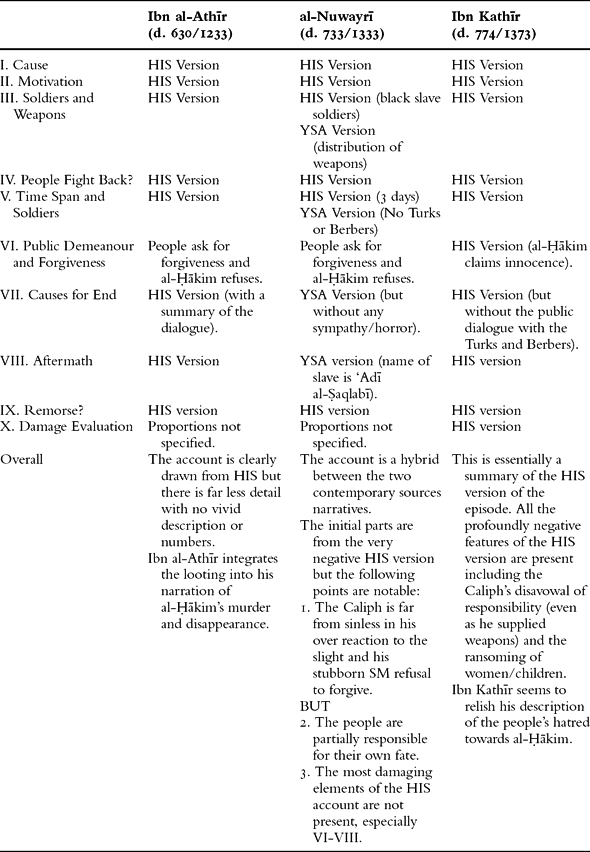
Ibn Taghrībirdī is the only historian to cite an authority (i.e. Hilāl al-Ṣābi') for his version of the looting of Fusṭāṭ. This claim is substantiated by the avidly anti-Ḥākim tone that permeates his account.Footnote 53 The basic structure and details of the narratives presented by Ibn al-Athīr and Ibn Kathīr also intimate a dependence on Hilāl al-Ṣābi'. Ibn al-Athīr truncates his depiction of the episode in the interests of his larger narrative but the information is almost identical in content and presentation. Ibn Kathīr also follows Ibn Taghrībirdī very closely and their reliance on a common source (Hilāl al-Ṣābi') is self-evident. In particular, both texts include identical details regarding the extent of damage (a third of the city burned and half looted), the alleged suicides of portions of the female population, al-Ḥākim's attempt to disavow responsibility, and his covert reinforcement of the black troops.
Although al-Nuwayrī does not explicitly cite his sources, several general conclusions can be drawn from his version of the incident. Al-Nuwayrī's omission of the role of the Turks and Berbers in ending the violence and his inclusion of the incident between ‘Adī and al-Ḥākim evidence his partial reliance on al-Anṭākī's historical chronicle.Footnote 54 Outside of these details, however, al-Nuwayrī relies on the account ascribed to Hilāl al-Ṣābi'. Whereas al-Anṭākī attributes the decision to plunder Fusṭāṭ to the people's refusal to accept al-Ḥākim's self-proclaimed divinity, al-Nuwayrī chooses to cite the incident with the female statue. He does not, however, mention the most damaging details found in Ibn Taghrībirdī and Ibn Kathīr (e.g. the rape and enslavement of innocent women and children), suggesting that he may have pared down Hilāl al-Ṣābi's account to eliminate overtly anti-Ḥākim polemic. Overall, there is little doubt that al-Nuwayrī was familiar with the accounts of both al-Anṭākī and Hilāl al-Ṣābi, and made conscious decisions regarding which aspects of each account to include in his narrative of the looting.
The decision to unleash the army against the civilian Muslim population of Fusṭāṭ is difficult (if not impossible) to defend. Any historian wishing to discuss the incident would be hard pressed to cast al-Ḥākim in a positive light. Even al-Nuwayrī, who omits many of the harshest elements recounted by Ibn al-Athīr, Ibn Kathīr, and Ibn Taghrībirdī, is forced to condemn al-Ḥākim's actions as cruel and unjustified. In an incident with only one possible interpretation, the decision not to include it in a historical work takes on a particular significance. Whereas authors can forward multiple interpretations of Barjawān's murder, they have little room for manoeuver when dealing with the looting of Fusṭāṭ. Although Ibn Khallikān, Ibn al-Dawādārī, and al-Maqrīzī were undoubtedly aware of the episode, they chose not mention it in their respective works. They might have deemed the incident unimportant or had doubts regarding its veracity. Their decision to omit the incident may also indicate a bias in favour of al-Ḥakim. This judgment cannot be made on the basis of a single episode, but it should be kept in mind as we turn to an examination of al-Ḥākim's disappearance and possible murder.
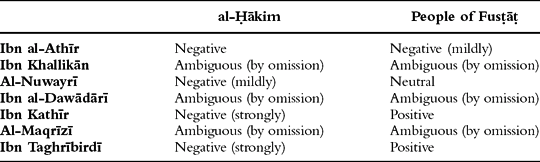
The portrayal of the main characters in the looting of Fusṭāṭ

C. Al-Ḥākim's Disappearance/Murder
On a night near the end of Shawwāl in the year 411/1021, al-Ḥākim set out – as he often did – into the hills surrounding Cairo. He never returned and no trace of his body was ever found. The mystery of this disappearance grew to legendary proportions with the Druze sect forwarding it as proof of al-Ḥākim's divinity. The event has been discussed by every major medieval and modern historian of the Fāṭimid period with many offering multiple explanations.Footnote 55
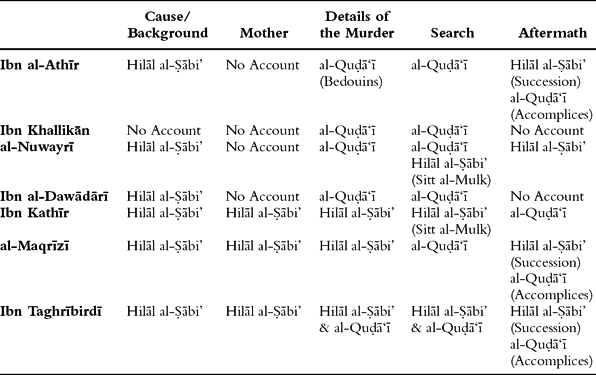
The approach employed in dealing with this incident will vary slightly from that of Barjawān's murder and the looting of Fusṭāṭ. The large number of accounts and their apparent intertextuality necessitates an individual examination of the main narrative elements which include (1) the cause/background, (2) al-Ḥākim's interactions with his mother, (3) the details of the alleged murder, (4) the search party, and (5) the political aftermath. This section will conclude with an analysis of the depiction of the two primary characters in the drama; namely al-Ḥākim and his sister, Sitt al-Mulk.
1. The causes and background of al-Ḥākim's disappearance/murder
Every account implicates Sitt al-Mulk in the alleged murder of her brother. The root cause of her involvement centres on al-Ḥākim's accusations that she improperly kept the company of male visitors and was guilty of fornication. Discussions of the tension between the two siblings can be divided into two categories. Ibn al-Athīr, Al-Nuwayrī, Ibn Kathīr, and al-Maqrīzī do not comment on the veracity of the charges, leaving open the question of Sitt al-Mulk's guilt or innocence. Ibn al-Dawādārī and Ibn Taghrībirdī, on the other hand, extol Sitt al-Mulk as a virtuous woman who tried to check her brother's excesses only to find herself the target of his slanderous rage. Ibn Khallikān does not recount the incident in any detail citing a lack of space.
With the exception of Ibn Khallikān and Ibn al-Dawādārī, all the compilers explain the murder as the result of a conspiracy between Sitt al-Mulk and Ibn Dawwās (a Kutāmī Berber military chief). Ibn al-Athīr and al-Nuwayrī recount Sitt al-Mulk's adept manipulation of her accomplice as she arranges a face-to-face meeting, stokes his fears of al-Ḥākim, and offers him administrative control of the state. Although Ibn Kathīr and al-Maqrīzī mention the conspiracy, they do not describe the meeting or Sitt al-Mulk's false promises of power and wealth. Ibn Taghrībirdī's glowing portrait of Sitt al-Mulk is followed by an elaborate justification of her decision to kill al-Ḥākim and a truncated report of her initial meeting with Ibn Dawwās. Ibn Dawwās is wholly absent from Ibn al-Dawādārī's text as a desperate and frightened Sitt al-Mulk relies on two of her own slaves to carry out the murder.
2. Al-Ḥākim's interactions with his mother
Three (Ibn Kathīr, al-Maqrīzī, and Ibn Taghrībirdī) of the seven compilers include an encounter between al-Ḥākim and his mother in which he predicts his demise based on astrological observances and implicates his sister in the crime. He then presents his mother with a large sum of money as insurance in case he is killed and prepares to set out. She pleads with al-Ḥākim to stay home, and he reluctantly acquiesces to her wishes and goes to bed. Near dawn, however, the Caliph is mysteriously compelled to ride out into the night and the impending danger.
The importance of this element in the narrative rests in its human portrayal of al-Ḥākim. All three accounts stress his love for his mother and emphasise his concern for her financial independence and well-being. Al-Ḥākim's brutality is mitigated by this sincere exchange, and his prediction of his own murder has important occult implications. By including this event, Ibn Kathīr, al-Maqrīzī, and Ibn Taghrībirdī explicitly condemn the impending murder and cast al-Ḥākim in an unexpectedly positive light. It is not surprising, therefore, that the two strongest condemnations of Sitt al-Mulk are found in these accounts (i.e. Ibn Kathīr and al-Maqrīzī).
3. The details of the alleged murder
Two narrative patterns emerge with regards to the accounts of al-Ḥākim's actual murder. In the first, the text specifies the circumstances of the murder (verified by witnesses) while leaving the details unspecified. Ibn al-Athīr, Ibn Khallikān, and Ibn al-Dawādārī note that al-Ḥākim rode out to the grave of al-Fuqā‘ī with two horsemen. He sent one of the two away in the company of nine Bedouins from Sueda with authorisation to provide them funds from the treasury. The other horseman left his side around dawn. The accounts go no further in explaining al-Ḥākim's disappearance. There is strikingly little sympathy for the murdered Caliph.
The second narrative pattern – embodied in the versions of Ibn Kathīr, al-Maqrīzī, and Ibn Taghrībirdī – includes an elaborate and detailed description of the murder itself. Ibn Kathīr mentions the two horsemen that accompany al-Ḥākim outside the city but they play no further role in the affair. Al-Maqrīzī and Ibn Taghrībirdī agree that the Bedouins who return with one of the two horsemen are from the ‘Banū Qurra’ but disagree on their number (al-Maqrīzī – 7, al-Nuwayrī – 10). All three compilers note that the assassins gut al-Ḥākim before transporting his body to Ibn Dawwās who, in turn, sends it to Sitt al-Mulk for disposal. Ibn Kathīr and Ibn Taghrībirdī also mention that al-Ḥākim's arms and legs are severed prior to his death. The most sympathetic account is forwarded by Ibn Taghrībirdī who portrays the Caliph pleading with his killers for an explanation of their actions. The depictions of all three of these compilers elicit strong sympathy for al-Ḥākim by emphasising the brutality of his murder.
Al-Nuwayrī's version of the murder is unique in a number of ways. First, he never specifies the number of horsemen that set out with al-Ḥākim. Second, the local Bedouins who appear in every other account (aside from Ibn Kathīr) are conspicuous by their absence. Finally, the murder is carried out by ten assassins for 500 dīnārs as opposed to the two assassins and a price of 1,000 dīnārs (when specified) mentioned in the other texts. Although al-Nuwayrī notes that the Caliph was alone at the time of the murder, he forwards no further details of the crime or the subsequent disposal of the body.
4. The Search Party
There are two narrative patterns in the accounts dealing with the search for al-Ḥākim after his disappearance. The first – which includes Ibn al-Athīr, In Khallikān, al-Nuwayrī, and Ibn al-Dawādārī – focuses on the dignitaries who set out each day anticipating the Caliph's return. Finally, on either the 2nd (Ibn Khallikān) or the 3rd (Ibn al-Athīr, al-Nuwayrī, and Ibn al-Dawādārī) of Dhū al-Qa'da, a number of high officials conduct a meticulous search of the hills outside Cairo and discover al-Ḥākim's mount (its legs severed) surrounded by a set of tracks that lead to a pool containing his unbuttoned clothes in either four (Ibn al-Dawādārī) or seven (Ibn al-Athīr, al-Nuwayrī, and Ibn Khallikān) parts with the tell-tale signs of stab wounds. The officials return to Cairo convinced that al-Ḥākim is dead. A version of this narrative is also mentioned by both al-Maqrīzī (in a summarised form) and Ibn Taghrībirdī in addition to their primary accounts. Overall, the pattern does not forward an easily identifiable bias for or against either al-Ḥākim or Sitt al-Mulk.
A more cutting polemic is evident in the second narrative pattern which emphasises Sitt al-Mulk's efforts to quell unrest by lying about the murder. According to Ibn al-Athīr, Ibn Kathīr and al-Maqrīzī, she summons the leading men of the state and claims that she is in contact with the missing Caliph. To add a degree of veracity to the lie, Sitt al-Mulk continually sends messengers into the mountains ostensibly to communicate with al-Ḥākim. Al-Nuwayrī and Ibn Taghrībirdī temper the impact of this report by suggesting that the Caliph's sister only lied about his disappearance when confronted with a possible revolt by the army and high ranking officials. In either case, Sitt al-Mulk's machinations portray her in a negative light as she first kills her brother and then deceives/manipulates the general population.
5. The Aftermath
The aftermath of al-Ḥākim's murder concerns the succession of his son, al-Ẓāhir. Al-Nuwayrī simply states that Sitt al-Mulk distributed money to officials, military officers, and dignitaries to keep the state together until the oath of allegiance was taken on the 10th of Dhū al-Ḥajj. No polemic permeates the account which conforms to the ceremonial through which a new caliph typically assumed power in Fāṭimid Egypt.Footnote 56
Ibn al-Athīr, Ibn Kathīr, al-Maqrīzī, and Ibn Taghrībirdī offer an expanded version of the succession crisis which strongly condemns Sitt al-Mulk. Although they differ on exact amounts, they concur on her use of bribes and gifts to keep officials in line. Ibn Kathīr and Ibn Taghrībirdī assert that she secured two million dīnārs and one million dirhams from Tinnis and Damascus which was then distributed to important figures in the army and bureaucracy. Al-Maqrīzī and Ibn Taghrībirdī emphasise her manipulation of Kathīr al-Mulk (the wazīr) in designing a trap to kill al-Ḥākim's appointed successor, ‘Abd al-Rahim Ilyās. After securing the oath of allegiance, all four compilers agree that Sitt al-Mulk arranged the murder of Ibn Dawwās. Ibn al-Athīr, Ibn Kathīr and Ibn Taghrībirdī vividly recount her incitement of a group of soldiers against Ibn Dawwās through a public proclamation of his role in al-Ḥākim's murder as well as her subsequent disposal of anyone aware of her part in the conspiracy. Sitt al-Mulk is cast as a ruthless woman willing to go to murderous extremes in the pursuit of power.
Ibn Khallikān and Ibn al-Dawādārī end their narratives after recounting the details of al-Ḥākim's murder and the search party. They do not discuss the steps through which Sitt al-Mulk secured the oath of allegiance for her nephew, al-Ẓāhir. The absence of these details reflects positively on Sitt al-Mulk as the authors shield her from the raw ruthlessness that permeates the other accounts.
5. Al-Ḥākim's murder: the polemics
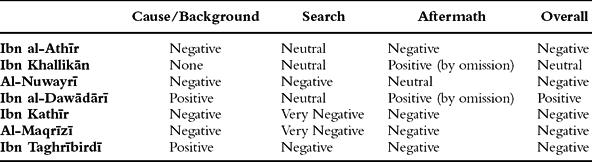
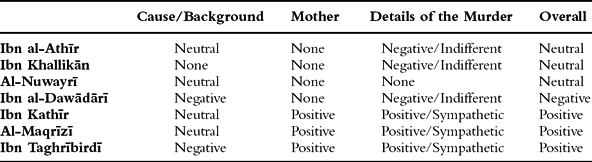
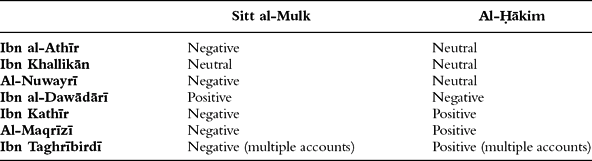
Charts 3 and 4 below summarise the depictions of al-Ḥākim and Sitt al-Mulk in the five central elements of the disappearance/murder narrative while Chart 5 offers a summary of our results. Whereas some of the Mamlūk works cast al-Ḥākim in a positive light, Sitt al-Mulk is almost universally condemned. Ibn Khallikān does not forward any clear opinion, while Ibn Taghrībirdī's text is somewhat problematic as it is essentially a side-by-side quotation of two relatively complete early accounts (i.e. those of Hilāl al-Ṣābi' and al-Quḍā‘ī). A more detailed discussion of authorial polemics inclusive of the collective case studies is discussed below.
The portrayal of Sitt al-Mulk in the disappearance/murder accounts

The portrayal of al-Ḥākim in the disappearance/murder accounts

The portrayal of the main characters in the disappearance/murder accounts

6. General ConclusionsFootnote 57
The only unredacted near contemporary account of the disappearance of al-Ḥākim is found in al-Anṭākī's historical chronicle.Footnote 58 The text begins by emphasising the Caliph's growing sympathy towards the Jacobite monks who lived in a monastery on the hills outside Cairo. Al-Anṭākī notes that al-Ḥākim would regularly visit the monastery accompanied by a mounted rider. On the night of the disappearance, al-Anṭākī takes a special interest in the encounter between the Caliph and the party of seven Bedouins. All the Mamlūk accounts note that the Bedouins returned to the city in the company of one of al-Ḥākim's riders. Al-Anṭākī, however, claims that only four of the seven set out for Cairo while the others waited with al-Ḥākim for their companions to return. Eventually they grew impatient with the delay, killed the Caliph, and concealed his body. Al-Anṭākī ascribes no role in the murder to Sitt al-Mulk and depicts her as a concerned sibling who sincerely organises a search party for her brother. It is noteworthy that this version of the events is not mentioned by any of the Mamlūk compilers despite the fact that it was known and available to them.Footnote 59
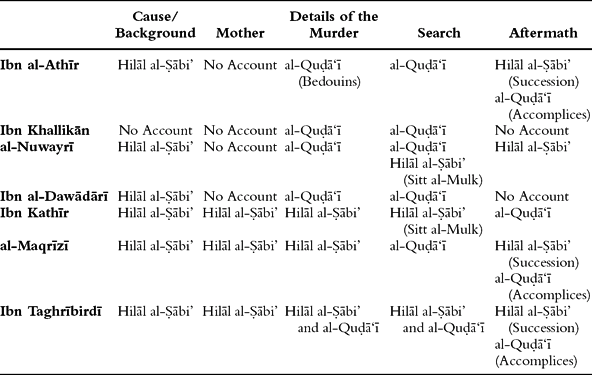
Ibn Taghrībirdī is the most transparent of the selected authors, citing authorities for both his central account and his variant. He mentions Hilāl al-Ṣābi' (‘and others’) as sources for the dispute between al-Ḥākim and his sister, the subsequent conspiracy, the conversation between al-Ḥākim and his mother, the details of the murder, and the efforts at securing al-Ẓāhir's succession. He also cites al-Quḍā‘ī for a second version of the actual murder (lacking the vivid descriptions attributed to al-Ṣābi’), a more detailed account of the search party, and Sitt al-Mulk's machinations against her accomplices. Almost every element – albeit with some minor variations – of the disappearance/murder narratives found in Mamlūk works can be traced back to the accounts of either Hilāl al-Ṣābi' or al-Quḍā‘ī (see Chart 6). The differences between the various accounts lie in their use of these narrative elements to construct specific polemics/judgments on the events and historical personalities in question. In other words, they could (and did) pick and choose from a wide array of narrative elements to craft narratives which best adhered to their individual preferences and motives.
The sources of the disappearance/murder accounts

IV. Historical Veracity or Polemical Purpose
The Fāṭimids posed no immediate political threat to Mamlūk political dominance in the early seventh/thirteenth century. There was no need for the selected compilers to defend Mamlūk claims against an extinct and discredited dynasty. Four of the seven (al-Nuwayrī, al-Dawādārī, al-Maqrīzī, and Ibn Taghrībirdī) compilers either served in the Mamlūk bureaucracy or were raised in military/bureaucratic families. The modern secondary literature ascribes these men the intention of either (a) educating their audiences or (b) providing works of historical reference. The three remaining compilers (Ibn Athīr, Ibn Khallikān, and Ibn Kathīr) were raised in religious backgrounds. Ibn al-Athīr took part in the Crusades and his accounts of the period include consistent condemnations of the perceived ‘enemies of Islam’. Ibn Khallikān was a trained religious scholar who was twice appointed Chief Qāḍī of Egypt. Ibn Kathīr was a renowned traditionalist and a student of Ibn Taymiyya.
A. The Overall Portrayal of al-Ḥākim
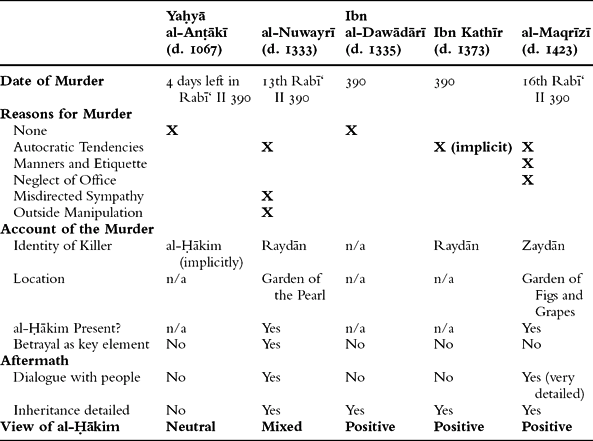
Chart 7 (below) summarises the treatment of al-Ḥākim by the selected compilers. A neutral account does not make any clear judgments with regards to al-Ḥākim either (a) by not presenting any information at all or (b) by summarising events without additional commentary or elaborate detail. Ambiguous narratives combine positive and negative portraits of al-Ḥākim within a single narrative. The results suggest that four (Ibn al-Athīr, Ibn Khallikān, al-Nuwayrī, and al-Maqrīzī) of the seven selected compilers present reasonably consistent views of al-Ḥākim. Ibn al-Athīr is problematic due to the neutrality of his account of al-Ḥākim's murder. If he was intent on portraying al-Ḥākim as an evil ruler, we would expect an active voice justifying his sister's actions. In actuality, he is highly critical of Sitt al-Mulk for her political machinations. Ibn Khallikān's apparent neutrality stands out in comparison with the other selected authors. Al-Nuwayrī and al-Maqrīzī are the only selected compilers who appear to work through the source material intent on forwarding a consistent portrait of the Caliph. The former (al-Nuwayrī) depicts al-Ḥākim as a tyrant to be condemned for his bloodthirsty streak and his cruelty, while the latter (al-Maqrīzī) casts him as a misunderstood victim of outside manipulation.Footnote 60 The three remaining compilers (Ibn al-Dawādārī, Ibn Kathīr, and Ibn Taghrībirdī) forward contradictory portraits of the Caliph that oscillate wildly from highly critical to sympathetic.
The Portrayal of al-Ḥakim in the selected accounts

B. A Possible Alternative: Morality Plays and Literary Analysis
An important question remains regarding the accounts with inconsistent portrayals of al-Ḥākim. If they were not designed to disparage or rehabilitate the Caliph, then what was their purpose? It seems unlikely that a man as serious about his work as Ibn Kathīr would include stories merely for their entertainment value. What, then, explains the different versions of al-Ḥākim offered in each historical episode? Modern scholarship has uncovered numerous recurring motifs and stock themes in outwardly historical works.Footnote 61 It is the argument of this paper that when dealing with the events of the Fāṭimid period, many of the selected compilers may have had a different purpose in mind; namely to convey to their audience (if not inform them of) the acceptable norms of ‘civilised’ behaviour and, in particular, the social bonds and responsibilities that held society together.Footnote 62 The final section of this paper offers a number of social/ethical themes which appear to emerge from a close reading of the Mamlūk historical tradition's treatment of al-Ḥākim.
1. Barjawān's murder
The narratives dealing with Barjawān's murder focus on one of two social/ethical themes. Accounts critical of al-Ḥākim (e.g. al-Nuwayrī) accuse him of betraying the intrinsic bond of loyalty that governed his relationship with his guardian-tutor. Specifically, al-Nuwayrī recounts Barjawān's pivotal role in securing the oath of allegiance for al-Ḥākim at the time of his father's death despite staunch military opposition on the part of the Berbers. Al-Nuwayrī then assails the Caliph's blatant disregard for the eunuch's past endeavours on his behalf. In other words, there was a debt of gratitude that al-Ḥākim owed Barjawān but which the former violated by the sudden murder. The importance of the episode lies in the act of betrayal which cut against society's established standards of ethics. It is not insignificant that, at the moment prior to his beheading, Barjawān calls out to al-Ḥākim that he has been betrayed.
The accounts which endorse the murder (e.g. al-Maqrīzī and Ibn al-Dawādārī) forward a different – though equally important – theme. Al-Maqrīzī emphasises the corruption and neglect endemic to the latter part of the eunuch's regency. In addition to his illegal seizure of power and his obsessive love of the forbidden (songs), Barjawān is ascribed uncouth and inappropriate etiquette in the presence of the Caliph. On the whole, these accounts construct a series of justifications for the overthrow of an illegitimate and incompetent ruler. In his speech to the people in the aftermath of the murder, al-Ḥākim focuses on Barjawān's growing autocratic tendencies and his dissent into sin. The bond of loyalty and trust which initially empowered the eunuch is invalidated by his corruption which is coupled with his refusal to consult or acknowledge the legitimate head of state (al-Ḥākim).
The central element in these accounts ranges from the depiction of al-Ḥākim's betrayal of a loyal servant to the depiction of the servant's betrayal of his duty and responsibility to his master. The compiler has the freedom to choose either one of these representations and to portray the event through the chosen narrative's distinctive lens. Al-Nuwayrī decides to place a greater emphasis on the Caliph and his obligations to his servants, while al-Maqrīzī concentrates on the behaviour of officials entrusted to positions of authority.
2. The looting of Fusṭāṭ
The four versions of the looting of Fusṭāṭ – which is difficult to cast in a light favourable to al-Ḥākim – centre on the mutual responsibilities that bind a leader to his/her subjects. These accounts are particularly emphatic in their condemnation of al-Ḥākim's cruelty, despotism, and profound lack of forbearance in his interactions with the Fusṭāṭīs. This motif is not new to Ibn al-Athīr as it also occurs in his accounts of the Mongol invasions and the Crusades. In fact, Ibn al-Athīr routinely depicts al-Ḥākim as a ruler indifferent to the well-being of his Muslim subjects, culminating in measures which equate the legal standing of Muslims and non-Muslims. Al-Nuwayrī, Ibn Kathīr, and Ibn Taghrībirdī adhere to a similar perspective, emphasising the malicious nature of al-Ḥākim's decision to unleash his black soldiers on the civilian population. Al-Ḥākim utterly fails as a ruler, a point made explicitly by al-Nuwayrī through his decision to quote unfavourably ‘Adī's comparison of the Caliph to the Byzantine Emperor. These accounts do not strictly report historical events as much as they condemn the Caliph's vindictiveness and cruelty. In doing so, they judge al-Ḥākim's actions against the societal expectation that a ruler must protect his subjects regardless of perceived (and possibly isolated) slights and provocations. The ideal of good leadership and its violation is far more important than the actual sequence of events.
3. Al-Ḥākim's disappearance/murder
It is striking that the majority of the accounts dealing with al-Ḥākim's disappearance/murder either refrain from judgment or depict him in a surprisingly positive manner. In his analysis of Ibn Taghrībirdī's chronicle, Little discerned a strong topos against regicide even at the cost of historical accuracy.Footnote 63 Al-Maqrīzī and Ibn Kathīr also appear to condemn regicide categorically. Despite the fact that al-Ḥākim is universally reviled for his proclamation of divinity, he still emerges as a sympathetic figure in the disappearance/murder accounts as the physical being of the Caliph is considered sacrosanct. Even compilers who generally assail al-Ḥakim (e.g. Ibn al-Athīr and al-Nuwayrī) condemn his sister for the murder. Ibn al-Dawādārī is unique in his endorsement of regicide; a position even avoided by al-Anṭākī, a persecuted Christian contemporary of al-Ḥākim. The existence of a single account which endorses the murder is testament to the pervasiveness of the taboo against regicide.Footnote 64
V. Conclusion
This study has shown that – with the exception of al-Nuwayrī and al-Maqrīzī – the Mamlūk compilers do not generally present consistent portraits of al-Ḥākim. They oscillate between depicting him as a cruel ruthless murderer and as a loving victim of a vicious and cold sister. There is a possibility that the man's complicated and erratic behaviour was accurately preserved in the historical sources. Indeed, many compilers end their biographies with a litany of contradictions about al-Ḥākim and a candid confession of their inability to understand his motives. Still, the significant differences in the depiction of the Caliph from one event to another suggest the possibility of a different explanation.
The case studies above indicate that the Mamlūk compilers had access to a reservoir of different narratives contemporary to the events in question, including those of al-Anṭākī, Hilāl al-Ṣābi', and al-Quḍā‘ī. The narratives that the Mamlūk compilers eventually produced were consciously constructed from these disparate elements. They were the result of a creative process whose internal dynamics remain largely obscure to modern historians who often assume veracity as the primary end of all medieval historical work. While factual representations may have been valued by these compilers, the literary nature of their works should not be underestimated. This study is intended as one step in a much-needed process of reinterpreting historical texts from a variety of perspectives which moves beyond the quest for historical veracity.Footnote 65
In the case of al-Ḥākim's portrayal in the Mamlūk sources, we can discern an emphasis on the importance of loyalty ties and the interlocking responsibilities of ruler and ruled which Mottahedeh articulated in a Buyid context. Although the small number of historical case studies do not allow for broad generalisations about the Mamlūk treatment of Fāṭimid history, the analysis does suggest the need for a re-evaluation of the historical chronicles with respect to their intertextuality, their internal dynamics/structure, and the choices made in the course of their construction/compilation. Little has been done to compare the historiographical methods or intentions of al-Nuwayrī with al-Maqrīzī or Ibn Taghrībirdī with Ibn al-Dawādārī. Given their access to similar source material for the Fāṭimid period, this constitutes a significant lacuna in the current landscape of medieval Islamic historiography. Perhaps Mamlūk compilers conceived of their works – historical or otherwise – in a broader context and worked with multiple purposes in mind, some of which went beyond redaction or explicit historical veracity.
Appendix I – The Base Narratives and Sources
The murder of Barjawān narratives

The Base Narratives of the Looting of Miṣr

* This account is taken from Ibn Taghrībirdī's al-Nujūm, 180-3. It includes an incredible amount of colourful detail which others tend to summarise. This might be a result of Ibn Taghrībirdī's authorial elaboration upon the skeletal account attributed to Hilāl al-Ṣābi' or it may be the actual full account. In either case, the narrative elements seem to be consistent across the many texts which rely on the HIS version.
The Looting Narratives of Later Historians

The HIS version is the account of Hilāl al-Ṣābi' as preserved in Ibn Taghrībirdī. The YSA version is the account of Yaḥyā b. Sa‘īd al-Anṭākī as preserved in his extant historical chronicle.
The Base Narratives of the Disappearance/Murder of al-Ḥākim

* As cited in Ibn Taghrībirdī's al-Nujūm, 185-90.
α As cited in Ibn Taghrībirdī's al-Nujūm, 190-92.
The Disappearance/Murder Narratives of Later Historians