

1. INTRODUCTION
The last 25 years have witnessed a huge growth in the level of international constitution making.Footnote 1 A majority of the world’s nations have amended, rewritten or drafted new constitutional texts during this period. As part of this vigorous spate of constitutionalism there has been what Boyd describes as an ‘environmental rights revolution’, where the response to planetary degradation is now being addressed through the language of human rights and within constitutions.Footnote 2 Since Italy made reference to the protection of natural landscapes in its 1947 Constitution,Footnote 3 the trend has grown, gradually at first, but gathering significant momentum in the last couple of decades. Today, of the 196 national constitutions surveyed, 148 demonstrate some degree of environmental constitutionalism.Footnote 4 This occurs both in democracies and states subject to absolute monarchy or single party or authoritarian rule.
Despite the proliferation of environmental references, some constitutions remain free of such provisions. This is not solely a consequence of states not having engaged in constitutional amendment. Two states have had the opportunity in the last ten years to adopt environmental constitutional provisions as part of a wider constitutional reform, and both have failed to do so.Footnote 5 This indicates that environmental constitutionalization is not inexorable, but rather must be caused by specific circumstances. For advocates of environmental constitutionalism it is therefore important to understand the factors that influence the chances of its successful adoption.
Building on the existing literature in the field, this article investigates the elements which affect whether a state adopts environmental constitutionalism. Section 2 defines environmental constitutionalism for the purposes of this research. Section 3 focuses on states that exhibit environmental constitutionalism and categorizes the various contexts surrounding the constitutional change that occurred when the relevant provisions where first adopted. Section 4 examines the literature on the transfer of external political and constitutional ideas between states and applies this literature to the spread of environmental provisions. Section 5, in turn, considers internal factors within countries that have proved to be important for the adoption of environmental constitutionalism. In conclusion, the article identifies four broad factors that environmental advocates need to be cognizant of before campaigning for the adoption or strengthening of environmental constitutionalism in states where it is absent or the provisions are weak.
At the outset, it is necessary to state that this research does not make any claims about the substantive impact of environmental constitutional provisions.Footnote 6 It is fully acknowledged that the presence or absence of environmental constitutionalism is not indicative of the degree to which a state protects the environment.Footnote 7 Similarly, this research does not encompass states that lack specific provisions within their domestic constitutions, but in which courts have interpreted and applied other constitutional provisions – such as the right to life, bodily integrity or access to information – for environmental purposes.
1.1. Methodology
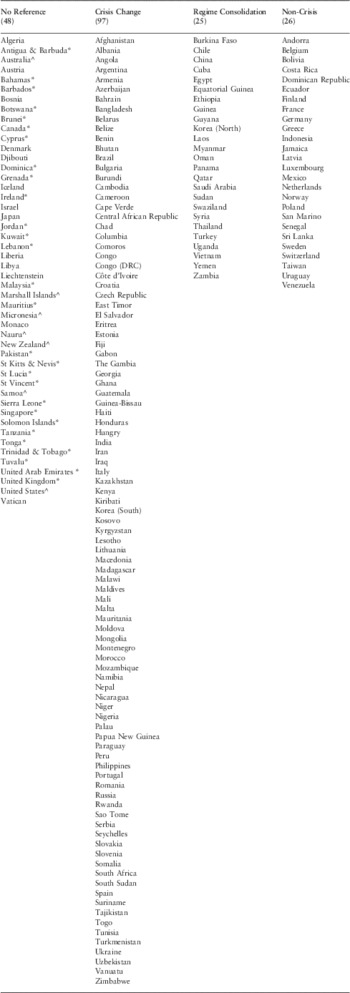
The data informing the analysis in Section 3 was gathered through an examination of all 196 national constitutions for the inclusion of a range of terms (environm*, ecology, conservation, natur*, sustainab*, landscape). The Constitute Project website (ConstituteProject.org) was used as the primary database containing up-to-date national constitutions. Where a term was present but referred to elements outside the definition of environmental constitutionalism (such as ‘ownership of natural resources’) it was disregarded. For those constitutions that contain one or more of the researched terms, the date on which the reference was originally inserted was noted for each state.Footnote 8 A dataset was created on the basis of a historical analysis of domestic events behind each specific constitutional change. Each state was then categorized under one of three broad headings (crisis change, regime consolidation, non-crisis) according to the driver for constitutional amendment, guided by the definitions of the categories in Section 3.Footnote 9
Constitutional references to environmental protection made in the context of the allocation of competencies between the federal and state level are excluded from the scope of the analysis.Footnote 10 Equally outside the scope of this study are constitutional references to the protection or wise use of natural resources generally,Footnote 11 and to particular resources such as waterFootnote 12 or soil.Footnote 13 The reason for the latter exclusion is that such references tend to reflect concerns beyond environmental care, such as economic development and broader conceptions of human rights.Footnote 14
2. DEFINING ENVIRONMENTAL CONSTITUTIONALISM
A review of the 196 national constitutions reveals a great diversity in the way in which environmental issues manifest. To date, academic discussion has tended to focus on the specific category of ‘environmental rights’.Footnote 15 However, Kotzé outlines a wider concept, stating that where environmental ‘care’ is expressed in constitutional language, it constitutes environmental constitutionalism.Footnote 16 He describes the idea of ‘constitutionalism’ as:
[one that] creates the foundation that legitimizes and guides governance, be it private or public; it sets out those basic universal values which a legal community is deemed to hold dear and which the legal order seeks to protect; and it provides checks and balances for the exercise of executive, legislative and judicial authority in the day-to-day task of governing.Footnote 17
Kotzé sees environmental provisions in a constitution as a method to dictate the content of laws, a way to establish moral and ethical obligations with respect to the environment and as a legal grounding and authority to require actual performance of these obligations.Footnote 18 Such an understanding of environmental constitutionalism goes beyond a focus on specific rights and instead sees value in the articulation of environmental concerns within a constitutional document as having the potential to influence a wider range of public and private interactions. This article adopts the same expansive definition of environmental constitutionalism based on ‘environmental care’, encompassing any reference to the environment, ecology, natural landscape, or any rights or duties associated with these elements, contained within a national constitution, bill of rights or other document with a similar legal status. This section clarifies the various components of environmental constitutionalism and also outlines certain aspects that will be omitted from consideration.
2.1. Environmental Rights
Environmental rights have been described as a set of responses to the problems stemming from human interaction with non-human nature.Footnote 19 Rodriguez-Rivera asserts that the term ‘environmental rights’ comprises three separate elements, directed at different aims: (i) environmental procedural rights; (ii) the right of environment; and (iii) the right to environment.Footnote 20
Environmental procedural rights include those associated with participation in decision making, access to information and access to justice.Footnote 21 In international law, these constitute arguably the most accepted tenet of environmental rights, having been codified by the Convention on Access to Information, Public Participation in Decision-Making and Access to Justice in Environmental Matters (Aarhus Convention).Footnote 22 Rights to environmental information feature extensively in national constitutions,Footnote 23 while there are a number of references to public participation in environmental decision making.Footnote 24 The third element of the Aarhus Convention, access to justice, does not feature as commonly at the constitutional level, but it is referenced in the Kenyan Constitution.Footnote 25
The most radical environmental right is the right of environment, which envisages a value in the environment beyond mere human benefit. It proposes that the environment should be regarded as a good on its own merits, and be given rights and protection on that basis.Footnote 26 The argument is based on the position that:
[it is] arbitrary to restrict justice and rights exclusively to inter-human relationships and to tolerate a situation in which interested parties are deprived of essential values in the distributive process on the basis of morally irrelevant factors – such as their not being human.Footnote 27
Ecuador became the first and only country to give protection to this right at constitutional level, when it inserted a chapter on nature (or Pachamama) as part of its 2008 constitutional revision.Footnote 28
The right to environment was first given international expression in Principle 1 of the Declaration of the United Nations (UN) Conference on the Human Environment (Stockholm Declaration), which states that ‘[m]an has the fundamental right to freedom, equality and adequate conditions of life, in an environment of a quality that permits a life of dignity and well-being’.Footnote 29 The right to environment is conceptualized as a right pertaining to each individual; the environment is valued not on its own merits, but in light of its importance for human existence.
2.2. Environmental Duties
In some constitutions, the relationship between citizen, state and the environment is described as based on duties rather than rights. The specificity of these duties and the degree to which they can be enforced varies between countries.Footnote 30 Where environmental duties are cast on the state, they are usually widely framed. Often, they are described in basic terms, such as are found in the Constitution of Myanmar, which provides: ‘[t]he Union shall protect and conserve natural environment’.Footnote 31 In some jurisdictions, environmental duties may go further and actually include an obligation to improve the existing condition of the environment,Footnote 32 or to increase awareness of environmental issues among the state’s population.Footnote 33 Duties addressed to citizens can be framed as a general requirement on all citizens to respect the environment,Footnote 34 or apply more specifically to the actions of individuals,Footnote 35 or extend to an obligation to make reparations where environmental damage is committed.Footnote 36
2.3. Environmental Principles
Environmental principles are treated as distinct from duties on the state as, in the former instance, the constitution mandates that environmental concerns should be reflected in the general principles of governance to which the state must adhere.Footnote 37 For example, the Slovakian Constitution states that ‘[t]he economy of the Slovak Republic is based on the principles of a socially and ecologically oriented market economy’,Footnote 38 whereas the Constitution of Bhutan mandates the state to ‘[s]ecure ecologically balanced sustainable development while promoting justifiable economic and social development’.Footnote 39
2.4. The Environment as Justification for Limiting Rights
Fundamental constitutional rights are rarely wholly unconditional and may be limited either by textual requirement or by implication. Environmental values can feature as a limitation, as in the Constitution of Madagascar, which declares that the state guarantees free enterprise ‘within the limit of the respect for the general interest, the public order, morality and the environment’.Footnote 40 The Macedonian Constitution adopts a similar approach and states that ‘[t]he freedom of the market and entrepreneurship shall be restricted by law only for reasons of … protection of the natural and living environment’.Footnote 41 Environmental concerns may be used to justify limitations, such as restrictions of freedom of enterprise through bans on commercial advertising,Footnote 42 restrictions of property rightsFootnote 43 and of freedom of movement.Footnote 44
3. THE CONTEXT OF CONSTITUTIONAL CHANGE
The scope of individual constitutional changes that have resulted in environmental provisions range from the addition of a single amendment on environmental constitutionalism to a wholesale repeal and replacement of articles of the constitution. Constitutions change for different reasons and certain sets of circumstances are more likely to stimulate the inclusion of environmental constitutionalism than others. As such, it is necessary to examine and categorize the context in which constitutions change. For the purpose of this analysis, the focus is on actual textual changes, as distinct from judicial or executive reinterpretation. The 148 constitutions that have environmental provisions have been classified under three broad categories according to the context in which such provisions were introduced: (i) crisis change; (ii) regime consolidation; and (iii) non-crisis change.
The categorization is based upon a historical analysis of the domestic situation pertaining at the time when environmental constitutionalism was first adopted and therefore does not reflect any subsequent changes that each constitution may have undergone.
3.1. Crisis Change
The literature on constitution making identifies moments of crisis as significant drivers of constitutional change.Footnote 45 For example, the creation of a newly independent state is a moment of legal crisis, which requires a new constitution to be drafted.Footnote 46 A similar situation arises with the departure of an occupying force. The difference in values or institutional requirements between the incumbent regime and its successor will demand a new constitutional settlement, representing a complete break with the existing constitutional order.Footnote 47 However, constitutional change can result also from an internal crisis which stops short of causing the complete removal of the existing political and legal order. For example, a crisis may result from petitioning the government with the view to achieving constitutional change, or from mass protests against governmental policy. In such situations, constitutional amendment or replacement may be necessary because of the risks arising from a failure to act.Footnote 48 Of the 148 constitutions which demonstrate environmental constitutionalism 97 (65.5%) first inserted environmental provisions during a crisis-change situation.
A large proportion of the constitution making that occurred during the period following the Second World War can be classified as crisis change. This occurred in three key phases: following decolonization between the 1950s and 1970s; at the end of European military dictatorships in the 1980s; and following the break-up of the Soviet Union and other communist countries in the 1990s.Footnote 49 The latter two phases saw nearly all the newly democratic or independent states include environmental constitutionalism upon achieving independence.Footnote 50
If the crisis that triggers constitutional change is internal to the state, environmental provisions can enter into constitutions despite having little to do with the reasons for discontent. For example, the amendments made to the Indian Constitution in 1976 altered its fundamental rights provisions as part of the highly controversial state of emergency that existed between June 1975 and March 1977.Footnote 51 The bundle of changes included the insertion of a new Article 48A on environmental protection and a new Article 51A on fundamental duties of the citizen.Footnote 52 The changes stemmed largely from the report of a committee established by Indira Ghandi to review the Constitution.Footnote 53 However, while that report suggested many of the major changes to the separation of powers and the balance between fundamental rights and directive principles which led to the Forty-Second Amendment being so controversial, it contained no reference to the protection of the environment. Similarly, environmental constitutionalism first manifested in Kenya in 2010, during a process of amendment designed to reduce violence within the state. The new Constitution was part of an effort to consolidate democracy and resolve ethnic tensions that had resulted in major bloodshed between 2007 and 2008, following an earlier failed constitutional reform process.Footnote 54 Both the Indian and Kenyan cases illustrate how moments of crisis can be seized upon as opportunities to introduce wide-ranging constitutional reform.
3.2. Regime Consolidation
Just as some constitutions emerge as part of democratization following a crisis change, alterations to governmental structures by non-democratic rulers may also result in new constitutions being generated.Footnote 55 Of the 148 states 25 (16.9%) included environmental provisions in their constitution during a period of constitutional regime consolidation.
This trend can be seen in a number of Gulf states, where countries ruled under a form of absolute monarchy have witnessed the promulgation of constitutions to confer legitimacy on existing legal arrangements.Footnote 56 A similar approach is seen in one-party states, with China adopting environmental constitutionalism in 1978 and Vietnam in 1992. As well as helping to consolidate power, constitutions may be adopted in a regime consolidation context with a view to transitioning towards democracy, or at least to give the appearance of such a move, as with the 2008 Constitution of Myanmar. In some instances, the constitution adopted at this point may outlive the regime that created it, and persist in an amended form once the democratization process is completed. This occurred in the case of Chile.Footnote 57
3.3. Non-Crisis Change
Despite the prominence of constitution making driven by crisis change, a significant number of constitutional change occurs in non-crisis situations.Footnote 58 Changes in the values that a nation holds, or in views on the effectiveness of institutional arrangements, may mean that existing constitutional structures no longer operate to the satisfaction of the citizens.Footnote 59 Of the 148 states 26 (17.6%) have added environmental constitutionalism into their national constitutions in a non-crisis situation.
Even in a non-crisis situation, altering a constitution can cause controversy. Sometimes this distracts focus from the environmental constitutionalism provisions being added. When the Dutch Constitution was significantly amended in 1983, a duty was placed on the state under Article 21 to keep the country habitable and to protect and improve the environment. Significantly, the amendment was adopted alongside a number of new social provisions – labour rights, welfare rights and health rights – which were understood to have future cost implications for the Dutch state. It is arguably for this reason that ‘in the debates about the Constitution in Parliament little attention was paid to article 21’.Footnote 60 Additionally, the fact that Article 21 was generally understood as merely a restatement of the existing legal position of the environment arguably contributed to the lack of focus upon it.Footnote 61
4. EXTERNAL FACTORS INFLUENCING CONSTITUTIONAL CHANGE
The fact that so many nations have adopted some variation of environmental constitutional provision within a matter of decades strikingly illustrates the rapid proliferation of environmental constitutionalism across the globe. New political ideas or legal concepts have spread among states through a variety of channels.Footnote 62 These external factors have a significant influence on the content of constitutional revision. This article identifies four broad channels of transnational influence: (i) coercion; (ii) competition; (iii) learning/persuasion; and (iv) acculturation/emulation. The sections below explain and discuss their impact on the spread of environmental constitutionalism.
4.1. Coercion
Coercive diffusion of political ideals involves power asymmetries where strong states exploit their position to impose their policy preferences on weaker countries.Footnote 63 Strong states influence the behaviour of the weaker countries through ‘escalating the benefits of adoption and the costs of non-adoption through material rewards and punishments’.Footnote 64 This can result in the stronger states driving the adoption of specific constitutional arrangements in those less powerful states.Footnote 65 Both foreign aid and foreign assistance have been used as tools of coercion by some states, and Goderis and Versteeg have provided statistical analysis demonstrating that countries with the same dominant aid donor tend to have similar constitutional provisions.Footnote 66
Coercion can characterize the role of international organizations in constitution building. For example, the European Union (EU) might require certain constitutional amendments to harmonize domestic constitutions with Member State obligations under the EU Treaties.Footnote 67 Beyond accession requirements, bodies such as the World Trade Organization (WTO), International Monetary Fund (IMF) and World Bank all possess a degree of power which they are prepared to use in order to shape what they see as advantageous constitutional and legal developments.Footnote 68 This can manifest as pressure exerted during a pending constitutional drafting process to ensure that democratic norms are adhered to,Footnote 69 or, alternatively, may encourage entrenched regimes to initiate a process of constitutional reform.Footnote 70
These forms of coercion appear to have set the pace for the adoption of environmental laws globally, with Frank, Hironaka and Schofer pointing to the role of international organizations like the World Bank in stimulating the enactment of environmental impact assessment laws internationally, including their occasional reliance on ‘strong-arm tactics’.Footnote 71 However, although the World Bank may conditionalize access to its services on the enactment of new legislation, the provision of extra resources for environmental purposes or even the domestic implementation of international environmental agreements, it has not yet compelled beneficiary states to engage in environmental constitutionalization.Footnote 72 Indeed, the World Bank itself recognizes that constitutions are at the core of states’ sovereignty and nationhood, and has stated that it cannot include conditions that expressly breach domestic constitutional provisions.Footnote 73 Similarly, a state gains little obvious benefit from forcing another to amend its constitution to include environmental constitutionalism.Footnote 74 As such, there is no substantive evidence that direct coercion from either states or international organizations has contributed to the spread of environmental constitutionalism as opposed to lower order environmental laws.Footnote 75
4.2. Competition
Competition describes the rivalry between states for material benefits such as foreign capital or export markets.Footnote 76 This rivalry can play out at a constitutional level when these benefits can be obtained by adopting policies or enshrining institutions that are attractive to other states and thus increase the chance of engaging in mutual trade.Footnote 77 A state might appeal to foreign investors by increasing or expanding upon constitutional provisions that are considered conducive to a favourable business climate.Footnote 78 Economists have provided some evidence that competition has led to higher environmental standards, with countries adopting the stricter regulations of their trading partners.Footnote 79 Perhaps counterintuitively, considering the preoccupation of many states with attracting investors over other interest groups, the competitive effect more often seems to exert an upward than a downward pressure on environmental standards.Footnote 80 However, this research has uncovered no examples of competitive factors driving environmental constitutionalization.
4.3. Learning/Persuasion
Learning and persuasion have been separately identified as external drivers of the migration of political ideas. The influence of learning assumes that states see the benefits of constitutional change undertaken by other nations, and make similar changes to their own constitution.Footnote 81 Data generated about the consequences of particular constitutional choices in one country impacts upon constitutionalization abroad.Footnote 82 Persuasion, on the other hand, sees the applied use of knowledge in argument to bring about a change of mind.Footnote 83 In a context of persuasion, those undertaking constitutional change are convinced of the superiority of a different constitutional approach.Footnote 84 However, in light of the fact that both categories involve a non-coerced comparison between two or more constitutional strategies, these two drivers of constitutional change and their impact on environmental constitutionalism are considered together.
A clear example of learning/persuasion in the context of constitutional change is the significant influence of international constitutional consultants on constitutional design in certain states,Footnote 85 with the role of United States (US) academics particularly noticeable in the development of Eastern European constitutions.Footnote 86 International non-governmental organizations (NGOs) can similarly exert influence on the constitution-writing process in states through learning and persuasion. The role of such bodies can be particularly significant in post-conflict situations, where a transitional political situation enhances their potential to influence the emergent constitutional structure and content. The influence is particularly prominent if the UN or a world power is directly involved in a crisis-change situation. The influence of such organizations has been documented in the constitutional negotiation processes in both Iraq and Afghanistan.Footnote 87
Evidence of the role of NGOs in spreading environmental constitutionalism through learning/persuasion can be seen in the adoption of a new Ecuadorian Constitution. This was a key campaign pledge of former President Rafael Correa following his election in 2006.Footnote 88 The new Constitution contains four different articles dealing with the environment.Footnote 89 The most significant of these is Article 71(1), the sole example of a right of environment, which states: ‘Nature or Pachamama, where life is reproduced and exists, has the right to exist, persist, maintain and regenerate its vital cycles, structure, functions and its processes in evolution’.Footnote 90
These constitutional changes have been attributed to President Correa.Footnote 91 However, the Community Environmental Legal Defence Fund (CELDF), an American environmental law NGO, provided significant support to the Ecuadorian Constitutional Assembly in authoring the relevant provisions. Throughout the process, the CELDF met with the different drafting committees established within the Assembly to focus on various issues, including environmental, development, and fundamental rights.Footnote 92 It engaged with the lawyers supporting the Assembly as well as with domestic environmental NGOs. Throughout, the CELDF referred to its previous work with indigenous communities in the US and emphasized its attachment to a legal recognition of the rights of nature. The organization met with indigenous Assembly members who understood the rights of nature as an expansion of the existing collective rights of indigenous peoples in Ecuador, which had been recognized in earlier constitutional provisions.Footnote 93 At the request of the Assembly, the CELDF drafted the relevant provisions and provided support to its local NGO partners.Footnote 94 The Assembly expanded the draft provisions, which were then approved and ultimately voted in through a national referendum which ratified the new constitution.
4.4. Acculturation/Emulation
Acculturation in the context of constitutional change is the acceptance of external ideas not on the basis of cost or benefit, as in the case of coercion and competition respectively, but rather because of the potential for social rewards.Footnote 95 It can manifest as the adoption of behaviour and beliefs from proximate states.Footnote 96 The concept of emulation – described by Simmons, Dobbin and Garrett as the adoption of a global culture comprising broad consensus on the set of appropriate social actors, appropriate societal goals and the means of achieving those goals – suggests a similar dynamic and as such the two are discussed together.Footnote 97 In contrast to coercion, countries are not pressured into change, but rather an internal view is formed of what donor nations or international organizations desire, and this may prompt the commencement of a new wave of constitutionalization.Footnote 98
It has been argued that acculturation occurs when states adopt environmental standards or legislation, even if those countries are not experiencing the specific environmental problems the laws were designed to address.Footnote 99 This is seen as evidence that environmental protection has become a ‘world cultural institution’ which is enacted by the state, rather than driven by a bottom-up approach.Footnote 100 Romania’s adoption of a right to environment arguably demonstrates this acculturation of constitutional norms. The state’s post-communist Constitution of 1991 did not contain a fundamental right to environment, though it did impose duties on the state to protect and preserve the environment.Footnote 101 In contrast, Article 35 of the 2003 Constitution specifically references the state’s recognition of the right to a healthy, well-preserved and balanced environment. Ionita comments that this came about under pressure to harmonize domestic and EU regulations prior to Romania’s accession to the EU.Footnote 102 He argues that a further impetus was the fact that the right to environment was already recognized in the constitutions of many Member States.Footnote 103 It would appear that the fact that this right to environment did not exist in EU law, nor was required by it, did not detract from the perception in Romania that stronger environmental consciousness within the EU would require such a constitutional provision.
Similarly, the rapid spread of environmental constitutionalism across sub-Saharan Africa during the early 1990s was arguably influenced by acculturation, with the African Charter on Human and Peoples’ Rights providing a basis for emulation.Footnote 104 The Charter, signed in 1981 and in force since 1986, states in Article 24 that ‘[a]ll peoples shall have the right to a general satisfactory environment favourable to their development’.Footnote 105 It has been credited as driving the adoption of certain constitutional provisions related to the environment in African states, such as the right of access to information,Footnote 106 or indeed specific environmental provisions themselves.Footnote 107 The direct influence of the Charter can be seen in the constitutions of Benin, Cameroon and the Democratic Republic of Congo, all of which include environmental constitutionalism post 1986, with identical or similar wording to Article 24 of the Charter.Footnote 108
5. INTERNAL FACTORS INFLUENCING ENVIRONMENTAL CONSTITUTIONALISM
While acculturation/emulation and learning/persuasion are influential drivers of environmental constitutionalism, these external factors alone cannot explain why countries do or do not adopt it. Examination of existing literature on the spread of environmental constitutionalism and analysis of amendments undertaken within individual states show that domestic dynamics also influence a state’s receptiveness to these provisions.
5.1. Political Leadership
Some commentators argue that constitution making occurs outside the frame of normal political debate and that, therefore, constitutional politics is different from traditional politics.Footnote 109 Others argue that it is influenced by the same sort of bargaining as everyday political activity.Footnote 110 Nicol, for example, argues that the politics of constitutional reform are inextricably linked to the politics of substantive policy and overarching ideology.Footnote 111 This was seen during the drafting of the Iraqi Constitution, as the occupying powers and international organizations involved found it hard to overcome local political resistance on specific issues of controversy, such as the status of Islam as the state religion.Footnote 112
It is submitted here that politics and political leadership, or the lack thereof, are significant internal factors that influence the adoption of environmental constitutionalism. The (contested) role of politicians in the Ecuadorian case has already been considered. Furthermore, it is undeniable that, in France, political leadership initiated and drove the process leading to the Charter of the Environment being appended to the French Constitution in 2005, along with a reference to the document in the Preamble to the Constitution. President Jacques Chirac is recognized as the key driver behind the amendment.Footnote 113 In a speech delivered in 2001, he stated his goal of creating an environmental charter:
A new and vast ambition is imposed on everybody, and particularly on us: to make France a new crucible of this new ethic and new way of life for the 21st century. To enshrine a humanist ecology at the heart of our republican pact.Footnote 114
The environment formed a significant plank of Chirac’s 2002 campaign and, following his re-election, he appointed a government commission which undertook a wide-ranging public consultation about the Charter over a seven-month period.Footnote 115 The commission presented a draft text of the Charter to Parliament, which was subsequently affirmed by a constitutional Congress of both houses, thus removing the need for a referendum. The Socialists, Communist and Green deputies had wanted a stronger text so they did not participate in the vote, though Bourg and Whiteside suggest this was also because of their reluctance to give Chirac a political victory.Footnote 116 Similarly, there was some resistance to the Charter from within Chirac’s own UMP party. The President made personal interventions twice during the process: firstly, to ensure that the document would have constitutional status and, secondly, to make sure that the precautionary principle would be treated as a constitutional principle.Footnote 117 The fact that the final text was an acceptable minimal standard for both the Socialist and Green deputies, along with a significant number of right wing members, demonstrates the high level of consensus which had been reached on this issue within the French political system.
5.2. NGOs, Sectoral Interests and Public Pressure
Domestic NGOs can impact upon the constitutional drafting process, both directly and by mobilizing public pressure in support of or opposition to proposed provisions. In addition, domestic organizations contribute to the wider political and social debate on environmental constitutionalism, which serves as an indicator of the importance that society attaches to the environment and the degree to which environmental protection is valued compared with other public interests.
Where the constitutional drafting process includes a public consultation process, domestic NGOs have the opportunity to shape the debate. In the wider context of environmental lobbying, Bernauer and Caduff note that the stronger the public concern about a particular issue is, the greater the chance an NGO will have in shaping public opinion and thereby influencing policy.Footnote 118 As such, NGOs will focus on areas where public concern is most strongly felt. The influence of public perception and the need to show results from lobbying could also potentially influence an NGO’s decision-making process regarding whether to support environmental constitutionalism. Securing a reference to the environment in a constitution, irrespective of the subsequent impact of such provision, could be interpreted as a high-profile ‘win’ for the organization. The perks of high visibility may lead NGOs to campaign for constitutional change rather than for environmental amendments to ordinary laws and regulations, even though that might actually prove to be more effective in enhancing environmental protection.
The 1980s saw environmental issues become increasingly politicized in West Germany as the environment was embraced as a cause by various social movements.Footnote 119 This period saw three unsuccessful initiatives to amend the Basic Law to include environmental provisions.Footnote 120 Following reunification, a Joint Constitutional Commission was appointed to review the Basic Law and recommend changes.Footnote 121 The Commission representative of the former East Germany argued for the inclusion of an environmental protection provision.Footnote 122 This demand was supported by a range of political parties and by public opinion. Over 170,000 members of the public made submissions calling for ‘animal protection and the preservation of fellow creatures’ to be included in the new draft.Footnote 123 Quint notes that at the time of the amendment the discussion about its content focused on whether environmental protection should be cast as being for human benefit, or to protect animals and plants for their own sake.Footnote 124 The proposed addition was eventually narrowed down to a reference to the environment with no mention of animal welfare, and Article 20a was added to the Constitution in 1994.Footnote 125 Article 20a was further amended in 2002 to include the phrase ‘and the animals’ in its text. This new amendment was a response to ongoing lobbying from animal welfare interest groups since the 1980s, which gained specific momentum following a decision of the Federal Constitutional Court which broadened the definition of groups who could legally undertake ritual slaughter.Footnote 126 The strengthened position of the German Green Party, which formed part of the governing coalition at the time, was also seen as significant in progressing the issue.Footnote 127
5.3. Constitutional Ideology: The Colonial Impact of the ‘Liberal’ Constitution
In examining the differences in substantive content between national constitutions, Law and Versteeg have identified the distinctive ideological character of each document.Footnote 128 They contrast constitutions with a ‘traditional and libertarian’ character (primarily Anglo-American in abstraction) with those that are ‘contemporary and statist’.Footnote 129 Their research shows that seven of the ten most libertarian constitutions lack any element of environmental constitutionalism.Footnote 130
This same trend is affirmed in all 48 states that exhibit no environmental constitutionalism. Strikingly, 35 of these comprise the United Kingdom (UK), its former colonies, dependencies or mandates, and their former colonies.Footnote 131 This commonality is significant and suggests that the common law model of governance is resistant to environmental constitutionalism.Footnote 132 After independence, most former British colonies demonstrated behaviour similar to other post-colonial states and followed the choices of their colonizer, particularly as regards the types of constitutional right that they protect.Footnote 133 Differences in the frequency with which these constitutions were subsequently amended contribute to whether they now manifest environmental constitutionalism or not.
The correlation between former British colonies and the absence of environmental constitutionalism can be seen with particular clarity among Caribbean states. Ten Caribbean countries gained independence and then enacted constitutions that followed the ‘Westminster model’ with broadly similar rights provisions.Footnote 134 Of these states, all but one still lack environmental constitutional provisions. Because of the high level of political stability in the Caribbean region, a number of these states have never undergone a revision process since independence, thus removing the opportunity to add new provisions.Footnote 135 However, at least three states – the Bahamas, Barbados, and Trinidad and Tobago – amended their constitutions in the 2000s without adding any reference to environmental constitutionalism. These changes took place during a period when such provisions were becoming commonplace internationally. A new draft constitution for St Vincent and the Grenadines in 2009 contained a reference to the environment, but the document was rejected in a referendum. The draft constitution had proposed major changes including the ending of both the monarchy and the right of appeal to the Privy Council.Footnote 136 The marked reluctance of the Caribbean Commonwealth nations to adopt environmental constitutionalism makes the new Jamaican Charter of Fundamental Rights, ratified in 2011, particularly interesting as it contains a right to enjoy a healthy and productive environment.Footnote 137 Like the other Caribbean states, the original post-independence Jamaican Constitution was based on civil and political rights. The new Charter was adopted in a non-crisis situation, and was understood to demonstrate a desire to ensure the ‘patriation’ of the Constitution and break links with colonial rule.Footnote 138
The British colonial legacy equally left a major legal imprint across Africa, with at least one third of the states inheriting a common law legal code,Footnote 139 and with most newly independent colonies adopting a Westminster model of government, accompanied by a bill of rights.Footnote 140 However, in contrast to its former Caribbean colonies, currently only four African states previously ruled by the UK – Botswana, Mauritius, Sierra Leone, and Tanzania – still lack elements of environmental constitutionalism. This can be attributed to the political turmoil in many African states during the decades following independence, which occasioned frequent constitutional amendment and replacement.Footnote 141 Many former British colonies included constitutional references to the environment when their postcolonial constitution was rewritten following a crisis-change situation. These events broke the link with the liberal Westminster model and allowed former African colonies to open up to internal and external influences towards environmental constitutionalism.
5.4. National Environmental Damage
While the relationship may seem obvious, the degree to which significant environmental damage within states leads to the adoption of environmental protection measures is subject to debate. Sprinz and Vaahtoranta theorize a close link and state that, without actual or potential environmental damage, environmental protection would be unnecessary.Footnote 142 Frank, Hironaka and Schofer are more sceptical about the connection, arguing that, for centuries, the human response to large-scale environmental degradation was migration rather than repair.Footnote 143
Looking specifically at environmental constitutionalism, there are examples where its adoption was at least influenced by the occurrence of widespread pollution. During the 1980s, the high level of environmental damage across Eastern Europe started to come to public attention and, by the time of the fall of the communist regimes, concern for the environment was a significant issue for public concern.Footnote 144 In Poland, concern over damage done during the communist period has been credited as a reason for multiple references to environmental protection in its new Constitution of 1997.Footnote 145 At the time of its drafting, environmental NGOs in Poland lobbied heavily to get strong references to the environment into the new text.Footnote 146 Similarly, during the drafting of the Brazilian Constitution in 1988, domestic NGOs coopted international concern regarding the destruction of the Amazon rain forest, which helped to raise national environmental consciousness.Footnote 147 Gellers notes that prolonged environmental degradation in Nepal produced a similar effect on public consciousness, resulting in the adoption of environmental constitutionalism in its 2007 Interim Constitution.Footnote 148
6. ADVANCING ENVIRONMENTAL CONSTITUTIONALISM
6.1. Capitalizing on Constitutional Strife
Throughout this research, a crucial factor in the proliferation of environmental constitutionalism has been the frequency of modern constitution making and this, in turn, has been driven by constitutional strife. While Ginsburg, Elkins and Blount argue that the level of non-crisis constitution making is underestimated,Footnote 149 the research on the context of change in Section 3 demonstrates that 65.5% of states introduced environmental constitutionalism provisions at points of civil disorder or major political upheaval. These instances of crisis change have created situations in which constitutional change flourishes, whereupon the amendment process becomes exposed to a range of factors, particularly the external pressures outlined in Section 4. During these periods, the overriding preoccupation with finding a constitutional fix for the crisis can cause the inclusion of environmental constitutionalism within the draft text to be overshadowed by the wider constitutional debate. The exposure of the process of constitutional drafting to learning/persuasion and acculturation/emulation influences, combined with the variety of potential manifestations of environmental constitutionalism, mean that individual drafting processes can be guided towards a particular wording, whether by persuasive academic advisers, lobbying NGOs, or through perceptions of a regional consensus reflected in treaties or organizational norms. The fluid nature of the drafting process provides an opportunity for those advocating environmental provisions to secure their inclusion in the final text.
Where such a constitution is then subject to a vote of approval via a referendum or in a political assembly, it is implausible that any arguments against environmental constitutionalism specifically will be strong enough to warrant rejection of the wider set of compromises that the constitutional text represents. Environmental constitutionalism may be regarded as being too inconsequential to expend political capital on within the wider processes of delicate constitutional negotiation.
6.2. Addressing the Economic Arguments
The argument that enhanced nature protection can be achieved only at the expense of economic development is one that stymies the environmental movement internationally.Footnote 150 In the constitutional context, too, failure to address public concerns about the cost implications of environmental constitutionalism may jeopardize its success. At a time of great focus on human rights and the importance of protecting them within constitutions, the benefits of protecting the environment in this same way must be clearly articulated in a manner with which the public can engage.
Brown notes that, in Poland, initial public support for rigorous environmental standards declined following the difficult economic situation the country experienced as it adjusted to a free market system.Footnote 151 Negotiations on new constitutional provisions required compromises between ‘the desire of various political parties, particularly the Green Party, to have future governments protect the environment and the concerns of those parties who favour conservative economic policies and view environmental protection as a luxury’.Footnote 152 A similar debate was seen during the drafting of the Czech Charter of Fundamental Rights and Freedoms when, criticizing the push for more environmental rights, Vojtech Cepl, a prominent constitutional law expert and a member of the Czech Constitutional Commission, warned that such rights had to be ‘functional from an economic point of view’.Footnote 153 He queried whether giving constitutional status to a right to live in a healthy environment would see people from polluted areas of the state going to court to try and enforce the right.
Cepl’s stance illustrates the entrenched perceptions regarding the costliness of environmental constitutionalism faced by those who advocate them. Fears about the affordability of environmental constitutionalism, and those interests that perpetuate these fears, must be countered. Civil society campaigns can play a role here. Agnone contends that ‘public opinion influences changes in pro-environmental public policy above and beyond its independent impact when accompanied by protest which increases the salience of the public’s demands in the eyes of legislators’.Footnote 154
6.3. Non-Crisis Situations: Politics, Politicians and People
Examination of states that have introduced environmental constitutionalism in non-crisis situations, or where draft provisions were rejected in non-crisis conditions, reveals a more varied range of considerations. Undoubtedly, environmental constitutionalism can still be enacted as part of a bundle of amendments on the basis of it being considered non-controversial, as happened in the Netherlands. However, efforts to insert environmental constitutionalism at the same time as more contested reforms, such as major institutional change, can jeopardize the chances of success, as was demonstrated in St Vincent and the Grenadines.Footnote 155 The pressures to accept the range of compromises that a new constitutional settlement represents in the wake of a crisis situation are not present in non-crisis situations. Similarly, in circumstances where the conflict that spurred the reform movement is abating, a wholesale change of the constitution is unlikely to be supported.Footnote 156
Across the literature, it is clear that achieving consensus on the need for constitutional amendment is a fundamental element in guaranteeing its success. Regarding the significant constitutional reform undertaken in Switzerland in 1999, Behnke and Benz note the importance of the depth of agreement that had been achieved during the extended negotiation process between political parties and various social interests. This was influenced by the knowledge that all changes would have to be put to a referendum prior to final ratification.Footnote 157 The example of France shows that consensus should be present in order to ensure the success of an amendment that inserts environmental references.Footnote 158 Consensus is a practical necessity in order to see the amendment passed, but it is also vital if the new provision is expected to bring about an actual enhancement of the protection of the environment in that state.
Consensus was clearly absent in Iceland, which undertook to completely redraft its constitution following the collapse of the national banking system and the subsequent electoral defeat of the sitting government in 2008–9.Footnote 159 Throughout the entire process, there was strong opposition from the main opposition party to the very concept of the constitutional rewrite.Footnote 160 This was exacerbated by the novel nature of the drafting body and, in particular, the deliberate exclusion of politicians from the initial steps of the drafting procedure.Footnote 161 This approach has since been recognized as flawed. Bergman, for example, notes that ‘political involvement had to come into the picture and the political forces needed to take a stance on the substance of a new constitution before its final adoption’.Footnote 162 Despite receiving majority support in a non-binding referendum, the draft document, which included a new environmental constitutional provision, did not pass through the Icelandic Parliament and the revision process stalled.Footnote 163
In tandem with political agreement, public support needs to be harnessed. In Brazil, the major social mobilization behind the submissions on environmental protection contributed to the 1988 Constitution introducing a full chapter on the environment.Footnote 164 The argument for environmental constitutionalism needs to be won outside the constituent assembly or drafting body, by convincing the public that such measures are reflective of an evolving international consensus on the environment, yet also relate to core domestic values. Even when the addition of environmental constitutionalism is contested, as in Germany, it has been shown that a long-term campaign to influence both the public and politicians – and thereby bring about agreement on its desirability – can be successful.
In light of the challenges inherent in achieving an environmental constitutionalism amendment in non-crisis situations, it appears that it can best be achieved as part of a discrete package of reform proposals. Environmental constitutional amendment is less successful when undertaken as part of a complete constitutional overhaul.Footnote 165 Where attempts to incorporate environmental provisions have been unsuccessful, it was not as a result of an explicit rejection of environmental values. Linking the provisions to unacceptably radical constitutional changes, whether in the eyes of the public or of politicians, plays a key role in defeat. The absence of widespread public support can also prove fatal, but even where support is tepid, the provisions can still be promoted in situations where influential politicians champion their adoption. This may be done as part of a ‘legacy building’ project for the individual or party in questionFootnote 166 or, alternatively, to demonstrate to other countries that the state reflects international norms in this area. Similar conditions may prevail in regime consolidation situations, where autocratic regimes treat the environment as one of the set of notional human rights that need constitutional expression to give the state perceived legitimacy. However, it is acknowledged that further research is needed on the regime consolidation point.
6.4. Linking Environmental Protection to National Values
The extent of human concern for the environment and the desire to express this via legal protection is a relatively recent phenomenon. The degree to which care for the environment warrants constitutional status is uncertain and lacks the doctrinal underpinnings of more traditional fundamental rights. The myriad ways in which environmental constitutionalism manifests, outlined in Section 2, is indicative of the ambivalence of its constitutional status, which in turn calls into question the appropriateness of their constitutional elevation.Footnote 167
It is submitted that this diversity of expression can be traced back to a central weakness: the lack of a clear political or social value which anchors environmental constitutionalism in the same way as traditional first- and second-generation fundamental rights. Where environmental constitutionalism was successfully linked to a national political principle or societal value, even one not directly connected with the environment, it provided a stronger argument for passing the amendment. This was demonstrated in France and Ecuador, where evident efforts were made to align the new text with respective national values of republican tradition and the protection of indigenous peoples. The African Charter on Human and Peoples’ Rights, which clearly influenced the adoption of environmental constitutionalism in a number of states, is itself understood as representing specifically African values related to the continent’s ‘colonial history, philosophy of law, and conception of man’.Footnote 168 Its adoption as a reflection of these values represented a rejection by states of constitutions based purely on the traditional liberal ideology of negative rights and indicated support for the protection of second- and third-generation rights. Similarly, Jamaica’s 2011 Charter of Fundamental Rights, which includes a new right to a healthy environment, was seen as introducing national values into the constitution, with those opposing its adoption branded as possessing neo-colonialist tendencies.Footnote 169 These examples demonstrate that, while constitutional provisions are reflective of universal values, they are also strongly influenced by particular elements of national identity.Footnote 170 This is important as it demonstrates that environmental rights can be contextualized and thereby insulated from any suggestion that they are merely an imposition of the Western/industrialized world. In any event, such an argument would be difficult to sustain in light of the numerous Western constitutions that do not include environmental provisions.
7. CONCLUSION
Though the adoption of environmental constitutionalism has not generated the same level of controversy as other contested constitutional debates across the world (such as the status of religion or the recognition of same-sex marriage), nevertheless its spread has been swift and extensive. In contrast to the battles surrounding some of these more controversial constitutional changes, the proliferation of environmental constitutionalism has taken different routes, arriving in some states as a result of a broad civil society campaign, harnessing public concerns about the condition of the domestic environment or the strong leadership of political figures; whereas, in others, its enumeration as a constitutional feature has passed with little fanfare. Such non-controversial acceptance of the new provisions may not necessarily be a positive, as it raises a query as to whether players in the amendment process expect these to be seriously applied, as Fernandes noted regarding the passive acceptance of the substantial environmental chapter by the Brazilian Constituent Assembly.Footnote 171
Research is needed to ascertain whether the scale of the debate on whether to grant constitutional status to environmental provisions is linked to subsequent adherence to those articles. It is submitted here that a vigorous debate on the proposed new provisions can only be a positive development as it would act to reduce confusion about their intended meaning and effect. Favouring a contested amendment process, as opposed to passive acceptance, does entail a risk as people may be less likely to accept environmental references if they understand that their constitutionalization may have restrictive or limiting impacts. However, it is argued that outright rejection is preferable to environmental constitutionalism that occurs by stealth, but which subsequently makes little difference to environmental protection in practice. If the continued and meaningful spread of environmental constitutionalism is considered a worthy goal, the most important step that the environmental movement can take in achieving this is to better articulate the good that environmental protection creates in its own right. This will in turn strengthen the case for inserting and strengthening these provisions within national constitutions.
Categorization of Environmental Constitutionalism in National Constitutions

Notes
* UK and former colonies, dependencies and mandates
^ US, New Zealand, Australia and former colonies, dependencies and mandates