This article focuses on change in the “short-a system” of New York City English (NYCE)Footnote 1—the set of phonological conditions on vowel quality in words like bag, hat, and bang. Like most North American English dialects, NYCE has variation between “lax” (backer, shorter, and usually lower) and “tense” (fronter, longer, and usually higher) realizations of short-a, so-called because they largely descend from the short Middle English /a/. The phonological (and lexical) conditions governing tensing versus laxing, however, vary considerably across dialects (Labov, Ash, & Boberg, Reference Labov, Ash and Boberg2005). Recent literature on NYCE has reported evidence suggesting that this traditional system is being replaced by several simpler and less regionally specific systems (Becker, Reference Becker2010; Becker & Wong, Reference Becker and Wong2010; Coggshall, Reference Coggshall2017; Newlin-Łukowicz, Reference Newlin-Łukowicz2015, Reference Newlin-Łukowicz2016; Newman, Reference Newman2014; Shapp, Reference Shapp2018). This article reports on a study of this change using data recently produced through the CUNY Corpus of New York City English (CoNYCE) project, now the single largest speech corpus of New York City English specifically developed for linguistic analysis (Tortora, Cutler, Haddican, Newman, Santorini, & Diertani, Reference Tortora, Cutler, Haddican, Newman, Santorini and Diertaniin progress). In particular, this paper makes three main claims about this process of change.
First, unlike short-a change in Philadelphia English (PhilE) as described by Labov, Fisher, Gylfadóttir, Henderson, and Sneller (Reference Labov, Fisher, Gylfadóttir, Henderson and Sneller2016) and Sneller (Reference Sneller2018), our results do not suggest a single abstract process of change from the traditional system to a nasal system, that is, system-level competition. Rather, our results suggest that change to the nasal system involves (minimally) two separate processes of change—one affecting change in pre-oral obstruent contexts, and a second affecting short-a in pre-nasal contexts.
Second, we present evidence that the set of recent results suggesting change in the short-a system cannot be exclusively attributed to parent L1 effects. Importantly, with the exception of Newlin-Łukowicz (Reference Newlin-Łukowicz2015, Reference Newlin-Łukowicz2016), none of the recent studies suggesting change in NYCE short-a have taken into account parent L1 in sampling independent of ethnicity, despite previous evidence of parent L1 effects on short-a acquisition in different dialects (Labov, Reference Labov2007; Payne, Reference Payne1976, Reference Payne and Labov1980). Our results suggest that, even among self-identified White participants with two NYCE-native parents, the traditional tensing rules are subject to age effects. Similarly, ethnicity effects reported in recent literature appear to be partially independent of parent L1 effects.
Third and finally, our results reveal an additional, orthogonal change affecting short-a sounds among the youngest speakers in our sample. In particular, short-a sounds in contexts not implicated in the phonological reorganization to a nasal system—for example, those preceding voiceless stops and tautosyllabic front nasals—are undergoing lowering and retraction “trap-backing.” This process correlates across speakers with lot backing (Kendall & Fridland, Reference Kendall and Fridland2017). Social correlates of this change are somewhat distinct from those involved in the phonological shift to a nasal system.
The discussion is organized as follows. In the following section, we describe the traditional tensing systems and review previously reported evidence for age, class, and ethnicity effects on tensing rules. Subsequent sections describe the data reported and discuss the results of the analysis.
THE TRADITIONAL SYSTEM AND ITS INNOVATIVE COMPETITORS
The NYCE short-a system of the nineteenth and twentieth centuries has been characterized formally in two different ways. Most commonly, the system has been described as involving a phonemic difference between lax trap and tense bath, in light of minimal pairs such as noun can (tense) versus stressed auxiliary can (lax), adds (tense) versus adze (lax), and Abby (tense) versus abbey (lax), as well as lexical exceptions to tensing rules including tense ask and after, (Kaye, Reference Kaye, Cyran, Kardela and Szymanek2012; Labov, Reference Labov2001; Labov, Reference Labov2007; Labov et al., Reference Labov, Ash and Boberg2005; Trager, Reference Trager1934, Reference Trager1940). Labov, Yaeger, and Steiner (Reference Labov, Yaeger and Steiner1972), Halle and Mohanan (Reference Halle and Mohanan1985), and Benua (Reference Benua, Beckman, Dickey and Urbanczyk1995), on the other hand, described it as an allophonic difference in view of the fact that the distribution of the two sounds in this system is in fact largely predictable from a complex set of rules, likely related to the emergence of the split.Footnote 2
The NYCE short-a pattern is one of a number of split systems found along the US East Coast from Providence to Baltimore (Labov et al., Reference Labov1972), and in New Orleans (Carmichael, Reference Carmichael2020). Durian (Reference Durian2012), however, argued that it was once much more widespread, encompassing Eastern varieties at least as far west as Ohio. In these outlying regions, it has now been replaced by a simple allophonic distribution where tense forms occur only and always before nasals, the so-called “nasal system.” From this perspective, the NYCE split could be considered a conservative remnant of a previously widespread pattern. In any case, the US split systems appear related to the southern British and Antipodean trap/bath splits. Of course, those versions, along with a remnant found in Eastern New England, show a backing of bath instead of the tensing found in North America. This widespread cross-dialectal variation and the diachronic geographic shrinkage discussed by Durian suggests the split is relatively unstable at least in the US.
Following Coggshall (Reference Coggshall2017), we will refer to this traditional NYCE system as the “Tragerian” system, after George Trager, who provided one of the first detailed descriptions of these facts (Trager, Reference Trager1930, Reference Trager1934, Reference Trager1940). The details of this system are complex and subject to considerable variability (see Coggshall [Reference Coggshall2017] for an extensive overview). Here, we focus on three of the main properties of the Tragerian system that will be most relevant for the analysis to follow.
Following sound and syllable structure
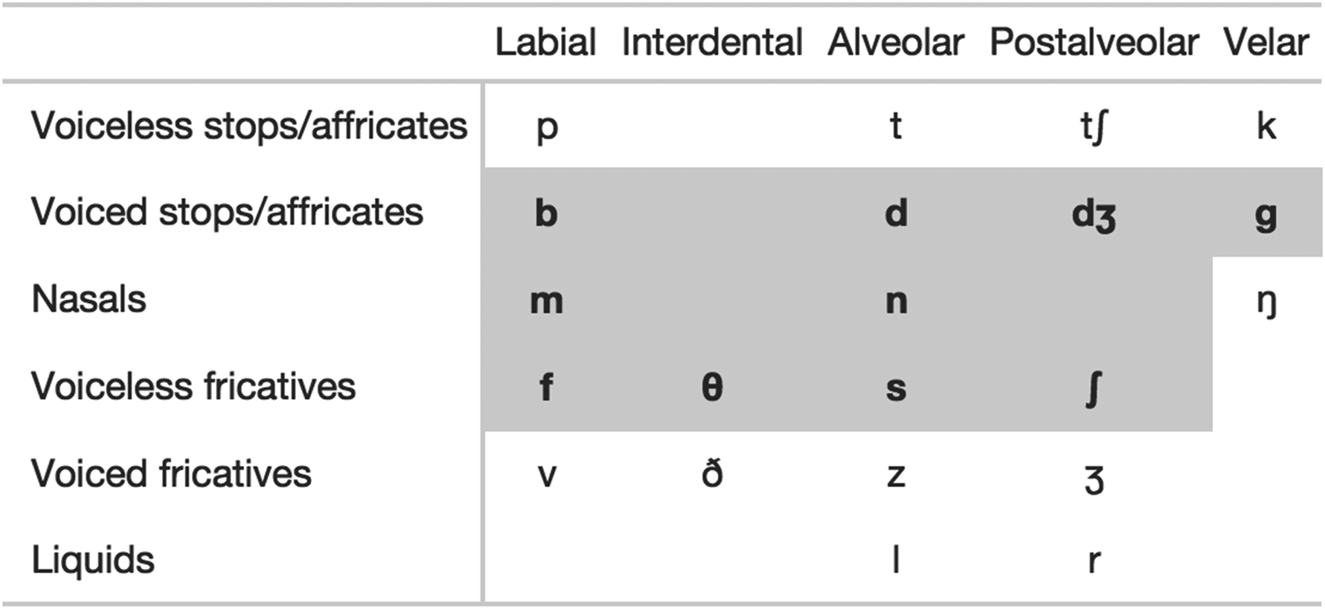
The most important set of conditions for our purposes concerns the interaction of following sound and syllable structure. In particular, as the system is typically characterized, tensing is triggered in closed syllables with following voiceless fricatives, voiced stops, voiced affricates, and front nasals. Elsewhere contexts including all open syllables are lax.Footnote 3 This is schematized in Figure 1, where the shading indicates the set of following consonants triggering tensing. Importantly, this set of conditions only applies to closed syllables. Short-a in open syllables is, in the general case, lax regardless of following sound, such that the stressed vowels in cannibal, hammer, and saddle are lax, while closed-syllable counterparts (beer) can, ham, and sad are tense.
The effect of following sound on short-a tensing in closed syllables under the Tragerian system (adapted from Labov [Reference Labov2007]). Shading indicates sounds triggering tensing.

Morphological boundary
Morphological operations that affect syllable structure may or may not feed the tensing rules just described. For instance, the vowel in the progressive verb form canning typically remains tense despite the fact that it sits in an open syllable, because the syllable is open by virtue of concatenation of -ing. Similarly, short-a vowels in syllables closed by truncation (Cameron > Cam) typically remain lax. Labov (Reference Labov2007) characterized this constraint as limited to inflectional morphological processes, though Trager (Reference Trager1934) described the condition as applying to “derivational or inflectional suffix[es],” and Labov (Reference Labov2001:335) described the effect of derivational boundaries as “variable.” In our dataset, open syllables formed by derivational morphology generally pattern with monomorphemic open syllables and have been treated as such in the analyses below.
Preceding word boundary
Short-a vowels in word-initial position are lax, even in closed syllables with a following sound that otherwise triggers tensing pursuant to Figure 1, as for example lax absolute, athlete, ash. Lexical exceptions to this rule include high frequency ask, after, and, for many speakers, avenue and answer.
Several descriptions from the last decade of work on NYCE have reported evidence of change away from the Tragerian system (Becker, Reference Becker2010; Becker & Wong, Reference Becker and Wong2010; Coggshall, Reference Coggshall2017; Newman, Reference Newman2014; Shapp, Reference Shapp2018). In particular, Becker and Wong (Reference Becker and Wong2010) reported that the Tragerian system is being lost to a simplified system common in many parts of the US, where tensing applies before a following nasal, unconditioned by syllable structure, as in (1).
(1) /æ/➔ tense / _____ [nasal]
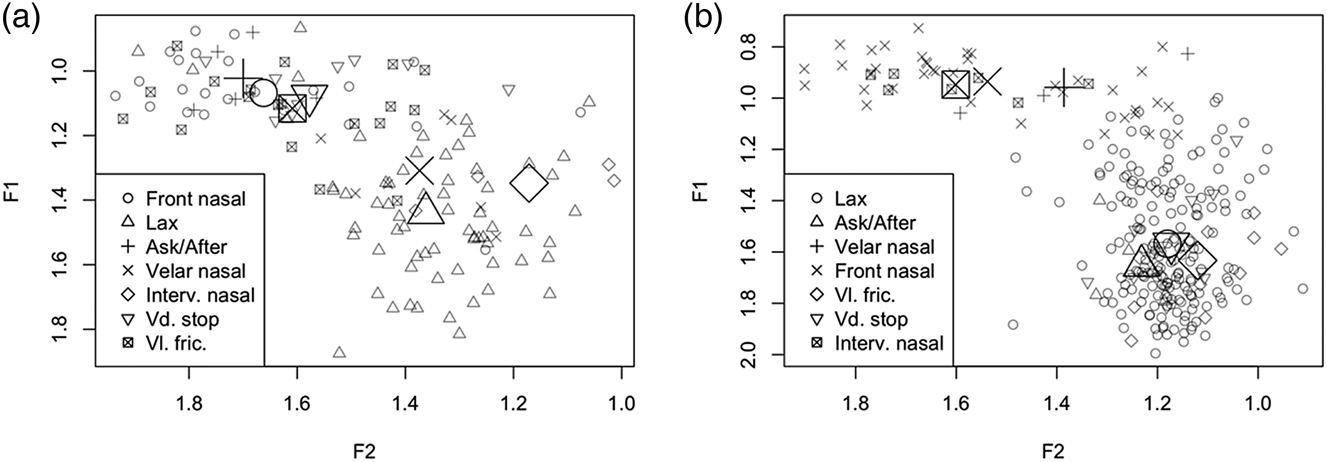
We illustrate the contrast between the two systems in the F1~F2 plots in Figure 2. The left panel of this plot (a) shows tokens by context for an older White man, originally from Brooklyn. The plot shows a fairly clean distinction in acoustic space between the Tragerian tensing contexts (ask/after and closed syllables with a following voiceless fricatives and voiced stops/affricates) and laxing contexts (contexts preceding velar nasals and all other laxing contexts). By contrast, the right panel, showing data from a younger African American woman, shows a pattern described by (1)—tense realizations before nasal sounds and lax elsewhere.
F1~F2 plots illustrating two short-a systems. Here, ‘Interv. Nasal’ indicates intervocalic nasal contexts, ‘Vl. Fric.’ indicates following voiceless fricative contexts, and ‘Vd. Stop’ indicates following voiced stop contexts. Panel (a) illustrates the traditional Tragerian system. Panel (b) illustrates the innovative nasal tensing system. The smaller circles represent individual tokens. Larger, darker circles represent context mean values.

Importantly, Becker (Reference Becker2010) and Coggshall (Reference Coggshall2017) noted that the nasal system represented by (1) is not the only innovative pattern attested in recent datasets. In particular, Becker (Reference Becker2010) described speakers showing a “continuous” pattern with a hierarchy of tensing environments headed by following nasals and a “single allophone” pattern with little differentiation across contexts. We return to these issues in the discussion below.
DATA
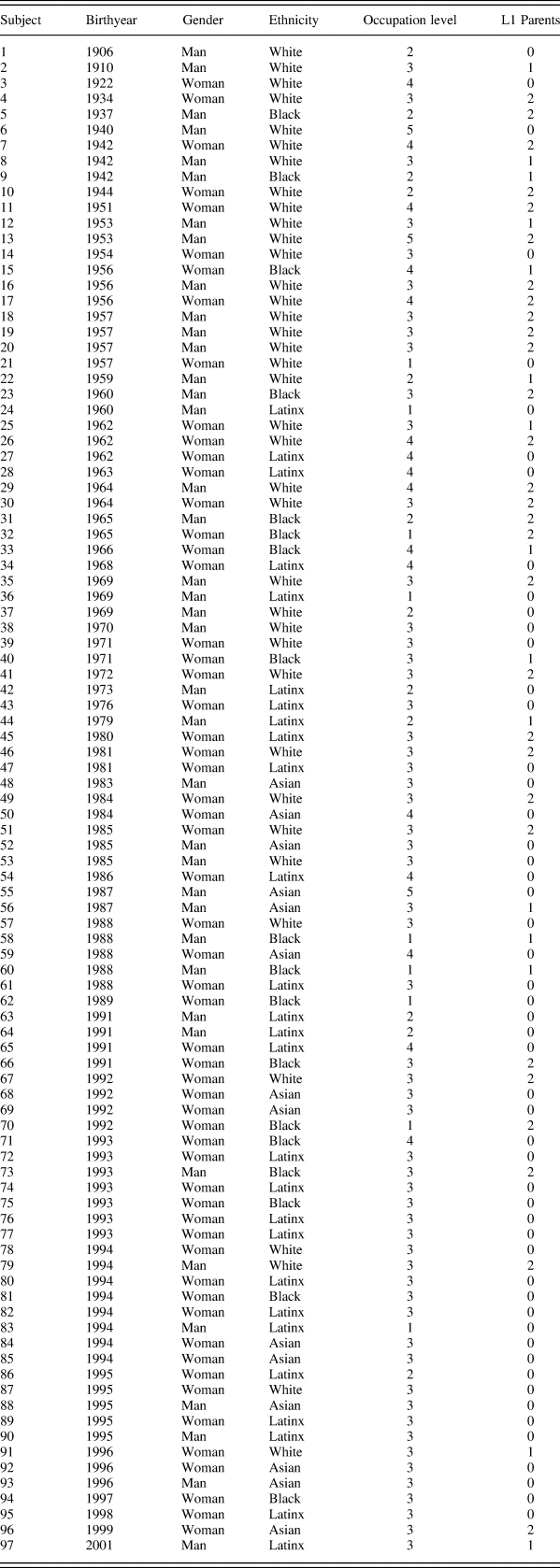
The data presented below were gathered through the CoNYCE corpus project, which, when completed, will make publicly accessible an approximately one million-word audio-aligned and parsed corpus of New York City English (Tortora et al., Reference Tortora, Cutler, Haddican, Newman, Santorini and Diertaniin progress). The subsample discussed here consists of audio recordings of ninety-seven speakers with years of birth ranging from 1906 to 2001 (M = 1971). Of the ninety-seven speakers, fifty-eight self-identified as women and thirty-nine as men. Subjects were coded for occupational prestige on a five-point scale following Baranowski and Turton (Reference Baranowski and Turton2018).Footnote 4 Subject data were also coded for whether subjects’ parents were themselves native speakers of New York City English, based on parents’ L1s, and where the parents were raised, as reported by the subjects. Using these data, twenty-nine of the ninety-seven subjects were coded as having two NYCE-native parents. A summary of subject demographic information is provided in Table 3 in the appendix.
The recordings analyzed come from two main sources. Ninety-one subjects were recorded between 2015 and 2018 using standard sociolinguistic interviewing techniques (Labov, Reference Labov1972, Reference Labov, Baugh and Sherzer1984). The interviews, typically lasting between thirty minutes and an hour, followed a template structured around childhood narratives and change in local neighborhoods, concluding with a series of questions on perceptions of linguistic difference within the community and short read-alouds (not included here).Footnote 5 The interviews were conducted by City University of New York (CUNY) undergraduate students in linguistics coursework trained by the project PIs. All but a handful of the CUNY undergraduate researchers involved in the project grew up in the New York City area and resided there at the time of recording. Interview subjects were recruited by the undergraduate researchers in their home communities, based on sampling criteria provided by the project PIs. All participants reported having lived since the age of nine within the New York City dialect area defined for our purposes as the five New York City boroughs, western Long Island, and the narrow strip of northeastern New Jersey between the Meadowlands/Hackensack River and the Hudson (Coggshall, Reference Coggshall2017; Labov, Reference Labov1966; Newman, Reference Newman2014). These recordings were made using Zoom H4N digital recorders at a sampling rate of 44100 Hz.
In addition, six audio samples are oral histories recorded through Bronx Oral History Archive (BOHA) project, which has been incorporated into the CoNYCE project. The BOHA dataset was recorded in the 1980s with analog recorders and has subsequently been digitized.Footnote 6 From this dataset we included only subjects for whom we could recover relevant biographical information.
Using a transcription protocol based on English orthography designed by the project PIs, student researchers transcribed recordings in Praat, where utterances were time-aligned with the speech signal. Transcriptions were subsequently checked by graduate research associates. A total of 16,589 short-a vowel tokens bearing main word stress were measured using FAVE Extract (Rosenfelder, Fruehwald, Evanini, Seyfarth, Gorman, Prichard, & Yuan, Reference Rosenfelder, Fruehwald, Evanini, Seyfarth, Gorman, Prichard and Yuan2014) and Prosodylab-Aligner (Gorman, Howell, & Wagner, Reference Gorman, Howell and Wagner2011), using the DARLA interface (Reddy & Stanford, Reference Reddy and Stanford2015). Each individual lexical item was coded by native speakers of the traditional system as phonemically lax versus tense.Footnote 7 In addition, all tokens of and, even those bearing focal stress, were excluded from the analysis.
The data were normalized using Watt & Fabricius’ modified procedure (Fabricius, Watt, & Johnson, Reference Fabricius, Watt and Johnson2009). In an effort to model the fact that tensing involves acoustic correlates for both F2 and F1, in the analyses presented below the dependent measure, unless otherwise specified, will be F2normalized - F1normalized, the “front diagonal.” Higher values for this measure will therefore reflect tenser realizations in acoustic space.
RESULTS AND DISCUSSION
Replicating age and ethnicity effects
We begin by replicating core results for social effects on short-a described in recent literature, particularly Becker (Reference Becker2010), Becker and Wong (Reference Becker and Wong2010), Coggshall (Reference Coggshall2017), and Shapp (Reference Shapp2018, Reference Shapp2019).
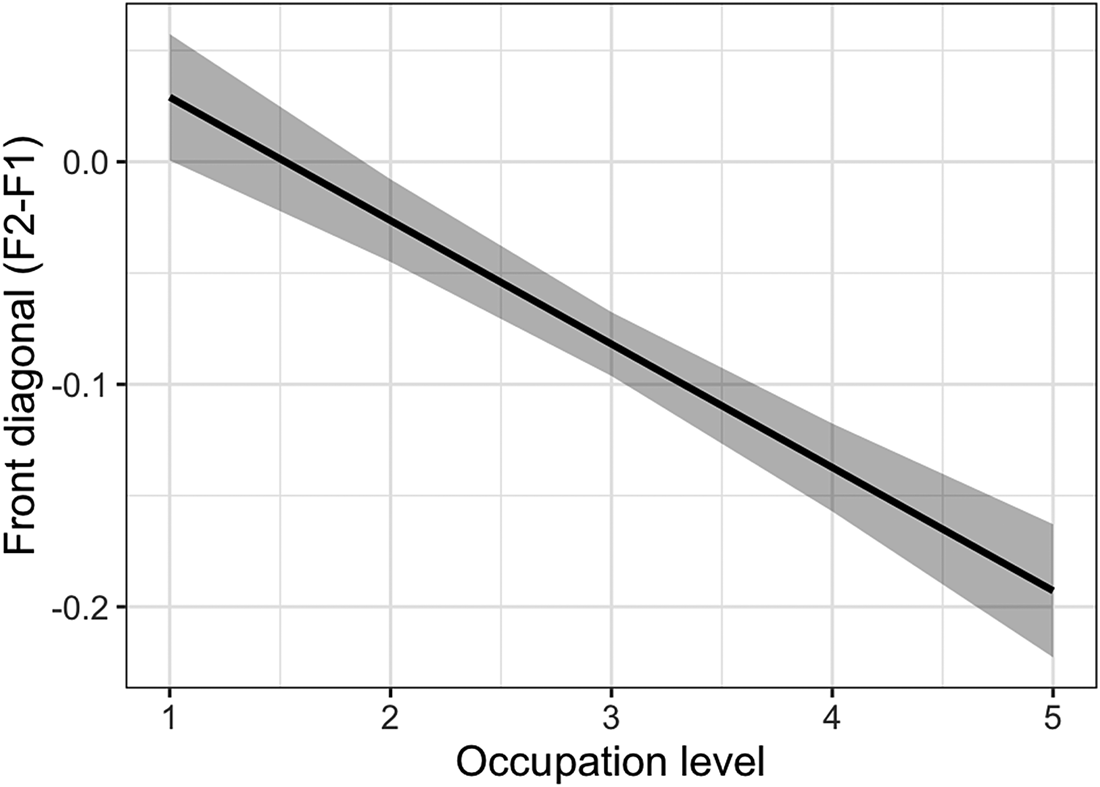
We first present estimates from a baseline model of short-a tensing from the full sample (ninety-seven subjects, n = 16,163).Footnote 8 Figure 3 shows model estimates from occupation prestige level. It shows that subjects at lower occupational levels tend toward tenser realizations compared with subjects higher on the occupational prestige scale. Importantly, the analysis revealed no interaction with tensing context, suggesting that occupational level is related to short-a sounds as a class, a result that we return to shortly.
Model estimates for occupation level, based on the whole sample. Here and in figures below, the Front diagonal refers to normalized F2-F1. For occupational levels, 1 = Unskilled laborers; 2 = skilled laborers; 3 = lower white collar, retail, and current university students; 4 = lower professionals, including teachers, engineers, and manager; 5 = higher professional occupations.

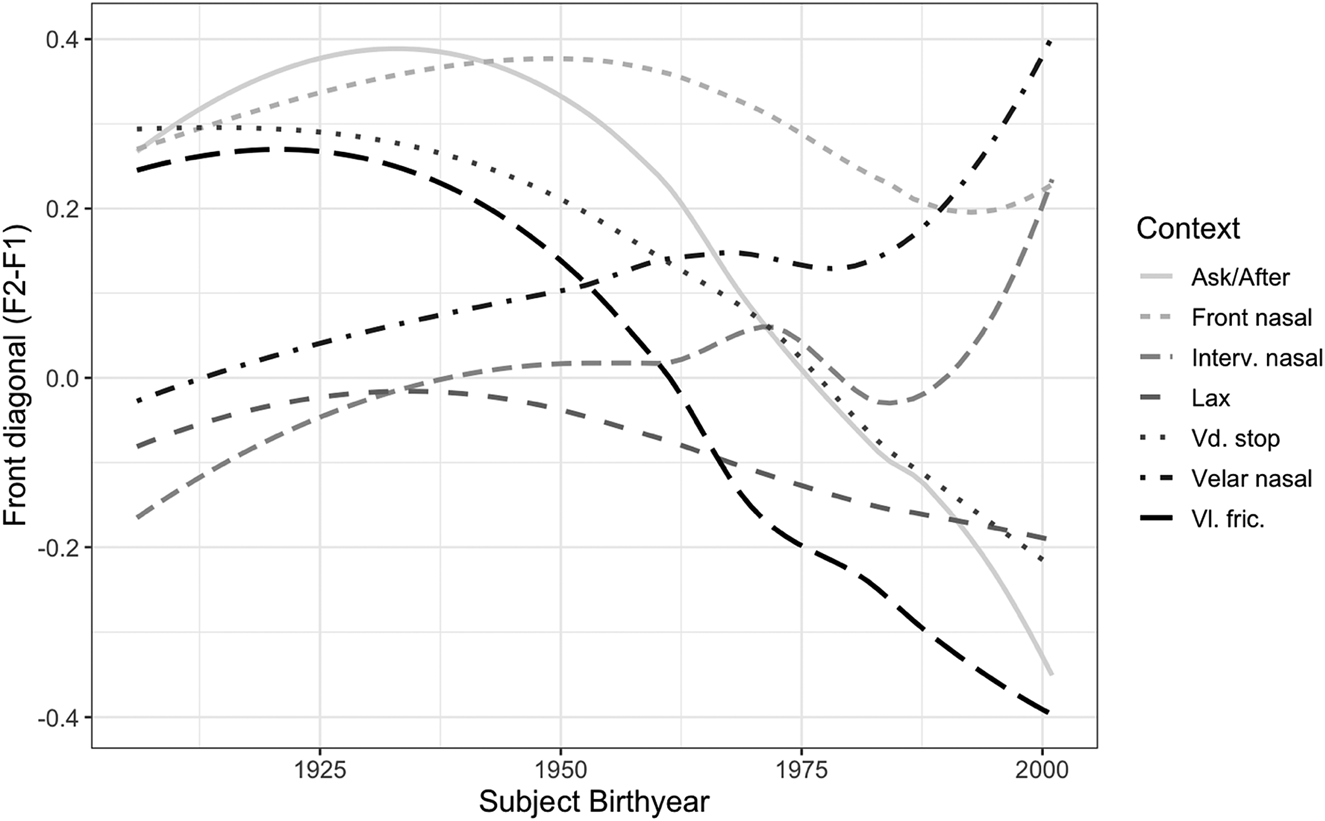
More important for the focus of our discussion is that our results reveal an interaction between subject age and tensing context, replicating a core result from Becker (Reference Becker2010) and Becker and Wong (Reference Becker and Wong2010). We illustrate this in Figure 4, which shows by-subject loess smoothers for mean front diagonal values by subject birthyear and tensing context. As expected from the perspective of these previous results, older subjects tend toward tenser realizations in (nonnasal) Trager-tensing contexts, and laxer realizations in contexts preceding velar nasals and intervocalic nasals. Over the time-period covered in the sample, these effects shift such that younger speakers show tense realizations in all prenasal contexts and lax realizations elsewhere including contexts preceding voiceless fricatives and voiced stops. In addition, as shown in Figure 4, younger speakers tend toward laxer realizations than their elders even in contexts not implicated in the phonological reorganization discussed above, that is, in Trager lax contexts and in contexts preceding a tautosyllabic front nasal. In other words, similar to the occupational prestige effect just described, there appears to be a lowering change affecting the set of short-a sounds as a class. We return to this result shortly.
Loess smoothers for mean F2-F1 values by subject birthyear and tensing context. ‘Interv. Nasal’ indicates intervocalic nasal contexts, ‘Vl. Fric.’ indicates contexts preceding voiceless fricatives, and ‘Vd. Stop’ indicates contexts preceding voiced stops.

Also notable in Figure 4 are similar smoother shapes for several of these contexts. In particular, the smoothers for ask/after, voiceless fricative, and voiced stop contexts, show a similar trajectory with the change beginning in earnest for subjects born in the 1950s. To assess more accurately the onset of this change, we fit a series of models with breakpoints, fitting two different slopes for subject year of birth—one before a given year of birth in the sample (1906–2001) and one after. One model was fit for each year of birth in the sample. The birthyear model with the smallest total deviance between fitted and observed values then serves as a measure of the point of inflection for the change (Baayen, Reference Baayen2008). For the three main Trager-tensing contexts undergoing laxing—ask/after, prevoiceless fricative, and prevoiced stop contexts—this analysis reveals an optimum breakpoint at year of birth 1955, as reflected in the smoother shapes in Figure 4. Also similar are the smoothers for the two Trager lax contexts undergoing raising in this process of change—those preceding intervocalic front nasals and velar nasals. Importantly, the principal point of inflection for the latter two contexts undergoing raising is later than that for the preoral obstruent contexts undergoing lowering. The breakpoint modeling procedure, applied to a subset of the data with just intervocalic front nasals and prevelar nasal contexts reveals an optimum breakpoint for subjects born in 1979. These facts, then, suggest different courses of change for these two sets of contexts. We return to these issues later.
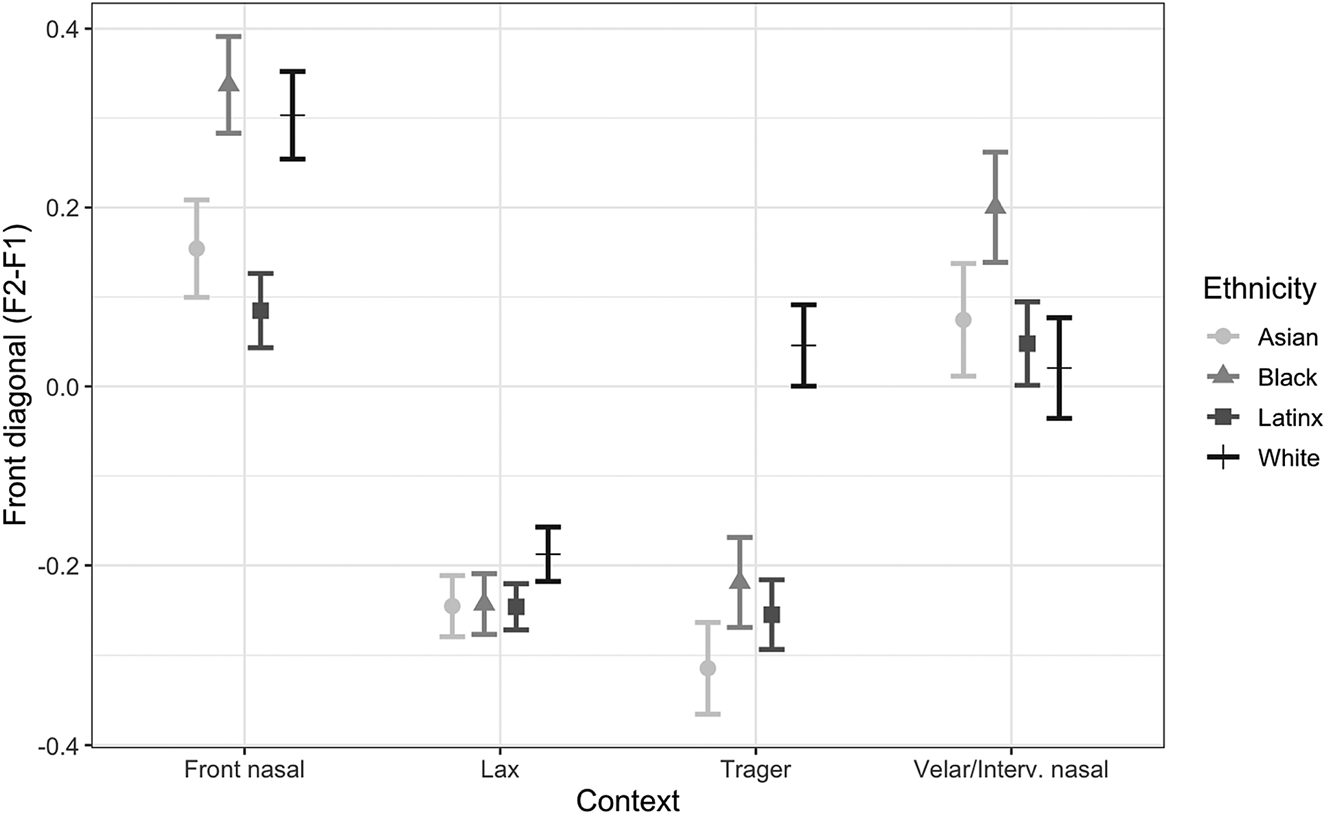
A second main social effect on short-a tensing reported in recent studies is ethnicity. In particular, the Tragerian system is reported to be best preserved by White participants, across age groups, but even among White subjects, younger speakers have been reported to show movement away from the Tragerian constraints (Becker, Reference Becker2010; Becker & Wong, Reference Becker and Wong2010; Coggshall & Becker, Reference Coggshall and Becker2009; Newlin-Łukowicz, Reference Newlin-Łukowicz2015; Shapp, Reference Shapp2018, Reference Shapp2019). We replicate these findings with a subset of seventy subjects from the sample, excluding subjects born before 1963, which provides a sample more appropriately balanced for age and ethnicity. In particular, the self-identified Latinx (Latino/Latina) and Asian subjects in our sample are almost exclusively middle-aged and younger, reflecting changes in migratory trends in the city in the wake of the Immigration and Nationality Act of 1965 (Hart-Celler Act) (Becker & Coggshall, Reference Becker and Coggshall2009; Newman, Reference Newman2014).
Figure 5 shows model estimate for the interaction between subject Ethnicity and tensing context taken from this subsample.Footnote 9 It shows, for non-White groups, a clear nasal split—tensing in prenasal contexts and lax realizations in traditional laxing and Trager tensing contexts.Footnote 10 For self-identified Latinx subjects, estimates for prefront nasal contexts are below those for White and Black participants, a result reminiscent of reports of a weaker nasal effect among Latinx subjects both in NYCE (Becker, Reference Becker2010; Coggshall, Reference Coggshall2017) and in other speech communities (Eckert, Reference Eckert2008; Thomas, Reference Thomas2001). We return to these facts below.
Model estimates for Ethnicity:Context. ‘Interv. nasal’ refers to intervocalic nasal contexts, ‘Trager’ refers to pre-oral contexts triggering tensing in the Tragerian system, and ‘Lax’ refers to pre-oral contexts determining lax realizations in the Tragerian system.

In addition, Figure 5 shows that White subjects tend toward tenser realizations in Trager-tensing contexts than non-White groups, a result consistent with other recent studies (Becker, Reference Becker2010; Becker & Wong, Reference Becker and Wong2010; Coggshall & Becker, Reference Coggshall and Becker2009; Shapp, Reference Shapp2018). Even among White subjects, however, estimates for Trager-tensing contexts do not approach those for front nasals, indicating that, even among White participants, the Trager system is weakening among younger and middle-aged subjects. Similarly, while model estimates for contexts preceding velar nasals and intervocalic nasals for White subjects are below those for front nasals (and show a greater contrast than non-White groups), they are still much higher than traditionally Lax contexts, again, indicating weakening of the Tragerian system for White speakers.
Parent L1 effects
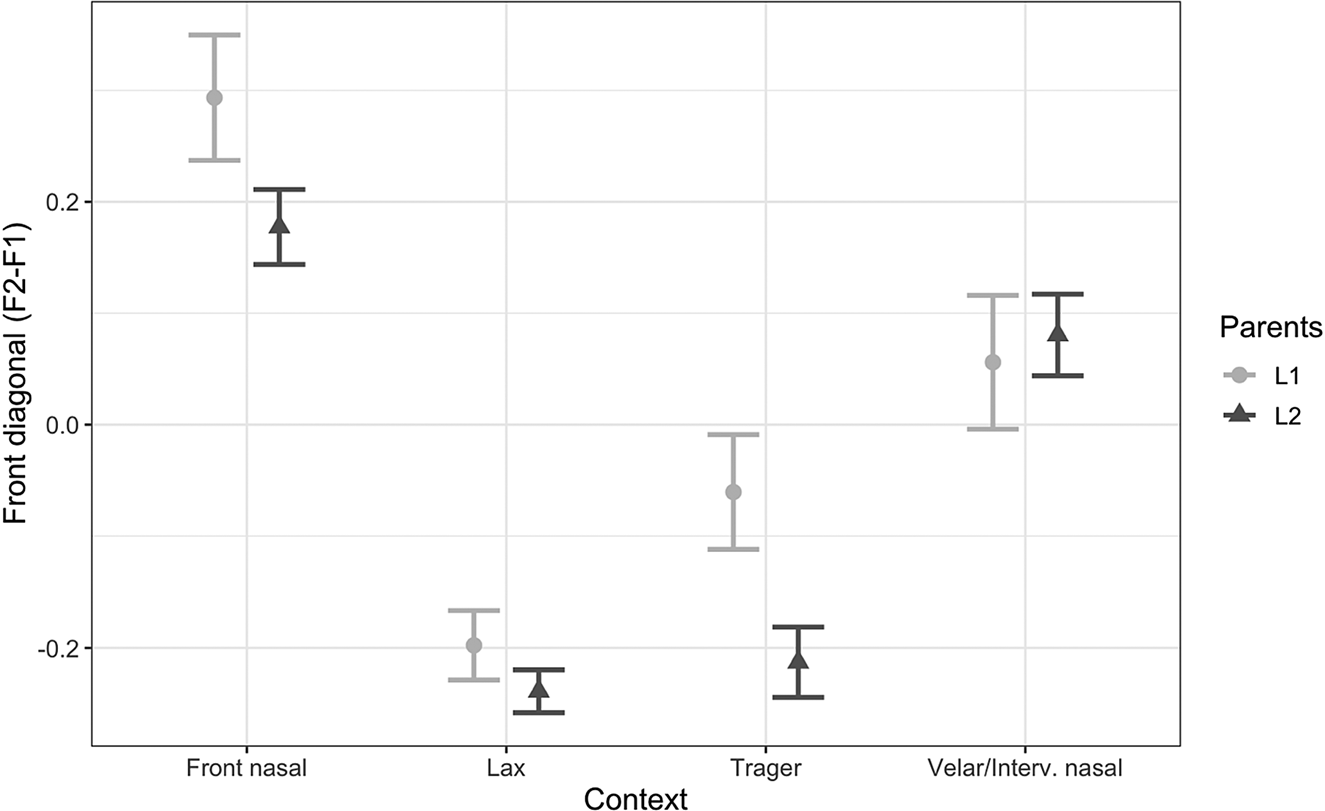
The results so far align with other recent reports suggesting that age and ethnicity interact with contextual effects on short-a quality. As discussed above, a potential confound in previous studies of short-a change concerns parent L1 effects. In examining acquisition of the complex system of constraints on /æ/-tensing in the Philadelphia suburb of King of Prussia, Payne (Reference Payne1976, Reference Payne and Labov1980) found that “complete acquisition of the Philadelphia short-a [system] by an [out-of-state] child [a child with parents from outside the Philadelphia dialect area] is rarely accomplished” (Payne, Reference Payne1976:204). Notably, with the exception of Newlin-Łukowicz (Reference Newlin-Łukowicz2015) and Newlin-Łukowicz (Reference Newlin-Łukowicz2016), none of the previous work on short-a has controlled for parent first-dialect effects on sampling.Footnote 10 A possibility raised by this state of affairs, then, is that previously reported age and ethnicity effects instead reflect a misdistribution of parent L1 effects in sampling, given the rise in the foreign-born population of New York City in the wake of the Hart-Celler Act of 1965. This influx is supplemented by the arrival of White so-called transplants as the city has become more attractive to professionals.
Evidence for an effect of parent L1 on this process of change comes from the data summarized in Figure 6, which plots model estimates for the interaction between tensing context and parent L1.Footnote 11 Here, “L1” denotes subjects with two native-NYCE speaking parents, and “L2” all other subjects. The figure shows that subjects with two NYCE-native parents tend toward tenser realizations in Trager tensing contexts and contexts preceding a tautosyllabic front nasal. Little difference is observed in Trager lax contexts and contexts preceding an intervocalic nasal or velar nasal. The results for Trager tensing contexts, however, suggest that subjects with two NYCE-native parents are more likely to conserve the traditional Tragerian system than other subjects, a result consistent with Labov's (Reference Labov2007) suggestion that parent input is crucial to acquisition of the traditional system.Footnote 12
Model estimates for Parent L1:Context. ‘Interv. nasal’ refers to intervocalic nasal contexts, ‘Trager’ refers to pre-oral contexts triggering tensing in the Tragerian system, and ‘Lax’ refers to pre-oral contexts determining lax realizations in the Tragerian system.

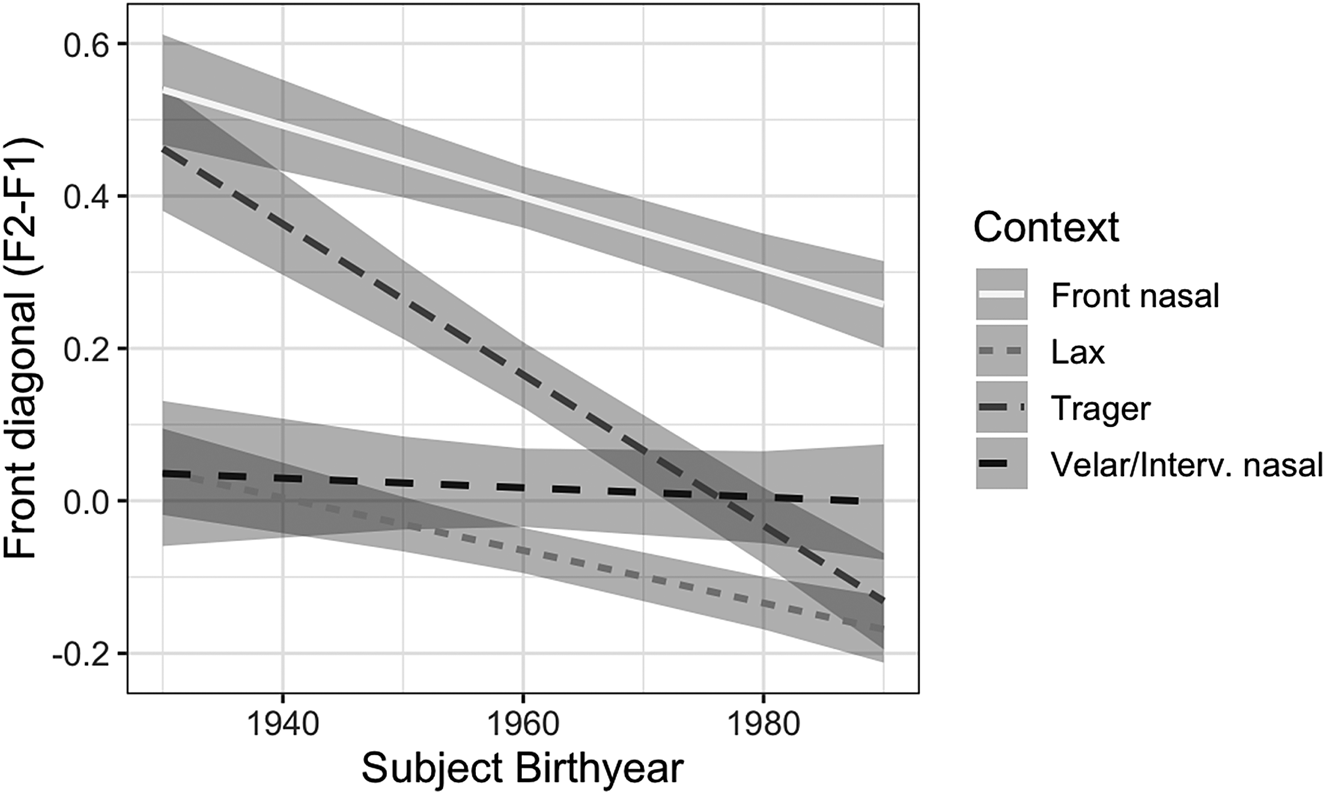
These results, then, suggest the need to take account of parent L1 effects in the analysis. The present dataset, however, does not permit us to cross ethnicity and parent L1 directly, given that most of the sample's self-identified Latinx and Asian subjects have parents who are not themselves native speakers of NYCE. We examine age effects in a subsample of self-identified Black (n = 7) and White (n = 20) subjects with two NYCE-native parents. Figure 7 shows model estimates for the interaction between subject birthyear and tensing context for this subset of speakers.Footnote 13 It shows, again, increased laxing in Trager-tensing contexts. There is little change in contexts preceding velar nasals and intervocalic nasals, but among younger speakers, these contexts are increasingly tense relative to Trager lax and Trager tense contexts. The results, therefore, support previous reports suggesting the Tragerian system is weakening among younger New Yorkers.
Model estimates for Birthyear:Context for subjects with two NYCE-native parents. ‘Interv. nasal’ refers to intervocalic nasal contexts, ‘Trager’ refers to pre-oral contexts triggering tensing in the Tragerian system, and ‘Lax’ refers to pre-oral contexts determining lax realizations in the Tragerian system.

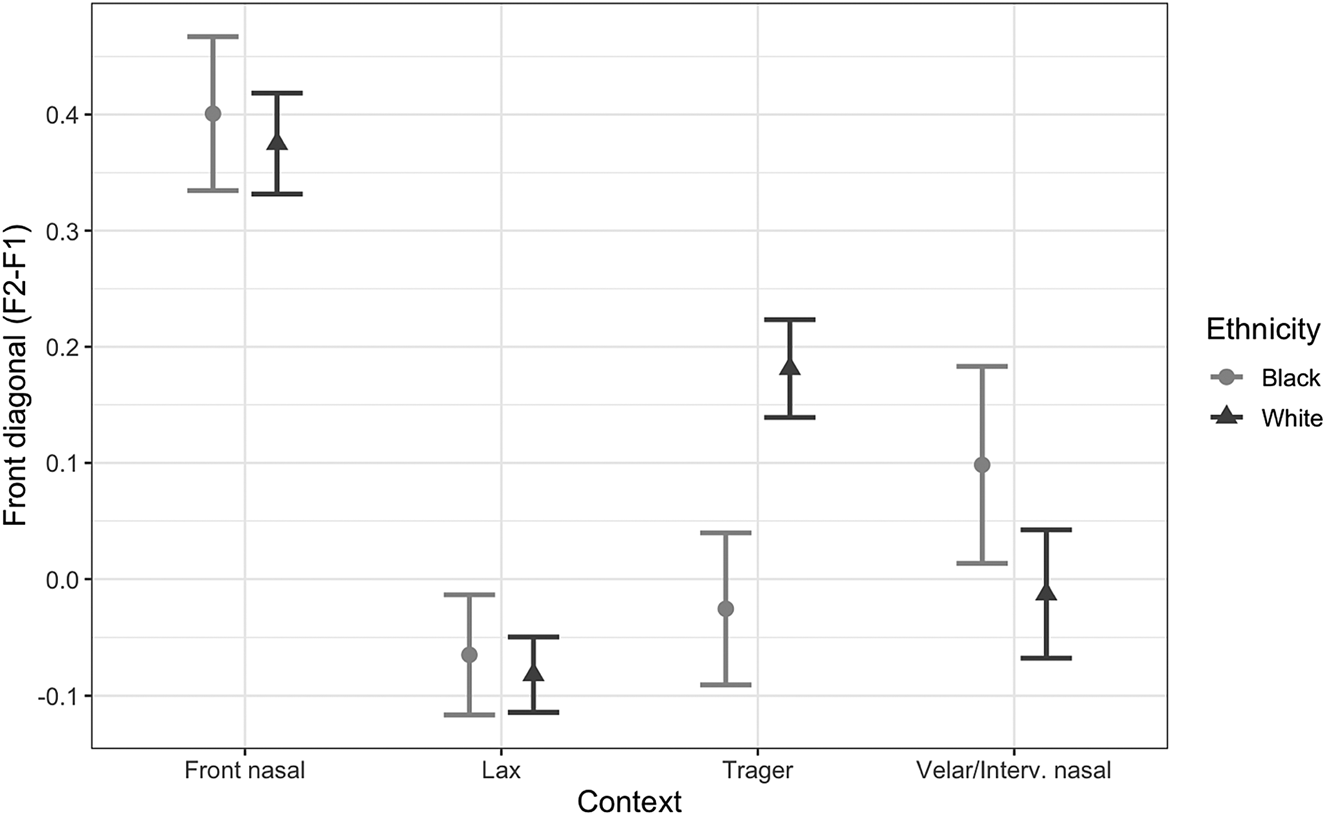
Figure 8 shows model estimates for the interaction between subject ethnicity (White versus Black) and tensing context from this same model. It shows, again, laxer realizations for Black subjects in Trager tensing contexts and tenser realizations before velar and intervocalic nasals. Taken together, the results support previous reports suggesting (i) the Tragerian system is weakening among younger New Yorkers; and (ii) that the Tragerian system is most robust among White speakers. Importantly, the current results suggest that these reported patterns are unlikely to reflect a confound of parent L1 effects in sampling.
Model estimates for Ethnicity:Context for subjects with two NYCE-native parents. “Interv. nasal” refers to intervocalic nasal contexts, “Trager” refers to preoral contexts triggering tensing in the Tragerian system, and “Lax” refers to preoral contexts determining lax realizations in the Tragerian system.

trap-lowering/retraction
Recall that Figure 4 showed subject age effects for contexts not targeted by the phonological reorganization from the Tragerian system to a nasal system. In particular, younger speakers in the sample show lower values than their elders for Trager lax contexts (realized as lax in both Trager and nasal grammars), and contexts preceding a front nasal (tense in both grammars). These results suggest the possibility that there is an independent process of change–orthogonal to the changes reorganizing the allophonic conditioning of short-a, producing lower and backer short-a across the board, that is, “trap-backing.” Lowering and/or retraction of /æ/ in such contexts has been described in several North American varieties (D'Onofrio, Praat, & Van Hofwegen, Reference D'Onofrio, Pratt and Van Hofwegen2019; Eckert, Reference Eckert2008; Jacewicz, Fox, & Salmons, Reference Jacewicz, Fox and Salmons2011; Kendall & Fridland, Reference Kendall and Fridland2017; Wassink, Reference Wassink2015). Kendall and Fridland (Reference Kendall and Fridland2017), moreover, noted that in many of these descriptions, /æ/-retraction co-occurs with backing and/or raising of lot. Based on perception data and acoustic results from three regional samples, Kendall and Fridland (Reference Kendall and Fridland2017) suggested that the two vowels are phonologically related, that is, in a chain-shifting relationship in many North American dialects.
We consider evidence for such a relationship in the present dataset by comparing individual subjects’ aggregate measurements for lot with their measurements for Trager lax contexts.
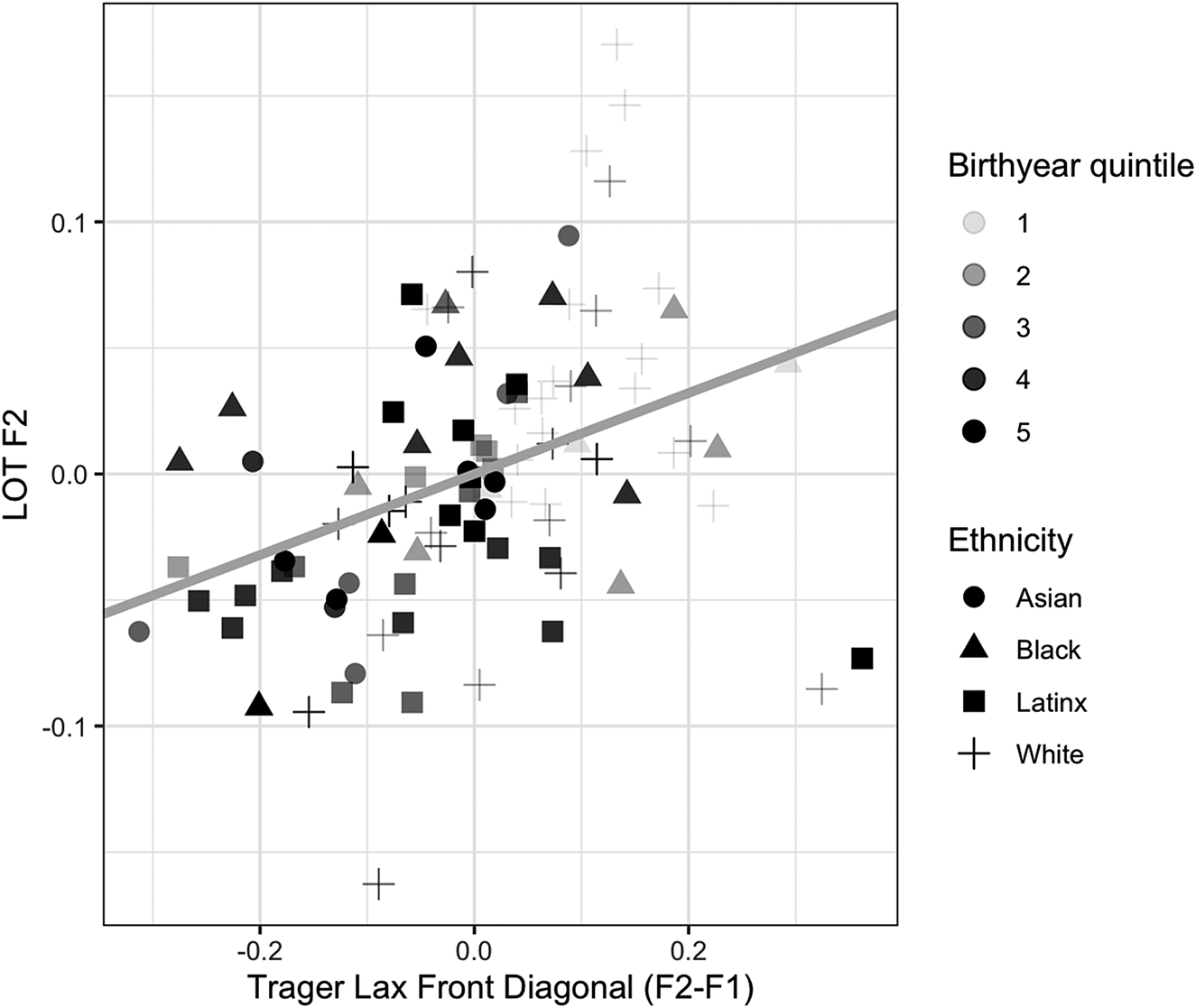
Figure 9 shows, on the x-axis, by-speaker random slopes for Trager lax contexts (excluding all pre-nasal contexts) and by-speaker random intercepts for lot.Footnote 14 The figure shows a positive relationship between the two sets of measurements, such that the same speakers with low F2 values for lot also generally show low front diagonal values for Trager lax contexts. The figure shows that the subjects with the greatest degree of retraction for both lot and Trager lax classes—those in the lower left corner of the plot—are younger subjects, principally Asian and Latinx. The relationship is positive for all four ethnicity categories used here (r = .386, p = .0001 for the four sets combined).Footnote 15
By-speaker model estimates for Trager lax contexts and lot.

The two different changes suggested by these results—the loss of the Tragerian system and across the board lowering/retraction of short-a—have similar, but not altogether identical, social correlates. Recall that Figure 5 showed that self-identified White subjects are conservative vis-à-vis non-White participants in lowering/retraction of short-a in both Trager tensing and Trager lax contexts. However, this ethnicity effect is stronger for Trager tensing contexts than it is for Trager lax contexts. A model for a data subset with only Trager tense and Trager lax contexts, and Ethnicity recoded to levels non-White versus White reveals a significant Ethnicity:Context interaction with a greater ethnicity effect in the Tense condition.Footnote 16
Second, as discussed above, occupational level scores correlate with higher front diagonal measurements of short-a as a class, but there is no interaction between occupational level and context. This result suggests that occupational prestige is implicated in short-a lowering/retraction change, but not in the loss of Tragerian constraints.
Finally, the process of short-a retraction in Trager lax and front nasal contexts began later than the onset of the loss of the Tragerian system. Figure 4 shows that the changes in the smoother shapes for the contexts implicated in loss of the Tragerian system come first: contexts preceding velar nasals, voiceless fricatives, and voiced stops. It is only afterward that the drop for smoothers occurs for the contexts preceding front nasals and Trager lax environments.
To summarize, the present dataset suggests an additional change affecting the class of short-a sounds as a whole, namely, lowering/retraction of short-a sounds across contexts, a process similar to trap-backing in other contemporary North American English varieties (D'Onofrio et al., Reference D'Onofrio, Pratt and Van Hofwegen2019; Eckert, Reference Eckert2008; Jacewicz et al., Reference Jacewicz, Fox and Salmons2011; Kendall & Fridland, Reference Kendall and Fridland2017; Wassink, Reference Wassink2015). The results suggest that social correlates for this change are somewhat different from change involved in the phonological reorganization of short-a constraints, that is, the loss of Tragerian system. We consider further social correlates on short-a in traditionally lax contexts in the following section.
Social correlates of different short-a systems
A central question in much of the recent literature on short-a change in mid-Atlantic varieties concerns the number and nature of the different short-a systems in the speech community and whether these different systems have social correlates. For White Philadelphians, Labov et al. (Reference Labov, Fisher, Gylfadóttir, Henderson and Sneller2016) and Sneller (Reference Sneller2018) proposed a single process of change from a traditional system (similar in many ways to the Tragerian system) to the nasal tensing rule in (1). This analysis, then, entails two abstract systems whose distribution is conditioned by several factors including speaker age. The most extensive discussion of these issues for NYCE is by Becker (Reference Becker2010). Based on visual inspection of F1~F2 plots, Becker (Reference Becker2010) classified sixty-four subjects into one of five categories based partly on the classification in Labov et al. (Reference Labov, Ash and Boberg2005) and Labov (Reference Labov2007): (i) the “Labovian” (Trager) system; (ii) Labovian transitional; (iii) continuous; (iv) nasal-transitional; and (v) nasal. Becker found that the first two of these systems, in particular, are characteristic of older speakers, and that the nasal system is characteristic of the youngest speakers in the sample. To date, none of the literature on NYCE short-a has addressed this problem using unsupervised procedures. We consider these issues using a Divisive Analysis (DIANA) clustering algorithm based on by-speaker random slopes for context extracted from an LMER model.Footnote 17
As with all clustering procedures, this mechanism supplies an output that groups individuals in terms of similarity in N-dimensional space; this output can be represented in a dendogram with binary branching nodes, and individual “leaves” whose stem length represents distance in N-dimensional space. Whereas better-known agglomerative clustering procedures begin by grouping individuals in terms of similarities, the DIANA algorithm begins with the whole dataset as a single cluster, which is then split. It then takes the most heterogenous cluster and divides that until it separates out each individual “leaf.” We adopt this algorithm as best suited to the question of which large-scale groupings are salient within the sample. Although the clustering continues until each individual is separated, we focus here on the highest-level groupings.
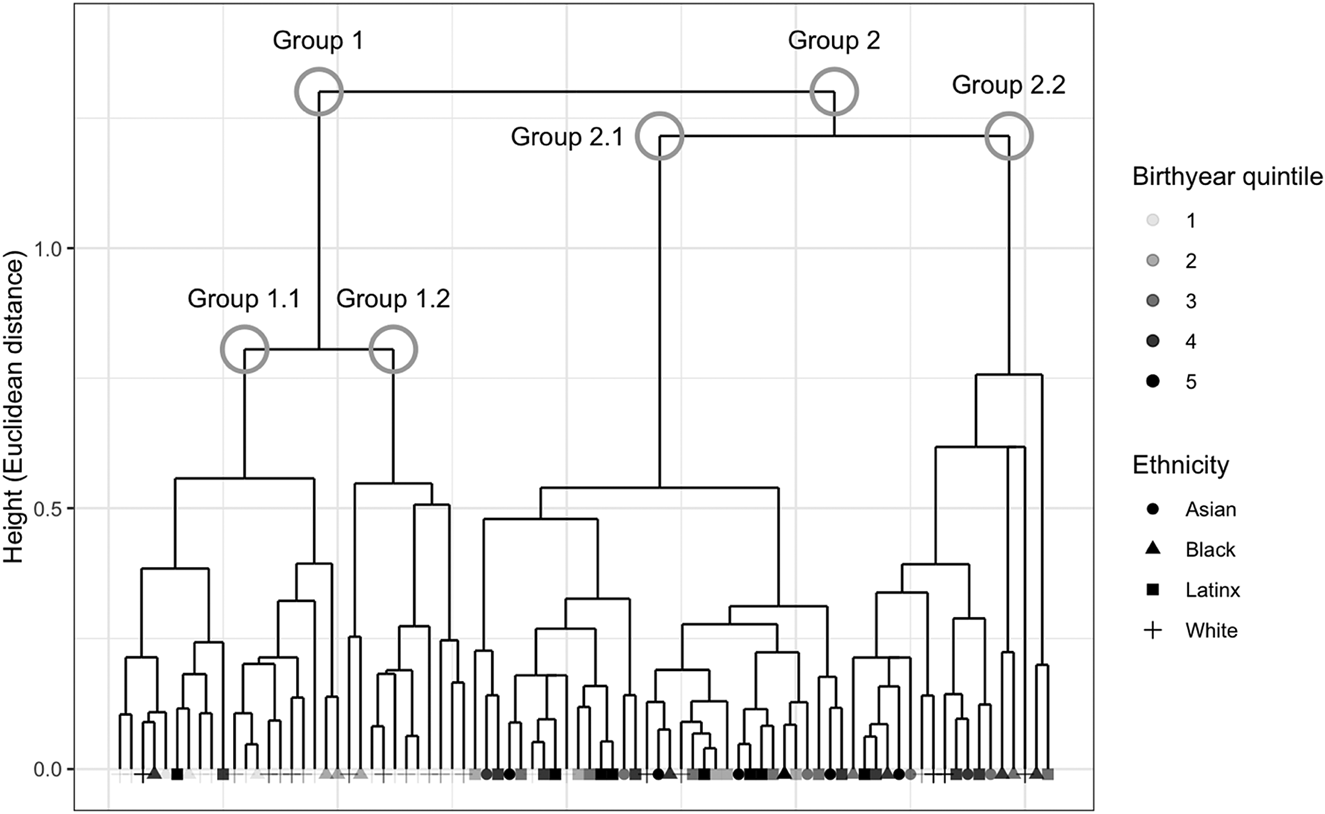
Specifically, the data we used are by-speaker estimates for four contexts: (i) Trager lax contexts; (ii) following tautosyllabic front nasals; (iii) other Trager tensing contexts, including contexts preceding a tautosyllabic voiceless fricative or voiced stop; and (iv) contexts preceding an intervocalic nasal or a velar nasal. The latter set of contexts—those preceding an intervocalic or velar nasal sound—were grouped in the modeling in light of their similar distribution across speakers as discussed above. (See also discussion below.) Clusterings were based on Euclidean distances, that is, the square roots of the sum of squares of differences between two nodes. The results of this procedure are illustrated in the dendrogram in Figure 10, with each circle along the x-axis representing a subject. Shading indexes quintile of subject year of birth, with younger participants’ data points more darkly hued.Footnote 18
Dendrogram of a DIANA cluster analysis for eighty-two subjects, using by-speaker random slopes for context. The points at 0 along the y-axis represent individual participants, whose shape indexes ethnic category. Shading indexes quintile of subject year of birth, such that younger speakers are more darkly hued. The points denoting each speaker are terminal nodes, and each higher-level node is binary branching connecting two (possibly singleton) sets of speakers. The length of each branch corresponds to the Euclidean distance (square root of sum of squares of difference) between the vocalic measurements for the two sets. Each node, therefore, reflects, for two daughter nodes, similarity in the realization of short-a in these contexts.

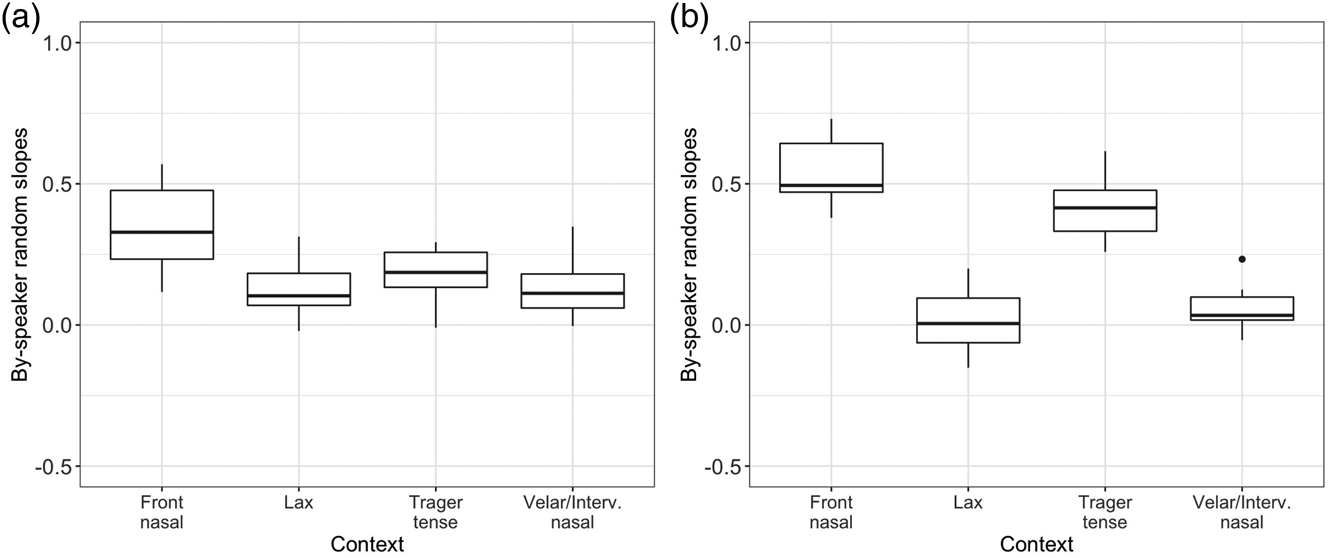
We focus on the four patterns in the data distinguished by the three highest level splits. The first split separates two constituents whose top nodes are labeled Group 1 and Group 2 in the figure. The first of these is a set of thirty-one subjects instantiating one of two conservative patterns illustrated in Figure 11. The two panels in this plot show distributions for the sets of subjects under Group 1's daughter nodes, labeled 1.1 and 1.2 in the figure. The second of these (panel [b]) corresponds to subjects who adhere most closely to the traditional short-a pattern described above, with raised and fronted values in the traditional tensing contexts and lower, retracted values elsewhere (see Figure 2a, above). Group 1.1, by contrast, represents a transitional pattern, with Trager tensing contexts still somewhat raised and fronted relative to Lax contexts and contexts preceding velar and intervocalic nasals, but to a lesser degree than for Group 1.2. As shown in the figure, these two groups contain the oldest subjects in the sample. The two groups are comparable in terms of age, with a mean birthyear of 1963 for Group 1.1 and a mean birthyear of 1961 for Group 1.2 (n.s.). More conservative Group 1.2 has a larger proportion of White subjects on aggregate (ten White, one Black) than Group 1.1 (twelve White, six Black, two Latinx), a result consistent with previous work suggesting that the traditional system is best maintained among older Whites (Becker, Reference Becker2009; Becker & Wong, Reference Becker and Wong2010).
Model estimates by context for Group 1.1 (panel [a]) and Group 1.2 (panel [b]). ‘Interv. nasal’ refers to intervocalic nasal contexts, ‘Trager’ refers to preoral contexts triggering tensing in the Tragerian system, and ‘Lax’ refers to preoral contexts determining lax realizations in the Tragerian system.

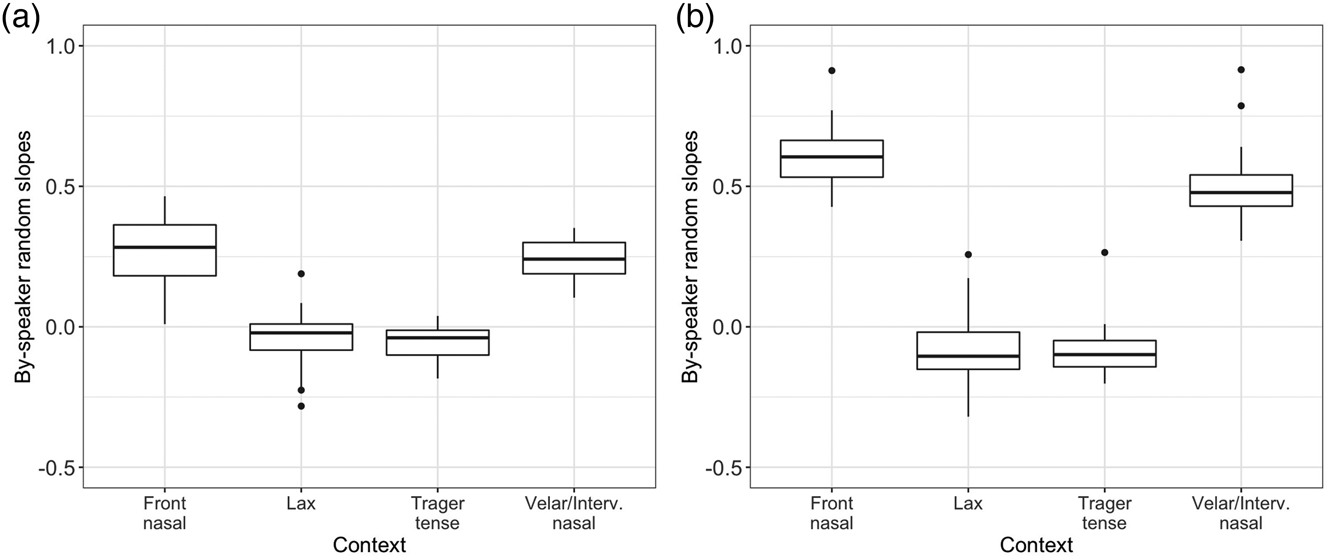
The sister node in this dendrogram splits to two main innovative patterns among the remaining fifty-one speakers in the subsample, labeled Group 2.1 and Group 2.2 in the figure. Distributions of by-speaker random slopes for these groups are shown in Figure 12. The two panels in this figure are distinguished principally by the degree of raising in prenasal contexts. For Group 2.2, front diagonal values for contexts preceding tautosyllabic front nasals and intervocalic and velar nasals are much higher than those for Group 2.1. In addition, Group 2.2 shows somewhat lower front diagonal values for Lax and Trager tensing contexts.
Model estimates by context for Group 2.1 (panel [a]) and Group 2.2 (panel [b]). “Interv. nasal” refers to intervocalic nasal contexts, “Trager” refers to preoral contexts triggering tensing in the Tragerian system, and “Lax” refers to preoral contexts determining lax realizations in the Tragerian system.

Figure 10 shows that Group 2.1 is somewhat older than Group 2.2 with mean years of birth 1982 and 1990 (n.s.). In addition, the two groups differ in Ethnic composition. While Group 2.1 is largely Latinx (twenty Latinx, seven Asian, four White, two Black), Group 2.2 is more mixed (five Black, five Latinx, four White, four Asian). The fact that Latinx subjects in the sample cluster in Group 2.1—20/27 Latinx subjects in this subsample fall into Group 2.1—is in keeping with previous results on NYCE and other North American varieties suggesting less pronounced raising of short-a in prenasal contexts in Heritage Spanish communities (see above) (Becker, Reference Becker2010; Coggshall, Reference Coggshall2017; Eckert, Reference Eckert2008; Thomas, Reference Thomas2001).
To summarize, a DIANA clustering analysis identifies four main patterns for contextual effects. One group (1.2), consisting almost entirely of older White subjects, adheres closely to the Tragerian system. The remaining subjects show one of three innovative patterns: (1) a transitional pattern (Group 1.1) with lower front diagonal values in traditional tensing contexts; (2) a sharply distinguished nasal pattern (Group 2.2), characteristic of the youngest group in our sample; and (3) a nasal system with a less pronounced nasal split, consisting principally of Latinx subjects (Group 2.1). Importantly, these results, and those presented above, suggest that prenasal contexts behave somewhat differently in this process of change from those preceding oral obstruents. We consider this issue further in the remaining discussion.
Systemic versus constraint-by-constraint change
In this section, we consider a set of issues raised by Labov et al.'s (Reference Labov, Fisher, Gylfadóttir, Henderson and Sneller2016) study of a similar process of change in Philadelphia. PhilE, like NYCE, has been reported to be undergoing change to a nasal tensing pattern, from a traditional system similar in nature and complexity to the Tragerian system (Labov et al., Reference Labov, Fisher, Gylfadóttir, Henderson and Sneller2016; Sneller, Reference Sneller2018). Labov et al. (Reference Labov, Fisher, Gylfadóttir, Henderson and Sneller2016) argued that the traditional constraints are not being lost piecemeal but rather in one fell swoop. They take these facts to indicate that the change involved is not at the level of individual constraints (i.e., individual contextual conditioning effects), but rather at a more general level, between two sets of constraints—the traditional system and the nasal system—which they represent as in (2).
(2) phl ➔ nas
Given the superficial similarity in the changes in Philadelphia and New York, a question invited by Labov et al.'s (Reference Labov, Fisher, Gylfadóttir, Henderson and Sneller2016) results is whether short-a change in NYCE is similarly of a piece, such that individual contextual effects are being lost in one fell swoop, as in (3).
(3) Trager ➔ nas
Following Labov et al. (Reference Labov, Fisher, Gylfadóttir, Henderson and Sneller2016), we approach this question from the perspective of Kroch's (Reference Kroch1989) generalization about grammatical change, the constant rate hypothesis (CRH). The CRH holds that, for any single abstract process of change, contextual effects on the choice of variants will be constant across the course of the change. If, in the general case, language learners faithfully acquire from input sources the probabilities for different contexts independently of the overall probability of application of a given variable rule, then one expects no contextual reordering across time/speakers. The CRH is supported by an extensive set of results on syntactic change in production corpora (Ball, Reference Ball1994; Cukor-Avila, Reference Cukor-Avila2002; Durham, Haddican, Zweig, Johnson, Baker, Cockeram, Danks, & Tyler, Reference Durham, Haddican, Zweig, Johnson, Baker, Cockeram, Danks and Tyler2011; Kallel, Reference Kallel2007; Kroch, Reference Kroch and Beals1994; Pintzuk, Reference Pintzuk1999; Santorini, Reference Santorini1993), and, more recently, has been described in phonological change by Fruehwald, Gress-Wright, and Wallenberg (Reference Fruehwald, Gress-Wright and Wallenberg2009) and Labov et al. (Reference Labov, Fisher, Gylfadóttir, Henderson and Sneller2016). The CRH is typically characterized as a generalization about change over time, but the proposal about acquisition underlying the CRH allows one to take it as a generalization about constancy in variation across speakers in a community as well. In particular, Guy (Reference Guy and Labov1980, Reference Guy2007) called this the shared constraints hypothesis—the generalization that, for any single abstract locus of variation, contextual effects will be constant across speakers in an acquisition community.
If, indeed, change in NYCE short-a involves a single abstract process of change as in (3), we expect contextual effects on these changes to be similar across speakers. We examine this by considering cross-speaker correlations among four contexts of the Tragerian system undergoing change listed in (4). We selected these four contexts because they provide a suitable number (3) of tokens/speaker/context. Other contexts involved in the change, including tensing of nasals before a morphological boundary and “learned” lexical items, yielded few tokens/contexts and have therefore been excluded. Here, we report on data from thirty-three subjects that meet this minimum distribution of tokens.
(4) Four contexts undergoing short-a change.
a) Closed syllables with following voiced stop (Tragerian tense).
b) Closed syllables with following voiceless fricative (Tragerian tense).
c) Open syllables with following front nasal (Tragerian lax).
d) Following velar nasal (Tragerian lax).
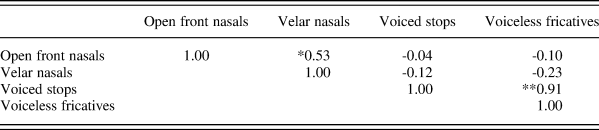
In particular, the approach in (3) predicts (i) a positive relationship between the two lax contexts in the Tragerian system; (ii) a positive relationship between the two tense contexts in this system; and (iii) a negative relationship for pairs of Trager lax/Trager tense contexts. Table 1 shows Spearman's rho values for correlations between each of the ten pairs of contexts in our comparison. The p-values shown are based on the Spearman's rho values and are unadjusted for multiple comparisons. It shows support for the first two of the predictions of (3) just outlined. In particular, tensing before velar nasals correlates positively across speakers with tensing of front nasals in open syllables. Similarly, the table shows a strong correlation across speakers in tensing before voiceless fricatives and voiced stops in closed syllables. Table 1, however, shows that the predicted negative relationships between contexts preceding nasal and oral obstruents are all indeed in the expected direction, but quite weak (Spearman's rho range: -.23: -.04, n.s.). These results suggest that the abstract process of change represented in (3) is not an effective model for this subsample of thirty-three speakers. The results, rather, indicate two distinct processes of change—one affecting oral obstruents and another affecting nasals, as foreshadowed by results discussed above.
A matrix of Spearman's rho values showing cross-speaker correlations in mean values of front diagonal measurements for four contexts. n = 33. *p = .002. **p < .001

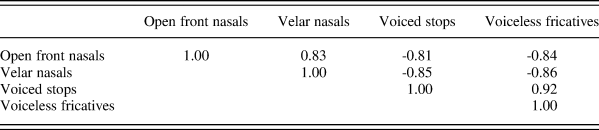
A question immediately raised by these results is whether this misprediction of (3) reflects some vagary of sampling. In other words, if (3) is not an appropriate model for community-wide change, does it describe change across some socially defined subset of the community, for example, subjects with NYCE-native parents or White communities (as in Labov et al.'s [Reference Labov, Fisher, Gylfadóttir, Henderson and Sneller2016] analysis for PhilE)? Another way of posing the problem is to ask, which is the set of speakers in the dataset for whom (3) is the best fit. To test this, we examined correlation matrices for unique combinations of subjects in this subset of thirty-three speakers. For each combination of speakers in the set nCk, beginning with n = 33 and k = 32, and in descending order for n and k, we examined Spearman's rho values and associated p-values for each pairwise comparison. For successive iterations, speakers who fit the correlations matrix most weakly were excluded. The combination selected as optimal was that with the lowest p-values associated with each pairwise comparison among the four contexts in (4).Footnote 19 This is a set of fifteen subjects that yield a correlation matrix illustrated in Table 2, which indeed aligns very well with the predictions of (3). That is, the same speakers with tensing in the prenasal contexts show laxing in the preoral obstruent contexts.
A matrix of Spearman's rho values showing cross-speaker correlations in mean values of front diagonal measurements for four contexts. n = 15. For all values, p < .001

Importantly, the set of speakers selected under this procedure show no evidence of forming a natural class sociolinguistically, that is, of being defined by any of the external, social factors typically reported in the literature as conditioning short-a change or vocalic change more generally in contemporary NYCE. Relative to the remaining speakers in the subsample of thirty-three speakers, the selected set shows no effects of age, (t(21.3) = 1.02, p = .32), occupation level, (t(29.8) = .74, p = .46), ethnicity (χ2(3) = 3.35, p = .34), gender (χ2(1) = 2.65, p = .10) nor whether subjects’ parents are NYCE-native (χ2(2) = .52, p = .77). In addition, the set shows no geographic patterning within the city. These results therefore suggest that, if indeed (3) describes change in a relevant community of NYCE-speakers, there is little to suggest that it is sociolinguistically distributed according to social factors that have been predictive in previous sociolinguistic research. As a reviewer observes, there could well be third wave practice-oriented features that unify these speakers in a way not discernable by our dataset. Future work might usefully explore this possibility.Footnote 20
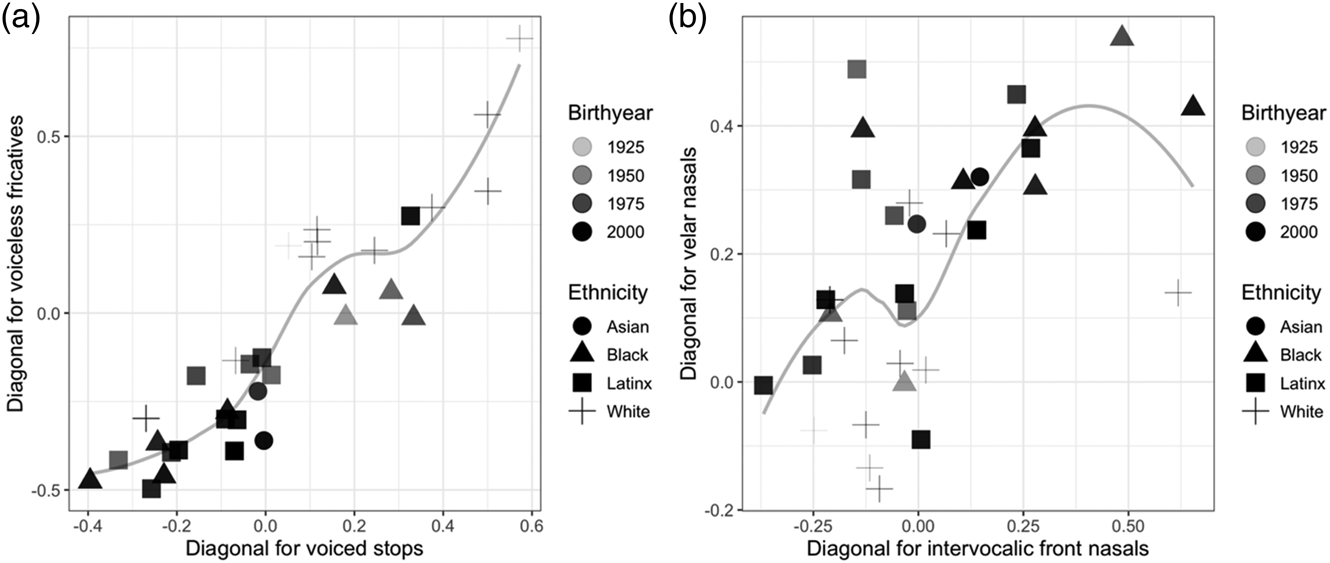
If, indeed, there are two distinct abstract processes of change responsible for the transition to the nasal system—one affecting short-a in prenasal contexts and another in contexts preceding oral obstruents—a question that arises is whether these distinct changes have separate social correlates. The subset of thirty-three speakers used in this section provides somewhat limited resolution for cross-group comparisons, but we suggest a partial answer here. Figure 13 plots by-speaker means for these two pairs of correlations. The left panel in this figure (13a) shows that the most conservative speakers for the changes affecting preoral obstruent contexts—those toward the top right corner of the plot—tend to be older White subjects, as expected in light of the results presented above. The right panel in the figure shows results for prenasal contexts, with conservative speakers in the bottom left part of the figure (i.e., those with the laxest realizations for these contexts). Among these are most of the older White subjects, as expected, but also some young Latinx subjects. These results are again reminiscent of reports suggesting laxer realizations for prenasal contexts in heritage Spanish communities both in New York (Becker, Reference Becker2010; Coggshall, Reference Coggshall2017) and in other speech communities (Thomas, Reference Thomas2001; Eckert, Reference Eckert2008). The figure reveals considerable variation, however, across Latinx subjects, a pattern that future work might usefully consider in greater detail.
Cross-speaker correlations in front diagonal measurements (F2-F1) for prenasal contexts and preoral obstruent contexts, with speaker age and ethnicity shown. n = 33.

To summarize, our results suggest constancy across speakers in the effect of following nasals on the one hand and following oral obstruents on the other (Figure 13), but our dataset provides no evidence of constancy across speakers in all four of these contexts, as predicted by (3). These results suggest the possibility that there is no single abstract process of change underlying the loss of the traditional system, as Labov et al.'s (Reference Labov, Fisher, Gylfadóttir, Henderson and Sneller2016) results suggest is the case for PhilE. Rather, the results suggest that the reorganization of the short-a system in New York City involves (minimally) two separate changes affecting prenasal and preoral obstruent contexts. In addition, as discussed previously, results from contexts not implicated in this phonological reorganization—that is, lax and contexts preceding tautosyllabic front nasals—suggest a third independent lowering/backing change affecting the class of short-a sounds as a whole.
A question raised by the present results, alongside those of Labov et al. (Reference Labov, Fisher, Gylfadóttir, Henderson and Sneller2016) and Sneller (Reference Sneller2018), is how to understand the relationship between the changes in the two cities. Sneller's (Reference Sneller2018:30) results indicate that, in PhilE, a single process of change affecting all contexts began for speakers born around 1983. The present dataset suggests that, at least for contexts preceding tautosyllabic oral obstruents, the change began earlier in NYCE, for speakers born around 1955, as discussed above. For the change affecting intervocalic front nasal contexts and those preceding tautosyllabic velar nasals, the change appears to have begun for speakers born around 1979. This timeline raises the possibility of diffusion change into PhilE of a change originating in NYCE, a scenario consonant with Sneller, Fruehwald, and Yang's (Reference Sneller, Fruehwald and Yang2019) results from computational simulations, suggesting that the change in Philadelphia English is exogenous, that is, driven by children exposed to learning input from outside the community. In this light, a reviewer wonders whether the differences between PhilE and NYCE in the social patterning of short-a change might reflect more general properties of endogenous versus exogenous change. In particular, the reviewer suggests that the “fell swoop” system-level competition described for PhilE by Labov et al. (Reference Labov, Fisher, Gylfadóttir, Henderson and Sneller2016) and Sneller (Reference Sneller2018) may be a property of diffusion change more generally, while the phonologically incremental change described here is characteristic of endogenous innovations. We believe the suggestion warrants further study.
CONCLUSION
The data presented here support two main conclusions about change in NYCE short-a vowels.
1. Our findings converge with results reported by Newlin-Łukowicz (Reference Newlin-Łukowicz2015, Reference Newlin-Łukowicz2016), Coggshall (Reference Coggshall2017), and Shapp (Reference Shapp2018), suggesting that the short-a system in NYCE, like in PhilE, is undergoing regional leveling, that is, a shift to a simpler, pan-local norm (Kerswill, Reference Kerswill2003; Watt, Reference Watt2002). In NYCE, this change interacts with ethnicity, much like the loss of raised THOUGHT (Becker, Reference Becker2009). Specifically, White subjects in the sample diverge from other groups in adhering most closely to the Tragerian system, but all groups show a weakening of the Tragerian system across time. Importantly, the current results suggest that neither age nor ethnicity effects are likely to reflect a confound of parent L1 in sampling (Payne, Reference Payne1976, Reference Payne and Labov1980).
Many younger speakers tend toward a pattern typically described as the “nasal system” in other varieties whereby short-a vowels are raised and fronted before nasal sounds and lowered and retracted elsewhere. Results from a cluster analysis support previous findings suggesting that, among younger speakers, less pronounced raising in prenasal environments is prevalent among Latinx speakers (Becker, Reference Becker2010; Coggshall, Reference Coggshall2017). In addition, younger speakers in the sample show laxer realizations for contexts not implicated in a change from a Tragerian system to a nasal system. Younger subjects show laxer realizations than their elders for contexts preceding tautosyllabic front nasals despite the fact that both the Tragerian and the nasal systems have relatively tense realizations in such contexts. Similarly, younger speakers show laxer realizations than their elders for /æ/ in contexts preceding a voiceless stop even though both systems have laxing in these contexts. We take this to indicate a separate process of change affecting /æ/ generally, that is, “trap-backing.”
2. Unlike short-a change in Philadelphia as described by Labov et al. (Reference Labov, Fisher, Gylfadóttir, Henderson and Sneller2016) and Sneller (Reference Sneller2018), the change away from the traditional system in NYCE does not appear to be a unified process of change within the community. Tensing in pre-nasal contexts correlates strongly across speakers, as does tensing in contexts preceding voiceless fricatives and voiced stops closing a syllable. Both of these results are predicted under the single-change hypothesis. Not borne out by this hypothesis, however, is the further prediction that tensing in the former set of contexts (pre-nasals) will be inversely correlated with tensing in the latter (preceding voiceless fricatives and following stops). Why the two speech communities, otherwise undergoing very similar processes of change in the short-a system, should diverge in this way warrants further study.
Acknowledgments
We thank, first of all, the participants in this study and our bright CUNY undergraduate research collaborators for their hard work and insights. We are grateful also to three very insightful reviewers, and to Benji Wald, C. E. A. Diertani, Anthony Kroch, Beatrice Santorini, Márton Sóskuthy, Jim Stanford, and Meredith Tamminga. This work is supported by NSF Grant Numbers BCS-1152148, BCS-1630274, BCS-1630377, BCS-1630286, BCS-1629348, and BCS-1152148, a CUNY Collaborative Incentive Research Grant (#2129), and the CUNY Advanced Research Collaborative Fellowship (ARC) program.
Appendix
Subject demographic information