INTRODUCTION
Cetacean research usually begins with the study of occurrence and diversity. In the case of the Atlantic Islands, 62 cetacean species have been identified (Hoyt, Reference Hoyt2005) and, to date, 28 of them have already been recorded in the Canary Archipelago (Arbelo, Reference Arbelo2007). Of these, 24 have been sighted in Tenerife (Carrillo, personal communication), which represents more than 85% of all cetacean species present in the Canaries. Twenty-one species have been identified off the coast of La Gomera (Ritter, Reference Ritter, Evans, Vella and Stockin2001) and 14 off La Palma (Pérez-Vallazza et al., Reference Pérez-Vallazza, Álvarez-Vázquez, Cardona and Hernández-Brito2008). This suggests that Tenerife's cetacean diversity is the highest known in the occidental part of the Canary Archipelago. Mention should be made also of the sightings of the highly endangered Atlantic northern right whale Eubalaena glacialis Müller, 1776 (Martín et al., Reference Martín, Iani and Schweikert1998; Aguilar Soto, Reference Aguilar Soto, Evans, Cruz and Raga1999) and of the blue whale Balaenoptera musculus Linnaeus, 1758 (Carrillo, personal communication) in these waters. Both species have also been sighted off the island of La Gomera (Ritter & Brederlau, Reference Ritter and Brederlau1998; Brederlau, personal communication) and can be considered rare in the archipelago. In addition, cetaceans in this region contribute to the general economy (Urquiola et al., Reference Urquiola, Sevilla and Iani1998) as whale watching in the Canary Archipelago attracts more than 700,000 people every year (Aguilar Soto et al., Reference Aguilar Soto, Díaz, Carrillo, Brito, Barquín, Alayón, Falcón and González2001; Plasencia et al, Reference Plasencia, Rodríguez, Herrera and Delgado2001) and generates more than $62000,000 (Hoyt, Reference Hoyt2001; Reference Hoyt2005). The south-west (SW) coast of Tenerife, one of the surveyed sub-areas, is the location within the archipelago where whale-watching operations have shown most development in the past few years (Urquiola, Reference Urquiola1998).
Information on cetacean presence in these islands arises mainly from stranding records registered by the Canary Stranding Network (Canary Government, Las Palmas de Gran Canaria University, Tenerife Conservación and SECAC) and some studies published in reports and symposium proceedings (Vonk & Martín, Reference Vonk, Martín and Evans1988; Martín et al., Reference Martín, Montero, Heimlich-Boran, Heimlich-Boran and Evans1992; Carrillo, Reference Carrillo1996; Arbelo, Reference Arbelo2007).
So far, only a few studies have carried out further analysis of cetacean distribution and its relationships with environmental variables in this area (Aguilar Soto, Reference Aguilar Soto, Evans, Cruz and Raga1999; Arranz et al., Reference Arranz, Aguilar Soto and Johnson2008; Pérez-Vallazza et al., Reference Pérez-Vallazza, Álvarez-Vázquez, Cardona and Hernández-Brito2008). Nevertheless, information on spatial and temporal variation in cetacean abundance is essential for conservation and management (Evans & Hammond, Reference Evans and Hammond2004).
In the SW sub-area of Tenerife, studies focusing on the short-finned pilot whales (Globicephala macrorhynchus Gray, 1864) and the bottlenose dolphin (Tursiops truncatus Montagu, 1821), have shown the stable presence of these species (Escorza et al., Reference Escorza, Heimlich-Boran, Heimlich-Boran, Evans, Vella and Stockin1992; Heimlich-Boran & Heimlich-Boran, Reference Heimlich-Boran, Heimlich-Boran and Evans1992; Heimlich-Boran, Reference Heimlich-Boran1993; Montero & Arechavaleta, Reference Montero, Arechavaleta, Evans, Vella and Stockin1996). Nevertheless, very little is still known about spatial and temporal patterns of cetacean distribution along this coast, or about their occurrence in other areas of Tenerife.
This paper describes data obtained from sightings between 1997 and 2006; it indicates the occurrence, diversity and distribution of the cetacean community off the coast of Tenerife. The aim of this study was to provide baseline information on the principal cetacean species sighted around the island and on the spatial and temporal distribution of this community. In addition, we also ascertained whether the island could function as a breeding area for any of these species.
Survey area
The Canary Archipelago lies about 115 km off the West African mainland, in the Atlantic Ocean. It is composed of seven islands and four islets, most of them independent volcanic edifices with a subsequent narrow shelf (Anguita & Hernán, Reference Anguita and Hernán2000) and, consistently, very deep waters (2000–4000 m) quite close to the coast. These characteristics determine some of the main oceanographic features of the area (Violette, Reference Violette1974; Hernández-León, Reference Hernández-León1986; Arístegui et al., Reference Arístegui, Sangrá, Hernández-León, Hernández-Guerra and Kerling1994).
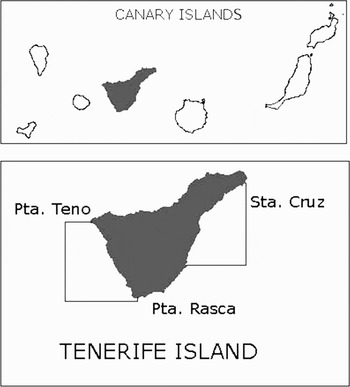
Our survey area covers mainly two zones off the coast of Tenerife (Figure 1). The SW sub-area is the marine strip from Punta de Teno to Punta de Rasca; traditionally, research effort in this leeward area has been more intense due to good weather conditions. The second sub-area, the north-east (NE) coast, is poorly known as survey efforts have been less important due to the unfavourable cetacean watch conditions. Usually, sea states on the windward coast of the Canary Islands are above Beaufort scale 3 which represents unfavourable conditions to perform cetacean abundance and distribution surveys (Evans & Hammond, Reference Evans and Hammond2004).
Location of the Canary Archipelago and the two study sub-areas off Tenerife.

In biological terms, both areas enjoy an outstanding natural status. Different portions of the surveyed area, such as the ‘Sebadal de San Andrés’ and the ‘Franja Marina de Teno-Rasca’, are catalogued by the European Union as Sites of Community Importance (SCI) and are included in the Natura 2000 Network (Council Directive 92/43/EEC). In particular, the ‘Franja Marina de Teno-Rasca’ has been included due to the presence of Tursiops truncatus, as well as for other ecological findings.
MATERIALS AND METHODS
Fieldwork
Cetacean surveys were carried out in both sub-areas off Tenerife, with variable effort, from March 1997 to October 2006, with two gaps in 2000 and 2005. Weather permitting (sea state below Beaufort scale 3) dedicated cruises were conducted along the island shelf edge in a 13 m motorboat yacht with a flying bridge located 7 m above sea level. A total of 9713 nautical miles (17989 km) were covered at a mean survey speed of 6 knots.
With the aim of establishing standard and repeatable protocols for these zone conditions, sighting data were collected following standard line-transect methods of surveying (Buckland et al., Reference Buckland, Anderson, Burnham and Laake1993; Heimlich-Boran, Reference Heimlich-Boran1993; Dudzinski, Reference Dudzinski1999; Schwarz & Seber, Reference Schwarz and Seber1999) together with the model previously designed by Carrillo et al. (Reference Carrillo, Tejedor, Peña and González2002) for the southern study sub-area.
In each survey, four experienced observers were onboard. Two of them watched by naked-eye from a platform 4.20 m above sea level while a third person observed from the flying bridge with 7 × 50 binoculars and the fourth person worked as data recorder. They all changed positions every hour.
In the data for each sighting, records included species, presence of calves in the group, time and position, weather and water depth, among others. Animals were identified to the lowest taxonomic level possible, which in almost every sighting was the species.
Analysis
Once the information was collected, it was processed to characterize the cetacean community of Tenerife. Records were analysed to compare cetacean diversity, average number of sightings, temporal and spatial distribution and calves occurrence.
Firstly, the number of sightings of every species during the research period was calculated. Then, the relative abundance of the different species was examined by calculating the number of sightings per effort unit (SPEU) (Evans & Hammond, Reference Evans and Hammond2004), using as the effort unit the total km of transect-line covered with Beaufort sea state lower than 3. Mean cetacean sighting rates (number of sightings per 100 km surveyed) were compared between species. Sightings from each species were separated by month in order to analyse seasonal changes in cetacean diversity. Sightings during each month were pooled for several years to investigate seasonal distribution of the species.
Further analyses were carried out over the five most frequent species (those with more than 15 sightings during the study period). The distribution of these five species was studied monthly, using the number of surveyed days as the effort. Therefore, sighting frequencies were calculated by dividing the number of sightings by the number of total surveyed days each month.
In addition, sightings of the most common species were located on an island map to represent the cetacean spatial distribution and to examine geographical differences using the software Autodesk Map 2006. Maximum, minimum and mean depths of the sightings of these species were calculated together with the standard deviation of the mean depth.
Finally, the temporal occurrence and the number of sightings from groups with calves and/or newborns were compared with the total number of sightings for each species, to determine which cetacean species bred in the area and when.
RESULTS
Diversity
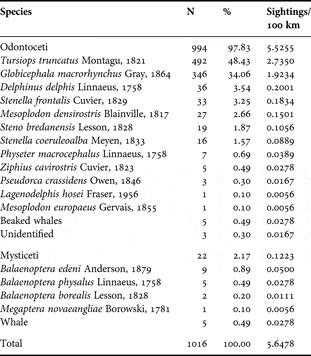
From 1997 to 2006, cetaceans were sighted 1016 times in both study sub-areas, across 9713.41 nautical miles (17989.24 km) on survey (sea state 3 or less), with a mean sighting success of 5.65 sightings per 100 km. Sixteen species were identified, twelve Odontoceti (Flower, 1869) and four Mysticeti (Cope, 1891). The species could not however be determined in 13 sightings, and were therefore attributed to the ‘whale’, ‘beaked whale’ and ‘unidentified’ general groups.
The species observed and their sighting frequencies are shown in Table 1.
Summary of cetacean sightings in Tenerife (1997–2006).

N, number of sightings; %, percentage from the total number of sightings.
Odontoceti species represent the largest amount of sightings (994 sightings, 97.83%) with a frequency of 5.52 sightings/100 km, while Mysticeti species correspond to 0.12 sightings/100 km (22 sightings, 2.17%).
Tursiops truncatus was the most frequently seen species (2.74 sightings/100 km), followed by Globicephala macrorhynchus (1.92 sightings/100 km), Delphinus delphis (0.20 sightings/100 km), Stenella frontalis (0.18 sightings/100 km) and Mesoplodon densirostris (0.15 sightings/100 km). These are the five species for which further analyses were performed.
Temporal distribution of cetaceans
Regarding cetacean diversity, Table 2 shows cetacean sightings off Tenerife by month. According to this table, the number of species sighted does not seem to follow a seasonal pattern. Although an upward trend can be observed in spring and summer, the months with the highest diversity are January and October (10 different species sighted). The months with lowest cetacean diversity are November and December (5 species sighted each month) (Table 2).
Cetacean species sighted off Tenerife per month, summing the full study period. Months in which each species was sighted are represented by cells in black.

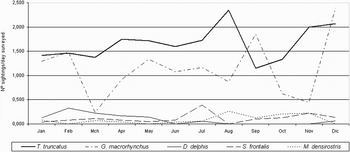
Figure 2 shows the number of sightings per number of days surveyed each month for the five most common species. Regarding this sighting frequency some peaks are shown by month. These peaks are significantly high in August and November for Tursiops truncatus and in September and December for Globicephala macrorhynchus.
Number of sightings/number of days surveyed each month from the five most sighted species.

Tursiops truncatus and Globicephala macrorhynchus occur all through the year with more than one sighting per day (1.57 and 1.10 sightings/day respectively). Tursiops truncatus shows a higher sighting frequency in August (2.35 sightings/day) and December (2.07 sightings/day), and Globicephala macrorhynchus in September (1.85 sightings/day) and December (2.40 sightings/day), which corresponds to the highest frequency of all species and months.
Delphinus delphis has not been seen in June, or from August to November, although it is present the rest of the year with a mean frequency of 0.12 sightings/day. On the other hand, Stenella frontalis was sighted every month except for August. Its occurrence remains constant through the year, excluding a peak in July where it was seen 0.39 times per day. Mesoplodon densirostris was seen every month except in February, May and December with a mean frequency of 0.086 sightings/day and two sharp peaks in its relative frequency of occurrence in August (0.26 sightings/day) and November (0.22 sightings/day).
Spatial distribution of cetaceans
Figures 3 and 4 show the distribution of the five most frequently sighted species in Tenerife. Distribution for Tursiops truncatus and Globicephala macrorhynchus remains very different; the first one concentrates its locations in the coastal area, especially close to Punta de Teno; and the second one clearly distributes itself around the 1000 m bathymetric. Sighting locations in Delphinus delphis, Stenella frontalis and Mesoplodon densirostris seem to appear randomly.
Locations of the two most frequently sighted species off Tenerife. (A) Tursiops truncatus; (B) Globicephala macrorhynchus.

Locations of the sightings of (C) Delphinus delphis; (D) Stenella frontalis; (E) Mesoplodon densirostris.

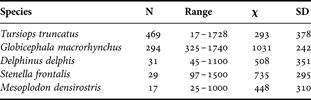
Regarding spatial distribution, differences among species in water depth at the sighting locations are summarized in Table 3. Most sightings were concentrated in the SW sub-area, between Punta de Teno and Punta de Rasca. Differences in mean depths were found between species (from almost 300 m to 1000 m approximately). The deepest average depth is shown by Tursiops truncatus and the shallowest one by Globicephala macrorhynchus, the two most sighted species of both sub-areas.
Descriptive statistics for water depth (m) at sighting locations for the five most sighted cetacean species in Tenerife.
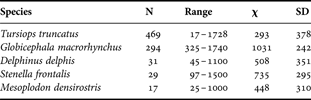
N, total number of groups sighted; χ, mean water depth; SD, standard deviation.
Presence of calves and newborns
Calves and neonates were observed in several groups of different species. Only one Mysticeti species was observed with calves: two mother–calf pairs of Balaenoptera physalus. Nine Odontoceti species were seen with calves and/or neonates. Pseudorca crassidens was seen in December both with a calf and a newborn. Physeter macrocephalus was observed in March and May with one and two calves respectively. Steno bredanensis was seen five times in groups with calves; on one of these occasions, in August, there was also a neonate in the group. Stenella coeruleoalba groups were observed with calves on nearly half of the occasions (43.75%), five of which also included newborns (in January and March).
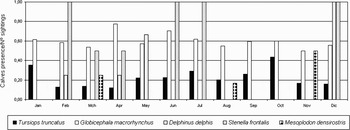
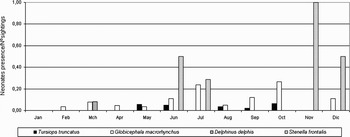
Tursiops truncatus has been observed 114 times with calves (22.15% of its sightings), in some cases even with 10 calves in the same group. Newborn bottlenose dolphins were seen from May to October. Calves were observed every month of the year, with a peak in October. Calves were seen in variable numbers in more than half of the encounters with Globicephala macrorhynchus (209 times, 63.87% of its sightings, 31 sightings of neonates). Calves and neonates of this species were seen every month of the year with the exception of January and November. Delphinus delphis calves were seen in February, April, May and December and only one neonate was seen in March. Stenella frontalis showed a high percentage of sightings with calves and/or neonates (60.61%). Calves of this species were not seen in January, May, or from August to November; nevertheless a marked peak of neonates was observed in November. Mesoplodon densirostris calves were observed three times, in March, August and November respectively; neonates of this species were not detected.
Graphs of the monthly occurrence of calves and neonates, corrected with the total number of sightings per month for each of the most sighted species, are shown in Figures 5 & 6.
Presence of calves/number of sightings within each species per month.

Presence of neonates/number of sightings within each species per month.

DISCUSSION
The present study recorded 1016 sightings of 16 cetacean species during 9713 nautical miles (17989 km) of visual survey in the study sub-areas off Tenerife. These results, together with previous sightings of the Atlantic northern right whale (Martín et al., Reference Martín, Iani and Schweikert1998; Aguilar Soto, Reference Aguilar Soto, Evans, Cruz and Raga1999) and of the blue whale (Carrillo, personal communication) sum up to 18 cetacean species sighted off Tenerife, corroborating the high cetacean diversity around the island. As observed on other islands in the Canaries group (Pérez-Vallazza et al., Reference Pérez-Vallazza, Álvarez-Vázquez, Cardona and Hernández-Brito2008), spring and summer are the periods when more cetacean species are observed. This probably responds to the occurrence of sporadic and occasional species, such as mysticetes.
The overall high sighting rate in the study (5.64 sightings/100 km), similar but higher to rates obtained in other Macaronesian islands (Silva et al., Reference Silva, Prieto, Magalhães, Cabecinhas, Cruz, Gonçalves and Santos2003), demonstrates the high cetacean presence in the survey area. In the Azorean Archipelago a SPEU of 4.13 sightings/100 km was estimated, and 11 cetacean species were identified. The same number of species was observed in Lanzarote (Canary Islands), where the SPEU was estimated as 2.5 sightings/100 km (Politi et al., Reference Politi, Notarbartolo di Sciara and Mazzanti1997).
In the present study, sightings were dominated by two Odontoceti; species, together comprising 82% of the total sightings: Tursiops truncatus and Globicephala macrorhynchus. The occurrence of these species in Tenerife is well known (Escorza et al., Reference Escorza, Heimlich-Boran, Heimlich-Boran, Evans, Vella and Stockin1992; Heimlich-Boran & Heimlich-Boran, Reference Heimlich-Boran, Heimlich-Boran and Evans1992; Carrillo et al., Reference Carrillo, Tejedor and Ramos2006) as both are considered to be residents (with occasional transient individuals). The bottlenose dolphin has a population size estimated at 122 individuals (Carrillo et al., Reference Carrillo, Tejedor, Peña and González2002), with the highest number of sightings registered in the SW study sub-area. The population of short-finned pilot whales includes approximately 362 specimens (Carrillo et al., Reference Carrillo, Tejedor, Peña and González2002) and was frequently found in the south of Tenerife (Los Cristianos–Caleta de Adeje). There are few places in the world with a cetacean group showing a high fidelity to such a small area (Carrillo et al., Reference Carrillo, Tejedor and Ramos2006). Nevertheless, the species was also unexpectedly common in the NE study sub-area where seventeen groups were sighted in total.
The next most abundant species of the survey area, totalling 9% of all sightings, were Delphinus delphis, Stenella frontalis and Mesoplodon densirostris. The latter two species tended to occur almost every month of the year. Presence of Delphinus delphis, on the contrary, follows a marked seasonal pattern from December to May, as reported in other sites of the north-east Atlantic in general (López et al., Reference López, Pierce, Valeiras, Santos and Guerra2004), and in other Canary Islands in particular (Politi et al., Reference Politi, Notarbartolo di Sciara and Mazzanti1997; Aguilar Soto, Reference Aguilar Soto, Evans, Cruz and Raga1999; Pérez-Vallazza et al., Reference Pérez-Vallazza, Álvarez-Vázquez, Cardona and Hernández-Brito2008). Although Stenella frontalis occurs the whole year round in the archipelago, it is most common in winter and spring. In the present paper sightings were registered in waters of depths from 100 to 1500 m, in contrast to previous studies where the depth distribution-range was established at 600 to 900 m depth (Carrillo et al., Reference Carrillo, Tejedor, Peña and González2002).
Steno bredanensis is a rare species in other regions of the world, but relatively common in Tenerife with 0.11 sightings/100 km. This species might be resident in these waters, at least seasonally, as it was recorded every month of the year except in October, November and December. Further photo ID data are needed to assess this possibility.
Although it was not observed during several months (February, April, July and December), this could be due to a more offshore distribution or to low relative abundance in the survey area. It is thought that Stenella coeruleoalba is present all year-round.
Lagenodelphis hosei can usually be found in tropical habitats (Reeves et al., Reference Reeves, Stewart, Clapham and Powell2005), which is not the case in the Canaries. However, general tropicalization of the waters (Stergiou, Reference Stergiou2002) or anomalous environmental conditions, could favour its presence in the Canary Islands. Over the past few years its occurrence in these waters has become more frequent, with it being sighted in La Gomera (Ritter, Reference Ritter, Evans, Vella and Stockin2001) and Tenerife. Pseudorca crassidens is also typically distributed over tropical and temperate waters. The present study shows it to be present in the entire archipelago in winter and springtime (Carrillo, personal communication).
The family Ziphiidae is represented in the Canaries by five species; two of them (Mesoplodon densirostris and Ziphius cavirostris) are known to be resident in the most western island of the archipelago, El Hierro (Aguilar Soto Reference Aguilar Soto2006; Aparicio et al., Reference Aparicio, Aguilar Soto and Crespo2009). These two species and another one from the five Ziphiidae inhabiting the archipelago, were identified in the present study off Tenerife. Mesoplodon densirostris is the beaked species most frequently sighted around the island (Carrillo et al., Reference Carrillo, López and López-Jurado1998), and in the present study (almost every month). Autumn was the time with a higher frequency of sightings for this species, in agreement with previous results in this sub-area (Carrillo et al., Reference Carrillo, López and López-Jurado1998). Mesoplodon europaeus and Ziphius cavirostris were rarely observed in the study area. Mesoplodon europaeus has been seen occasionally in the Atlantic Ocean (Carrillo & Martín, Reference Carrillo, Martín, Evans, Cruz and Raga1999) and in the present paper it was once seen in January at a depth of 1700 m. Ziphius cavirostris was registered five times, in June, August and October. These data and previous results in the area (Carrillo, Reference Carrillo and Evans2003), suggest that the species is a summer and autumn resident in these waters. Its depth-range is from 509 to 1808 m, with an average of 953 m, which constitutes a similar estimate to the one reported in previous studies of the Canaries (Carrillo, Reference Carrillo and Evans2003; Arranz et al., Reference Arranz, Aguilar Soto and Johnson2008).
Regarding Physeter macrocephalus, it was registered seven times in the survey area, all of them in the SW zone. This species seems to be frequent in the channel between Tenerife and Gran Canaria (André, Reference André2000). However, in the present study, no sightings were recorded in the NE area of Tenerife.
Despite the huge effort invested and the fact that both species have been stranded on the island (Canary Stranding Network), the occurrence of Kogia breviceps Blainville, 1838 (pygmy sperm whale) and Kogia sima Owen, 1866 (dwarf sperm whale) off Tenerife, was not confirmed.
Very little is known about the stocks of Mysticeti that inhabit the Canary Islands. Nevertheless, results from the present study confirm a certain level of seasonal migration for these species. Balaenoptera physalus and Balaenoptera edeni have been sighted in every island of the archipelago, during spring and summertime respectively (Politi et al., Reference Politi, Notarbartolo di Sciara and Mazzanti1997; Ritter, Reference Ritter, Evans, Vella and Stockin2001; Carrillo et al., Reference Carrillo, Tejedor, Peña and González2002; Pérez-Vallazza & Haroun, Reference Pérez-Vallazza and Haroun2005; Pérez-Vallazza et al., Reference Pérez-Vallazza, Álvarez-Vázquez, Cardona and Hernández-Brito2008), in agreement with our results. The temporal distribution of Balaenoptera borealis in the archipelago remains unclear. To date, its presence is confirmed in Gran Canaria (Carrillo et al., Reference Carrillo, Tejedor and Ramos2006), Lanzarote (Politi et al., Reference Politi, Notarbartolo di Sciara and Mazzanti1997), La Gomera (Ritter, Reference Ritter, Evans, Vella and Stockin2001), La Palma (Pérez-Vallazza et al., Reference Pérez-Vallazza, Álvarez-Vázquez, Cardona and Hernández-Brito2008) and Tenerife (Carrillo et al., Reference Carrillo, Tejedor and Ramos2006) from the end of autumn to the beginning of spring. The present study reinforces this seasonal pattern, which suggests that Balaenoptera borealis is present only seasonally in the Canaries. When visiting the Canary Islands, Megaptera novaeangliae is thought to be on its migratory route (April–June) from its breeding area in Cabo Verde (February–March), to its feeding area in Europe or America (July–August). Nevertheless, recent records, such as the January sightings recorded in this study, do not follow this pattern.
From the Mysticeti suborder, only Balaenoptera physalus was observed with a calf, which happened twice from a total of five sightings. In both cases records were from the month of May (of different years), coinciding with their seasonal visit to our waters.
As far as the Odontoceti suborder is concerned, almost every species was observed with a calf, at least once (except for Lagenodelphis hosei, Mesoplodon europaeus and Ziphius cavirostris). Furthermore, some groups of the four most sighted species (Tursiops truncatus, Globicephala macrorhynchus, Delphinus delphis and Stenella frontalis) included neonates. This fact suggests that Tenerife may be a calving ground for these four species. Despite the absence of newborns in the dense beaked whale, three groups of this species (registered in March, August and November) included calves. The use of the study area as a breeding ground by this species requires further study.
We should note the highest frequency of calves in both surveyed sub-areas, revealed by Globicephala macrorhynchus (0.60 sightings with newborns/total species sightings), with more than half of the encounters containing calves and/or neonates within the group (63.9% from the total sightings within this species). In particular, in most of the NE encounters (76.5%) calves and neonates were part of the group. Considering these statistics and the fact that the presence of calves and neonates of this species was detected almost every month of the year, the survey area could act as an important calving ground for the short-finned pilot whale. Summer seems to be the most important birth period for this species in our study area, as higher neonate frequencies were observed from June to October. Tursiops truncatus also seems to use the survey area as a breeding ground, mainly during the summer, as neonates were only observed from May to October.
Stenella frontalis showed the highest frequency of sightings of neonates in the survey area (0.18 sightings with newborns/total species sightings) and the second highest percentage of sightings with calves and/or neonates after Globicephala macrorhynchus. In one of these sightings, four adults showed mating and evasive behaviour, which together with the presence of calves and newborns indicates that the study area is being used as a breeding ground for this species. Delphinus delphis appeared with calves in almost every month that the species was sighted, which indicates that the study area may be used as a calving ground for this species.
This paper highlights the high cetacean diversity and occurrence found off the island of Tenerife. Most of the recorded cetacean species occur all throughout the year. However, Balaenoptera physalus, Balaenoptera edeni, Megaptera novaeangliae, Delphinus delphis and Ziphius cavirostris can be classified as occasional or seasonal species present in the study area. In addition, the area is being used as a breeding ground for several species, which emphasizes the biological and ecological importance of these waters. The information acquired enables a better understanding of the Canary cetacean community and can be useful in future management and conservation measures.
ACKNOWLEDGEMENTS
We would like to thank to the numerous field assistants who helped us with the collection of data. We are also very grateful to Natacha Aguilar, Ciro Pérez, Ruth Fernández and Noelia Arto for their valuable comments. The cruises were carried out thanks to the financial support of different projects (principally from the Canary Government), managed by Tenerife conservación, a non-profit association which works for cetacean conservation in the Canary Archipelago. The ‘Monachus’ yacht is a cession from Las Palmas de Gran Canaria University to the Tenerife conservación Association.