INTRODUCTION
Persons living with HIV disease commonly experience failures in prospective memory (PM; Carey et al., Reference Carey, Woods, Rippeth, Heaton and Grant2006), which involves the ability to successfully execute an intended action in response to specific cues that are based on time (e.g., attending a medical appointment at 3 pm) or an event (e.g., take a medication after a meal). Although PM deficits correlate with executive dysfunction, retrospective memory impairment, and slowed information processing in HIV disease (e.g., Zogg et al., Reference Zogg, Woods, Weber, Doyle and Grant2011), they are also separable from HIV-associated neurocognitive deficits as supported by evidence from biomarker (Woods et al., Reference Woods, Morgan, Marquie-Beck, Carey, Grant and Letendre2006), cognitive (Gupta et al., Reference Gupta, Woods, Weber, Dawson and Grant2010), and real-world functioning (e.g., Woods et al., Reference Woods, Iudicello, Moran, Carey, Dawson and Grant2008) studies. HIV-associated PM deficits are of clinical concern, as they are associated with engagement in HIV transmission risk behaviors (e.g., Martin et al., Reference Martin, Nixon, Pitrak, Weddington, Rains, Nunnally and Bechara2007) and increased odds of functional dependence (e.g., Woods et al., Reference Woods, Iudicello, Moran, Carey, Dawson and Grant2008), including suboptimal adherence to combination antiretroviral therapies (cART; Woods et al., Reference Woods, Dawson, Weber, Gibson, Grant and Atkinson2009). Thus, investigating the cognitive mechanisms and co-occurring conditions that modulate the expression of HIV-associated PM deficits is of both scientific and clinical value.
The perceived importance of a PM task is one interesting psychological mechanism with particular relevance to HIV clinical care. The idea that task importance may influence PM functioning was first described by Freud (Reference Freud1914), but formal empirical investigations did not emerge until the 1980s. For example, Kvavilashvili (Reference Kvavilashvili1987) found that university students were significantly less likely to execute a prescribed intention when its importance was not emphasized, particularly when the ongoing task was highly demanding. By definition, PM involves a dual task condition in which one is performing an ongoing task (e.g., engaging in normal daily activities) while simultaneously monitoring the environment for the PM cue (e.g., a meal) that will trigger retrieval and execution of the intention (e.g., take a dose of a prescribed medication). Thus, the ongoing task and the many complex elements of the PM task (e.g., cue monitoring and detection) are in competition for limited cognitive resources (see Loft & Remington, Reference Loft and Remington2013). Viewed through the lens of multiprocess theory (Einstein et al., Reference Einstein, McDaniel, Thomas, Mayfield, Shank, Morrisette and Breneiser2005), which claims that PM processes vary along a continuum of spontaneous/automatic to strategic/executive, increasing the importance of the PM task should encourage the strategic allocation of cognitive resources away from the ongoing task and toward the PM task, thereby improving PM accuracy. For example, Kliegel, Martin, McDaniel, and Einstein (Reference Kliegel, Martin, McDaniel and Einstein2001, Reference Kliegel, Martin, McDaniel and Einstein2004), Loft and Yeo (Reference Loft and Yeo2007), and Loft, Kearney, and Remington (Reference Loft, Kearney and Remington2008) have showed that emphasizing PM task importance in healthy adults increases the allocation of attentional resources to PM as evidenced by poorer performance (viz., costs) on the ongoing task. In turn, the increased resource allocation toward the PM task can improve PM accuracy, particularly for PM tasks that are strategically demanding, such as when the PM cue is based on time (Kliegel et al., Reference Kliegel, Martin, McDaniel and Einstein2001), or is not focal to the ongoing task (Kliegel et al., Reference Kliegel, Martin, McDaniel and Einstein2004).
Yet we know very little about the moderating effects of task importance in populations vulnerable to deficits in strategically demanding aspects of PM that may interfere with independent living. According to multiprocess theory, in clinical populations with diminished strategic PM resources, as in the case of HIV infection (e.g., Doyle et al., Reference Doyle, Loft, Morgan, Weber, Cushman and Johnston2013), emphasizing the importance of the PM task should focus strategic processing on PM cue monitoring and thereby enhance PM accuracy. In 2007, Altgassen, Zöllig, Kopp, Mackinlay, and Kliegel reported that individuals with Parkinson’s disease performed worse on the PM task than healthy adults when the importance of ongoing task was emphasized, but not when the importance of the PM task was stressed. More recently, Hering, Phillips, and Kliegel (Reference Hering, Phillips and Kliegel2014) demonstrated that age-related PM deficits evident in a low PM importance condition were ameliorated in the high PM importance condition (cf. Smith & Hunt, Reference Smith and Hunt2014). Across this literature, the beneficial effects to PM accuracy of emphasizing the relative importance of the PM task were accompanied by increased performance cost to the ongoing task. When considered in the context of the multiprocess theory and the laboratory studies reviewed above, these data suggest that experimenter-driven allocation of additional attentional resources to PM cue monitoring by way of a task importance instruction manipulation can enhance PM performance in populations vulnerable to deficits in strategically demanding PM.
The present investigation describes two separate experiments designed to determine the role of task importance in the expression of PM deficits in persons living with HIV disease. We focused our experiments on two clinical aspects of HIV disease, namely HIV-associated neurocognitive disorders (HAND) and substance use disorders (SUD). In the first experiment, we examine the effects of PM task importance in adults with HAND, which are prevalent in the era of cART (Heaton et al., Reference Heaton, Clifford, Franklin, Woods, Ake and Vaida2010), a major risk factor for real-world complications including non-adherence (e.g., Hinkin et al., Reference Hinkin, Castellon, Durvasula, Hardy, Lam, Mason and Stefaniak2002), and an important determinant of both time- and event-based PM deficits (e.g., Zogg et al., Reference Zogg, Woods, Weber, Doyle and Grant2011; Morgan et al., Reference Morgan, Weber, Rooney, Grant and Woods2012). A second experiment was conducted to investigate whether SUD modify the response to PM task importance among young adults infected with HIV. SUD are common in persons living with HIV disease, particularly so in young adults (Murphy et al., Reference Murphy, Wilson, Durako, Muenz and Belzer2001; Rotheram-Borus, Murphy, Kennedy, Stanton, & Kuklinski, Reference Rotheram-Borus, Murphy, Kennedy, Stanton and Kuklinski2001), and are known to exacerbate HIV-associated neural injury (e.g., Chana et al., Reference Chana, Everall, Crews, Langford, Adame and Grant2006), including deficits in episodic memory (e.g., Meyer et al., Reference Meyer, Rubin, Martin, Weber, Cohen, Golub and Maki2013) and executive functions (Scott et al., Reference Scott, Woods, Matt, Meyer, Heaton, Atkinson and Grant2007). Indeed, a growing body of evidence is elucidating a relationship between SUD and PM impairment as evidenced on laboratory-based tasks (e.g., Iudicello et al., Reference Iudicello, Weber, Grant, Weinborn and Woods2011; Weinborn, Woods, O’Toole, Kellogg, & Moyle, Reference Weinborn, Woods, O’Toole, Kellogg and Moyle2011), and is thought to be due at least in part to frontostriatal circuitry injury (Volkow, Fowler, Wang, & Goldstein, Reference Volkow, Fowler, Wang and Goldstein2002). Furthermore, there is evidence that HIV-infected young adults with SUD are susceptible to suboptimal cART adherence (Murphy et al., Reference Murphy, Wilson, Durako, Muenz and Belzer2001), and so identifying mechanisms that could improve PM is of clinical relevance. Across both of these experiments, we expected that emphasizing PM task importance would enhance allocation of attention resources to the PM task as shown by increased performance costs to the ongoing task and, in turn, improve PM accuracy in subjects with HAND and SUD risk as compared to their study counterparts. In other words, we hypothesized that there would be detrimental effects of HAND and SUD when the importance of the ongoing task was emphasized, but not when the importance of the PM task was emphasized.
EXPERIMENT 1: HIV-ASSOCIATED NEUROCOGNITIVE DISORDERS
Method
Participants
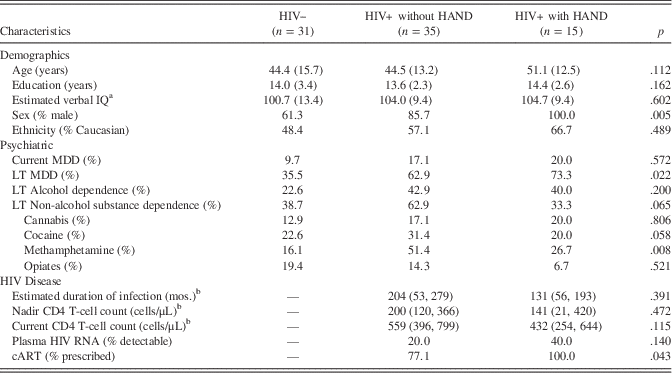
The study in which these data were gathered was approved by the UC San Diego human research protections program. The study sample included 31 HIV− individuals, 15 HIV+ individuals diagnosed with HAND, and 35 HIV+ individuals not diagnosed with HAND, all of whom were recruited from local HIV clinics and community organizations. HAND was diagnosed according to Frascati criteria (Antinori et al., Reference Antinori, Arendt, Becker, Brew, Byrd, Cherner and Wojna2007) as determined by results from a comprehensive neuropsychological, medical, and psychiatric evaluation (for details, see Morgan et al., Reference Morgan, Weber, Rooney, Grant and Woods2012). Exclusion criteria included a diagnosis of severe psychiatric (e.g., schizophrenia) or neurologic illness (e.g., seizure disorder, active opportunistic infection, stroke), or a verbal IQ estimate<70 (based on the Wechsler Test of Adult Reading; Psychological Corporation, 2001). No study subjects met substance dependence criteria within 1 month of evaluation as determined by the Composite International Diagnostic Interview (CIDI version 2.1; World Health Organization, 1998). In addition, we excluded subjects who were urine toxicology positive for illicit substances on the day of evaluation (excluding marijuana or prescribed medications), or tested positive for alcohol via a Breathalyzer test. Of note, all individuals were enrolled in a National Institutes of Health-funded R01 parent study that examined the combined effects of HIV and aging on PM, which used a discrepant age classification approach such that no individuals between the ages of 40 and 50 were enrolled in the parent study. The demographic, psychiatric, and medical characteristics of the study participants in Study 1 are provided in Table 1.
Demographic, psychiatric, and HIV disease characteristics of the study samples in Experiment 1
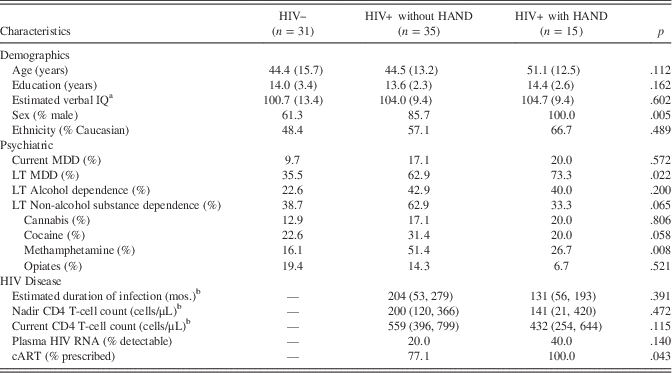
Note. cART=combination antiretroviral therapy; MDD=major depressive disorder; LT=lifetime.
a Based on the WTAR.
b Data are presented in medians and interquartile ranges.
Materials and procedure
After providing written informed consent, study participants completed a neuropsychological, psychiatric, and medical evaluation (see Morgan et al., Reference Morgan, Weber, Rooney, Grant and Woods2012).
The current study used a computerized laboratory paradigm in which a PM task is embedded within an ongoing lexical decision task. For the lexical decision task, participants were required to decide, as quickly and as accurately as possible, whether presented letter strings were English words or non-words by pressing designated keys representing “yes” and “no.” A list of 150 medium frequency words (i.e., 20–50 occurrences per million), all of four to six letters in length, was obtained from the Sydney Morning Herald database (Dennis, Reference Dennis1995). Given that the task was originally developed for use within Australian samples, words that were uncommon in American English were excluded and replaced. A list of 150 non-words, also four to six letters in length, was obtained from the Macquarie University ARC non-word database (Rastle, Harrington, & Coltheart, Reference Rastle, Harrington and Coltheart2002). On each lexical decision task trial, a fixation cross was presented on the computer screen followed by a presentation of the letter string. The letter string was then removed from the display and replaced by a fixation cross for the next trial after the participant responded, or after the maximum duration of 3000 ms, whichever occurred first.
The experiment consisted of three experimental blocks, each of which included 100 lexical decision trials. The first block presented was the baseline condition, in which no PM instruction was given and participants only performed the lexical decision task. The following two blocks, in which a PM task was required in addition to the ongoing lexical decision task, were randomized in their order of presentation. The assignment of words and non-words to the three blocks as well as the presentation order within blocks was randomized but yoked across the two PM conditions. Ten additional words that contained the syllable “tor” (e.g., “monitor,” “tortoise”) were selected from the Sydney Morning Herald database and used as PM cues; five were randomly assigned to each of the two PM blocks. Within each PM block, a PM cue was presented every 18–21 trials.
After participants completed 10 practice lexical decision trials followed by the baseline lexical decision block, they were informed that the researcher had a secondary interest in their ability to remember to perform actions in the future. Specifically, they were told to press the “Q” key instead of the “yes” or “no” keys if they saw any word that contained the syllable “TOR.” Participants then received additional instructions for either the PM block in which the importance of the ongoing task was emphasized (“Please note that in this case, your performance on the word-nonword task is more important than looking for ‘TOR’ and remembering to press the ‘Q’ key. In other words, we would like you to put more effort into performing the word-nonword task”), or for the PM block in which the importance of the PM task was emphasized (“Please note that in this case, looking for ‘TOR’ and remembering to press the ‘Q’ key is more important than your performance on the word-nonword task. In other words, we would like you to put more effort into looking for ‘TOR’ and remembering to press the ‘Q’ key”). Before each PM block, participants were engaged in a paper-and-pencil distractor task for 2 min. Upon completion of each PM block, participants completed a recognition test for the five PM targets that had just been presented in that block.
Results
Ongoing task
Analysis of lexical decision response times were based on word trials only. We excluded incorrect lexical decisions, and response times greater than 3 SDs from each participant’s mean for each block (see Loft & Yeo, Reference Loft and Yeo2007; Loft et al., Reference Loft, Kearney and Remington2008). We conducted a mixed effects analysis of variance (ANOVA) on accuracy and reaction time (RT) to the word trials of the ongoing lexical decision task. Block (baseline, ongoing task emphasis, and PM task emphasis) was the within-subjects factor and HAND group (i.e., HIV−, HIV+ without HAND, and HAND) the between-subjects factor. Lifetime diagnoses of MDD and SUD were included as covariates in this model. Lexical decision accuracy was near ceiling and we observed no significant main effects or interactions (Fs<1, see Table 2). For lexical decision RT, there was a main effect of Block (F[2,75]=107.8; p<.001). Follow-up analyses showed that lexical decision RTs were significantly faster in the Baseline condition as compared to the Ongoing Task Emphasis condition (t(80)=13.2; p<.001), which in turn was faster than the PM Task Emphasis condition (t(80)=7.9; p<.001). These data indicate that the increased performance costs to the ongoing task under Ongoing Task Emphasis compared to baseline conditions, and under PM Task Emphasis compared to Ongoing Task Emphasis conditions, were both significant and comparable between the three groups. There was also a main effect of HAND group (F[2,76]=3.9; p=.024), such that individuals with HAND were significantly slower than the HIV− and HIV+ subjects without HAND in both the baseline and Ongoing Task Emphasis conditions (ps<.05), but not in PM Task Emphasis condition (ps>.05) (see Figure 1). No main effects of either of the covariates were observed (ps>.10), and no interaction was found between HAND and Block (F<1; p>.10).
Panel a displays the response times to the ongoing lexical decision task in the HIV− (n=31), HIV+ neurocognitively normal (n=35), and HAND (n=15) groups in Experiment 1 at baseline (i.e., no PM instructions), and in the two conditions in which either the relative importance of ongoing or the PM task was emphasized. Panel b displays the PM accuracy data across the HAND study groups and PM task importance conditions in Experiment 1. Standard errors are represented in the figure by the error bars on each column.

Proportions of correct lexical decision responses across the study groups in Experiments 1 and 2

Note. HAND=HIV-associated neurocognitive disorders; SUD=substance use disorders; PM=prospective memory.
PM accuracy
We also conducted a mixed effects ANOVA using PM accuracy, with PM Task Importance (Ongoing Task Emphasis and PM Task Emphasis) as the within-subjects factor and HAND group (HIV−, HIV+ without HAND, and HAND) as the between-subjects factor. Lifetime diagnoses of MDD and SUD were again included as covariates. Results revealed no main effect of HAND group (F[2,76]=1.9; p=.162); however, there was a main effect of PM Task Importance (F[1,76]=18.5; p<.001) and a significant interaction between HAND and PM Task Importance (F[2,76]=3.2; p<.048). Planned post hoc examination of the interaction term showed significant omnibus effects of HAND group on PM accuracy in the Ongoing Task Emphasis condition (F[2,78]=3.1; p<.049). This effect was driven by lower PM accuracy in HAND versus HIV+ (p=.018; Hedges g=.78), as the HAND group did not differ from the HIV− cohort (p=.230; g=.36), despite evidence of a small-to-medium effect size. There were no significant effects of HAND in the PM Task Emphasis condition (F[2,76]=1.6; p=.210). PM accuracy improved significantly from the Ongoing Task Emphasis condition to the PM Task Emphasis block in both the HIV− (t(30)=4.3; p<.001; g=.91) and HAND (t(14)=2.9; p=.011; g=.71) groups; however, there was no evidence of PM accuracy improvement in the HIV+ subjects without HAND across task emphasis blocks (t(34)=.70; p=.490; g=.13).
Given that individuals who were urine toxicology positive for cannabis were included in the study sample, we examined the potential influence of this variable on ongoing task RT and PM accuracy. As only two HIV− participants produced positive urine toxicology screens, these potential effects were examined within the HIV+ without HAND group, the HIV+ with HAND group, and the HIV+ sample as a whole. These analyses showed no significant associations between a positive urine toxicology for cannabis and any of the study dependent variables (ps>.10).
EXPERIMENT 2: SUBSTANCE USE DISORDERS
Method
Participants
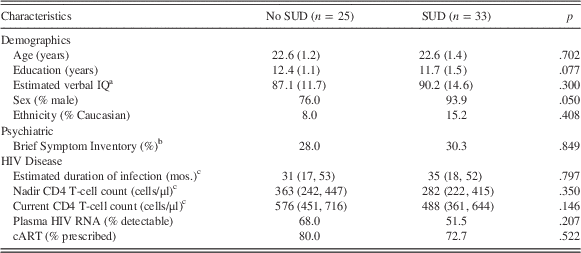
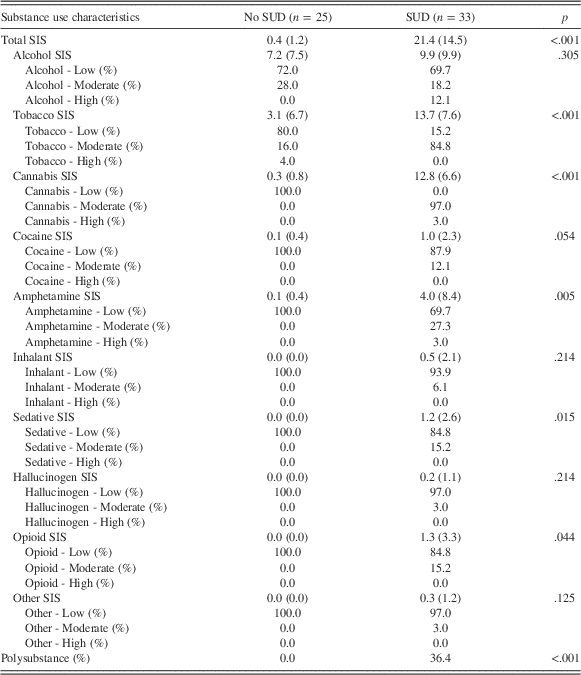
The human research protections programs at UC San Diego and Wayne State University approved this study. The study sample included 58 HIV-infected young adults enrolled in a multisite National Institute on Drug Abuse-funded study of PM in San Diego (n=28) or Detroit (n=30). All participants had documented HIV infection and were between the ages of 18 and 24 years of age. Exclusion criteria included a diagnosis of severe psychiatric (e.g., psychosis) or neurologic (e.g., seizure disorder, closed head injury with loss of consciousness more than 30 min) conditions. SUD status was determined by the Alcohol, Smoking, and Substance Involvement Screening Test (ASSIST version 3.0; WHO ASSIST Working Group, 2002), which is a brief instrument that queries subjects on substance use frequency, craving, and related problems over the three months before assessment. Participants were classified as likely having an SUD if they met criteria for “moderate” or “high” risk for at least one illicit substance (excluding alcohol and tobacco). A total of 33 (56.9%) HIV+ young adults met criteria for SUD, with cannabis and methamphetamine being the two most common substances of abuse. The demographic, psychiatric, and medical characteristics of the study participants in Experiment 2 are provided in Table 3; the substance use characteristics of the study participants are provided in Table 4.
Demographic, psychiatric, and HIV disease characteristics of the study samples in Experiment 2
Note. Data are presented in means and standard deviations unless otherwise noted. cART=combination antiretroviral therapy. MDD=Major Depressive Disorder. LT=lifetime.
a Based on the WTAR.
b % of individuals with elevated global scores.
c Data are presented in medians and interquartile ranges.
Substance use characteristics of the study samples in Experiment 2
Note. Data are presented in means and standard deviations unless otherwise noted. SIS=substance involvement score. Low=raw score of<11 for alcohol or<4 for all other substances. Moderate=raw score between 11 and 26 for alcohol and 4 and 26 for all other substances. High=raw score of >26 for all substances. Polysubstance=percent of individuals who met criteria for at least moderate substance involvement in two or more substances.
Materials and procedure
After providing written informed consent, study participants completed a brief neurocognitive and psychiatric evaluation that included the identical PM task importance paradigm described in Experiment 1.
Results
Ongoing task
Paralleling our analytic approach in Experiment 1, we conducted a mixed effects ANOVA on RT to the word trials from the ongoing lexical decision task. Block (Baseline, Ongoing Task Emphasis, and PM Task Emphasis) was the within-subjects factor and SUD group (SUD, No SUD) the between-subjects factor. Education, gender, and tobacco risk as measured by the ASSIST were included as covariates. Ongoing task accuracy was near ceiling and we observed no significant main effects or interactions (Fs<1, see Table 2). For ongoing task RT, there was a significant within-subjects effect of Block (F[2,52]=10.3; p<.001). As displayed in Figure 2, follow-up analyses showed that lexical decision RTs were significantly faster in the baseline condition versus the Ongoing Task Emphasis condition (t(57)=3.1; p=.004), which was also faster than the PM Task Emphasis condition (t(57)=4.0; p<.001). There were no significant main effects of SUD group and no interaction between SUD group and Block (Fs<1, ps>.10). Overall, these data indicate that the increased performance costs to the ongoing task under Ongoing Task Emphasis compared to baseline conditions, and under PM Task Emphasis compared to Ongoing Task Emphasis conditions, were both significant and comparable between the SUD group and the No SUD group.
Panel a displays the response times to the ongoing lexical decision task in the HIV+ subjects with (n=33) and without (n=25) risk of substance use disorders (SUD) in Experiment 2 at baseline (i.e., no PM instructions), in the two conditions in which either the relative importance of ongoing or the PM task was emphasized. Panel b displays the PM accuracy data across the SUD study groups and PM task importance conditions in Experiment 2. Standard errors are represented in the figure by the error bars on each column.
PM accuracy
We conducted a mixed effects ANOVA on PM accuracy, with PM Task Importance (Ongoing Task Emphasis and PM Task Emphasis) as the within-subjects factor and SUD group (SUD and No SUD) as the between-subjects factor. Education, gender, and tobacco use were again entered as covariates. There was no main effect of SUD group (F<1; p>.10). Consistent with Study 1, there was a main effect of PM Task Importance (F[1,53]=4.6; p=.036), which was modified by a significant interaction with SUD group (F[2,76]=11.2; p=.002). Planned analysis of the interaction term showed that the SUD group was marginally less accurate in PM than the No SUD group under Ongoing Task Emphasis conditions (F[1,66]=3.1; p=.082; g=.4), which was driven by a significant association with problematic cannabis use as measured by the correlation with the continuous score from the ASSIST (r=−0.40; p=.020). All other individual substances of abuse, including alcohol, were not significantly associated with PM accuracy in the Ongoing Task Emphasis condition (ps>.10). In contrast, there were no significant effects of SUD group in the PM Task Emphasis condition (F<1). PM accuracy improved significantly from the Ongoing Task Emphasis condition to the PM Task Emphasis block in the SUD group (t(32)=2.6; p=.016; g=.44), but not in the No SUD group (t(24)=−.46; p=.651; g=−0.11).
GENERAL DISCUSSION
HIV-associated deficits in the strategic aspects of PM are common (e.g., Doyle et al., Reference Doyle, Loft, Morgan, Weber, Cushman and Johnston2013; Morgan et al., Reference Morgan, Weber, Rooney, Grant and Woods2012) and greatly increase the risk of poorer real-world outcomes, including non-adherence to cART (Woods et al., Reference Woods, Dawson, Weber, Gibson, Grant and Atkinson2009). In two complementary experiments, we demonstrated that PM task importance plays a key role in the expression of event-based PM in adults with HIV-associated neurocognitive disorders (HAND) and HIV+ young adults with substance use disorders (SUD). Specifically, HAND and SUD were each associated with relative deficits in non-focal event-based PM when the importance of the ongoing task was emphasized, but not when the importance of the PM task was emphasized. These HAND and SUD effects were independent of clinic demographic factors, including education, psychiatric comorbidity, and HIV disease severity, which were either comparable between groups or were covaried in the statistical models. As the HAND group was comprised entirely of men, we were unable to covary for this demographic factor; however, we are unaware of any studies showing gender effects in the expression of PM task importance or HIV-associated PM deficits. In both experiments, the shifting of importance away from the ongoing task and toward the PM task was associated with a parallel increase in attentional resources apportioned to the PM task requirement by all groups of participants, and an accompanied improvement in PM accuracy for HIV+ individuals with HAND and SUD, and for HIV− individuals. Thus, these experiments align with prior findings from younger healthy subjects (e.g., Loft & Yeo, Reference Loft and Yeo2007), older adults (Hering et al., Reference Hering, Phillips and Kliegel2014), and Parkinson’s disease (Altgassen et al., Reference Altgassen, Zöllig, Kopp, Mackinlay and Kliegel2007) in suggesting that supporting strategic PM cue monitoring by allocating increased attentional resources to the PM task can improve PM in persons living with HIV infection. Across these two experiments, emphasizing the importance of the PM task successfully decreased study participants’ focus on the ongoing task as indicated by slowed response times (but no gross changes in accuracy, which was generally at ceiling) to the lexical decision task when the PM instruction was emphasized. This effect of importance on the ongoing task was broadly comparable across all study groups, suggesting that individuals with and without HAND and SUD in Experiments 1 and 2, respectively, were able to increase allocation of attentional resources to the PM task to a similar extent when the importance of the PM task was emphasized. This cognitive resource allocation shift away from the ongoing task in response to PM task importance instructions in HIV disease is commensurate with prior data from healthy younger (e.g., Loft & Yeo, Reference Loft and Yeo2007) and older (Hering et al., Reference Hering, Phillips and Kliegel2014) adults, although prior findings vary by the relative demands of the ongoing task (e.g., Kliegel et al., Reference Kliegel, Martin, McDaniel and Einstein2001). In the only prior clinical study of PM task importance (Altgassen et al., Reference Altgassen, Zöllig, Kopp, Mackinlay and Kliegel2007), patients with Parkinson’s disease did not show decrements in the ongoing working memory task accuracy when the importance was directed to the PM task, but this study did not report the more sensitive measure of response times. All told, data from the current experiments suggest that individuals living with HIV infection are successfully able to shift additional attentional resources from the ongoing task to the PM task when PM task importance is emphasized.
Of clinical relevance, the shift of attention away from the ongoing task afforded significant improvements in PM accuracy. In Experiment 1, HAND was associated with substantially lower PM accuracy as compared to neurocognitively normal HIV+ subjects when the ongoing task was emphasized. Indeed, HAND has reliably been associated with deficits in strategically demanding (i.e., non-focal) event-based PM (e.g., Zogg et al., Reference Zogg, Woods, Weber, Doyle and Grant2011). However, when the PM task was emphasized the HAND group improved their PM accuracy significantly; in fact, the previously observed between-group effects of HAND were no longer evident. Interpretation of this null finding is somewhat tempered by the small sample of subjects with HAND, which may have increased our risk of Type II error in detecting the small effect size. Regardless, it is clear that the task importance manipulation dampened the effect of HAND on PM as evidenced by a medium-to-large effect size for PM accuracy across conditions, which suggests that individuals with HAND can more successfully execute PM task requirements when the resource demands of the ongoing task are intentionally limited. Emphasizing the importance of the PM task relative to the ongoing task in HAND can be conceptualized as bolstering strategic processing by way of allocating attention to PM cue monitoring, according to the assumptions of multiprocess theory (Einstein et al., Reference Einstein, McDaniel, Thomas, Mayfield, Shank, Morrisette and Breneiser2005). Moreover, this finding is commensurate with prior studies from our group showing that automatic/spontaneous event-based PM processes can be spared in vulnerable subpopulations of HIV disease (e.g., aspects of encoding in older adults; Woods, Dawson, Weber, Grant, & The HNRC Group, Reference Woods, Dawson, Weber and Grant2010).
We observed a similar pattern of PM accuracy decrement and improvement across the task importance manipulations among young adults with SUD in Experiment 2. When the importance of the ongoing task was emphasized, HIV+ SUD showed marginally lower PM accuracy as compared to their non-SUD counterparts, which was driven by young adults with cannabis use disorders. To our knowledge, this is the first study to demonstrate adverse effects of cannabis use on PM in young adults infected with HIV. Such data are consistent with studies showing that cannabis use is associated with elevated PM failures in daily life (e.g., Bartholomew, Holroyd, & Heffernan, Reference Bartholomew, Holroyd and Heffernan2010) and in the laboratory (e.g., Fisk & Montgomery, Reference Fisk and Montgomery2008; Montgomery, Seddon, Fisk, Murphy, & Jansari, Reference Montgomery, Seddon, Fisk, Murphy and Jansari2012; cf. Cuttler, McLaughlin, & Graf, Reference Cuttler, McLaughlin and Graf2012) among seronegatives. Frequent cannabis use is also associated with worse procedural learning (Gonzalez, Schuster, Vassileva, & Martin, Reference Gonzalaz, Schuster, Vassileva and Martin2011) and mild retrospective episodic memory deficits (e.g., Cristiani, Pukay-Martin, & Bornstein, Reference Cristiani, Pukay-Martin and Bornstein2004) in adults with HIV disease. Limitations of this study include the absence of a demographically similar seronegative comparison group, and the relatively limited characterization of SUD, which was measured by the ASSIST. The ASSIST serves as a brief screening instrument to identify those who engage in problematic substance use, and thus are likely to meet diagnostic criteria for dependence. As such, the current study was unable to base SUD group categorization off formal, interview-based diagnostic criteria for substance use disorders per DSM. Additionally, other important and relevant substance use characteristics, such as age of onset and lifetime amount used, were not obtained in the current study. Future studies on the effects of PM in younger HIV-infected substance users would benefit from more comprehensive assessment substance use diagnoses and parameters based on structured clinical interviews.
Emphasizing the importance of the PM task and thereby shifting subjects’ attention away from the ongoing task not only significantly improved PM accuracy in the HIV+ SUD group, it also fully ameliorated the SUD group effects on PM. Paralleling the findings observed with HAND in Experiment 1, these data indicate that the PM accuracy of HIV+ young adults with SUD is greatly benefitted when individuals allocate additional attentional resources to support PM cue monitoring. Taken together, findings from these experiments suggest that HIV-infected persons with HAND and/or problematic cannabis use may have clinical vulnerabilities in PM cue monitoring that are amenable to improvement with strategic supports. It remains to be determined whether importance manipulations can successfully improve PM accuracy in other vulnerable subpopulations of the HIV epidemic, perhaps most notably older adults, who are at high risk for deficits in the strategic aspects of PM (Woods et al., Reference Woods, Dawson, Weber and Grant2010).
It is interesting to note that the PM task importance manipulation did not improve PM accuracy in HIV+ subjects without HAND or SUD. This despite the fact that both HIV+ comparison groups demonstrated the expected increase in response costs to the ongoing task in the PM emphasis condition that were comparable to the HAND and SUD groups. One possibility is that the “importance” manipulation used in this study, while powerful enough to improve PM accuracy in HAND and SUD subjects with PM cue monitoring deficits, was too weak to enhance PM in less vulnerable HIV+ subjects. In other words, simply instructing some HIV+ participants to allocate more attentional resources to the PM task may not be sufficiently motivating as an importance manipulation for individuals not in need of such a “boost.” If this were the case, however, it is not clear why the PM performance of the seronegative participants in Experiment 1, and in prior studies (Loft and Yeo, Reference Loft and Yeo2007; Loft et al., Reference Loft, Kearney and Remington2008), significantly benefitted from the same PM task emphasis instruction. Nonetheless, future studies with more salient incentives (e.g., monetary; McCauley, McDaniel, Pedroza, Chapman, & Levin, Reference McCauley, McDaniel, Pedroza, Chapman and Levin2009) may be needed to amplify the PM task importance effect in these HIV+ individuals.
Another, perhaps more likely, possibility for this curious null result is a “glass ceiling” effect in the HIV+ groups, whereby the enhanced monitoring afforded by emphasizing the PM task does not improve PM performance deficits driven by other component processes, such as PM cue-intention encoding (Altgassen et al., Reference Altgassen, Zöllig, Kopp, Mackinlay and Kliegel2007) and cue detection (e.g., Doyle et al., Reference Doyle, Loft, Morgan, Weber, Cushman and Johnston2013). In addition, the response cost evidence for the shift of attentional resources away from ongoing task may not have necessarily directly translated into effective PM cue monitoring. That is, while HIV+ participants demonstrated equivalent costs under PM importance emphasis conditions (an indicator of overall attention allocation to the PM task), it does not suggest that they used qualitatively similar attentional processes as the other groups. Furthermore, sustained PM cue monitoring can absorb considerable cognitive resources and may be susceptible to lapses in attentional control—which is a neurocognitive hallmark of HIV infection (Morgan et al., Reference Morgan, Woods, Delano-Wood, Bondi and Grant2011)—impairing PM cue detection.
The finding that HIV+ individuals with HAND and SUD benefit from emphasizing the importance of PM may have implications for designing interventions to improve PM and real-world functions in HIV disease. For example, McCauley and colleagues (2009) reported that increased monetary rewards for successful task performance improved naturalistic PM in subjects with both mild and severe traumatic brain injury. PM response to the monetary rewards was associated with the microstructural integrity (i.e., fractional anistropy) of frontolimbic white matter bundles (McCauley et al., Reference McCauley, Wilde, Bigler, Chu, Yallampalli, Oni and Levin2011), which are also affected in HIV disease (see Ellis, Calero, & Stockin, Reference Ellis, Calero and Stockin2009). Given that interventions based on cash payments also demonstrate promise for HIV prevention (e.g., Pettifour, MacPhail, Nguyen, & Rosenberg, Reference Pettifour, MacPhail, Nguyen and Rosenberg2012), incentive-based programs are increasingly being developed for reducing HIV risk transmission behaviors (e.g., Operario, Kuo, Sosa-Rubí, & Gálarraga, Reference Operario, Kuo, Sosa-Rubí and Gálarraga2013). This is relevant because HIV transmission risk behaviors are strongly associated with strategically demanding PM among persons with SUD (Martin et al., Reference Martin, Nixon, Pitrak, Weddington, Rains, Nunnally and Bechara2007; Weinborn et al., Reference Weinborn, Moyle, Bucks, Stritzke, Leighton and Woods2013). Similar incentive-based interventions are being considered to improve adherence to cART (e.g., Farber et al., Reference Farber, Tate, Frank, Ardito, Kozal, Justice and Braithwaite2013), which is also reliant upon PM (Woods et al., Reference Woods, Dawson, Weber, Gibson, Grant and Atkinson2009). A recent study demonstrated that endorsing normative beliefs about the importance of ART adherence was associated with greater likelihood of being adherent (Brown, Littlewood, & Vanable, Reference Brown, Littlewood and Vanable2013). Consideration of PM functioning as a possible moderator of the effectiveness of these incentive-based interventions is therefore warranted across the lifespan in persons infected with HIV.
ACKNOWLEDGMENTS
The authors report no conflicts of interest. This research was supported by National Institutes of Health grants R01-MH073419, R01-DA034497, T32-DA31098, L30-DA032120, P30-MH062512, P50-DA026306, as well as and Discovery Grant DP-12010311 from the Australian Research Council. The views expressed in this article are those of the authors and do not reflect the official policy or position of the Department of the Navy, Department of Defense, nor the United States Government. The authors thank Marizela V. Cameron and P. Katie Riggs for their assistance with study coordination, Yanqi Ryan Li for his help with the construction of the PM task, and Donald Franklin and Stephanie Corkran for their assistance with data compilation.