Introduction
The link between higher education and higher cognitive status is well-documented across adulthood (Yaffe et al., Reference Yaffe, Vittinghoff, Pletcher, Hoang, Launer, Whitmer and Sidney2014; Zahodne et al., Reference Zahodne, Glymour, Sparks, Bontempo, Dixon, MacDonald and Manly2011). However, individual differences exist such that some individuals with low educational attainment perform at a level that is comparable to that of individuals with high educational attainment. These individual differences indicate the presence of resilience factors that reduce the negative impact of educational disadvantage on cognitive health.
One potential resilience factor is self-efficacy, an individual-level psychological construct that is consistently associated with cognitive level (Bandura, Reference Bandura1989; Windsor & Antsey, Reference Windsor and Anstey2008; Zahodne, Nowinski, Gershon, & Manly, Reference Zahodne, Nowinski, Gershon and Manly2014) and the rate of late-life cognitive decline (Seeman, McAvay, Merrill, Albert, & Roding, Reference Seeman, McAvay, Merrill, Albert and Rodin1996; Seeman, Lusignolo, Albert, & Berkman, Reference Seeman, Lusignolo, Albert and Berkman2001), independent of other psychological constructs such as depression. According to Bandura’s self-efficacy theory, personal efficacy beliefs can enhance cognitive performance via cognitive, affective, and/or motivational processes (Bandura, Reference Bandura1989). For example, strong beliefs in one’s ability to succeed on a cognitive task may enhance motivation. Higher self-efficacy may also relate to better cognition via better physical health, as higher personal control beliefs have been linked to better self-rated health, fewer acute health symptoms, and better physical functioning (Lachman & Weaver, Reference Lachman and Weaver1998). This relationship between higher self-efficacy and better physical health may, in part, reflect greater engagement in positive health behaviors among individuals who perceive control over their own circumstances (Lachman & Firth, Reference Lachman and Firth2004).
On average, self-efficacy has been reported to be lower among individuals with lower education (Leganger & Kraft, Reference Leganger and Kraft2003). However, previous studies have shown that control beliefs are more strongly related to mortality (Turiano, Chapman, Agrigoroaei, Infurna, & Lachman, Reference Turiano, Chapman, Agrigoroaei, Infurna and Lachman2014) and cognition (Wight, Aneshensel, Seeman, & Seeman, Reference Wight, Aneshensel, Seeman and Seeman2003) among individuals with low educational attainment, providing preliminary evidence that self-efficacy buffers against the negative impact of educational disadvantage on physical and cognitive health in this group. The previous study showing that education interacts with self-efficacy to influence cognition was limited to elderly men and only assessed global cognition with a 10-item inventory (Wight et al., Reference Wight, Aneshensel, Seeman and Seeman2003). The current study extends these findings to a nationally representative sample of men and women age 30 to 85 and explores which cognitive domains are most strongly associated with self-efficacy, educational attainment, and their interaction. The primary hypothesis was that higher self-efficacy buffers against the negative cognitive impact of low educational attainment. Specifically, we predicted that self-efficacy would be more strongly positively related to cognitive performance among individuals with relatively lower educational attainment.
Methods
Participants and Procedures
The 1,032 individuals in this sample participated in the norming study for the NIH Toolbox (Beaumont et al., Reference Beaumont, Havlik, Cook, Hays, Wallner-Allen and Gershon2013). In brief, participants were randomly selected from among existing databases maintained by several market research companies. The sampling strategy was defined by age, sex, and language preference (English or Spanish) to include a minimum of 25–100 individuals in each targeted demographic and language subgroup. Inclusion criteria for the norming study were: community-dwelling; age 3–85 years; capable of following test instructions in English or Spanish; and able to give informed consent. Participants were not excluded for the presence of an Axis I disorder or cognitive impairment. This research was completed in accordance with the Helsinki Declaration, and all participants provided informed consent before participating.
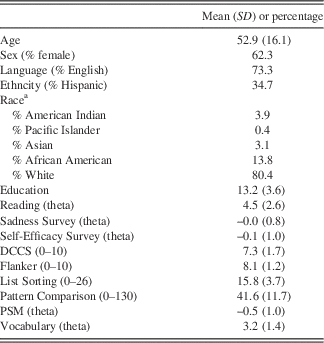
Study procedures took place at one of several research sites located across the United States and occurred under the supervision of a trained administrator. Only individuals aged 30–85 years were included in the current study to increase confidence that participants had most likely achieved their maximal educational attainment. Characteristics of this adult sample are shown in Table 1.
Sample characteristics

a Racial categories are not mutually exclusive.
DCCS=Dimensional Change Card Sort; PSM=Picture Sequence Memory.
Primary Measures
Self-efficacy and cognition were measured with the NIH Toolbox for the Assessment of Neurological and Behavioral Function (www.nihtoolbox.org). The NIH Toolbox comprises standardized, web-based measures recently developed through a contract initiated by the NIH Blueprint for Neuroscience Research (Gershon et al., Reference Gershon, Wagster, Hendrie, Fox, Cook and Nowinski2013). It contains four modules: Motor, Sensation, Cognition, and Emotion. In the current study, self-efficacy was assessed with the NIH Toolbox Emotion module. Cognition was assessed with the NIH Toolbox Cognition module.
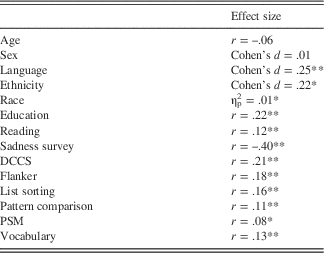
The NIH Toolbox Emotion module assesses a variety of psychosocial variables with self-report Likert-type items presented using computerized adaptive testing based on item response theory (Salsman et al., Reference Salsman, Butt, Pilkonis, Cyranowski, Zill and Cella2013). The Self-Efficacy Survey assesses a person’s belief in his/her capacity to manage his/her life and have control over meaningful events. Participants are queried about global self-efficacy using items modified from several existing self-efficacy scales and are presented at a 4th–6th grade reading level. The Self-Efficacy Survey shows excellent internal consistency for adults (Cronbach’s α=0.91). Scores on the Self-Efficacy Survey are Rasch/IRT theta scores that reflect where an individual falls on the entire self-efficacy continuum and are similar to Z-scores. Bivariate associations between self-efficacy and other variables are displayed in Table 2.
Bivariate associations between self-efficacy and other variables

*p<.05
**p<.001
The NIH Toolbox Cognition module includes tests of executive function, working memory, processing speed, episodic memory, vocabulary and reading (Weintraub et al., Reference Weintraub, Dikmen, Heaton, Tulsky, Zelazo and Gershon2013). In the current study, the first six tasks were cognitive outcomes, and the reading task was a covariate. Executive tasks include Flanker Inhibitory Control & Attention, a test of inhibition, and Dimensional Change Card Sort, a test of set-switching ability. The inhibition tasks requires participants to indicate the direction of a central arrow flanked by distractor arrows. The set-switching task requires participants to match a central picture to one of two response choices based on either color or shape. The working memory task (List Sorting) presents pictures of animals and/or food and requires participants to immediately recall the pictures in size order. The processing speed task (Pattern Comparison) requires participants to indicate whether as many pairs of pictures are the same or different in 90 s. The episodic memory task (Picture Sequence Memory) presents a series of related scenes and requires participants to recreate the sequence. Vocabulary is a computerized adaptive test of vocabulary knowledge. Picture Sequence Memory and Vocabulary scores are Rasch/IRT theta scores.
Test–retest reliability of each cognitive measure is good, with intraclass correlation coefficients ranging from 0.71 (Pattern Comparison) to 0.94 (Flanker Inhibitory Control & Attention) (Weintraub et al., Reference Weintraub, Dikmen, Heaton, Tulsky, Zelazo and Gershon2013). Convergent validity for each task was demonstrated through significant, moderately sized correlations with gold-standard measures, ranging from 0.48 (Flanker Inhibitory Control & Attention) to 0.69 (Picture Sequence Memory) (Weintraub et al., Reference Weintraub, Dikmen, Heaton, Tulsky, Zelazo and Gershon2013).
Covariates
Models controlled for age, sex, race, ethnicity, education, reading ability, testing language, and depressive symptoms. Race and ethnicity were measured via self-report using the format of the 2010 U.S. Census. Models included non-mutually exclusive dichotomous variables reflecting Hispanic ethnicity, American Indian race, Asian race, and African American race. Note that Pacific Islander race was not included as a covariate because of low frequency. Education was measured via self-report in years, from 0 to 20. Reading ability was measured with the NIH Toolbox Oral Reading Recognition Test, which shows good test–retest reliability (intraclass correlation coefficient=0.90) and convergent validity (r=0.86) with the Wide Range Achievement Test 4 – reading subtest (Weintraub et al., Reference Weintraub, Dikmen, Heaton, Tulsky, Zelazo and Gershon2013). Testing language was recorded as English or Spanish. Note that the NIH Toolbox was only available in those two languages at the time of the norming study. Depressive symptoms were measured with the NIH Toolbox Sadness Survey, which assesses depressive symptoms over the past seven days. The Sadness Survey shows excellent internal consistency for adults (Cronbach’s α=0.97) and high convergent validity (r=0.88) with the Center for Epidemiologic Studies Depression Scale (Salsman et al., Reference Salsman, Butt, Pilkonis, Cyranowski, Zill and Cella2013). Scores on Oral Reading Recognition and the Sadness Survey are Rasch/IRT theta scores.
Statistical Analysis
Analyses were carried out using SPSS version 19 (IBM Corp., Armonk, NY). To minimize Type I error, the hypothesis that self-efficacy would be more strongly related to cognitive performance among individuals with low education was initially evaluated using a multivariate analysis of covariance (MANCOVAs). In the MANCOVA, dependent variables were scores on the six cognitive outcomes, and covariates were age, sex, race, ethnicity, education, reading level, testing language, and depressive symptoms, as described above. Independent variables were (continuous) years of education, (continuous) score on the Self-Efficacy Survey, and their interaction.
If the multivariate test of the interaction between education and self-efficacy using Pillai’s trace was significant at p<.05, then follow-up analyses were conducted. Separate linear regressions were run in which the dependent variable was one of the six cognitive outcomes and the independent variables were self-efficacy, education, their interaction, and relevant covariates. To determine whether the presence of mild cognitive impairment (MCI) may have affected results, additional sensitivity analyses were conducted. Specifically, 55 individuals who scored more than 1.5 standard deviations below the sample mean on Picture Sequence Memory, the episodic memory test, were excluded in subsequent analyses.
Results
Omnibus Test for the Education by Self-Efficacy Interaction
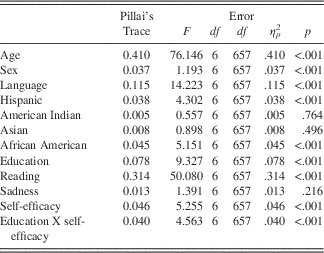
Results from the omnibus test of the self-efficacy by education interaction, independent of other predictors of cognitive performance, are shown in Table 3. Significant multivariate main effects were identified for age, sex, Hispanic ethnicity, African American race, reading level, testing language, education, and self-efficacy. There was also a significant interaction between years of education and self-efficacy. This analysis met the assumption of homogeneity of regression slopes. The interaction between education and self-efficacy remained significant after excluding 55 individuals suspected of having MCI, as defined above (Pillai’s Trace=0.039; η p 2 =.039; p<.001).
Multivariate results

Self-Efficacy by Education Results for Different Cognitive Domains
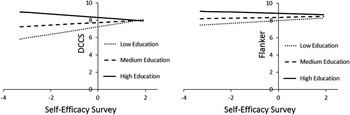
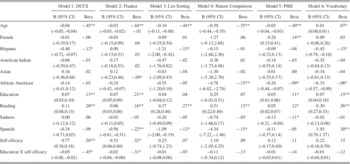
Standardized regression coefficients from separate regressions involving each of the six cognitive tests are shown in Table 4. As shown, Higher education was independently associated with better performance on all cognitive measures. Higher self-reported self-efficacy was independently associated with better set-switching and attention/inhibition. Significant interactions between education and self-efficacy were found for set-switching and attention/inhibition. These interactions are depicted in Figure 1. Independent of the covariates, higher self-efficacy was associated with better set-switching among individuals with relatively low education (beta=.142; p=.006), but not among individuals with relatively high education (beta=.028; p=.55). Higher self-efficacy was not significantly associated with attention/inhibition among subgroups of individuals with low or high education, but visual inspection of Panel B of Figure 1 reveals slightly increasing attention/inhibition with increasing self-efficacy among low-educated individuals, but not high-educated individuals.
Interactions between education and self-efficacy. Graphs show model-predicted associations between self-efficacy and performance on (a) Dimensional Change Card Sort and (b) Flanker Inhibitory Control and Attention when all covariates are set to zero. Due to centering, covariate values of 0 correspond to age 53, White race, English testing language, the sample’s mean levels of reading ability (i.e., Reading theta=3.92) and depressive symptoms (i.e., Sadness Survey theta=0), and 0 years of education. Theta values are Rasch/IRT theta scores similar to z-scores. To facilitate graphical depiction of the interactions, low, medium and high education levels were defined as educational attainment ±1.5 standard deviations from the sample mean (i.e., 8, 13 and 19 years, respectively). The Y axis corresponds to the entire range of possible scores on the cognitive measure. The X axis corresponds to the range of theta scores on the Self-Efficacy Survey observed in this sample.

Results from follow-up regressions

*p<.05
**p<.001
DCCS=Dimensional Change Card Sort; PSM=Picture Sequence Memory.
Because diagnostics revealed a potential problem with multicollinearity between self-efficacy and the education by self-efficacy interaction term for both DCCS (tolerance=.05) and Flanker (tolerance=.05) models, we also computed an orthogonal interaction term. Specifically, the education by self-efficacy interaction term was regressed onto education and self-efficacy. The resultant unstandardized residual represents the component of the interaction term that is uncorrelated with both education and self-efficacy. The regressions described above were re-run, replacing the original interaction term with the orthogonalized term. Results were unchanged. Specifically, there was a significant education by self-efficacy interaction in both DCCS (beta=−0.129; p<.001) and Flanker (beta=−0.076; p=.013) models, independent of all covariates. Education by self-efficacy interactions also remained significant for both DCCS (beta=−.736; p<.001) and Flanker (beta=−.316; p=.026) following exclusion of the 55 individuals with possible MCI.
With regard to covariates, older age was associated with worse performance on measures of set-switching (Dimensional Change Card Sort), attention/inhibition (Flanker), working memory (List Sorting), processing speed (Pattern Comparison) and episodic memory (Picture Sequence Memory), but better performance on a measure of vocabulary. Female sex was associated with better episodic memory. Hispanic ethnicity was associated with worse set-switching, working memory, and vocabulary. African American race was associated with worse attention/inhibition, working memory, processing speed, episodic memory, and vocabulary. Higher reading level was independently associated with better performance on all measures. Spanish language testing was associated with worse set-shifting, attention/inhibition, working memory and processing speed, and better vocabulary. More self-reported depressive symptoms were associated with worse episodic memory.
Discussion
The main contribution of the current study is that the association between self-efficacy and executive functioning (i.e., set-switching and attention/inhibition) was moderated by education such that self-efficacy was more strongly related to performance among individuals with lower educational attainment. Results were independent of age, sex, reading level, testing language, depressive symptoms, and race\ethnicity. The finding of stronger relationships between self-efficacy and executive functioning among individuals with relatively lower educational attainment is consistent with the hypothesis that self-efficacy beliefs buffer against the negative effects of low educational attainment on executive functioning. Specifically, individuals with low education but high self-efficacy beliefs performed similarly to individuals with high education. With regard to task-switching and attention/inhibition performance, scoring one standard deviation higher on the NIH Toolbox Self-Efficacy Survey was equivalent to 1.5 and 1.25 additional years of education, respectively.
In contrast, the finding that self-efficacy was not associated with executive functioning among individuals with relatively high educational attainment may suggest that situational and environmental benefits afforded by higher education may overpower any influence of individual difference factors such as self-efficacy. In other words, educationally advantaged adults may possess alternative paths to successful executive functioning that diminish the relative role of self-efficacy. These results are consistent with studies showing that control beliefs are more strongly related to mortality (Turiano et al., Reference Turiano, Chapman, Agrigoroaei, Infurna and Lachman2014) and global cognition (Wight et al., Reference Wight, Aneshensel, Seeman and Seeman2003) among individuals with low educational attainment. Similarly, control beliefs have been shown to be show stronger associations with health among low-income groups (Lachman & Weaver, Reference Lachman and Weaver1998).
Individuals with lower educational attainment report lower self-efficacy beliefs in this study, which is consistent with prior literature (Lachman & Firth, Reference Lachman and Firth2004). Educational experiences have the potential to influence any and all of the proposed sources of efficacy information: vicarious experience (i.e., seeing similar others succeed), verbal persuasion (i.e., receiving messages about one’s abilities from others), emotional arousal (i.e., inferences individuals make about their abilities based on emotional states), and opportunities for personal mastery experiences (Bandura, Reference Bandura1977). Significant interactions identified in the current study additionally show that independent of this relationship between self-efficacy and education, the association between self-efficacy beliefs and executive functioning is stronger among individuals with lower education. Although the current study was cross-sectional, results are compatible with the view that enhancing self-efficacy beliefs leads to better executive performance in the setting of low education. Indeed, positive youth development programs that incorporate strategies for enhancing self-efficacy show a positive impact on academic outcomes (Catalano, Berglund, Ryan, Lonczak, & Hawkins, Reference Catalano, Berglund, Ryan, Lonczak and Hawkins2004; Alfassi, Reference Alfassi2003). However, because these programs often target multiple aspects of youth development (e.g., physical, emotional, cognitive), it is not clear whether self-efficacy is an “active ingredient.” Of interest, a review of positive youth development programs noted that self-efficacy was an explicit target of all 25 well-evaluated programs (Catalano et al., Reference Catalano, Berglund, Ryan, Lonczak and Hawkins2004).
Results from this study also indicated that education variables and self-efficacy beliefs are each independently associated with worse performance on certain cognitive tests. Specifically, both years of education and reading level, a proxy for educational quality, were independently positively associated with performance on all six cognitive tests. Indeed, previous studies have shown that years of education and reading level are independent sources of variance in cognitive test performance (Manly et al., Reference Manly, Smith, Crystal, Richardson, Golub, Greenblatt and Young2011; Manly, Byrd, Touradji, & Stern, Reference Manly, Byrd, Touradji and Stern2004). Accounting for reading level attenuates or eliminates racial differences in cognitive test performance, as reading level better captures the educational experiences of diverse elders who attended school for the same number of years (Manly, Jacobs, Touradji, Small, & Stern, Reference Manly, Jacobs, Touradji, Small and Stern2002).
Independent of these and other covariates such as depressive symptoms, self-efficacy was positively associated with better performance on two executive tests (i.e., set-switching and attention/inhibition). Potential mechanisms underlying the association between self-efficacy and executive functioning may include enhanced motivation (Bandura, Reference Bandura1989), better cardiovascular health due to a reduction in the number of stress experiences related to lack of control (Marmot, Bosma, Hemingway, Brunner, & Standsfeld, Reference Marmot, Bosma, Hemingway, Brunner and Standsfeld1997), and reduced physiologic reactivity to stressors (Frankenhaeuser, Reference Frankenhaeuser1983; Lupien, Reference Lupien1994). Educationally advantaged adults may have access to these mechanisms via means other than self-efficacy.
Both the main effects of self-efficacy and interactions between self-education and education were limited to these tasks of executive functioning. This relationship between self-efficacy and executive functioning is unsurprising given overlap in the definitions of the two constructs. For example, Bandura (Reference Bandura1977) described self-efficacy as the belief that a person has in his/her ability to increase motivation, to mobilize cognitive resources and to perform the actions necessary to exercise control over the task. In the present study, executive functioning was assessed by two tasks of cognitive control that required participants to switch between two matching rules or inhibit distracting information. The association between self-efficacy and the two executive tasks is also consistent with prior research demonstrating links between self-efficacy and multiple executive abilities, including planning, monitoring, evaluation, concentration, strategy use, complex decision-making, analytic skills, and metacognition (Bandura & Wood, Reference Bandura and Wood1989; Bouffard-Bouchard, Parent, & Larivee, Reference Bouffard-Bouchard, Parent and Larivee1991; Cera, Mancini, & Antonietti, Reference Cera, Mancini and Antonietti2013; Kanfer & Ackerman, Reference Kanfer and Ackerman1989). Furthermore, path analyses indicate that reported associations between self-efficacy and cognitive abilities in other domains (e.g., episodic memory) are mediated by executive abilities (Bandura, Reference Bandura1993). That is, higher self-efficacy beliefs are associated with enhanced goal-setting, self-regulation, and use of analytic strategies, which in turn is associated with better performance in other cognitive domains.
The main limitation of this study is its cross-sectional design. An alternative interpretation of the results is that self-efficacy ratings track more closely with actual executive performance among individuals with relatively lower education compared to individuals with relatively higher education. However, previous longitudinal and experimental studies provide evidence that self-efficacy influences adult cognition rather than vice versa. For example, Seeman and colleagues (Reference Seeman, McAvay, Merrill, Albert and Rodin1996) reported that self-efficacy beliefs predicted cognition three years later, but not vice versa, in the MacArthur Studies of Successful Aging. In addition, enhancing self-efficacy through the implicit activation of positive stereotypes of aging led to better cognitive performance in an experimental setting (Levy, Reference Levy1996). Another limitation of this study was that indicators of socioeconomic status (SES) beyond education and educational quality (i.e., reading) were not included. However, we believe that education variables may be key SES indicators in the study of cognitive performance because they contains information not only about social class, but also about cognitive development. Finally, other potential contributors to cognitive performance (e.g., acculturation) were not available for analysis. Strengths of this study include its adult lifespan sample, the high-quality indicator of self-efficacy derived using item response theory, and the examination of multiple cognitive domains. It should be noted that domain-specific measures of self-efficacy may be more strongly associated with functioning than domain-general measures such as the NIH Toolbox Self Efficacy Survey used in the present study (Bandura, Reference Bandura1989). Thus, the identified associations between self-efficacy and cognition in this study may represent underestimates, as querying individuals’ perceived self-efficacy for cognitive tasks may have yielded stronger associations.
In conclusion, this study provides evidence that self-efficacy beliefs buffer against the negative effects of low educational attainment on executive functioning such that individuals with low education but high self-efficacy beliefs perform similarly to individuals with high education. These results have implications for future policy and/or intervention work aimed at reducing the deleterious effects of educational disadvantage on later cognitive health.
Acknowledgments
This work was supported by Federal funds from the Blueprint for Neuroscience Research, National Institutes of Health, under Contract No. HHS-N-260-2006-00007-C and by the National Institute on Aging (K99 AG047963). The authors report no conflicts of interest.