Introduction
Historical themes of infection prevention and control (IPC) in Emergency Medical Services (EMS) have centered on hand hygiene, sharps safety, personal protective equipment (PPE), and the disinfection of equipment. Emergency Medical Service clinicians often have contact with multiple patients per day in home, ambulance, and hospital environments. The transition of patients throughout these environments and the challenges of hand washing and personal protection in the field lead to pathogen spread among EMS clinicians. Reference Bucher, Donovan and Ohman-Strickland1
Many infectious agents can be transmitted via contact with the skin or mucous membranes. Other infectious agents, such as the human immunodeficiency virus (HIV) and hepatitis C, can spread to EMS clinicians via bloodborne exposure. Emergency Medical Service clinicians have an increased risk of injury from needle sticks or other sharp instruments because of the difficulty of performing procedures in a mobile environment. Reference Richey, Fowler and Swienton2 These clinicians are also at risk for airborne exposure to infectious diseases, such as tuberculosis, influenza, and the severe acute respiratory syndrome coronavirus 2 (SARS-CoV-2).
The coronavirus disease 2019 (COVID-19) pandemic has highlighted the importance of IPC practices. However, adherence to IPC guidance involves structural determinants such as budget constraints and individual knowledge, attitudes, skills, and behaviors. The purpose of this review is to summarize the evidence on the effectiveness of interventions for preventing, recognizing, and controlling occupationally acquired infectious diseases with respect to EMS clinician populations with consideration of context and implementation factors.
Methods and Report
Scope of the Review
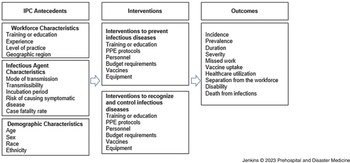
This review was conducted as part of a project commissioned by the Agency for Healthcare Research and Quality (AHRQ; Rockville, Maryland USA) calling for a detailed Technical Brief (Figure 1) on the evidence from studies in the United States on Infection Prevention and Control for the Emergency Medical Services and 9-1-1 Workforce. Reference Jenkins, Hsu and Russell3 The protocol for the Technical Brief is available on AHRQ’s web site. 4 This evidence review followed methods consistent with those outlined in the Evidence-Based Practice Center Methods Guidance. 5 This article highlights the characteristics and effectiveness of workplace practices and interventions to prevent, recognize, and control infectious diseases.
Conceptual Framework for Infection Prevention and Control in EMS Clinicians.
Abbreviations: EMS, Emergency Medical Services; IPC, infection prevention and control; PPE, personal protective equipment.

Study Selection
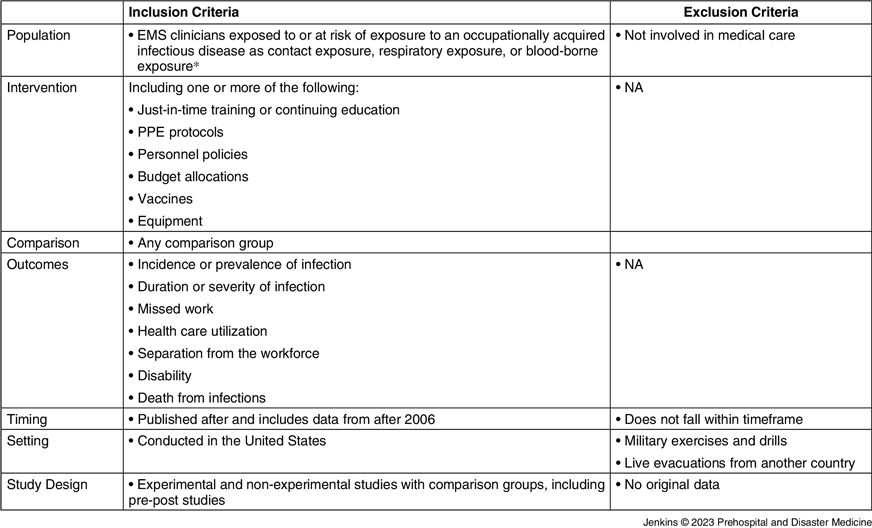
Studies in this review targeted EMS clinician populations in the United States and IPC interventions with control groups. This review included but was not limited to the following outcomes: incidence, prevalence, duration, and severity of disease, missed work, vaccine uptake, health care utilization, separation from the workforce, disability, and death from infections. Interventions included but were not limited to training and education, PPE protocols, personnel or staffing changes, budget changes, vaccine clinics or offerings, and equipment availability.
A systematic search for published evidence was conducted using: PubMed (National Center for Biotechnology Information, National Institutes of Health; Bethesda, Maryland USA); Embase (Elsevier; Amsterdam, Netherlands); CINAHL (EBSCO Information Services; Ipswich, Massachusetts USA); and SCOPUS (Elsevier; Amsterdam, Netherlands) from January 1, 2006 through March 15, 2022. The search was limited to studies published since 2006 because it corresponds to passage of the landmark Pandemic and All-Hazards Preparedness Act in 2006, 6 which focused on improving the nation’s public health and medical preparedness and response capabilities for emergencies. Complete search strategies are provided in Supplemental Tables 1-4 (Appendix; available online only). Two members from the team independently assessed each citation to determine whether it met inclusion or exclusion criteria (Table 1).
Inclusion and Exclusion Criteria

Abbreviations: EMS, Emergency Medical Services; PPE, personal protective equipment.
* Microbes of interest included but are not limited to methicillin-resistant Staphylococcus aureus, severe acute respiratory syndrome coronavirus 2, influenza, tuberculosis, human immunodeficiency virus, and hepatitis B and C.
Data Extraction and Synthesis
For each eligible study, a team member used an Excel spreadsheet (Microsoft Corp.; Redmond, Washington USA) to extract information about the characteristics, effectiveness, and context of interventions, following the framework in Figure 1. To assess effectiveness, data were abstracted on the outcomes of each study, whether there was a statistically significant effect, and the direction and magnitude of the effect with the corresponding 95% confidence intervals (CIs). Sample sizes were also captured. A second team member reviewed extracted information for accuracy.
Paired reviewers independently assessed the quality of each study by focusing primarily on classification of the study design according to the accepted hierarchy of study designs. The quality of studies was assessed using three questions from the Effective Public Health Practice Project tool Reference Thomas, Ciliska and Dobbins7 : (1) Are the individuals selected to participate in the study likely to be representative of the targeted population? (2) What percentage of selected individuals agreed to participate? and (3) Were there important differences between groups prior to the intervention?
The authors described the characteristics of the included studies and generated evidence maps describing the results using Stata (Intercooled, version 14.2; StataCorp; College Station, Texas USA).
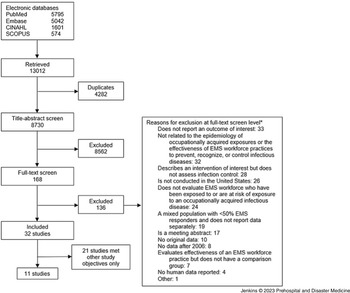
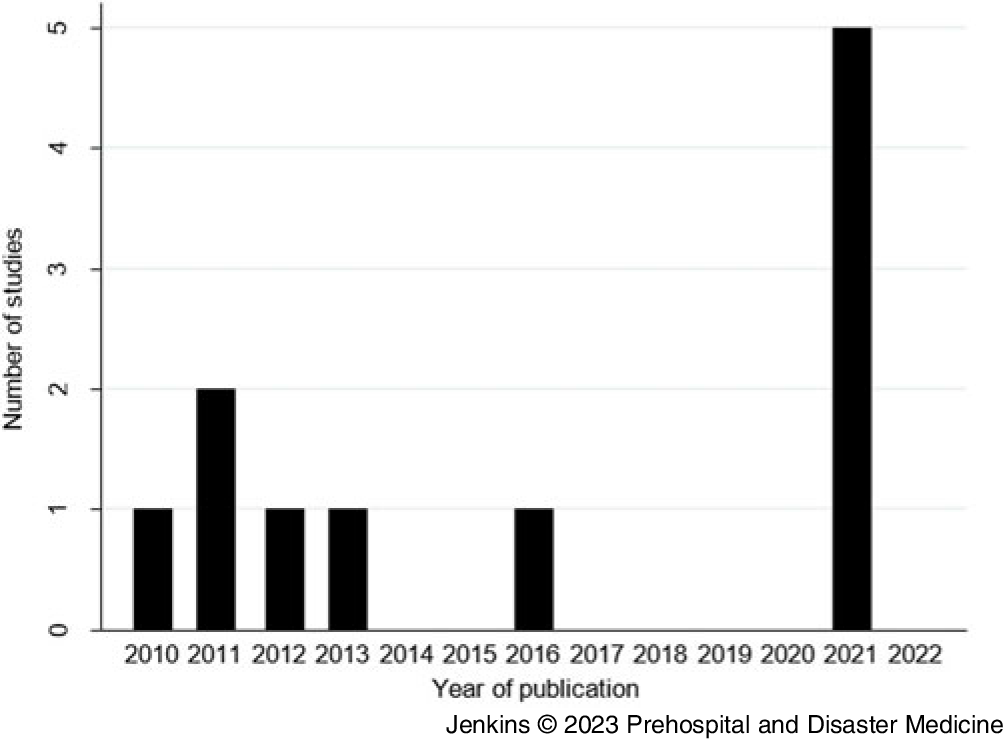
The search yielded 8,730 unique citations (Figure 2). After screening abstracts and full text of articles, 11 studies were included (N = 20,438 participants). Reference Brown, Schwarcz and Counts8–Reference Rebmann, Wright and Anthony18 Five studies were published in 2020 or later (Figure 3). Many of the studies published in 2020 or later assessed the prevalence of COVID-19.
Results of Literature Search.
Abbreviation: EMS, Emergency Medical Services.
*Articles could be excluded for more than one reason.

Number of Studies Included by Year of Publication.

Study Quality
Eleven (11) studies were identified as addressing the effectiveness of IPC interventions in EMS clinicians. Reference Brown, Schwarcz and Counts8–Reference Rebmann, Wright and Anthony18 All studies were observational studies with a concurrent comparison group; nine studies were prospective cohorts Reference Grant, Harrison and Nuñez10–Reference Rebmann, Wright and Anthony18 and two were retrospective cohorts. Reference Brown, Schwarcz and Counts8,Reference Glaser, Chui and Webber9 Six were in urban settings,Reference Glaser, Chui and Webber9,Reference Grant, Harrison and Nuñez10,Reference Halbrook, Gadoth and Martin-Blais12,Reference Miramonti, Rinkle and Iden15,Reference Newberry, Gautreau and Staats16,Reference Rebmann, Wright and Anthony18 and five were in multiple settings. Reference Brown, Schwarcz and Counts8,Reference Gregory, Powell and MacEwan11,Reference Harris and Nicolai13,Reference Hubble, Zontek and Richards14,Reference Orellana, Hoet and Bell17 The studies took place in eight different states. Although few listed a jurisdictional funding description, a post-publication analysis of the jurisdictions suggests that studies were funded by a mixture of fire and third service (ie, stand-alone ambulance) departments. Seven studies included both EMS workers and firefighters involved in medical care Reference Brown, Schwarcz and Counts8–Reference Grant, Harrison and Nuñez10,Reference Halbrook, Gadoth and Martin-Blais12,Reference Harris and Nicolai13,Reference Newberry, Gautreau and Staats16,Reference Rebmann, Wright and Anthony18 and four studies only focused on EMS workers. Reference Gregory, Powell and MacEwan11,Reference Hubble, Zontek and Richards14,Reference Miramonti, Rinkle and Iden15,Reference Orellana, Hoet and Bell17 The total study sample size ranged from 186 to 10,612 EMS and 9-1-1 workers.
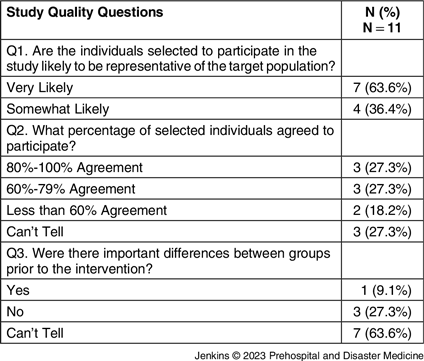
None of the studies used an experimental study design. According to the inclusion criteria for this review, all 11 of the included studies had a concurrent comparison group. Although all studies were somewhat or very likely to include workers representative of the target population, only 27% of the studies reported a participation rate of 80% or higher among those invited to participate (Table 2). Regarding potential selection bias, only three studies presented data indicating no important differences between those who participated and those who did not, while one study reported important differences between groups (Table 2). The other seven studies did not present enough information to assess selection bias.
Quality of Studies that Reported on the Characteristics and Effectiveness of EMS Practices to Prevent, Recognize, and Control Infectious Diseases

Abbreviation: EMS, Emergency Medical Services.
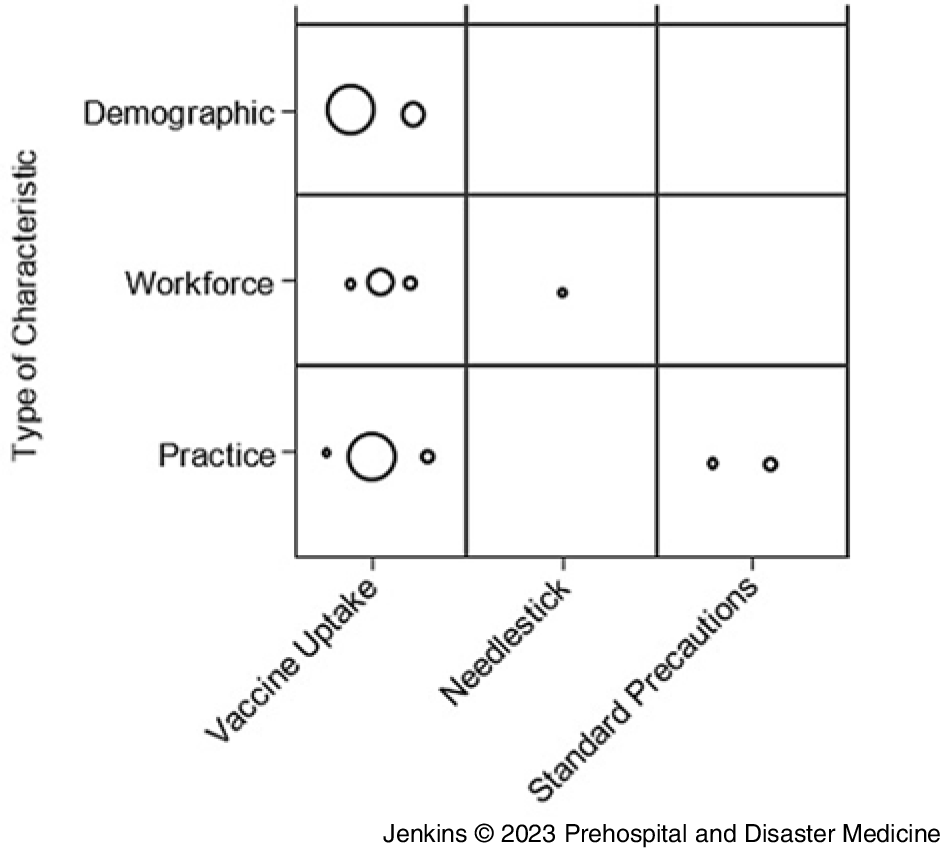
Figure 4 presents an evidence map of the main characteristics of the IPC practices that have been studied in EMS clinicians, and whether they reported on how practices vary by demographic, workforce, and practice characteristics. Each circle represents the number of studies, with vaccine uptake for influenza being the most frequently reported type of IPC practice. Only one study focused on prevention of needlestick injuries. Two studies focused on standard precautions for IPC.
Evidence Map of the Studies that Report on Infection Prevention and Control Practices and How they Vary by Demographic, Workforce, and Practice Characteristics.
Note: Each study is represented by a circle. The size of the circle is proportional to the sample size.

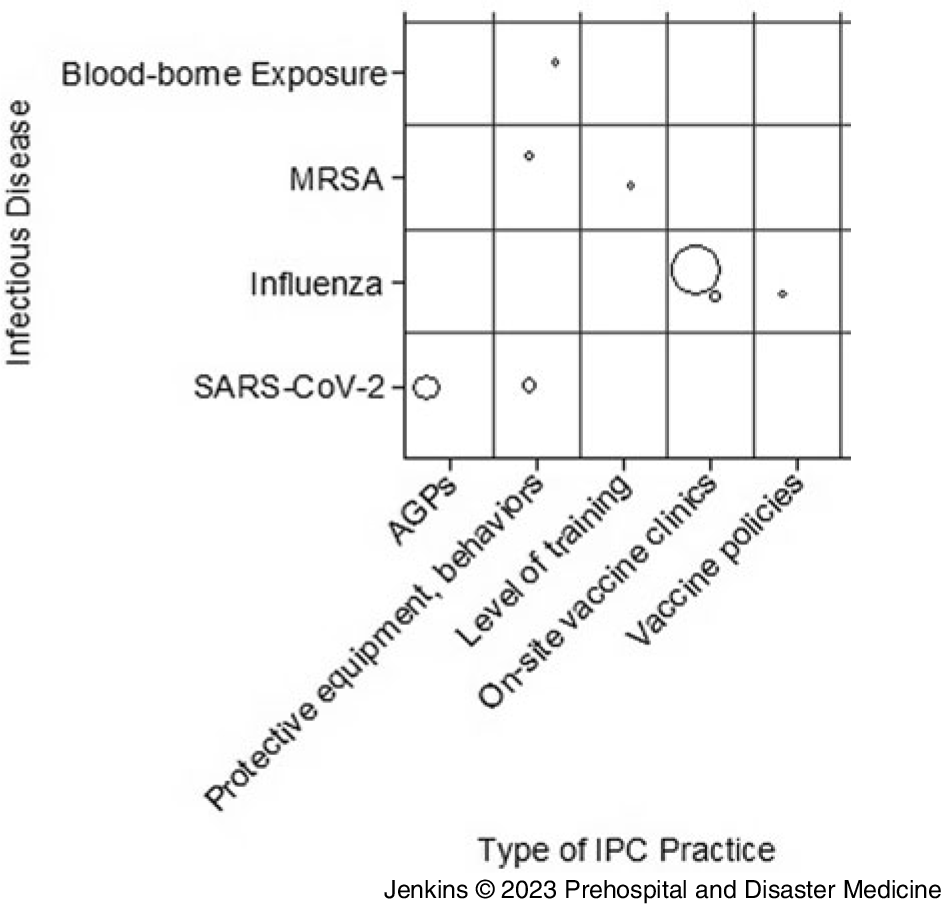
Eight studies reported on the effectiveness of interventions preventing infectious diseases among the EMS and 9-1-1 workforce. Reference Brown, Schwarcz and Counts8,Reference Glaser, Chui and Webber9,Reference Harris and Nicolai13–Reference Rebmann, Wright and Anthony18 The studies were heterogeneous, involving five distinct types of IPC practices and focusing on four different infectious diseases. The studies were so different from each other that it would not be appropriate to perform any meta-analysis. Figure 5 demonstrates an evidence map of studies reporting on the effectiveness of IPC practices in EMS clinicians. The most common infectious disease studied was influenza. On-site vaccine clinics were the most commonly studied workforce practice.
Evidence Map of Studies Reporting on the Effectiveness of IPC Practices in Emergency Medical Service Clinicians.
Note: Each study is represented by a circle. The size of the circle is proportional to the sample size.
Abbreviations: IPC, infection practice and control; AGP, aerosol-generating procedures; MRSA, methicillin-resistant Staphylococcus aureus; SARS-CoV-2, severe acute respiratory syndrome coronavirus 2.

Standard Precautions and PPE
Harris found significant differences in protective practices among Advanced Life Support (ALS) and Basic Life Support (BLS) certified/licensed EMS workers. Reference Harris and Nicolai13 Specifically, ALS-certified/licensed EMS workers were more likely than BLS-certified/licensed EMS workers to wear gloves for all calls (unadjusted odds ratio [OR] 1.75; 95% confidence interval [CI], 0.81 to 3.79), use face masks (unadjusted OR 4.86; 95% CI, 1.44 to 16.4), and use protective devices during resuscitation (unadjusted OR 17.3; 95% CI, 1.04 to 28.8). Increased use of standard precautions 19 such as face masks, gloves, and protective devices for resuscitation were associated with a decreased likelihood of a needlestick.
Grant described higher selected self-reported PPE use among firefighters/paramedics, such as for gloves, N-95 respirators, and eye protection, on medical versus non-medical runs. Reference Grant, Harrison and Nuñez10 The study further detailed self-reported PPE use among firefighters/paramedics before versus after a Department of Public Health shelter-in-place order. Reference Grant, Harrison and Nuñez10 On non-medical runs, use of individual PPE measures increased significantly after the shelter-in-place order (P <.0001 for surgical masks, N-95 respirators, eye protection, and gowns; P <.05 for gloves), while self-reported use of “no PPE” decreased significantly (P <.0001). On medical runs, use of individual PPE increased significantly after the shelter-in-place order (P <.0001 for surgical masks, N-95 respirators, eye protection, and gowns), while self-reported use of “no PPE” did not differ before versus after the shelter-in-place order.
Three studies reported on effectiveness of protective equipment and behaviors in preventing and controlling infectious disease. Reference Harris and Nicolai13,Reference Newberry, Gautreau and Staats16,Reference Orellana, Hoet and Bell17 Newberry found that lack of PPE or PPE breach were correlated with higher SARS-CoV-2 seropositivity (unadjusted risk ratio [RR] 4.2; 95% CI, 1.03 to 17.22). Reference Newberry, Gautreau and Staats16 Orellana found that less frequent daily handwashing (survey-weight adjusted OR 4.20; 95% CI, 1.02 to 17.27) and less frequent hand hygiene after glove use (survey-weight adjusted OR 10.51; 95% CI, 2.54 to 43.45) were positively correlated with nasal colonization of Methicillin-resistant Staphylococcus aureus (MRSA). Reference Orellana, Hoet and Bell17 Harris found that disposing of other contaminated materials was significantly associated with decreased needle stick injuries (unadjusted OR 0.2; 95% CI, 0.06 to 0.64). Reference Harris and Nicolai13
In 2021, Brown reported on the association between aerosol-generating procedures (AGPs) with full PPE (defined as a mask, eye protection, gloves, and a gown) and SARS-CoV-2 diagnoses (unadjusted incidence rate ratio [IRR] 1.64; 95% CI, 0.22 to 12.26). 5 However, these data are based on only one EMS clinician developing COVID-19 infection in the cohort studied out of 182 total AGPs performed and 8,582 person-days at risk while in PPE and performing an AGP.
Vaccinations and Policies
The Glaser study Reference Glaser, Chui and Webber9 found that vaccination was less likely in those younger than 30 years old (adjusted OR 0.70; 95% CI, 0.62 to 0.78), African Americans (adjusted OR 0.46; 95% CI, 0.40 to 0.50), and Hispanics (adjusted OR 0.87; 95% CI, 0.77 to 0.99) after adjusting for age, gender, race, class (EMS versus firefighter), and smoking status. Gregory, in 2021, reported on odds of COVID-19 vaccinations by associations with age (referent <38 years; 39 to 50 years: 1.56, 95% CI, 1.17 to 2.08; >51 years: 2.22, 95% CI, 1.64 to 3.01) and male sex (1.26, 95% CI, 1.01 to 1.58). Reference Gregory, Powell and MacEwan11
Hubble, in 2011, found that EMS professionals in rural areas (35.5%) received the influenza vaccine at lower rates than urban (50.0%) or suburban (54.3%) EMS professionals (unadjusted P = .01). Reference Hubble, Zontek and Richards14 Gregory, in 2021, found that increased COVID-19 vaccination uptake was associated with residing in an urban/suburban area (referent rural; 1.36, 95% CI, 1.08 to 1.70) and advanced education (referent General Educational Development or high school and below; bachelor’s and above: 1.72, 95% CI, 1.19 to 2.47). Reference Gregory, Powell and MacEwan11 In this study, despite availability of vaccine, 69.8% of EMS professionals reported having received a COVID-19 vaccine while 30.2% indicated that they had not. Reference Gregory, Powell and MacEwan11
In 2021, Halbrook found that COVID-19 vaccine uptake was higher among in-hospital health care workers (96.0%) compared to EMS workers (87.5%) and that EMS workers were significantly more likely to delay receiving a vaccine (adjusted OR 2.94; 95% CI, 1.71 to 5.04 after adjusting for age, sex, race, education, and patient contact). Reference Halbrook, Gadoth and Martin-Blais12 Gregory found increased odds of COVID-19 vaccination were associated with hospital-based systems (referent fire-based agency; 1.53, 95% CI, 1.04 to 2.24). Reference Gregory, Powell and MacEwan11
Rebmann, in 2012, found that mandatory vaccine policies for H1N1 and other strains of influenza increased the vaccine uptake rates; 100% of participants reporting mandatory vaccine policies also reported being vaccinated while those who did not have a mandatory vaccine policy reported a 66.8% vaccination rate for H1N1 influenza (unadjusted P <.01) and a 75.6% vaccination rate for seasonal influenza (unadjusted P <.001). Reference Rebmann, Wright and Anthony18 Emergency medical technicians whose employer had a mandatory vaccination policy were significantly more likely to receive the seasonal influenza vaccine (100.0% versus 75.6%) or the H1N1 influenza vaccine (100.0% versus 66.8%) compared with those without such a policy (unadjusted P <.001 and P <.01, respectively). Reference Rebmann, Wright and Anthony18
Two studies reported on the effectiveness of vaccine clinics at the work site. Reference Glaser, Chui and Webber9,Reference Hubble, Zontek and Richards14 Hubble found that workers were more likely to be vaccinated against influenza if they recalled their employer offering the flu vaccine (unadjusted OR 3.3; 95% CI, 1.3 to 8.3) and if they received training or education from their employer on the flu vaccine or influenza illness (unadjusted OR 1.5; 95% CI, 1.2 to 2.1). Reference Hubble, Zontek and Richards14 Workers were more likely to be accepting of a vaccine during an on-site vaccine clinic when surrounded by their peers who were also receiving the vaccine. In addition, the authors noted that supervisor and peer buy-in was a factor during the vaccine clinics. In a study by Glaser, the acceptance rate of the H1N1 influenza vaccination was 57.2% (5,746 out of 9,559) during a targeted, active, and dedicated vaccine program in a bio-preparedness drill as compared to 34.4% (362 out of 1,053) during medical visits. Reference Glaser, Chui and Webber9 During the bio-preparedness drill, the EMS workers and firefighters also received targeted education.
Discussion
While a wide range of interventions pertaining to IPC exist, only 11 observational studies were found pertaining to effectiveness of IPC practices in EMS clinicians. These were focused on hand hygiene, standard precautions, on-site vaccine clinics, and mandatory vaccination policies. Both daily hand hygiene and hand hygiene following use of gloves were negatively correlated with nasal colonization of MRSA. Reference Orellana, Hoet and Bell17 While hand hygiene is accepted as effective, real-world practice is challenging, often complicated by transitions between different care sites and lack of access to water or hand sanitizer. Increased use of standard precautions 19 was also associated with a decreased likelihood of a needlestick. Vaccine uptake and acceptance were enhanced not only by the presence of a vaccination program, but also by accompanying educational modules and buy-in from supervisors and trusted peers. Mandatory vaccination policies for seasonal influenza and H1N1 influenza were shown to be effective at increasing vaccine uptake amongst EMS workers. Reference Rebmann, Wright and Anthony18 Of note, no studies on mandatory vaccination policies for SARS-CoV-2 fit the inclusion criteria.
Since the onset of the COVID-19 pandemic, the attention to infectious diseases in EMS care has increased with most studies included in this review published during the last two years. Despite the growing number of studies pertaining to COVID-19, just one study fit the inclusion criteria and reported on the effectiveness of PPE in preventing COVID-19 among EMS clinicians. The authors found no studies of on-site vaccine clinics or mandates focused on prevention of COVID-19.
The utility of future research to policy makers will be enhanced by more uniform approaches to the assessment of outcomes, consistent attention to selection bias and confounding factors in comparative studies, extensive analysis of how the effectiveness of interventions differ according to the characteristics of the targeted workforce and their practice setting, and attention to the resources needed to implement IPC interventions in EMS settings. Emergency Medical Service researchers could consider the development of practical guidance on how to conduct such studies in the highly challenging mobile environments in which EMS clinicians work, ideally taking advantage of opportunities for analysis of natural experiments in the implementation of IPC practices.
Limitations
This scoping review includes only studies from the United States with interventions that included control groups for comparison. The body of evidence present in the international literature is not included here, although this highlights the need for further research in the United States population of EMS clinicians. At present, characterizing the effectiveness of IPC practices in the EMS workforce relies largely upon observational studies. The absence of experimental design and relative lack of studies with comparison groups illustrate the difficulties of conducting such studies in a dynamic field environment. In addition, the heterogeneity of existing studies makes it difficult to make comparisons. Additionally, most studies did not provide enough information to assess potential selection bias and confounding factors.
Conclusion
Ensuring adequate access to and supplies for hand hygiene and standard precautions has been effective in preventing exposure and infection among this workforce. Designated funding should be considered for protective measures and appropriate PPE, along with prioritization for use by EMS clinicians when shortages occur. On-site vaccine clinics, educational programs, and vaccine mandates have demonstrated effectiveness at increasing uptake for the influenza vaccine. More research is needed in the United States to address the effectiveness of diverse IPC interventions for the full range of occupationally acquired infections in the EMS workforce.
Conflicts of interest/disclaimer
This report is based on research conducted by the Johns Hopkins University Evidence-based Practice Center (EPC) under contract to the Agency for Healthcare Research and Quality (AHRQ), Rockville, Maryland (Contract No. 75Q80120D00003) with support from the National Highway Traffic Safety Administration (NHTSA). The findings and conclusions in this document are those of the authors, who are responsible for its contents; the findings and conclusions do not necessarily represent the views of AHRQ or NHTSA. Therefore, no statement in this report should be construed as an official position of AHRQ, the US Department of Health and Human Services, NHTSA, or the US Department of Transportation. All authors declare no conflicts of interest.
Supplementary Material
To view supplementary material of this article, please visit https://doi.org/10.1017/S1049023X23000389