




No CrossRef data available.
Article contents
- Abstract
- THE CHANGING SOCIAL CONTEXT OF CITIZEN DECISION MAKING
- CONCEPTUALIZING POLITICAL COMMUNICATIONS IN ELECTION CAMPAIGNS
- DATA SOURCES
- THE PARTISAN BIASES OF POLITICAL INTERMEDIARIES IN THE 1992 ELECTION
- THE BIASES OF INTERMEDIARIES AND THE PRESIDENTIAL VOTE
- SOCIAL CONTEXT AND VOTING CHOICE
- References
The Social Calculus of Voting: Interpersonal, Media, and Organizational Influences on Presidential Choices
Published online by Cambridge University Press: 03 March 2004
Article contents
- Abstract
- THE CHANGING SOCIAL CONTEXT OF CITIZEN DECISION MAKING
- CONCEPTUALIZING POLITICAL COMMUNICATIONS IN ELECTION CAMPAIGNS
- DATA SOURCES
- THE PARTISAN BIASES OF POLITICAL INTERMEDIARIES IN THE 1992 ELECTION
- THE BIASES OF INTERMEDIARIES AND THE PRESIDENTIAL VOTE
- SOCIAL CONTEXT AND VOTING CHOICE
- References
Abstract
Voting choices are a product of both personal attitudes and social contexts, of a personal and a social calculus. Research has illuminated the personal calculus of voting, but the social calculus has received little attention since the 1940s. This study expands our understanding of the social influences on individual choice by examining the relationship of partisan biases in media, organizational, and interpersonal intermediaries to the voting choices of Americans. Its results show that the traditional sources of social influence still dominate: Interpersonal discussion outweighs the media in affecting the vote. Media effects appear to be the product of newspaper editorial pages rather than television or newspaper reporting, which contain so little perceptible bias that they often are misperceived as hostile. Parties and secondary organizations also are influential, but only for less interested voters—who are more affected by social contexts in general. Overall, this study demonstrates that democratic citizens are embedded in social contexts that join with personal traits in shaping their voting decisions.
Information
- Type
- Research Article
- Information
- Copyright
- © 2002 by the American Political Science Association
How are political choices shaped by a decision maker's immediate social and informational context? This question has interested scholars of both elite and citizen decision making across many different political systems. The recognition that these contexts can vary to a considerable degree and that the cost of acquiring political information is high has created an appreciation for how much political choices are circumscribed by the social and informational contexts within which individuals reside.
These considerations apply to the occasional political decisions made by citizens just as much as they apply to the routine decisions of their leaders. At any given time, in any given place, citizens confront specific sources of political information: their own personal networks of social interaction and political communication, particular newspapers, a range of electronic media outlets, and a variety of organized efforts at political persuasion. Political choice takes on meaning within these contexts. Thus, theories of democracy and democratic citizenship increasingly focus on the sources and consequences of political information. These contexts are especially important because alternative sources of information typically vary in the extent to which they carry distinctive political biases. By relying on one information source rather than another, citizens are more or less likely to encounter information that encourages some choices and outcomes while it discourages others.
These spatial and temporal variations in information would be less important if citizens were able and willing to undertake comprehensive searches for political information, but the willingness to undertake a comprehensive search is limited by the high costs of political information (Downs 1957). Indeed, the acquisition of information is perhaps the primary cost of political participation, and hence citizens regularly pursue informational alternatives that limit these costs, typically by relying on readily available information sources. Even among individuals who are willing to pay higher costs for a more comprehensive information search, cognitive limits circumscribe individual capacities (Lodge, Steenbergen, and Brau 1995). These inherent limitations on information processing abilities suggest that individual capacity is vulnerable to being swamped by readily available information sources in the immediate context. None of this suggests that individual preferences and capacities are unimportant but, rather, that limits on individual capacities and resources make the immediate contexts of political choice particularly important.
Most studies of voting behavior in the United States and other democracies have paid little attention to context, viewing vote choices as the product of a “personal” rather than a “social” calculus. Through application of social–psychological (Campbell et al. 1960) and rational-choice (Fiorina 1981) perspectives, scholars have developed a rich understanding of the role that individuals' personal characteristics, attitudes, and interests play in their voting decisions. The modern study of voting behavior did not begin this way. A social context perspective guided the first survey studies of voting, conducted at Columbia University in the 1940s (Lazarsfeld, Berelson, and Gaudet 1944; Berelson, Lazarsfeld, and McPhee 1954). By the 1960s, however, this focus had given way to an almost-exclusive concentration on the voter as an autonomous actor independent of social context. Despite a revival of attention to social factors in recent decades, a comprehensive treatment of the social context for voting has not been attempted since the Columbia studies more than half a century ago.
The present study comprehensively addresses this social calculus of voting by drawing upon a unique collection of data on the 1992 American presidential election campaign.1
This study of the 1992 presidential election in the United States was part of the five-nation Cross-National Election Project (CNEP). The CNEP employed the same intermediation framework and study design to examine the social intermediation process in the first national election of the 1990s in Britain, East and West Germany, Japan, and Spain as well as the United States.
The social context for the survey respondents was constructed from both their own perceptions of their various intermediaries and direct information on the intermediaries themselves. We asked respondents about messages coming from personal discussants, newspapers, television network news, secondary organizations, and political parties. The study also gathered information directly from all of these intermediaries except for secondary organizations. An innovative clustering of the citizen sample enabled us to examine the local social context in detail, yet still maintain a nationally representative study. We measured the presidential campaign coverage of the principal newspaper in each sample county and the presidential campaign activities of the county party and presidential campaign organizations. We also interviewed personal discussants identified by the main survey respondents. (See Appendix A for a more detailed description of the data collections.)
This paper addresses two specific research questions about voting behavior within the social context defined by these data. First, what candidates did the intermediaries to which voters were exposed in the 1992 presidential election campaign favor? This is an inquiry into variations in the partisan bias of political information—that is, the favorability of the intermediaries toward one presidential candidate or another. Second, what was the relationship between the biases of their intermediaries and voters' choices in 1992? If the flow of information coming to voters is skewed in favor of one candidate over another, we hypothesize that this will influence their electoral decisions, even after their own partisan orientations and other enduring personal influences on the vote are taken into account. In short, ours is an inquiry into how a social calculus supplements the well-established personal calculus of voting.
THE CHANGING SOCIAL CONTEXT OF CITIZEN DECISION MAKING
Our research agenda builds upon voting studies by Paul Lazarsfeld and his colleagues at Columbia University conducted in 1940 in Erie County, Ohio (Lazarsfeld, Berelson, and Gaudet 1944), and in 1948 in Elmira, New York (Berelson, Lazarsfeld, and McPhee 1954). After this auspicious beginning, research on the role of social context was largely neglected until recent times. Important recent studies have illuminated the influence on citizen attitudes and behavior of interpersonal networks (e.g., Huckfeldt and Sprague 1995; Mutz and Mondak 1998; Huckfeldt, Sprague, and Levine 2000b) and the mass media (e.g., Iyengar and Kinder 1987; Just et al. 1996; Dalton, Beck, and Huckfeldt 1998a). Some studies (e.g., Patterson 1980; Mutz and Martin 2001) even have analyzed social intermediaries in combination. Our study goes beyond recent research through its comprehensiveness and its depth in the coverage of multiple key intermediaries. Its national scope demonstrates the role of social context in contemporary times, fulfilling the research agenda initiated by the early Columbia studies.
Both political intermediaries and citizens have changed markedly since the 1940s. Television is now the principal mass medium for modern campaigns, displacing radio and newspapers, which were the twin foci of the Columbia studies. The competitive local newspaper markets of yesteryear have been replaced by newspaper monopolies in most locales and fewer partisan papers overall. Labor unions are not as strong as they were in that earlier era, but churches seem to be more involved in politics than they were then. With the increased presence of women in the workforce, more Americans now are likely to be exposed to political discussions outside of the family and intimate friends. Americans also seem to be less anchored by political party loyalties (Wattenberg 1998; but see Bartels 2000), less involved in organizational and political life (Putnam 2000), and less exposed to grass-roots party contacts (Gerber and Green 2000) than they were a half-century ago.
These and myriad other changes make it questionable that inferences about the relative influence of social intermediaries on voting behavior, founded upon studies conducted more than half a century ago in two communities, remain accurate today. In particular, the principal Columbia studies finding that interpersonal communications were more important than the media may well have been rendered obsolete by the rise of television and the decline of other intermediaries. As Austin Ranney (1983, 181) has observed,
…The advent of television is the most profound change that has occurred in all advanced industrial societies, including American, since the end of World War II. There is no going back to the old days when most people got their political cognitive maps mainly from newspapers and magazines and from conversations with their families and friends.
CONCEPTUALIZING POLITICAL COMMUNICATIONS IN ELECTION CAMPAIGNS
The first step in our research determines the content of the messages from various intermediaries during the 1992 campaign. Following John Zaller's (1992) theory of political communication, we submit that the most important characteristic of these messages is which candidate, if any, they favor. That is, what is the partisan “bias” of the communication?2
By bias, we mean which party or candidate is directly favored by messages from a particular intermediary. This bias can be direct, as in Zaller's (1992) conceptualization, or it can be indirect through agenda setting, priming, and framing. Both direct and indirect biases are important, but our study focuses only on direct bias.
Evaluating the bias of political communications across a range of intermediaries is a challenging enterprise. Because of selective exposure and selective perception, the message sent is not necessarily the message received (Eagly and Chaiken 1993). First, the receiver has to be exposed to the intermediary and its messages. Voters can control exposure to political messages to some degree. They can, for example, refrain from reading the local paper or its political coverage, and they can avoid discussing politics with a relative or neighbor. Yet selective exposure is not always easy to accomplish. Receiving an intermediary's political message may be an inadvertent by-product of exposure for other purposes. It is difficult, for instance, to ignore the local paper and its political stories or to avoid personal discussions that turn to political topics. Second, people can selectively perceive the messages that are sent. Consciously or unconsciously, disagreeable political messages can be tuned out or interpreted in ways that render them compatible with one's own views.
These considerations raise the issue of whether political bias should be measured at the source or at the receiver. On the one hand, measurement of the message should be done at its source because it is difficult to maintain that a message is influential if it is transformed upon its receipt. Except where there is an actual record (e.g., for newspapers and television), however, it is hard to know what signal was sent, and an individual's perceptions of the signal may not be reliable. Even where the exact message can be reproduced, moreover, we cannot know the receiver's degree of exposure to it. On the other hand, what matters is the message received rather than the message sent, so it may be better to know the partisan bias of the message as perceived by its recipients (Mutz and Martin 2001). Given the various ways in which messages can be mis- or selectively perceived, however, relying solely upon the receiver also can be problematic (Niemi 1974).
To understand better the influence of intermediaries, therefore, it is important to know the partisan nature of the messages emanating from various intermediaries as well as the voter's perception of them. The simultaneous assessment of these multiple factors enables us to see the information flows that provide the social and political context for vote choice.
DATA SOURCES
Our study of voters in context is based on an innovative sampling design that included five interconnected data collections. The full details of the design are described in Appendix A, but a brief summary will help to orient the reader. First, at the core of our analysis is a nationally representative telephone survey of the American electorate (N = 1318). An innovation was to cluster this sample in 39 counties, selected by stratified sampling to represent the American population. Second, we generated a “snowball” sample of discussants mentioned by the respondents in our main survey, which enables us to study personal discussion networks directly. Third, for each of these counties we coded news reports and editorials in the major daily newspaper read by county residents for a sample of days during the election campaign. Fourth, we conducted content analyses of the national network news programs during the same period. Fifth, in each county we surveyed county party and presidential organizations on their activities during the campaign. These data collections create the unique ability to examine voting choice in the context of the political intermediaries that surround the citizen.
THE PARTISAN BIASES OF POLITICAL INTERMEDIARIES IN THE 1992 ELECTION
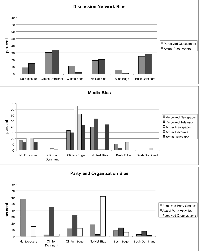
This study thus estimates the partisan bias of communications from political intermediaries by relying, in most instances, on reports from both sources and recipients. Figure 1 displays the distributions of partisan bias regarding the two major-party candidates3
Perot voters are not the focus of this paper, but they are included in Fig. 1 and in the base of the Democratic and Republican vote columns in Table 1.
For presentation purposes, Fig. 1 breaks the mostly continuous bias variables used in Table 1 and 2 into several discrete categories. In some cases, the categories are straightforward. In others, especially for media content and party activities, where there were no natural breaks, we had to establish our own cutting points (as described in Appendix B) to represent essential differences in intermediary bias.


Interpersonal Discussion Networks
Interpersonal discussion networks have been shown in previous research to be important influences on political behavior (e.g., Huckfeldt and Sprague 1995; Huckfeldt et al. 1998, 2000b). People with whom we have close relationships, especially relatives, typically dominate these networks; but they also may contain regular contacts, such as co-workers (Mutz and Mondak 1998), who are not intimates. Discussants with whom ties of intimacy are weakest play an especially important role in discussion networks. Most likely to come from different backgrounds and thereby to have dissimilar political views, they become agents of change or deviation in one's political orientations (Granovetter 1973).
In constructing discussion networks, therefore, it is important to look beyond the most intimate discussants. For this reason, our respondents were asked to report which candidate each of up to five discussants supported in the 1992 presidential election. The first four were to be discussants “with whom they discussed important matters;” and the fifth-named discussant was prompted to be an explicitly political discussant who was not already mentioned. Sixty percent of the sample added the fifth discussant, and only a slight majority of them were relatives. The partisan biases reflected in both perceptions of discussants and actual discussants' voting preferences are reported in the top panel in Fig. 1.5
The difference between actual and perceived discussant presidential preferences is modest, making reliance upon preferences less vulnerable to distortion than might be supposed. The correlations (r's) between voters' perceptions of their discussants' vote preferences among Bush, Clinton, and Perot (located in the center) and the discussants' own reports ranged from 0.70 to 0.78 across the five discussants. (Potential problems of multicollinearity are avoided, though, when we combine discussants to create our network measures.)
Whether measured by main respondent perceptions or discussant self reports, a substantial majority of Americans found themselves in either pro-Clinton or pro-Bush discussion networks, with Clinton enjoying an advantage comparable to his edge over Bush in the popular vote.6
None of this is meant to suggest that the pervasive partisan biases within networks shield individuals from the frequent experience of political disagreement (see Huckfeldt et al. 1998, 1003–5). Based on respondent perceptions, approximately 70% of both Bush and Clinton voters were located in networks where 50% or more of their discussants shared the same vote preference. At the same time, less than a majority of Bush and Clinton voters reported that all of their discussants shared the same vote preference. Hence, the modal condition among these respondents is to be located in networks that convey a clear but less than unanimous partisan bias. (See Huckfeldt, Johnson, and Sprague 2002.)
While more respondents were in discussion networks favorable to Clinton, a quarter of them were embedded in a homogeneously pro-Bush discussion network. These patterns show how discussion networks may insulate minorities from the prevailing climate of opinion (Finifter 1974; Huckfeldt et al. 1995). In a year when little seemed to be going their way, many Bush partisans found refuge in a protective environment of similarly minded discussants, who may have provided valuable support in resisting powerful forces arrayed against the Bush candidacy. Finally, about 30% of Americans in 1992 were not located in a discussion context noticeably favorable to a single candidate. This is a substantial share of the electorate to lack partisan anchoring through personal networks—more than found in the early Columbia studies (Berelson, Lazarsfeld, and McPhee 1954, 104–6).
The Mass Media
Although the media, especially television, are seen as the most important political intermediaries in contemporary America, there is little agreement regarding the partisan tone of their messages. Some analysts view the media as biased in favor of Democrats and liberals (Lichter, Rothman, and Lichter 1986), and this appears to be an article of faith among conservatives. Others conclude that the media pursue a probusiness and consequently a more mainstream agenda (Bennett 1996) or that the direction of partisan bias varies across outlets in line with their different ideological persuasions (Page 1996). Some of the most systematic studies of media content, in contrast, find little evidence of blatant partisanship in the contemporary media (Hofstetter 1976; Robinson and Sheehan 1983).7
Rather than search for explicitly partisan favoritism, the most influential studies of the media have pursued more subtle and indirect effects (e.g., Iyengar and Kinder 1987; Iyengar 1991). Researchers also find that media coverage of campaigns adopts a critical posture toward politics, parties, and politicians; focuses on the “horse race” and strategy rather than substance; concentrates on action and controversy; and elevates news bites over in-depth coverage (Ranney 1983; Robinson and Sheehan 1983; Patterson 1993). These tendencies have profound political consequences, but they are only indirectly partisan and are ignored in our study.
To be sure, media partisanship was manifested in earlier times when the partisan press was little more than a propagandist for its favored party. That overtly partisan style seems to have given way in modern times to a media more concerned with expanding audience than political proselytizing and a press corps protective of its independence from any particular party or politician (Rubin 1981).
The middle panel in Fig. 1 reports the distributions of media bias in the 1992 presidential election. It contains survey respondents' perceptions of which candidate was favored by the principal newspaper they read and by the television network newscast they watched the most. It also reports the results of content analyses of the partisan leanings of newspaper stories, editorial page articles, and television network evening news to which the respondents were presumably exposed during the campaign.
At first glance, these data support the view of the media as a partisan actor in presidential elections. In terms of actual content, three-quarters of all Americans in 1992 read newspapers that on average favored one of the major-party candidates in their news reports and editorials, and over 40% watched television news programs that showed similar partisan bias. Most of these media favored Bill Clinton. Even many traditionally pro-GOP newspapers did not favor Bush in either their reporting or their editorial pages. In view of the pro-Republican advantage in newspaper presidential endorsements in every year since 1944 except 1964 (Stanley and Niemi 1998, 188–9), it is surprising that so many papers favored Clinton in editorial content and endorsements in 1992.8
Stanley and Niemi (1998), citing data from Editor and Publisher (October 24, 1992, p. 9) that weighted newspapers by their circulation, report that 27% of editorials in 1992 favored Clinton, 18% favored Bush, and 55% were uncommitted. Our measure includes these editorials as well as op-ed columns.
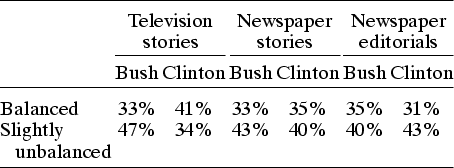
This first glance at the actual content of media messages, though, proves to be highly misleading in two important ways (Dalton, Beck, and Huckfeldt 1998a). First, where there was partisan favoritism in news reports and editorials, it was demonstrably small in most cases. A majority of those exposed to television received messages that were close to evenly balanced; similarly, biases in newspaper coverage were often slight. Averaged across their total content, none of the four television networks and only 3 of the 46 newspapers we coded were more than slightly critical of one candidate and more than slightly positive toward his major opponent. Consequently, even most respondents exposed to what we label as biased media coverage received information giving the candidate what we characterize as an “edge” rather than the “dominance” the one-message model requires.9
At least 74% of the individual news stories and editorials on the major party candidates in 1992 were coded as balanced (4) or in its adjacent categories of either slightly critical or slightly positive (3 or 5) on a 7-point scale. The percentages in these categories for each media source coded were as follows.

Second, even where they showed net candidate favoritism, most newspapers and all television newscasts presented both favorable and unfavorable stories on each candidate during the campaign. Eleven of the 46 newspapers had only unfavorable editorials on one of the candidates, but only the pro-Clinton New York Daily News combined them with no unfavorable editorials on the other. Overall, even when the average bias ended up in the imbalanced category, this location was typically leavened by contrasting stories, either favorable to the other side or unfavorable to the apparently “favored” candidate.10
The standard deviations across stories in each specific source averaged 0.99 and 1.06 in newspaper reports, 1.17 and 1.18 in editorials, and 1.02 and 1.07 in television reports, for Bush and Clinton, respectively, on a 7-point scale. In virtually all of the media, these variations were large enough to place at least one-third of all coded stories on the other side of the scale's pure balance midpoint (=4).
Because we did not ask respondents to report the extent of perceived favoritism by their media and include only one source (because few use more than one), all perceived bias is coded as giving the candidate an “edge.”
Our interpretation of the media as a largely unbiased source is further supported by a persistent curiosity in perceptions of the media among those who see it as biased. Previous research has shown that when media reporting of competing sides in a conflict is balanced, partisans often perceive the reporting as biased in favor of the side that they oppose (Vallone, Ross, and Lepper 1985). This so-called “hostile media phenomenon” appears when partisans view balanced coverage as bias against their side, which unquestionably (in their view) deserves highly favorable treatment. Partisans in our data were more likely to perceive their newspaper and television news as biased in favor of the candidate of the other party (Dalton, Beck, and Huckfeldt 1998a). This is almost entirely a function of Republicans who saw their media sources as pro-Clinton. In many cases, of course, their perceptions were accurate, because content analysis showed pro-Clinton coverage in many newspapers and two of the network news shows. Even where the particular newspaper or television news program was either balanced or only slightly imbalanced, however, many Republicans (almost always a plurality of those using that source) saw it as favoring Clinton. Consequently, the operation of the hostile media phenomenon among Republicans in 1992 produced systematic misperceptions of bias where it did not, based on our content analysis, actually exist.
Compared to discussion networks, then, the media were considerably less likely to be sources of partisan-biased information during the 1992 presidential election campaign. They were less partisan overall, and their partisanship was inconsistent across their stories. Our respondents also were somewhat less exposed to the media than to personal discussants. Perhaps the only compensating factor in the potential for media influence on presidential choices in 1992 was the sizable Clinton advantage in media coverage, which was considerably more skewed than the bias in interpersonal networks. Whether that potential was realized is a question for later consideration.
Organizations
Party and secondary organizations often are credited with playing important roles for both turnout and vote choice during an election campaign. Groups serve as reference points in evaluating candidates (Miller, Wlezien, and Hildreth 1991) and are fundamental building blocks of the party coalitions. Formally organized groups also make explicit or implicit endorsements of candidates, which serve as valuable voting guides for their members and followers as well as for their opponents. Moreover, organizations often actively proselytize their members on behalf of candidates for office through normal channels of membership communication and by making personal contacts during the campaign.
The bottom panel in Fig. 1 reports the frequencies of perceived exposure to partisan bias from secondary organizations generally and also for the most politically specialized organizations, the political parties. In addition, Fig. 1 depicts relative party activity levels as reported by the parties operating in the respondent's county of residence.
Political parties are inherently partisan organizations. Mere contact from them in mobilizing voters to get to the polls and to vote for the right candidates necessarily exposes the voter to partisan influence. Such grass-roots party contacts were common in the 1992 election campaign. More than two-fifths of the respondents said that they had been contacted or had received literature in support of a presidential candidate. This contact corroborates earlier evidence of still-vibrant local parties (Gibson et al. 1985), yet it falls well short of the percentage of respondents who were exposed to partisan messages through personal discussion networks or the media. Moreover, over 40% of those perceiving party contacts in 1992 were reached by both parties, suggesting that the organizations may have moved away from the traditional strategy of concentrating their efforts on mobilizing their own supporters (Wielhouwer and Lockerbie 1994). Where voters were exposed to grass-roots contact from only one of the major parties, alternatively, it was somewhat more likely to come from the Democrats.
The picture is different once we turn to party reports of activity. The Democratic and Republican parties each performed some activities in every county, yet one party outperformed the other in all but one county (also see Beck et al. 1997). Over the years, Democrats have been more active than Republicans at the local level (Gibson et al. 1985), and their activity advantage was so substantial in 1992 that the Democrats enjoyed at least a clear edge in about three-quarters of all counties, dominating in close to a majority. Such a lopsided Democratic lead in grass-roots party activity provided another social context advantage for the 1992 Clinton campaign.
Many secondary organizations also actively support candidates for president. Labor unions, veterans' organizations, business associations, and, in recent years, religious groups, especially fundamentalist Christian organizations, are conspicuously active in attempting to mobilize their followers on behalf of presidential candidates (Asher et al. 2001; Leege and Kellstedt 1993). Our survey asked respondents about their membership in up to three organizations, including whether each supported a candidate in the election. The number of specific organizations named was very large, precluding direct measurement of each organization's partisan preferences, so we rely entirely upon perceptions of organizational bias.
The data on organizations tell a story of little organizational bias overall, but it generally favors the Democrats where it does appear. America is a nation of joiners, and 85% of the sample reported membership in at least one organization. The organizations Americans join are overwhelmingly nonpolitical, however; fewer than one-quarter of the respondents claimed that an organization to which they belonged supported one of the presidential candidates. Unions were perceived as most commonly exhibiting a candidate preference, with churches a distant second. In 1992, where there was organizational bias, it favored the Democrats by a two-to-one margin. Whether this represents a change from earlier years cannot be said for sure, but it is reasonable to suppose that, as politically conservative churches have joined unions in making presidential endorsements, a traditional Democratic advantage in organizational partisan activity may have been reduced.
THE BIASES OF INTERMEDIARIES AND THE PRESIDENTIAL VOTE
Our ultimate question is whether partisan biases in voters' information sources influence their vote choices. We believe that social context is important in giving content and meaning to the political issues and attitudinal orientations that are prominent in individual-actor theories of voting behavior. In addition, we have hypothesized that this context has a direct impact on voting choice by providing new information and voting cues to the individual. Thus, if the vote decision really is subject to social influence, then the partisan cues of intermediaries' messages should relate to the vote even after we have taken into account the enduring personal characteristics that normally predict voting behavior. Moreover, we can assess which intermediaries carried the greatest weight in the 1992 election.
We included several personal characteristics as baseline variables in our social calculus model. The most important is long-term party preference, which anchors the social–psychological perspective on voting behavior (Campbell et al. 1960). The rational-choice perspective offers a second predisposition that is presumed to guide voting choices—the voters' political ideology. Although a role for highly developed ideologies is limited (Converse 1964), voters' self locations along a liberal-to-conservative continuum seem to be increasingly relevant for voting behavior (Miller and Shanks 1996, 289–94). Standard demographic characteristics also are causally antecedent to the vote decision and have been theoretically and empirically linked to the presidential vote in previous studies (Abramson, Aldrich, and Rohde 1998). We include race, education, income, religion (both denominational affiliation and evangelical Christian identification), and gender as additional baseline controls in our model.
Such important short-term components of the vote decision as evaluations of candidates, issues, and retrospective evaluations of party performance are excluded from our model on theoretical grounds. They typically are endogenous to the election campaign and are influenced by intermediaries and long-term baseline variables rather than influencing them. Moreover, the ideological liberal/conservative scale already represents broad and enduring issue orientations to some extent. Taking these considerations into account, our analysis gauges whether the partisan cues of intermediaries add explanatory power to a “baseline” model built around long-term forces in voting behavior.
Our social calculus model also includes the Clinton percentage of the major-party vote in each respondent's county. The political tendencies of geographical units such as a neighborhood or a county are staples of contextual analysis (Berelson, Lazarsfeld, and McPhee 1954; Huckfeldt et al. 1998). In a properly specified intermediation model, which includes the various carriers of this contextual influence, the effects of the aggregate contextual variable should be reduced to insignificance. The county presidential vote variable, therefore, performs a different function from the preceding “control” variables. Because our model includes many of the primary ingredients of the county context (i.e., the partisan biases of discussants, local newspapers, local party activities, and local organizations), we expect the county presidential vote variable to lack statistical significance in the full model.
Estimating the Impact of Social Context in Voting
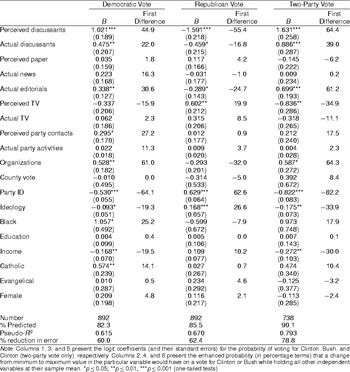
Table 1 presents logit equations for the various intermediaries and control variables in predicting the Clinton vote, the Bush vote, and the Clinton share of the two-party vote. The first column under each “vote” heading contains the logit coefficients and measures of fit; the second columns provide estimates of the impact of each variable across its range when other predictor variables are set at their mean values.12
First differences are computed using the Tomz et al. (2000) CLARIFY routine.
The results show a substantial relationship between the partisan cues provided by a number of intermediaries and the presidential vote in 1992, even after standard personal characteristics are considered. Our results also demonstrate that party identification and ideology, key explanatory variables in the social–psychological and rational-choice perspectives, respectively, and a few other fixed personal characteristics remain important even after taking the social context into account. Party identification, as expected, emerges as by far the most powerful predictor of the vote in each equation. Clearly, social considerations take their place alongside, rather than displace, personal considerations in voting.
Personal Discussants.
Both actual and perceived presidential preferences of personal discussants are significantly related to the Democratic vote, the Republican vote, and the two-party vote. In each case, the candidate favored by the discussion network is advantaged. Of the two measures, perceived discussant preferences consistently turn out to be more important than actual discussant preferences, but each adds significantly to the account. It is theoretically understandable that both the message sent and the message received are consequential for voting choices. Given the potential for slippage between the original message and how it is received (Huckfeldt et al. 1998), moreover, it seems entirely reasonable that perceptions have a stronger relationship to the vote. Because four of five discussants were identified as people with whom “important matters” are discussed, not necessarily politics, the likelihood that respondents initially chose discussants to support their political views is minimized. This makes the relationships all the more impressive and signals an importance for personal discussants in the social calculus of voting that many analysts thought had eroded by the 1990s.
Newspapers and Television.
Our research provides suggestive evidence of mass media influence that varies across media sources and measures in theoretically interesting ways. As we have shown in earlier analysis of media effects (Dalton, Beck, and Huckfeldt 1998a), newspaper editorial content is significantly related to each of the vote variables. Neither actual newspaper news content nor voter perceptions of newspaper bias, on the other hand, comes close to having a significant relationship with the vote. These results make theoretical sense. Even though newspapers showed a persistently pro-Clinton bias in 1992, their partisan cues were so slight and inconsistent that many voters could come away with the sense that their paper was unbiased—and they did. However, newspapers still reserve their editorial pages for opinion taking as is reflected in our data.13
That editorials provide a sharper partisan image than news reports is demonstrated by a comparison of their standard deviations. Editorial page standard deviations are 0.55 for Bush, 0.55 for Clinton, and 0.82 for the difference between Bush and Clinton. News report standard deviations are 0.28 for Bush, 0.28 for Clinton, and 0.64 for their difference.
For television, perceptions rather than content are linked to the vote, albeit in a puzzling way. Perceptions of television bias are significantly related to both the Bush vote and the Clinton share of the two-party vote, but in the direction opposite that expected: As pro-Clinton bias increased across network news shows, the vote for Bush grew. We interpret this as a product of the hostile media phenomenon, with partisans tending to see balanced television news and even news slightly favorable to their candidate as favoring the opposition. In 1992, this phenomenon was most prevalent among Republicans. These perceptions of television bias remain after controls for actual news content, while the ones for newspapers do not. Paradoxically, Republicans single out television as a more “hostile” medium than newspapers despite its objectively more balanced coverage of the 1992 presidential campaign. We suspect that Republicans' perceptions of network television news as especially unfriendly to their cause have been many years in the making rather than an immediate product of the 1992 contest.
Party Activity.
Given the concentration on media advertising rather than grass-roots activity by modern presidential campaigns, it may seem unsurprising that local party activity had a limited relationship to voting in 1992. The coefficients for perceived contacting and party activity attain significance for only one of six possibilities: the relationship of perceived contacts to the Democratic vote. The sign of this relationship is in the expected direction, with more contact perceived with a party increasing its electoral support. The actual level of party activity in a county relative to its opposition, in contrast, does not exhibit a significant relationship to the vote. This result may be attributable to the lack of residual influence for party activity once its contacting efforts are taken into account. The presence of significant party activity effects in even one case, though, is a tantalizing hint that there may be more payoff from grass-roots activities than presidential campaigns seem to assume, and we will explore the matter further in subsequent analysis.
Secondary Organizations.
Membership in an organization that communicates a presidential preference is not common. When it occurs, though, it is significantly related to the Clinton and two-party votes for president, but not to the vote for Bush—an asymmetry that is investigated further below. Because secondary organization memberships are typically set well before the particular election campaign, we can interpret this relationship as evidence of organizational influence rather than vote preferences dictating what organizations to join, even if the latter can happen over the long run.
County Partisan Context.
The remaining result of interest is a comforting null finding: County context is not significantly related to the vote in the multivariate model. The bivariate relationships between the Clinton share of the two-party countywide vote and respondents' votes for Clinton (r = 0.19), Bush (r = −0.20), and Clinton in the two-party contest (r = 0.23) are all significant. When the contextual variable is embedded in a multivariate model including direct agents of that context, however, its coefficients are reduced to insignificance. We have conceptualized discussion networks, secondary organizations, local parties, and newspapers as carriers of the county's social context. Our data support this hypothesis.
Theoretical Reflections.
It is perilous to infer influence from relationships in cross-sectional surveys. Therefore, we have taken great pains to use temporally antecedent explanatory variables as much as possible and to measure them beyond the conventional reliance on perceptions. On the basis of our evidence, therefore, we feel that it is justifiable to conclude that the social context of individuals affects the vote choices of the contemporary electorate. The partisan cues of personal discussants, newspaper editorials, and secondary organizations seem most influential in presidential vote choices in 1992. Television and newspaper reporting and party activity, in contrast, appear to have had no direct impact on the vote.
Why might discussants, organizations, and editorials exert such influence? The primary reasons may be the clarity and credibility of their messages (Lupia and McCubbins 1998). Some organizations and newspapers make candidate endorsements or other explicit attempts to influence the presidential vote. Typically sent as one-message communications in Zaller's (1992) terms, these cues are hard to mistake. Personal political communications may be more ambiguous, but their messages are often so repetitive and reinforced in such a variety of ways that our respondents had little difficulty in accurately detecting the presidential preferences of their discussants. Messages from these sources also have an aura of credibility. Secondary organizations' and newspaper editorials' endorsement are reasoned products of a process in which the different presidential candidates have been carefully evaluated. Organizations and newspapers also may be assumed to speak on behalf of the interests of their followers, which enhances their credibility, at least to those audiences. To the degree to which personal discussants come from the same backgrounds as the voter—and they typically do—the potency of their messages is similarly enhanced. Of course, it must not be forgotten that exposure is a necessary ingredient for influence. Personal discussants enjoy the advantage of having close and continuing relationships with the voter. No other intermediary can match the level of attention that discussants' political messages receive.
Why do television and newspaper reports and political parties, in contrast, seem to lack an influence on the vote? What is missing from the news reports, as we have suggested, is a clear partisan bias to their messages. Whatever their lineage, and for newspapers it is highly partisan, most newspapers and television are now “two-message” communication sources in presidential politics, trying to balance their reporting so as not to unduly favor either candidate. As Fig. 1 shows, their coverage is often balanced, and where it is not, it is so mildly partisan that voters may have difficulty discerning any bias—or misperceive bias against their candidate from even supportive sources. Therefore, despite their nonpartisan credibility and wide (albeit shrinking) audiences, the direct influence of newspaper and television reporting is constrained. This leaves it to the more subtle and indirect processes of agenda setting, priming, and framing to carry the media's effects.14
Incorporating these complex processes into a vote model is well beyond the scope of this paper (but see Dalton et al. 1998b). Moreover, newspapers and television hardly are the only media sources of information during election campaigns. Talk radio and television and the Internet (plus even MTV in 1992) have become increasingly important, and news magazines traditionally have been a source of campaign news. We asked our respondents about their exposure to such sources. While many reported relying upon each, the numbers fell far short of those reporting regularly reading newspapers or watching national network news about the campaign, and the specific sources they mentioned were so segmented that they defied systematic analysis. A fully comprehensive study of media effects in contemporary times, though, needs to find ways to take these sources and others into account.
The opposite situation prevails for political parties. Their messages are so clearly partisan that many voters may find them offensive or at least do not treat them as new information that updates their preferences. Consequently, party messages lack the credibility of less partisan sources, which acts as a counterbalance to their clarity. Even though we found an unexpected amount of presidential-campaign party activity at the grass roots in the counties we studied, moreover, only a minority of our respondents perceived direct contact from a political party. Perceived party contacting seems to have declined in recent decades (Wielhouwer and Lockerbie 1994), and the most efficacious of those contacts—personal meetings rather than impersonal telephone contacts and literature drops—presumably has fallen off even more (Gerber and Green 2000). Party efforts also may be redundant, consequently adding nothing, when focused on the most committed and informed partisans.
The Special Role of Political Awareness
Americans vary in their awareness of politics, and numerous scholars have found that this variation profoundly affects political reasoning and choice. Yet, as Zaller (1992, 18) has observed, “Most of the time, when scholars attempt to explain public opinion and voting behavior…, they build models that ignore the effects of political awareness.” We should not fail to look in our data, therefore, for differences by political awareness.
Although little previous work has addressed the role of political awareness in social influences on the vote, some theoretical expectations do emerge. Zaller's (1992) theory predicts that the influence of messages received from intermediaries will grow as political awareness declines, at least as long as the person is exposed to political messages. While inattentiveness makes reception of political messages less likely, once they are received people with little political information find them difficult to resist. Converse (1964) and Sniderman, Brody, and Tetlock (1991, 164–78) also posit that partisanship and ideology become more important guides for voting behavior as political awareness increases. This leaves less informed voters more open to influence by short-term considerations and other forces—including, perhaps, their immediate social context.
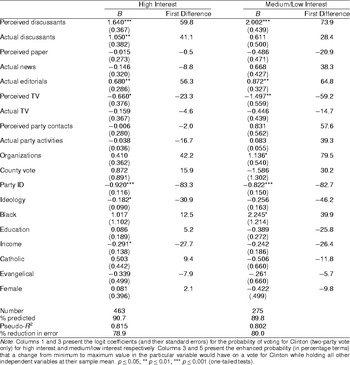
We can test these theoretical expectations by reestimating the logit model for voters under contrasting conditions of campaign interest. The number of low-interest respondents is already depleted by the removal of nonvoters, so we combined them with moderate-interest respondents to yield a sufficient number of cases for analysis. While using campaign interest rather than factual information to measure political awareness is not ideal (Zaller 1992, 333–7), it is the best alternative our study offers. The results of this analysis are presented in Table 2 for the two-party vote.

Differentiation by campaign interest yields parallel coefficients for most intermediation variables, but two differences of special theoretical importance emerge. First, though the differences are small and our inferences necessarily tentative, the social context variables have more substantial relationships to the vote for less interested than for more interested respondents. For every intermediary measure except actual discussants, the relationship between the bias of the intermediary and the vote of less interested voters is stronger. Based on these results, one can conclude that the social context is more important for less politicized than for more politicized members of the American electorate.
Second, the largest differences under political interest conditions appear for political parties and organizations. Among less interested voters, the candidate bias of secondary organizations was significantly and positively related to the vote. What was a significant relationship for the Clinton vote in Table 1 proves to be solely the effect of organizational support among lower-interest voters in Table 2. Similarly, the party that enjoyed the advantage in contacting voters and in overall activity countywide won relatively more votes among the politically inattentive, whereas the relationship was insignificant and negative among those who were interested in the campaign. These relationships for perceived party contacts and actual party activities among less interested voters (at p = 0.070 and p = 0.065, respectively) fall just short of significance at the 0.05 level. Suspecting that they may be competing against one another as indicators of local party effort, we held each out of our logit analysis in turn and reestimated the parameters. In each case, the party coefficient attained significance at the 0.04 level for lower-interest voters—and was far short of being significant for higher interest voters. Party and secondary organization efforts appear to matter, but only for those who are less attentive to politics!
These results signal a persistence into modern times of the important role organizations have been found to play in providing political motivation and direction to less politicized citizens (Rosenstone and Hansen 1993). Politically aware voters may be immersed in so rich a milieu of political information that party and organizational efforts are redundant. Even in an era when political campaigns are waged largely through the airways and restricted attention is given to grass-roots voter contacts, though, there are citizens who still respond to messages from a local party organization. Similar influence from secondary organizations is perhaps less surprising, although its pro-Democratic skew may be. That most voters apparently did not receive or heed party and organization directions, though, may be as much the result of lesser effort, and a consequently shrunken electorate, than of a citizenry that has become more adept at processing political information.
SOCIAL CONTEXT AND VOTING CHOICE
In the mid-20th century, electoral researchers thought of voters in terms of their social characteristics and social context. In subsequent decades, researchers developed a more atomistic model of voting choice in which long-standing partisan loyalties and interests, as well as short-term attitudes and perceptions, were seen to influence voting choices and less emphasis was placed on social forces. Our research has attempted to reposition this image of the voter as an autonomous decision maker by examining the role of social intermediaries in contemporary presidential voting.
Our major research contributions have been to show that, first, Americans vary considerably in the partisan nature of the political messages to which they are exposed. If voters look for party cues in their environments, they will find no shortage of such cues. The primary sources of these cues are personal networks and groups, not the modern mass media, which has often been ceded greater electoral significance. Second, these partisan cues have a direct influence on voting behavior. To be sure, personal characteristics are key factors in voting: partisanship, ideologies, and fixed personal characteristics play powerful roles in determining the vote. Our evidence indicates, however, that these personal forces are only part of the voting calculus.
Because the intermediaries we have considered serve as the major channels through which information flows in American elections, they are the relevant influences to consider in establishing a social “calculus” of voting. The mass media, of course, have become paramount in modern times as carriers of candidates' messages. In 1992, the partisan bias in newspaper editorial pages seemed to directly affect the vote, but the bias of newspaper and television news reports appeared to be unimportant. The primary reason for this failure of influence, where one might most expect it, we think lies in the subtlety and inconsistency of media biases in straight news reporting. In effect, the media appear to most voters to fit Zaller's (1992) “two-message model”—even in a year when they gave more favorable coverage overall to one of the candidates. Viewed from this perspective, then, the media are promoting deliberation in the electoral process rather than playing the partisan role sometimes ascribed to them.
Organizations and personal discussants serve as more consequential carriers of partisan messages than the media. Although many Americans receive balanced partisan messages from them, for many others organizational and personal messages favor one of the candidates, and our evidence suggests that voters tend to be responsive to this bias. The powerful effect of personal networks is one of the most significant findings of this study. It signals the continuing influence of an important traditional source of political communication and reaffirms in modern times the message of the Columbia studies half a century ago. Secondary organizations and political parties, on the other hand, are less important across the entire electorate because their effects are restricted to the Americans who are least attentive to politics, which confirms a continuing role for mobilization in contemporary society.
While the social forces we have examined do not tell the complete story of voting behavior in presidential elections, they add an important chapter. American voters do not operate in the social vacuum that much of the contemporary voting literature seems to assume. Rather, voters' enduring personal characteristics interact with the messages they are receiving from the established social context in which they operate. This context cannot be ignored in trying to understand voting and electoral outcomes in any election. Moreover, the social context can have a cumulative impact across elections in shifting standing party preferences and ideological positions. Over the long run, then, we expect that consistent messages from intermediaries may contribute to the social learning process, just as new voting preferences can weaken old partisan predispositions (Fiorina 1981).
How the context in 1992 compares with other elections, in the United States and elsewhere, particularly where political cleavages are deeper and social contexts more biased, also needs to be understood in building a general theory of voting that includes both personal and social factors. For right now, it seems reasonable to conclude that the outcome of the 1992 election was rooted, in part, in the pro-Clinton skew of the social intermediation process. The media had given a strong advantage to the Democratic challenger by the campaign's end, not because they are naturally Democratic but rather because they were candidly reporting a faltering presidency and a failing GOP campaign. Secondary organizations and grass-roots party activity too were more supportive of the eventual winner. Given the positions of the other intermediaries, the advantage in personal discussions of Clinton over Bush seems surprisingly modest, but it added to the Democrat's edge nonetheless. Whether the operation of this intermediation process in 1992 was customary or unique, though, necessarily awaits a continuation of research on the social calculus of voting.
Finally, our study affirms, for citizens playing their fundamental role in the democratic political process, that political choices are affected to a significant degree by the flow of information from the decision-maker's immediate social context. Hence, even within one particular democratic system, the United States in 1992, the analysis of democratic political behavior is inherently comparative—not only across individuals and their personal characteristics, but also among the settings in which these individuals reside (Przeworski and Teune 1970). By identifying these ties between individuals and their environments—by bringing into perspective the social calculus of voter choice—we move closer to a better understanding of citizenship and political choice within, and potentially among, democratic political systems (Huckfeldt, Ikeda, and Pappi 2000a; Ikeda and Huckfeldt 2001).
References
Abramson Paul R.
Aldrich John H.
Rohde David W.
1998
Change and Continuity in the 1996 Elections
Washington, DC
Congressional Quarterly Press
Asher Herbert B.
Heberlig Eric S.
Ripley Randall B.
Snyder Karen
2001
American Labor Unions in the Electoral Arena
Lanham, MD
Rowman and Littlefield
Bartels Larry M.
2000
Partisanship and Voting Behavior, 1952–1996
American Journal of Political Science
44
January
35
50Google Scholar
Beck Paul Allen
Dalton Russell J.
Haynes Audrey
Huckfeldt Robert
1997
Presidential Campaigning at the Grass Roots
Journal of Politics
59
November
1264 75Google Scholar
Beck Paul
Dalton Russell J.
Huckfeldt Robert
2000
Cross-National Election Studies: United States Study, 1992 [computer file] (Study 6541), 2nd ICPSR version. Columbus: Ohio State University/Irvine: University of California/Bloomington: Indiana University [producers], 1992. Ann Arbor, MI: Inter-university Consortium for Political and Social Research [distributor], 2000
Bennett W. Lance
1996
News: The Politics of Illusion
White Plains, NY
Longman
Bennett W. Lance
Entman Robert M.
2001
Mediated Politics: Communication in the Future of Democracy
Cambridge, UK
Cambridge University Press
Berelson Bernard R.
Lazarsfeld Paul F.
McPhee William N.
1954
Voting
Chicago
University of Chicago Press
Campbell Angus
Converse Philip E.
Miller Warren E.
Stokes Donald E.
1960
The American Voter
New York
Wiley
Converse Philip E.
1964
The Nature of Belief Systems in Mass Publics
Ideology and Discontent
David E. Apter
New York
Free Press
206 61
Dalton Russell J.
Beck Paul Allen
Huckfeldt Robert
1998a
Partisan Cues and the Media: Information Flows in the 1992 Presidential Campaign
American Political Science Review
92
March
111 26Google Scholar
Dalton Russell J.
Beck Paul Allen
Huckfeldt Robert
Koetzle William
1998b
A Test of Media-Centered Agenda Setting: Newspaper Content and Public Interests in a Presidential Election
Political Communication
15
October–December
463 81Google Scholar
Downs Anthony
1957
An Economic Theory of Democracy
New York
Harper & Row
Eagly Alice
Chaiken Shelly
1993
The Psychology of Attitudes
New York
Harcourt, Brace, Jovanovich
Finifter Ada W.
1974
The Friendship Group as a Protective Environment for Political Deviants
American Political Science Review
68
June
607 25Google Scholar
Fiorina Morris P.
1981
Retrospective Voting in American National Elections
Haven, CT
Yale University Press
Gerber Alan S.
Green Donald P.
2000
The Effects of Canvassing, Telephone Calls, and Direct Mail on Voter Turnout: A Field Experiment
American Political Science Review
94
September
653 63Google Scholar
Gibson James L.
Cotter Cornelius P.
Bibby John F.
Huckshorn Robert J.
1985
Whither the Local Parties?
American Journal of Political Science
29
February
139 60Google Scholar
Granovetter Mark J.
1973
The Strength of Weak Ties
American Journal of Sociology
78
6
1360 80Google Scholar
Hofstetter C. Richard
1976
Bias in the News
Columbus
Ohio State University Press
Huckfeldt Robert
Sprague John
1995
Citizens, Politics, and Social Communication
New York
Cambridge University Press
Huckfeldt Robert
Beck Paul Allen
Dalton Russell J.
Levine Jonathan
1995
Political Contexts, Cohesive Social Groups, and the Communication of Public Opinion
American Journal of Political Science
39
November
1025 54Google Scholar
Huckfeldt Robert
Beck Paul Allen
Dalton Russell J.
Morgan William
1998
Ambiguity, Distorted Messages, and Nested Environmental Effects on Political Communication
Journal of Politics
60
November
996
1030Google Scholar
Huckfeldt Robert
Ikeda Ken'ichi
Pappi Franz Urban
2000a
Political Expertise, Interdependent Citizens, and the Value Added Problem in Democratic Politics
Japanese Journal of Political Science
1
2
171 95Google Scholar
Huckfeldt Robert
Sprague John
Levine Jeffrey
2000b
The Dynamics of Collective Deliberation in the 1996 Election: Campaign Effects on Accessibility, Certainty, and Accuracy
American Political Science Review
94
September
641 51Google Scholar
Huckfeldt Robert
Johnson Paul E.
Sprague John
2002
Political Environments, Political Dynamics, and the Survival of Disagreement
Journal of Politics
64
in pressGoogle Scholar
Ikeda Ken'ichi
Huckfeldt Robert
2001
Political Communication and Disagreement among Citizens in Japan and the United States
Political Behavior
23
March
23
52Google Scholar
Iyengar Shanto
1991
Is Anyone Responsible?
Chicago
University of Chicago Press
Iyengar Shanto
Kinder Donald R.
1987
News That Matters
Chicago
University of Chicago Press
Just Marion R.
Crigler Ann
Alger Dean E.
Cook Timothy E.
Kern Montague
West Darrell M.
1996
Crosstalk: Citizens, Candidates, and the Media in a Presidential Campaign
Chicago
University of Chicago Press
Kish Leslie
1949
A Procedure for Objective Respondent Selection within the Household
Journal of the American Statistical Association
44
September
380 7Google Scholar
Lazarsfeld Paul F.
Berelson Bernard R.
Gaudet Hazel
1944
The Peoples' Choice
New York
Duell, Sloan, and Pearce
Leege David C.
Kellstedt Lyman A.
1993
Rediscovering the Religious Factor in American Politics
Armouk, NY
M. E. Sharpe
Lichter S. Robert
Lichter Linda S.
Rothman Stanley
1986
The Media Elite
New York
Adler and Adler
Lodge Milton
Steenbergen Marco R.
Brau Shawn
1995
The Responsive Voter: Campaign Information and the Dynamics of Candidate Evaluation
American Political Science Review
89
June
309 26Google Scholar
Lupia Arthur
McCubbins Mathew D.
1998
The Democratic Dilemma: Can Citizens Learn What They Really Need to Know?
New York
Cambridge University Press
Arthur H. Miller
Wlezien Christopher
Hildreth Anne
1991
A Reference Group Theory of Partisans Coalitions
Journal of Politics
53
November
1134 49Google Scholar
Miller Warren E.
Shanks J. Merrill
1996
The New American Voter
Cambridge, MA
Harvard University Press
Mutz Diana C.
Martin Paul S.
2001
Facilitating Communication Across Lines of Political Difference: The Role of the Mass Media
American Political Science Review
95
March
97
114Google Scholar
Mutz Diana C.
Mondak Jeffery J.
1998
Democracy at Work: Contributions of the Workplace Toward a Public Sphere
Presented at the Annual Meeting of the Midwest Political Science Association, Chicago
Niemi Richard G.
1974
How Family Members Perceive Each Other
New Haven, CT
Yale University Press
Page Benjamin I.
1996
Who Deliberates? Mass Media in Modern Democracy
Chicago
University of Chicago Press
Patterson Thomas
1980
The Mass Media Election: How Americans Choose Their President
New York
Praeger
Patterson Thomas
1993
Out of Order
New York
Knopf
Przeworski Adam
Teune Henry
1970
The Logic of Comparative Social Inquiry
New York
Wiley
Putnam Robert D.
2000
Bowling Alone: The Collapse and Revival of American Community
New York
Simon and Schuster
Ranney Austin
1983
Channels of Power
New York
Basic Books
Robinson Michael J.
Sheehan Margaret A.
1983
Over the Wire and on TV: CBS and UPI in Campaign '80
New York
Russell Sage Foundation
Rosenstone Steven J.
Hansen John Mark
1993
Mobilization, Participation, and Democracy in America
New York
Macmillan
Rubin Richard L.
1981
Press, Party and Presidency
New York
Norton
Semetko Holli A.
1995
Cultures Apart: TV News and Campaigning in Europe and the U.S.
Presented at the Annual Meeting of American Political Science Association, Chicago
Sniderman Paul M.
Brody Richard A.
Tetlock Philip E.
1991
Reasoning and Choice: Explorations in Political Psychology
New York
Cambridge University Press
Stanley Harold W.
Niemi Richard G.
1998
Vital Statistics on American Politics 1997–1998
Washington, DC
Congressional Quarterly, Inc.
Tomz Michael
Wittenberg Jason
King Gary
2000
CLARIFY: Software for Interpreting and Presenting Statistical Results, Version 1.2.2
Cambridge, MA
Harvard University
March 3
Wattenberg Martin P.
1998
The Decline of American Political Parties, 1952–96
Cambridge, MA
Harvard University Press
Wielhouwer Peter W.
Lockerbie Brad
1994
Party Contacting and Political Participation
American Journal of Political Science
38
February
211 29Google Scholar
Vallone Robert P.
Ross Lee
Lepper Mark R.
1985
The Hostile Media Phenomenon: Biased Perceptions and Perceptions of Media Bias in Coverage of the Beirut Massacre
Journal of Personality and Social Psychology
49
3
577 85Google Scholar
Zaller John
1992
The Nature and Origins of Mass Opinion
New York
Cambridge University Press
The 1992 Presidential Vote by the Partisan Bias of Social Intermediaries, with Controls for Personal Factors
The 1992 Presidential Vote by the Partisan Bias of Social Intermediaries, with Controls for Personal Factors: High Interest vs. Medium/Low Interest
 You have Access
- 260
- Cited by
Comments
No Comments have been published for this article.