Introduction
The air transportation industry continues to grow rapidly, adding consumer space travel as a new facet on the horizon.Reference Baur and Silverman1 Despite this growth, the aerospace industry faces several challenges, such as high fuel and maintenance costs, that seriously impede its growth.Reference Baur and Silverman1,Reference Vaia2 Furthermore, there is a critical need for developing new lightweight materials and sensors that can provide early warning for radiation and shield the air/spacecraft from possible hazards from exposure to ionizing radiation, and reduce the amount of rocket fuel. Emerging lightweight, energy-efficient, and multifunctional nanomaterial-based composites offer solutions to overcome these challenges.Reference Baur and Silverman1,Reference Vaia2
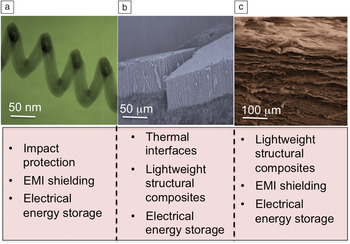
Carbon-based nanomaterials, in particular, exhibit properties that are best suited for the highly demanding requirements of aerospace applications (Figure 1). For instance, single- and multiwalled carbon nanotubes (SWCNTs and MWCNTs, respectively) exhibit high thermal conductivitiesReference Balandin3–Reference Yang, Zhang, Chen, Yoon, Ahn, Wang, Zhou, Wang and Li12 (κ > 1000 W/[m K]), necessary for efficiently distributing otherwise localized heat fluxes from spacecraft components such as propulsion structures, electronic boxes, radiators, and their accompanying thermal interfaces.
Overview of carbon nanotube-based composites and their related applications in aerospace: (a) Helically coiled multiwalled carbon nanotubes (HCNTs) offer unique mechanical properties that are useful in impact protection and electromagnetic interference (EMI) shielding. (b) Aligned arrays of multiwalled carbon nanotubes (MWCNTs) are excellent lightweight thermal interface materials, and could also be used as supercapacitor electrodes because of their high surface area. (c) MWCNTs can also be assembled into hierarchical aerogels that constitute layers of the so-called buckypapers stitched together by carbon fibers for applications in lightweight composites and thermal management.

Although carbon nanotube- (CNT-) based composites hold promise for aerospace applications, two main challenges must be addressed to make the incorporation of nanomaterials into aerospace structures a reality: (1) notwithstanding the excellent electrical, thermal, and mechanical properties of individual CNTs,Reference Berber, Kwon and Tomanek6,Reference Hone, Whitney, Piskoti and Zettl7,Reference Lukes and Zhong10,Reference Yang, Zhang, Chen, Yoon, Ahn, Wang, Zhou, Wang and Li12 bulk CNT-based composites suffer from anisotropy due to inhomogeneous CNT distributions and intertube interactions (which cause higher electrical and thermal resistance),Reference Ivanov, Puretzky, Eres, Wang, Pan, Cui, Jin, Howe and Geohegan8,Reference Han and Fina13 and (2) there is still a great need for scalable nanomanufacturing methods that increase the production throughput and reduce the cost of nanomaterial-based composites.Reference Arcila-Velez, Zhu, Childress, Karakaya, Podila, Rao and Roberts14 In this article, we provide a succinct overview of recent advances aimed at addressing these challenges, primarily through defect engineering and the development of bulk low-cost manufacturing methodologies.
Efficient CNT-based thermal management
Modern air- and spacecraft thermal design and management is very challenging because of the continually increasing heat loads from expanded avionic functionality, microprocessors in electronic systems, and complex electrical architectures.Reference Vaia2,Reference Njuguna and Pielichowski15 In addition, military aircraft designers also need to consider heat loads from advanced weapon systems. CNTs offer excellent promise for efficient thermal management in aerospace applications because their thermal conductivity along the long axis of individual CNTs at room temperature is κ > 3000 W/(m K).
Despite the high κ values of individual CNTs, uncompressed vertically aligned CNTs exhibit a room-temperature thermal conductivity of κ ≈ 15 W/(m K)Reference Ivanov, Puretzky, Eres, Wang, Pan, Cui, Jin, Howe and Geohegan8 along the tube direction, whereas for randomly oriented bulk CNTs, κ ≈ 3 W/(m K).Reference Zhang, Sharma and Johnson16 Evidently, the heat transport in bulk CNT structures is strongly influenced by the interactions between CNTs, which increase the interjunction resistance.Reference Yang, He, Puneet, Su, Skove, Gaillard, Tritt and Rao17,Reference Yang, He, Su, Reppert, Skove, Tritt and Rao18 Indeed, intertube interactions have been proposed to be the dominant factor governing the macroscopic electrical and thermal transport in CNT composites. Although these interactions can break electron–hole symmetry and distort the electronic density of states to alter the electrical behavior, the intertube junctions efficiently scatter phonons to reduce the thermal conductivity.Reference Hone, Whitney, Piskoti and Zettl7
Another factor that can profoundly affect thermal conductivity is the packing density of CNTs. Previously, Hone et al. showed that denser SWCNT films exhibit a low resistivity of ρ ≈ 0.125 mΩ cm and a high thermal conductivity of κ > 200 W/(m K) at room temperature parallel to the axes of the CNTs.Reference Hone, Llaguno, Nemes, Johnson, Fischer, Walters, Casavant, Schmidt and Smalley19 Wang et al. reported a mechanical process by which high-quality buckypapers could be prepared by rolling a cylindrical pin over arrays of MWCNTs. The aligned orientation of the MWCNTs in their samples improved the room-temperature electrical conductivity (σ) in the oriented direction by a factor of 1.3 and κ by a factor of 2, but the latter was still limited to 15 W/(m K).Reference Wang, Song, Liu, Wu and Fan20
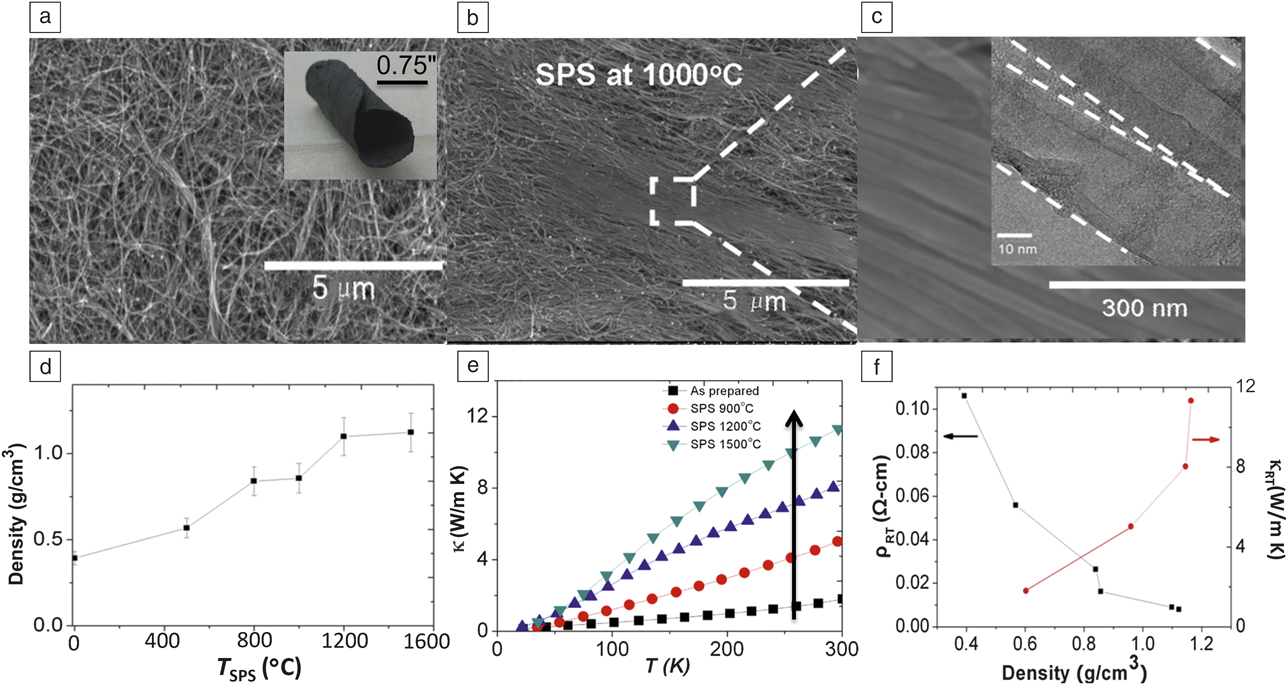
For realistic aerospace applications, we must go beyond the existing thermal transport paradigm and develop economically viable and scalable methodologies that can efficiently engineer thermal boundaries to mitigate phonon scattering at intertube junctions. Previously, it has been shown that exposure to ion/electron irradiation at elevated temperatures can induce coalescence of nanotubes and weld interjunctions.Reference Krasheninnikov, Nordlund, Keinonen and Banhart21,Reference Terrones, Terrones, Banhart, Charlier and Ajayan22 Building on these studies, we showed that spark-plasma sintering (SPS) at 1600°C can induce covalent intertubular bonding in aligned MWCNTs, resulting in an enhanced value of κ ≈ 31 W/(m K) at 300 K in the longitudinal direction (parallel to the axes of tubes), which is one of the highest reported values for three-dimensional CNT materials.Reference Yang, He, Puneet, Su, Skove, Gaillard, Tritt and Rao17,Reference Yang, He, Su, Reppert, Skove, Tritt and Rao18 SPS is a high-energy, low-voltage, pulsed plasma discharge method in a low-pressure atmosphere that can generate highly localized Joule heating (up to a few thousand kelvin) in a few minutes.Reference Puneet, Podila, Zhu, Skove, Tritt, He and Rao23,Reference Puneet, Podila, Karakaya, Zhu, He, Tritt, Dresselhaus and Rao24 In addition to inducing intertube bonding, the SPS process is a high-throughput method by which the packing density of CNTs can be controlled with the applied pressure and sintering temperature (see Figure 2a–c).
(a) Scanning electron microscope (SEM) image of as-prepared multiwalled carbon nanotube (MWCNT) buckypaper, with a digital photograph in the inset. (b) SEM image showing the densification of some MWCNTs in the buckypaper upon spark-plasma sintering (SPS) processing at 1000°C. (c) Higher resolution SEM image of the densified MWCNTs, with a high-resolution transmission electron microscope image in the inset showing that the MWCNTs are joined at the intertube junction. (d) An increase in the SPS processing temperature (T SPS) increases the MWCNT packing density, thereby resulting in (e) improved thermal conductivity and (f) reduced electrical resistivity (ρRT). Reproduced with permission from Reference Reference Yang, He, Puneet, Su, Skove, Gaillard, Tritt and Rao17. © 2010 IOP Publishing, and Reference Reference Yang, He, Su, Reppert, Skove, Tritt and Rao18. © 2010 Elsevier.
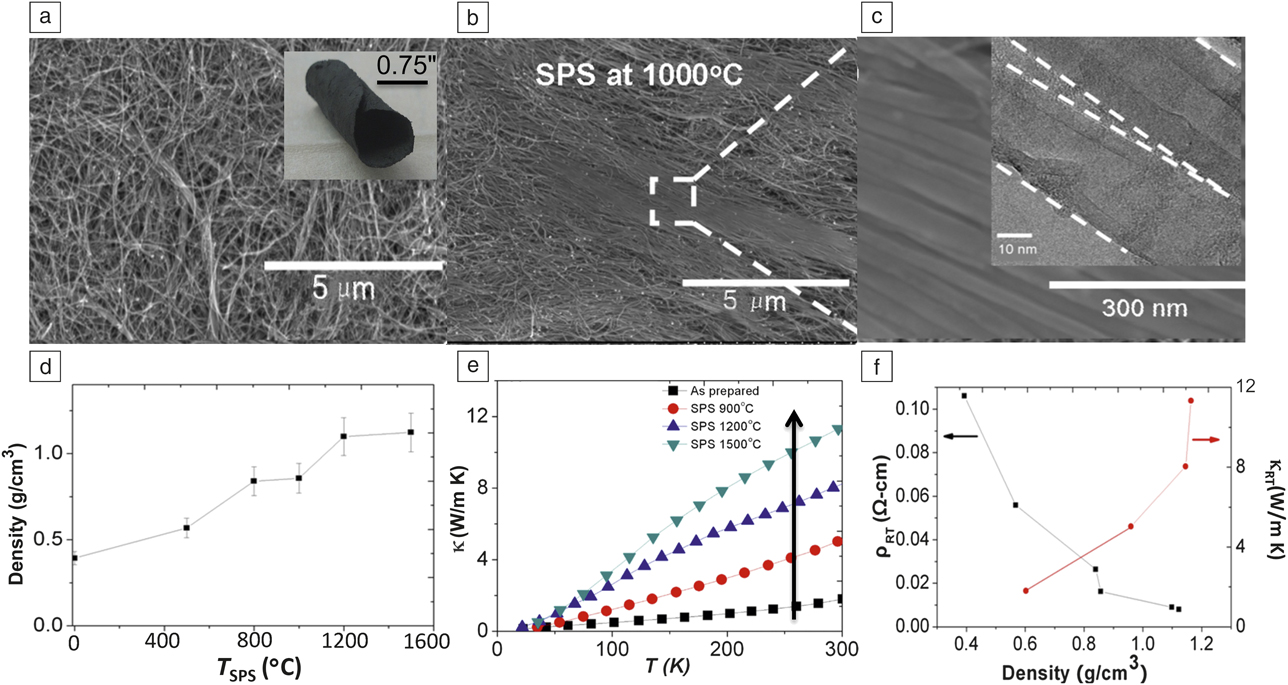
As shown in Figure 2d–f, we observed that the SPS processing temperature (T SPS) provides excellent control of density and intertube interactions and, thereby, improves the electrical and thermal conductivities.Reference Yang, He, Puneet, Su, Skove, Gaillard, Tritt and Rao17,Reference Yang, He, Su, Reppert, Skove, Tritt and Rao18 In addition to the SPS-induced changes in MWCNT density, high-resolution transmission electron microscopy studies indicated that the MWCNTs were locally welded together during the SPS process (inset in Figure 2c), which is expected to provide new percolating paths to electrons and phonons, thereby mitigating intertube junction resistance. Although such intertube welding may be perceived as a structural defect from a lattice-symmetry standpoint, it ultimately improves the electrical and thermal conductivities.
SPS thus is a scalable industrial process for improving the thermal properties of MWCNT ensembles through defect engineering, such as intertubular bonding between neighboring MWCNTs. The direct current (DC) energy in the SPS process, which activates the MWCNT surfaces and welds them together, is often pulsed in a square waveform with a particular ON/OFF ratio of p/q, where DC is ON for p pulses and OFF for q pulses in a total of p + q pulses constituting the total SPS processing time. Previously, we observed that the ON/OFF ratio plays a critical role in welding nanojunctions. In this regard, the SPS process can be further tuned in the future by varying the ON/OFF ratio to efficiently weld the tubes and extinguish anisotropy in thermal conductivity through intertubular bonding to achieve predicted κ > 100 W/(m K) in bulk CNTs.Reference Puneet, Podila, Zhu, Skove, Tritt, He and Rao23
Helically coiled carbon nanotubes in aerospace applications
Many intriguing natural structures gain their functionality through nonlinear complex architectures. For example, biomolecules, including DNA and proteins, adapt nonlinear geometries, particularly spring-like or helically coiled morphologies (such as double-helix, α-coils, or helices) that provide excellent flexibility and yet impart or retain high mechanical strength.Reference Saini, Behlow, Podila, Dickel, Pillai, Skove, Serkiz and Rao25 Building on these blueprints provided by nature, we and others have developed helically coiled carbon nanotubes (HCNTs) to enable elastic memory devices, flexible electronics, impact protection, nanoinductors, and efficient electromagnetic shielding for applications in many fields including aerospace.Reference Saini, Behlow, Podila, Dickel, Pillai, Skove, Serkiz and Rao25–Reference Park, Theilmann, Yang, Rao and Bandaru29
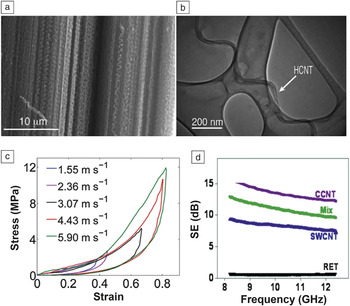
The mechanical properties of bulk HCNT foams, (made up of vertically aligned HCNTs) which originate from their hierarchically organized microstructure characterized by aligned and entangled helical coils of MWCNTs, are of particular interest as structural composites for aerospace applications (Figure 3a–b).Reference Thevamaran, Karakaya, Meshot, Fischer, Podila, Rao and Daraio30 HCNTs act like elastic springs, with their deformation behavior governed by geometric nonlinearity in their spring constants, which is directly (/inversely) proportional to the HCNT diameter (/coil radius). Such geometric nonlinearity in the deformation of the individual HCNTs collectively leads to highly nonlinear and non-Hertzian contact interactions (i.e., mechanical contact interactions where friction cannot be ignored and surfaces are nanostructured and not continuous) with projectiles in HCNT foams, which can efficiently mitigate both low- and high-velocity (0.1–5 m s−1) impact forces (Figure 3c) and fully recover deformation on the order 5 μm (5% strain).Reference Saini, Behlow, Podila, Dickel, Pillai, Skove, Serkiz and Rao25,Reference Thevamaran, Karakaya, Meshot, Fischer, Podila, Rao and Daraio30
(a) Microscopic structure of helically coiled carbon nanotube (HCNT) foams, characterized by vertically aligned bundles of entangled HCNTs. (b) Representative transmission electron microscopy image of an HCNT bundle. Reproduced with permission from Reference Reference Wang, Yang, Gaillard, Bandaru and Rao28. © 2008 Wiley. (c) Dynamic stress–strain responses of HCNT foams subjected to repeated impacts at increasing velocities, showing that HCNT foams can act as excellent impact protection materials with recoveries up to 5% strain. Reproduced with permission from Reference Reference Wang, Yang, Gaillard, Bandaru and Rao28. © 2008 Wiley. (d) Electromagnetic interference shielding efficiency (SE) was observed to be higher for helically coiled CNT foams (labeled CCNT), than for single-walled carbon nanotubes (SWCNTs), a mixture of SWCNTs and multiwalled carbon nanotubes (labeled as Mix), and pure reactive ethylene terpolymer (RET) because of the capacitive coupling between the alternate coils in HCNTs.Reference Ihara, Itoh and Kitakami27 Reproduced with permission from Reference Reference Ihara, Itoh and Kitakami27. © 1993 American Physical Society.

In addition to their excellent mechanical properties, HCNTs exhibit a larger relative dielectric permittivity (ε′), at least twice that of SWCNTs.Reference Park, Theilmann, Yang, Rao and Bandaru29 This increase in ε′ can be explained on the basis of enhanced capacitive coupling between alternate windings/segments of the coils in HCNTs. Because of this increase, the electromagnetic interference (EMI) shielding efficiency of HCNT–reactive ethylene terpolymer composites could be increased by at least 50% over that of SWCNTs (Figure 3d). Like HCNTs, bucky aerogels consisting of BP laminates stitched together by carbon fibersReference Karakaya, Saini, Podila, Skove, Rao, Thevamaran and Daraio31 also exhibit improved impact-protection properties and enhanced EMI shielding because of the capacitive coupling between alternate BP layers.
The National Aeronautics and Space Administration (NASA) has specified risks of exposure to space radiation as one of the most significant factors limiting our ability for long duration space missions. The high chemical and thermal stability of HCNTs, combined with their excellent EMI shielding efficiency, opens new avenues for the use of nanocarbons in space applications. Furthermore, others, as well as our group, previously demonstrated the use of CNT arrays in gas-filled proportional counters Reference Kotani, Kawai, Chiba and Kitamoto32–Reference Kotani, Ueno, Kawai and Kitamoto34 to overcome the problems of low absolute detection efficiency and operational issues in radiation detectors. Such detectors can reach detection efficiencies as low as 10–6%, making it possible for early detection of ionizing and other radiations in space.
Scalable nanomanufacturing of energy-storage devices for aircraft
In commercial and military aircraft, as well as rocket launches, particularly those operating in cold regions, large transient electrical loading requirements are often placed on their batteries to provide so-called cold-cranking power to a starter motor. In many current aircraft, the battery system is often oversized to provide the peak powers demanded by the starter motor. Although batteries have high energy densities, they suffer from poor power delivery rates. The inherently low power densities of batteries result in an induced stress during operation under extreme conditions that worsens as the batteries are cycled multiple times. This induced stress in batteries increases the servicing time and maintenance costs and, more importantly, could lead to undesired electrical problems that can harm aircraft.
Electrochemical supercapacitors use high-surface-area electrodes that inherently have high energy and power densities and can function as “fast batteries.”Reference Arcila-Velez, Zhu, Childress, Karakaya, Podila, Rao and Roberts14,Reference Karakaya, Zhu, Raghavendra, Podila, Parler, Kaplan and Rao35 The increasing power demands of modern electric aircraft and cold-crank auxiliary power units (APUs) necessary to power start the main engines in aircrafts can be addressed by placing supercapacitors in parallel with batteries. The excellent electrochemical stability and high electrical conductivity of CNTs makes them ideal electrodes for supercapacitors. In particular, arrays of vertically aligned multiwalled CNTs (VACNTs) are attractive for supercapacitors because of the ability to control the ion-accessible surface by varying the CNT areal density on growth substrates. VACNT electrodes have been used to achieve high-power-density electrochemical double-layer capacitors (EDLCs).Reference Zhou, Meng, Zhu, Li, Liu, Fan and Jiang36–Reference Chen, Peng, Durstock and Dai38
However, aerospace applications of VACNTs have been limited by the lack of continuous synthesis methods for preparing VACNTs directly on current collectors (e.g., aluminum foil) at relatively low cost. Although CNTs can be synthesized in large quantities, present processes are not amenable for VACNT growth directly on current collectors for scalable manufacturing of EDLC electrodes.
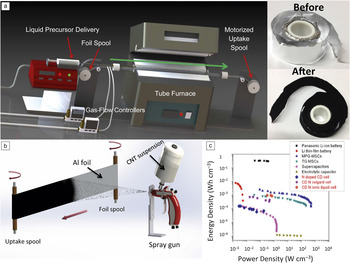
To resolve this challenge, others, and our group, have developed a commercially viable and relatively low-temperature roll-to-roll (R2R) processReference Arcila-Velez, Zhu, Childress, Karakaya, Podila, Rao and Roberts14,Reference Karakaya, Zhu, Raghavendra, Podila, Parler, Kaplan and Rao35,Reference de Villoria, Hart and Wardle39,Reference Huang, Zhang, Zhao and Wei40 for growing VACNTs on inexpensive aluminum-foil current collectors to achieve continuous production of CNT-based supercapacitors (Figure 4a). Our electrochemical studies on VACNTs produced using this R2R method displayed significantly lower contact resistance than traditional activated-carbon supercapacitors.Reference Arcila-Velez, Zhu, Childress, Karakaya, Podila, Rao and Roberts14 More importantly, supercapacitors comprising R2R-produced VACNT electrodes exhibit high power densities (1270 W/kg) and energy densities (11.5 Wh/kg) with no loss in performance over more than 1000 cycles and should be highly suitable for integration with batteries for APUs in aircraft. As an alternative to the R2R process, CNTs can be dispersed into ink form and spray-coated directly onto aluminum foils to achieve supercapacitors with excellent energy and power densities (Figure 4b–c).
(a) Schematic showing the chemical vapor deposition system for roll-to-roll (R2R) production of vertically aligned multiwalled carbon nanotube (MWCNT) supercapacitor electrodes. The insets at right show a spool of kitchen aluminum foil before and after the growth of MWCNTs using the R2R process. Reproduced with permission from Reference Reference Arcila-Velez, Zhu, Childress, Karakaya, Podila, Rao and Roberts14. © 2014 Elsevier. (b) Schematic of a high-throughput spray-coating R2R process that can also be used to scalably manufacture supercapacitor electrodes. Reproduced with permission from Reference Reference Thevamaran, Karakaya, Meshot, Fischer, Podila, Rao and Daraio30. © 2015 Royal Society of Chemistry. (c) R2R electrodes (magenta stars and red hexagons) exhibit higher energy and power densities than traditional electrolytic capacitors (olive-green triangles) and state-of-the-art activated carbon electrodes (pink triangles), but still require further improvements to match the energy density of commercial lithium-ion batteries (black squares). Reproduced with permission from Reference Reference Thevamaran, Karakaya, Meshot, Fischer, Podila, Rao and Daraio30. © 2015 Royal Society of Chemistry.

Conclusions
In this article, we have provided an overview of the possible mechanical, electrical, and thermal uses of carbon nanomaterials in aerospace applications. Major challenges in integrating CNTs in aircraft design have been the lack of (1) an ability to control the properties of CNT ensembles and (2) scalable production methods. However, the SPS method and helical forms of CNTs present solutions to control the thermal and electrical properties of bulk CNT composites, and R2R synthesis of MWCNTS can address the existing manufacturing challenges. With the advent of scalable manufacturing methodologies and improvement of bulk CNT composite properties, one can envision the economically viable incorporation of CNT-based composites in structural, thermal, and electrical applications of interest to the aircraft industry. The development of scalable intertube bonding methods such as SPS, and high thermal conductivity bulk CNT composites is expected to result in lightweight materials that can efficiently dissipate heat as well as shield air and spacecraft from radiation.
Acknowledgments
The authors are thankful to their collaborators Profs. Prabhakar Bandaru (University of California at San Diego), Chiara Daraio (ETH Zurich), Jian He (Clemson University), and Terry M. Tritt (Clemson University) for their support in the mechanical and thermal characterization of CNT materials. Our work on the scalable manufacturing of CNTs was supported by National Science Foundation CMMI Award 1246800. We dedicate this article to the late Dr. A.P.J. Abdul Kalam, who played a pivotal role in the development of ballistic and launch vehicle technologies.