


Introduction
Biotic cosmopolitanism has been documented repeatedly for time intervals in geologic history. Especially for times in the aftermath of mass extinctions, the extirpation of endemic taxa with restricted environmental tolerances and the proliferation of generalist, disaster, or opportunistic taxa have been proposed as the main drivers for cosmopolitanism (Harries et al. Reference Harries, Kauffman, Hansen and Hart1996; Erwin Reference Erwin1998; Brayard et al. Reference Brayard, Bucher, Escarguel, Fluteau, Bourquin and Galfetti2006, Reference Brayard, Escarguel and Bucher2007; Button et al. Reference Button, Lloyd, Ezcurra and Butler2017). For the aftermath of the Permian–Triassic mass extinction (PTME), ca. 251.9 million years ago (Burgess et al. Reference Burgess, Bowring and Shen2014; Baresel et al. Reference Baresel, Bucher, Brosse, Cordey, Guodun and Schaltegger2017), Lystrosaurus (tetrapod), Claraia (bivalve), and small foraminifers are examples of such postulated cosmopolitan taxa (Erwin Reference Erwin1998; Rodland and Bottjer Reference Rodland and Bottjer2001; Petsios and Bottjer Reference Petsios and Bottjer2016; Song et al. Reference Song, Tong, Wignall, Luo, Tian, Song, Huang and Chu2016). However, quantitative tests of changes in species distribution across mass extinctions are rare (e.g., Button et al. Reference Button, Lloyd, Ezcurra and Butler2017). Aside from qualitative descriptions, a quantitative method called “biogeographic connectedness” (BC) has been applied to continental tetrapods after the PTME and did not show any remarkable tetrapod cosmopolitanism (Sidor et al. Reference Sidor, Vilhena, Angielczyk, Huttenlocker, Nesbitt, Peecook, Steyer, Smith and Tsuji2013; Button et al. Reference Button, Lloyd, Ezcurra and Butler2017). Button et al. (Reference Button, Lloyd, Ezcurra and Butler2017) also introduced the new method “phylogeny biogeographic connectedness” and highlighted that the PTME drove terrestrial cosmopolitanism, mainly caused by new widespread taxa during the Early Triassic. Cosmopolitan ammonoid genera were common after the PTME. They dominated the faunal composition during the Griesbachian (e.g., Ophiceras) and the late Smithian (e.g., Anasibirites) (Tozer Reference Tozer, House and Senior1981). Brayard et al. (Reference Brayard, Bucher, Escarguel, Fluteau, Bourquin and Galfetti2006, Reference Brayard, Escarguel and Bucher2007) quantitatively confirmed these two brief episodes of ammonoid cosmopolitanism. Moreover, these authors showed that the rediversification and spatiotemporal distribution of ammonoids during the Early Triassic were likely constrained by successive, marked environmental fluctuations, particularly changes in oceanic temperatures. After Brayard et al.'s (Reference Brayard, Bucher, Escarguel, Fluteau, Bourquin and Galfetti2006, Reference Brayard, Escarguel and Bucher2007) work, which analyzed 181 Early Triassic ammonoid genera, there were 67 new genera erected for the Early Triassic (Brayard and Bucher Reference Brayard and Bucher2008; Brühwiler et al. Reference Brühwiler, Brayard, Bucher and Guodun2008, Reference Brühwiler, Bucher and Goudemand2010b, Reference Brühwiler, Bucher, Goudemand and Galfetti2012a,Reference Brühwiler, Bucher and Krystynb,Reference Brühwiler, Bucher, Ware, Hermmann, Hochuli, Roohi, Rehman and Yaseenc; Shigeta et al. Reference Shigeta, Zakharov, Maeda and Popov2009; Guex et al. Reference Guex, Hungerbühler, Jenks, O'Dogherty, Atudorei, Taylor, Bucher and Bartolini2010; Ware et al. Reference Ware, Jenks, Hautmann and Bucher2011; Brayard et al. Reference Brayard, Bylund, Jenks, Stephen, Olivier, Escarguel, Fara and Vennin2013; Smyshlyaeva and Zakharov Reference Smyshlyaeva and Zakharov2013; Jattiot et al. Reference Jattiot, Bucher, Brayard, Brosse, Jenks and Bylund2017; Jenks and Brayard Reference Jenks and Brayard2018; Ware et al. Reference Ware, Bucher, Brühwiler and Krystyn2018a,b). These recent advances largely improved our knowledge about Early Triassic ammonoid taxonomy and biostratigraphy. However, new quantitative analyses that include the increased generic richness and new occurrences have to be done to validate our previous views on the Early Triassic ammonoid biogeographic patterns.
Unfortunately, the potential mechanisms underlying cosmopolitanism events are poorly known. Three potential explanatory models can be proposed (Fig. 1): (1) selective extinction of endemic taxa, (2) endemic taxa becoming cosmopolitan after the extinction, and (3) newly originated taxa that rapidly became cosmopolitans after an extinction. The three scenarios can independently lead to cosmopolitanism but are not mutually exclusive. To test these models, we compiled an updated dataset on the middle Permian to the Middle Triassic ammonoid spatial and temporal occurrences. We then applied two complementary quantitative methods—BC and Dice index weighted network (DIN)—to address the following questions: (1) Can the previously documented Early Triassic ammonoid cosmopolitanism episodes be detected by our two complementary methods on the updated dataset? (2) To which model(s) can these cosmopolitanism events be attributed? (3) Can we consequently determine whether ammonoid cosmopolitanism events have different mechanisms?
Three models of cosmopolitanism. In model 1, extinction is selective among endemic taxa. The circles represent cosmopolitan taxa that survived. Triangles, squares, and pentagons represent endemic taxa. In model 2, pre-extinction endemic taxa survive and become more cosmopolitan, represented by the squares. In model 3, newcomers are cosmopolitan, indicated by the stars.

Materials and Methods
Data
The ammonoid occurrence dataset includes 831 ammonoid genera from 15 successive time bins spanning from the Roadian throughout to the Ladinian. Ammonoid occurrence data from the Roadian to the Spathian were downloaded from the Paleobiology Database (PBDB) in July 2018. A total of 8864 original occurrences (one species or higher taxonomic rank occurring at one place) were checked. The taxonomy was revised based on previously published classifications (Zhao et al. Reference Zhao, Liang and Zheng1978; Tozer Reference Tozer1994; Leonova Reference Leonova2002; Brayard and Bucher Reference Brayard and Bucher2008, Brühwiler et al. Reference Brühwiler, Bucher, Ware, Hermmann, Hochuli, Roohi, Rehman and Yaseen2012c; Korn et al. Reference Korn, Ghaderi, Leda, Schobben and Ashouri2016; Ware et al. Reference Ware, Bucher, Brühwiler, Schneebeli-Hermann, Hochuli, Roohi, Rehman and Yaseen2018b). The Middle Triassic data were published by Brayard et al. (Reference Brayard, Escarguel, Monnet, Jenks, Bucher, Klug, Kruta, Korn, Mapes and Baets2015) and used directly in this work without modifications. Some recently published work (e.g., Korn et al. Reference Korn, Ghaderi and Tabrizi2019; Jattiot et al. Reference Jattiot, Bucher and Brayard2020), which are still not compiled in the PBDB, were added to our dataset. Unpublished Early Triassic ammonoid data including 52 genera from south Tibet were also included in the analyzed dataset. Occurrence data were compiled at the basin scale, representing 53 basins from the middle Permian to the Middle Triassic (Supplementary Tables S1, S2). Our dataset now contains 265 Early Triassic genera and their respective occurrences.
The biostratigraphic framework used in this work is based on Leonova (Reference Leonova2002), Jenks et al. (Reference Jenks, Monnet, Balini, Brayard, Meier, Klug, Kruta, Korn, Mapes and Baets2015), and Brühwiler et al. (Reference Brühwiler, Bucher, Brayard and Goudemand2010a). Durations of each time bin were calculated using the most recently published U-Pb ages or cyclostratigraphic data (Supplementary Figs. S1, S2). To reveal the impact of the late Smithian crisis on the biogeographic structure of the ammonoid, we adopted the subdivisions (early, middle, and late) proposed by Brühwiler et al. (Reference Brühwiler, Bucher, Brayard and Goudemand2010a) for the Smithian and consequently used in many recent ammonoid studies (e.g., Brayard et al. Reference Brayard, Bylund, Jenks, Stephen, Olivier, Escarguel, Fara and Vennin2013; Jattiot et al. Reference Jattiot, Bucher, Brayard, Brosse, Jenks and Bylund2017). The duration of each Smithian subunit was estimated by the mean of the estimated time duration of ammonoid unitary association zones (Brühwiler et al. Reference Brühwiler, Bucher, Brayard and Goudemand2010a), owing to the current absence of a radiometric age date for the middle/late Smithian boundary.
Methods
Biogeographic Connectedness
Several quantitative methods were used to decipher Early and Middle Triassic ammonoid biogeography, including Q-mode hierarchical clustering, ordination analyses, and bootstrapped spanning networks (Brayard et al. Reference Brayard, Bucher, Escarguel, Fluteau, Bourquin and Galfetti2006, Reference Brayard, Escarguel and Bucher2007, Reference Brayard, Escarguel, Monnet, Jenks, Bucher, Klug, Kruta, Korn, Mapes and Baets2015). In our study, we applied two supplementary network methods, BC (Sidor et al. Reference Sidor, Vilhena, Angielczyk, Huttenlocker, Nesbitt, Peecook, Steyer, Smith and Tsuji2013) and the Dice index weighted biogeographic network (Kivelä et al. Reference Kivelä, Arnaud-Haond and Saramaki2015). The BC result is a numerical value and can directly reflect the overall similarity among studied assemblages (Sidor et al. Reference Sidor, Vilhena, Angielczyk, Huttenlocker, Nesbitt, Peecook, Steyer, Smith and Tsuji2013). A high BC value corresponds to a cosmopolitanism episode, and a low BC value indicates a marked endemism. Dice index weighted biogeographic networks can reveal the similarity of each paired locality and biogeographic province (Kiel Reference Kiel2017). The BC approach is calculated as follows (Sidor et al. Reference Sidor, Vilhena, Angielczyk, Huttenlocker, Nesbitt, Peecook, Steyer, Smith and Tsuji2013):
 $${\rm BC} = \displaystyle{{O-N} \over {\lpar {L\ast N} \rpar -N}}$$
where O is the number of links in the network (the sum of taxon–locality matrix), N is the number of taxa, and L is the number of localities.
When compiling large paleontological synthetic datasets, heterogeneous taxonomic treatments among authors may be a problem. The analyzed dataset has thus been revised based on the most recent systematic and taxonomic publications to avoid such bias. To test this effect, we conservatively removed 10% of genera (genera with uncertain stratigraphic occurrences represent less than 10% in our dataset) randomly in each subdivision with 5000 replicates and calculated the mean estimated BC and associated 95% confidence intervals. To set a sufficient quantity of replicates, we performed 10 to 20,000 replicates on the BC of Wordian ammonoids. The estimated BC value was stabilized after 500 replicates (Supplementary Fig. S3). Thus, 5000 replicates are largely significant for our analyses. To test the effect of the heterogeneous number of sampling locations, we used a jackknife method with 5000 replicates to estimate the BC of each time bin. Resampling experiments were performed in R (see Supplementary Material for respective codes).
Dice Index Weighted Biogeographic Network
Apart from the BC method, we provided a weighted biogeographic network approach based on the Dice similarity index (see Kivelä et al. [2015] for weighted network approach). The Dice index (DI) of each pair of localities is calculated as follows:
 $${\rm DI} = \displaystyle{{2\ast M_{11}} \over {2\ast M_{11} + M_{10} + M_{01}}}$$
In this equation, M 11 is the number of shared taxa between two localities (A, B), M 10 is the number of taxa occurring only at locality A, and M 01 is the number of taxa occurring only at locality B. We prefer DI to other coefficients (e.g., Simpson's and Jaccard's coefficients) due to its double-weighted shared presences, which can better reflect the real similarity between assemblages (Brayard et al. Reference Brayard, Escarguel and Bucher2007; Peybernes et al. Reference Peybernes, Chablais, Onoue, Escarguel and Martini2016). The DI was calculated in PAST v. 3.0 (Hammer et al. Reference Hammer, Harper and Ryan2001). Then, the DI matrix was used in the software EDENetwork (Kivelä et al. Reference Kivelä, Arnaud-Haond and Saramaki2015) to construct the weighted biogeographic network. A threshold method was adapted when reconstructing the links between a pair of localities. Details of this method are available in Kiel (Reference Kiel2017). If the threshold is too high (e.g., 0.9), most basins will be isolated, and the biogeographic structure will be invisible; when the threshold is too low (e.g., 0.1), most basins of the resulting network will be strongly linked. Hence, in this study, we chose an intermediate threshold of 0.5. The higher the similarity is, the stronger the connection is. Finally, the weighted networks were plotted on paleogeographic maps (Scotese Reference Scotese2014). However, the threshold method cannot display all actual connections among each pair of studied basins. Thus, we calculated the average DI of each paired basin of each subdivision to show the overall similarity of all basins.
Results
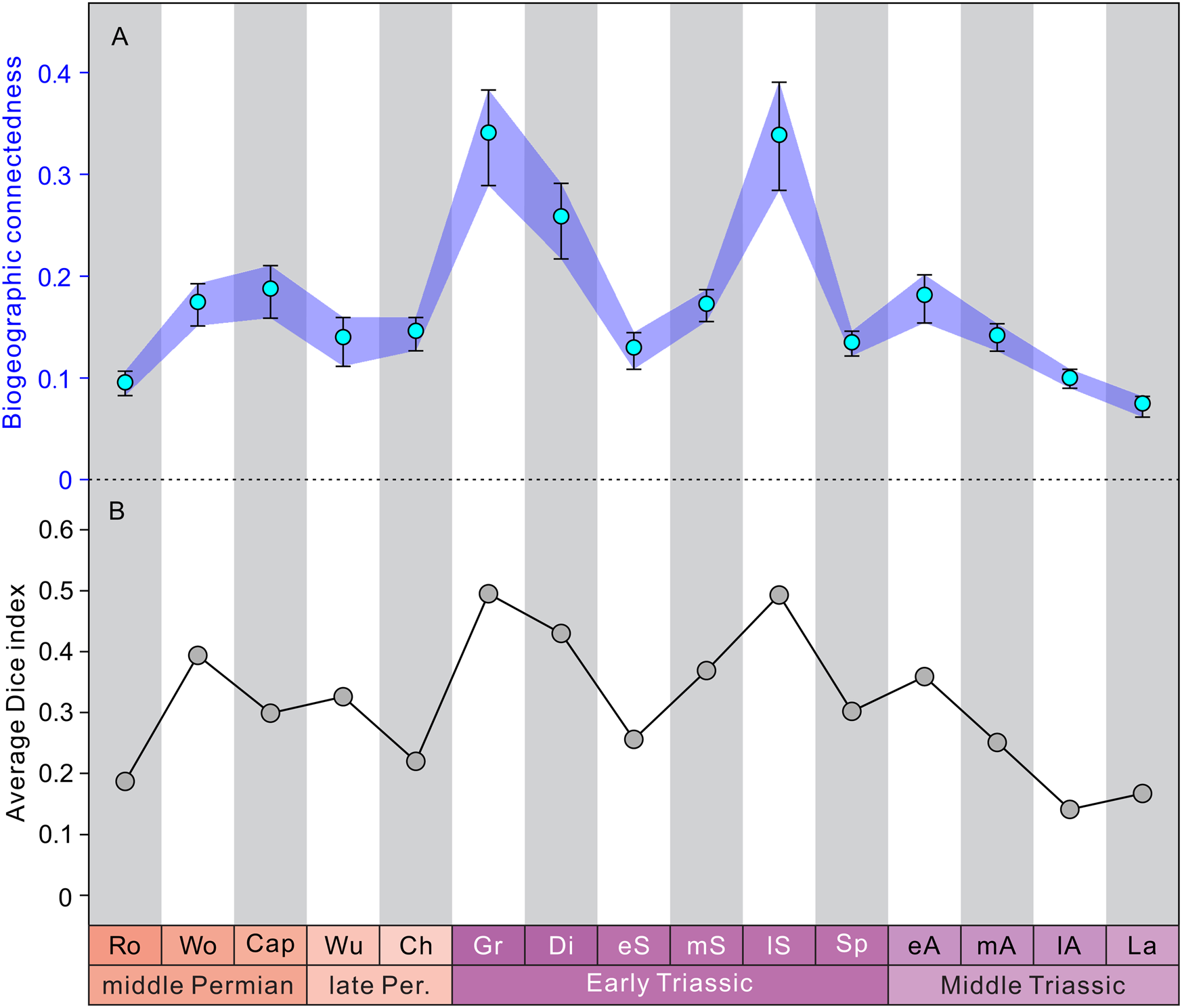
Overall, the BC and DIN results are congruent, showing low BC values associated with a low average DI and a simple DIN exhibiting few internal links (Figs. 2, 3). Conversely, high BC values are associated with a high average DI and a complex DIN displaying numerous links. The BC and DIN results show two remarkable episodes of ammonoid cosmopolitanism in the Griesbachian and the late Smithian, respectively, thus confirming previously documented cosmopolitanism events during these two intervals (Brayard et al. Reference Brayard, Bucher, Escarguel, Fluteau, Bourquin and Galfetti2006, Reference Brayard, Escarguel and Bucher2007). Postmortem transport caused by ocean currents could have theoretically influenced distribution of ammonoids and thus their biogeographic pattern. If it had, then no or little endemism would be recorded, which is not inconsistent with fossil records (Tozer Reference Tozer, House and Senior1981; Brayard et al. Reference Brayard, Bucher, Escarguel, Fluteau, Bourquin and Galfetti2006). Modern observations and experiments on cephalopods document that only highly inflated forms may float after death during long time intervals (Yacobucci Reference Yacobucci2018). However, most ammonoids have conch morphologies, making postmortem transport unlikely (Yacobucci Reference Yacobucci2018).
A, Evolution of ammonoid biogeographic connectedness from the middle Permian to the Middle Triassic (shaded area represents the 95% confidence interval estimated by a resampling method with 5000 runs; sample size is 90% of generic richness of each time bin; see text and Supplementary Material for details). B, Average Dice index of each paired locality of each subdivision. Ro, Roadian; Wo, Wordian; Cap, Capitanian; Wu, Wuchiapingian; Ch, Changhsingian; Gr, Griesbachian; Di, Dienerian; eS, early Smithian; mS, middle Smithian; lS, late Smithian; Sp, Spathian; eA, early Anisian; mA, middle Anisian; lA, late Anisian; La, Ladinian; Per, Permian.

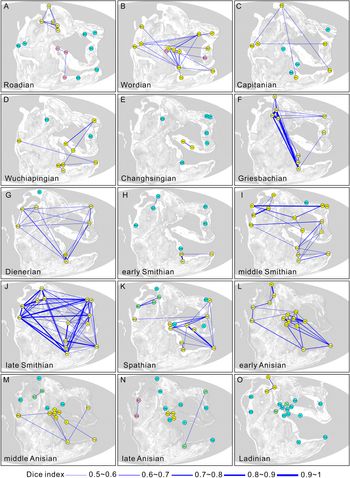
Dice index weighted ammonoid biogeographic network from the middle Permian to Middle Triassic (threshold at 0.5; see text for details). A, Roadian; B, Wordian; C, Capitanian; D, Wuchiapingian; E, Changhsingian; F, Griesbachian; G, Dienerian; H, early Smithian; I, middle Smithian; J, late Smithian; K, Spathian; L, early Anisian; M, middle Anisian; N, late Anisian; O, Ladinian. Abbreviations for each basin: Ab, Albania; AC, Arctic Canada; Af, Afghanistan; Al, Alaska; Ap, Alps; BC, British Columbia; Ca, Caucasus; Ch, Chios; CI, Central Iran; Cr, Crimea; FE, Far East; Gc, Greece; Ge, Germany; Gr, Greenland; Hi, Himalayas; Hu, Hungary; Ik, Irak; Ir, Iran; Is, Israel; It, Italy; JP, Japan; Ki, Kirovsk; Ma, Malaysia; Md, Madagascar; Me, Mexico; Mo, Mongolia; NC, North China; Ol, Olenek; Om, Oman; PA, Pamirs-Afghanistan; Qh, Qinghai; Ru, Rumania; Sb, Spitsbergen; SC, South China; Si, Siberia; Sn, Spain; SP, South Primorye; SR, Salt Range; Tb, Tibet; Te, Texas; Th, Thailand; TI, Transcaucasia-North Iran; Tu, Turkey; Tm, Timor; Tn, Tunisia; Ur, Volga-Ural; Ve, Verkhoyansk; Vi, NE Vietnam; WA, Western Australia; WU, Western USA; Yo, Yogoslavia.

The middle and late Permian ammonoids displayed very simple DINs, showing few links among the Boreal Ocean, the Panthalassa, and the Tethys (Fig. 3A–E). The BC values increase from ~0.1 in the Roadian to ~0.2 in the Capitanian occurrences; they remain almost stable during the late Permian, with a slight decrease at the Capitanian/Wuchiapingian boundary. At the Permian/Triassic transition, a significant increase in the BC from 0.15 to 0.35 can be observed (Fig. 2A). The Changhsingian and Griesbachian DINs thus show a marked change from a weakly connected to a complex similarity network with numerous links among the studied sites and strong links between the Boreal Ocean and the southern Tethys (Fig. 3E,F). The Griesbachian can thus be considered an interval of marked ammonoid cosmopolitanism. Subsequently, the BC values decrease continuously, reaching a minimum in the early Smithian. This trend is paralleled by the DIN, which shows simpler networks and fewer links between the Boreal Ocean and the Tethys (Fig. 3F–H), indicating an increase in biogeographic heterogeneities. The middle Smithian is marked by a new increase in BC values and the complexity of the DIN. Links among the Boreal Ocean, the Panthalassa, and the Tethys also increase (Figs. 2, 3I). This second Triassic increase in cosmopolitanism reaches its maximum in the late Smithian, where the BC value is high and similar to the Griesbachian value (Fig. 2). The late Smithian DIN is also very complex, showing all localities interconnected (Fig. 3J). Like the Griesbachian, the late Smithian is another cosmopolitanism episode owing to the composition of the ammonoid assemblages including very widespread genera (Brayard et al. Reference Brayard, Bucher, Escarguel, Fluteau, Bourquin and Galfetti2006). After the late Smithian cosmopolitanism event, the Spathian assemblages return to lower BC values and a simpler DIN, with the disappearance of links between the Boreal Ocean and the Tethys (Fig. 3K). This substage is thus coeval to a return to marked heterogeneities in ammonoid distributions. Subsequently, the BC reaches a small peak in the early Anisian, coupled with the reemergence of several links among the Boreal Ocean, the Panthalassa, and the Tethys (Fig. 3L), suggesting a small cosmopolitan event. After that time interval, the BC shows a sustained decrease toward the end of the Middle Triassic, corresponding to a simplification of the DIN and to a reduction in links among the Boreal Ocean, the Panthalassa, and Tethys (Fig. 3L–O). Additionally, strong links are observed during the Early Triassic between each side of the Panthalassa, that is, during the Griesbachian, Dienerian, and late Smithian (Fig. 3F,G,J). These short intervals are characterized by a high BC and strongly connected DIN, indicating that long-dispersal ammonoids between each side of the Panthalassa were quite frequent during these periods, confirming the results of previous studies (Brayard et al. Reference Brayard, Bucher, Escarguel, Fluteau, Bourquin and Galfetti2006, Reference Brayard, Escarguel and Bucher2007, Reference Brayard, Brühwiler, Bucher and Jenks2009a; Monnet et al. Reference Monnet, Bucher, Brayard and Jenks2013).
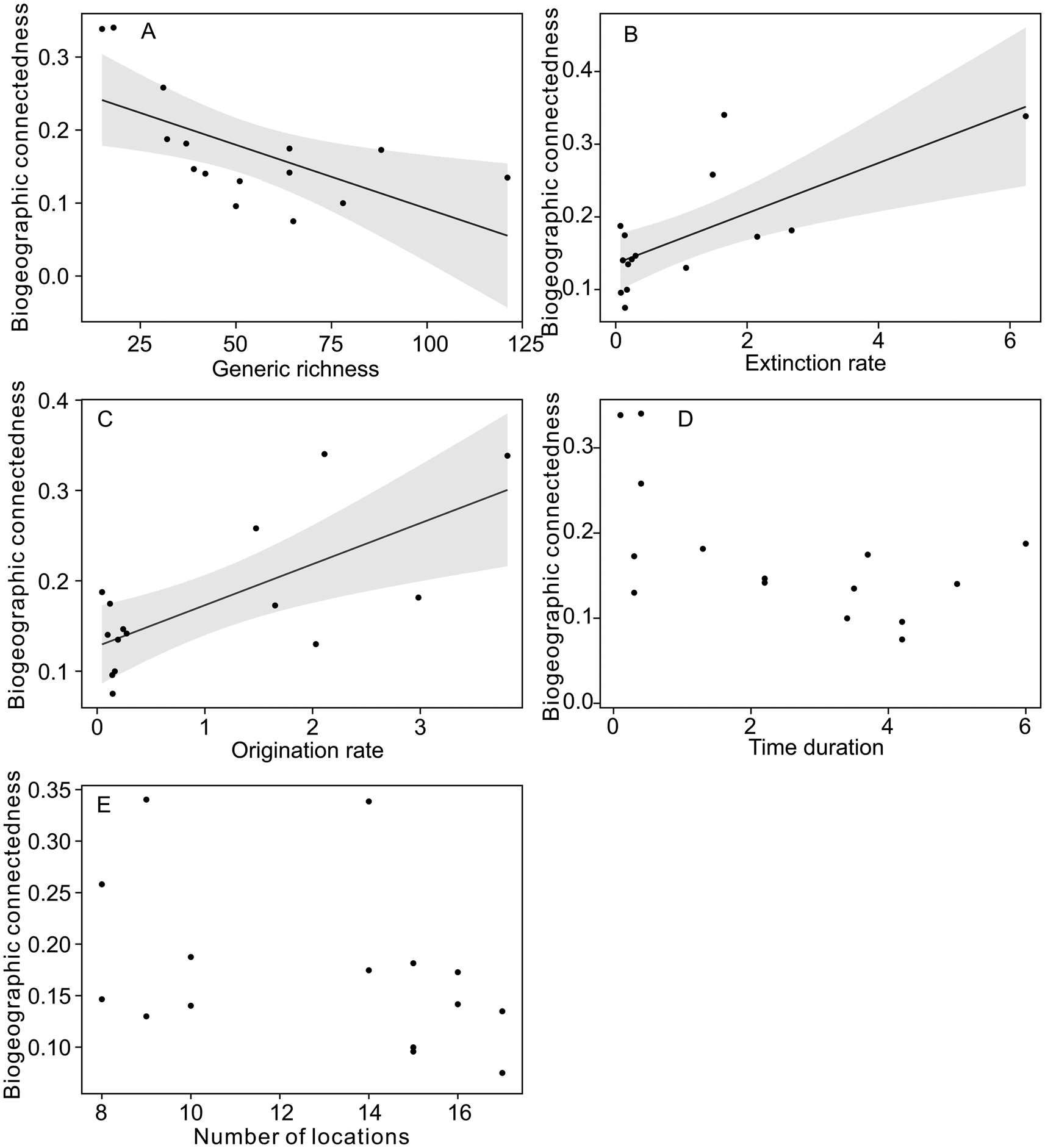
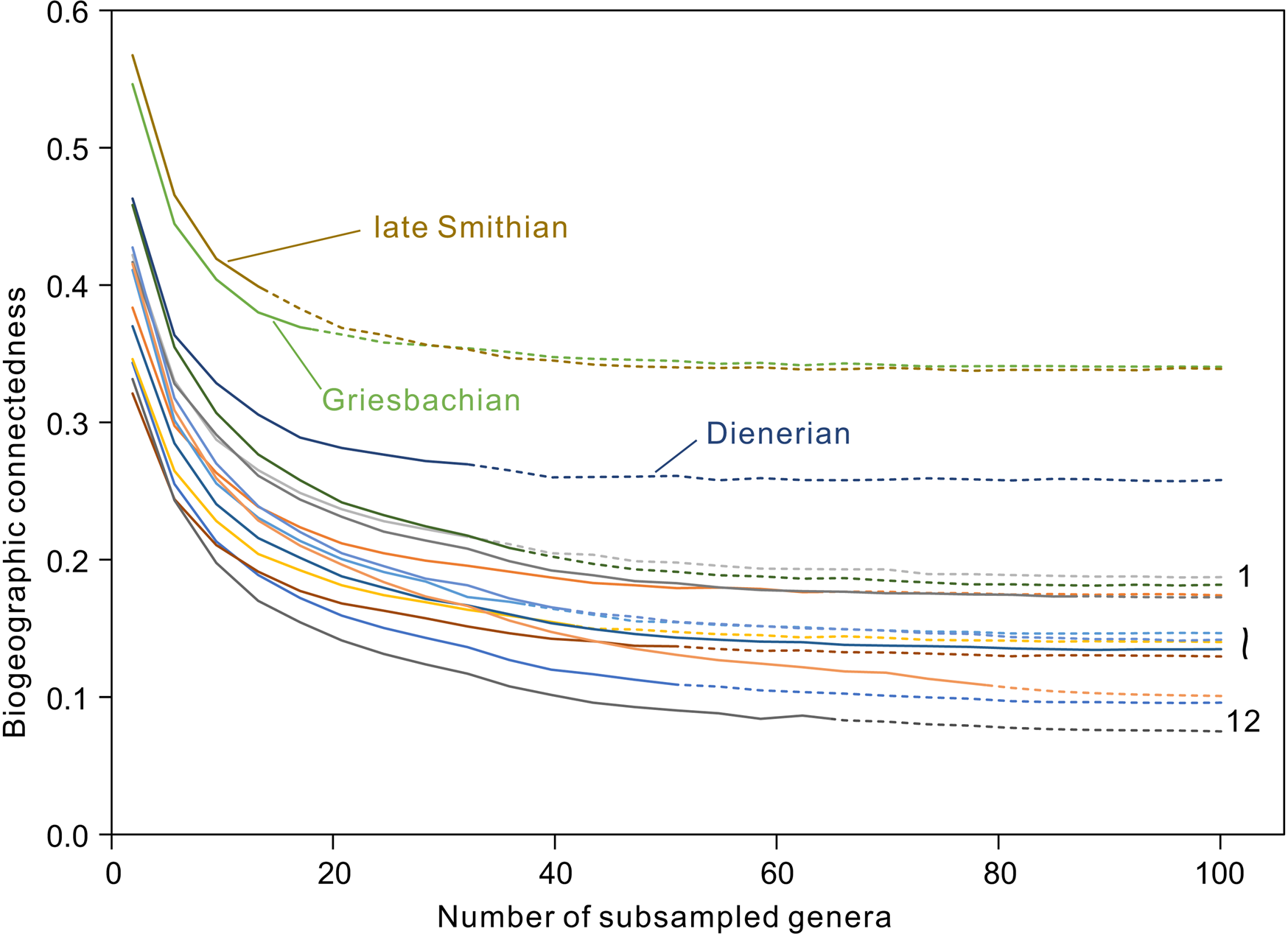
BC values are negatively correlated with generic richness (Fig. 4). Therefore, the calculated high BC values correspond to ammonoid diversity bottlenecks during the Griesbachian and the late Smithian, suggesting that they might be biased by the observed low diversity. Under uniform generic richness, the Griesbachian and late Smithian also have higher BC values than any other time intervals (Fig. 5). Thus, diversity and taxonomic practices did not markedly distort our results. In addition, uneven time subdivisions, as well as the number of studied basins, may have influenced the results. Regression analyses show that the BC values are weakly correlated with the time duration and number of studied basins in each time bin (Fig. 4). This result indicates that the unevenly long time intervals have no or only a very limited effect on the observed results. The uneven number of studied basins also has only a restricted effect on the results. We used the jackknife method to test this effect, and the results are consistent with previous findings (Supplementary Fig. S4).
Regression analysis of biogeographic connectedness (BC) with other parameters. A, Generic richness vs. BC (R = −0.614, p = 0.0148); B, extinction rate vs. BC (R = 0.714, p = 0.0027); C, origination rate vs. BC (R = 0.697, p = 0.0038); D, time duration vs. BC (R = −0.573, p = 0.025); E, number of locations vs. BC (R = −0.388, p = 0.153). Shaded areas represent 95% confidence intervals.

Estimated mean biogeographic connectedness for each time bin using bootstrap replicates. Sampled diversity ranged from 2 to 100 under 5000 replicates. The solid line represents resampled diversity within observed diversity; dashed lines correspond to resampled diversity over observed diversity. 1, Capitanian; 2, early Anisian; 3, Wordian; 4, middle Smithian; 5, Changhsingian; 6, middle Anisian; 7, Wuchiapingian; 8, Spathian; 9, early Smithian; 10, late Anisian; 11, Roadian; 12, Ladinian.

Discussion
Early Triassic Ammonoid Cosmopolitanism Events
Our results highlight two remarkable cosmopolitanism episodes, in the Griesbachian, that is, immediately following the PTME, and in the late Smithian; they thus support the results of previous work (Tozer Reference Tozer, House and Senior1981; Brayard et al. Reference Brayard, Bucher, Escarguel, Fluteau, Bourquin and Galfetti2006, Reference Brayard, Escarguel and Bucher2007, Reference Brayard, Escarguel, Bucher, Monnet, Brühwiler, Goudemand, Galfetti and Guex2009b, Reference Brayard, Escarguel, Monnet, Jenks, Bucher, Klug, Kruta, Korn, Mapes and Baets2015). The increase in the number of described ammonoid genera and of spatial–temporal occurrences for the Early Triassic do not change previously illustrated and discussed biogeographic patterns for this time interval.
Ammonoids were nearly wiped out during the PTME; only three genera survived this crisis (e.g., Brayard et al. Reference Brayard, Escarguel, Bucher, Monnet, Brühwiler, Goudemand, Galfetti and Guex2009b). Patterns of ammonoid biogeographic distributions were totally different between the late Permian and the Griesbachian, with a dramatic BC increase and a shift from a very simple to a complex DIN. However, the biogeographic distribution of the late Permian ammonoids could be influenced by sampling biases, because most of the late Permian ammonoid assemblages are limited to only two regions, that is, south China and Transcaucasian–northwest Iran (Zhao et al. Reference Zhao, Liang and Zheng1978; Korn et al. Reference Korn, Ghaderi, Leda, Schobben and Ashouri2016). The Griesbachian is a time interval with marked cosmopolitanism of ammonoid assemblages. In the Griesbachian, the latitudinal diversity gradient of ammonoids was also very weak, probably resulting from a weak temperature gradient within a globally warm ocean (Brayard et al. Reference Brayard, Bucher, Escarguel, Fluteau, Bourquin and Galfetti2006). A study on marine benthic faunas also showed that the PTME severely reduced their biotic provinciality and triggered whole-scale biogeographic turnover (Kocsis et al. Reference Kocsis, Reddin and Kiessling2018). A similar high cosmopolitanism pattern is also documented for terrestrial tetrapods after the PTME (Button et al. Reference Button, Lloyd, Ezcurra and Butler2017).
The late Smithian crisis caused a marked ammonoid diversity and disparity bottleneck and was paralleled by another ammonoid cosmopolitanism event (Brayard et al. Reference Brayard, Bucher, Escarguel, Fluteau, Bourquin and Galfetti2006, Reference Brayard, Escarguel and Bucher2007, Reference Brayard, Escarguel, Bucher, Monnet, Brühwiler, Goudemand, Galfetti and Guex2009b; Brosse et al. Reference Brosse, Brayard, Fara and Neige2013). Tozer (Reference Tozer, House and Senior1981) qualitatively described the cosmopolitan feature of the late Smithian ammonoid assemblage, which was dominated by prionitids with worldwide distributions (e.g., Anasibirites and Wasatchites). Brayard et al. (Reference Brayard, Bucher, Escarguel, Fluteau, Bourquin and Galfetti2006, Reference Brayard, Escarguel and Bucher2007) applied two quantitative methods (i.e., generic occurrence ratio and bootstrapped spanning networks) to ammonoids from this time interval and confirmed that the late Smithian corresponds to a cosmopolitanism event. A detailed basin-scale analysis of ammonoid assemblages within different facies in the western U.S. basin also demonstrated a marked homogenization during the late Smithian (Jattiot et al. Reference Jattiot, Brayard, Bucher, Vennin, Caravaca, Jenks, Bylund and Escarguel2018). A weak ammonoid latitudinal diversity gradient was also documented for the late Smithian crisis and corresponded to this cosmopolitanism event (Brayard et al. Reference Brayard, Bucher, Escarguel, Fluteau, Bourquin and Galfetti2006). The late Smithian crisis did not markedly delay ammonoid rediversification during the Spathian, when many new ammonoid families (e.g., Dinaritidae, Tirolitidae) appeared and rapidly diversified (Brayard et al. Reference Brayard, Jenks and Bylund2019; Zhang et al. Reference Zhang, Orchard, Brayard, Algeo, Zhao, Chen and Lyu2019). At the Early/Middle Triassic boundary, a slight increase in the BC and a moderately complex DIN can be recognized, potentially reflecting a small cosmopolitanism event. This observation coincides with a severe diversity loss and turnover of ammonoids and a weak ammonoid latitudinal diversity gradient (Brayard et al. Reference Brayard, Escarguel, Bucher, Monnet, Brühwiler, Goudemand, Galfetti and Guex2009b, Reference Brayard, Escarguel, Monnet, Jenks, Bucher, Klug, Kruta, Korn, Mapes and Baets2015; Monnet et al. Reference Monnet, Bucher, Brayard and Jenks2013) and thus likely corresponds to renewed environmental perturbations. The latter is far from well documented (Goudemand et al. Reference Goudemand, Orchard, Bucher and Jenks2012; Chen et al. Reference Chen, Jiang, Ogg, Zhang, Gong and Yan2020). Coinciding with a global regression, carbon isotope excursion, and possible oceanic anoxia (Payne et al. Reference Payne, Lehrmann, Wei, Orchard, Schrag and Knoll2004; Monnet et al. Reference Monnet, Bucher, Brayard and Jenks2013; Muto et al. Reference Muto, Takahashi, Yamakita, Suzuki, Suzuki and Aita2018), the ammonoid family Acrochordiceratidae displayed a sudden and drastic morphological change (“evolutionary jump”) (Monnet et al. Reference Monnet, Bucher, Brayard and Jenks2013). Afterward, the ammonoid BC exhibits a continuous decline, and the DIN becomes simpler, coupled with the emergence of marked latitudinal diversity gradients (Brayard et al. Reference Brayard, Escarguel, Monnet, Jenks, Bucher, Klug, Kruta, Korn, Mapes and Baets2015).
Models for Cosmopolitanism Events
Three theoretical models can be proposed to explain cosmopolitanism events (Fig. 1). Model 1 is a selective extinction against endemic taxa. Cosmopolitan taxa are usually expected to be more resilient to extinction, while endemic taxa are supposed to be more vulnerable to such events (Powell Reference Powell2007; Dunhill and Wills Reference Dunhill and Wills2015). This pattern is pervasive in fossil and extant organisms (Kiessling and Aberhan Reference Kiessling and Aberhan2007; Payne and Finnegan Reference Payne and Finnegan2007; Finnegan et al. Reference Finnegan, Anderson, Harnik, Simpson, Tittensor, Byrnes, Finkel, Lindberg, Liow, Lockwood, Lotze, McClain, McGuire, O'Dea and Pandolfi2015). Large geographic ranges usually promote survivorship during both mass and background extinctions (Powell Reference Powell2007). Selective extinction among endemic taxa can thus lead to surviving taxa with cosmopolitan distributions, generating a cosmopolitanism episode.
Model 2 is a nonselective extinction, and endemic survivors become more cosmopolitan. The nonselective extinction is attributed to the collapse of the association between geographic range and survivorship when widespread environmental perturbations simultaneously affect endemic and cosmopolitan populations and usually happens during mass extinctions (Payne and Finnegan Reference Payne and Finnegan2007; Dunhill and Wills Reference Dunhill and Wills2015). Random extinction will thus result in the survivors’ BC having almost the same value as that of the victims or overall taxa. After the extinction event, the survivors expand their geographic ranges, potentially benefiting from vacant niches caused by extinction, where competition and predation pressures are very low (Harries et al. Reference Harries, Kauffman, Hansen and Hart1996). However, empirical evidence is limited, and at least bivalves and brachiopods do not show ecological release after extinction crises (Antell et al. Reference Antell, Kiessling, Aberhan and Saupe2020).
Model 3 is when newcomers rapidly become cosmopolitan. Postextinction newcomers usually show wide geographic distributions. This phenomenon was documented in terrestrial tetrapods after the PTME and the end-Triassic extinction event (Button et al. Reference Button, Lloyd, Ezcurra and Butler2017).
Regarding ammonoids, their ancestor–descendant relationships are far from well known. Therefore, we simply define survivors in a given time bin as genera ranging from prior time intervals, and newcomers are genera first occurring in the given time interval.
The PTME versus the Late Smithian Crisis
Ammonoids suffered a dramatic diversity decrease during the PTME followed by high cosmopolitan distributions in the aftermath. Furthermore, ammonoids exhibited a slight increase in disparity immediately after the PTME (Villier and Korn Reference Villier and Korn2004). A disparity bottleneck was documented in the subsequent Dienerian substage (McGowan Reference McGowan2004, Reference McGowan2005; Brosse et al. Reference Brosse, Brayard, Fara and Neige2013). The late Smithian crisis caused diversity and disparity bottlenecks of ammonoids (Brayard et al. Reference Brayard, Escarguel, Bucher, Monnet, Brühwiler, Goudemand, Galfetti and Guex2009b; Brosse et al. Reference Brosse, Brayard, Fara and Neige2013; Jattiot et al. Reference Jattiot, Bucher, Brayard, Monnet, Jenks and Hautmann2016; Zhang et al. Reference Zhang, Orchard, Brayard, Algeo, Zhao, Chen and Lyu2019). The different responses in ammonoid disparity to the PTME and the late Smithian crisis suggest that these two extinction events may have had different triggers. Recent work showed that the PTME corresponded to a rapid warming phase, while the late Smithian was characterized by a warming event followed by a severe cooling event (Romano et al. Reference Romano, Goudemand, Vennemann, Ware, Schneebeli-Hermann, Hochuli, Bruehwiler, Brinkmann and Bucher2013; Goudemand et al. Reference Goudemand, Romano, Leu, Bucher, Trotter and Williams2019). As a consequence, the ammonoid cosmopolitanism episodes happening in the PTME and the late Smithian may have had different causes, although climate change likely played a significant role. To better understand the mechanisms underlying these two ammonoid cosmopolitanism phases, we reconstructed the BC of ammonoid survivors and newcomers for each interval (Fig. 6).
Comparison of biogeographic connectedness of survivors, newcomers, and complete dataset. A, At the Permian/Triassic boundary, 95% confidence intervals are indicated by the vertical bar, calculated by resampling (n = 3, without replacement) with 5000 replicates; B, at the middle/late Smithian boundary, 95% confidence intervals are indicated by the vertical bar, calculated by resampling (n = 6) with 5000 replicates. The squares correspond to the complete dataset; the circles represent survivors; the triangles represent newcomers. The asterisk (*) indicates that the number of genera in a subset is insufficient for resampling and thus not included in the resampling experiment.

The PTME was nonselective in terms of biogeographic ranges, as both endemic and cosmopolitan taxa went extinct. During the PTME, only three genera survived (Brayard et al. Reference Brayard, Escarguel, Bucher, Monnet, Brühwiler, Goudemand, Galfetti and Guex2009b). Survivors did not show a higher BC than the overall value of the Changhsingian, but they displayed a significant increase in BC during the Griesbachian, thus supporting model 2 for this event. Changhsingian ammonoid assemblages are known from only a few locations, of which only two regions (i.e., south China and Transcaucasian–northwest Iran region) show diverse ammonoid assemblages (Zhao et al. Reference Zhao, Liang and Zheng1978; Korn et al. Reference Korn, Ghaderi, Leda, Schobben and Ashouri2016). However, the ammonoid composition of the two regions is significantly distinct, with only two shared genera (i.e., Pseudogastrioceras and Neoaganides). The Changhsingian ammonoids therefore exhibit strong endemism but, to some extent, could be biased by sampling effort, because the Changhsingian ammonoids are far from well documented. (Korn et al. Reference Korn, Ghaderi, Leda, Schobben and Ashouri2016). The three surviving genera had a limited geographic distribution during the Changhsingian (Fig. 6). In the Griesbachian, these three ammonoid genera rapidly expanded their geographic ranges. There are 15 newcomers in the Griesbachian, which had a high BC value corresponding to cosmopolitan distributions, for example, Ophiceras and Wordieoceras. A few endemic genera also exist in the Griesbachian assemblages, for example, Jieshaniceras, which has only been reported from south China to date (Brühwiler et al. Reference Brühwiler, Brayard, Bucher and Guodun2008; Dai et al. Reference Dai, Song, Brayard and Ware2019). These results support previous work and show that the association between geographic range size and survivorship can be removed during mass extinctions, as widespread environmental perturbations simultaneously affect both endemic and cosmopolitan taxa (Payne and Finnegan Reference Payne and Finnegan2007; Dunhill and Wills Reference Dunhill and Wills2015). Moreover, the PTME was nonselective regarding ammonoid disparity (Villier and Korn Reference Villier and Korn2004; Korn et al. Reference Korn, Hopkins and Walton2013). The nonselective traits support the global-scale catastrophic causes of the PTME.
Selective survivorship profiting from a wide geographic distribution is pervasive in geologic history, especially during background extinctions and secondary extinctions (Kiessling and Aberhan Reference Kiessling and Aberhan2007; Payne and Finnegan Reference Payne and Finnegan2007; Powell Reference Powell2007; Dunhill and Wills Reference Dunhill and Wills2015). Eight genera crossed the middle/late Smithian boundary, and they had a higher BC than the overall value in the middle Smithian (Fig. 6), indicating selective survivorship. This result may correspond to model 1. Typical representatives of survivors are widely distributed within the middle Smithian, for example, Pseudosageceras and Subvishnuites. However, not all middle Smithian cosmopolitan genera (e.g., Owenites, Paranannites) survived into the late Smithian. Six genera originated in the late Smithian and showed a high BC, corresponding to model 3. These newcomers (e.g., Anasibirites, Wasatchites) are mainly dominated by Prionitidae, which originated during the middle Smithian and flourished in the late Smithian (Tozer Reference Tozer, House and Senior1981; Jattiot et al. Reference Jattiot, Bucher, Brayard, Monnet, Jenks and Hautmann2016).
In summary, the PTME is nonselective among the biogeographic range sizes, and the Griesbachian cosmopolitanism event can be associated with models 2 and 3. In contrast, the late Smithian crisis appears selective, and the late Smithian cosmopolitanism event may be linked to models 1 and 3. These results suggest that the PTME was caused by global-scale environmental disturbances, while the late Smithian crisis was the result of smaller-scale environmental perturbations. Widespread environmental stresses can simultaneously affect both endemic and cosmopolitan taxa. Our results support that the late Smithian crisis was a secondary mass extinction (Stanley Reference Stanley2009) and had a smaller spatial impact on marine ecosystems than the PTME. A quantitative study on the anoxic seafloor area reveals that the late Smithian anoxic area is much smaller than that of the PTME (Zhang et al. Reference Zhang, Romaniello, Algeo, Lau, Clapham, Richoz, Herrmann, Smith, Horacek and Anbar2018). Intriguingly, postextinction newcomers are usually widely distributed. The same case was also documented on continental tetrapods after the PTME and the end-Triassic extinction (Button et al. Reference Button, Lloyd, Ezcurra and Butler2017). One possible explanation is that the newly originated taxa benefit from the empty niches available after mass extinctions (Harries et al. Reference Harries, Kauffman, Hansen and Hart1996; Erwin Reference Erwin1998).
Links between Environmental Disturbances and Cosmopolitanism
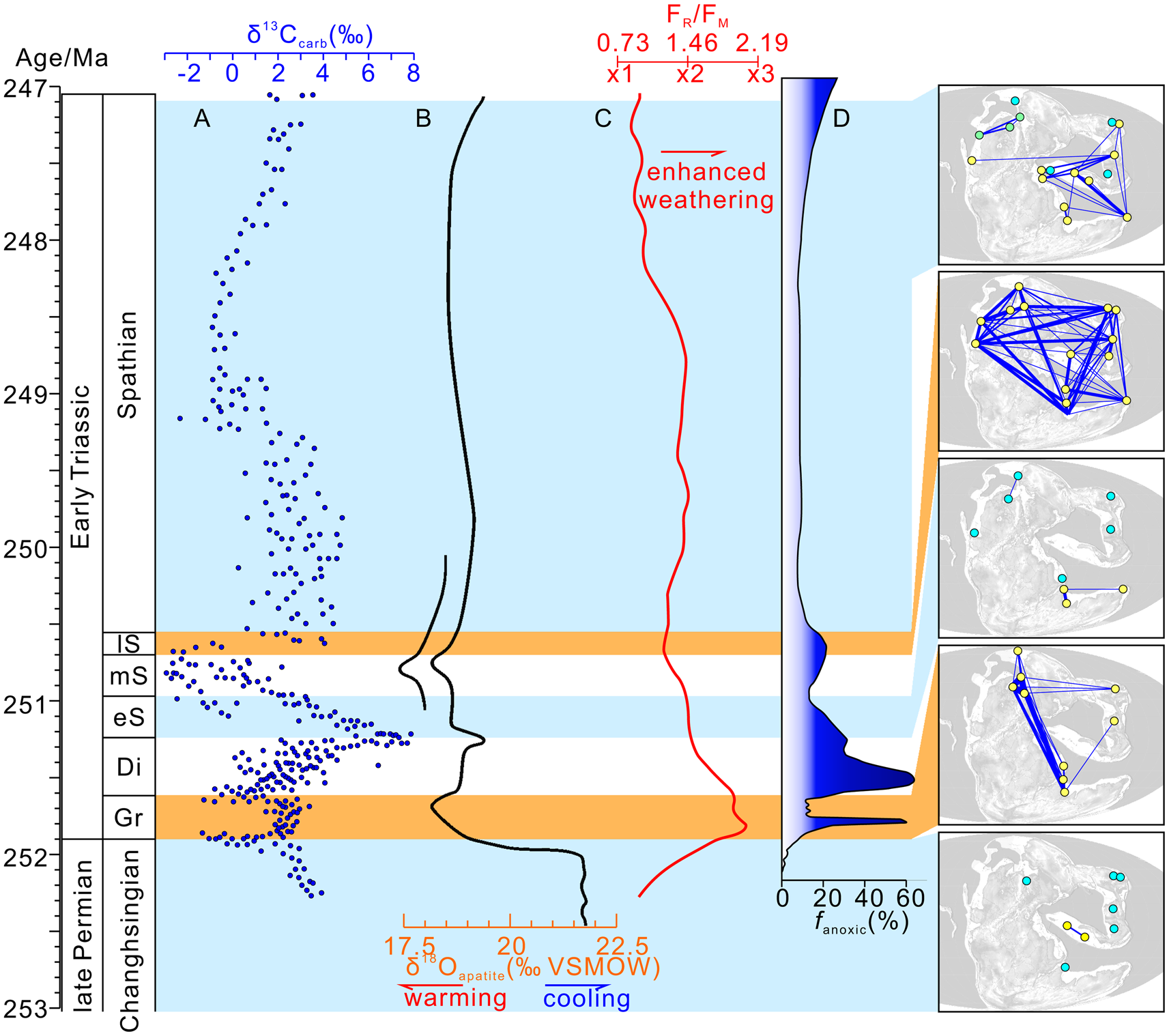
The PTME and the late Smithian crisis are characterized by marked environmental upheavals (Fig. 7), including large, global carbon isotope perturbations (e.g., Payne et al. Reference Payne, Lehrmann, Wei, Orchard, Schrag and Knoll2004; Tong et al. Reference Tong, Zuo and Chen2007), drastic climate changes (Sun et al. Reference Sun, Joachimski, Wignall, Yan, Chen, Jiang, Wang and Lai2012; Romano et al. Reference Romano, Goudemand, Vennemann, Ware, Schneebeli-Hermann, Hochuli, Bruehwiler, Brinkmann and Bucher2013; Schobben et al. Reference Schobben, Joachimski, Korn, Leda and Korte2014), enhanced weathering (Song et al. Reference Song, Wignall, Tong, Song, Chen, Chu, Tian, Luo, Zong, Chen, Lai, Zhang and Wang2015), and oceanic acidification (Clarkson et al. Reference Clarkson, Kasemann, Wood, Lenton, Daines, Richoz, Ohnemueller, Meixner, Poulton and Tipper2015) and anoxia (Bond and Wignall Reference Bond and Wignall2010; Song et al. Reference Song, Wignall, Tong, Bond, Song, Lai, Zhang, Wang and Chen2012; Grasby et al. Reference Grasby, Beauchamp, Embry and Sanei2013; Clarkson et al. Reference Clarkson, Wood, Poulton, Richoz, Newton, Kasemann, Bowyer and Krystyn2016; Zhang et al. Reference Zhang, Romaniello, Algeo, Lau, Clapham, Richoz, Herrmann, Smith, Horacek and Anbar2018). These environmental changes were possibly triggered by the eruption in the Siberian large igneous province (Renne et al. Reference Renne, Zhang, Richards, Black and Basu1995; Galfetti et al. Reference Galfetti, Hochuli, Brayard, Bucher, Weisset and Vigran2007; Burgess et al. Reference Burgess, Muirhead and Bowring2017) and contemporaneous volcanic activity around the Paleotethys Ocean (Yin and Song Reference Yin and Song2013). The relationships between the evolution of sea-surface temperature (SST) and BC values suggest that climatic fluctuations deeply influence ammonoid biogeographic structuring. Modern observations have shown that an ~1°C rise in SST has resulted in rapid homogenization in marine fishes in western Scotland (Magurran et al. Reference Magurran, Dornelas, Moyes, Gotelli and McGill2015). The present-day rapid anthropogenic climate change (e.g., global warming and oceanic acidification) will likely drive a major shift in species’ geographic distributions and lead to biotic homogenization both on land and sea (Burrows et al. Reference Burrows, Schoeman, Buckley, Moore, Poloczanska, Brander, Brown, Bruno, Duarte, Halpern, Holding, Kappel, Kiessling, O'Connor, Pandolfi, Parmesan, Schwing, Sydeman and Richardson2011; Thuiller et al. Reference Thuiller, Lavergne, Roquet, Boulangeat, Lafourcade and Araujo2011; Burman et al. Reference Burman, Aronson and van Woesik2012; Richardson et al. Reference Richardson, Graham, Pratchett, Eurich and Hoey2018). Modern observations show that under thermal stress and oceanic acidification, previously distinct coral fish assemblages became more similar in taxonomic composition and function (Richardson et al. Reference Richardson, Graham, Pratchett, Eurich and Hoey2018). Through the PTME interval, the SST increased rapidly, more than 8°C in ~30 kyr (Joachimski et al. Reference Joachimski, Lai, Shen, Jiang, Luo, Chen, Chen and Sun2012; Sun et al. Reference Sun, Joachimski, Wignall, Yan, Chen, Jiang, Wang and Lai2012; Schobben et al. Reference Schobben, Joachimski, Korn, Leda and Korte2014; Shen et al. Reference Shen, Ramezani, Chen, Cao, Erwin, Zhang, Lei, C, Henderson, Zheng, Bowring, Wang, Li, Wang, Yuan, Zhang, Mu, Wang and Wu2018), coinciding with oceanic anoxia (Bond and Wignall Reference Bond and Wignall2010; Song et al. Reference Song, Wignall, Tong, Bond, Song, Lai, Zhang, Wang and Chen2012; Grasby et al. Reference Grasby, Beauchamp, Embry and Sanei2013; Clarkson et al. Reference Clarkson, Wood, Poulton, Richoz, Newton, Kasemann, Bowyer and Krystyn2016) and acidification (Clarkson et al. Reference Clarkson, Kasemann, Wood, Lenton, Daines, Richoz, Ohnemueller, Meixner, Poulton and Tipper2015). This situation may have extirpated taxa with reduced environmental tolerances and/or modified their geographic ranges and ecological structure (Knoll et al. Reference Knoll, Bambach, Payne, Pruss and Fischer2007; Benton Reference Benton2018; Bernardi et al. Reference Bernardi, Petti and Benton2018; Song et al. Reference Song, Wignall and Dunhill2018, Reference Song, Huang, Jia, Dai, Wignall and Dunhill2020). The observed correlation between environmental disturbances and biotic cosmopolitanism indicates a possible cause and effect relationship. Generalists with expected higher environmental tolerances may have survived and flourished under these stressed environments. A few surviving taxa may have thus occupied the place left behind by many extinct taxa and show homogenized distributions, as mentioned by McKinney and Lockwood (Reference McKinney and Lockwood1999).
Recurrent environmental upheavals during the Early Triassic. Associated ammonoid Dice index weighted network is shown in the right column. A, Carbon isotope data from south China, modified after Payne et al. (Reference Payne, Lehrmann, Wei, Orchard, Schrag and Knoll2004) and Tong et al. (Reference Tong, Zuo and Chen2007). B, Conodont apatite oxygen isotope data modified from Joachimski et al. (Reference Joachimski, Lai, Shen, Jiang, Luo, Chen, Chen and Sun2012), Sun et al. (Reference Sun, Joachimski, Wignall, Yan, Chen, Jiang, Wang and Lai2012), and Schobben et al. (Reference Schobben, Joachimski, Korn, Leda and Korte2014), the time calibration being revised by Zhang et al. (Reference Zhang, Orchard, Brayard, Algeo, Zhao, Chen and Lyu2019). C, Ratio of riverine flux (FR) to mantle flux (FM), from Song et al. (Reference Song, Wignall, Tong, Song, Chen, Chu, Tian, Luo, Zong, Chen, Lai, Zhang and Wang2015). An increase in FR/FM represents enhanced continental weathering. D, Evolution of seafloor anoxic areas (f anoxic) from Zhang et al. (Reference Zhang, Romaniello, Algeo, Lau, Clapham, Richoz, Herrmann, Smith, Horacek and Anbar2018). Gr, Griesbachian; Di, Dienerian; eS, early Smithian; mS, middle Smithian; lS, late Smithian.

From the late early Dienerian (Gyronites frequens beds; Ware et al. Reference Ware, Bucher, Brayard, Schneebeli-Hermann and Brühwiler2015) to the late early Smithian (Radioceras evolvens beds; Brühwiler et al. Reference Brühwiler, Bucher, Brayard and Goudemand2010a), the SST decreases gradually (Romano et al. Reference Romano, Goudemand, Vennemann, Ware, Schneebeli-Hermann, Hochuli, Bruehwiler, Brinkmann and Bucher2013), and ammonoid geographic patterns become more complex. A rapid climate change happened during the late Smithian, from a thermal maximum to a cooling event (Goudemand et al. Reference Goudemand, Romano, Leu, Bucher, Trotter and Williams2019) associated with oceanic anoxia in several places (Grasby et al. Reference Grasby, Beauchamp, Embry and Sanei2013; Song et al. Reference Song, Du, Algeo, Tong, Owens, Song, Tian, Qiu, Zhu and Lyons2019). These late Smithian changes witnessed the second ammonoid cosmopolitanism event.
The latitudinal diversity gradient of Early Triassic ammonoids was suggested to be closely related to SST gradients (Brayard et al. Reference Brayard, Bucher, Escarguel, Fluteau, Bourquin and Galfetti2006). Potentially, hyperthermal events during the PTME and Early Triassic recurrently weakened the latitudinal SST gradient (Black et al. Reference Black, Neely, Lamarque, Elkins-Tanton, Kiehl, Shields, Mills and Bardeen2018), which is one of the main parameters of species range and dispersal (Brayard et al. Reference Brayard, Brühwiler, Bucher and Jenks2009a). In the case of a weakening of the SST gradient, the range size might be expanded, thus enhancing biotic cosmopolitanism. Spatially heterogeneous environmental stresses (e.g., oceanic anoxia and acidification) during the PTME and the late Smithian (Payne et al. Reference Payne, Lehrmann, Wei, Orchard, Schrag and Knoll2004; Song et al. Reference Song, Wignall, Tong, Bond, Song, Lai, Zhang, Wang and Chen2012, Reference Song, Du, Algeo, Tong, Owens, Song, Tian, Qiu, Zhu and Lyons2019; Clarkson et al. Reference Clarkson, Wood, Poulton, Richoz, Newton, Kasemann, Bowyer and Krystyn2016; Zhang et al. Reference Zhang, Romaniello, Algeo, Lau, Clapham, Richoz, Herrmann, Smith, Horacek and Anbar2018; Goudemand et al. Reference Goudemand, Romano, Leu, Bucher, Trotter and Williams2019) may have led surviving ammonoids to rapidly disperse, increasing large-scale faunal similarities.
Conclusions
Three theoretical models were proposed to explain cosmopolitanism events: (1) selective extinction in endemic taxa; (2) pre-extinction endemic taxa becoming cosmopolitan; and (3) increasing numbers of newly originated cosmopolitans. We used an updated dataset containing 831 ammonoid genera from 15 successive time bins spanning the Roadian throughout the Ladinian interval and two network methods to analyze ammonoid biogeographic evolution from the middle Permian to the Middle Triassic. Our results show distinct ammonoid cosmopolitanism episodes during the Griesbachian and late Smithian, respectively, consistent with previous work. We analyzed survivors and newcomers separately and compared them with the overall data. We found that the Griesbachian cosmopolitanism is attributed to expansion of survivors’ geographic distribution (model 2) with an increase in the number of newly originated cosmopolitan genera (model 3), while late Smithian cosmopolitanism resulted from the selective survivorship of cosmopolitan genera (model 1) and the emergence of new cosmopolitan genera (model 3). The PTME is nonselective for biogeographic ranges, while the late Smithian crisis shows selective survivorship among cosmopolitans. This suggests that the PTME is a global-scale crisis and that the late Smithian crisis is a secondary crisis with limited geographic impact. The simultaneity of ammonoid cosmopolitanism and environmental and climate upheavals suggests that environmental perturbations play a significant role in ammonoid cosmopolitanism.
Acknowledgments
We thank A. Brayard for constructive suggestions and D. Ware for useful suggestions on Griesbachian–Dienerian ammonoid taxonomy. We thank D. Korn, W. Kiessling, and an anonymous reviewer for their constructive comments and suggestions. We acknowledge the contributors to the PBDB. This is Paleobiology Database publication number 379. This research was supported by the National Natural Science Foundation of China (41821001, 41622207), the State Key R&D project of China (2016YFA0601100), and the Strategic Priority Research Program of Chinese Academy of Sciences (XDB26000000). The project was supported by the Fundamental Research Funds for National University, China University of Geosciences (Wuhan).