

Executives need a new approach to engaging the external environment. We believe that the best one is to integrate external engagement deeply into business decision making at every level of a company (Browne & Nuttal, 2013: 1).
There is a growing movement toward framing responsibility in terms of a balancing act on the part of organizational leaders. . . .The stakeholder perspective would argue that the needs of each of these [stakeholder] groups or interests need to be balanced in the decision-making and actions of people in positions of organizational leadership (Waldman & Galvin, Reference Waldman and Galvin2008: 330).
The above quotations exemplify the multiplying calls that are voiced by practitioners and scholars alike for a form of responsible leadership that takes into account the concerns of stakeholders, integrating them into corporate decision making. Such integrative responsible leaders are expected to show a broad sense of accountability toward different stakeholder groups whose interests they try to balance and thus focus on delivering to the multiple bottom lines of economic, social, and environmental performance (Maak, Pless, & Voegtlin, Reference Maak, Pless and Voegtlin2016; Patzer, Reference Patzer2009; Pless, Maak, & Waldman, Reference Pless, Maak and Waldman2012).
Research on responsible leadership has proliferated in recent years (Doh & Stumpf, Reference Doh and Stumpf2005; Maak & Pless, Reference Maak and Pless2006, Reference Maak and Pless2009; Miska & Mendenhall, Reference Miska and Mendenhall2015; Pless et al., Reference Pless, Maak and Waldman2012; Siegel, Reference Siegel2014; Stahl & Sully de Luque, 2014; Waldman & Balven, 2014). Much of the literature on the concept focuses on the accountability that different stakeholder groups expect leaders to demonstrate (Maak & Pless, Reference Maak and Pless2006; Voegtlin, Patzer, & Scherer, Reference Voegtlin, Patzer and Scherer2012). While there is no clear consensus on the nature and scope of a business leader’s responsibility, the various competing perspectives can be positioned alongside two primary dimensions (Miska, Hilbe, & Mayer, Reference Miska, Hilbe and Mayer2014; Pless et al., Reference Pless, Maak and Waldman2012; Waldman & Galvin, Reference Waldman and Galvin2008; Waldman & Siegel, Reference Waldman and Siegel2008): the scope of relevant stakeholders (with a focus on either shareholders or a broader group of stakeholders) and the scope of corporate objectives (with a focus on either profitability or a broader set of economic, social, and environmental objectives). Instrumental approaches to responsible leadership argue for a singular focus on the expectations of shareholders and emphasize the obligation to pursue financial objectives (Friedman, Reference Friedman1970; Waldman & Siegel, Reference Waldman and Siegel2008). A growing part of the literature favors a broader scope of responsibility alongside both dimensions and advances the idea that responsible leadership means essentially making the concerns of different stakeholders and competing economic, social, and environmental objectives an integrative part of the corporate decision-making process (integrative leadership) (e.g., Doh & Quigley, Reference Doh and Quigley2014; Maak et al., Reference Maak, Pless and Voegtlin2016; Pless et al., Reference Pless, Maak and Waldman2012).
However, the current debate around these integrative approaches to responsible leadership faces two limitations: First, it does not fully consider the developments of current social transformation processes. While responsible leadership research acknowledges that economic globalization, along with the growing heterogeneity of social norms and lifestyles, acts as a driver for the demand for integrative responsible leadership (Maak et al., Reference Maak, Pless and Voegtlin2016; Voegtlin et al., Reference Voegtlin, Patzer and Scherer2012), it does not yet take into consideration the implications of the emerging new nationalism, populism, and religious or political fundamentalism that can currently be observed (Emerson & Hartman, Reference Emerson and Hartman2006; Kaltwasser, Taggart, Espejo, & Ostiguy, Reference Kaltwasser, Taggart, Espejo and Ostiguy2017; Scherer, Rasche, Palazzo, & Spicer, Reference Scherer, Rasche, Palazzo and Spicer2016; Wodak, Khosravinik, & Mral, Reference Wodak, Khosravinik and Mral2013). These developments pose significant challenges that business leaders will be facing in the future. The integration of a diverse and multicultural workforce in MNCs, the socialization of foreign specialists, the treatment of minorities and different ethnicities, or the response to issues of discrimination based on sex, age, nationality, religion, or other factors, will become increasingly difficult in an environment that is characterized by a hardening of national identities and political ideologies (Scherer et al., Reference Scherer, Rasche, Palazzo and Spicer2016).
We will argue that the various leadership concepts such as instrumental responsible leadership and integrative responsible leadership are not merely analytical distinctions (Miska et al., Reference Miska, Hilbe and Mayer2014; Waldman & Galvin, Reference Waldman and Galvin2008; Waldman & Siegel, Reference Waldman and Siegel2008), but can be interpreted as responses to historical societal conditions and changes in the corporate environment. More specifically, we propose that the justification of instrumental responsible leadership emerged as a consequence of the development of modern society and its differentiation into societal subsystems (Habermas, Reference Habermas1984, Reference Habermas1987; Luhmann, Reference Luhmann1995; Parsons, Reference Parsons, Parsons, Shils, Naegle and Pitts1961), including the economic and the political system. The call for integrative responsible leadership, in turn, becomes more prevalent in the current transformation of modern society toward a postmodern society (Beck, Reference Beck2000; Habermas, Reference Habermas2001a; Scherer et al., Reference Scherer, Rasche, Palazzo and Spicer2016). Within the latter, we further distinguish between the developments Habermas (Reference Habermas2001a) described under the term “post-national constellation” (which we label “post-national constellation 1.0”) and more recent developments Scherer et al. (Reference Scherer, Rasche, Palazzo and Spicer2016) have termed the “post-national constellation 2.0.” We argue, that in order to develop a deeper understanding of what integrative responsible leadership means, it is necessary to reconstruct it from a historical perspective. This reconstruction will help us forward an understanding of integrative responsible leadership that better reflects the current requirements for social integration than previous approaches, especially in light of the most recent developments toward a post-national constellation 2.0 (Scherer et al., Reference Scherer, Rasche, Palazzo and Spicer2016).
Second, the term “integrative,” as it is used in extant literature on responsible leadership, is often restricted to the mere engagement with stakeholders, rather than having a specific focus on social integration (Maak & Pless, Reference Maak and Pless2006; Maak et al., Reference Maak, Pless and Voegtlin2016). As such, the literature lacks a discussion on how social integration may become possible. Research does not specify a form of dialog or cooperation that would create morally binding outcomes for all stakeholders involved in the process. Moreover, integrative responsible leadership is often merely advocated as a means to avoid potentially negative consequences for the organization and not as a means to create a foundation of shared norms and values, which we argue is necessary to solve the pressing problems accompanying current societal transformation processes. We propose a discourse-ethically extended understanding of integrative responsible leadership (Habermas, Reference Habermas1996) and base our idea of integration on Habermas’s (1987) understanding of a process that produces and perpetuates the norms and values of a shared lifeworld, i.e., the common practices that provide meaning and guidance for social action (Habermas, Reference Habermas1987). We extend current research by proposing that responsible leadership requires “values work” (Gehman, Trevino, & Garud, Reference Gehman, Trevino and Garud2013; Vaccaro & Palazzo, Reference Vaccaro and Palazzo2015), i.e., initiating and guiding discourses about the values of good business conduct.
In order to move the debate on integrative responsible leadership forward, the present article draws on Habermas’s social theory and his observations on processes of societal transformation (Habermas, Reference Habermas1984, Reference Habermas1987, Reference Habermas2001a). Even though Habermas’s works have been widely discussed in management studies and business ethics (see e.g., Fryer, Reference Fryer2012; Raelin, Reference Raelin2013; Scherer, Reference Scherer, Alvesson, Willmott and Bridgman2009; Scherer & Palazzo, Reference Scherer and Palazzo2007; Scherer, Palazzo, & Baumann, Reference Scherer, Palazzo and Baumann2006; Stansbury, Reference Stansbury2009; Stansbury & Barry, Reference Stansbury and Barry2007; Steffy & Grimes, Reference Steffy and Grimes1986) implications for responsible leadership have only recently become subject to analysis (for exceptions, see Voegtlin et al., Reference Voegtlin, Patzer and Scherer2012).
This article thereby contributes to research on philosophical approaches to leadership ethics. While many normative approaches to leadership ethics focus on the ethics of the leader and the leader–follower relationship process (Ciulla, Reference Ciulla1995, Reference Ciulla1998; Fryer, Reference Fryer2012; Moore, Reference Moore2008; Raelin, Reference Raelin2013; Solomon, Reference Solomon1992; Tomkins & Simpson, Reference Tomkins and Simpson2015), they often neglect the broader societal context of leadership. We specifically take this context into account in that we seek to answer how integrative responsible leadership can help remedy the negative consequences of the societal transformation processes accompanying postmodern society (Habermas, Reference Habermas2001a; Scherer et al., Reference Scherer, Rasche, Palazzo and Spicer2016).
One of these challenges for social integration we discuss in the article is the recent European migration crisis. The migration crisis, and the nationalist movements that emerge in its wake, have severe implications for “the inclusion of the other” (Habermas, Reference Habermas1998), i.e., individuals that do not fit with the dominant ideology and value base or who do not have the same ethnicity, religion, or citizenship. It requires discourses about the respectful treatment of such “others” when working in contexts with hardening identities. Moreover, these others are an important pool of talent that business should be in need of when trying to stay competitive.
Dieter Zetsche, chairman of the German automobile company Daimler, explained in the media the need for integrating foreign workers when he said that “they are exactly the people we need . . . they could, like the guest workers from decades ago, help us preserve and improve our prosperity” (see Pancevski, Reference Pancevski2015). Similar responses of such integrative responsible leadership can be observed with regard to the immigration ban the Trump Administration launched in the US immediately after Trump was elected as president, where, for instance, Starbucks CEO Howard Schultz publicly announced plans to employ 10,000 refugees over the next five years (New York Times, 2017). We argue that it is a specific obligation of integrative responsible leadership to engage in such discourses about the values of a shared lifeworld and discuss the implications for integrative responsible leaders in light of these challenges.
The article is structured as follows. In the first part, we reconstruct the changing expectations that scholars and practitioners have about the purpose of leadership alongside the transition from modernity to a postmodern society. We start by introducing Habermas’s (1984, 1987) social theory on the differentiation of modern society as a helpful heuristic for this analysis. In the second part, we develop an understanding of integrative responsible leadership that is based on Habermas’s (1984) distinction of strategic and communicative action and argue that responsible leaders need to display both actions. We discuss the interplay between strategic and communicative action and specify how and when leadership should resort to communicative action. We thereby emphasize the relevance of engaging as an integrative responsible leader in discourses about values and explicate the implications of such values work. The article discusses the challenges for the integrative responsible leader. We conclude with theoretical implications and future research directions.
THE IMPLICATIONS OF SOCIETAL TRANSFORMATION PROCESSES FOR RESPONSIBLE LEADERSHIP
Introducing Habermas’s Social Theory
Based on works in social theory by Schütz, Husserl, Weber, Parsons, and Luhmann, among others, Habermas distinguishes between two main spheres of modern social life: the “lifeworld” and the “system,” each of which has its own specific logic and function for social integration (Habermas, Reference Habermas1987). The lifeworld comprises the informal, unregulated, and unmarketized domains of social life: family, culture, and political life outside organized political parties and institutionalized politics (Finlayson, Reference Finlayson2005; Habermas, Reference Habermas1987). As “the medium of the symbolic and cultural reproduction of society” (Finlayson, Reference Finlayson2005: 53), the lifeworld encompasses the stock of assumptions, understandings, knowledge, and values the members of society share (Habermas, Reference Habermas1987). This property makes the lifeworld the primary medium of social integration. The background assumptions of the lifeworld, to which individuals refer often unconsciously, are not stable, but are in flux and change. Social integration thereby functions as both the process of socializing new members into the community and as the process of reproducing but also changing the shared norms and values of a community. However, the changes of these shared assumptions can only occur when people communicate, i.e., when they reach consensus on which modified values or norms they wish to adhere to as a social group or community (Habermas, Reference Habermas1987). As a consequence, Habermas (Reference Habermas1987) argues that the lifeworld is the locus of communicative action. Habermas (1984: 285-286) speaks of communicative action “whenever the actions of the agents involved are coordinated not through egocentric calculations of success but through acts of reaching understanding.”
The system complements the lifeworld as a coordinating mechanism for society (Habermas, Reference Habermas1987; Scherer, Reference Scherer, Alvesson, Willmott and Bridgman2009). In order to cope with the increasing complexity of social life, modern society differentiates into subsystems that specialize on certain societal functions and collective steering tasks: economy, politics, science, religions, arts, etc. These subsystems operate according to distinct systemic logics—that is, profit for the economy, power for politics, truth for science, beliefs for religions, aesthetics for arts, etc. In systemic coordination, the steering mode is no longer based on the communicative understanding among individuals who refer to shared traditions and moral norms. Instead, communicative understanding is replaced by the restrictions and incentives of the subsystems that guide human action and condition individual choices (Habermas, Reference Habermas1987; Luhmann, Reference Luhmann1995; Scherer, Reference Scherer, Alvesson, Willmott and Bridgman2009). Societal subsystems are governed by the efficient choice of means for given objectives and thus build on an instrumental rationality (Habermas, Reference Habermas1984, Reference Habermas1987).
Because we focus on business organizations, we are mainly interested in the economic subsystem. Its primary function is to ensure the material reproduction of society by coordinating the production and distribution of goods and services (Habermas, Reference Habermas1987). Coordination is achieved through strategic action. According to Habermas, strategic action “involves getting other people to do things as a means to realizing one’s own ends” (Finlayson, Reference Finlayson2005: 48). The aim of strategic action is to promote the interests of the actor. Strategic action differs from communicative action, in that the latter aims at reaching a mutually agreed upon understanding among different actors through an open, egalitarian, and cooperative discourse (Habermas, Reference Habermas1984).
Individuals can switch between strategic and communicative action, depending on the situation and their intention (Habermas, Reference Habermas1984). Recent economic research supports this argument in that it shows that individuals alternate between cooperative and competitive behavior, depending on situational cues (see e.g., Fehr & Fischbacher, Reference Fehr and Fischbacher2003; Kahneman, Reference Kahneman2011; Liberman, Samuels, & Ross, Reference Liberman, Samuels and Ross2004). For instance, in an experiment using the classical prisoner’s dilemma game, cooperation significantly increased among participants who were simply told they are playing the “community game” as opposed to participants who were told they are playing the “Wall Street game” (Liberman et al., Reference Liberman, Samuels and Ross2004).
While strategic action is aimed at “the efficacy of influencing the decisions of a rational opponent” (Habermas, Reference Habermas1984: 285), the goal of communicative action is to reach consensus. In order for communicative action to reach consensus and thereby unfold its function of creating morally binding decisions for the lifeworld, it is bound to certain conditions. The basic conditions for an ideal discourse as defined by Habermas in his theory on discourse ethics include that participation in the discourse is open to all affected parties and that there is an egalitarian balance of power between participants (Habermas, Reference Habermas1996). Moreover, Habermas’s idea of communicative rationality implies that the participants in a discourse can justify their position by referring to normative contexts (Habermas, Reference Habermas1996), i.e., by offering the other participants good, convincing reasons for the views they hold.
In his theory of deliberative democracy, Habermas (Reference Habermas1998, Reference Habermas2001b) extends the concept of discourse ethics and reflects on how communicative action can become institutionalized in order to guarantee the stability of society and the legitimacy of social rules and institutions. The main aspect of deliberative democracy is the institutionalization of discourses as procedures of the political will-formation process (Habermas, Reference Habermas1998, Reference Habermas2001b). The democratic processes through which public opinion and will are formed are thereby expressed not only through elections and parliamentary processes but also through the broader political engagement of an informed and engaged public society in public discourses (Habermas, Reference Habermas1998).
Habermas (Reference Habermas1987) argues that the shared assumptions of the lifeworld and their coordination through communicative action are more fundamental than, for instance, predefined corporate goals and should take precedence over the system and the orientation to strategic action, because only through consensus in the lifeworld can the goals of the system be justified or redefined. This extends also to everyday workplace situations, where agreement about norms of good conduct should precede individuals’ strategic plans.
Responsible Leadership in Modern Society
Leadership in business organizations as part of the economic system has a bias toward strategic action. This is reflected in the common definitions of leadership in the literature, according to which leadership is the process of influencing others to accomplish business objectives (Yukl, Reference Yukl2013: 19). The implicit or explicit assumption in most leadership research is that the purpose of leadership is to “influence, motivate and enable employees to contribute toward the effectiveness and success of the organization” (House et al., Reference House, Hanges, Ruiz-Quintanilla, Dorfman, Javidan, Dickson, Mobley, Gessner and Arnold1999: 184, cited in Yukl, Reference Yukl2013: 19; for a critical debate about such an understanding of leadership, see e.g., Alvesson & Spicer, Reference Alvesson and Spicer2012, Reference Alvesson, Spicer and Day2014; Fairhurst & Grant, Reference Fairhurst and Grant2010; Knights & McCabe, Reference Knights and McCabe2015; Tourish, Reference Tourish2014). In modern society, there is a fairly clear differentiation between societal subsystems that focus on particular functions (Scherer, Reference Scherer, Alvesson, Willmott and Bridgman2009). For example, the political subsystem’s purpose is to generate common rules, while the economic system’s purpose is to produce and distribute goods. This implies that business organizations, as actors in the economic system, do not assume political roles and state authorities do not do business (for a critical analysis, see Scherer & Palazzo, Reference Scherer and Palazzo2007, Reference Scherer and Palazzo2011). After the Westphalia Peace Treaty in 1648 the modern nation state became the focal entity in the development of modern society (Falk, Reference Falk2002). Nation states provide the regulations and institutions (e.g., property rights, contract law, tort law) that are necessary for the economic system to function, allowing business firms to pursue their primary purpose of maximizing profit without creating too many externalities that are negative for society (see, e.g., Sundaram & Inkpen, Reference Sundaram and Inkpen2004). Rather, it is the state system that compensates for externalities and protects the interests of third parties with laws and regulations.
Instrumental, shareholder-oriented leadership is connected to the functioning differentiation of modern society. The initial idea of the responsible businessman that emerged around the 1950s in the US was associated with philanthropy (Bowen, Reference Bowen1953; Carroll, Reference Carroll1991, Reference Carroll1999), often in the form of private donations by business leaders (Mizruchi & Marshall, Reference Mizruchi and Marshall2016). It was not questioned how profits were made as long as leaders invested a part of their profits to help the communities in which they were doing business. Public expectation of the responsibility of leaders was to follow the law and the moral expectations of a society confined by nation-state borders (Carroll, Reference Carroll1991, Reference Carroll1999; Friedman, Reference Friedman1970).
Thus, in this conception of modern society it appears prima facie unnecessary to challenge the purpose of leadership as a process of strategic influence that helps organizations achieve performance goals, because the shared traditions and norms of the lifeworld and the regulations of nation-state governance provide the boundary conditions for responsible business behavior (Friedman, Reference Friedman1970; Sundaram & Inkpen, Reference Sundaram and Inkpen2004). As a consequence, leadership scholars who implicitly build on this functioning differentiation of society focus primarily on instrumental understandings of leadership and the responsibilities it involves, and search for the most efficient ways in which leaders can convince employees to commit to corporate goals (e.g., through motivating them, transforming to become even better employees, etc.; Bass & Avolio, Reference Bass and Avolio1994; Dulebohn, Bommer, Liden, Brouer, & Ferris, Reference Dulebohn, Bommer, Liden, Brouer and Ferris2012; Shamir, House, & Arthur, Reference Shamir, House and Arthur1993). This is also reflected in Rost’s (1991) differentiation between the “industrial” and “post-industrial” paradigm of leadership research. The former reflects 18th-century liberal philosophy and has
a structural-functionalist view of organizations, … a view of management as the pre-eminent profession, … a personalistic focus on the leader, … a dominant objective of goal achievement, … a self-interested and individualistic outlook, … a male model of life, … a utilitarian and materialistic ethical perspective, and … a rational, technocratic linear, quantitative, and scientific language and methodology (Rost, Reference Rost1991: 180).
Recent research has addressed the ethics of leadership in greater depth (Bass & Steidlmeier, Reference Bass and Steidlmeier1999; Brown & Trevino, Reference Brown and Trevino2006; Ciulla, Reference Ciulla2005; van Dierendonck, Reference van Dierendonck2011). Several works on leadership ethics argue that good leadership has a managerial as well as a moral dimension and that, as a consequence, it needs to be not only efficient but also ethical (for an overview, see Ciulla, Reference Ciulla1998, Reference Ciulla2005). The idea that ethics lies within every human interaction leads to the argument that ethics is “at the heart of leadership” (Ciulla, Reference Ciulla1995, Reference Ciulla1998). In her seminal work, Ciulla mapped the territory of leadership ethics and came to the conclusion that “leaders are often morally disappointing” (Ciulla, Reference Ciulla1995: 5) and not the heroes we make them out to be. The integrity, values, and virtues of leaders who pursue organizational performance goals and the implications of ethical leadership have since been studied both from a normative and a social scientific perspective (e.g., Brown & Mitchell, Reference Brown and Mitchell2010; Brown, Trevino, & Harrison, Reference Brown, Trevino and Harrison2005; Moore, Reference Moore2008; Solomon, Reference Solomon1992; Waddock, Reference Waddock2007). However, this body of research treats the functional differentiation of modern society as given and static, rather than as something dynamic that may change as the societal context changes. As a consequence, scholars see no need to burden leaders with the responsibility for societal issues and the relevant literature focuses mainly on the intra-organizational challenges of good leadership (Patzer & Voegtlin, Reference Patzer, Voegtlin, Todnem and Burnes2013; Voegtlin, Reference Voegtlin2016).
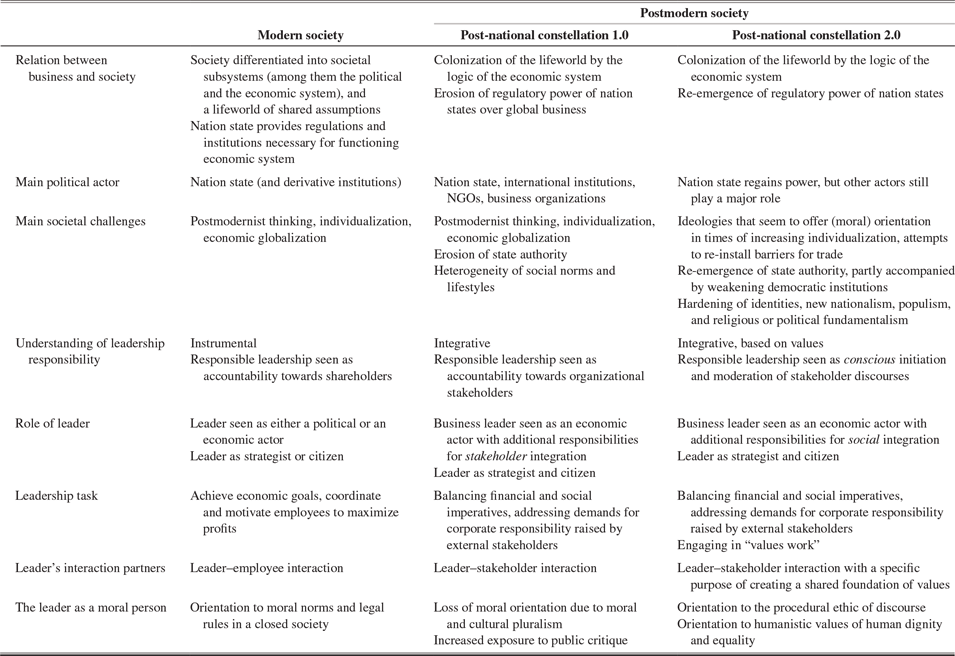
Table 1 presents an overview of the implications of modern society for responsible leadership and displays the changes in expectations from modern to postmodern society we will discuss in the following section.
The Challenges that Arise from the Transformation of Modern into a Postmodern Society

Note. Societal challenges described in the first three rows of the post-national constellation 2.0 (i.e., those relating to the relation between business and society, the main political actor, and the main societal challenges) are adapted from Scherer et al. (2016: 280-281).
Responsible Leadership in a Postmodern Society
We have argued that instrumental, shareholder-oriented leadership emerged from and is connected to the functioning societal differentiation of modern society. However, scholars who study business ethics and corporate social responsibility (CSR) have stressed the significance of “modernity’s end” and of the emerging postmodern society, characterized by the three developments described below: pluralism of norms and belief systems, individualization, and globalization. These scholars point out that these developments affect our understanding of the relationship between business and society (e.g., Kobrin, Reference Kobrin2009; Matten & Crane, Reference Matten and Crane2005; Palazzo & Scherer, Reference Palazzo and Scherer2006; Santoro, Reference Santoro2010; Scherer & Palazzo, Reference Scherer and Palazzo2011). We propose that the processes through which society is gradually being transformed into a postmodern society (Habermas, Reference Habermas2001a) partly explain why scholars and practitioners alike increasingly demand that leaders assume broader responsibilities and that they integrate the concerns of a range of stakeholders and various social and environmental objectives into their decision making. Especially the recent global developments in the business–society relationship, summarized in the literature under the term “post-national constellation 2.0” (Scherer et al., Reference Scherer, Rasche, Palazzo and Spicer2016), require some rethinking of the role of responsible leadership. We will explicate these transformation processes and their implications for responsible leadership in the following.
Modern society is challenged by three parallel, mutually reinforcing processes that mediate the transition to a postmodern society (Beck, Reference Beck2000; Habermas, Reference Habermas1994): postmodernist thinking, increasing individualization, and economic globalization. Postmodernist thinking refers to the process of societal transformation that signifies the end of a shared societal belief in one universal truth, be it the religious belief in an ultimate purpose that life has, the scientific belief in objective knowledge, or the moral belief in common norms (Lyotard, Reference Lyotard1984; Rajchman & West, Reference Rajchman and West1985). Postmodernist thinking signifies individual thinking that questions the possibility of universal norms or criteria of reason and rationality. Instead, in postmodern societies, individuals are confronted with a variety of alternative world views and life styles with incompatible perspectives on how to act in a way that is morally acceptable. In a world increasingly characterized by a pluralism of norms and values this makes the task of identifying a justified moral orientation difficult if not impossible (Rorty, Reference Rorty and Rorty1991).
Individualization describes the fragmentation and erosion of shared social identities and lifestyles within a community that was originally anchored in family and village life, and the decline in solidarity within communities (Teubner & Korth, Reference Teubner, Korth and Young2012; Thomas, Reference Thomas2000). Emerging postmodernist thinking together with the process of individualization affect societies around the world; however, these societal transformations are most prominent and influential in developed and democratic countries. Both processes erode the functionality of the lifeworld, because they make it harder for societal actors to rely on shared norms and expectations about what is right and what is wrong, and create a normative vacuum instead.
Lastly, economic globalization describes the increasing integration of value creation through collaboration that transcends national boundaries and extends beyond the reach of the nation state’s regulatory and control mechanisms (Beck, Reference Beck1992, Reference Beck2000; Scherer & Palazzo, Reference Scherer, Palazzo, Crane, McWilliams, Matten, Moon and Siegel2008, Reference Scherer and Palazzo2011). Economic globalization increases the power of business organizations, which, in turn, raises expectations that such organizations use it responsibly to address environmental problems or help remedy social injustices around the world (Young, Reference Young2011). We have summarized the implications of these societal challenges for responsible leadership in Table 1.
Together, these three processes of societal transformation increase the diversity of norms, values, and lifestyles and create a range of expectations, in a range of stakeholders, about responsible business conduct. In modern society, the most dominant stakeholder group, which shaped the expectations of responsible leadership, were shareholders. In the postmodern environment, the several and diverse societal interests and expectations of responsible business conduct are voiced not only by these primary organizational stakeholders, but also by non-governmental organizations (NGOs), international organizations, and the media (Spar & La Mure, Reference Spar and La Mure2003; Teegen, Doh, & Vachani, Reference Teegen, Doh and Vachani2004; Waddock, Reference Waddock2008).
As a consequence, leaders frequently have to cater to complex and often contradictory demands that reflect a multitude of conflicting political, economic, and institutional rationalities. Generally, leaders are expected to follow moral norms of conduct that satisfy both the shareholders and various groups of stakeholders (Doh & Quigley, Reference Doh and Quigley2014; Waldman & Galvin, Reference Waldman and Galvin2008). This is a difficult task, considering the heterogeneity of expectations and values in global business and the absence of a single source of global authority to guide responsible business behavior. We argue that, as a consequence of this pluralism, responsible leaders are required to adopt a more integrative approach to engaging with diverse stakeholders and pursuing various organizational goals.
Recent developments that steer society toward a post-national constellation 2.0 might seem to reverse some of the processes that transform modern society into a postmodern society (according to Scherer et al., Reference Scherer, Rasche, Palazzo and Spicer2016, the earlier processes that accompany postmodern society can be summarized as “post-national constellation 1.0;” see Table 1). Notable among these processes are the emergence of new forms of nationalism and the growing tendency for people to seek answers in religious fundamentalism or political ideologies. Both might be seen as attempts to reverse the loss of moral orientation that comes with postmodernist thinking and increasing individualization. Moreover, economic globalization seems to be threatened not only by social movements that try to fight what they consider its negative consequences, but also by governments that aim to re-establish trade barriers. In addition, some nation states try to regain control over businesses, both by providing the means for extraterritorial law enforcement and by trying to orchestrate intergovernmental initiatives to put pressure on corporations (Scherer et al., Reference Scherer, Rasche, Palazzo and Spicer2016).
We will argue, however, that these developments do not compensate for the loss of moral orientation or lessen the challenges for responsible leadership in business organizations; on the contrary, they even increase the demand for integrative responsible leadership. First, these developments do not diminish the call for socially and environmentally responsible behavior, especially in the case of companies that operate globally. For instance, the intensification of state regulation does not lessen in any way the role of companies and their leaders in causing social misery and environmental damage. On the contrary, it is an indication that governments increasingly try to enforce means of controlling this role and of forcing business leaders to respond to the demand for responsible business conduct worldwide (Knudsen, Slager, & Moon, Reference Knudsen, Slager and Moon2015). At the same time, we need to acknowledge that in some cases, state intervention may restrict civic liberties, even in democratic societies (Scherer et al., Reference Scherer, Rasche, Palazzo and Spicer2016).
Second, the emergence of religious fundamentalism, populist political ideologies, and new forms of nationalism in some regions of the world (this may even apply to developed countries such as the UK after the “Brexit” referendum or the US after the election of the Trump administration with its “America first” policy) may, in fact, increase the challenges to, as well as the need for, integrative responsible leadership in multinational corporations: if anything, these developments widen the gap between different societies with respect to what is true or false (e.g. with regard to the causes and implications of climate change; Hulme, Reference Hulme2009), what is considered right or wrong (e.g., with regard to issues such as abortion or gay marriage; BBC, 2017), and what is morally acceptable behaviour in the political or economic realm (e.g., with regard to the treatment of individuals of different nationalities, ethnicities, or religious beliefs; New York Times, 2017).
As a response to this trend, responsible leaders may be required to criticize the neglect of scientific evidence reflected in the environmental policies of governments, to resist the discrimination of individuals because of their ethnicity, gender, or sexual orientation, to support the integration of foreign employees in regions where nationalism is strong, or to uphold basic human rights in societies where these rights are compromised in the name of religious ideals or political ideologies (see Table 1). Overall, we argue that the developments that mark the shift toward a postmodern society call for integrative responsible leadership (Voegtlin, Reference Voegtlin2011; Voegtlin et al., Reference Voegtlin, Patzer and Scherer2012). The difficulty that this task presents is that leaders act in an environment that functions primarily according to the strategic logic of the economic system, whereas the demands of stakeholder groups that leaders need to integrate in order to address social and ecological challenges often assume a common ground in social norms and moral beliefs, i.e., a lifeworld that is intact.
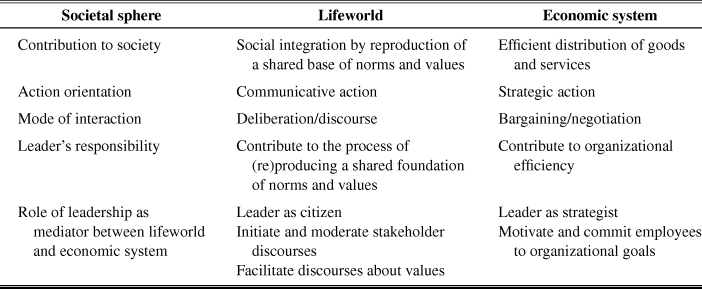
The lifeworld and the economic system are two distinct spheres of social life that are based on different principles and require different modes of interaction: in the lifeworld, interaction is primarily communicative and aims at social integration, whereas in the economic system it is primarily strategic and aims at the efficient distribution of goods and services. These differences make it hard for leaders to assume an integrative role. Moreover, the shift toward a post-national constellation 2.0 seems to indicate that in a world where segregation and alienation are gaining ground and where at the same time business is increasingly blamed for unsustainable practices, responsible leaders may be required not merely to integrate diverse viewpoints into their decision making, but also to initiate and guide the discussion on values and norms.
RECONSTRUCTING INTEGRATIVE RESPONSIBLE LEADERSHIP
Current approaches to integrative responsible leadership acknowledge the implications of the processes of global transformation and take them into account in their conceptualizations (Voegtlin et al., Reference Voegtlin, Patzer and Scherer2012). Scholars argue that leaders should act as cosmopolitan citizens (Maak & Pless, Reference Maak, Pless, Scherer and Palazzo2008), as agents of world benefit (Maak & Pless, Reference Maak and Pless2009) and that they should engage in societal deliberation (Voegtlin et al., Reference Voegtlin, Patzer and Scherer2012) to account for the negative externalities that are a consequence of economic globalization. Moreover, the concept of responsible leadership suggests that ethical, social, and environmental goals are an integral part of a leader’s tasks and that one aspect of these tasks is the need to tackle in a balanced way the existing and potentially conflicting goals of various stakeholders (Maak & Pless, Reference Maak and Pless2006; Maak et al., Reference Maak, Pless and Voegtlin2016; Voegtlin, Reference Voegtlin2016; Voegtlin et al., Reference Voegtlin, Patzer and Scherer2012). The notion of “integration,” that is forwarded in these approaches thereby focuses on the integration of stakeholders and various societal, environmental, and economic objectives.
However, these current approaches to responsible leadership do not account for the more recent developments that are part of the post-national constellation 2.0. We propose that these developments require that leaders play a more conscious role in overcoming the challenges that global business faces. This proposal involves not merely debating which values the responsible leader should uphold (see e.g., Maak & Pless, Reference Maak and Pless2009), but also how responsible leadership can open up the debate on dealing with the restrictive value structures and identities that are associated with religious or nationalist ideologies (Scherer et al., Reference Scherer, Rasche, Palazzo and Spicer2016). On the whole, such ideologies leave no room for the valid concerns of those who do not believe in the same ideology. For that reason, the changes they inflict on society are a threat not only to cooperation within a diverse workforce, but also to an open and unprejudiced discourse between businesses and stakeholders (Habermas, Reference Habermas, Calhoun, Mendieta and VanAntwerpen2013; Scherer et al., Reference Scherer, Rasche, Palazzo and Spicer2016).
In addition, current research on responsible leadership does not consider the implications of the process which Habermas (Reference Habermas1987) described as the colonization of the lifeworld. As a consequence of this process, which accompanies the shift to modernity, “the systems of money and power cut deep channels into the surface of social life, with the result that agents fall naturally into pre-established patterns of instrumental behavior” (Finlayson, Reference Finlayson2005: 54). Habermas (Reference Habermas1987) argued that in the process of modernization, the logic of the system, driven by its efficiency, supersedes that of the lifeworld and communicative reason is gradually replaced by instrumental rationality (Scherer, Reference Scherer, Alvesson, Willmott and Bridgman2009). That this is detrimental becomes obvious when one considers that communicative action is indispensable in order to coordinate diverse social groups and that such coordination is in its turn indispensable for society to cope with the challenges it faces. One example of this trend is the pervasive influence of the dictates of efficiency, competition, and strategic consideration in many parts of modern life. This is problematic insofar as the colonization of the lifeworld, where economic rationality increasingly pervades all parts of life, affects how the pressure to engage in integrative leadership is interpreted by leaders, i.e., leaders will most likely use economic criteria like efficiency and cost-benefit calculations to evaluate the usefulness of integrative behavior. However, leadership that integrates stakeholders and their various goals out of strategic reasons does not help to resolve the pathologies of postmodern societies, because it does not fulfill a truly integrative function, i.e., it does not help build a core inventory of value orientations, coordinate actions to achieve consensus about social institutions, and reproduce patterns of social belonging (Gond, Palazzo, & Basu, Reference Gond, Palazzo and Basu2009; Habermas, Reference Habermas1987).
In order to become truly integrative, leaders would have to internalize their citizenship obligations and their role in social integration. This requires that responsible leaders become conscious initiators and moderators of stakeholder dialogues. In the following, we delineate the form that integrative responsible leadership might take, what could motivate leaders to become truly integrative, and what challenges these present.
The Responsible Leader as Strategist and Citizen
Integrative responsible leadership, as we understand it, is able to draw on both strategic and communicative action to either pursue corporate performance objectives or to engage in the discourse on corporate responsibility, depending on the requirement of the situation. The two roles of integrative responsible leadership that we will delineate here—the leader as a strategist and as a citizen—reflect the distinct rationalities of the economic system and of the lifeworld. We thus view leadership not only as a strategic endeavor that tries to influence others to pursue organizational goals, but also a communicative endeavor, whose objective is to facilitate the pursuit of common societal goals.
Leaders as strategists search for the most efficient means to reach predefined ends. Strategic considerations dominate the bargaining and negotiating processes with those stakeholders that directly affect organizational effectiveness (Clarkson, Reference Clarkson1995). Strategic leadership predominantly focuses on influencing employees so that they commit themselves to pursuing corporate objectives. Leaders as citizens, in contrast, engage in dialog with stakeholders who have a legitimate claim in corporate decisions (Clarkson, Reference Clarkson1995; Voegtlin et al., Reference Voegtlin, Patzer and Scherer2012). Based on a communicative rationality, leadership becomes the enabling mechanism of societal discourse on the appropriateness of corporate conduct (see Table 2). Leaders can achieve this by developing a common understanding of a given situation and agreeing on a joint course of action. Responsible leaders are integrative in their role as citizens and can contribute to maintaining a lifeworld guided by shared assumptions of what constitutes good business conduct and shared norms that regulate such conduct.
Responsible Leaders as Mediators Between Lifeworld and Economic System
The role of the strategist is well researched and numerous leadership models and studies focus on investigating the influence of leadership on corporate performance (for an overview, see Bass, Reference Bass1990; Yukl, Reference Yukl2013). The ethical implications of the leader–follower relationship have also been amply addressed (e.g., Brown & Mitchell, Reference Brown and Mitchell2010; Brown et al., Reference Brown, Trevino and Harrison2005; Ciulla, Reference Ciulla1995, Reference Ciulla1998). In this article, we focus primarily on the role of the responsible leader as a citizen. To discuss this role, we will explain in the following under what conditions leaders should resort to communicative action and what this entails in practice.
The Interplay Between Strategic and Communicative Action
The answer to the question of when leaders should engage in communicative action lies in the purpose and functionality of the two main spheres of social life that we focus on in this article; namely, the lifeworld and the economic system. Strategic action enables the efficient distribution of goods and services, while communicative action relates to the way in which the distribution of goods and services should be effected and the means that should be used for that purpose. Communicative action also relates to the values and norms that the members of an organization should share and should uphold in their dealings with the various organizational stakeholders.
Strategic and communicative action represent two different modes of coordination. Depending on the situation, individuals would rather resort to strategic or communicative action. Habermas (Reference Habermas1984), for instance, identified different forms of strategic action, ranging from open strategic action, where individuals try to achieve their goals through coercion or reward, to hidden strategic action, where individuals rely on conscious or unconscious deception to influence the outcomes of communication. The choice of action orientation is influenced by contextual factors and individuals’ personality. For instance, in the study by Liberman et al. (Reference Liberman, Samuels and Ross2004) that we mentioned earlier, making the economic context salient by framing the task as a “Wall Street game” was enough to make participants act more strategically.
A leader’s action orientation, in turn, does not necessarily result in the successful realization of her or his goals. Success also depends on the action orientation of the other parties involved and the conditions under which communication takes place. Habermas (Reference Habermas1984) acknowledged that the conditions for action that are truly communicative rarely occur. There is often a grey area between lack of understanding and misunderstanding, intended or unintended untruth, hidden or open discrepancy. In such cases, reaching understanding is the process that tries to overcome these barriers of distorted communication.
With the right intention, the leader can try to facilitate the conditions for communicative action and guide participants toward reaching an understanding. To that end, leaders can draw on different forms of participative decision making. Leadership research has distinguished between various grades of participative decision making, ranging from autocratic decision making, where the leader decides alone without asking other people for their opinion or suggestions; over several forms of consultation, where the leader asks for and, to varying degrees, considers the opinions and suggestions of others; to forms of joint decision making, where the leader discusses the decision problem with others and has no more influence over the decision than any other participant in the process (Tannenbaum & Schmidt, Reference Tannenbaum and Schmidt1958; Yukl, Reference Yukl2013).
From a normative viewpoint, the issue that requires coordinated action should determine the action orientation of the leader and the degree of participative leadership. The more an issue touches upon aspects of a shared lifeworld, the more it requires a communicative action orientation and a higher degree of participative decision making. We therefore distinguish between the roles of integrative responsible leadership and a leader’s action orientation: while the roles of strategist and citizen can be understood as a set of designated obligations associated with leadership in business organizations (Biddle, Reference Biddle1986), action orientation reflects the actual behavior that becomes evident in communication and ranges from strategic to communicative action. Thus, the two roles are ideally enacted through the corresponding action orientations in communication about specific issues.
Although there are no conclusive criteria as to which issues require communicative action, certain characteristics make issues more prone to an engagement by the leader as citizen (Marti & Scherer, Reference Marti and Scherer2016). These characteristics relate to whether an issue is novel, whether there is social consensus, whether it is linked to conflicting interests between different stakeholders, which values and norms come into play, and to what extent it is linked to organizational externalities: the newer the issue, the greater the disagreements about it, the likelier the conflicts between different stakeholder interests, and the greater the range of values it concerns, and the closer the links to organizational externalities, the higher the likelihood that it will touch upon relevant aspects of the lifeworld and the more it will require communicative action.
The issue of child labor can serve as an illustrative example. Child labor is an issue that touches upon the values and norms of the lifeworld. When the issue of child labor entered the public discourse in Western societies in the 1990s, in connection with the activities of multinational corporations such as Nike (Nisen, Reference Nisen2013; Zadek, Reference Zadek2004), it represented a novel concern for those companies and the different stakeholder groups had varied and seemingly incompatible beliefs about the issue (ranging from beliefs that the money children are earning is needed by their families to survive to the belief that child labor in any form is not to be tolerated). We suggest that the debate on the right course of action where such an issue is concerned would require integrative responsible leadership. However, the discussion around the issue has “matured” over time (Zadek, Reference Zadek2004) and today the belief that child labor is morally wrong is a quite broadly accepted norm and codified in several conventions of the International Labor Organization (2016). Thus, today, a leader can justify a “no child labor” policy without having to engage in dialog with stakeholders every time the problem emerges.
However, there are issues such as the role of women in management, the tolerance of homosexuality at the workplace, or the inclusion of employees from ethnic minorities, that are not institutionalized, regulated by any norms that are widely accepted in different societies and cultures, or already in the guidelines and codes of conduct of global multi-stakeholder initiatives. These are exemplary issues that would require the engagement with stakeholders through communicative action.
The leader in her or his role as a citizen who is oriented to communicative action and who wants to create possibilities for social actors to debate about the responsibility, duty, and moral norms of business should try to initiate discourses with these actors. However, the role of leadership is not only to initiate discourses but also to orchestrate these discourses to make sure that they approximate the conditions that facilitate understanding and agreement (Habermas, Reference Habermas1984).
Leaders can assume the role of a good citizen and engage with the lifeworld of societal norms by creating possibilities for discourses with stakeholders, moderating these discourses, and guaranteeing access and equal participation to all parties affected by a specific issue (Voegtlin et al., Reference Voegtlin, Patzer and Scherer2012). A main precondition is that stakeholder engagement should be based on a communicative rationale and the main objective should be to reach consensus, rather than fulfill strategic intentions. Research on deliberation as a specific form of institutionalized discourse “has shown that providing participants an opportunity to voice their opinion leads to perceptions of a fair process and legitimate outcomes, and to an increased willingness to cooperate” (Voegtlin & Scherer, Reference Voegtlin and Scherer2017: 238; see also Carpini, Cook, & Jacobs, Reference Carpini, Cook and Jacobs2004; Ryfe, Reference Ryfe2005; Thompson, Reference Thompson2008). Fryer (Reference Fryer2012) argues that the power and influence a leader holds can be used to encourage others to adhere to the principles of discourse. Leadership can help implement measures that enable communicative engagement; for instance, by minimizing jargon in meetings, by giving a platform to opposing views, by encouraging participation in decision making, by exposing latent or concealed interests, and by institutionalizing debate (Fryer, Reference Fryer2012: 31).
Responsible leaders, especially in MNCs, can establish the conditions that will create appropriate arenas for successful discourse. For instance, modular and decentralized structures, the work organized around projects, and the reliance on teams provide ample possibilities for the leaders of such modular units, projects, or teams to “democratize” decision making and to establish the rules favorable for discourses (Raelin, Reference Raelin2013). New communication technologies offer additional possibilities and platforms for discourse (Fryer, Reference Fryer2012; Morsing & Schultz, Reference Morsing and Schultz2006; Trittin & Schoeneborn, Reference Trittin and Schoeneborn2017). Social media in particular allows two-way communication between corporations and their stakeholders (Morsing & Schultz, Reference Morsing and Schultz2006). However, communication through these channels often does not follow the standards of rational argumentation. Leaders can use their influence to moderate the content of social media and assist others to engage in constructive exchanges by ensuring that everybody is heard and that communication is based on the exchange of arguments.
We argue that the citizen role of responsible leadership implies both, the case-by-case discourse with stakeholders, and the engagement in institutionalized modes of deliberation. The latter may take the form of corporate engagement in global governance and multi-stakeholder initiatives (Gilbert & Rasche, Reference Gilbert and Rasche2007). Recently, Maak et al. (Reference Maak, Pless and Voegtlin2016) argued that integrative responsible CEOs have sufficient leverage to engage their companies in such multi-stakeholder initiatives.
The role of the citizen can present a counterbalance to an ongoing colonization of the lifeworld insofar as it provides a mode of interaction that does not rely on economic rationality. Dialogue and deliberation based on communicative action can help to sustain cultural practices worth preserving and create awareness for and agree upon shared societal values and goals that transcend purely economic interests and efficiency considerations (Habermas, Reference Habermas1987). We discuss in the following section what it might take to prompt leaders to engage in such communicative action centered on values.
“Values Work”: Facilitating Deliberation About Values
We have argued that integrative responsible leadership involves, first, the role of managing the processes of strategy formulation and implementation, with an emphasis on profit making and achieving efficiency, and second, the role of citizen, which involves engaging in dialog with stakeholders and in public will-formation through deliberative processes. This understanding of leadership implies that the authenticity and integrity of leaders emerge from their commitment to the procedural practice of communication and dialog.
We will now argue that in order to overcome the challenges that the colonization of the lifeworld and the emergence of the post-national constellation 2.0 pose, it takes more than merely providing discursive arenas. As we explained further up, the insistence on economic thinking on the one hand and the hardening beliefs in narrowly defined values and identities on the other make it hard to convince those who espouse such beliefs by means of rational arguments, especially if those beliefs are tied to strong sentiments and ideological worldviews. In such a setting, in order to exchange rational arguments about how to resolve optimally an issue that affects multiple stakeholders, it is necessary to begin with a more basic discourse. For instance, before debating how to integrate workers of different ethnicities at the workplace, it is necessary to discuss the moral aspects of tolerating people who hold different beliefs or come from different cultural, ethnic, or religious backgrounds.
With respect to these matters, scholars have recently argued and empirically shown that values can be used strategically to expose normative tensions and drive institutional change (Gehman et al., Reference Gehman, Trevino and Garud2013; Vaccaro & Palazzo, Reference Vaccaro and Palazzo2015). For instance, in their study of an anti-Mafia movement, Vaccaro and Palazzo (Reference Vaccaro and Palazzo2015) showed that using values can be a highly effective way to co-opt, unite, and engage critical stakeholders so that they take active part in an initiative for change against prevailing institutions and corrupt practices. Values “(1) are concepts or beliefs, (2) pertain to desirable end states or behaviors, (3) transcend specific situations, (4) guide [the] selection or evaluation of behavior and events” (Schwartz, Reference Schwartz and Zanna1992: 4). As such, they are the criteria individuals use to select and justify actions (Schwartz, Reference Schwartz and Zanna1992). The values of a social group can be changed deliberately; such “values work” refers to the practices and individual actions that initiate and drive changes in values (Gehman et al., Reference Gehman, Trevino and Garud2013).
We argue that integrative responsible leaders can and should engage in values work to identify and expose the normative tensions that arise from the conflicts that relate to the key issues we discussed earlier. Identifying and addressing these tensions will enable leaders to work toward positive change. A first step in that direction involves addressing the moral aspects of problematic issues: for example, whether the tolerance of corrupt practices or intolerance towards people of different ethnicity is acceptable (Vaccaro & Palazzo, Reference Vaccaro and Palazzo2015). In the course of that process, leaders can place the values that relate to these issues at the center of debate: in the case of corruption, relevant values might be honesty, legality, or solidarity, while in the case of showing tolerance towards other ethnicities, relevant values might include human dignity and respect for others. A second important step would be uniting the affected stakeholders and securing their support in order to make the value change sustainable (Vaccaro & Palazzo, Reference Vaccaro and Palazzo2015). Vaccaro and Palazzo (Reference Vaccaro and Palazzo2015) showed how a group of activists successfully engaged in values work in an environment that is dominated by strong beliefs and traditions as well as fear of retaliation. We argue that leaders as citizens can engage in similar values work to help safeguard the lifeworld against the social transformation processes that challenge its functioning.
Such values work should take place in the space that open discourse provides and should be guided by a communicative action orientation. Its main aim should be to get all affected parties to agree upon and to uphold the new values (Habermas, Reference Habermas1996, Reference Habermas2001b). However, it would additionally require the motivation of the leader to initiate discourses about desirable values and a foundation on which the leader could draw to problematize the values underlying current (business) practices. Such a fundamental base to start from can consist of humanistic values, reflected for instance in the human rights agreement (Ruggie, Reference Ruggie2007), the sustainable development goals (United Nations, 2016), or the emerging global consensus around the ten principles of the UN Global Compact (Rasche, Waddock, & Mcintosh, Reference Rasche, Waddock and Mcintosh2013; Voegtlin & Pless, Reference Voegtlin and Pless2014).
A prominent example of the challenging issues to which such values are highly relevant is the migration crisis that is affecting Europe (BBC, 2016; Traub, Reference Traub2016). In this case, business leaders could play an important part in helping define the values that should guide the treatment of refugees in European countries and their integration into the workforce. More specifically, business leaders could contribute a rational voice to the debate on this issue, which is often dominated by emotional and populist right-wing political views (Aisch, Pearce, & Rousseau, Reference Aisch, Pearce and Rousseau2016; Freedland, Reference Freedland2016) and could help focus it on values such as human dignity and respect for others. Business leaders can initiate and moderate such discourses, be it on a small scale, when discussing with their subordinates how to treat new employees of immigrant background, or on a larger scale, when the top management engages in a public discourse about the integration of refugees into the host society. An example of such engagement is found in the public statements of the top management of American companies boycotting the immigration ban of the Trump administration (New York Times, 2017).
Implications for the Leader
The role of the citizen sets high normative expectations for responsible leadership. We envisioned this role as a normative ideal that can offer guidance for business leaders and pointed out that there is a continuum from strategic to communicative action. We also argue that striving toward this normative ideal is desirable in order to amend the processes threatening a lifeworld of shared norms and values. Moreover, leaders are by definition individuals who can influence others and are therefore in a position of power that requires a heightened sense of responsibility (Fryer, Reference Fryer2012; Young, Reference Young2011).
In practice, integrative responsible leadership will face a number of challenges that relate to the interplay between the two roles of strategist and citizen and to the enactment of the citizenship obligations (i.e., creating arenas for discourse and engaging in successful values work). Some of these challenges are associated with the limitations of discourse. In this regard, discourse ethics and the ideals of deliberative democracy have been critiqued for being too unrealistic because of the demands they place on successful deliberation, including a power free and rational exchange of arguments and the consent in the better argument (Ryfe, Reference Ryfe2005; Stansbury, Reference Stansbury2009; Thompson, Reference Thompson2008).
In our argument we focus on Habermas’s core assumption that language is the only medium through which a community of people can agree upon the norms that should govern their way of living. We do not argue that an ideal discourse based on the exchange of purely rational arguments and resulting in a consensus is always needed in order to address concerns of the lifeworld. Rather, we propose that what is needed is the willingness to discuss the issues that touch upon the lifeworld and the possibility to do so in a relatively free and uncoerced manner (arguing again for a continuum toward the ideal). We thereby concur with more recent research on deliberation that has relaxed the assumptions of rationality and consensus (Carpini et al., Reference Carpini, Cook and Jacobs2004; Ryfe, Reference Ryfe2005; Thompson, Reference Thompson2008).
With regard to the concept of rationality that was argued to be culturally dependent, scholars propose that storytelling might be a required corrective: “Successful deliberation seems to require a form of talk that combines the act of making sense (cognition) with the act of making meaning (culture). Storytelling is one such form of talk. Stories anchor reality by organizing experience and instilling a normative commitment to civic identities and values” (Ryfe, Reference Ryfe2005: 63). Such storytelling might be what successful values work requires. With regard to the outcome of discourse, consensus is considered one among other possible success factors. Scholars argue that not only different forms of agreement but also learning about issues and developing a better understanding of opposing views can be considered successful outcomes (Thompson, Reference Thompson2008). Finally, research has shown that increasing the diversity of voices can counter the effect of domination by powerful groups and encourage discourse, as “individuals who discuss a political issue in ‘mixed’ groups (in which the members have been exposed to conflicting perspectives on the issue) are less vulnerable to elite framing effects” (Thompson, Reference Thompson2008: 504). Responsible leadership as we define it fosters such a diversity of voices by inviting various organizational stakeholders to deliberate about potentially “difficult” issues relating to the shared norms of the lifeworld. While such values work might not always be successful, we consider responsible leadership to be the spark that can ignite the debate.
Apart from the difficulties relating to successful discourse, the interplay between the two roles of strategist and citizen might prove challenging for the leader. These challenges encompass the motivation and the ability to simultaneously cater to the needs of the organization and society. The motivation to act as both strategist and citizen can be considered an identity challenge, i.e., the leader has to believe that it is part of her or his belonging to the organization that requires that she or he cares for both the needs of the organization and society (Ashforth & Mael, Reference Ashforth and Mael1989). There might be ways that can help to change the self-concept of leadership in this regard. First, discourses with stakeholders might actually act as a kind of self-fulfilling prophecy. Scott and Lane (2000: 44) argue that a leader’s “organizational identity is best understood as contested and negotiated through iterative interactions between [the leader] and stakeholders.” This suggests that a leader’s identity can change through stakeholder engagement and that integrative responsible leadership might lead to a kind of moral entrapment: the more leaders engage in discourses with stakeholders, the more they might perceive it as being part of their organizational identity (Scott & Lane, Reference Scott and Lane2000). Second, committing to a professional code or oath that would contain the obligation to uphold basic human rights and to engage in discourses where these rights seem to be violated might be a way to infuse leadership with the responsibility to act as a citizen.
CONCLUSION
In this article, we reconstructed integrative responsible leadership from a Habermasian perspective. We argued that the call for integrative leadership reflects a historical development and is the consequence of the transformation of modern society into a postmodern society. Drawing on Habermas’s (1984, 1987) social theory, we developed an understanding of responsible leadership that reflects the challenges of societal transformation. This theory offered us a heuristic for analyzing the responsibilities of leadership toward society. Responsible leadership, understood as both strategic action that influences others to achieve organizational goals and as communicative action that influences others to achieve common goals, occupies a mediating role between what Habermas (Reference Habermas1987) defined as the lifeworld and the system (see Table 2).
The article thereby contributes to research on leadership ethics in that it offers important philosophical foundations for the responsibilities of leadership: the procedural practice of discourse as developed by Habermas (Reference Habermas and Habermas1993, Reference Habermas1996, Reference Habermas1998, Reference Habermas2001b) and extended by various research streams, especially in deliberative democracy research (e.g., Carpini et al., Reference Carpini, Cook and Jacobs2004; Ryfe, Reference Ryfe2005; Thompson, Reference Thompson2008), and the idea of a lifeworld of shared values and norms (Habermas, Reference Habermas1984, Reference Habermas1987). Our conceptualization of integrative responsible leadership thereby offers a way of how leaders can avoid the homogenization of interests that result from purely strategic reasoning that dominant leadership approaches build upon (see textbooks like Bass, Reference Bass1990; Yukl, Reference Yukl2013), and a way of how leaders can acknowledge and live with the plurality of lifestyles and responsibility expectations of postmodern society. Furthermore, the introduction of the concept of the lifeworld into leadership ethics (Ciulla, Reference Ciulla1998, Reference Ciulla2005) can offer a solution that balances between relativistic and essentialist positions (Scherer & Patzer, Reference Scherer, Patzer, Tsoukas and Chia2011). As a foundation for shared moral norms that is open to change from “within,” i.e., from the lifeworld itself, through the deliberation among its members, it avoids universalizing moral norms. At the same time, it offers an alternative to purely relativistic assumptions in that it offers a basis for negotiating shared values (Scherer, Reference Scherer2015; Scherer & Patzer, Reference Scherer, Patzer, Tsoukas and Chia2011).
Future research could further engage with this idea of integrative responsible leadership. While we have discussed some of the challenges of integrative responsible leadership, we would encourage further empirical research to address such questions as these: What do we expect of leaders when they are confronted with persistent disagreement, despite an orientation toward consensus building? What does it mean for a leader to moderate different stakeholder groups? Are there individual characteristics possessed by leaders that facilitate communicative interaction? Moreover, the status of a leader could be open to deliberation as well (Fryer, Reference Fryer2012). What does this imply for our understanding of leadership if the leader is subject to ongoing communicative authorization, especially if external stakeholders have a say in this, too?
Moreover, in our analysis of the implications of societal transformation and its influence on the differentiation between lifeworld and system, we focused in a first step on the economic system as the locus of business leadership. Apart from the lifeworld and the economic system, Habermas identifies the political system and its steering mechanism of power as an essential pillar of modern society. Habermas (Reference Habermas1987) argues that not only the economic system, but also the political system, colonizes the lifeworld with the consequence that the coordination by power replaces communicative exchanges. Thus, it might be difficult for leaders to supersede economic interests and power dynamics in their efforts of achieving societal integration; moreover, they will also have to influence others to do so as well in order to engage in a sincere exchange of arguments. Therefore, we consider it important that future research investigates, also empirically, different forms and arenas for deliberation and the role of the leader as initiator and moderator therein. This can help to identify empirical examples of successful societal integration and could add to our understanding of the challenges associated with communicative action. It would, for instance, be interesting to analyze the role of responsible leaders oriented to communicative action in meetings or as moderators of social media platforms (Morsing & Schultz, Reference Morsing and Schultz2006; Raelin, Reference Raelin2013).
Our concept of responsible leadership also suggests practical implications. Raelin (Reference Raelin2013) mentions the example of a top management team of a division of a Fortune 100 company where the members of the team developed the capacity for discourse through different methods. The training encouraged them “to suspend their judgments and assumptions in order to listen and truly understand one another’s point of view” (Raelin, Reference Raelin2013: 829); they became better observers and listeners and engaged in more rational discourses. Corporations can offer training and build awareness to encourage communicative action.
Overall, we propose that integrative responsible leadership as a form of leadership that draws on communicative action and engages in values work when issues touch upon questions of a shared lifeworld can contribute to solving pressing problems of our time, such as the problem of how to integrate foreigners into the workforce in countries where the tolerance for other cultures and other ways of living is diminishing (Aisch et al., Reference Aisch, Pearce and Rousseau2016; Freedland, Reference Freedland2016). It might also be a relevant counterbalance in what appears to be an age of emerging populism (Freedland, Reference Freedland2016). Such an environment, where discussions are no longer based on facts and reason but on sentiments, requires integrative responsible leaders who can steer these discussions toward a more rational exchange of arguments about the values that members of an organization, but also members of the community in which the organization is doing business, want to endorse and how they could solve problems collectively.
ACKNOWLEDGEMENTS
The authors thank Emilio Marti for helpful comments on earlier drafts of this article. We acknowledge financial support by the Swiss National Science Foundation for the projects “Making Responsible Leadership Relevant: Development and Validation of a Theory-Based Measure” (100018_149937) and “When Individuals Become Social Innovators: Investigating Social Innovative Behavior and its Individual and Contextual Preconditions” (100010_165699).