INTRODUCTION
The family Fissurellidae includes 55 genera and over 500 valid species (WoRMS, Reference WoRMS2016). Although fissurellids have been routinely included in phylogenetic analyses of (veti)gastropods (e.g. Harasewych et al., Reference Harasewych, Adamkewicz, Blake, Saudek, Spriggs and Bult1997; Colgan et al., Reference Colgan, Ponder and Eggler2000, Reference Colgan, Ponder, Beacham and Macaranas2003; McArthur & Harasewych, Reference McArthur, Harasewych, Lydeard and Lindberg2003; Geiger & Thacker, Reference Geiger and Thacker2005; Aktipis & Giribet, Reference Aktipis and Giribet2010) taxon sampling has been very loose; these studies included just one or a few fissurellid species. The genus Diodora occurs in tropical and temperate shallow waters all over the world, and three species have been classically recognized in the Mediterranean (Bucquoy et al., Reference Bucquoy, Dautzenberg and Dollfus1882–1886 (as Fissurella); Ghisotti & Melone, Reference Ghisotti and Melone1969; Sabelli et al., Reference Sabelli, Giannuzzi-Savelli and Bedulli1990, Reference Sabelli, Giannuzzi- Savelli and Bedulli1992; Poppe & Goto, Reference Poppe and Goto1991): Diodora graeca (Linnaeus, 1758), D. italica (Defrance, 1820) and D. gibberula (Lamarck, 1822). Two further taxa D. dorsata (Monterosato, Reference Monterosato1878) and D. producta (Monterosato, 1880) listed as ‘doubtful species’ by Sabelli et al. (Reference Sabelli, Giannuzzi- Savelli and Bedulli1992) were treated as valid by Giannuzzi-Savelli et al. (Reference Giannuzzi-Savelli, Pusateri, Palmeri and Ebreo1994) and Buzzurro & Russo (Reference Buzzurro and Russo2005). In addition, a couple of Indo-Pacific migrants, Diodora rupellii (G. B. Sowerby I, 1834) and D. funiculata (Reeve, 1850), are also recorded from the Mediterranean, but – as is frequent with Lessepsian migrants (Zenetos et al., Reference Zenetos, Gofas, Verlaque, Cinar, Garcia Raso, Bianchi, Morri, Azzurro, Bilecenoglu, Froglia, Siokou, Violanti, Sfriso, San Martin, Giangrande, Katagan, Ballesteros, Ramos-Espla, Rastrototaro, Ocana, Zingone, Gambi and Streftaris2010) – are restricted to the coasts of the Levant (Barash & Danin, Reference Barash and Danin1992; Mienis, Reference Mienis2002). Whereas no new fissurellid had been discovered in the Mediterranean since the 19th century, a sixth native species, Diodora demartiniorum Buzzurro & Russo, Reference Buzzurro and Russo2005, was quite unexpectedly recently described from the Gulf of Gabès and the Aegean Sea. Its status as a valid species was accepted by Delongueville & Scaillet (Reference Delongueville and Scaillet2006) and Cecalupo et al. (Reference Cecalupo, Buzzurro and Mariani2008). The subtlety of shell characters used to delimit species of fissurellids, in general, and of Diodora in particular, explains why the status of D. producta or D. dorsata has remained uncertain for over a century (listed as ‘doubtful species’ by Sabelli et al. (Reference Sabelli, Giannuzzi- Savelli and Bedulli1992) but treated as valid by Giannuzzi-Savelli et al. (Reference Giannuzzi-Savelli, Pusateri, Palmeri and Ebreo1994) and Buzzurro & Russo (Reference Buzzurro and Russo2005)), as it requires considerable personal experience to discriminate Mediterranean Diodora species beyond the ‘classical three’ (D. graeca, D. italica, D. gibberula). The state of the art of Mediterranean Diodora taxonomy is thus to recognize 4–6 native and two introduced species, all exclusively discriminated based on shell characters. The comprehensive molecular fissurellid phylogeny by Aktipis et al. (Reference Aktipis, Boehm and Giribet2011) included 30 terminal taxa, of which two were Mediterranean species of Diodora (D. graeca, D. gibberula), but the purpose of these authors was not to discuss species-level systematics.
Diodora demartiniorum is one of 33 mollusc species currently regarded as valid and endemic to the Gulf of Gabès (Cecalupo et al. Reference Cecalupo, Buzzurro and Mariani2008). All were defined exclusively based on shell characters, and the only molecular approach to the systematics of putative Gulf of Gabès endemics is by Barco et al. (Reference Barco, Corso and Oliverio2013). Targeting the small muricids of the genus Ocinebrina, they recovered some species as valid and others as synonyms. In this context, the purpose of the present work is to revisit the status and distribution of the Mediterranean species of Diodora using molecular markers: Is D. demartiniorum a valid species? What is the status of the populations of D. demartiniorum from the Aegean Sea that have been attributed to it?
MATERIALS AND METHODS
Samples and primary morphological identifications
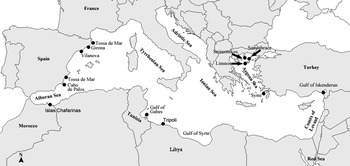
Live animals were collected specifically for this work from the Gulf of Gabès (Djerba, Tunisia; 9 specimens, personal collects, 2012 and 2013); the Alboran Sea (Cabo de Palos and El Mohon, Prov. of Murcia, Spain, 2 specimens; Islas Chafarinas, off Morocco, 1 specimen; J. Esteban leg. 2014); and the Aegean Sea (Gulf of Strimonikos and Limnos I., Greece; 3 specimens; K. Papavasileiou leg. 2014) (Figure 1). The soft parts were detached from the shell and preserved for molecular analysis in 95–98% ethanol. The shell was photographed, morphologically identified by Gianni Spada, Paolo Russo and/or Marco Oliverio, and catalogued as a voucher in Muséum National d'Histoire Naturelle (MNHN, Paris) (Tunisian and Greek material) or Museo Nacional de Ciencias Naturales (MNCN, Madrid) (Spanish material).
Location of the localities of Mediterranean fissurellids discussed in this paper.

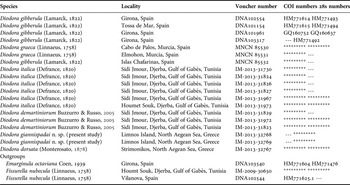
The locality data, voucher catalogue numbers and GenBank accession numbers for each of the 15 specimens are presented in Table 1.
List of species, collection locality, specimen voucher numbers and GenBank accession numbers.

In addition, to increase the size of the dataset analysed, the sequences of seven Mediterranean specimens of Diodora produced by Giribet & Wheeler (Reference Giribet and Wheeler2002) and Aktipis et al. (Reference Aktipis, Boehm and Giribet2011) were downloaded from GenBank. We found problems with the specimen corresponding to the sequence HM771613.2 identified by Aktipis et al. (Reference Aktipis, Boehm and Giribet2011) as D. graeca fell with specimens identified by them as D. cayenensis (a species from the tropical western Atlantic). After correspondence with the authors, we concluded that contamination and/or misidentification was responsible for this result, and we decided to discard this sequences from our analyses. Further, the two specimens corresponding to the sequences AF120632 and AY923915 identified as D. graeca respectively by Giribet & Wheeler (Reference Giribet and Wheeler2002) and by Geiger & Thacker (Reference Geiger and Thacker2005), fell with specimens identified by Aktipis & Giribet (Reference Aktipis and Giribet2010) (and also by us) as D. gibberula, and we have also decided to discard these sequences in our analyses. This leaves four specimens from GenBank with reliable and usable sequences.
Sequencing and amplification
DNA was extracted from a piece of muscle tissue using the DNeasy 96 Tissue kit (Qiagen). A fragment of Cytochrome Oxidase I (COI) mitochondrial gene and a fragment of 28S rDNA nuclear gene were amplified using respectively universal primers LCO1490 (5′-GGTCAACAAATCATAAAGATATTGG-3′) and HCO2198 (5′-TAAACTTCAGGGTGACCAAAAAATCA-3′) (Folmer et al., Reference Folmer, Black, Hoem, Lutz and Vrijenhoek1994), and C1′ (5′-ACCCGCTGAATTTAAGCAT-3′ (Jovelin & Justine, Reference Jovelin and Justine2001) and D2 (5′-TCCGTGTTTCAAGACGG-3′ (Dayrat et al., Reference Dayrat, Tillier, Lecointre and Tillier2001). All PCR reactions were performed in 25 µl, containing 3 ng of DNA, 1× reaction buffer, 2.5 mM MgCl2, 0.26 mM dNTP, 0.3 µM of each primer, 5% DMSO and 1.5 units of Q-Bio Taq, QBiogene. Thermocycles consisted of an initial denaturation step at 94°C for 4 min, followed by 40 cycles of denaturation at 94°C for 30 s, annealing at 48°C for COI gene and 60°C for 28S rDNA gene for 40 s and extension at 72°C for 1 min. The final extension was at 72°C for 5 min. PCR products were purified and sequenced by the Eurofins sequencing facility. Both directions were sequenced to confirm accuracy of each sequence.
Phylogenetic analyses
COI and 28S genes were edited using Codon Code Aligner version 4.0.4, and automatically aligned using Clustal W implemented in BioEdit version 7.0.5.3 (Larkin, Reference Larkin2007). The accuracy of automatic alignments was confirmed by eye. To delimit species an online version available at http:// wwwabi.snv.jussieu.fr/public/abgd/ of the Automatic Barcode Gap Discovery method (ABGD; Puillandre et al., Reference Puillandre, Lambert, Brouillet and Achaz2012) was used, with default parameters. It automatically detects, when present, a gap in the pairwise distribution of the genetic distances calculated between each pair of specimens. This gap, referred to as the barcode gap, is supposed to correspond to a threshold between intra- and interspecific distances and is used to propose species hypotheses. For each gene, a phylogenetic tree was built, using Bayesian Analysis (BA), consisting of six Markov chains (5,000,000 generations each with a sampling frequency of one tree each hundred generations) run in two parallel analyses using MrBayes version 3.1.2 (Ronquist & Huelsenbeck, Reference Ronquist and Huelsenbeck2003). The chain temperature was set at 0.2. When the log-likelihood scores were found to stabilize, a consensus tree was calculated after omitting the first 25% trees as burn-in.
RESULTS
Molecular analysis
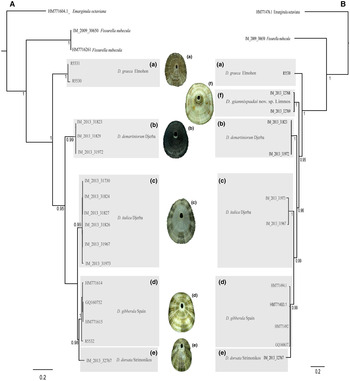
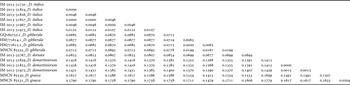
We obtained 16 COI sequences (13 newly produced, three from GenBank), and 28S sequences for 12 (eight newly produced, four from GenBank); we have not been able to obtain sequences for both loci in some specimens. The COI sequences resulted in a 658 bp alignment. The pairwise distance values are presented in Table 2. The Bayesian tree (Figure 2A) shows five different lineages, (a) to (e), each recognized as a distinct species hypothesis by ABGD and each including sequences separated by genetic distances lower than 3% (and often 1% or less). Sequences from different groups are separated by genetic distances greater than 5%. When including several specimens, each lineage corresponds to a well-supported clade (Posterior Probabilities PP > 0.98). The first clade (PP = 1) corresponds to a group (a) which includes two specimens from Spain that diverge from all the other species hypotheses. The second clade (PP = 0.99) includes four genetic groups (b to e), of which (b) from Djerba (PP = 0.99) is sister to the other three together and separated from them by COI distances >10%. The remaining three genetic groups (c, PP = 0.99; d, PP = 1; e, PP = 0.98) are separated by genetic distances around 7%; two closely related clades contains specimens collected respectively in Spain and Strimonikos (Northern Aegean Sea) and the last group contains only one specimen.
Bayesian trees of COI (A) and 28S (B) genes. Probabilities (superior to 0.5) and bootstrap values (superior to 50) are given for each node. Genetics groups are lettered from (a) to (f).

Kimura 2-parameter distance matrix for COI sequences of Diodora specimens.

Using the a priori identifications, the COI groups are morphologically identifiable as, respectively, (a) D. graeca, (b) D. demartiniorum, (c) D. italica, (d) D. gibberula and (e) D. dorsata. There is no material identifiable as D. producta.
The 12 remaining 28S sequences resulted in a 700 bp alignment. Although not all specimens were successfully sequenced for both COI and 28S, the same highly supported (PP > 95) clades (a, b, c, d and e) are found (Figure 2B), now with the addition of a sixth group (f) corresponding to specimens morphologically identifiable as D. demartiniorum from Limnos Island (no COI sequences could be obtained for the latter).
Altogether, the molecular data unambiguously indicate the following:
-
(1) They confirm the distinctiveness of the three ‘classical’ species (D. graeca, D. italica, D. gibberula).
-
(2) They confirm the validity of D. demartiniorum based on specimens from the type locality, and suggest a further cryptic species corresponding to clade (f) from Limnos Island and morphologically identified as ‘D. demartiniorum’.
-
(3) They suggest the existence of further species of Diodora in the Mediterranean (one specimen in Figure 2 tentatively identified as D. dorsata, see below).
SYSTEMATICS
Superfamily Fissurelloidea Fleming, 1822
Family Fissurellidae Fleming, 1822
Genus Diodora Gray, 1821
Diodora demartiniorum Buzzurro & Russo, Reference Buzzurro and Russo2005
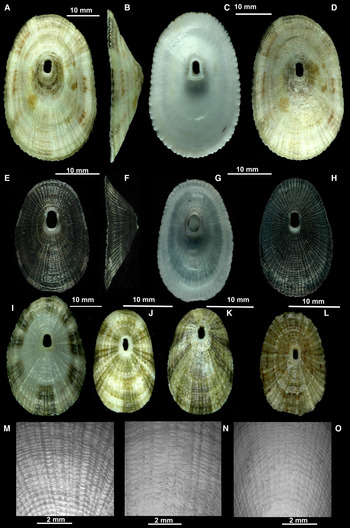
(Figures 3E–H)
Shells of Mediterranean fissurellids sequenced. A–C: Diodora giannispadai n. sp. (holotype. MNHN 2013-32769). Limnos Island. D: Diodora giannispadai n. sp. (paratype. MNHN 2013-32768). Limnos Island. E–H: Diodora demartiniorum. Djerba (MNHN IM-2013-31972. IM-2013-31829). I: Diodora italica. Djerba. (MNHN IM-2013-31967). J: D. gibberula. Islas Chafarinas. Spain (MNCN 85532). K: D. dorsata. Strimonikos. Greece (MNHN IM-2013-32767). L: D. greaca. Cabo de Palos. Murcia. Spain (MNCN 85530). M: ribs of D. italica (MNHN IM-2013-31967). N: ribs of Diodora giannispadai n. sp. (holotype. MNHN 2013-32769). O: ribs of D. demartiniorum. Djerba (MNHN IM-2013-31972).

TYPE DATA
Holotype, 39.8 × 22.1 mm, Mo27083 Museo Civico di Storia Naturale, Milano. Type locality: Djerba, Tunisia; shallow subtidal. Many paratypes from Djerba in various private collections. Paratypes from Samothrace and Limnos in collections F. Rubio and P. Russo.
MATERIAL EXAMINED
Six specimens (three sequenced, MNHN IM-2013-31972, IM-2013-31823, IM-2013-31829; three not sequenced, IM-2013-32084, IM-2013-32039 and IM-2013-32115) from Djerba; intertidal and shallow subtidal.
DESCRIPTION (BASED ON SEQUENCED AND NON-SEQUENCED ADULT SPECIMENS FROM DJERBA)
Shell limpet-shaped, solid, elongated, sculptured with 75 to 78 equal, closely and evenly spaced primary radial ribs, and secondary riblets in their interspaces. Anal pore rounded-elongated, very broad, length 4.8–5.0 mm, distance to anterior and posterior shell edge respectively 10–12 mm and 23–25 mm. Peristome totally adherent to the plane. Inner background colour beige, darker apically; outer shell surface dark grey with greenish bands radiating from the apex. Dimensions of the shell: (mean) length 35 mm, width 21 mm, height 7.5 mm.
DISTRIBUTION
In the original description of D. demartiniorum, Buzzurro & Russo (Reference Buzzurro and Russo2005) included specimens from the Aegean (Limnos, Samothrace, Strimonikos). The latter are more likely to be D. giannispadai, and D. demartiniorum ends up endemic to the Gulf of Gabès. Beside various localities on the NW coast of Djerba, D. demartiniorum is also reported from Kerkennah Islands by Cecalupo et al. (Reference Cecalupo, Buzzurro and Mariani2008), who declare it ‘poco comune’. A shell from Tripoli (Libya) illustrated by Giannuzzi-Savelli et al. (Reference Giannuzzi-Savelli, Pusateri, Palmeri and Ebreo1994: fig. 61) as D. producta resembles very much D. demartiniorum, and may very well be conspecific. The record from Iskendrun (Delongueville & Scaillet, Reference Delongueville and Scaillet2006) needs to be checked since it may possibly concern D. giannispadai (see below).
Diodora italica (Defrance, 1820)
(Figure 2I)
TYPE DATA
The name Fissurella italica was established by Defrance for fossils from the ‘Plaisantin’ (Piacenzian; upper Pliocene) of northern Italy. The Defrance collection was destroyed during the bombing of Caen during WWII. Based on our examination of topotypical material, the name appears to be applicable to the Recent Mediterranean species. The name Fissurella neglecta Deshayes, 1830, which was established for Recent shells from Sicily, is considered a synonym, which is confirmed by our examination of six syntypes (MNHN IM-2000-4789).
MATERIAL EXAMINED
Six specimens (MNHN IM-2013-31824, IM-2013-31827, IM-2013-31730, IM-2013-31826, IM-2013-31967, IM-2013-31973), all sequenced, from Djerba, intertidal and shallow subtidal.
DISTRIBUTION
Throughout the Mediterranean. Distribution in the eastern basin and Aegean Sea not known in detail.
DESCRIPTION (BASED ON SEQUENCED ADULT SPECIMENS FROM DJERBA)
Shell limpet-shaped, markedly narrower towards the anterior part, solid, elongated, sculptured with 28 to 36 widely spaced primary radial ribs, irregularly shaped, with secondary riblets in their interspaces. Anal pore up to 4–6 mm long, distance to anterior and posterior shell edge respectively 15–16 mm, and 26–27 mm. Peristome concave, non-adherent to the plane. Inner background colour uniformly beige; outer shell surface cream with visibly darker bands radiating from the apex. Dimensions of the shell: length 38–40 mm, width 21–22 mm, height 7.5–8 mm.
Diodora giannispadai sp. nov.
(Figures 2A–D)
TYPE MATERIAL
Holotype, a sequenced specimen, MNHN IM-2013-32769; paratype MNHN IM-2013-32768.
TYPE LOCALITY
Limnos I., Greece (39°55′N, 25°15′E); shallow subtidal.
DIAGNOSIS
Shell sculptured with widely spaced primary radial ribs and secondary riblets in the interspaces. Peristome totally adherent to the plane. Anal pore elongated, broad.
DESCRIPTION (OF HOLOTYPE)
Shell limpet-shaped, very solid, elongated, sculptured with 70 unequal, widely and evenly spaced primary radial ribs and secondary riblets in their interspaces. Anal pore elongated, broad, length 7 mm long, distance to anterior and posterior shell edge respectively 15 and 30 mm. Peristome slightly concave, especially in anterior part. Inner background colour evenly light beige; outer shell surface cream with darker, greenish to brownish, bands radiating from the apex. Dimensions of the holotype: length 45.0 mm, width 28.0 mm, height 13.6 mm; paratype: length 48.0 mm, width 30.0 mm, height 13.6 mm.
REMARKS
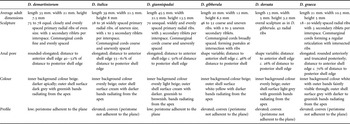
Diodora giannispadai differs from D. demartiniorum and D. italica by its broadly spaced ribbed with secondary riblets in between; the concentric (commarginal) cords may also be fewer and more widely spaced, although there are too few specimens to judge intraspecific variation (Table 3). Specimens of D. italica occasionally reach 52 mm at least in the northern Adriatic (Buzzurro & Russo Reference Buzzurro and Russo2005), and are comparable in size to D. giannispadai, but D. demartiniorum from the Gulf of Gabès rarely exceeds 35 mm and appears to be smaller on average.
Comparative morphological data of the shells of Mediterranean Diodora.

DISTRIBUTION
Beside the sequenced holotype and paratype from Limnos, specimens from Strimonikos (coll. P. Mel, cited by Buzzurro & Russo Reference Buzzurro and Russo2005; not seen), Samothrace (coll. F. Rubio; not seen) and Simi (Giannuzzi-Savelli et al., Reference Giannuzzi-Savelli, Pusateri, Palmeri and Ebreo1994, as D. italica) are very probably referable to the new species: the first two localities are in the North Aegean near the type locality, while Simi (also spelled Symi) is in the south-eastern part of the Aegean Sea. It is not known which other species of Diodora D. giannispadai is syntopic or sympatric with. Manousis (Reference Manousis2012) illustrates D. demartiniorum, D. dorsata, D. gibberula, D. graeca, D. italica and D. producta from Greece, but gives no details on their distribution within Greek waters. The material from Iskendrun (Turkey) referred to D. demartiniorum by Delongueville & Scaillet (Reference Delongueville and Scaillet2006) may or may not be conspecific; its identity should be verified with molecular markers.
ETYMOLOGY
The new species is named after Gianni Spada, a longtime promoter of Mediterranean malacology in the heydays of Societa Malacologica Italiana, and a participant of fieldwork in the Gulf of Gabès in 1982 with the senior author, and again in 2013 with the first author. Gianni generously helped the present project with identifications, advice and opinions.
DISCUSSION
The same divergent monophyletic groups are discriminated by the COI and 28S genes and they are congruent with the shell characters classically used to identify Mediterranean keyhole limpets, even though three of these groups are morphologically similar to each other: clade b (Diodora demartiniorum) from the Gulf of Gabès, clade c (D. italica from the Gulf of Gabès, Figure 3I), clade f (D. giannispadai from the Aegean Sea). As there is congruence between the mitochondrial dataset, nuclear dataset and shell morphology, we treat these three groups as three distinct species.
Diodora italica and D. demartiniorum were collected syntopically in Djerba and they are separated by COI distances greater than 10%, well over the threshold commonly found (i.e. > 3%) between different gastropod species (Hebert et al., Reference Hebert, Cywinska, Ball and Dewaard2003; Puillandre et al., Reference Puillandre, Baylac, Boisselier, Cruaud and Samadi2009; Crocetta et al., Reference Crocetta, Bonomolo, Albano, Barco, Houart and Oliverio2012; Barco et al., Reference Barco, Corso and Oliverio2013), and well over the threshold found between the other Diodora species in our dataset. As they are also recognizable by subtle, but constant morphological differences, there is no doubt that they are two separate species. The 28S data also indicate that the Aegean Sea specimens morphologically identified as D. demartiniorum are not conspecific with D. demartiniorum from the type locality, the Gulf of Gabès. As no name is available to designate this North Aegean species, it has been described as new.
The status of the other Mediterranean Diodora is more problematic. Our data are sufficient to show that there are more species of Diodora in the Mediterranean, but how many and what names should be applied to them can of course not be determined from the single specimen in our molecular dataset. Its identification as D. dorsata (Figure 3K) is tentative, and the whole issue should be revisited with more specimens from more localities.
As emphasized already by Sabelli & Taviani (Reference Sabelli, Taviani and Rampal1981), the Gulf of Gabès is geologically very young. During the last glacial maximum and resulting low sea levels, the shallow Gulf was completely exposed, and it can be reasonably assumed that the Gabès ecosystem, as we know it today, is not older than 6000–8000 years when sea level rose sufficiently to flood the exposed platform (Morhange & Pirazzoli, Reference Morhange and Pirazzoli2005; Barco et al., Reference Barco, Corso and Oliverio2013). Quoting Barco et al. (Reference Barco, Corso and Oliverio2013) who tested the validity and endemicity of the small muricid Ocinebrina hispidula, there are several possible hypotheses on the putative Gulf of Gabès endemics: (1) it is a distinct species that has originated elsewhere and is now restricted to the Gulf; (2) it is a distinct species that has originated elsewhere, has colonized the Gulf and is also present elsewhere in the Mediterranean; (3) it is a distinct species that has originated in the Gulf very recently; or (4) it is not a distinct species, and the Gulf of Gabès populations are merely ecophenotypes resulting from the extreme environmental conditions in the Gulf. Our results confirm the validity of D. demartiniorum, and therefore exclude hypothesis (4) above. However, just like Barco et al. (Reference Barco, Corso and Oliverio2013), our results do not positively favour one or the other of hypotheses (1) – (3). The possible occurrence of D. demartiniorum in Tripoli (Libya) (Giannuzzi-Savelli et al., Reference Giannuzzi-Savelli, Pusateri, Palmeri and Ebreo1994, see above) suggests that the range of D. demartiniorum includes the Gulf of Syrte. The Gulf of Syrte has a narrow continental shelf that drops quickly to deep water, and thus has always remained marine during Glacial low sea levels. We hypothesize that D. demartiniorum in fact originated in the Gulf of Syrte during Pleistocene low sea levels and subsequently invaded the Gulf of Gabès. Its apparent endemism there results from a sustained interest by malacologists in the Gulf of Gabès ever since Monterosato (Reference Monterosato1879) whereas, by contrast, the coasts of Libya remain essentially unexplored and its biota undocumented. The occurrence of another large Diodora in the Aegean Sea (and possibly the Gulf of Iskendrun) raises the possibility that populations of Diodora remained trapped in various Mediterranean refuges during glacial times, underwent genetic drift and speciated during this/these phase(s) of isolation, as found by other gastropods (e.g. Dendropoma, Calvo et al., Reference Calvo, Alda, Templado, Oliverio and Machordom2015). In this respect, it is noteworthy that the North Adriatic has at least a couple of endemic molluscs (Sabelli & Taviani, Reference Sabelli, Taviani, Goffredo, Baader and Dubinisky2013), and it would be most interesting to test genetically the identity of Diodora italica from the northern Adriatic which, like the Gulf of Gabès, dried out during glacial times and was subsequently reinvaded.
The systematics of the Mediterranean Diodoras thus ends up considerably more complex than the long-accepted three-species group. Beside the recognition of D. demartiniorum and D. giannispadai as distinct species, the present study also points to the existence of at least another species (here tentatively identified as D. producta). Clearly, molecular data for more morphs from more localities are critically needed.
ACKNOWLEDGEMENTS
The material for molecular studies in this paper derived from fieldwork in the Gulf of Gabès conducted specifically for this research, and we are grateful to everyone in the field party, Philippe Maestrati, Emmanuel Vassard, Gianni Spada, Marco Oliverio and Jean Pierre Miquel for their help in sampling. Special thanks go to Kyriakos Papavasileiou who collected specimens in the northern Aegean, and Junes Esteban who collected specimens in Murcia and Chafarinas. Paolo Russo sent photos and offered expert opinion. Virginie Héros, Barbara Buge and Philippe Maestrati helped with the curation of vouchers and access to MNHN historical material. The molecular part of the work was carried out at Service de Systematique Moléculaire (UMS 2700 CNRS, MNHN).
FINANCIAL SUPPORT
This project was partly funded by the MNHN ATM ‘Barcode’ (PIs: S. Samadi and J.N. Labat).