INTRODUCTION (SETTING A PROBLEM)
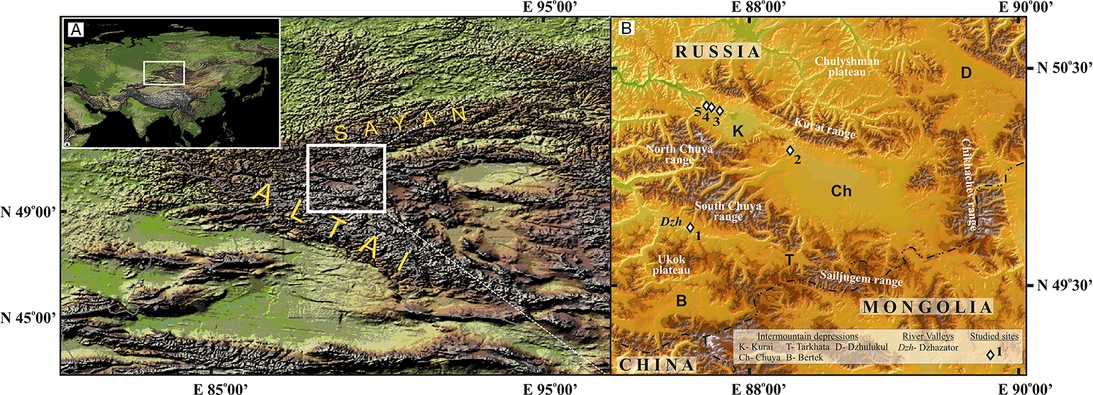
The Altai Mountains are located in the northern part of the Central Asia collision belt, stretching northwest more than 1500 km across the borders of Mongolia, China, Kazakhstan, and Russia (Figure 1). The intermountain basins of the highest southeastern part of Russian Altai are the largest and oldest depressions within whole mountain system. They are filled with redeposited products of Upper Cretaceous-Low Paleogene weathering crust, Paleogene-Neogene lacustrine and peat/brown coal boggy sediments, Pleistocene sediments (mainly alluvial, glacial, glacio-fluvial, glacio-lacustrine, and deposits associated with cataclysmic outburst floods from ice-dammed lakes), as well as with Holocene deposits of various genesis. As a result of tectonic movements, Tertiary deposits containing organic matter were uplifted and exhumed on the ridge’s slopes. Later, these were affected by sliding, glacio-fluvial activity and erosion from ice-dammed lakes during the Pleistocene, as well as by intensive Holocene erosion, pedogenesis and permafrost formation/degradation. Locations of even more ancient (Late Paleozoic [Middle and Upper Carboniferous] and Mesozoic [Lower Jurassic]) coal deposits in the region, which were affected by the same exogenous processes, are associated with fault boundaries between intermountain depressions and framing ridges (Selin and Goverdovsky Reference Selin and Goverdovsky2000). Such a complicated sedimentation and post-sedimentation history is generally typical for tectonically active mountain uplifts. This can be the reason of penetration of “young” carbon into ancient organic material with the own age beyond the limits of the radiocarbon (14C) dating. As a result, geochronological reconstructions of the Cenozoic paleogeography in Russian Altai applying 14C method encountered two problems:
1. obtaining apparent 14C-ages for the Paleogene-Neogene peat and coal-bearing deposits in situ, and, as result, incorrect interpretation of previously unknown near-surface location of Tertiary deposits as being of the Pleistocene ones with the redeposited ancient flora;
2. obtaining apparent 14C-ages for redeposited Carboniferous, Jurassic, and Neogene clays, peats and brown coals, which are represented as inclusion in the Pleistocene-Holocene colluvium, alluvium, lacustrine deposits etc., and, as a result, wrong reconstruction of regional Quaternary paleogeography.
(A) Altai Mountains and (B) southeastern part of Russian Altai, discussed in this paper.

A solution to the first problem is necessary to clarify the scale of the boggy-lacustrine sedimentation in Paleogene-Neogene, as well as for clarifying the Cenozoic tectonic history of the region (including magnitude and characteristic features of post Neogene tectonic movements). The solution of the second problem is important for understanding the Pleistocene paleogeography of the region, especially the chronology of the large Pleistocene ice-dammed lakes and their cataclysmic draining, which triggered significant landscape transformations not only within intermountain depressions, but also in the drainage valley network over the hundreds of kilometers.
In both cases, multidisciplinary studies are required to correctly interpret the age of the deposits and to explain the inability to directly use 14C dates as a geochronological basis for stratigraphic reconstructions. It should be mentioned that new locations of Tertiary peat/brown coal deposits in the Russian Altai have not been described since the 1990s, and in this context the problem of rejuvenating the 14C dates of ancient organic matter had not previously been raised. At the same time, single 14C ages (often near the upper time limit of the 14C dating method) of organic fragments discovered as inclusion in Quaternary pre-lacustrine, glacio-lacustrine sediments and deposits associated with cataclysmic outburst floods have still been accepted as key dates in paleogeographic reconstructions (Svitoch et al. Reference Svitoch, Boyarskaya, Voskresenskaya, Glushakova, Evseev, Kursalova, Parmonova, Faustov and Khorev1978; Okishev and Borodavko Reference Okishev and Borodavko2001; Herget Reference Herget2005; Zolnikov Reference Zolnikov2011).
The present study is focused on preventing possible misinterpretations of 14C dates in understanding Tertiary sedimentation patterns and making the late Pleistocene geochronological reconstructions within tectonically active mountain provinces, one of which is Altai. Similar methodological studies in the Russian Altai have not yet been carried out.
METHODS
In this paper, we report the results of multidisciplinary investigations of deposits of various ages and genesis within the intermountain depressions of the Russian Altai. These data should be taken into consideration while interpreting the 14C dates and further applying them in regional paleogeographical reconstructions. In addition to 14C and optically stimulated luminescence (OSL) dating, a set of techniques was applied including: pollen, and ostracod analyzes; paleocarpology; determination of the biological composition of deposits (Uspenskaya Reference Uspenskaya, Treshnikov, Kvasov and Rumjancev1986); exploring the micro-morphological structure of brown coal layers in situ, as well as redeposited organic-mineral layers; x-ray diffractometry and IR spectroscopy of enclosing clay deposits.
The 14C dates were obtained by liquid scintillation counting methods (LSC) at the Institute of Geology and Mineralogy SB RAS, Novosibirsk (marked by the SOAN index) and at the Laboratory of Radiocarbon Dating and Electronic Microscopy of the Institute of Geography RAS, Moscow (marked by the IGAN index). For charcoal samples, an acid-base-acid (ABA) technique was applied, i.e., treated the samples in sequence with 1M HCl (at 80ºC for 1 hour, centrifuged and decanted), 0.1 M NaOH and diluted HCl, then washed with deionized water and dried at 105ºC. The production of lithium carbide and benzene synthesis was applied by standard techniques (Arslanov Reference Arslanov1987; Skripkin and Kovaliukh Reference Skripkin and Kovaliukh1997). The activity of 14C was determined using the Quantulus-1220 liquid scintillation counter in both Novosibirsk and Moscow laboratories. All dates were normalized to δ13C value of –25‰. The conventional 14C ages were calibrated (2-sigma standard deviation) applying the CALIB Rev 7.1 program (http://calib.qub.ac.uk/calib/), with the IntCal13 calibration data set (Reimer et al. Reference Reimer, Bard, Bayliss, Beck, Blackwell, Bronk Ramsey, Buck, Cheng, Edwards, Friedrich, Grootes, Guilderson, Haflidason, Hajdas, Hatté, Heaton, Hogg, Hughen, Kaiser, Kromer, Manning, Niu, Reimer, Richards, Scott, Southon, Turney and van der Plicht2013). The paper presents both conventional 14C (BP) and calibrated ages (cal BP).
Samples for OSL dating were collected into steel tubes to protect sediment from the sun light, and processed at the Institute of Physics, Silesian University of Technology, Poland (marked by the GdTL index). High-resolution gamma spectrometry using a HPGe detector was applied to determine the content of U, Th, and K in the samples. Dose rates were calculated using the conversion factors of Guerin et al. (Guerin et al Reference Guerin, Mercier and Adamiec2011). The method of Prescott and Stephan (Prescott and Stephan Reference Prescott and Stephan1982) was applied for the cosmic ray beta dose-rate calculation. A present-day depth and assuming average water content of 18 ± 5% for most of the time-range was used, as its precise fluctuations could not be reproduced for the last several thousand years. Sand-sized grains of quartz (90–200 µm) were extracted applying standard procedures (Aitken Reference Aitken1998). An automated Risø TL/OSL DA-20 reader was used for the OSL measurements of multi-grain aliquots, each of ca. 1 mg. The stimulation light source was a blue (470 ± 30 nm) light emitting diode (LED) array delivering 50 mW/cm2 at the sample. Detection was through 7.5 mm of Hoya U-340 filter. Equivalent doses were determined using the single-aliquot regenerative-dose (SAR) protocol (Murray and Wintle Reference Murray and Wintle2000).
STUDIED SECTIONS AND OBTAINED RESULTS
The neotectonic structure of the highest (up to 4506 m) and most seismically active southeastern part of the Russian Altai (SE Altai), presented in this study, is formed by the alternation of uplifts (ridges, mountain massifs, and plateaus) and depressions (large valleys and intermountain basins), which forms a wedge shape widening in the northeast direction (Figure 1). The studied sections are located in the Dzhazator valley and within the Kurai-Chuya system of intermountain depressions. All of them are associated with the fault boundaries of the main morphostructures.
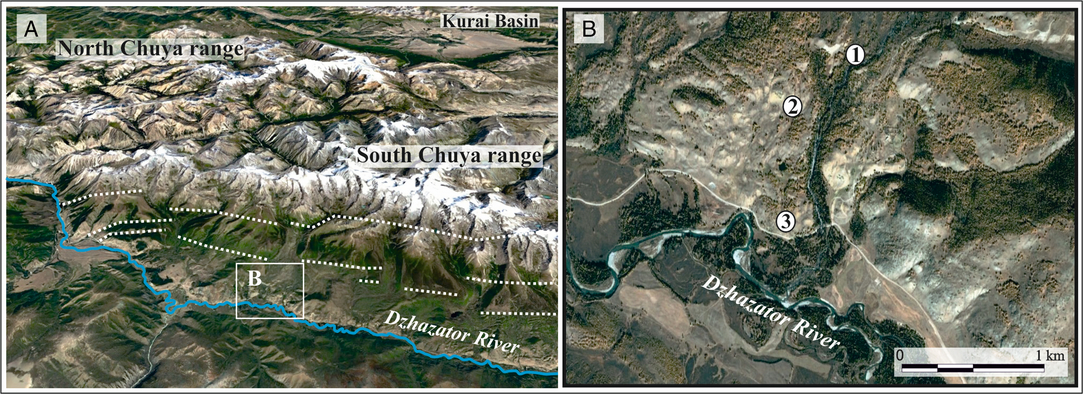
In the Dzhazator valley (Figure 1, location 1) apparent 14C-ages were obtained for peat-coal deposits. Later paleontological and geochemical study of these sediments indicated their Tertiary age. This discovered new location of the Oligocene-Miocene brown coal deposits associated with Koshagach suite is confined to the southern foot of the highest (3936 m asl) part of the South Chuya Range. Active tectonic movements caused uplift on the slope of the ridge and further areal slippage (Agatova et al. Reference Agatova, Nepop, Rudaya, Khazina, Zhdanova, Bronnikova, Uspenskaya, Zazovskaya, Ovchinnikov, Panov and Shurygin2017a). It was established that brown coal deposits were also affected by cold lacustrine and transitional waters, associated with the degradation of the Pleistocene glaciations. That was another factor that controlled areal downslope sliding of substratum. Within the landslide body, the coarse material of Pleistocene moraines and boggy-lacustrine deposits with peat / brown coal layers are mixed and wrinkled into folds. Three sections were studied in this location (Figure 2).
(A) Expanded look at the area around location 1 (Figure 1); (B) Google image of studied sites in the Dzhazator River valley. Faults are shown by dotted lines. Numbers indicate sections in this location discussed in text.

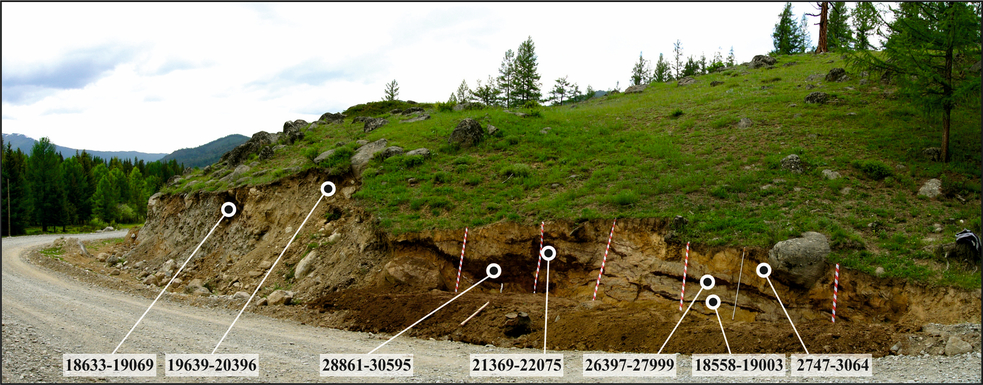
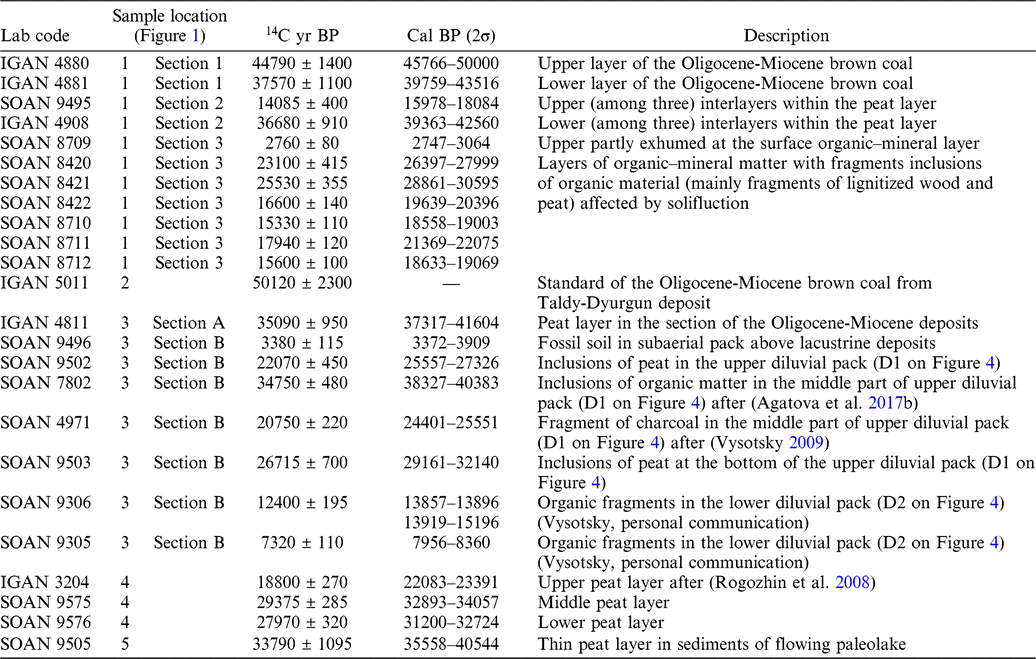
There are different degrees of transformation of the organic material in the upper (section 1), middle (section 2), and lower (section 3) parts of the sliding slope. Coal-bearing layers in the section 1 are least changed and are horizontally bedded. In section 2, these layers are creased into folds, but preserved the internal structure. Finally, in section 3 organic material is redeposited with a high content of mineral matter. The paleontological and geochemical characteristics of the discovered brown coal deposits clearly indicate their formation in Tertiary time in wet meadow-boggy conditions under a warm climate. At the same time, systematic rejuvenation of the 14C dates of studied sediments was revealed (Figure 3). Ten 14C dates of both redeposited organics and lithified peat-brown coal layers with unbroken structure, obtained in two laboratories, fell within the interval 17.0–47.9 ka cal BP, i.e. Late Pleistocene (Table 1).
Redeposited organic-mineral material in section 3 in the Dzhazator valley (Figure 2B) and obtained intervals of calibrated (2σ) age (BP).

Radiocarbon dating results.

The distribution of 14C ages (17.0–47.9 ka cal BP) for peats with the preserved structure in sections 1 and 2 is larger than for organic-mineral layers redeposited to the foot of the sliding slope in section 3 (18.8–29.7 ka cal BP). One more date of about 2.9 ka cal BP (SOAN 8709) was obtained for the upper partly exhumed at the surface layer in section 3, but it was not taken into consideration. Obtained age is one order of magnitude less than ages of other samples from this section mainly due to the influence of modern pedogenesis. In sections 1 and 3 (the most preserved material and redeposited one respectively), there is an inversion of 14C ages. The scattering of 14C ages for the same layer in sections 2 and 3, reaches 23.9 ka and 10.9 ka, respectively.
It should be noted that originally a Holocene age of the peat-mineral layers, which are exhumed at the surface in the section 3 in Dzhazator valley was assumed, which is why their 14C dating was conducted. Then, the problem of the discrepancy between 14C dates and paleontological and geochemical features of sediments could be addressed. It required the dating of the standard of Oligocene-Miocene brown coal from the Taldy-Dyurgun deposit in the Chuya basin (Figure 1 location 2, IGAN 5011), and Oligocene-Miocene peat bearing deposits in the Kurai basin (Figure 1 location 3 section A, IGAN 4811). Both locations are situated within fault boundaries between intermountain depressions and framing ridges. These deposits were exhumed to the surface and were affected by washing activity of the late Pleistocene ice-dammed lakes. Apparent 14C-ages (about 50 [IGAN 5011] and 39.4 [IGAN 4811)] ka cal BP, respectively) obtained for both locations challenge the inferred Pleistocene age of deposits in the Dzhazator valley.
Within the fault boundary zone between the Kurai basin and Kurai range in the western periphery of the basin, three sections were studied: section of the Pleistocene deposits associated with a cataclysmic outburst flood event from ice-dammed lake—diluvium (Figure 1 location 3), section of post-lacustrine late Pleistocene-Holocene alluvial deposits with peat layers (Figure 1 location 4), and deposits of flowing late Pleistocene-early Holocene lake (Figure 1 location 5).
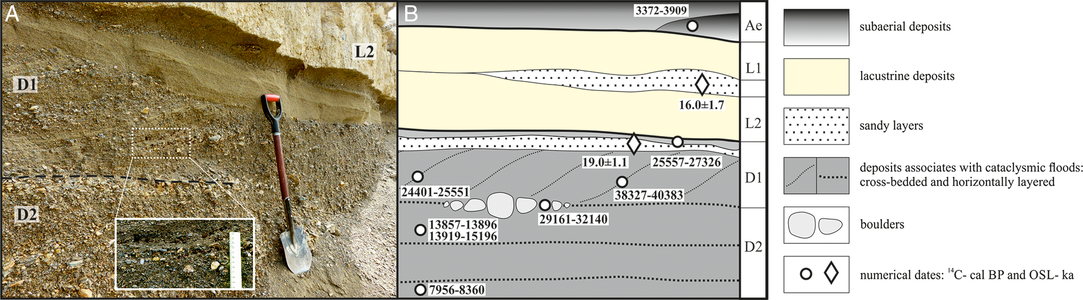
In location 3 (section B), diluvial gravel and land-waste deposits associated with two draining events (or with two different stages of a single unsteady flow) represent two packs—the lower horizontally layered and the upper cross-bedded ones. Both packs contain inclusions of organic material. Diluvium is covered by two horizons of lacustrine sediments, separated by a sandy layer (Figure 4).
Section B (location 3, Figure 1): (A) general view of the lower part of the section and (B) generalized section scheme. Inset on the left panel demonstrates numerous fragments of redeposited organic material presented as inclusions in deposits, associated with cataclysmic outburst floods from ice-dammed lakes (diluvium). Genesis of sediments is indicated with letters: Ae–aeolian; L–lacustrine; D–diluvial.

Two OSL dates (19.0 ± 1.1 ka [GdTL-2590] and 16.0 ± 1.7 ka [GdTL-2591]) indicate the age of accumulation of sands at the top of the diluvial pack and between the lacustrine sediments (Agatova et al. Reference Agatova, Nepop, Khazin, Zhdanova, Uspenskaya, Ovchinnikov and Moska2019). Two 14C dates were obtained for inclusions of organic material (mainly fragments of lignitized wood and peat) from the upper cross-bedded diluvial pack (about 26.4 (SOAN 9502) and 30.7 (SOAN 9503) ka cal BP in the roof and bottom, respectively). Earlier, two 14C dates—about 25 (SOAN 4971) (Vysotsky Reference Vysotsky2009) and 39.4 (SOAN 7802) ka cal BP (Agatova et al. Reference Agatova, Nepop and Slyusarenko2017b)—were reported for these deposits. Two 14C dates were also obtained from the underlying horizontally layered pack—about 14.5 (SOAN 9306) and 8.1 ka cal BP (SOAN 9305) (E. M. Vysotsky, personal communication). Thus, a significant scattering (up to 31 ka) of 14C dates is observed for sediments which were accumulated practically instantaneously. There is also an inversion of dates within the diluvial pack. It should be noted that outcrop of Tertiary peat bearing sediments (section A, location 3) is located nearby at the slope, which is terraced by the waters of the Pleistocene Lake.
A 14C age 22.7 ka cal BP (IGAN 3204) of fossil soil under alluvium within the terrace of the right tributary of the Chuya river (Figure 1 location 4) was reported by Rogozhin et al (Reference Rogozhin, Ovsyuchenko and Marakhanov2008). This date is one of the few ones that characterizes the period of Sartan glaciation in the Russian Altai, but the process of soil formation is in poor agreement with paleoenviromental reconstructions of that time. Detailed study of sedimentation records in this section revealed inter-bedding of thin (up to 5–10 cm) alluvial and three peat (not soil!) layers, among which the upper one was previously dated as 22.7 ka cal BP. The obtained 14C ages of organic material from two lower peat layers 33.5 (SOAN 9575) and 32 (SOAN 9576) ka cal BP have inversion. Sedimentation patterns in this section indicate periodical river bed migration and accumulation of sediments with peat filling during the post-glacial period. As well as in the location 3, washed out Tertiary brown coal deposits most likely served as original source for peat interlayers.
A single thin (less than 1 cm) layer of peaty material was dated applying 14C dating (38 ka cal BP SOAN 9505) at location 5 (Figure 1). It is included in horizontally bedded fine and medium sands, which accumulated in a flowing lake. Along the section, the peaty layer breaks down into separate lenses and fragments. Two OSL dates were obtained for sands above and below it. Despite a slight inversion (11.12 ± 0.87 ka [GdTL-3126] and 9.41 ± 0.84 ka [GdTL-3125]), OSL dates indicate the early Holocene age of lacustrine sedimentation, which is three-four times younger than the 14C age of peat inclusions. As in previous locations, this suggests a redeposition of old organic material by more recent geomorphic processes, and 14C ages could not be used for any paleogeographical reconstruction.
DISCUSSION
The “invalid” dates could not be a reason to doubt the professional work of 14C laboratories, which is confirmed by the results of dating in different laboratories. Apparent 14C-age close to limit ages were obtained for sediments with the specific features of the pre-Late Pleistocene age. The disagreement between the 14C date and paleontological and geochemical characteristics of the deposits suggests the presence of “young” carbon in old material. The influx of this carbon can be related to post-sedimentation tectonic and exogenous processes including formation of zones of increased fracturing, exhumation of deposits to the surface, the influence of melted glacial and lake waters, solifluction, cryoturbation, contemporary pedogenesis, etc. Complicated regional paleogeography, which is quite common for tectonically active mountain provinces, suggests that “young” carbon within the studied peat and coal-bearing dated material cannot be eliminated completely utilizing standard pre-treatment techniques (such as the ABA method).
Old deposits in situ with an age of more than 30 ka BP are particularly sensitive to contamination of young carbon: the admixture of only 1% of modern carbon to an indefinitely ancient sample will give a final date of about 37 ka BP (Mangerud et al. Reference Mangerud, Astakhov and Svendsen2002). Together with Astakhov (Reference Astakhov2009) we conclude that utilizing a single old 14C ages (more than 30 ka BP) can hardly be correct in this type of situation, since they can come from an infinitely ancient organic material. Ancient (beyond MIS 2) dates can be used for geochronological reconstructions only if there is other stratigraphic information and consistency with other dates and proxy data.
In general, the problem of rejuvenation of 14C ages when dating ancient deposits is not new. Earlier, this was reported for Altai fore-plain and northern Russian plain (Panychev Reference Panychev1979; Kaplina et al. Reference Kaplina, Sher, Giterman, Zazhigin, Kiselev, Lozhkin and Nikitin1980), but for Russian Altai it was reliably established for the first time. Presented study highlights the need for thorough comprehensive investigations of dated organic-rich sediments here to avoid incorrect conclusions concerning the age of the Pleistocene ice-dammed lakes, where Tertiary peat and brown coal deposits are also present.
For redeposited ancient organic material (peat inclusions, lignitized wood, brown coal fragments, clays with high content of organic carbon, etc.), the 14C ages obtained also should not be used in geochronological reconstructions. The fact is that dated samples represent a mixture of ancient and young carbon in a unique (for each sample) ratio, and at the present time, there are no techniques to separate them. That is the reason why apparent 14C-ages could not characterize the period of formation of organic-mineral layers at the foot of the South Chuya range in Dzhazator valley, as well as the time of accumulation of deposits associated with one of the cataclysmic outburst flood events in the Kurai basin.
CONCLUSION
Multidisciplinary investigations of deposits of different genesis within the SE Altai set a problem of obtaining apparent 14C-age for ancient organic material preserved in deposits in situ, as well as for such material redeposited as inclusion in the Pleistocene-Holocene sediments. The true ages of studied organics are well beyond the time limit of 14C method and is confirmed by various proxy data. This fact was established for the SE Altai for the first time and is of key importance for understanding the Quaternary paleogeography and making chronological reconstructions, including the highly debatable chronology of giant Pleistocene ice-dammed lakes and their cataclysmic draining.
The problem of rejuvenation of 14C ages due to contamination of ancient organic matter with young carbon as a result of a complicated post-sedimentation history is quite common for tectonically active mountain provinces including Altai Mountains. Generally, apparent 14C-ages near the upper time limit do not serve as reliable age markers and should cautiously be used only if they have an independent control by other proxy data. Significant scattering of obtained 14C dates together with their inversion within a section, and even within a single layer are the main attributes of invalid dates. To avoid erroneous interpretations, multiple dating and multidisciplinary studies of deposits are necessary.
ACKNOWLEDGMENTS
Dr. Vysotsky (IGM SBRAS, Novosibirsk) is kindly thanked for providing unpublished 14C dates. The study was supported by state assignment project (0330-2016-0015) and partly funded by Russian Foundation for Basic Researches (grants 18-05-00998) and by state assignment of Institute of geography RAS N 0148-2019-0006.