The Christian faith has historically been deeply rooted in the social fabric of the United States (Finke and Stark, Reference Finke and Stark2005). As a consequence, both political and religious elites articulate various expressions of public religion as they seek to connect the events of the day to religious worldviews. Although some political God talk seeks to inspire a sense of God's blessing on the nation and aspirational visions for future progress towards inclusion and national community, other types of public religion seek to prioritize the values and belonging of Christianity and Christians above other faiths.
This former type of ethnocultural public religion is accused of fusing not just religion and nation, but race as well. Religious traditions, especially Christianity, have developed differently in White and non-White spaces. While Black-majority religious traditions have explicitly wrestled with race and racism (Raboteau, Reference Raboteau1999), race plays a more implicit role in White-majority religious traditions, especially Christianity. Many White Christians argue that their application of their religiously-inspired values to public questions such as affirmative action is race-neutral (Emerson and Smith, Reference Emerson and Smith2000), but a flurry of recent research has brought heightened attention to the entrenched nature of racism in White Christianity (Davis, Reference Davis2019; Davis and Perry, Reference Davis and Perry2021; Whitehead and Perry, Reference Whitehead and Perry2020; Yukich and Edgell, Reference Yukich and Edgell2020; Braunstein, Reference Braunstein2021; Gorski and Perry, Reference Gorski and Perry2022). Theoretically, it has been suggested that concepts of a religious or Christian America are deeply connected, psychologically, with concepts of a White America, with religious, racial, and national concepts fused by the rhetoric of candidate, then president, Donald Trump (Perry, Reference Perry2023).
At the same time, however, Christian communities in the United States have become more racially diverse. The number of multiracial congregations has grown (Dougherty et al., Reference Dougherty, Chaves and Emerson2020) and non-White Christians increasingly occupy leadership positions in Religious Right organizations (Stewart, Reference Stewart2020). To what extent are preferences for religion in public spaces an outcome of racialized processes? To answer this question, we fielded a novel survey experiment that presented respondents with racial primes. We find that, for White Americans, pictures of Black Americans are sufficient to raise support for both types of public religious expressions–the theoretically-inclusive civil religion and Christian nationalism. Moreover, we demonstrate that this effect is related to racist beliefs about the belongingness of Black Americans. We provide the first experimental test, to our knowledge, of the effect of racial priming on public religion support. Our results provide stronger evidence of race's causal mechanism to the already-substantial correlational literature. These findings challenge the differentiation of civil religion and Christian nationalism and contribute to the literature on counter-stereotypical racial priming.
Religion and nation
Religion has long played a role in American political life. The country's founding narrative centers Puritan refugees looking to establish a religious haven, politicians throughout American history have used religious language to signal their religious bona fides (Domke and Coe, Reference Domke and Coe2008), and Americans demonstrate higher religious commitment than do citizens of peer countries (Norris and Inglehart, Reference Norris and Inglehart2011). It is therefore not surprising that religious ideas have been connected to the nation, with two main traditions articulating different conceptualizations of this connection.
First, Christian nationalism is an “ideology that idealizes and advocates the fusion of American civic life with a particular type of Christian identity and culture” (Whitehead and Perry, Reference Whitehead and Perry2020, ix–x). Specifically, this fusion emphasizes a story in which the United States is a Christian nation, founded on Christian principles, and that it should consequently embrace Christian values (Whitehead and Perry, Reference Whitehead and Perry2020; Gorski and Perry, Reference Gorski and Perry2022).
The second tradition is civil religion, a “common elements of religious orientation that the great majority of Americans share” (Bellah, Reference Bellah1967, 42). Civil religion is not tied to any particular religion, but it does draw upon ideas of a deity actively involved in the world. This deity has blessed the United States by guiding its development and by inspiring our leaders to create a democratic system. References to civil religion are used to invite all citizens to action related to national objectives. President Biden's inauguration speech is cited as an example of civil religion (Cremer, Reference Cremer2022) in which he cites St. Augustine's influence on Biden's own understanding of Americans as defined by their love of liberty. He goes on to cite Psalms as evidence that the country would endure hard times if Americans remained unified. And he detailed a history of deepening civil rights occurring on the “sacred ground” of the inauguration site (Biden, Reference Biden2021).
Conceptually, these traditions have been differentiated in two main ways. First, Christian nationalism maintains an exclusive focus on, not just Christianity, but a specific tradition of evangelicalism (Davis et al., Reference Davis, Perry and GrubbsN/A). In particular, Christian nationalism is strongly correlated with evangelical beliefs about biblical literacy and “end times” (Whitehead and Perry, Reference Whitehead and Perry2020; Djupe, Reference Djupe2023; Onishi, Reference Onishi2023; Walker and Vegter, Reference Walker and Vegter2023) and identification as born again (Kobes du Mez, Reference Kobes du Mez2020; Perry et al., Reference Perry, Whitehead and Grubbs2021). Consequently, Christian nationalism support is lower among adherents to other Christian traditions (mainline Protestants, Catholics), adherents to non-Christian religions, and the religiously unaffiliated (Whitehead and Perry, Reference Whitehead and Perry2020). Conversely, civil religion typically refrains from references to specific religious traditions and instead makes broad references to God as a deity transcending religious sects (Bellah, Reference Bellah1967). Second, Christian nationalism is associated with exclusive boundaries around American belonging, often based on ascriptive characteristics (Edgell and Tranby, Reference Edgell and Tranby2010; Davis, Reference Davis2019; Davis and Perry, Reference Davis and Perry2021). Civil religion, conversely, aspirationally frames the nation in inclusive terms (Bellah, Reference Bellah1967; Lüchau, Reference Lüchau2009; Gorski, Reference Gorski2017).
The role of race
In the American context, religion is intensively interconnected with race (Yukich and Edgell, Reference Yukich and Edgell2020), with perhaps no other institution in American civic life as segregated as the Christian church. While other racial and ethnic groups have also struggled to find a place in majority-White Christian congregations, the sharpest racial segregation has existed between Black and White Christian traditions. The result of centuries of the use of Christianity by White Americans to promote subservience and uphold racial hierarchies (Jones, Reference Jones2020), religious segregation resulted in Black Americans' development of their own religious communities and theologies (Raboteau, Reference Raboteau1999). This situation has persisted: in 1960, Dr. Martin Luther King Jr. remarked, “I think it is one of the tragedies of our nation, one of the shameful tragedies, that 11:00 on Sunday morning is one of the most segregated hours, if not the most segregated hour in Christian America” (Reference King1960), and congregations remain less racially-integrated than other social institutions (Mohamed et al., Reference Mohamed, Cox, Diamant and Gecewicz2021; Shimron, Reference Shimron2023).
Capturing accurate racial animosity can be difficult because it is socially undesirable (Mendelberg, Reference Mendelberg2001; Hutchings and Jardina, Reference Hutchings and Jardina2009). But this challenge is especially pronounced for religious people. Of the Big Five personality traits, religious people are high in agreeableness and conscientiousness (Saroglou, Reference Saroglou2002). This desire to appear agreeable translates into self-deception and conscious impression management that would make the open communication of racial stereotypes unlikely (Leak and Fish, Reference Leak and Fish1989).
A large body of research demonstrates that people organize their political ideas into schemas, or cognitive structures that organize information to facilitate the integration of new information and the retrieval of old information (Conover and Feldman, Reference Conover and Feldman1984). Schemas “contain information about race […], including our knowledge of common social stereotypes” (Winter, Reference Winter2008, 6). Schemas enable individuals to more easily classify new information, attaching stereotypes to their assessments (Lau and Redlawsk, Reference Lau and Redlawsk2006). Much of the effect of schemas occurs pre-consciously, such that individuals are not aware of the role schemas and their associated stereotypes are playing (Mendelberg, Reference Mendelberg2008). One method used to assess the extent to which ideas are linked into schemas is priming. Priming activates one concept and then evaluates the extent to which other concepts are made accessible (Iyengar and Kinder, Reference Iyengar and Kinder1987; Valentino et al., Reference Valentino, Hutchings and White2002), affecting attitudes on issues for which race is salient (Peffley and Hurwitz, Reference Peffley and Hurwitz2002; Hurwitz and Peffley, Reference Hurwitz and Peffley2005; but also see Huber and Lapinski, Reference Huber and Lapinski2006; Stephens-Dougan, Reference Stephens-Dougan2021).
One body of work classifies primes as either explicit or implicit. Explicit racial primes directly invoke race, using terms like “white” or “black” to raise consciousness of racial schemas. Implicit racial primes work “implicitly either because it uses negative images of the target group that appear coincidental to the main message, which is delivered without racial words; or because it uses words that have racial associations but are not racial nouns or adjectives and therefore do not appear to focus on race” (Mendelberg, Reference Mendelberg2008, 110). In the initial work comparing these prime types, implicit primes were found to be most effective, with “racial cues racializ[ing] people's responses even though—and especially when—people are unaware that they have been exposed to racial cues” (Mendelberg, Reference Mendelberg2008, 111). Whereas explicit primes were theorized to activate social desirability concerns, implicit primes operate at a subconscious level and therefore may more accurately capture racial schemas (Hutchings and Jardina, Reference Hutchings and Jardina2009). Elite representations matter in building schemas among the public (Valentino et al., Reference Valentino, Hutchings and White2002; Valentino and Vandenbroek, Reference Valentino, Vandenbroek, Kenski and Jamieson2017), and explicit racial cues entered the mainstream with the Trump campaign and presidency. There is some evidence that, since the Trump era, responses to explicit racial primes have become socially acceptable (Reny et al., Reference Reny, Valenzuela and Collingwood2020; Newman et al., Reference Newman, Merolla, Shah, Lemi, Collingwood and Karthick Ramakrishnan2021). Accurately capturing priming effects of religious people is more likely with implicit primes because treatment effects from explicit primes are likely to be masked by social desirability concerns (Hopkins and Washington, Reference Hopkins and Washington2020; Stephens-Dougan, Reference Stephens-Dougan2021).
Another consideration is the extent to which stereotypical primes are required for priming effects to activate racial schemas. Mendelberg's racial priming theory is that schemas are built of racial stereotypes, so stereotypical portrayals are used as racial primes. More recently, Stephens-Dougan (Stephens-Dougan, Reference Stephens-Dougan2016) has demonstrated that counter-stereotypical images also elicit priming effects. Indeed, the use of facial images (without framing those images in a stereotypical fashion) is common practice within racial priming literature. Payne (Reference Payne2001) finds that individuals seeing a Black face are more likely to mistake tools for guns, compared to seeing a White face (see also Payne et al., Reference Payne, Lambert and Jacoby2002), and implicit association tests make frequent use of faces without a larger context (Greenwald and Krieger, Reference Greenwald and Krieger2006). Because counter-stereotypical images do not explicitly tap into the stereotypes underlying racial animus, they constitute a conservative test of the effects of racial priming.
The racialization of Christian nationalism
Christian nationalism defines the U.S. to be a Christian nation driven by Christian values. While “Christian nation” and “Christian values” may appear, on their face, to be race-neutral, they can be intertwined with ideas about race.
For many White supporters, a “Christian America” is a White America. Christian nationalist narratives of the nation's founding center the role of White Christian men, downplaying systematic eradication of Native populations, the long-term implications of slavery, and the role of race in the Civil War (Fea, Reference Fea2018; Maxwell and Shields, Reference Maxwell and Shields2019; Jones, Reference Jones2020; Braunstein, Reference Braunstein2021; Gorski and Perry, Reference Gorski and Perry2022). White Christian nationalists are especially likely to tolerate police mistreatment of Black suspects (Perry et al., Reference Perry, Whitehead and Davis2019) and to assert that White Americans endure the most discrimination (PRRI, 2023; Walker and Haider-Markel, Reference Walker and Haider-Markel2024), compared to the general population. Finally, the differences between Christianity and non-Christian religions have been racialized. For example, while Christians are typically classified as White (d'Urso, Reference d'Urso2022), adherents of non-Christian religions (namely Islam) are classified as non-White (Jamal, Reference Jamal and Sinno2009; Selod and Embrick, Reference Selod and Embrick2013).
“Christian values” are also racialized. Religious Right organizations have long emphasized the idea of traditional two-parent households, attempting to focus national attention on the family as an institution as the cornerstone of the nation (Bjork-James, Reference Bjork-James2021). Recent parents-rights rhetoric plays on this theme as well by reorienting debates about community educational institutions to the individual family. But racial stereotypes portray Black families as violating these Christian values by the absence of fathers and the presence of children born out-of-wedlock (Collins, Reference Collins2004).
Second, Black Americans are perceived to violate Christian values of work ethic. Since the 1930s, Christian libertarianism has asserted that the strength of the nation is conditioned on a biblical economic system, namely a capitalist system with few social safety nets (Kruse, Reference Kruse2015; Martí, Reference Martí, Yukich and Edgell2020; Gorski and Perry, Reference Gorski and Perry2022). Modern racism is rooted in the belief that, by demanding redress for systemic inequalities, Black citizens violate the biblical economic values that make America great (Emerson and Smith, Reference Emerson and Smith2000; Henry and Sears, Reference Henry and Sears2002). An editorial at the leading conservative Christian news publication The Christian Post despairs that, “[t]oday in nearly every major city, black children are raised in 80% fatherless homes. […] LBJ's Great Society social welfare programs in the 1960s financially incentivized women to have children outside of marriage for the first time in U.S. history. These programs were heavily marketed in urban communities. The absence of a husband and father seemed a small price to pay for ‘free money’ and housing” (Qualls, Reference Qualls2022). He goes on to argue that restoration of the Black community will require repudiation of government dependency and affirmation of “marriage before children, and a love of God and country” (Qualls, Reference Qualls2022). In other words, Black Americans’ subordinate social status is attributable to their own reliance on government handouts and failure to form biblical families. Because the nation has become intertwined with Whiteness, we anticipate that White respondents will express stronger support for public religion when primed with pictures of Black people than with pictures of White people (H1).
The racialization of civil religion
Much of the initial conceptualization of civil religion emphasized its inclusive notion of the nation and the unifying ways in which politicians have employed civil liberties language (Williams Jr and Goff, Reference Williams, Haberski and Goff2021). President Obama himself frequently used rhetoric consistent with civil religion (Gorski, Reference Gorski and Go2011). However, civil religion itself may prove more racially-divisive than originally thought. First, references to God, even when not directly tied to Christianity or any other religious tradition, can increase outgroup prejudice. Bloom et al. (Reference Bloom, Arikan and Courtemanche2015), for example, find that priming religion concepts can increase desire for social distance, especially when the outgroup under consideration is religiously or ethnically distinct from the respondent. Second, primes that do make reference to God increase out-group derogation (Johnson et al., Reference Johnson, Rowatt and LaBouff2012; LaBouff et al., Reference LaBouff, Rowatt, Johnson and Finkle2012; Ramsay et al., Reference Ramsay, Pang, Shen and Rowatt2014; Yilmaz et al., Reference Yilmaz, Karadöller and Sofuoglu2016), a finding demonstrated in multiple countries and across religious traditions, pointing to a general effect of religion broadly defined.
Religious language also carries specific political and social meaning in the current American context. Since the 1970s, the party identifiers have sorted themselves along religious, ideological, and racial lines. Specifically, Christians have become significantly more likely to identify as Republican, such that “Republican” has become a marker for “Christian” (Bean, Reference Bean2014). At the same time, the parties have sorted racially, with the Republican party becoming Whiter (Bowler et al., Reference Bowler, Nicholson and Segura2006). The Republican Party has therefore become the party of White Christians, linking the two in the public political consciousness (Mason, Reference Mason2018; Maxwell and Shields, Reference Maxwell and Shields2019; Kane et al., Reference Kane, Mason and Wronski2021) so strongly that political attitudes can influence religious adherence (Margolis, Reference Margolis2018). To the extent that people of faith remain in the Democratic Party, it is the public perception of the God Gap in party membership that matters (Ahler and Sood, Reference Ahler and Sood2018). Because religion is implicitly linked with prejudice, we expect that White respondents will express stronger support for civil religion when primed with pictures of Black people than with pictures of White people (H2).
Racial attitudes as mechanism
H1 and H2 both predict that Black racial primes will increase White support for Christian nationalism and civil religion. Although existing literature would point to underlying racial animus as the mechanism at play, demonstration of a significant treatment effect is insufficient to establish that racial animus is to blame. The Christian nationalist movement has grown more diverse over the past two decades (Goldberg, Reference Goldberg2006, Reference Goldberg2021), and elites strongly supportive of Christian nationalism present their positions as pro-Black. For example, Ken Blackwell, a Black fellow at the Family Research Council, argues that discussions of structural racism are fundamentally anti-Black, discouraging Black children from pursuing education and hard work (Blackwell, Reference Blackwell2021) by encouraging “people to despise traditional values that nurture safety, opportunity, and prosperity.. […] With its underlying assumption that all white people are racists, CRT is itself racist” (Blackwell, Reference Blackwell2020). From this perspective, conservative Whites may be motivated by an attempt to demonstrate their commitment to racial equality (Hood and Mckee, Reference Hood and Mckee2015; Karpowitz et al., Reference Karpowitz, King-Meadows, Quin Monson and Pope2021). Likewise, respondents who have sacralized the American story, especially its steps towards greater civil rights for racial minorities, may affirm the tenets of civil religion because they believe it embodies greater racial equality. When seeing a Black prime, White respondents may interpret Christian nationalism and civil religion as being pro-Black. How can we know that racial resentment is driving treatment effects?
We argue that beliefs about the national inclusion of Black Americans can clarify the underlying mechanism. Not all American citizens are considered equally part of the national community–White Americans are considered more stereotypically American than Black Americans (Devos and Banaji, Reference Devos and Banaji2005; Theiss-Morse, Reference Theiss-Morse2009; Devos and Ma, Reference Devos and Ma2013). If treatment effects are a compensatory mechanism through which respondents are attempting to communicate their innocence of racism, then assessments of Black Americanness should not shape treatment effects. But we argue that if affirmation of Christian nationalism and civil religion is racialized, White respondents will respond to perceived symbolic threat (Valentino et al., Reference Valentino, Neuner and Matthew Vandenbroek2018; Wetts and Willer, Reference Wetts and Willer2019). In other words, when race is made salient through implicit primes, respondents who harbor racially-exclusionary attitudes should be especially likely to communicate support for racially-laden worldviews about the role of religion in public spaces. Consequently, we expect that Black national inclusion will moderate the relationship between treatment and Christian nationalism/civil religion support–Black primes will increase White support for Christian nationalism and civil religion among those respondents who feel that Black Americans are not characteristically American (H3).
Method
To test these hypotheses, we employ a survey experiment fielded between September 29 and October 11, 2020 by Dynata. Dynata recruits participants via email from their authenticated national pool, 1,730 of whom successfully passed an attention check (Oppenheimer et al., Reference Oppenheimer, Meyvis and Davidenko2009) and completed the survey. While the sample is a non-probability sample, the demographic characteristics of the sample closely match those of other frequently-utilized non-probability samples and of probability samples (see Appendix) and multiple studies demonstrate that experimental results from probability and non-probability samples compare favorably (Mullinix et al., Reference Mullinix, Leeper, Druckman and Freese2016; Coppock et al., Reference Coppock, Leeper and Mullinix2018; Krupnikov et al., Reference Krupnikov, Nam, Style, Druckman and Green2021). Even when nonprobability samples under-sample religious respondents, nonprobability samples provide sufficient variation on religious variables to generate reliable estimates from survey experiments (Lewis et al., Reference Lewis, Djupe, Mockabee and Wu2015).
To assess Christian nationalism support we use the two-measure index recommended by Davis (Reference Davis2023), which asks respondents to rate their support for declaring the U.S. a Christian nation and federal government advocacy of Christian values (Cronbach's α = 0.888). These measures both explicitly link Christianity with the nation, asserting that Christianity should occupy a privileged status. We also included traditional measures of civil religion, both of which tap into a nonsectarian God concept and reference inclusive visions of the country (Gorski, Reference Gorski2017). In his survey of the relevant literature, Gardella argues that democracy, cultural tolerance, and personal freedom are core tenets of civil religion (Reference Gardella2014). To capture these tenets, we measure civil religion by asking respondents to provide their agreement with, “God can be known through the historical experiences of the American people” and “In America, freedom comes from God through our system of government by the people” (Wimberley, Reference Wimberley1979). Wimberley (Reference Wimberley1979) captures civil religion with these measures, which (contrary to the Christian nationalism measures) do not explicitly refer to an exclusively Christian nation, but rather to deistic references and core civic values shared by many Americans (Bellah, Reference Bellah1967). Respondents signaled their support for these statements on a 4-point strongly disagree-strongly agree scale, for which higher values indicate stronger agreement.
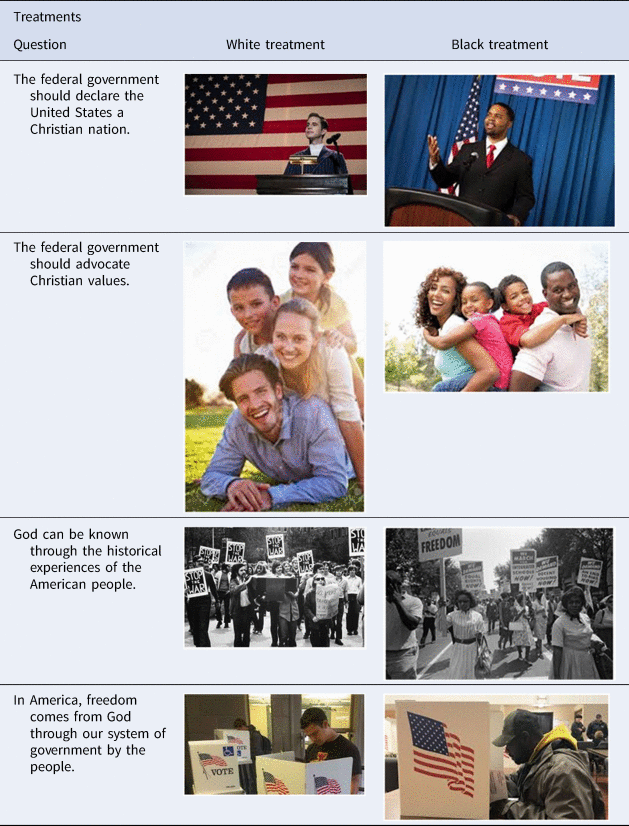
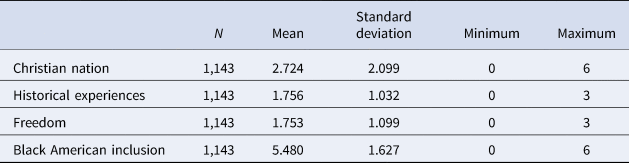
Because racial attitudes, especially for religious populations, are associated with social desirability motivations, our experiment utilizes implicit racial priming. Respondents were presented with each dependent variable question, accompanied by a picture. Respondents were randomly assigned to see images of White people or of Black people. The images are carefully matched so that, in general, only the race of the subject(s) differs.Footnote 1 Respondents were also asked to rate how strongly Black Americans are identified with the idea of America on a 7-point scale. Treatment images are presented in Table 1. Summary statistics are presented in Table 2. In acknowledgement of the racialized development of American Christianity and national identity (Yukich and Edgell, Reference Yukich and Edgell2020), we isolate our analysis to non-Hispanic White respondents (Perry and Whitehead, Reference Perry and Whitehead2015; Davis and Perry, Reference Davis and Perry2021; Gorski and Perry, Reference Gorski and Perry2022). The appendix presents results for Black respondents, showing that treatment does not produce the same effects. Our models utilize ordered logit, the tables present odds ratios, and, because randomization was successful, no control variables are used. Randomization analysis is included in the Appendix.
Treatment wording and images

Summary statistics

Findings
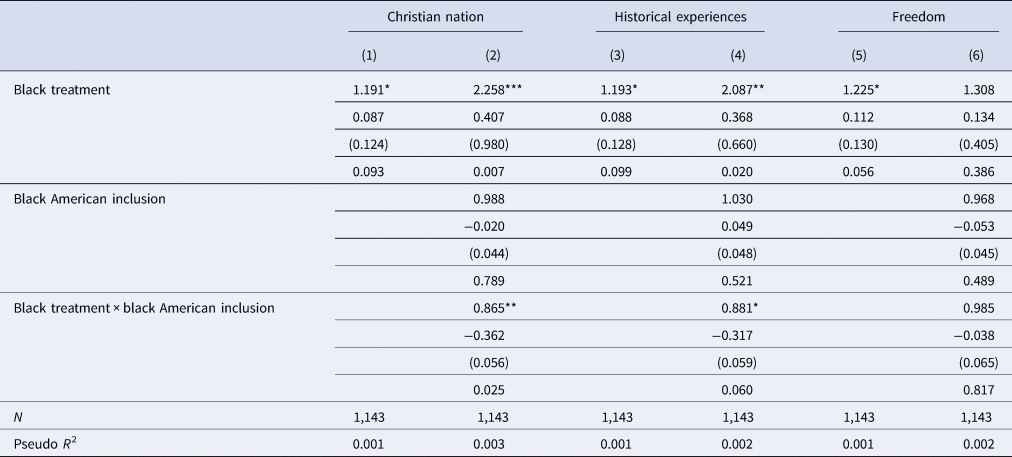
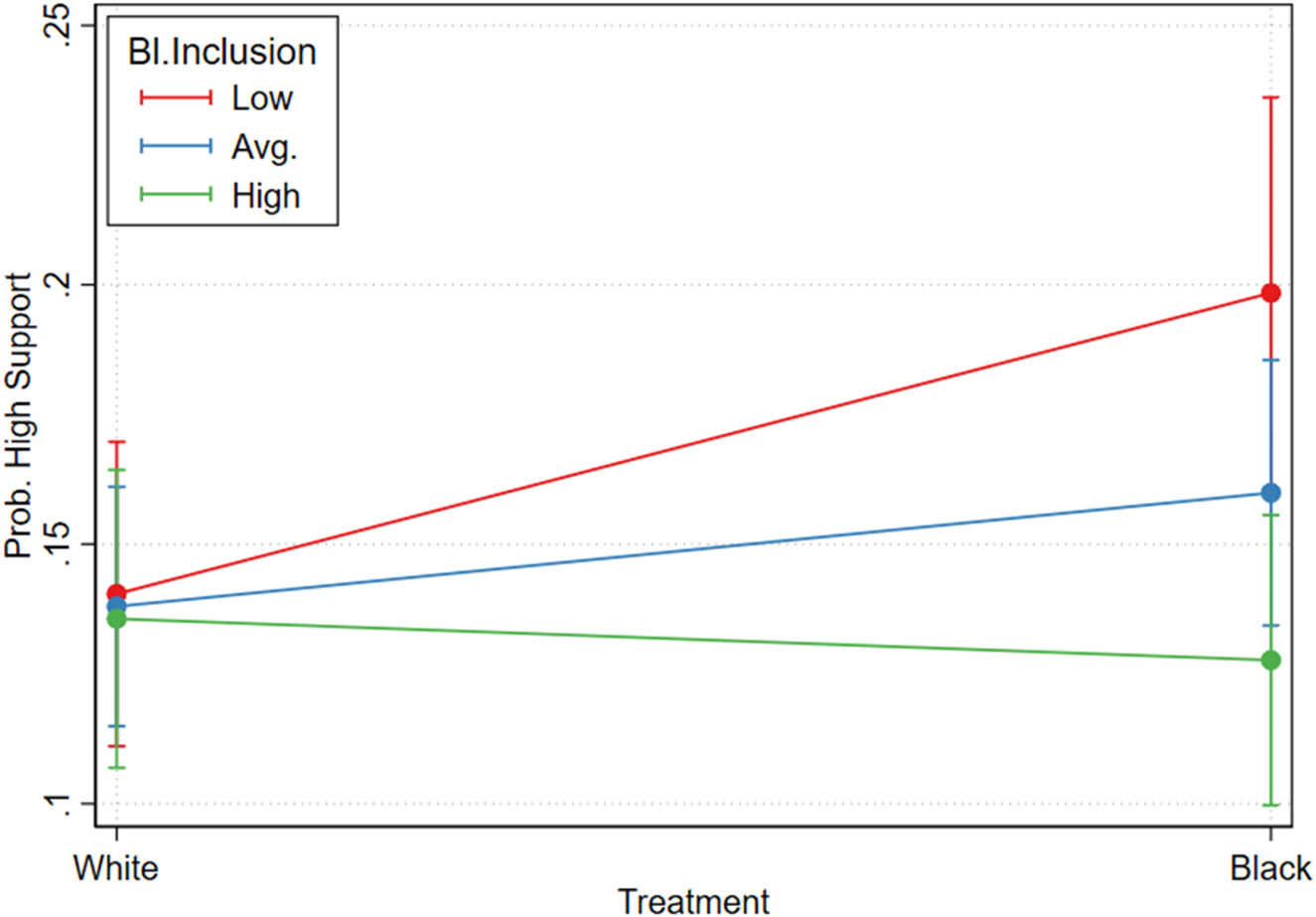
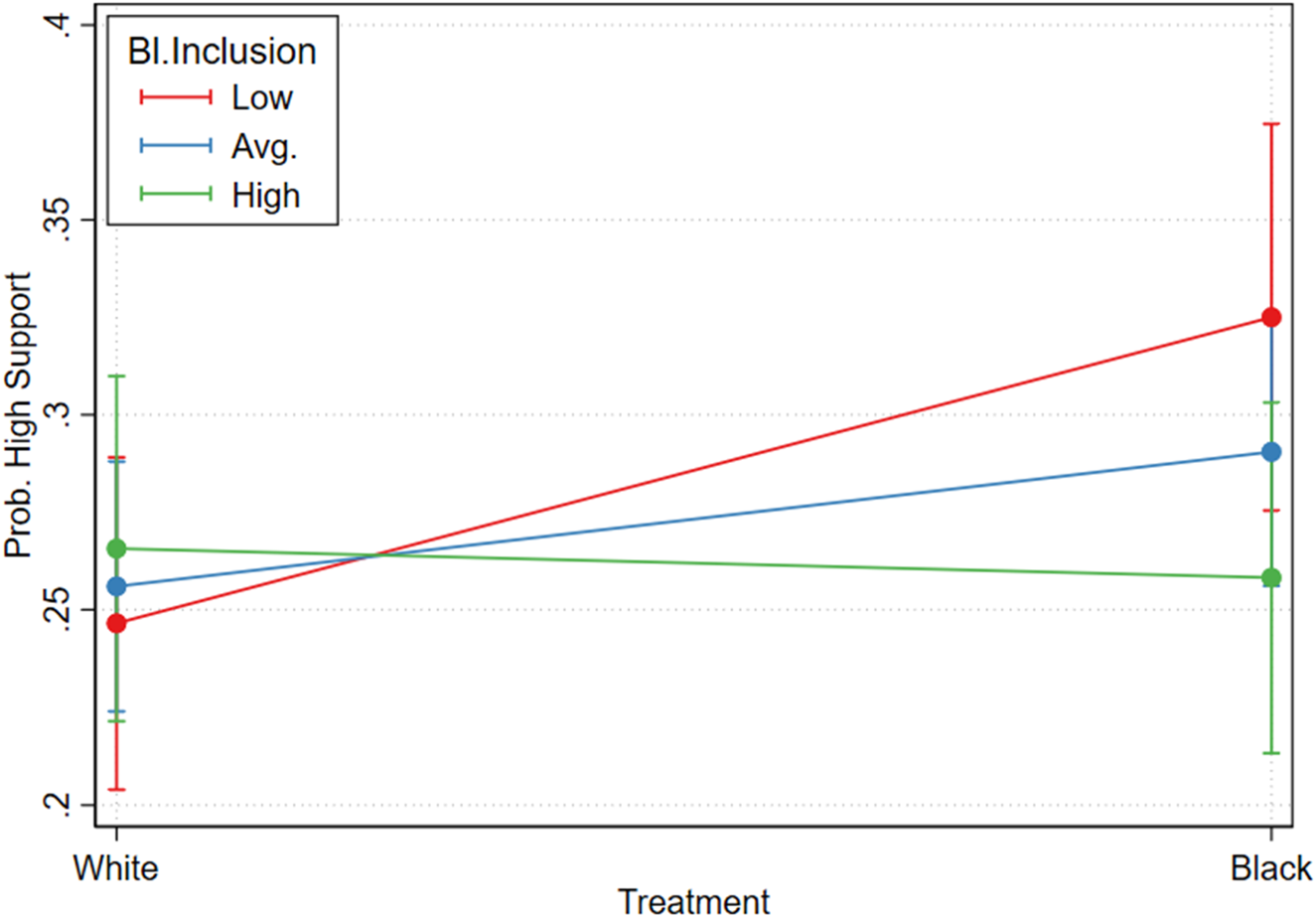
Table 3 presents the results of the ordered logit models assessing treatment effects. Hypothesis 1 predicted that White respondents would express stronger support for Christian nationalism when primed with Black race. In Model 1, White respondents in the Black treatment group are 19% more likely to express higher support for an explicit role for Christianity in American government in the form of Christian nationalism than respondents in the White treatment group. The difference between the White and Black treatment groups is statistically significant (p = 0.093), providing support for H1. The racialized nature of Christian nationalism support becomes more apparent in the interaction model (Model 2). Black treatment by itself increases Christian nationalism support by over 120%, a significantly larger effect than was observed in Model 1. Moreover, the difference between the White and Black treatment groups is statistically significant (p = 0.009). But the effects of treatment are contingent on beliefs about Black prototypicality as Americans. White respondents who believe that Black Americans are associated with all things American and who are in the Black treatment group are less likely to support Christian nationalism (p = 0.025), consistent with H3. As demonstrated in Figure 1, those respondents who are most exclusive of Black Americans are the most likely to express stronger Christian nationalism support in the Black treatment group. In other words, increased Christian nationalism support is a reaction to making Black race salient, and that is especially true for those who do not believe that Black Americans belong in their characterization of America.
Effect of racial priming on national religious orientation support

Note: The first reported coefficients are odds ratios from ordered logit for non-Hispanic White respondents, then we report coefficients when the independent variables are standardized. Standard errors are in parentheses, followed by p-values. The White treatment group is the reference group.
*p < 0.1, **p < 0.05, ***p < 0.01.
Christian nation support. Figure 1 depicts the probability respondents give the highest level of support for the dependent variable. Levels of Black inclusion are set at the mean (avg.) and at 1 standard deviation above (high) and below (low) the mean.

Turning to our measures of civil religion, we find that treatment has a similar effect. First, we test support for beliefs that God is revealed through the historical experiences of the United States in Model 3. Respondents in the Black treatment group are 19% more likely to express higher support for linking God to American history (p = 0.099), providing support for H2. It could be argued that White respondents are proud of the Black civil rights movement and see God as acting through that history. Indeed, conservative White religious leaders have made a point of celebrating civil rights leaders like Dr. Martin Luther King Jr. and the advances associated with the civil rights movement (Hoffman, Reference Hoffman2000).
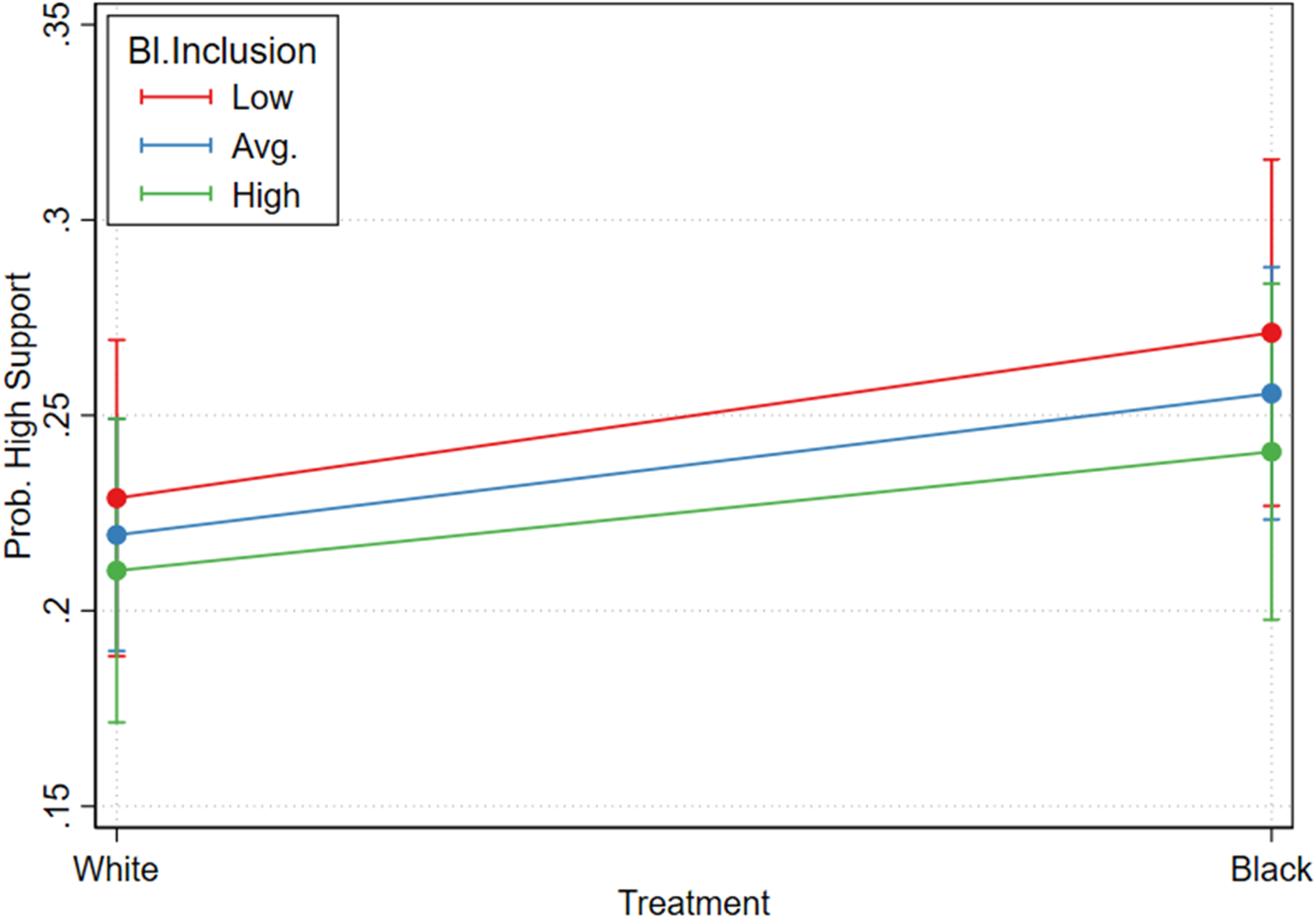
But Model 4 reveals that perceptions of God's role in history are racialized. Black treatment increases the likelihood of seeing God in US history by 109%, again a significant difference over the treatment effects observed in Model 3, and a difference that is statistically significant compared to the White treatment group (p = 0.020). But respondents who feel that Black Americans are characteristically American are less likely to see God's role in history when exposed to the Black treatment (p = 0.060). This finding is especially significant given the pictures displayed. The White treatment featured a picture of an anti-war protest while the Black treatment featured a picture from the civil rights movement (see the Appendix for treatment images). Conservative Christians melded support for the Vietnam War and for the military with their vision of a Christian nation, with protestors' faith and patriotism coming under doubt (Kobes du Mez, Reference Kobes du Mez2020). Respondents who describe Black Americans as “not at all American” are significantly more likely to report that God is revealed in history when seeing White anti-war protests (which should have a complicated relationship to god concepts) compared to images of Black civil rights protests. Figure 2 demonstrates this relationship, plotting treatment effects for those at high levels of support for the statement that God is revealed through American history. In the White treatment group, Black inclusion doesn't significantly predict strong support for this statement. But in the Black treatment group, respondents who feel Black Americans are not characteristic are significantly more likely to express support for civil religion. These findings support H3 and provide additional evidence that civil religion references to US history have racialized overtones.
Historical experiences. Figure 2 depicts the probability respondents give the highest level of support for the dependent variable. Levels of Black inclusion are set at the mean (avg.) and at 1 standard deviation above (high) and below (low) the mean.

Finally, we assess the effects of racial primes on agreement that “freedom comes from God through our system of government by the people.” White respondents in the Black treatment condition are approximately 23% more likely to believe that God provides freedom through democracy (p = 0.056). While this result supports H2 (priming race shifts civil religion support), the role of race is unclear. It could be the case that White respondents are responding to images of Black voters with alarm and falling back on White-centric conceptualizations of public religion (Gorski and Perry, Reference Gorski and Perry2022; Perry et al., Reference Perry, Whitehead and Grubbs2022), or White respondents may view Black participation in the electoral process as a movement by God to deepen democracy. For example, the Family Research Council highlights the expansion of Black voting rights in the 1960s as an exemplar of a values-based political movement (Mosley and Closson, Reference Mosley and Closson2018). Unfortunately, the data does not allow us to adjudicate between these two explanations. Once we include beliefs about Black prototypicality, the treatment does not independently predict beliefs about God's role in democracy (p = 0.386). Moreover, the treatment effects are not contingent on racial attitudes (p = 0.817), contrary to the expectations of H3. Figure 3 depicts the probability of strong support for the idea that freedom comes from God. The confidence bars overlap, failing to differentiate respondents by treatment group or commitment to Black inclusion.
Freedom. Figure 3 depicts the probability respondents give the highest level of support for the dependent variable. Levels of Black inclusion are set at the mean (avg.) and at 1 standard deviation above (high) and below (low) the mean.

Conclusion
The story of religious communities and beliefs in the United States cannot be told without acknowledgement of the country's racial divides. But is the interweaving of religion and race mostly relegated to the big stories of institutions and social movements, or has the fusion penetrated the minds of everyday Americans, too?
We examine the extent to which racial primes provoke augmented support for two forms of public religion: Christian nationalism and civil religion. Our survey experiment reveals that, for non-Hispanic White respondents, race and public religion are linked. Respondents shown pictures of Black people express stronger support for public religion, compared to respondents shown pictures of White people. Moreover, we demonstrate that this relationship is attributable to racial attitudes. Support for public religion occurs when respondents have racially exclusive boundaries around American identity.
Our results make three main contributions to the existing literature. First, although suggested by past work (Perry, Reference Perry2023), we provide the first empirical test of the effect of racial priming on support for public religion, to our knowledge. We demonstrate that calls for a larger role for religious ideas in public spaces are related, at least in part, to racial attitudes.
Second, our results suggest that Christian nationalism and civil religion may not be as conceptually distinct from each other as has been argued in previous work (Gorski, Reference Gorski2017). The existing Christian nationalism has emphasized its correlation with racist attitudes, but civil religion has been conceptualized as being more inclusive. But we find that the effects of racial primes on Christian nationalism and civil religion support are similar. Far from being inclusive, racial primes trigger approximately the same support for civil religion as they do for Christian nationalism.
Finally, we contribute to the racial priming literature. Past work has argued that racial priming uses “stereotypical imagery or racially coded language,” which “activate[s] or deactivate[s] voters” negative racial attitudes” (Stephens-Dougan, Reference Stephens-Dougan2021, 303). However, we find that playing to negative stereotypes is not required for racial priming to affect attitudes about the role of religion in public life. Our implicit racial primes use images of young families, peaceful protest, and formal political speech, none of which play to negative racial stereotypes of Black Americans. Moreover, the Black and White treatment images are closely matched so that the race of the image's subject is the only difference. Extending existing work on counter-stereotypical images and candidate choice (Stephens-Dougan, Reference Stephens-Dougan2016), our results indicate that even counter-stereotypical images, especially when combined with racial exclusion, can generate heightened support for applying religion to the nation at large.
Our project points to the need for further work on the intersection of race and religion. We echo calls for serious evaluation of the conceptualization and measurement of public expressions of religious identities and beliefs (Smith and Adler, Reference Smith and Adler2022; Davis, Reference Davis2023) and welcome work that explicitly explores similarities and differences between types of public religion (for example, see Vegter et al., Reference Vegter, Lewis and Bolin2023). Moreover, more should be done to substantiate the relationship between racial attitudes and religious orientations. If these concepts are cognitively linked, then activating one should activate the other (Margolis, Reference Margolis2018). We test whether activation of racial considerations shifts Christian nationalism and civil religion support; future work should test the reverse. Finally, we would also encourage explorations of the extent to which implicit primes of one group activate schemas related to other groups. For example, does implicitly priming race or atheists affect immigration attitudes?
The United States is deeply divided over issues related to race. Heated debates have erupted explicitly over the story of race in public school curricula, but race is also fundamentally linked to many of our most pressing challenges: affordable housing, criminal justice reform, and income inequality, to name a few. For some White Americans, our findings suggest that the prominence of race-related topics on the public agenda may serve to amplify calls for religion, especially Christianity, in the public sphere. Given the racially exclusive propensities of such calls by White Americans, they are likely to contribute to the further unraveling of America's social fabric.
Supplementary material
The supplementary material for this article can be found at https://doi.org/10.1017/S1755048324000154.
Data
Data for replicating this study will be made available on Dataverse under the article title once accepted for publication.
Acknowledgments
We acknowledge that other measures of racial resentment exist (such as the Sears or FIRE batteries), but we believe that our measure of national belonging is a better conceptual match for our theory. Measures of racial resentment capture general attitudes about race that span social contexts, whereas our measure of national belonging explicitly targets the idea of Black Americans as full and equal citizens. Our measure more directly links those respondents who believe Black Americans are not fully Americans with worldviews (Christian nationalism and civil religion) that signal racialized ideas about who counts as American.
Financial support
The College of Liberal Arts at the University of Kansas funded the survey for this project; no external funding was utilized.
Competing interests
Neither Don Haider-Markel nor Brooklyn Walker have any competing or conflicting interests.
Brooklyn Walker teaches political science at Hutchinson Community College, and she researches religious group interests, often through the lens of political psychology.
Donald Haider-Markel is Professor of political science at the University of Kansas. His research and teaching are focused on the representation of group interests in politics and policy, and the dynamics between public opinion, political behavior, and public policy.