Alexander Hamilton was a Scottish sea-captain who plied the waters of the Indian Ocean, first in military service for the East India Company, then as a country trader for 35 years and, retiring to Scotland, wrote up his memoirs “over two long winters”, despite lacking full diaries. The resulting two volumes were entitled A New Account of the East Indies, being the Observations and Remarks of Capt. Alexander Hamilton, who spent his time there from the year 1688 to 1723. The book was published by John Mosman in Edinburgh in 1727, and has been re-edited many times since, as his accomplishment and the depth of experience it reflected is unique for British sailor-merchants of the period.Footnote 2 Hamilton's text is a well-known and important one, with a considerable influence over a number of later works such as Daniel Fenning's A New System of Geography (London, 1780), Sir Thomas Stamford Raffles's The History of Java (London, 1817), where extensive sections of Hamilton's commentaries were copied out and incorporated, to Dutch East Indies accounts of the time, as we can find in the recounting of the fall of Portuguese Melaka in the multi-volume edition Batavia, published in Amsterdam in 1799.Footnote 3 The text remains one of the principal sources of this period for today's historians.
The goal Hamilton set himself was to provide a work “more particular, correct and extensive, than any of this kind, at least, of any that I ever saw”.Footnote 4 He everywhere provides the reader with a wealth of detail, arranged by places he visited, though his interests are as much directed towards political intrigue and historical tales. He is strangely silent on the topic of commercial data, exactly what goods he is moving from where to where, and who his principal competitors were. He may have considered that his memoirs, destined for a generally leisured reading audience, would be better received if he stuck to generalities and topics of human interest. Hamilton's business dealings may also not have been particularly successful, as Søren Mentz has suggested was typically the case with British ‘country traders’ at that time.Footnote 5 Hamilton's contemporary William Warre, for example, rarely made a dividend of over 15 percent.Footnote 6 He may also have felt these topics better covered by his fellow East India Company servant, Charles Lockyer, in his Account of the Trade with India, containing rules for good government in trade, price courants and Tables, published in 1711. For all these reasons then, Hamilton may have decided that it would not have been germane to dwell on aspects of commerce.
Hamilton's reflections coincide with a period in which the Indian Ocean waters were internationalised to an unprecedented degree and under no nation's strict dominion – in Holden Furber's memorable turn-of-phrase “nationality stopped east of the Cape”.Footnote 7 It was a time when the company commerce of the Dutch Verenigde Oostindische Compagnie (VOC) and the English East India Company (EIC) was overlaid by a vigorous ‘country trade’ of private merchants and shipowners such as Hamilton, working on their own initiative and generating profits pre-eminently from shipping goods and services around the Indian Ocean world rather than by transporting goods back to Europe. Although, then, strictly speaking an interloper, for which Hamilton ran the risk of having his ship and its cargo impounded, and his person imprisoned, British historians like J.H. Parry have credited men like Hamilton and Thomas Pitt operating outside company monopolies with the “spread of English commercial influence around the shores of the Indian Ocean”.Footnote 8
The purpose Hamilton's text is to serve here however, is as a benchmark for the state of Portuguese affairs in the East. In a series of articles published from 1995, Kenneth McPherson tried to unveil the meaning of the Portuguese presence in the Indian ocean world in a wider international context for the period following Portugal's short burst of greatness (idade aurea) in the sixteenth century, especially for the late seventeenth century.Footnote 9 Historians have previously treated the arrival of Dutch and English trading companies from the beginning of the seventeenth century as if it were a tsunami that washed away the Portuguese presence in Asia, dismissing the survival of the Portuguese as limited and of marginal importance. Since McPherson, work has proceeded on the question, but largely in two opposing directions. On the one hand, the period has been presented as following on from one in which the Portuguese Estado da India sought to stabilise its losses, and even as Glenn Ames has shown, revived its prosperity.Footnote 10 On the other hand, historians like René Barendse are quick to point out the threadbare realities of the Portuguese-issue sea-pass system (cartazes), suggesting that the Portuguese maritime presence was risible, and that in any case the Estado da India increasingly possessed a ‘creole’ character.Footnote 11 To the extent that the Portuguese continued in the East, it was a case of ‘staying on’, more as hucksters with a couple of bottles of arrack than shipowners and sizeable traders.Footnote 12 Other researchers, like Rogério Miguel Puga, have drawn attention to the ‘somnolence’ (sonolência) of the Portuguese Far East.Footnote 13
The article, therefore, uses a valuable source in order to gauge the author's observations and feelings as to the commercial activities and presence of the Portuguese, particularly in the geographical area George Winius christened the ‘Shadow Empire’. Here the power of the Estado da Índia was never really brought to bear, both for lack of resources and because freely settling Portuguese communities did not feel that the backing of the Portuguese state would enhance their livelihoods, and indeed might only complicate relations with the local ruling authorities. The most forceful example of the informal or ‘Shadow Empire’ is South-East Asia.Footnote 14
The mixed record of the Portuguese presence in South-East Asia: language, Christianisation and ‘abusing and affronting their neighbours’
In a now well known turn-of-phrase, the Portuguese sixteenth-century historian João de Barros at one point prophesied that:
The Portuguese arms and pillars (armas e padrões) placed in Africa and in Asia, and in countless isles beyond the bounds of three continents, are material things, and time may destroy them. But time will not destroy the religion, customs and language which the Portuguese have implanted in those lands.Footnote 15
Alexander Hamilton would without doubt have acknowledged the prescience of these words. He recommended that if as a European in Asia one cannot master an indigenous language, then it is best to learn Portuguese for they have left a ‘vestige of their language’. His language is dotted with Portuguese loan words, such as ‘covet’, from the Portuguese covado, a measure varying from 18 to 22 inches, even ‘bamboo’, and adopts Portuguese nautical reference points such as the offshore rock shoal he encounters on his way to Pegu, which he referred to as ‘Legarti’ or the Lizard. William Dampier, Hamilton's contemporary, similarly refers to wind patterns in the Bay of Bengal in Portuguese terminology: for instance, the Terrenos, “because they blow from the Land”.Footnote 16 Hamilton practised what he preached. When he went ashore at Ponteamass (Banteay-Meas, later Ha-Tien) in Cambodia, it was in Portuguese that Hamilton conversed with the crown's officials.Footnote 17
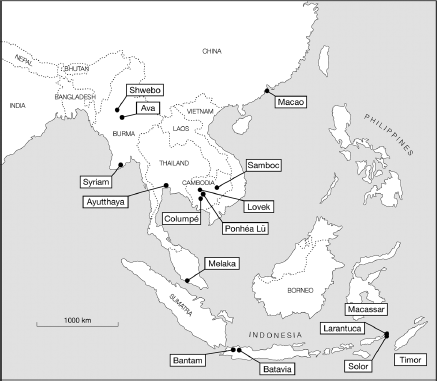
Centres of Portuguese presence in Southeast Asia in Alexander Hamilton's time.

If language was one of the cultural features Hamilton concedes that the Portuguese successfully implanted in the East, then so too was the Christian religion. It is noticeable from his account, however, that although the Portuguese had implanted Catholicism and continued actively to preach and lead the Jesuit presence in South-East Asia,Footnote 18 the important Church officiants had become French, as indeed had almost the Europeans in positions of authority, as we find in Hamilton's story of the French surgeon to whom the Portuguese in Siam with broken limbs turned to.Footnote 19 This was a product of King Narai's permission granted to French M.E.P. missionaries to preach Christianity following their establishment in Ayutthaya in 1662 under the Apostolic Vicar Lambert de la Motte, followed by a set of papal briefs in 1669 and 1673, which effectively placed Siam and some neighbouring states under the newly founded Society of Foreign Missions of Paris, which created a missionary headquarters of the church at Ayutthaya, and conferred authority upon de la Motte (a.k.a. Monseigneur de Bérythe) in the role of general administrator of the missions in Siam, Cochinchina and Tonkin.Footnote 20 The upshot of this was both unequivocal official recognition of French clerical supremacy in Siam itself, and a policy undertaken by the new missionaries of discrediting the authority of the existing Portuguese community and church.Footnote 21
The Portuguese had from the outset been opposed to the French intervention, which threatened to usurp the exclusive rights and authority of the Portuguese Padroado. In 1663, the Archbishop of Goa had circulated a letter advocating “preventing the French to reach their missions by all means available”, although this only had the effect of splitting the Portuguese community, which was unhappy with some of the Portuguese missionaries.Footnote 22 During the 1670s and the beginning of the 1680s, Portuguese authorities also received more and more letters from religious and other residents in Siam complaining about the presence of French missionaries in the region, denouncing them as impostors and condemning their “evil designs under the garb of religion”.Footnote 23 Even Frenchmen working for the Jesuits, such as Marcel Le Blanc SJ, nurtured contempt for his French brethren.Footnote 24
Rivalry between French and Portuguese was only exacerbated with time. In 1705 the Bishop of Melaka Manuel de Santo António sent a ‘vicar of the rod’ (vigário de vara, this sobriquet refers to a rod which, when carried, denotes that the bearer holds ecclesiastical jurisdiction) to Siam to spiritually reclaim the kingdom on behalf of his superior.Footnote 25 The French Vicar Apostolic, Monseigneur de Cicé, after explaining the error to no avail, felt obliged to excommunicate the ‘vicar of the rod’, João d'Abreu de Lima, at which point de Lima arrived with armed partisans and laid siege to the French seminary, tore up the episcopal sentences on the church door, and threatened to carry off the prelate to Goa.Footnote 26 The French responded by summoning the Bishop of Melaka to appear before an ecclesiastical court presided over by Mgr. de Tournon, the papal legate to China, on pain of a fine of 1,000 gold écus to be paid to Rome, but the Bishop of Melaka understandably refused to appear.Footnote 27 A similar confrontation took place in neighbouring Cambodia, though here it was the turn of the natives to stand by the Portuguese Jesuit missionary father. When a companion of the M.E.P. priest Louis Chevreuil confined the Jesuit Father André Gomes to a vessel which was heading to Macao in 1670, the latter was rescued by natives whose “piety vanquished the impiety of a soulless Christian [i.e. Chevreuil, to whom] some good lashings will teach him to keep the Word of God”.Footnote 28 Chevreuil was kidnapped and taken to Macao by boat, where he was charged with heresy. Like other French priests before him, he was sent on to Goa for trial, but was released and sent to Surat.Footnote 29 Instances of ecclesiastical conflict amongst men of the cloth continued to flare up. When the Portuguese priesthood, such as one Jesuit, Ignácio Franco, encouraged the Portuguese clan in Ponhéa Lü (Penhalu in Portuguese), a village outside Longvek (Lovek) in neighbouring Cambodia, to submit to the Apostolic Vicar, and ordered the cherished cultic objects of Ponhéa Lü to be removed, what followed was a fight between two rival villages in which a sacristan was killed and the King of Siam was forced to intervene. The feuding continued until at least 1796.Footnote 30
Hamilton's analysis of the state of the Catholic missions is, as we have seen, very sketchy. The issue was of no interest to a Scot, and – unlike the legacy of the Portuguese language – was not something that impinged in any meaningful way on his experiences in the East. Hamilton's general ignorance of religious matters, in the case of Siam, Theravada Buddhism, is to be noticed at various points in his text.Footnote 31 He was a harsher judge of Portuguese settlement strategies in the region. The port-city of Syriam in Lower Burma, for example, was lost out of “insolence and pride”, just as it was “insolence.. abusing and affronting their neighbours” too, that led to Portugal's losing Melaka.Footnote 32 Here, then, rather than a historical account hinging on impersonal factors such as shifting economic opportunities, or failed strategy at state-policy level as the story is often presented by Portuguese historians,Footnote 33 we have a highly moralised account of success and failure. Continuing this vein of interpretation, Hamilton argues that the Dutch challenged the Portuguese not out of strictly economic motivations but “to be equal with the Portuguese, for their driving the Dutch out of Brazil”.Footnote 34 These highly moralised accounts, it will be argued, are often less the product of individual thinking than the influence of a standardised set of anti-Iberian, anti-Catholic sentiments that crystallised between 1558 and 1660 into what became known in north European Protestant countries as the Black Legend. Even when the events or issues in South-East Asia proved far-removed from the issues that constituted the core complaints of the Black Legend (for example, the Spanish refusal to sanction the secession of the Dutch Estates), the Black Legend served as a useful dumping ground for anything negative north Europeans felt inclined to say about the Spanish, and by extension, the Portuguese.Footnote 35 Denigration, moreover, was expressly fostered as part of what Maltby describes as the “conscious and systematic attempt to control the attitudes of English readers in the interests of Protestantism”.Footnote 36
A cursory look at British accounts of South-East Asia contemporary to Hamilton's would suggest that many of Hamilton's opinions concerning explanations of Portuguese decline were fairly commonplace. If, for example, we were to take William Dampier's Voyages we would find the Portuguese guilty of “presuming upon the strength of their forts, they insulted over the natives; and being grown rich with trade, they fell to all manner of looseness and debauchery; the usual concomitant of wealth, and as commonly the fore-runner of ruin”.Footnote 37 Or to take another example: John Fryer, who roved across the Asian scene from 1672–1681, could denigrate the Portuguese settlement at São Thomé de Meliapur on the Coromandel coast as a town of “riches, pride and luxury. . second to none in India”.Footnote 38
One of the problems of researching European expansion from the ‘other side’ is that there are very few indigenous sources, and many of these are oral accounts dogged by shortcomings specific to that genre. Many of these oral accounts filter down to us second-hand via European record-takers like Hamilton who set them down on paper but clearly also used them to compose his own stories as he expressly indicates, despite simultaneously professing derision for “those who use second or third-hand accounts” (Hamilton, 1727, p. xiv). As with all oral accounts, there are no clear dates (the stories Hamilton relates tend to begin in the fifteenth century and end in the seventeenth century), and considerable skill is needed in decoding names. The Portuguese adventurer in South-East Asia Filipe de Brito e Nicote, for example, became known as Xenga or changa (or in Dutch, Schengan), Captain Salvador Ribeiro da Sousa became known as Massinga while Javans referred to Jan Pieterszoon Coen as Mor Djankung (Capitão-Mor Jan Coen).Footnote 39 Ultimately, however, the tales contain a strong element of truth, if not in the details, then on the fundamental moral conclusions from these episodes drawn by the host society.
Hamilton, for instance, relates the story by which Portuguese inserted themselves between the Peguans and Siamese, making themselves useful to the monarchs of both Pegu and Siam to great effect through their knowledge of firearms. This is a well-known story, related by a number of different commentators, including the mid-sixteenth century Portuguese commentator Mendes Pinto,Footnote 40 who apparently himself drew on Diogo do Couto,Footnote 41 a scrupulous historian, as well as a number of oral accounts, from both Siamese and from fellow Portuguese, like Domingos de Seixas, a military leader engaged in the campaigns and seized at Tenasserim.Footnote 42 In Hamilton's version of events, little care is taken to identify the individual historical instances he discusses: whether, for example, he is referring to the Peguan Burmese invasions of 1563–4, or 1569. Then, there are many mistakes: Hamilton's ‘Senhor Thomas Pereyra’ is almost certainly a conflation of Diogo Pereira, to whom the King of Siam confided the best of his guns during the siege of Ayutthaya, and Pinto's Diogo Soares de Albergaria, active in local politics in the Irrawaddy delta area in the 1540s, whom Diogo Couto more reliably refers to as Soares de Melo, providing us with his genealogy.Footnote 43 Like the account of Pieter Willemszoon Verhoeff (Peter Floris) of relations between Siam and Burma, the story is hard to follow and not easily intelligible.Footnote 44
Hamilton's of course is a tale of things gone wrong, and the cause of the Portuguese downfall is that cardinal sin for which the Portuguese have, over history and from very different quarters, been repeatedly accused: luxúria, or lust.Footnote 45 Pereyra eloped with a newly married bride who took his fancy, which caused temperatures to boil over and the issue provoked a general massacre of Portuguese in the city of Ayutthaya. Other sources and commentators do not agree entirely with Hamilton's version of events, although it is plausible. The historian George Winius describes Diogo Soares's actions, but not explicitly, suggesting he abused his position and ended up being stoned to death, though Rebecca Catz refers to him as ‘o Galego sensual’ (the sensual Galician).Footnote 46 The Burmese Great Chronicle (Maha-ya-zawin-gyi) of U Kala, while making no specific mention of Albergaria's role, does speak of Portuguese influence over the ruler Tabin-shwei-hti (ruled 1531–50), who is reported by the chronicler to have become an alcoholic as a result of associating with these “unseemly heretics”.Footnote 47 Elsewhere we do find a similar train of events recounted, even if the lack of accompanying historical information makes it impossible to determine quite which events it is that the authors are referring to. Fernão Mendes Pinto describes how, after the sack of the city of Nouday, a place scholars have been unable to locate and which we must presume fictitious,Footnote 48 the Portuguese made off with “beautiful girls ‘for our use later on.. and it was pitiful to see them coming along in groups of four and five, hands tied up with musket-fuses, the girls all weeping and our men all singing and laughing”.Footnote 49 Other commentators like Dampier explain how at Melaka “the Portuguese.. by report, made use of the Native Women at their pleasure, whether virgins or Married Women; such as they liked they took without control: and it is probable, that they as little restrained their lust in other places. These injuries exasperated the native Maylayans [sic] here who joining with the Dutch, as I have been informed, found means to betray to them their insolent Masters the Portuguese”.Footnote 50 Again, in Captain Owen's account of the Portuguese expedition of 1728–9 from Goa to recover the fortress at Mombasa, the success of the venture was chequered by the Portuguese “taking their [i.e. the local Mazaru'i clan] wives to themselves”.Footnote 51
Regardless of the incongruities in detail regarding time and place, the behaviour that triggered Soares's/Senhor Thomas Pereyra's demise is mirrored time and time again in historical fact, and is not here merely a figment of the Black Legend. Such was the fate of Portuguese sea captains like Henrique de Leme, expelled from Pegu in 1516Footnote 52 and Spanish and Portuguese mercenaries active in South-East Asia.Footnote 53 Ruiz and Veloso intrigued at the court of the King of Cambodia in 1596 together with Mexican troops, resulting in skirmishes at the court of Columpé (today an outskirt of Phnom-Penh), and their deaths in 1599.Footnote 54 Even historians sympathetic to the Iberians like Cayetano Socarrás are obliged to denounce the ‘systematic outrages’, principally sexual misdemeanours.Footnote 55 It is interesting, however, that for Socarrás the outrages are less the product of a degenerating Portuguese society in the tropics than a typical Iberian proclivity for “impetuosity and a tragic gambling with death” (ímpetu y un juego trágico con la muerte).Footnote 56
Transcending Hamilton and the Black Legend: the ups-and-downs of the Portuguese communities in Ayutthaya and neighbouring Cambodia and Burma over the seventeenth century
Although the Portuguese community or ‘tribe’, to take on board Andaya's application of a thought-provoking concept (Andaya, 1995, p. 129), was always quick to interbreed to a degree that made summary distinctions difficult, in South-East Asia the notion of a Portuguese community remained recognisable and distinct well into the nineteenth century, as Crawfurd could attest.Footnote 57 The community began the seventeenth century intact, albeit languishing at Longvek (Lovek) and in Ayutthaya, where Jeremias van Vliet, Chief of the Dutch Factory of Siam between 1629–1634, reported that there remained “only a few poor Portuguese, Mestizoes and Indian Christians.. they will most probably not regain their former influence”.Footnote 58 Massacres of the Portuguese community, as described by the seventeenth-century commentators Schorer and Verhoeff, were limited to Syriam in Burma in 1612. The Portuguese presence in this part of the world was, however, considerably swollen with arrivals from Japan in the first half of the seventeenth century and with the expulsion of the Portuguese ‘tribe’ from Macassar by the Dutch in the 1660s, probably numbering 400 individuals.Footnote 59 In this instance, their successful transplantation to mainland South East Asia was carried out under the leadership of an inspiring self-styled ‘archdeacon and governor’ of Melaka, Padre Paul d’ AcostaFootnote 60 and other padres like the Frenchman Father Germano Mecret.Footnote 61 The instability of the Cambodian court was well-known, and so numbers are certain to have been less than to neighbouring Siam. Though most of the ‘Portuguese’ settlers had only a small percentage of European blood, and others none at all, desiring to be called Portuguese as the term connoted respect, the Portuguese were well received and were given places to settle outside the city walls, such as the Campo Português in Columpé, or the Bandel in Ayutthaya, with the freedom to practise their own religion and with a headman, Capitão Mor da Bandel, as other communities like the ‘Moors’, the Malays and the Japanese did, “elected with the King's approval and who governs in accordance with the customs of that particular country”.Footnote 62 Historical sources frequently relate how Portuguese, taken as prisoners-of-war in the repeated conflicts that plagued South-East Asia in this period, were much prized and taken away by the conquering force to implant new communities elsewhere.Footnote 63 Many of the individuals within this community were offered jobs and positions in the King's service: Soarez was entrusted with supervision of the royal mint in Ayutthaya, Veloso given the province of Ba-Phnom situated east of Mekom, and Diaz made governor of Samboc, further up the Mekong.Footnote 64 In Cambodia, the Dominican Order retained spiritual leadership of the community, ministered to converts at the church and worked as commissary for the Grand Inquisitor in Goa,Footnote 65 but in Ayutthaya the Jesuits formed the largest religious community around their church, São Paulo, and the College of São Salvador, founded in 1656 from the proceeds of a successful Portuguese merchant, Sebastião André, operating there.Footnote 66 In Syriam, which Hamilton visited in 1709, he could also note the Portuguese church, and the Christian community around it.Footnote 67
Whether the fortunes of the Portuguese communities in South-East Asia were set for the long term on an even keel is more questionable, and seems with retrospect to depend on the point in time and specific place. In the period when Mendes Pinto described the Portuguese in Siam, chiefly as mercenaries during the 1540s and 1550s, the Portuguese were “much respected in this land”.Footnote 68 They were given generous pay packets from the ‘good King of Siam’ – to steal the title of Pinto's Chapter 183 – were exempted from customs duties and were given permission to build churches “where the name of the Portuguese God could be worshipped”. Hamilton's description, however, suggests life was difficult for them: they were “contemptible to all people in general”, in Siam “the most dissolute, lazy, thievish rascals that were to be found in the country”.Footnote 69 Hamilton's dismissive opinions are echoed by William Dampier, who insists: “there are not a more despicable people now in all the Eastern nations”.Footnote 70 There were strong tensions, too, with the host society: Hamilton reports how the Portuguese were summarily attacked for cultural insensitivity such as shooting at crows.Footnote 71 The difficulties between the two communities, it seems, had been around for some time. Francisco Vieira de Figueiredo complained about Siamese ‘vexations’ (Siamse vexatien) on the return from his voyage there in 1649, and told the Dutch he would never go there again (dat daer noijt wilde weder keeren).Footnote 72
It is strange that the Portuguese had acquired such a sordid reputation as Hamilton reports. Even after the episodes of ‘insolence’, one thing that emerges from these incidents is that rather than blackening the Portuguese name for ever in the local lore, the memory of these murders or street lynchings were often conserved as tales of martyrdoms. Thus, for example, Cambodian chronicles continued to remember Veloso and Ruiz as two ‘adopted sons’ (chou-fa) of King Satha of Longvek (Lovek).Footnote 73 Several bakus (hereditary guardians of the Sacred Sword) claimed descent from Veloso's marriage with a Cambodian princess.Footnote 74 It has been suggested that the Portuguese settlement at Ponhéa Lü was originally named Ponhéa Ruiz, a fief granted by King Barom Reacha II to the homonymous mercenary.Footnote 75 And a large black hat appropriated from the Portuguese became henceforth an essential part of the regalia in the Mekong valley.Footnote 76 It seems, then, that there was a fine line in the eyes of locals between revering these motley mercenaries and preserving their memory and, on the other hand, despising them and seeking to put them to death.
Other accounts, such as that written by Nicholas Gervaise, a would-be missionary who attended the court of King Narai, concentrate not on the political circumstances which enveloped the Portuguese community, but rather on the fact that “Portuguese settlers in Siam suffered from extreme poverty” because, he explains, “they prefer to die of hunger than to work for their living there”.Footnote 77 In neighbouring Burma, the Portuguese tribe was somewhat more fortunate, being supported by Portuguese trading networks from Coromandel bringing wealth into the area in the form of the calicoes and chintz cloths.Footnote 78 It is probably a gesture of tribute to the Portuguese community, that they appear in paintings in the cave-temples of Po Win Taung, executed during he second Ava period (1597–1752).Footnote 79 In Cambodia, too, the Portuguese may have done considerably better than in Siam, plying their profitable trade upriver and acquiring the little-known gold, musk, benzoin and rubies of inaccessible Laos.Footnote 80 An English report of 1664 noted that “most of the expelled Portuguese from Macassar resort thither [Cambodia] who trade highly”.Footnote 81 Hamilton concedes that the “about 200 topasses or Indian Portuguese settled and married” here obtained “pretty good posts in the government, and live great after the fashion of the country”.Footnote 82 In this way, Hamilton's devastatingly negative report about the Portuguese community in Siam stands out, and cannot be easily explained simply as a function of what Simon de La Loubère saw to be the diminishing of trading opportunities in Siam, emanating from the royal decision to reserve foreign commerce primarily to himself.Footnote 83 Might Hamilton's judgement have been coloured here by his own personal experiences, having incurred dreadful financial losses and having come close to losing his life following an indictment of speaking treasonably of the Siamese king?Footnote 84
Hamilton's account of the Portuguese presence in South-East Asia is a mixed one, then. The spirit of the Black Legend certainly informs Hamilton's text, but the vacillating denigration and recognition may be more a function of English-Portuguese relations in that part of the world which, as McPherson states, swung “between enmity and friendship”.Footnote 85
Circumstances surrounding the fall of Melaka in 1641
If insolence is the first, lasciviousness is the second, deceit is the third and corruption the fourth sin Hamilton heaps upon the Portuguese. We can explore some of these accusations in his tale of how Melaka fell in 1511. Here, Hamilton comments on Portuguese tactics in inserting themselves in local wars, and then “deceiving their allies once they trusted them”.Footnote 86
Can Hamilton's interpretation be corroborated from other accounts? Until recently, the authoritative accounts of the event in western historiography tended to ply a firmly Eurocentric path. R.W. McRoberts, for example, places the responsibility on the Sultan of Melaka's failure to comprehend the mission of the Westerners.Footnote 87 Portuguese deceit in their acquisition of Melaka is otherwise an issue that shines out of the primary sources, even though the actual circumstances of this deceit differ. An untitled Malay text from the late seventeenth or early eighteenth century dwells on Portuguese treachery, suggesting that the deceit took the form of persuading the sultan to part with the smallest parcel of land “no bigger than the hide of a skin”, but that once they had the ‘skin’ they cut it up into tiny strips, laid it out in a great square, and so began to construct a mighty and impregnable fortress.Footnote 88 At the same time, they made openings for cannon. “And the people of Melaka asked: ‘But what openings are these?’ And the Portuguese responded: ‘These are the openings that white people use as windows. And at night they unloaded cannon from their ships, and muskets hidden in boxes, saying that there was cloth inside them”. It is germane to point out here that this tale is reproduced in other parts of South-East Asia with regard to the arrival of the Portuguese, indeed is a classical tale lifted from the Aeneid recounting Dido's arrival in Carthage from Tyre, and thus loses its particular validity.Footnote 89 In the account of Dutch Governor John van Twist's journal, on the other hand, the deceit was in Portuguese self-presentation as innocuous Chinese traders prepared to play by the rules of Indian Ocean trade, rather than would-be conquerors.Footnote 90
Corruption is a more serious charge levelled at the Portuguese, this time in explanations of the collapse of Portuguese Melaka 130 years later, in 1641. According to Hamilton, the Portuguese governor of Melaka Manuel de Sousa Coutinho “was a sordid avaricious fellow, and ill-beloved by the garrison” and so, faced with a long drawn-out campaign whereby they would have to starve the Portuguese out of their entrenched positions, the Dutch simply offered to pay him off for his treachery with 80,000 pieces of eight. What transpired is the following:
He [the Governor] thereupon called a council, and told them he had a mind to circumvent the Dutch by letting them come close to the fort walls, and then to fire briskly on them from all quarters, and destroy them at once, so the Dutch made their approaches without molestation, and placed their ladders. The garrison sent message after message to acquaint the governor of the danger they were in, for want of orders to fire and sally out on the Dutch, as was agreed on in council, but he delayed so long till the Dutch got into the fort, and drove the guard from the east gate, which they soon opened to receive the rest of the army, who, as soon as they were entered, gave quarters to none that were in arms, and marching towards the governor's house, where he thought himself secure by the treaty, they forthwith dispatched him to save the fourscore thousand dollars.Footnote 91
The story that Hamilton tells here, like much of what he said, had a powerful impact on subsequent versions of the event, as we find in the lengthy report Thomas Raffles submitted to the Governor of Penang in 1810Footnote 92 and then in Karl Marx's Das Kapital of 1867.Footnote 93 But does the story stand its ground in fact? It is telling that Hamilton does not leave us the governor's name. The historian Charles Boxer suggests rather that Melaka was taken through ‘seasonal blockades’, of which that of the second half of 1640 was just one, a campaign which had begun with a siege directed by Cornelis Matelief in 1606 and included sinking vessels in the bay of Melaka in 1636.Footnote 94 But there inevitably was a personal dimension to the tale of the taking of this highly important, strategic port. The historian Bernard H.M. Vlekke's account, drawing on the account in Batavia (1799), speaks of Sousa Coutinho's ‘haughtiness’, and his refusal to surrender, only doing so when further resistance was to no avail.Footnote 95 A treaty was signed, a “favourable treaty, which they [i.e. the Dutch] observed sacredly”, but only following the conquest, and the Portuguese Governor “died a natural death”.Footnote 96 The tally of Dutch deaths, estimated at 1,000 men killed in action and dead through epidemics, would sustain the impression that the conquest of Melaka was a military one.
The question of whether Batavia was acquired treasonably was investigated assiduously by the Dutch historian P.A. Leupe, who published his extended findings from the Dutch East India Company archives – specifically the Batavian Dagh-Register between 1640–41 – in the Berigte van het Historisch Genootschap te Utrecht in 1859. Mac Hacobian translated Leupe's findings into English, and had them published as ‘The Siege and Capture of Malacca from the Portuguese in 1640–1641’ in the Journal of the Malay Branch of the Royal Asiatic Society in 1936. Admittedly, Leupe conducted his research less out of an interest in the state of affairs with the Portuguese than for the possible besmirching of a glorious military campaign on the part of his compatriots. Leupe's research brought to light fairly incontrovertible evidence that Melaka fell under conditions of war, with no foul play. The letter written by Sd. J. Lamotius on 15 January 1641, that is a day after the city fell, describes the victory, the three victorious units of Dutch troops under their respective command, the losses, and the circumstances by which victory was had: “we attacked the enemy courageously and in good order at daybreak, and forced them to retreat, pursuing them around the city”.Footnote 97 A report (Actum) signed by Anthonie van Diemen, Cornelis van den Lijn and Pieter Mestdach in the Castle of Batavia reiterates this account: “650 brave men . . . all participated, sailors and soldiers, healthy or ill, in the storming and smashed all resistance until the enemy, seeing no chance of escape, surrendered”.Footnote 98 Consequently, Commander Minne Willemsz. Cartekoe was rewarded by decree of 10 October 1642 with “a golden necklace and medallion to the value of Five Hundred Guilders, bearing the engraving of the city of Melaka on one side and that of the Coat-of-Arms of the Company on the other”. At the same time, Leupe traced the report drawn up by Commissioner Schouten directly following the siege and forwarded to the government at Batavia, where amongst other things it was confirmed that the Portuguese Governor Manuel de Sousa Coutinho had died of illness two days after the fall of the city and was interred with due military honours and Roman Catholic rights in the Church of St Dominic.
It is a pity that no Portuguese version of events has availed itself despite the fact that such a loss would inevitably have been accompanied by a devassa, or judicial enquiry. The eye-witness account of the Spanish Dominican missionary-friar Juan Bautista de Morales (1597–1664) seems to indicate a lack of adequate Portuguese garrisoning and the sloth of the Portuguese commander, rather than treachery or deceit.Footnote 99 So, we have two sets of first-hand accounts which affirm the Portuguese loss of Melaka was not, as Hamilton sustained, a product of corruption.
Rumours of underhand tactics and fixing are not, however, easily dispelled from this episode. But the question of who is ultimately responsible is not clear and different sources apportion the blame differently. William Dampier, no friend of the Portuguese as we have seen, in his account of the fall of Melaka which he attributed to hearsay, contends that the betrayal was on the part of the Malay inhabitants who were ‘exasperated’ by the ‘injuries’ done them by the lust-driven Portuguese, namely making “use of the Native Women at their Pleasure, whether Virgins or Married Women such as they liked”. The Malays consequently “joyn[ed] with the Dutch”.Footnote 100 The way Dampier tells his story, even if the evil-doing behind the fall of Melaka is undertaken by the Malays, in classic Black Legend fashion rebounds on the Portuguese.
Other accounts, written recently and more interested in the dynamics concerning the Asian actors in the event, have suggested that the Sultan of Johore, planning to restore his sovereignty over the city and assisting the Dutch attack from the land side with around two thousand auxiliary troops, sappers, as well as victuallers and bridge builders, was dismayed that the VOC subsequently brought Melaka under direct Dutch control.Footnote 101 Despite the anonymous author of Batavia's protests that “our simple and upright ancestors were not capable of such tricks of which they are accused by the English” (onze simpele en oprechte voorvaderen waren niet in staat die dingen te doen, waarvan de Engelsen hen beschuldigden),Footnote 102 were the Dutch, then, guilty of deception over the fall of Melaka?
To establish that this amounts to treachery we need to be sure not only of Johore's expectation, but also Dutch promise. The expectation shines out of the Malay folk tale and work of literature, the Hiyakat Hang Tuah, extant manuscripts dating from around 1800, and which reflects a strong sense of propriety and pride in Johor's place in the history of the Malay world. The author portrays Johor as an equal power with the Dutch and – in what is apparently an oniric horizon – ruling jointly over Dutch Melaka.Footnote 103 For unfortunately, the historical records at our disposal do not much clarify Dutch promise. It is true that a written contract was signed between the Johorese and Philips Lucasz., a VOC official in Patani, committing the Johorese to the siege of Melata, sometime in 1639.Footnote 104 A letter dated 4 August 1640 addressed to Adriaen Antonisz by the Governor-General Van Diemen and the Council of India raises the issue of satisfying the Johorese, but in the most diffuse language: “Moreover, it is our intention that after the capture of Melaka to come and arrange matters by way of satisfying the Princes of Achin and Johore”.Footnote 105 A more detailed letter from Governor-general Van Diemen to the King of Johor dated 20 April, 1640, talks about helping the ruler of Johor to build forts in Batu Sawar and elsewhere with cannons and war munitions, and to protect Johor from “all unlawful procedures and annoyances of the Portuguese as well as the Achehnese”.Footnote 106 It is, moreover, difficult to believe that Johore could have been promised Melaka: the Dutch were only too aware of the bitter rivalries between Aceh and Johore, and tried to negotiate a precarious path between them without disturbing the delicate balance-of-power and conferring explicit favouritism either way. Besides this, Johore did not, as we are informed by Van Diemen's report ‘Van den Lijn and Mestdach’, actually participate in the fighting. Johore was to be rewarded in other ways: certain trading privileges were accorded, allowing the Sultan and orang kaya of Johore to trade in Melaka toll-free, that were denied others, and all the suggestions are that they made the most of this dispensation. A 1643 letter of Van Diemen reminded the Directors (Bewindhebbers) of the VOC that: “Only those (princes) from Johore are rather proud and resentful, because they profited from the booty of the Melakan conquest and now have more than what is normal” (Die van Jhoor alleen sijn vrij trots ende vrevelmoedigh, dewijle nu door den grooten buijt, uijt de Malaxse veroveringh geproffiteert) (Heeres, 1895, vol. 3, 143). Johore was also assured protection against Aceh, although Aceh's power was on the wane and by the 1660s Aceh no longer posed a threat to Johore.Footnote 107
To conclude, Hamilton's account of the rise and fall of Portuguese Melaka in 1641 levels two further indictments at the character of Portuguese India: deceit and corruption. Deceit, unfortunately, seems to have been pretty much the currency of European operations in the East, so much so that a successful fortress, as an anonymous Dutch account of the Coromandel coast tells us, was “a place which is said cannot be taken except by treachery”.Footnote 108 It was a tactic undoubtedly adopted by the Portuguese, but also against them, as the tale of the sultan of Mombasa's recapture of the Portuguese fortress Fort Jesus in 1631 testifies.Footnote 109 We must, however, affirm for the historical record that true to P.A. Leupe's protestations, the Dutch seizure of the fortress of Melaka in 1641 did not employ deceit as had the Portuguese in their seizure of the fortress in 1511. Hamilton's account of the corrupt sale of the fortress on the part of the Portuguese governor must be dismissed as deluded invention, of no credit to Hamilton's historical probity, and another piece of evidence to suggest Hamilton's blind adherence to the Black Legend.
War between Macao and Timor, 1688–1703
A further story that Hamilton seems to have gleaned from oral sources, probably from – as Hamilton's text asserts – taking as passenger one of the Portuguese captains at the fort of Lifau, Alexander Pinto, is that regarding the war between Macao and Timor between 1688–1703. Again, this is an account that deserves more detailed historical scrutiny, and one where Hamilton's apparent vision of a Portuguese world in the East rent by quarrels and infighting, a world breaking down, must be opened to analysis.
Hamilton suggests that what lay at stake was the Macanese trying “by fair means to get the whole government of the country into the church's hands”; the Timorese on the other hand would, according to Hamilton, “never suffer [the Portuguese colony of Macao] to interfere with the government of their country”, albeit acknowledging the King of Portugal as their sovereign.Footnote 110 The viceroy of Goa – in a bid to broker a third path – apparently sent an embassy to persuade ‘Gonsales Gomez’, the Timorese general, to accept a governor-general and an archbishop from Goa, but the embassy failed.
Historians such as Michael Smithies downplay the conflict, suggesting that rather than a war between Macao and Timor, these were ‘internal revolts’ of the Timorese.Footnote 111 It is interesting that visitors to Timor at this time, like William Dampier, who stopped on Timor for around ten days in September 1699, had absolutely nothing to say about any conflict, although aware of distinct Dutch and Portuguese settlements on the island.Footnote 112 Charles Boxer, on the other hand, broadly follows Hamilton's interpretation, albeit pointing a finger at Goa rather than Macao in terms of periodic attempts to enforce viceregal authority.Footnote 113 Church matters do seem to have been one of the principal flashpoints. While the viceroys complained about the turbulence, intractability and even immorality of the Dominican missionaries, the Timorese – a hotchpotch of forces around the Hornays and da Costas and the Dominican friars entrenched on the island – insisted defiantly that the Dominicans would not be supplanted by the Jesuits. Their defiance was supported by VOC, who provided arms to the native rulers (régulos)Footnote 114 The end to the conflict seems, to have been reached in 1702 when the governor sent from Goa, Antonio Coelho Guerreiro, succeeded in establishing a fortified beachhead and later a permanent Portuguese fortified position on Lifau, despite an ongoing three-year siege by a rebellious chieftain of the Da Costa family. This achievement also owed a lot to the support of Bishop Manuel de Santo António, who convinced a number of important chiefs, like Lourenco Lopes, brother-in-law of Domingos da Costa, to accept Portuguese sovereignty. Subsequent developments nonetheless render it something of a miracle that Timor remained under Portuguese Control.
From reading George Bryan Souza's work, a slightly different picture emerges, one centered on trade concerns and that did have a Macanese component to it. The backdrop was one of incipient competition, especially on the part of Chinese junks from Batavia, for the sandalwood supplies of Timor.Footnote 115 A report from António Hornay, in communication with the VOC, confirms this. In 1692, only 500 picols of sandalwood, as compared with twice and three times that figure previously, were exported to Macao.Footnote 116 Guerreiro was sent out from Goa first to Macao, where he tried to enlist Macanese support. They in turn would benefit from the Crown's implementation of a vigorous naval patrolling policy aimed at restricting the access of Batavia-owned Chinese shipping to the Timor market. It did not turn out happily, however, as the Macanese were incensed at Guerreiro's personal and Crown trading operations, which clashed directly with their own interests.Footnote 117 In Guerreiro's defence, this may have been because Guerreiro's pleas for financial help addressed to the Council in Goa in 1702, fell on deaf ears.Footnote 118 In any case, Goa and Macao were scarcely able to present a united front against the Timorese rebels.
The Timorese problem rumbled on and in its overwhelmingly negative prognosis, Hamilton's version of events was to some extend corroborated by subsequent developments. Bishop Manuel de Santo António quarrelled with Governor Francisco de Melo e Castro, sent from Goa in 1718, to the point of excommunicating him, and ordered the kidnapping of the local ‘Emperor’ Sonobai's wife, leading to a new insurrection against the Portuguese. The bishop himself was then captured on the instructions of the then governor of Macao, António de Albuquerque Coelho, and sent to Goa for judicial enquiry.Footnote 119
What about the confusion of names emerging from Hamilton's account? Could it be that Hamilton's ‘Gonsales Gomez’ was none other than Domingos da Costa, the most important rebel leader (or acting captain-major, depending on one's viewpoint) in Timor in 1708? Boxer leaves greater room for manoeuvre, suggesting it could be “a mistake for a Costa or Hornay”, throwing the chronology open so as to leave a match for António Hornay, who had ruled over the island as an ‘uncrowned king’ (rei não coroado) until his death in 1693.Footnote 120
The boldest interpretation of Hamilton's account was proposed in Boxer's Fidalgos of the Far East, where it was suggested that Hamilton's Alexander Pinto was none other than Coelho Guerreiro – the governor sent from Goa – in disguise. Boxer claims to have scoured Coelho's “voluminous correspondence” and also looked in contemporary lists of fidalgos and captains, albeit failing to trace Pinto's name. The argument that Coelho clandestinely travelled is, however, bolstered by findings in the Archives of Batavia. A record of 26 June, 1705, refers to the “clandestine arrival of the late governor of Liffao”. Boxer also cites a record of 20 February 1705 dealing with the Batavian government's decision to send an official protest to the “Portuguese Governor of Liffao over the hostilities he has practised for three years”: the allusion being that Coelho was in Batavia, brought there as Hamilton recounts in his ship.Footnote 121 Portuguese records, this time, recently pored over by Artur Teodoro de Matos, cast Boxer's interpretation into jeopardy, suggesting that Coelho Guerreiro was only released from his post later in 1705, when he accompanied the new governor Dom Frei Manuel de Santo António, who went to receive his episcopal anointment in Macao, leaving the island on 18 August 1705. Unfortunately the name of the vessel and the captain are not forthcoming, so we cannot ascertain whether Hamilton did provide the transport as Boxer believes.Footnote 122
Once again, then, Hamilton presents a story of war and conflict whose bare bones reflect the general outline of events, but whose inaccurate details are simply confusing and mistaken, obliging readers interested in the chain of events to conduct textual exegesis from a number of different parallel sources. Oral tradition is often regarded as a shorthand for history “in those parts of the world inhabited by peoples without writing”.Footnote 123 But we need to take stock of the fact that the genre's shortcomings are just as applicable to the mythmaking of educated literate Anglo-Saxon observers of the ilk of Alexander Hamilton.
‘Long exanimated and dead in this part of the world’? The Portuguese communities in South-East Asia at the time of Alexander Hamilton
By the time George Macartney produced his Journal from his embassy to the court of the Celestial Emperor in 1792, the Portuguese were regarded as “long exanimated and dead in this [sic] part of the world”, an entity that the might of the British Empire could wipe away with little concerted effort.Footnote 124 Was this equally apparent to Hamilton, operating a hundred years earlier and in South-East Asia? Since McPherson started to look into the phenomenon of ‘staying on’ in 1995, other historians have gone so far as to talk of a renascent empire under the House of Braganza between 1640–1683, and, in the case of Portuguese Hughli from the mid-seventeenth century and as a separate bandel under the English in Calcutta, a ‘springboard’ phenomenon.Footnote 125
Hamilton's take on this question goes two ways. On one hand the Portuguese, who played a useful intermediary role in the gem trade, particularly after the decline in the fortunes of the pepper trade from the 1630s, had according to Hamilton evidently been supplanted in Burma by the Armenians, who dominated the trade in precious stones.Footnote 126 We can corroborate the problems faced by the Portuguese in the diamond trade from the 1680s from archival sources, though the Portuguese continued to operate succesful commercial runs from Macao in niches like the China-Malabar sugar and pepper trade and were so successful in Fort St George that local authorities could declare in 1680 “our greatest income arises from the customs upon Portuguese commerce”.Footnote 127
On the other hand, the Portuguese retained many useful skills, such as that of interpreters in Cambodia.Footnote 128 Hamilton's tribute is mirrored by other commentators like Jacques de Bourges and proves more widely applicable across Asia.Footnote 129 Pieter Verhoeff had expressly used the Portuguese word ‘lingua’ in his text of 1615,Footnote 130 and the manuscript relating the Dutch mission to the Chinese Emperor in the 1780s also used the Portuguese term for interpreter, even if referring here to Chinese nationals.Footnote 131
Other English writers like Dampier, writing in 1684, accredited the Portuguese a role as pilots. He writes: “Sometimes the English merchants of Fort St George send their ships [to the Philippines] as it were by Stealth, under the charge of Portuguese pilots”.Footnote 132 This was equally true with respect to voyages beginning in Siam, as Engelbert Kaempfer recorded in his diary.Footnote 133 The logic here was not one of English material need, so much as a political trump. The truth was that the Spanish authorities were far more likely to let Portuguese vessels trade Coromandel cloths for silver from Acapulco than they would have been their arch-rivals the English. In Quiason's analysis, the English use of Portuguese pilots and shipping became quite a generalised phenomenon.Footnote 134
Hamilton, then, tended towards downplaying the future of the Portuguese communities which, as a look at additional sources confirms, managed to successfully stay on in South-East Asia, if only by specialising in certain sectors that their experience and that political circumstances allowed them to exploit. In this article, an attempt has been made to anchor Alexander Hamilton's account of certain episodes in South-East Asian history within a well-established mainstream of English-language Protestant Black Legend narratives with regards to the Portuguese Orient. Many of Hamilton's accounts are not only one-sided, but draw upon curious inspiration that is not easily historically traceable and, in the case of the circumstances surrounding the fall of Melaka in 1641, patently false. Much of this might be expected from an author who wished he “had been more careful and curious in my collections, and of keeping memorandums” and explains his writing technique as letting “my [sic] thoughts take their places, as they came out of my little Magazine, without studying to put them in Rank and File, according to some Rules and Forms”.Footnote 135
The underlying rationale for the Black Legend discourse that Hamilton went along with seems to have been primarily as a tool to reinforce the writer's own moral superiority as a Presbyterian Scotsman. But aware of the public he was addressing, it is clear that we also have here a good example of an author employing a well-established discourse so as to ensure popularity for his work amongst his British readership.
Even as a discourse, however, it is not one that holds exclusive application over Hamilton's version of events, and certainly not in the details. At times, for example, Hamilton is capable of praising individuals of the Portuguese world like Alexander Pinto, here for his ‘probity’, calling him a ‘gentleman’.Footnote 136 Hamilton also seems to have been appreciative of Portuguese womanhood. On one instance, he praises the natives of Laos as “little inferior to Portuguese or Spanish ladies”.Footnote 137 While previous assessment has complimented Hamilton on his “remarkable freedom from any colour prejudice”, the similarity of Portuguese to Laotian women from the context of this passage seems to be drawn precisely from the colour of their skin, “neither white, nor dusky”.Footnote 138 In his consideration of Iberian femininity, however, Hamilton diverges from more orthodox lines of Protestant denigration of southern European womanhood. Most Protestant attacks put aside the question of Portuguese women's physical appeal to dwell rather on their questionable mores. This, for example, is how the issue is presented in William Ovington's condemnation of the adulterous predilections of Portuguese womanhood on Madeira. Dutch accounts of the Portuguese mesties women of the East, too, almost universally denigrated their indolent lifestyle and love of luxury.Footnote 139
The memoirs of Alexander Hamilton, to conclude, constitute a rich and useful text for the historian of South and South-East Asia at the turn of the seventeenth and eighteenth centuries, interweaving personal observation and reflection with tales he had heard from many different sources. Championed by British colonialist historiography as “an outstanding example of the British adventurer at his best – shrewd, capable, cool, taking the hard knocks of fortune with equanimity”, his stories, however, must be used carefully, as many of his accounts, regardless of their interest, are either poorly founded or simply inventions, material to validate the inherited prejudices of the Black Legend lurking subconsciously in the Protestant mind.Footnote 140
 aux royaumes de Siam, de la Cochinchine, de Camboye, & du Tonkin. . .etc. (Paris, 1674).