Introduction
The ability to manage one's finances is an important aspect of functional independence. In later life, the ability to competently manage finances may be questioned due to incipient cognitive impairment as a result of neurocognitive decline, or impaired cognitive or decision-making capacity due to psychiatric disturbance (Moye et al., Reference Moye, Marson and Edelstein2013). Questions concerning financial capacity often arise from concerned family members, healthcare professionals or, in some cases, the patients themselves. There is real potential for loss of assets due to mismanagement or financial exploitation, or abuse if an individual's financial capacity is impaired (Pinsker et al., Reference Pinsker, Stone, Pachana and Greenspan2006; Acierno et al., Reference Acierno2010).
Determination of financial capacity is often not straightforward and has the potential to cause distress to all parties involved. Assessment of financial capacity may be carried out by a variety of healthcare professionals, but ideally should be undertaken using both interview strategies and objective assessment data (Moye et al., Reference Moye, Marson and Edelstein2013). Clinical judgment alone may prove unreliable if not well supported by objective data, for example, if clinicians hold different values from those of their patients (Braun et al., Reference Braun, Gurrera, Karel, Armesto and Moye2009). Discrepancies in the clinical judgments of healthcare professionals with respect to patient capacity are also well documented (e.g. Marson et al., Reference Marson, McInturff, Hawkins, Bartolucci and Harrell1997).
A variety of instruments to assist with the determination of financial capacity have been either developed for older adults or validated in older populations. These include semi-structured interviews, vignettes, and direct assessment of performance on items targeting financial management abilities (Marson et al., Reference Marson2000; Marson, Reference Marson2001; Griffith et al., Reference Griffith, Belue, Sicola, Krzywanski, Zamrini, Harrell and Marson2003; Moye et al., Reference Moye, Marson and Edelstein2013). Assessment of global or domain-specific aspects of cognitive functioning may be important, particularly if cognitive decline is suspected. Such declines have been shown to predict reduced performance of financial management tasks, for example, in patients with amnestic mild cognitive impairment (MCI) and mild Alzheimer's disease (AD) (Griffith et al., Reference Griffith, Belue, Sicola, Krzywanski, Zamrini, Harrell and Marson2003; Sherod et al., Reference Sherod2009). When assessing financial capacity, informant reports should also be sought, as collateral information can provide useful information to inform clinical judgments of financial capacity (Pinsker et al., Reference Pinsker, Stone, Pachana and Greenspan2006; Sherod et al., Reference Sherod2009). Finally, assessment of psychiatric conditions, such as depression and anxiety, is recommended (Moye et al., Reference Moye, Marson and Edelstein2013), as financial capacity may be affected by the cognitive, affective, or behavioral sequelae of such conditions.
Although objective assessment of financial capacity, relevant cognitive and psychiatric domains of functioning, and informant reports are considered important in making the determination of financial capacity, in clinical practice, such a strategy may not be carried through. Indeed, even in research contexts, not all relevant domains may be assessed with respect to financial capacity; for example, no measures of depression or other symptoms of psychiatric conditions were assessed by Sherod et al. (Reference Sherod2009). Given the important interpersonal and financial ramifications of the determination of impaired financial capacity in the patient, and the need for appropriate actions to be taken (which could range from education about options to transferral of decision-making to another party through to obtaining treatment for a mood disorder), the need for the assessment of financial capacity to be wide-ranging and thorough is clear from the research (e.g. Triebel et al. Reference Triebel2009). With respect to the education of the patient and their family about options, health practitioners, and particularly primary care physicians, have an important role to play (Widera et al., Reference Widera, Steenpass, Marson and Sudore2011).
In the current study, the influence of relevant socio-demographic, cognitive, health, and psychiatric variables on the direct measure of financial capacity performance was explored in both community-dwelling healthy older persons and a clinical sample referred for assessment of financial capacity. In addition, a purpose-designed instrument aimed at measuring social vulnerability (inability to gauge intentions of others) was administered.
Methods
Participants
Participants included 76 healthy older adults (aged 60–95 years, mean value (M) = 69.74; SD = 7.37), and 25 clinical older adults (aged 56–93 years, M = 69.49; SD = 9.74). Participants in the healthy group (36 males, 40 females) were community-dwelling older adults recruited from a healthy participant register (the 50+ Registry) of approximately 2,500 persons aged 50+ years residing in the southeast portion of Queensland, Australia. The majority of healthy participants were born in Australia (67.1%), lived with their spouse (61.8%) or resided alone (29.0%), had completed tertiary education (59.2%) or high school (17.1%), and lived in their own home (90.8%). Healthy participants were asymptomatic for dementia or memory impairment at the time of testing.
Participants in the clinical group (14 males, 11 females) had received a diagnosis of dementia (AD, vascular dementia, or mixed dementia) or another cognitive disorder not otherwise specified. Clinical participants were referred by their treating practitioner, nursing staff, or key recruitment contacts from three major hospital sites in Brisbane (The Royal Brisbane and Women's Hospital, The Princess Alexandra Hospital, and The Prince Charles Hospital) as well as the Queensland Alzheimer's Australia service. Inclusion criteria for the clinical group included community-dwelling individuals aged 55 years and over with identified memory impairment potentially affecting financial capacity; exclusion criteria for all groups included active psychosis and lack of basic English language skills. The majority of clinical participants were born in Australia (60%), lived with their spouse (48%), alone (28%) or with other family members (12%), lived in their own home (84%), and completed tertiary education (56%) or high school (12%).
Each study participant nominated an informant (spouse or other relative/friend) as a source of collateral information regarding financial affairs. Informants for the healthy participants (26 males, 47 females, 56.6% spouses) consisted of 73 adults (M = 59.90; SD = 14.78) aged between 21 and 89 years. The majority were Australian born (67.1%) and had completed tertiary education (46.6%) or high school (24.7%). Clinical informants (7 males, 15 females, 48% spouse) consisted of 22 adults (M = 61.86; SD = 13.22) aged between 35 and 79 years. The majority were born in Australia (68.2%) and had completed tertiary education (36.4%) or high school (13.6%). All informants were interviewed either face to face at the time of testing the participant, or over the telephone.
The University of Queensland's Human Research Ethics Committee (HREC), as well as the HREC at each of the participating hospitals, approved the study protocol. All participants and informants provided written informed consent.
Procedures
Basic demographic information (age, gender, and living arrangements) was obtained at the interview. Participants nominated a suitable informant to be contacted, and informants were then assessed at a time that was convenient to them. Participants completed one cognitive screening measure, namely the Addenbrooke's Cognitive Examination – Revised (ACE-R; Mioshi et al., Reference Mioshi, Dawson, Mitchell, Arnold and Hodges2006), from which the Mini-Mental State Examination (MMSE) score could also be calculated (Folstein et al., Reference Folstein, Folstein and McHugh1975). Symptoms of depression and anxiety were assessed with the Geriatric Depression Scale (GDS; Yesavage et al., Reference Yesavage1983) and the Geriatric Anxiety Inventory (GAI; Pachana et al., Reference Pachana, Byrne, Siddle, Koloski, Harley and Arnold2007) respectively.
Financial capacity was measured with the 38-item Financial Competence Assessment Inventory (FCAI; Kershaw and Webber, Reference Kershaw and Webber2008), an instrument specifically developed in Australia to determine strengths and weaknesses across the following six domains of financial capacity: everyday financial abilities, financial judgment, estate management, cognitive functioning related to financial tasks, debt management, and support resources. We chose the FCAI for our study based on its ability to sample across domains to offer strengths and weaknesses (felt to be important in giving feedback to patients which went beyond simple deficits), and based on the fact that our sample was Australian and this was an Australian measure with good psychometric properties. Kershaw and Webber (Reference Kershaw and Webber2008) reported the overall internal consistency (Cronbach's α) of the FCAI as r = 0.96, with the subscales ranging from r = 0.91 to 0.54, with the support resources subscale having the poorest internal consistency. Inter-rater reliability and test-retest correlations (at 5–9 weeks) were good (Cohen's K = 0.86 and r > 0.93 for all subscales respectively). Significant correlations between the full FCAI total score and MMSE scores in persons with dementia (r = 0.76, p ≤ 0.01) were also reported by Kershaw and Webber (Reference Kershaw and Webber2008).
Informants completed the Instrumental Activities of Daily Living Scale for the Elderly (IADL-E; Mathuranath et al., Reference Mathuranath, Cherion, Mathew, George, Sankarg and Sarma2005), the Informant Questionnaire on Cognitive Decline in the Elderly (IQCODE; Jorm, Reference Jorm1994), the delusions, hallucinations, anxiety, and depression questions from the Neuropsychiatric Inventory (NPI; Cummings et al., Reference Cummings, Mega, Gray, Rosenburg-Thompson, Carusi and Giorbein1994), and the Social Vulnerability Scale (SVS; Pinsker et al., Reference Pinsker, Stone, Pachana and Greenspan2006). The assessment of participants took approximately 90 to 150 minutes to complete; all participants were debriefed regarding the specific aims and expected outcomes of the research.
Statistical analysis
We generated descriptive statistics for all variables and measured the internal consistency of the FCAI using Cronbach's α. The FCAI debt management subscale (FCAI-dm) was omitted as it had limited variance and a low item-total correlation. The FCAI total score distribution was negatively skewed (–2.20; p = 0.0000) and leptokurtic (8.01; p = 0.0000), and not significantly improved following transformation. Distribution-free correlation coefficients were estimated with Spearman's r. Logistic regression using group (0 = control; 1 = patient) as the outcome variable was used to identify those FCAI subscale scores that independently predicted membership of the patient group. The Kruskal–Wallis equality-of-populations rank test was used to determine whether there was a significant difference in mean FCAI scores of the clinical and control groups. Robust linear regression was used to estimate the independent association of covariates with FCAI scores. All tests were two-tailed and the critical value of α was set at 0.05. Bonferroni corrections were applied where relevant to control the Type-I error rate. Analyses were conducted in STATA/SE 12.1 (StataCorp, College Station, TX).
Results
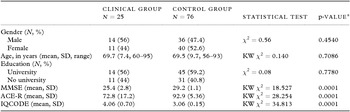
Table 1 summarizes the socio-demographic and clinical characteristics of the patients and control participants. The patients and the control participants did not differ significantly on age, gender, or education. However, as expected, controls performed significantly better than patients on the three measures of cognitive function (MMSE, ACE-R, IQCODE).
Socio-demographic and clinical data by group

Notes: aUnadjusted p-values (the Bonferroni adjusted critical value of α is 0.0084).
MMSE: Mini-Mental State Examination; ACE-R: Revised Addenbrooke's Cognitive Examination; IQCODE: Informant Questionnaire for Cognitive Decline in the Elderly. χ 2: Pearson's χ 2 test; KW χ2: Kruskal–Wallis equality-of-populations rank test.
In our sample, the internal consistency of the FCAI scale, including the debt management (DM) subscale (FCAI-a), was 0.87 with a mean inter-item covariance of 7.8. The internal consistency of the FCAI scale without the DM subscale (FCAI-b) improved to 0.91 and the mean inter-item covariance increased to 11.7. Summary statistics (mean, SD, and range) for the FCAI-a and FCAI-b were 114.2, 18.0, and 39–134 and 110.3, 18.0, and 35–130 respectively. Mean FCAI-b score was lower in the patient group than in the control group, indicating reduced financial management abilities in the former: 90.5 (SD = 25.3), 116.8 (SD = 7.3), Kruskal–Wallis χ 2 = 28.9, df = 1, p = 0.0001.
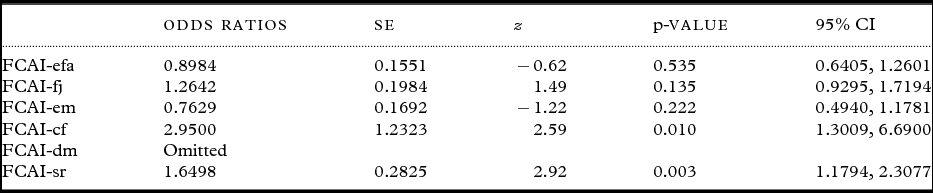
Next, we used a logistic regression model (see Table 2) to investigate which FCAI subscales independently predicted group membership with group coded “0” for the control participants and “1” for the patients. Scores on the FCAI-cf (cognitive functioning in relation to financial tasks) and FCAI-sr (support resources) subscales were independently associated with group membership, with odds ratios of 0.42 (95% CI: 0.21–0.82) and 0.73 (95% CI: 0.57–0.93) respectively. Thus, the patients were judged to have poorer cognitive functioning and fewer support resources than the control participants. In contrast, the patients and control participants did not differ significantly on everyday financial abilities (FCAI-efa), financial judgment (FCAI-fj), or estate management (FCAI-em). FCAI-dm could not be assessed as it was automatically dropped from the regression model, along with four participants, as all clinical participants (25/25) and most controls (72/76) were assigned the same score of “4.” There were 97 participants with complete data for this analysis.
Prediction of group membership by FCAI subscale scores

Notes: N = 97, LR χ 2 = 60.28, p = 0.0000, pseudo R2 = 0.5444, log likelihood = −25.2175.
Logistic regression using group (coding: 0 = control, 1 = clinical) as the outcome variable and FCAI subscale raw scores as the predictor variables; FCAI-debt management (FCAI-dm) was dropped from the model and 4 scores not used.
FCAI: Financial Competence Assessment Inventory; FCAI-efa: FCAI-everyday financial abilities; FCAI-fj: FCAI-financial judgment; FCAI-em: FCAI-estate management; FCAI-cf: FCAI-cognitive functioning; FCAI-sr: FCAI-support resources.
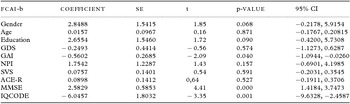
Finally, we employed a robust linear regression model (STATA rreg) to estimate independent associations of socio-demographic (gender, age, and education), psychological (anxiety, depression, total neuropsychiatric symptom burden, and social vulnerability), and neurocognitive variables (ACE-R, MMSE, and IQCODE) with FCAI-b score (see Table 3). There were 93 participants with complete data for this analysis. The overall model was statistically significant (F(10, 82) = 23.5, p = 0.0000; adjusted R2 = 0.7059], with MMSE (p = 0.000), IQCODE (p = 0.002), and GAI (p = 0.040) showing significant independent associations with FCAI-b.
Prediction of FCAI score by socio-demographic and clinical variables

Notes: N = 93, F(10, 82) = 23.87, p = 0.0000; adjusted R2 = 0.7059.
Robust regression using the STATA command rreg, with FCAI-b score (see text) as an dependent variable. Education: university or no university education; GDS: Geriatric Depression Scale; GAI: Geriatric Anxiety Inventory; NPI: Neuropsychiatric Inventory; SVS: Social Vulnerability Scale; ACE-R: Addenbrooke's Cognitive Examination – Revised; MMSE: Mini-Mental State Examination; IQCODE: Informant Questionnaire for Cognitive Decline in the Elderly.
Discussion
The current study examined predictors of financial capacity (as measured by the FCAI) in healthy older participants as well as those referred specifically for financial capacity assessment. However, while the overall internal consistency of the FCAI was relatively close to that cited by Kershaw and Webber (Reference Kershaw and Webber2008), the FCAI-dm subscale performed poorly in the current study. In the present study, a modified version of the FCAI (without the FCAI-dm subscale) demonstrated sound internal consistency and correlated with several measures of neurocognitive functioning. We suggest that further work on the FCAI-dm subscale may be warranted.
In bivariate analyses, this modified FCAI score was not significantly associated with gender, age, or education. The patients referred for capacity assessment had lower scores on the modified FCAI than the control participants. The FCAI-cf and FCAI-sr subscales were independently associated with patient's status. In a multivariable robust regression model, MMSE, IQCODE, and GAI were independently associated with modified FCAI scores, but the socio-demographic and remaining cognitive and psychological variables were not. Lower cognitive function and greater anxiety were associated with reduced performance of financial management tasks.
Interestingly, vulnerability to financial exploitation, as measured by SVS (Pinsker et al., Reference Pinsker, McFarland and Pachana2010), was not associated with financial capacity performance in this sample. It may be that most of the participants in the current study were relatively high functioning (Pinsker et al., Reference Pinsker, McFarland and Pachana2010); note that older adults with intact cognition are no different from younger persons with respect to social vulnerability to exploitation or abuse. Furthermore, acts of exploitation typically involve deception or coercion within a social context. To this extent, avoiding exploitation potentially encompasses a distinct subset of abilities, including social reasoning, and skills of this nature are not directly targeted by the FCAI.
The data showing a lack of correlation between depressive symptoms and financial capacity are somewhat unexpected if for no other reason than depressive symptoms have been shown to be associated with declining cognitive capacity (Moye et al., Reference Moye, Marson and Edelstein2013). Lack of variance in our sample with respect to scores on the depression scale could partially explain the lack of a significant relationship in our sample. However, to our knowledge there has not been specific exploration of the impact of symptoms of depression or anxiety on financial capacity abilities in later life. The prevalence of both depression and anxiety symptoms, as well as comorbid depression and anxiety in geriatric clinical participants, and the impact of such symptoms on the ability to live independently, supports the notion that in at least a subset of such patients financial capacity could be impaired (Beattie et al., Reference Beattie, Pachana and Franklin2010). In light of this our positive finding of a relationship between increased anxiety symptoms and poorer performance of financial management tasks warrants further study.
The lack of a correlation between financial ability and level of education in this sample points reflects other research suggesting that education is not a good proxy for financial literacy (Lusardi and Mitchell, Reference Lusardi and Mitchell2011). The significant correlation between financial abilities and scores on the IQCODE demonstrates the potential value of gaining an informant perspective on matters of financial capacity. Although important, it may be that the informants’ rating of cognition or other domains should be considered as only one source of data, given that other research with patients with MCI has shown that informants were not as accurate as the patients themselves in gauging financial capacity abilities (Okonkwo et al., Reference Okonkwo2008). Interestingly, in the study by Okonkwo and colleagues (Reference Okonkwo2008), the patients with MCI and depression underestimated their financial capabilities, whereas MCI patients with more global deterioration in cognitive capacity overestimated their financial capabilities. As other authors (e.g. Kershaw and Webber, Reference Kershaw and Webber2008; Widera et al., Reference Widera, Steenpass, Marson and Sudore2011; Moye et al., Reference Moye, Marson and Edelstein2013) suggest, a variety of indicators, including informant reports, objective testing results, and a careful history, are superior to any one source of data alone, including over reliance on screens such as the MMSE; to this list we would add the potential of psychiatric variables, such as anxiety to add important information about a patient's current financial capacity.
Finally, the lack of a strong correlation between current cognitive functioning as assessed with the ACE-R and financial capacity performance may reflect the ACE-R's decreased sensitivity to domains relevant to financial capacity, compared with more detailed neuropsychological assessment tools. There is a plethora of research indicating a strong relationship between cognitive functioning and financial capacity (e.g. Griffith et al., Reference Griffith, Belue, Sicola, Krzywanski, Zamrini, Harrell and Marson2003; Sherod et al., Reference Sherod2009). To our knowledge, the current study is the first to directly examine the ACE-R's relationship to financial capacity in older persons; further research using a more recent revision of the ACE-R, the ACE-III, in a larger clinical sample may be more sensitive in detecting relationships between cognitive test scores and specific financial management abilities.
Strengths of this study and limits to generalizability are worth noting. Strength of the current study is that it simultaneously tested the financial capacity of healthy community-dwelling persons and a clinical sample identified because of questions regarding the ability to manage their own finances. Often perceptions of abilities in the so-called “healthy” persons may be inflated, and in clinical practice healthcare professionals may not appreciate that a number of contextual issues (e.g. experience with handling finances, size of the estate) can influence actual functional capacity to manage finances. A similar argument may be made for using any single tool (for example, the MMSE) without reference to a specific normative sample; several reports (e.g. Tombaugh and McIntyre, Reference Tombaugh and McIntyre1992) have been published regarding pitfalls of a lack of reference to normative data. Finally, potential of psychiatric symptoms such as anxiety to influence financial decision-making in later life is suggested by our data; having a larger clinical sample of older participants with symptoms of depression and anxiety would help clarify the impact of such symptoms on financial capacity.
Potential limitations of the study include the relatively small sample size obtained and the predominance of relatively highly educated participants within the sample. The recruitment process for the clinical participants was protracted and complicated by unforeseeable changes in the procedures and requirements of the public health system. Longitudinal data to follow healthy older adults with relatively lower scores would add to our knowledge of the natural course of progression of financial management abilities, and the relative contributions of disease, age, and other factors.
Conflict of interest
None.
Description of authors’ roles
N.A. Pachana, G.J. Byrne, J. Wilson, C. Tilse, and D.M. Pinsker designed the study, supervised the data collection, and wrote the paper. D.M. Pinsker, K.J. Vearncombe, B. Massavelli, and L.K. Mitchell collected the data and assisted with writing the paper. G.J. Byrne and N.A. Pachana were responsible for the statistical design of the study and for carrying out statistical analysis.
Acknowledgment
This project was funded by a National Health and Medical Research Council of Australia dementia grant (511119) to N.A. Pachana, G.J. Byrne, J. Wilson, and C. Tilse.