In his book Apparitions and Thought-Transference: An Examination of the Evidence for Telepathy (1895), Frank Podmore relates what might at first seem a humdrum occurrence of settling into bedtime reading. The diary he has transcribed, of a woman he calls D, records on January 6th, “Tried several books . . . finally took to ‘Villette.’” But D’s choice was not completely autonomous. She was clearly influenced by her friend, “X.” As Podmore wrote, “From Miss X's diary it appears that she willed D to read The Professor,” which he notes, portentously, was “also by Charlotte Brontë.” X got luckier – or honed her skills – a few weeks later, when D recorded “Sonnets by E.B.B. 10:30 p.m.” and “In Miss X's diary, written at about 10 p.m., appears the entry, ‘Sonnets viii-ix., E.B.B.’” Assessing the records, Podmore found X's influence over D's literary taste to be “presumably telepathic” (122–23). Although the phenomenon was sensational, the circumstances surrounding it were decidedly mundane, ranging from bedtime reading to hearing X's piano-playing at a distance of miles, and meeting specific people at certain times. At a second glance, the phenomenon remains humdrum. Gauri Viswanathan has described how the institutionalization of Theosophy created reality effects that routinized its mysticism, rendering it ordinary (7). Similarly, though psychical research studied the numinous, its institutions ensconced it in bureaucracy, making it mundane. In the last quarter of the nineteenth century in Britain, the oddly interesting-yet-boring phenomenon of thought-reading became a cultural activity that ranged between scientific research, domestic pastime, and popular entertainment. Could people read each other's minds? If so, how was it done? Thought-reading arose to compete with Spiritualism, the practice of contacting the dead through séances. Its most mysterious public persona, and one of the more intriguing historical figures of the period, was Podmore's aficionado of Charlotte Brontë and Elizabeth Barrett Browning, the presumed telepath known as Miss X.Footnote 1
Miss X's enigmatic moniker appears throughout the pages of the Proceedings of the Society for Psychical Research, the Spiritualist journals Borderland and Light, and occasionally in mainstream publications such as The Times and The Nineteenth Century. Miss X played many roles: writer and editor, respected researcher, clairvoyant and telepath, psychic investigator, folklorist, world traveler, and magnet for controversy. She may also have been the model for a literary icon, the governess in Henry James’ The Turn of the Screw (1898) (Sheppard 148). Scholarship on Miss X has itself been controversial. In 1968, Trevor H. Hall's book-length smear claimed that she faked her psychic abilities; seduced – with her preternaturally youthful appearance – her professional acquaintances, such as the SPR's Frederic W. H. Myers; and passed others’ research off as her own. Hall's misogynist animosity provoked Hilary Grimes’ critical rehabilitation of X as a woman “ghosted” by the male-dominated SPR, and exemplifying “the female haunted mind” (Grimes 90). Rather than replicating Hall's and Grimes’ shared critical model of excavating Miss X's secrets, I stage my inquiry on the surface by describing the mass media landscape in which her pseudonym emerged and circulated as well as the affective realms her writings illuminated. X appeared at precise but shifting coordinates of aristocratically-connected gentility, emergent modern professionalism, empirical science, New Womanhood, and mass culture. I show how her persona, which blended sensitivity with skepticism, developed through and against scientific institutions of paranormal research, Spiritualism and thought-reading as mass entertainment, and New Journalism. At the same time, her telepathic writings reveal, on the surfaces of everyday life, an affective potential beyond the sensational, commodified variety.
Spiritualism and psychic phenomena, as well as new roles for women, interested William T. Stead, the pioneer of twentieth-century tabloid journalism. Stead, who edited The Pall Mall Gazette and founded the Review of Reviews, garnered fame for his controversial 1885 exposure of child prostitution, “The Maiden Tribute of Modern Babylon,” which revealed the power of investigative journalism to move readers to demand changes in public policy. Roger Luckhurst has described Stead's “affective journalism,” seen in his occult journal Borderland, as the combination of a democratizing ethos and the suggestively “limitless intimacy” of thought reading, in which minds all over the world could connect in a sympathy that would overcome modern alienation (133). As Stead's editor at Borderland and as a practitioner of and authority on telepathy, X actively produced affective journalism. Yet, she did so under gendered constraints that have yet to be explored. Recent feminist work on affect by Kathleen Stewart and Lauren Berlant, among others, has accentuated its ordinariness, and analyzed its hidden political and cultural work in reshaping the public sphere. Stead capitalized on the affective potential of telepathy, rendering it into familiar narrative and generic forms; but X's telepathic accounts for the SPR, and her fiction, resisted the drive to commodification. In this essay, I interpret X's pseudonym as a point of tension between two different kinds of telepathic affect: on the one hand, the sensational affect associated with Stead's, which attracted scientific debunkers and ultimately defended the occult against a hyper-rational interpretive practice verging on paranoia; on the other, an everyday, domestically-situated, femininely-networked affect grounded in class privilege and scientific empiricism. X's sensitive skeptic persona, signified by her pseudonym, mediated between these cultural formations.
Using affect to look anew at British psychical discourses of Spiritualism and telepathy shows how they created an alternative to the deep subjectivity associated with the psychoanalytic paradigm. While Freud's concept of transference bears passing resemblance to thought-transference, insofar as neither of them are materially demonstrable, psychoanalysis and psychical research operated in different registers. In Eli Zaretsky's account, Freudian psychoanalysis differentiates itself from Victorian psychology by emphasizing the idiosyncrasy of the unconscious, which no longer rejoined individuals to a transpersonal whole, as in Romantic notions of spirit (6). Accordingly, the meaning of the unconscious was socially determined by childhood family dynamics, but it was not socially created or shared through ongoing real-time influence as, for example, in X's messages to D. By contrast, British and U. S. cultural discourses of Spiritualism and telepathy emphasized individuals’ ability to communicate at subliminal or subconscious levels, placing the social within the psyche as a real phenomenon rather than a fictive or constructed one. The affect theory that I invoke similarly departs from individualizing psychoanalytic terminology, categories, and scenes, reconceiving affect broadly as “the ability to affect and to be affected” – a potential enacted inter-subjectively, in a horizontal network (Massumi 49). While the horizon of psychoanalysis is the individual psyche, the vanishing point of affect is dynamic, embodied, emotional exchange – phenomena wide open to different social formations. Because it escapes familiar conceptual structures of individualism, narrative, reason, and irrationality, the breadth of this openness can disperse into a seeming nothingness; however, I shall endeavor to show that in this mode, affect performs significant feminist and other cultural work.
The Sensitive Skeptic
In the 1870s and 1880s, thought-reading rose to prominence in British and U. S. culture, partly by flaunting its superiority to Spiritualism. The suspicion of fraudulence had dogged Spiritualism from its inception and, by the 1890s, had attained cultural dominance. Ever since the medium Maria Hayden had exported Spiritualism from the U. S. to Britain in 1852, its spectacular excesses had threatened its authenticity, prompting scientific interest and testing. Respected scientists such as Alfred Russel Wallace, William Crookes, and Oliver Lodge believed in it, and while John Tyndall and T. H. Huxley roundly excoriated it, they had first engaged with it, attending séances. As Tyndall put it, “absolute unbelief in the facts was by no means my condition of mind” (444). Even Huxley, who exposed its methods in his brief essay “Spiritualism Unmasked,” wrote that “Fraud is a kind of genius, and I confess that I have never been able to get over a certain sneaking admiration for Mrs. X” (Huxley). Huxley was referring to Hayden, not X; though the placeholder suggestively put X in proximity to the fabled medium. In the 1870s, Spiritualism in Britain entered its most theatrical phase which included Florence Cook's full form materializations of her spirit guide, Katie King, and Mrs. Guppy's manifestations at séances of sunflowers, prickly cactus, live eels, lobsters, and starfish on demand (Owen 54). Crooke investigated Cook and credited her performances, an endorsement that sparked jubilation amongst Spiritualists, though Janet Oppenheim interprets it as the result of vanity, seduction, and later, bereavement (Oppenheim 342). Scientific testing of Spiritualists took place in bourgeois homes; cheaper public performances were more likely to be suspected. Simone Natale, who has recently argued for Spiritualism's status as mass entertainment, suggests that its adherents deliberately courted skepticism to keep up their popularity, confident that the general public did not need to reconcile faith with materialism (70–71). By contrast, the drama of scientific confirmation was grounded in bourgeois privilege, setting the scene for X's sensitive skeptic persona and expertise as a telepath. As Spiritualism flagged under the weight of its popularity, telepathy prepared to ascend.
When thought-reading emerged in the 1880s, some heralded it as Spiritualism's successor, but it also replicated some of the older practice's social and economic dynamics. Like Spiritualism, thought-reading as mass entertainment began in the U. S. and traveled to Britain. Its first popular personality was J. Randall Brown, who found hidden objects by reading people's minds; other notable thought-readers were W. I. Bishop and Stuart Cumberland. Unlike the charged emotional performances of Spirit mediums, Brown's style was impassive and professional; he was an entertainer disguised as a scientist (Wiley 41). He himself distinguished his powers from those of spirit mediums, who he derided as “humbugs” in a positive New York Times review (“Spiritualism Outdone”). Bishop began his career as the manager of the Spiritualist Annie Eva Fay, though they quarreled over money, and he later developed an act that exposed her techniques. A second source of popular thought-reading was “the willing game,” in which a group of people tried to mentally influence a person who had left the room and returned to execute a specific act. A Derbyshire clergyman named Andrew Creery, impressed by his daughters’ success at it, undertook home experiments with them and published the results in the Proceedings of the SPR. As with Spiritualism, scientists were interested enough to witness demonstrations, but skeptical enough to test them. Eminent British physiologist W. B. Carpenter hypothesized that the wiling game worked through unconscious signaling via gestures and lip movements (Otis 184). The American psychologist George Beard, coining the motto “‘when we think, we move’,” and citing the close connection between mind and body, claimed it was merely “muscular motion and relaxation” in an article in Popular Science Monthly (468). Though they resembled mediums in many ways, thought-readers tended to be more masculine, their aesthetics more self-consciously emotionless, scientific, and procedural. The practice shared the performance idiom of Harry Houdini and others who demonstrated how spirit mediums beguiled their audiences. They enacted the cultural formation Neil Harris has called “the operational aesthetic,” or, the desire to see how illusions, machines, and systems worked (79). Whereas Spiritualism emphasized contacting the dead on behalf of the bereaved, thought-reading typically involved living participants, and thus lacked the same pathos and joy. Compared to the electric atmosphere of Spiritualism's full-form materializations, thought-reading demonstrations belonged to the aesthetic category Sianne Ngai has described as “merely interesting.” (Ngai; ch. 2).
In thought-reading, X saw an opportunity to mingle the feminized sensitivity of Spiritualism with the masculinized operations of thought-reading. Her pseudonym first appeared as the sign of benevolent patriarchal exclusion, as she modestly declined to present her work in person. In 1889, SPR President Henry Sidgwick read aloud her paper on crystal gazing to that body, noting that it was “contributed by a lady, well known to the editor, who prefers for the present to remain anonymous” (X, “Recent Experiments” 486). The following year, he read her second paper, “A Record of Telepathic and Other Recent Experiences,” once again approving her anonymity and authorizing the account as one “composed with a scrupulous desire to avoid anything like exaggeration of the marvelous element in the experiences which it records” (X, “A Record” 358). Sidgwick's comments helped shape X's identity as a woman conducting psychic research who exhibited none of the enchanted, melodramatic, or histrionic excesses of either the traditional female subjects of mesmerism and Spiritualism, or more recently, of Jean-Martin Charcot's demonstrations of hysteria. Likewise X downplayed her abilities, claiming they implied no “special strength of intellect or will” on her part and had been of “of very little practical use” (X, “A Record” 358). As the sober investigator, X exceeded the role of the test subjects normally designated by initials: Misses X, as well as Misses A through Z, abound in the pages of the SPR's Proceedings and Podmore's book, and appear in Tyndall's and Huxley's essays, acting as notional psychic protagonists. X's two essays lifted her out of this milieu. Her disquisition on crystal-gazing, the fruit of long labor at the British Museum, traced the phenomenon from ancient Greece and Egypt through the Middle Ages and into the modern period; it remains the standard account. The report on X's telepathic experiences, rendered in crisp, modest terms, emphasized her scientific experiments with D., and reprinted detailed notebooks of what passed between them. Rather than mystifying her abilities, X references “my knowledge of the way in which my own mind works,” establishing a self-scrutiny that suggested integrity (X, “A Record” 359).
Though she cultivated masculine scientific sobriety, in these notes and diaries X was no automaton: she claimed that without the authentic, intense emotion inspired by the presence of intimate friends, she could not transmit or receive thoughts. In this way she contrasts herself to other clairvoyants and Spiritualist mediums who can “at a given moment . . . conjure up a strong excitement” as a performance of entertainment (X, “A Record” 359). X positions herself as both femininely susceptible to psychical phenomena, and – in professionally scientific, middle-class, and masculine fashion – disinterested enough to record, classify, and interpret it without any profit motive. Speaking through Sidgwick, she voiced the male scientific tone of the SPR, while simultaneously exhibiting the feminine receptivity and passivity Jill Galvan has identified as the hallmark of mediumship and other psychic phenomena (12). In this way, X detached the meaning of women's psychic performance and labor from its sentimental Spiritualist context of contacting the dead on the behalf of the bereaved and from the odor of commerce that always clung to its pretensions to truth. As she advanced into the male-dominated SPR, presenting herself as a scientific researcher, she figured as that malleable construct of the times, the New Woman (Ledger 10).
Seizing on X, with her respected scholarship and alluring anonymity, as a resource in his effort to capture the otherworldly from the tedium of the Proceedings of the SPR and bring it to the masses, Stead asked Myers for an introduction. He wanted her to edit Borderland, his new occult journal, modeled on the Review of Reviews (Baylen 30). X consented to meet with Stead, but later explained that their professional relationship developed under the same patriarchal restrictions that had motivated the anonymity of her SPR papers, imposed “in deference to prejudices on the part of my family” (Harper 63).Footnote 2 Calling on the famous, non-conformist crusader in his office, she later recounted, “was an adventure for a girl brought up by an elderly relative with early Victorian standards”; it was “undertaken secretly so far as my home was concerned.” Stead pushed her to meet with him weekly in Gatti's, a restaurant, and to work with him on Real Ghost Stories, the Review of Reviews Christmas extra that would sell over 100,000 copies in two days in late 1891 (Luckhurst 120–21). X, it turns out, silently edited or authored much of it. She also successfully negotiated work conditions at Borderland that would appease her family, who would regard her public lunching with Stead as “too emancipated.” Yet within a few months, she reported that unspecified changes “freed [her] from the more extreme of the conventional austerities” that had limited her activities; however, she maintained two limitations: though Stead urged her to publish her portrait in Borderland, she refused and retained her pseudonym. “There was . . . from the journalistic point of view, a certain value in the mystery in which the personality of ‘Miss X’ was enshrouded.” In this act of self-authorship, X turned the letter X from the sign of prohibition to that of an enticing secret. She commodified her exclusion, transforming it into an opportunity. The phrase “Miss X” can be read as the sign of an intensive feminine negotiation of quotidian professional life – where to lunch, how to receive visitors on professional business, how and where to allow one's image and name to appear.
The “Miss X” pseudonym exploited the rift between the older Victorian periodical practice and aesthetic of authoritarian anonymity, and the New Journalism, with its breezy personal emphasis and signed pieces. It also marked the difference between mainline religious publications, which allowed authors to maintain anonymity, and the left religious press, which favored signatures (Altholz 184). The debate between advocates of anonymity and those of signatures began in 1859 and lasted until the end of the century. The discretion of anonymity, driven by the tacit idea that writing in periodicals was beneath the dignity of one in public life, confronted an opposing preference for open engagement between personalities (Brake 24). Yet throughout much of this period, women were not supposed to lead public lives. Anonymity both assisted and thwarted them: on the one hand, it permitted them to comment on topics of the day; on the other, it left their work uncredited (Gray 8). In the 1890s, the liberation of the New Woman notwithstanding, their signed journalism remained controversial. Commentators cited “the physical, temporal, and moral pressures of the industry” as reasons why women should not – and in some cases, could not – write good journalism (Gray 5). Yet in this misogynist context, scholars such as Alexis Easley see the shift toward signatures as a productive challenge for women writers “to find ever more innovative ways of claiming a ‘name’ in the high-culture literary canon without narrowly defining their work as the outgrowth of a conventionally ‘feminine’ biographical identity” (“First” 183). X did not primarily write imaginative literature, but she aspired to join the lettered elite of opinion-makers. Her pseudonym – neither exactly an anonym, nor a signature; clearly signaling gender difference, but not traditionally feminine – represented this kind of innovation. Stead's brand of popular journalism, and the occult sphere of Borderland, were open to her; they both led to further opportunities. Her pseudonym bridged the anonymity of the past, and the burgeoning of celebrity news in the 1890s, with its commodification of notable women's everyday lives (Easley, “Literary” 139).
The Miss X moniker shone like the name above the title of Borderland. Though Annie Besant was also an assistant editor, her name appears seldom compared to the ubiquity of X's. Stead devoted much of his announcement of the journal in The Review of Reviews to extolling X's intellectual and scientific credentials as a person of “exceptional talents and rare natural gifts” in the field of psychic phenomena; “trustworthy, careful, and exact” in her work for the SPR; and whose work on crystal-gazing garnered the praise of eminent psychologists Pierre Janet and Max Dessoir (Stead, “Borderland” 675–78). Scientific broadmindedness blazed from each cover of Borderland, in a quotation from no less a figure than Isaac Newton: “To myself I seem to have been as a child playing on the seashore while the immense ocean of Truth lay unexplored before me.” Stead wanted the journal to be “more open and scientific than science itself, because the stakes – the furthest reaches of the human mind and soul – were higher” (Eckley 34–35). By popularizing the occult, he hoped to make it a social good, in the spirit of the new “public science” of the period (Sausman 151). In addition to adding scientific credibility and glamor, X also generated much of the copy: for example, volume I, number 3 contains 70 pages of articles, of which she wrote 33, on topics such as hypnotism, the medium Leonora Piper, thought-transference, and even a book review of a psychical novel, Waynflete, by “Christabel Coleridge.” Moreover, X's telepathic prowess facilitated her work with Stead. As he explained in the journal's pages, they used telepathy to conduct business: “However incredible it may appear, I can, and do constantly, receive messages from my assistant editor, Miss X, as accurately and as constantly as I receive telegrams from those with whom I do business, without the employment of any wires or instrument” (Stead, “Borderland” 6). In a later number, he boasted that she “wrote telepathically with my hand a long report covering three closely written quarto pages,” with only one slight error, testifying to her superior abilities (Stead, “A Case of Auto-Telepathy” 507). Like X's account of her telepathic experiments for the SPR, Stead's puts the marvelous, telepathy, in the service of the humdrum – business dictation. Yet this dynamic between Stead and X energized readers, one of whom submitted a parodic verse drama, “The Crystal-Gazing Scene,” featuring “The Spooker Chief” and a “Miss Three X” who comically demands that Stead's pen be preserved in the British Museum (“The Crystal-Gazing Scene” 382–83). The public persona of Miss X was clearly integral to Borderland, authoring its pages and appearing throughout them, dominating the journal's self-conscious presentation, inspiring audience interactivity, and symbolizing its ethos of open-minded empiricism.
Stead's claim to fame, the 1885 article series on prostitution, “The Maiden Tribute of Modern Babylon,” had sensationalized class, sexual, gendered, and racial difference. X's pseudonymous performances in Borderland were less confrontational and politicized, investing the everyday with the lighter enchantments of telepathy and other psychic phenomena. The ethos of her skeptical sensitivity in the SPR, translated into the affect of Borderland's popular occultism, was the milder surprise, curiosity, and amusement of openness to otherworldly phenomena. “Miss X” emerged and succeeded in this occult offshoot of Stead's popular brand of journalism because she drew her authority from a limited form of genteel professionalism, the veneer of scientific skepticism, and empirical experience. Because she did not sensationalize her telepathic experiences, she acquired the bourgeois professional's technically-based credibility, while remaining aloof from the perceived vulgarity and fraudulence of professional mediums. Moreover, she neatly appealed to both sides of the New Woman debate: “Miss” signified a more traditional woman writer; “X,” a mysterious, modern cipher. “Miss X” marked the intersection of these cultural forces.
On The Trail of a Ghost
Though X was the star of Borderland, her persona faltered in the mainstream press, when The Times generated contretemps over her investigation of Ballechin, “the most haunted house in Scotland”Footnote 3 (“A Correspondent” 10). Scotland's association with the paranormal had recently resurfaced, in the work of Andrew Lang, a guest at Ballechin, and Robert Louis Stevenson, the subject of a Stead-authored Borderland feature, “Man of Dreams.” X could not invent a Scottish identity for herself, but she accentuated her northern village origins, which made her “a folk-lorist from [her] earliest years,” well-versed in the everyday mysticism of “Dolmens and Menhirs, and Roll-right stones, and rocks with cup-markings, and Celtic inscriptions, and Roman altars, and Saxon crosses . . . local witches and boggarts and rocking stones and cromlechs” (X, “Folklore” 263–64). She conducted research on the phenomenon of Scottish second sight with Father Allan MacDonald in the Hebrides; such research formed the grounds of articles, talks, and her book Outer Isles (1902), as well as of Hall's charges of academic misappropriation. Decades later, her obituary in Folklore would claim “an inherited Highland sympathy with the mysterious” (“In Memoriam” 299). Leveraging an apparent English northern-ness into Scottish-ness, X played the role of native informant to London audiences. This cultivated credibility, combined with her skeptical sensitivity, led the Marquess of Bute, a member of the SPR, to finance Ballechin's rental and to back X to conduct the controversial investigation. X invited guests to Ballechin for several months in the winter and spring of 1897. While enjoying a country house party, they had also slept in the possibly haunted bedrooms to detect ghostly emanations.
The investigation erupted into public notice in the pages of The Times on June 8, 1897, when an anonymous correspondent who had visited the house under cover exposed the affair as an unscientific shambles. Claiming that X and the SPR had rigged the experiment to confirm their supernatural hypothesis, he declared the ghostly resonances to be nothing more than servants’ footsteps and noisy plumbing. Over the following weeks, letter-writers – including X, Myers, the house's owners, other guests and tenants, letting agents, and the house's butler – all defended themselves, expressed their ire, testified to the haunting, or ridiculed it. The Times correspondent, J. Callendar Ross, excoriated the SPR's pseudo-scientific methods, claiming that “the whole thing has been fudged up in London”; that the baseless rumor of haunting had ruined the house's value to its owners; and that X, as a lady and the hostess of a house party, could not simultaneously act responsibly as a scientific investigator (“A Correspondent” 10).
In her letter published the next day, X struck back, expressing her astonishment at Ross’ violation of the norms of hospitality, since she had asked guests to divulge neither the house's name nor the purpose of their visit (X, “On the Trail” 6). A day later, Tenez-Le-Droit wrote to defend X's “sensitive accuracy in registering [psychic] impressions, comparable to that of a scientific instrument” and her “thoroughly agnostic attitude” as to their sources (Tenez-Le-Droit 4). His description supported the sensitive skeptic persona X actively cultivated. Yet her very anonymity threatened it. On June 10, a letter-writer signed “H. R.” called the SPR's practice of withholding names “ludicrous”: “Can anything be more useless or more absurd than an inquiry in which the names of persons and places are omitted from the depositions? What value can be assigned to evidence when the names of the witnesses are kept secret?” (H. R. 11). Days later, “L. E. B.” joined in the attack, vituperating the SPR's “childish methods” of concealing the names of its witnesses and experimenters: “[O]f what profit or interest was it to know that a nameless lady (whose veracity we had no possibility of testing), saw a nameless ghost in a nameless house” (L. E. B. 6). The accusation, aimed at the SPR, also struck X, who – neither plainly named, nor precisely nameless – featured both as investigator and test subject of many published accounts of psychic phenomena.
Yet the Times exposé itself, and its long train of letters, were published under cover of anonymity, as Myers himself observed in a letter that he pointedly signed (Myers, “On the Trail” 12). Rather than arguing for total transparency, however, he suggested that there were “many motives” for anonymity – a descriptive blanket covering various bourgeois privileges. X wrote again, too, to concur that transparency was ideal, but also to observe that The Lancet frequently preserved the anonymity of patients whose cases it reported. Her more pointed criticism, however, turned again on Ross’ betrayal: “I [have not] hitherto found it necessary to request my visitors to refrain from ‘making copy’ of the conversations (in this case not always accurately remembered) of their fellow-guests” (X, “On the Trail” 9). In the pages of Borderland, she reiterated the value of domestic social propriety in a lighthearted verse: “You have scored – for the nonce – in The Trail of a Ghost; / Your visit, your ‘copy,’ your jest. / But what of the courtesy, due to your host? / Oh, who's on the trail of a Guest?” (X, “A Times Correspondence” 303). The closing point of her Times letter emphasized her scientific sobriety – investigating Ballechin did not mean confirming the presence of ghosts, only exploring unexplained phenomena – a project aloof from the “popular interpretation” of spirits (X, “On the Trail” 9). X's self-defense relied on an older, genteel model of scientific inquiry: invitations to Ballechin were to professional men and respected ladies; in the grand British empirical tradition, they were clear-sighted, propertied observers, not low-minded or hysterical ghost hunters; and, Ross excepted, they were not interested in cashing in on their experiences in the popular press. She expanded her defense in The Nineteenth Century two months later: “When, in psychical research we have allowed for the vulgarities of curiosity, the vileness of fraud, the ignorance of superstition, the inaccuracy of the incapable observer, the hasty deductions of the theorist, the illogical ravings of the merely emotional . . . we have, I venture to think, still a residuum of ‘facts we can't explain’” (Goodrich-Freer, “Psychical Research” 234). To uphold her credibility as an investigator, X had to distance herself and the Ballechin project from “vulgar” stories of ghosts and her possible feminine, “emotional” belief in them. Yet as a popular writer, she could not claim the identity of a scientist, or the prestige of having produced scientific results. She had to construe the affair as a house party, full of guests interested in hunting, country rambles, and tobogganing, with the occasional ear out for causeless noises – a narrative calculated to appeal to a wide reading audience, and one that was domestic, ordinary, and spontaneous rather than strictly scientifically controlled.
X also confronted the problem of her pseudonym in The Nineteenth Century, a more serious journal that, along with others, had replaced the older quarterlies. She signed her article, “Psychical Research and an Alleged ‘Haunted’ House,” with her first initial and surname. The Nineteenth Century’s signature policy under editor James Knowles accounts for X's dropping her pseudonym on that occasion. Brake suggests the policy had been the object of “envious” criticism of profitable celebrity from – of all places – Stead's Review of Reviews (Brake 90). The appearance of her name in The Nineteenth Century broke the successful celebrity veneer of “Miss X”; but it also allowed her to level up, becoming a named participant in a journal devoted to the debate of thoughtful ideas. As the discussion of psychical phenomena moved beyond popular occult periodicals such as Borderland, X's stance of common-sense open-mindedness required transparency. If psychic investigation was to be modern and scientific, its named authors needed to be separated from its anonymous test subjects, and their experiences cordoned off from those involved in the experiment. Occult and popular journalism had afforded X the beguiling persona of sensitive skeptic, telepath and researcher; however, the Ballechin controversy exposed the tensions between feminized privacy and implicitly masculine public transparency underwriting it. The Nineteenth Century article suggested that X could occupy the same elite intellectual space as the other, male members of The Metaphysical Society – who had supplied its pages in the 1870s – without the male intercession on her behalf in the SPR. If the Times exposure brought too much popular scrutiny to bear on the SPR, The Nineteenth Century article drew perhaps too much elite attention to it. The debacle soured her relationship with Myers, who publicly and mendaciously disavowed his initial interest in the haunted house (Hamilton 240–41). Even Hall, X's hostile biographer, acknowledged Myers's and the SPR's bad behavior in throwing X “to the wolves” (96). She would never again be the organization's darling.
Around the same time that the SPR cast X off for the too-public scandal of Ballechin, her comments about Spiritualism provoked another scandal and rejection, this time from the occult press. X's persona required a critical distance from Spiritualism, and she accordingly followed the Ballechin affair with a kerfuffle over mediumship in Light, another popular periodical devoted to psychic phenomena, founded by Edmund Dawson Rogers in 1881. In the question-and-answer session after her talk on “Hauntings” before the periodical's associated organization, the London Spiritualist Alliance, Alfred Russel Wallace remarked that mediums could be enlisted to assist in telepathic experimentation. X replied that “she found it quite possible to examine accounts of haunting without the assistance of mediums. One of the particulars in which she strongly dissented from the methods of the London Spiritualist Alliance, was in the employment of professional mediums, a class with which she had no sympathy whatever, and for which she wished to express an entire lack of toleration.” After this bombshell, the account notes drily that “The meeting then terminated” (X, “Hauntings”17). Perhaps because they were unable to respond at the time, audience members did so for weeks in the pages of Light, attacking X and defending professional mediums. They contended that a medium's acceptance of remuneration did not compromise his or her honesty, since mediums, like clergy and others, also had to make a living; just because some mediums cheated did not mean that all who accepted compensation were frauds. It was a well-worn Spiritualist defense against the long siege of materialism.
Rogers’ editorial “Paid Mediums” delved further into the classed context of Spiritualism, in which poorer believers could not afford to retain a medium as a houseguest, and were thus effectively debarred from the paranormal experiences they craved (“Paid Mediums” 6). Wiley notes the far fewer publicly performing mediums in Britain than in the U. S.; in Britain, Spiritualism had remained an upper-class household affair, though this situation was beginning to change (75). X's own apparent wealth and status allowed her to distance herself from the grubby world of lower-paid mediums. A cantankerous letter-writer who signed himself “Bidston,” reversed X's indictment of them: “‘Miss X’ is, I believe, a professional journalist, and it is no secret that bribes are offered and accepted, both for ‘writing up’ and ‘writing down.’ Would Miss X like us to suspect her of such mean dishonesty?” (11). Rogers, though agreeing with Bidston's defense of professional mediums, also corrected him in language that underscored X's financial independence: “We happen to know that she is not [a professional journalist], and, fortunately or unfortunately, does not need to be; but we should esteem her work no less highly if she were” (X, “Hauntings” 11). One can imagine X's appreciating Rogers's effort to distance her from professional journalism, while recoiling from his populist, pragmatic embrace of commercially-underwritten scientific results. Bidston's comparison of professional journalists to professional mediums offended X's gentility and technical expertise – the advantages that had allowed her into the elite circle of the SPR and which continued to ensure her professional and social existence. Her class status especially had served as a floatation device as she waded into professional popular journalism with Stead, allowing her to circulate her minor celebrity persona without ceding her social status. X had bragged about her family origins in raced and classed terms, as having traditionally “expended its energies and ambitions on horses and hounds” (qtd. in Myers, Subliminal 484). That ladies and gentlemen were incapable of lying remained the cornerstone of their identity, and the one Bidston challenged when he suggested that X, as a professional journalist, might distort facts.
The pseudonyms themselves, “Bidston,” “H. R.,” “L. E. B.,” and others exposed some of the fault-lines beneath “Miss X.” They demonstrated that for her, the traditional shelter of feminine bourgeois privacy had extended into the public sphere, threatening its rational ideals of scientific transparency and disinterested truth. Could X be both a hostess and a scientist? A lady and a paid journalist? Bred to be truthful, yet possibly an inventor of fictions? Was a “professional” a low position or a high one? Her pseudonym supported her popular persona in the friendly pages of Borderland, but the Times critiqued her with hostility, and The Nineteenth Century, while giving her space to make her case, entirely excluded the pseudonym that formed her persona. The idiom of this public sphere was a habitual paranoia, with its attendant affects of suspicion, nervousness, and restless questioning. Here, pseudonyms were still common currency, but they only covered accusers and self-defenders rather than charming readers. Ballechin was not a delightful country house, but “a laboratory,” as one of the letter-writers put it (“A Late Guest” 6). X was not a methodical researcher, but a “highly strung” woman; the ghosts were “obviously hallucinatory in character, the offspring of suggestion upon a strongly prepossessed mind” (Crichton-Browne 183–84). X's public fall from grace reassigned her to the role of the hysterical woman she had studiously avoided: “unfit” for her scientific task and aided by inept assistants paralyzed by “abject fright” (“A Correspondent” 10). This slightly crazy role has been her dominant literary legacy, as the possible origin of James’ governess in The Turn of the Screw, and as the inspiration for Shirley Jackson's haunted spinster Eleanor Vance in The Haunting of Hill House (1959). The paranoid style animating such works is one that, as I shall discuss, has long driven literary criticism, preoccupied as it characteristically is with endlessly weighing words against each other. The negative affects surrounding this heightened interpretation form a deep contrast with the ones that X's other writings on telepathy invite. They witness rather than attempt to resolve unexplained phenomena.
Telepathy's Everyday Affects
I have been discussing the triumphs and trials of X's pseudonym, which exposed her gender but not her precise identity, in different periodicals and their cultural contexts. I mentioned the colorless affect of professional male thought-readers such as Brown, and the paranoid affect associated with the debunking discourses of anti-Spiritualists and commentators on the Ballechin controversy. If we return now to X's other writings – her original report of telepathic experience, heavily reliant on her own diaries, and her fiction – we can see how the pseudonym shelters a different kind of affect. This affect, closely resembling mere apperception, is situated in the private domestic life of and between women. To elucidate the difference between these two modes of affect, I will make use of Pamela Thurschwell's distinction between two kinds of telepathy. One is a “fantasy of total communication, from mind to mind without interference . . . a place where language between two people would not be necessary”; the other, by contrast, construes “language as material, quantifiable – words as things to be counted” (Thurschwell 93). We already have seen a bit of the second model, in which words are weighed in rational interpretation; now I will turn to the first, which, in its resistance to narrative and reasoned resolution, returns us to the routinization of everyday life with which I began.
As we saw at the outset, X's and D's record of their thought-reading participated in this aesthetic of puzzling and remarkable, yet distinctly domestic and quotidian, phenomena. Similarly, in her “Record of Telepathic and Other Recent Experiences” published in the Proceedings of the SPR, X warned her audience that the transmitted messages were “as intrinsically unimportant as the transference of a card or a number, and perhaps more tedious to read about,” consisting as they did of “details of slight incidents in a very uneventful existence” (X, “A Record” 376). But, this advertised boringness secured their veracity: “certainly my friend and I, if we had given free play to the imagination, could have painted our telepathic intercourse in more exciting colours” – the bright, sensational ones that characterized cheap popular psychic entertainment (376). Instead, the account of non-events conjures domestic intimacy between anonymous women, creating their experience as mutual and mentally networked.
At the risk of boring my own readers, I will quote one of X's descriptions to illustrate the everyday affective quality of potentially psychic perceptions and sensations. On a Friday in August 1877 around 4 a.m., X was suffering from neuralgia and was awakened by a sound in the Venetian blinds in her room, which she succeeded in replicating with her hand:
I then drew up the blind, opened the window wide, noted the hour in my diary (4.20), and sat in my easy chair for perhaps 10 or 15 minutes watching the starlings and wondering what it all meant. At length, however, I felt chilly, so shut the window, leaving the blind drawn up, went back to bed and watched. In a very few minutes the noise began again, quite as loud and distinct but different in character, rather as of something being drawn slowly across the glass, still from the outside. (To put it familiarly, the first sound was a rattle, the second a squeak.) I was looking out the whole time, and could see the starlings on the telegraph wires which ran opposite, and at a few feet distant from, the windows. Certainly nothing I could see would account for the sounds, which still continued. There was no wind, no ivy on the house, there was no motion in the telegraph wires. (372)
X's account draws minute attention to the absence of action and drama – the lack of wind and motion, the background of birds on lines, the simple acts of sitting and watching and listening. This smooth texture of ordinary life draws attention to affect as the physical and cognitive conditions of sensing and perceiving. This was precisely the kind of description Stead viewed as tedious and wished to re-energize when he founded Borderland and hired X to popularize her knowledge in its pages. Yet, the record exemplifies what Kathleen Stewart has described as “the intensities of the ordinary” and “things that happen”; attending to them slows “the quick jump to representational thinking” that critics often make when they impose interpretation (5, 2, 4). Unsensational observation allowed the mundane affects associated with middle-class feminine domesticity to become newly visible, such as the expectancy and mild curiosity that come with waiting and marking time. This stillness and isolated perception is the very condition of telepathic sociability, as one waits for a communication to arrive in one's mind, and for non-physical intimacy to be enjoined.
Glimpses of trivial, domestic, affective life perform an openness to nondescript experience, but they do so defensively, against the more rational, classificatory intellectual reflex of interpretation. In X's accounts of her telepathic experience, the operational aesthetic that had come to dominate the cultural discourses of Spiritualism and thought-reading – was it real or fraud? If fraudulent, how perpetrated? – was suspended. Eve Sedgwick has described the way paranoid readings quickly explain away affective phenomena by invoking grand narratives, and argued for simply attending to affect and the non-rational realities it organizes (136). Merely presenting a record of her unexplained sensations and perceptions, X made no revelation, nor offered any specific hypotheses about how images, ideas, and feelings arrived in her mind. Her record thus stood against an Enlightenment perspective, exemplified by David Brewster and carried into the twentieth century by Harry Houdini, aimed at explaining away deception and superstition, lest they propel revolution, delusion, or other chaos. Spiritualism constantly defended itself against this debunking discourse, conceding the fraudulence of some mediums as exceptions to a norm of mediumistic honesty. As Owen and others have noted, Spiritualism afforded women entrance to the public sphere as actors without directly challenging the status quo (4). However, the price of their inhabiting a highly commercialized corner of it had been the constant theatrical display of their special sensitivities and talents – the feminine receptivity and passivity, Galvan notes, is required to serve as a channel for spirit communication (2). X represents a development in this formation, mediating between skepticism and sensitivity to borrow masculine, scientific, professional privilege. In the process, she radically changed the scene of feminine passivity, from spectacular spirit possession to a domestically situated affect that is both quotidian and charged with potential intersubjective intensity. It is in the dull pages of the SPR, where psychic phenomena are institutionalized and bureaucratized, that this affective intensity comes into view – far more so than in Stead's sensational journalism.
X's fiction likewise claims for women's experience an access to monumental other worlds within the quotidian confines of the ordinary one. She wrote and edited a volume, tellingly titled The Professional and Other Psychic Stories (1900), which contains three stories written by her, and one each by Olive Birrell, Christabel Coleridge, and G. M. Robins. Her stories, “A Professional Person,” “Another Professional Person,” and “A Dead Man's Evidence” deal with female mediums and telepaths and their negotiation of their professional and romantic lives. In “Another Professional Person,” she fictionalizes herself as a character named Monica, an experienced crystal-gazer, in the throes of a transmission:
even in this moment of Memory and Fancy's supremest effort . . . [she] retains – as one does in dreams – a conscious fear that at some lightest breath, some slightest movement, the whole will dissolve, and past and future will yield to the all-absorbing, all-devouring Now. A sense of the fullness of life, of its possibilities, love-lighted, love-strengthened, has possession of her for the instant, but at any moment the sense of its littleness, its futility, its failure, its reality, may return. (X, The Professional 38–39)
In this passage, nothing – and everything – is happening. Narrative time and space are simultaneously full as Monica experiences affective presence, and strives to resist its lapse back into triviality. In Berlant's description of the cultural operation of affect, such a passage might describe the “conflation of ordinariness and extremity” that mark women's struggles (12). In the story, Monica solves a minor domestic mystery using her powers; these contradictions revolve around women's knowledge and authority. But the passage's refusal to let its represented affect settle into a particular narrative groove also suggests a mobile, unformed realm below the threshold of commercial genres and expected plots. Nor do this and similar passages operate within Freudian narrative paradigms of unconscious repression; rather they constellate subjective nodes in a spiritualized network.
To this model of telepathy marked by open-ended affect, we can contrast Thurschwell's second model of telepathy, a communication transmission focused more on counting – and commodifying – words. This is the interpretive, critical model often linked to paranoid affect. It is best exemplified by Stead's expanded account of his telepathic connection to X. Stead collected telepathic transmissions from his dead friend Julia Ames, which had appeared in an ongoing Borderland feature, in the best-selling Letters from Julia (1898). His new preface, written in 1909 but not published until 1914, allowed him to also speak from the great beyond – he had sunk with the Titanic in 1912. Framing the story as the most compelling evidence of his belief in psychic phenomena, Stead relates how one day he mentally asked X if she was indeed still planning to meet him for lunch as scheduled. Placing his pen in his hand to record her answer, he wrote the following:
I am very sorry to tell you I have had a very painful experience of which I am ashamed to speak. I left Haslemere at 2.27 p.m. in a second-class carriage in which there were two ladies and one gentleman. When the train stopped at Godalming the ladies got out and I was left alone with the man. After the train started he left his seat and came close to me. I was alarmed and repelled him. He refused to go away and tried to kiss me. I was furious. We had a struggle. I seized his umbrella and struck him, but it broke and I was beginning to fear that he would master me when the train began to slow up before arriving at Guildford station. He got frightened, let go of me and before the train reached the platform he jumped out and ran away. I was very much upset. But I have the umbrella. (After Death xvii–xviii)
Stead sent his secretary to X with a note of condolence, adding, “Be sure and bring the man's umbrella on Wednesday” (xvii–xviii). She wrote, “I am very sorry you know anything about it. I had made up my mind to tell nobody. I will bring the broken umbrella, but it was mine, not his” (xvii–xviii). As in his earlier “Case of Auto-Telepathy,” Stead declared that there was only one mistake in the received message; here, it was the ownership of the broken umbrella (Stead, After Death xvii–xviii). Eyeing the minute detail like the contemporaneously popular figure of Sherlock Holmes, recounting the story for mass public consumption, and essentially counting words, Stead enacts the sensationalized affective model of telepathy at its most extreme. The mild buzz of his and X's telepathy as represented in Borderland here turns darkly melodramatic, burning up the wires and dropping hot off the press.
The story demonstrates an interpretive problem with telepathy: the events are meant to serve as evidence of Stead and the woman's telepathic connection, but the urgent spectacle of sexual violence in the train carriage overshadows this extraordinary phenomenon. The assault is supposed to function as the banal materiality that guarantees the truth of the evanescent, numinous mysteries of psychic phenomena by miring it in the material prop of the broken umbrella, which is like the books X willed D to read, the birds X observed on the telegraph wire, and the generalized uneventfulness that she promotes in her record. The anecdote's rhetorical frame obliges this souvenir item to stand as proof not of the assault, but of the telepathically-powered automatic writing. Yet the excessively sensational story of sexual assault overwhelms its status as telepathic evidence, titillating or distressing readers. It is important to recognize that Stead conjured this narrative – and fantasy – about X, scripting her into the kind of melodrama she carefully avoided in her telepathic accounts for the SPR.Footnote 4 By positioning himself as the amanuensis to a female author, Stead appears to reverse the gendered dynamic common to automatic writing and emerging within business dictation and typewriting. Yet, by receiving the apparently unwittingly transmitted story, and then publishing it, he assumed authorial control of its circulation. The fantasy of an unspoken intimacy between the two confronts the intrusion of another, ghostlier anonymous figure – the mass reading public who listens in on Stead and X's mental conversation. In distinct contrast to X's open-ended, non-narrative apperception, the affect here is tight, almost plotted, and a little paranoid.
X never narrated such scenes for publication; and yet their depressing familiarity indexes the inevitable friction attending women's negotiation of public and professional life at the fin-de-siècle. The story thus coalesces a latent violence surrounding X as she moved into public life under the protection of her pseudonym, from her “adventure” of first meeting Stead, through the Ballechin and Light debacles, and Hall's misogynist biography. This figurative – and perhaps real – violence marked the bleeding edge of New Womanhood for those who lived it.
The difference between Thurschwell's two models of telepathy, as inchoate intimacy and as quantifiable communication, parallel the two kinds of affect that I have been describing. Stead's “affective journalism” described by Luckhurst sizzles with the frisson of connectedness itself; in it, words serve a narrative, are commodified and popularized as they link the mass (Luckhurst 131). Jonathan Elmer has described the emergence of this “mass affect” in the U. S. in Edgar Allan Poe's sensational horror and detective fiction (Elmer 7). Oscillating between visceral feelings and the reasoned narrativization that attempts to make sense of them, this kind of affect lends itself to a ratiocination that can descend into paranoia. In the case of telepathy as a cultural phenomenon, it animates the operational aesthetic that marvels at its spectacle, and attempts to detect its fraudulence. The other kind of telepathy, exemplified by X's notebooks and writings for the SPR as well as her fiction, is the open-ended, potentially intersubjective, anti-narrative mode that features everyday affects – the apperceptions that strike one while waiting, looking, listening, and feeling something that may or may not be there. This affective mode, which resists both critical paranoia and easy commodification, is the space that telepathic research figuratively afforded intimacy to women in X's accounts. Unlike the masculine telepathic acts of Brown and his debunkers, it is less concerned with explaining affect than documenting it. This is its significant cultural work: creating an open-ended space for women's affect.
Though I have separated them for the sake of this argument, neither kind of telepathy, affect, or response to texts, is ever wholly separate. Wordless communication between intimates can be commodified easily, and affect and reason mingle throughout all communication. Anti-narrative affect is always ready to collapse back into story and genre, just as the sensational generic tale can expand into uninformative boredom. The paranoid reading can break into documentary witnessing, and the reparative witness can build into the hermeneutics of suspicion. The mundane umbrella can be enlisted in a story of violence, or it can fall back out of it into everyday life. Jacques Derrida and his interpreter Nicholas Royle make a similar deconstructive move with respect to telepathy and literature, though they were writing in the psychoanalytic, high-theoretical vein of an earlier era.Footnote 5 My effort here has been to reveal and configure hitherto undescribed cultural contexts of telepathic discourse.
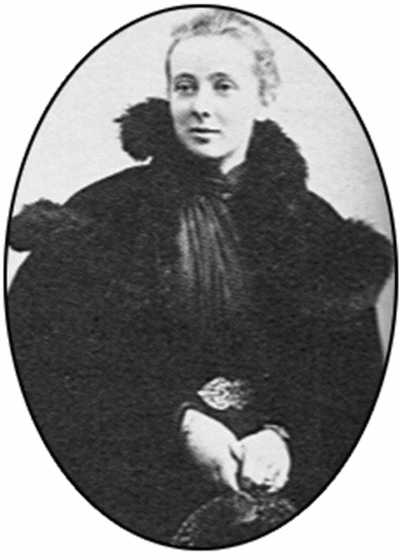
I have referenced X's pseudonym throughout this essay in an effort to present its cultural effect of combined protectiveness and glamor – its simultaneous backward glance to early Victorian conventions, and its forward gaze toward media celebrity. But to conclude the story, I must reference her name, as she herself began to do in her books and articles written after 1898. In 1901, she married, left England, and moved throughout the Middle East, writing books about its cultures’ occultism, such as Inner Jerusalem (1904), Things Seen in Palestine (1913), In a Syrian Saddle (1905), and Arabs in Tent and Town (1924). On the title pages of her books and articles from that date, her name and her pseudonym appear together, in varying order— sometimes one, sometimes the other, in parentheses. Occasionally, she uses variants on her first name and her married name. The ultimate paranoid literary detective, Hall cites the lack of consistency in her self-presentation to suggest her shadiness, as if she were a criminal evading detection (xvi). But her gradual and uneven shedding of the pseudonym and her play with her own name suggest instead her ongoing negotiation of her professional identity as a woman writer – transactions that ranged from adventure to the routines of everyday life. All that remains of her considerable work on telepathy in the archives of the SPR is a single unattributed photograph (Figure 5). But her name – which is, in the end, like any other – was Ada Goodrich-Freer.
Anonymous. Photograph of Ada Goodrich Freer CA. 1900.