Introduction
One of the most impressive and diverse forms of convergent evolution on Earth is bioluminescence: the generation of light from a chemical reaction in a living organism. Almost every domain of life has some bioluminescent species, with notable exceptions including plants, birds, reptiles and mammals. Terrestrial bioluminescent species include arthropods, bacteria, earthworms and fungi. The majority of bioluminescent species are aquatic marine organisms. There are over 30 different independent bioluminescent systems that have evolved in extant species, each system likely having unique enzymes responsible for catalysing the bioluminescent reaction (Wilson & Hastings Reference Wilson and Hastings1998). One common thread among all the different bioluminescent systems is the requirement of molecular oxygen.
Convergent evolution is the independent development of the same biological trait in unrelated lineages. These traits are said to be analogous to each other as opposed to homologous, which involves a common ancestor. Some classic examples of convergent evolution are the wings of bats and birds; bipedal locomotion of apes, birds and some octopuses; and, opposable thumbs in primates and opossums. There are many other less obvious examples of convergent evolution that occur at the molecular level. Both fungi and plants produce and use gibberellin and abscisic acid hormones (Siewers et al. Reference Siewers, Smedsgaard and Tudzynski2004; Tudzynski Reference Tudzynski2005). The gibberellin made by plants and fungi is structurally identical; the biosynthetic pathway is highly divergent between the two lineages. The same is true for abscisic acid production in plants and fungi. Both bats and dolphins use echolocation to detect objects in their environment; a critical component of this trait is the ability to listen to the echoes returning from the objects. The gene Prestin is partially responsible for cochlear amplification, when the sequences of the Prestin gene are compared among some mammals, the bat and dolphin genes cluster together, both species have amino-acid substitutions in similar locations (Liu et al. Reference Liu, Cotton, Shen, Han, Rossiter and Zhang2010). Given the diversity and quantity of bioluminescent organisms, little attention has been given to its convergent evolution.
In this work, we will examine bioluminescence from three perspectives: (i) the bioluminescent species on Earth will be introduced, and species will be grouped together by luciferin substrate; (ii) the ecological significance will be discussed and (iii) an overview of the biotechnological applications of bioluminescence will be presented.
The luciferins of bioluminescent organisms
A luciferin is a small molecule that generates light upon a chemical reaction with oxygen catalysed by an enzyme generically called luciferase (Wilson & Hastings Reference Wilson and Hastings1998; Shimomura Reference Shimomura2006). Other luciferins interact with photoproteins. One of the main differences between luciferases and photoproteins is the dependence of oxygen in cell-free luminescent reactions, photoproteins do not require oxygen for in vitro luminescence although oxygen is required for photoprotein synthesis, the net luminescence is directly correlated with the protein amount, as the photoprotein acts as reactant in the reaction being consumed (Shimomura Reference Shimomura2006). One can also consider photoproteins a subset of luciferases with low turnover, in which the luciferin binds covalently with the protein. Luciferases require oxygen in the cell-free luminescence reaction and they act as a catalyst (enzyme) and can be recycled. The total amount of light is dependent on the quantity of luciferin substrate. At the chemical level, most bioluminescent light is generated as a result of the decomposition of a four-membered ring dioxetanone (Wilson & Hastings Reference Wilson and Hastings1998). These strained and energy-rich peroxides require low energy to break, but their decomposition yields a molecule in the electronically excited state, whose decay to the ground state is accompanied by light emission. Some bioluminescent systems do not employ a dioxetanone intermediate, but an acyclic peroxide (a hemiperoxyacetal), such as bacterial systems. Although there are over 30 bioluminescent systems (Wilson & Hastings Reference Wilson and Hastings1998; Shimomura Reference Shimomura2006), there are only nine well-defined luciferins. A luciferin and its luciferase are usually encountered only within a single lineage. The exception includes some coelenterazine-dependent bioluminescent organisms from Phyla: Sarcomastigophora (protozoa), Cnidaria, Ctenophora, Mollusca, Arthropoda and Chordata (pisces), despite their common use of coelenterazine the luciferases differ or are currently unknown (Wilson & Hastings Reference Wilson and Hastings1998; Szent-Gvorgvi et al. Reference Szent-Gyorgyi, Ballou, Dagnal and Bryan1999).
Firefly luciferin
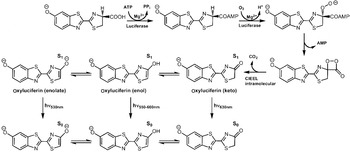
Depending on firefly species, the in vivo light emission peaks range from 552 to 582 nm (Seliger & McElroy Reference Seliger and McElroy1964). Structures of firefly luciferin and firefly luciferase have been determined (White et al. Reference White, McCapra, Field and McElroy1961; Conti et al. Reference Conti, Franks and Brick1996). cDNA clones of firefly luciferase have been isolated and translated in vitro (Wood et al. Reference Wood, De Wet, Dewji and DeLuca1984). Firefly luciferase catalyses the reaction of firefly luciferin with ATP and molecular oxygen, resulting in light emission (from green until red), CO2, AMP and oxyluciferin. The mechanism (Scheme 1) involves the formation of a dioxetanone ring common to other bioluminescent systems (Shimomura et al. Reference Shimomura, Goto and Johnson1977). There are three families of Coleoptera that are bioluminescent, Lampyridae (fireflies), Phengodidae (railroad worms) and Elateridae (click beetles). All three share the same basic bioluminescent mechanism and catalyse the same luciferin as the well-studied lampirids, although species of Phengodidae and Elateridae have homologous luciferases that emit different colours (Wood et al. Reference Wood, Lam, Seliger and McElroy1989; Viviani et al. Reference Viviani, Silva, Perez, Santelli, Bechara and Reinach1999).
Reaction mechanism of firefly bioluminescence.

Some Diptera emit blue bioluminescence, the mechanism is poorly understood, lacking structures for luciferin and luciferase, and a detailed reaction mechanism. Diptera bioluminescence is likely independent of Coleoptera bioluminescence. The Diptera Arachnocampa luminosa and Orfelia fultoni appear to have different bioluminescent systems based on the specificity of different cofactors. Each system is likely to have unique luciferin and luciferase structures (Viviani Reference Viviani2002; Shimomura Reference Shimomura2006).
Tetrapyrrole compound luciferins: Dinoflagellates and Krill
Krill and dinoflagellates luminesce at 476 and 474 nm, respectively (Nakamura et al. Reference Nakamura, Musicki, Kishi and Shimomura1988; Nakamura et al. Reference Nakamura, Kishi, Shimomura, Morse and Hastings1989), and both bioluminescent systems use very similar tetrapyrrolic compound as luciferin, differing only by a hydroxyl group moiety. Regarding the luciferases, they are analogous, showing a noteworthy example of convergent evolution in bioluminescence. In fact, the chemical pathways involved are the same, and luminescence was observed in a cross-reaction between krill luciferin and dinoflagellate luciferase, and vice-versa (Dunlap et al. Reference Dunlap, Hastings and Shimomura1980). The krill species Euphoausia pacifica and Meganyctiphanes norvegica are the most studied bioluminescent Euphausiids, and both species are widely distributed in marine environments (Shimomura Reference Shimomura2006). Nakamura et al. (Reference Nakamura, Musicki, Kishi and Shimomura1988) proposed a structure for the luciferin and Shimomura (Reference Shimomura1995) characterized the purified luciferase.
The dinoflagellate system is better understood than krill. Dinoflagellate blooms are responsible for red tide ‘phosphorescence’ in the sea (Wilson & Hastings Reference Wilson and Hastings1998). The structure of dinoflagellate luciferin was determined by Nakamura et al. (Reference Nakamura, Kishi, Shimomura, Morse and Hastings1989), and the bioluminescent pathway does not involve a dioxetanone intermediate (Stojanovic & Kishi Reference Stojanovic and Kishi1994). The gene responsible was cloned (Bae & Hastings Reference Bae and Hastings1994), and the crystal structure for functional 35 kDa dinoflagellate luciferase was solved by Schultz et al. (Reference Schultz, Lie, Cegielski and Hastings2005).
Cypridina luciferin
Cypridina hilgendorfii has been used as a tool to understand the biochemistry of bioluminescence in the 20th century. When disturbed it secretes a luminous mucus (light in the range of 450–460 nm) from a specialized gland with two types of cells, one cell type secreting luciferin and the other secreting luciferase, resulting in a bright blue cloud of bioluminescence (Shimomura & Johnson Reference Shimomura and Johnson1970; Shimomura Reference Shimomura2006). The structure of the luciferin was determined by Kishi et al. (Reference Kishi, Goto and Hirata1966) and the luciferase was cloned by Thompson et al. (Reference Thompson, Nagata and Tsuji1989). Shimomura & Johnson (Reference Shimomura and Johnson1971) demonstrated the involvement of a dioxetanone intermediate in the luminescence reaction mechanism. The luciferase of Pyrocypris noctiluca, in the same class as C. hilgendorfii, has also been cloned, and the two homologous proteins have 83.1% sequence identity (Nakajima et al. Reference Nakajima, Kobayashi, Yamagishi, Entomoto and Ohmiya2004). Moreover, several coastal luminous fish also utilize Cypridina luciferin although their luciferases are likely analogous to C. hilgendorfii.
Odontosyllis luciferin
The Bermuda fireworm Odontosyllis is one of the least understood bioluminescence systems. Odontosyllis luminescence is correlated with the lunar cycle, for 7 days following a full moon the Bermuda Fireworm luminesces at sunset (Morin Reference Morin1983). Harvey (Reference Harvey1952) demonstrated a luciferin–luciferase reaction using whole-worm extracts. However, the luminous mucus (light emission 507 nm) of the fireworm may emit light from a secreted photoprotein, as the classical luciferin–luciferase assay did not produce luminescence, and the reaction still occurs in the absence of oxygen suggesting that Odontosyllis may have two separate luminescence mechanisms, as suggested by Dehyan & Latz (Reference Deheyn and Latz2009).
Diplocardia luciferin
Some earthworms, the majority in the Megascolecidae family, bioluminesce in the range of 490–507 nm (Bellisario et al. Reference Bellisario, Spencer and Cormier1972; Ohtsuka et al. Reference Ohtsuka, Rudie and Wampler1976). Some earthworms secrete luminous mucus from their mouth, anus and pores. The most studied organism is Diplocardia longa, from which a substance has been isolated and proposed as luciferin (Ohtsuka et al. Reference Ohtsuka, Rudie and Wampler1976), and the luciferase activity evidenced (Rudie et al. Reference Rudie, Mulkerrin and Wampler1981). Light emission could be obtained using a cell-free extract upon addition of hydrogen peroxide. Moreover, a flavin has been suggested to be involved in the luminescent reaction (Shimomura Reference Shimomura2006), but this still requires further confirmation.
Latia luciferin
The limpet Latia neritoides emits light at 536 nm (Shimomura & Johnson 1968Reference Shimomura and Johnsonb) and is the only known freshwater luminescent organism, apart from some bacteria and larval stages of fireflies (Shimomura Reference Shimomura2006). Latia luminescence is extracellular and is due to the secretion of luciferin and luciferase, which were shown to participate in the process by the hot and cold luciferase assay (Bowden Reference Bowden1950). A putative structure of the fat soluble Latia luciferin was proposed by Shimomura & Johnson (Reference Shimomura and Johnson1968a). The luminescence reaction requires luciferin, luciferase, molecular oxygen and a ‘purple protein’ of unknown function (Shimomura & Johnson 1968Reference Shimomura and Johnsonb; Kojima et al. Reference Kojima2000). Later on, Kojima showed that the purple protein is not necessary to obtain light emission (Kojima et al. Reference Kojima2000). The reaction mechanism is not known, but is known to form formic acid as a product (Shimomura & Johnson 1968Reference Shimomura and Johnsonb).
Bacterial luciferin
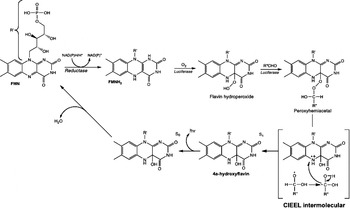
Bacteria emit light at 490 nm from the decomposition of the peroxyhemiacetal formed by the reaction among reduced flavin mononucleotide (FMNH2), oxygen and a long-chain aldehyde inside the active site of the luciferase (Cormier & Strehler Reference Cormier and Strehler1953). Several species of bacteria are known to produce light including the well-studied Vibrio harveyi and Vibrio fischeri. The lux operon contains genes for bacteria luciferase, luxA and luxB, genes for the fatty-acid luciferin reductase complex, luxC, lucD and luxE (Meighen Reference Meighen1991). Moreover, species-specific bioluminescence genes are also found in the lux operon (Meighen Reference Meighen1994). Depending on the species, several flavin-reductases yield FMNH2 a common one being homologous to the E. coli flavin reductase Fre (Zenno & Saigo Reference Zenno and Saigo1994). As already mentioned, the reaction (Scheme 2) does not produce a dioxetanone intermediate, but instead an FMN hydroperoxide, which on its turn adds to a long-chain aldehyde producing a hemiperoxyacetal, whose decomposition via the so-called Chemically Initiated Electron Exchange Luminescence (CIEEL) leads to the formation of hydroxy-FMN in the electronically excited state (Eckstein et al. Reference Eckstein, Hastings and Ghisla1993; Villa & Willetts Reference Villa and Willetts1997; Stevani & Baader Reference Stevani and Baader1999; Berkel et al. Reference Berkel, Kamerbeek and Fraaije2006). The bacterial luciferase and the NADH/NADPH-dependent flavin-reductase form a complex as demonstrated by affinity studies (Watanabe & Hastings Reference Watanabe and Hastings1982) and kinetic experiments (Tu Reference Tu2007).
Reaction mechanism of bacterial bioluminescence.

Fungal luciferin
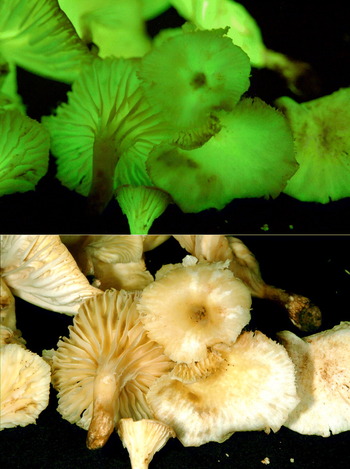
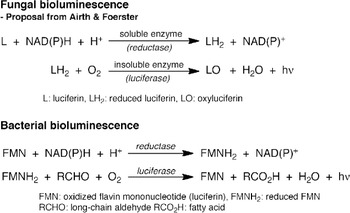
The structure of the fungal luciferin is currently unknown (Oliveira & Stevani Reference Oliveira and Stevani2009). There are no less than 71 species of luminescent fungi, representing four distinct lineages belonging to the Omphalotaceae, Armillaria, Mycenaceae and Lucentipes lineages (Desjardin et al. Reference Desjardin, Oliveira and Stevani2008; Desjardin et al. Reference Desjardin, Perry, Lodge, Stevani and Nagasawa2010; Oliveira et al. Reference Oliveira, Desjardin, Perry and Stevani2012). Fungal bioluminescence is poorly understood, but ongoing work performed by our group could answer some questions. Desjardin et al. (Reference Desjardin, Oliveira and Stevani2008) wrote the most current and comprehensive review on this subject. The spatial distribution of bioluminescence varies among species. In some species the whole fruiting body emits light (Fig. 1), and in others only some part of the fruiting body is luminescent (i.e., stipe or pileus), while the mycelium is non-luminescent or vice-versa (Desjardin et al. Reference Desjardin, Oliveira and Stevani2008). In 1959, Airth and McElroy were the first to successfully perform the classical luciferin/luciferase test in fungi (Airth & McElroy Reference Airth and McElroy1959). The mixture of the luciferin-rich hot extract, enzyme-rich cold extract and NADH or NADPH was required for sustained in vitro light emission (Airth & McElroy Reference Airth and McElroy1959). The cold water extract can be further separated by ultracentrifugation into soluble (supernatant) and insoluble (pellet) fractions each containing essential enzymes for the luminescent reaction and suggesting a two-step enzymatic reaction (Scheme 3) very similar to the bacterial mechanism. The first step involves a dark reaction with the supernatant containing the NAD(P)H-reductase and exogenous NAD(P)H, this occurs prior to the light generating step, which is catalysed by the luciferase-rich insoluble fraction (Airth & Foerster Reference Airth and Foerster1962). In 2009, the enzymatic nature of fungal bioluminescence was finally confirmed using hot and cold extracts prepared from luminescent fungi and NADPH (Oliveira & Stevani Reference Oliveira and Stevani2009). Moreover, the authors were also able to match the in vivo bioluminescence spectrum to the in vitro one obtained from hot and cold extracts, further supporting that the light emission processes were the same. Preliminary results indicate that the luciferin may have a flavin-like structure. However, the addition of FMN in the presence or absence of a long-chain aldehyde did not lead to light emission (unpublished data).
Bioluminescence of Neonothopanus gardneri photographed in dark conditions (above) and in the light (below).

Proposed mechanism of fungal bioluminescence.

The luciferin Coelenterazine
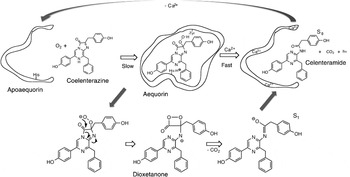
Coelenterazine is used as luciferin by many analogous systems, such as the protozoan Thalassicollin and six other animal phyla: Athropoda, Cnidaria, Mollusca, Ctenophora, Chordata and Echinodermata (Campbell & Herring Reference Campbell and Herring1990; Shimomura Reference Shimomura2006). All bioluminescent species that use coelenterazine are marine organisms. Notwithstanding the luciferin molecule is the same for these systems, the enzymes that catalyse the luminescent reaction (Scheme 4) are similar, but of independent origin. Only some species synthesize their own coelenterazine the rest relying on dietary sources, as there are many non-luminous species that contain large quantities of coelenterazine. Coelenterazine can be used by the organism either with a luciferase or with a photoprotein. In all cases the light emission is triggered by Ca2+.
Reaction mechanism of bioluminescence in a coelenterazine-based photoprotein system.

Functions of bioluminescence
Bioluminescence should serve to some beneficial purpose to the organism otherwise it would have been selected against and not evolved so many times. The significance of bioluminescence must be species specific, as the behaviours and characteristics of these organisms are diverse. The ecological significance of bioluminescence in fish is likely different from that for fungal bioluminescence, the fish being a mobile marine animal that can see light, the other a stationary decomposer that has no nervous system. There are two main environments where bioluminescence occurs, on the ground and in the ocean. There are significant differences in how light affects the marine environment than on land (Widder Reference Widder2001). The epipelagic zone of the ocean is illuminated by sunlight during the day and is dark by night. The only illumination the mesopelagic zone receives is dim light from above. The pelagic zone and below is only illuminated by bioluminescence (Widder Reference Widder2001). There is no barrier between these zones and many marine organisms hide in the mesopelagic or pelagic zones during the day and migrate to the surface epipelagic zone at night to feed closer to the surface. In the open-ocean there is no place to hide, everything is exposed (Widder Reference Widder2001). Most marine bioluminescence light is in the blue region, which closely matches the wavelengths of maximum transmission through seawater, this is also similar to the wavelength of maximal sensitivity for most pelagic fish and crustaceans. When monitoring basal bioluminescence levels in the ocean it was observed that mechanical disturbance by equipment and animals was the main trigger of plankton bioluminescence, any animal seeking darkness as a mean of evading detection must cope with a potential bioluminescent minefield (Widder Reference Widder2001). Bioluminescence could be thought to function in one of several ways, attraction, repulsion, camouflage, illumination and communication (Sivinski Reference Sivinski1981; Sivinski Reference Sivinski1998). These are likely to occur on land and the sea.
Larva of luminescent Diptera Mycetophilidae use their bioluminescence to lure phototropic prey into bead-shaped webs, also disturbance of luminescent Diptera larvae or pupae changes their light emission and may be acting as a warning signal to negatively phototropic predators (Gatenby Reference Gatenby1959; Sivinski Reference Sivinski1998). Dinoflagellates luminesce in response to mechanical disturbance. When a dinoflagellate grazer disturbs its prey the cloud of light then attracts the predator of the dinoflagellate grazer. This has been verified experimentally by monitoring numbers of copepods (grazers of dinoflagellates) and sticklebacks (predators of copepods) in aquariums with luminescent or non-luminescent dinoflagellates. In tanks with luminescent dinoflagellates, copepod numbers were lower (Abrahams & Townsend Reference Abrahams and Townsend1993). Attraction of mates has been observed on the land and in the sea, with fireflies and ostracods, respectively.
Bioluminescence could also benefit the individual by repelling unwanted pests or predators or tricking them into staying away. Caribbean ostracods can release large clouds of bioluminescence that luminesces for several seconds, which can blind or confuse a predator (Widder Reference Widder2001). Repulsion of fungivores is a proposed function of fungal bioluminescence (Sivinski Reference Sivinski1981).
As mentioned, the mesopelagic zone of the ocean only receives very dim sunlight from above. Frequently, organisms have downward facing bioluminescent organs presumably to disrupt their silhouette to predators or prey below (Widder Reference Widder2001). Some species of fish use luminescence to illuminate the water directly in front of them, such as the Stomiiformes fish that have far-red bioluminescent (>700 nm) light organs below their eyes and photosensors inside them, with the rare ability to detect this wavelength of light (Sutton Reference Sutton2005; Kenaley Reference Kenaley2010). It is thought that this top predator of the mesopelagic zone has evolved the ability to illuminate and see its prey.
Applications of bioluminescence
Since the late 1980s bioluminescent transgenic organisms have been engineered, such as bioluminescent tobacco plants transformed with the firefly luc gene (Ow et al. Reference Ow, Wood, DeLuca, De Wet, Helinski and Howell1986). These plants did not promptly bioluminesce, they had to be soaked in a firefly luciferin solution and long exposure photography was required to see the luminescence. Nevertheless, engineered bioluminescent organisms offer new and useful applications (Roda et al. Reference Roda, Pasini, Mirasoli, Michelini and Guardigli2004). Some of the commonly used luminescent genes are the bacterial lux operon, firefly luc and aequorin genes. In some compatible organisms, the lux operon requires no exogenous factors for expression, just FADH2 and the long-chain aldehyde, which can be found in some organisms (Francis et al. Reference Francis, Joh, Bellinger-Kawahara, Hawkinson, Purchio and Contag2000). The firefly luciferase and the aequorin photoprotein require additional exogenous substrates such as firefly luciferin and coelenterazine, respectively. The fluorescent, green fluorescent protein (GFP), found in a bioluminescent jellyfish is often used in research applications. GFP was discovered along with the Aequorea victoria luminescent photoprotein aequorin (Shimomura et al. Reference Shimomura, Johnson and Saiga1962). The chromophore of GFP absorbs light of a specific range and fluoresces green light (Shimomura Reference Shimomura1979). GFP has been transformed into cell lines to study various topics, it has many advantages in that it requires no additional substrates or cofactors for activity, just the absorption of blue light (Chalfie et al. Reference Chalfie, Tu, Euskirchen and Ward1994).
Bioluminescence resonance energy transfer (BRET) enables the monitoring of specific protein–protein interactions. This technique is based on the energy transfer that occurs when a photoprotein, such as aequorin, comes into close proximity with GFP or GFP-like protein. This is what occurs naturally in Aequorea, the greenish light that is emitted from the body of the jellyfish was not observed from the purified fractions containing the luciferin and the photoprotein involved, as blue light was observed. The study of jellyfish bioluminescence contributed to the discovery and isolation of the GFP (Shimomura et al. 1962). BRET can only occur when the primary light emitter and the fluorescent protein are in close proximity within (<100 Å) (Morise et al. 1974). BRET has been used to monitor insulin receptor dimerization (Issad et al. Reference Issad, Boute and Pernet2002), in vivo DNA transcription factor binding (Germain-Desprez et al. Reference Germain-Desprez, Bazinet, Bouvier and Aubry2003). Recently BRET has been used to observe the protein–protein interactions within deep tissues of mice. Mice were first transformed with both Renilla luciferase and fluorescent proteins. Then, the mice were injected with coelenterazine into the blood stream, and imaged for luminescence (Dragulescu-Andrasi et al. Reference Dragulescu-Andrasi, Chan, De, Massoud and Gambhir2011).
Bioluminescence can also be used to study gene transcription as a reporter gene. For example, the Cytochrome P450 3A4 (CYP34A) gene activity was monitored in mice by transformation of a plasmid constructed with a reporter gene containing the P450 promoter driving the firefly luciferase coding sequence. In order to observe bioluminescence, luciferin must be injected into the animal (Zhang et al. Reference Zhang, Purchio, Chen, Wu, Lu, Coffee, Contag and West2003). The use of two bioluminescent reporter genes in the same organism has been performed to measure both oxidative and genotoxic damage in E. coli (Mitchell & Gu Reference Mitchell and Gu2003). Bioluminescence imaging has also been used to study infectious diseases, such as salmonella, where salmonella transformed with the bacterial lux operon are injected into mice. Low yet substantial light can be detected through the animal tissue with ultra sensitive cameras, which enables monitoring of the spread of the salmonella infection (Francis et al. Reference Francis, Joh, Bellinger-Kawahara, Hawkinson, Purchio and Contag2000). Similarly, genetically engineered bioluminescent tumours have been implanted into mice to observe the spread of the tumour non-invasively and in real-time (Yu et al. Reference Yu, Timiryasova, Zhang, Beltz and Szalay2003). Similarly, transplanted cardiac stem cells can be monitored non-invasively and in real-time using bioluminescence (Wu et al. Reference Wu, Chen, Sundaresan, Min, De, Qiao, Fishbein and Gambhir2003).
Bioluminescent systems have been used in biosensors, both with immobilized enzymes on probes and with whole-cell biosensors. With immobilized enzyme probes, the luciferase protein system is coupled to another enzyme, such as the detection of lactate, where immobilized bacterial luciferase and long-chain aldehyde reductase complex are coupled to a third immobilized enzyme lactate dehydrogenase that produces NADH (Roda et al. Reference Roda, Girotti, Grigolo, Ghini, Carrea, Bovara, Zini and Grimaldi1991). Whole cell biosensors can also be engineered by inserting bioluminescence systems into various cell types such as E. coli. These biosensors are then exposed to the environment and varying levels of luminescence are observed depending on the target analyte concentration. This method has been used to determine the levels of arsenic, copper, cadmium, lead, chromium, mercury and various other organic compounds (Daunert et al. Reference Daunert, Barrett, Feliciano, Shetty, Shrestha and Smith-Spencer2000). Through a signal transduction cascade, biosensors can be engineered to luminesce when exposed to specific receptor ligands (Fairey & Ramsdell Reference Fairey and Ramsdell1999). There are also bio-industrial production applications, in which bioluminescent bacteria offer a non-invasive method of monitoring cell growth and density in industrial fermenters without sampling the reaction, and avoiding a potential dangerous opportunity for contamination (Trezzani et al. Reference Trezzani, Nadir, Dorel, Lejeune, Bellalou, Lieto, Hammouri, Longin and Dhurjati2003).
As more research continues on bioluminescent systems, new and exciting methods will appear. There is a desire to engineer luciferases and photoproteins that do not require exotic luciferin substrates so that they can be utilized by any cell type, without exogenous augmentation of substrate.
Conclusions: the authors note on astrobiology and bioluminescence
Bioluminescence on Earth is a very common phenomena, it is almost as common as life itself, occurring in almost every major domain of life. If an environment is found on another planet that is similar to ours, including liquid water and molecular oxygen, then it is probably likely to have bioluminescence as well. This is based on the predisposition of life to bioluminesce here on Earth. It is a very common form of communication, especially in dark places and could play a role in the early evolution of organisms in these locales, and could potentially be common across many planets. Behaviours observed on Earth involving bioluminescence could be similar to those found in alien bioluminescence, such as those seen in the mesopelagic zone of oceans. Biotechnological applications of bioluminescence could aid in the detection of life and the study of it.