I. INTRODUCTION
From the beginning of our civilization, especially in modern society, high-performance structural materials with combined high strength and large ductility are pursued urgently for improving engineering reliability and energy efficiency. However, most conventional alloys designed based on one single-principle element gradually show a serious embrittlement effect with increasing strength, following the long-standing dilemma of strength-ductility trade-off.Reference Ritchie1,Reference Jiao, Luan, Miller, Yu and Liu2 Multicomponent high-entropy alloys (HEAs), emerging as a new class of metallic materials, have been proposed recently.Reference Yeh, Chen, Lin, Gan, Chin, Shun, Tsau and Chang3,Reference Cantor4 HEAs were typically defined as those alloys having at least five major metallic elements each having an at.% between 5 and 35 at.%. Based on the entropy concept, the so-called HEAs are also generally defined as alloys having a high configurational entropy (ΔS mix) larger than 1.5R (calculated by ΔS mix = −R(X A ln X A + X B ln X B +…, where R is the gas constant, X A means the molar fraction of constituent A in the whole alloy, X B means the molar fraction of constituent B, and so on). By breaking through the traditional “single-element” base idea, the compositionally complex HEAs greatly widen the alloy design space for tailoring phase structure, stacking-fault energy, and associated deformation mechanisms in alloys, thereby significantly stimulating the rapid synthesis of more and more advanced materials with desirable mechanical properties.Reference Kozak, Sologubenko and Steurer5–Reference Senkov, Miller, Miracle and Woodward13 Among them, the single-phase HEAs with the face-centered cubic (FCC) structure initially attract great interest among the material community due to their many attractive mechanical properties, such as the excellent tensile ductility and fracture toughness at cryogenic temperatures.Reference Kozak, Sologubenko and Steurer5,Reference Gludovatz, Hohenwarter, Catoor, Chang, George and Ritchie14–Reference Yao, Pradeep, Tasan and Raabe17 However, the low strengths at ambient and elevated temperatures make them inadequate for lots of engineering applications.Reference Wu, Bei, Pharr and George18 Therefore, extensive efforts have been turned into the dual-phase or multiphase HEAs for achieving superior strength–ductility combination.
Although a single-FCC HEA matrix alone is insufficiently strong, its exceptionally high ductility and outstanding strain-hardening capacity enable them serving as an excellent base alloy for further precipitation hardening.Reference Wu, Bei, Pharr and George18–Reference Liu, Lu, He, Luan, Wang, Liu, Liu, Chen and Liu20 The strategy of which has been demonstrated as one of the most powerful approaches to strengthen metallic materials for structural applications at both ambient and elevated temperatures.Reference Jiao, Luan, Miller, Chung and Liu21,Reference Jiao, Luan, Zhang, Miller and Liu22 Various kinds of second-phase intermetallics, such as σ, μ, Laves, B2-NiAl, BCC, carbides, and L12 phases (γ′), have been actively investigated.Reference Liu, Yang and Liu19,Reference Pickering, Muñoz-Moreno, Stone and Jones23–Reference Liu, He, Huang, Wang, Lu and Liu31 Of particular interest, the coherent precipitation of L12-type nanoparticles exhibits the most promising strengthening effect toward achieving a superb balance between ductility and strength.Reference He, Wang, Huang, Xu, Chen, Wu, Liu, Nieh, An and Lu26,Reference Zhao, Yang, Tong, Wang, Luan, Jiao, Chen, Yang, Hu, Liu and Kai28,Reference Antonov, Detrois and Tin32–Reference Zhao, Chen, Lu and Nieh41 In comparison with the conventional steels and superalloys, these novel L12-strengthened HEAs combining the merits of the ductile HEA matrix, and the macro-alloyed L12-phase shows great potential to possess superior combinations of physical and mechanical properties, which thereby attract increasing research attention in recent years.
In this review, we aim at highlighting recent significant advancements in the development of new L12-strengthened HEAs, including computation-aided alloy design, atomic-level analyses of the precipitated nanostructures, unique mechanical properties, and phase stability. The correlation among their compositions, microstructures, and macroscopic mechanical properties as well as the deformation micromechanisms in these L12-strengthened HEAs is critically discussed. Finally, the challenges to overcome and future research work are also highlighted.
II. COMPUTATION-AIDED ALLOY DESIGN OF THE L12-STRENGTHENED HEAS
The mechanical properties of metallic materials are closely related to their internal chemical compositions and phase structures. Multicomponent HEA development strategies vastly expand the number of candidate alloys but also pose a new challenge—how to rapidly screen thousands of promising alloys for targeted properties. Specifically, for the design of L12-strengthened HEAs, one critical requirement is to rapidly distinguish the desired the “FCC + L12” (also referred as γ + γ′) two-phase region, which is highly dependent on the alloying compositions as well as the processing temperatures. Conventionally, the development of new alloys is based on a “trial and error” approach, which requires a systematical preparation of a large amount of alloys with varied chemical compositions for thermal–mechanical processing. In the compositionally concentrated HEA systems, because of the complex interactions among multiple alloying elements, it has a strong tendency to form various kinds of intermetallics with different crystalline structures. In such a case, the classical experimental “trial-and-error” method no longer suffices because it is very costly and time-intensive to obtain the targeted precipitated microstructures.
Since the HEA was put forward as a new alloying strategy in 2004, numerous parameters or models (such as the atomic size difference, configurational entropy, mixing enthalpy, and valence electronic concentration) have been gradually developed to evaluate their phase formation regularity and also stability.Reference Guo42–Reference Zhang, Zhou, Lin, Chen and Liaw47 Although significant advances have been obtained, it is worth to note that these above-mentioned parameters or models are basically raised from the statistics of the as-cast HEAs (the alloys of which are directly solidified from melted state without thermomechanical treatments). Thus, the resulting parameters or models can only realize the microstructural prediction of the as-cast HEAs. However, in fact, for most structural alloys, their phase structures as well as the mechanical behaviors exhibit strong temperature dependence, and the microstructural control during the solid-state phase transformation generally plays a more significant role in achieving desired performances for specific engineering applications. Obviously, the pre-existing parameters or models based on the as-cast HEAs show very limited ability to predict the relation between the phase evolution of HEAs and heat treatment temperature.
The CALPHAD (Calculation of Phase Diagrams) technique based on thermodynamic calculations offers an effective method by which the phase relationship in multicomponent alloys can be readily predicted, which thereby has been widely applied in the development of structural alloys like steels, superalloys, and titanium alloys.Reference Jiao, Luan, Miller and Liu48–Reference Suzuki, Inui and Pollock50 This computational-aided approach allows the researchers easier to obtain the desired microstructures with targeted phases and compositions, significantly accelerating the rapid design of advanced structural materials. For example, according to the guidelines of thermodynamic calculations, the phase constitutions and transformations in Fe-based multicomponent alloys were successfully controlled to introduce multitype NiAl and Cu particles for precipitation strengthening.Reference Jiao, Luan, Miller and Liu48 More recently, via the pseudo binary phase diagram calculations using the Ni-base thermodynamic database, many precipitation-hardened (PH) HEAs containing various intermetallic compounds were effectively predicted and evaluated.Reference Liu, Yang and Liu19,Reference Zhao, Yang, Tong, Wang, Luan, Jiao, Chen, Yang, Hu, Liu and Kai28,Reference He, Wang, Wu, Liu, Mao, Nieh and Lu30,Reference Manzoni, Singh, Daoud, Popp, Völkl, Glatzel and Wanderka36,Reference He, Wang, Zhu, Li, Dang and Wang51,Reference Chang and Yeh52 As presented in Fig. 1(a), Zhao et al. used the pseudo binary phase diagram to develop the L12-strengthened (CoCrNi)Al3Ti3 alloy.Reference Zhao, Yang, Tong, Wang, Luan, Jiao, Chen, Yang, Hu, Liu and Kai28 Typical “FCC + L12” dual-phase nanostructures can be controllably achieved after aging at 800 °C, which agrees well with the results of thermodynamic phase calculations. Chang et al. evaluated the equilibrium phase constituents in (Ni1.5Co1.5CrFe)AlxTiy (x, y values in molar ratio, x + y = 0.5) HEAs by Thermo-Calc software (using the TCNI5 database; China Iron & Steel Research Institute Group, Beijing, China).Reference Chang and Yeh52 As shown in Fig. 1(b), with an increase in the Al content, the microstructures of these HEAs transferred from (γ + η) to (γ + γ′ + η) to (γ + γ′) to (γ + γ′ + β) to (γ + β) for Ti05, Al01Ti04, Al02Ti03, Al03Ti02, and Al05 HEAs, respectively. The calculated results were subsequently well confirmed by experimental observations, in which the as-heat-treated Al01Ti04 and Al02Ti03 exhibited stable L12 precipitates from 750 to 900 °C.
Phase diagram calculations of the (a) (CoCrNi)97−xTi3Alx alloy (at.%) and (b) AlxCo1.5CrFeNi1.5Tiy alloy (in mole ratio) using Thermo-Calc software.Reference Zhao, Yang, Tong, Wang, Luan, Jiao, Chen, Yang, Hu, Liu and Kai28,Reference Chang and Yeh52 The equilibrium phase mole fraction of the (c) L12 phase and (d) Heusler phase as a function of temperature calculated using the thermal-calc method for the (FeCoNiCr)100−x−yAlxTiy system (at.%).Reference He, Wang, Wu, Liu, Mao, Nieh and Lu30 Some experimental data points are marked in (c) and (d).

More recently, the TCHEA1 thermodynamic database designed specifically for the HEA systems has been developed. As presented in Figs. 1(c) and 1(d), by applying this modified database, He et al. successfully predicted the precipitation evolution of the (CoCrFeNi)100−x−yTixAly (at.%) system with a better accuracy.Reference He, Wang, Wu, Liu, Mao, Nieh and Lu30 In good agreement with the experimental observations, both the major phase of L12-type Ni3(Al, Ti) precipitates and the minor phase of L21-type Heusler phase that generally cannot be predicted by Ni-base thermodynamic database were clearly identified. The phase formation regularity involving mole fraction and compositional change can also be accurately mastered during the alloy design process. Nevertheless, due to the more highly alloyed compositions of HEAs than that of conventional alloys, some disagreements between the simulated results based on the current databases and experimental results are still present [Figs. 1(c) and 1(d)], such as the solvus temperatures or incipient melting temperatures of alloys, which in turn impacts the alloy processing (melting) and design (aging). For a more precise prediction for alloying design in future, the thermodynamic databases specifically designed for HEAs are still desperately needed.
III. ATOMIC-LEVEL ANALYSES OF PRECIPITATED NANOSTRUCTURES
As indicated by previous studies, the mechanical properties of PH HEAs are strongly sensitive to their precipitate type, size, number density, and also distribution. A small change of chemical composition may generate a dramatic change to their precipitated microstructures, interface properties and the corresponding deformation behaviors. For a given L12-strengthened nanostructured HEA, different alloying elements will exert different metallurgical influences on its micro/macromechanical properties. Therefore, precisely determining chemical compositions and partitioning behaviors of these L12-strengthened HEAs are vitally important in understanding their microstructural evolution and strengthening mechanism. To realize the multiscale characterization, especially the accurate analysis at atomic level, an integrated approach including both experimental observation and theoretical calculation is necessarily required. Some typical examples in this direction are presented as below.
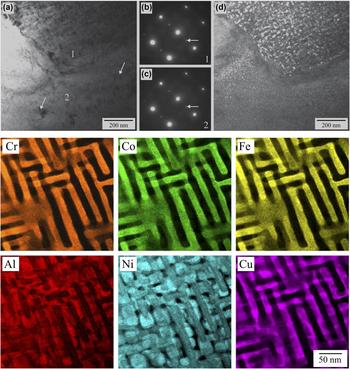
Based on scanning transmission electron microscopy (STEM) and energy dispersive X-ray (EDX) mapping (Fig. 2), Pickering et al. clearly revealed a nanoscale spinodal microstructure in the dendritic region of the Al0.5CrFeCoNiCu HEA.Reference Pickering, Stone and Jones53 Typical EDX mapping of the dendritic region indicated that these two spinodal phases were rich in Cr, Co, Fe, and Ni and rich in Cu and Al, respectively. Cuboidal particles were also observed in the Cu-rich phase, which were consistent in scale and morphology with the L12 precipitates seen in Fig. 2(d). These particles were enriched with Ni and Al in comparison with the matrix and exhibited some solubility for Cu. The formation of the L12 precipitate in the as-cast Al0.5CrFeCoNiCu HEA was ascribed to its rapid precipitation kinetics. On the other hand, the first-principles calculation based on the density functional theory (DFT) is able to calculate the ground state electronic structure and total energy of the HEA system. Yu et al. applied the simplified physical models to investigate the atomistic mechanism of the precipitation behavior in AlxCrFeCoNiCu HEAs.Reference Yu, Xu, Chen and Liu54 The simulation results agree well with the state-of-the-art STEM observations, proving that the coherent nanoscale phase separation in these FCC-type HEAs is energetically favorable.
(a–d) TEM images and electron diffraction patterns from the as-cast Al0.5CrFeCoNiCu HEA (in mole ratio). STEM-EDX maps of the Cu-rich dendritic region are shown at the bottom of the figure, revealing the nanoscale spinodal decomposed structures with L12 nanoparticles.Reference Pickering, Stone and Jones53

Atom probe tomography (APT) is an alternative high-resolution characterization method for compositional analysis, which provides visible three-dimensional (3D) elemental mapping with nearly atomic resolution and gives information on the topology of interfaces and local chemical gradients.Reference Seidman55,Reference Miller56 One distinctive advantage of APT over other micro-analytical techniques is that it enables a more quantitative detection with a super-high sensitivity, in particular, when the nanostructures of interest are smaller than the TEM foil thickness that are not readily quantified by the conventional TEM/EDX analysis. Based on the 3D-APT characterization, Yang et al. revealed the spatial distribution of the FCC-matrix and L12-nanoparticles in the aged (780 °C for 4 h) Fe–Co–Ni–Cr–Al–Ti HEA system and also quantitatively determined their respective chemical compositions (Fig. 3).Reference Yang, Zhao and Liu57 Spherical L12-nanoparticles with an average size of about 30 nm were homogeneously embedded in the FCC-matrix [Fig. 3(a)], consistent with the TEM observations (not shown here). Obviously, both the FCC matrix and the L12 nanoparticles are compositionally complex. By a mean of proximity histogram calculated from the isoconcentration surfaces, the nanoscale elemental partitioning behavior was identified accordingly. As shown in Fig. 3(b), Ni, Al, and Ti have a very strong tendency to partition into the L12 nanoparticles, whilst Co atom is partially depleted and Fe and Cr atoms are largely depleted from the L12 nanoparticles. Subsequently, combined with the first-principles calculations, the internal sublattice occupancy inside the complex L12-nanoparticles was also accurately determined, directly demonstrating that two atoms of Cr occupying the (Al, Ti) sublattice site are energetically favored compared with the Fe atoms, as shown in Fig. 3(c). Moreover, Han et al. successfully studied the compositional evolution of the metastable L12-nanoparticles in (CoFeCrNi)Ti0.2 HEA as a function of aging time at 800 °C.Reference Han, Wei, Tong, Chen, Zhao, Wang, He, Yang, Zhao and Shimizu58 It was found that Co atom rapidly reaches a stable concentration in the early stage of the precipitation, whereas Fe and Cr atoms are incorporated into the L12 nanoparticles during the coarsening process. The APT results were well supported by the first-principles calculations from a perspective of electronic state. In summary, this detailed microstructural information of the nanoparticles will play an important role in precise alloying control of these complex HEAs.
APT results and DFT calculations of the L12-strengthened Fe–Co–Ni–Al–Ti-based HEA.Reference Yang, Zhao and Liu57 (a) Atom maps showing the nanoscale element distribution. (b) Proximity histogram constructed across the interface between the matrix and precipitates. (c) First-principles calculations of the L12 nanoparticles with different sublattice occupancies.

IV. PROPERTIES OF THE L12-STRENGTHENED HEAS
It is well-documented that precipitation strengthening is an effective approach to improve the mechanical strength of alloys due to the strong hindrance to dislocation motion by precipitates. In terms of precipitation hardening in HEAs, significant enhancement of tensile strengths up to gigapascal level has been successfully obtained in a variety of alloy systems through the aging process. The strengthening precipitates can be mainly categorized into two types of intermetallic compounds: (i) incoherent phases like B2-NiAl phase, η phase, and σ and μ phases and (ii) coherent L12 phase. Among these reinforcing phases, the coherent L12 precipitates, which are generally known to be used in strengthening Ni-based superalloys, appear to provide unique solutions to the limitations that hold in incoherent-precipitate-bearing HEAs: temperature capability and balance of properties. In this section, the mechanical properties of various L12-strengthened HEAs with the FCC structure are carefully reviewed, including the tensile properties in different temperature ranges, high-temperature creep, and oxidation resistance.
A. Tensile properties at ambient temperature
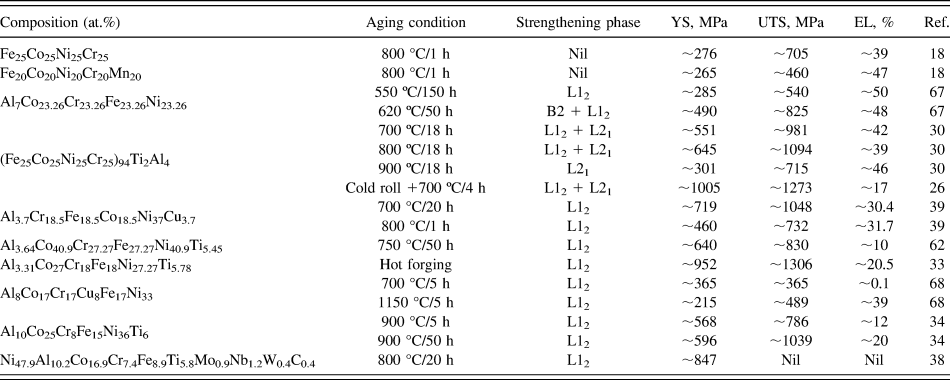
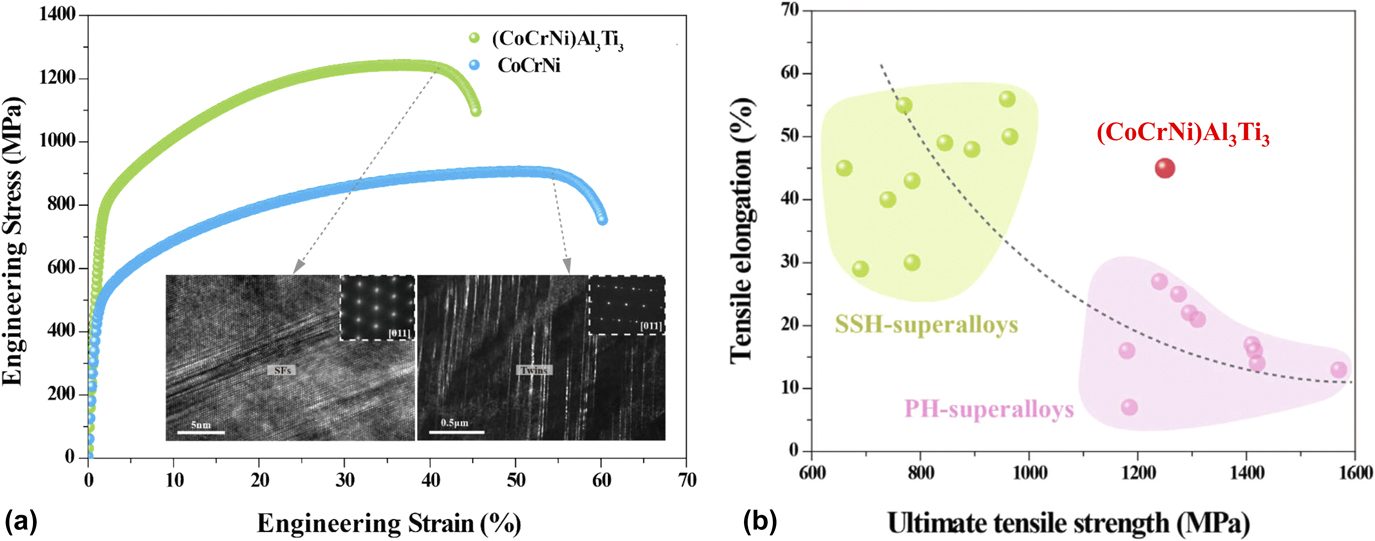
The tensile properties of various L12-strengthened HEAs at room temperature are summarized in Table I. The tensile performances of the single-phase HEAs were also included for direct comparison. It was clearly demonstrated that a strong precipitation strengthening can be fulfilled in the L12-strengthened HEAs, leading to a significant improvement of strength in comparison with the single-FCC base alloys. For instance, He et al.Reference He, Wang, Huang, Xu, Chen, Wu, Liu, Nieh, An and Lu26 reported a series of L12-strengthened FeCoCrNi-based HEAs with different additions of Ti and Al. Through tailoring the compositions and thermomechanical processing, the optimized (FeCoCrNi)96Ti2Al4 HEA shows extraordinary integrated tensile properties at room temperature: a high tensile strength of 1273 MPa and a respectable ductility of ∼17%. Zhao et al. developed a novel L12-strengthened HEA based on the CoCrNi alloy.Reference Zhao, Yang, Tong, Wang, Luan, Jiao, Chen, Yang, Hu, Liu and Kai28 Compared with He’s work, a more striking tensile ductility up to ∼45% at a similar strength level was realized [Fig. 4(a)]. Figure 4(b) compared the ultimate tensile strength and elongation of the L12-strengthened (CoCrNi)Al3Ti3 alloy with the reported commercial Ni-based superalloys, including both solid-solution-hardened (SSH) and PH variants.Reference Zhao, Yang, Tong, Wang, Luan, Jiao, Chen, Yang, Hu, Liu and Kai28 A serious strength-ductility trade-off can be apparently observed for most superalloys. By contrast, the L12-strengthened (CoCrNi)Al3Ti3 alloy does exhibit a superior combination of strength and ductility, making it a promising alternative for high-temperature applications. Compared to the SSH superalloys, the higher tensile strength of the (CoCrNi)Al3Ti3 alloy is ascribed to the precipitation hardening effect of L12 nanoparticles by pinning dislocation motions. The excellent fracture resistance and large ductility at such a high strength level can be attributed to the high strain-hardening capability of the CoCrNi base alloy, which is helpful to delay the onset of plastic instability during deformation at room temperature.
Tensile properties of representative single-fcc and L12-strengthened HEAs at room temperature.

(a) Mechanical properties of the L12-strengthened (CoCrNi)94Al3Ti3 alloy (at.%) compared to that of single-phase CoCrNi base alloy.Reference Zhao, Yang, Tong, Wang, Luan, Jiao, Chen, Yang, Hu, Liu and Kai28 (b) Ultimate tensile strength at room temperature versus tensile elongation of the present alloy in comparison with commercial superalloys.

B. Tensile properties at cryogenic temperature
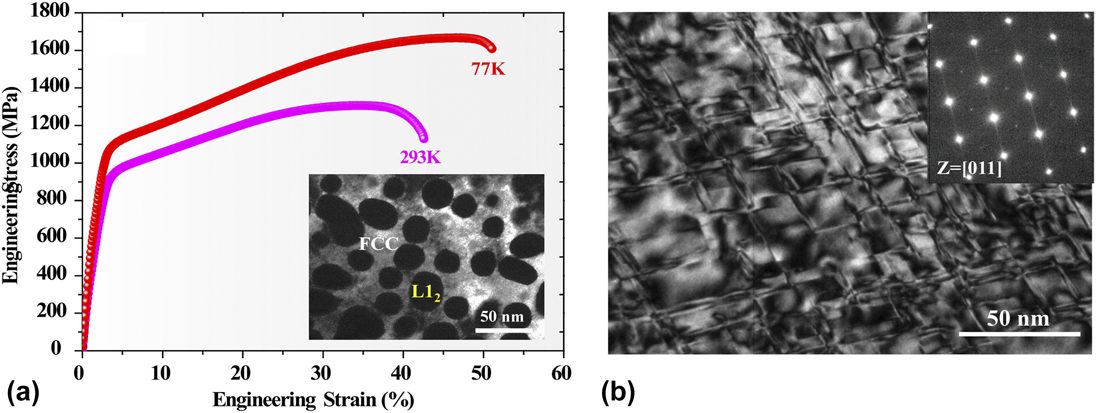
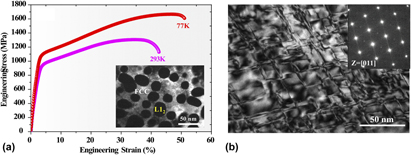
Single-phase-FCC HEAs have attracted interest as cryogenic structural materials because of their superior mechanical properties including high strength, large ductility, and excellent fracture toughness. The classical CrMnFeCoNi HEA, often named as Cantor alloy,Reference Cantor4 which has a single-phase FCC solid solution, was found to have exceptional damage tolerance with ultimate tensile strengths above 1 GPa and fracture toughness values exceeding 200 MPa m1/2, and the properties of which were comparable to or even better than the very best cryogenic steels like austenitic stainless steels and high-Ni steels.Reference Gludovatz, Hohenwarter, Catoor, Chang, George and Ritchie14 The onset of mechanical nanotwinning was demonstrated as the major reason accounting for the enhanced mechanical properties with decreasing temperature. Nevertheless, the relatively low yield strengths of the single-FCC HEAs make them insufficiently strong for many critical applications. Surprisingly, the L12-strengthened HEAs can exhibit higher yield strengths of about 1 GPa at both ambient and cryogenic temperatures, as shown in Fig. 5(a). More interestingly, in a similar manner to the single-FCC HEAs, a simultaneous improvement in both strength and ductility can be observed when deformed at 77 K, exhibiting a high yield strength of 1.1 GPa, a ultra-high ultimate tensile strength of 1.7 GPa, and a large ductility of 50%. Such an unexpected property is ascribed to the dynamic formation of high-density nanospacing stacking faults [Fig. 5(b)]. The high yield strength, good strain-hardening ability, and excellent tensile ductility of this L12-strengthened HEA make it highly attractive for wide applications at cryogenic fields.
(a) Tensile properties of the L12-strengthened Fe–Co–Ni–Al–Ti-based HEA at ambient and cryogenic temperature.Reference Yang, Zhao and Liu57 The inset shows the typical microstructure before deformation. (b) TEM images showing the deformation microstructures of high-density nanospacing SFs at cryogenic temperature.

C. Tensile properties at high temperature
In view of the similar microstructures to Ni-based superalloy strengthening by the coherent L12-type precipitate, these newly developed L12-strengthened HEAs provide a great expectation for high-temperature structural applications.Reference Daoud, Manzoni, Wanderka and Glatzel34,Reference Tsao, Yeh, Kuo, Kakehi, Murakami, Yeh and Jian38 On the one hand, the long-range ordered L12-phase generally exhibited sluggish diffusion kinetics and anomalous yield behaviors (the flow stress increases with the increasing temperature and reaches a maximum at a certain temperature) will enable these L12-strengthened alloys possessing superior antisoftened properties at elevated temperatures.Reference Suzuki, Inui and Pollock50,Reference Reed and Rae59,Reference Reed60 On the other hand, the sluggish diffusion effect of the multicomponent HEAs together with the low stacking-fault energy may also contribute to the thermal stability and creep resistance of these L12-strengthened HEAs.
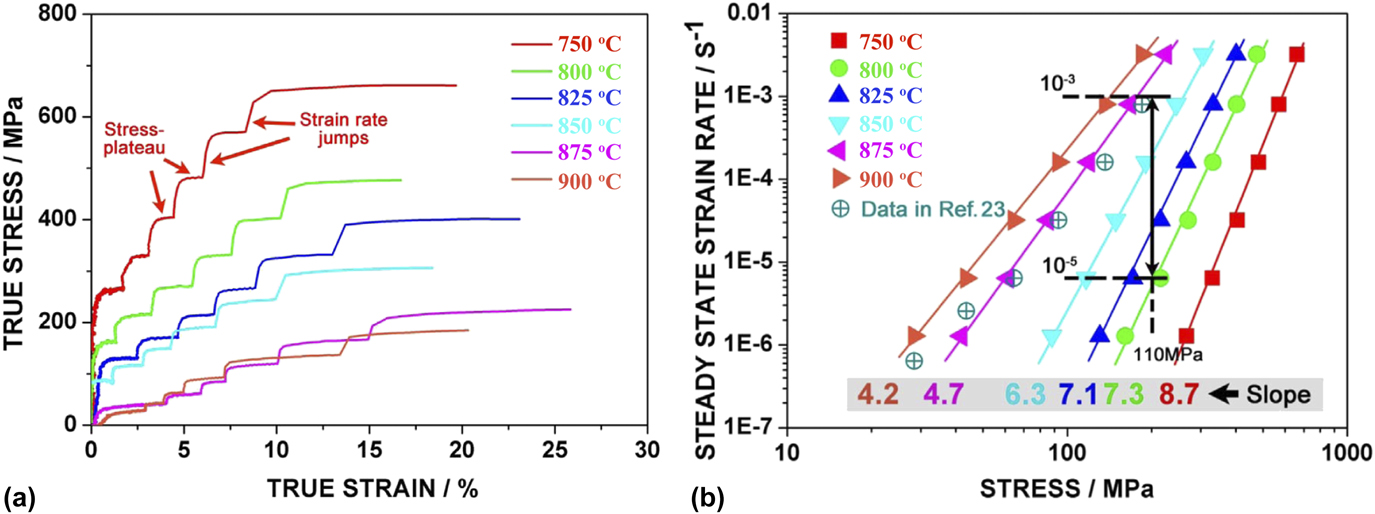
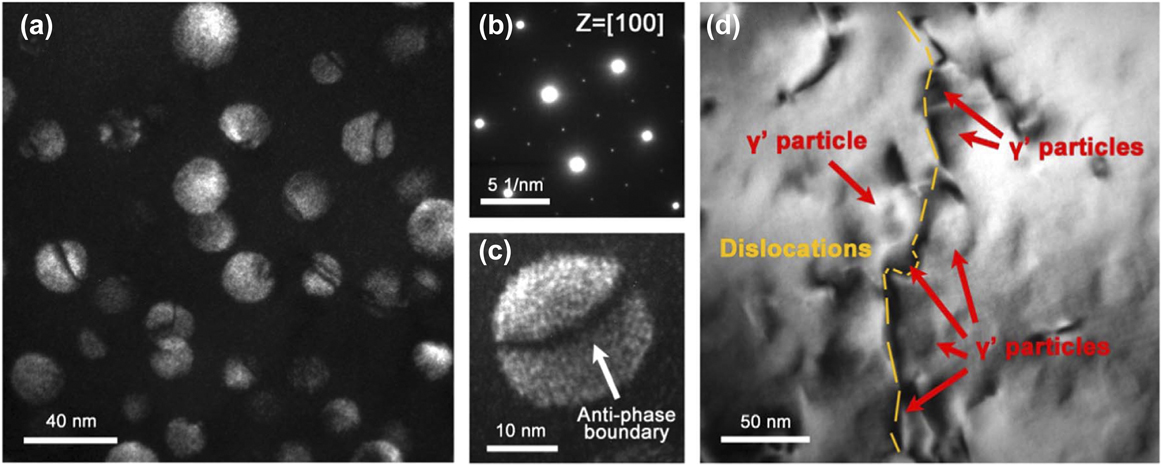
First of all, the steady-state flow behaviors of the L12-strengthened (FeCoCrNi)96Ti2Al4 HEA at temperatures from 1023 to 1173 K were characterized via strain-rate jump testsReference He, Wang, Wu, Liu, Nieh and Lu61 [Fig. 6(a)]. A large reduction of the steady-state strain rate (by ∼2 orders of magnitude) was found in the L12-strengthened (FeCoCrNi)96Ti2Al4 HEA, as compared to its single-phase counterpart, indicating a significant improvement in high-temperature properties [Fig. 6(b)]. The underlying strengthening mechanism at elevated temperatures (below L12-solvus temperature) was similar to that in the Ni-based superalloys, where the L12 precipitates are often sheared by pairs of antiphase boundaries (APBs)—coupled a/2〈110〉 dislocationsReference He, Wang, Wu, Liu, Nieh and Lu61 (Fig. 7). Above which, with the dissolution of L12 precipitates, the deformation was controlled by an ordinary dislocation climb mechanism. Nevertheless, it is noteworthy to mention that the L12-solvus temperature of this kind of (FeCoCrNi)96Ti2Al4 HEA still remained relatively low (∼1173 K) in comparison to those of superalloys,Reference He, Wang, Wu, Liu, Mao, Nieh and Lu30 making that it can only be applied in a medium-temperature range.
(a) Staircase-like true stress–strain curves of the (NiCoFeCr)94Ti2Al4 HEA (at.%) at six different temperatures from 750 to 900 °C using a strain-rate-jump method.Reference He, Wang, Wu, Liu, Nieh and Lu61 (b) Steady-state flow stress as a function of strain rate at different temperatures. The tensile data of FeCoNiCrMn at 800 °C are also included for a direct comparison.

TEM observations of the (NiCoFeCr)94Ti2Al4 HEA (at.%) deformed at 750 °C, showing apparent dislocation shearing through numerous γ′ particles in the matrix. (a) dark field image showing high-density sphere γ′ particles, (b) corresponding SAED pattern showing L12 superlattice, (c) magnified image showing single particle with clear anti-phase boundary and (d) bright field image showing apparent dislocation shearing through numerous γ′ particles in the matrix.Reference He, Wang, Wu, Liu, Nieh and Lu61

More recently, Taso and coworkers developed a new kind of L12-strengthened HEA with a complex composition of Ni47.9Al10.2Co16.9Cr7.4Fe8.9Ti5.8Mo0.9Nb1.2W0.4C0.4 (at.%) with the FCC + L12 two-phase microstructure, and the L12-solvus and solidus temperatures are 1199 °C and 1276 °C, respectively.Reference Tsao, Yeh, Kuo, Kakehi, Murakami, Yeh and Jian38 The L12 precipitates appeared to be spherical with an average size of 290 nm and 69 vol% measured by an image analysis. High tensile yield strengths over 800 MPa were achieved in the temperature range of 20–800 °C. The analysis of the experimental results indicated that this type of HEA was strengthened by the low stacking-fault energy of the matrix, high volume fraction and APB energy of the L12 precipitate, and thermally stable microstructure. With the temperature increasing to ∼1000 °C, the tensile strength was gradually decreased to about 500 MPa, which was comparable to that of Ni-based CMSX-2 superalloys.
On the other hand, for the L12-strengthened HEAs with polycrystalline structures, it is noteworthy to mention that the grain-boundary feature will also greatly influence their bulk mechanical properties.Reference Chang and Yeh33,Reference Kuo and Tsai62 For example, the tensile ductility of the L12-strengthened Al3.31 Co27Cr18Fe18Ni27.27Ti5.78 (at.%) HEA was affected by the existence of cellular precipitated structures and exhibits U-shaped temperature dependence.Reference Chang and Yeh33 The ductility drop occurred with increasing temperature, and the ductility reached a minimum at 750 °C due to the highest fraction of cellular precipitates. The cellular precipitation can be suppressed through the modification of alloy compositions to increase its L12-solvus temperature, or a slower cooling rate to decrease the degree of chemical supersaturation for reducing the driving force for the movement of grain boundaries.
D. Creep resistance
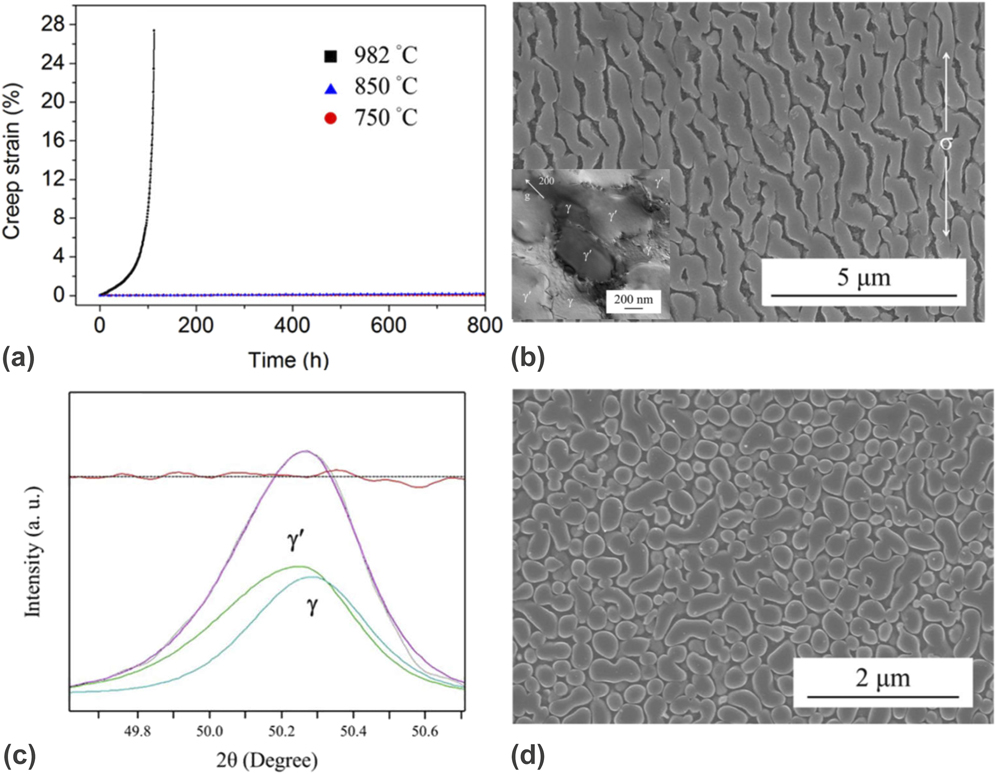
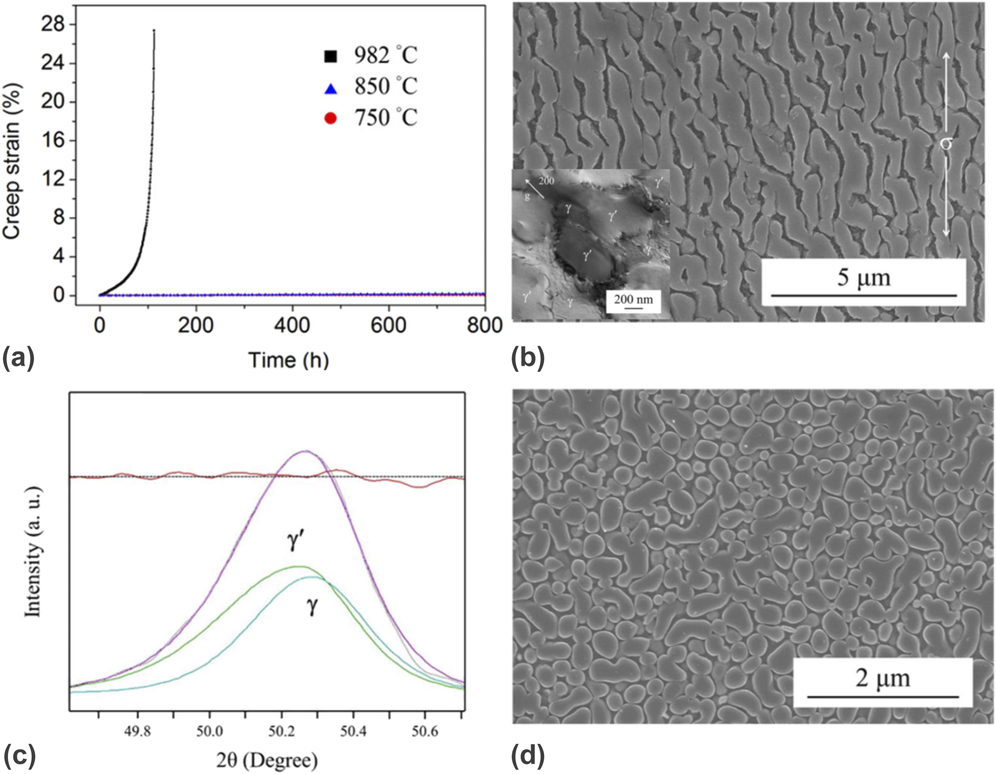
The creep resistance is one of the most important mechanical properties for elevated-temperature structural applications, such as components for steam turbines in thermal power plants. Regarding the creep behavior of γ′-strengthened HEAs, previous studies indicated that an outstanding creep resistance can be achieved due to their relatively low stacking-fault energy, high creep activation energy, and also the good thermal stability of γ′-precipitates.Reference Tsao, Yeh, Kuo, Kakehi, Murakami, Yeh and Jian38 For example, the rapture life of a γ′-strengthened HEA at 982 °C was found to be 114 h [Fig. 8(a)], which is comparable to those of several advanced Ni-based superalloys under similar test conditions, that is, the creep life of NX-188 DS tested under 982 °C/138 MPa is 58 h and that of Rene’ 80 tested under 982 °C/145 MPa is 118 h. The rafting of the γ′ phase under the creep test at this temperature can be observed, which evolves with their longitudinal axis parallel to the applied tension direction [Fig. 8(b)] due to the positive misfit between the FCC matrix and γ′-precipitate [Fig. 8(c)]. At intermediate temperatures, no obvious γ′-rafting was observed [Fig. 8(d)], and this excellent stability of L12 precipitates under thermal deformation enables it a superior creep performance compared to that of CMSX-2 Ni-based superalloys. Mughrabi systematically investigated the temperature dependence of the lattice misfit and the associated elastic constraint or loading of the L12 precipitates in conventional superalloys, indicating that the positive misfit should be more beneficial to properties than negative misfit.Reference Mughrabi63 Note that the lattice misfit is generally negative in Ni-based superalloys but positive in γ′-strengthened HEAs.Reference Suzuki, Inui and Pollock50,Reference Reed and Rae59 Such a distinctive interface property of the γ′-strengthened HEAs may also play an important role in promoting their high-temperature properties and deserves comprehensive studies in future.
High-temperature properties of Ni47.9Al10.2Co16.9Cr7.4Fe8.9Ti5.8Mo0.9Nb1.2W0.4C0.4 (at.%) high-entropy superalloy (HESA).Reference Tsao, Yeh, Kuo, Kakehi, Murakami, Yeh and Jian38 (a) Creep performance at 982, 850, and 750 ºC/159 MPa. (b) γ′ rafting parallel to the stress axis under 982 ºC/159 MPa creep. The dislocation morphology of the as-crept HESA also shown as inset. (c) Deconvolution of the {200} reflection peak of the L12-strengthened HESA at 982 °C. (d) Unrafted γ′ microstructure after 800 h creep tests at 750 °C.
In balance, the studies on the high-temperature mechanical properties and deformation mechanisms of the L12-strengthened HEAs are still inadequate until now. From the viewpoint of their good potential for high-temperature applications, extensive efforts on these aspects are certainly warranted.
E. Oxidation resistance
Alloying additions, especially the Cr and Al elements, will significantly enhance the oxidation resistance of metallic materials. To date, there have been limited studies on oxidation behaviors of the L12-strengthened HEAs.Reference Tsao, Chang, Chang, Yeh, Chiou, Jian, Kuo, Wang and Murakami64–Reference Daoud, Manzoni, Völkl, Wanderka and Glatzel66 Tsao et al. conducted isothermal oxidation of L12-strengthened Ni44Co22.3Fe11.8Cr11.7Al3.9Ti6.3 HEA (wt%) at 1100 °C for 5–200 h and no obvious oxide spallation was observed.Reference Tsao, Chang, Chang, Yeh, Chiou, Jian, Kuo, Wang and Murakami64,Reference Tsao, Yeh, Kuo and Murakami65 High content of various solutes in L12-strengthened HEAs lead to the formation of complex oxides. The typical oxidation structures can be roughly divided into three regions, consisting of an outer layer of (Ni, Co)O, a complex mixtures of CoFe2O4 and Fe3Ti3O10, TiO2 in the inner layer, and a layer beneath with Cr2O3 and Al2O3. More interestingly, after exposure for 200 h, the alloys with additional Ta, Mo, or W elements showed a smaller weight gains than that observed without additions of those heavy elements. Besides, continuous Al2O3 was formed to resist the internal oxidation. It is well-known that at elevated temperature, Al2O3 is more effective for surface protection, which is attributed to its lower oxygen permeability and more thermal stability than Cr2O3. For Cr2O3, it would become unstable beyond 950 °C and may gradually transform into the volatile CrO3. The formation of the continuous Al2O3 layer indicates that the L12-strengthened HEAs containing Al and Cr additions are expected to have a good oxidation resistance at elevated temperatures.
V. PHASE EVOLUTION AND STABILITY OF THE L12-STRENGTHENED HEAS
It is known that the degree of the precipitation strengthening effect strongly lies on the phase evolution and stability of precipitates. For the L12-strengthened alloys, particularly for those designed for long-term structural applications at elevated temperatures, thermal stability of the L12 nanoparticles is one of the most concerned issues. Therefore, it is necessary to understand the thermal stability and coarsening behavior of the L12 nanoparticles in HEA systems.
A. Alloying effects on the phase formation of the L12-strengthened HEAs
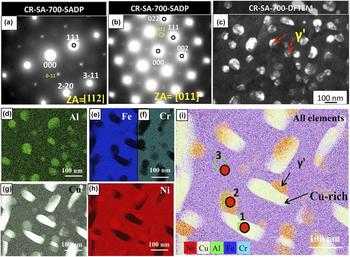
Al, Ti, and Nb elements, known as the strong L12 formers, are naturally favored choice for L12 formation but they should be elaborately tailored for the targeted FCC + L12 structure. It generally appears that the Al element alone is insufficient to stabilize L12 precipitates in HEA systems. For example, Gwalani et al. reported that L12-type precipitates can be found in both Al0.3CoCrFeNi and Al0.3CrCuFeNi2 alloys.Reference Gwalani, Choudhuri, Soni, Ren, Styles, Hwang, Nam, Ryu, Hong and Banerjee35,Reference Gwalani, Soni, Lee, Mantri, Ren and Banerjee67 In the Al0.3CoCrFeNi HEA, the L12-precipitates can only be stabilized at a low temperature of ∼550 °C and then will be destabilized into the B2-NiAl phase after annealing at ∼700 °C.Reference Gwalani, Soni, Lee, Mantri, Ren and Banerjee67 By contrast, the thermal stability of L12 precipitates in the Al0.3CrCuFeNi2 HEA is slightly higher, presumably due to the contribution of the Cu element on the stabilization and nucleation of the L12 phaseReference Gwalani, Choudhuri, Soni, Ren, Styles, Hwang, Nam, Ryu, Hong and Banerjee35,Reference Daoud, Manzoni, Völkl, Wanderka and Glatzel68 (Fig. 9). Furthermore, intensive studies have manifested that the increased addition of Al element has a strong tendency for promoting the formation of the BCC-type phase.Reference Yang, Xia, Liu, Wang, Liu, Zhang, Xue, Yan and Wang69,Reference Borkar, Gwalani, Choudhuri, Mikler, Yannetta, Chen, Ramanujan, Styles, Gibson and Banerjee70 For example, in the AlxCrCuFeNi2 system, with an increasing Al concentration from 0 to 1.5, the predominant microstructures would evolve from the initial FCC solid-solution, to duplex FCC + L12, to mixed FCC + L12/BCC + B2, and eventually to BCC + B2 structures.Reference Borkar, Gwalani, Choudhuri, Mikler, Yannetta, Chen, Ramanujan, Styles, Gibson and Banerjee70
Phase identification (a–c) and elemental distribution (d–i) of the Al0.3CuFeCrNi2 HEA (in mole ratio) aged at 700 °C.Reference Gwalani, Choudhuri, Soni, Ren, Styles, Hwang, Nam, Ryu, Hong and Banerjee35

Appropriate additions of Ti element will greatly promote the precipitation and stabilization of the L12 phase. Zhao et al. and He et al. revealed that, with a combined addition of Al and Ti, finely coherent L12 precipitates are formed in the HEA matrix, and a good combination of the strength and ductility at room-temperature tensile testing can be achieved.Reference He, Wang, Huang, Xu, Chen, Wu, Liu, Nieh, An and Lu26,Reference Zhao, Yang, Tong, Wang, Luan, Jiao, Chen, Yang, Hu, Liu and Kai28 However, on the other hand, too much addition of Ti may promote the formation of the L21-type Heusler phase or η phase. According to He et al., these L12 coherent precipitates merely dominated in the temperature range of 650–850 °C but became overwhelmed by the L21 Heusler phase at temperatures above 850 °C.Reference He, Wang, Wu, Liu, Mao, Nieh and Lu30 The brittle Heusler phase is likely to weaken the strength of the grain boundary and degrade the mechanical properties, particularly for those at high temperatures. Besides, the L12 phase was formed in HEA systems with a concurrent addition of Al and Nb.Reference Antonov, Detrois and Tin32 Yet, except for the forming L12 phase, Nb also has a strong tendency to bond with Co and Fe. Excessive addition of Nb will promote the formation of the brittle Laves phase and/or B2 phase. As discussed above, it is important to point out that an optimum combination of Ti, Al, and Nb is necessary for stabilizing the L12 phase especially at elevated temperatures.
In addition, the compositions of the base alloy also have an important impact on the phase structure and properties of the L12-strengthened HEAs. First of all, alloying additions of near-equimolar multiple-principle elements in HEA systems will lead to a relatively low melting point and low L12-solvus temperatures, leading to a reduced volume fraction of L12 precipitates at high temperatures. Moreover, in the Al–Co–Cr–Fe–Nb–Ni HEA system, Co was reported to destabilize the L12 phase, and the lowering of the Co content increases the number density of the L12 precipitates.Reference Antonov, Detrois and Tin32 Similarly, excessive Fe was proposed to be detrimental to the nucleation of the L12 phase, likely because it would deplete the Nb content in the matrix by forming a Nb-rich Laves phase. The tendency of Fe to form the BCC structure could also play a partial role on the destabilization of the L12 phase. By contrast, our preliminarily study on the Al–Co–Cr–Fe–Ti–Ni HEA system shows that Co atoms can strongly stabilize the L12 phase.Reference Yang, Zhao and Liu57 This discrepancy indicates that the specific role of individual alloying element on the phase stability of L12 precipitates is still unclear in these HEA systems, and further in-depth studies are essential for the future development of high-performance HEAs.
B. Thermal stability of the L12-nanoparticles
The unique microstructure of the L12-strengthened HEAs makes them to be new promising structural materials for high-temperature applications. At the present stage, the most pressing challenge is to maintain the microstructural stability of the L12 nanoparticles at elevated temperatures. Tsao et al. proposed a promising alloying design space in the FeCoNi-based system for studying the thermal phase stability of a series of L12-strengthened HEAs.Reference Tsao, Yeh and Murakami71 By controlling the elemental partitioning between γ/γ′, a stable γ–γ′ structure with no topologically close-packed phases can be successfully maintained even after 300 h exposure at 1173 K (900 °C). As shown in Fig. 10, Zhao et al.Reference Zhao, Chen, Lu and Nieh41 further investigated the coarsening behaviors of L12 nanoparticles in the (NiCoFeCr)94Ti2Al4 HEA, indicating that the precipitate coarsening rate of the L12 phase was one to two orders of magnitude less than that of other Ni-based superalloys containing refractory elements (such as Mo, Ta, W, and Re) deliberately added to retard the precipitate coarsening. All these results clearly demonstrated the feasibility to have a good thermal stability of the L12 precipitates in this HEA system. The lower coarsening rate is probably caused by either a lower precipitate/matrix interfacial energy or a smaller diffusion coefficient, or both. Subsequently, by further comparing the activation energy for precipitate coarsening by individual elements, it was suggested that the precipitate coarsening behavior should be controlled by the diffusion of either Al or Ti in the HEA matrix.
Coarsening rates for the (NiCoFeCr)94Ti2Al4 HEA (at.%) with respect to aging temperature compared to a number of Ni-based alloys.Reference Zhao, Chen, Lu and Nieh41

VI. FUTURE WORK AND PROSPECTS
Although a decent progress and some attractive achievements have been obtained during the past years, the development of the L12-strengthened nanostructured HEA is still at an early stage, and more fundamental and systematic studies are still urgently required. To further accelerate the advancement of these L12-strengthened HEAs and promote their large-scale engineering applications, future efforts should be focused on the in-depth understanding of the composition–processing–microstructure–property relationship of this new class of nanostructured HEAs. In particular, it mainly contains the following three aspects: (i) the control of the grain-boundary precipitation behaviors; (ii) the intrinsic properties of the L12 nanoparticle and its correlation with the macro/micromechanical behaviors of the bulk L12-strengthened HEAs; and (iii) the tensile and creep properties at elevated temperatures.
First of all, it is of essential importance to further optimize the comprehensive properties of the L12-strengthened HEAs by tailoring their grain-boundary precipitation behavior. It is known that the mechanical performances of polycrystalline structural alloys are highly sensitive to their structural features of grain boundaries. Although the CALPHAD technique is well-utilized for the prediction of the equilibrium phase for a given alloy, it shows relatively limited capacity to determine the heterogeneous precipitation at grain boundaries caused by the chemical instability and nonequilibrium segregation. As reported in previous studies, the formation of brittle intermetallics at grain boundaries causes a local stress/strain concentration and promotes the crack initiation during deformation, all of which in turn catastrophically damages the tensile ductility and fracture toughness.Reference Jiang, Wang, Wu, Liu, Chen, Yao, Gault, Ponge, Raabe, Hirata, Chen, Wang and Lu72 For example, in the L12-strengthened Fe–Ni–Cr–Mn–Al–Ti HEAs with a high Ti/Al ratio, the local chemical heterogeneity of the Ti element along grain boundaries significantly accelerated the nucleation of a needle-shaped η phase, leading to the decohesion of the η/matix interfaces and causing a local cleavage fracture.Reference Zhao, Yang, Zhu, Chen, Yang, Hu, Liu and Kai73 Moreover, pronounced discontinuous precipitation and coarsening behaviors of L12 nanoparticles have been widely observed in many L12-strengthened HEA systems.Reference He, Wang, Huang, Xu, Chen, Wu, Liu, Nieh, An and Lu26,Reference Zhao, Yang, Tong, Wang, Luan, Jiao, Chen, Yang, Hu, Liu and Kai28,Reference Chang and Yeh52,Reference Zhao, Yang, Zhu, Chen, Yang, Hu, Liu and Kai73 With the increased formation of cellular L12 precipitates along grain boundaries, the tensile ductility of these L12-strengthened HEAs dropped dramatically at elevated temperatures (such as 750 °C), although the room-temperature ductility was not influenced.Reference Chang and Yeh33 Obviously, it is of both fundamental and technological importance to uncover the structural origins governing this discontinuous precipitation behavior. Elements such as B, Zr, and Hf have been reported in conventional alloys for grain-boundary toughening,Reference Luan, Jiao, Chen and Liu49,Reference Reed60,Reference Stoloff74 but the quantitative investigations of these elements in HEA systems are still lacking. Systematic and in-depth studies on grain-boundary engineering are still necessary to further optimize the L12-strengthened HEAs for structural applications.
Furthermore, a more attention is needed to be directed toward a quantitative evaluation of the intrinsic properties of L12 nanoparticles and their impacts on the macro/micromechanical behaviors of bulk L12-strengthened HEAs. It is known that the deformation behaviors of PH alloys are closely related to the nature of the precipitate and matrix, both of which are compositionally complex in the HEA systems. Previous studies indicated that the excellent strain-hardening capacity of the disordered-FCC HEA-matrix can effectively inhibit the propagation of microcracks and thus be helpful to delay the onset of plastic instability for a ductility enhancement.Reference Liu, Lu, He, Luan, Wang, Liu, Liu, Chen and Liu20 On the other hand, the intrinsic properties of the complex L12-precipitates will also play a critical role in governing their interactions with dislocations and associated deformation behaviors.Reference Raynor and Silcock75,Reference Gladman76 Although the superior performance has been successfully achieved in some promising L12-strengthened HEAs, it is still difficult to clearly distinguish the respective contributions from the matrix and precipitate. The microscopic stress/strain distribution and dynamic transfer among the L12 nanoparticles and the FCC matrix are still unclear. Moreover, alloying effects on the surface energy, morphology, elastic parameter, stacking-fault energy, APB energy, and environmental embrittlement of the L12 alloys have remained obscure. Therefore, in the future study, it is crucial for us to get a more integrated metallurgical understanding of the complex L12-alloys for achieving targeted properties more precisely.
Finally, more systematic studies should be focused on tensile properties, creep resistance, and associated deformation mechanisms of these new-type L12-strengthened HEAs at elevated temperatures, which will promote their broader applications especially in advanced jet engine design and turbine disk applications. To increase the turbine output and efficiency, the enhanced high-temperature strength and creep life of these L12-strengthened HEAs are inevitably required. However, the relatively low melting points induced by alloying additions of near-equimolar multiple-principle elements in HEA systems as well as the relatively low solvus temperature of the L12 phase may place significant obstacles to their applications at higher temperatures. Although some advances have been achieved, the results accumulated in this topic are still very limited. Therefore, in future, it is essentially important to further optimize the high-temperature performance of these L12-strengthened HEAs by precise control of various alloying elements as well as the processing conditions. The high-temperature tensile properties, creep resistance, and associated deformation mechanisms should be systematically evaluated.
VII. SUMMARY
Nanostructured HEAs strengthened by L12 nanoparticles as a new class of structural materials hold a tremendous potential to achieve a superior strength–ductility combination. This paper presents a comprehensive review on the metallurgical design, alloying behaviors, and mechanical properties of these L12-strengthened HEAs, with an emphasis on the composition–microstructure–property relationship. The computational technique based on Thermo-Calc calculations provides an effective guideline for compositional design and phase control. State-of-the-art analytical tools including 3D-APT and TEM combined with the first-principles calculations enable the quantitative characterization of these L12-strengthened HEAs at nanoscales. Alloying effects of Al, Ti, Nb, and Cu elements on phase formation and stability, mechanical properties, and their corresponding deformation mechanisms have been carefully assessed. A fundamental metallurgical understanding of these newly developed L12-strengthened HEAs has been successfully achieved. To further accelerate the development of these novel L12-strengthened HEAs and promote their large-scale industrial applications, future work should be focused on the study of the control of grain-boundary precipitates, long-term creep resistance at elevated temperatures, and the interrelations between the micromechanical behaviors of the L12 nanoparticles and their bulk mechanical properties.
ACKNOWLEDGMENT
This research was supported by the Hong Kong Government GRF funds with the grant number of CityU 11209314 and 11205515.