Duchenne muscular dystrophy, an X-linked disorder resulting from mutations in the Duchenne muscular dystrophy (DMD) gene, is the most common type of muscular dystrophy, occurring in one per 3500 live male births.Reference Aartsma-Rus, Van Deutekom, Fokkema, Van Ommen and Den Dunnen 1 , Reference Emery 2 The DMD gene encodes the 427-kDa dystrophin protein, which is part of a protein complex that acts as both a mechanical link and communication pathway between the cytoskeleton and the sarcolemmal membrane in skeletal, smooth, and cardiac muscle.Reference Aartsma-Rus, Van Deutekom, Fokkema, Van Ommen and Den Dunnen 1 The absence of dystrophin results in instability of the sarcolemmal membrane and fibrofatty infiltration, which ultimately leads to skeletal muscle pseudohypertrophy, weakness, and contractures.Reference Emery 2
Cardiomyopathy develops in over 90% of patients with DMD and is the primary cause of death in 20%.Reference Finsterer and Stöllberger 3 Cardiac involvement typically becomes apparent in the second decade of life; however, patients develop few, if any, heart failure symptoms owing to limited physical activity secondary to loss of ambulation occurring on average between 12 and 14 years of age.Reference McDonald, Henricson and Abresch 4 , Reference Heymsfield, McNish, Perkins and Felner 5 With improved respiratory care, including the implementation of night-time non-invasive ventilation, many patients with DMD are living beyond their teens and into their late 20s.Reference Bushby, Muntoni and Bourke 6 As dystrophinopathy patients are living longer, heart failure and associated arrhythmias are becoming an increasingly important cause of morbidity and mortality.Reference Connuck, Sleeper and Colan 7
Severity of motor symptoms in DMD patients can be affected by the location of the mutation in the DMD gene and by modifying effects of other genes such as Latent transforming growth factor-beta-binding protein 4 (LTBP4).Reference Kaspar, Allen and Ray 8 – Reference van den Bergen, Hiller and Böhringer 11 Although the effect of the DMD mutation and modifier loci on motor function are increasingly understood, effect on the timing of onset of left ventricular dysfunction is limited. There is evidence in Becker muscular dystrophy that deletions affecting the amino terminal of the DMD gene may be associated with earlier onset of cardiomyopathy, whereas others, such as the hinge 3 region, are associated with delayed onset.Reference Kaspar, Allen and Ray 8 Early identification of DMD patients at risk for developing early-onset left ventricular dysfunction may allow for more timely initiation of medications such as angiotensin-converting enzyme inhibitors for the prevention and treatment of myocardial dysfunction.Reference Duboc, Meune, Lerebours, Devaux, Vaksmann and Bécane 12 , Reference Duboc, Meune and Pierre 13 The aims of this study were to assess associations between DMD genotype and the age of onset of left ventricular dysfunction and to assess the potential influence of medical therapy on these associations. We hypothesise that DMD genotypes and/or modifiers such as LTBP4 may be associated with the age of onset of left ventricular dysfunction in a cohort of DMD patients.
Materials and methods
Study population
We retrospectively studied a cohort of 101 consecutive DMD patients seen in our paediatric cardiology and muscular dystrophy clinics between 2004 and 2013. Medical records were reviewed for clinical features, DMD genotype, steroid treatment, age at loss of ambulation, and age of death. Patients were included if they had a complete cardiac evaluation, including a normal baseline echocardiogram and follow-up echocardiograms at least every 2 years, and genetic confirmation of a DMD diagnosis. Patients were excluded if they had the diagnosis of Becker muscular dystrophy, incomplete or missing echocardiographic data, abnormal left ventricular systolic function at the time of initial evaluation, missing genotype data, or incomplete medical records. This study was approved by our institution’s Institutional Review Board.
Echocardiography
Echocardiograms were obtained on DMD patients at their initial cardiology clinic visit and at each follow-up visit. Our institutional practice is to assess left ventricular function echocardiographically in DMD patients every 2 years before the age of 10 years and annually after the age of 10 years. Echocardiographic images were obtained using standard two-dimensional and Doppler ultrasound techniques. Measurements of left ventricular systolic function included shortening fraction obtained from M-mode imaging of the left ventricular in the parasternal short-axis imaging plane ([left ventricular end-diastolic dimension–left ventricular end-systolic dimension]/left ventricular end-diastolic dimension), and ejection fraction obtained using the single-plane Simpsons’ method from the apical imaging plane. For the purposes of this study, left ventricular dysfunction was defined as either a left ventricular ejection fraction <55% or a left ventricular shortening fraction <28% or both. The age at onset of left ventricular dysfunction was defined as the youngest reported age at which cardiac left ventricular ejection fraction and/or shortening fraction met the definition of left ventricular dysfunction. For patients not meeting criteria for left ventricular dysfunction, the age at the last echocardiogram at which both the ejection fraction and shortening fraction were normal was used in the analysis.
Genotyping and sub-grouping
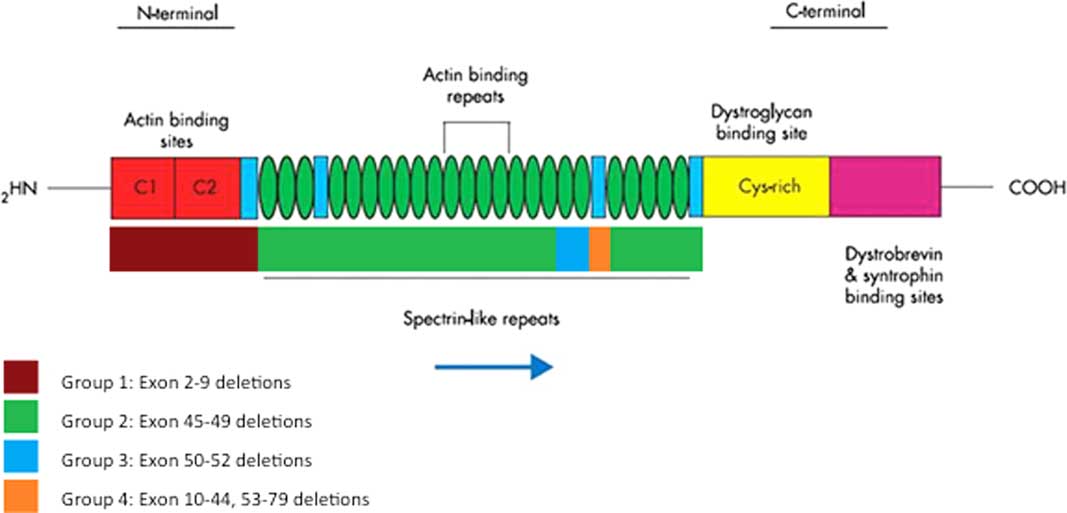
DMD mutations were identified in a step-wise manner, by multiplex ligation-dependent probe amplification for identification of deletions or duplications followed by single condition amplification/internal primer sequencing if no deletion or duplication was found using methods previously described.Reference Flanigan, von Niederhausern, Dunn, Alder, Mendell and Weiss 14 To determine whether age of onset of left ventricular dysfunction was associated with DMD genotype, we grouped patients on the basis of location of the mutation and functional domains involved with the mutation, similar to previous studies in Becker muscular dystrophy and DMD (Fig 1):Reference Kaspar, Allen and Ray 8 , Reference Jefferies, Eidem and Belmont 16 , Reference Ashwath, Jacobs, Crowe, Ashwath, Super and Bahler 17 .
Domains of the Dystrophin Protein. Illustration of the dystrophin protein that is disrupted in Duchenne muscular dystrophy. * Reproduced with permission from Sherratt et alReference Sherratt, Vulliamy, Dubowitz, Sewry and Strong 15 .

Group 1 included patients with mutations in the actin-binding amino-terminal domain (exons 2–9).
Group 2 included patients with mutations that preserve the hinge 3 domain (exons 45–49).
Group 3 included patients with mutations that disrupt the hinge 3 domain (exons 50–52).
Group 4 included patients with mutations affecting the rod domain (exons 10–44, 53–79).
Although most DMD patients have complete loss-of-function mutations owing to out-of-frame deletions and nonsense mutations, some DMD mutations have the potential for residual dystrophin production through mechanisms such as exon skipping.Reference Sherratt, Vulliamy, Dubowitz, Sewry and Strong 15 It has been proposed that residual dystrophin expression such as this may account for some of the differences in severity between patients. To account for this possibility, patients were also grouped on the basis of the presence of DMD mutations with no ability for residual dystrophin production (Group A) and DMD mutations with the possibility of dystrophin production if exon skipping were to occur (Group B).
Haplotype of the LTBP4 gene was determined using published methods.Reference Flanigan, Ceco and Lamar 9 Four single-nucleotide polymorphisms define the LTBP4 haplotype.Reference Flanigan, Ceco and Lamar 9 As these four single-nucleotide polymorphisms are in tight linkage equilibrium, the genotype for one can determine the complete haplotype. For this cohort, patients were genotyped for the rs10880 single-nucleotide polymorphism.Reference van den Bergen, Hiller and Böhringer 18 , Reference Vo and McNally 19 Genotypes were established using the Applied Biosystems TaqMan single-nucleotide polymorphism genotyping assay, “C___2936821_1_” (Life Technologies, Carlsbad, CA), on an ABI-7900HT instrument. For the rs10880 single-nucleotide polymorphism, a C allele determines the more severe VTTT haplotype and the T allele determines the less severe IAAM haplotype. For our study, patients were grouped on the basis of whether they were homozygous for the VTTT (CC genotype) or IAAM (TT genotype) haplotypes, or heterozygous (CT genotype).
Medical therapy
Medical therapy, including angiotensin-converting enzyme inhibitors and steroid therapy, is potentially an important factor affecting the onset of left ventricular dysfunction.Reference Duboc, Meune, Lerebours, Devaux, Vaksmann and Bécane 12 , Reference Duboc, Meune and Pierre 13 At the time of the study, our general institutional practice was to start angiotensin-converting enzyme inhibitor therapy if there was evidence of abnormal ventricular function; therefore, the use of angiotensin-converting enzyme inhibitors is not likely to be a confounder to the onset of left ventricular dysfunction in our cohort. To account for the possible confounding effect of corticosteroids, patients were categorised on the basis of the use of oral steroid therapy. Patients included in the steroid therapy group received either prednisone or Deflazacort for at least 1 year. Patients were categorised as not receiving steroid therapy if they received no oral steroids or were on therapy for less than a year.
Statistical analysis
Continuous variables were expressed as means with standard deviation or median and interquartile range as appropriate. Categorical variables were tabulated. Comparison of left ventricular dysfunction and no left ventricular dysfunction groups was performed using independent two-sample t-test or Wilcoxon’s rank sum test as appropriate. Non-parametric Kruskal–Wallis test was performed for cross-group age comparisons. Fisher’s exact test was used for two-group comparisons. A two-sided p value of <0.05 was considered statistically significant. Analysis was performed using SAS statistical software package (SAS 9.2; SAS Inc., Cary, North Carolina, United States of America).
Results
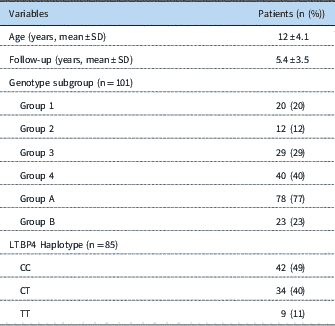
A total of 101 patients with DMD, serial echocardiograms, and known DMD mutations were included in this study (Table 1). Of these, 40 (40%) developed left ventricular dysfunction at a mean age of 14.0±3.1 years (range, 5–20 years). As expected, patients without left ventricular dysfunction were younger than those with left ventricular dysfunction (10.8±4.1 years versus 14.0±3.1 years, p<0.001). The mean length of outpatient paediatric cardiology follow-up for the entire cohort was 5.4±3.5 years. Patients with left ventricular dysfunction had an average follow-up of 6.1±3.5 years from the time of their initial cardiology evaluation to first abnormal echocardiogram, whereas those without left ventricular dysfunction at the last evaluation were followed up for a mean of 4.6±3.3 years (p=0.06). There were 11 deaths in the cohort (11%) at a mean age of 18.1±3.8 years. A majority (n=8, 73%) of patients had left ventricular dysfunction at the time of death, all of whom died of respiratory failure.
Demographic characteristics of the Duchenne muscular dystrophy cohort.

Effect of DMD mutation and LTBP4 genotype
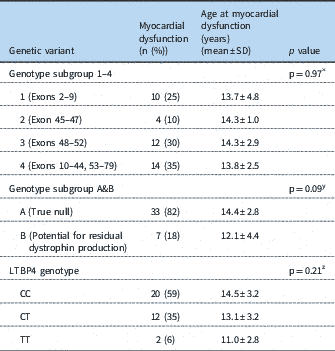
The mean age at onset of left ventricular dysfunction was not different among the four genotype subgroups (p=0.97), nor between groups A and B (p=0.09) (Table 2). The age of patients with normal left ventricular systolic function was also similar among genotype subgroups 1–4 (p=0.59) and groups A and B (p=0.74). Twelve of 29 patients (41%) with hinge 3 mutations developed left ventricular dysfunction compared with 28/72 patients (39%) without hinge 3 mutations – groups 1, 2, and 4. The age at onset of left ventricular dysfunction in patients with hinge 3 mutations was not different from patients without hinge 3 mutations – groups 1, 2, and 4 – who went on to develop left ventricular dysfunction (14.3±2.9 years versus 13.8±3.3 years, respectively, p=0.65).
Duchenne muscular dystrophy (DMD) subgroup and Latent transforming growth factor-beta-binding protein 4 (LTBP4) genotype and age at onset of myocardial dysfunction.

There was no difference between the age at onset of myocardial dysfunction between DMD subgroups 1–4 (xp=0.97), subgroups A and B (yp=0.09), and LTBP4 genotypes (zp=0.21)
Of the 101 DMD patients, 85 (84%) had DNA available for LTBP4 genotyping (Table 2). A total of 42 (49%) patients were homozygous for the VTTT haplotype (CC genotype), 9 (11%) were homozygous for the IAAM haplotype (TT genotype), and the remaining 34 (40%) patients were heterozygous. For those patients with left ventricular dysfunction, there was also no difference in the mean age at onset of left ventricular dysfunction (p=0.18). When assessed by the allele frequency, patients without left ventricular dysfunction had a higher T allele frequency when compared with patients with left ventricular dysfunction, but this was not statistically significant (p=0.09).
Medical therapy
Only a single patient was treated with angiotensin-converting enzyme inhibitors before the development of left ventricular dysfunction. Within the cohort, 67 (66%) patients received steroid treatment for ⩾1 year. Patients receiving steroid therapy ⩾1 year were younger than those not receiving steroid therapy (11.0±3.8 versus 13.4±4.3 years, p=0.01) at the time of study inclusion. For patients with left ventricular dysfunction, those treated with steroid therapy were also younger at onset of left ventricular dysfunction (12.7±3.0 versus 15.8±2.8 years, p=0.01). Overall, the proportion of patients with left ventricular dysfunction was not different between patients with and without steroid exposure (37% versus 43%, p=0.7). The proportion of patients receiving steroid therapy was similar among the four DMD genotype subgroups (p=0.85), groups A and B (p=0.32), and LTBP4 haplotype groups (p=0.25).
Discussion
Genotype and age of left ventricular dysfunction onset
With increasing life expectancy has come an increasing recognition of the importance of left ventricular dysfunction and associated cardiac co-morbidities in the natural history of DMD. Age of onset of left ventricular dysfunction is variable; however, the factors predicting earlier onset of left ventricular dysfunction are not well understood. In this study, we assessed the association of different DMD mutations and LTBP4 haplotype on the age at development of left ventricular dysfunction in patients with DMD. Previous work by Jefferies et alReference Jefferies, Eidem and Belmont 16 suggested that DMD patients with hinge 3 mutations – exon 51–52 mutations – are protected from earlier-onset left ventricular dysfunction, and patients with mutations involving exons 12 and 14–17 have earlier-onset left ventricular dysfunction. A later study by Ashwath et alReference Ashwath, Jacobs, Crowe, Ashwath, Super and Bahler 17 was not able to replicate these findings in a cohort of 75 DMD patients with left ventricular dysfunction. These investigators also found that DMD mutations were not associated with severity of left ventricular dysfunction. Kaspar et alReference Kaspar, Allen and Ray 8 suggested that the location of the mutation in the DMD gene may be associated with earlier onset of left ventricular dysfunction in a large cohort of Becker muscular dystrophy and x-linked dilated cardiomyopathy patients. In that study, there was an association with earlier-onset left ventricular dysfunction in Becker muscular dystrophy patients with mutations involving exons 2–9 and later-onset left ventricular dysfunction in Becker muscular dystrophy patients with mutations affecting exons 45–49, as well as mutations disrupting the hinge 3 portion of the dystrophin protein.Reference Kaspar, Allen and Ray 8
Similar to Ashwath et al, we found that specific regional mutations within the Duchenne muscular dystrophy gene were not predictive of the age of onset of left ventricular dysfunction. As expected, our cohort of DMD patients had earlier-onset left ventricular dysfunction compared with Becker muscular dystrophy patients; however, there was no significant difference in the age at onset of left ventricular dysfunction when separated by the genotype groups described previously in Becker muscular dystrophy patients. This finding is most likely because of the nature of the mutations in most DMD patients that results in complete absence of dystrophin production regardless of the location of the mutation in the DMD gene. Although most mutations in DMD patients result in complete absence of dystrophin, some mutations allow residual expression of dystrophin via mechanisms such as exon skipping.Reference Sherratt, Vulliamy, Dubowitz, Sewry and Strong 15 In the current study, we also grouped DMD patients on the basis of whether the DMD mutation could potentially allow residual expression and compared them with patients in whom residual expression was not possible even under unusual circumstances. Even when controlling for patients in whom residual dystrophin expression may take place, we did not find a difference in the age at onset of left ventricular dysfunction. In addition, we specifically assessed the age at onset of left ventricular dysfunction in patients with mutations involving the hinge 3 region – exons 51–52 mutations – versus all other DMD mutations, and did not find a cardioprotective benefit from disruption of the hinge 3 region.
In addition to studying DMD gene mutations, we were also interested in evaluating the association between genetic modifiers and age of onset of left ventricular dysfunction in DMD patients. Recently, a modifier effect from the LTBP4 gene on time to loss of ambulation has been described in DMD patients.Reference Flanigan, Ceco and Lamar 9 – Reference van den Bergen, Hiller and Böhringer 11 DMD patients homozygous for the IAAM (TT) haplotype remained ambulatory significantly longer than DMD patients with the VTTT (CC) haplotype. We assessed for a modifier effect from LTBP4 on time to onset of left ventricular dysfunction in DMD patients. In our cohort of 85 DMD patients with LTBP4 genotyping, there was no association between LTBP4 haplotypes and age at onset of left ventricular dysfunction; however, we did find a higher T allele frequency (IAAM haplotype) in DMD patients without left ventricular dysfunction.Reference Kaspar, Allen and Ray 8 – Reference Bello, Kesari and Gordish-Dressman 10 Although of interest, this effect did not reach statistical significance and will require a larger study to determine whether there is a protective effect from the IAAM haplotype.
Steroid Therapy
The role of steroid therapy in delaying the onset of left ventricular dysfunction in DMD patients is controversial.Reference Ashwath, Jacobs, Crowe, Ashwath, Super and Bahler 17 , Reference Schram, Fournier and Leduc 20 , Reference Markham, Kinnett, Wong, Woodrow Benson and Cripe 21 Schram et alReference Schram, Fournier and Leduc 20 recently showed that DMD patients receiving steroid therapy had improved 5-, 10-, and 15-year survival and decreased mortality in a similarly sized cohort (n=86). In that study, steroid use was independently associated with decreased all-cause mortality in DMD patients.Reference Schram, Fournier and Leduc 20 This is similar to a study by Markham et alReference Markham, Kinnett, Wong, Woodrow Benson and Cripe 21 , assessing steroid therapy and its effect on the onset of left ventricular dysfunction in a smaller cohort of DMD patients (n=37).Reference Markham, Kinnett, Wong, Woodrow Benson and Cripe 21 These investigators found improved left ventricular systolic function in DMD patients receiving steroids.Reference Markham, Kinnett, Wong, Woodrow Benson and Cripe 21 Although not the primary focus of our study, steroid therapy of⩾1 year was not associated with a delay in the onset of left ventricular dysfunction in DMD patients. The combination of steroid therapy in DMD mutation subgroups or in LTBP4 haplotype groups was not associated with later-onset left ventricular dysfunction. Our contradictory findings could be secondary to the younger age of our cohort, the longer duration of steroid therapy required to be included in the “steroid therapy” group, as well as a longer follow-up interval in our steroid-treated DMD patients. The role of steroids in delaying the onset of left ventricular dysfunction remains unclear, and larger studies are needed to address the potential benefit of steroid therapy in cardiac phenotypes in DMD patients.
Limitations
This is a retrospective, single-center study of a rare inherited disease; therefore, the study population is relatively small. Patients with incomplete genotype and echocardiographic data were excluded, further decreasing our sample size. Given our sample size of 40 patients with left ventricular dysfunction, our study was only powered to detect a mean difference of 3.5 years, with a standard deviation of 3.0 years, in age of onset of left ventricular dysfunction between patients with true loss of function and the group with the potential for some dystrophin production (β=0.2). Detecting a difference for a more clinically meaningful change in onset of left ventricular dysfunction would require many more patients. A 2-year difference in onset of left ventricular dysfunction between groups, for example, would require double the number of patients.
Another important limitation of this study is the lack of sensitivity echocardiography alone has for the detection of early ventricular dysfunction in DMD patients at risk for myocardial fibrosis. There is increasing evidence to show that cardiac MRI is more sensitive than echocardiography alone in detecting subclinical myocardial dysfunction. In addition, cardiac MRI allows detection of myocardial fibrosis, which may allow for more timely medication intervention in DMD patients before the onset of overt left ventricular dysfunction.Reference Silva, Magalhães and Meira 22
Follow-up intervals and the time intervals between assessments of left ventricular function were not uniform among those patients included in the study. Even with annual evaluation of ventricular function, the precise age of onset of left ventricular dysfunction is difficult to pinpoint and could differ by as much as 11 months. Of note, owing to sporadic assessment in our cohort, evaluation for myocardial fibrosis using cardiac MRI was not performed and was not used in the analysis. In addition, steroid use may have been subject to era effects as there was significant variability among providers regarding timing of initiation, as well as duration of therapy. The specific type of steroid used also varied among subjects.
Conclusions
Although the majority of DMD patients will develop left ventricular dysfunction by the second decade of life, the location of the mutation within the DMD gene in predicting the onset of left ventricular dysfunction in dystrophinopathy patients is unclear. In contrast to previous studies, we found no association between DMD mutations and the age at onset of left ventricular dysfunction. Recent studies have shown the effect of modifiers such as LTBP4 on delaying the progression of skeletal muscle involvement in DMD; however, our study did not show an association between LTBP4 modifier haplotypes and age at onset of left ventricular dysfunction. Further studies evaluating a larger cohort of DMD patients are needed to assess the role of DMD gene mutations, as well as the effect of modifiers such as LTBP4 and its interactions with steroid therapy, in the onset of left ventricular dysfunction.
Acknowledgements
The authors wish to thank Robert Weiss and Diane Dunn for assisting with the Duchenne muscular dystrophy genotypes and LTBP4 genotypes for this cohort.
Financial Support
This investigation was supported by the University of Utah Study Design and Biostatistics Center, with funding in part from the National Center for Research Resources and the National Center for Advancing Translational Sciences, National Institutes of Health, through Grant 8UL1TR000105 (formerly UL1RR025764).
Conflicts of Interest
Dr Butterfield serves on the advisory board for Sarepta Therapeutics and is site-PI for clinical trials sponsored by Eli Lilly, PTC Therapeutics, Marathon pharmaceuticals, and Pfizer. These conflicts of interest had no role in this study. The remaining authors have no potential conflicts of interest with respect to the research, authorship, and/or publication of this article.
Ethical Standards
The authors assert that all procedures contributing to this work comply with the ethical standards of the relevant national guidelines on human experimentation and with the Helsinki Declaration of 1975, as revised in 2008, and has been approved by the University of Utah Institutional Review Board.