1. Introduction
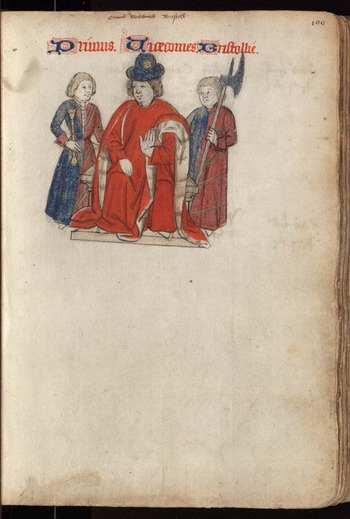
Oath-taking ceremonies were rituals that were, on the one hand, public demonstrations that the oath taker was to fulfill his sacred duties to his community and, on the other, an open acknowledgment of what his community could expect from his subsequent service.Footnote 1 For the English port town of Bristol in the late 1470s, the commemoration of the election of its first sheriff was immortalised in a colour drawing in the custumal (a collection of customs and memoranda) that was kept by the town clerk, Robert Ricart, from c. 1478. At the top-centre of the folium is a man sporting red livery and a top hat, flanked by two attendants in the background, taking an oath of office as ‘the first sheriff of Bristol’ (Figure 1). This is a relatively unadorned picture compared to the full-page illustration in the same manuscript of Bristol's mayor, taking his oath in full view of burgesses and office holders in the town hall.Footnote 2 Unlike the scene of the mayoral ceremony, which was supposed to depict a contemporary event, the image of the sheriff is layered with historical meaning. It uses the figure of a sheriff to beckon the reader back in time to ‘view’ a reenactment of what the ceremony would have been like a century earlier, when Bristol's burgesses received the privilege to swear in the town's new sheriff in 1373. In the mind of the illustrator, the only way to depict a new office holder was illustrating the ceremony that transformed him from ordinary burgess to civic official, bound to his community's customs as a Christian was to God's laws.
‘Primus Vicecomes Bristollie’ – The First Sheriff of Bristol Taking His Oath of Office, from the Maire of Bristowe is Kalendar, c. 1478–1479 (Bristol Archives CC/2/7, fol. 100r).

Civic oath-taking in medieval Britain predates the written appearance of oaths in town registers and custumals in the fourteenth century.Footnote 3 There is some evidence tracing civic oath-taking to the ancient Mediterranean.Footnote 4 In medieval Europe it is likely that the practice emerged once townsmen established annual elections that called for the regular turnover of civic personnel.Footnote 5 Before a man assumed a new role in civic government, he took an oath in a solemn ceremony in front of his colleagues and peers and, because public office-holding was squarely prohibited for women, the ceremony itself was a masculine exercise of power, one that drew ever more sharply the hardening divisions of the town's political hierarchies.Footnote 6 The earliest recorded civic oath for any British town dates to the reign of Richard I (r. 1189–1199), taken by men joining the ranks of London's commune, binding them in loyalty to the mayor, aldermen, and the probi homines (‘good men’) of the city.Footnote 7 The earliest surviving collections of civic oaths, however, date to the early fourteenth century, and are from Bristol and the four burghs of Scotland.Footnote 8 The later Middle Ages was a time when many towns and cities were establishing written guidelines, rooted in local traditions, that concerned elections and office-holding.
Despite the open nature of oath-taking ceremonies, the oath itself often suggested the importance of secrecy, or more precisely, ‘bureaucratic secrecy’, in medieval and early modern British towns. Building on the work of others, I use ‘bureaucratic secrecy’ as a concept to describe the intentional but routine concealment of information as part of the larger functioning of administrative control, particularly as it pertained to ‘expert’ knowledge shared only within bureaucratic circles and according to certain rules.Footnote 9 Though this concept of bureaucratic secrecy might seem to apply solely to European governments from the eighteenth century onwards, premodern bureaucracies, such as those in towns, also engaged in this type of routine concealment of information. From the perspective of many civic officials in British towns, the intent to conceal information was usually rooted in policies that, at least on the surface, safeguarded the common good. There was also undoubtedly a connection between secrecy and growing literacy. Urban historians, especially of Continental towns, have discussed at length the connection between the rise of urban literacy in the later middle ages and the policies of urban governments that aimed to keep sensitive information confidential.Footnote 10 As more civic administrators were producing written records – an outcome of increased literacy – the town's secrets, which likely involved a host of financial and political deliberations deemed too sensitive to reveal to outsiders, were also increasingly written down. As town governments matured and gained more political power, the need to track secrets became more common (that is, more routine). Concurrently, the rise of urban literacy heightened awareness about how to control both the flow of information and the officials who had access to it.
This article aims to add to our understanding of secrecy, literacy, and authority in medieval towns by examining the woefully underexamined cache of civic oaths to answer two questions: who were the civic officials enjoined to keep secrets in their oaths of office, and how did their discourses about secrecy change according to the status of the oath taker? The focus here is not necessarily on the content of the secrets but rather on how having access to secrets bestowed on the official a certain legitimacy to govern, granted paradoxically through the public acknowledgment that secrets were being held.Footnote 11 As it is argued here, not all officials tasked with keeping secrets were necessarily the ones who handled or wrote records. Analysing the types of officials entrusted with secrets, as well as those expected to deploy their knowledge in the course of their duties, reveals new perspectives on the ordering of hierarchies of civic government in the later Middle Ages.
The analysis here is based on an extensive archive of data that includes 378 oaths coded into a database (called Civic Oaths), of which 90 – or nearly a quarter of the evidence – refer to secrecy in some way. These 90 oaths represent the civic records of 31 Irish, Scottish, and English towns, dating from the pre- and post-Reformation periods. The principal conclusion of this article is that oaths represented a type of concession to the problems posed by keeping secrets (that is to say, being privy to certain information) in late medieval and early modern governments in towns. The act of governing necessitated the keeping of secrets, especially to ensure that civic bureaucracy ran smoothly and the common good was protected. But governance itself also required a degree of transparency for its leaders and administrators to claim legitimacy, incorruptibility, and respectability.
These two opposing forces sometimes created contradictions that civic officials tried to eliminate directly rather than reconcile through oath-taking. As Caroline Barron and Laura Wright's recent edition of the late fourteenth-century Jubilee Book has shown, officials in London were well-aware of the importance of transparency in their short-lived efforts to reform their government along more democratic lines. The oath taken by common councilmen in 1376, for example, had no clause requiring secrecy, though it was reintroduced in 1384, showing that even in a period that demanded an end to corruption the promise to conceal information could not be extricated fully from officials’ sworn duties to govern.Footnote 12 Ultimately, this tension between occlusion and transparency was resolved by the taking of oaths, many of which were public acknowledgments that secrets were going to be kept by certain officials. Oath-taking, in this sense, could be seen as officials entering social contracts promising that they were to be responsible with the confidential information with which they were entrusted, and that they would share information with the correct authorities. Secrecy, in other words, had to be acknowledged and required a form of openness.
2. Oaths as formulae
To understand the injunctions in civic oaths that demanded secrecy from citizens (also called burgesses in some towns) and new office holders, the first step is to delve into oaths as legal formularies and their four core elements. First, there was the initial promise that the candidate would serve in a specific office (sometimes, the duration of this term was specified). Such offices ranged from positions of high prestige, such as mayors or bailiffs, to minor ones, such as street pavers or sheriffs’ grooms in London.Footnote 13 Second, oaths outlined responsibilities that oath takers swore to fulfill. There were 40 possible duties, including, for example, collecting fines from men for shirking their sworn duties, as well as acknowledging certain restrictions on the oath taker to prevent bribes and other corruption.Footnote 14 The keeping and sharing of secrets were two of these 40 duties that could be stipulated in late medieval and early modern oaths. Third, oaths emphasised the importance of the personal qualities that men or office holders were to embody when they carried out their duties. There are seven such qualities, or descriptions of behavior, that could be articulated in oaths, such as competency, impartiality, and loyalty to monarchs or mayors.Footnote 15 Lastly, oaths had closing statements that invoked God, the saints, or the Bible upon which they were sworn. Many post-Reformation oaths crossed out the word ‘saints’ to cleanse the ritual of any lingering ‘popery’, suggesting that such words, however formulaic, were still considered significant to public perceptions of townsmen's religious allegiances, an expectation that persisted well into the seventeenth century, such as with the Protestation oath of 1641.Footnote 16
As an example of a typical oath for citizens or burgesses, members of the ‘Commons’ in Tenterden in the county of Kent during the reign of Henry VIII (r. 1509–1547) swore allegiance to the king, to uphold the laws, answer summons from their superiors, and pay the taxes demanded of their new status:
The Othe of the Commons
I, W. R. shall bere feith well and trewlye to oure lieche lorde the kinge H. and his heieres kinges of Englonde, and treulye to my power meynteyne the fraunchis, usages, and coustomes of this Towne & hundreth of Tenterden, And treulye come at the summoncon & commaundement of the Baylei And treulye the taxes, tallages, scottes, and other duties of the seied towne and hundred & fraunchis, the which to me shalbe putt fromhens forwarde within the seid fraunchis I shall paye And trewlye the counsell and preuieties of the Towne kepe And truelye the to my power to maynteyne the peace. And none other goodes than my owne make to acquitte be vertue and color of this fraunchis, as god me helpe & all etc.Footnote 17
(The Oath of the Commons: I, W. R., shall bear faith well and truly to our liege lord the king, H[enry] and his heirs, kings of England, and truly to my power maintain the franchise, usages, and customs of this Town and hundred of Tenterden. And truly come at the summons and commandment of the Baylie. And truly the taxes, tallages, scots, and other duties of the said town and hundred and franchise, the which to me shall be put from henceforward within the said franchise I shall pay. And truly the counsel and privities of the Town keep. And truly the to my power to maintain the peace. And none other goods than my own to acquit be virtue and color of this franchise, as God me help and all etc.)
In this oath, secrecy was expressed as both counsel (private matters) and privities (secret confidences).Footnote 18 What these and other oaths tell us about secrecy was not the type of knowledge to which citizens or office holders were privy, as oaths had to remain generic to be sworn in public and by many individuals over time, but that these men bore the obligation to be the guardians of their town's secrets. While we may not know the particulars of the counsel and privities that men in Tenterden swore to keep in confidence, a survey of oaths as a whole reveal how they link civic officers through a chain of command that relied on transparency in some cases, occlusion in others.
3. Oath-taking and keeping records
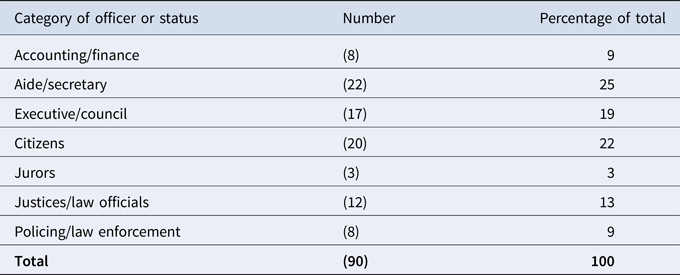
Who were the officials entrusted with secrets? A survey of oaths draws a picture of a variety of office holders, operating in different capacities, that had access to confidential information and deemed worthy as recipients of secrets (Table 1):
Citizens and categories of officers entrusted with secrets, taken from 90 oaths of 31 towns in England, Ireland, and Scotland

Source: Civic Oaths database.
The data suggests that officials who kept and wrote records about council meetings or the town's finances – about a third of the total if we combine the categories of ‘accounting/finance’ and ‘aides/secretaries’ categories together – were most sworn to keep secrets. Oaths of these amanuenses, such as chamberlains, town clerks, and clerks of the chamber, underscored the care with which they had to preserve sensitive documents.Footnote 19 In a mid-sixteenth century oath of Carlisle's clerks, for example, they swore to keep the counsel of the mayor and bailiff and were restricted from carrying the court books out of the town hall without acquiring the necessary permission.Footnote 20 The sixteenth-century oath of the common clerk in Canterbury, meanwhile, enjoined him to seal and keep together the precious documents of the city – records, charters, and any other writings produced in the chamber. Additionally, he was not to write:
[…] copiez out of the records charters ritts or other what so ever writyngs in theseid chamber beyng without the consent and knowledge of maister and the chamberleyn of the seid Cetie for the tyme beyng […].Footnote 21
(…copies out of the records, charters, writs, or other what soever writings in the said chamber, being without the consent and knowledge of the master and the chamberlain of the said City for the time being…).
Such an injunction highlighted a hierarchy of information to which certain men in secretarial roles were allowed access, one predicated on the clerk needing permission from his superiors to make copies of civic records deemed either important or confidential to Canterbury's government. Moreover, Canterbury's clerks ‘… shall discouer no thyng that [they] shalbe made prevy vnto to eny persone wherby the Cetie or eny of the Citezyns of the seid Cetie shalbe hirtid [or] hyndred…’Footnote 22 In other words, clerks could be made aware of damaging information, and had both a professional and moral obligation to disclose what they had learned to city officials and citizens. In this view, secrecy may have protected privileged information, but it could also be a potentially destabilising force, one that could hurt or hinder the standing of a city and the fortunes of its citizens.
As the town's main conduit of written information, one may imagine that clerks were privy to knowledge about most of the business that flowed from one administration to the next. In some towns, officials relied on them for their dispensation of counsel. In fifteenth-century King's Lynn, clerks were to give their honest counsel when ordered to, though the oath was later amended in another hand to make the appointee utter the words, ‘and ye counseil of yis toun treuly kepyn’, which may have pointed to how King's Lynn's clerk was a position that increased in influence over time.Footnote 23 Similarly, the late sixteenth-century oath of Bristol directed new inductees to ‘geve good and holsome counsel’ to the mayor and aldermen where such a prescription did not exist in the French oath composed nearly two centuries earlier.Footnote 24 This addition to the Bristol oath indicates the common clerk's increasing importance as a legal and political adviser. The late sixteenth-century Bristol oath is also significantly more forceful in its requirements for clerks to conduct themselves more honourably than in the earlier incarnation, with inductees promising to ‘well and honestly behaue and demeane’ themselves during their tenure in office – a prescription that may have also reflected an anxiety about the clerk's outsize role in keeping and recording the town's important records.Footnote 25
Oaths – because they were general rather than specific, and statements of ideology as much as they were guidelines – give us little insight as to the specifics of the secrecy demanded. But within them are tantalising clues about the social spaces where things were to be kept secret. For example, in one oath for the clerks who attended the Pentice court in seventeenth-century Chester, they swore that they would attend the mayor, sheriffs, and the city's council, and at these meetings, ‘[…] their councils debates and sayings in the Assembly of this incorporation shall to conceal and keep secret and shall honestly behave [themselves] in all things appertaining to [their] said office’.Footnote 26 Clerks were present at the deliberations of these council meetings because they were needed to record what was said. As the oath implies, the council's debates, and everything that was said during these assemblies, were considered secret. The council in Chester was thus a closed-off civic space, exclusive to those allowed to enter its halls and participate in its politics.Footnote 27 Secrecy not only covered the words spoken during these assemblies, but also any words exchanged between elite members of the governing classes – mayors, sheriffs, and those who sat on the executive council.
Concerns about the clerks and other officials’ obligation to record civic procedures of a sensitive nature are best illustrated in the two sixteenth-century oaths of Exeter, recorded in John Hooker's history of the city published in 1575. Oaths in this period clearly reflected the changes that had occurred in the language of devotion following the Reformation, as oath takers swore to fulfill their duties according to their conscience and the Bible. The oath of the clerk not only demanded that he not disclose the secrets of the common council and share any information that may harm the city, but also details the proper way of handling records so as not to compromise their contents.Footnote 28 The description of their duties in this oath reflects certain correctives put in place to prevent either abuses or mismanagement that had occurred in the past.Footnote 29
The roles and secrecy requirements of record-keepers like clerks seem to also suggest the expansion of electoral politics in towns that demanded a concomitant (and public) acknowledgement that the process needed to remain secret to ensure its sanctity. The potential of contentious elections in Exeter demanded separate oaths of its recorder (the city's lawyer) and the clerk to ensure the integrity of the process.Footnote 30 The men who held these offices were responsible for counting the votes that were to elect the mayor, receivers, bailiffs, stewards, and sergeants.Footnote 31 As such, they were not to disclose the ‘secrete’ results of the election and, perhaps most significantly, they were mandated to burn the final tally, written on paper, in front of the common council at the end of the election cycle. The destruction of this evidence was not entirely wholesale. The clerks were to make a (less detailed) note of the candidates with the most votes for their own use and could only pronounce the winners in a formal ceremony in the city's guildhall, a ritual that was to be conducted according to ancient custom. But before such a time, they were to keep to themselves the vote tallies and not disclose them to anyone by ‘any manner of meanes’.Footnote 32
The Exeter oaths show two different functions of secrecy when it comes to the record-keeping capacities of civic officials. The first focuses on their roles as information experts. As men who preserved and wrote records, there was the assumption that they could dispense advice and even legal counsel. This knowledge, which had to be concealed carefully from outsiders (or lower-ranked men), was rooted in expertise that was presumably gained on the job, given that the town's laws and business affairs were not learned in a formal setting but rather through the grind of attending court and council meetings. Record-keeping was necessary to the functions of the city, but written records also had the potential to destabilise the body politic – witness the example of Exeter's clerks being ordered to burn the vote tallies in a public spectacle in front of the common council. The second role was that of true secretaries – bearers of secrets that formed the crucial links in an elite network of information in which knowledge flowed upward.Footnote 33 J. F. Benders has noted that for clerks in late fifteenth-century Deventer (in the eastern Netherlands), fines were levied on those who committed occupational errors, such as intentionally revealing confidential information, a standard of professional secrecy that they swore to uphold from at least 1475 onward.Footnote 34 While civic oaths in British towns suggest general rather than specific types of secrets, the deliberations of the council, the results of elections, and the town's finances were considered privileged information.
Some clerks executed some of the duties traditionally reserved for receivers and chamberlains, office holders responsible for keeping financial accounts. In Colchester, though the receiver occupied a separate position, the town clerk seemed to have worked closely with him, which is emphasised in the late fourteenth-century oath.Footnote 35 The clerk was to make a proper account of the town's profits and deliver them to the receiver, as well as keep secret the counsel of the commonalty and two bailiffs, who were usually the wealthiest members of the franchise.Footnote 36 The bailiffs in Colchester together occupied the position of the town's chief executive absent a mayoralty, which was instituted in the seventeenth century.Footnote 37 While it is obvious that the clerks attended council meetings, the oath indicated that an orderly chain of command, in which the main financial officers oversaw the accounting of the clerks, was part of a larger imperative to keep sensitive information within certain parameters of control. Similarly, in the sixteenth-century oath of chamberlains in Canterbury, they promised to make true accounts of the profits that flowed into the city, whether from taxes or entry fees of new citizens, and
[…] not disclose the secrets of theseid chamber nor talk not eloigne no maner of charter or other what so ever wrtyngs out of the seid chamber beyng in my custody without thassent of mr. maier & aldermen of this Cetie.Footnote 38
(…not disclose the secrets of the said chamber nor talk, not eloign [remove] no manner of charter or other whatsoever writings out of the said chamber being in my custody without the assent of Mr. Mayor and aldermen of this City.)
In this and other oaths (such as the near-identical oath of Canterbury's clerk), the nature of ‘secrets’ remains ambiguous, but the rest of the oath is more precise about what could constitute secrecy: any ‘talk’ in the exclusive space of the city hall, as well as the contents of the city's charter and any documents the clerk produced inhouse. Put another way, what was secret was not simply select items of information that needed special handling, but in fact all business spoken of within the domain of urban officials. In other words, what was secret was defined not only by its content but the social space where secrets were shared, and information preserved.
4. The common council, mayoralty, and hierarchies of power
Making up nearly a fifth of the evidence, men elected as part of the executive branch – that is, members of the common council, often sworn as advisers to the mayor, and the mayors themselves – also took oaths of secrecy (Table 1). Although citizenship was a base requirement for civic service, elections to the council and mayoralty were never democratic but rather exercises in the exchange of power within a relatively small number of elite male householders.Footnote 39 These householders were usually involved in the town's most lucrative trades. Though bakers and carpenters, trades belonging to the lower-rung of citizens, could obtain the franchise, it was unlikely that they could ever rise to the rank of councilmen or mayors, who were, to take London as an example, dominated by the richest merchants – mercers, grocers, drapers, pepperers, fishmongers, and goldsmiths, to name but a few.Footnote 40 Given that the executive branch was the political arm of the urban oligarchy, the secrecy mandated in their oaths was about the preservation of this exclusivity.
Secrecy was not only mandated as a practical matter, one of the many duties required of councilmen (or jurats, as they were called in some towns), but also reinforced the town's ideological stance towards preserving clear hierarchies in which council members were subordinate to, but also in partnership with, mayors. As Jonathan McGovern has shown for the oaths of privy councillors in Elizabethan England, expectations that these councillors guard their counsel and keep secrets hinged not only on their proximity to the monarch but also on an acknowledgment that they held socially inferior positions.Footnote 41 Few men made it to these higher echelons of urban government because, quite simply, the business of civic rule was reserved for the elite. Councillors served in several different capacities depending on the borough and, while nearly 85 percent of their oaths dictated that they were to give proper counsel to the mayor or other officers of the town, about half of their oaths also emphasised guarding the counsel of the town.Footnote 42 In late fifteenth-century Norwich, for example, common councillors were to:
[…] redily come [when] somond to ye comoun counsel […] and good and trewe counsel [they] [sh]al yeve after [their] wyt and conyng […] And [th]at is seyd in [th]e comoun counsel and owght for to be kept counsell [they] [sh]al it counsell kepe and [discover nothing thereof…].Footnote 43
(…readily come when summoned to the common council…and good and true counsel they shall give after their wit and cunning. …And that is said in the common council and ought for to be kept conceal they shall it conceal, keep, and discover nothing thereof…).
As we see here, concerns about secrecy and the dispensation of counsel were often linked in their oaths. Those who had knowledge had access to power. The main duty of councillors was first and foremost to answer the summons from their superiors, attend council meetings, and dispense advice to the best of their ability.Footnote 44 In some towns, giving ‘true’ and ‘wholesome’ counsel was indistinguishable from guarding secrets, as some oaths implied that what separated good from bad (or, useful from worthless) advice was the councilman's ability to be properly informed. In a late fourteenth-century Colchester oath, the 24 councilmen swore to attend the meetings (unless they could present a reasonable impediment) to provide counsel to the town's bailiffs and aldermen, whose secrets, including those of their fellow councillors, they had to conceal. The councilmen were also compelled to reveal any information that could damage the town's political or economic standing.Footnote 45 It is clear, however, that councilmen were only to reveal prejudicial information to the bailiffs, not to aldermen or to other councillors. Councilmen were to guard the secrets of all but only reveal secrets to the bailiffs, who were the town's highest-ranked officers.Footnote 46
Secrecy was thus the organising framework through which hierarchies were clarified. These hierarchies were implicitly understood as both the moral and lawful ways in which civic society was ordered. When men of the common council in sixteenth-century Canterbury took their oaths, their promises to come to the mayor's aid when summoned and to keep the counsel of the town private were based on an understanding that their duties served the city's ‘comen wele and profett therof after the customez & usagez of theseyd Cetie’.Footnote 47 The common wealth and profit of the city referred to the body politic as it was governed in the best manner by civic officials, whose legitimacy as rulers was reinforced by custom.Footnote 48 The councillors’ ability to perform their duties, including the keeping of secrets, was to act lawfully according to custom, which was rooted in the idea that civic law was ancient and had been in continual usage.Footnote 49 Few oaths, however, made such explicit references to the common good because the civic oath – both as text and its performance in a public space – was itself a solemn promise that the oath-taker would do his part to preserve hierarchies and choose obedience over self-interest, which could sow disorder. In this reading, the very existence of an oath-taking regime ensured the lawful perpetuation of the common profit, and common councillors, as one of many cogs in the machinery of bureaucratic secrecy in medieval and early modern towns, were significant to its workings because of their critical roles in shaping policy and enforcing local laws.
The mayor, if a town had one, frequently reigned supreme over the hierarchy of elite officials.Footnote 50 He was the focus of obedience and at the centre of a system of secrecy in which knowledge crested at the top. In Elizabethan Reading, the oath of the head burgesses, who occupied positions in coram Majore (the mayor's court), essentially encouraged them to act as spies for the mayor and his deputies. The oath mandated that they were not only to inform on any individuals who would disturb the liberties and franchises of the commonalty, but also to be alert for any potential lawbreakers of acts, ordinances, or institutions that served the town's ‘common wealth’. In their positions as informants, head burgesses were ‘[…] to discover, shewe and declare to the said Maiour or his deputye, in open or secrett wise’ the sedition that had been fomenting in their midst.Footnote 51 What this clause in the Reading oath suggests is that secrecy might have been less about the circulation of damaging information than it was the anxieties about rebellious elements in the town that threatened the delicate balance of power between civic officials and the commonalty, as well as the enfranchised and unenfranchised. The head burgesses were to be at the frontlines of maintaining the borders of these hierarchies, promising to keep both the secret and the common counsel of the borough in confidence, and not to ‘…publishe, shewe or declare, excepte it be to a Burgesse of the said boroughe’.Footnote 52 Here, there was a division between what was secret and what was common knowledge, but both secret and common information had to be kept within a tight circle of men. Unlike those tasked with the production of documents, the anxiety about keeping secrets for sworn councillors was first and foremost about loose talk and sharing information to outsiders rather than the proper handling of written records.
Mayors, at the apex of a town's bureaucratic hierarchy, had a singular relationship to secrecy, one that depended less on keeping secrets than sharing them with those above them in the hierarchy.Footnote 53 Mayors themselves were not charged with keeping secrets. There are no oaths that directed mayors to guard the counsel or business of the town in the same way that office holders such as clerks and councillors were bound. Mayors were, however, directed to share prejudicial information to the only man who far outranked them – the King of England. This kind of information would, in most cases, come from his councillors. For example, in an oath dating to Henry VII (r. 1485–1509), the councillors in Nottingham were not only to keep the counsel of mayor and that of their colleagues in confidence but were also instructed to give lawful advice to the mayor according to their ‘conning’ (cunning).Footnote 54 Many such oaths were specific about the beneficiaries – mayors – of the town councillors’ guidance. Having privileged information from the town councillors likely placed some delicate obligations on mayors. In the circa 1419 oath in London's Liber Albus, the mayor was obligated to expose any practices that trampled on the rights of the King, these ‘rights’ being understood as ones allowing the Crown to enrich its coffers through taxation.Footnote 55 It was, in fact, a mayoral duty to outright ‘repel’ any underhanded practices that might cheat the Crown from its profits, the oath warning any mayor who uttered it that if the King were to be unreachable, then the mayor was duty-bound to inform the royal council, whose members would then inform the King.Footnote 56 In this sense, the oath subtly reinforced for mayors, and all mayoral candidates who followed, that keeping secrets might have been useful for ensuring the integrity of urban politics (for example, town councillors and other officials not disclosing damaging information to their social inferiors or to the public) but could be damaging to the realm if it affected town and Crown relations. In other words, the realm was not entirely a separate sphere that stood outside the inner workings of towns but rather an important extension of their mercantile economies, from which the Crown financially benefited. As such, the King and his ministers were liable to know information, and secrecy, here represented in potential mayoral obstruction, was a sign of insubordination.
No oath in the sample enjoined mayoral candidates to keep secrets, suggesting that either it was assumed any man elevated to this prestigious position would be automatically discreet, or – as was perhaps the case – the guarding of secrets was the larger responsibility of the various men below him, such as town councillors, who might have been entrusted with secrets originating from the mayor himself.Footnote 57 Although mayoral oaths across the board did not contain references to either giving advice or guarding the counsel of the town, when any counsel was mentioned, the focus was on the mayor as the beneficiary of the advice given to him. In Carlisle's mayoral oath from circa 1561, mayors were to ‘folowe and tak thadvice of the counsale in all poynts touchinge the government of this citie and the comonewelth therof etc according to thauncient orders’.Footnote 58 In this example, the mayor's obligation to take advice from his colleagues was tied to ancient practice. Mayors had, according to the oath, customarily followed the advice of the council during their mayoralties, and to continue to do so was a reaffirmation of customary law.Footnote 59 There was a direct connection between the mayor's obligation to hear his council and his duties as they were governed by customary precedent. In a late fifteenth-century Winchester oath, for example, mayors were to observe the statutes, usages, and ordinances of the city made by ‘oure predessessours by fore thys tyme’.Footnote 60
The ‘protection’ of the town's customs was a common refrain in mayoral oaths; the defense of these customs was not only formulaic but also integral to understand the terms of mayoral power – to act as a liaison between town and Crown. Though the mayor was tasked with protecting the Crown's profits, he also represented the town's interests, which in oaths translated to the stated responsibility that he should uphold the laws and customs of his community. In the sixteenth-century Irish town of Waterford, mayors during the time of Henry VIII held multiple offices according to custom, including that of the clerk of the market, Justice of the Peace, and the mayoralty of the Staple. He made sure all the King's profits were returned to the Exchequer and royal writs and laws enforced, but ultimately it was his councillors who were to guide him through the wide ambit of his duties.Footnote 61 In late fifteenth-century Hereford, a defense of the city's customs was tied directly to the mayor's obligation to heed the advice of his councillors. Unlike others of its kind, the mayoral oath from Hereford outlined the repercussions that awaited a mayor found to be obstinate or corrupt. His twelve councillors, who were enjoined to meet in secret to determine the extent of his crimes, were to purge him from office if they determined he was guilty.Footnote 62 The use of secrecy in these deliberations was part of the council's broader mandate to serve as a check on the mayor's power, not only as those qualified to dispense counsel but also as members of a taskforce with their own authority to expel their superior. Even so, councillors had to follow proper procedures. They had to give the mayor three days’ notice that they were to meet in private, during which the mayor could launch a defense of his actions.Footnote 63 Cast in this way, the councillors’ secret meeting was not an underhanded move to remove the mayor but rather integrated as an orderly process in which any drastic measure to alter the chain of command was done entirely above board.
5. Citizen secrecy and its meanings
Town council deliberations, secret or otherwise, were exclusive to appointed or elected men, as the majority of citizens, because of their economic status or occupation, did not qualify to hold prestigious civic offices.Footnote 64 Even so, anxieties over the disclosure of information were not limited to officials producing written records or to those who sat on the executive council. Citizens, the second largest individual category, constitute over a fifth of the total evidence and suggests that they were allowed to be present for council business (Table 1). Unlike amanuenses such as clerks and others who kept financial records, the types of secrets that citizens were expected to keep revolved around not what was written but what was revealed to them. As Christian Liddy has argued, oaths of citizenship (or enfranchisement), especially those that enjoined men to secrecy, were tools of social control. Officials framed secrets as illicit speech that undermined men who occupied positions of authority in civic government.Footnote 65 Liddy's observation bears out in some of the evidence, especially in oaths that directly condemn scurrilous speech. In an oath from Dartmouth dating to Henry VIII's reign, freemen (or burgesses) swore not to ‘sclannder (slander) nor rebuke the maiore of this Towne nor his brethern of the same but be of good and honest aberyng (bearing) ayenst (against) them and all thoffycers of this towne’.Footnote 66 In this formulation, a freeman's good and honest bearing constrained any of his impulses to either defame or abuse his social betters. In Beverley, anxieties about burgesses’ slander were stated obliquely in oaths but forthrightly in the customs of the town. In the Latin oath for burgesses (and in its sixteenth-century English recension), the oath takers swore to conceal the secrets of the council, obey the customs and ordinances of the town, and not place cattle on common pastures that did not belong to them, suggesting that they played roles in policing these boundaries.Footnote 67 They also promised not to be disobedient to their governors.Footnote 68 The actual town's laws, however, dictated steep fines if burgesses abused or defamed men who outranked them, such as the governors, the town clerk, aldermen, stewards, and common sergeants.Footnote 69
Certainly, the oaths of citizens (and civic oaths in general) were deeply concerned with the preservation of the political order, especially with its members showing proper deference to or obeying those in power. But an examination of the language of citizen secrecy in oaths paints a more complex picture of how secrecy, as a rhetorical tool, functioned in keeping new citizens as active participants in governing their communities. The fourteenth-century oaths of burgesses in the Scottish burghs of Berwick, Edinburgh, Roxburgh, and Stirling demanded that these men not only keep the secret counsel of the community, but also inform the necessary authorities ‘any thing to their prejudice’ that may affect these towns’ fortunes.Footnote 70 Similarly, in a French oath dating to Edward III (r. 1327–1377), new burgesses in Bristol swore to conceal the counsel of the town, as well as obey the summons of the mayor and, as was formulaic in all Bristol oaths, declare their loyalty to the King, his heirs, the mayor, and the commonalty.Footnote 71 Guarding the counsel of the town and professing loyalty to their social betters were surely envisioned as part of a larger rhetorical demand that citizens keep in line and refrain from disobedience (which included illicit speech), but as with many of the oaths in this sample, it was also a specific enough command that indicated citizens’ larger responsibility to aid civic governance and surveillance.
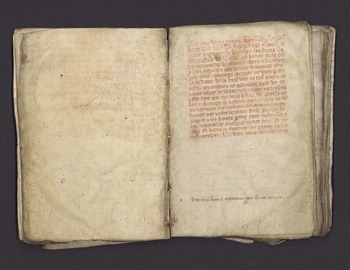
By sharing secrets, it made citizens active participants in the broader project of civic order. The early fourteenth-century oath for Southampton's burgesses was particularly detailed in its demands for using and leveraging secrecy towards building a stronger, more secure political community. The placement of the oath, which was rubricated and written beautifully in a Gothic book hand at the beginning of the town's oldest custumal, the Oak Book, indicated not only its frequent use but also its ideological importance (Figure 2). It was, in fact, the only oath recorded in the Oak Book. The French oath enjoined burgesses (also called guildsmen) of Southampton to keep secret the counsel of the guild, which was the main governing body of the town, but additionally to not hold any secret (or rather, unsanctioned) meetings in which men could be ‘defrauded or damaged’.Footnote 72 While this injunction may refer to any sort of activity that could undermine the power of the guild, the contemporaneous customs of the same town reveal the extent to which guildsmen could be defrauded or damaged, whether through physical violence, defamation, deprivation of their rightful profits, exclusion from meetings of the council, or dispossession of their trading privileges. It was imagined that in these secret, unlawful assemblies, rogue guildsmen or other officials could forge new laws or alliances – a shadow government that would split Southampton into political factions. Guildsmen swore in their oaths to alert the mayor if any ‘evil confederacies’ had occurred, just as they promised to obey any summons to attend meetings. Any man who refused the summons was to be fined as many times as it took to compel his attendance.Footnote 73
The Rubricated Oath of the Burgess (in French) in Southampton, from the Oak Book, c. 1300 (Southampton Archives Services SC/2/1/1, fol. 9r).

Illicit meetings, however, take on a different connotation in oaths written after the English Reformation, as the entire religious and political transformation of the realm was predicated on oath-taking, even at the local level. Oaths during and following the Reformation not only made public the loyalties of civic officers to the monarch (now the head of the Church) but were also valuable tools through which recusants could be identified.Footnote 74 In Exeter's oath for freemen (or citizens), men were to first swear fidelity to the sovereign ‘ladye Elizabethe by the grace of God Queene of Englande ffraunce and Irelande Defendor of the fayethe’, the latter title once bestowed by the Pope to the Catholic Henry VIII but which later became an important signifier for the king's successors’ new roles as supreme heads of an increasingly Protestant Church.Footnote 75 As subjects of Queen Elizabeth, new citizens of Exeter were to ‘keepe the peaxe and Common tranquillitie of this Citie’ and, if they were to uncover ‘vnlawfull assemblies or Conventicles’, they were to inform the mayor and other officers of the city.Footnote 76
Conventicles, of course, were secretive meetings of a very different sort from the ‘evil confederacies’ that were feared in fourteenth-century Southampton. As Susan Royal has noted for the period, there was a great deal of ambiguity about what kinds of assemblies constituted conventicles, which were religious gatherings that defied the authority of the Church of England and thus the power of the state itself. Conventicles were banned on three separate occasions in the late sixteenth and seventeenth centuries.Footnote 77 Some later interpolations in town books included oaths of supremacy alongside civic oaths that were recorded in an earlier period, suggesting that the politics of oath-taking (and fealty to the Crown in particular) were not only matters of local concern but also part of wide-ranging changes in religious policy after 1540. J. Michael Gray has argued that oath-taking during the English Reformation was itself a vehicle through which religious and political transformation was solidified, going so far as to claim that the Henrician Reformation did not just depend on the promises of fealty contained in oaths, but that the act of oath-taking constituted the entire foundation upon which the Reformation rested.Footnote 78
In this respect, medieval civic oaths were dress rehearsals for what was to come. About 35 percent of all civic oaths (or 91 out of 258) recorded before 1540 had clauses of fealty to the monarch, though this number jumps to 45 percent (or 17 out of 37) when only considering citizens’ oaths. After 1540, nearly half of all civic oaths (or 58 out of 120) have this clause, and 90 percent (or 9 out of 10) citizens’ oaths do. Though the sample size for post-1540 oaths is smaller, it still demonstrates how high politics filtered into the language of urban citizenship and royal subjecthood. Guarding the town's secrets, and sharing information that would expose disloyalties, went hand-in-hand; one injunction did not exist without the other, as all oaths for citizens that stipulated secrecy required both. Their professed loyalties linked the political fortunes of towns across the realm to the Crown.
6. Secrecy, surveillance, and policing
The oaths of policing, legal, and trade authorities make up a quarter of the evidence, as their duties to the health of their boroughs in terms of trade and keeping order demanded a particular type of secrecy that served these overarching goals. The men occupying these positions ranged from recorders, serjeants, and coroners to overseers of trade such as clerks of the market and ale tasters. For policing officials, their tasks were to inform their superiors of activity that might compromise the safety of their towns in some way.Footnote 79 The oath of the common serjeant-at-arms in fifteenth-century London is perhaps the most typical of what we would expect to find for officials who served in some policing capacity. Besides being tasked with upholding and enforcing the city's laws and keeping secret the business of the town council, serjeants-at-arms were not to know ‘the common harm of the City’, meaning that they were to actively prevent such harm by informing the officers of the city and council.Footnote 80 The secrecy requirements for the four men appointed to be serjeants in sixteenth-century Waterford skirted the line between policing breaches of the law and enforcing trade regulations. In this town, serjeants were to enforce the operations and summons of the local court, including executing warrants and eschewing favouritism when conducting inquests. They were also to ‘truly kepe consail of that ye herith & to noman it revele’, the vagueness of revealing secrets to ‘noman’ indicating their broad functions in keeping the administrative machinery of the town intact. In addition to swearing that they were to avoid being corrupted by gifts or bribes, serjeants were also tasked with revealing to their superiors if they knew of any ‘Custumes conceled’, revealing where there was deceit or corruption that may prevent the collection of taxes.Footnote 81
For such policing, legal, and trade authorities, their duty to maintain these urban regimes of secrecy was tied mainly to their roles in surveillance. Surveillance and secrecy were close siblings, brought together, as it were, by the twin goals of reinforcing the coercive power of civic authorities and providing them institutional authority to do so.Footnote 82 Disorder of all types, whether at the market or on the streets, was to be promptly identified. The oaths of the assayers of leather, ale conners, meat inspectors and other overseers of trade responsible for quality control were integrated into a larger surveillance apparatus, given that their responsibilities lay with reporting and indicting market offenders for legal prosecution. Obviously, protecting the urban community from faulty goods and spoiled victuals was a practical matter that helped safeguard the common good, but one cannot dismiss out of hand both the economic and ideological imperatives that lay behind such measures. Surveillance of this type – inspection of goods, the citation of offenders, and the reporting of such to the proper authorities – ensured the collection of taxes and fines that in turn enriched a civic polity within which its elite members issued legal mandates to punish and profit from the labor of all.Footnote 83 The oaths of trade and policing officials were, indeed, public professions of loyalty to the maintenance of this order. Surveillance and secrecy provided the crucial bonds between these lower-ranked officials and their superiors, their connection cemented in public oath-taking ceremonies.
7. Conclusion
The examination of civic oaths opens an entirely new world of inquiry about the regulation of knowledge in late medieval and early modern civic government. The evidence from many oaths confirms what many scholars of Continental towns have argued – anxieties about secrecy were closely connected to the rise of civic literacy and the proliferation of written records. It has been argued here, however, that this was only part of the story. Undoubtedly, beyond questions of civic literacy, the types of office holders to whom secrets were entrusted – men in secretarial positions as well as citizens and councillors – complicate how we understand bureaucratic secrecy as integral to the institutionalization and broadening of civic power in the later middle ages. Although oaths were often vague on the details of what was kept secret, we do know that the public nature of swearing oaths in front of other officials, citizens, and God helped institutionalise secrecy and thus entrench a hierarchy of knowledge beyond those who kept civic records.
The regime of secrecy that existed in medieval and early modern towns, and which was evident in oaths sworn in public rituals, helped clarify duties as well as hierarchies, made men legally answerable to their superiors as well as punishable for their disobedience, and reinforced the importance of protecting the common good as well as the customs that upheld it. They were social contracts made flesh by the men who were to literally embody the ideals of public service, uttering words that held them to standards of respectability in positions that comparatively few were allowed to have. The expansion of civic oath-taking practices in a period of growing autonomy for towns, when urban oligarchies were strengthening their authority over office holding and factionalism was rife, helped alleviate the anxieties prompted by these political tensions. The clauses in oaths concerning secrecy point to even larger concerns about rebellion and disorder, in all forms, that simmered underneath the promises of civic unity. It was, after all, a social order that was highly stratified according to status and occupation. Secrets were going to be kept, secrets were going to be revealed, and oaths were both written and public professions that certain knowledge was to be regulated. Knowledge of the type that afforded power and influence was not a tree with branches springing wildly in every direction but, rather, a ladder that was unscalable for most people. Those on its lower rungs looked towards the heavens for direction, sharing information with those at the top, who made sure they never had a reason to look down.
Acknowledgements
For their careful readings and good advice, I thank Asif Siddiqi, Susan Wabuda, Sarah Davis-Secord, Kim Klimek, and the anonymous readers for Continuity and Change.