Implications
Ban of surgical castration of piglets in EU is foreseen in 2018. Practicality of alternatives in practice is essential. The aim of this study was to evaluate the effect of alternatives on mortality, performance and carcass traits in controlled and on-farm conditions. Castration with anaesthesia did not negatively affect performance or mortality compared with other treatment groups. Results also indicate that farmers can gain profit by the improved performance and carcass traits when producing entire males or immunocastrates, without major management changes. These findings can convince farmers to shift towards the production of entire males or immunocastrates, provided that market opportunities are created.
Introduction
In the EU, the transition continues towards alternatives for surgically castrating piglets without pain relief. The various alternatives to traditional castration fall into two categories: reducing the pain of castration or avoiding physical castration. The first category aims to reduce the discomfort of castration by administering anaesthesia or analgesia. The second category leaves the male piglets entire, but attempts to reduce boar taint via management strategies or immunocastration. At the end of 2010, several main actors in the EU pork chain agreed to voluntarily end surgical castration of pigs in the European Union by 1 January 2018 (European Declaration on Alternatives to Surgical Castration of Pigs, 2010). Since 1 January 2012, the first step has been taken to only perform surgical castration of piglets under prolonged analgesia and/or general anaesthesia. Several national initiatives have been implemented, but none of the alternatives have been applied throughout the EU.
Before alternatives can be implemented, it is important to determine whether the alternatives are feasible in practice. The best way to determine the economic feasibility of the alternatives is to compare the performance and carcass results of pigs castrated without analgesia/anaesthesia v. the expected improvements and costs associated with an alternative strategy. Several studies indicate beneficial results regarding performance and carcass quality for immunocastrates and entire male (EM) pigs as compared with barrows, although results can be affected by several factors and may, therefore, vary between farms (Millet et al., Reference Millet, Gielkens, De Brabander and Janssens2011; Batorek et al., Reference Batorek, Candek-Potokar, Bonneau and Van Milgen2012a). Effectiveness of applying anaesthesia or analgesia has been evaluated under experimental conditions (McGlone et al., Reference McGlone, Nicholson, Hellman and Herzog1993; Prunier et al., Reference Prunier, Bonneau, von Borell, Cinotti, Gunn, Fredriksen, Giersing, Morton, Tuyttens and Velarde2006; Gerritzen et al., Reference Gerritzen, Kluivers-Poodt, Reimert, Hindle and Lambooij2008); however, data on mortality in field conditions are lacking. Furthermore, the prevalence of boar taint may affect the economical feasibility of raising EM pigs. This study evaluated the feasibility of these alternatives in practice, with a focus on mortality, performance, carcass traits and boar taint. Reliable information on these parameters may support farmers in their choice and to implement these alternatives in practice
Material and methods
The results presented in this study are part of a project that evaluated feasibility, animal welfare and farmers’ expectations and experiences of several alternatives to traditional castration that can be implemented in the short term. The evaluated treatment groups were as follows: (1) applying analgesia 15 min before castration (MET), (2) applying CO2 anaesthesia during castration (CO2), (3) raising EM pigs and (4) raising immunocastrates (two vaccinations with Improvac (Zoetis, Zaventem, Belgium), IM) compared with (5) castrated male pigs (CONT), all single-sex reared and slaughtered at a comparable carcass weight of 90 kg.
In all two trials were set up to evaluate mortality, performance, carcass traits and boar taint, as well as testes development. An experimental farm trial was set up for weekly evaluation of average daily feed intake (ADFI), average daily gain (ADG) and gain-to-feed ratio (G : F) of the treatment groups as well as study of the effect on testes development and carcass traits. All treatments were also tested on 20 farms during a field trial. In contrast to the experimental farm trial, in the field trial, we evaluated the effect of applying anaesthesia or analgesia at castration or the production of EM pigs and immunocastrates on mortality and carcass traits, and the effect of castration and immunocastration on performance, testes weight and prevalence of boar taint.
Animals and management
Experimental farm trial
The experimental farm trial was conducted from November 2009 to April 2010, with offspring from Piétrain×hybrid sow (RaSe). In two replicates, 3 weeks apart, 80 and 40 male piglets (first and second replicate, respectively) were allocated to one of the five treatment groups at 2 days of age (n=5×24). The effect of genetic background was minimised by allocating littermates randomly to different treatment groups. At weaning (4 weeks old), the pigs with the least deviating live weight were kept in the trial, resulting in 60 and 30 animals for the first and second round, respectively, per treatment (n=5×18). This resulted in three pens per treatment, with six animals per pen or 18 animals/treatment group in total. During the course of the trial, three pigs died (two CONT, one IMP), two pigs were removed from the trial because of lameness (INT) and one pig because of severe illness (CO2). A two-phase feeding system was used: feed 1 from 20 to 50 kg (9.4 MJ/kg, 8.8 g/kg apparent ileal digestible (AID) Lys) and feed 2 from 50 kg to slaughter (9.2 MJ/kg, 7.2 g/kg AID Lys). The pigs had free access to water and feed at all times. Pigs were slaughtered when the average weight of the pigs housed in a pen reached the intended live slaughter weight of 110 kg. Pigs were fasted for 24 h before slaughtering. After 1 h of transport and about 2 h of lairage at the slaughterhouse, the pigs were slaughtered by exsanguination after electric stunning.
Field trial
A total of 20 farms participated in the field trial. Piétrain was used as the sire line on 19 farms, one farm used Maximus as the sire line. The sow line was more divergent, with sow lines from Topigs 20 (six), JSR (three), Pic (four), BN (one), Danbred (one), as well as cross-bred sows (five). All five treatments were performed on each farm. Within each farm, treatments started consecutively with a period of 9 to 15 weeks between each treatment, depending on the management system and space available at the farm. The order of the treatments was randomised over the farms to minimise time effects. Farmers selected ~120 male piglets/treatment group. Total number of animals included in the trial for all farms was 2182, 2406, 2250, 2311 and 2193 for CONT, MET, CO2, IM and EM, respectively. The animals were kept in single-sex groups from weaning until slaughter. Number of pigs per pen was farm dependent, with 8 to 16 animals/pen in the fattening stable, or 12 on average. Farmers were asked to record deaths (date, number of animals) and the assumed cause of death. Ad libitum feeding was routine practice on all farms. Intended live slaughter weight was similar for all treatment groups per farm (113.3±2.7 kg). Pigs were fasted for at least 24 h before slaughtering. The pigs were slaughtered by exsanguination after electric or gas stunning.
Treatments
Surgical castration (with or without anaesthesia or analgesia) was performed on average at 4 days of age. Analgesia was applied by injecting 0.2 ml/piglet Metacam (20 mg/ml Meloxicam, Boehringer-Ingelheim, Brussels, Belgium) at least 15 min before castration. Anaesthesia during castration was performed by inhalation of 100% medical CO2 gas (Air Liquide, Machelen, Belgium). Administration of the gas was done using the MS Pigsleeper 3 device (Schippers, Bladel, the Netherlands), which was developed specifically for the castration of piglets with settings for 70% CO2 and 30% O2 gas (Gerritzen et al., Reference Gerritzen, Kluivers-Poodt, Reimert, Hindle and Lambooij2008). In this device, three piglets can be fixated and anaesthetised at the same time, and each fixation device can be operated individually. The flow and time of administration was optimised for use with 100% CO2 gas (unpublished data). Flow was set at 3.2 l/min. Standard time of administration was 27 s for piglets between 2 and 3 kg of weight and 23 or 30 s for smaller or larger piglets, respectively. Recovery time was ~1 min.
Immunocastration was performed by injecting 2 ml Improvac subcutaneously behind the ear in a series of two injections ~6 weeks apart. In the experimental farm trial, Improvac was administered by a trained Institute for Agricultural and Fisheries Research (ILVO) technician (first injection at 15 weeks of age, second injection at 21.5 weeks of age). In the field trial, Improvac was administered by the farmer under the supervision of the project team and a representative from the pharmaceutical company. Before the start of the trial, all the farmers were trained to administer the vaccine correctly. The first injection was given at 10 to 17 weeks of age; the second injection was given at 20 to 25 weeks of age. This resulted in a period of 24 and 57 days of age, with an average of 40.8±8.7 days between the second injection and the time of slaughter. At 1 to 2 weeks after the second injection, we double-checked the effectiveness of the vaccine by observing testes size and behaviour (fighting, mounting) of the pigs. In case of doubt, a third injection was given. Approximately 3.2% of the animals were re-injected (zero to eight pigs per farm).
All procedures were approved by the ILVO local ethics committee.
Production characteristics and carcass quality
Experimental farm trial
All pigs were weighed individually every week starting at birth. Feed consumption per pen was recorded from weaning, and ADFI was calculated for each feeding phase. ADG and G : F were also calculated weekly and in each feeding phase on a pen basis. Because the pigs were fasted for 24 h before slaughtering, growth performance is given only until 1 week before slaughter. At the slaughterhouse, optic light measurements were performed with a ‘Capteur Gras-Maigre’ device (CGM), equipped with an 8-mm diameter Sydel probe (Sydel, Lorient, France). Lean meat content in the carcass was estimated based on this CGM measurement with the equation approved for use in Belgian abattoirs (97/107/EC). Carcass yield was calculated as cold carcass weight divided by live weight before transport to the slaughterhouse. Gastrointestinal tracts were collected and weighted at slaughter. Width and length of the testes of IM and EM were measured using callipers (50 cm; Mitutoyo, Kruibeke, Belgium) at 15, 21 and 23 weeks (i.e. at the first and second injections and at 2 weeks after the second injection). These measurements were used to calculate testes volume as length²×width×(π/6).
Field trial
On six pig farms, farmers were able to register daily feed intake and daily gain (DG) in the fattening stable; the feed conversion ratio was calculated. Age at slaughter was determined per treatment group per farm. In case of more than one slaughter event, the weighted average age of slaughter was determined based on the number of animals and age of these animals per slaughter event. In all, five slaughterhouses were used among the 20 participating farms. Per farm, pigs were always slaughtered at the same slaughterhouse. Information on cold carcass weight and lean meat percentage (estimated based on CGM or PG 200 (97/107/EC)) of each carcass was provided by the slaughterhouse. Data on meat thickness, fat thickness, ham angle and width were available from two of the five slaughterhouses; this represents data for 10 farms. Muscle thickness and fat thickness were measured using a CGM-device (Sydel) (measured 6 cm off the split line between the third and the fourth last ribs) and converted into meat percentage by the equation approved for use in Belgian abattoirs by the regulation 2012/416/EU (2012/416/EU, 2012). Furthermore, ham angle and width were measured using a Pic2000 device (ROVI-TECH, Presles, Belgium). Carcass yield was calculated for all the treatment groups at eight farms. Yield was calculated as the sum of the individual cold carcass weights divided by the live weight of the animals weighed at transport to the slaughterhouse. For performance and carcass yield, data from CONT, MET and CO2 were pooled to one treatment group of barrows (surgically castrated males (SCM)) due to the limited number of observations for the groups of surgical castration.
Boar taint detection
The hot-iron method was used to evaluate boar taint. Neck fat was sampled at the slaughterhouse and tested the same day. Neck fat was heated with a hot iron (45 W) and scored on a 9-point scale from 0 (neutral), 0.5, 1, 1.5, 2, 2.5, 3, 3.5 to 4 (very strong boar taint), with score 0 to 1 defined as no boar taint, 1.5 to 2 as light boar taint and score 2.5 to 4 as strong boar taint. In all two trained persons scored the samples independently, and in case of disagreement samples were re-scored and the results were discussed until the experts came to a consensus.
For the experimental farm trial, all animals were sampled. For the field trial, all EM, the first 48 IM and 24 SCM were sampled per farm.
Statistical analysis
Statistics were performed with Statistica 9.0 (Statsoft, Tulsa, OK, USA). Effects were considered significant at P<0.05. Tukey’s post hoc test was used to compare treatment means.
Experimental farm trial
Effect of treatment on ADG was analysed with general linear models (GLM): treatment+feeding phase+treatment×feeding phase (farrowing crates to nursery to grower to finisher). Effect of treatment on ADFI and G : F was analysed with GLM, treatment+weaning round+feeding phase (nursery to grower to finisher), and their interactions as fixed factors. Carcass traits were analysed with GLM, with treatment as fixed factor and cold carcass weight as covariate. T test was used to compare testes weights of IM and EM. Evolution of testes volume was analysed with repeated measurements, with treatment as the fixed effect. Pen was considered as experimental unit. For carcass characteristics and testes variables, measurements on individual animals within the pen were used.
Field trial
Mortality rate was calculated per treatment per growing phase (farrowing crate, nursery pens, finishing phase) and corrected for the average number of days during each phase (23, 50 and 127 days, respectively). Effect of treatment on mortality rate (%) was then evaluated per phase with GLM with treatment as fixed effect and farm as random factor. Effect of sex on boar taint was analysed with GLM with sex as the fixed effect and farm as the random factor. Effect of treatment on age at slaughter was evaluated by GLM with treatment as the fixed effect and farm as the random effect. The same model was applied for carcass traits with cold carcass weight as covariate. t test was used to compare testes weights of IM and EM. Farm was considered as experimental unit. For measurements performed on individual animals, individual measurements within farm were used for statistical analysis.
Lean meat percentage was modelled using a mixed model with the average meat percentage of the barrows on the farm, cold carcass weight, time between vaccination and slaughter, treatment and the interaction between treatment and the mean lean meat percentage as fixed effects (SAS for Windows version 9.3; SAS Institute Inc., Cary, NC, USA). As lean meat percentage did not differ significantly between CONT, MET and CO2, barrows (SCM) were considered as one treatment group. The values of the fixed effects were centred to improve the interpretation of the estimates. Farm was included in the model as a random effect to correct for multiple observations on a farm.
Results
Performance
Experimental farm trial
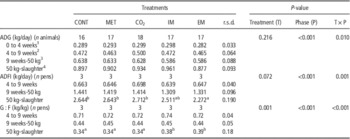
ADFI did not differ between treatments for the nursery phase (4 to 9 weeks of age) nor for the growing phase (up to 50 kg) (Table 1). During finishing (50 kg up to slaughter), ADFI was lower for the EM compared with the barrows (CONT, MET, CO2); it was not different from the IM. ADG did not differ significantly between the treatment groups for the different periods. For the finishing period, G : F was better for EM and IM compared with the groups of barrows. Figures of weekly evolution of ADFI, ADG and G : F are given as supplementary material (Supplementary Figure S1 to S3).
Effect of surgical castration without anaesthesia or analgesia (CONT), castration with analgesia (MET), castration with CO2 anaesthesia (CO2), immunocastration (IM) and raising entire male pigs (EM) on average daily gain (ADG) per animal, average daily feed intake (ADFI) and gain-to-feed ratio (G : F) per pen from farrowing or weaning until slaughter – experimental farm trial

abMeans with different superscripts on the same row are significantly different at P<0.05.
1 Farrowing to weaning.
2 Nursery phase.
3 Grower phase.
4 Early and late finisher phase.
Field trial
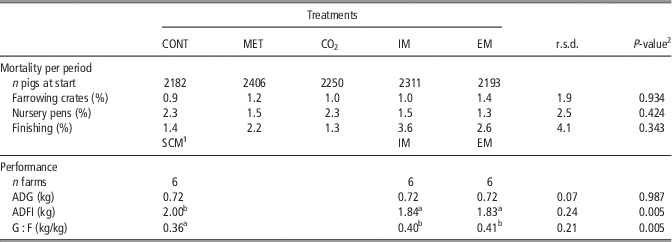
Mortality did not differ between treatments for any of the three periods, but differences between farms were observed (Table 2). ADFI during fattening was lower and G : F was higher for EM and IM as compared with SCM (pooled data of CONT, MET and CO2) (Table 2). ADG was not affected. Age at slaughter was not affected by treatment (average age: 201±14 days, P=0.567), but differed between farms from 174 to 234 days of age at slaughter.
Effect of surgical castration without anaesthesia or analgesia (CONT), with analgesia (MET), with anaesthesia (CO2), immunocastration (IM) and raising entire male pigs (EM) on mortality rates (%) per period and performance results from 20 kg to slaughter (average daily gain (ADG), average daily feed intake (ADFI) and gain-to-feed ratio (G : F)) – field trial

SCM=surgically castrated males.
abWithin a row, means without a common superscript differ (P<0.05).
1 As performance results of all three types of castration (without anaesthesia or analgesia, with analgesia and with anaesthesia) could not be registered on a sufficient number of farms, the performance results of the SCM were pooled and considered as one treatment group.
2 Farm was included as random factor.
Carcass traits
Experimental farm trial
Testes volumes of EM and IM did not differ at the time of the first and the second injection (week 15: IM: 264±74 cm3, EM: 244±65 cm3; week 21: IM: 692±153 cm3, EM: 670±186 cm3). After 2 weeks of second vaccination (week 23), testes size of IM did not further develop (651±158 cm3), whereas testes volume of EM increased (837±221 cm3) (sex: P=0.379, time: P<0.001, sex×time: P<0.001).
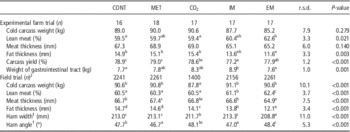
At slaughter, testes of EM (0.50±0.13 kg) were heavier compared with those of IM (0.28±0.08 kg) (P<0.001). Gastrointestinal tract of IM was heavier compared with that of EM (Table 3). As a result, carcass yield was the lowest for IM, intermediate for EM and the highest for CO2, CONT and MET.
Effect of surgical castration without anaesthesia or analgesia (CONT), castration with analgesia (MET), castration with CO2 anaesthesia (CO2), immunocastration (IM) and raising entire male pigs (EM) on carcass traits – experimental farm and field trial

abcWithin a row, means without a common superscript differ (P<0.05).
1 Parameters were recorded in two out of the five slaughterhouses (data from 10 farms, n of CONT=985, MET=1088, CO2=1033, IM=1078, EM=993).
2 Farm was included as random factor.
Lean meat percentage of EM was higher than CONT and CO2, with lean meat percentages of IM and MET being intermediate. Fat thickness was lower for EM compared with CONT, MET and CO2, with IM being intermediate. Meat thickness did not differ significantly.
Field trial
Farmers aimed to slaughter the pigs at a similar weight for all treatment groups according to their own practice; however, mean cold carcass weight was lower for CO2 compared with the other treatment groups. Carcass yield (n farms=8) was higher for SCM (pooled data from CONT, MET, CO2) (81.3%) compared with IM (80.3%) and EM (80.1%) (P<0.001). Testes weight (with epididymis) was lower for IM (0.31±0.15 kg, n=277) compared with EM (0.68±0.14 g, n=222) (P<0.001). For IM, the correlation coefficient between testes weight and number of days between the second vaccination and slaughter was −0.29 (P<0.001; n=277). Ham width was the lowest for EM. Ham angle was the highest for EM and CO2, intermediate for CONT and lowest for IM and MET.
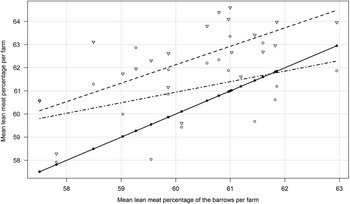
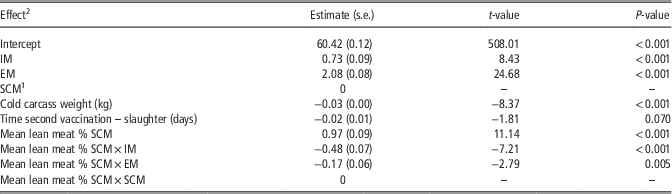
Lean meat percentage of EM was, on average, 2.0% higher (−0.5% to +4.6%) compared with the barrows (SCM : CONT, MET and CO2) and 1.3% higher compared with IM (Table 3). This increase in meat percentage for EM and IM compared with the SCM is also confirmed by the modelled estimates (Table 4). Meat percentage did not only depend on treatment (IM or EM) but also on the meat percentage present on farm (reflected by the meat percentage of the SCM) (P<0.001) and cold carcass weight (P<0.001); however, it was not significantly affected by time between the second vaccination and slaughter. There was also a significant interaction between treatment group and lean meat percentage of the SCM, indicating that the effect of shifting from SCM towards EM or IM was higher for a low lean meat percentage compared with a high lean meat percentage (Figure 1). This effect was more pronounced for IM (estimate: −0.48, P<0.001) compared with EM (estimate: −0.17, P=0.005).
Evolution of lean meat percentage of the barrows ( ), immunocastrates (
 ) and entire male pigs (
 ) compared with the mean lean meat percentage of the barrows per farm (lean meat percentage was modelled using a mixed model with the average meat percentage of the barrows on the farm, cold carcass weight, time between vaccination and slaughter, treatment and the interaction between treatment and the mean lean meat percentage as fixed effects) – field trial.

Evaluation of effect of treatment (immunocastration (IM) or raising entire male pigs (EM)), cold carcass weight, time between the second vaccination and slaughter, mean lean meat percentage of the barrows (SCMFootnote 1 ) and the interaction between mean lean meat percentage of barrows with treatment on the lean meat percentage – field trial

SCM=surgically castrated males.
1 SCM: data from surgically castrated males, castrated with or without anaesthesia or analgesia.
2 Based on data from 5902 barrows, 2156 immunocastrates and 2261 entire males, raised at 20 farms and slaughtered in one out of five slaughterhouses.
Evaluation of boar taint: field trial
The mean score for boar taint was higher for EM (0.5±0.7, n=2047) compared with IM (0.2±0.5, n=934) and SCM (0.1±0.4, n=649) (P<0.001). In general, the prevalence of strong boar taint was 3.0%, 0.5% and 0.2% and the prevalence of light boar taint was 12.8%, 4.2% and 2.8% for EM, IM and SCM, respectively. However, the detected prevalence varied greatly between farms. On nine farms, prevalence of strong boar taint for the EM was ⩽1%, eight farms showed levels between 2% and 5%, whereas three farms showed levels >9% (up to 14%).
Discussion
We have presented the results of several castration alternatives for pigs in two trials designed to measure boar taint, performance, carcass quality and mortality. The experimental farm trial was performed on a small number of animals under well-controlled circumstances, and gives a detailed view on the weekly evolution of growth performance, from farrowing to slaughter. In contrast, the field trial was performed on a large number of animals and relied partially on the measurements collected by the farmers. These trials, when taken together, provide a comprehensive view on the practical implications of the ban on the current practice of surgical piglet castration without pain relief that will take effect in the EU by 2018 (European Declaration on Alternatives to Surgical Castration of Pigs, 2010). The experiments confirm existing knowledge on castration alternatives and also yield valuable new information.
Both studies confirm that (immuno)castration effectively reduces boar taint, which is in line with the literature (Morales et al., Reference Morales, Gispert, Hortos, Perez, Suarez and Pineiro2010; Batorek et al., Reference Batorek, Candek-Potokar, Bonneau and Van Milgen2012a). Interestingly, EM from a similar genotype (Pietrain crosses) showed 0% strong boar taint on some farms and 10% and more on other farms. These results suggest that some farms have a boar taint prevalence of zero, whereas others have a high(er) risk for boar taint. Although caution is required when interpreting these prevalence results (they are based on a single slaughter batch per farm), future research on farm differences may yield additional insights. Of course, a prerequisite is the knowledge of the consistency of boar taint prevalence at the farm level. Comparing the low boar taint prevalence with the high prevalence farms may provide insight into risk factors for boar taint and stipulate strategies to reduce boar taint. In our opinion, efforts to determine risk factors for boar taint during the past decades have been hampered by the overall low prevalence of boar taint (3% in the present study) in combination with a limited number of experimental animals. Factors of interest are feed ingredients (such as inulin, lupines, raw potato starch), genetics of the sow line, hygiene conditions and management (e.g. mixing of groups) (Robic et al., Reference Robic, Larzul and Bonneau2008; Zamaratskaia and Squires, Reference Zamaratskaia and Squires2009; Aluwé et al., Reference Aluwé, Langendries, Bekaert, Tuyttens, De Brabander, De Smet and Millet2013).
To our knowledge, the present study is the first to compare mortality between CONT, MET, CO2, IM and EM under practical conditions. Anaesthesia was successfully induced in all piglets and none of the piglets died during or immediately after CO2 anaesthesia, indicating that flow and exposure time were well established as well as administered correctly. Mortality recorded by the farmer was also not significantly different between any of the treatment groups in the farrowing crates. Similarly, the treatments did not affect mortality during the growing or finishing periods, despite a slight increase in skin lesions and leg problems in EM (data not published). Little is known about the effect of analgesia or anaesthesia on on-farm mortality. However, McGlone et al. (Reference McGlone, Nicholson, Hellman and Herzog1993) and Fredriksen et al. (Reference Fredriksen, Furnols, Lundstrom, Migdal, Prunier, Tuyttens and Bonneau2009) indicated that castration itself rarely affects mortality. Neither castration nor administration of anaesthesia or analgesia during castration affected DG during the first weeks of age. This is in line with previous studies comparing DG during the first day(s) after castration between piglets castrated with or without analgesia and/or anaesthesia or piglets that were left entire (Kluivers-Poodt et al., Reference Kluivers-Poodt, Houx, Robben, Koop, Lambooij and Hellebrekers2012; Schmidt et al., Reference Schmidt, Konig and von Borell2012; Sutherland et al., Reference Sutherland, Davis, Brooks and Coetzee2012).
Both trials confirm the better G : F ratio in ad libitum fed EM and IM in comparison with SCM (Dunshea et al., Reference Dunshea, Colantoni, Howard, McCauley, Jackson, Long, Lopaticki, Nugent, Simons, Walker and Hennessy2001; Morales et al., Reference Morales, Gispert, Hortos, Perez, Suarez and Pineiro2010; Batorek et al., Reference Batorek, Skrlep, Prunier, Louveau, Noblet, Bonneau and Candek-Potokar2012b). This is a result of lower feed intake without clear differences in ADG. After the second vaccination, however, ADFI and DG of IM strongly increases (Schmidt et al., Reference Schmidt, Calabrese, Grodzycki, Paulick, Pearce, Rau and von Borell2011; Batorek et al., Reference Batorek, Skrlep, Prunier, Louveau, Noblet, Bonneau and Candek-Potokar2012b; Weiler et al., Reference Weiler, Gotz, Schmidt, Otto and Muller2013). We showed that this increase is very abrupt and noticeable within 1 week after the second injection.
In both studies, it was not possible to show a significant effect of treatment on ADG. Most studies show a similar growth for EM and SCM (Millet et al., Reference Millet, Gielkens, De Brabander and Janssens2011; Weiler et al., Reference Weiler, Gotz, Schmidt, Otto and Muller2013). For IM, results for DG for the overall fattening period differed between studies (Millet et al., Reference Millet, Gielkens, De Brabander and Janssens2011). Some studies did not show significant differences in ADG (D’Souza and Mullan, Reference D’Souza and Mullan2003; Morales et al., Reference Morales, Gispert, Hortos, Perez, Suarez and Pineiro2010), whereas others found a higher ADG for IM when fed ad libitum compared with EM, due to the increased ADG after the second vaccination (Gispert et al., Reference Gispert, Oliver, Velarde, Suarez, Perez and Furnols2010; Batorek et al., Reference Batorek, Skrlep, Prunier, Louveau, Noblet, Bonneau and Candek-Potokar2012b; Furnols et al., Reference Furnols, Gispert, Soler, Diaz, Garcia-Regueiro, Diaz and Pearce2012). Whether or not a difference over the entire fattening period is observed probably depends on the magnitude of the feed intake response after the second vaccination and the time between the second vaccination and slaughter.
The results of both trials also confirm the existing knowledge on lean meat percentage, with lowest values for SCM, highest for EM and intermediate for IM (Gispert et al., Reference Gispert, Oliver, Velarde, Suarez, Perez and Furnols2010; Morales et al., Reference Morales, Gispert, Hortos, Perez, Suarez and Pineiro2010; Boler et al., Reference Boler, Killefer, Meeuwse, King, McKeith and Dilger2012; Furnols et al., Reference Furnols, Gispert, Soler, Diaz, Garcia-Regueiro, Diaz and Pearce2012; Pauly et al., Reference Pauly, Luginbuhl, Ampuero and Bee2012). The effect on carcass conformation is less reported. We observed that ham conformation was better (highest ham width and lowest ham angle) for IM compared with EM (lowest ham width, highest ham angle). The results of ham width of IM were similar to the two groups of barrows (CONT and MET) with similar cold carcass weight. Results of ham angle also differed between the barrows, but these differences are difficult to explain. Other authors (Morales et al., Reference Morales, Gispert, Hortos, Perez, Suarez and Pineiro2010; Batorek et al., Reference Batorek, Skrlep, Prunier, Louveau, Noblet, Bonneau and Candek-Potokar2012b) found the highest ham and shoulder weights in EM and the lowest in SCM (Morales et al., Reference Morales, Gispert, Hortos, Perez, Suarez and Pineiro2010). This apparent contradiction may be due to the difference in growth stage at the time of slaughter. The maximal capacity for protein deposition declines faster in SCM (Van Milgen et al., Reference Van Milgen, Quiniou and Noblet2000), and thus, at a similar slaughter weight, SCM and IM may be more ‘full grown’ compared with EM.
The above-mentioned differences in lean meat percentage only apply to the average farm. The present farm study revealed new information on farm-specific differences in the effect of immunocastration on lean meat percentage: in farms with lower lean meat percentages (lean meat percentage of SCM<61.8%), a clear increase of lean meat percentage with immunocastration was observed. In contrast, on farms with higher lean meat percentage (lean meat percentage of SCM>61.8%), no increase in meat percentage for IM was seen. A similar effect was observed with EM compared with SCM, although EM have consistently higher meat percentages and the effect of basal lean meat percentage is less pronounced. These observations are in line with the studies conducted by Lundstrom et al., (Reference Lundstrom, Matthews and Haugen2009) and Bonneau (Reference Bonneau1998) who indicated that the advantage of lean meat growth when shifting towards EM pigs may have decreased because of selection for leaner pig breeds. None of the studies on the interaction between genotype and castration method on carcass quality published thus far showed any significant interactions (D’Souza and Mullan, Reference D’Souza and Mullan2003; Morales et al., Reference Morales, Camara, Berrocoso, Lopez, Mateos and Serrano2011 and Reference Morales, Serrano, Camara, Berrocoso, Lopez and Mateos2013). When shifting towards the production of immunocastrates or EM, it is relevant for the farmers to consider whether it is appropriate to continue with the current genetic line or whether it would be economically beneficial to change to lines characterised by a lower lean meat percentage and higher DG.
Time between second vaccination and slaughter may have considerable effects on performance results (Lealiifano et al., Reference Lealiifano, Pluske, Nicholls, Dunshea, Campbell, Hennessy, Miller, Hansen and Mullan2011; Boler et al., Reference Boler, Killefer, Meeuwse, King, McKeith and Dilger2012). However, other factors (such as diet, genotype of the sow, management practices) may be equally or more important, as we were not able to filter the effect of time of second vaccination from our data set. In the experimental farm as well as in the field trial, routine feed compositions and feeding schedules (ad libitum) were used. Up-to-date knowledge on the optimal feeding strategy for IM and EM is limited, and further research is needed (Millet et al., Reference Millet, Gielkens, De Brabander and Janssens2011). Although ad libitum feeding provides the opportunity to fully use the possibility of increased feed intake capacity and achieve an increased ADG, this may result in increased fat on the carcasses and may negatively affect carcass yield. Indeed, IM showed lower carcass yield compared with SCM. Increased gut fill and stimulation of the gastrointestinal tract development because of the higher feed intake are often suggested as main reasons for the lower carcass yield of IM (Dunshea et al., Reference Dunshea, Colantoni, Howard, McCauley, Jackson, Long, Lopaticki, Nugent, Simons, Walker and Hennessy2001; Gispert et al., Reference Gispert, Oliver, Velarde, Suarez, Perez and Furnols2010; Furnols et al., Reference Furnols, Gispert, Soler, Diaz, Garcia-Regueiro, Diaz and Pearce2012). The results of our experimental farm trial confirm the increased weight of the gastrointestinal tracts of IM compared with CONT and EM, even after fasting. Others also observed increased weight of kidneys, liver (Pauly et al., Reference Pauly, Spring, O’Doherty, Kragten and Bee2009) and abdominal fat (Skrlep et al., Reference Skrlep, Segula, Zajec, Kastelic, Kosorok, Fazarinc and Candek-Potokar2010). The lower testes weight of IM in comparison with EM is also in line with the literature (Morales et al., Reference Morales, Gispert, Hortos, Perez, Suarez and Pineiro2010; Batorek et al., Reference Batorek, Candek-Potokar, Bonneau and Van Milgen2012a). The positive correlation between time after the second injection and testes weight confirms that testes weight is lower when vaccination is performed earlier (Lealiifano et al., Reference Lealiifano, Pluske, Nicholls, Dunshea, Campbell, Hennessy, Miller, Hansen and Mullan2011).
Conclusion
In this study, applying anaesthesia or analgesia under field conditions did not increase mortality during castration or the first week after castration compared with uncastrated male pigs or male pigs castrated without anaesthesia or analgesia. Although (immuno)castration is a valid method to eliminate boar taint, the results suggest that boar taint can also be absent on some farms raising boars. In comparison with SCM, EM have improved G : F ratio and meat percentage without affecting ADG, slaughter age or mortality, but EM tends to decrease carcass yield. Immunocastration stimulates feed intake after the second vaccination, which negatively affects carcass yield. In comparison with SCM, IM have better G : F. IM benefits lean meat percentage on farms with a low average lean meat percentage; however, this benefit is less important for farms with a high lean meat percentage. Accordingly, the results of the present study support previous research. Nevertheless, important farm-specific differences in boar taint prevalence as well as in carcass quality may affect the choice for a particular castration alternative by 2018. Further research into the reasons for these differences is essential.
Acknowledgements
This study was financially supported by the Institute for Agriculture and Fisheries Research, the Agriculture and Fisheries Agency (Flemish Government), Boerenbond, Belporc and VLAM. Thanks to all farmers and slaughterhouses involved in this study for their dedicated co-operation. Thanks to B. Driessen for co-ordinating the anaesthesia. We are grateful for all the practical support given by our colleagues at ILVO, with special thanks to Stefan Meirlaen. We also thank B. Ampe for statistical guidance and Miriam Levenson for English language editing.
Supplementary material
To view supplementary material for this article, please visit http://dx.doi.org/10.1017/S1751731114002894