Introduction
Many older people admitted to hospital are malnourished and their nutritional status often deteriorates further during their in-patient stay.Reference McWhirter and Pennington1, Reference Potter, Klipstein, Reilly and Roberts2 This is due to a combination of physiological changes resulting in a decreased appetite, regulation of food intake,Reference Klipstein-Grobusch, Reilly, Potter, Edwards and Roberts3, Reference Roberts, Fuss, Heyman, Evans, Tsay, Rasmussen, Fiatarone, Cortiella, Dallal and Young4 and the effect of diseases which increase in prevalence with age.Reference Morley5
A low body mass index (BMI) in community-dwelling older people is independently associated with a higher mortality and a greater risk of functional impairment.Reference Galanos, Pieper, Cornoni-Huntley, Bales and Fillenbaum6, Reference Fiatarone and Evans7 Malnutrition is associated with an increased risk of both hospital admission and readmission to hospital.Reference Friedmann, Jensen, Smiciklas-Wright and McCamish8 Protein-energy malnutrition is common, occurring in 29% of patients admitted to residential care from home and rising to 43% of those admitted from hospital.Reference Christensson, Unosson and Ek9 Patients with pressure sores or leg ulcers, psychological stress, acute disease in the previous three months, reduced fluid intake, reduced appetite, reduced mobility, needing help during meals and with gastrointestinal symptoms are at particular risk.
Nutritional assessment is advocated by the British Geriatrics Society as an integral part of the comprehensive, multidimensional geriatric assessment of frail older patients admitted to hospital. Malnutrition is associated with an increased length of hospital stay, a higher rate of new prescriptions and disease severityReference Edington, Boorman, Durrant, Perkins, Giffin, James, Thomson, Oldroyd, Smith, Torrance, Blackshaw, Green, Hill, Berry, McKenzie, Vicca, Ward and Coles10 and is an independent predictor of hospital mortality.Reference Incalzi, Gemma, Capparella, Cipriani, Landi and Carbonin11 Nutritional supplementation, often in the form of commercially available sip feeds, is the most commonly used intervention to optimize nutritional state based on a large body of evidence showing improvement in mortality when given to in-patients with a low BMI, low triceps skin-fold thickness (TSF), low mid-arm circumference (MAC) or low serum albumin.Reference Potter, Milne, Vivanti and Avenell12 This has been shown consistently for older in-patients with a variety of medical conditions. In contrast there is uncertainty about how best to improve nutritional state in hospitalized older patients with fractures, or community-dwelling older people.Reference Avenell and Handoll13–Reference Nijs, Graaf and Kok21 Although trials of sip feeds in orthopaedic wards have been disappointing, using feeding assistants has been shown in at least one trial to reduce both in-patient and four-month mortality, to increase mean calorific intake and to lead to a smaller reduction in mid-arm circumference during the in-patient period.Reference Duncan, Beck, Hood and Johansen19
Malnutrition is therefore associated with a variety of adverse outcomes. In this article we review the evidence for the effectiveness of nutritional supplementation for older people in the community, in institutional care and following discharge from hospital. We also explore strategies to improve nutrition by means other than oral nutritional supplements.
Search methods
We performed a search of the MEDLINE database using the search terms ‘nutrition OR nutritional AND supplements, AND older people OR elderly’. We limited our search to English language and human studies. We reviewed the abstracts of studies with titles we felt to be relevant. A hand search of the references was also performed and any other relevant studies known about by the authors were included. The studies we found using this strategy are reviewed in three sections below: those performed in community-dwelling older people, those performed with institutionalized older people and those performed at time of discharge from hospital. We also review studies we found reporting on palatability of supplements and a few interventions other than nutritional sip feeds to improve nutritional state. These papers were found while searching those found using the search terms above.
Nutritional supplementation in community-dwelling older people
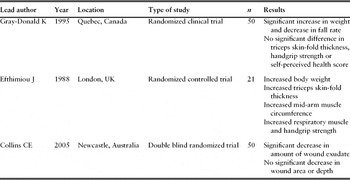
Trials of nutritional supplementation in the community are scarce; we found only three studies covering this population and these are summarized in Table 1.
Nutritional supplementation in community-dwelling older people

Gray-Donald and colleagues' trial enrolled older people (mean age 78 years) living at home but receiving long-term home help services.Reference Gray-Donald, Payette and Boutier22 Eligible subjects were deemed to be at nutritional risk due to recent weight loss (>5% in last month, >7.5% in last 3 months or >10% in last 6 months) or had a BMI < 24. People were excluded if they were receiving palliative care, had active cancer, or an illness requiring a therapeutic diet incompatible with supplementation. Therefore their malnutrition was not directly attributable to a specific underlying disease process and they had not recently been unwell or hospitalized. The effect of oral nutritional supplements (two 235 ml cans of commercial supplements per day) on weight, hand grip strength, anthropometric measurements, self-perceived health and rate of falls at 12 weeks follow-up was examined.
Efthimiou and colleagues' trial included just 21 patients with chronic obstructive pulmonary disease (COPD).Reference Efthimiou, Fleming, Gomes and Spiro23 Seven patients were randomized to the intervention group and received 3 months of a supplemented diet compared with the seven patients who received their normal diet. Both of these groups were compared with a control group of a further seven well-nourished patients with COPD. Although significant improvement was seen with most of their outcome measures the trial was disease specific in that the subjects all had COPD, meaning that the results are not necessarily pertinent to the population of older people in general. The study was also very small.
Collins and colleagues' study of community-dwelling over-60-year-olds examined the effect of supplements on wound healing.Reference Collins, Kershaw and Brockington24 Subjects with a variety of different wound types referred for wound management were randomized to receive a liquid supplement containing either 1 kcal/ml or 2 kcal/ml of energy for a 4-week period. Forty per cent of the subjects were moderately or severely malnourished as assessed using a subjective global assessment at baseline, although the mean BMI was 26 and most subjects were not underweight. Using the Australian Nutritional Screening Initiative (ASNI), 89% of the subjects were considered to be at moderate or high risk of malnutrition. The higher energy supplement was found to be associated with significantly greater wound healing as assessed by exudate volume but not by wound area or depth. This study was small (50 patients) and follow-up was brief at only 4 weeks; a longer and larger trial would be helpful to see if these trends reflect clinically useful interventions. In this trial's favour, it examined a clinically relevant endpoint, in contrast to most other studies in the field of nutrition.
Nutritional supplementation in institutionalized older people
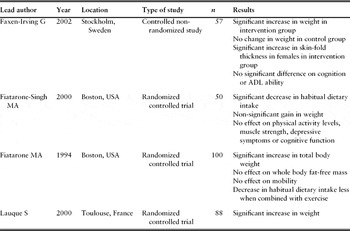
Many older people are discharged from acute hospitals to a variety of institutional settings such as nursing homes, residential homes and NHS continuing care hospitals rather than their own homes. A number of studies have looked at dietary supplements in these settings and are summarized in Table 2.
Nutritional supplementation in older people living in institutions

A non-randomized study of patients with dementia in a group living environment (community-assisted housing with communal eating and social areas) examined the effect of liquid oral nutritional supplements on body mass and cognitive decline.Reference Faxen-Irving, Andren-Olsson, Geijerstam, Basun and Cederholm25 Participants had a mean Mini Mental State Examination (MMSE) score of 9/30 at study entry so already had severe cognitive impairment. The intervention group in one centre received two 200 ml oral liquid supplements a day for 5 months: a juicy supplement between meals in the afternoon and a balanced supplement in the evening when the prescribed drugs were given. The staff caring for the intervention group also attended a 12-hour educational programme about nutrition and diet that those caring for the control group did not receive, which may have had an impact on the results. Follow-up was for 6 months. The increase in triceps skin-fold thickness was only seen in women following subgroup analysis based on sex. However, only five out of 36 and four out of 21 of the intervention and control groups respectively were men, so the numbers involved are only small. There was no randomization.
A randomized controlled trial involving 50 patients (mean age 87.5 years) residing in a long-term facility for older people studied the effect of a multinutrient liquid oral nutritional supplement compared with a non-nutritive placebo drink.Reference Fiatarone Singh, Bernstein, Ryan, O'Neill, Clements and Evans26 This study is actually a subgroup analysis of the larger Frailty and Injuries: Co-operative Studies of Intervention Techniques (FISCIT) trial, but looking only at participants who were not randomized to receive an exercise programme as the authors wanted to look specifically at the effect of supplements. Participants were frail nursing home residents. Interestingly there was a marked decrease in habitual dietary intake in the supplemented group, which meant that after the 10-week trial the total nutritional intake of energy was only marginally higher in the supplemented than the control group. The greatest negative effect was on energy and water intake. This study had numerous exclusion criteria, meaning that many acutely unwell or recently unwell subjects were excluded so the study population was relatively healthy.
Fiatarone and colleagues' earlier paper on the FISCIT trial also included subjects who were randomized to receive progressive exercise training, multinutrient oral nutritional supplements, both interventions or neither.Reference Fiatarone, O'Neill, Ryan, Clements, Solares, Nelson, Roberts, Kehayias, Lipsitz and Evans27 Eighty-three per cent of all participants required a cane, walker or wheelchair at baseline. The nutritional supplement contained 360 kcal of energy and one-third of the recommended daily allowances of vitamins and minerals. The effect on dietary intake as well as muscle strength, body composition and mobility was studied. At 10 weeks those receiving supplements had a significant decrease in habitual dietary intake, which was not as great when combined with exercise. Similarly to their later subgroup analysis discussed earlier this suggests that supplements alone without exercise to promote an increased appetite may not be beneficial and may actually be detrimental, by causing a decrease in normal dietary intake.
The effect of suppressing habitual dietary intake with oral nutritional supplements is controversial. It has been tested in a number of hospital settings with total nutritional intake increasing,Reference Milne, Avenell and Potter28–Reference Roberts, Potter, McColl and Reilly30 but outside hospital this does not appear to be the case universally. Some studies such as Fiatarone's discussed above show a suppression of appetite, while others show an increase in total energy intake similar to that seen in hospital.Reference Lauque, Arnaud-Battandier, Mansourian, Guigoz, Paintin, Nourhashemi and Vellas31
We also referred earlier to the differences in dietary regulation in older people as a possible explanation for some of the weight loss as people age.Reference Roberts, Fuss, Heyman, Evans, Tsay, Rasmussen, Fiatarone, Cortiella, Dallal and Young4 In this interesting study there was a difference in the likelihood of resuming usual energy intake between older and younger people. This was done in the out-patient setting so people were relatively well and living independently in the community. Older people were more likely to remain under- or over-eating after a period where this was enforced; perhaps this reflects some difference in appetite regulation. This concept was considered again in a further study of cognitively impaired residents of an aged care facility in Toronto. This trial aimed to determine nutritional intake after an intervention encouraging patients to consume an additional supplement given mid-morning for 3 weeks. The participants were followed up after the intervention phase and each phase lasted 21 days. Participants had a mean age of 88 years with mean BMI of 23.7. Patients were likely to continue their additional nutritional intake voluntarily after the research worker ceased to encourage them. Interestingly, not all participants did this, but the subgroup who had been compliant during the intervention period when the research worker was encouraging them continued to consume the additional morning snack. Overall nutritional intake of this group was increased without suppressing total intake from other meals.Reference Parrott, Young and Greenwood32 This highlights a potentially more efficient way to achieve additional intake for a larger number of patients by rotating staff over different groups and hoping to maintain intake between interventions.
Although Laque and colleagues describe their study of nursing home residents in France as randomized it was only semi-randomized.Reference Lauque, Arnaud-Battandier, Mansourian, Guigoz, Paintin, Nourhashemi and Vellas31 Those assessed as malnourished using the mini-nutritional assessment (MNA) were offered nutritional supplements, whereas those at risk of malnutrition were randomized to either receive supplements or not. Those randomized to receive supplements were offered a variety of feeds (sweet or savoury, liquid or creamy, hot or cold) to suit individual tastes. Subjects were encouraged to consume the entire amount offered. The effect on BMI, grip strength, energy intake and protein intake was studied. Again habitual energy intake decreased slightly in those receiving supplements, particularly in those with greater level of malnutrition at baseline, but contrary to Fiatarone's studies total energy intake increased significantly in all supplemented groups.
Nutritional supplementation on discharge from hospital
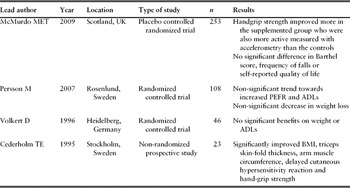
As hospital stays are short and becoming shorter, the opportunity for meaningful dietary supplementation during the in-patient stay is more limited. There is well-established evidence of a benefit on mortality for in-patient supplementation targeted at malnourished individuals. However, the effectiveness of ongoing nutritional assessment and support following hospital discharge requires exploration. There is a striking paucity of trials examining the effect of nutritional supplementation following hospital discharge. Those we found including this population of patients are summarized in Table 3.
Nutritional supplementation for older people following discharge from hospital

The most recent and largest trial recruited 253 people aged ≥70 years who had been admitted to hospital with an acute illness.Reference Edington, Boorman, Durrant, Perkins, Giffin, James, Thomson, Oldroyd, Smith, Torrance, Blackshaw, Green, Hill, Berry, McKenzie, Vicca, Ward and Coles10 Participants had a BMI less than 24.0 kg/mReference Potter, Klipstein, Reilly and Roberts2 and mid-arm muscle circumference below the 10th centile or weight loss of 5% or more during their hospital stay, and were randomized on discharge to oral nutritional supplementation in the form of 400 ml/day of Fresubin (containing 600 kcal, 840 kJ, 12.4 g protein) or a matching control supplement containing minimal energy and followed up for 16 weeks. The primary outcome measure was change in Barthel score where no significant difference was seen between the treatment groups. The results did demonstrate a non-significant trend towards an improvement in body weight and the sit-to-stand test. Following adjustment for gender and baseline handgrip strength, handgrip strength at 16 weeks improved more in the supplemented group than the controls. Deaths and unplanned readmissions were similar in both groups. Adherence was poor (approximately 50%) and the trend towards weight gain was only seen in ‘on treatment’ analysis. Possible reasons for this low adherence are discussed later.
Persson and colleagues' Swedish randomized study enrolled patients admitted to two geriatric medicine wards.Reference Persson, Hytter-Landahl, Brismar and Cederholm33 Patients assessed to be at risk of protein energy malnutrition within 3 days of admission were invited to participate. Those with malignant disorders, terminal illness or with severe cognitive impairment were excluded. Of 212 patients at risk of malnutrition, 79 fulfilled the exclusion criteria and 25 declined participation, leaving 108 to be enrolled (mean age 85 years). The participants were randomized before discharge. The intervention group received individualized counselling sessions from a dietician before discharge and another within 1 week of discharge. The dietician also telephoned the patients at 1–2 weeks following discharge, in the middle of the study and a week before follow-up at 4 months. Patients were advised to increase their fat intake by using full-fat milk, cream and creme fraiche in their cooking, to eat more snacks between meals and also prescribed a patient choice of liquid oral nutritional supplements (Semper, 200 ml/package) and a daily multivitamin supplement. The control group was given brief written dietary advice. When analysed by intention to treat, the intervention group's weight remained stable while those in the control group lost 2 kg. The intervention group appeared to improve both their ADLs (as assessed by the Katz index) and their peak expiratory flow (PEF), although these differences were not statistically significant.
A per protocol analysis demonstrated a statistically significant benefit on weight, which remained stable in the intervention group compared with mean weight loss of 3 kg in the control group. The same analysis showed that handgrip strength, PEF and MMSE improved in the intervention group but not in the controls, and the number of highly dependent patients decreased in the intervention group compared with an increase in the control group. No effects on self-assessed quality of life (as assessed by the SF-36 questionnaire) were seen. It should be noted that with the exception of BMI and weight, none of these differences reached statistical significance. Because the intervention involved a number of components (dietary advice, prescription of supplements and food fortification) it is difficult to determine which of these individual elements or the combination of them all led to the results.
Some smaller studies have been performed. A prospective randomized controlled trial of older women (mean age 85 years) admitted to acute geriatric wards in Germany studied the effect of liquid oral nutritional supplements, both during the in-patient stay and following discharge, on body weight, functional status and nutritional intake.Reference Volkert, Hubsch, Oster and Schlierf34 Those included were judged to be undernourished (based on the clinical judgement) and had no malignant disease or need for tube feeding or parenteral nutrition. On admission, patients were randomized to receive two portions of supplement in addition to the normal hospital diet, or normal hospital diet alone. The supplements consisted of soup mid-morning and a sweet supplement in the afternoon. On average the 200 ml supplements contained 250 kcal and 15 g protein. After discharge the intervention group were provided with one portion of the sweet supplement each day. Seventy-two patients were enrolled, but only 46 patients completed the 6-month study. Twelve died during the 6 months following discharge, ten refused examination at follow-up, and four patients moved out of the study town. The intervention group were split for analysis into those who had good acceptance (n = 11) of the supplements (consumed one portion per day) and those who had poor acceptance (n = 9) (consumed one portion every two days or less). Mean body weight improved significantly in all groups following discharge and was greatest in the ‘good acceptance’ group at 3.4 kg, but this was not significantly different from either the ‘poor acceptance’ or control groups. The effect on ADLs was assessed using a 100-point scale. Although the group who received and accepted the supplements had a larger increase in their ADL score as a whole, this appears to have mainly occurred during the hospital admission rather than at home. On the one hand none of the intervention group taking the supplements deteriorated in their ADLs at home compared with the control group and those in the intervention group with low acceptance of supplements, but on the other hand a larger proportion of the control group improved their ADL score following discharge than the intervention group who took the supplement. The small numbers in each of the subgroups reduces the power of any findings so no convincing conclusions can be drawn on any benefits of supplements on discharge from hospital.
Cederholm and colleagues' study of severely malnourished (subnormal values of all anthropometric, biochemical and functional variables) older patients with chronic diseases recently discharged from hospital found a number of benefits (see Table 3).Reference Cederholm and Hellstrom35 The supplement prescribed was Fortimel, a protein-rich liquid formula, but there was no randomization and the study was very small in size (23 patients), thus weakening these findings. In addition to the supplements all the study participants also received education on how to improve their nutritional intake. This study also examined the effect of ongoing inflammation (serum orosomucoid level) due to the underlying chronic disease on protein nutrition. A greater improvement in nutritional status was seen in those with lesser degrees of inflammation.
Palatability of and adherence with nutritional supplements
Even if nutritional supplements are beneficial, do patients take them? Many trials fail to adequately report adherence rates when supplements are offered. Measuring adherence is inherently more difficult in studies performed in the community as it relies on self-report or carton counts, but in this respect is no different from recording adherence with medication.
Some papers have reported low levels of adherence and palatability of oral nutritional supplements. Research in older patients after a hip fracture observed that ‘reluctance to take oral nutritional supplements appeared to be a major factor that limited the effectiveness of therapy’.Reference Potter, Milne, Vivanti and Avenell12 Adherence to supplements in a study of patients following hospital discharge was only 38% in the treatment arm.Reference Edington, Boorman, Durrant, Perkins, Giffin, James, Thomson, Oldroyd, Smith, Torrance, Blackshaw, Green, Hill, Berry, McKenzie, Vicca, Ward and Coles10 Many patients eligible for inclusion declined to do so, with many citing a dislike of milky drinks as a reason. This low level of enthusiasm for such supplements supports previous observations where 36% of potentially eligible participants declined to take part.Reference Gray-Donald, Payette and Boutier22, Reference Larsson, Unosson, Ek, Nilsson, Thorslund and Bjurulf36 However, low adherence is not universal, with some high adherence rates being reported. Over a 4-week period, 43 out of 50 subjects in one study reportedly consumed all (1 × 80 ml can per day) of a liquid supplement prescribed.Reference Collins, Kershaw and Brockington24
Where low adherence is a problem it may be that the perception of sip feeds and their taste is the problem rather than the actual tastes themselves. A study in 21 healthy adults aged 60–79 years looked at how users rated the taste of sip feeds compared with other high-energy snack foods such as potato chips, chocolate, cereal bars, cheese crackers and beer.Reference McAlpine, Harper, McMurdo, Bolton-Smith and Hetherington37 Sip feeds compared well with other energy-dense snacks; they were rated as tasting as pleasant as cheese crackers, potato chips and chocolate. Vanilla was the most popular flavour of sip feed. This suggests that if a supplement can be found to suit an individual's taste, adherence may be better. This is supported by Lauque and colleagues' study outlined above in which the authors report that those given supplements ‘had good compliance’.Reference Parrott, Young and Greenwood32 In their study a selection of different flavoured supplements were offered rather than just one, as in most studies. The element of patient choice in terms of adherence is likely to be significant. There was a slight decrease in consumption of supplements after 50 days suggesting that ‘taste fatigue’ or monotony may set in, even with preferred flavours when supplements are given in the longer term.
The concept of nutrition as a medicine may well be the reason for the variance in compliance rates between the hospital and community trials. For example, when supplements are prescribed on medication charts, compliance and thus nutrient intake is good.Reference Potter, Roberts, McColl and Reilly29 In this study low compliance was mainly due to reduced oral intake for medical reasons rather than patients finding supplements unpalatable. This is also shown clearly in the weight differences in the most recent Cochrane review on supplementation.Reference Potter, Milne, Vivanti and Avenell12 Treating supplements as medication and regular encouragement to take them is more difficult away from a ward setting.
Other dietary interventions
Alternative methods of improving dietary intake in elderly patients in institutional settings appear promising, perhaps because they are seen as more ‘normal’ and less like an additional medication.
Taste and smell play an important role in appetite, nutrient intake and food choice. Significant chemosensory losses occur with age with both altered and reduced sensation of taste and smell.Reference Schiffman38 A number of studies have examined the effect of the addition of food flavours to a variety of nutritious foods. A crossover study of 39 independent living residents at a retirement home, mean age 84.6 years, found flavour enhancement resulted in improved T and B cell levels and improved grip strength.Reference Schiffman and Warwick39 The intervention consisted of adding six flavours (roast beef, ham, natural bacon, prime beef, maple and cheese) to 30 nutrient-dense foodstuffs over a 3-week period. The group receiving the enhanced food had the same menu as those not receiving the enhanced food. The groups crossed over after 3 weeks. Consumption of 20 of the 30 foods increased with the addition of flavours, but neither the overall calorific intake nor the dietary nutrient profile changed. The authors' interpretation of this was that not all the foods in a meal were enhanced for the intervention period and that subjects just ate more of the enhanced foods at the expense of the non-enhanced items. Despite this, T and B cell counts increased, as did grip strength.
A study involving 43 hospital in-patients with either clinical malnutrition, weight loss of 6% or more or below their ideal body weight examined the effect of flavour enhancement and monosodium glutamate (MSG) fortification on dietary intake.Reference Schiffman40 The study was very short (only 2 days). The calorific intake on the 2 days was measured. On one of the days the patients were given food enhanced with flavours and MSG (the levels of which were individualized based on evaluations of each patient's taste and smell thresholds). On the other day the food was not enhanced. Forty of the 43 patients consumed at least 10% more calories on the day they received flavour-enhanced food than on the other day. These studies are small, non-randomized and the second study described was only 2 days long, making it is difficult to draw any clear conclusions. However, a possible role for enhancing flavours to increase palatability and improve appetite is suggested.
Human beings are usually social animals, and throughout our life eating plays an important social function as well as a purely nutritional one. Social facilitation of eating has been demonstrated to have a benefit on nutrition in healthy adults. When study participants ate in the company of familiar others, their intake of snack items increased significantly compared with their intake when eating alone.Reference Larsson, Unosson, Ek, Nilsson, Thorslund and Bjurulf36
This finding is supported by a novel study of residents of Dutch nursing homes.Reference Daniels, Miller, Bannerman and Crotty17 178 residents were randomized to an altered eating environment or usual care. The altered environment involved family styled meals with residents sharing a communal dining area with a table cloth and food available in the centre served to individuals as desired. Usual care included pre-ordered tray delivered meals to residents in their own rooms. The routines of the nursing home were also changed so that meal time was protected from other routine activities in the family style meal area. After 6 months body weight and energy intake, as well as a number of other outcomes including fine motor function and overall quality of life, improved in the family style meals area.
The positive results seen with employing feeding assistants study in orthopaedic wardsReference Duncan, Beck, Hood and Johansen19 and the family style meals intervention suggest that a personal touch to encouraging and serving food in community settings may offer an appealing alternative to sip feed supplements.
Conclusions
Community-dwelling plder people
Evidence for use of oral nutritional supplements as sip feeds in undernourished community-dwelling older people is currently insufficient to recommend routine use.
Older people living in institutions
Evidence for use of oral nutritional supplements in undernourished older people living in institutions is currently insufficient to recommend routine use. Some trials report increases in body weight, skin-fold thickness and muscle circumference, but these findings are not universal and no benefits on physical function have been proven. There are suggestions that habitual dietary intake may decrease when supplements are consumed. Further research is needed to clarify any benefits and potential disadvantages of nutritional supplementation in this setting.
Patients discharged from hospital
There is currently insufficient evidence to support the use of oral nutritional supplementation for undernourished older people following hospital discharge.
Other dietary interventions
There is encouraging evidence that interventions to heighten the taste of food and offering food in a more sociable environment, or using feeding assistants in a more personal approach, may improve nutritional status and quality of life for older people. This has potential for community and aged care facilities but may be labour intensive and therefore costly to achieve.
Future research
The outcome measures used in trials of nutritional interventions focus predominantly on body weight, grip strength and anthropometry, rather than more patient-centred outcomes such as quality of life or physical function, which are likely to be more meaningful to older people and more persuasive to those providing health and social care services. Future nutritional intervention trials would benefit from a more robust methodological approach (use of ‘placebo supplements’, blind outcome assessment, thorough reporting of adherence and adverse events) and from embracing outcome measures that are meaningful to the lives of older people.
Further trials considering pragmatic ways of improving the social settings of mealtimes and providing personal feeding assistants in the community or care settings are warranted. Research should explore how best to maximize the efficiency of these interventions to make them cost efficient and achievable.
Conflict of interest
ML has no conflict of interest. METM and JMP conducted a Scottish Executive-funded clinical trial of oral nutritional supplements in which both the supplements and the matching control supplement were provided at no cost by Fresenius Kabi Limited.