

Introduction
The benefits of gender-balanced governments are well documented, as electing more women to public office can strengthen democratic legitimacy (Osborn Reference Osborn2014) and produce different outcomes in public policy (Thomas Reference Tripp and Kang1991). Yet, most state legislatures remained composed of 70% men (Center for American Women in Politics 2019). This gap in representation leaves policy advocates, politicians, and activists searching for reforms to bring more women into the political sphere. Some states are turning to gender balance legislation (GBL) to alter their state board’s descriptive representation. As recently as January 2018, Democratic New York Assembly woman Nily Rozic, introduced a bill requiring officials who appoint state public board members to nominate women and men in similar numbers. Rozic argued, “the legislation… aims to change the dynamic that exists for women’s representation on local boards. Studies have repeatedly shown that having a more diverse board in terms of gender or otherwise actually increases profitability because you’re looking at problems differently, you’re more inclusive, and I think that will really benefit state boards across New York” (Mahoney Reference McQueen2018).
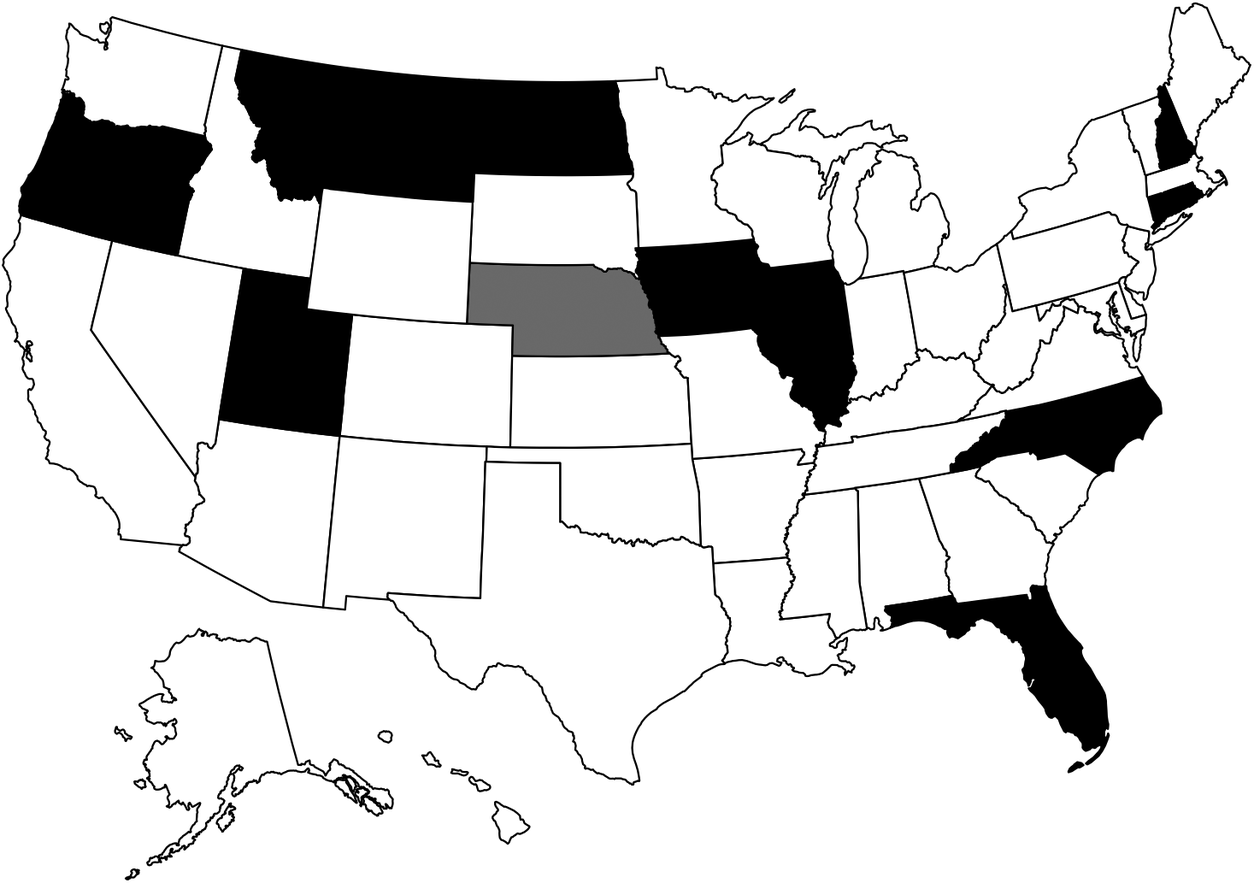
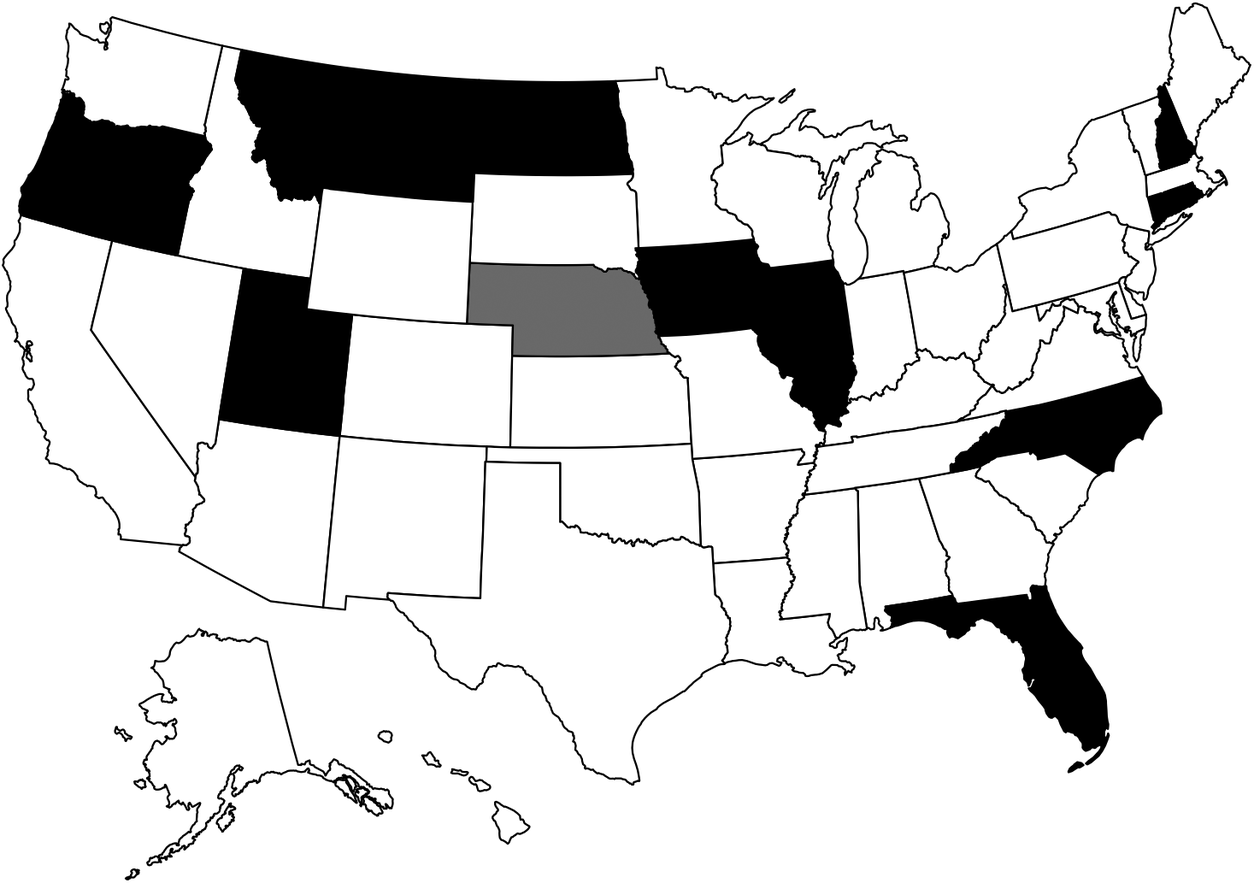
Ultimately, the GBL in New York did not pass, but the desire for diverse board membership is common among many state governments. Eleven states, depicted in Figure 1, have some form of GBL impacting their state board demographics. These state boards are sometimes referred to as advisory committees, commissions, or task forces. Despite the different names, all these groups provide insight into a specific policy problem. Citizens often serve on these boards alongside government employees, providing a low-pressure avenue for “regular” citizens to participate in state politics.
States with active GBL. Black states GBL. Nebraska is removed due to missing data.
Beyond state board diversification, GBL could bring more women into state leadership positions. As GBL encourages the appointment of women to state boards, the number and quality of women at lower levels of government could increase, potentially developing a candidate pipeline and increasing the number of women candidates and women legislators. This idea has taken hold in Iowa, where observers have noted, “women serving on boards can also gain a foundation to run for higher office” (Cannon Reference Cannon2018). In other words, by bringing women onto state boards using GBL, these women can develop the necessary experience, self-confidence, and visibility to later run for office.
This paper is the first scholarly attempt to assess the impact of GBL on the number of women candidates and women legislators at the state level. I utilize a nonparametric generalization of the difference-in-differences estimator (Imai et al. Reference Imai and Kim2018). This modeling method creates a matched set for each treated observation, which is then refined via a standard matching method and computes a difference in difference estimator. The methodology permits me to move beyond descriptive analysis and allows for an identification strategy exploiting within-state over-year and within-year-across-state variation. Ultimately, I find very limited evidence that GBL impacts on the percent of women candidates and the percent of women legislators in a state. These results are robust across multiple model specifications, including two-way fixed effects, synthetic control, and generalized synthetic control models.
These results suggest two explanations. First, as evidenced in the quota literature, solely implementing a gender quota policy is often not enough to change the descriptive representation of a decision-making body (Archenti and Tula Reference Archenti and María Inés2017; Childs and Lovenduski Reference Childs and Lovenduski2013). Second, bringing more women onto state boards may not spark progressive ambition. Women may seek alternative routes to office, or women board members may remain on state boards rather than running for elected positions. Beyond contributing to the burgeoning literature on GBL, these results highlight the distinction between interventions that build the women candidate pipeline and interventions that remain pipedreams.
State Boards and GBL
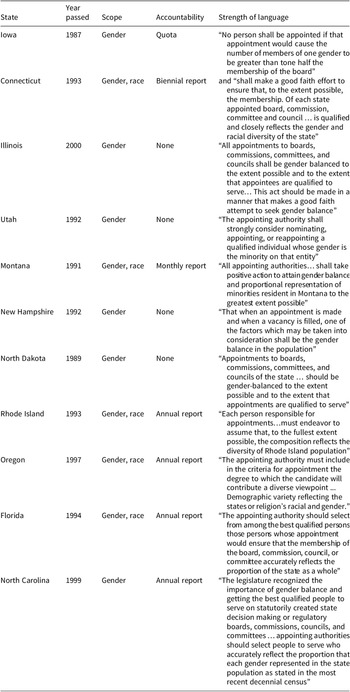
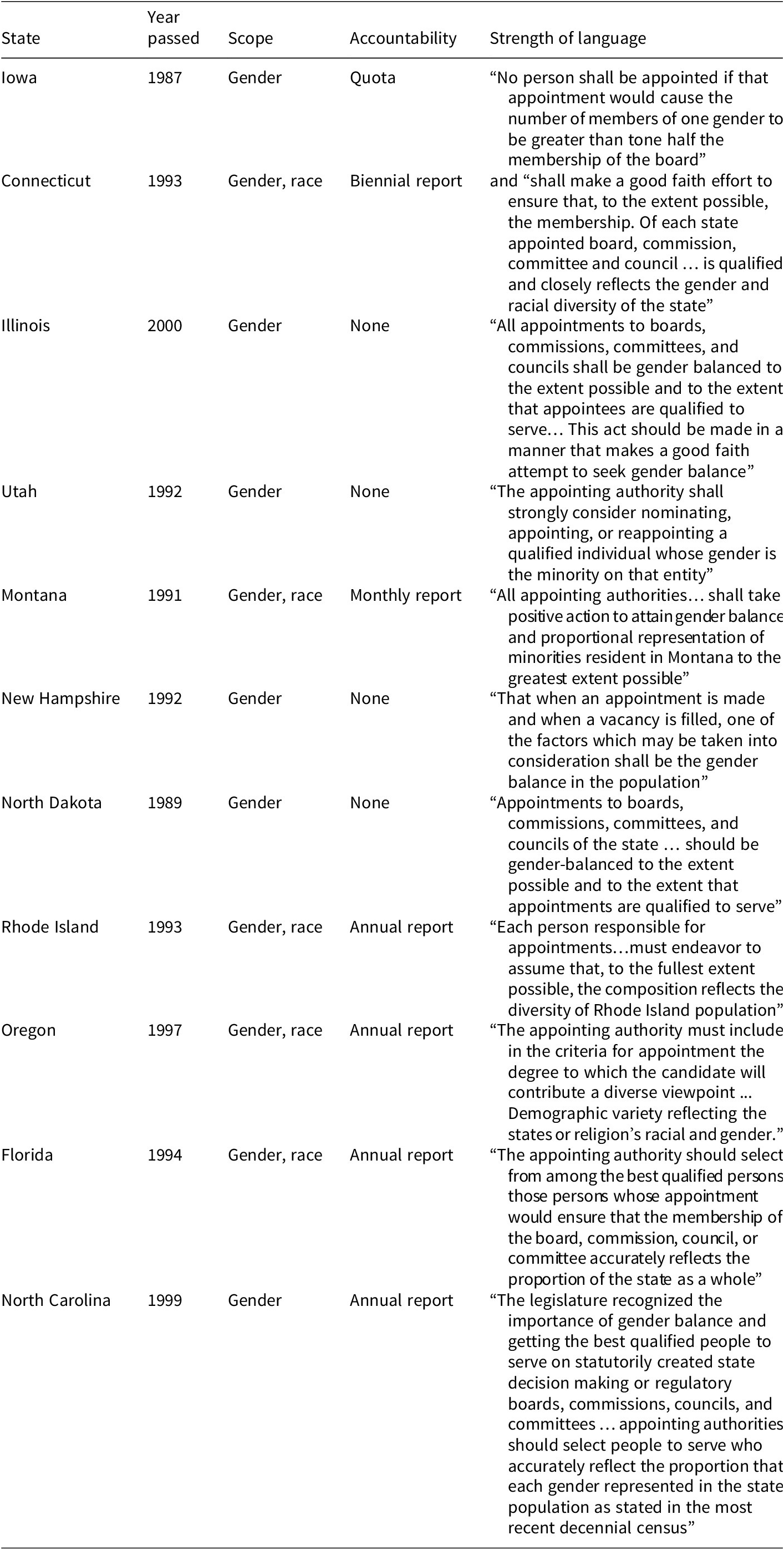
Similar to quota systems, GBL is an institutional structure designed to increase the number of women in decision-making bodies, specifically state boards and commissions.Footnote 1 Depicted in Table 1, there is significant variation in the structure of these boards. For example, boards can have a mandated purpose via a statute, or the local governing body can determine a board’s mission. Additionally, some boards are mandatory, such as “Emergency Planning Services,” while other boards are optional, such as an “Off-Street Parking Commission.” The ease of joining state boards also varies, as members can be elected or appointed to board positions by a legislature or executive office. Some states purposefully craft an accessible membership process, such as Iowa, where women citizens can express interest in joining a board by merely filling out an online application. Other states do not provide a specific mechanism to encourage board participation.
Gender board balance legislation
Due to these variations, state and local boards are particularly challenging to study. Although district boards are the most prevalent forms of government (Bauroth Reference Bauroth2005), the composition of these boards is unknown, as is information on the distinction between elected and appointed seats. As Holman notes in her analysis of scholarship on women in local government, the field knows “almost nothing about women’s representation on appointed boards” (Holman Reference Hoyt and Simon2017, 290). Although limited, the existing literature indicates the need for a heightened focus on state boards’ gender composition and implies a need for GBL. GBL directly addresses the lack of women on state boards by encouraging gender-balanced board appointments. Operationally, GBL refers to any enacted legislation that advocates balanced gender representation on boards, commissions, or task forces.
This legislative concept was originated in Iowa in 1986 by Representative Johnie Hammond. In the wake of 1976, two national reports prompted greater attention to women’s positions on state boards (Temko Reference Temko2019). The reports indicated Iowa had the highest percentage of women on their boards and commissions (Follon Reference Follon1976). Yet, the appointments were gendered, as a July 1974 study found that almost one-third of state boards and commissions had zero women, while others were over-represented with women (Gappa Reference Gappa1974; Gappa and Conlin Reference Gappa and Conlin1974). In 1986, as part of a larger state government reorganization effort, Representative Johnie Hammond led the successful movement to establish GBL in Iowa.Footnote 2
The legislation was inspired by a desire to increase women’s representation on boards, as well as balance state boards that were filled primarily or exclusively women members.Footnote 3 GBL works by encouraging men to join women-dominated groups, such as library boards, and encouraging women to join male-dominated groups, such as planning and zone commissions (Erickson Reference Erickson2015). Ideally, GBL promotes diverse and representative decision-making bodies that can include more viewpoints and support better governance.
Since Iowa’s initial GBL passage, the legislation has spread throughout the United States, mostly occurring in the early 1990s. Table 1 depicts that each state’s legislation is similar in its mission, but the legislation varies in its forcefulness and accountability measures. For example, there are weaker requests, such as Rhode Island’s legislation, which asks the appointing authorities to “endeavor to assure that, to the fullest extent possible … reflects the diversity of Rhode Island’s population” (Rhode Island General Law 28-5.1-3.1, 2017). This verbiage is vague and does not use any quota language. Other legislation has formalized accountability measures, such as Oregon’s legislation, which requires appointing authorities to give an annual report to demonstrate compliance with the law.
There are two legislative acts similar to GBL, but which are distinctly different. The first is joint resolutions, a maneuver in which legislative chambers express support for balanced boards and commissions, but do not pass a law to mandate gender-balanced boards. This act occurred in Virginia in 1992, where its House and Senate chambers passed a joint resolution in support of balanced state board appointments. Although this act may signal a commitment to gender-balanced appointments, I do not consider these joint resolutions a GBL, as resolutions do not mandate change. Second, some states include gender balance language within the legislation enacting a specific state board. For example, a state can dictate that a board focusing on education access “needs to reflect the state’s diverse population.” Likewise, I do not consider this act a GBL because the mandate does not universally apply, but only applies to a single board.
Theoretical Expectations
GBL may have impacts beyond increasing the representative diversity on state boards. Proponents of GBL have noted the potential for GBL to encourage women to run for office (“History of Gender Balance Brief,” CCCWP). Although GBL does not specifically note that it will increase women’s representation, many advocates for GBL offhandedly comment on the likelihood of this effect.Footnote 4 For example, a West Virginia Chairwoman of the board for the Women’s Commission noted that gender balance on board “would serve as a first, manageable step toward getting women more involved in higher levels of government” (Beck Reference Beck2016). Likewise, Kelly Winfrey, a researcher at Iowa State University, reported that “boards and commissions are good starting points to get into politics, and it’s not a huge time commitment. It’s a way for women to kind of get their feet wet” (Beck Reference Beck2016). The original proponent of GBL in Iowa, State Senator Johnie Hammond, commented that “I believe that the gender balance law [at the state level] has helped women develop a stronger resume to use in running for office. I personally know a few examples where that has happened” (Hannagan and Larimer Reference Hannagan, Larimer, Thomas and Bittner2017).
Some existing scholarship supports this argument, as GBL could impact women’s presence in state government directly or indirectly. Directly, GBL could increase women’s presence in state government by increasing women’s presence on state boards and provide women with more experience, confidence, and a pathway to run for state office. GBL acts like a quota system as the legislation encourages equal or “balanced” appointments to state boards.Footnote 5 Although not present in the United States, quota systems are an institutional tool to increase the number of women in elected office (Baldez Reference Baldez2007; Gray Reference Gray2003; Htun and Jones Reference Hughes, Paxton, Clayton and Zetterberg2002; Schwindt-Bayer Reference Schwindt-Bayer2009).Footnote 6 The quota system literature indicates that well-designed quota systems can successfully increase the number of women in representative bodies (O’brien and Rickne Reference O’brien and Rickne2016; Schwindt‐Bayer Reference Schwindt-Bayer2009). In addition to changing the state board demographics, bringing more women onto state boards provides an opportunity for women to gain the necessary experience to springboard to higher office. Scholars have noted the importance of candidates developing early experience in politics (Clark et al. Reference Clark, Hadley and Darcy1989; Jacobson Reference Jordan and Grossmann2009; Jacobson and Kernell Reference Jacobson and Carson1981; Krasno and Green Reference Krook1988). Accordingly, if women are absent from smaller stepping-stones in office (such as entry-level political positions), their ability to later run for higher office is diminished (Conway et al. Reference Conway, Ahern and Steuernagel2004; Sanbonmatsu Reference Sanbonmatsu2006). Thus, serving on these state boards allows women to develop the necessary experience to later run for office.
Although the data and scholarship of board compositions are scant, some scholars have argued the potential connection between prior local experiences and running for higher elected office (Carroll and Sanbonmatsu Reference Carroll and Sanbonmatsu2013; MacManus Reference Mahoney1996). In a recent paper, Crowder-Meyer (Reference Crowder-Meyer2019) found that around 65.7% of candidates for county-level office have previously held local leadership positions. Likewise, Sidorsky surveyed appointed board members to explore progressive ambition of women appointed to state boards. She found that 38% of males and 33% of females are somewhat or very interested in pursuing elected office, suggesting some progressive ambition for board members (Sidorsky Reference Sidorsky2015). If state boards are a jumping point for women to run for higher state offices, and GBL inspires more women to join these boards, then we can expect more women to run for state office in states who passed GBL.
Beyond directly encouraging women to jump from state board positions to state legislative positions, GBL could impact the presence of women indirectly.Footnote 7 Seeing more women serve on state board positions could serve as a signal to potential candidates that women are invited and welcome in the political sphere. There is evidence that the presence of women officeholders can stimulate engagement among women (Burns et al. Reference Burns, Schlozman and Verba2001; Kittilson Reference Klarner2005) The presence of female representatives and candidates is associated with an increase in women’s political knowledge (Verba et al. Reference Wang, Katelyn and Ben1997), political interest (Atkeson Reference Atkeson2003; Burns et al. Reference Burns, Schlozman and Verba2001), and political ambition. Ladman, Haden, and Windett find that the presence of a high-profile women governor or US senator increases the portion of women who run for state legislative seats (Ladam et al. Reference Lockwood and Kunda2018). Likewise, Beaman et al. explore the effect of randomly assigned gender quotas in Indian village councils, and find that “women are more likely to stand for, and win, elected positions in councils required to have a female chief councilor in the previous two elections” (Beaman et al. Reference Beaman, Chattopadhyay, Duflo, Pande and Topalova2009).
However, the efficacy of the role-model effect is still debated, as some scholars have found weak or null results (Broockman Reference Broockman2014; Gilardi Reference Gilardi2015; Karp and Banducci Reference Kittilson2008; Koch Reference Krasno and Green1999). For example, Dolan (Reference Dolan2006) explores the presence of women candidates in the United States over a 14-year period but finds little support that women’s symbolic presence changes political behavior or attitudes. Part of these weaker findings can be explained by the conditional factors, such as the visibility of the politicians, mediating the impact of the role-model effect.Footnote 8 State boards are not a visible part of government, and thus, it is unlikely that seeing more women serving on state boards would produce a strong mirroring effect. However, the media attention to passing GBL could be a symbolic enough signal to demonstrate a welcoming environment to potential women candidates.
Although some see GBL as a promising panacea for the gap in women’s descriptive representation in state governments, GBL may not be effective at developing a candidate pipeline. Specifically, there is reason to think GBL will not increase the number of women running for elected office. A primary concern is that states will not enforce GBL as the legislation’s language is often weak, and tend to lack enforcement mechanisms. If states do not enforce the law, women will not enter state boards in greater numbers, and consequently not run for higher elected state office in greater numbers.
The quota system literature has provided significant evidence that the design of a quota will impact the overall effectiveness (Krook Reference Kunovich and Paxton2008; Schwindt‐Bayer Reference Schwindt-Bayer2009; Trip and Kang 2008). Additionally, many scholars have noted the necessity of supplementary enforcement measures for quotas to be effective (Baldez Reference Baldez, Barakso, Freeman, Gelb, Meyer, Montoya, Nechemias, Reger and Robnett2005; Nanivadekar Reference Nanivadekar2006; Norris Reference Norris2004). In a global longitudinal analysis of quota systems, Huges finds that an effective quota has three characteristics, a strong placement mandate or strong sanctions, mechanisms for filling reserved seats, and a high threshold of seats for women in the governing body (Hughes et al. 2019). Much like instilling a quota system is not enough to change the descriptive representation of a decision-making body (Archenti and Tula Reference Archenti and María Inés2017; Childs and Lovenduski Reference Childs and Lovenduski2013; Kunovich and Paxton Reference Ladam, Harden and Windett2005; Reynolds Reference Reynolds1999), solely implementing GBL is likely not enough to change the descriptive representation on state boards. As many states lack an enforcement mechanism or strong language to mandate change, GBL may not fulfill its intended purpose and fail to change the descriptive representation on the state boards. Consequently, we should expect GBL with stronger designs (i.e., sanctions or mandates, a mechanism for recruiting women to boards, and bills that specify a threshold) to be more effective.
Each state’s legislation is unique, and the variation in different verbiage, enforcement mechanisms, and sanctions complicates the analysis of the legislation’s overall effectiveness. For instance, some states take the time and space within the bill to recognize the importance of gender balance in a symbolic way, such as Montana, Rhode Island, Florida, and North Carolina. Although this language is promising, none of the states, except Iowa, have strong mandates and thresholds within their legislation. Iowa’s GBL powerfully notes that “no person shall be appointed or reappointed to any board, commission, committee, or council established by the code if that appointment would cause the number or membership of the board… of one gender to be greater than one half the membership of the board” (Iowa Code 69.16A, 2016). Other states have weak language, using negative qualifiers in their laws. These include phrases such as “good faith effort,” “to the extent possible,” “one factor to consider,” “may be taken into consideration,” and “shall endeavor to ensue.” This language indicates tepidness to committing to gender balance on these boards, often implying that the authorities should try to change the demographics on state boards, but change may not be possible.
Even in Iowa, a state with the strongest language, the effectiveness of GBL is not guaranteed. Iowa is currently struggling with GBL enforcement on the local board level. Interim director for Carrie Chapman Catt Center for Women and Politics (CCCWP), Dr. Kelly Winfrey, explains, “if you can’t find a candidate that would make [a state board] gender-balanced after three months, you can just fill it with whoever is qualified for that position … so there’s a lot of flexibility in how it’s implemented, and there’s no real enforcement to it” (Wang et al. Reference Wolbrecht and Campbell2018).
Ideally, I could test the effectiveness of GBL by exploring the state board’s demographic composition and how it changes pre and post GBL enactment. However, this data are not available for all states. Uniquely, Iowa State University and CCCWP have captured some of this data, indicating that in 2014, 49% of state board members are women (Colbert and Bystrom Reference Colbert and Bystrom2014). Although this data are suggestive of GBL’s effectiveness at bringing women onto state boards, the Iowa data are not generalizable to other states; this is because Iowa is an ideal case for successful implementation. Iowa was the first state to implement GBL in 1987, has significant state-based media coverage of the GBL, and has an activist group, “Friends of the Iowa Commission on the Status of Women,” who advocate increasing women’s representation on boards. This group created a mechanism to bring women onto state boards easily, called the “Talent Bank,” a database of women who want to serve on a board. Due to the increased media coverage, advocates, and mechanisms created, it is unlikely other states with weaker legislation have higher or similar rates of women serving on their state boards.
Even if GBL does bring more women onto state boards, women may not use the position as a stepping-stone to higher office. Ambitious women could pursue other steps to gaining office. For example, candidates could perceive serving the mayor’s office as a more effective stepping-stone for office, avoiding state board work. Alternatively, women may want to stay on local board positions rather than gain higher elected positions. Scholars established that women are more attracted to narratives that emphasize “problem-solving” in political jobs, rather than power (Fox and Lawless Reference Fox and Lawless2010; Volden, Wiseman, and Wittmer Reference Verba, Burns and Schlozman2010). Additionally, women tend to be election averse (Kanthak and Woon Reference Karp and Banducci2015; Preece and Stoddard Reference Preece and Stoddard2015). As local boards and commissions center on solving problems and do not require an election, the woman serving on local boards may stay in these positions, expressing static rather than evolving ambition.
To explore if women are entering boards but expressing static ambition, I surveyed all Iowa state legislators serving in the 2019 boards.Footnote 9 From this short survey, I found that only 27% of responders had served on state boards or commissions. When considering different gender variations, I found that 33% of responding women legislators had previously served on state boards before gaining elected office while only 19% of responding male legislators had previous experience on these boards. The slightly higher percentage of women legislators serving on state boards compared to men may indicate that state boards are bringing more women into office. However, less than a third of responders served on state boards or commissions before holding elected office, suggesting that state boards are not traditional stepping-stones for women legislators.
This paper evaluates these competing expectations, exploring if GBL impacts the number of women candidates and representatives in a state. There are important implications of this analysis. If states and activists incorrectly believe that GBL can build a women candidate pipeline, time and resources may be invested in an unfruitful avenue for women’s advancement. However, if GBL does increase the number of women in state leadership positions, then we have stumbled across a useful mechanism for increasing women’s presence in state government.
Data and Research Design
I composed a time-series cross-sectional data set from multiple sources, including the Inter-university Consortium for Political and Social Research (ICPSR) Correlates of State Policy Project (Jordan and Grossmann Reference Kanthak and Woon2017) and Klarner’s “State Legislative Election Returns” (Klarner Reference Koch2018). I examine the effect of GBL across two dependent variables.Footnote 10 The first is the percent of legislators that are women by state from 1975 to 2016 (Center for American Women and Politics 2019) The second is the percent of women legislative candidates within the state, using the first names of candidates that ran for state legislative office from 1967 to 2016. I coded the gender of the candidates using Blevins et al.’s gender package via R softwareFootnote 11 (Blevins Reference Blevins and Mullen2020) and created an estimate of the percent of women candidates in each state per-year from 1983 to 2012. As elections occurred either every two or four years within the state, I duplicated off-year results from the closest prior election to accommodate model specifications.
Additionally, I account for various controls within the models. All the models include population density from 1975 to 1999 (US Census Bureau 2012) as states with higher densities may have specific demographic characteristics that differ from smaller density states. Additionally, more populated areas may have greater access to pools of women candidates. I also include a set of control variables to address institutional differences. As women tend to gain more elected positions in less competitive races (Kanthak and Woo Reference Karp and Banducci2015; Sanbonmatsu Reference Sanbonmatsu2010), all models include the respective upper and lower chamber’s portion of seats that are up for reelection. I account for party control of the state from 1983 to 2016 (Klarner Reference Klarner2013; Ranney Reference Ranney, Jacob and Vines1976). I include “equal pay,” a binary variable to represent the state’s gender norms, signaling if the state adopted equal pay law from 1919 to 1966 (Boehmke and Skinner Reference Boehmke and Skinner2012). Additionally, I include a measure of the legislation’s professionalism, as women are more likely to run in less-professionalized state legislatures (Sanbonmatsu Reference Sanbonmatsu2010). I operationalize professionalism by accounting for the yearly base salary of the legislators (Bowen and Green Reference Bowen and Greene2014) and duplicating off-year results.
To assess GBL’s effect on the percent of women legislators and percent of women candidates, I use a relatively new matching method for time-series cross-sectional data (Imai et al. Reference Imai and Kim2018). This method is an extension of the synthetic control method (Abadie et al. Reference Abadie, Diamond and Hainmueller2011) and generalized synthetic control method (Xu Reference Xu2016). Positively, this method relaxes parallel trends assumption, utilizes an identification strategy exploiting within-state over-year and within-year-across-state variation, and does not require data for many pretreatment periods (which other synthetic control methods require). Additionally, this method is ideal for understanding GBL’s effect as it estimates both short-term and long-term average treatment effects on treated states. Simply put, this model allows for assessing the effect across time, which is critical, as scholars do not know the length of time it may take for GBL to demonstrate an effect postenactment.
This model works through a multi-step process. First, a matched set is created for each treated observation. In other words, for each treated observation, a set of control observations with identical treatment history is selected, up to a specified time span. Each state with GBL in a given year is matched with control states in the same year that share an identical treatment history from t − L to t − 1. Next, a counterfactual outcome is estimated using a Mahalanobis distance matching technique, which adjusts to differences in confounding variables. In other words, a standardized distance is computed for a control state in the matched set, using covariates and averaged across time periods. Finally, the difference in difference estimator is calculated. For each state with GBL, the counterfactual outcome is estimated using a weighted average of the control states in the refined matched set. This difference in difference estimate of the average treatment effect on the treated (ATT) states for each treated observation is calculated and averaged across all treated observations. Imai et al.’s (Reference Imai and Kim2018) estimator estimates the average treatment effect for treated states, defined as:
 $$ \delta \left(F,L\right)=E\{{Y}_{i,t+F}\left({X}_{i,t}=1,{X}_{i,t-1}=0,{{\left\{{X}_{i,t-l}\right\}}^L}_{l=2}\right)-{Y}_{i,t+F}\left({X}_{i,t}=0,{X}_{i,t-1}=0,{{\left\{{X}_{i,t-l}\right\}}^L}_{l=2}\right)|{X}_{i,t}=1,{X}_{i,t-1}=0\}, $$
where treated states with those states that have passed GBL, that is, Xi,t−1 = 0 and Xi,t−1 = 1. Thus, as specified, the potential outcome of a state with GBL is {Yi,t+F(Xi,t = 1, X i,t−1 = 0, {X i,t − l}L l = 2) and the potential outcome for a state without GBL is the Yi,t + F (Xi,t = 0, Xi,t − 1 = 0, {X i,t − l}L l = 2)|. For both outcomes, the remaining treatment history is set to the realized history, that is, {X i,t − l}L l = 2) ={X i,t − 2,…Xi,t − L}.
My model uses δ (1, 10), meaning the average causal effect of GBL on the number of women candidates and legislators 10 years after treatment while assuming the potential outcome depends on treatment history up to 1 year prior. I use a lag of 10 years for this model, as it is likely to take numerous years for an enacted GBL policy to successfully become practice (Smith Reference Smith1973). In the case of Iowa, the state legislature passed an expanded bill in 2009, but the law did not go into effect until 2012 (Carrie Chapman Catt Center for Women and Politics 2018). Additionally, it may take multiple years for women serving on these boards to develop the ambition, confidence, and experience necessary to make a subsequent jump to elected office. Beaman et al. finds that after 10 years of quotas in Indian village councils, women are more likely to run and win elected positions (Beaman et al. Reference Beaman, Chattopadhyay, Duflo, Pande and Topalova2009). Therefore, it is feasible to think it could take up to 10 years to see any effect from GBL due to the proposed mechanisms and the often-slow incorporation of policy as practice.
There are three assumptions to this modeling strategy. The first assumes that the potential outcome for a state at a specific time does not depend on the previous treatment status of the same state after a certain number of periods. This assumption allows for the possibility that past treatments affect future outcomes up to a specific number of years. As every state in my analysis has only adopted state-level GBL once, this assumption does not impact my analysis. The second assumption asserts that the state’s potential outcome does not depend on the treatment status of other states. In other words, one state’s GBL adoption does not affect the outcomes (percent of women in higher office) for another state without GBL. Despite most states following Iowa’s model legislation, the states that have passed GBL are fairly diverse, spread throughout the United States, and passed throughout a fairly large time frame. Thus, there does not appear to be any descriptive evidence suggesting the interference assumption has been violated. The final assumption is parallel trends, in which in the absence of treatment, the difference between states with and without GBL will be constant over time. The larger lag of 10 years increases the credibility of the parallel trends assumption (Imai et al. Reference Imai and Kim2018).
Descriptive Data
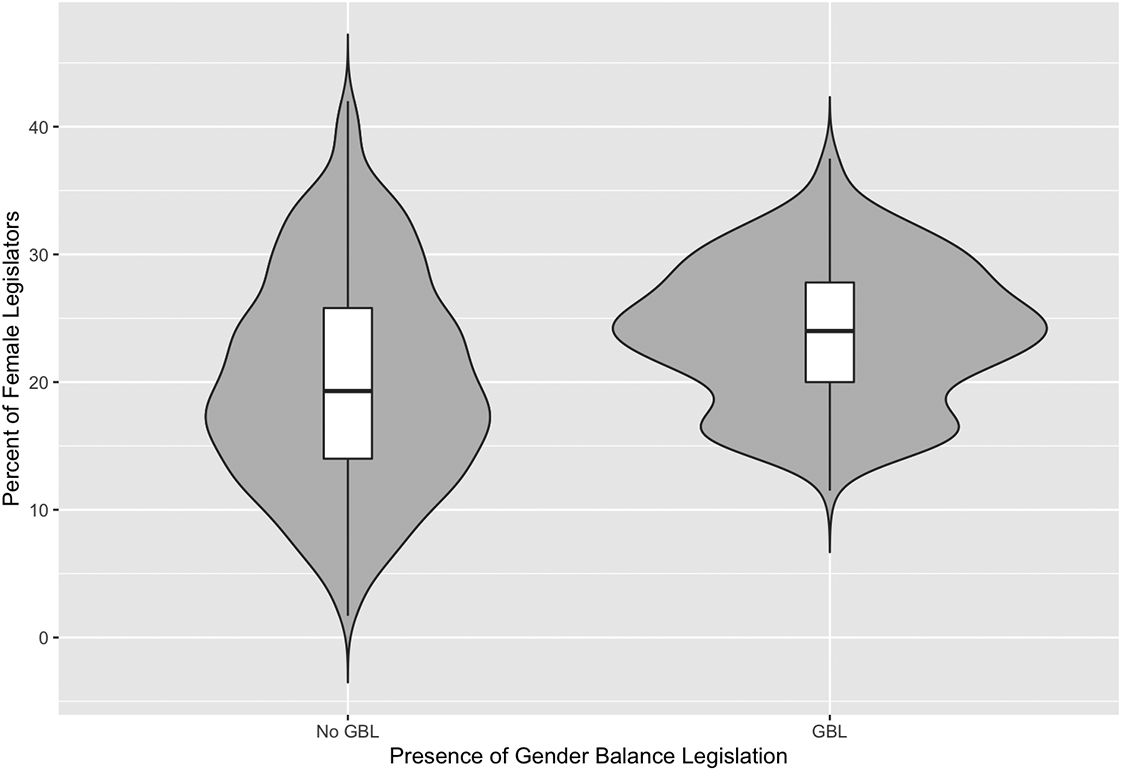
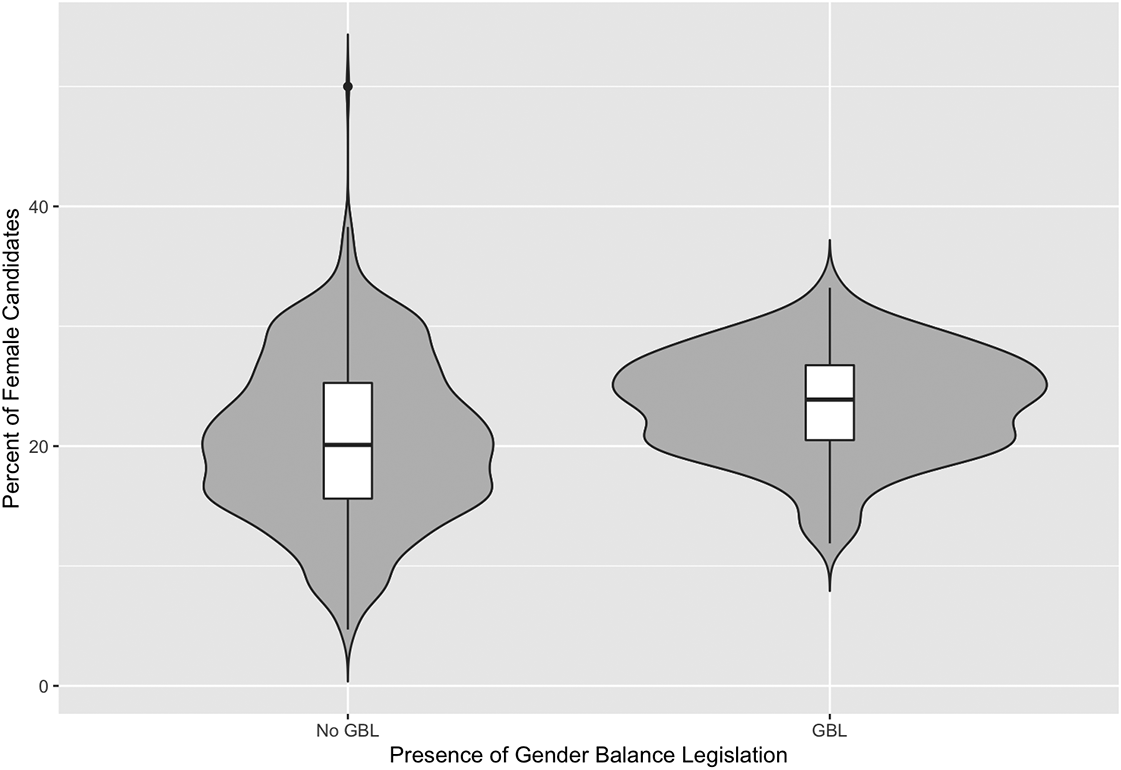
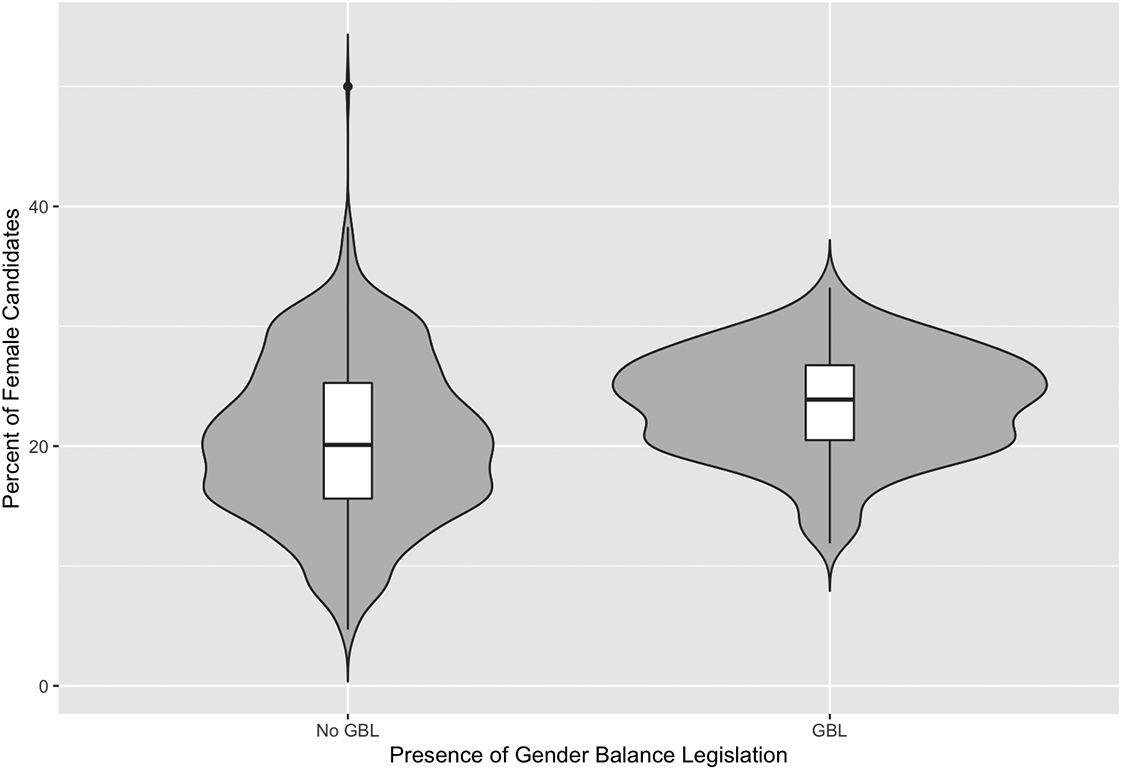
From the descriptive data alone, it is difficult to determine if GBL is responsible for increasing the number of women candidates and elected officials in state legislatures. Figures 2 and 3 plot the distribution of both outcome variables and indicate the mean for each group. When considering both these outcomes at large, in Figure 2, there is little distinction between states with or without GBL. However, states with GBL have a slightly higher mean percentage of women in state legislatures. For women candidates, there is a similar distribution and pattern in Figure 3. Again, states with GBL have a slightly higher average percentage of women candidates compared to states without GBL. The similar findings across outcome variables are expected, as the percent of female candidates and percent of women elected per state are highly correlated. Although this descriptive analysis is suggestive, there is an overall increase in most states, and these descriptive statistics do not isolate a causal effect from potential intervening variables.
Distribution of percent of women in state legislature by GBL.
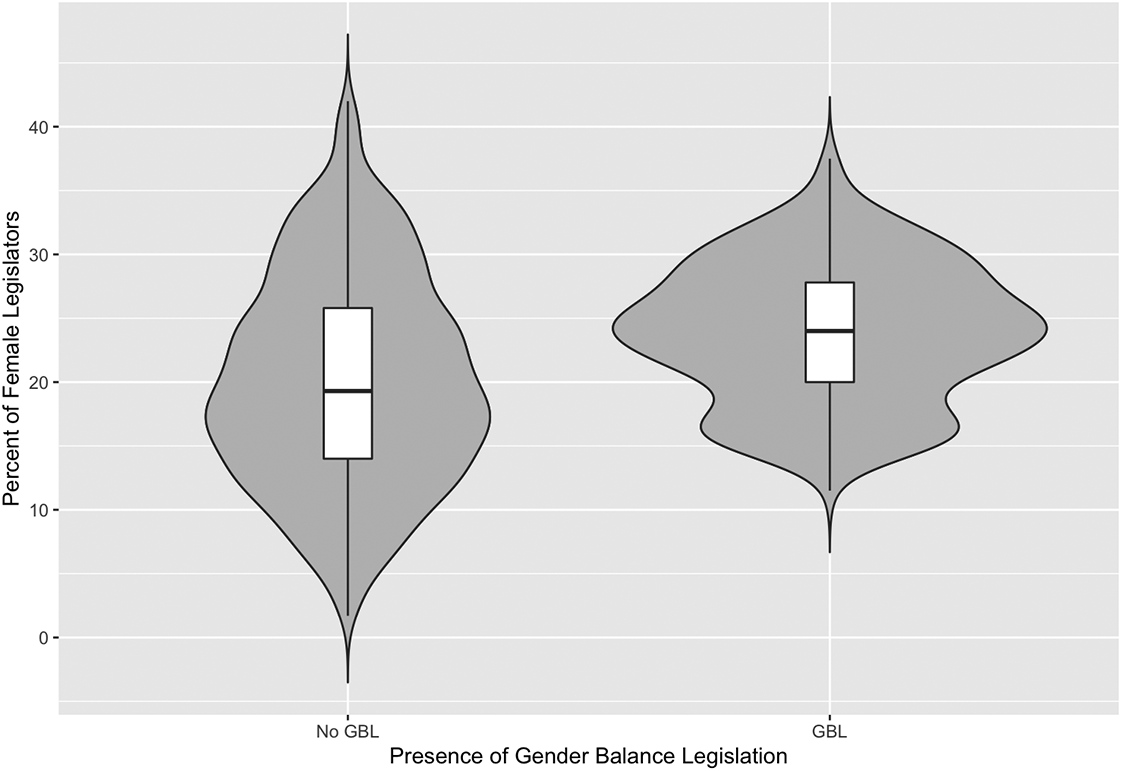
Distribution of percent of women candidates by GBL.
Results
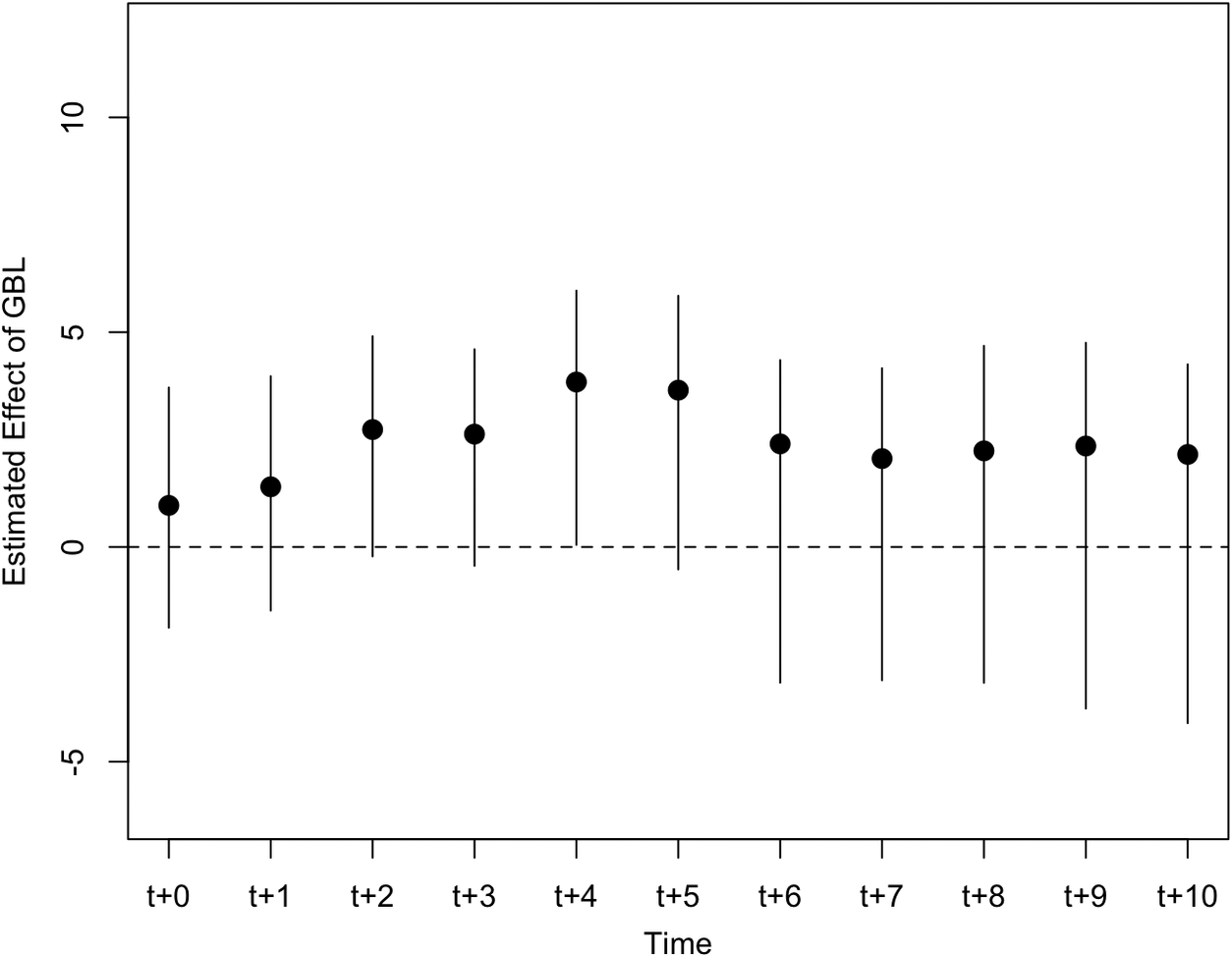
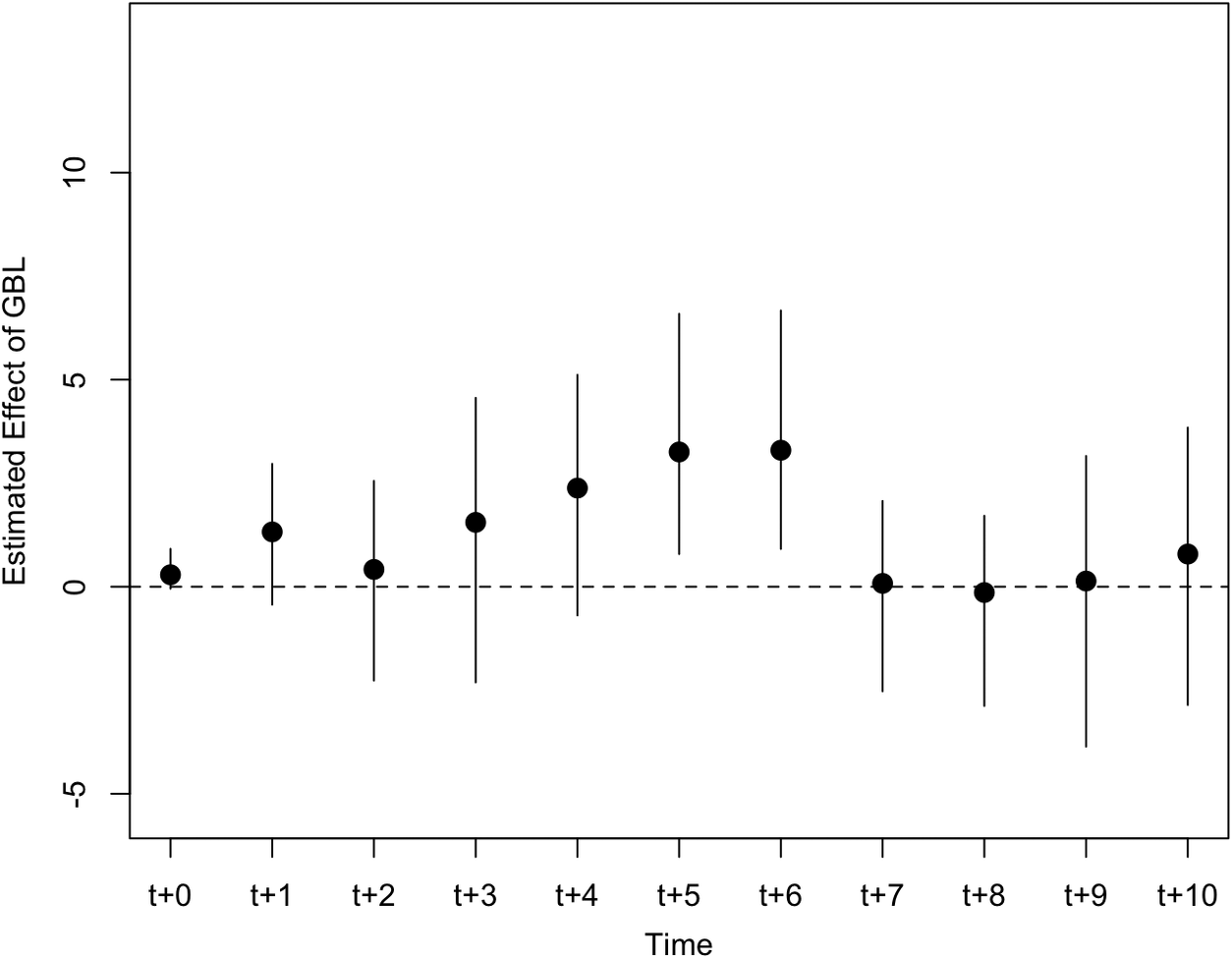
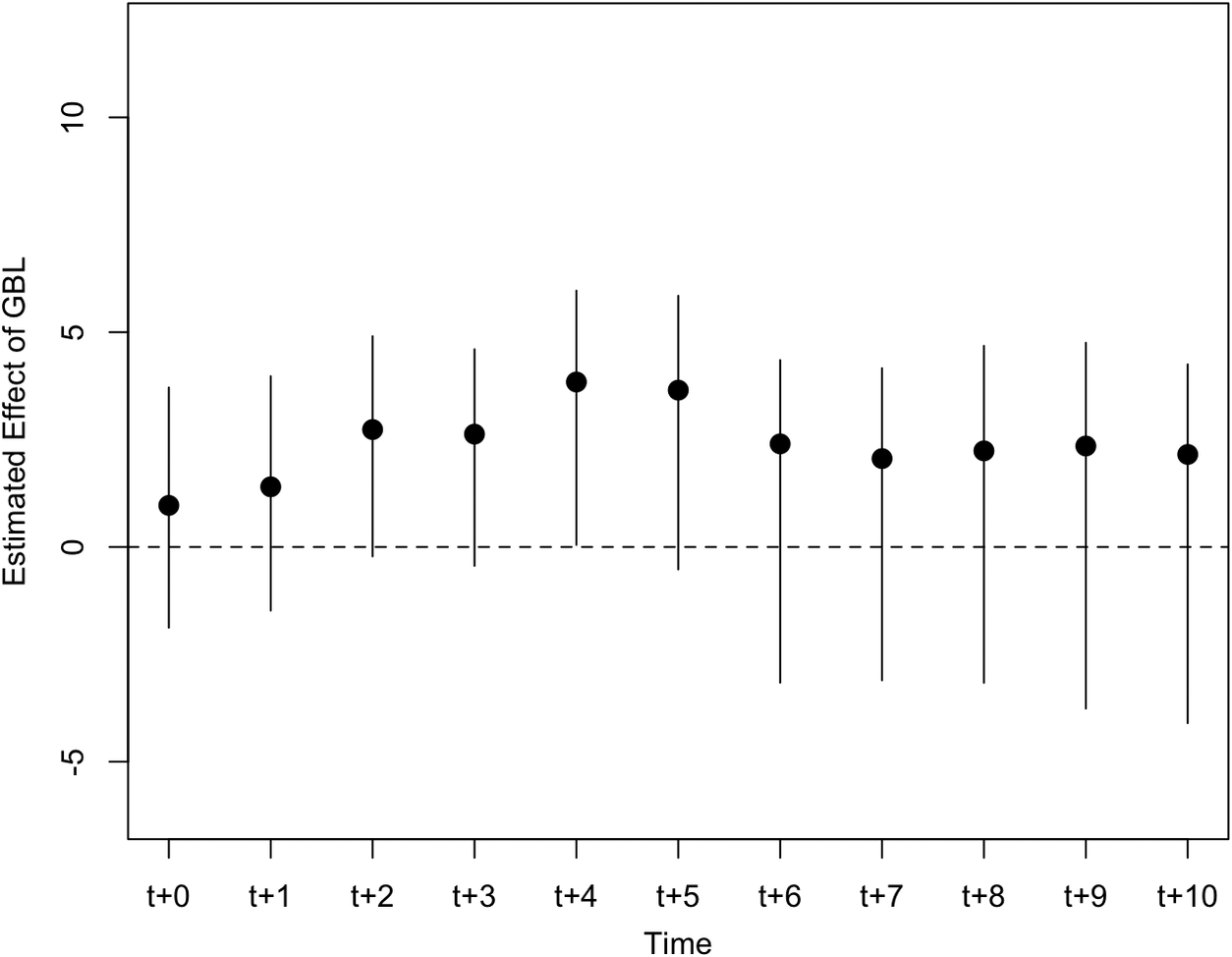
In this section, I will discuss my main results. I determine the effectiveness of GBL on the number of women candidates and women legislators in the state using a nonparametric generalization of the difference-in-differences estimator. Overall, the results indicate that GBL has a small to nonexistent and statistically insignificant effect across both outcome variables. The estimated ATT states across both outcome variables is depicted in Figures 4 and 5.
Effect of GBL on percent of women legislators.
Effect of GBL on percent of women candidates.
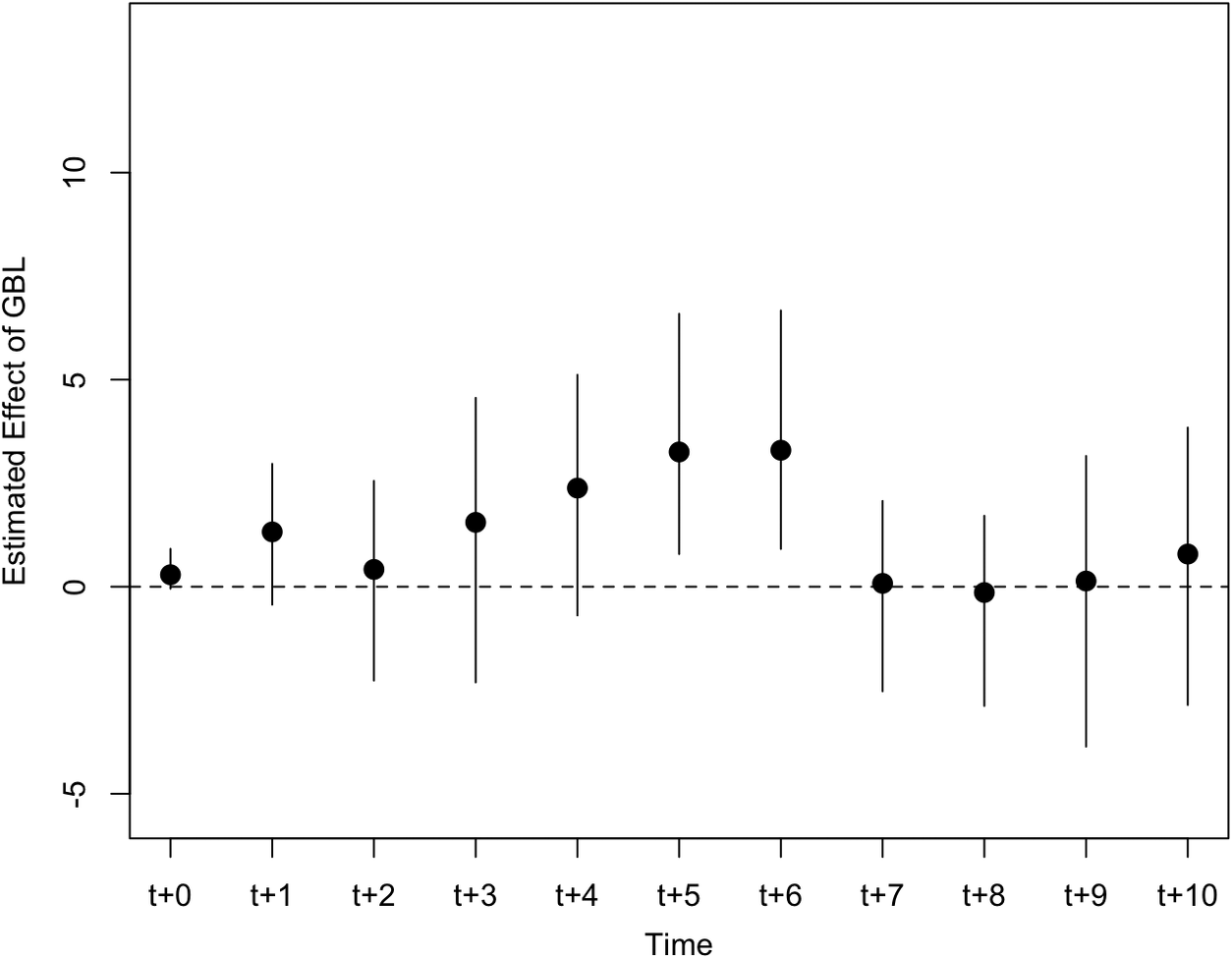
In Figures 4 and 5, the vertical bars symbolize 95% confidence intervals. The average treatment effect is depicted across the initial treatment year, up to 10 years after the GBL has passed. In Figure 4, GBL’s presence is associated with a statistically and substantively insignificant 0.05% increase in the percent of women legislators. Similarly, Figure 5 indicates similar results, illustrating a statistically and substantively insignificant 1.06% increase in the percent of women candidates. While there is a slight increase in the percentage of women legislators over time and a slight decrease of women candidates over time, these results are not statistically significant.
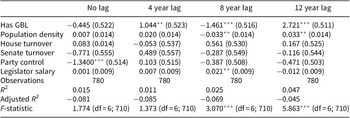
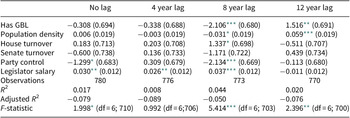
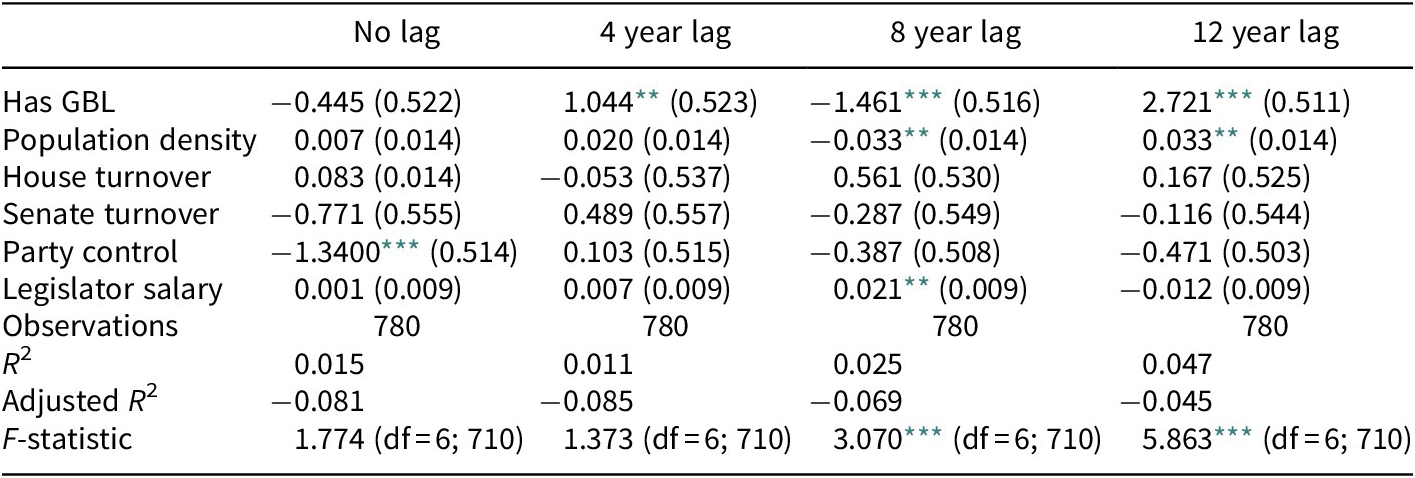
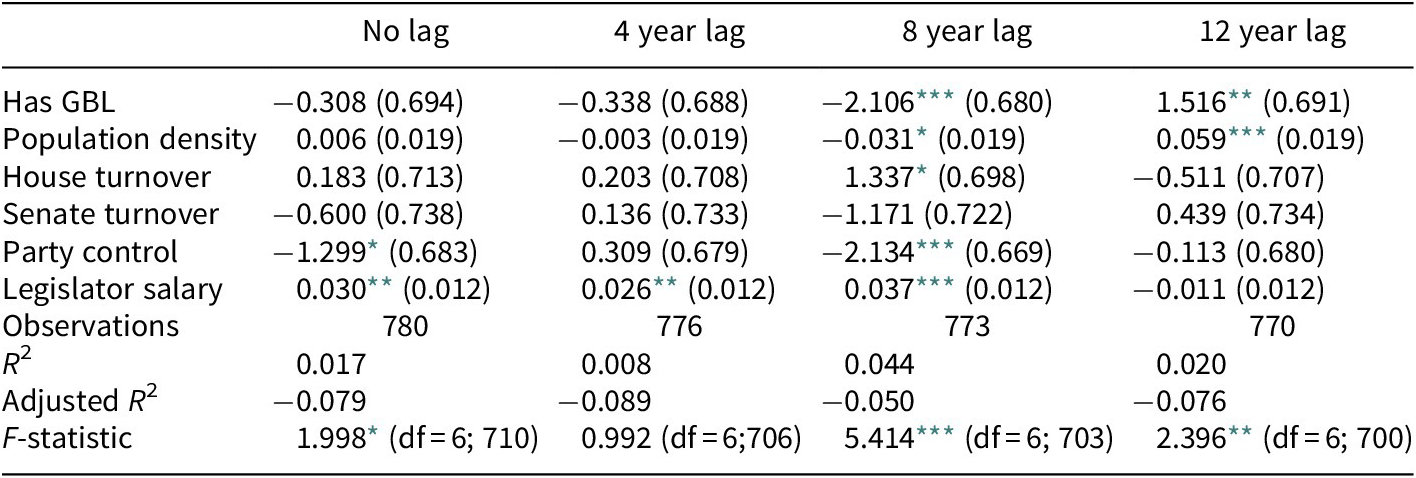
To assess robustness, I first estimate a two-way fixed effects model with state and year fixed effects (Imai and Kim Reference Jacobson and Kernell2016). I include multiple lags of 4, 8, and 12 years. Results for women legislators are depicted in Table 2, while results for women candidates are located in Table 3. Although many of the results are substantively small and statistically insignificant, it appears that over time, the effect size and statistical significance does substantively increase. The statistically significant 8 and 12-year lag results suggest GBL may be more effective than previous results indicate given a longer time frame. However, these results should be carefully interpreted. Two-way fixed effects models are highly susceptible to modeling assumptions, particularly the assumption of linear additive effects, making it impossible to adjust for unobserved unit-specific and time-specific confounders (Imai and Kim Reference Imai and Kim2019). Although I attempt to account for two-way fixed effects model’s core assumptions,Footnote 12 given these problems, I utilize two additional models to assess robustness.
Two-way fixed effects (state and year) for women legislators
* p < 0.1;
** p < 0.05;
*** p < 0.01.
Two-way fixed effects (state and year) for women candidates
* p < 0.1;
** p < 0.05;
*** p < 0.01.
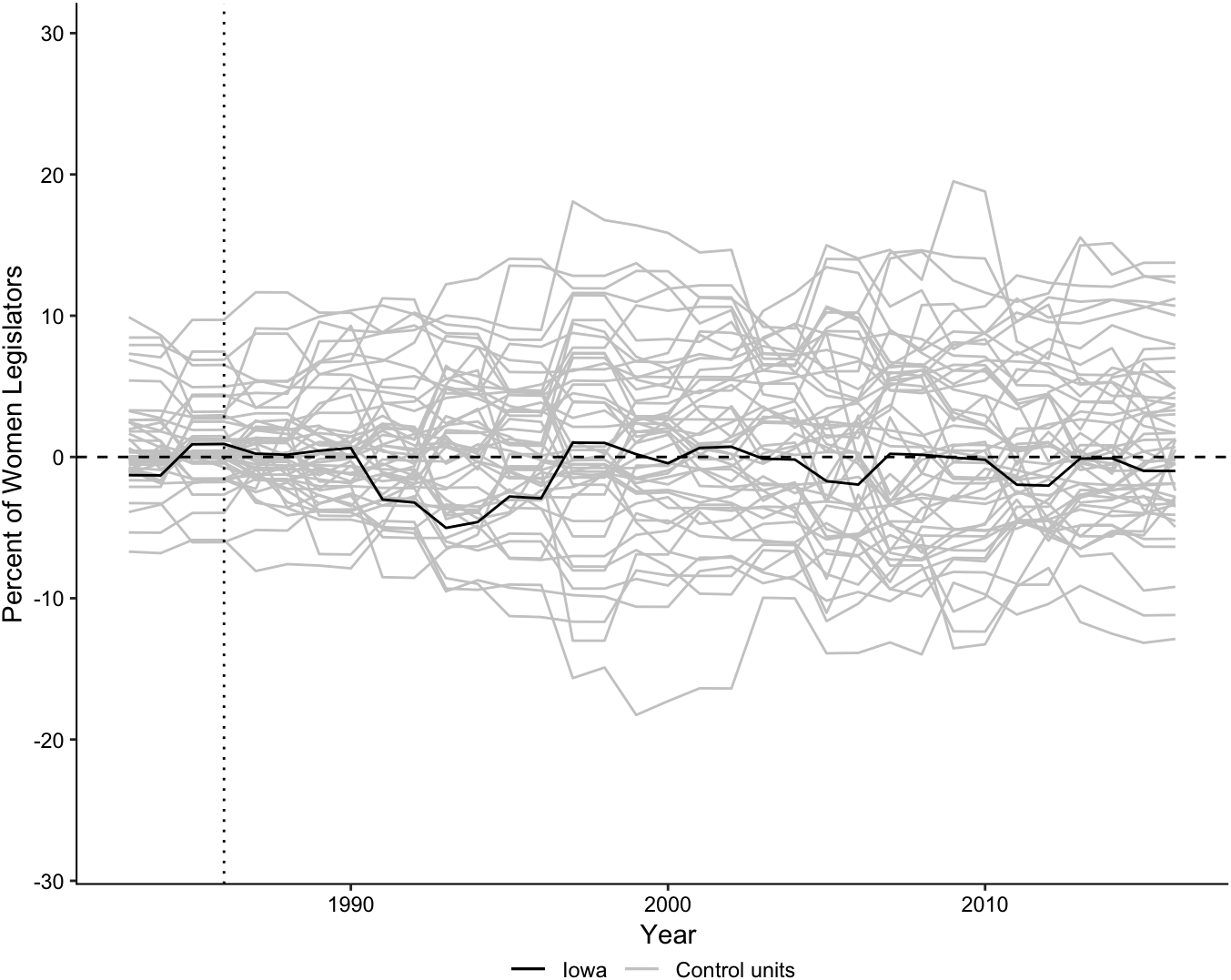
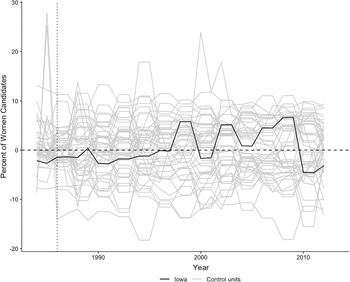
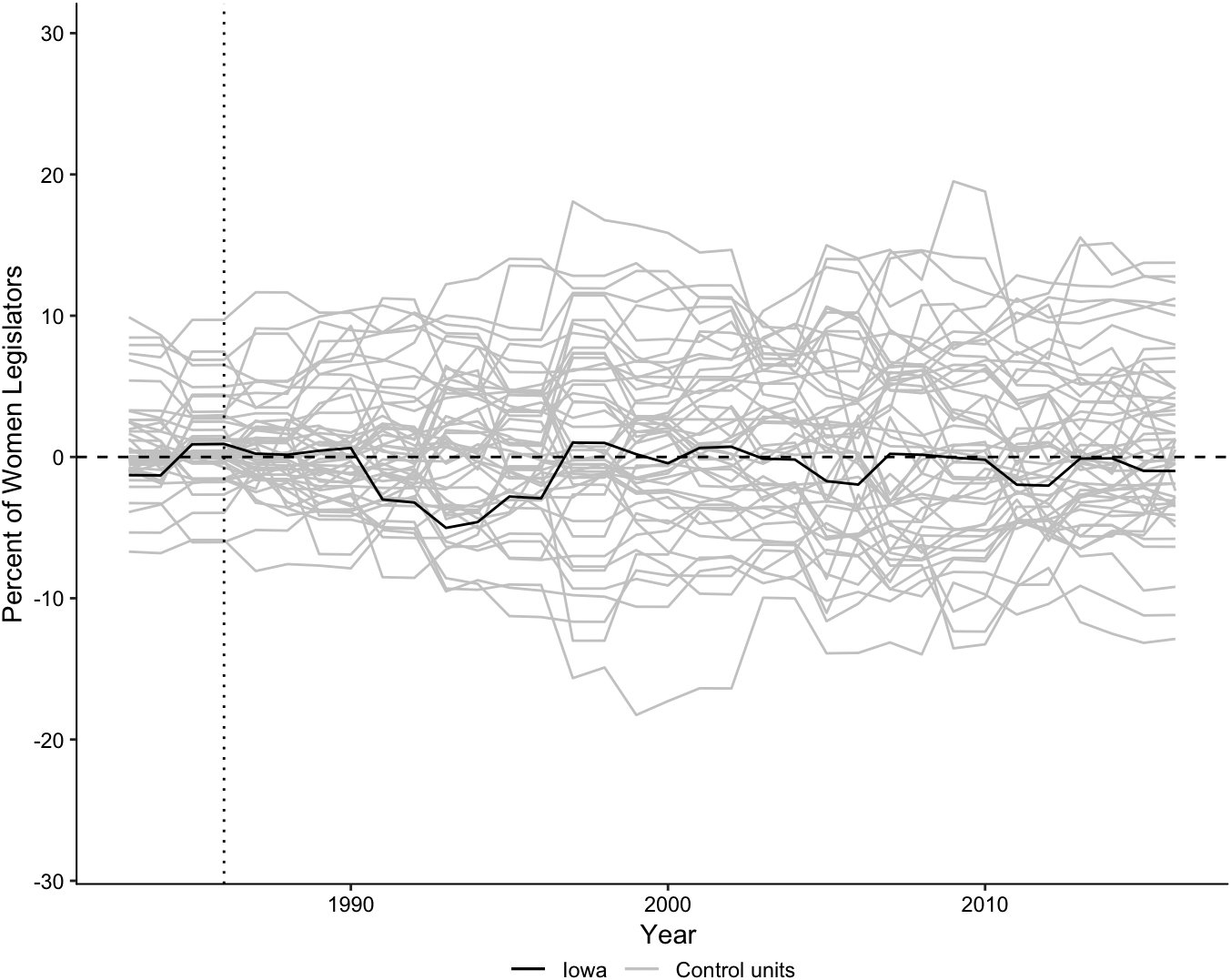
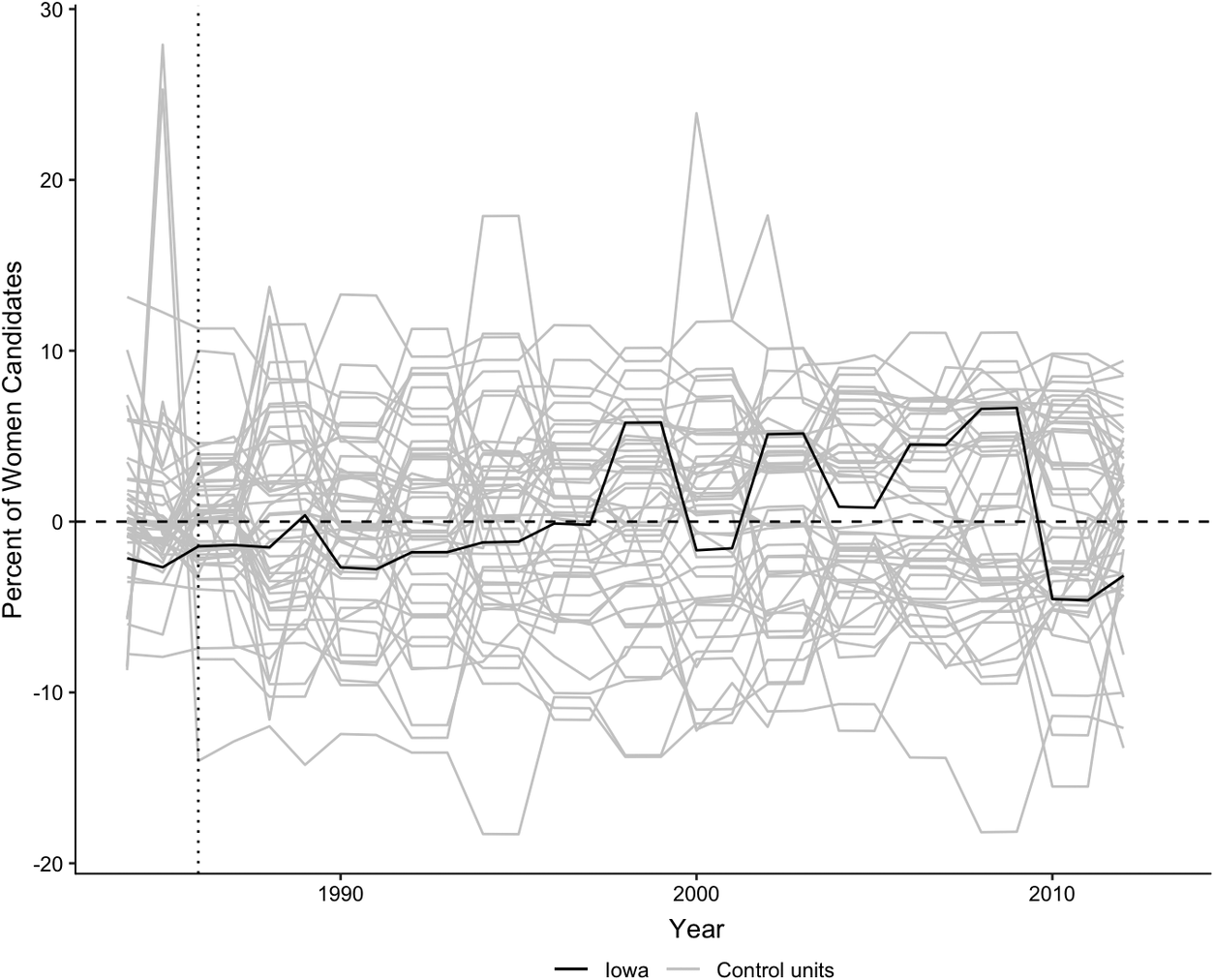
Second, I use a synthetic control model that focuses on Iowa, a state that provides a most likely case scenario. In Figures 6 and 7, I find only a slightly higher percentage of women in the state legislature than synthetic Iowa, in which there is no GBL.Footnote 13 The placebo test results do not indicate that Iowa’s results “conspicuously differentiate” from the rest of the units, instilling greater confidence in the results (Abadie et al. Reference Abadie, Diamond and Hainmueller2011, 14).
Lowa synthetic control and placebo states.
Low synthetic control and placebo states.
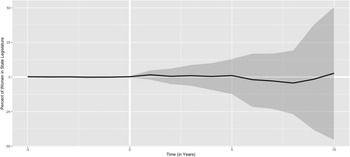
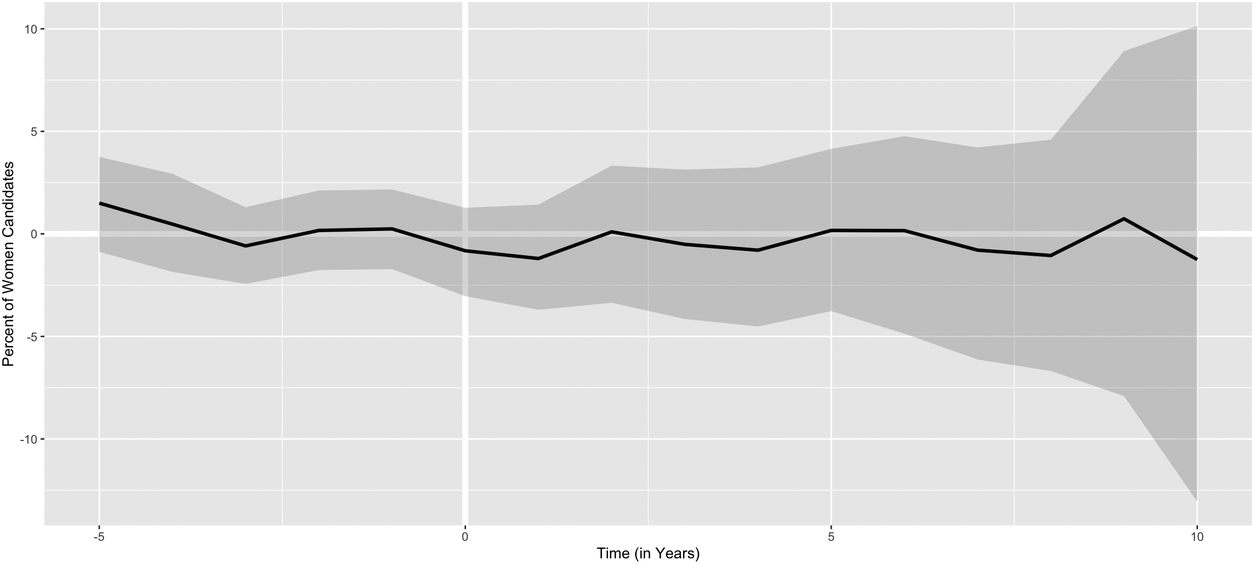
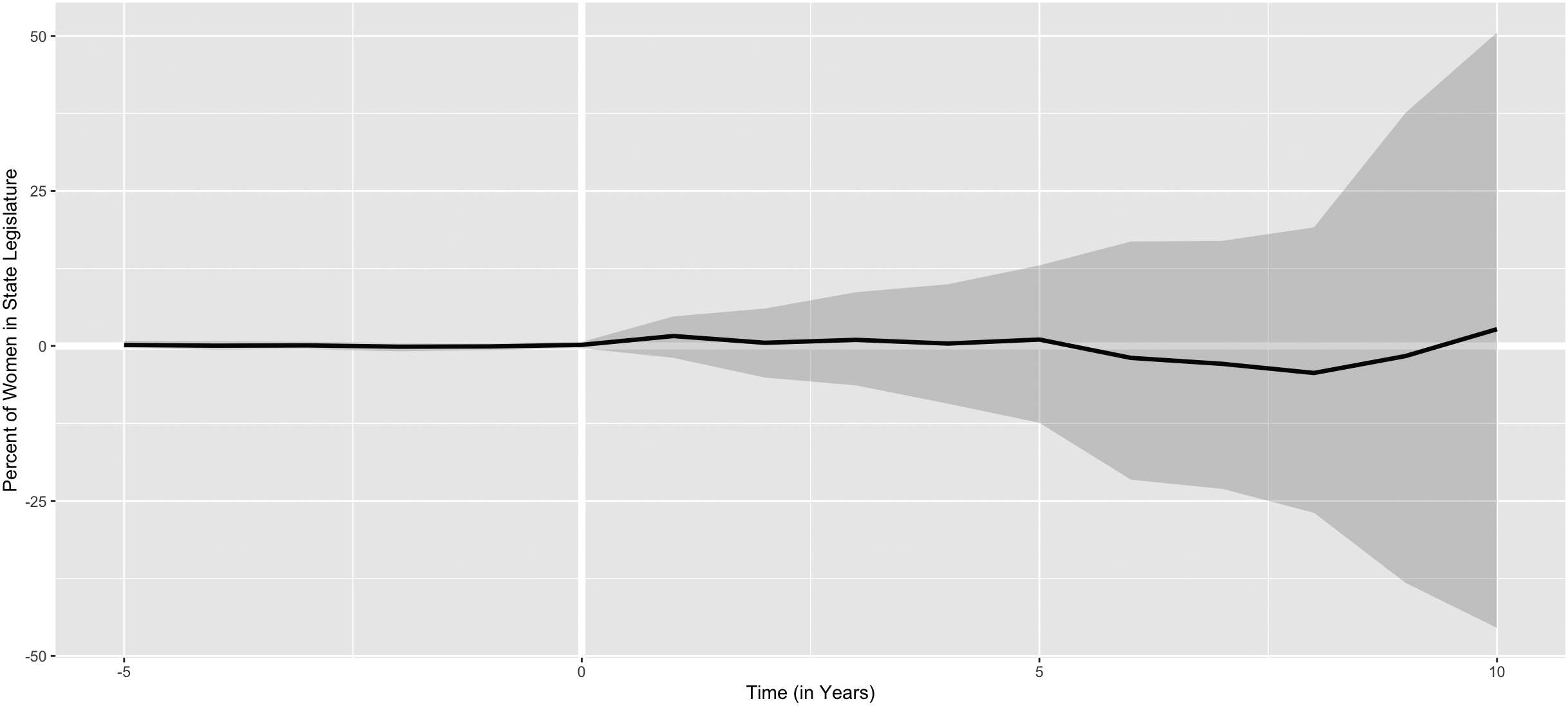
Finally, I run a generalized synthetic control model.Footnote 14 The results are depicted in Figures 8 and 9 and indicate that generalized synthetic control models do not indicate that GBL has a positive effect on the percent of women in the state legislature or percent of women candidates. These models indicate that GBL is associated with a 0.1% drop in the percentage of women legislators and a 0.45% drop in the percentage of women candidates. Additionally, the light grey shade indicates the 95% confidence intervals, meaning the results are not statistically significant.Footnote 15
GSC-estimated average treatment effect.
GSC-estimated average treatment effect.
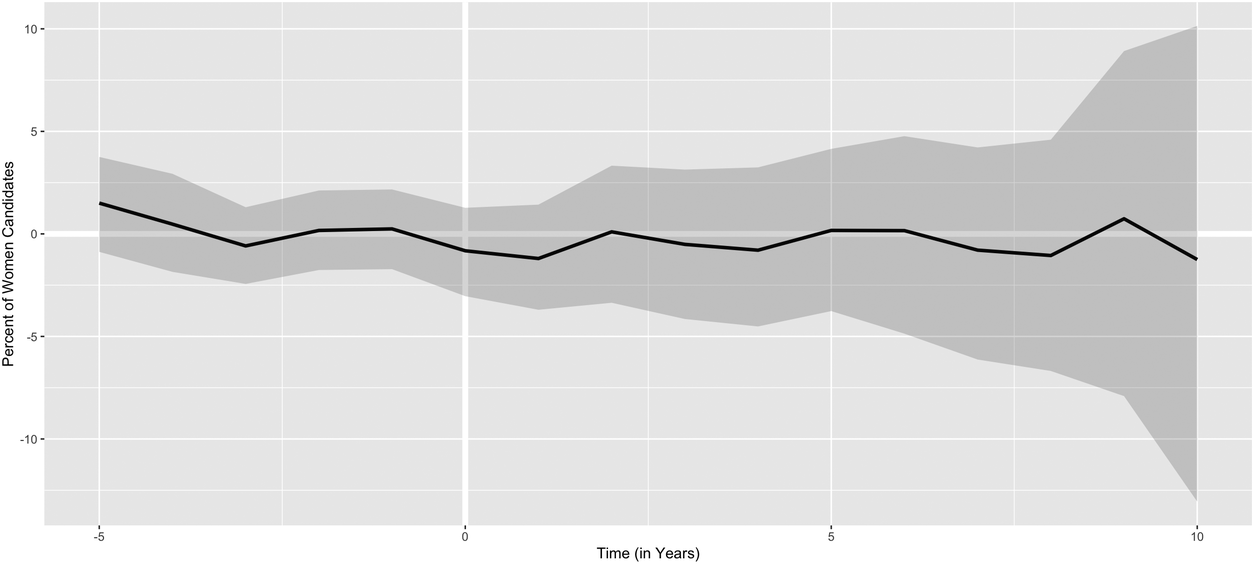
The vast majority of modeling specifications and the specifications best suited for this question find no significant effect of GBL on the percent of women candidates and state legislatures. I do find effects for the 8- and 12-year lagged fixed effects models, which could suggest a longer-term effect that bears future research. However, the similarity of the results across other multiple model specifications strongly suggests that GBL is not associated with an increase in women legislators or women candidates.Footnote 16 Although I cannot definitely prove that GBL has no effect, based on my analysis, there is very little evidence that GBL significantly impacts the presence of women in state government. These results are consistent with much of the quota literature, which notes that solely instilling a quota system is not enough to change the descriptive representation of a decision-making body (Archenti and Tula Reference Archenti and María Inés2017; Childs and Lovenduski Reference Childs and Lovenduski2013; Kunovich and Paxton Reference Ladam, Harden and Windett2005; Reynolds Reference Reynolds1999).
Conclusion
This paper examines GBL’s effectiveness at fueling the women candidate pipeline, exploring GBL’s downstream effect on the number of women entering state leadership positions. Using a nonparametric generalization of the difference-in-differences estimator, I find little evidence that GBL has a substantive effect on the number of women in state legislatures or the number of women running for state legislative office. The results are consistent across multiple modeling strategies, including fixed effects and synthetic control.
Two potentially failed mechanisms can explain the minimal impact of GBL. First, despite gaining greater political experience, women may not move from state board positions to state legislative positions. The board positions could be seen as an ineffective route to office. Alternatively, gendered perceptions of qualifications may keep women serving on state boards from expressing progressive ambition to run for state legislative office (Sidorsky Reference Sidorsky2015). Second, GBL itself could be ineffective at bringing more women onto state boards. Research has yet to explore if GBL is actually changing the composition of state boards, but quota system literature has established that the design of quota legislation will impact its effectiveness, particularly if the legislation lacks enforcement measures (Baldez Reference Baldez, Barakso, Freeman, Gelb, Meyer, Montoya, Nechemias, Reger and Robnett2005; Nanivadekar Reference Nanivadekar2006; Norris Reference Norris2004). As many of the states lack enforcement measures or have only weak accountability measures, GBL may be ineffective at its primary task to diversify state boards.
This is the first paper to introduce GBL into scholarly circles, leaving additional questions to address. Future research should examine the rationale that leads states to pass this legislation. As GBL has little impact on the female candidate pipeline, these bills may be passed as symbolic measures. Understanding the motivations leading to the bill will clarify if GBL is primarily a political gesture. Additionally, data on state boards’ composition would be highly valuable to determine if GBL is fulfilling its intended purpose. More information on the composition of state boards overtime is necessary to continue this research. Importantly, data on the composition of state boards would allow a natural next step to this project, determining if GBL’s ineffectiveness is due to the legislation’s failure at brining women onto state boards, or a lack of women moving up the political pipeline. Additionally, future research could explore the perceptions of state board positions, determining if party-gatekeepers and voters view state board experience as a meaningful qualification for higher elected office.
These results have implications for a range of actors. For academics, this paper extends the current literature, probing for a deeper understanding of legislation’s downstream effects on descriptive representation. Additionally, this work encourages greater scholarly attention to women’s presence in local and state politics. Perhaps more tangibly, these results have implications for activists aiming to increase the pool of women candidates. For those working toward gender parity, this paper finds that GBL is not wholly sufficient to bring women into the political sphere. Rather, the results suggest the need to analyze GBL’s effectiveness at encouraging women to join state boards, as well as a better understanding of the mechanisms that support women’s jump to elected office.
Supplementary Materials
To view supplementary material for this article, please visit http://dx.doi.org/10.1017/spq.2020.8.
Data Availability Statement
Replication materials are available on UNC Dataverse at https://doi.org/10.15139/S3/FEW2LM.
Acknowledgments
Shannon McQueen is grateful for Christopher Warshaw and Danny Hayes’s helpful suggestions and the George Washington University American Politics Workshop participants for their insightful conversation.
Funding Statement
The author received no financial support for the research, authorship, and/or publication of this article.
Conflict of Interest
The author declared no potential conflicts of interest with respect to the research, authorship, and/or publication of this article.
Author Biographies
Shannon McQueen is a doctoral candidate at George Washington University (GWU). Her research focuses on the importance and influence of women’s involvement in politics, the mobilization of women’s groups, and the institutional, cultural, and policy obstacles women face when running for office.