INTRODUCTION
The Nordic countries are among those countries that are pursuing the most permissive policies with regard to morality issues, i.e., value issues that concern fundamental questions of right and wrong in decisions about life and death (abortion, euthanasia, embryo, and stem-cell research), marriage (divorce, same-sex marriage), and reproduction (assisted reproductive technology). There is, however, one intriguing exception to this overall Nordic permissiveness: the Faroe Islands. This self-governing country that belongs to the Kingdom of Denmark pursues remarkably conservative and restrictive policies on morality issues.
For example, in the same year (2003) that Denmark celebrated the 30th anniversary of its free and legalized abortion, the Minister of Health in the Faroe Islands ordered that the requirements for abortion should be made more stringent. Moreover, he argued that the general medical practitioners should tighten their interpretation of the law and only authorize abortion under the stringent specific circumstances described in the legislation of 1956, i.e., only in case of rape, a mother's health risk, or fetal defects (Lov 1956). Abortion rates (per 1000 live births, 2000–2009) are hence strikingly lower in the Faroe Islands (around 63) than in Denmark (around 250), Norway (around 260), and Sweden (around 340) (ArcticStat).
Why is it that morality policies are so distinctively different in the Faroe Islands compared to the other Nordic countries (or other Western European countries for that matter; see Engeli et al. Reference Engeli, Green-Pedersen and Larsen2012)? This question touches upon a broader issue in the literature on religion and politics: religion and secularization play a crucial role in the politics of morality, but at the same time there is no direct or linear relation between religion and secularization and policy outcomes over morality issues. For instance, Dutch politics has been dominated by religious political actors from 1918 to at least 1994 and the level of politicization around morality issues has always been very high, yet on all the morality issues mentioned above, the Netherlands developed permissive policies (Timmermans and Breeman Reference Timmermans, Breeman, Engeli, Green-Pedersen and Larsen2012; van Kersbergen Reference Van Kersbergen2008).
In this article, we develop a theoretical framework to explain the political dynamics around morality issues and policy outcomes in the Faroe Islands, which draws on morality issue theory, secularization theory, and the supply side theory of religion. Politically speaking, the Faroe Islands belong to the so-called secular world: there is no religious-secular social cleavage and there is only a minor Christian party. Morality issue theory expects that under such circumstances morality issues will receive little attention and will not be incorporated into the competitive structure of party politics. This is exactly what we find looking at party programs and parliamentary activities: a minimal politicization of morality issues, decoupled from the major cleavage structure of society.
Although morality issue theory explains cross-national variation in contestation very well, it does not provide a foundation for deriving clear predictions on policy outcomes. So why does the Faroe Islands have such remarkably restrictive policies? Our analysis of the parliamentary struggle over abortion and the rights of homosexuals confirms the finding of minimal contestation, but also demonstrates that in spite of this, morality issues and policies are nevertheless strongly framed in terms of the secular-religious cleavage characteristic for the religious world: the conflict between human self-determination and what ought to be decided by God. Apparently, there is a third way — beyond the secular and the religious worlds identified by morality issue theory — in which religion can enter politics in a diffuse yet pervasive manner. In the Faroe Islands, virtually all political actors — whether in favor or against permissiveness — stress (quasi-)religious arguments in their appeal to voters and in their policy-making activities and justifications. In other words, it is the secular nature of the political system that explains minimal contestation, but it is the omnipresence of Christian morality in politics that explains the maximal restrictiveness of morality policies.
Christianity seems an integral part of what appears as a shared background identity of all political actors in the system. The question then is why the Christian religion so permeates politics in its entirety. The answer is that politics in this sense reflects society and culture: the Faroe Islands stand out because of their high level of religiosity. We describe how historically religion became attached to the nationalist movement, how the language struggle encouraged religious pluralism, and how industrialization helped to vitalize further religious life. These factors explain the relatively limited secularization and comparatively high level of religious vitality of Faroese society (Hansen Reference Hansen2013). We then use the insights of the supply-side theory of religion to explain how this historical pattern is reproduced by the competitive structure of the religious market, even under conditions of enduring and increasing pressures for secularization. We summarize our findings and discuss the relevant theoretical consequences for the study of religion and politics.
MINIMAL CONTESTATION OVER MORALITY POLITICS
A Theory of Morality Politics
The first step to solve the puzzle of Faroese exceptionalism is to look at the politicization of morality issues. The most sophisticated theoretical approach to morality politics currently available is Engeli et al.'s (Reference Engeli, Green-Pedersen and Larsen2012) framework, which brings together insights from policy agenda-setting theory, social cleavage theory, and the party system/party competition literature to explain cross-national variation in the level of conflict around morality issues. The approach argues that under conditions of secularization morality issues become only highly politicized if there is fierce party competition between secular and religious parties. In other words, only in political systems that have an inbuilt religious-secular cleavage and a religious political actor, defined as the “religious world,” do heated controversies over morality issues arise. In the secular world, where such a fundamental social conflict line and the corresponding actors are absent, no politicization of morality issues occurs.
The theory uses the four key factors of politicization that policy agenda-setting theory (Baumgartner and Jones Reference Baumgartner and Jones1993) has identified — attention, actors, framing, and venue — to explain for the field of morality politics the high level of controversy in the religious world and the relative political serenity in the secular world (Engeli et al. Reference Engeli, Green-Pedersen and Larsen2012, 16–17, 20–21).
Attention is a key factor for understanding conflict definition over issues. The main question here is whether political conflicts occur in an open public arena with a large audience or in rather closed circuits. The actor constellation denotes how the relevant actors position themselves on an issue and thus define conflict. Framing refers to from which perspectives actors discuss issues and which viewpoints are included and excluded from the conflict definition. Baumgartner and Jones (Reference Baumgartner and Jones1993, 26) see the framing of an issue as always involving a combination of empirical information and emotive appeals, which is critical for conflict definition. Finally, institutional venue refers to the institutional structure in which a conflict is articulated and where authoritative decisions are made (Baumgartner and Jones Reference Baumgartner and Jones1993, 32).
Variation in these four factors cause differences in conflict definition and these, in turn, create differences in the policy processes and in policy outcomes. Political contestation is virtually always structured as a conflict over policy and policy changes. Political actors do not just clash over an issue as such, but their conflict is about altering the status quo, in the case of morality issues, for instance, whether a specific behavior that touches upon morality should be legalized or prohibited (Engeli et al. Reference Engeli, Green-Pedersen and Larsen2012, 11).
In the religious world, morality issues are likely to get substantial attention from the political parties, as they are able to position themselves against each other on the religious-secular conflict line. Whether the religious parties or the secular parties have an interest in politicizing morality issues may change over time and depends, among other things, on whether religious or secular voters are likely to defect. The political parties are the central actors around morality issues and their role emerges from their positioning in the religious-secular conflict. Other actors, for example, interest groups on abortion or gay rights organizations, will also tend to be shaped by the same conflict. The framing of morality issues is mainly a question of what role religion should play in decisions about life and death, marriage, and reproduction. Should it be man, God, the church or the state that ultimately ought to decide in these matters? Party politics is the central institutional venue. Morality issues are expected to become an established element of party competition because of the religious-secular cleavage.
In the secular world, the attention to morality issues is often very limited because of the lack of interest from political parties. None of the major parties has a strategic interest in drawing attention to these issues, as they are not really a part of party political competition. Most of the political parties seem to possess a certain unwillingness to become a central actor around morality issues. Hence, free voting over legislative proposals is generally allowed. If parties are forced to take positions in such issues, they try to redefine the issue into something that can be placed on the left-right conflict line, highlighting, for example, the economic consequences of a proposed legislation. Other actors (e.g., interest groups such as women's movements and gay rights organizations) tend to take a secular stance on morality issues because there is no religious-secular cleavage to position themselves on and there are no significant religious opponents to formulate this position against. The framing of morality issues is mostly very issue specific with no general pattern for different issues, which is a consequence of the lack of a frame centered on human self-determination as against what has been ordained by God. The main venue is more likely to be parliamentary politics rather than party politics, because there is no party conflict around morality politics. When parties allow free voting the vote of each Member of Parliament (MP) counts in a different manner and the majority building takes a different form and is less predictable.
Morality Politics in the Faroe Islands
We apply this framework to morality politics in the Faroe Islands, which are a part of the Danish Realm and have been self-governing since 1948. The Faroe Islands have a unicameral parliamentary political system with proportional representation. Legislation is mostly introduced in parliament by the government, but individual members of parliaments have the opportunity to raise issues or bills. Parliament and politics in general are dominated by political parties with a strong party discipline. The structure of the political system in the Faroe Islands means that the parliament is virtually the only venue where morality issues can be politicized. Referenda are rare and there is no constitutional court (the Danish Supreme Court on rare occasions agrees to consider the constitutionality of legislation). Extra-parliamentary venues are unlikely to be significant in conflicts over morality issues.
The Faroese political spectrum is structured by the traditional left-right ideological cleavage as well as by the independence-unity conflict dimension, i.e., the conflict between those who wish independence from Denmark and those who strive for unity (Sølvará Reference Sølvará2002; Hoydal Reference Hoydal2000). This dual cleavage structure defines the competitive nature of the Faroese party-system and forces parties to seek a distinctive position in a two-dimensional policy space.
As the morality politics approach stresses, the presence of a secular-religious cleavage is necessary for politicization. Even though there is no such cleavage in the Faroe Islands, there have been two Christian democratic parties over the years. The first explicitly Christian party was the Christian People's Party, which was formed in 1984 and was an expansion of an already existing party (Wang Reference Wang1988). As in Denmark and Norway (Karvonen Reference Karvonen and Hanley1994; Madeley Reference Madeley and Hanley1994), the motivation for the party's formation was rooted in an anxiety about secularization and particularly the growing demand for the liberalization of pornography and abortion. Although Christian values have been important in other parties' value frames too, this was the first time that a party so explicitly conveyed religious issues into the party system. The Christian People's Party was part of a coalition government during two legislative periods, in which it had a ministerial post (Sølvará Reference Sølvará2003). In 1991, internal disagreements split the party and in 1992 a new Christian democratic party was formed, the Centre Party. In 1994, two Christian democratic parties were running for election and they received 12.1% of the vote, resulting in two seats each (Sølvará Reference Sølvará2003). In 2014, the Centre Party had two seats and held a ministerial post (Health) in the governing coalition (see Government). The Centre Party's distinctive characteristic and main purpose is to emphasize and bring religious values onto the agenda of morality and ethical issues. Otherwise, the party is a typical center party, forming a rather pragmatic approach in relation to the two cleavages significant in the Faroese party system. In socio-economic terms, the party supports a market economy as well as the welfare state (see Centre Party A).
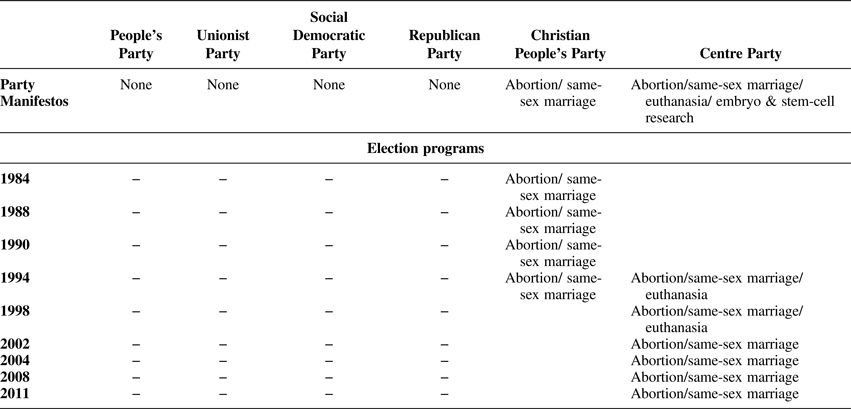
In spite of the presence of minor Christian parties, the political system of the Faroe Islands must be categorized as belonging to the secular world because of the dominance of the left-right and independence-union dimensions. It is therefore expected that the parties give limited attention to morality issues. To test whether this expectation can be confirmed, we first carried out a systematic search through all Faroese party manifestos and election programs since 1984 (see Table 1 for the results). Our major finding is that none of the four major parties in Faroese politics have ever even mentioned morality issues; it is only the two Christian democratic parties that mention them. The Christian People's Party focused exclusively on abortion and same-sex marriage in all documents from 1984 to 1994, while the Centre Party has consistently added euthanasia and stem-cell research to this list since 1994. The Centre Party states that life is a gift from God and that legislation must protect life, so that neither free abortion nor euthanasia should be legalized. In addition, the party argues that only embryo and stem-cell research that aims at diagnosis and treatment should be allowed. Marriage is the God-given form of consensual union between man and woman and hence legislation should only support this kind of marriage (see Centre Party B).
Mentions of morality issues in party manifestos and parliamentary election manifestos, 1984–2011

Source: Faroese party manifestos and election programs, available on the parties' homepages (links available upon request).
We also systematically looked at whether and to what extent morality issues become politicized in parliamentary debates. We make a distinction between interpellations and motions, where the former provide opposition parties the opportunity to generate a debate in parliament about an issue and MP's can table questions to the Ministers, while the latter provide the same opportunities but can further lead to parliamentary decisions that are binding for the government (Engeli et al. Reference Engeli, Green-Pedersen and Larsen2012). We covered the period 1984–2013 and found that abortion is the morality issue that has received most parliamentary attention: there were six interpellations and four motions, which were all at the initiative of the Christian People's Party and later the Centre Party (see Table 2 for the results). Embryo and stem-cell research has been raised only once, also at the initiative of the Christian People's Party. Several motions have been raised on the issue of same-sex marriage; these have not been raised by parties, but by individual MPs' and once by the Minister of Justice.
Interpellations and motions on morality issues in the Faroese parliament, 1984–2013

Source: compiled by the authors from the parliament's home page: http://www.logting.fo (more detailed links available upon request).
In sum, there has been limited party attention to morality issues and parliamentary activity on these issues is limited. Morality issues are not part of party political competition in the Faroe Islands. The only parties that focus on morality issues are the small Christian democratic parties. When these issues receive parliamentary attention, it is exclusively at their initiative. We therefore conclude that in the terms of morality issue theory, the Faroe Islands constitute indeed an example of the secular world and, as the theory predicts, that morality issues receive very limited attention in politics.
Can we confirm this finding if we study parliamentary contestation around abortion and the rights of homosexuals (including same-sex-marriage) — the two issues receiving most attention — in more descriptive detail? This is the topic to which we turn now.
Abortion
The legislation on abortion in the Faroe Islands stems from 1956 (in force since 1959) (Lov 1956). When Denmark allowed free abortion in 1973, the restrictive legislation on abortion in the Faroe Islands was retained. The first time abortion was brought on the agenda after 1956 was in 1985, when the Christian People's Party expressed its worry about the increasing number of abortions during the last decade and requested initiatives to reduce these (Løgtingið 1985). In 1991, The Christian People's Party collected almost two hundred signatures from, among others, priests, doctors, midwives, and nurses in support of a request for more stringent requirements for abortion. It proposed an amendment of the law, but the minister rejected it (Løgtingið 1991b). Subsequently, in the beginning of 1992, the Christian People's Party again proposed to amend the legislation so as to make abortion only legal if the pregnant woman's life was at stake. The proposal was considered in the Legal Affair Committee, but an amendment of the law was not deemed necessary (Løgtingið 1991a). Continuing its attempt to reduce the number of abortions, the Christian People's Party then proposed to amend the rules for prenatal diagnosis, so that embryo research with the purpose of identifying and removing fetuses with defects would be banned. The motion was rejected (Løgtingið 1993).
In 1997, the Centre Party introduced a bill to set up an abortion committee. The purpose of the committee would be to provide advice and offer alternative solutions to the women applying for an abortion, and thus reduce the number of abortions. A majority in the Welfare Committee found such a committee unnecessary and the proposal was voted down in parliament (Løgtingið 1996). Later that year and again in 2001, the Centre Party tried to start interpellations, but without success (Løgtingið 1997; 2001).
In 2002, the Centre Party became part of the government coalition and was assigned the post of the Ministry of Health. This was a great opportunity for the Centre Party to have a direct impact on abortion. In 2003, the Centre Party Minister sent a written request to all general medical practitioners, summoning them to adhere to the wording of the law in their legal assessment for the authorization of abortion, stressing that social conditions should not be part of the argument for allowing abortion, as this is not part of the legislation (Sosialurin A). The Minister's initiative caused great dissatisfaction both among the doctors and politicians, who found that the practice of abortion was fine as it was and that it was not necessary to further tighten the rules. Still, the Centre Party insisted that the government coalition contract included a point on the lowering of the abortion rate (idem). However, the Christian democrats did not have further impact because after the election of 2004 they ended up in opposition.
In 2005 and 2007, the Centre Party again proposed to set up an abortion committee and again to no avail, especially because parliament had already decided to introduce a consultative unit (Løgtingið 2004; 2007). This consultative unit, called Sjálvhjálpin (self-help), offered counseling and was operative between 2007 and 2014 (see Kvinnuhúsið).
The Centre Party continued to draw political attention to the abortion issue and after the parliamentary election in 2011 the party entered the government coalition, again claiming the post of the Ministry of Health. At the Centre Party's national convention in November 2012 it was revealed that the Minister of Health was preparing a bill to amend the abortion legislation so that women wanting an abortion shall have a mandatory counselling with an abortion committee, whose task is to find an alternative solution (Sosialurin D). The minister, facing political opposition, refrained from proposing the reform, but kept on working on another proposal since.Footnote 1
In sum, to the extent that the issue was brought up in parliament, it was exclusively on the initiative of the Christian democrats, who wished to further limit the already very restrictive abortion law or the — in their eyes — too lenient abortion practice. Importantly, there have been no attempts to liberalize the restrictive abortion law.
Homosexuality and Same-Sex Marriage
Homosexuality was decriminalized in Denmark in the early 1930s and simultaneously implemented in the Faroe Islands. The issue of equal rights for homosexuals was for the first time debated in the Faroese parliament in the late 1980s. This was because in 1987 Denmark had included “sexual orientation” in the anti-discrimination law. In 1988, the social democratic Minister of Justice proposed to add “sexual orientation” also to the Faroese anti-discrimination legislation. This caused the Christian People's Party to withdraw from the government coalition in protest (Wang Reference Wang1988). Interestingly enough, the proposal did not stand a chance in parliament: there was only one single vote from a member of the Republican Party in favor of adding “sexual orientation” to anti-discrimination law (Løgtingið 1987; Dimmalætting).
In 2003, an organization of Faroese homosexuals (later called lesbian, gay, bisexual, and transgender (LGBT) Føroyar, see LGBT Føroyar) entailed a public campaign on the issue and succeeded in putting the inclusion of “sexual orientation” again on the political agenda. Two members in the Republican Party authored a proposal, but a majority in the Committee on Judicial Affairs recommended parliament to vote against the proposal and it was again rejected, but this time with 20 votes against and 12 votes in favor. The parties allowed free voting and in a rough outline it was predominantly the right wing and the center parties that voted against the bill, while the left wing voted in favor (Løgtingið 2005).
In 2006, a young gay man was assaulted in the nightlife of the capital city, an event that received massive media exposure. Also the Danish media turned their attention to the incident and put the circumstances of the homosexuals in the Faroe Islands on the public agenda (Sosialurin B; see also LGBT Føroyar B; Hansen Reference Hansen2013, 103–106). Two members in the Republican Party resubmitted the proposal to include “sexual orientation” in the anti-discrimination law (Løgtingið 2006). The Committee on Judicial Affairs was split, with half of the members recommending voting in favor and the other half recommending voting against (Løgtingið 2006). The parliamentary debate was very similar to the earlier debate, except that this time the assault of the young homosexual man played a key role. The outcome was that the bill was passed with the smallest possible majority of 17 votes against 15 votes (Løgtingið 2006). The vice-president of the Republican Party reacted by withdrawing from the party, because he could not accept that members of his own party had taken the lead in what he saw as a wrong step toward secularism (Sosialurin C).
The Faroese organization for homosexuals (LGBT Føroyar) has remained very active — in the media, through campaigning, and by lobbying — to promote equal rights. Three individual MP's (from the Social Democratic Party, the Republican Party, and the Progress Party) took the initiative in 2013 and proposed legislation that allows same-sex marriage. The president of the Centre Party immediately made explicitly clear that if any MP of the government coalition would vote in favor of the bill so that it would be passed, the party would withdraw from the coalition (Sosialurin E). The proposal was rejected with 20 votes against, 11 votes in favor, and 2 abstentions (Løgtingið 2013).
Religious Pervasion
Mortensen's (Reference Mortensen2006) discourse analysis of the 2003–2005 debate over whether “sexual orientation” should be added to the anti-discrimination law reveals that those voting in favor of the bill were using secular arguments pertaining to human rights and society's obligation to accept and protect minorities. The arguments of those voting against the bill could be divided into quasi-religious and religious arguments. The religious arguments were directly based on what the Bible says: it is prohibited to engage in homosexual acts. Hence, members of the Centre Party argued that to legislate in favor of homosexuals is contrary to God's will and would have terrible consequences for the Faroese nation — just as in Sodom and Gomorrah (Mortensen Reference Mortensen2006; Løgtingið 2005; Hansen Reference Hansen2013, 104). The quasi-religious arguments stressed that it should not be necessary to give special rights to certain minorities because the Faroese culture and values, which are in essence Christian, already do not allow anyone to be discriminated. But starting to legislate on behalf of one minority was feared to lead to all sorts of other minorities voicing similar claims. Another argument concerned the slippery slope risk: adding “sexual orientation” to the anti-discrimination law would lead to additional demands from homosexuals, including the right to registered partnership, marriage, adoption, and so on. This was considered as contra the Christian values and traditions of Faroese society (Mortensen Reference Mortensen2006; Løgtingið 2005; Hansen Reference Hansen2013, 105).
The intriguing observation is that during the political debates all politicians expressed their personal religious conviction, not just those who were using religious arguments against the proposal or those simply voting against the proposal, but also those in favor of legislation to protect homosexuals. The politicians voting in favor of the bill were anxious to reject thoroughly the accusation that they were running counter to Christianity and were non-believers. Religion is apparently so dominant that these MP's felt obliged to state explicitly that they were just as much Christians and had as much a personal relationship with God as those rejecting the proposal (Mortensen Reference Mortensen2006; Løgtingið 2005).
Christianity seems an integral and constitutive part of a national political identity that has found a place in the political ideology of all political actors with clear consequences for morality policies. Secularization is comparatively constrained: religion has not entirely retreated from the public (political) sphere and there is less declining belief and religious practice at the personal level (Hansen Reference Hansen2013, 177ff). But in addition to these two type of secularity, there is a remarkable absence of what Taylor (Reference Taylor2007) calls secularity 3: “a move from a society where belief is unchallenged and indeed, unproblematic, to one in which it is understood to be one option among others, and frequently not the easiest to embrace” (Taylor Reference Taylor2007, 3). In the Faroe Islands, the condition of modern society is not such that it is a matter of choice whether to believe in (the Christian) God or not. In fact, it seems unimaginable not to believe in God. But why, in contrast to the other Nordic countries, is the Christian religion culturally so vibrant and why does it permeate politics so thoroughly?
EXPLAINING RELIGIOUS VITALITY
Exceptional Religiosity
During the 2011 census more than 90% of the population responded that they were Christian believers. The variation between the youngest (92%) and oldest (99%) age groups was remarkably small (Statistics Faroe Islands). Only about 1% responded to have another religion than Christianity.
In 2012, 82.1% of the population belonged to the national church (Statistics Faroe Islands). Membership of other churches is also high. The 2011 census reports that approximately 15% were affiliated with the Brethren, 11% with the Home Mission, and 8–9% with other churches and congregations. Although the vast majority of the population has an affiliation with the state church, there are therefore also an astonishing 35% of the people who belong to other congregations and churches than the state church (respondents could indicate more affiliations in the census).
Religious participation in the Faroe Islands stands out in comparison with the rest of Scandinavia. In the Faroe Islands, 23% of the population attends religious services at least once a week and if those who attend religious services at least once a month are included, then nearly 40% of the population is regular church-goers (see Gallup). In the Nordic countries generally only between 2–7% of the population attend religious services weekly (Norris and Inglehart Reference Norris and Inglehart2004; Hansen Reference Hansen2013, chap. 2; Engeli et al. Reference Engeli, Green-Pedersen and Larsen2012).
Theoretical Considerations: Delayed Secularization and Plural Religious Supply
What explains the exceptional religiosity of Faroese society? To answer this question, we draw on two rival theories — secularization theory and the supply-side theory of religion — that in our view offer, in fact, partly complementary explanatory factors.
From secularization theory we take seriously the idea that modernization is causally related to the decline of the social, cultural and political role, and importance of religion, but not inevitably so (see Bruce Reference Bruce2011, 58–59). Nationally specific cultural and historical factors play a role in the precise features and speed of the secularization of a society. Bruce (Reference Bruce2011, 49) points to two broad “retarding tendencies”: cultural transition and cultural defense. Modernization is a disrupting process, upsetting entire communities, revolutionizing employment relationships and patterns, breaking down status hierarchies and creating new ones, and questioning established social, religious, and political identities. “Where social identity is threatened in the course of social traditions, religion may help negotiate such changes or help to assert a new claim to a sense of worth” (Bruce Reference Bruce2011, 49). Religion, rather than simply gradually disappearing, offers tools to cope with a rapid transition of society. It also facilitates a cultural defense against modernization's disrupting power by guaranteeing (new) group identities. “Religion can provide resources for the defence of a national, local, ethnic, or status-group culture” (Bruce Reference Bruce2011, 50), hence delaying secularization.
How this delay works is an empirical issue and depends on the specific context and historical conditions that affect identity (re-)formation. For the Faroe Islands, we single out two key factors: (1) the revivalist movements that came from abroad and that aligned themselves with, and profited from, the language struggle when they started to use the Faroese language for their assemblies and preaching; (2) industrialization, which created a new fishing industry concentrated in new urban centers, where the national church failed to establish itself and where the revivalist movements worked hard and succeeded to meet religious demand.
Such factors not only help explain the delay in the process of secularization, but also account for the relative pluralism of religion in the Faroe Islands. The supply-side theory of religion (Stark and Bainbridge Reference Stark and Bainbridge1987; Stark and Iannaccone Reference Stark and Iannaccone1994; Stark and Finke Reference Stark and Finke2000) informs us how religious pluralism can account for the reproduction of religious vitality over time. The theory argues that religious activity is determined by the structure of the religious market: the more religious suppliers on this market and the more competitive the market is, the more religiosity flourishes. Assuming a constant demand for religion, the more religious suppliers there are, the more likely it is that people find something to their liking and the harder religious “firms” will work to attract and maintain their “clients.” The presence of a variety of relatively successful but competing suppliers reinforces and helps to reproduce religious vitality in the Faroe Islands.
Religion and the Language Struggle
The Faroe Islands have much in common with the other Nordic countries historically, institutionally and politically, but the country also has its distinct history and in many ways has evolved on its own terms. This applies particularly to religion and ecclesiastical history. Faroese religiosity and church affairs have been influenced by Danish religious culture, by the struggle against Denmark, and by religious forces from abroad, especially from Great Britain.
Crucial to understand religious history and religious vitality is how religion got connected to the struggle to get the Faroese language approved as the official language. All civil services in the Faroe Islands were Danish until the first half of the 1900s and the official written and spoken language was also Danish; the Faroese language was considered to be a rustic language not suitable for public usage (Debes Reference Debes1982). These conditions critically also applied to the state church. As a consequence of the Reformation the Faroese diocese was abolished and became part of a Danish diocese. The national language became the ecclesiastical language everywhere in the reformed countries, but not in the Faroe Islands, where it became and remained Danish. While the other Nordic countries had the Bible translated into their national language during the Reformation in the 1500s, the Faroe Islands had no authorized Faroese state church Bible until 1961 (Rasmussen Reference Rasmussen1987). In the Faroe Islands, “God only understood the Danish language.” This situation only began to change in the late 1800s when the Faroese National Movement tried to save the Faroese language from extinction (Debes Reference Debes1982).
The Danish state church reigned supreme on the religious market on the Islands for centuries and ecclesiastical renewals and movements, such as Pietism in the 1700s and Grundtvigianism in the 1800s, came to the Faroe Islands via the Danish clergy (Debes Reference Debes1982). It was not until several decades into the 20th century, however, that the revivalist movements really began to get support among the Faroese population and the Danish state church effectively started to lose its monopoly. Two revivalist movements, the Brethren and the Home Mission, managed to achieve a relatively large share of the religious market (Pons Reference Pons and Gaini2011; Hansen Reference Hansen2013).
The Brethren came to the Faroe Islands via Scotland in 1865 (Brøðrasamkoman, Berghamar Reference Berghamar1992; Zachariassen Reference Zachariassen2000). It was not until the movement started to use the Faroese language that its membership grew. In 1921, about 1.5% of the population had joined the Brethren, while in 1950 it was estimated that 10–12% of the population had joined the church (Wolles Reference Wolles1993).
The Home Mission (Heimamissiónin) was established in Denmark and has its roots in the pious assemblies and Pietism. It started its missionary work in the Faroe Islands about three decades after the Brethren had arrived. The Home Mission's history is characterized by punctuated revivals and internal conflicts over the role of the Faroese language in assemblies and missionary work. The Home Mission in the Faroe Islands has remained a Danish inner church movement using the Faroese language at assemblies. Membership in the 1950s amounted to about 10% of the population. The Brethren and the Home Mission have — next to the national church — enjoyed the largest membership. There have been other churches and revivalist movements too, but these have never become as large and significant (Jørgensen Reference Jørgensen2001; Hansen Reference Hansen1987).
The distinctive Faroese religious developments must be understood by taking into account the language issue. In contrast to all other Reformation countries, Danish remained the church language in the Faroe Islands. In fact, Faroese virtually disappeared after the Reformation and the Danish language superseded it in all sectors. The return of the language is a product of the nationalist movement.
The birth of the Faroese nationalist movement is generally dated on December 26, 1888, when a public meeting was held in the House of Parliament. The topic of the meeting was how to defend the Faroese language and customs (Debes Reference Debes1982). This so-called Christmas Meeting in 1888 today has obtained an almost mythological position in Faroese political culture, symbolizing the rebirth of a supposedly age old, but long since lost, national identity of medieval (Viking) origins. The immediate outcome of the meeting was the formation of the Føringafelag (Faroese Union), with the two-fold aim of bringing the Faroese language back into all areas of public life and of striving for the unity, progress and self-sufficiency of the Faroese people. The union's most important work for society was the issuing of a newspaper, Føringatidindi (Faroese News), which was written exclusively in Faroese. Føringatidindi, which appeared from 1890 to 1901, effectively taught the majority of the Faroese people to read and write their own language (see Østergaard Reference Østergaard, Dipper and Hiestand1995).
In the beginning of the 1900s, the Faroese language had no official status, which in 1901 led to the formulation of a policy of political and cultural autonomy aiming at raising Faroese to the official language (Debes Reference Debes1982). The language struggle became a key political issue and led to a conflict line that instigated protracted battles, both internally between political parties and externally between the Faroese people on the one side and the Danish authorities on the other (Rasmussen Reference Rasmussen1987). The conflict focused on the issue whether Faroese or Danish would be the church and school language and was resolved in 1939, when a solid majority in parliament, supported by a large majority of voters, had sent a demand to the Danish government to equalize the status of Faroese and the Danish language in school and in church. The Danish authorities yielded and adopted a law that equalized the Danish and Faroese language (Rasmussen Reference Rasmussen1987).
The language struggle was crucial for the success of the revivalist movements. When native missionaries, who used the Faroese language, assumed leadership in the congregations, membership started to increase (Jørgensen Reference Jørgensen2001; Berghamar Reference Berghamar1992). The nationalist movement had no impact on the national church and the Danish language remained dominant (Rasmussen Reference Rasmussen1978).
The breakthrough of religious renewal in the Faroe Islands therefore only occurred when the revivalist movements adopted Faroese and became associated with the nationalist movement (Rasmussen Reference Rasmussen1978; Reference Rasmussen1987). Having no connection to Denmark and being a movement outside the national church, the Brethren were entirely nationally oriented and once native leaders had taken over, Faroese became the language. For the Home Mission, being a movement within the church, Faroese became a key feature of distinctiveness and appeal.
Industrialization
The nationalist movement and the revivalists profiting from the language struggle are not the only social and cultural developments to take into account when explaining religious vitality on the Faroe Islands. The other key factor is industrialization, i.e., the transformation from a predominantly agricultural society to an industrial society. The Faroese mode of industrializing took predominantly the shape of a developing fishing industry, which created new urban centers on locations with good seaport conditions. Of key significance was that the national church did not have an established base in these new towns (Joensen Reference Joensen1987) and the revivalist movements found fertile ground for their proselytizing activities, working hard to cater to the religious demand of the fishermen (Hansen Reference Hansen1987).
In the new fishing towns, the majority of men went out to sea on their smacks for several months under extremely dangerous and life-threatening conditions. This thoroughly shocked the existing religious foundation and caused a need for a more personalized Christianity. And it was precisely this kind of personalized Christianity that the layman's revivalist movements preached, while the national church and its clergy kept serving as the intermediary between man and God (Sølvará Reference Sølvará2012; Jóansson Reference Jóansson2012). In 2013, the Brethren's religious “market share” in Klaksvík is estimated to be about 40%, while the Home Mission and other religious movements have a considerable presence too. The state church, in contrast, enjoys much less support in this town than anywhere else in the country (Statistics Faroe Islands).
The Contemporary Religious Market
The supply-side theory of religion states that religious pluralism reinforces and helps to reproduce religious vitality over time. The expectation is that a pluralistic religious market creates and maintains high religious participation and this is what we find in the Faroe Islands. The key concepts of the theorized causal mechanism are competition and activity. These are essential for participation because competing congregations actively generate a varied supply from which people can choose and religious leaders strive hard to maintain or develop their congregations. We mapped the religious congregations and their activities outside the state church (see State Church) to see to what extent the theory's key claims can be substantiated empirically.
The Home Mission has 31 mission houses throughout the country plus a leisure and conference center. The supply from the various mission houses varies according to their size and resources, but usually includes meetings, Sunday school, and Bible lessons on weeknights. Many of the mission houses also have various activities for young people, such as junior workshops and meetings. Further, some organize special meetings for women a few times a month and many have choirs — for both adults and children (see Home Mission).
The greatest supply of activities we find in Tabor in the region Eysturoy. Here the Home Mission has the largest percentage of adherents (Statistics Faroe Islands) and its program includes meetings, Sunday school, events for the youth, women's groups, workshops for children, prayer assemblies, Bible lessons, choir practices, and events for the elderly (see Tabor).
The Home Mission's houses collaborate and organize annual national and regional meetings, publish a newspaper (twice a month, see Trúboðin) and run a leisure and conference center (see Nesvík). Twice a year there are national evangelistic meetings, where the program has something to offer for all age groups and adherents gather from all around the country for a weekend. Additionally, there are regional gatherings during Easter and Pentecost. At the conference center (in Nesvík) a host of activities (seminars, camps), are organized catering to various groups.
The Brethren have 32 halls around the country and, in addition, a leisure and conference center for all congregations (Jóansson Reference Jóansson2012). The congregations vary in size and in the activities they offer. Activities include Sunday services and Sunday school, prayers, and Bible study (see Evangeliska Røddin). Most congregations also have junior workshops and youth worship nights (see Siloa; Nebo; Ebenezer; Lívdin). Several congregations work closely together to create bigger and more attractive events, especially for the young (Nebo). Several Brethren congregations have choirs and organize free concerts (e.g., Siloa; Ebenezer; Betesda). Also the Brethren cater to specific groups, men, women, and couples (e.g., Hebron). Some congregations have introduced opening hours on most days of the week, for confidential conversation, intercession, or just a cup of coffee. In order to reach out to people and inform them about their activities, some congregations are producing monthly leaflets or newsletters that they send out into the local community (Siloa; Hebron).
One of the most active congregations with the greatest supply is Betesda (in Norðoyggjar). Here the Brethren have the most support. Betesda has a wide variety of activities on offer each day (see Betesda). In 2013, Betesda had started to build a new assembly hall at an estimated total cost of € 3.7 million (US$ 4.6 million); the entire amount is privately funded and already paid for (Aktuelt). Furthermore, in 2011 an online platform was created with virtual live-streamed, interactive meetings, focusing on different themes and inviting different guests (Kedes). The concept behind these live virtual meetings is a modernization of the traditional street meetings and open-air meetings (Jóansson Reference Jóansson2012).
The Brethren congregations also cooperate closely nationally, establishing a publishing fund for religious publications in Faroese, organizing national gatherings and seminars, and running leisure and conference center. The Brethren gather six times per year for large national meetings that last for an entire weekend or longer. During these gatherings there are meetings, lectures, presentations, community singing, worship, etc. Around 2,000 people attend these gatherings (Jóansson Reference Jóansson2012). In the Brethren's national center Zarepta (see Zarepta A), there are a great number of activities throughout the year. During the winter the congregations can book the leisure and conference center and they use this option for socialization purposes and to invite new people to join the movement. During the summer there are camps and seminars for various audiences, including families, children, teenagers, adolescents, and people with disabilities. Furthermore, the program includes a Bible course, seminars for women, men and couples (see Zarepta B). In 2013, there were approximately 1,330 youngsters participating in the summer camps for children and teenagers (Zarepta C) and the ongoing expansion of the leisure and conference center indicates increasing activities.
Our empirical mapping of the religious movements and their activities can be taken to corroborate the supply-side theory's expectation that religious activity is considerable outside the realm of the state church. The religious market is competitive and pluralistic in the sense that different Christian movements compete to maintain and expand their congregations, a finding confirmed in Hansen (Reference Hansen2013, 138, 154). This has resulted in a dynamic, well organized and vigorous religious supply of almost 80 (excluding the 60 state churches and minor churches) very active congregations, at local, regional and national level. These cater to the religious demand and are instrumental in reproducing the overall high participation and high level of religiosity in Faroese society.
CONCLUSION AND DISCUSSION
The Faroe Islands constitute an example of the secular world, where contestation around morality issues is minimal. However, religion does play a prominent role in the debate around such issues. We found that religion is broadly important for political identity and affects the arguments of all political actors, even those who favor more lenient policies on morality issues. This is because the Christian religion, in its various forms, is uncharacteristically energetic and permeates Faroese society and culture. We explain this remarkable prominence of religion in terms of delayed secularization, where revivalist movement benefitted greatly from the language struggle when they started to use Faroese in competition with the Danish speaking national state church. The development of industrial society then increased the opportunity structure for these movements, as it created fishing industry towns, where the national state church had no presence and was not active, while religious demand was especially high. The movements worked hard to profit from this opportunity. Competition between the movements and the national state church then further vitalized and helped maintain religious life in these towns and created the contemporary competitive market that explains the high level of religiosity in Faroese society.
Religion is important and secularization is limited and this implies that even though the Faroe Islands belong to the secular world in the political sense that morality theory defines it, the religious-based side of morality issues is nevertheless electorally much more attractive than one would have expected. Because such a large part of the population attaches great value to religion for their cultural and political outlook and behavior, all political parties incorporate and stress Christian values in their policy stance definitions. Christianity is closely linked with culture and national identity, also because it was in the context of the national movement and the language struggle that the revivalist movements prospered. In other words, next to the secular and the religious worlds identified by morality issue theory, there is a third world, in which religion infuses politics. In the Faroe Islands, the political system can be characterized as secular and this explains why there is minimal contestation over morality issues, but the ubiquity of Christian morality explains the maximal restrictiveness of morality policies.
Crucial for policy outcomes is that the parties allow free voting with regard to morality issues so that MP's can act upon their personal convictions and considerations, taking into account the religious morality of society and their voters. This explains why a parliamentary majority of MP's time and again favors restrictive policies, even though party positions may not always be congruent with this. On average, people who are religiously committed, affiliated to a religious denomination, and active church-goers tend to be traditionalist in worldview and political stance (Hayes Reference Hayes1995; Beatty and Walter Reference Beatty and Walter1984). Religion thus influences political behavior both directly by shaping positions on political issues and indirectly by supporting specific policies. Because popular religiosity seems to be a necessary condition for religious influence on politics (Grzymala-Busse Reference Grzymala-Busse2012), religion matters not only because adherents are committed and ready to act politically on the basis of it, but also because religion as a cultural force continues to shape political life, where religious denominations and movements serve as sources of ideology and identity and of political influence, policy pressure and social mobilization. The competition on the religious market in the Faroe Islands is vigorous and this helps to explain religious vitality. Religious vitality, in turn, explains why religion continues to play a key political role in restrictive morality politics, even in the absence of contestation.