

In this article, we present research evidence of a national, public opinion, face-to-face interview survey on xenophobia and host-immigrant relations carried out in both mainland and islander regions of Greece demonstrating the role of the country’s economic crisis in shaping people’s attitudes towards immigrants and minorities. The present study was designed to articulate a typology of particular population groups of host majority expressing political xenophobia and negative attitudes towards foreigners. During times of major economic distress and social unrest and given the rise of extreme right-wing parties following the last Greek elections, this investigation may be particularly pronounced. One method of examining the antecedents of xenophobic attitudes is to identify subgroups within a host society that exhibit differing levels of xenophobia towards varied immigrant groups (Canetti-Nisim et al. 2006). Data gathered by a Eurobarometer opinion poll survey in 1997 showed a worrying level of racism and xenophobia in Member States, with nearly 33% of those interviewed openly describing themselves as “quite racist” or “very racist”. Respondents’ feelings of racism were found to be fed by fear of unemployment, personal insecurity, dissatisfaction with their life circumstances and low confidence in the way public authorities worked in their country.
Results from both Eurobarometer surveys and the European Social Surveys on the attitudes of majorities towards minorities in the 15 EU Member States over time (these surveys were carried out in 1997, 2000, and 2003) showed that the level of resistance to multicultural society has remained the same in 2003 as it was in 1997. However, there was a significant increase over this period (1997-2003) in those endorsing the view that multicultural society has reached its limits. Resistance to immigrants and asylum seekers was widely shared in Mediterranean countries, and Greece showed marked resistance to immigrants. Moreover, the statistical analysis of data in relation to the national circumstances of each Member State, such as GDP per capita and rates of unemployment, indicate that, generally, the higher the GDP per capita in a country, the lower the level of support for dimensions of ethnic exclusionism; and the higher the unemployment rates, the higher the resistance to multicultural society. Greece may be described as one of the European Member States that most suffered the consequences of the global economic crisis over the last five years, providing a particularly relevant context for assessing xenophobic sentiments among host members as well as their contributory factors.
Hjrem (1998: 341) defines xenophobia as a “negative attitude toward, or fear of, individuals or groups of individuals that are in some sense different (real or imagined) from oneself or the group to which one belongs”. In this study, we employed Watts’ conceptualization of political xenophobia (1997) referring to a dominant's group opposition to granting civil and political rights to a minority group. Additionally to these definitions, we set out our research hypotheses by drawing on two social psychological theories of prejudice and inter-group relations: integrated threat theory (Stephan and Stephan Reference Stephan, Stephan and Oskamp2000) and authoritarianism theory (Altemeyer 1981). An integrated threat theory, as proposed by Stephan and Stephan (Reference Stephan, Stephan and Oskamp2000), offers a theoretical framework of inter-group relations based on perceived threats posed to the in-group by the out-group's presence. In contrast, realistic group theories tend to emphasize both objective conflict and subjectively perceived conflict between groups (Bobo 1988). Realistic threats encompass any threat to the welfare of the in-group (e.g. threats to the political and economic power, to the physical or material well-being) while symbolic threat concerns group differences in morals, values, norms, standards, beliefs and attitudes, and is conceived to be closely related to the concept of symbolic racism (Stephan et al. Reference Stephan, Ybarra and Bachman1999: 2222). A meta-analysis of studies examining the relationship between perceived threats, hostility and anti-immigrant attitudes strongly indicates that shared conceptions of threat are closely intertwined with prejudice that often leads to discrimination and exclusionary practices (Riek et al. 2006). Therefore, integrated threat theory, as proposed by Stephans, is considered an appropriate theoretical framework within the specific context of the contemporary Greek situation.
Authoritarianism is conceptualized by Altemeyer (1981) as a set of three interrelated attitudes: conventionalism (agreement with traditional societal norms), authoritarian submission (tendency to obey authority figures who represent these norms), and authoritarian aggression (willingness to engage in authority-sanctioned aggression toward individuals or groups that violate traditional norms). Authoritarianism follows the Authoritarian Personality Theory proposed by Adorno and his co-workers (1950) who argued pro the potential individual tendency to accept anti-democratic political views and to express intolerance and exclusionary sentiments towards out-groups. In a number of relevant studies, authoritarianism has been postulated as a psychological explanatory framework for racism and xenophobia. Canetti-Nisim and Pedahzur (2003) assessed the explanatory potential of three kinds of reasoning: socio-economic, political and psychological in the field of political xenophobia within the multi-cultural context of Israeli society. The two researchers found psychological variables, expressed as authoritarian beliefs and attitudes, that were not only powerful for explaining all types of political xenophobia but constant in their explanatory ability. In other words, individual characteristics such as right-wing authoritarian attitudes were stable predictors of political xenophobia towards varied cultural groups.
Cohrs and Stelzl (2010) conducted a meta-analysis of the relations between ideological attitudes (right-wing authoritarianism and social dominance orientation) and anti-immigrant attitudes in 155 independent samples from 17 countries (total N = 38,522 participants) and reported that these two ideological attitudes strongly predict negative inter-group relations across countries, different measures and diverse samples. Notably, right-wing authoritarianism and anti-immigrant attitudes were found to be particularly high in countries where immigrants are perceived by the public as increasing the crime rate and as not being advantageous to the economy, that is, where they are viewed as posing a threat to collective safety and security. In other words, those who endorse perceptions of threats and view immigrants as both competitors for jobs and economic resources, and a threat to collective security would be more hostile toward immigrants than those rejecting such perceptions.
The following research objectives are addressed with respect to the present study:
a) To estimate the prevalence of majorities’ attitudes towards minorities according to different dimensions of xenophobia covering aspects such as social distance, perceived threats, opposition to civil rights of the immigrants.
b) To identify distinct attitudes in terms of the respondents’ views to specific aspects of xenophobia as well as to estimate the size of groups of respondents who are characterized by these attitudes.
c) To assess the degree to which particular attitudes of respondents are indicative of specific personal or socio-demographic characteristics such as education, age, employment, geographic position and political orientation; composition of groups characterized by a specific social profile, i.e. specific social, economic and political components.
d) To discover the relations among different components of xenophobia in order to promote our understanding with regard to its theoretical constitution.
Survey
The statistical population of this survey was the general population of Greece with Greek citizenship and age above 18 years of age. A stratified multi-stage sampling with a selection probability proportionate to the population was used as a sampling method, while the population Census of 2001 in the block level was used as a sampling frame. During the first stage large areas of Greece were used (NUTS I level), while in the second stage 167 blocks were selected. In the third stage households were selected using systematic sampling with 2 as a sampling interval. In the case of no response, the household was replaced with the next one available. Inside households a quota procedure according to the age and gender variables was used to select individuals. In case of absence of a proper individual inside the household, it was replaced by the next one. The size of the sample was 1,838 individuals. The mean age of the sample was 48.5 years old, while the age distribution seems to be typically normal with higher frequencies in the central age groups 38-47 and 48-57 and lower frequencies in the first and last age groups. Male units counted the 48.6% and female units the remaining 51.4% of the total.
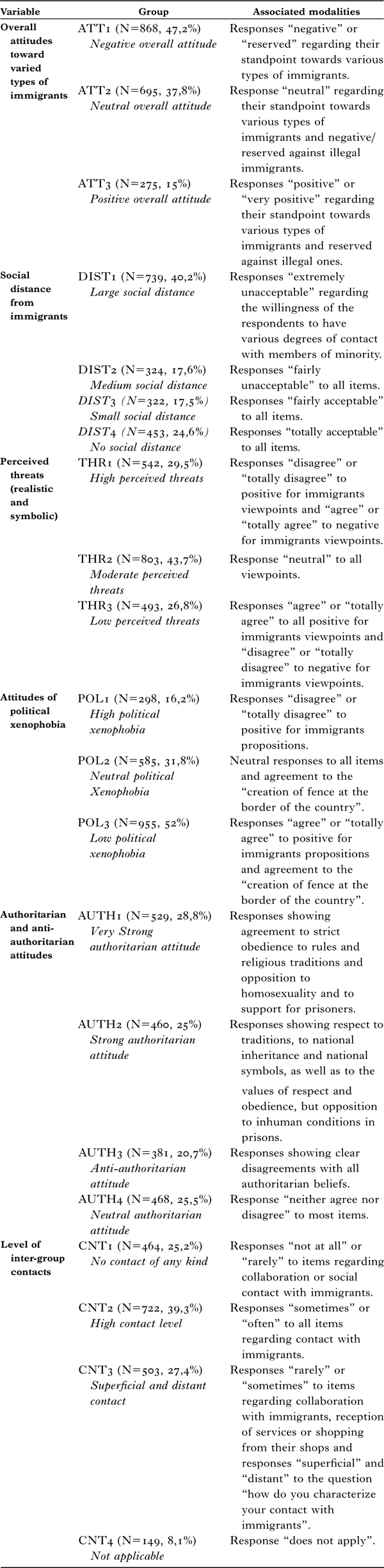
The identified groups are summarized in table 1.
The survey questionnaire was designed to cover the following matters.
• Demographic and social variables: age, gender, place of residence, education level, income, occupational and professional status, individual and local social capital, quality of life, local social problems, social capital and the influence of current economic crisis.
• Level of immigrant/host majority contact: participants of the study were asked to indicate number of immigrant friends, frequency of visit exchange, participation in pro-immigrant events, reception of immigrants’ services, interactions of immigrants’ and host majority children and mix interactions at work. The response format consisted of a 5-point scale ranging from 1 (never) to 4 (often). Additional questions explored participants’ perceptions of quality of interactions with immigrant groups.
• Social distance scale: participants of the study were asked to indicate on a 4-point scale ranging from 1 (extremely unacceptable) to 4 (extremely acceptable) their willingness to have various degrees of contact with members of a minority, e.g. would you be willing to work with them as employers, rent them a flat, marry them, have them as friends of your children, share a hospital ward.
• Realistic threats scale: four modified items were drawn on a measure created by Stephan and his co-workers (1999) to assess participants’ perceived realistic threats posed by immigrant groups such as job loss, economic and service cost for the country (e.g. “It is generally good for [country’s] economy that people come to live here from other countries”, “immigrants have increased the hospital and social services cost on Greeks”, “host society members lose jobs to immigrants”, “immigrants have contributed to the increased rates of [country’s] crime”). The response format consisted of a 5-point scale ranging from 1 (strongly disagree) to 5 (strongly agree).
• Symbolic threats scale: five modified items were drawn on a measure created by Stephan and his co-workers (1999) to assess participants' perceived differences with immigrants in values, morals and norms (e.g. “It is generally good for [country’s] culture that people come to live here from other countries”, “[country's] cultural life is generally undermined by people coming to live here from different countries”, “the values and norms of Greeks regarding cleanliness are different from those of most immigrants”, “the values and beliefs of Greeks regarding moral and cultural issues are not compatible with those of most immigrants”, “the values and norms of Greeks regarding family issues and socializing children are basically quite similar to those of most immigrants”. The response format consisted of a 5-point scale ranging from 1 (strongly disagree) to 5 (strongly agree).
• Political xenophobia scale: the three items were based on Watt's (Reference Watts1996) conceptualization of political xenophobia that refers to the extent to which members of the host majority wish to limit or not the rights and activities granted by the government to members of minority groups. The response format consisted of a 5-point scale ranging from 1 (strongly disagree) to 5 (strongly agree). Additional questions explored participants' opinions about social inclusion policies for the immigrants.
• Authoritarian and anti-authoritarian attitudes: the items of this particular section were drawn by Altemeyer’s Right-Wing Authoritarianism scale (Altemeyer 1988, RWA) covering beliefs concerning respect and obedience for authority, national anthems, flags, national heritage, traditional forms of religious, organizations that require strict obedience as well as attitudes to punishment and differences in terms of sexual orientation.
• Trust and social cohesion: participants were asked to indicate the kinds of networks involved within their local neighborhoods, frequency of social contacts, the existence of civic initiatives for promoting community welfare, the presence of immigrants within their local neighborhoods and whether this has affected the quality of community life. Social cohesion which focuses on shared values and norms was assessed in our survey using the Sampson et al. (Reference Sampson, Raudenbush and Earls1997) scale; respondents were asked to indicate the extent to which they agreed with five statements, using the 5-point Likert scale. The statements were: “people in this neighborhood can be trusted”, “this is a close-knit neighborhood”, “people around here are willing to help their neighbors”, “people in this neighborhood generally don’t get along with each other” and “people in this neighborhood do not share the same values”.
• Criteria for immigrants’ integration: participants indicated on a 5-point scale (1 = extremely unimportant, 5 = extremely important), how important having work and language skills, family presence, being in the host country legally and for an extended period of time, and being White and Christian were for immigrants' integration in the host country.
Perceptions of quality of life: participants of the study were asked for their subjective perceptions of both their overall life quality as well as of their finances. Comparisons with others and with the standard of living in the past were also articulated by the respondents.
Analysis methods
In order to uncover the dimensions of xenophobia, we proceeded from descriptives to multi-dimensional factor analysis and clustering methods. In particular, a combination of Multiple Correspondence Analysis (mca) (Benzecri 1973; Greenacre Reference Greenacre2007) and Hierarchical Cluster Analysis (cha) based on Benzecri's chi-square distance and Ward's linkage criterion (Benzecri 1992) were employed. The simultaneous use of dimensionality reduction and clustering for interpretation has been developed as a methodology by J.-P. Benzecri (Benzecri et al. 1980) and successfully applied in a wide range of fields (Stalidis and Karapistolis 2012). Specific analysis methods were preferred over quantitative statistical methods because of their ability to detect complex—even non-linear—relations among a large number of variables without a priori assumptions on the underlying models. Furthermore, this research was aimed at constructing a new model following the data, rather than confirming hypotheses. The produced outcome describes in a qualitative way the most representative patterns in the responses of the surveyed population and reveals underlying tendencies (Rouanet et al. 2000).
With respect to the distinguishing features of the adopted methods and on the analysis-related terminology used hereafter, it should be noted that all questionnaire items are treated as categorical variables—including the ordinal ones—and all possible answers (i.e. categories) are called properties or modalities. Levels of Likert scales are thus not used as quantitative measures of synthetic factors but instead are analyzed as vectors in a multidimensional space, revealing graphically their underlying relations (Van de Geer 1993). The aim of mca is to explain contingencies among properties by means of factorial axes and to detect associations among properties that form specific behavior patterns and tendencies. The hierarchical clustering method (cha) is applied on the indicator matrix (or logical matrix 0-1) and uses the same data representation as mca, that is, as vectors in a multi-dimensional space defined by the properties (Benzécri et al., 1980). The analysis has been performed using the data analysis software mad (méthodes d’analyse des données) (mad 2012; Karapistolis 2002).
The analysis process followed the three steps described below.
1. Firstly, a combination of mca and cha—in the form of the vacor algorithm (Benzécri et al., 1980)—was applied separately on each item-set corresponding to an individual questionnaire topic. In other words the analysis was iterated for each composite variable of xenophobia, considering such variables as constructs that represent manifestations, contributing factors or simply dimensions of xenophobia. In the resulting factorial axes, the main standpoints, and therefore the representative classes of respondents, appeared as groups of properties. At the same time, respondents were clustered into homogeneous groups and the characteristics of these groups were identified by associating them with specific classes or modalities.
2. After completing the above cycle of analysis per each construct, mca was applied on the full set of the cluster membership variables produced in the previous step. On the resulting factorial planes it was possible to observe the associations among these classes, as an overall picture of the phenomenon of xenophobia. Socio-demographic variables and geographic location were also added as supplementary data in order to associate such characteristics with xenophobia classes.
3. In the last step, the analysis was focused on the respondents that presented negative overall attitude, in order to explore at a finer scale the factors that could explain their standpoints. A combination of mca and cha was again used, identifying the most characteristic sub-groups within the negative attitude population and revealing the main factors explaining their formation.
Results
Study of individual dimensions of xenophobia
The factor analysis process was applied to the composite variables of overall attitudes towards immigrants, social distance, perceived threats, political xenophobia, authoritarian attitudes and level of inter-group contacts. In this section, the obtained analysis results are presented per variable, together with related descriptive data.
The identified groups are summarized in table 1.
• Overall attitudes toward varied types of immigrants
Only 19% of all respondents declared positive attitudes toward immigrants in general, and 31% toward immigrants who legally live and work in the receiving country. Much of the rejection of illegal immigrants and of refugees was addressed, by 86% and 49% of all the participants, respectively. Study participants were also asked to indicate the level of integration among immigrants of varied ethnic groups in the host country; those from outside Europe such as Pakistanis, other Asians, Arabs and those of African origin were thought of as being least integrated compared to those from within Europe and from ex-Soviet countries.
The analysis of the overall attitudes towards immigrants with multidimensional factor analysis showed, on the factorial plane 1 X 2 (explaining 60.3% of inertia), a typical escalation pattern, i.e. a Negative Attitude class formed by the modalities corresponding to negative values (1 and 2 in the 1-5 scale) to the items on the standpoint towards immigrants and likewise two more groups of modalities constituting the Neutral and Positive Attitude classes. The clustering step (cha) resulted in 3 homogeneous groups of respondents, clearly matching the above three attitude classes. Group att 1 (Ν = 868) corresponding to 47% of the sample, was the Negative overall attitude group, while the Neutral overall attitude group att 2 (Ν = 695) corresponded to 38% and the Positive overall attitude att 3 (Ν = 275) to 15% of the respondents. The property of negative attitude towards “illegal” immigrants was found to be a common characteristic of all three groups, showing that even respondents with a positive attitude profile are against illegal immigrants.
• Social distance from immigrants
Study participants expressed no or low willingness to marry, to rent a flat and to work with members of minority groups as supervisors. Moderate reservations were expressed to having them as friends of their children and to sharing a hospital ward. The analysis showed that the respondents can be clustered into 4 groups: dist 1 (N = 739, 40%) corresponded to Large social distance, dominated by the tendency to respond “extremely unacceptable” to all items regarding the willingness of the respondents to have various degrees of contact with members of a minority. dist 2 (N = 324, 18%) corresponded to Medium social distance, more specifically to the responses “fairly unacceptable” to certain items of the questionnaire and “fairly acceptable” to certain other items. dist 3 (N = 322, 18%) was the Small social distance group (response “fairly acceptable” to all items), while dist 4 (N = 453, 24%) was the No social distance group (response “totally acceptable” to all questions).
• Perceived threats (realistic and symbolic)
The survey showed a large majority of host society participants perceive immigrants as threats to the country’s economy generally (60%), to the job market (68%), to increased rates of [country’s] crime (80%) as well as a burden on the cost of the host country’s hospital and social services. As regards perceived symbolic threats, the survey showed a large majority of host society participants view immigrants as holding dissimilar values and norms regarding moral and cultural issues (58%), practices of cleanliness (47%), family and children socializing (43%). In addition, a considerable proportion of the survey participants (44%) endorse the belief that “[country’s] cultural life is generally undermined by people coming to live here from different countries”, and only a small number of the respondents (19%) felt that “it is generally good for [country’s] culture that people come to live here from other countries”. In sum, the study shows that perceived competition between groups for both material and symbolic resources is high, implying policy recommendations for reducing prejudice and feelings of fear. However, the large majority of respondents attached great value to fundamental rights to education (71%) as well as to health and social security (68%) equally to the Greeks.
The analysis on both realistic and symbolic threats resulted in three groups: thr 1 (N = 542, 29%) High perceived threats, thr 2 (Ν = 803, 44%) Moderate perceived threats and thr 3 (Ν = 493, 27%) Low perceived threats. It was also observed that the respondents from all groups tended to agree that “immigrants should accept the rules and values of Greek society as soon as possible” and totally disagreed that “the presence of immigrants will change the culture of Greece”.
• Attitudes of political xenophobia
Only 37% of those interviewed indicated their agreement with the statement that “the government of Greece should legally establish all immigrants who live in the country for more than five years”. Moreover, 68% agreed that “immigrants should be sent back to their country of origin under all circumstances”, and also with the recent measure of the Greek government to set up a fence on the country’s border (71%). These attitudes coexist with 57% of those who agreed that the Greek government should ascribe Greek citizenship to the immigrants' children. There was a mixed reaction to the question concerning policy measures which target an improvement in the social position of the immigrants. On the one hand, just over 50% were in favor of an integration philosophy through education and work as well as the development of a “multicultural” school system (57%). On the other hand, the vast majority of respondents held the view that “immigrants should fully accept the rules of Greek society as soon as possible” in order to become fully accepted members of the host society.
With regard to this aspect, three groups were identified, pol 1 (Ν = 298, 16%) High political xenophobia, pol 2 (Ν = 585, 32%) Neutral political xenophobia and pol 3 (Ν = 955, 52%) Low political xenophobia. It was also observed that all groups, even the one corresponding to low xenophobia, were associated to with a high level of agreement with “the creation of a fence at the country’s border”.
• Right-Wing Authoritarianism Orientation
Study participants were asked to indicate their agreement with statements concerning respect for authority, customs and national heritage as well as attitudes to homosexuals and punishment. The survey showed a large majority of participants endorsed strong conventionalist views with regard to submission and loyalty to a leader. In particular, they indicated their agreement with statements such as: “customs and national heritage are the things that make society great and people should be made to show great respect” (89%), “obedience and respect are the most important virtues that children should learn” (68%), and they encouraged loyalty to a leader (52%). Although half the study sample (51%) favored a relaxation of conventional religious rules, the great majority opposed the view of undermining national anthems, flags and glorification in the future (81%). Opinion was divided in relation to the statement that: “organizations that require strict obedience of commands from authority have unhealthy effects upon individuals”. Less strict views were expressed in relation to homosexuals (46%) and punishment (60%).
The multidimensional analysis process revealed a more complex structure than a simple scale, resulting in 4 groups of respondents: auth 1 (N = 529, 29%) corresponded to Very Strong authoritarian attitudes including agreement to strict obedience to rules and religious traditions as well as opposition to homosexuality and to support for prisoners. auth 2 (N = 460, 25%) corresponded to a Strong authoritarian attitude class identified by the endorsement of authoritarian attitudes, such as respect for traditions, national inheritance and national symbols as well as for the values of respect and obedience, but opposition to inhuman conditions in prisons. auth 3 (N = 381, 21%) was the Anti-authoritarian group of respondents who clearly disagree with all authoritarian beliefs. Finally, auth 4 (N = 468, 25%) was a group of respondents who tended to be Neutral to all aspects.
• Level of inter-group contacts
The 69% of those interviewed said they had no friends from minority groups, no direct interpersonal contacts at home, work and school with members of immigrant groups, and no participation in pro-immigrant activities or events. Nearly half of those interviewed considered contact with minority groups either as neutral (22%) or distant (26%). As regards the level of immigrant/host majority contact, the respondents were clustered in 4 groups: cnt 1 (N = 464, 25%) stating No contact of any kind with immigrants, cnt 2 (N = 722, 39%) characterized by High contact level, cnt 3 (N = 503, 27%) characterized by Superficial and distant contact and, finally, cnt 4 (N = 149, 8%) as the group of people who answered “Does not apply”.
• Criteria for immigrants’ integration
New immigrants are welcome as long as they enter the host country formally (87%), live and work for an extended time of period (82%), have language skills (73%), family (73%) and an economically useful function in the host country (70%). Survey participants were found to be race and religious neutral.
• Trust, social cohesion and neighborhood life
The findings based on the social cohesion scale (Sampson et al., 1997) indicated that a majority of the participants reported norms of trust (57%), willingness to provide reciprocal help (58%) and bonding relations (52%) within the area of their neighborhood. Respondents disagreed with the statement: “people in this neighborhood generally don't get along with each other” (49%) while they were neutral about whether “people in this neighborhood share the same values” (32%). The host majority group’s social network involved frequent interpersonal contacts with relatives (76%), neighbors (76%) and friends (89.5%). 57% of those interviewed reported a high presence of immigrant groups in their neighborhood area and experienced deterioration in terms of quality of life (57%). More than half of the respondents declared no civic participation in activities or groups for improving community life.
• Perceptions of quality of life
68% of those interviewed experienced a deterioration of their personal situation and claimed financial hardship (70%). Confidence in the country's government was particularly low (66%), reflected also in the pessimistic views expressed about the country's future (61%).
Summary of analysis results per composite variable

Analysis of the overall phenomenon of xenophobia
In order to reveal the overall relations within the entire phenomenon of xenophobia, mca was applied on all classifications identified in the previous section. On the factorial plane 1X2 shown in Figure 1 (explaining 53% of inertia), after selecting for projection the points with quality of projection (Squared Cosine) cor > 200 and contribution to the formation of the axes larger than the mean contribution ctr > 45 (Benzecri 1980), it was found that the overall negative attitude/reservation towards immigrants (att 1) was clearly associated with very strong authoritarian attitudes (auth 1), large social distance (dist 1), high perceived threats (thr 1) and high political xenophobia (pol 1). On the other hand, the overall positive attitude (att 3) was associated with no social distance (dist 4) and low perceived threats (thr 3), while neutral attitude (att 2) was associated with medium social distance (dist 2), moderate perceived threats (thr 2) and distant/superficial contact with immigrants (cnt 3).
The overall relation among individual factors or manifestations of xenophobia (color online)
In order to associate the above classes with socio-demographic properties, the variables on education level, age, employment status and economic status were added as supplementary data, together with a variable on political beliefs (self-positioning from left to right) and participation in social activities. It was found that negative standpoint towards immigrants, high perceived threats and large social distance were associated with the lowest education levels (up to primary school), to the oldest ages (> 68) and to extreme right-wing political beliefs. The extreme negative standpoint towards immigrants (1 in the 1-5 scale) was located close to the lowest income levels (up to €500 and €500-1,000—close to and beyond the poverty line), as well as to the following responses concerning their current economic situation: “It is difficult or very difficult to overcome” and compared to previous years “it is worse” or “much worse”.
On the other hand, positive general standpoint, low perceived threats, low political xenophobia and neutrality regarding authoritarianism were associated with young age and high education level (graduate or postgraduate studies). Those who maintained their income, and the few who improved it, tended to have a positive attitude towards immigrants. The responses concerning the situation in the neighborhood in relation to the number of immigrants showed that the response “there are many immigrants” was clearly associated with the most negative attitude towards immigrants whereas the response “there is a small number of immigrants” was associated with the neutral and positive stances towards immigrants. Finally, intensive participation (social capital) in local association and civic society initiatives was related to the very positive attitude towards immigrants.
Identification of the most intensely xenophobic groups
One of the goals of this study was to distinguish within the general population the particular xenophobic groups with strong anti-immigrant attitudes and delve into their beliefs and social characteristics, as a means of understanding the structural components of this phenomenon. To this end, a more targeted analysis was focused on a selected subset of the general sample, namely on the subgroup that was identified as the Negative overall attitude towards immigrants group att 1 (N = 868 or 47% of the general population).
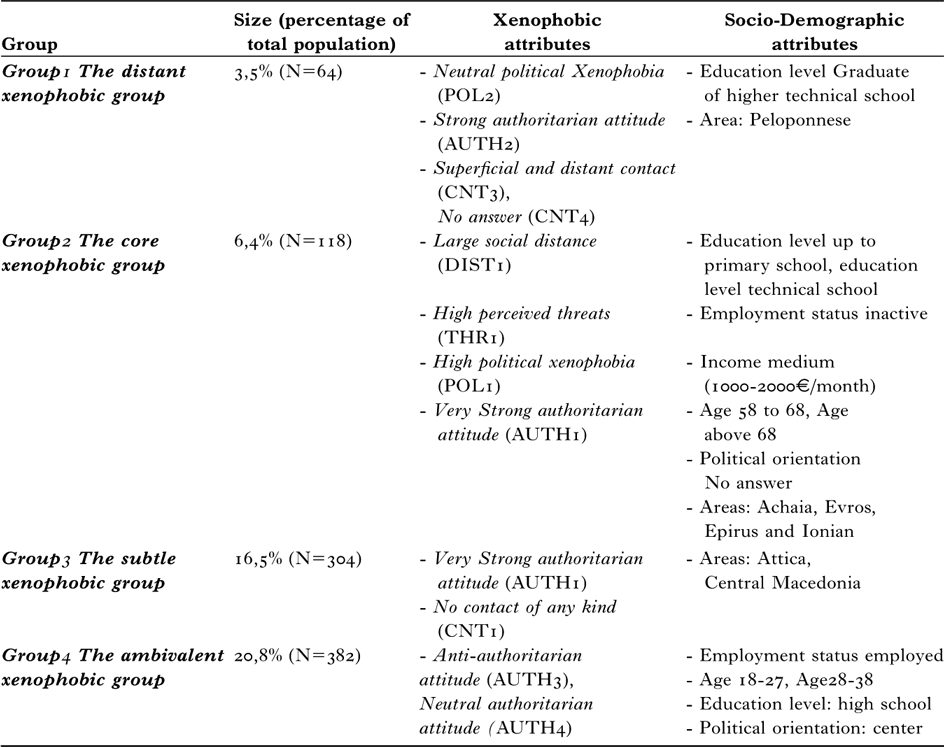
The cluster analysis of this subset resulted in four respondent groups. The dominant characteristics of these groups and the factors underlying their formation were then identified with the use of mca. The first factorial axis (22.7% of inertia) differentiated the extreme negative attitudes regarding social distance, perceived threats and political xenophobia from the positive ones, showing that these three elements are clearly correlated with each other and can be considered as one dimension of the phenomenon (horizontal axis in Figure 2). The second factorial axis (14.2% of inertia) expressed the dimension of authoritarianism, showing on the one side the modality of strong authoritarian attitudes and on the opposite side the modalities of neutrality and non-authoritarianism (vertical axis in Figure 2). The third axis (12.8% of inertia) represented the dimension of contact level with immigrants. The first two factors are shown in Figure 2, where it can be observed that Group2 was associated with high social distance, high perceived threats, high political xenophobia as well as with high authoritarianism. This represents the core xenophobic group with the most negative attitudes in all dimensions. Group 3 was also associated with high authoritarianism but, as regards the first factor, was not characterized by high levels of threats, social distance and political xenophobia. After including supplementary socio-demographic variables in the analysis, the consolidated interpretation of the three factorial axes conferred the profiles of the xenophobic groups (presented in more detail in Table 2) as follows:
• Group 1. The distant xenophobic group. Corresponding to 3.5% of the general population (N = 64), this is a small group of respondents who are mainly characterized by distant and superficial contact with immigrants. They are also characterized by strong authoritarian attitudes but they are neutral to political xenophobia and perceived threats.
• Group 2. The core xenophobic group. Corresponding to 6.4% of the general population (N = 118), this is a group with an intensely negative standpoint, characterized by large social distance, high perceived threats, high political xenophobia and also strong authoritarian attitudes. It can be stated that this group represents the core of the respondents with a negative standpoint towards immigrants, as they show the strongest opposition to immigrants, do not accept any contact with them and adopt absolute authoritarian positions. In terms of socio-demographic characteristics, there are significantly increased frequencies of people with a low education level (up to primary school) and with secondary technical education, are economically inactive and have a medium income (1000-2000). There are also increased frequencies of older people (above 58 years of age). There is no clear picture regarding their political position but there was a strong tendency not to answer the corresponding question.
• Group 3. The subtle xenophobic group. Estimated as 16.5% of the general population (N = 304), the group is associated with strong authoritarian attitudes and no contact with immigrants but is not characterized by high social distance attitudes, perceived threats or political xenophobia.
• Group 4. The ambivalent xenophobic group. Corresponding to 20.8% of the general population (N = 382), this group contains respondents who are mainly characterized by non-authoritarian attitudes. Their classification regarding the other dimensions of xenophobia does not reveal any association or disjunction to any negative or positive category. As such, although people in this group have expressed an overall reserved or negative attitude towards immigrants, they are not polarized to any particular anti-immigrant belief. The ambivalent xenophobic group is associated with being employed, of medium education level (high-school), the youngest age categories (18 to 38 years old) and tends to central political beliefs. The professions of manager and merchant and a good economic status are found in high frequencies in this group.
The negative-standpoint subgroups on the factorial plane 1X2 (color online)
The xenophobic and socio-demographic modalities associated to the four xenophobic groups
Finally, an analysis of geographic areas, similar to the one of socio-demographic variables, showed (according to 86% of inertia) that the presence of the core xenophobic group is stronger in the areas of Achaia, Evros, Epirus and Ionian, the distant group in Peloponnese, and the subtle xenophobic group in Attica and Central Macedonia. However, for Group 4, there was no clear pattern.
Discussion
The present analysis succeeded in identifying four distinctive subgroups with strong anti-immigrant attitudes. Group 2 labeled “the core xenophobic group” corresponds to 6.4% of the general population and draws our attention, as it represents the most extreme cases of xenophobia. The profile of this group is synthesized by the most negative properties in all aspects of xenophobia: strong authoritarian attitudes, high perceived threats, large social distance and high political xenophobia. We suggest that this particular group corresponds to Pettigrew and Meertens’ (Reference Pettigrew and Meertens1995) description of the blatant, traditional and direct form of intergroup prejudice which involves components of rejection, feelings of threat, emotional resistance, anti-intimacy and no support of immigrants’ rights. This traditional form of prejudice has been related to ethnocentrism, approval of racist movements, national pride and political conservatism––central tenets of a right-wing authoritarian orientation (Pettigrew and Meertens Reference Pettigrew and Meertens1995).
We assume that the profile of Group 3, characterized by moderate positions with regard to measures of more direct xenophobia (anti-intimacy, no support for immigrants’ rights and perceptions of threats) and simultaneously by social conservatism expressed by strong authoritarian attitudes, may be indicative of subtle and indirect prejudice. The subtle prejudice group tends to adopt more intermediate positions that reject minorities indirectly by placing emphasis on the importance of traditional values and by exaggerating cultural differences. For both blatant and subtle prejudice, conservatism proved the most significant predictors (Pettigrew and Meertens Reference Pettigrew and Meertens1995).
Group 4 is the largest in size, representing the mildest xenophobic attitudes and mainly characterized by non-authoritarianism. Katz and Hass (1988) employed both correlational and experimental methods in order to explain prejudice through two distinct value-attitude structures existing simultaneously within individuals: one friendly and the other hostile. These conflicting sentiments were found to be anchored in two largely independent, core value orientations: humanitarianism-egalitarianism, with its emphasis on ideals of equality, social justice, and concern for others’ well-being; and individualism, with its emphasis on personal freedom, self-reliance and devotion to work. In our study, Group 4 respondents would not endorse ideological beliefs of social conservatism and traditionalism and they would also not express any extreme, unfavorable concern with regards to immigrants. However, they would be negative towards them. We assume that this kind of ambivalence may be explained by Group 4 respondents’ full internalization of individualistic values which strengthen the sense that immigrants possess certain disqualifying attributes and are not doing enough to help themselves. However, these are only speculations given that our study did not consider core value orientations of contemporary Greek culture (Chtouris 2004) A more comprehensive understanding of xenophobia requires more attention to the norms on intergroup relations that currently shape the country’s wider social and cultural context.
An alternative explanation for conflicting sentiments derives from Devine’s (Reference Devine1989) theoretical model based on the dissociation of automatic and controlled processes involved in prejudice. The model assumes that high-prejudice persons are likely to have personal beliefs that overlap substantially with the cultural stereotype whereas low-prejudice persons experience a conflict between the automatically activated stereotype and their personal beliefs. We speculate that Group 4 respondents express anti-immigrant feelings because of automatic stereotype activation that is so strong that prejudice attitudes are expressed. In our study, this form of xenophobia was proved to be more descriptive of middle-age people, economically active with medium education and central political beliefs. In addition, the structural macro level condition in Greece can provide evidence on anti-immigrant attitudes (Scheepers et al. 2002; Semyonov et al. 2006).
The profile of Group 1, named the “distant xenophobic group”, includes respondents who have a certain level of superficial contact with immigrants and express moderate concerns with regard to immigrants. It represents only a small proportion of the general population who tend to have had a technical education.
At the broad scale of simultaneous observation of all variables, it was clear that the prevalence of xenophobia in the general population can be represented as an escalation from low to high levels of anti-immigrant attitudes. Rejection of immigrants was clearly associated with high perceived threats, large social distance, right-wing authoritarianism and political xenophobia, whereas on the other end, the low xenophobic stance was mainly characterized by the overall positive attitude towards immigrants, the low perception of threats and the lowest level of social distance. Our findings confirm empirical evidence that perceived intergroup competition over scarce resources and feelings of threat may lead to negative evaluations of immigrant groups (Esses et al. Reference Esses, Dovidio, Jackson and Armstrong2001; Stephan et al. Reference Stephan, Renfro, Esses, Stephan and Martin2005). A country’s economic recession, with a scarcity of jobs and resources may activate instrumental reactions by host society members that target the reduction of the source of competition and of the threat that immigrants are thought to represent (Quillian 1995). In the present study, a high perception of threats was strongly associated with the high presence of immigrants as well as with being unemployed. This confirms the motivational concerns that underlie anti-immigrant attitudes.
Other theoretical frameworks assume that ideological attitudes of right-wing authoritarianism and of social dominance orientation shape negative evaluations of immigrant groups (Bohman 2011). An individual’s ideological beliefs in social control, conformity and conventionalism, as indexed by right-wing authoritarianism, are linked to concerns for resources such as value dominance and for collective security which may be heightened in conditions of economic crisis (Duckitt 2001). Altemeyer (1998) has shown that ideological beliefs of right-wing authoritarianism predict rejection of out-groups such as ethnic minorities. The present results provide confirmation given the associations of social conventionalism, as measured by a number of items on the right-wing authoritarianism orientation scale, with the anti-immigrant attitudes. As expected, the oldest respondents with the lowest education levels and extreme right-wing political beliefs were those who endorsed the overall negative attitudes towards immigrants. Past research has consistently shown strong relationships between low education, age, the political right-wing, and high prejudice (Allport Reference Allport1958; Gaasholt and Togeby1995). In contrast, the small proportion of respondents who endorsed a positive standpoint towards immigrants also expressed low perceived threats, no or low opposition to immigrants’ rights and neutral attitudes towards authoritarianism. This group of respondents was young with a high education level and extreme left-wing political beliefs. Properties such as medium education levels, being middle aged, and central political beliefs were not indicative of certain xenophobic attitudes. We found high political xenophobia associated with extreme right-wing political beliefs.