INTRODUCTION
Flagship species are commonly used to generate commitment for conservation in general and for protected areas in particular (Simberloff Reference Simberloff1998; King & Beazley Reference King and Beazley2005). In marine environments, charismatic or economically valued taxa, such as whales and abalone, have been used as flagships to garner local support or international funds for the establishment and management of marine protected areas (MPAs) (Sloan 2004). Flagship species are frequently selected based on socioeconomic considerations, such as the ability to arouse sympathy in the public, rather than ecological factors, such as how well the abundance of the flagship correlates with regional biodiversity (Walpole & Leader-Williams Reference Walpole and Leader-Williams2002). Consequently flagship populations may or may not recover because of conservation activities such as protected areas that aim to improve environmental quality (Simberloff Reference Simberloff1998; Carillo et al. Reference Carillo, Wong and Cuaron2000; Williams et al. Reference Williams, Burgess and Rahbek2000; Zacharias & Roff Reference Zacharias and Roff2001).
The extent and rate of population recoveries in MPAs vary substantially across species and ecosystems. The effects depend on physical characteristics such as reserve size (Mosquera et al. Reference Mosquera, Côté, Jennings and Reynolds2000; Samoilys et al. Reference Samoilys, Martin-Smith, Giles, Cabrera, Anticamara, Brunio and Vincent2007; Claudet et al. Reference Claudet, Osenberg, Benedetti-Cecchi, Domenici, Garcia-Charton, Perez-Ruzafa, Badalamenti, Bayle-Sempere, Brito, Bulleri, Culioli, Falcon, Guala, Milzaao, Sanchez-Meca, Somerfield, Stobart, Vandeperre, Valle and Planes2008), biological factors such as dispersal behaviour, reproductive and life-history strategies (Russ & Alcala Reference Russ and Alcala1998; McClanahan et al. Reference McClanahan, Graham, Calnan and MacNeil2007) and socioeconomic factors such as fishing pressure and MPA enforcement (Mosquera et al. Reference Mosquera, Côté, Jennings and Reynolds2000; Côté et al. Reference Côté, Mosquera and Reynolds2001; Samoilys et al. Reference Samoilys, Martin-Smith, Giles, Cabrera, Anticamara, Brunio and Vincent2007; Guidetti et al. Reference Guidetti, Milazzo, Bussotti, Molinari, Murenu, Pais, Spano, Balzano and Agardy2008). In addition, numerous threats to biodiversity may not be effectively mitigated using a no-take MPA, such as pollution, sedimentation or invasive species (Allison et al. Reference Allison, Lubchenco and Carr1998).
For community-based MPAs that are managed and enforced by local people, local support is critical to MPA success (Alcala Reference Alcala1998; Crawford et al. Reference Crawford, Kasmidi, Korompis and Pollnac2006; Mora et al. Reference Mora, Andréfouët, Costello, Kranenburg, Rollo, Veron, Gaston and Myers2006). Such support depends partly on assisting the community to have realistic expectations for the MPA (Christie et al. Reference Christie, Lowry, White, Oracion, Sievanen, Pomeroy, Pollnac, Patlis and Eisma2005). For this to occur, non-governmental organizations (NGOs), government officials, or local leaders, who are facilitating the creation of a reserve, must honestly communicate the potential and realized impacts of the reserve to the local community. If flagship species are used to help garner support for MPAs, then it is important to conduct long-term monitoring of the flagship species so that communities can determine whether the MPA is meeting their goals (Danielsen et al. Reference Danielsen, Burgess and Balmford2005; Uychiaoco et al. Reference Uychiaoco, Arceo, Green, La Cruz, Gaite and Alino2005).
Seahorses have many characteristics of a successful flagship species (Simberloff Reference Simberloff1998; Walpole & Leader-Williams Reference Walpole and Leader-Williams2002; Caro et al. Reference Caro, Engilis, Fitzherbert and Gardner2004). They are among the most charismatic and valuable small marine fishes. They have unusual body shapes and unique life histories, and are also valued by fishers to sell internationally and locally for the traditional Chinese medicine market, aquariums and curio trade (Vincent Reference Vincent1996; Baum & Vincent Reference Baum and Vincent2005; Giles et al. Reference Giles, Ky, Hoang and Vincent2005; Magera Reference Magera2005). In addition, seahorse populations are threatened by bycatch, habitat loss due to destructive fishing damage to their coral, seagrass and macroalgae habitat (Vincent et al. Reference Vincent, Foster and Koldewey2011) and direct exploitation (Baum et al. Reference Baum, Meeuwig and Vincent2003; Salin et al. Reference Salin, Yohannan and Nair2005; Martin-Smith & Vincent Reference Martin-Smith and Vincent2006). Finally seahorse recovery could indicate improvements in environmental quality. For example, a previous study suggested that Syngnathids (seahorses and pipefish) could be used as an umbrella species, such that protecting one species of Syngnathid in a particular area might lead to the conservation of other species (Shokri et al. Reference Shokri, Gladstone and Jelbart2009).
The tigertail seahorse (Hippocampus comes Cantor) was used as a flagship species to help engender local support for the establishment of community managed and enforced MPAs in an area where these fish were of considerable economic value (Pajaro et al. Reference Pajaro, Vincent, Buhat and Perante1997; Vincent et al. Reference Vincent, Meeuwiga, Pajaro and Perante2007). In the central Philippines, where we conducted this study, they are captured locally in a small-scale lantern fishery, to an extent that apparently leads to recruitment overfishing (Pajaro et al. Reference Pajaro, Vincent, Buhat and Perante1997; Vincent et al. Reference Vincent, Meeuwiga, Pajaro and Perante2007). Seahorse fishing became illegal in 2004 under a Philippines law that translated CITES-mandated export controls (www.cites.org) into a domestic ban on seahorse capture, but this law is essentially ignored in our study area (M. Yasué, A. Nellas & A.C.J. Vincent, personal observations).
In this study, between 2001 and 2008, biologists, volunteers and local fishers surveyed seahorse populations in eight MPAs across the Danajon Bank, Philippines, and compared them to populations in fishing grounds just outside the MPAs and in four distant fishing sites. In contrast to many MPA studies (Russ & Alcala Reference Russ and Alcala1996a; Côté et al. Reference Côté, Mosquera and Reynolds2001; Roberts et al. Reference Roberts, Bohnsack, Gell, Hawkins and Goodridge2001), we were able to compare our reserve sites to both near and distant fished sites over several years. Distant fished sites may better represent a typical fished reference site, given that MPAs are a priori expected to affect areas just outside their boundaries (Ferraro & Pattanayak Reference Ferraro and Pattanayak2006), both because fish may move out of the MPA (Forcada et al. Reference Forcada, Valle, Bonhomme, Criquet, Cadiou, Lenfant and Sanchez-Lizaso2009) and because fishing effort may concentrate along the borders of the MPAs (Russ et al. Reference Russ, Alcala, Maypa, Calumpong and White2004; Kellner et al. Reference Kellner, Tetreault, Gaines and Nisbet2007; Harmelin-Vivien et al. Reference Harmelin-Vivien, Direach, Bayle-Sempere, Charbonnel, Garcia-Charton, Ody, Perez-Ruzafa, Renones, Sanchez-Jerez and Valle2008).
Given the rapid reproductive maturity of seahorses (for example H. comes 0.5–1 yr; Foster & Vincent Reference Foster and Vincent2004), as compared to other fish taxa (Jennings et al. Reference Jennings, Reynolds and Polunin1999; Hutchings & Reynolds Reference Hutchings and Reynolds2004), as well as the strong community support and enforcement in most of these MPAs (Martin-Smith et al. Reference Martin-Smith, Samoilys, Meeuwig and Vincent2004; Samoilys et al. Reference Samoilys, Martin-Smith, Giles, Cabrera, Anticamara, Brunio and Vincent2007; Yasué et al. Reference Yasué, Kaufman and Vincent2010), we predicted that there would be a significant reserve effect. A reserve effect would be indicated if seahorse densities in the MPAs increased or did better over time than in distant fished sites. We also analysed, size, sex ratios and reproductive status because previous studies suggested that MPAs could influence these characteristics of fish populations (Roberts et al. Reference Roberts, Bohnsack, Gell, Hawkins and Goodridge2001; Willis et al. Reference Willis, Millar and Babcock2003; Molloy et al. Reference Molloy, Reynolds, Gage, Mosqueira and Côté2008), without necessarily influencing abundance (Rakitin & Kramer Reference Rakitin and Kramer1996).
METHODS
Study site
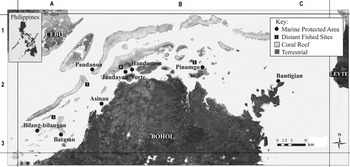
Danajon Bank is a 145-km long double-reef system of shoals and atolls located primarily along the coast of Bohol province (Philippines), with a total area in excess of 2350 km2 (Fig. 1) (Hansen et al. Reference Hansen, Ban, Jones, Kaufman, Panes, Yasué and Vincent2011). Historically, it is a region of high marine biodiversity (Christie et al. Reference Christie, Armada, White, Gulayan and de Dioas2006). However, in the last few decades, destructive fishing practices such as trawling, blast fishing and cyanide fishing have devastated most of the coral reefs in the region (Green et al. Reference Green, Alexander, Gulayan, Migrino, Jarantilla-Paler and Courtney2002; Christie et al. Reference Christie, Armada, White, Gulayan and de Dioas2006). Across Danajon Bank, where this study took place, there are very few unexploited seahorse populations outside MPAs. Indeed, due to the high economic value of seahorses (Vincent Reference Vincent1996; Pajaro et al. Reference Pajaro, Vincent, Buhat and Perante1997) and the extreme human poverty and socioeconomic dependence on marine resources (Green et al. Reference Green, Flores, Dizon-Corrales, Martinez, Armada and White2004; Tun et al. Reference Tun, Chou, Cabanban, Tuan, Philreefs, Yeemin, Suharsono, Sour, Lane and Wilkinson2004) populations of seahorses declined by at least 77% from 1970 to 2003 (Martin-Smith et al. Reference Martin-Smith, Samoilys, Meeuwig and Vincent2004; O'Donnell et al. Reference O'Donnell, Pajaro and Vincent2010).
Map of the marine protected areas (MPAs) and fishing areas in the Danajon Bank, central Philippines.

Seahorse census
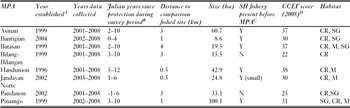
All data were collected in and around eight MPAs (Table 1, Fig. 1) and four distant fished sites on Danajon Bank between 2001 and 2008. All of these MPAs were established between 1996 and 2004, and varied in size from 8.6–100.1 ha.
Characteristics of the community-based marine protected areas (MPAs) in which seahorse (SH) surveys were conducted. Habitats: CR = coral reef, SG = seagrass, M = mangrove. A Date is the official establishment date from the MPA's municipal ordinances. B Julian years where zero denotes the year in which the MPA was established and a negative value denotes the number of years prior to MPA designation that survey was conducted. C Data obtained from interviews with field staff who conducted the biological surveys and/or helped establish the reserve; Y = yes, N = no. D Coastal Conservation Environment Fund (CCEF) score is a management rating scheme based on 38 survey questions that assess enforcement, monitoring, local community participation, planning and economic viability of the MPA. According to this rating system, a score of 20–25 indicates ‘enforced’ and good management, 25–30 indicates ‘sustained’ and very good management, and > 30 points indicates ‘institutionalized’ and excellent management. Key informants indicate whether or not the protected area meets a specific management effectiveness criterion. The maximum score is 38 (see White et al. Reference White, Aliño and Meneses2006).

Pre-MPA establishment data could not be obtained in most cases (Table 1). In order to minimize the likelihood of wasting resources for monitoring, seahorses were only monitored once it became apparent that the MPA would be enforced by the community. Six of the MPAs in the study area started being enforced one year before they were officially established (see Table 1: A. Nellas, personal observation). According to a study (White et al. Reference White, Aliño and Meneses2006), the other two MPAs (Pandanon and Bilang-Bilangan) still did not appear to have full protection in 2005.
Seahorse visual censuses were conducted as part of the long-term MPA monitoring programme, with surveys carried out in both the dry (February–May) and wet (August–November) seasons. Seahorse surveys were conducted in two different seasons because previous studies indicated a peak in reproduction in the wet season (Perante et al. Reference Perante, Pajaro, Meeuwig and Vincent2002). The survey team consisted of a local seahorse fisher, a biologist and a volunteer. The seahorse surveys were conducted at night because seahorses in this region of the Philippines are much more nocturnally active and visible in the shallow coral reef habitat (Perante et al. Reference Perante, Pajaro, Meeuwig and Vincent2002). A total of six haphazardly laid 50 × 4.5 m transects were surveyed at each site in each season. There were three location treatments (1) inside the MPA (hereafter ‘inside MPA’); (2) in fished sites near the MPA, c. 50–100 m outside of the boundary of the MPA (‘near fished’); and (3) in fished sites that were distant from the MPA 0.5–4 km outside of the MPA (‘distant fished’). The distant fished sites were selected to be near the MPAs and similar in habitat characteristics (generally degraded coral reefs). Distant fished sites appeared to have similar levels of exploitation to areas on Danajon Bank that were outside the influence of MPAs.
Transects were positioned during the day and underwater visual censuses (UVC) were conducted with SCUBA and flashlights at night. Surveyors laid six non-permanent transects parallel to the shore along a continuous section of shallow reef (crest and slope) at depths of 2–5 m, with at least 10 m between transects. The start point of each of the six transects was indicated with a surface marker buoy for relocation the following night between 20:00 and 03:00 hours.
The fisher plus either a biologist or volunteer swam the 50 m belt transect searching for seahorses in a 2.5 m wide zone (as measured by a measuring tape) on each side of the transect line. Transects were timed with a stop watch to ensure that search times (excluding time to handle and measure seahorses) for all transects were approximately ten minutes. The survey area was illuminated with the use of hand torches and a lantern attached to the prow of a paddle boat towed by the fisher, as in their usual fishing technique. When a seahorse was spotted, the fisher gently removed the seahorse from its holdfast (marking the location) and the biologist/volunteer assisted in measuring the fish. Height (cm) was measured in a straight line from the coronet to tail tip (Lourie et al. Reference Lourie, Stanley, Vincent, Hall, Pritchard and Casey1999; Lourie & Randall Reference Lourie and Randall2003), with the head of the seahorse at right angles to its body. The biologist also recorded the sex of the seahorse as well as the reproductive state for females (with or without eggs) and males (empty pouch or pregnant) (modified from Perante et al. Reference Perante, Pajaro, Meeuwig and Vincent2002). Because of time constraints, we did not determine the reproductive status of all the seahorses that were found. All seahorses were returned to their original location immediately following data collection.
Data analysis
Seahorse densities
We modelled the number of seahorses per transect using the negative binomial distribution to accommodate the zero-inflated and over-dispersed (variance > mean) nature of the data (Wolfinger & O'Connell Reference Wolfinger and O'Connell1993; White & Bennetts Reference White and Bennetts1996; Beyer et al. Reference Beyer, Merrill, Varley and Boyce2007). Specifically, we modelled the three fixed effects of protection ‘treatment’ (inside MPA, near, distant), season (wet and dry) and years since MPA establishment (Julian years) on seahorse density. Along with these three fixed factors, we also included the random factor of year in the model because data collected at the same sampling period at a given site were non-independent. Finally, we also included the interaction terms of the fixed effects. In particular, for this study, we were interested in the significance of the interactive effect between ‘treatment’ and years since MPA establishment because this would indicate a difference in density caused by protection. Differences in density amongst the three treatments would not indicate a reserve effect because densities of seahorses could be affected by initial (pre-MPA) conditions rather than any effect of protection.
We conducted analyses separately for different MPA sites so that we could assign the same ‘years since MPA establishment’ for the distant fished sites as the MPA sites (inside MPA and near fished) for each analysis. Each of the seven MPA sites was compared to the closest of the four distant fished sites. We could not conduct a single global analysis on the effects of ‘years since MPA establishment’ for all sites because each distant fished site was compared to more than one MPA site.
Although data were collected from eight sites, samples from Bilang-Bilangan were excluded from all mixed-effects modelling because no seahorses were found at any point during the surveys.
We began with the full model (including all interaction terms) and identified the minimum adequate model (MAM) by sequentially removed insignificant terms using backwards stepwise model selection (Crawley Reference Crawley2007). In order to test for reserve effects we used a likelihood ratio test to determine whether adding the interaction term between protection and years since MPA establishment to the MAM resulted in a significant decline in deviance. For the models on seahorse densities, we show the significance values for the increase in deviance when each variable is removed from the model. This method was used to present results because R (R Development Core Team 2009), the statistical programme that was used, cannot calculate significant values for negative binomial mixed effects models.
All statistical analyses were conducted in R using the function ‘lmer’ (linear mixed effects) in the LME4 package. Maximum likelihood estimates of variance components were used to compare models because it allowed for comparisons among models with a different number of fixed effects. After determining the MAM using maximum likelihoods, we updated the model using the less biased restricted maximum likelihood estimation criterion to estimate the final model parameters.
Sex ratios and reproductive status
We also tested to see if treatment affected the sex, maturity (adult versus juvenile) and reproductive status (with or without hydrated eggs[females]/pregnant or not [males]). During the sampling methods, we did not always collect data on sex and reproductive status of seahorses. As a result, we had a limited sample size and could not conduct a site-by-site analyses to test for reserve effects. Consequently, in these analyses, we aggregated all our data across sites and years and included site in the model. We included transect number (a unique identifier for each of the six 225 m2 transect conducted at a particular time) as a random factor. We used lmer in package lme4 of R as above to examine the effects of treatment on the binary dependent variables.
Seahorse size (height)
Using a similar method to our analyses for density, we modelled the season, treatment and years since MPA establishment on seahorse height (cm, square root transformed) separately for different sites. For these analyses we included distant fished sites. We used linear mixed-effects models (using ‘lme’ in ‘nlme’ package and assuming a normal error distribution) to explore the effects of years since MPA establishment, season, site and treatment on seahorse size. All fixed effects interaction terms were examined if there was sufficient power to do so. The random effects structure was a unique identifier for each transect nested within year.
Because of the small number of seahorses found during surveys, we were not able to statistically test for a reserve effect on seahorse size for Batasan and Pandanon. For these two sites we only tested for all fixed effects with no interaction terms.
In addition to a site-by-site comparison, which may be limited by the small number of seahorses found throughout the study and particularly in the distant fished sites, we also combined all the data for seahorses found inside MPAs and in nearby fished sites (namely, excluded distant fished sites) and examined how year since MPA establishment, season, treatment (inside or near MPA sites), site and the interaction between years since MPA establishment and treatment affected seahorse size. The random effects structure was transect number nested within year.
RESULTS
Seahorse densities
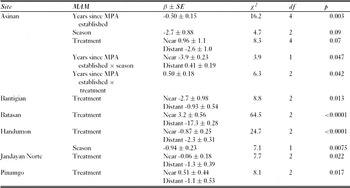
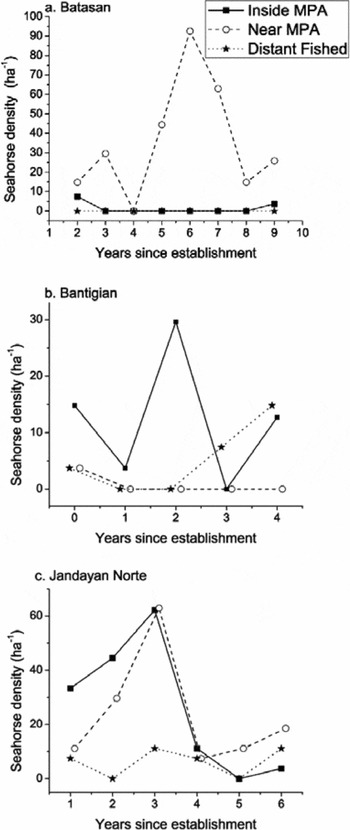
Overall, there were more seahorses in and near the MPA than in distant fished sites (inside: mean ± SE = 15.8 ± 1.6 ha−1; near fished sites: 15.0 ± 1.7 ha−1 ; distant fished sites: 4.8 ± 0.9 ha−1; Table 2, Fig. 2). We did not see any seahorses in the majority of transects sampled (82%, 83 % and 92 % of transects inside, near fished and distant fished sites, respectively). For six of the MPA sites, the seahorse densities inside the MPA were higher than in distant fished sites (Table 2, see β ± SE). In Pandanon there were no differences in seahorse densities amongst inside, near and distant fished sites and in Bilang-bilangan no seahorses were found in any of the transects. For three of the sites, seahorse densities were higher immediately inside the MPA than near the MPA while the converse was true in the rest (Table 2, see β ± SE).
The minimum adequate models (MAM) predicting seahorse densities in seven marine protected areas (MPAs). The initial model included the fixed effects of: ‘treatment’ (inside MPA, near fished, distant fished), season (wet and dry), years since MPA establishment (Julian years) and the random effect of year, as well as the interaction terms of the fixed effects. Model parameters are based on the MAM and restricted maximum likelihood estimation criterion. Dry season and inside MPA were comparison groups. Consequently, for example, a positive value of β for near MPA sites (‘near’) indicates that the sites near MPAs had greater densities of seahorses than sites inside MPAs, whereas the converse would be true for negative values of β. Shown are the significance values for the increase in deviance if each variable is removed from the model. None of the variables was a significant predictor of seahorse density in Pandanon.

Seahorse densities across sites, season, treatment and years of protection from (a) Batasan, (b) Bantigian and (c) Jandayan Norte. We selected these three sites because they all had high enforcement and management ratings (see Table 1) and because we collected data from these sites soon after the MPA was established.

For all MPAs other than Asinan, there was no significant interaction between years since MPA establishment and treatment (χ2 < 6.4; p > 0.10 all sites other than Asinan), and therefore indicating no reserve effect. In Asinan, there appeared to be a decrease inside and near the MPA over time during the dry season. In addition, the number of years since MPA establishment had no significant effect on seahorse densities χ2 < 1.9; p > 0.16 all sites). In Asinan and Handumon, there appeared to be higher seahorse densities in the dry season than in the wet season (Table 2).
Sex ratios and reproductive status
There appeared to be slightly more females, but the sex ratio did not differ significantly from even (χ2 = 2.3, df = 2, p = 0.323). The proportions of female seahorses were 52.6 %, 53.2% and 57.6 %, inside MPAs, nearby and in distant fished sites, respectively.
There was no significant difference in the proportion of adult (versus juvenile) seahorses among treatments (χ2 = 0.42, df = 3, p = 0.95). However, it appeared that there were slightly greater proportions of the juvenile seahorses near the MPAs and adults inside the MPAs. In total, 265 (49%), 238 (44 %) and 38 (7%), adult seahorses were found inside, near and in distant fished sites. In comparison, 6 (24 %), 17(68 %), and 2 (8 %) juvenile seahorses were found inside, near and in distant fished sites.
Although there appeared to be a slightly higher proportion of gravid females and pregnant males inside MPAs than near them, treatment had no statistically significant effect on reproductive status (males χ2 = 1.1, df = 2, p = 0.58; females χ2 = 3.4, df = 2, p = 0.18). Of the female seahorses 73 % (n = 81), 63 % (n = 90), and 84 % (n = 13) carried eggs inside, near and in distant fished sites, respectively. For the male seahorses, 87 % (n = 123), 67 % (n = 101), 78% (n = 18) were pregnant inside, near and in distant fished sites, respectively.
Seahorse size (height)
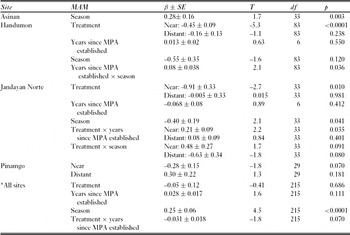
For the analyses in which we examined sites individually and included distant fished sites, the effects of treatment, years since MPA establishment and season differed across sites (Table 3). For Handumon and Jandayan Norte, seahorses were larger inside the MPAs than near them, and for Jandayan Norte seahorses were also larger inside the MPA than in the distant fished site. In Handumon, the seahorses inside the MPA became larger over years in the wet season but not in the dry season. Seahorses were larger inside Jandayan Norte's MPA than near it during the dry season, but not the wet season. Treatment had no other significant effect for the other sites. Year since MPA establishment had no significant effect in any of the sites. There was also no reserve effect on size detected in Asinan, Bantigian, Handumon and Pinamgo (likelihood-ratio test < 2.0; p > 0.10). However, there was a significant reserve effect for size in Jandayan Norte (likelihood-ratio test = 6.3, p = 0.034).
Parameters and significant values for minimum adequate models (MAM) for mixed effects models predicting seahorse height (cm). Dry season and inside marine protected areas (MPAs) were used as comparison groups. *For the aggregated analysis with all MPA sites, we did not include distant fished sites.

For Batasan and Pandanon, we could only test for the interaction between season and age. For both of these sites and Bantigian, none of the variables tested affected seahorse size.
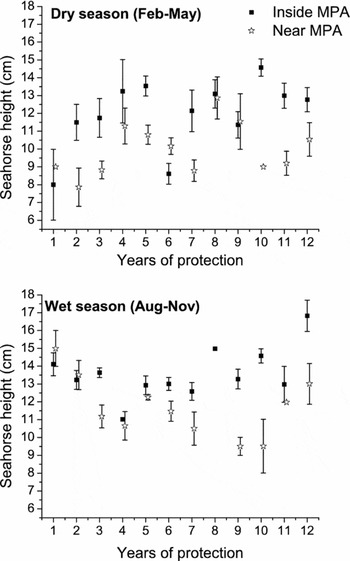
When we constructed a single model combining all the MPA sites and used a random effects structure of transect number nested within year, there was a marginally significant reserve effect. Seahorse sizes appeared to increase inside the MPA sites, as compared to nearby fished sites. However the trends were more apparent in the wet season (Fig. 3).
The effects of years of protection and season on seahorse height (cm) for (a) dry and (b) wet seasons. Aggregated data from all study sites.

DISCUSSION
Despite higher seahorse densities in and near MPAs and larger seahorses inside some MPAs, we did not detect a recovery of seahorse populations (an increase over time) inside the MPAs. These results suggest that MPAs may not drive the recovery of seahorse populations in our study region.
The higher initial seahorse densities in and near MPAs (compared to distant fished sites) may indicate that areas of high seahorse density were preferentially selected for protection, whether intentionally or inadvertently. According to social workers involved in the establishment of the MPAs, communities valued the potential economic worth of seahorses and were aware that our team had a special interest in these species. Thus, the communities may have selected areas that could both enhance the number of fish immediately outside MPAs for fishing and maximize conservation benefits for flagship seahorse populations. Because of the consistently low seahorse densities, it is important to note that a statistical difference in density between MPA and distant fished sites may not necessarily be ecologically or economically significant.
It is notable that both areas immediately inside and outside MPA sites maintained relatively high seahorse populations, despite the extensive and destructive fishing methods, such as dynamite fishing, that are used in most regions of the Danajon Bank. It may be that the areas near MPA sites also gained some level of protection. The guards and guardhouses within the MPAs probably acted as a deterrent against particularly destructive and illegal non-selective fishing methods such as blast fishing or trawling near the MPA.
It is possible that we might have detected reserve effects if we had been able to obtain pre-MPA data for most of the sites, rather than simply relying on differences in change over time in the three treatments. Although it is unlikely that coral reefs recover within a couple of years (Fox et al. Reference Fox, Pet, Dahuri and Caldwell2003), there is a remote possibility that some of the seahorse populations might have begun to recover before we began our surveys.
The larger sizes of seahorses inside some of the MPAs (compared to near MPAs) is important because larger seahorses tend to have disproportionately greater fecundity (Teixeira & Music Reference Teixeira and Music2001; Woods Reference Woods2005). The difference between inside and near sites may be maintained if fishers target seahorses that move outside the MPA. Given the greater value of larger seahorses (which are sold dried by weight) and a local loose agreement among fishers not to catch seahorses under 10 cm height, the fishers would generally focus their efforts on the larger animals, keeping average size down. That said, our site-by-site analysis for seahorse size should be interpreted with caution because of the small number of seahorses that were detected in our survey and especially in the distant fished sites. Though the results from the aggregated analysis in which we compared only MPA sites with nearby fished sites was more robust, the results were only marginally significant. Even though international donors or local community members may be particularly interested in the population trajectory of a rare species, the analyses on seahorse sizes demonstrate the challenges of assessing reserve effects on a rare species. Even after extensive monitoring over numerous years, the low seahorse densities may have limited the power of our analyses and ability to detect a reserve effect.
Reserve effects
There are several explanation for why our small MPAs did not appear to build seahorse populations. Given the high site fidelity, small home ranges (Foster & Vincent Reference Foster and Vincent2004; Curtis et al. Reference Curtis, Ribeiro, Erzini and Vincent2007) and limited swimming ability (Perante et al. Reference Perante, Pajaro and Vincent1998) of adult seahorses, the MPAs may be too small and isolated (Hansen et al. Reference Hansen, Ban, Jones, Kaufman, Panes, Yasué and Vincent2011) to enhance seahorse populations inside MPAs. Adult seahorses may be unable to move into MPAs or disperse effectively from one MPA to another. In addition, the very low densities of seahorses outside the MPA sites (for example 5.2 seahorses ha−1; Marcus et al. Reference Marcus, Samoilys, Meeuwig, Villongco and Vincent2007 and this study) means that there may be few sources of juvenile seahorses to populate the MPA sites. Moreover the high dispersal rates of juveniles may limit self-recruitment of seahorses living in MPAs (Morgan & Vincent Reference Morgan and Vincent2007). Finally, juvenile seahorses undergo an initial planktonic phase in which they are passively drifting in the water column (Foster & Vincent Reference Foster and Vincent2004). During this period, seahorses born inside an MPA are much more likely to disperse into fished sites than to other MPAs because the MPAs are surrounded by fished areas and isolated from other MPAs.
Second, even if juvenile seahorses are able to move into the MPAs from adjacent areas, they may not find suitable habitats inside the MPAs. Communities preferentially created MPAs in areas of high coral density (Hansen et al. Reference Hansen, Ban, Jones, Kaufman, Panes, Yasué and Vincent2011), which are suitable habitats for adult seahorses but tend to have few of the macroalgal Sargassum beds that juvenile seahorses occupy (Perante et al. Reference Perante, Pajaro and Vincent1998; Morgan & Vincent Reference Morgan and Vincent2007).
Third, MPAs could increase local predation pressure on seahorses. Fish recovery in MPAs can lead to complex changes in community structure (Micheli et al. Reference Micheli, Halpern, Botsford and Warner2004; McClanahan et al. Reference McClanahan, Graham, Calnan and MacNeil2007). MPAs tend to have greater positive effects on predatory large fish species that are targeted by fishers (Russ & Alcala Reference Russ and Alcala1996b; Mosquera et al. Reference Mosquera, Côté, Jennings and Reynolds2000). A previous study by our team (Samoilys et al. Reference Samoilys, Martin-Smith, Giles, Cabrera, Anticamara, Brunio and Vincent2007) indicated an increase in larger fish species, with potentially enhanced predation on juvenile seahorses. Other studies have shown declines in smaller fish families such as Syngnathids (Samoilys et al. Reference Samoilys, Martin-Smith, Giles, Cabrera, Anticamara, Brunio and Vincent2007) within MPAs (Graham et al. Reference Graham, Evans and Russ2003; Willis & Anderson Reference Willis and Anderson2003; McClanahan et al. Reference McClanahan, Graham, Calnan and MacNeil2007).
Fourth and finally, seahorse population recovery may be hindered by the poor pre-MPA establishment conditions of the benthic habitats. Decades of recurrent and destructive blast fishing in the region (Green et al. Reference Green, Alexander, Gulayan, Migrino, Jarantilla-Paler and Courtney2002) destroyed many of the biotic benthic habitat features used by seahorses. In our study region, abiotic features (rubble, sand and dead coral) dominated the majority of transects in fishing grounds in the region and only 12 % contained live coral (Marcus et al. Reference Marcus, Samoilys, Meeuwig, Villongco and Vincent2007). More time may be necessary for the recovery of benthic habitat and seahorse populations. One study in an Indonesian MPA showed that even after six years of protection there were no signs of recovery in an area where coral reefs (>300 m2) had been repeatedly destroyed by blast fishing (Fox & Caldwell Reference Fox and Caldwell2006).
Conservation implications
Despite the fact that these MPAs reduced local fishing effort, the density of seahorses did not increase more over time in the MPA as compared to outside the MPA. Since the next wave of new MPAs will include mangrove, seagrass or macroalgae habitats, it may be possible to assess how habitat type and quality are affecting density-dependent processes, seahorse movement patterns, and export of juvenile and adults into adjacent fished areas. Adding diverse sizes of MPAs should allow the construction of spatially explicit demographic models, and thus identify the critical seed densities that are necessary to drive population recovery, as well as the most appropriate sampling method to detect a reserve effect (Guénette & Pitcher Reference Guénette and Pitcher1999). Research may be coupled with direct conservation action by establishing and monitoring MPAs that are larger, closer together or in regions with lower fishing pressures outside of the MPAs, in order to understand how seahorse populations may be increased. Better understanding of the pre-existing biological and socioeconomic conditions in the areas that communities selected for their MPAs, and how they influenced their site selection, is required. This information can aid the selection of good reference sites that would be similar in pre-existing conditions to the MPA sites. Finally, an updated study (since White et al. Reference White, Aliño and Meneses2006) on enforcement practices and the prevalence of illegal fishing within these MPAs may help elucidate the results from this study.
Seahorses have been effective flagship species for marine conservation on Danajon Bank, but we did not find evidence that MPAs as such are a good tool for seahorse population recovery. Important threats to seahorses other than fishing, such as increased predation pressure, pollution or large-scale habitat change may not be mitigated by MPAs (Allison et al. Reference Allison, Lubchenco and Carr1998). Consequently, seahorse conservation will clearly also depend on a broader range of tools, including trade regulation (Foster & Vincent Reference Foster and Vincent2005; Curtis et al. Reference Curtis, Ribeiro, Erzini and Vincent2007), protocols to reduce bycatch (Meeuwig et al. Reference Meeuwig, Do, Truong, Job and Vincent2006), enforcement of fishing regulations (Baum et al. Reference Baum, Meeuwig and Vincent2003; Foster & Vincent Reference Foster and Vincent2005), as well as an ecosystem-based approach that considers management strategies outside of the MPAs.
In terms of overall biodiversity conservation, communities need to appreciate that seahorses, which serve as flagship species for the woes besetting the marine environment of Danajon Bank, may not be ideal indicator species for MPA recovery. It is unlikely that the people who depend on seahorses as a major source of income gained many economic benefits from the spillover of seahorses from MPAs to nearby areas. Given that the same is true of many other reef species (Samoilys et al. Reference Samoilys, Martin-Smith, Giles, Cabrera, Anticamara, Brunio and Vincent2007), it is vital that the diversity of fish responses be explained to communities (Mosquera et al. Reference Mosquera, Côté, Jennings and Reynolds2000).
Community support for MPAs may depend on much more than recovery of seahorses or any other flagship species. Despite some of the limitations of MPAs, engaging communities under a seahorse conservation umbrella has not only led to 34 MPAs, but also the development of citizen management groups and a regional alliance of small-scale fishing families, and capacity building for government officials. The positive biological responses in many small MPAs are often too limited to explain the degree of enthusiasm for MPAs that communities are expressing and demonstrating. The people of Danajon Bank, and the Solomon Islands (S. Aswani, personal communication 2010) may well appreciate MPAs for the social capital they can bring, quite as much as for their more direct ecological or economic benefits. In such cases, it would be interesting to explore the degree to which community support is influenced by the response of the flagship species, or whether such species serve a conservation purpose merely by engendering broad interest in and engagement with addressing besetting problems such as food security, as well as economic and ecological sustainability. Perhaps the answer lies in understanding the ecological, socioeconomic, political or psychological reasons why communities engage with particular flagship species.
ACKNOWLEDGEMENTS
This is a contribution from Project Seahorse. The authors thank John G. Shedd Aquarium and Guylian Chocolates, Belgium for their support through partnerships in marine conservation with Project Seahorse. We are grateful to friends at Project Seahorse Foundation in the Philippines for expert data collection and logistic support. We are also grateful to Sarah Foster, Hazel Panes, Kerrie O'Donnell, Phillip Molloy, Marivic Pajaro and others at Project Seahorse for comments on previous drafts and helpful suggestions, as well as Christina Czembor and Jennifer Selgrath for the map. Finally we thank three anonymous reviewers and the editor for the thoughtful and detailed comments that helped to significantly improve this manuscript.