Introduction
Previous research on support exchanges has consistently shown that receiving support in later life contributes to the maintenance of subjective wellbeing and reduces feelings of loneliness (Dykstra Reference Dykstra1990; Krause Reference Krause, Binstock and George2001). In recent years studies have also demonstrated that giving support to others is a key factor in maintaining wellbeing in later life (De Jong Gierveld and Dykstra Reference De Jong Gierveld and Dykstra2008; Post Reference Post2005). However, there is no consistent evidence on how types of social support (emotional and instrumental) and the direction of that support (giving and receiving) are related to loneliness in older age, and whether the effects are culture-specific.
The aim of this study was to investigate exchanges of social support (that is the support given and received) in two European countries, Spain and the Netherlands, and the effect of these exchanges on loneliness. In the following sections we present the theoretical background on the effects of social support on loneliness and investigate the presence of cultural differences in the meaning of social support. We argue that the theoretical perspective of Adams, Anderson and Adonu (Reference Adams, Anderson, Adonu, Haskek and Aron2004) on cultural differences in the meaning of intimacy and closeness in social relationships can be applied to the European cultural context, and specifically in contrasting southern and northern regions of Europe.
Social support and loneliness in older adults
Social support has been defined as ‘the interpersonal transactions including expression of positive affect, affirmation of values and beliefs of the person, and/or the provision of instrumental aid or assistance’ (Kahn and Antonucci Reference Kahn, Antonucci, Baltes and Brim1980). Exchange of support is the main indicator of the positive functioning of a social network (Antonucci and Akiyama Reference Antonucci and Akiyama1987, 274). In the literature, two main types of social support have been traditionally distinguished (Cohen and Wills Reference Cohen and Wills1985). Emotional support refers to the exchange of affect, sympathy and approval between individuals; it includes aspects of social interaction such as talking about personal problems or feelings or providing advice about personal matters. Instrumental support is defined as the exchange of practical help in activities of daily living or in moments of need; it includes the provision of financial help and also material resources and services, such as caring or providing a means of transportation. This distinction has been found to be important when studying the exchanges of support between individuals and their social network members (Cutrona and Russell Reference Cutrona, Russell, Sarason, Sarason and Pierce1990; Dykstra Reference Dykstra1990). Emotional and instrumental support have differential effects on wellbeing depending on the needs and preferences of individuals. In former studies, receiving support has been found to reduce feelings of loneliness, and receiving emotional support negatively predicted loneliness to a greater extent than did receiving instrumental support (Rook Reference Rook1987; Sorkin, Rook and Lu Reference Sorkin, Rook and Lu2002). However, it is possible that the needs and expectations of older people about social support change due to age-related factors such as poor health, and consequently instrumental support may be more important than emotional support in preventing people from feeling lonely.
Moreover, in the last decade several studies have provided consistent evidence that giving support to family members or other people is also related to lower levels of loneliness, to positive wellbeing in the people providing it (De Jong Gierveld and Dykstra Reference De Jong Gierveld and Dykstra2008; Post Reference Post2005) and to a lower risk of mortality in older age (Brown, Consedine and Magai Reference Brown, Consedine and Magai2005; Brown et al. Reference Brown, Nesse, Vinkur and Smith2003). Several psychological mechanisms have been hypothesised to mediate the relationship between giving support and subjective wellbeing, such as an increase in self-esteem and perceived control over the environment (Batson Reference Batson, Gilbert, Fiske and Lindzey1998; Boerner and Reinhardt Reference Boerner and Reinhardt2003).
The meaning of intimacy in social relationships: cross-cultural differences in social support
In examining social support in a cross-cultural setting, it is necessary to take into account the macro-level cultural context in which older people are embedded. The functioning of social relationships, including exchanges of emotional and instrumental support, depends on social norms and the value attributed to such exchanges in a given culture. It has been argued that in the family-oriented Mediterranean countries (including Spain), social norms about providing support to family members are stronger than in the less family-oriented Western and Northern European countries (including the Netherlands) (Jylhä and Jokela Reference Jylhä and Jokela1990; Reher Reference Reher1998). Hollinger and Haller (Reference Hollinger and Haller1990) and Reher (Reference Reher1998) have argued that these cultural differences in Europe originate from family structures in pre-industrial times. In Southern Europe, family bonds were stronger than in Northern Europe, where family members were more geographically dispersed.
More recently, Adams, Anderson and Adonu (Reference Adams, Anderson, Adonu, Haskek and Aron2004) have proposed a different view of the cultural grounding of social support and other social realities. They stated that there are independent and interdependent constructions of self, which are different ontological beliefs about the self and the social world. They suggested that cultures characterised by an independent construction of self (i.e. North America) ‘locate self and identity in internal properties of inherently separate particles’ (Adams, Anderson and Adonu Reference Adams, Anderson, Adonu, Haskek and Aron2004: 322), and social bonds are seen as a product of (voluntary) social interactions. On the other hand, cultures characterised by an interdependent construction of self (i.e. African countries) consider the individual as embedded in a network of pre-existing social relationships. In these cultures interpersonal connectedness is experienced as an inescapable fact of social existence and there is a higher sense of duty and obligations towards the family, resulting in filial values and norms. These different socio-cultural constructions affect the meaning of intimacy and social support: in societies where an independent construction of self is prevalent, self-disclosure and talking about personal matters (i.e. emotional support) is seen as the main way to show intimacy and to gain a sense of interconnectedness. In contrast, in more interdependent societies individuals have the sense of being already sufficiently connected to others, mainly to family members, and do not need to invest more time and energy in the exchange of emotional support. Consequently, in response to relational/filial obligations intimacy is optimally shown by sharing concern and providing help in moments of need (i.e. exchange of instrumental support). Empirical evidence supported this theoretical perspective: in cultures where the notion of independence is more dominant, the provision of emotional support is the main defining feature of a ‘friend’, while in cultures characterised by interdependence the provision of instrumental support is a central feature in the definition of a ‘friend’ (Adams and Plaut Reference Adams and Plaut2003).
We propose that this theoretical perspective can be applied to the European context where more interdependent cultural norms and values have been found in the South and more independence-related cultural norms in Northern parts of Europe (Hollinger and Haller Reference Hollinger and Haller1990). In a study comparing levels of individualism in 53 countries, Spain ranked 51 and the Netherlands 81, much higher on individualism (Hofstede Reference Hofstede2001). Recent studies comparing Spain and the Netherlands in value priorities have found that values related to social and familial interdependence (e.g. respect for parents and older people) were perceived as more important by Spanish respondents compared to the Dutch. In contrast, values that emphasise achievement and self-direction (e.g. ambition, capability, independence) were perceived as more important by the Dutch compared to the Spanish respondents (Rodríguez Mosquera, Manstead and Fischer Reference Rodríguez Mosquera, Manstead and Fischer2002). Consequently, in a Southern European country such as Spain, societal norms encourage interpersonal familial interactions. Most Spanish older adults maintain strong family ties (Centro de Investigaciones Sociologicas 1995; Rokach Reference Rokach2008), and they expect to receive instrumental support from their children if help is needed. In Northern European countries, independence is highly valued and older adults try to refrain from receiving instrumental support from their children as long as possible; intimacy and closeness are welcomed and shown primarily by confiding about personal matters.
We also propose that the exchange of different types of support might have different effects on loneliness depending on the cultural context. If loneliness is defined as ‘a perceived lack of intimacy in social relationships’ (De Jong Gierveld Reference De Jong Gierveld1987), the type of support that represents the accepted way to show intimacy in that specific culture will be the most important one in alleviating loneliness. Therefore, when intimacy is primarily shown by the exchange of emotional support, this type of support will be the main protector against loneliness, and in cultures where people intend to provide instrumental support as an indicator of closeness and intimacy in relationships, instrumentally helping others with daily problems will be the main protector.
Moreover, receiving support from others and providing support to others might have different consequences for older adults' wellbeing. It is possible that in the Netherlands receiving instrumental help has a negative connotation because it is conceived by recipients as placing them in a situation of dependence. In Spain norms about giving and receiving support within the family are salient, and receiving instrumental help from family members is positively valued as an important characteristic of embeddedness, as is the providing of instrumental support to family members. Therefore, when this type of support is not available and not provided to Spanish older people, they may experience loneliness, especially if they are in need of assistance (e.g. in very old age). On the other hand, providing instrumental help to significant others might not have that negative connotation of dependency and elderly people in both countries might benefit from giving instrumental help to others. In this study we examined the exchanges of (instrumental and emotional) support in both countries and their differential effects on loneliness.
Predictors of loneliness in older adults
As mentioned above exchanges of instrumental and emotional support affect the experience of loneliness. In investigating country differences in loneliness, we examined additionally the following broad groups of explanatory factors (Dykstra Reference Dykstra2009): differences in the population composition, differences in health (and wealth) and differences related to the social networks of older adults.
Differences in the demographic composition of populations
In investigating country differences in loneliness this study takes into consideration the specific demographic situations of the countries, more specifically the age, gender and marital status composition of the two populations. In previous studies, advanced age has been associated with a higher level of loneliness but the effect is mediated by the higher likelihood of experiencing social and functional losses in the last stage of life (Dykstra, Van Tilburg and De Jong Gierveld Reference Dykstra, Van Tilburg and De Jong Gierveld2005; Jylhä Reference Jylhä2004). In a meta-analysis, the effect of age on loneliness was only significant in the oldest age groups (mean age 80+) (Pinquart and Sörensen Reference Pinquart and Sörensen2001). The effect of gender on loneliness is inconsistent across studies; women are generally found to be lonelier than men, but the differences are stronger when direct simple questions to measure loneliness are used (e.g. ‘Did you feel lonely last week?’) (Borys and Perlman Reference Borys and Perlman1985; Pinquart and Sörensen Reference Pinquart and Sörensen2001). In studies using a series of items, such as formulated in the De Jong Gierveld loneliness scale, no gender differences are usually found. Widowhood is a negative life event that is closely related to loneliness. Being a recent widow or widower has been found to be associated with higher levels of loneliness in older age (Berg et al. Reference Berg, Mellström, Persson and Svanborg1981; Van Baarsen Reference Van Baarsen2002). Country-level differences in widowhood among older adults are to a certain extent related to differences between men and women in life expectancy and the related sex ratios in later life. Comparing female and male life expectancy at age 65 shows that in Spain the difference is 3.9 years and in the Netherlands it is 3.6 years (United Nations 2005). Per 100 women aged 60 and over, the ratio of men is 80 in Spain and 83 in the Netherlands (United Nations 2010). The proportion of married women aged 60 and over is higher in the Netherlands (52%) as compared to Spain (49%) (United Nations 2010). A higher age and being not married are main determinants of older adults' loneliness. Given the higher discrepancy in life expectancy of women and men in Spain, and the lower share of married older female adults in Spain, we expect that the population composition is an important determinant of higher levels of loneliness and of differences in older adults' loneliness in Spain and the Netherlands.
Differences in health and wealth
A poor health status is generally associated with having fewer resources to maintain satisfactory social relationships. People with functional limitations have more difficulties in participating in social activities outside the household, such as visiting friends, going for walks or doing volunteering activities. In previous studies, poor health has been found to be consistently related to loneliness (Bisschop et al. Reference Bisschop, Kriegsman, Van Tilburg, Penninx, Van Eijk and Deeg2003; Cacioppo et al. Reference Cacioppo, Ernst, Burleson, McClintock, Malarkey, Hawkley, Paulsen, Hobson, Spiegel and Berntson2000; De Jong Gierveld Reference De Jong Gierveld1987; Halleröd Reference Halleröd2009; Hawkley et al. Reference Hawkley, Hughes, Waite, Masi, Thisted and Cacioppo2008; Korporaal, Broese van Groenou and Van Tilburg Reference Korporaal, Broese van Groenou and Van Tilburg2008; Koropeckyi-Cox Reference Koropeckyi-Cox1998). A low educational level is also associated with higher levels of loneliness in older age, probably due to fewer personal and social resources to establish relationships with others (Koroperchyi-Cox Reference Koropeckyi-Cox1998; Victor et al. Reference Victor, Scambler, Bond and Bowling2002). Spain and the Netherlands have different levels of gross domestic product (GDP), and social protection and public health expenditure directed towards (frail) older adults. The GDP in Spain (US $27,377) is lower than in the Netherlands (US $35,105) (United Nations 2005) as is the percentage of GDP for social protection expenditure (for Spain, 20%, for the Netherlands, 26%) (United Nations 2005). Poverty rates at age 66–75 years differ sharply: 14.8 per cent in Spain compared to 1.5 per cent in the Netherlands. In view of these findings, we expected to find that wealth and health differences would be important determinants of (higher) levels of loneliness and that therefore the country differences on these indicators would be important determinants of loneliness.
Differences in the social networks of older adults
Living arrangements have been found to be one of the main predictors of loneliness. The presence of a partner in the household is more strongly associated with a lower level of loneliness in the Netherlands than in Italy and Canada (Van Tilburg, Havens and De Jong Gierveld Reference Van Tilburg, Havens and De Jong Gierveld2004). Living with children (and without partner) has been found to be associated with a lower level of loneliness in Italy, but a higher level in the Netherlands (De Jong Gierveld and Van Tilburg Reference De Jong Gierveld and Van Tilburg1999a). However, living alone is generally associated with a higher level of loneliness (Cornwell and Waite Reference Cornwell and Waite2009; Dykstra Reference Dykstra1990; Dykstra and Fokkema Reference Dykstra and Fokkema2007; Hawkley et al. Reference Hawkley, Hughes, Waite, Masi, Thisted and Cacioppo2008; Routasalo et al. Reference Routasalo, Savikko, Tilvis, Strandberg and Pitkala2006; Van Tilburg Reference Van Tilburg, Knipscheer, De Jong Gierveld, Van Tilburg and Dykstra1995).
Belonging to social and volunteering organisations and going to church, conceptualised as indicators of social integration, are both associated with lower levels of loneliness among older people (De Jong Gierveld and Havens Reference De Jong Gierveld and Havens2004; Van Tilburg et al. Reference Van Tilburg, De Jong Gierveld, Lecchini and Marsiglia1998). Previous research has also shown that a large and diverse network of social contacts represents a solid basis for the exchange of support and is an important protective factor against loneliness in older age (Cornwell and Waite Reference Cornwell and Waite2009; Dykstra Reference Dykstra1990; Guiaux, Van Tilburg and Broese van Groenou Reference Guiaux, Van Tilburg and Broese van Groenou2007; Van der Pas, Van Tilburg and Knipscheer Reference Van der Pas, Van Tilburg and Knipscheer2007; Van Tilburg et al. Reference Van Tilburg, De Jong Gierveld, Lecchini and Marsiglia1998). Regarding network composition, the presence of friends has been found to be very important (Stevens and Westerhof Reference Stevens and Westerhof2006). Relationships with friends are voluntary by definition and are characterised by shared company, leisure activities and the exchange of emotional support (Chappell Reference Chappell1983), affecting the alleviation of both social and emotional loneliness. However, cultural factors might also moderate the relationship between non-kin relationships and loneliness: Hollinger and Haller (Reference Hollinger and Haller1990) identified a broader concept of friendship in Southern than in Northern European countries. Adult children are also of great importance for alleviating loneliness among older people. It is not the number of children which is decisive in this respect, but the quality of relationships and the frequency of contact that relate to the exchange of support, be it instrumental or emotional. Research has shown that the quality of relationships with children and the social support provided by them are factors that especially determine the wellbeing of older parents (De Jong Gierveld and Dykstra Reference De Jong Gierveld and Dykstra2008; Long and Martin Reference Long and Martin2000; Pinquart and Sörensen Reference Pinquart and Sörensen2001; Routasalo et al. Reference Routasalo, Savikko, Tilvis, Strandberg and Pitkala2006).
Differences in the size and composition of the social networks of older adults in Spain and the Netherlands were also taken into account in investigating loneliness. We expected that network indicators would function as important determinants of older adults' differences in loneliness in the two countries. Finally, we addressed the following research question: Do the levels of instrumental and emotional support given and received differ across countries and do support characteristics affect levels of loneliness of older adults in both countries differently? We have suggested above that different conceptions of intimacy and closeness are present in Spain and the Netherlands. On the one hand, due to stronger social norms about providing support to family members and a more interdependent construction of social reality, we expected that in Spain instrumental support would be more frequently given and received. On the other hand, a more independent construction of social reality and the importance of personal disclosure to show intimacy in social relationships, should lead to more frequent exchanges of emotional support in the Netherlands. Finally, giving and receiving instrumental or emotional support, respectively, would be important determinants of differences in older adults' loneliness in Spain and the Netherlands.
Method
Respondents
In Spain the data were drawn from a survey conducted in the period 2003–04 by the Gerontology research group of the University of Salamanca within a larger study about Quality of Life in older age (Vega et al. Reference Vega, Bueno, Buz and Navarro2001). The questionnaire was developed following the main questions and procedures of the Longitudinal Ageing Study Amsterdam (LASA; Deeg et al. Reference Deeg, Beekman, Kriegsman and Westendorp-de Serière1998). Participants were 646 community-dwelling older adults aged 60 years and over. Trained university students undertook the interviews in the households of the respondents. The face-to-face interviews lasted approximately one hour and were conducted without the presence of the partner, other relatives or friends. The sample was one of convenience, and participants were equally divided in gender and age groups (60–74 and 75 and over, respectively). The majority of respondents (54%) resided in the province of Salamanca, located in the north-west of Spain. An exclusion criterion was having cognitive impairment (Mini Mental State Examination (MMSE) <23). Preliminary descriptive analyses have shown that the demographic variables are generally representative for the population of older adults in Spain (Imserso 2006), although the age and gender distribution of the sample differed to a certain extent; 47.5 per cent aged 75 and over in the survey compared to 43 per cent in the general population; 54 per cent of women compared to 58 per cent in the general population.
The data for the Dutch older adults were drawn from the Longitudinal Ageing Study Amsterdam (LASA; Deeg et al. Reference Deeg, Beekman, Kriegsman and Westendorp-de Serière1998). A first wave of LASA interviews was conducted in 1992 with 4,494 men and women born between 1903 and 1937 (Knipscheer et al. Reference Knipscheer, De Jong Gierveld, Van Tilburg and Dykstra1995). The respondents were interviewed again in 1993, 1995/6, 1998/9, 2001/2 and 2005/6. This study used the 2001/2 wave. The interviews were conducted face-to-face. Deeg et al. (Reference Deeg, Van Tilburg, Smit and De Leeuw2002) investigated the attrition rates and concluded that 80 per cent could be attributed to the death of the respondent and that a refusal to participate in the survey was not related to demographic characteristics or to physical or mental health. The final sample for this study is 656 older adults (60+). The sample was stratified by age and gender, with participants equally divided in gender and age groups (60–74 and 75 and over, respectively). This survey included participants living in institutions, but only those living in the community were included in this study.
Measures
Social network
To collect social network data, respondents in both surveys were asked to identify the social relationships that were important to them and with whom they had frequent contact. This information was collected using an ego-centred social network procedure (Van Tilburg Reference Van Tilburg, Knipscheer, De Jong Gierveld, Van Tilburg and Dykstra1995) in both surveys. The procedures for data collection on the social network differed slightly between the two countries; in the Spanish survey, information was collected with reference to three circles of emotional closeness to the person, following the ‘hierarchical mapping technique’ developed by Antonucci (Reference Antonucci1986). In the Netherlands the domain-specific approach (network members identified in seven domains of the network: children, friends, neighbours, etc.) was used (Cochran et al. Reference Cochran, Larner, Riley, Gunnarson and Henderson1990). Additionally, in both surveys information was collected about the type of relationship with each network member. Variables on the total network size and the presence of children and friends in the social network were subsequently calculated.
Social support
In both surveys information was collected about the exchange of emotional and instrumental support. Four questions were asked about the support exchanged with each of a maximum of ten closest network members (if available), excluding support exchanges with a spouse. One question was about instrumental support received (‘How often did it occur in the last year that … helped you with daily activities such as prepare meals, clean the house, transportation, shopping, etc.?’) and one question about emotional support received (‘How often did it occur in the last year that you told … about your personal experiences and feelings?’). Parallel questions were asked regarding instrumental and emotional support given to a maximum of ten most important members of the network. The response format ranged from 0=never to 3=often. A mean score was calculated for each kind of support.
Social activities
In both surveys two similar questions on social activities were included. First, a question on the frequency of participation in church activities, with a response format from 1=never to 6=daily. The variable was dichotomised into ‘weekly or more’ versus ‘less than weekly’ for the descriptive analyses. Second, a question on belonging to an organisation (i.e. sport, cultural, leisure activities, etc.) was included, with a dichotomous response format (yes/no).
Socio-demographic and health variables
Age was measured as a continuous variable and for descriptive purposes this variable was dichotomised (60–74 years and 75 years and above). Information was collected on educational level as a categorical variable with four response categories: ‘illiterate’, ‘read and write’, ‘went to school’ and ‘went to university’. Living arrangements were measured as a categorical variable with four response categories: ‘living alone’, ‘living with a partner’, ‘living with a partner and children’, ‘living with children and/or others’. The questionnaires also included information on marital status but this variable was not included in the multivariate analysis due to the high correlation with living arrangements. If the respondents' marital status was ‘widowed’, a question was posed about the age at which they lost their partner. A dummy variable was created for those who had been widowed for less than three years. Finally, a question on subjective health status was included with a response format from 1=excellent to 5=poor.
Loneliness in both surveys was measured using the De Jong Gierveld loneliness scale (De Jong Gierveld and Kamphuis Reference De Jong Gierveld and Kamphuis1985; De Jong Gierveld and Van Tilburg Reference De Jong Gierveld and Van Tilburg1999b). Loneliness has a negative connotation. For that reason it is embarrassing to talk about feelings of loneliness, and people with deficiencies in their relationships do not always admit to being lonely. The use of direct questions including the words ‘lonely’ or ‘loneliness’ to investigate loneliness is likely to result in under-reporting. The De Jong Gierveld loneliness scale consists of 11 items excluding any reference to loneliness and intents to measure level of loneliness. Five items are positively phrased (e.g. ‘There are plenty of people that I can lean on in case of trouble’) and six are negatively phrased (e.g. ‘I experience a general sense of emptiness’); each of which is scored dichotomously in the direction of loneliness. The loneliness scale total score varies from 0 (not lonely) to 11 (extremely lonely) and it has been shown to be reliable and valid for older populations (Pinquart and Sörensen Reference Pinquart and Sörensen2001; Van Tilburg and De Leeuw Reference Van Tilburg and De Leeuw1991). The instrument was originally developed in the Netherlands and it was translated into Spanish following a reversed translation procedure. Reliability of the scale in this study was measured with the internal consistency coefficient alpha. In the Dutch sample the alpha coefficient was similar to the one found in other studies (0.75) and in the Spanish sample it was lower but acceptable (0.69).
Analysis procedure
Analyses involved descriptive statistics and multiple regression models. First, we used frequencies, means and standard deviations, in order to analyse the prevalence of socio-demographic, health and social integration variables in both samples. Cross-national differences were analysed using Chi-square coefficients and F scores. We also calculated means and standard deviations for types of social support. Differences between countries were calculated using analyses of variance (ANOVAs). Secondly, we used multivariate regression analyses to calculate the effects of social support on level of loneliness after taking into account the effect of other loneliness predictors in the model. Analyses were performed separately for the Spanish and Dutch samples. Giving and receiving support were included in separate models due to the high correlation between these variables within each type of support, probably due to the presence of reciprocity in social relationships.
Results
Descriptive analyses
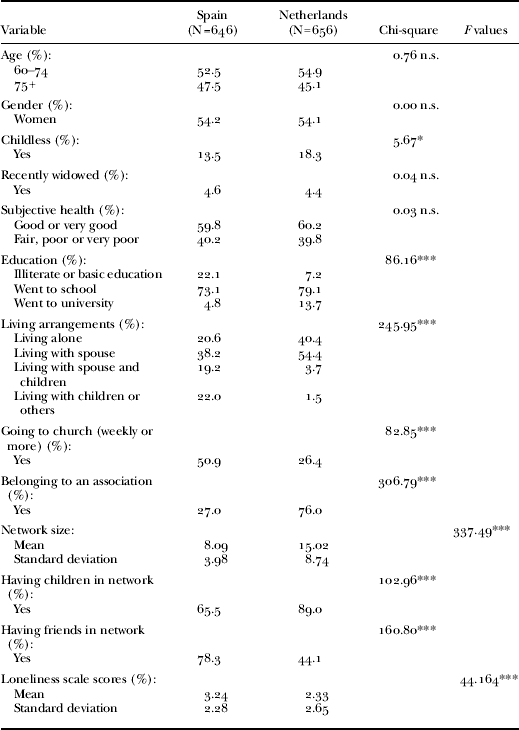
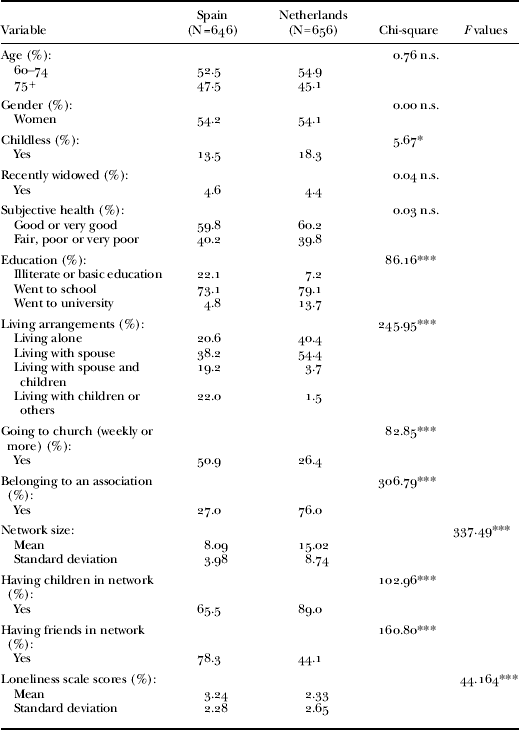
First, sample characteristics are presented, separately by country, as well as statistical comparisons (Table 1). No significant differences were found in important loneliness-predicting variables, such as age, gender, being recently widowed and subjective health. However, in Spain, educational level was significantly lower than in the Netherlands, with a higher proportion of illiterate and basic education respondents (22% versus 7%) and fewer respondents having attended university (5% versus 14%). There were also significant differences regarding childless older adults. The percentage of older adults without children is 13.5 per cent in Spain and at 18.3 per cent in the Netherlands. Significant differences are shown regarding living arrangements. Inspecting cell means revealed that Spanish respondents were much more likely than the Dutch participants (41% versus 5%) to co-reside with their adult children or other family members, or with the spouse and children together. In contrast, in the Netherlands it was more common than in Spain to live only with the spouse in a two-person household (54% versus 38%), or in a one-person household (40% versus 21%).
Description of the samples
Significance levels:* p<0.05
*** p<0.001, n.s.: not significant.
We also found national differences in participation in social activities and other social integration variables. Spanish respondents participated in religious activities more frequently than the Dutch (51% versus 26%), but in the Netherlands it was more common to belong to an association than in Spain (76% versus 27%); therefore we concluded that patterns of social participation were different for both countries. Differences were also shown in social network size; the mean number of network members was significantly higher in the Netherlands than in Spain (mean=15 and 8, respectively). Spanish respondents were more likely than Dutch respondents to include at least one friend in their social network (78% versus 44%), while in the Netherlands respondents were more likely than in Spain (89% versus 66%) to include adult children as part of the network, although Dutch respondents are significantly more frequently childless.
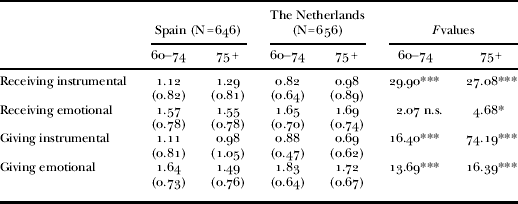
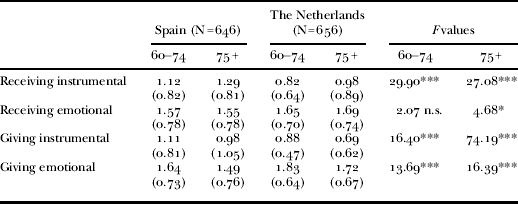
Levels of loneliness were significantly higher in the Spanish than in the Dutch sample: a mean score of loneliness in Spain of 3.24 – above the loneliness threshold of ‘3’. The mean loneliness score of Dutch older adults is 2.33, indicating that Dutch respondents were more frequently recorded in the ‘not lonely’ category. Moreover, we found significant differences in the levels of social support exchanged with the closest network members (see Table 2). In Spain, a higher level of instrumental support was given and received than in the Netherlands, while the Dutch respondents provided more emotional support than the Spanish. The level of emotional support received was only higher for the Dutch respondents in the age group 75+.
Means (and standard deviations) for social support in Spain and the Netherlands
Significance levels:* p<0.05
*** p<0.001, n.s.: not significant.
Multivariate analyses
Our data, as presented in Table 1, showed significantly higher mean levels of loneliness among Spanish older adults than among Dutch older adults. Parallel regression analyses were carried out for Spain and the Netherlands in order to assess the contribution of socio-demographic variables, health and social integration variables (encompassing living arrangements and the characteristics of the broader social network), and especially to assess the impact of social support on the levels of loneliness. We analysed the effects of giving and receiving support separately in models 1 and 2, because of the high correlation of support given and received within each type of support (see Table 3). The results show the presence of reciprocity in social relationships.
Bivariate correlations of loneliness, age and social support in Spain (N=646) and the Netherlands (N=656)

Note: In the upper part of the table are the bivariate correlations for the Netherlands, and in the lower part the bivariate correlations for Spain.
Significance levels:† p<0.10
* p<0.05
** p<0.01
*** p<0.001.
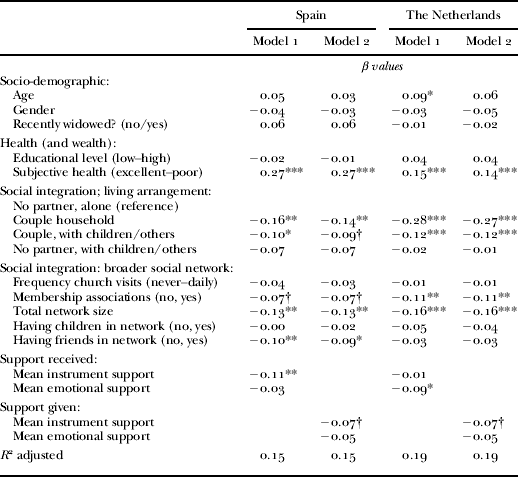
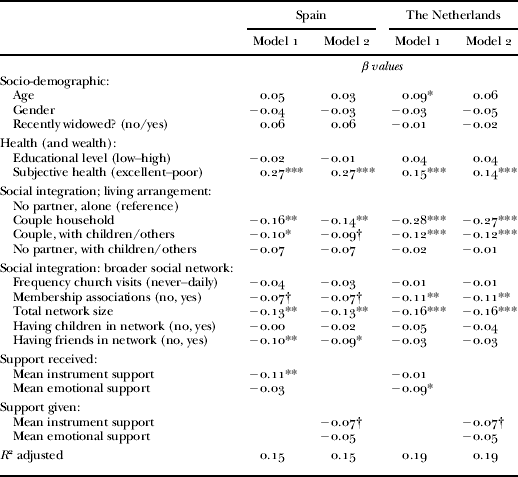
In models 1, the effects of socio-demographic variables, health, the social integration variables and the contribution of receiving social support were investigated. In models 2, the effects of socio-demographic variables, health, social integration and the contribution of providing social support were investigated. The models explained 15 per cent of the variance in the Spanish sample and 19 per cent in the Dutch sample (see Table 4).
Summary of regression analysis for variables predicting levels of loneliness among older adults in Spain (N=646) and the Netherlands (N=656)
Note: Household composition was represented as dummy variables with a one-person household as the reference group.
Significance levels:† p<0.10
* p<0.05
** p<0.01
*** p<0.001.
Models 1 of Table 4 showed that out of the socio-demographic factors only age differentially explained loneliness in the two countries: the effect of age was significant only for the Dutch respondents, indicating that higher ages are associated with higher levels of loneliness in older adults in the Netherlands. Next, we show that subjective health is an important determinant of loneliness in both countries. However, the coefficient in Spain was higher than in the Netherlands, indicating that older adults in Spain in poor health are lonelier than their peers in the Netherlands. Older people living with a partner in a couple-only household were significantly less lonely than those living alone in both countries. Living with a partner and adult children was significantly related to a lower level of loneliness in both countries. The effect of living without a partner but with children or other family members was not significant for either of the two countries. These outcomes underline the importance of a partner in the household; a partner relationship being more decisive for the alleviation of loneliness in older age than co-residence with adult children. Regarding the effects of the other social integration factors, being a member of an association was a significant predictor of lower levels of loneliness in the Netherlands and in Spain. Frequency of church activities did not explain loneliness in either country. A larger social network was a significant predictor of a lower level of loneliness in both countries. The presence of children in the network did not predict a lower level of loneliness in either of the countries. However, having friends in the network predicted lower levels of loneliness in Spain, but not in the Netherlands. It is possible that friends are more important within Spanish society. Consequently, social integration variables are important vehicles in explaining the varying levels of loneliness in both countries.
Receiving instrumental support from the closest network members significantly predicted a lower level of loneliness in the Spanish sample, but receiving emotional support did not. In the Dutch sample a reversed pattern in the effects of social support was found; receiving instrumental support had no effect on loneliness, while receiving emotional support was significantly related to lower levels of loneliness. Providing instrumental support to close network members predicted a lower level of loneliness in the two countries, but the effects were only marginally significant. The provision of emotional support did not explain loneliness in either of the two samples.
Discussion
The main aim of the study was to analyse patterns in the exchange of support and the consequences for older adults' loneliness in two European countries, Spain and the Netherlands. Following the theoretical assumptions of Adams, Anderson and Adonu (Reference Adams, Anderson, Adonu, Haskek and Aron2004), we suggested that cultural constructions influence social realities: the meaning attributed to closeness and intimacy in a certain culture affects the type of support (emotional or instrumental) which represents the culturally accepted way to show intimacy and love in relationships between older people and their network members and, consequently, the types of support affect the level of loneliness. In this section we discuss the findings of the study regarding social support and other variables that were included in the study, first at a descriptive level, and second, as predictors of loneliness. Finally, we comment on the limitations of the study and the directions for future research.
At the descriptive level, we found different patterns in the flows of social support exchanged between the older respondents and their social network members. As expected, in the Spanish sample, the exchange of instrumental support was more frequent than in the Dutch sample. We found a reversed pattern in the exchange of emotional support; in the Netherlands, a higher proportion of respondents provided emotional support to others than in Spain. Also Dutch respondents received more emotional support than Spanish respondents, but only when they were in advanced age. These findings support the theoretical assumptions regarding cultural differences in flows of social support and the interdependent versus independent orientations of the two countries (Adams, Anderson and Adonu Reference Adams, Anderson, Adonu, Haskek and Aron2004). In Spain, values and norms about familial interdependence and about providing support within the family are important and providing care to older parents when needed is predominantly seen as a responsibility of the adult children. Accordingly, children generally leave home late and maintain a close relationship with older parents during adulthood, co-residing or living close to them. Also the main care-givers are frequently family members, such as an adult daughter, who often co-resides with the care receiver (Imserso 2006). In Spain, living with children (with or without the spouse) was a much more common situation than in the Netherlands, as has been consistently found in previous studies (Fernández-Ballesteros Reference Fernández-Ballesteros2002; Hank Reference Hank2007). On the contrary, the Netherlands is a country with a more independent construction of social reality and a higher score on individualism (Hofstede Reference Hofstede2001). Consequently, in the Netherlands independence is highly valued and the social world is seen as inherently unconnected. Children usually leave home early and more frequently do not share the household with the older parents, although they tend to have at least weekly contact with them (Hank Reference Hank2007). Dutch older people are also more likely to have access to formal sources of help and support, which are provided by the Government. Therefore, more resources are left to and available for the exchange of emotional support between the older people and their adult children. It is also possible that the exchange of emotional support is a better indicator of intimacy in Dutch society, being the optimal way of establishing and maintaining close connections between the older people and their network members.
Moreover, social support had a differential impact on loneliness in the two countries. Regarding the reception of support, in Spain receiving instrumental help from others had loneliness-reducing effects, while in the Netherlands it was receiving emotional support which was related to a lower level of loneliness. The results can also be explained within the theoretical approach previously suggested. According to the theory, it is to be expected that in cases where Spanish older people's expectations regarding receiving instrumental support from family members are not fulfilled, they will feel intensely lonely. Congruently, qualitative research has shown that Spanish older adults living alone identify the experience of loneliness with a situation where there is an absence of instrumental support, when they lack a person who is ready to provide help in an emergency situation or when they have health problems (López Reference López2005). In the Spanish sample living with children did not alleviate loneliness. It is possible that it is the support received by the children living at a short distance and not co-residing with them which is optimal for wellbeing. On the other hand, the increasing levels of labour market participation of daughters resulted in different realities than previously expected regarding receiving instrumental support. The results are also consistent with the ‘intimacy at a distance’ concept (Rosenmayr and Köckeis Reference Rosenmayr and Köckeis1963). On the contrary, in Dutch culture, receiving instrumental support may convey negative connotations of loss of independence and control over one's own life. Intimacy and love are probably better shown by the provision of emotional support, and therefore, when the Dutch elders do not receive this type of help from their network members they feel lonely.
With reference to the provision of support, giving instrumental help to others was a protective factor against loneliness in the two countries, although it lost significance after controlling the effect of other age-related factors (i.e. health, education, number of network members). In Spain, providing support to family members (e.g. caring of grandchildren) is probably a way to feel connected to others and socially active in late life. In the Netherlands, Dutch elders may also feel more socially active and engaged with life when they provide instrumental help to significant others. However, in the Netherlands this type of help is probably provided in a wider social context, such as through participation in volunteer organisations, which is much more common among the Dutch than among Spanish elders (Hank and Erlinghagen Reference Hank and Erlinghagen2010). Our results therefore support the idea to a certain extent that providing help to others has a positive effect in maintaining psychological wellbeing in older age.
To further understand the social environment where support is given and received, we also analysed other variables such as social activities and network factors at a descriptive level and also as factors related to loneliness. Spanish older adults more frequently go to church, while a larger proportion of Dutch older adults belong to social and volunteer organisations; this belonging to organisations proved to be an important loneliness-reducing factor in the Dutch older adults. The number of people included in the network was higher in the Dutch than in the Spanish sample. Similar differences between the Netherlands and other Mediterranean countries, such as Italy, have been found in previous studies (Van Tilburg et al. Reference Van Tilburg, De Jong Gierveld, Lecchini and Marsiglia1998). In both countries a large social network was related to a lower level of loneliness. Regarding the composition of the network, Spanish older respondents included friends in a higher proportion than Dutch respondents; and the presence of friends proved to be an important loneliness-reducing factor among the Spanish older adults. These results could also relate to the presence of different cultural concepts of kin and non-kin relationships in the social network (Hollinger and Haller Reference Hollinger and Haller1990). However, these results should be interpreted with caution due to the different procedures of network data collection in both samples. According to Antonucci (Reference Antonucci1986), the hierarchical mapping technique used in the Spanish sample is less influenced by a social desirability bias.
Finally, differences in the level of loneliness were also found between the countries. Loneliness among Spanish older adults showed a mean level of more than ‘3’, indicating moderate to high levels of loneliness; the loneliness of Dutch older adults showed a mean less than ‘3’. Our results are consistent with the studies finding higher levels of loneliness in Mediterranean countries than in the north of Europe (Del Barrio et al. Reference Del Barrio, Castejón, Sancho Castiello, Tortosa, Sundström and Malmberg2010; Jylhä and Jokela Reference Jylhä and Jokela1990; Sundström et al. Reference Sundström, Fransson, Malmberg and Davey2009; Van Tilburg et al. Reference Van Tilburg, De Jong Gierveld, Lecchini and Marsiglia1998). We conclude that not only social support, but also other social characteristics, such as co-residing with children, participating in social organisations or having friends, are influenced by cultural context.
Regarding the limitations of the study, first, we could not provide adequate measures of income in the Spanish survey so it was not possible to control for the economic status of the respondents. It is possible that when older people do not have access to help from formal services, receiving instrumental support from family and friends becomes an important factor in maintaining their subjective wellbeing. In Spain, the ‘formal’ care-giving system for older adults is still in a process of development and instrumental help is mainly given in the context of close family relationships (Imserso 2006). In the Netherlands, the levels of wealth are higher, and formal resources for elder care are more frequently available and used. It is more than likely that instrumental needs of older people are covered by formal services and that the provision of emotional support by children and others becomes more important for their subjective wellbeing. Second, in Spain the sample was not randomly selected and, although the background variables were very similar to the ones of a national survey (Imserso 2006), the generalisation of the results to the Spanish population should be made with caution. Third, in this study only community-dwelling older adults were included. It is possible that selection bias affected the study outcomes. This could be due to the fact that more older people live in institutions in the Netherlands than in Spain, where living in a nursing home is seen as the last resort when family care-givers are not available (Imserso 2006). In the future, it will be necessary to analyse samples of both community-dwelling and institutionalised older people to further our understanding of loneliness in different cultures.
In summary, this study has provided a cultural comparison of social support and loneliness, using comparable data from Spain and the Netherlands. Loneliness was measured with the same instrument in the two countries. In both surveys, data were available on the exchange of social support and several other indicators of social integration, such as living arrangements, social network size and composition, using the same questions. The results have been interpreted in the context of independent versus interdependent constructions of the social world, according to the theoretical approach proposed by Adams, Anderson and Adonu (Reference Adams, Anderson, Adonu, Haskek and Aron2004). We highlight the need to develop trans-cultural studies that include the meaning of intimacy and closeness in social relationships, as well as personal expectations and preferences for giving and receiving different types of support, as predictors of loneliness in European older adults.
Acknowledgements
We would like to thank the anonymous reviewers and the Ageing & Society editor for helpful comments on previous versions of the paper. We also thank Rick Levenson PhD for a last review of the paper and language corrections. This research was supported by an FPU doctoral grant from the Spanish Ministry of Science and Innovation to the first author. The Longitudinal Ageing Study Amsterdam is supported for a large part by the Netherlands Ministry of Health, Welfare and Sports.