On 12 January 2010, at 4:52, a 7.0 M w magnitude earthquake struck Haiti and caused thousands of deaths and severe material destruction (Orelien et al., Reference Orelien, Philippe, Wesner, Ashley, Fisher and Scheuren2013). In the following weeks, there were roughly around 50 aftershocks that struck with a magnitude of 4.5 M w or greater (Kolbe et al., Reference Kolbe, Hutson, Shannon, Trzcinski, Miles, Levitz, Puccio, James, Noel and Muggah2010). The earthquake's epicenter was closest to a town called Léogâne, only 25 km from the capital Port-au-Prince, where the largest proportion of the population of Haiti resides. There were 222 000 deaths and more than 300 000 injuries (Orelien et al., Reference Orelien, Philippe, Wesner, Ashley, Fisher and Scheuren2013), and about 170 000 people were buried in mass graves (Kolbe et al., Reference Kolbe, Hutson, Shannon, Trzcinski, Miles, Levitz, Puccio, James, Noel and Muggah2010; Corbet, Reference Corbet2011; Cénat et al., Reference Cénat, Eid, Derivois, Hébert and Clorméus2015b). The country also suffered immense material damage, including the loss of over 18% of Haiti's schools as well as more than 100 000 homes (Orelien et al., Reference Orelien, Philippe, Wesner, Ashley, Fisher and Scheuren2013). In addition, more than 2 million people were left homeless and were thus displaced and around 1.3 million people had to live in provisional tent cities throughout Port-au-Prince (Risler et al., Reference Risler, Kintzle and Nackerud2015).
Studies conducted after similar natural disasters around the world showed that they constituted great risk factors for mental health problems among survivors, including posttraumatic stress disorder (PTSD) and depression (Tang et al., Reference Tang, Liu, Liu, Xue and Zhang2014; Dai et al., Reference Dai, Chen, Lai, Li, Wang and Liu2016). Studies carried out after the 2010 earthquake in Haiti showed severe mental health consequences in all groups in the population (Cerdá et al., Reference Cerdá, Paczkowski, Galea, Nemethy, Péan and Desvarieux2013; Cénat and Derivois, Reference Cénat and Derivois2014a, Reference Cénat and Derivois2014b; Cénat and Derivois, Reference Cénat and Derivois2015; Derivois et al., Reference Derivois, Cénat and Mérisier2014Reference Derivois, Cénat and Mérisiera; Blanc et al., Reference Blanc, Bui, Mouchenik, Derivois and Birmes2015; Cénat et al., Reference Cénat, Derivois, Hébert, Eid and Mouchenik2015a; Cadichon et al., Reference Cadichon, Lignier, Cénat and Derivois2017; Cénat et al., Reference Cénat, Derivois, Hébert, Amédée and Karray2018; Jaimes et al., Reference Jaimes, Hassan and Rousseau2019). Indeed, studies conducted among children, adolescents (Blanc et al., Reference Blanc, Bui, Mouchenik, Derivois and Birmes2015; Cénat et al., Reference Cénat, Derivois, Hébert, Eid and Mouchenik2015a, Reference Cénat, Eid, Derivois, Hébert and Clorméus2015b), young adults (Cadichon et al., Reference Cadichon, Lignier, Cénat and Derivois2017), adults (Cénat and Derivois, Reference Cénat and Derivois2014a, Reference Cénat and Derivois2014b; Cerdá et al., Reference Cerdá, Paczkowski, Galea, Nemethy, Péan and Desvarieux2013), and specific samples such as street children and mental health professionals (Cénat et al., Reference Cénat, Derivois, Hébert, Amédée and Karray2018; Derivois et al., Reference Derivois, Mérisier, Cénat and Castelot2014Reference Derivois, Mérisier, Cénat and Castelotb) showed high prevalence of PTSD, depression, and anxiety, among others.
One of the biggest challenges after the earthquake was the high-reported proportion of sexual assaults in refugee camps (Rahill et al., Reference Rahill, Joshi, Lescano and Holbert2015). Data collected from several organizations, such as Amnesty International, showed that ~10 813 people living in Port-au-Prince were survivors of sexual assault in the six weeks that followed the 2010 earthquake. According to the participants' responses, 69.6% of attackers were ‘criminals’, while 13.6% were spouse, boyfriend, girlfriend or ex-partner (Kolbe et al., Reference Kolbe, Hutson, Shannon, Trzcinski, Miles, Levitz, Puccio, James, Noel and Muggah2010). Another study estimated that 50 to 72% of women living in Cité Soleil, the poorest municipality in the Port-au-Prince region, experienced some form of sexual violence (Rahill et al., Reference Rahill, Joshi, Lescano and Holbert2015). On many different occasions, women who were sexually assaulted felt shame and were also stigmatized by the community (Rahill et al., Reference Rahill, Joshi, Lescano and Holbert2015). Studies showed that sexual assault is associated with multiple lifetime psychiatric disorders including PTSD, depression, anxiety, and others (Chen et al., Reference Chen, Murad, Paras, Colbenson, Sattler, Goranson, Elamin, Seime, Shinozaki, Prokop and Zirakzadeh2010). Studies conducted among sexually assaulted people in general, and among women particularly, have shown that they are more likely to present significant symptoms of PTSD, depression, anxiety, and substance use problems, among others (Ullman, Reference Ullman2016; Dworkin et al., Reference Dworkin, Ullman, Stappenbeck, Brill and Kaysen2018; Scott et al., Reference Scott, Koenen, King, Petukhova, Alonso, Bromet, Bruffaerts, Bunting, de Jonge, Haro, Karam, Lee, Medina-Mora, Navarro-Mateu, Sampson, Shahly, Stein, Torres, Zaslavsky and Kessler2018). These studies and others have also shown that social support is an important protective factor in helping women survivors of sexual assault cope with traumatic consequences (Bryant-Davis et al., Reference Bryant-Davis, Ullman, Tsong, Anderson, Counts, Tillman, Bhang and Gray2015; Ullman and Peter-Hagene, Reference Ullman and Peter-Hagene2016; Dworkin et al., Reference Dworkin, Ullman, Stappenbeck, Brill and Kaysen2018).
Sexual assault has been a serious problem in Haiti for years prior to the earthquake. In 1994, an important increase in sexual assaults was uncovered in a time of political uncertainty (Rey, Reference Rey1999; Davis, Reference Davis2010). When the 2010 earthquake hit Haiti, chaos ensued, and sexual violence rose again (Davis, Reference Davis2010; Rahill et al., Reference Rahill, Joshi, Lescano and Holbert2015). The main issue in this case was the fact that women and girls lived in internally displaced persons camps, meaning they had no way to ensure their security, and this increased the probability of assault (Davis, Reference Davis2010). However, traumatic consequences associated with sexual assault are poorly studied in Haiti (Cénat et al., Reference Cénat, Derivois, Hébert, Amédée and Karray2018; Deschamps et al., Reference Deschamps, Theodore, Christophe, Souroutzidis, Meiselbach, Bell, Perodin, Anglade, Devieux, Cremieux and Pape2019). The few studies that have been conducted have shown a significant association between sexual assault and mental health problems (Rahill et al., Reference Rahill, Joshi, Lescano and Holbert2015; Grelotti et al., Reference Grelotti, Gerbasi, Eustache, Fils-Aimé, Thérosmé, Severe, Raviola, Darghouth, Legha, Pierre, Affricot, Alcindor, Boyd, Becker and Smith Fawzi2018; Deschamps et al., Reference Deschamps, Theodore, Christophe, Souroutzidis, Meiselbach, Bell, Perodin, Anglade, Devieux, Cremieux and Pape2019). However, no post-earthquake studies were conducted to examine the role of pre-earthquake sexual assaults on the mental health of women exposed to the earthquake.
Increasingly, studies have been exploring the effect of multiple traumatic events to understand patterns associated with cumulative trauma and polyvictimization and their consequences (Briere et al., Reference Briere, Agee and Dietrich2016; Do et al., Reference Do, Correa-Velez and Dunne2019). These studies and others have shown that individuals who have experienced multiple traumas are more likely to present negative outcomes such as PTSD, depression, and others (Myers et al., Reference Myers, Wyatt, Ullman, Loeb, Chin, Prause, Zhang, Williams, Slavich and Liu2015; Briere et al., Reference Briere, Agee and Dietrich2016; Cénat et al., Reference Cénat, Derivois, Hébert, Amédée and Karray2018, Reference Cénat, Smith, Hébert and Derivois2019; Do et al., Reference Do, Correa-Velez and Dunne2019). However, studies on cumulative trauma usually included only interpersonal traumas. The current literature does not put any particular focus on research related to understanding the consequences of interpersonal trauma followed by non-interpersonal trauma. Research that looks at interpersonal trauma followed by a natural disaster is important to better intervene among survivors.
The current study
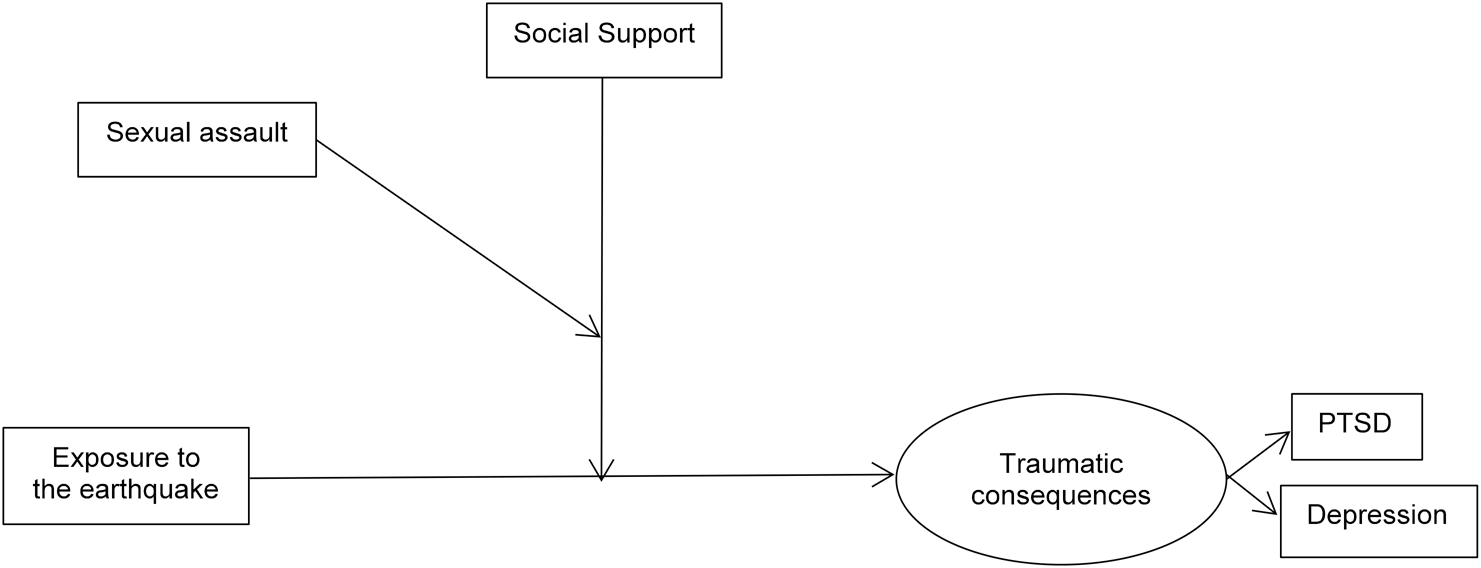
Given these gaps in the literature, this study aimed to explore the cumulative role of sexual assault (as interpersonal trauma) experienced before the earthquake (as non-interpersonal trauma) and mental health problems among women survivors. The main objective of this study was to examine the association between the level of exposure to the earthquake, sexual assault experienced by women before the earthquake, the PTSD and depression symptoms, and the perceived social support as a protective factor among women survivors of the 2010 earthquake in Haiti. Our research questions included: (i) What are the links between sexual assault as an interpersonal trauma before the earthquake, the level of exposure to that natural disaster and their posttraumatic consequences in terms of PTSD and depression symptoms? (ii) Does sexual assault experienced before the earthquake heighten traumatic consequences for women survivors? (iii) Does social support satisfaction play a protective role in the relationship between the level of exposure to the earthquake and the posttraumatic consequences? (iv) Does social support satisfaction play a protective role in the association between sexual assault experience by women before the earthquake, the level of exposure to the earthquake, and the posttraumatic consequences? Fig. 1 illustrates the moderated moderation model that was tested.
Conceptual model of the moderated moderation model.

Methods
Procedure
Data were collected about 30 months following the earthquake using a door-to-door approach, visiting shelter camps, churches, different offices, universities, and professional training centers throughout the six municipalities of the capital of Haiti, Port-au-Prince. The data were collected by 27 research assistants, all in their final year in psychology at the State University of Haiti, over the course of 6 weeks. Additional information about the procedure and design can be found elsewhere (Cénat and Derivois, Reference Cénat and Derivois2014a, Reference Cénat and Derivois2014b). The research ethics board of the University of Ottawa approved this project.
Participants
A total of 660 women aged between 18 and 86, with an average age of 28.20 (s.d. = 12.45), were recruited in the six municipalities of Port-au-Prince. Participants were chosen based on these inclusion criteria (1) be 18 years old or over, (2) have experienced the earthquake in Port-au-Prince or neighbouring municipalities (Carrefour, Delmas, Cité Soleil, Tabarre, Croix-des-Bouquets), (3) not having received any psychological treatment following the earthquake, and (4) having signed the informed consent form.
Measures
Sexual assault
Sexual assault experienced before the earthquake was assessed using an item from the Life Event Checklist Subscale (Gray et al., Reference Gray, Litz, Hsu and Lombardo2004) of the Clinician Administered PTSD Scale (Blake et al., Reference Blake, Weathers, Nagy, Kaloupek, Charney and Keane1995): Before the earthquake… Sexual assault (rape, attempted rape, made to perform any type of sexual act through force or threat of harm). Responses were rated on a 5 point-scale: Happened to me, Witnessed it, Learned about it, Not sure, and Doesn't apply. In our study, responses were recoded as, Happened to me (1), and the rest of the responses (0).
Exposure to the earthquake
Exposure level to the earthquake was evaluated using the 19-item Yes or No Traumatic Exposure Questionnaire. Items addressed how the earthquake affected their life, their family, and their social network. This questionnaire also asked questions related to injuries and deaths within their social network including family and friends, and the level of impact on their home and where they were during the earthquake (e.g. during the earthquake…members of my family have died) (Cénat and Derivois, Reference Cénat and Derivois2014a, Reference Cénat and Derivois2014b). The Cronbach's alpha in our sample was 0.71.
Peritraumatic distress
Peritraumatic distress was assessed using the peritraumatic distress inventory (PDI) (Brunet et al., Reference Brunet, Weiss, Metzler, Best, Neylan, Rogers, Fagan and Marmar2001) related to the earthquake. The PDI is a self-report questionnaire, which was developed to evaluate criterion A2 of PTSD in the DSM-IV (American Psychiatric Association, 2000). In other words, this evaluates the emotional level of distress experienced in the days after the trauma. Research showed a positive correlation between peritraumatic distress and progression of PTSD and depression symptoms (Cénat and Derivois, Reference Cénat and Derivois2014a and Reference Cénat and Derivois2014b). The questionnaire included 13 items with a 5 point-scale: not at all true (0), slightly true (1), fairly true (2), very true (3), and extremely true (4) (Jehel et al., Reference Jehel, Brunet, Paterniti and Guelfi2005). A score of 15 and higher was shown to best represent a clinical score of severe peritraumatic distress (Brunet et al., Reference Brunet, St-Hilaire, Jehel and King2003). The French version of the PDI was used (Jehel et al., Reference Jehel, Brunet, Paterniti and Guelfi2005). Internal consistency was good with a Cronbach's α of 0.80.
PSTD symptoms
Symptoms of PTSD were evaluated using the Impact of Event Scale-Revised (IES-R) related to the earthquake. The IES-R includes 22 items divided into three subscales, eight items dedicated to feelings of avoidance, eight items dedicated to feelings of intrusion, and six items that evaluated hyperarousal (Weiss and Marmar, Reference Weiss, Marmar, Wilson and Keane1997). The scale used a 5-point scale: not at all (0), a little bit (1), moderately (2), quite a bit (3), and extremely (4). Final scores ranged from 0 to 88 with a cut off score of 32 indicating severe PTSD (Weiss and Marmar, Reference Weiss, Marmar, Wilson and Keane1997). In the present study, we used the French version of the IES-R (Brunet et al., Reference Brunet, St-Hilaire, Jehel and King2003). The Cronbach's α in our sample was 0.93.
Depression symptoms
The beck depression inventory (BDI) was used to assess depression symptoms related to the earthquake (Beck et al., Reference Beck, Steer and Brown1996). This questionnaire evaluated the occurrence and level of severity of depression. The newest version of the scale named BDI-II was used. It was developed based on the definition of MDD found in the DSM-IV. It consisted of 21 items with a 4-point scale (0 to 3) with a total score between 0 and 63. A score of 20 and higher is used to determine the presence of significant depression symptoms. This measure was found to have strong internal consistency with a Cronbach's α of 0.89 in our sample.
Social support
Social support was evaluated using Social Support Questionnaire 6 (SSQ-6) (Sarason et al., Reference Sarason, Sarason, Shearin and Pierce1987). The SSQ-6 included six items that assessed the perceived number of people who socially supported them, and the level of satisfaction from that social support. Participants first provided the number of people that can support them in the different areas, and then provided the degree of satisfaction of the support received in each area (Sarason et al., Reference Sarason, Sarason, Shearin and Pierce1987). The Cronbach's alpha in our sample was 0.89, which indicated good internal consistency.
Statistical analyses
Descriptive analysis was used as well as the use of χ2. This allowed us to compare the proportions of people who showed significant levels of depression and PTSD based on whether they had experienced sexual assault or not. These data were analyzed using Statistical Package for Social Sciences version 25. First, two other parallel multiple regression analyses have been conducted (online Supplementary Appendix 1) to observe how depression and PTSD were individually associated to the predictors in order to confirm the use of a latent variable in this study. This analysis demonstrates that the behavior of predictors is similar for both variables while controlling for the same set of confounders. Then a multiple regression model was used to observe the behavior of predictors on a latent variable predicting depression and PTSD. Finally, a moderated moderation model, usually called three-way interaction model (Hayes, Reference Hayes2012), has been computed in lavaan 0.6-2 (see Fig. 1) using the modelization of Hayes (Reference Hayes2018). It allowed to assess the ways the interaction between satisfaction toward received social support and sexual assault victimization would alter the relationship between the level of exposure to the Haiti earthquake and a latent variable of traumatic consequences (i.e. depression and PTSD). Covariates included age, employment, religion, and marital status. Education and presence of children were included at first but very poorly fit to the model, although keeping significance of regressions stable. In this situation, it has been decided that those confounding variables would be excluded from the model (Pourhoseingholi et al., Reference Pourhoseingholi, Baghestani and Vahedi2012).
Results
Prevalence of sexual assault related to sociodemographic data
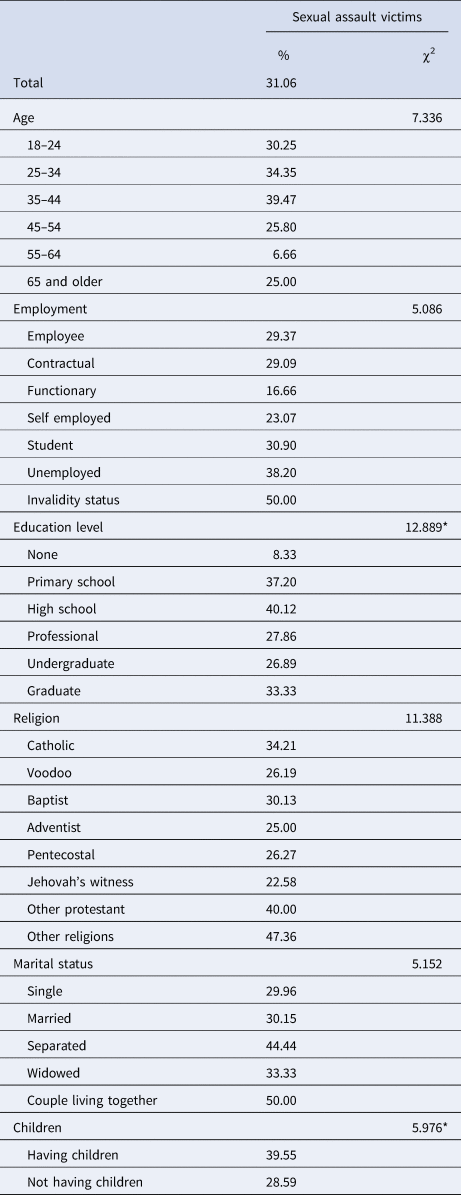
Results of this study showed that 31.06% of women were sexually assaulted before the 2010 earthquake in Haiti. The results presented in Table 1 showed significant differences in the prevalence of sexual assault according to the education level of women (χ2 = 12.889, df =5, p< 0.05). Higher educated women presented a higher prevalence of sexual assault. For example, women with college graduate level education presented a higher prevalence of sexual assault (33.33%) than those with no education (8.33%). Results presented in Table 1 also showed that women who have children were more likely to be victims of sexual assault (39.55%) than those who do not have children (28.59%, χ2 = 12.889, df =5, p < 0.05). Table 1 also presented results that showed there are no significant differences for age, marital status, employment status, and religion.
Prevalence of sexually assaulted according to age, employment, education level, religion, marital status, and having children

Prevalence of PTSD and depression related to sexual assault and sociodemographic data
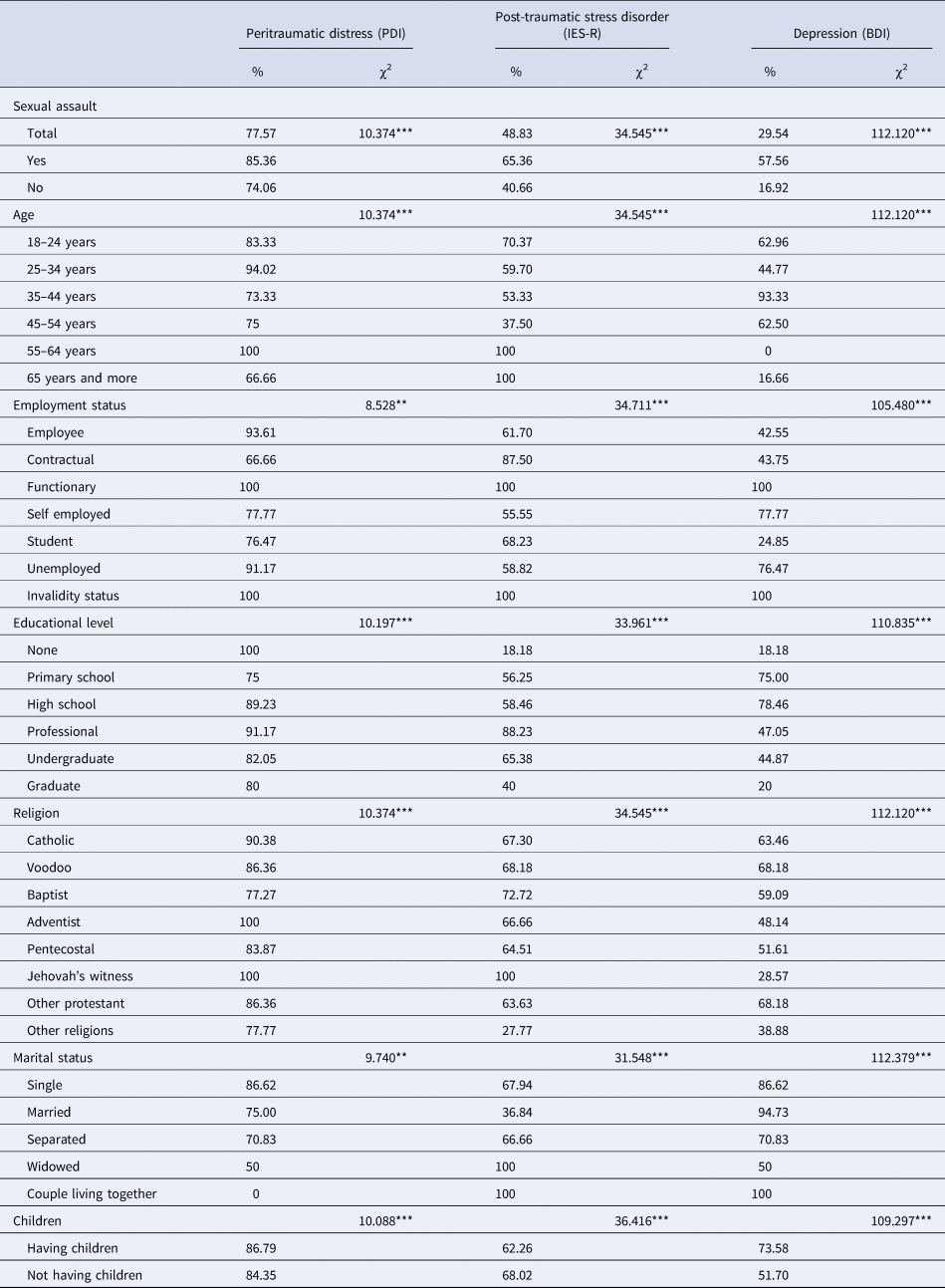
Table 2 shows that women who were sexually assaulted presented a higher prevalence of peritraumatic distress, PTSD, and depression symptoms (respectively, 85.36, 65.36, and 57.56%) compared to non-victims (respectively, 74.06, 40.66, and 16.92%), (χ2 = 10.374, df = 1, p < 0.001; χ2 = 34.545, df = 1, p < 0.001; χ2 = 112.120, df = 1, p < 0.001). Table 2 also presents the prevalence of peritraumatic stress, PTSD, and depression according to sexual assault victimization, as well as demographic factors such as age, employment, level of education, religion, marital status, and having children.
Prevalence of peritraumatic distress, PTSD, and depression in victims of sexual assault

Moderated moderation analyses
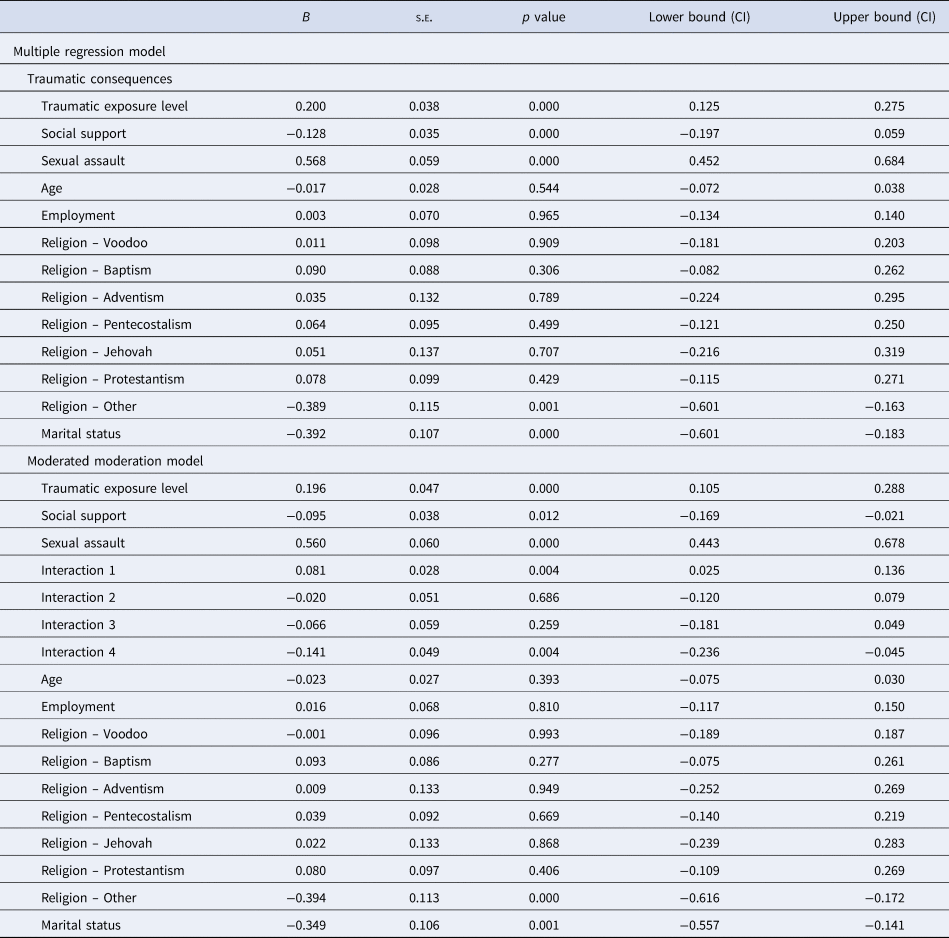
Results from the multiple regression model suggest that all independent variables are significantly associated with the latent outcome variable while controlling for age, employment, religion, and marital status (see Table 3). Departing from this conclusion, a moderated moderation model follows in which the interactions between those significant predictors are observed to understand how they may alter the individual relationships between the individual IVs and the DVs.
Results from the multiple regression model and the moderated moderation model

Interaction 1: exposure to the earthquake × social support; Interaction 2: exposure to the earthquake × sexual assault; Interaction 3: social support × sexual assault; and Interaction 4: social support × exposure to the earthquake × sexual assault
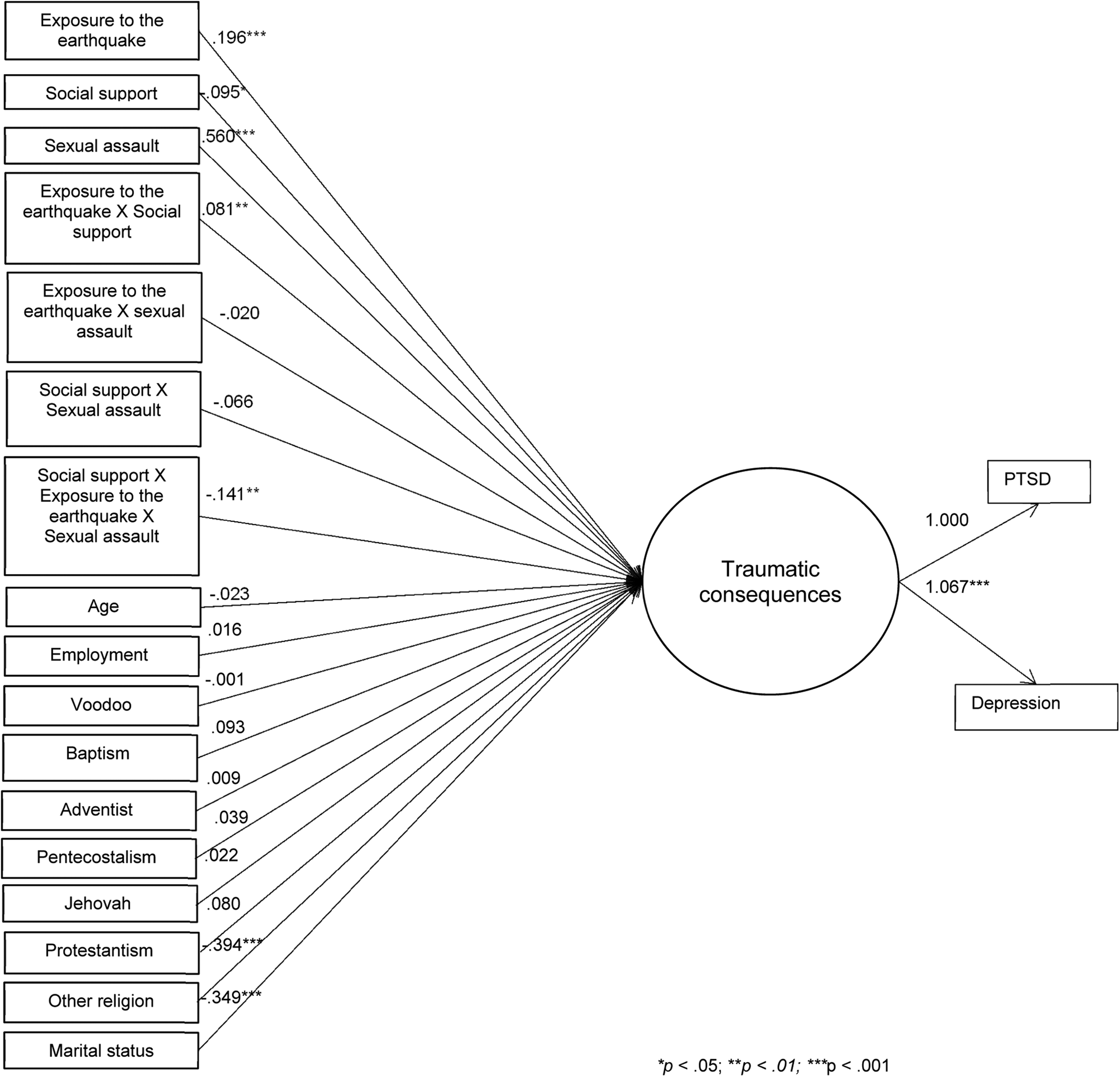
The moderated moderation model (see Fig. 2 and Table 3) assessed the ways in which the interaction between satisfaction towards received social support and sexual assault victimization would alter the relationship between the level of exposure to the Haiti earthquake and a latent variable of traumatic consequences including PTSD and depression variables. Control variables included age, employment [unemployed (0); employed (1)], religion (coded using seven dummy variables that are compared with the Catholicism baseline), and marital status (not in a relationship (0); in a relationship (1)).
Statistical model of the moderated moderation model.

The χ2 statistic was significant (χ2 (16) (robust) = 63.120, p = 0.000) and robust CFI was low (CFI = 0.834). Robust RMSEA was moderate with a significant value below 0.07 [robust RMSEA = 0.068, CI (0.051–0.086), p = 0.044], and the GFI indicates well fit (GFI = 0.920). The SRMR was also very good with a value below 0.08 (robust SRMR = 0.019) (Hooper et al., Reference Hooper, Coughlan, Mullen, Hooper and Mullen2008). Robust estimates were obtained using the robust maximum-likelihood estimator in lavaan 0.6-2.
All continuous variables were recoded into z scores in order to reduce variability differences as well as to obtain mean-centered variables ready for computing interactions. In this context, when satisfaction towards received social support is mean-centered and in the absence of any sexual assault, the level of exposure to the earthquake was positively significantly associated with the latent endogenous variable of traumatic consequences, consisting of both measures of PTSD and depression (B = 0.196, p < 0.001). Also, when the exposure level to the earthquake is mean-centered, and in the absence of any sexual assault, the satisfaction towards received social support was negatively significantly associated with the latent variable of traumatic consequences (B = −0.095, p = 0.012). However, when the level of exposure to the earthquake and the satisfaction towards the social support received are mean-centered, the sexual assault measure was positively significantly associated with the latent variable of traumatic consequences (B = 0.560, p < 0.001). When the traumatic exposure and the satisfaction towards social support are mean-centered, as well as in the absence of sexual assault, being a catholic was not different from any religion regarding the association with traumatic consequences, although being a part of ‘other’ religions negatively predicted the latent variable of traumatic consequences better than Catholicism (B = −0.394, p < 0.001). Finally, being in a romantic relationship was negatively associated with traumatic consequences (B = −0.349, p = 0.001).
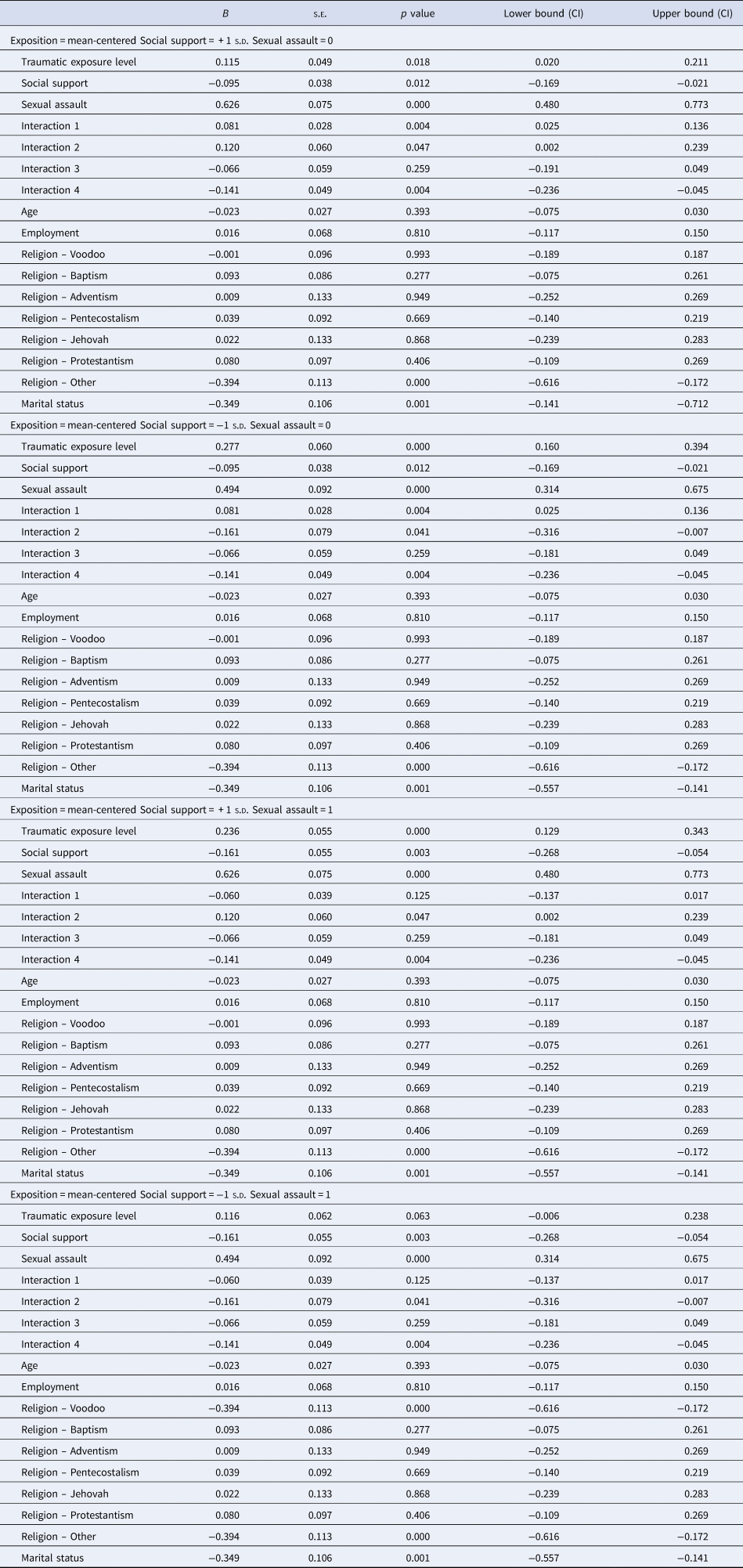
A triple interaction has been found between the traumatic exposure, the satisfaction towards social support, and the presence of sexual assaults (B = −0.141, p = 0.004) in predicting the traumatic consequences. In the current model, the traumatic exposure is considered as the main independent variable (X). It is the two moderator variables (M and Z) that must determine how their variation (−1 s.d.; +1 s.d.) may influence the relationship between X and the latent variable of traumatic consequences (Y). Thus, the values of the traumatic exposure (X) remained static in the decomposition of this interaction, while the values of M (satisfaction towards social support) and Z (sexual assault) could vary for each four combination. The decomposition of the triple interaction can be found in Table 4.
Decomposition of the moderated moderation

Interaction 1: exposure to the earthquake × social support; Interaction 2: exposure to the earthquake × sexual assault; Interaction 3: social support × sexual assault; and Interaction 4: social support × exposure to the earthquake × sexual assault.
A closer look to Table 4 reveals that the association between the level of exposure to the earthquake and traumatic consequences is significant under three conditions. Indeed, when social support is low (+1 s.d.) and in the absence of sexual assaults, the effect of traumatic exposure is significant (B = 0.115, p = 0.018). Also, when social support is high (−1 s.d.) and in the absence of sexual assaults, the effect of the traumatic exposure level is stronger than previously and, obviously, significant (B = 0.227, p < 0.000). Then, when social support is low (+1 s.d.) and in the presence of sexual assaults, the effect of traumatic exposure stays significant (B = 0.236, p < 0.001). Although, when social support is high (−1 s.d.) and in the presence of sexual assaults, the effect traumatic exposure level on traumatic consequences becomes non-significant (B = 0.116, p = 0.063). Thus, higher satisfaction towards social support would only buff out the effect of the traumatic exposure level on traumatic consequences in the condition of the previous experience of sexual assaults.
Discussion
This study aimed to examine the associations between sexual assault experienced by women before the earthquake, the exposure level to the disaster, traumatic consequences, and satisfaction of social support received. Specifically, this study intended to evaluate the cumulative impact of interpersonal trauma (sexual assault) before the experience of non-interpersonal trauma (the 2010 earthquake).
First, results from this study show that sexual assault is not an isolated phenomenon in Haiti. Our results show that approximately one in three women were victims of at least one episode of sexual assault before the earthquake and that sexual assault is a major social issue for women in Haiti. Similar results were observed in studies conducted in America, India, Canada, and Brazil (Brennan and Taylor-Butts, Reference Brennan and Taylor-Butts2008; dos Reis et al., Reference dos Reis, Lopes and Osis2017; Kundapur et al., Reference Kundapur, Shetty, Kempaller, Kumar and Anurupa2017; Mellins et al., Reference Mellins, Walsh, Sarvet, Wall, Gilbert, Santelli, Thompson, Wilson, Khan, Benson, Bah, Kaufman, Reardon and Hirsch2017). Thus, sexual assault is a systemic problem worldwide (dos Reis et al., Reference dos Reis, Lopes and Osis2017). The literature also shows a higher prevalence of sexual assault toward higher educated women in developing countries (Kundapur et al., Reference Kundapur, Shetty, Kempaller, Kumar and Anurupa2017). According to previous studies conducted in other low- and middle-income countries, educated women are particularly at risk because of the prevailing machismo, coercive attitudes, and male control (Koenig et al., Reference Koenig, Stephenson, Ahmed, Jejeebhoy and Campbell2006; Abramsky et al., Reference Abramsky, Watts, Garcia-Moreno, Devries, Kiss, Ellsberg, Jansen and Heise2011). Furthermore, research shows that younger women are particularly at risk of sexual violence in Haiti, which is also supported by the findings of the current study (Gómez et al., Reference Gómez, Speizer, Beauvais and Speizer2009).
Second, our results show that women survivors of the earthquake that are victims of sexual assault are at higher risk of developing peritraumatic distress, PTSD, and depression than non-victims. It is true that the prevalence of peritraumatic distress, PTSD, and depression symptoms are important among all women survivors of the 2010 earthquake. However, the results show that those who were sexually assaulted before the earthquake are significantly more likely to present peritraumatic, PTSD, and depression symptoms. Considering depressive symptoms, for example, female victims of sexual assault present a prevalence more than three times higher than other survivors. The few studies conducted among sexually assaulted women after the earthquake also showed that they present higher prevalence of traumatic consequences (Rahill et al., Reference Rahill, Joshi, Lescano and Holbert2015; Deschamps et al., Reference Deschamps, Theodore, Christophe, Souroutzidis, Meiselbach, Bell, Perodin, Anglade, Devieux, Cremieux and Pape2019). The results of the present study and previous research suggests that the consequences of enduring cumulative trauma can leave women more vulnerable to important traumatic consequences (Suliman et al., Reference Suliman, Mkabile, Fincham, Ahmed, Stein and Seedat2009; Rahill et al., Reference Rahill, Joshi, Lescano and Holbert2015). Our results in particular show that the cumulative effect persists even in the case of mixed interpersonal and non-interpersonal trauma. They suggest that research with survivors of natural disasters should further investigate the cumulative effect of trauma experienced before as well as after the disaster.
Lastly, we also examined the association between sexual assault experienced by women before the earthquake, the level of the exposure to the earthquake, the traumatic consequences (i.e. PTSD and depression), and social support received. The moderated moderation model shows that, separately, sexual assault and exposure to the earthquake positively predict traumatic consequences, while social support predicts them negatively. Research has previously shown the efficacy of social support in dealing with traumatic consequences experienced by women (Bryant-Davis et al., Reference Bryant-Davis, Ullman, Tsong, Anderson, Counts, Tillman, Bhang and Gray2015; Ullman and Peter-Hagene, Reference Ullman and Peter-Hagene2016; Dworkin et al., Reference Dworkin, Ullman, Stappenbeck, Brill and Kaysen2018). Our results corroborate that social support plays a protective role in women, but go beyond that by also showing that it plays a protective role in cumulative trauma. Indeed, our results indicate that women who are victims of sexual assault and were satisfied with the social support received are less likely to develop symptoms of PTSD and depression after being exposed to the earthquake. Although research shows that women survivors of earthquake or sexual assault tend to develop PTSD and depression (Tang et al., Reference Tang, Liu, Liu, Xue and Zhang2014; Dai et al., Reference Dai, Chen, Lai, Li, Wang and Liu2016; Scott et al., Reference Scott, Koenen, King, Petukhova, Alonso, Bromet, Bruffaerts, Bunting, de Jonge, Haro, Karam, Lee, Medina-Mora, Navarro-Mateu, Sampson, Shahly, Stein, Torres, Zaslavsky and Kessler2018), our results show that women with the help of a well-developed social support have a greater chance of recovery. Thus, social support plays an important protective role against trauma resulting from sexual assault and exposure to the earthquake (Cénat and Derivois, Reference Cénat and Derivois2015; Cénat and Derivois, Reference Cénat and Derivois2014b; Derivois et al., Reference Derivois, Mérisier, Cénat and Castelot2014b; Cénat et al., Reference Cénat, Derivois, Hébert, Eid and Mouchenik2015a; Stark et al., Reference Stark, Landis, Thomson and Potts2016).
Limitations
This study has several limitations that must be noted. First, as with other studies, it should be pointed out that the cross-sectional design of this study makes it impossible to prove the causal association between the variables examined. However, although we evaluate retrospectively, we know that the sexual assaults occurred before the earthquake, whereas the study was conducted two and a half years later, and the symptoms of post-traumatic stress disorder and depression refer to that time. This would justify the use of moderated moderation analyses. Second, data were collected 30 months after the earthquake and many events could affect the participants' life during that time. A longitudinal design would be more suited to observe the process of development of traumatic consequences. The retrospective cross-sectional design does not allow to control the symptoms of PTSD and depression pre-existing, which a longitudinal design could have allowed. Lastly, a comparison of victims and non-victims of sexual assault of neighbouring towns, who were not as close to the epicenter of the earthquake and thus may have faced less severe consequences, would have helped to understand the magnitude of the impact the earthquake had on the cumulative aspect of trauma in this study.
Implications for prevention and intervention
By highlighting the protective role of social support in attenuating mental health consequences due to the interaction between victimization of both sexual assault and natural disasters, this study outlines avenues for evidence-based intervention and prevention programs. Moreover, since younger women were particularly vulnerable, prevention programs should be implemented in universities and other institutions frequented by emerging adults. By increasing awareness of sexual assault, this study also shows it is important to engage the community in the prevention of sexual assault and gives a voice to victimized women in order to help them obtain more support from family, friends, and mental health services. The process of overcoming traumatic consequences is difficult, and reducing the stigma attached to sexual assault would help them to seek and use mental health resources (Ullman and Peter-Hagene, Reference Ullman and Peter-Hagene2016). Intervention programs should integrate the reinforcement of social support in order to help sexually assaulted women in the development of resilience and coping strategies (Ullman et al., Reference Ullman, Townsend, Filipas and Starzynski2007; Bryant-Davis et al., Reference Bryant-Davis, Ullman, Tsong, Anderson, Counts, Tillman, Bhang and Gray2015).
Conclusions
In summary, our research has shed light on the fact that sexual assault is not an isolated problem in Haiti – it is worldwide (Scott et al., Reference Scott, Koenen, King, Petukhova, Alonso, Bromet, Bruffaerts, Bunting, de Jonge, Haro, Karam, Lee, Medina-Mora, Navarro-Mateu, Sampson, Shahly, Stein, Torres, Zaslavsky and Kessler2018). It also reveals that sexual assault comes with major traumatic consequences. Most importantly, it shows that the protective role of social support to attenuate women's mental health consequences after cumulative traumas. Thus, efforts should be put towards decreasing the stigma of victims on a small scale (i.e. families) as well as on a large scale (i.e. society as a whole). Further studies should be conducted among representative samples including among women in rural area that are more at risk to experience different types of sexual assault (Asif et al., Reference Asif, Javed and Janjua2018; Grelotti et al., Reference Grelotti, Gerbasi, Eustache, Fils-Aimé, Thérosmé, Severe, Raviola, Darghouth, Legha, Pierre, Affricot, Alcindor, Boyd, Becker and Smith Fawzi2018). It should also explore the potential problems of having children as consequences of sexual assault and look at similar issues emphasized in this study using longitudinal or mixed study design.
Supplementary material
The supplementary material for this article can be found at https://doi.org/10.1017/S0033291719002757.
Acknowledgements
This research was supported by the grant # ANR-10-HAIT-002 RECREAHVI from the National Research Agency (ANR) of France.
Conflict of interest
No conflict of interest for any author.