Background
Neonates undergoing congenital heart surgery are at risk for postoperative gastrointestinal complications and aspiration events. Little research has been conducted on the complications of transitioning to an exclusively oral diet following neonatal cardiac surgery, despite the high rate of postoperative feeding complications.Reference Davies, Carver and Schmidt 1 A commonly used assessment tool for dysphagia and aspiration is the modified barium swallow study. This videoflouroscopic test allows radiologists in collaboration with speech therapists to assess the functional mobility of the infant’s oral cavity, pharynx, and cervical oesophagus.Reference Kakodkar and Schroeder 2 The high prevalence of postoperative gastrointestinal complications inclusive of real or suspected aspiration events and abnormal barium swallow study results can prolong the neonates’ length of hospitalisation, compromise the outcomes of cardiothoracic surgery, and lead to an increased use of resources in this patient population. Owing to suck and swallow dysfunction, neonates may struggle to breastfeed or bottle feed after cardiac surgery, increasing the risk for aspiration.Reference St. Pierre, Khattra and Johnson 3
The utility of the modified barium swallow study is not well established. It is often compared with the more invasive endoscopic evaluation of the swallow mechanism; however, studies have suggested that there is no significant difference in outcomes between patients who have had one versus the other of these tests.Reference Aviv 4 Dysphagia is common among the paediatric population having undergone open-heart surgery. Younger age at the time of surgery has been proven to increase the risk for developing dysphagia postoperatively.Reference Skinner, Halstead and Rubenstein 5 Infants having undergone a first-stage surgery for univentricular physiology are at the highest risk for developing poor feeding skills, contributing to inadequate intake, growth failure, and an increased risk of mortality.Reference Kohr, Dargan and Hague 6
To our knowledge, no comprehensive review of the modified barium swallow study as a tool to evaluate risk for aspiration has been conducted on a group of post-surgical infants with varying heart defects.
The objective of our study was to determine the incidence of positive barium swallow study results with clinically documented aspiration events, in a population of neonates with cardiac defects who have undergone surgical intervention. In addition, we analysed demographic data of infants known to aspirate to better understand the risk factors for aspirating and their post-aspiration nutritional management.
Materials and methods
A retrospective chart review was conducted using the institution’s cardiac database for infants having undergone neonatal cardiac surgery from July, 2013 through January, 2014. This study was approved by the Institutional Review Board at Children’s Healthcare of Atlanta. All neonates admitted to Children’s Healthcare of Atlanta’s Egleston campus cardiac ICU following surgery for cardiac defects were eligible for participation. Infants with more than one cardiac defect were classified as complex cardiac disease. Patient’s heart defects were classified as either single- or two-ventricle circulations.
At our institution, any patient with identified feeding concerns is referred to the speech therapy team. An initial bedside assessment is performed, and a speech therapist may recommend imaging, such as a modified barium swallow study. The attending physician ultimately decides whether or not the test is obtained. After evaluating the medical and surgical history of neonates extracted from the database, 62 patients met criteria for study inclusion. Infants included in the cohort were neonates at the time of their first open-heart surgery. Infants were classified as neonates if they were between 0 and 30 days of age at the time of initial open-heart surgery. For the purposes of our study, infants were only included in the cohort if their operative and postoperative course was at Children’s Healthcare of Atlanta’s Egleston campus. Neonates diagnosed with either tracheo-oesophageal fistula or cleft palates were excluded from the study because of the known risk of aspiration associated with these conditions.Reference Medoff-Cooper and Irving 7 , Reference Kovesi and Rubin 8
Swallow study test results were classified as abnormal if either aspiration or laryngeal penetration was documented. Infants whose swallow study test demonstrated laryngeal penetration were considered to be at risk for aspiration, as laryngeal penetration is often a precursor of an aspiration event.Reference O’Connor, Ravishankar and Ballweg 9 Symptoms suggestive of aspiration during the infant’s inpatient stay or infants who presented to the emergency department with history and symptoms of aspiration were considered to be swallow study-independent aspiration events.
Statistical analyses
Data are reported as medians, with interquartile ranges as measures of spread when appropriate. Comparison among groups was performed with contingency tests such as the χ2 or Fisher’s exact test for categorical variables and the Student t-test or Wilcoxon’s rank sum for continuous variables. A Kaplan–Meier graph was used to portray time spent on combination oral and tube feeds until patients resumed exclusive oral diets. Significance was determined at p<0.05. STATA 11.0 statistical programme (College Station, Texas, United States of America) was used for all analyses.
Results
Patient population
In total, there were 62 infants in the study who presented with 17 different types of cardiac defects at the time of neonatal surgery. The median age at time of operation was 6 days, with an interquartile range of 4–10 days. Although there were 36 males (58%), only 47% of swallow study-independent aspiration events occurred among male patients. Compared with females, male patients were not more likely to aspirate (x2>0.05).
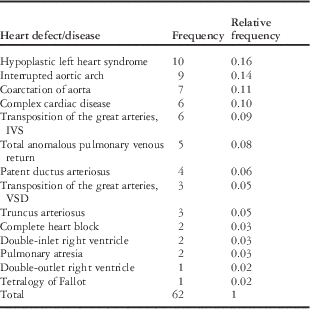
Defect type – single- versus two-ventricle circulation – was not predictive of whether or not a patient would aspirate after neonatal cardiac surgery. Among all, ten percent (n=6) were classified as “complex heart disease” owing to the diagnosis of multiple heart defects at the time of neonatal surgery. Approximately 20% (n=12) of the neonates were reliant on surgically implanted shunts to alter and/or support their cardiac circulation. In total, there were nine infants born prematurely – that is, born before 37 weeks of gestation. The distribution of patients by cardiac circulation is summarised in Table A1.
In the present study, 16% of patients (n=10) were diagnosed with a genetic syndrome. These diagnoses included trisomy 21 (n=3), DiGeorge syndrome (n=3), and chromosome 20 trisomy (n=1). The other three patients had combination of genetic diagnoses. At the time of chart review, no aspiration event was associated with a neurological diagnosis or impairment. There was insufficient evidence to conclude that aspiration events or abnormal swallow study results could be predicted by a known genetic disorder (x2=0.06).
Prevalence of aspiration among neonates
Clinical aspiration events were extracted from the patient’s chart, and are described as events where the patient choked, gagged, or experienced oxygen desaturation during oral feed trials. In the cardiac ICU and cardiac stepdown unit, these events were primarily documented by speech language pathologists. Among patients who were re-admitted because of suspected aspiration, parents described the event using the same symptom terminology to personnel in the emergency department. Aspiration events and laryngeal penetration were observed in 57% (n=9) and 12% (n=2), respectively, of the neonates studied. Swallow study results did not predict a swallow study-independent aspiration event (p=0.6). We found that documented aspiration events were more likely among infants whose modified barium swallow study revealed no laryngeal penetration (p<0.01). Neonates considered to be at a higher risk for aspirating, as indicated by laryngeal penetration on a modified barium swallow study, had no documented swallow study-independent aspiration events. Type of cardiac defect and feeding route at the time of discharge were independent of each other (x2=0.3). There was no significant relationship between aspiration events and single-ventricle circulation (p=0.8).
Feeding after discharge
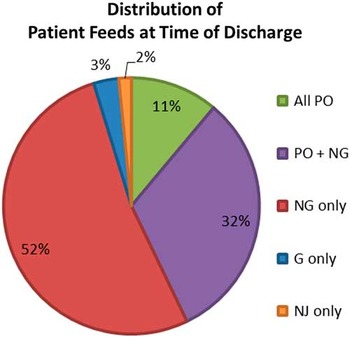
Before surgery, 26% of patients were exclusively orally fed (n=16). At the time of discharge, 54% (n=33) of infants were fed exclusively by nasogastric or nasojejunal tube. Of these 33 infants, 45% (n=15) demonstrated a clinical aspiration event, 24% (n=8) had both a documented clinical aspiration event and a positive barium swallow study, and one infant had only a positive barium swallow study result. In this subgroup, both documented aspiration events and abnormal swallow study results were significantly more common among the premature infant population (x2<0.05). The remaining nine infants were fed by a nasogastric tube at the time of discharge secondary to poor intake; they were not thought to have had an aspiration event.
Length of hospitalisation and re-admission
The median length of postoperative hospital stay was 11 days with an interquartile range between 7 and 18 days: 21% (n=13) of infants were admitted for less than 7 days, whereas 24% (n=15) had a length of stay of more than 18 days. A χ2 goodness-of-fit test showed a significant relationship between the barium swallow study and the increased length of hospital stay, classified as any admission lasting longer than 18 days (p=0.01).
Among neonates discharged after cardiothoracic surgery, 24% (n=14) were re-admitted within 30 days of initial postoperative discharge. All re-admitted infants were initially discharged home on exclusive or partial enteral tube feedings. These infants were re-admitted because of feeding-related issues: emesis (n=8), documented aspiration (n=2), dehydration (n=2), diarrhoea (n=1), bloody stools (n=1), or poor weight gain (n=1). Re-admitted infants required exclusive nasogastric, gastric, or jejunal feedings for an average of 446 days. At the time of chart review, two of these patients were still exclusively tube fed by nasogastric tube. Of all re-admitted patients, almost 50% (n=7) were subsequently evaluated for aspiration using the modified barium swallow study. Owing to the skewed distribution, the number of days between initial discharge and re-admission is reported as a median of 10 days.
Post-discharge care
In the present study, 20 infants were discharged home on combined oral and nasogastric tube feeds; of these, 25% (n=5) received outpatient speech therapy. A majority of infants, 55% (n=34), were exclusively tube fed when discharged, either via nasogastric or gastric tubes. Almost half of these infants received outpatient speech therapy after discharge. Speech therapy was not ordered for any patient feeding exclusively by mouth at the time of discharge.
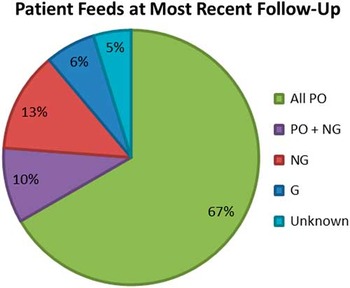
A majority of patients were not fed orally before surgery. The time course of transition to an exclusively oral diet was examined to determine resolution of feeding difficulties and elimination of aspiration risk. Among patients discharged with nasogastric and nasojejunal tubes (n=34), the median time from hospital discharge to exclusive oral feeds was 90 days. At the time of last follow-up, 12 patients were still tube fed, for more than 2 years after initial discharge. The median time to transition to exclusively oral feeds was 95 days among patients with single-ventricle circulation (n=10). For patients with two-ventricle circulations, the median time until resumption of oral feeds was 39 days (n=52).
Discussion
Our findings reveal that aspiration events and laryngeal penetration are common after neonatal heart surgery. As a result, many infants are discharged home with feeding tubes because of concern for aspiration. Our results suggest that increased use of the modified barium swallow study may be an initial step to identify infants with increased risk for aspiration events and laryngeal penetration. We believe that identification of aspiration is important, as it may have implications for lung function, which can later impact the course of CHD care.
With the sophistication of prenatal diagnosis, some cardiac anomalies are often identified during pregnancy; many infants in the present study were transported to Children’s Healthcare of Atlanta immediately after birth. These babies often do not have the opportunity to feed orally before surgery. A multicentre study found that 13% of neonates born with CHD were breastfed.Reference Torowicz, Seelhorst and Froh 10 The low rate of preoperative oral feeding among infants born with CHD may be reflective of a lack of opportunity for infants to feed orally before surgery and not their inability to do so without aspirating.
The modified barium swallow, the study of choice, is a safe and useful tool to assess the functionality of the oesophagus, swallow, and gag reflex.Reference Newman, Keckley and Peterson 11 Patients who fail the modified barium swallow study – for example, aspiration or laryngeal penetration – may be candidates for enteral nutrition support via use of a nasogastric, nasojejunal, or gastric tube.Reference Bazyk 12 Our point-in-time findings revealed that laryngeal penetration identified by barium swallow was not always directly correlated with future aspiration events, leaving providers with the decision to discharge infants with or without tube feedings. In fact, from our data, infants with no evidence of laryngeal penetration during a modified barium swallow study were more likely to aspirate after the study than infants whose tests revealed laryngeal penetration. The decreased incidence of aspiration events after a positive swallow study suggests that nutritional interventions, such as administering all nutrition via an enteral feeding tube, decreases aspiration risk. Our data also revealed that infants with increased length of hospitalisation were also more likely to be screened for aspiration using the modified barium swallow study, and patients with a shorter length of hospitalisation were less likely to be assessed for aspiration risk using a barium swallow study.
The modified barium swallow study allowed us to evaluate point-in-time aspiration events among neonates who have undergone surgical intervention for CHD. Studies have indicated that the modified barium swallow study and the functional endoscopic evaluation of swallowing are two of the most comprehensive tests used to evaluate swallow function.Reference Aviv 13 The modified barium swallow study, however, is clinically indicated for use in patients who lack head control.Reference Brady and Donzelli 14 An examination of the utility of the modified barium swallow study requires understanding the false-positive and negative results. In our study, there was a single incidence of a false-negative swallow study result, and no evidence of laryngeal penetration or aspiration; however, there was a later documented study-independent aspiration event. We also had three positive swallow study results that were not followed by an aspiration event. In our study, an abnormal modified barium swallow test result was predictive of an infant’s inability to exclusively feed orally at the time of hospital discharge. The modified barium swallow study provides a point-in-time assessment of the oral, pharyngeal, and upper oesophageal phases of an infant’s suck and swallow function. Information obtained from the modified barium swallow study may be helpful in identifying both infants at risk for aspiration events and infants who demonstrate aspiration.Reference Genna and Sandora 15
Cardiac surgery in neonates may interfere with vocal cord function, impair the infant’s ability to protect his or her airway, and increase the risk of postoperative aspiration.Reference Sachdeva, Hussain and Moss 16 To better understand factors that may increase aspiration risk in neonates having undergone open-heart surgery, we examined patient demographic information. Age at the time of surgery is related to both swallow dysfunction and may be associated with vocal cord paralysis. Patients with defects of the aorta and those intubated for prolonged periods are at the highest risk for postoperative aspiration, in part due to the loss of suck and swallow coordination.Reference Agnew, Kendall and Akrofi 17 – Reference Starks and Harbert 19 Studies have been conducted on potential long-term adverse outcomes of paediatric open-heart surgery and any association with swallow dysfunction following surgical intervention, including vocal cord paralysis.Reference Kohr, Dargan and Hague 6 , Reference Medoff-Cooper, Irving and Mariano 20 A particular study concluded that neonates undergoing surgical repair for a single-ventricular defect are at significant risk for growth failure, and that feeding support, via an external device such as a nasogastric tube, is insufficient in ensuring adequate growth postoperatively;Reference Medoff-Cooper, Irving and Mariano 20 however, we are unaware of any studies that have exclusively examined the incidence of the acute complications of neonatal cardiac surgery such as aspiration and laryngeal penetration.
Neonatal heart surgery patients are discharged with feeding tubes for two reasons: in order to decrease their aspiration risk while feeding, and to ensure adequate caloric intake. Infants are considered “ready” for exclusive oral feeds when they consistently meet a specified caloric and fluid goal with oral feedings, and they are able to feed comfortably without clinical signs of aspiration or laryngeal penetration. Parents are taught how to wean their child from tube feedings and assess their readiness for exclusive oral feeding; however, as many as 16 parents in our study reported removing their child’s feeding tube when they believed these criteria were met. Such feeding tube removals were performed independently without direction or supervision by medical or nursing providers. Importantly, there appeared to be rather dramatic differences in the institutional practices surrounding tube feeding following neonatal heart surgery. A multicentre trial reported that the institutional proportion of children fed exclusively by mouth following the Norwood procedure varied from 3 to 81%.Reference Pasquali, Ohye and Lu 21 This suggests variability in either the rate of aspiration, the surveillance/management of aspiration, or providers’ decision-making on using a feeding tube.
Limitations of study
This was a retrospective chart review in a single centre with a heterogeneous infant cardiac population; therefore, our conclusions are only applicable to this cohort. There were premature infants in our study who presented with an increased risk for aspiration independent of their heart surgery.Reference Jadcherla 22 There may be differences among centres in availability and use of the modified barium swallow study to assess swallow function. As a retrospective chart review, there are inherent factors that we could not control, such as different radiologists reading these studies. We had limited access to post-discharge infant medical records, which limited the scope of our enquiry for follow-up on post-discharge feeding and nutritional status.
Conclusion
The modified barium swallow study is a useful tool that can help detect infants at risk for an aspiration event. Neonates undergoing cardiothoracic surgery are at high risk for postoperative aspiration, and a large number of infants are fed via nasogastric or gastric tubes at the time of discharge. These alternative feeding routes may not be permanent, as indicated by the 90-day time course resolution to resumption of oral feeds. Poor fluid and caloric intake may be directly related to swallow dysfunction, inclusive of aspiration, which can impact infant growth following neonatal open-heart surgery. Our findings indicate that infants with prolonged hospital length of stay, greater than 18 days, are more likely to be screened for swallow dysfunction using a modified barium swallow study. Preterm infants undergoing cardiac surgery are at higher risk for postoperative aspiration. Our findings suggest that premature infants may be a target population for aspiration risk screening using the modified barium swallow study. Further studies are necessary to identify other at-risk infant populations following neonatal cardiac open-heart surgery that may be at increased risk for aspiration. There was no significant relationship between positive modified barium swallow study and future aspiration event, which may reflect the implementation of preventative measures such as nasogastric or nasojejunal enteral tube feedings following positive swallow study results. This study is an initial step to determine the utility of the modified barium swallow study as a preventative screening tool to identify infants at risk for aspiration following neonatal surgery for CHD.
Acknowledgements
The authors thank Kim Woodall, MSN, CNML, CPNP AC/PC, Manager of Cardiac Advanced Practice Providers, and Anna Vance, Speech Language Pathologist, for their explanation of aspiration protocol and speech therapy in the Cardiac ICU and Step-down unit at Egleston.
Financial Support
This study received no external financial support.
Conflicts of Interest
None.
Appendix
Distribution of heart defects among neonates having undergone open-heart surgery at our institution from July, 2013 to January, 2014.

The majority of patients were discharged home using either exclusive nasogastric or gastric tubes. Patients discharged with orders for combination nasogastric and oral feeding were fed first by mouth for a length of time determined either by the speech pathologist or the cardiologist. If there was any residual formula after the oral feeding time had elapsed, parents fed subjects via a NG tube, so that the baby could meet the appropriate caloric goal. G= gastrostomy tube; NG= nasogastric tube; NJ = nasojejunal tube; PO =per os, Latin for by mouth.

distribution of patient feeds at the most recent follow-up with their cardiologist. Of the patients included in the study, three patients did not follow-up with Sibley Heart Center cardiologists postoperatively, possibly because of distances involved. At the time of chart review, the average difference between discharge date and most recent follow-up appointment was 439 days. G= gastrostomy tube; NG= nasogastric tube; PO = per os, Latin for by mouth.