Carbapenemase-producing Enterobacteriaceae (CPE) have spread globally and are considered an urgent public health threat due to the increasing number of infections, limited options for treatment, and high mortality. 1,Reference Solter, Adler and Rubinovitch2 Carbapenemase production is an important mechanism of carbapenem resistance that contributes to the spread of CPE because it is frequently plasmid mediated and can be transferred among different species of Enterobacteriaceae. 1 Risk factors for CPE infection include residence in long-term care facilities, use of medical devices, antibiotic exposures, and prior colonization with CPE. 1,Reference Borer, Saidel-Odes and Eskira3
Not all CPE-colonized individuals develop CPE infection. Reference Borer, Saidel-Odes and Eskira3,Reference Tischendorf, de Avila and Safdar4 A few reports in the United States describe factors associated with CPE infection after colonization; most studies are limited to rectal colonization, and colonization of other body sites and associated infection have not been studied often. Reference Tischendorf, de Avila and Safdar4 We aimed to identify patient characteristics associated with CPE infections among patients previously colonized by the same organism.
Methods
This retrospective cohort study was conducted in Miami, Florida, between 2012 and 2016 and included CPE-colonized patients admitted to any of 4 hospitals in a large healthcare system (3 adult and 1 pediatric with 2,500 total beds). The study was approved by the Florida International University Institutional Review Board.
Rectal and tracheal aspirate (ventilated patients) surveillance cultures were performed on admission to adult intensive care units (ICU) and weekly thereafter until discharge or transfer out of the ICU. Surveillance cultures were processed on MacConkey plates following a standard protocol (Supplementary Material online).
We included patients colonized at the time of first CPE identification; patients with first CPE isolated from a normally sterile source were excluded. Patients with first CPE isolated from a nonsterile source were evaluated for infection versus colonization at the time of first identification. Infections were defined using the National Healthcare Safety Network (NHSN) protocols 5 and review of infectious disease consultation and medical record. Colonized patients were followed through subsequent admissions for development of infection or censored. The probability of information bias by case misclassification was reduced by reviewing every case by an infection disease physician and by infection preventionists during a patient’s admission and again retrospectively for the purpose of this study. Data were collected retrospectively from the electronic medical record and infection prevention database from the date CPE was first detected until the date of event of infection or censoring.
Baseline characteristics were compared using the χ Reference Solter, Adler and Rubinovitch2 or t test. Kaplan-Meier was used to analyze the probability of developing CPE infection after colonization over time. Cox proportional hazards regression models were used to assess the association between predictors and the development of CPE infection. Statistical analysis was performed using SPSS version 26 software (IBM, Armonk, NY).
Results
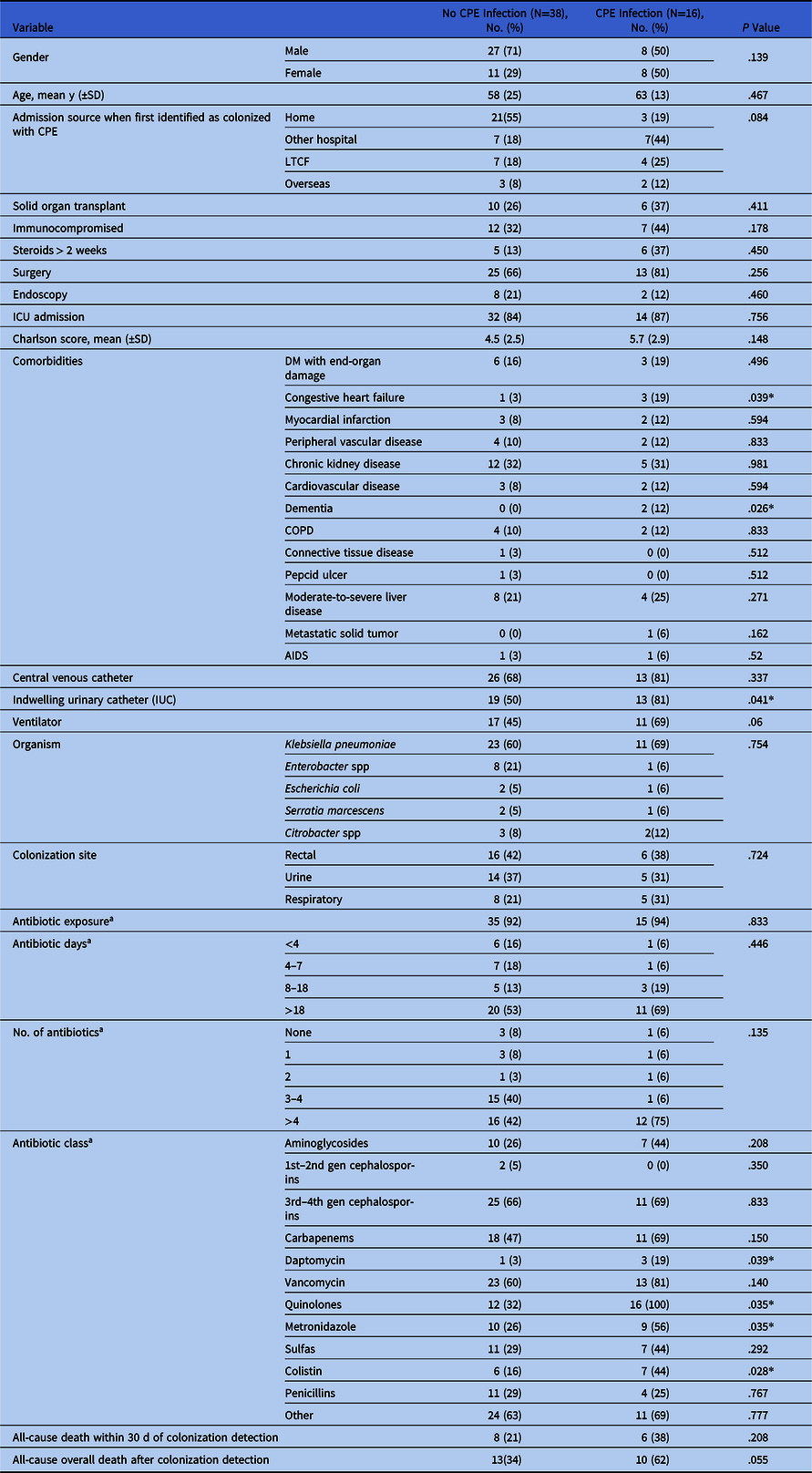
In total, 152 patients with CPE were identified during the study period; 98 were excluded, resulting in 54 (35%) included in the analysis (Supplementary Fig. 1 online). Of the 54 colonized patients, 34 (80%) had Klebsiella pneumoniae (Table 1). Also, 35 isolates were tested by polymerase chain reaction (PCR); of those, 91% were positive for bla KPC and 9% were positive for bla SME. The most frequent source of colonization was rectal (41%), then urine (35%), and respiratory (24%). Furthermore, 16 colonized patients (30%) developed CPE infection. Patient characteristics for both groups are presented in Table 1. Two patients (13%) had infections in 3 different body sites, 8 patients (50%) had infections in 2 different body sites, and 6 patients (38%) had infection in 1 body site, yielding a total of 28 infections. The most frequent types of infection were bloodstream infections (39%), followed by pneumonia (32%), and urinary tract infections (18%) (Supplementary Table 1 online).
Characteristics of Patients Colonized With Carbapenemase-Producing Enterobactericeae (CPE) at a Large Healthcare System 2012–2016

Note. CPE, carbapenemase-producing Enterobacteriaceae; SD, standard deviation; LTCF, long-term care facility; ICU, intensive care unit; DM, diabetes mellitus; COPD, chronic obstructive pulmonary disease; AIDS, acquired immunodeficiency syndrome; IUC, indwelling urinary catheter.
a Antibiotic exposures were measured since first identified as colonized until date of event for infections, censoring date, or end of study period whichever occurred first.
*P < .05.
CPE-colonized patients were followed up for a mean of 304 days (IQR, 422). The mean time for infection development was 63 days (IQR, 81; range, 0–7 months). Kaplan-Maier curve analysis (Supplementary Fig. 2) showed that the probability of development of CPE-related infections among colonized patients decreased over time, with a higher probability in the first 3 months after the identification of colonization.
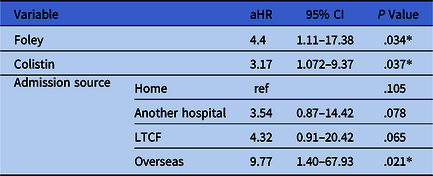
After adjusting for significant variables in the multivariable Cox regression (Supplementary Table 2 online), CPE-colonized patients with indwelling urinary catheter (IUC) exposure (adjusted hazard ratio [aHR], 4.4; P = .034), exposure to colistin (aHR, 3.17; P = .037), or transferred from overseas (aHR, 9.77; P = .021) had a higher risk of developing a CPE infection (Table 2). Evaluation of those exposed to colistin showed that patients who developed CPE infection were exposed via intravenous route, whereas those exposed to inhaled colistin did not. Colistin was administered for the treatment of extensively drug-resistant (XDR) Pseudomonas, Acinetobacter, or Stenotrophomonas.
Reduced Model for CPE Infection Among Colonized Patients at a South Florida Healthcare System 2012–2016

Note. CPE, carbapenemase-producing Enterobacteriaceae; aHR, adjusted hazard ratio; CI, confidence interval; LTCF, long-term care facility.
*P ≤ .05.
Discussion
We identified the use of IUC, exposure to intravenous colistin, and transfer from overseas facilities as variables associated with the development of CPE infection. All of the infections occurred within 7 months of being identified as CPE colonized; the probability of developing CPE infections decreased over time, possibly related to spontaneous colonization clearance.
Our findings are consistent with previous reports that identified CPE colonization as a risk factor for the development of CPE-related infections. Reference Tischendorf, de Avila and Safdar4,Reference McConville, Sullivan, Gomez-Simmonds, Whittier and Uhlemann6 These studies focused on rectal colonization. This study included other sources of colonization, and we found that a higher percentage of those colonized in the respiratory tract developed infection. However, this was not statistically significant; nevertheless, this finding highlights the importance for considering screening >1 anatomical site. Also, facilities should consider including in their CPE surveillance testing high-risk populations such as patients transferred from overseas.
In our cohort, 30% of the colonized patients developed CPE infections; this finding has implications for antibiotic selection. Colistin resurged as an option of treatment for XDR Pseudomonas, Acinetobacter, and Enterobacteriaceae infections. Reference Tsuji, Pogue and Zavascki7 Until recently, there was no consensus about the dosage and use of colistin for such infections or about antimicrobial susceptibility testing and break points. Reference Tsuji, Pogue and Zavascki7 The possibility that resistance to colistin played a role in the development of the CPE infections among our cohort is unknown due to lack of reliable testing at the time of the study. Pseudomonas and Acinetobacter were tested against colistin by Etest; the reliability of this method has been largely questioned. Reference Chew, La, Lin and Teo8 Recently, there have been an increasing number of reports related to colistin resistance, and the mechanisms of colistin resistance are not yet fully understood. Reference El-Sayed, Abd El-Gawad and Zhong9 Antimicrobial stewardship programs should tailor interventions to align with the recent recommendations for the use of colistin and recently available antimicrobials.
Indwelling urinary catheters are among the most commonly utilized devices in hospitals. Reference Lo, Nicolle and Classen10 Exposure to these devices was associated with an increased probability of developing CPE infections in colonized patients; this finding concurs with previous reports. Reference Borer, Saidel-Odes and Eskira3 Infection prevention interventions should aim to reduce the utilization of such devices to prevent catheter-associated urinary tract infections (CAUTI) as well as CPE infections.
This study has several limitations. First, the small sample size reduced the power to detect other possible associations. Second, active surveillance cultures were only collected from adult ICU patients; among non-ICU patients, detection of colonization relied on the identification of CPE in clinical cultures, introducing selection bias and possibly information bias affecting the results and limiting the generalizability of the study. Third, 91% of the isolates tested had bla KPC as the resistance mechanism. Facilities with higher prevalence of other carbapenemases might yield different findings, and further studies should explore this possibility. Lastly, we introduced time-dependent bias by measuring exposure to devices and to antibiotics as categorical variables and possibly affecting the hazard ratio.
In conclusion, 30% of CPE-colonized patients developed infections associated with these organisms. We suggest both reducing the use of IUC for patients colonized with CPE and implementing the use of alternative devices such as condom catheters or external female urinary catheters whenever possible. Furthermore, we suggest expanding CPE surveillance testing including other anatomical sources in addition to the rectum. Lastly, as part of multidisciplinary interventions, we recommend limiting the use of colistin among CPE-colonized patients to decrease the risk of infection. Further studies should evaluate the effect of interventions, such as selective decolonization or fecal transplantation, to prevent the CPE infections among colonized patients.
Acknowledgments
Financial support
No financial support was obtained for the current study.
Conflicts of interest
L.S.M.P. reports receiving grants from Cepheid and served as advisor to Paratek and Entasis. Y.D. reports grants and personal fees from Pfizer, Merck, and Shionogi, grants from Astellas, Kanto Chemical, personal fees from Roche, Tetraphase, Recida, personal fees from Fedora, VenatoRx, Entasis, BD, and bioMerieux, outside the submitted work. L.A. reports personal fees from Achaogen, Nabriva therapeutics, Paratek, Roche diagnostics, WebMD, Pfizer Latin America, and from MSD, outside the submitted work. All other authors report no conflicts of interest relevant to this article.
Supplementary material
To view supplementary material for this article, please visit https://doi.org/10.1017/ice.2020.1270