Introduction
To understand the complex and varied pathways of identity among lesbian, gay, bisexual and transgender (LGBT) older cohorts, we must understand the socio-historical context in which they aged. Otis and Harley (Reference Otis, Harley, Harley and Teaster2016) suggest sexual identities are socially constructed, fluid and continuously evolving through social interaction and meaning-making. Contributing to the complexity are various forms of discrimination ranging from overt macro-aggressions to subtle micro-aggressions, which over time lead to hierarchical social constructs that provide particular demographic groups more power than others (Goodman, Reference Goodman2001; Calasanti and Slevin, Reference Calasanti and Slevin2006). However, understanding the intersections of sexual identity with social constructs is difficult due to the underdeveloped body of research dedicated to exploring the diverse views, experiences and attitudes of LGBT older adults (Otis and Harley, Reference Otis, Harley, Harley and Teaster2016). While many researchers have discussed the dominant pathways to self-actualising sexual identity (Cass, Reference Cass1979; D'Aguelli, 1994), others recognise the variation of experience and call for deeper examination of socio-historical factors impacting the timing and outcomes arising from one's decision to identify openly as a sexual minority person (Coleman, Reference Coleman1982; Kertzner, Reference Kertzner2001; Herek and Garnets, Reference Herek and Garnet2007). Furthermore, Herek and Garnets (Reference Herek and Garnet2007) recommend that ongoing research should be grounded in historical and cultural context to understand better the moderating effect social interactions have on mental health outcomes. Social interactions that framed the life trajectories of this population, internalised over time, inform their narrative identities as older adults and have revealed that we are at the beginning of adding the richness of a shimmering and reflective grey to the rainbow.
In the next sections, we first consider the gaps in the literature and examine different trajectories of sexual identity formation shaped by social-historical contexts. We then explore these contexts as they relate to the personal identity. The review of literature concludes with existing research on narrative identity as it is understood to be the reflexive storytelling process individuals engage in to internalise their sense of purpose and to express themselves to others. Following the literature review, we explain how our critical perspective frames our narrative inquiry and adds dimension to our analysis. Our approach to understanding identity as fluid is especially valuable in expanding the current body of literature to include the changing roles and fluid experiences that inform one's embodiment of sexual identity in later life.
Social identity and generation
Social identity, also referred to as a collective identity, defines a person's sexual feelings, intimate relationships, as well as their affiliations with a larger group or community (Herek and Garnets, Reference Herek and Garnet2007). Although everyone experiences some degree of awareness regarding their sexual orientation, which in this context defines the emotional and physical connection to another person (Fish and Harvey, Reference Fish and Harvey2005), some generations have been able to express this awareness more freely than others. The Gayby Boomers (Ramirez-Valles, Reference Ramirez-Valles2016) are defined by a generation that shares similar cultural attitudes and experiences (Plummer, Reference Plummer, Hammack and Cohler2009). This sub-population of baby-boomers was the first gay cohort to embrace their collective gay identity, to engage actively in the gay liberation movement and to age with HIV (Ramirez-Valles, Reference Ramirez-Valles2016). Understanding the socio-historical factors that impact one's social identity is imperative to understanding how they interact with their environment.
Research exploring gay social identity surmises there are positive effects gleaned from being open with one's sexual identity as individuals develop adaptive coping mechanisms developed through the collective or social identity (Herek and Garnets, Reference Herek and Garnet2007; Lindsey et al., Reference Lindsey, King, Gilmer, Sabat and Ahmad2019). For instance, when a person experiences enacted stigma, they may rely on individual and group resources to overcome the negative experience. Adler (Reference Adler2012) suggests the process of narrating one's social identity may also act as a protective factor in mitigating negative mental health outcomes. However, the intersectionality of one's social identity and the oppression and privilege experienced are complicated and makes researching minority populations challenging (McCall, Reference McCall2005). For example, Fredriksen-Goldsen (Reference Fredriksen-Goldsen2016) finds that in comparison to prior generations, LGBT baby-boomers report lower levels of internalised stigma and identity concealment, but higher levels of discrimination, victimisation, loneliness and social isolation. These findings further legitimise the necessity of exploring generational effects on sexual identity over time as the social, physical and mental health outcomes are as fragile as the process of identity formation itself.
Personal identity and sexual orientation
Identities and behaviours are not mutually exclusive, as they overlap in numerous ways and one's behaviour may or may not be consistent with how one outwardly presents one's self (Biggs, Reference Biggs2004). Fish and Harvey (Reference Fish and Harvey2005) explain that sexual identity is the outward expression of sexual preference while sexual orientation is the inner desire one has, which one may or may not claim publicly. Researchers and clinical practitioners have begun to deconstruct personal identity by noting the discrepancy between when individuals come out to themselves and when they come out to others. For instance, D'Augelli et al. (Reference D'Augelli, Hershberger and Pilkington1998) report adolescents understand their own sexual identity by the age of 10; however, they may not outwardly label themselves until 14 and may wait even longer to come out to their peers and family. Although research has established normative developmental benchmarks for queer youth, Savin-Williams (Reference Savin-Williams2001) brings attention to the individuality that exists among various age cohorts and calls for more comprehensive theories of sexual minority development that incorporate cultural and environmental factors. Grov et al. (Reference Grov, Bimbi, Nanín and Parsons2006) examine how generational cohorts have differences in terms of the age in which they disclose their sexual identity. Their data indicate older gay men (55+) came out to themselves five years later than those 18–24, and only 55 per cent of the older age group reported ever coming out to their parents. Also notable is the age at which the oldest group of men came out to others (mean = 24.11) and the age at which they reported to have their first same-gender sexual debut (mean = 18.95), both of which occurred later than the mean age of the youngest cohort (mean = 16.94 and 16.08, respectively).
Younger adults have closed the gap between disclosure to self and others, as many feel they have more significant community support and experience an overall increase in cultural acceptance (Fish and Harvey, Reference Fish and Harvey2005; Grov et al., Reference Grov, Bimbi, Nanín and Parsons2006) than do older adults. However, researchers, mental health providers and skilled health professionals continue to explore sexual orientation from different perspectives, acknowledging the importance of one's culture. For instance, Boe et al. (2018: 98) discuss the coming out process for Latino adolescents and families from a decolonising theoretical lens, suggesting clinicians consider the multiple meanings of ‘cultivating a brave space’ for all individuals. Additionally, there remains a need to examine the trajectories of identity formation among older adults as this community experiences disproportionate social isolation due to lifelong experiences with stigma, discrimination, ageism and homophobia (Fredriksen-Goldsen, Reference Fredriksen-Goldsen2016; Otis and Harley, Reference Otis, Harley, Harley and Teaster2016). Research has only begun to unravel the complexities of coming out and the implications that occur in later life, with much more to be discovered about this phenomenon constructed by one's personal experiences informed through culture over time.
Narrative identity
Narrative identity is understood to be the reflexive storytelling process individuals engage in to internalise their sense of purpose and to express themselves to others (Adler, Reference Adler2012; McAdams and McLean, Reference McAdams and McLean2013). When we share our life stories, our past experiences and future expectations become part of our present narrative and alternatively the present influences what we remember of our past and how we plan for our future (Plummer, Reference Plummer, Hammack and Cohler2009; McAdams and McLean, Reference McAdams and McLean2013). A heuristic relationship forms between social constructs and self-awareness and contributes to the way individuals develop their life story or narrative identity (Singer, Reference Singer2004; McAdams and McLean, Reference McAdams and McLean2013).
Singer (Reference Singer2004) identifies common principles shared by narrative identity researchers from multiple disciplinary backgrounds. According to Singer, one core principle is to resist reducing identity formation to a single contributing factor. Instead, multiple social and individual influences are explored to develop a more holistic understanding of narrative identity formation. The second guiding principle is to address the complexity of human identity as it changes through time, rather than relying on one dominant narrative to define one's self (Singer, Reference Singer2004). Furthermore, narrative identity attempts to balance individuals’ agency with social demands. Plummer (Reference Plummer, Hammack and Cohler2009) refers to this balance between one's personal and social identity as the embodiment of one's life narrative, explaining the stories people tell are more profound than the words they communicate; they are connected emotionally and physically to the world around them. Adler et al. (Reference Adler, Turner, Brookshier, Monahan, Walder-Biesanz, Harmeling, Albaugh, McAdams and Oltmanns2015) also contribute to the discussion in their longitudinal work, finding that individuals experience improved mental health outcomes once they realise their agency through narration. Following, we introduce a critical theoretical framework to explore intentionally the connection between individual agency and socially constructed heteronormativity.
Conceptual framework: a critical perspective
Emerging from the postmodernist movement in the 1990s, queer theory challenges researchers to consider not only the construction of identity among LGBT individuals, but also the ways in which binary understanding of sexuality (i.e. heterosexual/homosexual) and gender (i.e. male/female) identity permeate all aspects of modern society (Gamson, Reference Gamson, Denzin and Lincoln2000). Furthermore, Oswald et al. (Reference Oswald, Kuvalanka, Blume, Berkowitz, Loyd, Few and Allen2009) explain that not only does queer theory challenge the binaries of gender and sexuality, but this theoretical framework also provides individuals with the agency to define their subjective attractions, behaviours and expressions. Combined with a narrative approach, queer theory allows space for individuals to depict their lives beyond heteronormative expectations and even the stereotypical storylines that have come to define gay identity.
Although there have been theoretical advancements, queer theorists have also received criticism for dismantling socially constructed sexual and gender identity (Green, Reference Green2002), as the creation of one's identity does not occur in a vacuum. Without understanding the socially constructed limitations on identity over time, it is difficult to understand how individuals choose to demonstrate personal agency that informs their own narrative identity. Although it is necessary to question conventional ways of thinking, it is equally important to acknowledge how socially constructed definitions of sexual identity have impacted adults in later life.
Feminist scholars recognise sexuality and gender as linked and overlapping experiences, meaning individuals can only subscribe to labels such as heterosexual, homosexual, man, woman, or transgender or gender non-conforming (TGNC) because of their relations with the others (Calasanti, Reference Calasanti2004; Allen et al., Reference Allen, Lloyd, Few, Lloyd and Few2009). Furthermore, a feminist lens allows researchers to go beyond the demographic description and addresses the complexity of identity formation over time (Butler, Reference Butler2007; Allen et al., Reference Allen, Lloyd, Few, Lloyd and Few2009). Together, these critical perspectives create a framework that addresses the multiplicity of identity formation in later life as well as the systematic impact of heteronormativity on the lives of gay men in later life.
Taken from a larger sample of 18 LGBT older adults, the paper presents narratives from a sub-sample of nine gay men born within the same generational cohort. Our aim is to contribute to the understanding of how societal structures impact the formation of identity, while also addressing the need for recognising the individuality that exists within the broader LGBT older adult population (Institute of Medicine, 2011).
Methods
To understand how LGBT individuals describe themselves in old age, it is important to first understand the generational cohort to which they belong as the past, present and future are all components of one's identity, i.e. who we were, who we are and who we hope to be (Heidegger, Reference Heidegger2010). Life-story narrative allows for the expression of individuality while maintaining the importance of broader cultures in which one's story is given meaning (McAdams, Reference McAdams, Levy, Ghisletta, Le Goff, Spini and Widmer2005; Atkinson, Reference Atkinson and Clandinin2007). McAdams eloquently explains:
Stories live in culture. They are born, they grow, they proliferate, and they eventually die according to the norms, rules, and traditions that prevail in a given society, according to the society's implicit understandings of what counts as a tellable story, a tellable life. (McAdams, Reference McAdams, Levy, Ghisletta, Le Goff, Spini and Widmer2005: 250)
The past, present and future have the potential to influence a life story, e.g. take the word ‘normal’. Plummer (Reference Plummer, Hammack and Cohler2009) reminds us that what someone considers normal is not only influenced by their past experiences but also influenced by the life they live presently, and how they perceive future normalcy. Therefore, the meaning of the word ‘normal’ is not confined to a particular moment, but instead is defined through time. Through narratology, queer and feminist scholars use the method to ‘expose the dominant stories keeping the binaries in place’ (Warhol and Lanser, Reference Warhol, Lanser, Warhol and Lanser2015: 8), meaning through narration of our life stories we are expressing our personal agency that gives meaning to our lives as we exist within and beyond societal norms. Additionally, this method acknowledges the natural non-linear pattern of storytelling and allows one narrative story to consist of multiple dimensions (Pinnegar and Daynes, Reference Pinnegar, Daynes and Clandinin2007; Holstein and Gubrium, Reference Holstein and Gubrium2012). Furthermore, the personal aspect of storytelling facilitates the co-construction of knowledge between self (i.e. editing one's thoughts) and between the story-teller and the story-listener (i.e. the process of meaning-making) (Atkinson, Reference Atkinson and Clandinin2007; Pinnegar and Daynes, Reference Pinnegar, Daynes and Clandinin2007). Within the scope of this method, researchers can engage in a critical discourse with the narrative by examining the structure of the shared story as well as the context in which it is told (Zeilig, Reference Zeilig2012).
Study participants
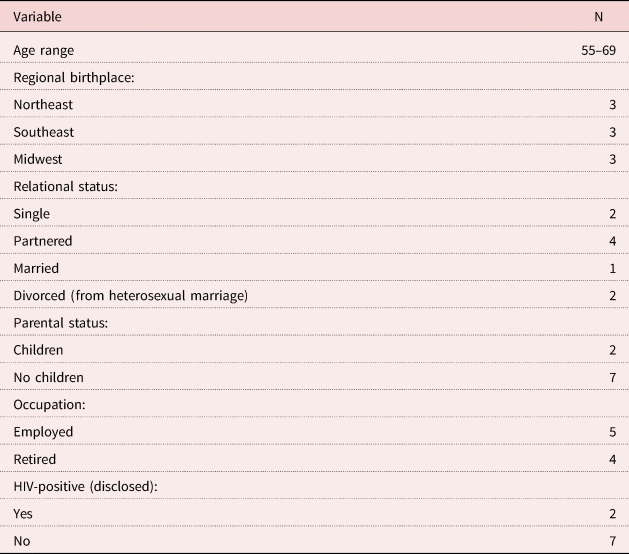
From the original sample of 18, nine men were used for this analysis based on their birth year, as all were born within the years of the baby-boom cohort (1946–1964). This cohort embodies a unique cultural-historical perspective that enhances the particular culturally grounded identity formation. The three men whose birth year fell outside this range – two were born after 1964 and one was born before 1946 – were excluded from this analysis. I eliminated one man who self-identified as gay and fell within the birth years because he transitioned from female to male later in life and did not share similar experiences in their socialisation. Additionally, we did not want to further marginalise the transgender participant by comparing his experiences to cisgender gay men who benefit from different social privileges. Recent literature has been hesitant to group transgender individuals in research reporting on sexuality as the experiences of TGNC individuals and those who identify as a sexual minority are vastly different and warrant specific attention (Porter et al., Reference Porter, Brennan-Ing, Chang, Dickey, Singh, Bower and Witten2016). Additional demographic information is in Table 1.
Participant demographics

Note: N = 9.
Data collection
Procedures for this project were approved by the University of Georgia's Institutional Review Board. Participants were recruited via emails sent to a local chapter of Services and Advocacy for Gay, Lesbian, Bisexual, and Transgender Elders (SAGE) as well as to an electronic listserv. In the latter case, a snowball effect occurred, and a member of a social group for older gay men shared the information on a private Facebook page. The original email sent included an invitation to participate, a study description, flyer for distribution and the interview protocol.
Nine interviews were conducted by the first author in a location that was both convenient and comfortable for the participant. Conversations took place in personal homes, private office spaces or in a secluded room within a public setting, such as a library. All participants’ names have been changed to pseudonyms. Interviews lasted no more than two hours, ranging from 55 minutes to 90 minutes, and began by gaining informed consent. Participants were given a US $20 gift card as an incentive. A conversational approach was used to allow participants to tell their life stories as they conceptualised them. Narratives were told using a linear structure, beginning with past, moving to present, and concluding with future thoughts on life and legacy. However, some participants were prone to moving between past, present and future in a non-linear fashion.
Research team
The research team was composed of the first author, three research assistants and three faculty members. Undergraduate students helped with transcription as well as some basic narrative summarising. Throughout the transcription process we discussed data, especially attending to the subjective experiences of gender and sexuality that became a part of this project. One research assistant identifies as transgender female, while the two other individuals and the first author identify as straight, cisgender females. Of the faculty members, one identifies as queer and the two others identify as straight, cisgender female. These discussions became part of the reflexive memoing process that informed the preliminary coding structure and thematic organisation. Throughout the paper, we use the terms ‘gay’ and ‘LGBT’ as these were words used by the participants. Since none of the authors identify as older gay men, we felt it was important to remain close to the ways in which the participants identified themselves within the broader sexual and gender minority population. It is our way of upholding the agency of these older men who vulnerably shared their stories through narrative discourse.
Data analysis
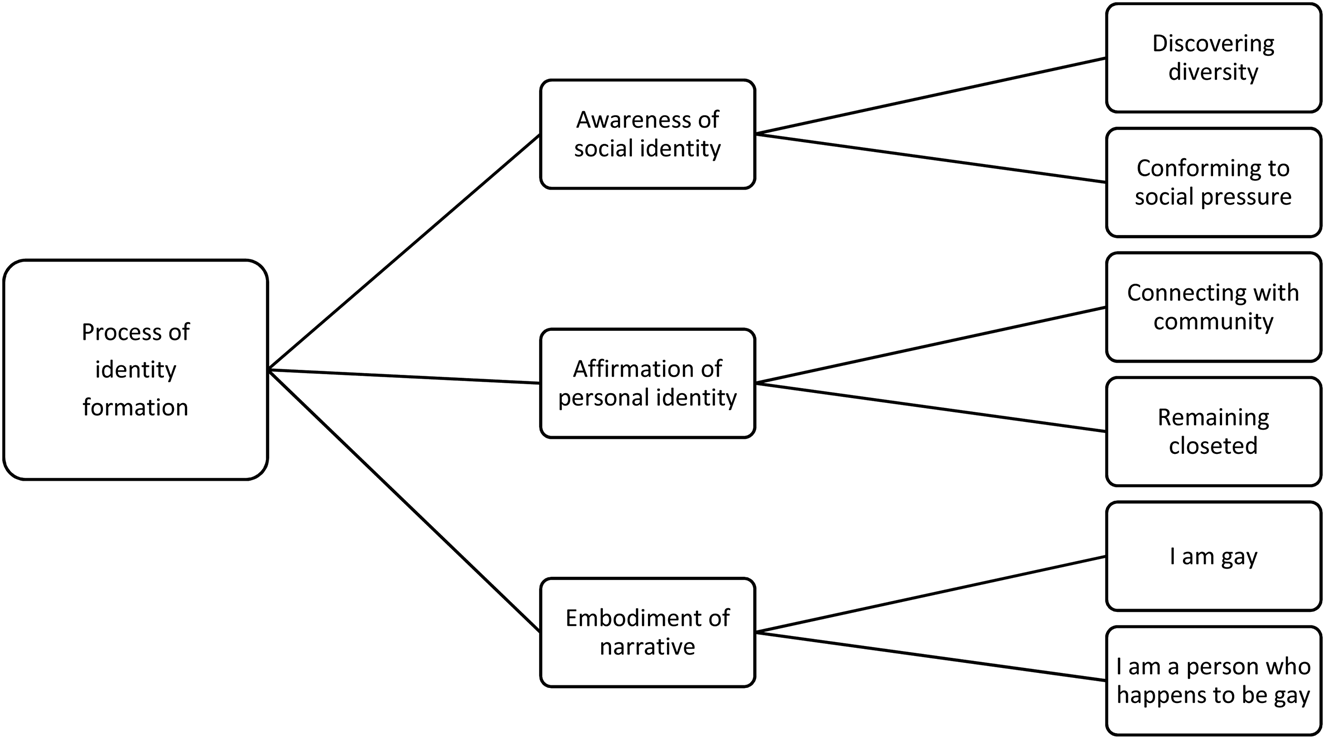
Once interviews were transcribed and checked for correctness, documents were uploaded to ATLAS.ti for Mac to begin the iterative coding process. ATLAS.ti is a data management software program used to assist with data storage, coding and retrieval. We moved between transcripts, academic literature and analytical memos to strengthen reflexivity and add depth to the analysis (Friese, Reference Friese2014). As coding evolved, we identified a theme of sexual identity formation, which was expanded upon to address three emerging components of sexual identity formation: (a) awareness of social identity, (b) affirmation of personal identity, and (c) embodiment of narrative identity. We then organised the three components according to dominant and counter-narratives. The full thematic structure is shown in Figure 1.
Identity thematic structure.

Sequencing of the narratives
Like many narratives, not all the participants told stories linearly. Many revealed segments of their stories as they recalled significant events of their life. Since these narratives were co-constructed between each participant and the primary researcher, it was important to use interpretation skills, as well as the subjectivity gained throughout the study, to reorganise the narratives and provide a clear account of the life narratives. Determining when these stories begin and end is intricate work, as they frequently blend into other life facts (Riessman, Reference Riessman2008). Thus, we systematically organised the narratives within a linear framework that tracks identity throughout the lifecourse and introduce the information to the reader in meaningful way.
Findings
All nine men report being aware of their gay identity as children, however, like many socially constructed labels, their outward identity was more complex and difficult to understand. The findings represent how the men negotiated their sexual identities through decades of social change. As young men, they were emerging into a world that was dramatically changing all around them. Politically, baby-boomers were protesting the Vietnam War on campuses around the United States of America (USA), Dr Martin Luther King Jr was leading a march on the National Monument, the women's liberation was gaining momentum and, for the first time, gay men were creating space to express their sexual identity openly in connection to others. However, just as these men were feeling a sense of belonging, AIDS began to reduce their social networks and caused them to question their collective identity once more. As a generational cohort, they faced these historical life events together, but their unique experiences shaped their individual identities.
The findings are organised parallel to our thematic structure of identity (see Figure 1). Within each section we define the theme and share the dominant and counter-narrative that emerged. We begin with the theme ‘awareness of social identity’ and move to the ‘affirmation of personal identity’, concluding with ‘embodiment of narrative identity’. Additionally, we follow the same outline in the discussion that addresses narrative identity as representative of the amalgamation between both social and personal aspects of identity formation throughout the lifecourse.
Awareness of social identity
The men considered attending college a turning point. It marked a time when they were away from their families of origin and had the freedom to express themselves. The dominant narrative, discovering diversity, was revealed by Andy, Reese, Jean, Drew, Toby and Lee as they recalled their college years as a time for sexual exploration and discovered a more diverse social environment among their peers. Their experiences in college inspired their decision to be openly gay for the remainder of their lives. A counter-narrative, conforming to social pressure, emerged among three participants: Chris, Alex and Sam. These men said they experimented sexually with other men during college, but felt they needed to leave behind their impulsive behaviours for a more adult life that included a wife, steady job and possibly children. The juxtaposition of these broad narratives highlights the essence of cultural context as an influential factor of narrative performity. Each man uniquely discussed how his social environment influenced the decisions he made, which then impacted the remainder of his life.
Discovering diversity
In addition to defining themselves by their sexual experiences with other men, Andy, Drew, Jean, Lee, Reese and Toby explored their identity through their interaction with social networks. Attending college introduced these men to a new way of living they scarcely knew had existed. Lee described his college experience as a ‘refuge’ from his family. It was during college when he connected with a community of other gay men and found the ‘gay life’ for which he had been searching. Jean also felt college gave him the opportunity to escape the confines of home. While an undergraduate, he joined a fraternity and the campus newspaper. He described the combination of social networks as a highly important part of his life:
I had this dichotomy in college. ’Cause I was with this kind of hippiefied, radicalised newspaper group of friends, who were probably smoking pot, I wasn't at the time, but that was the kind of people I hung out with. And then at the same time I had this very kind of traditional fraternity.
Additionally, Drew realised during his college years that being gay looked different than just one stereotype. He recalled a trip he took during a semester break when he observed gay men as diverse individuals:
At that time, I realised there are people who don't look and don't talk like me, who are also gay … It was my first time to see all of that. What a gay ghetto is and how being gay 24/7 appears.
It was in that moment he said he chose to follow the examples of other men who were living openly gay lives and recognised his own desire to live among people who were similar, yet also different from himself.
Issues of diversity not only surrounded sexuality, there were also important socio-political discussions of race, gender and social class. Jean described the politically active collegiate environment: ‘All the traditional things happened where, you know, the students took over the offices of the President and there were Vietnam protests.’ The civil rights movement was also a strong force in their daily lives. For instance, Reese said he was confronted with a complex relationship between socially marginalised identities when he dated a black man. Within his circle of friends, sexual freedom was accepted, but racist attitudes permeated what was deemed acceptable and represents the complexity of this time period. Reese shared an experience that highlights the intersectionality of identity embedded within the socio-historical context of racial segregation.
For those who were openly gay during this time, a community grew around the newfound sexual freedom. Drew noted how sexuality was explored by everyone, not only those who identified as a sexual minority:
It was more about free love and bisexuality and sexual freedom so no one really called it gay as much as they just called it ‘openness’ and ‘experimentation’. The more that I found out about myself and others, the more that I realised that all of these other people were discovering the same things that I was discovering.
Andy also described the impact sexual freedom had on his life:
I think more pivotal and meaningful to my sexuality was seeing an actual movement begin to grow. Not only the anti-war movement or the women's movement, but sexual freedom movement. Specifically, gay liberation as it was called in those days.
He went on to describe the electric feeling of being part of a social movement: ‘There was a society beginning, I kind of felt like it was new in those days. At least expressing ourselves as okay to be who you are was a new behaviour.’ Lee and Reese shared similar sentiments. Lee shared a memory of going to his first gay pride parade where drag queens were marching down the street in the middle of the day. Reese described the various communities he lived in that catered specifically to a gay clientele. When asked why his community needed a gay bank he remarked, ‘It was making a statement’, meaning they were on the frontier of gay living and if there was a statement to be made, they were going to make it.
Conforming to social heteronormative pressure
Although Alex, Chris and Sam said they were aware of their gay sexual identity as young men, they internalised the social stigma associated with being gay and kept their sexuality a secret for many years. Sam recalled the collegial atmosphere: ‘There were 2,000 students and I felt like I was the only person in that entire school, which was all male, that was attracted to other men. I just, there was no connection with anybody!’ The isolation he felt was affirmed by heteronormative life events such as the expectation of marriage and children. He further explained:
I really thought that if I got married, I would change. And I was hoping I would. So I got married and on my honeymoon we went to Italy, and my wife was sleeping in the sleeper car and I was out in the hallway just looking at the countryside and there was a man also out there, who I suddenly realised I was extremely attracted to. And my thought was, ‘What have I done?’ You know? And I was aware that getting married was not the answer.
Sam's story represents the internalised stigma of being gay during the mid-1960s. Although this was a time of progressive ideas, he could not break from the constraints of a heteronormative society and because he did not have a community to come out to and receive support, he followed the expected life path.
Chris and Alex shared similar sentiments regarding socially acceptable behaviour. Chris said, ‘It was the normal thing to do at the time, in 1970 when I graduated. I got married because that's what you did.’ After he served in the military he taught in a high school where he knew he could not disclose his sexuality without losing this job. Alex disclosed he was sexually active with both men and women during his college years, but said he ‘squashed’ his sexuality until the early 1990s. He explained the stigma connected to unmarried men of a certain age, ‘The story always was, I'm not sure if this, this exists now, but you know if you're 30 and you're unmarried, you're gay.’ He went on to say:
I look back now, this is hindsight, when people ask like, ‘What was that all about? Getting married?’ I shrug and say, ‘Well, it was the Reagan administration.’ But at that point I'm simply saying, when you grow up you put aside childish things and I was clumping my sexuality in with that.
The decisions Alex made reaffirmed the influence societal expectations had on men of his age.
Affirmation of personal identity
Disclosure was important to many of these men, as the act of coming out was a way for their sexual orientation and social expression of sexuality to co-exist. Affirming of one's gay identity took two different forms. The first, and more dominant narrative, was connecting with a community. Andy, Drew, Jean, Lee, Reese and Toby came out earlier in life and that transition was easier due to the availability of support. Even though some family members did not offer their support until years later, all the men included stories of finding a community to which they felt connected. The less-dominant narratives were from those who remained closeted until later in life. Alex described coming out in the early 1990s as a time when he ‘exploded out of the closet’. They had jobs, wives and children to consider and their matured roles as middle-aged men made it more challenging to disclose their sexual orientation. Realised agency was an important element for these men in how they came to terms with the decisions they had made as younger adults.
Connecting with community
Andy, Drew, Jean, Lee, Reese and Toby all described their coming out as rather uneventful. While they did experience some hesitation from their parents, ranging from Jean's parents’ reaction, ‘“What did we do wrong? Why did you turn out this way? Can we get you to a psychiatrist? How can we help you? That's an awful lifestyle, you'll never be happy”’, to other parents such as Toby's mother, who he said always conveyed her support. Despite their parents’ reactions, these men sought community with their peers. As previously discussed, they found connection in college, but even after college, their social networks worked in a way to reaffirm their gay identity. For example, Reese described the atmosphere after he moved with Jean (his partner) to a city that had an eclectic gay community:
It was amazing because then it would bring all of these people close together again and that was when I really started enjoying the being around gay people. It didn't matter if they were effeminate or if they were drag queens or whatever they were. It didn't matter to me – they were people and they liked me. Genuinely, liked me.
Jean also enjoyed the various gay communities they came in contact with over the years. Wherever they moved they became involved in theatre life so they could express their artistic talents; Jean is a playwright and Reese has many years of acting experience. Through the arts they found a place where individuals can freely express themselves despite sexual orientation, race, class, age or gender. Jean has enjoyed the opportunity to expand his intergenerational connectedness and Reese said, ‘At the theatre there are a lot of gay people and a lot of straight people. And they all work together. And they marry together as a solid group. That's something I have never seen.’
Drew also found ways to be a part of a diverse community. His sexuality was never a topic of discussion in his family home. He explained, after his mother's death he, his father and his sister lived together as individuals, rather than a family unit, so whatever they did in their private time was their business. That experience strongly shaped Drew's understanding of his sexuality, and although he identifies as gay, he finds community and companionship among all types of people.
AIDS was also a unifying factor for many of the men who came out earlier in life. Lee and Andy are both HIV-positive and have managed their illness for over 30 years. Both suggested their diagnosis gave them an opportunity to connect in a unique way to their gay community. Andy candidly said, ‘HIV is the most impactful aspect of my life, of my entire life.’ He went on to explain that hiding from public view was not the way he intended to live out his life, ‘I resolved to be out, not only about being gay, but being HIV-positive while here. And maybe in some respects it's actually dangerous thing to do. So be it.’ Lee shared similar sentiments and highlighted how the loss he experienced impacted all aspects of his life:
For all intents and purposes I was going to have a pretty good lifestyle. When your friends start dying around you, and you, you suddenly look in the mirror and you're like I can't live in Washington right now, any longer, I've lost all of my friends, so at a certain point I moved to [blinded]. Well when you move to [blinded] you have to change your jobs. When your next set of friends start to go, you're in [blinded] going, okay all my friends are gone now here. You've come into another five-year cycle or six-year cycle, you lose, you leave that town, you leave that job behind, suddenly, you're 35 years old, you didn't have the career that you had planned on.
Lee's HIV-positive identity impacted his career trajectory, his desires to have children and the ways he has connected with people around him. Similar to Andy and Lee, Toby met his husband through his connection to AIDS. Although not HIV-positive, Toby's partner of six years died at the age of 24. Soon after his former partner's passing, Toby met his current husband, who had also experienced personal loss, and together they helped each other process their grief. They have been together for over 20 years and in 2013 decided to legally marry. Toby is now a husband, which he said was not something he ever thought possible, especially after losing his partner to AIDS, but said it feels ‘right’.
Remaining closeted
Alex, Chris and Sam expressed more difficulty coming out, although they were peripherally aware of their sexual orientation, they did not feel they had access to affirming language. Sam explained, ‘In high school and college, as a gay person, and I didn't even know what gay was back then, I knew I was attracted to males. I think more difficult than what it is today.’ It was not until he got married did he realise his mistake and he said he turned to alcohol to cope with the stress. After his second child was born he could not deal with the inner stress and came out to his wife. They agreed he would remain closeted until their children got older. Years later, Sam still remembers the day he finally had to make a change in his life:
We saw Pretty Woman. And we came home and my wife said, ‘I don't understand why we can't stay together because you've already told me what's going on in your life and I just think we should stay together.’ And I said, ‘We just went to the movies tonight and we both lusted after the same person in the movie, but I can't talk about it.’ And I remember that really clearly. That was the time I had to leave. I just could not do it anymore. Because even though I was out to her, I could not talk to her about it, or live my life the way I felt I should.
Chris also stayed in his marriage for years because of his children. After coming home from Vietnam, he became a teacher. He described the intense responsibility he felt to provide for his family and knew if even a hint of his gay identity became public, he would lose his job:
As was the normal thing to do at the time in 1970 when I graduated, I got married because that's what you did. Again, homosexuality was still illegal, it was a straight ticket to hell. I think at that time my family would have totally disowned me and uh, I would have probably lost most of my friends.
Chris also felt a need to resolve his relationship with God and sought answers from his faith:
Finally, at 40, I had a revelation I guess you'd call it. ’Cause I knew I'm a good person, I'm an honest person, I treat people fairly, and I just can't imagine the fact that I would rather be with a man than a woman would send me to hell. I'd been raised in the church all my life and I don't believe in a judgemental condemning God, I believe in a kind, a loving kind, you know, Jesus says love everybody. Well you know, I'm a part of everybody.
After coming out, Chris and Sam both lost touch with their immediate family members, but over time some of the relationships have been re-established. Sam poignantly described the moment he knew his daughter no longer harboured ill feelings:
My daughter came around. And at her wedding she picked out the father–daughter dance and I didn't know what it was until I went to dance with her and it was Billy Joel ‘I Love You Just the Way You Are’. And I cried.
Alex had a similar trajectory of substance abuse and depression, despite not having children. However, Alex described coming out as a much more explosive time in his life, marked by contemplating suicide. It was not until months later, when his depression lifted, was he able to meet and observe other gay men living their lives openly. At that juncture he began to envision how his life could go on and ever since has been open about being gay. Meeting others and forming a network of support has been essential for these men and, fortunately, they were able to connect in later life. Although unique to them, Alex, Chris and Sam realise they are part of a unique cohort of men who did live closeted lives because of social and political constraints on their identity.
Embodiment of narrative identity
Although some narratives are more dominant than others, one's embodied narrative is fluid, not fixed, and acknowledges that a person is connected to many identities simultaneously. In later life, the men understood their embodied narrative to be a reflection of the many identities to which they had ascribed. Over the course of their lives, the men shifted from closeted to openly gay, from married to divorced, from career-centred to health-centred, or from fatherhood to disillusionment. These trajectories impact the way they currently embody their sexuality as older men. For most, being gay defined their life and still does in many ways. Their sexual orientation represents their pride, their struggle, their challenges and their perseverance. They rely on past experiences to inspire their activism, fuel their desires to legally marry and kindle their mentorship. The second narrative is of those whose sexuality is described as a part of who they are, not their entire being or purpose. Although they acknowledge their gay identity as impacting certain aspects of their life, their sexuality is not in the forefront, it is just another fact of life.
I am a gay man
For seven of the nine men, a gay identity is integral to how they live their lives. For instance, Andy referred to himself as a ‘sexual warrior’, implying he is on the frontlines, advocating for more inclusive laws and policies that support LGBT older adults as well as those living with HIV. He remarked his own HIV diagnosis and survival acts as a driving force behind his activism:
Even today, it's very much about why I do what I do and, you know my activism is; a lot of its predicated around having survived that era and uh, having seen society's reactions and knowing where it is I should put my volunteer efforts, my activism, my advocacy, etc.
Lee also described the role advocacy plays in his life. He expressed strong opinions and described how he stays current with legislation being passed. For example, he said the Affordable Care Act was monumental in his life:
When the Affordable Care Act happened, you could now have pre-existing conditions, myself and everybody like me got to celebrate. Because now we could actually lose a job, and the fear of getting insurance back when we re-found a job or having to go off-insurance for a little while was lifted off my shoulders.
With the passing of this legislation, Lee felt the challenges of living with HIV were finally recognised. He said he no longer needed to live in fear of losing his job because there was alternative health care available to him and to the many others who are managing HIV daily.
Sam also spoke about the role current politics have in his life. At the time of the interview, Barack Obama was the president of the USA and Sam explained how the administration impacted his gay identity:
I honestly believe that if it weren't for Obama, we wouldn't be where we are today. And it wasn't necessarily that he passed laws, but it was his leadership and his evolution, and the evolution within the Democratic Party. Even if they weren't super-supportive, they were not blocking things the way Republicans have. And I'm telling you, don't ask don't tell, I mean that was a specific movement under Obama, and I never thought I would see that. And then to have equality with marriage, it's mind-blowing. It's definitely helped me feel … I wasn't aware I was still feeling shame, maybe I'm feeling more pride, or just feeling like I am totally who I am.
For Chris and Toby, their gay identity is embodied in the love they have for their partners who are also men. Toby was legally married in 2013 and Chris said he plans to marry his partner eventually. By expressing their right to marry they hope to change the national conversation concerning marriage. During the interview with Chris, I (KLB) shared that I have a son. When he began to explain what same-sex marriage means to him, Chris used my son as an example of how the evolving idea of marriage may impact future generations, ‘I think … like, your son, when he's grown or in college he will have the same reaction to gays not being married as I did in college about the fact that two different races couldn't marry.’ Chris related anti-gay perceptions of his past to issues that we, as a society, face today. It was not lost on him the historical significance of marriage equality, and he expressed his desire to be a part of this turning point.
I am a person who happens to be gay
Alex and Drew did not describe their lives as centred around being gay. Being gay was a strong theme throughout their narrative, as both described the fluidity of their identities by way of sexual exploration. However, as men in later life, neither felt he related to a dominant gay narrative or stereotype. For instance, Alex was candid about his gay identity not being a choice, but a part of himself he could no longer ignore. When he realised his sexuality was beyond his control and fighting his identity made life more difficult than conforming, Alex resolved to come out. In later life, he said he resents when people describe him as ‘the gay friend’ and introduce him using his sexuality as an adjective. Being gay has influenced Alex's life, but it has not defined it.
Drew acknowledged the cultural significance of the ‘coming out story’ and explained, ‘I never felt like there was a closet to come out of.’ He went on to explain:
I've never compelled I had to tell someone I was gay … There was no other time that I've ever sat someone down and said, ‘I'm gay.’ I've just never felt a need. It's bizarre because there is, so much of gay identity that is in literature and art is the coming out story and I just didn't have that.
Drew said he supports the social and legislative progress centred around gay rights, but he went on to explain that he has become more focused on inclusion for everyone:
I'm not as strident about living a gay identity or expressing a gay identity, I think I do without even knowing. I'm very much focused on expressing a liberal, or a position of fairness and inclusion, than I am – you must include homosexual men.
Drew's narrative identity may represent a shift in the way we think about sexuality in the future. Drew and Alex both embody the normalising of gay sexuality as being a part of human existence, not a descriptive attribute.
Discussion
Identity is not only externally influenced through politics, social relationships and economic status, but identity is also internally rooted. The dominant and counter-narratives presented here not only demonstrate the complexity of identity, but also the importance of allowing individuals to explore their lives in a narrative way. As illustrated within each subset of identity (i.e. social, personal and narrative), some found themselves pioneering a broader social movement, while others described the experience of being relegated to silence and invisibility for most of their lives. When we share our life stories, our past experiences and future expectations become a part of our present narrative and alternatively the present influences what we remember of our past and how we plan for our future. Narrative exploration of identity allowed participants to consider the degree to which they were impacted by historical contexts.
Dominant and counter-narratives were intentionally presented to demonstrate the complexity of identity. Queer theory and other critical perspectives suggest there is not just one way to express sexuality (Fish and Harvey, Reference Fish and Harvey2005). As illustrated within each subset of identity (i.e. social, personal and narrative), some participants found themselves pioneering a broader social movement, while others described the experience of being relegated to silence and invisibility for most of their lives. Furthermore, social interaction framed their trajectories which were internalised over time and informed their narrative identity as older men. While it is necessary to present the narratives as ‘dominant’ and ‘counter’ given our narrative approach, we recognise these narratives as more than merely a product of living within a heteronormative society in which labels, identities and roles are assumed binary. Their identities could more accurately be visualised as concentric circles, representing varying layers of social, collective and embodied identities, all sharing the same axis.
Social identity
College years acted as a time for participants to explore their inner sexual desires in relation to a broader social environment. Similar to Otis and Harley (Reference Otis, Harley, Harley and Teaster2016), the findings represent how sexual identity is socially constructed and continuously evolving. Some found college to be a place where they could take risks without experiencing social consequences. For example, Drew contextualised his emerging sexuality within the 1970s era of sexual freedom. Drew said he did not feel ostracised because his peers were also questioning and expressing themselves in new and different ways. College also enabled participants to socialise with others and label the feelings they had harboured during their childhood and adolescence. Although they grew up in towns and cities where ‘queer’ was an ugly word and being gay was not acceptable, establishing diverse support networks gave them hope. Feelings of camaraderie are not isolated to this sample, as other researchers have nicknamed this cohort the Gayby Boomers (Ramirez-Valles, Reference Ramirez-Valles2016) or the Pride Generation (Fredriksen-Goldsen, Reference Fredriksen-Goldsen2016) to account for its uniqueness. These individuals make up the first gay cohort to embrace their gay identity and engage actively in a gay liberation movement (Fredriksen-Goldsen, Reference Fredriksen-Goldsen2016; Ramirez-Valles, Reference Ramirez-Valles2016). Although there was significant social progress during this time, there were also those who did not connect and remained hidden. For Alex, Chris and Sam, college was not a time for social growth. Sam said he felt even further isolated while attending an all-male college and, upon graduation, Alex and Chris believed they had to put aside youthful foolishness and fulfil obligations established by society. Feelings of loneliness and social isolation are documented in gerontological literature of LGBT populations (de Vries and Herdt, Reference de Vries, Herdt, Witten and Eyler2012; Fredricksen-Goldsen et al., Reference Fredriksen-Goldsen, Kim, Shiu, Goldsen and Emlet2015), as the stigmas, discriminations and prejudices these older adults faced had life-long impacts. For instance, Chris knew he would be court-marshalled and given a dishonourable discharge if he had come out as a young man and later struggled with substance abuse and depression.
The men were born within the same cohort, however, their relationship to the broader social and political environment differed significantly. Although research reports positive effects of disclosing one's sexual identity, others caution clinicians not to combine all sexual minority persons into one group (Herek and Garnets, Reference Herek and Garnet2007; Boe et al., Reference Boe, Maxey and Bermudez2018). Herek and Garnets (Reference Herek and Garnet2007) demonstrated the importance of considering the various ways individuals connect to a collective identity over time as they may possess several identities throughout their lifespan. As feminist gerontologists explain, sexual and gender identities are not only linked together but also connected to social structures (Calasanti, Reference Calasanti2004; Allen et al., Reference Allen, Lloyd, Few, Lloyd and Few2009). Alex, Chris and Sam spoke directly of the social pressures they felt to become male providers and hid their true sexual orientation for years. To understand personal identity, we need to understand how social structures, such as a heteronormative society, impact the lives of sexual minorities over time (Butler, Reference Butler2007; Allen et al., Reference Allen, Lloyd, Few, Lloyd and Few2009). Although these men shared the same birth cohort, how they interacted with a collective identity influenced how they would emerge into adulthood: some as openly gay and others remaining private.
Personal identity
During college, many of the men gained an understanding of who they were in relation to larger society. As young adults, they found ways to confirm their personal identity, namely by identifying others with whom they could share a ‘gay life’ (Lee). For instance, Reese recalled moving to a town that was home to a diverse population where he finally felt connected to a gay community, and that experience reaffirmed his gay identity. Drew, Andy and Lee also described instances where connecting with others strengthened and revalidated their personal identity. No longer was their sexuality hated or feared, they had discovered places where they could live a life they never thought possible.
Even those who came out later in life eventually identified a community to which they could come out. Although they knew internally they were gay, family members and peers did not affirm their personal identities, and it became difficult for them to live with themselves. Chris said he spent decades hating himself and Sam and Alex mirrored his sentiments. To be honest with others, they needed to be honest with themselves. Sam recalled a conversation with his ex-wife where he explained he could not go on keeping secrets about being gay. He said it was so much work covering his footsteps so as not to get caught by a friend or colleague. Although a difficult transition, marred by substance abuse and issues with mental health, Alex, Chris and Sam eventually found the support they needed to become who they always knew they were.
The discrepancy between the time of disclosing to one's self and disclosing to others is consistent with other research (Grov et al., Reference Grov, Bimbi, Nanín and Parsons2006). According to existing research, older men waited until their mid-twenties to come out because they did not have a community of support to come out to (Fish and Harvey, Reference Fish and Harvey2005, Grov et al., Reference Grov, Bimbi, Nanín and Parsons2006). Furthermore, identity affirmation has been found to be important in mitigating adverse health outcomes and establishing positive wellbeing in later life (Fredriksen-Goldsen et al., Reference Fredriksen-Goldsen, Kim, Bryan, Chengshi and Emlet2017). As social awareness of sexuality has become more inclusive, younger adults have identified support networks and are closing the gap between inner and outward disclosure (Fish and Harvey, Reference Fish and Harvey2005, Grov et al., Reference Grov, Bimbi, Nanín and Parsons2006). The men in this study were pleased young adults are now coming out earlier than they had and encouraged them to continue being open about their sexuality, even though they admitted it is tough at first.
Narrative identity
Narrative identities emerged from social and personal narratives. The experiences, or stories, of their life, came together to form how each participant thinks of himself as an older man. While many spoke of their gay sexuality as being a driving factor, others expressed ways in which being gay has become a fact of life, similar to one's race or chronological age. For those who conveyed their gay identity as a descriptor (i.e. I am a gay man), they embody the perceived advantages of being gay. Chris is proud to be gay and finds ways to make social statements that emphasise his coming out later in life. Andy and Lee also proudly describe themselves as gay men who are HIV-positive. They think of their older adulthood as a privilege and openly discuss their health status as a way to weaken the oppressive social order that continues to disenfranchise their fight for survival. Jean and Reese, who also lived through the AIDS epidemic, witnessed how the disease impacted gay communities across the USA. They found a way to be together through it all and their partnership has spanned decades. Their love and appreciation for one another, as gay men, is embodied within their narrative identities. Additionally, Toby has been with his partner for over 20 years, and when marriage was finally legal for same-sex couples, he married the love of his adult life. His commitment to his husband not only enriches his narrative identity, it also brings awareness to the importance of normalising love beyond the confines of heteronormativity.
Whether openly gay at 21 or a ‘family man’ until the age of 40, smaller stories occurring throughout life contributed to narrative identity. McAdam (Reference McAdams, Levy, Ghisletta, Le Goff, Spini and Widmer2005) explains that narrative identity represents the process of making sense of one's life by applying meaning to it. While some made sense of their sexuality by placing it at the forefront of their lives, others found meaning in the subtleties of being gay. For instance, Alex and Drew did not feel a need to describe themselves as gay men, but rather as people who happen to be gay. This distinction, however, should not be conflated with them not being proud of who they are. Alex and Drew recognised their own sexuality as nothing more than a human condition: to love and to be loved. According to them, there is no need to label themselves as openly gay men, just as there is no (socially constructed) need to label straight individuals openly heterosexual. Whether intentional or not, Alex and Drew are actively challenging heteronormativity and enacting agency over their own narrative identity. Similarly, queer theory draws attention to heteronormative assumptions and aims to decentralise socially constructed ideas of normal (Gamson, Reference Gamson, Denzin and Lincoln2000). Human sexuality, as well as the absence of, is normal and subjectively lies within human experience (Oswald et al., Reference Oswald, Kuvalanka, Blume, Berkowitz, Loyd, Few and Allen2009).
The variation of narrative identity emphasises our need to question further whether coming out, which is predominantly described as staying in or coming out of a metaphorical closet, is still an appropriate metaphor. We should venture to ask: is being in or out of a closet another binary, rooted in hegemonic discourse that assumes there are ‘in’ and ‘out’ ways of being or expressing our sexuality? Queer and feminist theories help us deconstruct the notion of who is ‘in’ and who is ‘out’ and what systems are in place that create the need for people to label their sexuality in this way. For instance, Butler (Reference Butler2007) suggests gender and sexual identity are performed within the temporal context of one's environment that evolves over time. Warhol and Lanser (Reference Warhol, Lanser, Warhol and Lanser2015: 7) also consider narrative identity from a critical perspective that emphasises a fluidity of doing rather than a stagnant being, ‘gender and sexuality are not who you are, but rather what you do, and they do never settle into a solid or coherent identity’.
Limitations
This project contributes to the diversifying discourse of older adult LGBT narratives. Although there is conceptual strength in analysing a homogenous sample, a limitation exists in the transferability of these findings to others who identify as a sexual or gender minority. It is beyond the scope of this particular study to comment on the privileged social status of the nine men in comparison to others who experience multiple targeted identities. Although disparities in health status and wellbeing among racially and ethnically diverse LGBT populations have been documented (Fredriksen-Goldsen and Kim, Reference Fredriksen-Goldsen and Kim2017; Kim et al., Reference Kim, Jen and Fredriksen-Goldsen2017), we do not yet know much about their personal lives as they age into later adulthood and how those disparities may impact their process of forming their sexual identity. Future research should build upon the diverse identities presented here, as we know there is more diversity to be discovered as researchers continue to document and analyse life-story narratives (Hall and Fine, Reference Hall and Fine2005). Furthermore, there is space for continued exploration through critical narratology to determine how one's narrative identity can improve one's self-actualisation, agency and mental health, given the oppressive systems in which they live and interact (Claggett, Reference Claggett, Warhol and Lanser2015).
To continue moving the needle and decentring socially constructed norms, we need to recognise the heteronormative reductionist approach to presenting narratives as dominant or counter. Despite the limitations of this study, we learned that stories were diverse, even within a homogeneous sample, and told of complex embodiments of identity that embraced individual culture, history and privilege. This offers a starting point to examine more deeply the strength of socially constructed binaries that use reductionist methods to smudge the experiences of others (Warhol and Lanser, Reference Warhol, Lanser, Warhol and Lanser2015).
Conclusion and implications
As a society, we are at a unique juncture in that individuals emerging into older adulthood are expected to live longer and with better health outcomes than ever before (Administration on Aging, 2014). Fried (Reference Fried2017) refers to the emergence of this modern cohort of older adults as the Third Demographic Dividend, meaning collectively the wealth of knowledge found among these individuals should be considered a valuable resource to the futurity of humanity. In the USA, there are an estimated 2.7 million older adults who self-identify as lesbian, gay, bisexual and transgender (LGBT), and this number is expected to more than double by 2060 (Fredriksen-Goldsen et al., Reference Fredriksen-Goldsen, Kim, Bryan, Chengshi and Emlet2017). We have a distinctive advantage to capitalise on this growing demographic by collecting personal narratives to begin forming a mosaic of queer history that has been invisible up until this point (de Vries and Herdt, Reference de Vries, Herdt, Witten and Eyler2012).
At the same time, we must be careful not to reduce queer history, culture, narratives or identity to one stereotype as this may perpetuate marginalisation of this population (Jones and Pugh, Reference Jones and Pugh2005). In addition to lessening the negative life outcomes for the present cohort of older adults, we must also prepare for the next generation of LGBT older adults who are just on the horizon and are adding to the intersectional meaning of sex, gender, race, ethnicity and age. Plummer (Reference Plummer, Hammack and Cohler2009) ascertains that it is from the counter-stories that we gain richness and insight into sexual identity.
These men came of age during a time when binaries were just beginning to be redefined with the feminist and civil rights movements. However, we are in an exceptional time when younger generations are exploring and questioning their sexual and gender identity with more ferocity. As these younger cohorts continue to embrace life's subjective meanings and network with diverse peers through social media platforms, we will no longer be able to box them in, check them off or assign them a socially constructed identity. As demonstrated by these participants, identity is fluid and is externally influenced by politics, relationships and social positioning. In sum, the gay men in this study were strongly affected by the cumulative experiences of living in a heteronormative and homophobic society, as well as the trauma of being rejected by their families of origin and disenfranchised by society. As the LGBT population becomes more visible and gains greater societal power, there will be a growing need to understand the ‘within-group diversity’ and individualism that exists within this coalition and affirm their increasingly diverse cultural, sexual and gender identities. We hope that what is gleaned from this project will ‘add grey to the rainbow’ by honouring the narratives of older gay men, fostering intercultural conversations that span across age cohorts and powerfully link our lives together in affirming ways.