





1. Introduction
Interior (non-low central) vowels like schwa often behave differently from peripheral vowels. They frequently appear as epenthetic or excrescent vowels, are positionally restricted, and tend to avoid stress. These properties reflect their prosodically light status, aligning with their shorter duration, lower intensity and reduced articulatory effort. Phonological theory captures this through constraints that penalise stressed (Kenstowicz Reference Kenstowicz1997) or moraic (Shih Reference Shih2018a) interior vowels, and others that ban peripheral vowels in unstressed positions (Crosswhite Reference Crosswhite, Hayes, Kirchner and Steriade2004). Still, interior vowels can serve as syllable nuclei, and are preferred over consonants for this role – even in languages that permit consonantal peaks (Zec Reference Zec1995; Recasens Reference Recasens2022).
While some interactions between interior vowels and prosodic constraints have been identified, the typological predictions of their full constraint-ranking space remain under-explored. This article examines a relevant case in Shiwilu, a critically endangered Kawapanan language of Peruvian Amazonia with about 30 elderly speakers. In Shiwilu, consonants geminate after the non-moraic central vowel /ɘ/, not because of a stress-to-weight requirement, but in response to two constraints: one mandating that every syllable have a moraic head, and another banning moraic interior vowels. Both constraints cross-linguistically shape the prosodic behaviour of interior vowels. Shiwilu is typologically unusual in enforcing both constraints without exception, with the result that /ɘ/ is never moraic.
The empirical foundation of this study relies on a combination of phonological observations and phonetic analysis of both naturalistic and elicited recordings of Shiwilu. It is shown that the phonetic manifestations of non-moraicity and its repair are robust in natural speech, thereby extending results that had previously been limited to controlled experimental conditions (e.g., Broselow et al. Reference Broselow, Chen and Huffman1997; Gordon Reference Gordon2002) and demonstrating that phonetic manifestations of phonological weight are evident even in noisy data.
The structure of the article is as follows: §2 provides a typological overview of non-moraic interior vowels. §3 summarises Shiwilu segmental and suprasegmental phonology and the corpus used in this study. §4 presents durational evidence for gemination and the non-moraic status of the interior vowel in Shiwilu. In §5, we discuss the representation of geminates in Shiwilu, while §6 develops an Optimality-Theoretic analysis of Shiwilu /ɘ/ couched within the factorial typology of constraints governing the weight of interior vowels. §7 contextualises the findings for Shiwilu relative to the cross-linguistic relationship between interior vowels, syllable weight and stress. §8 concludes the article.
2. Non-moraic interior vowels in the literature
It has long been observed that ‘heavy’ syllables tend to attract stress or tonal contrasts, appear in metrically prominent positions, and/or satisfy morphological templates or minimality conditions. In phonological theory, syllable weight is typically encoded by mora count: syllables with more moras are heavier (Hyman Reference Hyman1985; Hayes Reference Hayes1989). Moras (μ) are usually projected based on contrasts in segment length or count in the syllable rime, though in rare cases syllable onsets may contribute weight (Topintzi Reference Topintzi2008).
Moraic status can also vary by vowel quality (Kenstowicz Reference Kenstowicz1997; de Lacy Reference de Lacy2004), with lower-sonority vowels treated as lighter in some languages. Among such weight contrasts, the most robust – also operative in Shiwilu – involves a distinction between interior vowels and peripheral ones (front, back or low). Gordon (Reference Gordon2006) cites twelve cases of stress avoidance on interior vowels, usually schwa, and only three involving peripheral vowel contrasts. Shih & de Lacy (Reference Shih and de Lacy2019) even question the validity of weight distinctions among peripheral vowels.
Non-moraic interior vowels show phonetic properties consistent with their light status: they are short (Crosswhite Reference Crosswhite, Hayes, Kirchner and Steriade2004) and exhibit greater variance in quality. Their acoustic properties are plausibly grounded in articulation (Shih Reference Shih2018a: 21–22), as their target lies near the vocal tract’s default centre, requiring less movement and effort than peripheral vowels (Gordon et al. Reference Gordon, Ghushchyan, McDonnell, Rosenblum, Shaw and Parker2012). Because of this centrality, interior vowels such as schwa often serve as epenthetic or excrescent elements inserted to meet phonotactic or syllabification demands (Piggott Reference Piggott1995).
Hyman (Reference Hyman1985) proposes that schwa may be either moraic or non-moraic. Building on this, Shih (Reference Shih2018a) offers an enriched representation of interior vowels, showing that schwa can be non-moraic, monomoraic or bimoraic – even within the same language. In Piuma Paiwan, for instance, schwa is typically non-moraic, as in (1a), but is monomoraic in non-head positions of a foot, as in (1b), and bimoraic as a foot head, as in (1c) (Shih Reference Shih2018a,Reference Shihb). However, these configurations are not attested in Shiwilu: (1a) is ruled out by a ban on syllables lacking a moraic head, while (1b) and (1c) violate a constraint against moraic interior vowels. The only licit configuration in Shiwilu is (1d), where the postvocalic consonant bears the mora. This consonant may be in word-final or preconsonantal position, or be the first half of a geminate.

3. Shiwilu phonology
This section describes phonological properties of Shiwilu. The description of segmental phonology, syllable structure and stress patterns is based on previous work (primarily Valenzuela & Gussenhoven Reference Valenzuela and Gussenhoven2013) and confirmed with our study, while the discussion of segment distributions relies on our own corpus, which serves as the basis for the phonological analysis and assumed representations presented in §5 and §6.
3.1. Corpus data
The data for this study come from a 66-minute corpus of 13 narratives recorded in Iquitos, Jeberos and Yurimaguas in July and August of 2019. The speakers were eight women and one man, aged 58–88, all bilingual in Shiwilu and Spanish. The narratives include folklore, legends and anecdotes. Recordings were made with the built-in microphone of a Tascam Linear PCM DR-100MKII at 44.1 kHz and 16 bits. A Shiwilu speaker assisted with transcription using ELAN (Sloetjes & Seibert Reference Sloetjes, Seibert, Spink, Riedel, Zhou, Teekens, Albatal and Gurrin2016), and segmentation was done in Praat (Boersma & Weenink Reference Boersma and Weenink2018). A customised Praat script was used to extract duration and vowel formant data. All examples not otherwise sourced come from this corpus.
3.2. Segmental phonology
Shiwilu has 18 consonant phonemes, shown in Table 1 (adapted from Valenzuela Reference Valenzuela2012 and Valenzuela & Gussenhoven Reference Valenzuela and Gussenhoven2013). The practical orthography is provided in angle brackets. As can be noted from Table 1, voicing is not a distinguishing feature for any consonant.
Shiwilu consonants (adapted from Valenzuela Reference Valenzuela2012 and Valenzuela & Gussenhoven Reference Valenzuela and Gussenhoven2013).

Table 1 Long description
The table organizes consonants into columns for Place of Articulation (Labial, Alveolar, Palatal, Velar, Glottal) and rows for Manner of Articulation. Each entry provides the I P A symbol followed by its orthographic representation in angle brackets.
* Plosive: Labial p <p>, Alveolar t <t>, Velar k <k>, Glottal ʔ <’>. A second Velar entry shows k super w <ku>.
* Affricate: Palatal t͡ʃ <ch>.
* Nasal: Labial m <m>, Alveolar n <n>, Palatal ɲ <ñ>.
* Fricative: Alveolar s <s>, Palatal ʃ <sh>.
* Tap: Alveolar ɾ <r> and a glottalized version super ˀ ɾ <r’>.
* Lateral: Alveolar l <l>, Palatal ʎ <ll>.
* Approximant: Labial w <w> or <u>, Alveolar ð̞ <d>, Palatal j <y>.
The consonants /ɾ/ and /ˀɾ/ are contrastive word-internally and word-finally (Valenzuela & Gussenhoven Reference Valenzuela and Gussenhoven2013: 99). The latter segment’s glottalisation can be lost word-finally, leading to neutralisation between these two sounds in word-final position. The glottalised tap /ˀɾ/, however, only occurs after the vowel /ɘ/, leading Bendor-Samuel (Reference Bendor-Samuel1961: 21) to analyse the glottalisation of /ˀɾ/ as a prosodic feature of the syllable. The assumption that glottalisation reflects a prosodic rather than a segmental feature is not shared in more recent accounts like Valenzuela & Gussenhoven (Reference Valenzuela and Gussenhoven2013) or Madalengoitia Barúa (Reference Barúa and Gracia2018) and accordingly will not be adopted in the present study.
Shiwilu has four vowels: /i, u, a, ɘ/.Footnote 1 Figure i in the Supplementary Material shows the F1–F2 distribution of these Shiwilu vowels, based on 5,762 stressed tokens from nine speakers. Formants were measured over a 25-ms window using Praat. Confidence ellipses (±1 standard deviation) reflect vowel dispersion. The interior vowel /ɘ/ overlaps with all others, likely because of its central position and shorter duration. Vowels have no contrasts in quantity or nasality, and all vowels can appear as the nucleus of a syllable. There is a phonologically relevant distinction between peripheral /i, a, u/ and central /ɘ/ in Shiwilu, which will be further developed in the following sections.
3.3. Syllable structure and stress
The basic syllable structure in Shiwilu is (C)V(C). Complex onsets (limited to plosive plus liquid/glide) are found in some loanwords, such as  ‘water jar’, borrowed from Quechua (Valenzuela & Gussenhoven Reference Valenzuela and Gussenhoven2013: 98), but these sequences are absent in native words. Complex onsets and codas in the native vocabulary arise in limited contexts on the surface through lenition and deletion of the interior vowel. Valenzuela & Gussenhoven (Reference Valenzuela and Gussenhoven2013: 99) state that the only complex coda /ɾn/ is found in the words
 ‘bubbles’ and
 ‘pineapple’ and potentially reflects an underlying /ɾɘn/ sequence, with loss of /ɘ/. Crucially, peripheral vowels can appear in both open and closed syllables, but the interior vowel is restricted to closed syllables on the surface.
According to Valenzuela & Gussenhoven (Reference Valenzuela and Gussenhoven2013: 98), all consonants except /ʔ/ and /ˀɾ/ can occur in the onset, a generalisation corroborated in the present study. /ɾ/ can only occur as an onset word-internally, and the rest of the consonants may occur word-initially. Most coda consonants are either placeless, like glottal stop, or have a dorsal component, either by virtue of being velar or palatal, the latter of which is assumed to involve a simultaneous dorsal and coronal constriction (Keating Reference Keating1988). Nasals are realised as velar in coda position (we return to this in §3.5).
Stress in Shiwilu is largely predictable. There is only one stress per word; its location is fixed and thus not used to distinguish different lexemes. Regular stress occurs on the second syllable, as in  ‘jaguar’ and
 ‘very small’. However, word-final stress is avoided. Hence, disyllabic words have initial stress, as in
 ‘owner of the carnival (kind of spirit)’,
 ‘kind of frog’ and
 ‘renaco tree (Ficus trigona)’. Morphology plays only a minor role in stress assignment and is irrelevant to the gemination pattern under discussion in this article.Footnote
2
(2) shows words with different syllable structures, differentiating between /ɘ/ and other vowels (V), that exemplify the stress in the default peninitial position of trisyllabic and longer words and on the initial syllable of disyllables. As can be seen, syllable weight does not affect stress patterns. Nor does vowel quality affect stress, as the interior vowel can attract stress even in words with peripheral vowels elsewhere in the word.

3.4. The central vowel /ɘ/ and gemination
The central vowel /ɘ/ (henceforth the ‘interior vowel’ to avoid any confusion with /a/, which is also central) has exceptional phonetic and phonological features that differentiate it from the other vowels and resemble typological properties of its phonetically lower central vowel neighbour schwa. In our observations, and in the description of Valenzuela & Gussenhoven (Reference Valenzuela and Gussenhoven2013), the interior vowel is very short and in certain contexts can be inaudible, leading to a perceived sequence of consonants that would otherwise be disallowed. The central vowel /ɘ/ also often coalesces with a preceding /w/ to yield a high back vowel /u/. Finally, and central to this article, the interior vowel cannot appear in an open syllable, unlike the other vowels in the Shiwilu inventory.
Despite being phonetically short, evidence indicates that the interior vowel in Shiwilu is underlyingly present rather than epenthetic or excrescent (see Hall Reference Hall, Oostendorp, Ewen, Hume and Rice2011 on this distinction). It is receptive to stress, as in many languages with underlying non-low central vowels, such as British English (Parker Reference Parker2002), Besemah (McDonnell Reference McDonnell2008), Hindi (Dixit Reference Dixit1963; Kelkar Reference Kelkar1968; Ohala Reference Ohala1977, Reference Ohala1999), Albanian (Trommer Reference Trommer2013), Aguaruna (Overall Reference Overall2007) and Moseten (Sakel Reference Sakel2011), and it is also present for speakers in syllabification and syllable-counting tasks and in careful or slower speech.Footnote 3 The interior vowel also does not participate in regular alterations with zero that would provide evidence for epenthesis. The situation for Shiwilu is thus different from other languages, such as Arabic (Broselow Reference Broselow, Broselow, Eid and McCarthy1992) and Kabardian (Gordon & Applebaum Reference Gordon and Applebaum2010), in which allomorphy offers two possible a priori analyses of the underlying vowel to the learner, one with the vowel and the other without.
As previously mentioned, /ɘ/ is the only vowel in the Shiwilu inventory that does not appear in an open syllable anywhere in a word. It does occur, however, in word-final and word-medial syllables before a coda consonant, as in (3).

Any time /ɘ/ would otherwise surface in an open syllable, it is followed by a geminate consonant, the first half of which serves as the coda of the syllable containing the interior vowel and the second half as an onset of the following syllable, as shown in (4). As the examples show, gemination after /ɘ/ occurs both before and after stress. In keeping with the generalisation that codas (other than glottal stop) have a dorsal component (§3.3), the geminates in the last two examples begin with a velar phase (see §3.5 for discussion).

The consonants that are geminated following /ɘ/ are /k/
$\langle $
 k
$\rangle $
 , /t͡ʃ/
$\langle $
 ch
$\rangle $
 , /ʎ/
$\langle $
 ll
$\rangle $
 , /n/
$\langle $
 n
$\rangle $
 and /ɲ/
$\langle $
 ñ
$\rangle $
 , which are the only consonants other than rhotics and the glide /j/
$\langle $
 y
$\rangle $
 that can follow the interior vowel. The glide /j/ can sometimes occur as a coda of certain syllables with /ɘ/ as a nucleus, but always word-finally or before another consonant – that is, in contexts where it is already a coda and thus does not need to geminate.
The only intervocalic consonants that do not geminate following the interior vowel are the rhotic taps /ɾ/ and /ˀɾ/, as in (5). Concomitant with their failure to occur as geminates after the interior vowel is their characteristic syllabification by native speakers as a coda in intervocalic position rather than an onset. Their treatment by speakers in intervocalic position accords with their absence in word-initial position, where they would unambiguously serve as an onset (if they were to occur).Footnote 4

The articulatory nature of the tap accounts for its failure to geminate. There is an inherent antagonism between gemination and a tap, which involves a dynamic gesture that produces a rapid closure (Pellard Reference Pellard2016). If a tap is geminated, it loses its identity as a tap and instead becomes a trill (Ladefoged & Maddieson Reference Ladefoged and Maddieson1996; Kawahara & Pangilinan Reference Kawahara, Pangilinan and Kubozono2017: 20). Accordingly, it is typologically common for rhotics to avoid gemination. For example, in Romanesco Italian and some Dravidian languages, such as Tamil and Malayalam, all consonants except the rhotics can geminate (Nikolaev Reference Nikolaev2021: 173).
The distribution of Shiwilu vowels is summarised in (6).

Crucially, gemination is non-contrastive within morphemes; geminates following the interior vowel are the only tautomorphemic geminates in Shiwilu. Heteromorphemic geminates, in contrast, may occur after either /ɘ/ or peripheral vowels, as the examples in (7) show.

Intervocalic consonants surface as geminates after /ɘ/ regardless of the position of the stress. Examples of gemination both before and after stress are shown in (8):

3.5. Gemination and dorsality
Coda consonants – whether singletons or the first portion of a geminate (tauto- or heteromorphemic) – display a dorsal component if they are not homorganic with a following non-dorsal plosive. This results in a biphasal articulation. In geminate nasals, this biphasal realisation involves an initial dorsal gesture followed by a coronal nasal closure. The parallel between within- and across-morpheme gemination supports the view that morpheme-internal gemination after /ɘ/ is phonological, not merely phonetic lengthening. The velar constriction furthermore appears even in careful speech, indicating that it is part of the coda, while the coronal gesture forms the onset. Together, they create a single geminate with a mora and shared root node, exhibiting a posterior-to-anterior shift in place. This dorsal tendency in codas is broader in Shiwilu, including singleton codas, which generally disfavour non-dorsal places (§3.7). The presence of the velar phase in geminates following /ɘ/ varies by consonant, a point we explore below.
For nasals, the velar component in geminates parallels singleton coda nasals, which also are dorsal (unless immediately preceding an alveolar or bilabial consonant to which the nasal is assimilated, as seen in §3.3). Although we do not have articulatory data to assess precisely the gestural timing for geminate nasals, auditory impressions indicate that the velar constriction is initiated earlier than the coronal one, and that the coronal constriction persists after the release of the velar closure in the geminate nasals corresponding to both singleton [n] and [ɲ]. Valenzuela & Gussenhoven (Reference Valenzuela and Gussenhoven2013: 100) describe similar patterns, noting that coda /n/, even before /n, ɲ/, shows ‘a variably wide area of contact […], maximally [n̪͡ŋ]’. This early velar timing is likely universal, as cross-linguistic evidence from doubly articulated stops also shows velar gestures preceding others (Ladefoged & Maddieson Reference Ladefoged and Maddieson1996). We thus transcribe the resulting geminate consonants as [ŋ.n] and [ŋ.ɲ]. In the case of [ŋ.n], the dorsal component is solely a feature of the geminate and not a property of its singleton counterpart. In the case of palatal consonants, which are typically assumed (even as singletons) to be both [coronal] and [dorsal] (Keating Reference Keating1991), gemination does not change the featural specification of the nasal. Rather, it is assumed that the additional duration associated with gemination allows for a phonetic reduction in temporal overlap between the coronal and dorsal constrictions, thereby allowing for auditory resolution of distinct velar and palatal components. The inferred timing relations between the dorsal and coronal gestures for the singleton and geminate alveolar and palatal nasals are shown schematically in Figure 1.
Schematic representation of the inferred timing of coronal (blue) and dorsal (red) constrictions for singleton and geminate nasals.

It may be noted that the presence of a dorsal component in coda nasals is cross-linguistically common, attested in languages throughout the world, including Spanish (e.g., Nuñez-Cedeño Reference Nuñez-Cedeño1980; Trigo Ferré Reference Ferré and Rosario1988), Midi French (Durand Reference Durand1988a,b), Mongolian (Poppe Reference Poppe1970), Japanese (Trigo Ferré Reference Ferré and Rosario1988; Yip Reference Yip1991), Yamphu (Rutgers Reference Rutgers1998), Misantla Totonac (MacKay Reference MacKay1994), Macushi (Abbott Reference Abbott, Derbyshire and Pullum1991), Carib (Peasgood Reference Peasgood and Grimes1972), Atayal (Rau Reference Rau2000), Sulawesi (Sneddon Reference Sneddon1993), Dagbani (Olawsky Reference Olawsky, Dixon and Aikhenvald2002) and Dutch (Hoeksema Reference Hoeksema1999).
In the case of the Shiwilu geminate lateral, gemination results in lengthening without an audible change in constriction location: [ʎ.ʎ]. We attribute the auditory realisation of the palatal lateral to the incompatibility of the lateral with a purely velar constriction, which is consistent with the vanishingly rare status of velar laterals cross-linguistically (Ladefoged & Maddieson Reference Ladefoged and Maddieson1996) and their potential reanalysis as complex segments in languages in which they are reported to occur (see Staroverov & Tebay Reference Staroverov and Tebay2021). Rather, laterals involve synchronous (or nearly synchronous) gestures, one front, corresponding to the occlusion reflected in the transcription (in this case palatal), and one posterior (Sproat & Fujimura Reference Sproat and Fujimura1993).
Lengthening of the affricate /t͡ʃ/ targets only the closure phase (see Pycha Reference Pycha2009; Di Benedetto & De Nardis Reference Benedetto, Gabriella and De Nardis2021), yielding [t̠.ˈt͡ʃ], which also involves a constriction in the palatal region that we assume to reflect a combination of the [coronal] and [dorsal] features.
Finally, although typically treated as coronal in terms of phonological features, taps share with other liquids a dorsal raising gesture in conjunction with the coronal place of contact (Proctor Reference Proctor2011). We thus assume that the production of taps, which do not geminate and are characteristically syllabified as codas, is consistent with the generalisation that coda consonants are produced with a dorsal constriction in Shiwilu.
3.6. Tautomorphemic and heteromorphemic geminates
The tautomorphemic geminates following /ɘ/ perceptually mirror geminates that arise across morpheme boundaries, in particular at the root–suffix boundary, where the first half of the geminate belongs to the root and the second half to a consonant-initial suffix. There are only a small number of consonant-initial suffixes, and the only two combinations of consonants at morpheme boundaries that have parallels morpheme-internally involve suffixes that begin with /k/ and /ɲ/. Some examples are shown in (9).Footnote 5

A preliminary analysis of the cases found in our corpus suggests phonetic equivalence between tautomorphemic geminates following /ɘ/ and geminates derived through morpheme concatenation, with respect to both duration and the obligatory velar component in the initial part of the geminate. However, because of the scarcity of heteromorphemic geminates in our corpus, we were unable to conduct a statistical comparison, and therefore this observation remains qualitative.
Figure 2 provides a three-way visual comparison of a heteromorphemic geminate with both a tautomorphemic geminate and a singleton /k/. All forms were produced in isolation and are representative of those found in naturalistic speech. As the figure shows, the two geminates are virtually identical in duration and over three times longer than their singleton counterpart. This difference is larger than the differences observed in our quantitative study of tautomorphemic gemination in §4, which we attribute to the fact that the quantitative analysis is based on naturalistic data.
Singleton velar plosive in  ‘muena tree’ (top), heteromorphemic geminate velar plosive in
 ‘throw it!’ (middle) and tautomorphemic geminate velar plosive in
 ‘sun’ (bottom).

Figure 2 Long description
A multi-panel figure containing three spectrograms, each with a Y-axis from 0 to 5000 H z and an X-axis from 0 to 1.115 sec.
* Top panel: Displays a singleton velar plosive. Phonetic labels along the bottom are eth with a subscript dot, a, k, and a. A red double-headed arrow measures the closure duration of the k sound at 113 ms.
* Middle panel: Displays a heteromorphemic geminate velar plosive. Phonetic labels are eth with a subscript dot, schwa, k k, schwa, and a glottalized r. A red double-headed arrow measures the closure duration of the k k sound at 390 ms.
* Bottom panel: Displays a tautomorphemic geminate velar plosive. Phonetic labels are k, schwa, k k, and i. A red double-headed arrow measures the closure duration of the k k sound at 414 ms.
In all three panels, the dark horizontal bands represent formants, and the white gaps between these bands correspond to the measured closure durations of the plosives.
3.7. Distribution of segments
Beyond the confinement of gemination to intervocalic position after /ɘ/, there are other salient asymmetries in the distribution of consonant phonemes in Shiwilu, as a function of both the preceding vowel and the position in the syllable and word, as shown in Table 2.
Possible onsets and codas in Shiwilu.

Table 2 Long description
The table consists of 17 phoneme rows and 4 categorical columns.
* p: Word-initial onset only. Not word-medial after schwa.
* t: Word-initial onset only. Not word-medial after schwa.
* t-esh: Word-initial, word-medial, and geminate after schwa.
* k: Word-initial, word-medial, geminate after schwa, and coda.
* Glottal stop: Coda only, but not after schwa.
* m: Word-initial onset only. Not word-medial after schwa.
* n: Word-initial, word-medial, geminate after schwa, and coda (realized as eng).
* n-yot: Word-initial, word-medial, and geminate after schwa.
* s: Word-initial onset only. Not word-medial after schwa.
* esh: Word-initial onset only. Not word-medial after schwa.
* Alveolar tap: Coda only.
* Pre-glottalized alveolar tap: Coda only.
* l: Word-initial onset only. Not word-medial after schwa.
* Turned y: Word-initial, word-medial, and geminate after schwa.
* w: Word-initial onset and coda. Not word-medial after schwa.
* Eth with down tack: Word-initial onset only. Not word-medial after schwa.
* j: Word-initial onset and coda. Not word-medial after schwa.
Looking first at onsets, every consonant except for the glottal stop and the taps can occur word-initially. Word-medially, only the glottal stop and the taps do not occur as onsets (though intervocalic taps may optionally be syllabified as onsets; see §3.5). However, the vast majority of consonants attested as syllable onsets are limited to occurring after peripheral vowels and do not follow the interior vowel. The only onset consonants occurring after /ɘ/ are /ʧ, k, n, ɲ, ʎ/ and optionally /ɾ, ˀɾ/. As noted earlier, all of these except the two taps geminate after /ɘ/ when in intervocalic position. Finally, the inventory of coda consonants is the same in word-medial and word-final syllables, encompassing a relatively small subset of consonants: /k, n, ɾ, ˀɾ, w, j/. Of these, coda /n/ is realised as a dorsal nasal unless it occurs before a following bilabial, alveolar or palatal segment to which it assimilates in place – this assimilation is not reflected in Table 2.Footnote 6 Glottal stop does not occur after /ɘ/.
Frequency patterns illustrate further asymmetries in the distribution of consonants. Table 3 shows the frequency of coda consonants after /ɘ/ in our corpus, both singleton and geminated. Table 4 shows the relative frequency of codas (all singletons, since monomorphemic geminates only occur after /ɘ/) following the peripheral vowels. The data in the tables are based on a token analysis; however, we also conducted a basic type-frequency analysis by counting distinct lexical items bearing each relevant coda consonant. This yielded largely similar patterns to the token-based results.
Frequency of coda consonants after /ɘ/ in the corpus.

Table 3 Long description
The table is organized into five columns. The first column lists the coda consonants, while the subsequent columns are grouped under two main headers: Non-geminated and Geminated. Each main header contains two sub-columns: n (count) and percentage.
* Row 1: Forward slash k forward slash. Non-geminated: 616 (46.80 percent). Geminated: 113 (53.80 percent).
* Row 2: Forward slash n forward slash. Non-geminated: 333 (25.30 percent). Geminated: 35 (16.70 percent).
* Row 3: Forward slash n-j-tilde forward slash. Non-geminated: dash. Geminated: 19 (9 percent).
* Row 4: Forward slash t-s-h-caron forward slash. Non-geminated: dash. Geminated: 14 (6.70 percent).
* Row 5: Forward slash j forward slash. Non-geminated: 15 (1.10 percent). Geminated: dash.
* Row 6: Forward slash l-y-yogh forward slash. Non-geminated: 29 (2.20 percent). Geminated: 29 (13.80 percent).
* Row 7: Forward slash r-flap forward slash. Non-geminated: 65 (4.90 percent). Geminated: dash.
* Row 8: Forward slash r-flap glottal stop forward slash. Non-geminated: 258 (19.60 percent). Geminated: dash.
* Row 9: Total. Non-geminated: 1,316. Geminated: 210.
Frequency of coda consonants after peripheral vowels in the corpus.

Table 4 Long description
The table consists of 8 columns and 9 rows. The columns are organized by vowel type: forward slash a forward slash, forward slash i forward slash, and forward slash u forward slash, each subdivided into count n and percentage. The final column is the row total.
* Row 1, forward slash n forward slash: forward slash a forward slash has 577 (29.4 percent); forward slash i forward slash has 277 (44.7 percent); forward slash u forward slash has 188 (48 percent); Total 1,042.
* Row 2, forward slash s forward slash: forward slash a forward slash has 48 (2.4 percent); forward slash i forward slash has 6 (1 percent); forward slash u forward slash has 8 (2 percent); Total 62.
* Row 3, forward slash esh forward slash: forward slash a forward slash has 0 (0 percent); forward slash i forward slash has 0 (0 percent); forward slash u forward slash has 2 (0.5 percent); Total 2.
* Row 4, forward slash j forward slash: forward slash a forward slash has 3 (0.2 percent); forward slash i forward slash has 4 (0.6 percent); forward slash u forward slash has 6 (1.5 percent); Total 13.
* Row 5, forward slash k forward slash: forward slash a forward slash has 5 (0.3 percent); forward slash i forward slash has 7 (1.1 percent); forward slash u forward slash has 139 (35.5 percent); Total 151.
* Row 6, forward slash w forward slash: forward slash a forward slash has 22 (1.1 percent); forward slash i forward slash has 1 (0.2 percent); forward slash u forward slash has 0 (0 percent); Total 23.
* Row 7, forward slash glottal stop forward slash: forward slash a forward slash has 1,307 (66.6 percent); forward slash i forward slash has 325 (52.4 percent); forward slash u forward slash has 49 (12.5 percent); Total 1,681.
* Row 8, Total: forward slash a forward slash total is 1,962; forward slash i forward slash total is 620; forward slash u forward slash total is 392; Grand Total 2,974.
In Table 3, among both types of coda consonant phonemes following /ɘ/, /k/ constitutes a plurality of occurrences: over 46% of the non-geminated codas and 53% of the geminated ones. The nasal /n/, realised as velar [ŋ] in the default case not involving assimilation to a following plosive, is the next-most frequent in both types of codas: roughly 25% in non-geminated codas and 16% in geminated ones. The two kinds of coda consonants deviate from each other in the third-most frequent case, which is /ˀɾ/ in the non-geminated type, with a rate of occurrence of roughly 19%, and /ʎ/ in the geminated type, with a rate of occurrence of approximately 13%.
As Table 4 shows, glottal stop is quite frequent as a coda consonant after peripheral vowels, which stands in sharp contrast to its complete absence after /ɘ/. While we do not have an explanation for the frequency of coda glottal stop after peripheral vowels, we attribute the absence of coda glottal stop after the interior vowel, which is itself non-moraic, to its non-moraic status, a feature shared with several other languages, including Cha’palaa (Lindskoog & Brend Reference Lindskoog, Brend and Elson1962), Burmese (Lee Reference Lee2007), Mohawk (Piggott Reference Piggott1995: 307–308), Nuxalk (Bagemihl Reference Bagemihl1991) and Witsuwit’en (Hargus Reference Hargus2001). Glottal stop aside, /k/, the most common consonant following /ɘ/, is less common after the peripheral vowels, especially after /a/ and /i/. Instead, /n/ (=[ŋ] except before bilabials and alveolars), is the second-most preferred coda (behind /ʔ/) after a peripheral vowel. The remaining consonants,  , are rarely found as codas.
4. A phonetic analysis of the Shiwilu interior vowel
This section explores phonetic evidence in support of the analysis of /ɘ/ as a non-moraic vowel that triggers gemination of a following intervocalic consonant. In particular, we focus on the duration of /ɘ/ relative to peripheral vowels, and the duration of consonants following /ɘ/ as compared with peripheral vowels. We test two hypotheses in particular:
-
Hypothesis 1: /ɘ/ is shorter than peripheral vowels.
-
Hypothesis 2: Intervocalic consonants are longer following /ɘ/ than after peripheral vowels.
4.1. Duration of the interior vowel /ɘ/ in Shiwilu
This section tests the hypothesis that the interior vowel in Shiwilu is significantly shorter than other vowels.Footnote 7 We used the same corpus described in §3.1, excluding word-initial and word-final segments to minimize prosodic boundary effects (e.g., final lengthening and non-modal phonation) and related segmentation ambiguities. Vowels preceding a glottal stop or the preglottalised rhotic were also excluded, as these sounds often introduce glottalisation on adjacent vowels, complicating boundary identification (see Madalengoitia Barúa Reference Barúa and Gracia2018). Monosyllabic words were discarded as well, since stress is analysed here as the relative prominence among syllables within a word and is therefore inapplicable to monosyllables. Of the initial 10,042 tokens, 3,266 (32.5%) were excluded based on these criteria.
A total of 6,776 individual tokens ( ,
$\textrm {a}=2,773$
 ,
$\textrm {i}=1,967$
 ,
$\textrm {u}=1,111$
 ) were used in this model designed to examine vowel duration. The dependent variable is DURATION, the duration of each vowel, which was Box-Cox transformed (using version 3.1-2 of the car package on R, Fox & Weisberg Reference Fox and Weisberg2019: §§3–4). The main predictor of interest was SGM (each individual vowel), and the control variables were STRESS (stressed vs. unstressed), N_SYLL_WORD (the number of syllables of the word containing each vowel, which was centred) and SYLL_TYPE (open or closed). However, apart from testing the hypothesis that /ɘ/ is shorter, we also wanted to see whether SYLL_TYPE affects the duration of the peripheral vowels, a result that will affect the interpretation of moraic configurations (see §5). Normally, one would include an interaction of SYLL_TYPE and SGM, but since ɘ:O (/ɘ/ in an open syllable) is not attested, we created a new fixed-effect (fixef) predictor SGM_x_SYLL_TYPE.orth that featured the seven attested combinations of the four vowels and the two types of syllable, and that featured an orthogonal-contrast matrix with six contrasts that codified our expectations as well as possible. Regarding the vowels, we compared ɘ against the other vowels, then a vs. i and u combined, then i vs. u. Regarding the syllable types, we compared each syllable type within the same pertinent segment (e.g., aO_vs_aC). Finally, the random-effects (ranef) structure of the initial model had varying intercepts and slopes for the newly created fixed-effect per speaker.
4.1.1. Statistical analysis
We analysed the data with linear mixed-effects models using the lme4 package (version 1.1-35.5; Bates et al. Reference Bates, Maechler, Bolker and Walker2015) in R (version 4.4.0; R Core Team 2024). This section covers the statistical analysis of the model designed to test the hypothesis that the interior vowel is shorter than the other vowels in Shiwilu.
Our initial model had (the transformed version of) DURATION as its numeric response variable, N_SYLL_WORD as a numeric control and STRESS as a categorical one, and the newly created SGM_x_SYLL_TYPE.orth as its main predictor of interest. For the ranef structure, we tried the maximal structure (following Barr et al. Reference Barr, Levy, Scheepers and Tily2013) with varying intercepts and slopes for SGM_x_SYLL_TYPE.orth by speaker. This model was subjected to a stepwise backward model selection process using likelihood ratio tests and following the strategy proposed by Zuur et al. (Reference Zuur, Ieno, Walker, Saveliev and Smith2009: §5.7) and Gries (Reference Gries2021). We first tried to find the best ranef structure (‘best’ meaning ‘the most comprehensive one that does not cause convergence or singularity problems’) using REML estimation, followed by finding the best fixef structure (‘best’ meaning ‘highest explanatory power – relative to Occam’s razor, of course – without causing numerical problems’) using ML estimation. We followed the principle of marginality, meaning more complex terms were eliminated before their simpler terms, until (i) no more ranefs needed to be deleted (to achieve an unproblematically converging model) and (ii) no more fixefs could be deleted (because they were all significant); multicollinearity was checked at every step (using generalised variance inflation factors).
Upon arriving at a final model, we performed regression diagnostics by exploring (i) the overall distribution of the residuals of the model (to check for approximate normality); (ii) the distribution of the residuals of the model conditional on each predictor (to check for approximate homogeneity); and (iii) the distribution of the intercept/slope adjustments where applicable to check for approximate normality.
The model was then evaluated globally (based on
$R^2_{\textrm {marginal}}$
 and
$R^2_{\textrm {conditional}}$
 ) and ‘locally’ – that is, regarding the effects of the predictors/controls left in the final model with plots of model predictions for each predictor at a time and other predictors/controls held constant at typical values (means for N_SYLL_WORD and conditional distributions for SGM_x_SYLL_TYPE.orth and STRESS); see Fox (Reference Fox2003) and Fox & Weisberg (Reference Fox and Weisberg2019). We used general linear hypothesis tests for specific follow-up tests or targeted contrasts of interest.
4.1.2. Results
The final model we arrived at using the above selection process exhibited no collinearity problems (all
$\textit {GVIF}\textrm {s}<1.1$
 ) and was overall highly significant (as compared to a model with the same ranef structure as the final model and no fixefs (
$LR\textrm {-value}=2401.2$
 ,
$df=8$
 ,
$p<10^{-15}$
 ), but with only intermediate
$R^2$
 s:
$R^2_{\text {marginal}}=0.284$
 and
$R^2_{\text {conditional}}=0.333$
 , which indicates that baseline speaker differences only explain a fairly small amount of variability. A table with the overview of this model is included as Table A in the Supplementary Material.
Several of our expectations were confirmed by the coefficients for our manually defined orthogonal contrasts: coefficient 2 indicates that ɘ is indeed significantly shorter than the other vowels, and coefficient 5 indicates that the difference between i and u is not significant. Also, as per coefficient 9, vowels in stressed syllables are significantly longer than in unstressed syllables for peripheral vowels, but not for the interior vowel.
For ease of interpretation, the main result is represented in Figure 3. The x-axis represents the main predictor SGM&SYLLTYPE, whereas the y-axes represent predicted durations (Box-Cox-transformed values on the left y-axis, back-transformed durations on the right one for a more intuitive understanding of the predictions).Footnote 8 Each point is an observed duration value (horizontally jittered around the levels of the predictor), and the red points with their 95% confidence intervals are the effects predictions for the durations (as usual, with N_SYLL_WORD set to its centred mean of 0 and STRESS to its proportional distribution). The black values shown correspond to the back-transformed mean values (in milliseconds).
Model-predicted vowel duration based on the effect of syllable type (open vs. closed) and vowel quality.

Figure 3 Long description
The dot plot features two Y axes. The left Y axis is labeled Duration B C n-transformed with values from 2.2 to 2.6. The right Y axis is labeled Duration back-transformed to m s with values 24.1, 44.8, 74, 119.7, and 199.6. The X axis is labeled Vowel colon Syllable Type.
Seven vertical columns of gray data points represent different categories. Each column contains a red dot indicating the mean and red horizontal error bars. From left to right, the data points are:
* e underscore colon underscore C: Mean 40.9, located at approximately 2.28 on the left axis.
* a underscore colon underscore C: Mean 79.8, located at approximately 2.42 on the left axis.
* i underscore colon underscore C: Mean 70.5, located at approximately 2.39 on the left axis.
* u underscore colon underscore C: Mean 75.1, located at approximately 2.40 on the left axis.
* a underscore colon underscore O: Mean 85.3, located at approximately 2.43 on the left axis.
* i underscore colon underscore O: Mean 81, located at approximately 2.42 on the left axis.
* u underscore colon underscore O: Mean 76.7, located at approximately 2.41 on the left axis.
The category e underscore colon underscore C shows the lowest duration, while a underscore colon underscore O shows the highest.
4.2. Duration of intervocalic consonants after /ɘ/ vs. after the peripheral vowels
Hypothesis 2 states that the intervocalic consonants that can geminate (intervocalic consonants appearing after /ɘ/ other than the rhotics) are significantly longer when they follow the interior vowel than when they follow the other vowels in Shiwilu. For this model, the dependent variable is DURATION.next, corresponding to the following segment’s duration. This variable was also Box-Cox transformed. Originally, we were interested in the predictors SGM (ɘ vs. a vs. i vs. u) and QUALGEM (for ‘quality of geminated segment’, with values k, ll, n, ñ, corresponding to /k, ʎ, n, ɲ/ in the conventional Shiwilu orthography). For this model, we also used the variable N_SYLL_WORD (number of syllables in the word), since it is usual for segments to be shorter in longer words than in shorter ones. Finally, we added the variable REL2STRESS (standing for ‘relative to stress’), which indicates whether the consonant to be analysed is immediately post-tonic relative to the stressed vowel; post-tonic, but not immediately so; or immediately pretonic. Some examples of words with these positions relative to the stressed vowel can be found in (10), where the analysed consonant is in boldface.

We excluded monosyllabic words from this model, since they do not have intervocalic consonants. A crucial subsetting also consisted of leaving aside consonants after the vowel [u] for a practical reason: many instances of this vowel correspond to an underlying /wɘ/ that is realised as [u] in some contexts (described in Valenzuela & Gussenhoven Reference Valenzuela and Gussenhoven2013). Because [u] can come from /wɘ/, the following consonant is longer (as would be expected following the interior vowel, according to our hypothesis). Since this change is unpredictable and can happen within the same speaker in different contexts, we discarded consonants following [u] from the model.
The preparation of these variables for the statistical analysis proceeded similarly to what we did for analysis 1. The numeric predictor N_SYLL_WORD was again centred, but this time, all combinations of our relevant categorical predictors SGM, QUALGEM and REL2STRESS were attested often enough for us to consider their pairwise interactions for our initial model, which is why no new variables or special contrast settings were required.
4.2.1. Statistical analysis
The statistical analysis of the current hypothesis – that intervocalic consonants are longer after /ɘ/ than after peripheral vowels – followed the same procedure described in §4.1.1. Using lme4, we began with a maximal model, with the (transformed) DURATION.next (duration of the intervocalic consonant) as the numeric response variable; N_SYLL_WORD (number of syllables in the word) as a numeric control; and SGM (vowel quality), QUALGEM (intervocalic consonant quality) and REL2STRESS (vowel position relative to stress), along with their pairwise interactions, as fixed-effect predictors.
For the random-effects structure, we initially used a maximal specification (random intercepts and slopes for all predictors and their pairwise interactions), but were prepared to simplify the model in case of convergence issues. As before, we used backward model selection via likelihood ratio tests on models fitted with maximum likelihood estimation to arrive at a final model from which no non-significant predictors could be removed. We then performed standard residual diagnostics and evaluated the model in terms of variance explained and the effect of each predictor; post-hoc tests adjusted for multiple comparisons using Holm’s method.
4.2.2. Results
The analysis of the random effects structure indicated that only the model with varying intercepts for speakers converged without issues. As for the fixef structure, the only insignificant predictor was the interaction of SGM and REL2STRESS (
$p=0.184$
 ). This final model was again unproblematic with regard to collinearity (all
$\textit {GVIF}\textrm {s}<2.65$
 ) and residual diagnostics and was highly significant (
$LR\text {-value}=296.35$
 ,
$df=20$
 ,
$p<10^{-15}$
 ). However, the model returned intermediate
$R^2$
 s of
$R^2_{\text {marginal}}=0.212$
 and
$R^2_{\text {conditional}}=0.333$
 , which indicates that the baseline speaker differences here explain a more substantial amount of variability. A table with the overview of this model can be found as Table B in the Supplementary Material.
For ease of interpretation, the results are presented using effects plots, and variable names have been simplified for clarity. Figure 4 shows the effect of the interaction SGM:QUALGEM (labelled as ‘intervocalic consonants’ on the x-axis). The black dots represent individual data points; the red dots correspond to model-estimated means for each vowel–consonant combination; the red error bars indicate 95% confidence intervals; and the numeric labels above each bar show the back-transformed means in milliseconds. The right y-axis again shows back-transformed durations (in milliseconds) and the black values correspond to the back-transformed mean values (in milliseconds). These results indicate that, regardless of the level of QUALGEM, the predicted duration for SGM:a does not differ from that for i. However, the predicted duration for SGM:ɘ is longer than that for a, and for all levels of QUALGEM except k, ɘ is also significantly longer than i; for k, no significant difference was found between ɘ and i. Additionally, the segments ll, n, and ñ are significantly longer after ɘ than after the other vowels, although k after ɘ is not significantly longer than k after i.
Model-predicted intervocalic consonant duration based on the effect of the interaction of vowels with following intervocalic consonant quality.

Figure 4 Long description
A scatter plot displays data across four categories on the x-axis labeled Intervocalic consonants: k, ll, n, and ñ. The left y-axis represents Duration of postvocalic consonant (B C n-transformed) ranging from 0.870 to 0.880. The right y-axis shows the back-transformed duration in milliseconds (m s) with values -5, 14.2, 39.2, 77.3, 156.3, and 659.3.
A legend at the top identifies three vowel types: red square for ‘a’, green square for ‘e’, and blue square for ‘i’.
Each consonant category contains three vertical clusters of semi-transparent dots with black error bars and central mean points.
* For ‘k’: The clusters for ‘a’, ‘e’, and ‘i’ are closely aligned vertically around 0.876. Numerical labels above the x-axis are 81.8, 94.3, and 85.4.
* For ‘ll’: The ‘e’ cluster (green) is notably higher than ‘a’ (red) and ‘i’ (blue). Numerical labels are 69.3, 104.3, and 69.7.
* For ‘n’: The ‘e’ cluster is the highest, followed by ‘i’ and then ‘a’. Numerical labels are 71.3, 107, and 72.6.
* For 'ñ’: The ‘e’ cluster is the highest, while ‘a’ and ‘i’ are lower and similar to each other. Numerical labels are 86.8, 114.9, and 89.1.
Across all consonants, the vowel ‘e’ consistently results in the longest predicted duration.
Since the difference in duration between consonants after ɘ and consonants after the peripheral vowels a/i is the focus of this section, Table 5 presents pairwise comparisons between environments for each consonant. The difference is shown both in milliseconds and as a percentage relative to the corresponding consonant after the peripheral vowel.
Pairwise comparison of intervocalic consonants with different preceding vowels (difference of predicted durations, peripheral-preceding as base).

Table 5 Long description
The table is organized into five columns. The first column lists four intervocalic consonants preceded by the schwa symbol (schwa) k, (schwa) lambda, (schwa) n, and (schwa) n-j. The subsequent columns are grouped under two main headers: (a) underscore underscore and (i) underscore underscore. Each group contains two sub-columns: Difference in m s and Relative difference.
Data for (a) underscore underscore:
* (schwa) k: 12.5 m s, +15.2 percent.
* (schwa) lambda: 35 m s, +50.5 percent.
* (schwa) n: 35.6 m s, +49.9 percent.
* (schwa) n-j: 28.1 m s, +32.3 percent.
Data for (i) underscore underscore:
* (schwa) k: 8.8 m s, +10.3 percent.
* (schwa) lambda: 34.9 m s, +49.6 percent.
* (schwa) n: 34.4 m s, +47.3 percent.
* (schwa) n-j: 25.8 m s, +28.9 percent.
As shown in Table 5, in every case the analysed consonants were longer after the interior vowel than after the peripheral vowels /a/ and /i/. All pairwise comparisons between consonants after the interior vowel and those following peripheral vowels were significant, with the exception of the comparison of /k/ following /i/ vs. /k/ following the interior vowel. Geminate-to-singleton duration ratios hovered between
$1.3:1$
 and
$1.5:1$
 in most cases, with the smallest (
$<1.2:1$
 ) occurring for /k/.
By cross-linguistic standards, Shiwilu shows relatively small geminate-to-singleton duration ratios. In many languages, geminates are at least twice as long as singletons (e.g., Finnish, Estonian, Bengali, Italian, Japanese, Levantine Arabic, Turkish). However, shorter ratios are attested in languages like Icelandic (around 1.5; Orešnik & Pétursson Reference Orešnik and Pétursson1977), Sinhala (1.8 or 1.69; Letterman Reference Letterman1994), Chickasaw (1.03–1.79; Gordon et al. Reference Gordon, Munro and Ladefoged2000) and Norwegian (1.1–1.38; Fintoft Reference Fintoft1961).
Shiwilu aligns with the lower end of this range. One reason may be that gemination in Shiwilu is non-contrastive, reducing the need for enhanced durational cues. The gemination of the consonant is also likely perceptually enhanced by the correspondingly short duration of the preceding vowel, under the view that the duration of the consonant relative to the vowel is as important to cuing gemination as the duration of the consonant itself (see Port & Dalby Reference Port and Dalby1982 for a similar view on the perception of the syllable-final voicing distinction in English). Support for this relational view of gemination comes from Norwegian and Icelandic, two other languages with relatively short geminate-to-singleton duration ratios and an inverse relationship between the duration of the consonant and that of the preceding vowel.Footnote 9 A final factor potentially contributing to the relatively short geminate-to-singleton ratios in Shiwilu is the source of the data in naturalistic speech, in which faster speech rates tend to reduce geminate–singleton contrasts (Arvaniti Reference Arvaniti, Ohala, Hasegawa, Ohala, Granville and Bailey1999; Mitterer Reference Mitterer2018). This likely contributes to the modest length distinction observed in Shiwilu narratives compared to elicited speech.
5. Phonological representations
The short duration of the interior vowel and the asymmetric gemination of consonants following /ɘ/ but not peripheral vowels, suggest a distinct moraic status for /ɘ/. For typological consistency, references to ‘schwa’ or ‘ɘ’ below refer to interior vowels with similar properties, including the Shiwilu interior vowel. This vowel can be assumed to be non-moraic, as in other languages such as Piuma Paiwan (Shih Reference Shih2018a), Dutch (Kager & Zonneveld Reference Kager and Zonneveld1986; Kager Reference Kager1989), German (Féry Reference Féry1995) and Amazigh (Bensoukas Reference Bensoukas2021). Under this view, illustrated in (11), gemination in Shiwilu repairs prosodically ill-formed syllables that would otherwise lack a mora, represented as in (11a). Syllables closed by a singleton consonant and containing an interior vowel satisfy the requirement that every syllable bear a mora, as in (11b). Similarly, syllables with peripheral vowels, which project their own mora, also meet this condition, as in (11c), where V = /i/, /u/, /a/.

There is no evidence supporting mora-sharing between the interior vowel and either a singleton coda or the first half of a geminate, as duration does not vary by syllable structure in Shiwilu. This contrasts with languages like Malayalam (Broselow et al. Reference Broselow, Chen and Huffman1997), where stress distinguishes CVV and CVC: the former is heavy (bimoraic) and the latter is light (monomoraic, with sharing of the single mora between the vowel and the coda). In Shiwilu, stress is insensitive to such weight differences. Lacking phonological or phonetic support for mora-sharing, we adopt a simpler analysis without it – one that reduces structural complexity and aligns with our Optimality-Theoretic account in §6.
Likewise, there is no phonological evidence (e.g., from stress or minimal word constraints) bearing on the weight status of codas after peripheral vowels. Since only heteromorphemic geminates follow peripheral vowels, we remain agnostic about their moraicity, though our analysis predicts they are non-moraic (§6).
In representing geminate length, we adopt the standard assumption that tautomorphemic geminates result from a single consonant (one root node) linked to both a mora and the onset of the following syllable, as in (11a) (Hayes Reference Hayes1989). This representation neatly captures the tautomorphemic geminates [k.k], [ʎ.ʎ] and [ṯ.t͡ʃ], which together account for over 76% of such tokens in our corpus.
As discussed in §3.5, coronal geminates shift in place during articulation, from velar in the coda to more anterior in the onset. For instance, geminated alveolar /n/ and palatal /ɲ/ approximate [ŋn] and [ŋɲ], respectively. While this place split could suggest two distinct segments (two root nodes; Selkirk Reference Selkirk1990), we lack articulatory data confirming separate, non-overlapping gestures. We therefore assume a single segment with a broad constriction spanning both dorsal and coronal regions. The velar gesture consistently begins before the coronal one, though exact timing varies. In the absence of articulatory data, we leave for future research the featural representations of the dorsal element in coda position, which in other languages has been analysed as the surface reflex of a consonant unspecified for place (Ito Reference Ito1986; Trigo Ferré Reference Ferré and Rosario1988).
6. An Optimality-Theoretic analysis of mora augmentation
In this section, we develop a formal Optimality-Theoretic analysis of mora augmentation in Shiwilu that enriches the factorial typology of interactions between moraic weight constraints and other prosodic constraints.
6.1. Gemination as a reflex of well-formedness constraints
As a precursor to examining the factorial typology, we consider the constraints driving the co-occurrence of the central /ɘ/ with a following geminate. The critical prosodic well-formedness constraint driving intervocalic gemination after /ɘ/ requires that syllables dominate a mora:

Headedness-σ is satisfied in a syllable containing a peripheral vowel by simply having a mora linked to the peripheral vowel. This option is not available, however, in a syllable containing the interior vowel, because of the highly ranked constraint banning moraic interior vowels in (13) (Kager Reference Kager1989, Reference Kager1990; Féry Reference Féry1995, Reference Féry1996; Shih Reference Shih2018a):

*μ/IntV belongs to a family of constraints banning associations between moras and segments with various degrees of sonority. Constraints against moraic segments of lower sonority, such as interior vowels, are universally ranked above constraints prohibiting moraic segments of higher sonority (Zec Reference Zec and Lacy2007). We adopt a streamlined theory of moraic association constraints that does not differentiate between head and non-head moras.Footnote 10
Another relevant constraint for Shiwilu in the family of moraic association constraints is one that militates against moraic consonants:

In order to satisfy both higher ranked *μ/IntV and Headedness-σ, *μ/C is violated when the interior vowel is followed either by a singleton consonant eligible to be a coda (i.e., a preconsonantal or word-final consonant), or by the first half of a geminate.Footnote 11
The tableau in (15) shows the output for a syllable containing /ɘ/ followed by a coda consonant. We follow the standard assumption that all vowels are underlyingly associated with a mora in (15) and tableaux that follow (Hayes Reference Hayes1989). Candidate (15b) is ruled out by virtue of its moraic interior vowel in violation of *μ/IntV. Candidate (15c) is doomed because the syllable completely lacks a mora as required by Headedness-σ. Another candidate, (15d), involving sharing of a mora between the interior vowel and the coda consonant, is also precluded by a constraint against mora-sharing, NoSharedMora (Broselow et al. Reference Broselow, Chen and Huffman1997).Footnote 12 There is no evidence that NoSharedMora is violated in Shiwilu. The victorious candidate (15a) is one with a mora linked to the coda consonant, violating only the low-ranked *μ/C.Footnote 13

We now turn to the analysis of cases involving gemination in Shiwilu. The combination of the high-ranked constraints *μ/ə and Headedness-σ ensures that a syllable with an interior vowel must secure a mora regardless of whether that mora is present in the input. More generally, the input–output moraic faithfulness constraints Dep-IO(μ) and Max-IO(μ) (McCarthy & Prince Reference McCarthy and Prince1995) play no role in deriving gemination, which follows purely from well-formedness constraints like *μ/IntV and Headedness-σ.Footnote 14
With the constraints thus far, we are in a position to account for mora augmentation through gemination as in (16):

Candidate (16b) is eliminated by virtue of having a moraless initial syllable, while candidate (16c) fails because it has an interior vowel associated with a mora. The winning candidate is thus (16a), with a geminate /k/ containing a single root node following the interior vowel, even though it violates *μ/C.Footnote 15
The gemination observed following the interior vowel contrasts with the lack of gemination after a peripheral vowel. An intervocalic geminate after a peripheral vowel is effectively ruled out by *μ/C, since Headedness-σ is already satisfied by the moraic vowel, as shown in (17).

The outcome illustrated in (17) does not preclude the possibility that a higher-ranked constraint might coerce moraic status on coda consonants under certain conditions (Rosenthall & van der Hulst Reference Rosenthall and van der Hulst1999; Morén Reference Morén2000). For example, it is conceivable that the Stress-to-Weight Principle (SWP; Prince Reference Prince1990), requiring that stressed syllables be heavy (bimoraic), could enforce moraic status on singleton codas in stressed syllables, for example, on the coda /n/ of the stressed syllable in  ‘centipede’. Although this pattern is typologically common (see §7.2), there is no evidence in Shiwilu for a requirement of bimoraicity under stress or in other circumstances. For this reason, we tentatively assume that coda consonants lack a mora after peripheral vowels in Shiwilu.
6.2. Conditions that block mora augmentation through gemination
Although mora augmentation through gemination is widespread in Shiwilu, there are certain contexts in which it is blocked. For one, gemination is not an option in word-final position, an effect that is captured by a constraint ensuring that consonants do not span word boundaries. This constraint, defined in (18), belongs to the CrispEdge family of constraints (Ito & Mester Reference Ito, Mester, Kager, Hulst and Zonneveld1999; Walker Reference Walker2001) requiring that all material belonging to a prosodic unit be entirely contained in that unit, rather than spanning domains. In the case of Shiwilu, the relevant domain is the prosodic word, as a geminate spanning two prosodic words would violate CrispEdge(PrWd). This constraint need not reference particular phonological properties as there are no segmental features that belong to multiple prosodic words in Shiwilu.

Assuming Richness of the Base, ranking CrispEdge(PrWd) above Max-IO (IntV) Footnote 16 precludes the preservation of any underlying word-final interior vowel through gemination of the word-initial consonant of a following word, as shown in (19).

Candidate (19b) violates CrispEdge(PrWd), since the prosodic word with an interior vowel in the final syllable includes half of the initial consonant of the following word (the word boundary is indicated by #). This leaves as the winner the first candidate – the one without the interior vowel – in the interest of ensuring that the initial consonant of the morphological word to the right does not geminate to close the preceding prosodic word.
More generally, CrispEdge(PrWd) also effectively precludes resyllabification of a coda consonant across a word boundary preceding a vowel-initial word, which could potentially strip a moraic coda from a word-final closed syllable containing an interior vowel. In such cases, the word boundary also aligns with the syllable boundary, as at the boundary between the words  ‘house’ and
 ‘big’ in the phrase
 ‘big house’.
Another exception to gemination is provided by the taps /ɾ/ and /ˀɾ/, both of which fail to surface as geminates intervocalically after /ɘ/. This pattern follows from an articulatorily motivated constraint against geminate taps, *GemTap, defined in (20) (see Kawahara Reference Kawahara2007 on the typology of constraints governing geminates).Footnote 17

Evidence for the syllable affiliation of the tap is inconclusive. Native-speaker intuitions and the absence of the tap word-initially are consistent with analysing the tap as a coda. However, speakers also report that syllabification as an onset is also an option (see §3.4).
This variation can be modelled through variable constraint ranking. If the tap is treated as a coda, it can be assumed to be moraic like other coda consonants, in satisfaction of Headedness-σ and *μ/ə and at the expense of violating the constraint requiring syllables to have onsets, Onset (Prince & Smolensky [Reference Prince and Smolensky1993] 2004). The result is a moraic singleton tap and an onsetless following syllable, candidate (21a).

On the other hand, if the tap is treated as an onset, either candidate (21b), with coerced moraic status of the interior vowel, or candidate (21c), with a non-moraic interior vowel, would be the winner. The choice between these candidates, which are empirically indistinguishable from each other, hinges on the relative ranking of Headedness-σ and *μ/ə, for which we otherwise have no probative evidence. In both scenarios, Onset outranks the lower ranked constraint between Headedness-σ and *μ/IntV, as shown in (22) and (23).


6.3. Summary of analysis
The Hasse diagram in Figure 5 summarises the constraint rankings, checked using OTSoft (Hayes Reference Hayes2021). Ranking reversals yielding the alternative syllabification of the tap as an onset in (22) and (23) are represented by dotted arrows.
Shiwilu constraint rankings.

Figure 5 Long description
A directed graph consisting of eight oval nodes representing linguistic constraints.
At the top right is CRISPEDGE, which has solid arrows pointing down to MAX-INTV and diagonally down to *mu forward slash C.
In the middle row from left to right are:
* *GEMTAP, with solid arrows pointing to ONSET and *mu forward slash C.
* *mu forward slash INTV, which has a solid arrow pointing down to ONSET, a solid arrow pointing to *mu forward slash C, and a double-headed dashed arrow connecting to HEADEDNESS.
* HEADEDNESS, with solid arrows pointing down to ONSET and *mu forward slash C.
* *mu-SHARE, with a solid arrow pointing down to *mu forward slash C.
* MAX-INTV, with a solid arrow pointing down to *mu forward slash C.
At the bottom row are:
* ONSET, which has dashed arrows pointing back up to *mu forward slash INTV and HEADEDNESS.
* *mu forward slash C, which serves as the primary terminal node for most arrows in the diagram.
7. Discussion
7.1. Shiwilu and the typology of moraic hierarchies
Mora augmentation in Shiwilu is typologically unusual and informs our understanding of the relationship between interior vowels and stress. Shih (Reference Shih2018a) proposes that there are three types of interior vowels like schwa: consistently moraic ones, consistently non-moraic ones, and ones that are conditionally moraic when in stressed positions. Under Shih’s account, the moraic status of schwa is inextricably linked to its capacity to receive stress: in order to be stressed, it must be moraic. Shih analyses Eastern Armenian schwa as consistently moraic, since stress falls on the final syllable even if it contains schwa (Haghverdi Reference Haghverdi2016). On the other hand, he cites Paipai (Joel Reference Joel1966) and Aljutor (Kodzasov & Muravjova Reference Kodzasov and Muravjova1980) as languages with non-moraic schwa, since words containing only schwa are reported to lack stress completely.Footnote 18
Variably moraic schwa is observed in Piuma Paiwan, in which stress falls on the penultimate syllable as long as it does not contain schwa, as in (24a). If the penult has schwa, whether it is open or closed by a coda consonant, stress instead falls on the final syllable, as in (24b).

Crucially, in Shih’s account, in words with only schwa, stressed schwa is coerced to take on a mora. Shih also demonstrates in an acoustic study of Piuma Paiwan that schwa falls into three different durational categories based on its position; he attributes the different durational profiles to differences in moraic status under the assumption that stress reflects a right-aligned bimoraic trochee and coda consonants are non-moraic. Unstressed schwa in the penult is shortest, which is consistent with its non-moraic (and unfooted) status in that position, as in  . Schwa is longer in an unstressed final syllable, reflecting its monomoraic status, as in
 . Schwa is still longer in a stressed final syllable corresponding to its association with two moras, as in
 .
Thus, regardless of the source of the stress, a stressed schwa is assumed to be at least monomoraic. Languages with consistently non-moraic schwa are those in which schwa always rejects stress. In most of the languages discussed by Shih, coda consonants do not contribute weight to a syllable. A coda consonant thus does not compensate for the inherently light status of schwa even in languages in which schwa is potentially moraic, such as Piuma Paiwan.
Shiwilu differs from Piuma Paiwan in that the interior vowel is non-moraic even if it is stressed. Whether stressed or not, however, a syllable containing the interior vowel is required to be moraic, a requirement that is satisfied through association of a mora with the following consonant rather than the interior vowel itself. Shiwilu demonstrates that the prosodic headedness constraint requiring that syllables contain a mora can be satisfied through a mora linked not necessarily to the syllable nucleus but rather to a consonant.
In the typology of mora–segment mappings by sonority, Shiwilu presents a reversal: it treats consonants as moraic but not interior vowels, despite an interior vowel’s higher sonority (Parker Reference Parker2008). This shows that the constraint ranking governing moraicity of interior vowels vs. consonants is language-specific. In many languages (e.g., Piuma Paiwan), *μ/C outranks *μ/Vint, favouring moras linked to interior vowels over those linked to codas. In Shiwilu, the opposite holds. Consonants outweigh interior vowels in other languages too – Gordon (Reference Gordon2006: 66–67) notes cases where interior vowels resist stress in open but not closed syllables (e.g., Literary Mari, Sentani, Sarangani Manobo), indicating the moraic status of codas (at least after interior vowels). More commonly, however, interior vowels are light in both open and closed syllables (e.g., Northwest Mari, Witsuwit’en, Lillooet), reflecting the non-moraic status of both interior vowels and codas. In summary, the relative weight of interior vowels and codas varies cross-linguistically, similar to other sonority-related patterns, such as the nuclear capacity of liquids vs. nasals (Bell Reference Bell, Greenberg, Ferguson and Moravcsik1978) or glottals vs. obstruents (Mielke Reference Mielke2008).
There is also typological variation in how vowel type and coda sonority interact. In Kwak’wala (Boas Reference Boas1947; Shaw Reference Shaw2009), stress treats syllables with peripheral vowels – or schwa plus a sonorant coda – as heavy, but syllables with schwa alone or with an obstruent coda as light. A similar pattern is found in Lamang (Wolff Reference Wolff1983), where schwa plus sonorant coda patterns with peripheral vowels in weight.
Combining vowel and coda sonority yields cross-linguistic variation in the hierarchy of constraints governing the relative weight of interior vowels and coda consonants, as shown in (25), where R stands for a sonorant consonant, O for an obstruent, and Vint for an interior vowel. Following de Lacy (Reference de Lacy2004), equivalently ranked constraints referring to obstruents and sonorants are conflated as *μ/C.

In Piuma Paiwan and other languages in which interior vowels are light in both open and closed syllables, the constraints banning moraic coda consonants outrank the constraint against moraic interior vowels, which in turn supersedes the requirement that syllables contain a moraic head. In Shiwilu, the ranking of the mora association constraints for consonants and interior vowels is reversed, since the interior vowel is never moraic, whereas coda consonants are moraic after interior vowels. Kwak’wala differs from Shiwilu in drawing a distinction between coda obstruents, which are non-moraic, and coda sonorants, which are moraic. Finally, in Northwest Mari, any syllable containing an interior vowel, whether open or closed, is non-moraic.
Shiwilu appears to be exceptional among languages sensitive to a weight distinction between interior and peripheral vowels in requiring that every syllable, whether stressed or not, have a mora in order to satisfy high-ranked Headedness-σ. The closest analogous case of which we are aware arises in several Austronesian languages discussed in Smith (Reference Smith2023a,Reference Smithb), in which an intervocalic consonant following an unstressed schwa in the penult is geminated before a stressed final syllable. Smith analyses gemination as mora addition triggered by a non-moraic schwa to ensure that a word contains a well-formed bimoraic foot at its right edge (where word-final consonants are non-moraic): that is,  →
 .
In virtually all languages in which syllables containing interior vowels are normally non-moraic, in violation of Headedness-σ, their moraic status is nevertheless coerced on a syllable that receives stress by default in words consisting entirely of interior vowels (see Shih Reference Shih2018a for typology). The best-documented exceptional case appears to be Aljutor (Kodzasov & Muravjova Reference Kodzasov and Muravjova1980; Kenstowicz Reference Kenstowicz1997), which does not assign stress at all to words consisting of only light syllables. Aljutor is also typologically interesting in treating open syllables with schwa as light but closed syllables with schwa as heavy. Stress in Aljutor falls on the second syllable of a three-syllable or longer word, as in (26a), and on the first syllable of words with fewer than three syllables, as in (26b). However, if the second syllable in a trisyllabic or longer word is open and contains schwa, stress retracts onto the initial syllable, as in (26c). If both of the first two syllables are open and contain schwa, the word is reported to lack stress, as in (26d).

Crucially, closed syllables containing schwa pattern with syllables containing a peripheral vowel both in attracting stress when in peninitial position, as in  in (26a), and in receiving stress that retracts from a second syllable that is open and has schwa as its nucleus, as in
 in (26c).
The Aljutor pattern is consistent with both peripheral vowels and coda consonants being moraic while interior vowels are non-moraic, as in Literary Mari, Sentani and Sarangani Manobo. Aljutor differs from these languages, however, in permitting stressless words containing only interior vowels. This difference follows from the fact that *μ/ə is never violated in Aljutor but is violated in the other languages in the interest of ensuring that every prosodic word has a stressed syllable.
7.2. The target of mora augmentation
Mora augmentation through consonant gemination is attested in the literature, typically as a strategy for bulking up stressed syllables, unlike in Shiwilu, where it applies regardless of stress. Consonant lengthening through gemination of an onset consonant following a stressed vowel in an open syllable is attested, for example, in Lenape (Goddard Reference Goddard1979) and Menominee (Bloomfield Reference Bloomfield1962) (see Hayes Reference Hayes1995 for more cases), although the typologically more common mechanism for adding moras is through vowel lengthening, for example, in Chickasaw (Munro & Ulrich Reference Munro and Ulrich1984; Gordon & Munro Reference Gordon and Munro2007) and Central Alaskan Yupik (Jacobson Reference Jacobson1985; Miyaoka Reference Miyaoka1985; Woodbury Reference Woodbury1987). Viewed through an Optimality-Theoretic lens, and setting aside language-specific factors, variation in the target of mora augmentation reflects a difference in the ranking of constraints governing mora associations between different segment types relative to the constraint driving augmentation – in most languages, the SWP (Prince Reference Prince1990). In languages with vowel lengthening, SWP and the constraint against moraic (i.e., geminate) consonants are ranked above a constraint against bimoraic (i.e., long) vowels; cf. Rosenthall (Reference Rosenthall1997). In languages in which consonants are moraically augmented, SWP and the constraint against bimoraic vowels outrank the prohibition against moraic consonants. These rankings are summarised in (27).Footnote 19

Shiwilu enriches the typology of mora augmentation in two ways. First, consonant gemination in Shiwilu is not motivated by stress; rather, it occurs regardless of the location of stress. Furthermore, augmentation asymmetrically applies following only the interior vowel in Shiwilu, precisely because of its non-moraic status.
Interestingly, in certain Central Alaskan Yupik varieties (Jacobson Reference Jacobson1985; Miyaoka Reference Miyaoka1985), stressed peripheral vowels asymmetrically lengthen, while consonants following a stressed interior vowel geminate. Across Central Alaskan Yupik varieties, peripheral vowels lengthen in stressed open syllables where stress follows a left-to-right iambic pattern: /atata/ ‘later’ → [(aˈtaː)ta]. However, stressed schwa is not lengthened, and in certain varieties, such as Norton Sound, the following consonant geminates to close the syllable containing the schwa, as in  ‘his own flesh’ →
 (Miyaoka Reference Miyaoka1985: 62). In most other varieties, a schwa that would be stressed by iambic parsing is instead deleted (subject to the constraint that schwa deletion does not yield a geminate) with retraction of the stress to the preceding syllable, as in
 →
 (Miyaoka Reference Miyaoka1985: 61).
The cross-variety variation in response to a (potential) stress on an interior vowel reflects different rankings of the constraint against moraic consonants relative to other constraints. In varieties with post-schwa gemination, the faithfulness constraint Max-IO(IntV) is ranked above the constraint against moraic consonants *μ/C. In varieties with schwa deletion, conversely, *μ/C is prioritised above Max-IO(IntV). In both varieties the constraint militating against associations between interior vowels and moras drives the avoidance of stressed schwa in an open syllable. In Central Alaskan Yupik, the relevant constraint differs from Shiwilu in prohibiting bimoraic rather than monomoraic interior vowels, since schwa is moraic in Central Alaskan Yupik, as evidenced by its parallel treatment to peripheral vowels in the iambic parse (at least when unstressed). For example, the schwa in the first syllable is footed in  ‘his own flesh’ (→
 or
 depending on the dialect).Footnote
20
8. Conclusions
The Shiwilu interior vowel /ɘ/ shares many typologically prevalent features with schwa despite being slightly higher than canonical schwa (Valenzuela & Gussenhoven Reference Valenzuela and Gussenhoven2013). Shiwilu /ɘ/ patterns as non-moraic, evidence for which was gleaned from an instrumental study of duration using naturalistic data. Acoustic results of this study demonstrate that the duration of vowels and the following onset consonant stand in a compensatory relationship: the interior vowel is shorter than peripheral vowels, while the consonant is longer following the interior vowel than after other vowels. The duration patterns can be analysed in terms of moraic equivalence calculated over the syllable: peripheral vowels are moraic, whereas the central is non-moraic but followed by a geminated moraic consonant intervocalically. Since stress in Shiwilu is predictable and is unaffected by /ɘ/, gemination is not driven by a stress-to-weight constraint requiring that stressed syllables be heavy; instead, it is motivated by a syllable-level constraint on headedness that complements more familiar constraints applicable to the prosodic word requiring a metrical head (McCarthy Reference McCarthy2002). Gemination in Shiwilu is also noteworthy for creating monomoraic rather than bimoraic syllables.
The Shiwilu weight patterns can be analysed in Optimality Theory through the interaction between a syllable headedness constraint and a set of hierarchically ranked constraints governing the association of segments to moras. Although the ranking of many of these mora association constraints is fixed across languages, variation between languages in the weight of interior vowels relative to coda consonants points to permutability in the ranking of different elements in the sonority hierarchy. In particular, constraints banning associations between consonants and moras may, as in Shiwilu, be ranked lower than their counterparts prohibiting moraic interior vowels. On the other hand, in languages with stressed interior vowels and weightless codas, constraints precluding moraic consonants outrank those militating against moraic interior vowels. This variation exemplifies what McCarthy (Reference McCarthy2002) describes as the ‘heterogeneity of processes’, whereby similar markedness pressures are resolved through different strategies across languages. Shiwilu offers a case where gemination, rather than vowel lengthening or deletion, satisfies the need for moraic structure – contributing to the broader typology of weight effects.
Supplementary material
The supplementary material for this article can be found at https://doi.org/10.1017/S0952675726100463.
Acknowledgements
We extend our heartfelt gratitude to the Shiwilu speakers who contributed to this study, with special thanks to Mr. Fidel Lomas Chota for his invaluable insights and numerous examples. We are also deeply appreciative of the three anonymous reviewers, as well as the editor and associate editor, whose thoughtful comments and suggestions were instrumental in shaping and strengthening this work.
Competing interests
The authors declare no competing interests.
 ‘Varadero (place name)’,
 ‘squirrel’ (with unexpected final stress) and
 ‘four’ (with antepenultimate stress; Valenzuela & Gussenhoven
 ‘thank you’, which contains the root yus [jus] ‘god’, derived from the Spanish dios [djos]. All other instances of coda /s/ are word-final, where it is almost exclusively limited to a position following /a/ (see Table
 ‘renaco tree (Ficus trigona)’, not *
 .
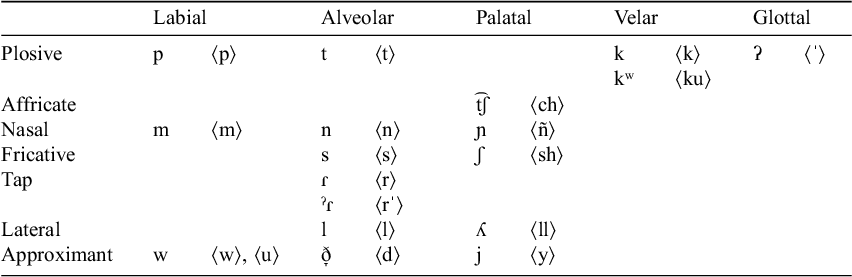
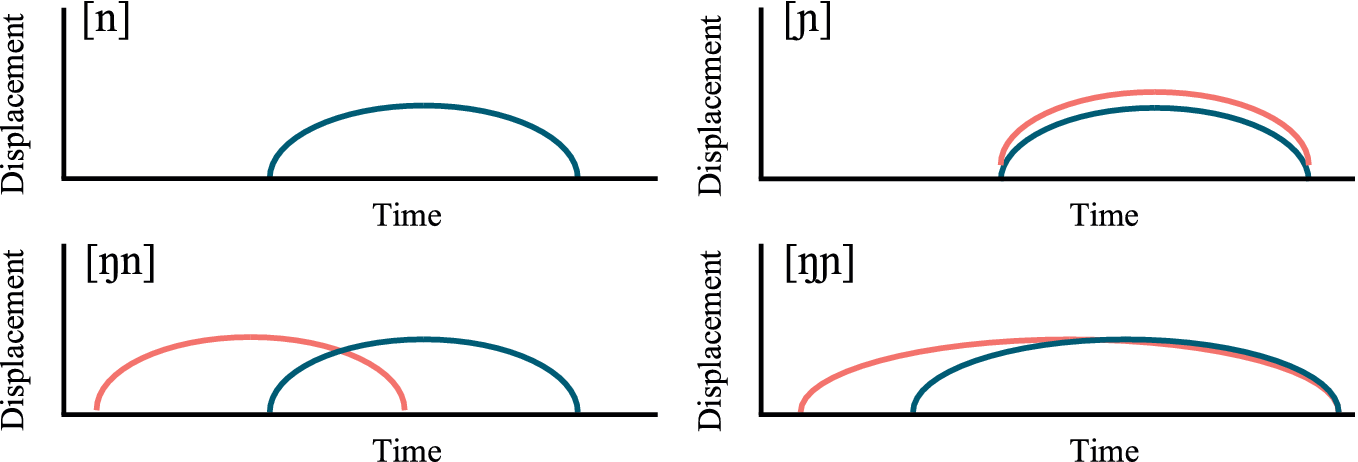

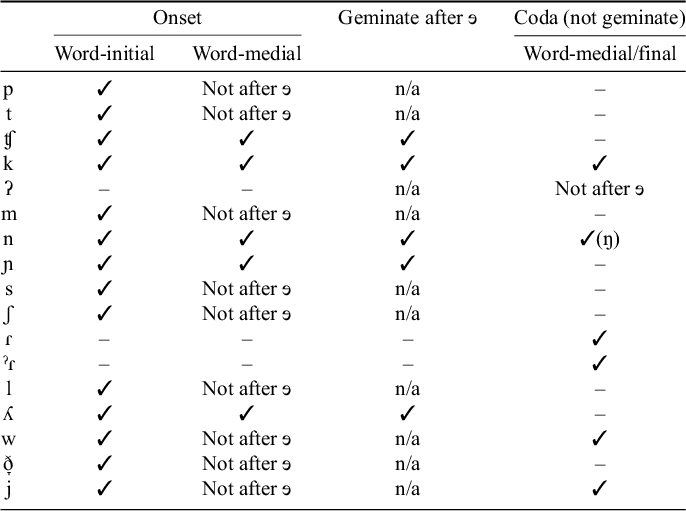
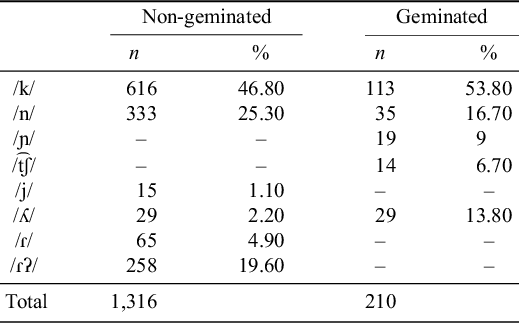
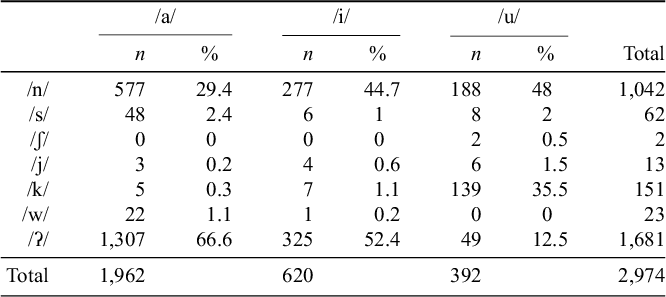


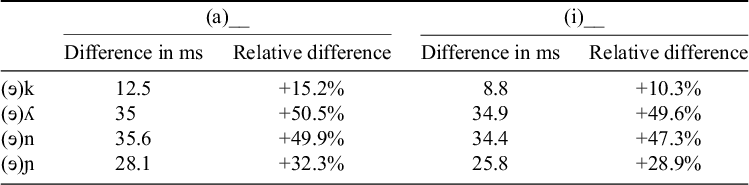
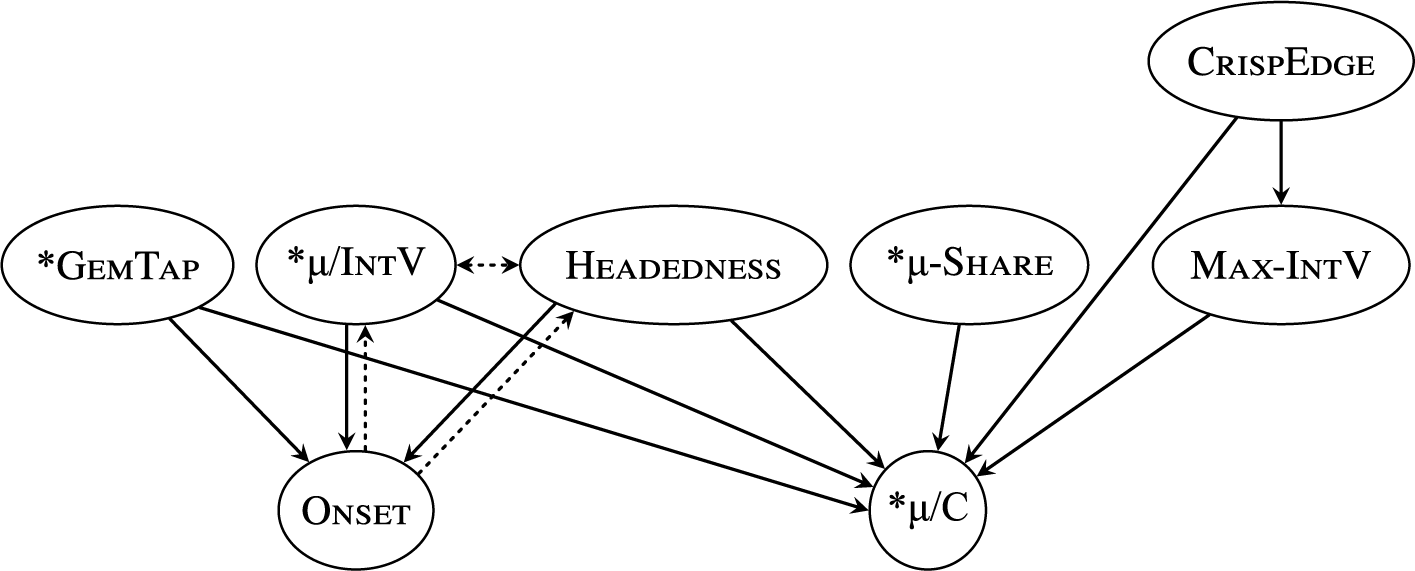


 Open access

