INTRODUCTION
The same year that Kenya achieved political independence, 1963, the World Health Organisation (WHO 1963) reported that basically all urban dwellers in the country were served with piped water from the public systems. Although Kenya still fares well in a comparison with other sub-Saharan African countries, public water services in towns have since deteriorated considerably. For urban households with access to public water systems, per capita consumption has dropped to almost one third since the 1960s and services are less reliable (Thompson et al. Reference Thompson, Porras, Wood, Tumwine, Mujwahuzi, Katui-Katua and Johnstone2000, Reference Thompson, Porras, Tumwine, Mujwahuzi, Katui-Katua, Johnstone and Wood2001). In 2000, almost 30% of over 2 million inhabitants in the capital, Nairobi, did not have access to the public supply, but had to buy water from private providers (Collignon & Vézina Reference Collignon and Vézina2000). The poor are, as can be expected, worst off; roughly 80% of all slum dwellers in Nairobi had no direct access to piped water (APHRC 2002: 15). Any attempt to achieve the water-related Millennium Development Goals in Kenya must thus take off from there: at the tip of a long-term negative trend in public service coverage.Footnote 1 The Government of Kenya (GoK), with assistance from international donors, is currently carrying out a reform of the public water sector in order to improve sector performance and the situation for the poor. Much has been written about water sector reforms in Kenya and elsewhere, where the emphasis of the discussion has been on private sector involvement with regards to service provision (see e.g. Bayliss Reference Bayliss2003; Budds & McGranahan Reference Budds and McGranahan2003; Lobina & Hall Reference Lobina and Hall2000; World Bank 1994, 2003). We do not seek to review this debate, or to add arguments to one side or the other in this often polarised discourse. However, we wish to make two distinct contributions to the debate. First, we argue that a historical dimension is needed. Given the inertia and resistance to change characterised by the technical systems for urban water supply, fundamental problems in the service provision systems may be omitted from the analysis unless a historical perspective is applied (Kaijser Reference Kaijser, Biel, Hansson and Mårtensson2003; Nilsson Reference Nilsson2006). Second, we argue that urban water supply must be treated as a socio-technical system, where not only institutions and organisations interact, but also technology. The reform debate should therefore not be reduced only to sector policy issues and formal institutional structures.
Our objective in this article is to reconstruct the modern history of urban water supply in Kenya, mainly at the policy level, and to analyse the relationship between government policy and the socio-technical systems. Our particular interest is to identify (dis)continuities in the transformation from a colonial to an independent state. Through this, we aspire to complement and deepen the current discourse on reform and urban water provision with a historical dimension. Data for the study have been taken from various official sources, and from reports from consultants and donor organisations, most of which have been acquired from Kenya's National Archives and the British Institute in Eastern Africa in Nairobi, and the Nordic Africa Institute in Uppsala, Sweden.
We provide a historical overview of how the role of the state in relation to urban water has evolved from 1900 to 1990 in the next section. We then make a qualitative analysis of the processes outlined. Finally, we discuss how our findings can be used to assess and contextualise the water sector reforms of the last decade in Kenya.
THE EVOLVING ROLE OF THE STATE FOR URBAN WATER IN KENYA
Railway supplies and the emergence of state responsibility: 1900–1945
Of the several actors and factors that provided impetus for the development of water supplies in Kenya, the Uganda railway was clearly the pioneer. When the railway reached the shores of Lake Victoria in 1901, it had created along its route from the ocean a number of small stations and railway depots such as Nairobi, Nakuru and Kisumu (Obudho & Obudho Reference Obudho, Obudho, Ochieng and Maxon1992). To supply these stations and their rapidly growing populations, piped distribution systems were put in place by the railway authorities (BEAP 1907). For the first two decades of the 1900s, the Uganda Railways would remain the main water service provider for the inland towns of Kenya.
However, the public objectives of urban development and health were not always congruent with those of the railway, which gave the public water supplies second priority (ibid.). As a response, the role of the state for urban water supply increased gradually from the time of the First World War. In Mombasa, the colonial government constructed a new large water supply system in 1912–17 (Willis Reference Willis1995). It was also during the First World War that the colonial administration started developing the first comprehensive water legislation (BEAP 1916a). By the end of the 1920s, the state had taken over from the railway as the main provider of water in urban areas. In Nairobi and Nakuru, the local authorities were directly in charge of the water supply. In other towns, the railway's supplies were taken over by the Public Works Department (PWD). The government also constructed new supplies in towns ‘which had reached such a stage in their development as to justify piped supplies being laid on’ (CPK 1930). By 1931, the PWD operated 11 township supplies in various parts of the country (CPK 1933). A new law, the Water Ordinance of 1929, which championed the role and powers of the state in relation to water, took effect in 1935 (CPK 1935). However, Kenya was deeply affected by the global economic depression of the 1930s (van Zwanenberg & King Reference van Zwanenberg and King1975). Therefore, Kenya would see little new water development take place outside Nairobi until after the Second World War.
Water as a basis for economic development: 1945–1970
After the war, the British government, under the Colonial Development and Welfare Act, invested in the British colonies to boost economic and social development (Fieldhouse Reference Fieldhouse1999). In the Kenyan colonial context, economic growth meant agricultural expansion, which required development and management of water resources. In Kenya, the colonial government in 1946 launched an ambitious investment programme under the Development and Reconstruction Authority, DARA. The DARA programme sparked off a rapid development of urban water supplies. Minor towns' water supplies were seen as ‘vital for the development of the country, and as the expenditure involved is normally recoverable through the rates charged, is in every way a suitable object for the allocation of Development Funds’ (Colonial Office 1950a). The PWD's undertakings for local water supplies grew fast. By 1950 it operated 57 urban supplies, and in 1958, no less than 80 (CPK 1950; Colonial Office 1959). The total number of urban centres with piped water supplies in Kenya, including those operated by local authorities, thus increased from 13 to about 85 in 25 years. Most of these urban centres were very small, but in terms of numbers it was still quite a remarkable expansion.
The Water Ordinance was revised in 1951, and the Minister for Agriculture and Natural Resources was given the overall mandate for water development policy.Footnote 2 However, the Hydraulic Branch of the PWD was still in charge of urban supplies, which created conflicts and duplication of work (REAC 1955: 139). Institutional and organisational reforms were initiated, and following the report in 1957 by Sir Herbert Manzoni, a government-appointed expert, the government decided that supply in all large towns should be taken over by the local authorities, while the Ministry of Agriculture (MoA) should operate supplies in smaller towns. The Hydraulic Branch of PWD was to be transferred to MoA in the ‘post-1960 planning period’ (CPK 1957). As it turned out, the proposed organisational model would outlive the colonial government by 25 years.
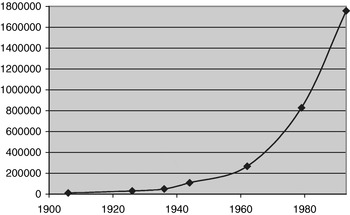
The reader probably needs no introduction to the phenomenon of ‘slums’, or informal settlements. However, the history of informal urban settlements in Kenya needs to be briefly recounted here, given its close interconnectedness with urban water services. Higher urban wages and rapid population growth had generated an influx to towns since before the Second World War (Furedi Reference Furedi1973). The colonial administration sought to control both the immigration and the settlement patterns of Africans in towns. Although Kenya officially abolished racial segregation in 1923, it was officially stated that in urban areas segregation along racial lines could be achieved through other means, such as strict building and sanitary regulations (White et al. Reference White, Thornton, Silberman and Anderson1948). Services and housing for Africans in towns such as Nairobi were left grossly underdeveloped, and strict regulations were applied after the war to control the movement and settlements of the African population (Furedi Reference Furedi1973; REAC 1955: 206–12; Werlin Reference Werlin1966). Local authorities were generally not keen on spending money on Africans, and the Nairobi City Council spent only between 1% and 2% of its revenues on services for Africans between 1932 and 1947 (REAC 1955: 245; van Zwanenberg & King Reference van Zwanenberg and King1975: 268). With the lifting in 1960 of the emergency laws introduced during the Mau-Mau rebellion, and reduced regulation of African migration, urban growth took off, as shown in Fig. 1 (Furedi Reference Furedi1973; Muwonge Reference Muwonge1980). As housing provision could not keep up, unplanned urban settlements mushroomed (Mitullah Reference Mitullah, Ng'ethe and Owino1999; Stren Reference Stren1975). This would have a severe impact on water provision.
Population of Nairobi

Post-war local government reforms increased the responsibilities and powers of local authorities (Stamp Reference Stamp1986). Decentralisation was followed up by new institutions for municipal finance. Nairobi received rights to raise international loans independently and did so for the first time in 1949 (Colonial Office 1950b). In order to provide capital for the other municipalities, the government in 1953 created the Local Government Loans Authority (LGLA) (Colonial Office 1959). Local authorities could take up loans from LGLA, which acted as the government's lending entity to the local authorities. In 1957 the government also set up the Mombasa Pipeline Board. This statutory board was able to raise a £5 m international loan for a new water supply in Mombasa, with the backing of a state guarantee from the Kenyan government (MPB 1962).
From the available data, it seems that the urban supplies in the colonial period were able to recover most (but not all) of their costs through tariffs. Some towns generated a surplus while others had to be subsidised, but taken together, the urban supplies were more or less financially self-sustaining in the colonial period.Footnote 3 However, the questionable financial viability of some water supplies would jeopardise the decentralisation efforts in the early 1960s, as local authorities refused to take over responsibility unless the schemes were running at a profit. This created problems for the government: handing over profitable schemes while retaining non-profitable ones strained government finances (CPK 1961).
In 1963, the country gained independence from the British. The new government took a firm grip of the helm, using five-year development plans to harness the rapid development of the new-born republic. Given the rapid urbanisation, the young independent nation soon faced a serious backlog of urban services for Africans, especially housing (Stren Reference Stren1972). The first development plan from 1964 was a carry-over from the colonial period, in which focus was on economic growth (Green Reference Green1965; Ochieng Reference Ochieng, Ogot and Ochieng1995). Water development was declared to be important for the economy, and priority was given to schemes that were expected to be financially self-sustaining, such as water services for the municipalities (GoK 1964: 100). The policy of cost recovery was continued and as declared in 1965, economic viability was still a key concern: ‘Unless there is a very good reason … government will not accept a water scheme that is financially or technically unsound and is likely to be a continuing liability on the country's resources’ (GoK 1965). Even the doctrinal Sessional Paper No. 10 of 1965 regarded water as a public service, alongside such services as transport, telecommunications and electricity, not as a social service to be subsidised (RoK 1965).
Many actors which had previously been involved in water governance continued as before, while some processes were carried over from the colonial period. In line with a 1957 government decision, the Water Development Department (WDD) was formed under the Ministry of Natural Resources in 1964, to deal with both rural water and smaller towns (RoK 1966: 300). However, by the end of the 1960s further decentralisation to local authorities had come to a dead end. For the large towns, local responsibility for water was not a problem. The municipal water supply in Nairobi for instance, generated a substantial surplus throughout 1966–71 (SWECO 1973). In smaller towns, however, there were financial problems and a shortage of trained staff (GoK 1964: 340). In response to these problems, the WDD took back the responsibility for water supplies in the county councils in 1968 (RoK 1969b: 10). This move by the WDD should also be seen in the context of a series of reforms of local government after independence. According to Sharp and Jetha (Reference Sharp and Jetha1970), these reforms were supposed to rectify old inequalities and make resource allocation more efficient. But, as argued by Stamp (Reference Stamp1986), the subject matter of the reforms was political control. While local authorities were entrusted with more responsibility for public services, their autonomy was also restricted so as to secure supremacy of central government.
Supply-oriented expansion: 1970–1990
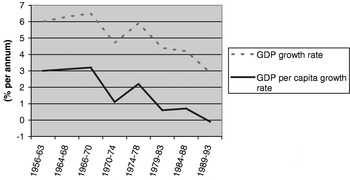
In about 1970, water development became a highly prioritised area for the government. According to WHO (1972), urban areas by this time had almost universal service coverage, with a standard that was deemed high in comparison to international standards. However, in the rural areas, services were much less developed. Backed by a strong economy, showing a sustained growth rate of more than 6% per annum (see Fig. 2), an ambitious programme for a state-led expansion of water development was launched in the 1970–74 Development Plan.
Annual growth rate of Kenya's GDP

This programme had the objective of ‘bringing acceptable water supplies to all the rural population before 2000’, and the government's financial contribution to water development was to increase five-fold (RoK 1969b: 366). The rural areas were given priority, but the urban water budget also increased. The Plan no longer mentioned cost recovery as an issue; however, it stated that municipalities should consider increased water tariffs in order to secure revenues for investment needs (ibid.: 187).
In the 1974–78 Development Plan, universal access to ‘safe and adequate’ water had by the year 2000 become a goal in itself. The government argued that water supplies would bring benefits in the form of higher income, security, health and leisure and that generally ‘a significant social benefit is attached to a water supply project’ (RoK 1974: 327). Total government water expenditure would increase more than six-fold, and expenditure for urban water would triple (ibid.: 186). But to keep up with urban growth was demanding, and WHO (1973) stated in 1973 that funds as well as manpower would soon be in short supply. The government itself concluded that: ‘Services for urban population have expanded over 70 years to cater for the present 1 million urban inhabitants. In the coming 25 years towns will have to develop services for another 8 million people. Rate of service provision development has to go up with a factor 20 as compared to the past’ (RoK 1974: 119). But how? The strategy adopted was to boost central government in its role as service provider, as further decentralisation had been halted. The water development division was upgraded to a department in 1972, and in 1974 it became a fully-fledged ministry: the Ministry of Water Development (MoWD) (WHO 1975). The powers of the minister for water were extended with the revised water legislation of 1972 (see below). The government's policy on cost recovery was reaffirmed. The 1974–78 Plan stated: ‘It is intended that systems for urban supply and sewage disposal become self-supporting financially as rapidly as possible. Rates will be established, therefore, on the basis of a full recovery of capital, operating and maintenance costs of all schemes taken together in the long run’ (RoK 1974: 328).
The ambitious development programmes of the 1970s now largely depended on external funding, mainly from the World Bank, West Germany, Saudi Arabia and Norway (Hukka et al. Reference Hukka, Katko and Seppälä1992). However, in terms of funding channels, the old colonial system was still intact. Nairobi took up loans independently, while all other towns received funding through the LGLA and the regular government budget.
The government's objectives were as bold as they were ambitious – and costly. Unfortunately, real economic growth cannot be commanded. After years of plenty in the 1960s, the economy slowed down considerably after 1972 (see Fig. 2), and throughout the 1970s the economy was characterised by a poor balance of payments, a high government budget deficit and inflation. Despite this, government spending kept increasing (Onjala Reference Onjala, Ng'ethe and Owino1999). In 1964/65 total GoK spending had equalled 16% of GDP, in 1980/81 it was 33% (RoK 1983a).
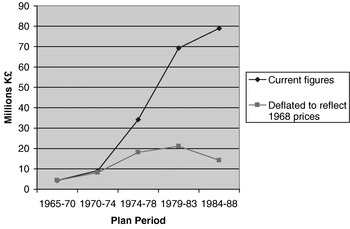
The financial sustainability of urban water supplies began to dwindle: already in 1972 the ministry-operated urban supplies could no longer recover capital charges (WHO 1972). In 1975, a WHO (1975) review mission made it clear that the financial situation of the water supplies under the MoWD was unsustainable, with insufficient maintenance resulting in the deterioration of infrastructure. WHO frankly concluded that ‘there is no link between the real costs of providing water and sewerage services and revenue collected for the services’. As the tariffs were not revised to keep in step with inflation, real urban water tariffs in Kenya went down by 75% between 1971 and 1989 (Hukka et al. Reference Hukka, Katko and Seppälä1992). Inflation also derailed capital expenditure and programmes such as the Minor Urban Water Supply Programme that experienced cost increases of over 300% (RoK 1978). Moreover, high inflation in the 1970s and 1980s would consume most of GoK's urban water budget increase since 1972 (see Fig. 3).
Government of Kenya Development Budget in Development Plans for urban water

Expansion of urban water services was also compromised by the failure of the government's housing policy. According to Mitullah (Reference Mitullah, Ng'ethe and Owino1999), the independent government basically continued the policies from the colonial period, and perpetuated the housing shortage through enforcing strict building regulations. With reference to ‘slum areas’, the government endeavoured in 1969 to ‘take more positive action to prevent this undesirable type of development’ (RoK 1969b: 89). In Nairobi, this meant that more housing units were demolished in slum clearances than were being built through government programmes. Furthermore, standards were so high that the houses that were built were only affordable for middle and high-income people (Mitullah Reference Mitullah, Ng'ethe and Owino1999; Stren Reference Stren1975). Over the 1974–78 period, only 5% of all planned low-cost housing units in Nairobi were completed. On average they cost five times the expected price (RoK 1979: 50). As a consequence, informal settlements kept growing steadily, despite government efforts to contain them (Matrix 1993).
By 1979, it was obvious that the government's goal of ‘water for all by year 2000’ was not going to be met. The government accordingly reformulated its goal in the Development Plan for 1979–83: ‘to have an adequate water supply available to the entire population soon after the year 2000’ (RoK 1979: 107, our emphasis). About this time, the Kenyan government joined hands with the international community in the global campaign for a ‘Basic Needs approach’ (see Curry & Rothchild Reference Curry and Rothchild1980). Under this approach, the Kenyan government stated water to be a ‘social service’, and cost recovery from users was not prioritised. This strategic shift in the fourth plan also coincided with the launch of the ‘International Drinking Water Supply and Sanitation Decade’ from 1980, where donors together with developing countries made a dedicated effort to increase access to water and sanitation worldwide (Hukka et al. Reference Hukka, Katko and Seppälä1992). The 1980s also saw a revival of decentralisation through the ‘district focus’ reform of 1982–83, and by 1983, 11 local authorities were in charge of urban water operations (RoK 1983b).
The deterioration of the financial situation continued. A study in 1983–84 found that urban supplies under MoWD were able to recover only operating and maintenance (O&M) costs, but no part of capital charges. The financial situation of the Ministry's water operations was aggravated by the fact that less than 10% of the total cost for rural supplies was recovered (RoK 1984). The performance of the water supplies run by municipalities was only a little better: in 1986 no municipality recovered more than one third of the total production cost for water through the collected revenue (Hukka et al. Reference Hukka, Katko and Seppälä1992). Throughout the 1970s and 1980s, the civil service workforce in Kenya expanded steadily (Swamy Reference Swamy1994). This applied not least to the MoWD, which saw its payroll ballooning in the 1980s. It was reported in 1988 that no less than 92% of MoWD's recurrent allocation was for staff salaries and personal emoluments, at the expense of maintenance and operation of facilities (Hifab 1988).
The Basic Needs strategy did not survive long, as already in the next plan in 1983 the government started to reverse its policy. The bold goal from the early 1970s was replaced with the rather lame statement that ‘The supply of water, of good quality, in sufficient quantity and in close proximity to the population is one of the long-term objectives of the government’, and the development budget for water was reduced (RoK 1983a). In terms of pricing policy, the government once again reverted to the old formula: ‘rural water rates should cover at least O&M, in urban areas prices should cover both the maintenance and capital investment costs’ (ibid.: 162). With Sessional Paper No. 1 of 1986, the GoK stated a clear policy shift towards a pay-for-service approach. This move was reinforced in 1988 with the establishment of the National Water Conservation and Pipeline Corporation, which was to operate a number of urban supplies on a commercial basis (Nyangeri Reference Nyangeri, Hukka and Katko2003a).
On paper, the government's commitment to water development in the 1970s was impressive. The monumental water service goals and the political momentum behind them are unparalleled in Kenyan history. In retrospect, however, the post-independence era of water politics is marked by inability to find ways of expanding services in pace with urban growth. Possibly, the failure of the post-independence urban water policy may seem graver than it actually was. The claims for near universal service coverage in towns from 1963 and 1970 made by WHO might not stand the test if today's criteria for service coverage were applied. WHO's reports built on aggregated, official statistics that generally capture the service situation in informal areas poorly (Satterthwaite Reference Satterthwaite2003). Therefore the deterioration of services may appear less drastic if one starts from a more nuanced picture of early post-independence service coverage. However, the objective of this article is not to map the exact development of service coverage in Kenya. It is sufficient to note that public service levels beyond doubt deteriorated over the 30 years following independence, as has been clearly demonstrated by the widely cited ‘Drawers of Water’ studies (Thomson et al. Reference Thompson, Porras, Tumwine, Mujwahuzi, Katui-Katua, Johnstone and Wood2001). It is true that urban growth in Kenya has presented a gigantic challenge: from 1962 up to 1990 the urban population grew from 671,000 to 4,170,000 (Morgan Reference Morgan1969; RoK 1994). Most of this expansion has been in informal settlements, due to the defunct housing policy. Public service provision has been largely non-existent in these areas and, as a consequence, sanitation and water services in Nairobi's informal settlements were found totally inadequate in the early 1990s (Matrix 1993; Odira & Nyangeri Reference Odira, Nyangeri and Sandelin1994). The government's commitment to increased service coverage during the ‘Water Decade’ of the 1980s rang hollow, as urban coverage instead went down from 85% to 78% (Hukka et al. Reference Hukka, Katko and Seppälä1992). In the section that follows, we try to understand why this has happened.
ANALYSING THE SOCIO-TECHNICAL SYSTEM OF URBAN WATER IN KENYA
Urban water supply: a socio-technical model
How can we understand urban water service in relation to the state? Historically, in most Western countries, the state has endeavoured to make water supplies part of public provision just as in Kenya, as water markets are highly imperfect (Gleick et al. Reference Gleick, Wolff, Chalecki and Reyes2002; Hukka & Katko Reference Hukka and Katko2003: 126). First, water supply in urban areas has public good features in its consumption through externalities, e.g. in terms of health effects (Kjellén & McGranahan Reference Kjellén and McGranahan1997; McGranahan Reference McGranahan2002; Nilsson Reference Nilsson and Tempelhoff2005). Second, as water networks exhibit production characteristics of a monopoly nature and involve large capital investments, the state often has an important role as regulator, financier or provider (Belli Reference Belli1997; Crocker & Masten Reference Crocker and Masten2000; World Bank 2003). Although urban water provision is frequently managed by local authorities, these authorities evolve in a national context. Hence, assessing the evolution of urban water supply calls for a model in which social as well as technical elements can be represented. Kaijser (Reference Kaijser1994, Reference Kaijser, Biel, Hansson and Mårtensson2003) offers a model for describing socio-technical systems as made up of three layers: institutions, organisations and technical systems. In our adaptation of this model, ‘institutions’ means the formal and informal rules in society that affect the translation of public preferences to service provision systems. ‘Organisations’ refer to the formal structure and division of responsibilities between actors for providing services (after Ostrom et al. Reference Ostrom E., L. and Wynne1993; Ostrom & Walker Reference Ostrom, Walker and Mueller1997). With ‘technical systems’, we have here concentrated on the technologically codified part of service provision, such as standards and engineering practice, but not the infrastructure in itself. Finally, as the water sector does not evolve in isolation, we put our model into a context of the wider social and economic historic processes.
Institutional change
The most obvious type of institution is formal legislation. The first legislation to deal specifically with water was the Water Ordinance of 1929, in force since 1935. This was revised in 1951, and again in 1972 when it was renamed Cap. 372 of Laws of Kenya. These laws structured the provision of services in urban areas in a similar way. The minister in charge of water resources would appoint a ‘Water Undertaker’ for each town. The Water Undertaker could be the local authority, the government through its ministry responsible for water, or any other person or organisation. The Undertaker developed regulations, to be approved by the minister, defining the operations and tariffs in the service area. The minister would also have a monitoring role to ensure the quality of services. Furthermore, all three acts provided for an advisory body that would assist the minister with policy and the implementation of the legislation. Interestingly, the direct influence from the minister over this advisory body increased with each revision, at the expense of influence from the technical wing of government.Footnote 4
Other important parts of the institutional framework are the public objectives officially stated in relation to urban water supply. When the state responsibility for water rose in the 1920s, it was generally on the grounds that private provision could not satisfy the objectives of public health, economic efficiency or vital strategic interests. Post-war expansion under DARA focused more on economic growth, and this objective remained until about 1970. With the ‘water for all by 2000’ strategy, water became a goal in itself, motivated by various ‘social benefits’. Under this strategy as well as the Basic Needs approach, the government's objective for state responsibility took a supply-oriented stance: ‘provision of water, both in the urban and rural areas, will be viewed as a provision of service and not as a source of revenue’ (RoK 1979: 193). This shift in policy objectives is likely to have affected pricing and cost recovery.
In terms of pricing urban water, we argue that Kenya's official policy has essentially been stable over time. Pricing based on cost recovery has featured as a central policy element throughout the period studied. In the colonial period, full cost recovery from the users was the rule. This rule was generally followed in practice, but as noted, some supplies had to be subsidised. The official policy remained basically unchanged in the first years after independence. In the 1969 Development Plan, cost recovery was left out, but in 1974 it was firmly put back on the agenda. In 1979 it was again dropped, only to be reintroduced four years later. Although the cost recovery policy waxed and waned over a period of almost 15 years, it was not completely discarded. It is rather in the implementation of the policy that a marked discontinuity of cost recovery can be found. In practice, cost recovery had been dropped after the 1970s, and the supplies were running huge deficits. How can this shift be explained? Earlier studies have sought explanations in high inflation, inefficient administration and poor financial estimates resulting from inadequate human resources (RoK 1983b; WHO 1971, 1973). We also suggest that as policy objectives slid towards regarding water as a social service, the case for cost recovery must have become less legitimate in the eyes of the public and the politicians, leading to decreasing willingness to pay. Furthermore, the formal institutions for tariff setting and revenue collection, and their associated incentive structures, contributed to poor policy enforcement. If those in charge of revising tariffs and collecting the revenue have little to gain from doing so, it is unlikely that such a policy will be implemented. The revenue for MoWD-operated schemes was collected by the Office of the President, and forwarded directly to the Treasury. There was no link between tariffs, the revenue actually collected, and what was forwarded to the Water Undertaker through budget appropriations, hence there was a complete lack of incentive for MoWD to keep tariffs at par with costs (WHO 1975). Similar disincentives appeared in the municipalities, where revenues from water sales went into the council's coffers without being channelled back to the water operations (Nyangeri Reference Nyangeri, Hukka and Katko2003a). Features of the technological system may have also contributed. The durability of piped supply systems makes it possible to underinvest in maintenance for a relatively long period of time, before complete breakdown occurs (Shirley Reference Shirley2000). This may induce decision-makers to award lower priority to recurrent expenditure in a situation marked by competition for resources. In addition, clientelism may have exacerbated these disincentives, as further discussed below.
Organisational change
Since the state took over responsibility from the railway in the 1920s, no organisational change of an equally fundamental nature has been made. Development and operation of urban water supplies have been the responsibility of either central government or local authorities. Mombasa offered a third alternative, with the Mombasa Pipeline Board after 1957. The independent government reorganised the water sector along the intentions of the colonial government, through a series of transfers of responsibility between the ministries, but the functions carried out at central level remained. The mechanisms for raising capital have also been essentially unchanged in the post-Second World War period. Small towns were funded from the government's development budget, whereas municipalities depended on loans through the LGLA. Nairobi was an exception, and remained the only local authority with the right to raise loans independently from 1949 to 1990. As towns have grown, water supplies have been transferred to local authorities, except for the period 1968 to 1983 when central government had a more leading role. Altogether, seen over a longer time period, the principles of organisation and funding have been stable.
The paradigm of urban water supply technology
Large-scale systems for urban water supply have a high technical content, which requires specialisation and technical knowledge. Such systems often develop in a paradigmatic manner, where certain engineering practises and standards come to prevail, which may deter technological change (Chatzis Reference Chatzis and Coutard1999; Ertsen Reference Ertsen2005). This applies also to the Kenyan context. In the following we present a view of how a technological paradigm for public water supply was formed in Kenya.Footnote 5
One key design criterion for water supply is the daily per capita demand. When the first urban water systems were built, no Kenyan standards existed. Reference was instead made to British and American standards (BEAP 1907). At about the time of the Second World War, a norm for the design per capita demand evolved in Nairobi, which would be taken up as an informal standard (CPK 1945). For domestic water supply, a normal allowance was 50 gallons per capita and day (about 220 litres per day – l/pd) for ‘non-natives’, whereas for Africans, one fifth would suffice (CPK 1953a). The 220 l/pd norm was comparable to European standards. Through assistance from WHO, new general design data that was felt to be more appropriate was adopted in 1973 (WHO 1975). Demand was now taken as 135–160 l/pd (WHO 1972). Although this was a smaller amount than previously, even today, in some smaller towns in Kenya, average consumption is as low as 20 l/pd (Nyangeri Reference Nyangeri2004).
Second, a paradigm of piped networks with individual connections emerged. As costs were recovered directly from the users in proportion to water consumption, metering was necessary, preferably through individual household connections. This paradigm goes back to the 1920s. For Nairobi, a loan was approved in 1925 for investments in the water system, including £6,000 for ‘meters for all consumers’ (CPK 1925). In 1963, all township supplies operated by the PWD were reported to be metered (WHO 1963). This policy was continued in the post-independence period. In 1972 individual metering was the norm in all urban areas, and the 1984–88 Development Plan clearly stated that individual metered connections were the aim (RoK 1983a: 161; WHO 1972). The high design demand and individual piped connections were also mutually reinforcing: without universal connections consumption would be much lower. It is important to note however, that alternative technologies have coexisted all along. On demand from the citizens of Nakuru in 1914, the Uganda Railways expanded the number of public standpipes in the town (BEAP 1915; BEAP 1916b). When the Nairobi City Council was planning ‘re-development’ of the shanty towns in Mathare Valley in 1969–70, alternative technologies such as communal toilets, water vending machines and kiosks were discussed (RoK 1969c).
Another important cornerstone of the paradigm was housing standards. The Building Code from 1969, for example, stipulated that all urban houses should be equipped with water installations according to British Standard (RoK 1969a). The problem of too high housing standards had already been pointed out in the 1950s, and ‘graded regulations’ were proposed, where lower standards could be allowed in certain areas of towns (REAC 1955). Graded regulations were developed in Kenya in the 1960s, but it was optional for each local authority to apply them. According to Werlin (Reference Werlin1973), it was difficult for policy-makers to accept a reduction of standards, as this did not concur with prevailing ideas of development and progress. The low-cost options were simply not utilised and this would hold back urban development (Mitullah Reference Mitullah, Ng'ethe and Owino1999; Stren Reference Stren1975). The same applied to the water services. The government pledged in 1974: ‘To adopt standards for urban infrastructure which closely relate to what can be afforded by the country as a whole’ (RoK 1974: 119). Although the problem of affordability was acknowledged, very little changed in terms of policy and technology choices. In 1983, the government admitted again that: ‘The current design standards for both urban and rural water supplies appear to be too high in relation to needs and the costs’ (RoK 1983a: 161). In the early 1980s, the concept of ‘appropriate technology’ had emerged as a concept for remodelling public service provision and creating alternative, more affordable technologies (Vaa Reference Vaa1993). Towards the end of the 1980s, the public authorities in Nairobi made an attempt to use alternative small-scale systems. However, the attempt was not carried through to completion, and the main focus was still on conventional large-scale systems (Howard Humphreys 1986; Katui-Katua & McGranahan Reference Katui-Katua and McGranahan2002).
External factors have also helped to cement the technological paradigm. As it was increasingly difficult for the municipalities to get technical assistance from government in the 1970s, they had to rely on private consultants. WHO (1971) lamented that: ‘When they get the opportunity to obtain financing they tend to over-estimate their requirements. There is little incentive for the consultants to keep the total cost down.’ Finally, the influence of donors in recent decades, and the technologies and norms they represent, cannot be ignored. In the 1960s, for instance, much of the urban water programme was financed with concessionary credits from the UK, tied to British exports (ibid.). Later on, the key donors to the urban sector would prioritise improved cost recovery within the existing technological paradigm over promoting appropriate technology (Nyangeri Reference Nyangeri2003b). The concept of appropriate technology never really worked its way into Kenyan policy and practice, and the paradigm of conventional piped networks has persisted (Drangert et al. Reference Drangert, Okotto-Okotto, Okotto and Auko2002; Vaa Reference Vaa1993). Simply put, incentives for technological change were not strong enough.
Processes outside the sector
Already in the first Development Plans from the 1960s, future rapid urban growth was foreseen. According to the government's own projections in 1969, Nairobi would grow to about 3 million people by the year 2000, a projection that even overshot actual growth (RoK 1969b: 83). However, the planners did not foresee the economic stagnation of Kenya. The development plans from the early 1970s had assumed an average annual growth in the economy of about 7%. By 1972 it was clear to the government that the bonanza years of the 1960s could not be taken for granted (RoK 1972b). Kenya would not come close to 7% GDP growth again for any sustained period (see Fig. 2). Still, the expansive strategies of the government carried on, with the benevolent support of international donors, plunging the country deeper into financial crisis. So why did the government carry on this financially extravagant policy? And why did they not redress standards of service provision effectively to fulfil the objective of universal service? Looking at the political context of public service provision may provide some clues.
In the early years of independence, although the economy was growing fast, inequalities in Kenya persisted or increased (Leys Reference Leys1979). According to Hydén (Reference Hydén1983), out of the old colonial system there grew a new indigenous and mainly urban political elite, which could utilise the machinery of the state to further its own interests. As argued by other scholars, Kenya, like many other African countries, developed a patron–client system in its public service and political systems, further aggravated by a strong presidency (Levy Reference Levy, Levy and Kpundeh2004; van de Walle Reference van de Walle2003). Under such a system, certain interest groups would appropriate unduly large shares of the public resources, not only exacerbating inequality but also making the economy perform poorly (Collier & Gunning Reference Collier and Gunning1999). Already in 1973, Chege (Reference Chege1973) argued that public resource allocation in Kenya was subject to ‘interest group appeasement’.
A clientelistic state system does not have to be confined to the national level. Over time, a type of patron–client relationship has evolved between local authorities and central government in Kenya, where local authorities and their polity exchange political support to central government for public resource allocations. At the local level there simultaneously evolved a clientelistic system for competition for these scarce resources (Southall & Wood Reference Southall and Wood1996). With increased dependence on central government and eroding capacity of local authorities, mounting clientelism and corruption has been recorded at local level (Barkan & Chege Reference Barkan and Chege1989; Cohen Reference Cohen1993). In terms of service provision, certain user groups have been favoured and certain groups – especially the poor – have been in practice excluded from service by the public systems (Odira & Nyangeri Reference Odira, Nyangeri and Sandelin1994). This targeting of public services towards higher income groups may also have contributed to the preservation of the technological paradigm, and created disincentives for cost recovery. Influential groups (‘clients’) who already had access to water at a low cost resisted tariff hikes that could be controlled by politicians (‘patrons’). Reluctance of local politicians to carry out unpopular tariff hikes has been reported as one of the main threats to financial viability of water operations in municipalities in Kenya (Nyangeri Reference Nyangeri, Hukka and Katko2003a).
CHANGE AND CONTINUITY IN KENYAN URBAN WATER PROVISION
The past that is already dead remains present in the future that has still to be born.
Lewis MumfordLooking back: learning from the past
In the introduction, we argued that history matters for the present-day reforms of water provision in Kenya. In the following, we sum up the findings of our study, and bring out the key issues from history, with a bearing on today's reform.
We have shown that, in spite of numerous reshufflings of parent ministries for urban water supply, the organisation of the state vis-à-vis its responsibility for urban water supply was more or less constant from the 1920s to 1988. There was also continuity in terms of technology. A paradigm centred on piped individual connections evolved, which persisted even after the government declared it unaffordable from the 1970s. The real change that has taken place is to be found in the general institutional framework. Formal political influence over policy increased gradually over the whole period at the expense of technical influence, and social objectives were given priority. From 1970, it is possible to talk of a discontinuity in cost recovery in practice, although not in terms of official policy, which still professed the principle of full cost recovery. The combination of institutional disincentives, mounting clientelism and a shift in policy objectives set the stage for deteriorating cost recovery. Rapid urbanisation, the stagnation of the economy and the high inflation rate from the 1970s changed the social context of urban water provision, and accelerated the financial erosion of the capital-intensive socio-technical system. The technological paradigm persisted due to lack of incentives for change, despite the rapid growth of informal settlements. This lack of technological and institutional adaptation to a changing social context made the urban water sector in Kenya spiral into disarray and dysfunction.
What can we learn from this story? We propose three key lessons for today's reformers.
(1) Policy is not all. The high-profile water development policy from 1970 could not be meaningfully supported on the ground, and hence it failed. We have also seen that formal institutions for cost recovery grew completely ineffective, and that the many organisational and legal reforms after the Second World War in effect changed very little in the sector. The drivers of change instead were informal institutions and processes outside the water sector itself. Institutional reform is about making rules and incentive structures concurrent with stated objectives. Reformers therefore need to look at the key actors and their motives: who wants change and why, and who will benefit? And is change going deep into effective institutions, formal as well as informal, or is it superficial? And, can policy be meaningfully implemented?
(2) The time-scale of institutional change: as shown, many features of the socio-technical systems evolve over long periods, and some may even appear to be constant. Nevertheless, abrupt change can take place. It may be intentional, like the emergence of state responsibility in the 1920s, or the shift of public objectives in 1970. It may also be externally invoked, like the economic recessions, or be part of another social or political agenda, such as clientelism. The key issue here is that all these processes and variables will together determine the performance of the urban water sector and direction of change. Some of the key variables in the system cannot be identified unless a longer time perspective is applied, and if they cannot be identified, how can they be controlled?
(3) System imbalances: urban water provision is a socio-technical system, and responds to change as a system, as shown by the Kenyan case. Changes in the institutional structures that eroded cost recovery were not matched by changes in technology. This created an imbalance in the system, and precluded the provision of water to all Kenyans. In a vision for lasting change, one cannot focus only on correcting present shortcomings, such as poor cost recovery, but must also envisage the system in a different equilibrium position. This calls for inclusion of aspects of technology and service standards in reforms.
Looking ahead: socio-technical systems and institutional change
In the last 15 years, Kenya has seen a new round of reform for urban water supply. The government attempted commercialisation of services from the late 1980s, backed by donors such as Germany and the World Bank. A new Water Policy was launched in 1999, and a new Water Act in 2002. Since then, a major overhaul of the water sector has been taking place, and much hope has been placed in private-sector participation. At first glance, the new sector structure appears to be very different from before, in terms of both organisation and institutions. The ministry mainly deals with policy and legislation, and seven regional Water Service Boards (WSB) are instead responsible for water and sewerage services. These Boards are supervised by an independent Water Services Regulatory Board (WSRB) at national level, which approves tariffs and also develops standards and guidelines. For actual service delivery, the WSB contracts operators, which operate on commercial terms, so-called Water Service Providers (WSP). The local authorities are no longer allowed to operate their supplies themselves (Nyangeri Reference Nyangeri, Hukka and Katko2003a, Reference Nyangeri2004).
At a closer look, however, some of the institutional shortcomings remain and new ones have emerged. The regulatory function, including tariffs, is the most important function of the state under the new Act. However, as pointed out by Mwangi & Gitau (Reference Mwangi and Gitau2003), this seems to be the weakest part of the new structure. The WSRB is autonomous in theory but depends on funding from government, and the minister appoints its members. The huge staff of the ministry will either be absorbed by WSBs and WSPs, or retained in the ministry, who legally may opt to continue as service provider. The WSBs are responsible for services and are supposed to be self-financed through the tariffs, but cannot determine tariffs or standards. Furthermore, the WSBs contracts operators to run the urban supplies. In most cases the only practical alternative is to contract the former municipality, now in the guise of a municipal company. The recent experience of municipally owned water companies in Kenya shows them to be anything but autonomous, and political interference is still rife (Nyangeri Reference Nyangeri2004; Orgut 2006). Nevertheless, the new structure should be able to provide better incentives for cost recovery, as revenue cannot easily be diverted for other purposes. The clearer division of roles within the sector can furthermore be expected to promote professionalism and customer orientation. The recently improved performance of the new Nairobi water company shows that institutional incentives and professional organisation go a long way in sector performance improvement (East African Standard 2005).
What is more debatable is whether the new structure is likely to improve service coverage to the millions of urban poor in the short to medium term. So far, technology choice, standards and accessibility have largely been left out of the picture. The service targets set in the reform have initially concentrated more on increased per capita average water supply, rather than on improved access to those presently unserved (MWI 2004). Moreover, thus far the new WSPs and WSBs have made little headway towards a realistic plan for increased coverage (Orgut 2006). The WSBs are regional government bodies, and will not by default be more accountable – whether de jure or de facto – to the urban poor than the local or central governments have been before them. The Water Service Providers for their part, being commercial entities, may not identify the urban poor as their primary customer group. As much as Kenya's water sector reform may seem to have accomplished a historic turn-around in the sector, from the viewpoint of the urban poor, much is still the same.
No doubt, reform was needed in Kenya. But what kind of reform was needed? The Kenyan water reform should be viewed in the light of history. First, while adopting a new policy document, or changing the organisation and legislation is relatively easy, changing informal institutions and behaviour is, as we have seen, the real challenge. Motives and goals of the actors must therefore be brought into the discourse. Second, reformers must acknowledge the long-term dynamics of urban water supply systems. Such systems will be subject to institutional and technological inertia as well as ‘path dependency’; there will always be resistance to change from actors with vested interests in the system (North Reference North2005). Third, and finally, restoring the capacity for cost recovery while retaining the old technological paradigm will not automatically lead to increased service coverage for the poor. It is necessary for institutions to create an incentive structure that is supportive of low-cost technology and provision in informal settlements, so that poor people can enjoy their entitlement to public services. The water sector reform in Kenya is in many ways a step in the right direction, but policy-makers also need to refine their objectives to ensure that the needs – and the rights – of the urban poor can be met.