The World Health Organization (WHO) has been guiding vaccination studies for many years. The Strategic Advisory Group of Experts (SAGE) defines vaccination hesitancy as a delay or refusal to accept vaccination despite the availability of vaccines and vaccination services. The concept of vaccine hesitation was created by the SAGE working group. Reference MacDonald1 In research by the WHO, it is stated that vaccine hesitation is a behavior, influenced by 3 main factors: [i] fear/lack of confidence (do not trust the vaccine or have a fear of it), [ii] complacency (do not perceive a need for a vaccine or do not value the vaccine), and [iii] inconvenience in accessing vaccines (difficulty to access the vaccine for individuals and society). 2
Health-Care Workers in Turkey and the World
During the pandemic, the Minister of Health in Turkey stated that the number of health-care workers (HCWs) infected with coronavirus disease 2019 (COVID-19) in Turkey exceeded 120,000 and 1 of every 10 patients with COVID-19 was a HCW. It was announced in December 2020, that 28,138 people had died due to COVID-19, and 380 of them were HCWs. In Turkey, 1 of every 74 people who die due to COVID-19 is a HCW. In research conducted on HCWs, by Turkish Thoracic Society, reported that the rate of HCW infected with COVID-19, had increased from 12% during June-July 2020 to 57% during December 2020 to January 2021. It is thought that the participation of HCWs in vaccination campaigns has had an influential effect on vaccine hesitancy within society. Reference Jelleyman and Ure3 For this reason, HCWs are 1 of the priority risk groups for the vaccination program, which was decided by the Republic of Turkey Ministry of Health. We determined that a study was necessary on HCW who refuse vaccination even though they have been given priority in receiving vaccination. The aim of this study is to analyze the factors influencing vaccine hesitancy. For this aim, the reasons for vaccine hesitation should be learned to successfully vaccinate these groups in the continued fight against the pandemic.
Vaccine Administration in Turkey and the World
We determined, as the studying team, that vaccine hesitancy should be divided into 2 groups, based on chronology to better define this term and organize the postpandemic world. During the pandemic, different practices have emerged in many countries around the world that focus on many different aspects, including vaccine supply, production, and approval processes.
Before 2020
The WHO announced vaccine hesitancy as a global health threat in 2019 when discussions about a vaccine began to influence people around the world; this situation also negatively affected vaccine campaigns. 2 The most prominent example of vaccine hesitancy in the general population surrounds the flu vaccination. Due to the 2009 swine flu pandemic caused by the influenza virus, by 2009, nearly half of the population in the United States did not receive a seasonal flu vaccine. Reference On Kwok, Li and Wei4 In summary, looking at the literature previous to 2020, it can be inferred that, “even vaccine availability does not guarantee sufficient population vaccination as evidenced by vaccine hesitancy”. Reference Omer, Salmon and Orenstein5
Since 2020
While the WHO continues its struggle against vaccine hesitancy, the COVID-19 pandemic also continues. Vaccination against the virus still remains the only weapon for social immunity. While the seriousness and spread of the pandemic around the world continues, the primary safety measure that will protect both society and HCWs is vaccination. As of April 2021, 2 brands of vaccines have been administered in Turkey; these are the Sinovac and the Pfizer/BioNTech vaccines. Sputnik V, which was approved for emergency use as a third vaccine option, has not yet been administered. 6
Methods
A descriptive method for collecting qualitative data was designed for this study. The approach to the research is also in line with case study design, which examines specific cases.
There is a total of 4201 HCWs employed at Dr. Lütfi Kırdar City Hospital in Istanbul and its affiliated units. Data were collected for this study from 649 vaccine hesitant HCWs employed at the hospital. All HCWs were interviewed to determine their reasons for their vaccine hesitancy. In addition to the personal interviews, records and documents related to the vaccination program were also used. These records and documents cover the information of persons who have not been vaccinated since the beginning of the vaccination program. The data for this research were collected through telephone interviews between April 1 and April 12, 2021.
The classification data collected in the study include the sex (male/female) and occupation information (examples include doctor, nurse, technician, or other HCW) of HCWs. Along with this classification information, the participants were asked as an open-ended question about the reasons for their hesitations against the vaccine.
The responses about the vaccine hesitation of the participants were categorized through a descriptive qualitative analysis. The data obtained for the descriptive qualitative analysis were arranged and interpreted in line with 3 main factors that cause vaccine hesitancy (fear/lack of confidence, complacency, and inconvenience), which was put forward by the WHO.
Results
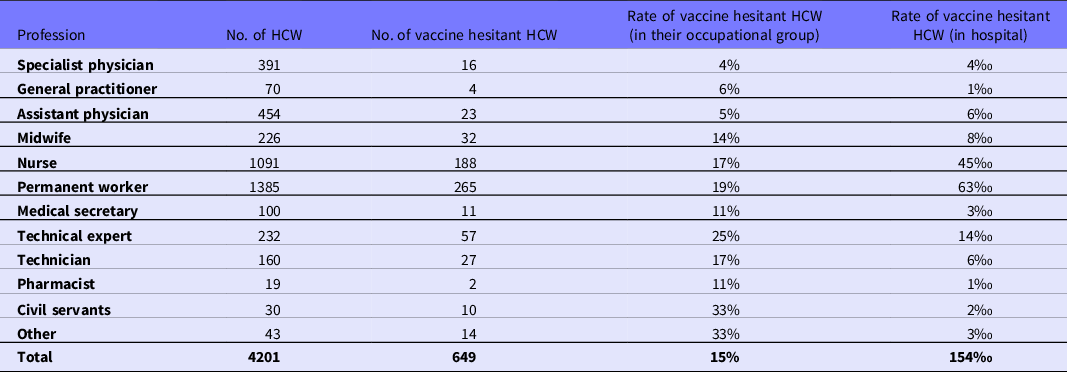
There is a total of 4201 HCWs employed at Kartal Dr. Lütfi Kırdar City Hospital. The work locations of the HCWs include multiple units that serve both children and adults, such as the emergency department (ED), polyclinic, hospitalization services, intensive care (ICU), laboratory, imaging, security, and administration. There were 649 vaccine hesitant HCWs (15%) in total. Of those HCWs, 392 were women (60%), and 257 were men (40%). Table 1 shows the total number of HCWs by profession and the distribution of vaccine hesitant HCWs among them. In the table, the rate of vaccine hesitant HCWs are presented in 2 ways: the rate of vaccine hesitant HCWs to the total number within their occupational group and the ratio of vaccine hesitant HCWs to the total number of HCWs in the hospital.
Rate of vaccine hesitant HCWs by profession

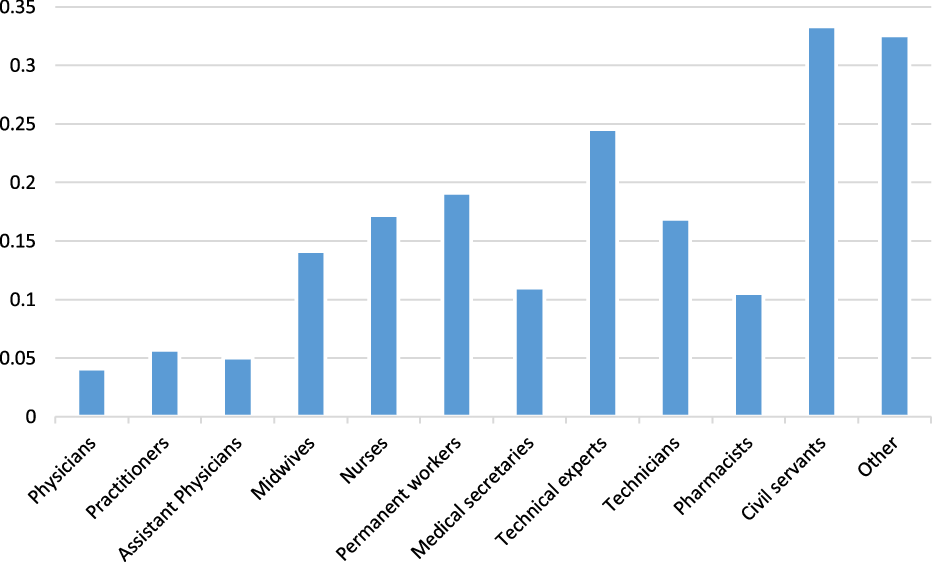
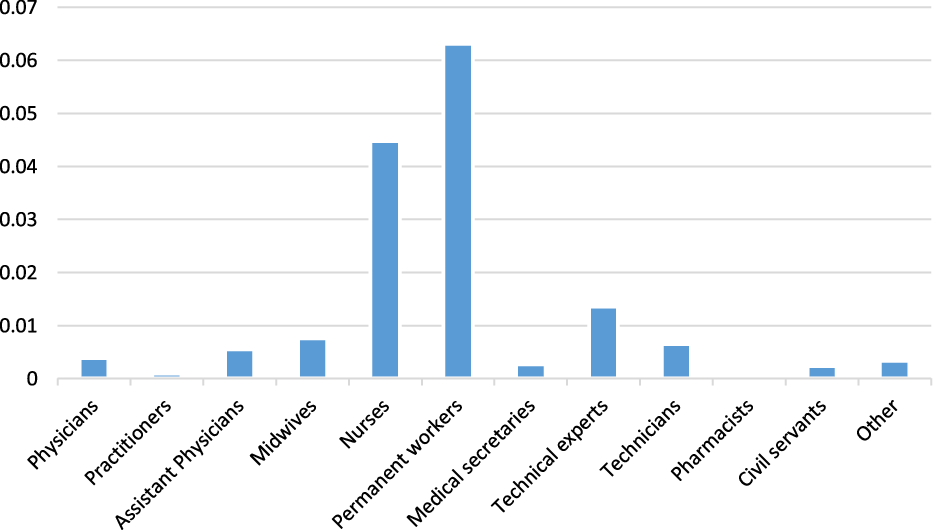
A total of 915 physicians work at the hospital, 43 of them (5%) are vaccine hesitant. The rate of vaccine hesitant HCWs in other occupational groups varies. There were many occupational groups employed with various professional titles that had fewer than 10 members; these HCWs have been grouped under the “other” category. The rate of vaccine hesitant HCWs within each occupational group employed at the hospital is provided in Figure 1. The ratio of vaccine hesitant HCW by occupational groups to the total number of HCWs in the hospital is seen in Figure 2.
Vaccine hesitant HCW rate of occupational groups.

Vaccine hesitant HCW rate of occupational groups among total HCWs.

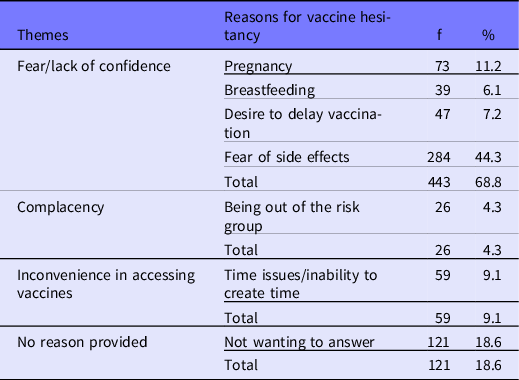
Among the HCWs employed at Kartal Dr. Lütfi Kırdar City Hospital, 649 of the vaccine hesitant were asked about the reasons for having hesitation toward the vaccine. As seen in Table 2, this information has been categorized into the 3 main factors which was put forth by the WHO: [i] fear/lack of confidence (they do not trust and/or fear the vaccine); [ii] complacency (they do not perceive a need or value of a vaccine); and [iii] inconvenience in accessing vaccines (they had difficulties in accessing the vaccine).
Reasons for vaccine hesitancy of the HCW

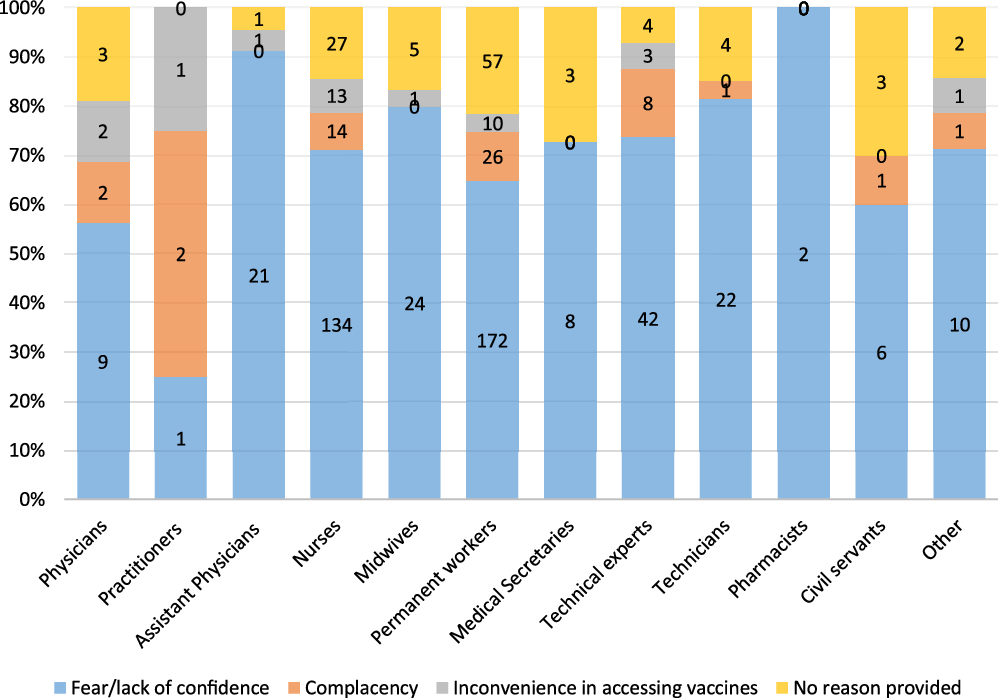
It can be seen that 121 of the 649 personnel (19%) did not state a reason for their vaccine hesitancy or stated that they did not want to provide an answer (Table 2). It is noteworthy that the most common reason for vaccine hesitancy of the 443 HCWs (69%) is under the theme of fear/lack of confidence. The most cited reason within this category (44%) was the fear of side effects. A total of 112 people (17%) reported vaccine hesitation due to pregnancy and breastfeeding; everyone who was hesitant in this category were female HCWs. Within this category, 47 people (7%) stated that they would delay vaccination and observe how events unfold before and make a decision. Within the theme of complacency, 26 (4%) of the HCWs stated that they did not need the vaccine as their main reason for vaccine hesitancy. Under this category, HCWs stated that they had previously had COVID-19, thought they had antibodies, or did not need it. The third theme, inconvenience in accessing vaccines, included 59 HCWs (9%). Issues about not being able to create time due to personal or work responsibilities were mostly expressed. The distribution of the reasons for vaccine hesitancy according to their profession is shown in Figure 3.
Reasons for vaccine hesitancy among HCWs by profession.

When looking at the reasons why HCWs are vaccine hesitant, it is clearly seen in Figure 3 that the most common theme for all professions is fear/lack and of confidence. Graphically, attention is drawn to the fact that mostly nurses and permanent workers stated an inconvenience in accessing vaccines and thought they did not need the vaccine (complacency category).
Discussion
In Turkey, on January 14, 2021, the Ministry of Health determined the HCWs as group “A” as the first of the priority groups in vaccination. 6 In this study, HCWs and all hospital personnel without medical training who took part in technical and logistical jobs were included and identified as HCW. Because this is a single-center study, the results cannot be generalized. However, the hospital where the study was conducted, Kartal Dr. Lütfi Kırdar City Hospital, is 1 of the largest public hospitals in Istanbul. Throughout the COVID-19 pandemic, this hospital continues to serve as a pandemic hospital and is 1 of the largest vaccine administration centers. A total of 85% of the hospital personnel who participated in this study were vaccinated with either Sinovac or Pfizer/BioNTech. It has previously been shown that the knowledge and attitude of HCWs about vaccines has a significant effect on its acceptance by their patients. This is due to their recommendation and own vaccination and protection. Reference Clark, Cowan and Wortley7,Reference Zhang, While and Norman8 For this reason, the rate of participation of HCWs in a vaccination program can be considered a strong indicator for the participation of society.
During the pandemic, although herd immunity rate is often said to be 60% for COVID-19, in R0-based modeling studies conducted over certain periods, it was claimed that even 43% would be sufficient. Reference Britton, Ball and Trapman9 However, the WHO did not mention any specific rates and emphasized that, “the proportion of the population that must be vaccinated against COVID-19 to begin inducing herd immunity is not known.” Consequently, the highest proportion possible of the population becoming vaccinated should be the vaccination target of world countries. 10 In our study, vaccination rates for HCWs and society should be administrated and high immunization rates should aim to be achieved throughout the pandemic. In the Concise Systematic Review (conducted with data from many countries) by Sallam on COVID-19 vaccine acceptance rates among health-care workers (doctors and nurses) were found with vaccine acceptance rates ranging from 28% in the Democratic Republic of the Congo to 78% in Israel. In our study, the rate of vaccine acceptance was much higher in HCWs. Reference Sallam11
In many studies from the literature, professions such as permanent workers, technical experts, technicians, civil servants, medical secretaries, and other occupational groups are referred to as “nonprofessional support staff,” because they do not directly administer medical care or treatment in the hospital, but rather, supply additional services. In our study, we preferred to classify these groups as well. The most vaccine hesitant HCWs in the hospital were the permanent workers (63%), nurses were second (45%), and the ratio was much less for physicians (10%) (sum of specialist, assistant, and general practitioners). When we compare these 3 groups within themselves, among the vaccine hesitant HCWs, the number of permanent workers is higher than the number of nurses and physicians. However, when we compare these occupational groups within their own occupational groups, an important point stands out. The rate of vaccine hesitancy is 5% for physicians (specialist, assistant, and general practitioners), 17% for nurses, and 19% for permanent workers within their own occupational groups.
The reason why these 3 occupational groups have a specific importance in our study, is because they are the 3 occupational groups with the highest employment numbers in the hospital. If we make a comparison among these 3 groups, vaccine hesitant physicians constitute only 5% of all physicians working in the hospital. When physicians are examined within themselves, 4% of specialist physicians, 5% of assistant physicians, and 6% of general practitioners are vaccine hesitant. An interesting result has emerged here: as the physicians gained more scientific knowledge and education, the rate of vaccine hesitancy slightly decreased. When the vaccine hesitancy rate among occupational groups other than physicians is compared, we find that 17% working in nursing services, 14% of midwives, 19% working in “permanent worker” status, 11% of medical secretaries, 25% of technical experts, 17% of technicians, 11% of hospital pharmacists, and 33% of civil servants have hesitation toward the COVID-19 vaccine.
In a recent study on HCWs, Dror et al. revealed the vaccine acceptance rates of the COVID-19 vaccine and the seasonal influenza vaccine for physicians and nurses. It was found that the vaccine acceptance rate of physicians for the seasonal influenza vaccine and the COVID-19 vaccine was significantly higher from that of nurses. There are 2 interesting results here. First, while the acceptance rate of physicians for these 2 vaccines was higher than nurses, both nurses and physicians accepted the influenza vaccine more often than the COVID-19 vaccine. Reference Dror, Eisenbach and Taiber12 In a study conducted by Torun and Torun in 2010, it was stated that the immunization rate of the pandemic influenza A/H1N1 vaccine was higher in physicians than in nurses. Reference Torun and Torun13 Second, the study by Dror et al. compared the preferences of nurses and physicians with the general HCWs population at that hospital. It was found that health-care providers (physicians and nurses) who were caring for COVID-19 positive patients appeared to be less confident about the COVID-19 vaccine than the general population; nurses were also found to be more hesitant about vaccination than physicians. Reference Dror, Eisenbach and Taiber12 The result being that physicians and nurses will not administer the COVID-19 vaccines to their children at higher rates than the general population. However, no COVID-19 vaccine that is currently available has been approved by the WHO. Although our study obtained similar results, the conclusion is different.
In April 2009, the WHO announced it as the first pandemic of the 21st century. 14 Important information can be seen when we compare the vaccination rate of the COVID-19 vaccine with that of the influenza A/H1N1 vaccine from this previous pandemic. In a study conducted by Torun and Torun on HCWs in 2010 it was determined that, while the seasonal influenza vaccination rate was 22% in 2009, the pandemic influenza A/H1N1 vaccination rate was only 23% after a second announcement of the pandemic in 2010. By comparing the data from this study to our study and by looking at the effect of the second announcement about the pandemic by the WHO, we see that the COVID-19 vaccine has been more accepted than the pandemic influenza A/H1N1 vaccine, although these are similar groups. Reference Torun and Torun13
In our study, reasons for vaccine hesitance by HCWs fell into the complacency-not needing theme (4%). This same theme was found to be 11% in the study by Dror et al. This theme had the lowest rate in both studies. When these rates were combined, in the study conducted by Torun and Torun on the hesitancy of the pandemic influenza A/H1N1 vaccine in 2010, the rate of complacency-not needing theme was 36%. Reference Dror, Eisenbach and Taiber12,Reference Torun and Torun13
It is seen that HCWs who do not directly give care to COVID-19 positive patients have less confidence in the COVID-19 vaccine when compared with general HCWs. As for professions, nurses are more hesitant to be vaccinated than physicians. With regard to this aspect, we found similar results in our study: the rate of hesitancy in nurses was higher than physicians. Reference Dror, Eisenbach and Taiber12
The “vaccine hesitancy scales” made before the COVID-19 pandemic revealed that there were 2 main reasons for vaccine hesitancy. These were the “lack of confidence” and “risks.” In fact, these 2 reasons point to the theme of fear/lack of confidence. Reference Shapiro, Tatar and Dube15
In our study, the main theme expressed by HCWs as the reason for their hesitancy toward the COVID-19 vaccine was the fear/lack of confidence (69%). When the reasons of this theme were examined, the most frequently stated was “fear of side effects” (44%). In a study conducted by Dror et al. using these same themes on HCWs, the rate of fear/lack of confidence theme was found to be similarly high. However, while the most expressed reason in our study was the “fear of side effects” the study by Dror et al. found that concern over the quality control of the vaccine was highest. Reference Dror, Eisenbach and Taiber12 We think that the concern of vaccine side effects that was expressed in our study included concern for the inadequate quality control of vaccines. This is due to the fact that we conducted our study while an active vaccination campaign was being carried out in Turkey; the Sinovac vaccine (which was most widely used in the country during the period we conducted the study) had not yet been approved for use by the WHO. Therefore, although this similar theme is dominant, Dror et al. attributed the predominance of this theme to the “rapid development” of the vaccines.
We think that the “lack of data during the administration process” of the vaccines was significant in our study. In addition, it is thought that the difference in the distribution of the fear/lack of confidence theme could vary according to different countries. An important reason for that difference could be associated with the new vaccine technologies being produced. A few of the first vaccines currently available are based on a new mRNA technology, and there is a lack of data about the long-term safety of these types of vaccines in the literature. Reference Laine, Cotton and Moyer16 If we look at another reason of the fear/lack of confidence theme, while Dror et al. used “wait for next year” and “wait until others are tested” as different reasons in their study, we combined them into a single one, “desire to delay vaccination.” However, in their study, this rate was almost double of that of ours. Reference Dror, Eisenbach and Taiber12
There are many reasons for this difference, their study measured perspectives before vaccinations began as well as the long-term safety doubts of mRNA technology. In our opinion, 1 of the reasons for the difference in the rates between these 2 studies (even though they are the same reason) could be due to the availability of vaccines within each country. At the time of this study (May 6, 2021), Israel has the largest vaccinated population in the world (63%) while Turkey, on the other hand, has been able to vaccinate only 17% of its entire population. Countries who had created and provided early vaccination agreements from the beginning of the pandemic, may reflect a tendency for people to delay vaccination and observe how the vaccine campaigns progress. 17
In our study, women were in the majority for COVID-19 vaccine hesitancy (60%). In a study conducted by Kwok et al., it was revealed that gender was not a determining factor in the decision to vaccinate, although women were in the majority for vaccine hesitancy. In the study conducted by Torun et al. on vaccine hesitancy for the A/H1N1 vaccine as well as a study by Murphy et al., women were also the largest group. Reference On Kwok, Li and Wei4,Reference Torun and Torun13,Reference Murphy, Vallières and Bentall18 The most frequently used reasons for vaccine hesitancy in the majority of women in our study were pregnancy, pregnancy suspicion, plans to become pregnant, and breastfeeding. Additionally, it was determined that pregnancy and breastfeeding were also the most common reasons for a lack of confidence in the occupational groups such as assistant physicians, specialist physicians, nurses, and midwifes.
Similar to other studies, we think that the reason for vaccine hesitation in women is not because of “gender basis,” but is instead mostly due to the lack of vaccine studies about the effects of the vaccines on pregnant women and breastfeeding mothers. However, none of the vaccines produced for COVID-19 are live vaccines and none are expected to significantly pass into breast milk and affect the baby. Reference Anderson19 This reason for hesitation was also used less frequently in the study conducted by Dror et al. Reference Dror, Eisenbach and Taiber12 Vaccine acceptance rates and reasons should be evaluated separately for each pandemic, and the change in their numbers should be examined closely in future pandemics.
In a review and meta-analysis of studies using large nationally representative samples, by Robinson et al., it was shown that, as a pandemic progresses, the percentage of people who accept vaccination decreases while the percentage of people with vaccine hesitation increases. For this reason, we recommend that the conditions that cause vaccine hesitancy be documented and examined throughout the process of social immunization. Reference Robinson, Jones and Lesser20 The WHO emphasized that administrators should closely study the concept of “vaccination hesitancy” and determine a strategy with an understanding that, “the extent and nature of vaccine hesitancy needs to be better understood at local levels”. Reference MacDonald1 Strategies to increase confidence in vaccination should be evaluated within the political, social, cultural, and economic contexts of each country. Improving knowledge about vaccine confidence, efficacy, or requirement could be decisive in reducing vaccine hesitancy. Because HCWs have the potential to influence patient vaccination, it is essential to increase their confidence in vaccination and involve them in activities targeting vaccine hesitancy among their patients. Reference Karafillakis, Dinca and Apfel21
Limitations
Although the hospital where the research was conducted is one of the largest public hospitals in Istanbul, data were collected from a single center. Because this is a single-center study, the results cannot be generalized. Data collected from health-care professionals who are hesitant about vaccination are limited to April 2021.
Conclusion
The fact that supplying the world with vaccines is one of the first targets right now might cause another important issue, vaccine hesitancy, to be overlooked. However, vaccine hesitation is a challenge that can be overcome with detailed monitoring and policy-making. With this pandemic, we should organize the postpandemic world to reduce chaos and complication and take the correct steps based on the guidance of previous experiences. Although the vaccine seems to be more significant than anything else right now, we do not want to see vaccine hesitancy grow more than the vaccine itself, in the future. Our previous experiences are our best guide.
Availability of Data and Materials
The authors agree to the conditions of publication including the availability of data and materials in our manuscript.
Author Contributions
Concept: S.Y., F.U.Ç.; Design: N.M.H., E.Y.; Supervision: S.Y.; Materials: E.Y., R.A., M.M.A.; Data: E.Y., M.M.A., R.A.; Analysis: S.Y., F.U.Ç.; Literature search: R.A., N.M.H., E.Y.; Writing: S.Y., R.A., E.Y.; Critical revision: S.Y., F.U.Ç., N.M.H.
Funding
The authors received no financial support for the research, authorship, and/or publication of this article.
Declaration of Conflicting Interests
The authors declare that they have no conflicts of interest.
Ethical Approval
This study was approved by the local ethics committee. The principles outlined in the Declaration of Helsinki have been followed.
Informed Consent
Written informed consent for publication was received from the participants.