Introduction
There is increasing evidence that poor maternal nutrition extending from before conception into early pregnancy can have important effects on the postnatal health of offspring. Offspring born to mothers exposed to the Dutch Famine around the time of conception had increased risk of cardiovascular and metabolic disease in adult life.Reference Roseboom, de Rooij and Painter 1 In rats, maternal protein restriction for as little as 4.5 days in the period before implantation leads to hypertension in the offspring.Reference Kwong, Wild, Roberts, Willis and Fleming 2 Periconceptional undernutrition in sheep also resulted in impaired glucose tolerance of adult offspring.Reference Todd, Oliver, Jaquiery, Bloomfield and Harding 3
Altered hypothalamo–pituitary–adrenal axis (HPAA) function may play an important role in mediating the effects of an adverse intrauterine environment on the development of disease in postnatal life. In rats, protein malnutrition of pregnant dams leads to hypertension in the offspring, an effect dependent on altered HPAA function in the offspringReference Langley-Evans, Gardner and Jackson 4 and mediated by in utero exposure to excess maternal glucocorticoids.Reference Lesage, Blondeau, Grino, Breant and Dupouy 5 Early pregnancy exposure of ewes to synthetic glucocorticoids also results in hypertension in the adult offspring.Reference Dodic, Hantzis and Duncan 6 Subsequent studies in sheep showed perturbed glucose metabolism in the offspring after maternal exposure to synthetic glucocorticoids.Reference Sloboda, Challis, Moss and Newnham 7 , Reference De Blasio, Gatford, Robinson and Owens 8 However, in this case, although offspring HPAA function was enhanced in foetal and early postnatal life, it was profoundly suppressed in adult life.Reference Sloboda, Moss and Li 9 , Reference Sloboda, Moss and Li 10
We have shown in sheep that maternal undernutrition before and for the first 30 days of pregnancy leads to precocious activation of the foetal HPAAReference Bloomfield, Oliver and Hawkins 11 and an increased incidence of preterm birth.Reference Bloomfield, Oliver and Hawkins 12 Regulation of early postnatal growth in offspring from periconceptionally undernourished (PCUN) mothers also appears to be perturbed, with dissociation of growth velocity from circulating concentrations of key endocrine regulators of growth.Reference Jaquiery, Oliver, Bloomfield and Harding 13 There was also advanced pancreatic maturation in the foetus,Reference Oliver, Hawkins and Breier 14 followed by impaired glucose tolerance in early adulthood, and this effect was sex specific.Reference Todd, Oliver, Jaquiery, Bloomfield and Harding 3 Previous studies in sheep have also shown sex differences in the development of HPAA function.Reference Gardner, Van Bon and Dandrea 15 – Reference Wallace, Milne, Green and Aitken 19
Others have reported enhanced plasma adrenocorticotropic hormone (ACTH) and cortisol responses to arginine vasopressin plus corticotropin-releasing hormone (AVP + CRH) in 3-month-old lambs born to ewes undernourished from 14 days before to 70 days after mating,Reference Hawkins, Steyn and McGarrigle 20 but reduced ACTH and cortisol responses to AVP + CRH stimulation in 12-month-old female offspring following a restricted maternal diet for the first 30 days of pregnancy.Reference Gardner, Van Bon and Dandrea 15 Recent sheep studies using the same 30-day period of maternal undernutrition report enhanced adrenocorticoid output in 2.5-year-old female offspring.Reference Poore, Boullin and Cleal 18 Further, behaviour (including stress responses) of offspring of ewes exposed to periconceptional undernutrition, is modified by sex and singleton/twin status.Reference Hernandez, Harding and Oliver 21 , Reference Hernandez, Matthews, Oliver, Bloomfield and Harding 22
There are no longitudinal data on postnatal HPAA function following establishment of a stable plane of maternal undernutrition at conception, in both females and intact males, and distinguishing singletons and twins. We therefore aimed to investigate the changes in postnatal HPAA function over time in offspring of ewes undernourished in the periconceptional period, studying both females and intact males, as well as singletons and twins.
Materials and methods
Animals
Ethical approval was obtained from the University of Auckland Animal Ethics Committee.
Four- to 5-year-old Romney ewes were acclimatized for 10 days to indoor conditions, and to a pelleted concentrate diet (65% lucerne, 30% barley with limestone, molasses and trace element supplements; Camtech Nutrition Ltd, Hamilton, New Zealand). Ewes were randomly allocated to one of the two treatment groups. Controls (N) were fed a maintenance ration of concentrates at 3–4% body weight/day from 61 days before mating. PCUN ewes were undernourished from 61 days before until 30 days after mating, then fed in the same way as N for the remainder of the experiment. During undernutrition, feeds were adjusted individually to achieve and maintain a weight reduction of 10–15% body weight.Reference Todd, Oliver, Jaquiery, Bloomfield and Harding 3 Restricted feed intake was initially 1–2% of body weight/day, increasing to approximately 80% of N levels (4% of body weight per day) by the end of the undernutrition period.
Ewes were housed indoors in a photoperiod-controlled feedlot from 71 days before mating until 2 weeks after lambing. Ewes were kept in individual pens during the undernutrition period (PCUN ewes only), and from 2 weeks before until 2 weeks after lambing. At all other times, animals were housed in group pens.
Two weeks before mating with Dorset rams, oestrus was synchronized using an intravaginal progesterone-release device (Eazi-Breed CIDR; Pfizer, NZ, Ltd).Reference Wheaton, Windels and Johnston 23 After birth, lambs were weighed and remained with their mothers indoors for the first 2 weeks. In the cohort described in this study, length of pregnancy was not affected by nutritional group or lamb sex; however, twins were born 2 days later than singletons (147.4 ± 0.3 v. 145.3 ± 0.5 days, P < 0.001). Ewes and lambs were then returned to the pasture outdoors and managed as part of a single flock. Although on pasture, animals were kept acquainted with concentrate feeds and handling to allow better acclimatization on re-entry to the feedlot for challenge tests.
At 4, 10 and 18 months of age the offspring were again brought indoors, housed in individual pens and fed concentrate feeds. After an acclimatization period of 2 days, animals were weighed and indwelling catheters (size 040, Critchley Electrical, Auburn, Australia) were inserted into both jugular veins under local anaesthesia. At 10 and 18 months, ewes were also fitted with CIDRs to prevent oestrus during the tests. Five days after catheter insertion, animals underwent AVP + CRH challenge. After a 3 ml baseline blood sample, equimolar doses of bovine CRH 0.5 μg/kg and AVP 0.1 μg/kg, (both Sigma Chemical Co., St Louis, MO, USA) were given intravenously. Further 3 ml samples were taken at 15, 30, 45, 60 and 120 min. Catheters were removed after the tests and the animals were returned to the pasture.
Hormone analysis
Blood samples were collected on ice, centrifuged at 3000 rpm for 10 min at 4°C, and the plasma were divided into two aliquots and stored at −20°C until analysis. Plasma ACTH was measured using a commercial radioimmunoassay kit (DiaSorin Inc., Stillwater, MN, USA) previously validated for sheep,Reference Jeffray, Matthews, Hammond and Challis 24 with inter- and intra-assay coefficients of variation being 13.1% and 7.6%, respectively (n = 37). Plasma cortisol concentrations were measured by liquid chromatography tandem mass spectrometry as described previouslyReference Rumball, Oliver and Thorstensen 25 with mean inter- and intra-assay coefficients of variation of 11% and 4.3%, respectively (n = 50).
Statistics
Data are presented as means ± s.e.m. Total area under the curve (AUC) for cortisol and ACTH responses were calculated from baseline until 60 min following AVP + CRH. Where a single data point was missing (because of practical difficulties of sampling or assay), the missing value was obtained by extrapolation for the purposes of calculating AUC. If more than one data point were missing, the data were excluded from this calculation. AUC for cortisol and ACTH at different ages were compared using analysis of variance (ANOVA) with the Tukey correction for multiple comparisons. Body weight, baseline plasma concentrations of cortisol, ACTH and AUC parameters at each age were analysed using factorial ANOVA with nutrition group, sex and single/twin status as independent variables. The time courses of the plasma cortisol and ACTH concentrations during the AVP + CRH challenge were analysed using repeated measures of ANOVA with group, sex and single/twin status as covariates. The independent effects of nutritional group, sex, single/twin status, birth weight and current weight were analysed using multiple regression.
Results
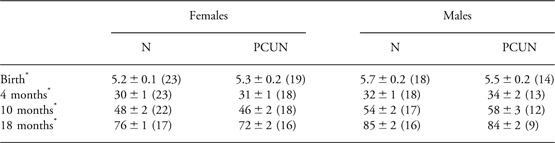
A total of 74 offspring were born to 49 ewes (Table 1); 41 offspring from 26 N ewes (11 singles, 30 twins) and 33 offspring from 23 PCUN ewes (13 singles, 20 twins). Mean birth weight was 5.4 ± 1 kg, and nutrition group had no effect on weight at any age (Table 1). Males were heavier than females at all ages (P < 0.05; Table 1), whereas singletons were heavier than twins at birth (5.7 ± 0.1 v. 5.3 ± 0.1 kg, P < 0.05) and 4 months of age (33 ± 1 v. 30 ± 1 kg, P < 0.05).
Offspring weight (kg) at birth, 4, 10 and 18 months of age

PCUN, periconceptionally undernourished; N, well nourished.
Data are mean ± s.e.m. (n).
*P < 0.05 for sex effect.
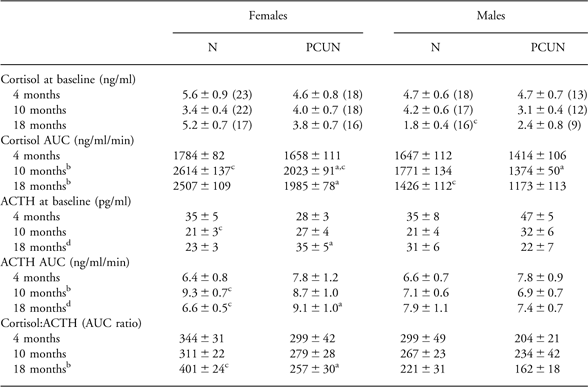
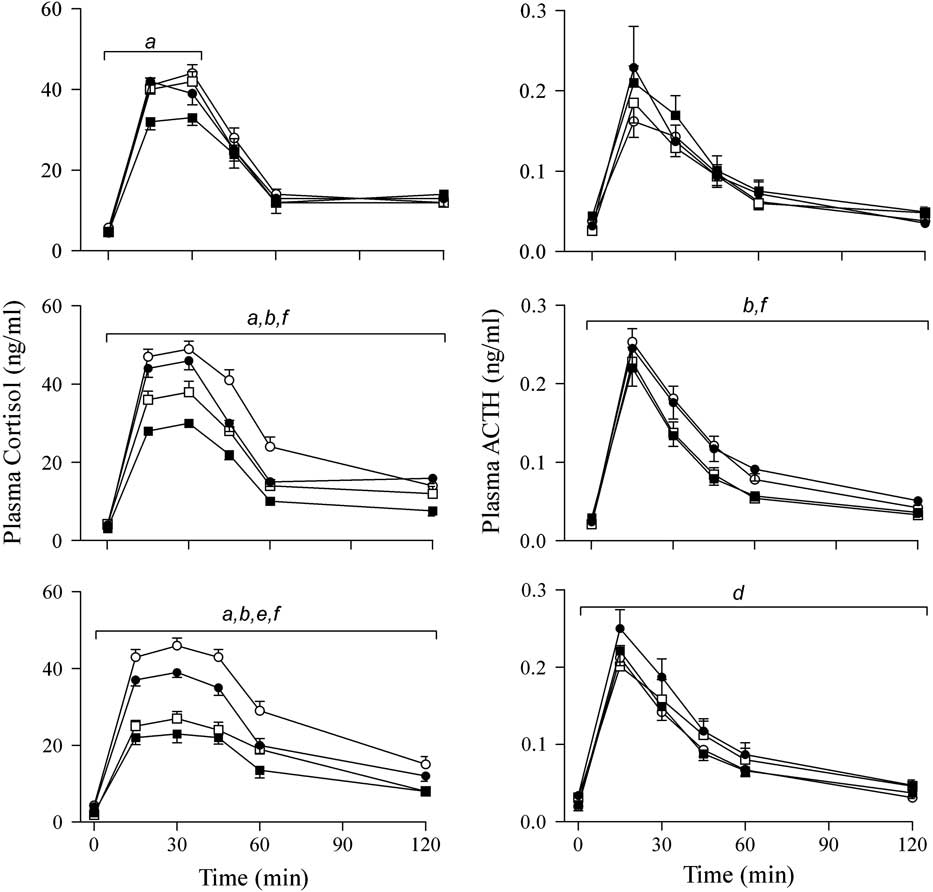
Baseline plasma cortisol concentrations were similar in all groups at 4 and 10 months of age (Table 2). At 18 months, baseline plasma cortisol concentrations were approximately 60% lower in N males than in other animals (Table 2). Plasma cortisol AUC was similar in all groups at 4 months of age (Table 2). However, over the first 30 min of the challenge, plasma cortisol concentrations were higher in the N than in the PCUN group, with the effect more marked in males (P < 0.05; Fig. 1). Plasma cortisol AUC increased by approximately 25% from 4 to 10 months in females, remaining relatively stable until 18 months (Table 2). However, plasma cortisol AUC in males did not change from 4 to 10 months, but decreased by 20% at 18 months in the N group (Table 2). At both 10 and 18 months of age, plasma cortisol AUC was greater in females than in males, and was approximately 30% greater in N than PCUN animals, with no significant sex times nutrition group interaction (Table 2).
Plasma cortisol and ACTH concentrations at 4, 10 and 18 months of age

ACTH, adrenocorticotropic hormone; PCUN, periconceptionally undernourished; AUC, area under the curve; N, well nourished.
Data are mean ± s.e.m. (n).
a P < 0.05 for nutrition effect within sex.
b P < 0.05 for sex effect.
c P < 0.05 for comparison with value at previous age.
d P < 0.05 nutrition group × sex interaction.
Plasma cortisol (left) and adrenocorticotropic hormone (ACTH; right) responses to arginine vasopressin plus corticotropin-releasing hormone stimulation at 4 months (top), 10 months (middle) and 18 months (bottom) in control (N) females (○), periconceptionally undernourished (PCUN) females (●), N males (□), and PCUN males (▪). Data are mean ± s.e.m. a Effect of nutrition group (P < 0.05); b effect of sex (P < 0.05); d nutrition group × sex interaction (P < 0.05); e time × nutrition group interaction (P < 0.05); f time × sex interaction (P < 0.05).

Baseline plasma ACTH concentrations were similar in all groups at 4 months of age, but decreased in N females at 10 months, remaining lower than in PCUN females at 18 months (Table 2). In males, baseline plasma ACTH concentrations did not change with age and were similar among nutrition groups (Table 2). Plasma ACTH AUC was similar in all groups at 4 months of age, and increased approximately 30% by 10 months in N females, but not in males (Table 2). At 18 months, plasma ACTH AUC decreased again in N, but not in PCUN females (P < 0.05 for nutrition group times sex interaction; Table 2).
Cortisol:ACTH AUC was similar in all groups at 4 and 10 months of age, then increased approximately 30% by 18 months in N females (Table 2). At 18 months, the cortisol:ACTH AUC was thus greater in females than males, and greater in N than in PCUN females (Table 2).
There were no associations between weight at birth or at the time of study and baseline or stimulated hormone concentrations. There was also no effect of singleton or twin status on any of the outcomes measured.
Discussion
Maternal undernutrition from 61 days before to 30 days after conception resulted in suppression of plasma cortisol response to AVP + CRH challenge during postnatal life. This suppression of cortisol response first appeared in the male offspring as early as 4 months of age; however, was clearly evident in both sexes at 10 months, increasing in females but not males at 18 months. Following puberty (∼6 months) cortisol responses were lower in males than females, but were not different between singles and twins. These effects of maternal periconceptional undernutrition on response to AVP + CRH stimulation and the interaction with sex, may contribute to the long-term effects of periconceptional undernutrition on postnatal metabolic and cardiovascular regulation.
The literature describing the consequences of maternal undernutrition for postnatal HPAA function in sheep includes a variety of differently timed and managed nutritional insults, and a mixture of sex and single/twin outcomes. Hawkins et al. Reference Hawkins, Hanson and Matthews 26 reported that moderate nutritional restriction of ewes (at 85% of theoretical requirement) for 14 days before to 70 days after conception resulted in foetuses with suppressed plasma cortisol responses to AVP + CRH stimulation in late gestation. However, in a cohort from the same study exposed to the same nutritional insult, cortisol response to AVP + CRH stimulation was enhanced at 3 months after birth.Reference Hawkins, Hanson and Matthews 26 Similarly, Poore et al.Reference Poore, Boullin and Cleal 18 reported that maternal nutritional restriction for 30 days after mating increased cortisol responses to AVP + CRH in female offspring at 2.5 years of age. In the Hawkins studies, the period of restriction extended into mid-gestation, and the lambs may have been subjected to weaning stress at the time of testing, whereas in the Poore study there was an acute change in the maternal nutrition introduced at the time of conception. Clearly, the hormonal and metabolic milieu of the uterine environment in those studies would be quite different from those reported here, potentially explaining the contrasting effects on postnatal HPAA function.
Diminished cortisol response to AVP + CRH challenge in adult offspring of PCUN ewes may be because of embryonic and foetal development in an environment of altered maternal HPAA function. In rats, maternal undernutrition leads to decreased placental 11β-hydroxysteroid dehydrogenase (11βHSD-2) activity, and thus increased foetal exposure to maternal glucocorticoids.Reference Lesage, Hahn and Leonhardt 27 Exposure of ewes to 11βHSD-resistant synthetic glucocorticoids in mid-pregnancy results in adult offspring with hypertensionReference Dodic, Hantzis and Duncan 6 and altered glucose–insulin homeostasis.Reference De Blasio, Gatford, Robinson and Owens 8 Consistent effects on glucose metabolism are also seen in adult offspring of ewes treated with repeated synthetic glucocorticoid doses in mid-to-late gestation.Reference Sloboda, Challis, Moss and Newnham 7 In the same experiment, HPAA responsiveness in foetal offspring is enhanced in late gestation,Reference Sloboda, Moss and Li 9 but suppressed in adulthood.Reference Sloboda, Moss and Li 10
It is possible that altered maternal HPAA function also mediated the effects of periconceptional undernutrition observed here. Periconceptional undernutrition similar to that reported in this study resulted in the suppression of circulating maternal plasma ACTH and cortisol concentrations,Reference Bloomfield, Oliver and Hawkins 11 and reduced maternal responsiveness to corticotropic stimulation during the period of undernutrition and for at least 20 days after refeeding.Reference Jaquiery, Oliver and Bloomfield 28 However, in mid-gestation, 55 days after the end of undernutrition, placental 11βHSD-2 activity was decreased and the ratio of cortisol to cortisone in foetal blood was increased.Reference Connor, Challis and van Zijl 29 Thus, the embryonic period, during which the developing foetal adrenal gland is capable of producing large amounts of cortisol relative to body weight,Reference Wintour, Brown and Denton 30 was characterized by development in a low maternal cortisol environment, whereas by mid-gestation, at a time when the developing ovine adrenal gland undergoes a period of quiescence,Reference Wintour, Brown and Denton 30 the foetuses could have been exposed to higher concentrations of maternal cortisol after, rather than during, the period of undernutrition. Either of these abnormal exposures to maternal glucocorticoid concentrations could alter the developmental trajectory of the foetal adrenal gland, resulting in accelerated foetal HPAA maturation and function in late gestationReference Bloomfield, Oliver and Hawkins 11 and preterm birth.Reference Bloomfield, Oliver and Hawkins 12 In general, our findings after periconceptional undernutrition are largely consistent with previous findings after exposure to synthetic glucocorticoids in sheep, leading to enhanced foetal but suppressed postnatal HPAA function.Reference Sloboda, Moss and Li 9 We have described similar enhanced foetal maturation, followed by impaired postnatal function, in the glucose–insulin axis in these sheep.Reference Todd, Oliver, Jaquiery, Bloomfield and Harding 3 The relationships between maternal periconceptional undernutrition, twinning, birth size, growth rate up to 12 weeks of postnatal age and postnatal cortisol and other endocrine factors have been reported previously.Reference Jaquiery, Oliver, Bloomfield and Harding 13
Our findings also suggest that the suppressed response to AVP + CRH stimulation in postnatal offspring is due to reduced adrenal cortisol production and release, rather than a defect at the level of the hypothalamus or pituitary, leading to reduced ACTH response to corticotropic stimulation. Cortisol response to AVP + CRH was suppressed at 18 months in both sexes, without any reduction in ACTH response. Indeed, in female PCUN offspring at 18 months of age both baseline ACTH concentrations and ACTH AUC in response to AVP + CRH challenge appear to have increased compared with N offspring, perhaps indicating a compensatory increase in ACTH response reflecting adrenal ACTH resistance. Once again, this is the opposite of our findings in the late-gestation foetus, where PCUN resulted in a decreased ACTH response to AVP + CRH stimulation, but an accentuated 11-deoxycortisol response to metyrapone-induced suppression of cortisol synthesis, suggesting enhanced adrenal responsiveness to ACTH.Reference Rumball, Oliver and Thorstensen 25 Consistent with this, PCUN foetuses also had increased expression of placental 17α-hydroxylase (P450C17), the rate-limiting enzyme in cortisol synthesis.Reference Connor, Bloomfield, Oliver, Harding and Challis 31
Overall, these data suggest that a diminished cortisol response to corticotropic stimulation in postnatal life follows precocious activation of cortisol synthesis during foetal life. Such a response could reflect a trade-off between continued growth v. early maturation in foetal life, representing an adaptive response to an adverse intrauterine environment that has long-term consequences in postnatal life.Reference Gluckman and Hanson 32 Similar findings have been reported for the glucose–insulin axis, with evidence of accelerated pancreatic beta cell maturation in foetal life after periconceptional undernutrition,Reference Oliver, Hawkins and Breier 14 but impaired insulin secretion in postnatal life that worsens with age.Reference Todd, Oliver, Jaquiery, Bloomfield and Harding 3 Mechanisms underlying these effects remain to be determined, but could include alterations in cell cycle genes or in epigenetic changes, similar to those we have recently reported in proopiomelanocortin and the glucocorticoid receptor in the arcuate nucleus of the hypothalamus in late-gestation foetuses exposed to periconceptional undernutrition.Reference Stevens, Begum and Cook 33
A consistent feature in this study was the greater cortisol response in female than in male offspring, regardless of nutritional group. There are sex differences in function at all levels of the HPAA, which may result primarily from stimulatory effects of oestrogen.Reference Canny, O'Farrell, Clarke and Tilbrook 17 Differences in cortisol secretion between the sexes are reported to originate mainly from a higher adrenal steroidogenic enzyme response to ACTH rather than to reception or signal transduction.Reference Canny, O'Farrell, Clarke and Tilbrook 17 Sex differences consistent with our findings have also been reported in other experiments involving maternal nutritional restriction in sheep.Reference Poore, Boullin and Cleal 18 , Reference Wallace, Milne, Green and Aitken 19 One-year-old female offspring born to ewes restricted for the first 30 days of pregnancy showed suppressed ACTH response, but enhanced cortisol response to AVP + CRH, whereas males had enhanced ACTH responses, but similar cortisol responses compared with N.Reference Gardner, Van Bon and Dandrea 15 In guinea pigsReference Kapoor, Petropoulos and Matthews 34 and rats,Reference Liu, Li and Matthews 35 sex differences in the development of postnatal HPAA function have been reported after maternal treatment with synthetic glucocorticoids during pregnancy. These findings emphasize the importance of ensuring that experiments have sufficient power to determine outcomes separately for offspring of both sexes after intrauterine nutritional manipulation.
Interestingly, we did not find any differences between singletons and twins in the outcomes measured. Evidence for the effect of twinning on the risk of adult onset disease in humans is conflicting,Reference Bo, Cavallo-Perin, Ciccone, Scaglione and Pagano 36 – Reference Zhang, Brenner and Klebanoff 43 and most experimental studies are undertaken on polytocous species. However, weReference Rumball, Oliver and Thorstensen 25 and othersReference Gardner, Jamall, Fletcher, Fowden and Giussani 44 have reported in late-gestation foetal sheep that twins have suppressed HPAA function compared with singletons. In contrast, after birth there is increased responsiveness of the central HPAA in twins compared with singletons.Reference Bloomfield, Oliver and Harding 45 This responsiveness is associated with the within-twin coefficient for birth weight, rather than the between-twin coefficient, suggesting an effect of factors related to the growth of individual foetuses rather than to their shared maternal environment. Thus, it is perhaps not surprising that in this study we did not detect any effect of twinning per se, as the substantial effect of periconceptional undernutrition, a shared maternal environmental influence on both twins, may have obscured any subtle changes due to twinning itself.
In conclusion, moderate maternal undernutrition from 61 days before to 30 days after conception results in offspring that develop impaired adrenal response to corticotropic stimulation after birth, an effect seen earlier in males than females. Previously published data show that maternal HPAA function is suppressed during periconceptional undernutrition and that the embryo develops in a low cortisol environment,Reference Bloomfield, Oliver and Hawkins 11 followed by possible increased exposure to maternal cortisol by mid-gestationReference Connor, Challis and van Zijl 29 and accelerated maturation of the foetal HPAA in late gestation.Reference Bloomfield, Oliver and Hawkins 11 Together, these longitudinal data suggest that early maturation of the foetal HPAA, perhaps as an adaptive response to the altered intrauterine corticosteroid environment, incurs the cost of profound postnatal HPAA suppression that worsens with increased age and affects males earlier than females. Periconceptional undernutrition has long-term effects on the endocrinology of the adult offspring that may impact on later health.
Acknowledgements
The authors thank the Health Research Council of New Zealand and the National Research Centre for Growth and Development for funding, and the staff of Ngapouri Research station and the Fetal and Neonatal Growth Group at the Liggins Institute for invaluable technical assistance.