Does the electoral system influence legislators’ behavior in parliament? While this question has received considerable attention in the existing literature, the empirical findings have remained inconclusive. We argue that one possible reason for this is the fact that existing studies have largely relied on incomplete research designs. Two common empirical strategies have been used: (1) cross-national comparison of countries with different electoral systems,Footnote 1 and (2) within country comparison of legislators elected under different rules in mixed member systems (MMS).Footnote 2 Neither of these strategies is ideal for uncovering the effect of electoral systems. The former does not allow full understanding of the causal effects of rules because differences in institutions may be confused with differences in cultural characteristics, historical legacies, or other possible confounding factors that are difficult to measure. Studying MMSs seems a better strategy because it allows us to hold constant confounding factors at the country level while providing the necessary variance in electoral rules.Footnote 3 However, this strategy implies that the average member of parliament (MP) elected under single member district (SMD) rules and the average MP elected under proportional representation (PR) rules are as similar as they can be in all relevant respects other than their mandate type – an assumption that is untenable. Finding that MPs from SMDs are more likely to be mavericks than their colleagues from PR lists may simply reflect the tendency of more independently-minded candidates to run in SMDs.Footnote 4
Given these incomplete research designs it is not surprising that the findings regarding the connection between legislative behavior and electoral institutions have remained inconclusive.Footnote 5 For example, while some cross-national studies report that electoral systems significantly influence party unity, Morgenstern and Swindle show, with data from twenty-three democracies, that the electoral system has no clear effect on whether legislators follow local interests when voting in parliament.Footnote 6 The findings from the MMS studies are also mixed.Footnote 7 Some studies have found that SMD MPs are not significantly more likely to break party unity in parliamentary voting than their PR counterparts once other characteristics – such as party affiliation – are controlled for.Footnote 8 Yet, other studies find that SMD MPs are significantly more likely to be mavericks than PR MPs, even after accounting for relevant controls.Footnote 9 Such contradictory findings have been reported even for the same country.Footnote 10 Contradictory findings have been reported also for parliamentary behavior other than voting, such as committee assignments:Footnote 11 although some studies claim that SMD MPs are more likely than their PR counterparts to serve in constituency oriented committees,Footnote 12 other studies show little evidence of such a connection.Footnote 13
Our research design makes use of a different kind of controlled comparison offered by MMS but not exploited in previous studies – one that allows us to identify the effect of electoral rules on the voting behavior of legislators more rigorously. Specifically, we make use of the fact that in an MMS some legislators can switch district types from one term to the next, i.e., the same legislator can be elected from an SMD for one term, but from a party list for another. This allows us to hold constant a host of variables, including personal particulars (such as a personal inclination against authority), and study whether legislators’ behavior changes when electoral rules change from SMD to PR and vice versa. By observing the change in the voting behavior of those legislators whose mandate type changes and of the others, we can evaluate whether and how different electoral rules causally influence individualism in parliament. As such, the results of the study contribute not only to the literature on legislative behavior and representation, but to institutional theory more broadly by directly evaluating one of its primary claims that institutions influence, rather than simply reflect, behavior.
Using data from four parliamentary terms in Hungary (1994–98, 1998–2002, 2002–06, 2006–10), we find that when the electoral system changes from PR to SMD, then legislators become significantly more constituency oriented in their voting behavior, as indicated by increased levels of defections from the party line of voting. However, when the electoral system changes from SMD to PR, there is no significant change in the voting behavior of legislators. These asymmetric results are novel and run counter to the unqualified argument according to which legislators’ behavior is a response to the constant-sum power of competing principals (i.e., the party and the constituency), so that when the balance of power between them changes due to a change in electoral rules, so does the behavior of legislators.
Overall, our findings strongly suggest that the effect of the electoral system on legislative behavior is not immediate and unconditional. Rather, MPs are creatures of habit bound by their reputation (i.e. by the information they have already revealed about themselves), and change their behavior in response to new rules only under certain conditions. As we elaborate in the conclusion, we suggest that these conditions involve the extent to which one of the principals gains rather than loses power (i.e., gains the ability to sanction legislator's behavior directly). Note that our findings also directly contribute to the literature on electoral system change or reform – an area that, despite its significant practical relevance, has remained relatively unexplored, especially with regard to its effects on the ‘intra-party dimension of politics.’Footnote 14 The lasting influence of past institutions, as uncovered here, may explain why electoral reforms do not always produce the expected results.Footnote 15
Legislative Behavior and The Mandate: Theoretical Argument
The most common (albeit sometimes implicit) argument connects electoral rules and legislative behavior through the incentives to align with the preferences of one actor from a set of competing principals – that is, actors who have a say in a legislator's reelection prospects, but whose interests can be at odds with each other.Footnote 16 Party leaders and constituency voters are the most easily identifiable principals of the legislator.Footnote 17 Both principals expect the legislator to choose the voting alternative that they prefer. Failing to do so is costly for the reelection-oriented legislator because the offended principal can withdraw or decrease its support for them.
When the interests of the two principals coincide, the legislator has no trouble choosing from the set of alternative voting options: he or she chooses the alternative preferred by both principals, and party discipline is observed. When the preferences of these principals are misaligned, however, the legislator must favor one at the expense of the other. Which principal the legislator chooses to favor depends on which one has a greater impact on his or her prospects of reelection, i.e., which offense is costlier. If the reelection goal is best attained through party leadership, then legislators are more likely to adhere to the party line in their voting. If the goal of reelection can be achieved by a direct relationship with voters, then party loyalty in parliament becomes less important. In such a situation, aligning with the party and defecting against voters is likely to be costlier for the legislator than defecting against the party. Therefore, increases in defections would indicate that the legislator is deliberately eschewing the party interests in favor of the constituency.Footnote 18
The relative cost incurred by offending each of the competing principals and consequently the relative power of these principals is, in turn, affected by the electoral system in place. Previous literature argues that electoral systems where voters have no direct say over the reelection of individual candidates encourage legislators to adhere to party loyalty, while those that allow personal votes make parties less relevant for legislators’ political advancement and create incentives for individualism in parliament.Footnote 19 In both systems considered here – SMD and closed-list PR – legislators are likely to depend on party resources such as favorable nomination (including list place), campaign funds, party infrastructure, and party reputation for reelection. However, the extent to which they also depend on the constituency is likely to vary across these electoral systems. Specifically, because personal votes cannot be cast and because the voting behavior of any individual legislator is less consequential for the overall party reputation in a given district, legislators in closed-list PR systems should be less likely to value their constituency as a reelection resource and, therefore, serve party interests in the legislature. In SMD systems, because voters can vote for a specific legislator and because that legislator's behavior is largely responsible for his or her party reputation in the eyes of his or her district voters, legislators should be more likely to value their constituency as a reelection resource and, therefore, serve their interests in the legislature.
When a legislator experiences a mandate change, the balance of power between the two principals is expected to change accordingly: if the change occurs from an SMD mandate to a PR mandate, the party principal gains salience with respect to the constituency principal, thereby incentivizing the legislator to be more responsive to the party's interest. Similarly, when a legislator's mandate changes from PR to SMD, his or her behavior should accordingly accommodate the interests of the electorate over those of the party more often than before.
Research Design
We focus our analysis on an MMS. However, unlike the existing studies that use legislators with a PR mandate as controls for legislators with an SMD mandate, we use MPs who did not change mandate type from one term to the next as controls for those who did. Our approach improves on previous measures of the effect of mandate type on legislative discipline by increasing the expected comparability of the groups, and allows us to test the hypotheses derived from the competing principals theory directly.Footnote 20 Note that our research design is tantamount to studying electoral system change and, therefore, allows extending our results to situations of institutional change more generally.
The Justification and Context of the Hungarian Case
We use data from the National Assembly of Hungary – a post-communist democracy that has held regular democratic parliamentary elections every four years since 1990. Until 2011, this parliament offered an ideal setting for the empirical testing of our arguments because (1) it employed an MMS with 176 out of the 386 MPs elected from SMDs and the rest elected from regional and national party lists, and (2) the mandate type (SMD vs. PR) changed from one term to the next for a number of MPs, while for others it remains the same. We will estimate the impact of changing mandate types by comparing the difference between average defection levels for those MPs whose mandate changed to those whose mandate remained the same.
During the period of our study, the Hungarian MMS combined three ways to elect an MP.Footnote 21 First, in the SMD contests, candidates from different parties competed directly and voters chose their most preferred candidate on the ballot. The candidate who got the most votes won, unless nobody received more than 50 percent of the vote – in which case a runoff plurality contest would be held between the top three candidates and any candidate with more than 15 percent of the vote. Second, Hungary was divided into twenty regional constituencies, which corresponded to counties (megyék). The district magnitude in the regional districts ranged from 4 to 28. In the regional tier, voters voted for the party list and seats were then distributed according to a largest-remainder PR formula. Third, fifty-eight national list seats were allocated to qualifying parties based on votes that were not used to obtain a seat in the first two tiers (so called surplus votes) using the D'Hondt procedure. The regional and national lists were closed. In our empirical analysis, we use two alternative strategies to handle the PR elections: (1) we consider the MPs elected from either regional PR (RPR) or national PR (NPR) list together as having a PR mandate, and (2) we separate the RPR MPs from the NPR ones and estimate the effects for each type.
Because we are combining data over a relatively long period, the likelihood that our results represent an unusual parliamentary term is decreased. Furthermore, we believe that our results are not just characteristic of a transitioning democracy because, during the time-period under consideration, the Hungarian democracy matured and stabilized considerably. Additionally, with its two different PR tiers, the pre-2011 Hungarian case provides us with more information than other MMS systems: it allows studying electoral system change to and from (1) a PR with a large nationwide district (NPR) and (2) a PR with smaller geographically concentrated districts (RPR). Most importantly, however, the generalizability of our study is buttressed by the extent to which we can isolate the effect of institutional changes on legislative behavior – despite the observational nature of our data.
Candidate selection and nomination in Hungary was (and will, in all likelihood, continue to be) a highly centralized process, with party elites playing the most prominent role. National and regional lists could only be proposed by parties, and voters had no say on the order in which candidates appear on the ballots (i.e., lists were closed and there were no democratic procedures within parties to determine list ranks). Centralization also applied to selecting candidates for SMDs: while in some cases local organizations could propose candidates, the central party had the final decision-making power when it came to granting endorsements. Even in the Hungarian Socialist Party (MSZP) – the one with the most decentralized rules – the central party could veto SMD nominations put forth by local party organizations.Footnote 22 Additionally, candidates had to collect at least 750 signatures in their district to be able to run for office in the SMD race. Voters could only sign one petition and, because the possibility of fielding lists at the regional PR tier depended on the number of SMD districts that the party had contested, voters had the incentive to support the candidate of the party that they intended to vote for in the regional PR race. The Hungarian setting during this period, therefore, conforms to the theoretical assumption that both SMD and PR legislators depended on party resources for reelection purposes, while the extent to which they also depended on the constituency varied across tiers.
Candidates in Hungary were allowed to run simultaneously on all tiers of election – a possibility that parties had increasingly used. Mandate change could therefore occur via two different mechanisms: (1) an MP's nomination could change from one tier to another or from double to single nomination, or (2) an MP could be elected from a different tier than previously even if his or her nomination remained the same (i.e., the MP was double nominated both times).Footnote 23 Except for the highest rankings in the national and regional PR tiers (which were usually filled by party leadership), it is not the case that one type of mandate was deemed more prestigious than another.Footnote 24 That is, mandate changes were not the expression of career advancements, or differences in career paths, for the vast majority of party members.Footnote 25 As explained below, our results are similar regardless of the origin of mandate change.
Elections to the Hungarian parliament occur every four years, either in April or May. The electoral law in place during the period under study stipulated that the minimum duration of the campaign season was seventy-two days, but candidacies could be announced as late as twenty days before the election.Footnote 26 For most MPs, nominations were not made official more than four months ahead of the election, thereby restricting most of the campaign season to only a few months before the end of the legislative term. While it is, of course, possible that some MPs learned or had an inkling about these nomination decisions before the official announcement, we believe that it is, in general, reasonable to expect that our voting record data are likely to reflect behaviors induced by mandates received rather than by mandates expected for the following legislative term.
During the time period under study, seven parties were represented in the Hungarian parliament: the left-wing MSZP, the liberal Alliance of Free Democrats (SZDSZ), the right-wing agrarian Independent Smallholders’ Party (FKGP), the centre-right Democratic Forum (MDF), the radical rightist Justice and Life Party (MIÉP), the Christian-conservative Christian Democratic Party (KDNP), and the conservative Alliance of Young Democrats (FIDESZ). The size of these parties has varied over the parliamentary terms with MSZP and FIDESZ gaining influence over time and the others losing it or disappearing altogether.
Since only those MPs who have served in at least two terms are susceptible to mandate change, our sample is composed of the set of all MPs who served in at least two terms between 1994 and 2010.Footnote 27 There are a total of 1,419 cases in our dataset. Because we are looking at change in mandate type, we are losing the first observation for each MP.Footnote 28 Of the remaining 932, 137 MPs changed from the SMD to the PR tier, while 344 remained in the SMD tier; 117 MPs changed from the PR to the SMD tier, and 334 remained in the PR tier.Footnote 29
Measurement Strategy
We measure legislative behavior using MP's parliamentary voting records. In Hungary, almost all votes are publicly recorded at the individual level avoiding the otherwise common selection bias in roll-call votes.Footnote 30 Specifically, we look at the percentage change in the weighted frequency with which an MP disagrees with his or her party line across two consecutive parliamentary terms – a variable labeled Percent Change in Defection Rate. The defection rate for each MP, in each term, is obtained by calculating the share of recorded votes by a given legislator that deviate from the party line of voting, weighted by the closeness of the vote in which the deviation occurred. Following previous research, we infer party line from the behavior of the majority of its members who are present and participate in voting.Footnote 31 That is, when a majority of party members vote ‘aye,’ then ‘nay,’ and ‘abstain’ votes are coded as defections.Footnote 32 When there is no majority of party members who are present voting the same way, then there is no party line and no defections are possible. The participation rate can vary significantly and it is fair to assume that votes where very few party members participate are not important to the party and no clear party position exists. Therefore, for measurement purposes, defection is only possible in the case of those votes where the majority (50 percent or more) of party members are present and voting. Because defections in which the vote was closer are presumably more costly to the party, we weigh each defection by a measure of closeness of the corresponding vote.Footnote 33 Finally, we record the percentage change in defection rate in order to treat changes relatively with respect to each MP's previous level of defection, rather than absolutely.Footnote 34 Our observations of this variable range from −100 to +671.791, with a mean of +0.921.
In terms of additional descriptive statistics, our sample offers considerable variance in the defection rate: five MPs never defected against their party during the terms that they are included in the dataset, while the maximum defection rate was 12.269. The defection rate of an average MP was about 1.288. Comparing groups of SMD and PR legislators in Hungary, previous research shows that the former are more likely to break party unity and engage in constituency work than the latter.Footnote 35 A similar comparison using our data shows that the difference is not striking: the average defection rate is about 1.381 for MPs from SMDs and about 1.202 for MPs from PR lists. This difference is not statistically significant and would lead us to believe that voting behavior across the two tiers does not differ – a conclusion that a careful, more appropriate analysis proves to be false.
Our main explanatory variable is Mandate Change, distinguishing between the groups of returning legislators whose mandate type changed and those for whom it did not. We also include a number of control variables. Double Nomination measures whether a given MP was nominated in both the SMD and at least one of the PR tiers in the current election. Legislators who are double nominated may not behave according to the expectation of single-nominated SMD or PR legislators.Footnote 36 In our setting this may mean that MPs who are doubly nominated and simply happen to be elected from a tier other than that from which they were previously drawn have less of an incentive (or none at all) to change their behavior.Footnote 37 Electoral Security may affect legislator's voting behavior as well as the likelihood of mandate change:Footnote 38 more electorally secure MPs may be more likely to voice their disagreement with the party and less likely to experience mandate change. Therefore, we control for the distance between the candidate's or list's vote share and the effective electoral threshold, defined by Lijphart to be roughly 0.75/(M+1), where M is the district magnitude.Footnote 39 Principal Distance controls for the extent to which the preferences of the two competing principals differ by capturing the distance between the legislator's party ideal point and the position of the median voter in the legislator's constituency on a left–right scale.Footnote 40 We use data assembled by the Comparative Manifestoes Project to obtain party locationsFootnote 41 and, in conjunction with district level electoral returns, to calculate district medians in the way proposed by Kim and Fording.Footnote 42 The variable measures the difference between the location of the MP's party and that of the district median. Additionally, since defection rate may vary across parties,Footnote 43 we measure MP's party affiliation by including party dummies,Footnote 44 and we include parliamentary term dummies to control for any time effects.Footnote 45
Analysis and Results
We use MCMC methods to estimate a multilevel (or mixed) linear regression,Footnote 46 and obtain estimates of the effect of mandate change on the change in an MP's defection rate. Given our definition of comparison groups, we estimate a model with random intercepts and random slopes for two distinct (and non-nested) groups: (1) MPs whose mandate in the preceding term came from an SMD district, and (2) MPs whose previous mandate came from a PR district. The general form of each model of the Percent Change in Defection Rate (ΔDR) for the i th observation is:
 $$ { \% \Delta D{{R}_i}\: = \: {{\alpha }_{j[i]}}\: + \:{{\theta }_{j[i]}}Mandate\,Chang{{e}_i} \cr & + {{\beta }_1}\,double\,Nominatio{{n}_i} \cr & + {{\beta }_2}\,Part{{y}_i}\: + \:{{\beta }_3}\,Parliamentary\,Ter{{m}_i} \cr & + {{\beta }_4}\,Electoral\,Securit{{y}_i}\: + \:{{\beta }_5}\,Principal\,Distance\: + \:{{ \epsilon }_i} \cr} $$
where the grouping indicator j[i] tracks whether MP i previously had an SMD or PR mandate; the αj [ i ] is a Normal (namely, N(μα , σα )) random deviate for the defection of MPs whose mandate did not change from one term to the next; θj [ i ] is the effect of changing mandates, drawn from a normal distribution N(μθ , σθ ); Mandate Change is an indicator variable signaling whether the MP changed her mandate type (from SMD to PR for the first group, and vice versa for the second); and controls are as defined in the previous section.
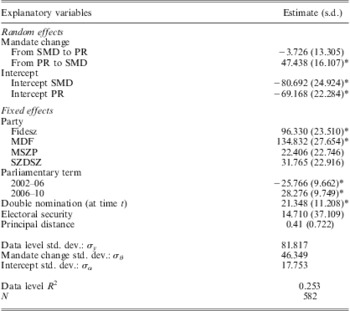
The results of this model, presented in Table 1, only partly support the competing principals theory. Changing the mandate from PR to SMD produces a significant change in voting behavior, i.e., those MPs whose mandate changes become significantly more independent and less partisan than their peers whose mandate remains PR. Specifically, changing mandates from PR to SMD increases the percentage change in an MP's defection rate from one term to the next by about 47 percentage points, which is a change of about half of one standard deviation. However, changing the mandate from SMD to PR does not significantly alter the MP's voting behavior. This finding is surprising and runs counter to the expectations of the competing principals theory. Therefore, we proceeded with additional analyses in an attempt to find out the possible reasons for the unexpected results.Footnote 47
The Effect of Mandate Change on Percentage Change in Defection Rate, Linear Multilevel Model

Note: Table entries are means of posterior sampling distributions of regression coefficients, with the respective distribution's standard deviation in parentheses. Outcome variable is Percent change in defection rate. The reference category for Party is FKGP and for Parliamentary term 1998–2002. *p<0.1.
Different Types of Proportional Representation Lists
Fortunately, the Hungarian setting during the time period under consideration allows us to do more than simply look at the differences between SMD and PR. This is because, as discussed above, the PR seats are filled from two different kinds of lists: of the 210 PR seats, a maximum of 152 mandates are allocated from the twenty regional closed constituency lists and a minimum of fifty-eight mandates are allocated from the closed national (compensation) list. Voters cannot vote for the national list directly; rather, they can cast two votes: one for a candidate in an SMD and one for a regional party list. The allocation of seats from the national lists is decided based on surplus votes from the other two tiers. Therefore, MPs elected from a national list essentially have no easily identifiable geographical constituency. By deciding the composition of the national list, the party becomes their sole principal. In a continuum of constituency-centered to party-centered electoral rules, in the Hungarian case, the SMD tier and the national list tier should represent the opposite ends of the scale respectively with the regional list tier constituting a middle category. MPs from the latter are tied to the party due to closed lists but they also have identifiable geographical constituencies functioning as a possible competing principal and potentially drawing them away from party-centered behavior in parliament. Given this, it would not be surprising if the effect of mandate change differs for the different types of PR. It is equally possible that mandate switches to and from one type of PR are driving our asymmetrical findings.
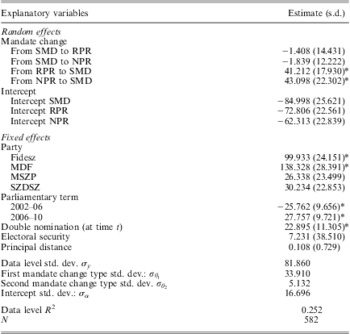
In order to test for this, we estimate the model in Equation 1, but this time with random intercepts and random slopes for three distinct groups of MPs depending on their previous mandate: (1) SMD, (2) RPR, or (3) NPR, each with at most two possible directions of change (for example, the mandate of SMD MPs can change to either RPR or NPR). Table 2 presents the results of this analysis. In general, support for the asymmetry hypothesis remains: a mandate change from SMD to PR – this time to either type of PR – produces no significant change in an MP's voting behavior. However, the effect of the mandate change from PR to SMD is statistically significant for both types of PR: the percentage change in defection rate of those MPs who switch from RPR to SMD increases by about 42 percentage points, and a similar switch from NPR to SMD increases the percentage change by about 43 points.Footnote 48
The Effect of Mandate Change on Percentage Change in Defection Rate, Different PR Tiers, Linear Multilevel Model

Note: Table entries are means of posterior sampling distributions of regression coefficients, with the respective distribution's standard deviations in parentheses. Outcome variable is Percent change in defection rate. The reference category for Party is FKGP and for Parliamentary term 1998–2002. *p < 0.1.
The Effect of the Origin of Mandate Change
As noted above, mandate change can occur via two different mechanisms: (1) an MP's nomination can change from one tier to another or from double to single nomination, or (2) the MP can be elected from a different tier than previously even if his or her nomination remains the same (i.e., the MP is doubly nominated both times). Another test we can perform, then, is to explore whether and to what extent both sources of mandate change influence voting behavior, in order to separate the effects of mandates received from the effects of potential mandates. For instance, it is possible that MPs only respond to mandate changes when they are the result of party decisions – in which case they would change their behavior only (or to a greater extent) when their nomination changes but not when they are simply elected from a different tier without nomination changes. In the latter case, MPs may continue serving their previous principal in the hope of earning a mandate from them again in the future. In order to get at this conditional effect, we augment the number of groupings in the model presented in Table 1 to include all combinations between mandate change and nomination change. Nomination change is coded ‘1’ if an MP's nomination changes (1) from SMD to PR or PR to SMD, (2) from single nomination to double nomination, or (3) from double nomination to single nomination.
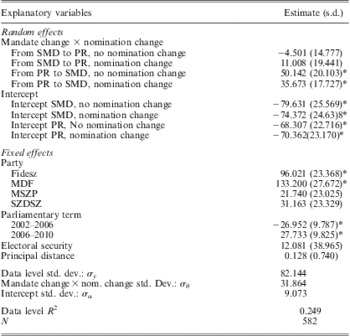
The results of the augmented multilevel model are presented in Table 3. The effect of mandate change in the SMD group remains insignificant regardless of the source of this change. For the PR group, however, (i.e., for those MPs who were previously elected from a PR list), mandate change, regardless of its origin, results in significant change in voting behavior. Specifically, mandate change that results from a nomination change is associated with about 35 percentage point increase in the change in defection rate, and a mandate change that results from being elected from a different tier (even though the nomination remains the same), is associated with about 50 percentage point increase in the change in defection rate. This evidence suggests that behavior is affected by changes in the type of mandate itself regardless of the changes in nomination – as these effects are discernible both when a nomination change is present and when it is not – but also that the effect is even greater when the nomination remains the same.Footnote 49 This attenuating effect of changes in potential mandates (largely controlled by party elites in Hungary) on the effect of changes in the mandate actually received is interesting in and of itself, and future research could explore the strength and logic of this finding. For our purposes, however, the evidence is enough to support the claim that our main substantive result (namely, the asymmetry in effects when mandate changes occur in different directions) is not an artifact of unaccounted changes in nomination. Although the size of the effect of mandate change on legislative behavior depends on the specific avenue through which the change takes place, it is the case that a mandate change from PR to SMD is associated with significant increases in defection rates regardless of the source (i.e., nomination or election) of the change, and that the same is never true when considering changes in the opposite direction.
The Effect of Mandate Change on Percentage Change in Defection Rate Conditional on Nomination Change, Linear Multilevel Model

Note: Table entries are means of posterior sampling distributions of regression coefficients, with the respective distribution's standard deviation in parentheses. Outcome variable is Percent change in defection rate. The reference category for Party is FKGP and for Parliamentary term 1998–2002. *p < 0.1.
Selection Effects
Finally, it is possible that the mechanism for the SMD-to-PR change is different from that of the PR-to-SMD change. This difference in mechanisms might account for the asymmetry in our results. Changes in the former direction can be the result of a punishment already taking place – namely, a stick wielded by the electorate on a legislator who sided with the party all too often. Such legislators would arguably still be of great value to the party, which would explain their reappearance for yet another consecutive term under the same party. Changes in the other direction (i.e., from PR to SMD) cannot be thought of in the same way, because running successfully in an SMD race requires quite a bit of party support – something a consistent party maverick might be hard pressed to get. Hence, changes in the direction of SMD to PR are consistent with a selection process that is not present in the case of mandate changes occurring in the direction of PR to SMD.
To check if this is indeed the case, we explored whether the defection rate was systematically different for MPs whose mandate changed from SMD to PR and MPs whose mandate remained SMD at the time when both sets of legislators had an SMD mandate. Although our response variable is designed to take into account potential differences in ‘baseline’ defection rates, it is possible that systematically smaller changes in already disciplined SMD-turned-PR MPs are obscuring the effects of the mandate change in our modeling strategy. The mean defection rate for the group of MPs whose mandate changed from SMD to PR, however, was actually higher than that of MPs whose mandate remained SMD: the mean defection rate of changing MPs was 2.059, while the mean defection rate of MPs whose mandate remained SMD was 1.321. The difference is significant at the usual confidence levels (p-value is 0.0004), implying that legislators whose mandate changed to PR were actually significantly more likely to defect against the party. Hence, it does not appear to be the case that selection through effective punishment on the part of principals is driving our finding of asymmetry.
To summarize, we have found a significant asymmetry in the effect of electoral system change from SMD to PR and vice versa. The former does not alter MPs’ voting behavior, while the latter significantly increases – by about 35 to 49 percentage points, i.e., by approximately half of one standard deviation – MPs’ percentage change in defection rate against their party. These findings remain robust in the presence of a number of control variables, and when using either multilevel linear regression or matching analysis.Footnote 50 Furthermore, the results hold for both the regional and national PR tier and do not depend on nomination changes, double nomination, or selection effects. Overall, our original findings appear to be robust, but they run counter to the theoretical expectations derived from the argument about competing principals.
One issue that we have not yet addressed is what the literature on MMS often refers to as the ‘contamination effect,’ i.e., the idea that the SMD and PR tiers in such systems are not independent of each other and MPs elected in the SMD (PR) tier of an MMS do not behave as do those elected in pure SMD (PR) systems, because of the presence of the other tier. One might argue that our results emerge only because of the fact that the two tiers may not be independent and, therefore, our results do not help us understand electoral system change more generally.
Contamination has been argued to result from two main sources: (1) the concurrent presence of copartisans elected under different rules can make both SMD MPs and PR MPs less constituency oriented than they would be in pure systems, or (2) the possibility of dual candidacies can make MPs follow a mixed strategy in legislative behavior.Footnote 51 Both arguments imply that the behavior of MPs from different tiers is not significantly different from each other. For our analysis this means that we should find symmetrical null effects for both changes from SMD to PR and vice versa. Our asymmetric results negate this possibility. As for dual candidacy, we have explicitly accounted for this variable in our analyses, and the results regarding the effect of mandate change remain reliable. Moreover, we are including party indicators in all of our models, and this effectively holds the composition of each party's legislative delegation constant, thereby controlling for the effects that come about by having different mixtures of SMD and PR legislators.Footnote 52
Finally, if we are interested in understanding the effects of change of electoral rules for a given legislator on their legislative behavior, this effect should not hinge on the concurrent existence of legislators elected under a different set of rules. In other words, whatever ‘contamination effects’ exist, they are held constant when one focuses exclusively on a single country with a mixed member system, so that any effect we do find is brought about by change in the set of rules that got any individual candidate elected. This is similar to situations where countries change from one type of pure system to another. In sum, while not taking a stance in the contamination debate, we believe that our results have implications beyond mixed systems and help us understand electoral system change more generally.
Discussion and Conclusion
Using a setting that allows us to control for spuriousness in an observational situation, we have explored the effect of change in electoral rules on legislative behavior. We have found that if an MP's mandate changes from PR to SMD, then that MP will become significantly more independent in his or her voting behavior – a relationship that holds for both types of PR used in Hungary, i.e., regardless of whether an MP's previous mandate came from the regional or national PR list. However, if an MP's mandate changes from SMD to PR – including either regional or national PR and regardless of whether the mandate change results from a change in nomination or a change in electoral fortune – then the legislative behavior of that MP does not change significantly. This is a robust but unexpected finding that we were unable to explain away when testing for a number of possible explanations. In this concluding section, we offer two plausible interpretations of the novel finding. They both share the notion that, although hypotheses about the effect of mandate change derived from the competing principals theory is blind to any past experiences, electoral change does not occur in a vacuum. As a result, past experiences and reputations may shape how institutional arrangements affect current legislative behaviors.
First, MPs may be constrained by their personal reputations built under the previous electoral rules. Some studies, for example, argue that nonconformist MPs use party loyalty strategically to fool party elites into promoting them to desirable positions. Once this has been achieved, MPs are free to reveal their true preferences and break unity.Footnote 53 If this is the case, then MPs who have had an SMD mandate and have broken with the party line in order to satisfy their constituency principal cannot credibly play the ‘loyalist’ card once in office through a PR mandate. They may also not want to act as a loyalist if they continue to draw their support from the SMD constituency.Footnote 54 Instead, they are likely to resort to other means to please the party leaders. For example, they could capitalize on the personal reputations built through defying their parties. Studies have shown that parties often reward such MPs for the added support brought about by ‘locals’ and ‘mavericks’ even if it comes at the expense of defections.Footnote 55 In other words, legislative discipline need not be a zero sum game between party leaders and MPs who have proven their personal worth.Footnote 56 As a result, on one hand, SMD-turned-PR backbenchers – having already revealed their ‘true type’ as mavericks – would have no incentive to toe the party line to any greater extent than their colleagues who retained their SMD mandates. Rather, they may have an incentive to maintain their already established reputations as independent thinkers amongst their core constituents.Footnote 57 Their PR-turned-SMD counterparts, on the other hand, cannot afford to keep up a loyalist façade when faced with the possibility of losing the support of voters. A change from PR to SMD would signify not just the possibility, but the necessity, for MPs to increase their defection rates.
Alternatively, it is possible that the lasting influence of past institutions – combined with MPs’ selective incentives to respond to mandate change depending on whether a principal gains or loses power as a result of the change – may account for this persistence of indiscipline. As with any institutional change, the effects of changing the rules through which an MP is elected are likely to be incremental and path-dependent because of the formalization of the existing set of practices.Footnote 58 The actors involved are likely to have adapted to the situation before the change in ways that influence their behavior also after the change,Footnote 59 making them ‘punishment avoiders’ rather than ‘reward seekers.’ The expected change in behavior may, therefore, occur only to the extent that it is necessary to avoid punishment by either principal.
Consider a change from PR to SMD. Legislators who maintain their party-centered behavior acquired under PR are likely to be punished by voters, because now, unlike under PR, voters can vote directly for them and decide when to oust them for being party lackeys. As a result of this added ability to determine a legislator's future, the distribution of power between the two competing principals changes: voters become more powerful than they were under PR. This, in turn, generates a significant incentive for the legislator to adjust his or her prior parliamentary voting behavior and account for constituency interests. However, if the change occurs from SMD to PR, it is possible that a different dynamic takes place. An SMD legislator is already attending to party interests given that he or she needs access to party resources to run. This legislator is also attending to constituency interest and has a history of a favorable personal reputation in his or her district. When the electoral system changes to PR, no principal necessarily gains any additional power, i.e., the ability to punish the legislator for undesirable behavior. At the same time, the constituency-principal loses some of the power it commanded under SMD: namely, the ability to directly vote for or against (and thereby reward or punish) the legislator. Since neither principal gains power over the MP's reelection prospects, neither one has more ability to punish the legislator for defecting than they had before the change of the electoral system.Footnote 60 Thus, while a legislator may choose to abandon constituency interests in favor of party interests in such cases, he or she faces no immediate pressure from the party to do so, suggesting that any changes in legislative behavior resulting from an SMD-to-PR switch are not likely to be sudden and pronounced.
Further investigation of these plausible theoretical avenues for explaining our asymmetric results would not only contribute to the study of political institutions and legislative behavior, but could also provide important lessons for the constitutional engineers interested in encouraging the representational strategies of legislators to be more or less party centered. Specifically, new electoral rules may not produce desired behavior because habits adopted and reputations acquired under previous rules persist, or because they affect the incentive structures provided by the new institutional framework. Reformers would, therefore, be especially well advised to consider (a) the changes that the electoral reform produces in the relative power of the different principals of the MP, and (b) the constraints imposed on MPs who, by virtue of having served under different rules in the past, have revealed information about themselves, in order to predict the consequences of electoral reform more accurately.
Finally, our findings suggest a new way of thinking about MMS. Literature on MMS often refers to the contamination effect described above. Our results suggest a different type of contamination: one that comes from MPs’ personal electoral histories in a different tier, i.e., legislators’ current behaviour may be ‘contaminated’ by having previously been elected under different rules. Rather than being a nuisance, this type of contamination can be informative about possible consequences of electoral reform, as we have suggested here. More generally, our study highlights the benefit of searching for opportunities to exploit controlled comparisons offered by the real world to understand how democratic institutions work. Such comparisons allow better testing of (causal) theories because sources of extraneous variance are held constant by design. With the help of such a comparison, we have been able to provide a more appropriate test of the effect of electoral systems on legislative behavior than has been offered by previous studies.