Introduction
The healthy human brain is capable of carrying out complex mental tasks that rely on processes such as perception, attention, executive function, memory and language. When the brain is affected by stroke, these cognitive processes are often impaired. Approximately 5.5 million people worldwide die each year from either the primary insult or secondary complications of stroke (WHO, 2003), and many more are left with chronic disability. Cognitive deficits make a major contribution to stroke-related disability, with approximately two-thirds of stroke survivors experiencing cognitive impairments (Jin et al., Reference Jin, Legge, Ostbye, Feightner and Hachinski2006). Not only is cognitive impairment a major problem in itself but it is also associated with other negative outcomes including death and disability (Patel et al., Reference Patel, Coshall, Rudd and Wolfe2002), greater rates of institutionalization (Pasquini et al., Reference Pasquini, Leys, Rousseaux, Pasquier and Henon2007) and poorer quality of life (Hochstenbach et al., Reference Hochstenbach, Anderson, van Limbeek and Mulder2001). While a range of treatments have been proposed to help reduce cognitive impairment after stroke, these have so far been poorly tested and have not yielded definitive findings (Lincoln et al., Reference Lincoln, Majid and Weyman2000; das Nair and Lincoln, Reference das Nair and Lincoln2007).
Approaches to cognitive rehabilitation can be classified broadly into two groups: (a) restorative, where the aim is to reinforce, strengthen or re-establish previously learned cognitions or behavior, and (b) compensatory, where new patterns of cognitive activity are established (Cicerone et al., Reference Cicerone2000). Compensatory approaches have had some success in helping people cope with daily challenges (e.g. list-writing for a dementia patient), but do not have a direct bearing on acquired cognitive deficits (i.e. the underlying memory impairment remains). Only limited evidence exists to support the efficacy of restorative interventions for cognitive impairments (Cicerone et al., Reference Cicerone2005). One approach that may prove to be restorative is to increase physical activity levels. Longitudinal epidemiological data indicate that exercise reduces the risk of cognitive decline in healthy older people (Fratiglioni et al., Reference Fratiglioni, Paillard-Borg and Winblad2004), and meta-analyses of intervention studies demonstrate a link between physical activity and cognition in older people (Colcombe and Kramer, Reference Colcombe and Kramer2003; Angevaren et al., Reference Angevaren, Aufdemkampe, Verhaar, Aleman and Vanhees2008). Physical activity can also be beneficial for cognitive performance in older adults with cognitive impairment (Heyn et al., Reference Heyn, Abreu and Ottenbacher2004), in those at risk of Alzheimer's disease (Lautenschlager et al., Reference Lautenschlager2008) and in patients with multiple sclerosis (Prakash et al., Reference Prakash2007). Findings from animal studies provide further support: physical activity can reduce the risk of cognitive decline in mice (Cotman and Engesser-Cesar, Reference Cotman and Engesser-Cesar2002) and rats (Griesbach et al., Reference Griesbach, Hovda, Molteni, Wu and Gomez-Pinilla2004).
Despite the recent research interest in this area (van Uffelen et al., Reference van Uffelen, Chin a Paw, Hopman-Rock and van Mechelen2008; Devine and Zafonte, Reference Devine and Zafonte2009; Smith et al., Reference Smith2010), no review to date has focused on patients with stroke and the effect of physical activity on cognitive function in this population. Exercise (e.g. walking, cycling) represents a simple, feasible, and potentially broadly applicable intervention for people with stroke. Thus, the aim of this systematic review was to determine whether increasing physical activity after stroke leads to improvements in cognitive performance. For the purposes of this review, we use the terms “exercise” and “physical activity” interchangeably and define them broadly as “any bodily movement produced by skeletal muscles that substantially increases energy expenditure over resting expenditure level” (Bouchard et al., Reference Bouchard, Blair and Haskell2007).
Methods
Inclusion criteria
Study designs
All randomized controlled trials (RCTs) and controlled clinical trials that evaluated the effects of a physical activity or exercise-based intervention were included in the review. Other study designs (e.g. cohort studies, observational studies) were captured but not included in the analysis. We did not restrict the search to studies reported in English, and used translation where possible.
Types of participants
The target population was human adults who had suffered stroke. Studies of patients with traumatic brain injury (TBI), slow-onset progressive neurological syndromes (e.g. Parkinson's disease, multiple sclerosis), seizure-related conditions (e.g. epilepsy) or infections (e.g. meningitis) were excluded. Studies that investigated patients with acquired brain injury of various etiologies were included if stroke patients made up more than one-third of the sample.
Types of interventions
Studies that contained any intervention that aimed to increase levels of physical activity or exercise (e.g. walking, therapeutic exercise, participation in sport, active leisure pursuits) were included. Any form of intervention was considered, irrespective of type, frequency, duration or the person delivering the intervention. The experimental group could be compared to either a control condition (normal practice or no intervention) or a different intervention.
Types of outcome measures
The primary outcome measure was change in cognitive performance from pre-intervention to post-intervention. Tests of cognitive function could include assessments in the domains of visuospatial ability, attention, executive function, memory, language, arithmetic or abstract reasoning. Assessments might include a global measure of cognitive function (e.g. Mini-Mental State Examination), individual tests (e.g. Trail-Making Test) or a neuropsychological test battery (a combination of individual cognitive tests). Secondary outcome measures were depression and anxiety.
Search strategy
The initial literature search was carried out in 2008 and included studies of TBI as well as stroke, in an attempt to capture all the information relevant to these types of acquired brain injury. The following electronic bibliographic databases were searched: MEDLINE (1950–2008), EMBASE (1980–2008), CINAHL (1982–2008), SPORTDiscus (1985–2008), PsycINFO (1967–2008), AMED (1985–2008) and the Cochrane Library (up to 2008). The three key search terms – physical activity, cognitive function, stroke/TBI – and their synonyms were combined to identify relevant articles. The initial MEDLINE search strategy was modified to suit other databases (e.g. “exp Motor Activity” became “motor activit*.mp”). The full list of search terms is available from the authors. Once the yield was narrowed down to relevant included studies only, citation tracking on these studies was performed using the following electronic databases: the Science Citation Index Expanded (1975–2009), Social Sciences Citation Index (1975–2009) and the Arts and Humanities Citation Index (1975–2009). A search of the reference lists of the relevant included studies was also undertaken.
The initial search yield was considered to be insufficient, and closer inspection of the included studies led us to question the appropriateness of combining the two diverse populations of stroke and TBI. A subsequent search was undertaken in early 2011 using the same search strategy, but this time TBI studies were excluded.
Study selection
All studies identified using the methods outlined above were considered for inclusion in the review. A reviewer (KT) read the titles of each reference and eliminated any studies that were clearly irrelevant. Abstracts for the remaining studies were obtained. Further elimination occurred and full articles were obtained for any potentially relevant studies. Based on the criteria set out above (types of studies, types of participants, types of interventions, outcome measures), a reviewer (TC) classified these references as relevant, possibly relevant or not relevant. Where necessary, authors of studies that were possibly relevant were contacted and asked to provide additional information or data. Studies classified as possibly relevant were included or excluded on the basis of a consensus meeting with all authors.
Assessment of study quality
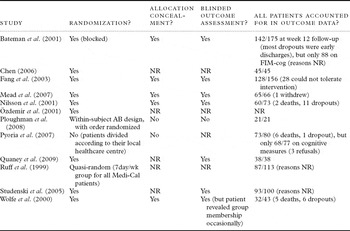
Use of randomization, allocation concealment, blinding of outcome assessment, and whether all the randomized patients were accounted for in the outcome data were examined for each study. These four quality criteria were selected as they are important sources of bias in research trials (Higgins and Green, Reference Higgins and Green2008).
Data extraction and analysis
Relevant data were extracted from the included studies using a standard data recording form. If cognitive outcomes were reported from more than one time point post-intervention, results from the earliest time point were used (enabling us to maximize the available data in cases where there were losses to follow-up over time). In some cases this was immediately post-intervention, in other cases it was up to 12 months post-intervention. For both intervention and control groups, the change score was defined as the difference between the pre-intervention mean and the post-intervention mean. If the review yielded sufficient information, we planned to divide cognitive outcomes into separate domains (e.g. executive function, memory, visuospatial ability). If there were not enough studies that incorporated multiple cognitive outcomes, we would calculate standardized values for each cognitive outcome and then average across these to get a single change score. Baseline standard deviations for both groups were used together with the change scores as input for the meta-analysis (Morris and DeShon, Reference Morris and DeShon2002). Data from studies that contained sufficient information on means and variance were pooled and analyzed using the DerSimonian and Laird random-effect model in STATA version 11.0 (Stata Corp, College Station, TX, USA). The resulting meta-analysis yielded an overall standardized mean difference (SMD). Heterogeneity among studies was tested using the χ2 test, variation in SMD attributable to heterogeneity was estimated using the I2 index, and publication bias was assessed using both Begg's test and Egger's test (Egger et al., Reference Egger, Smith and Altman2001).
Results
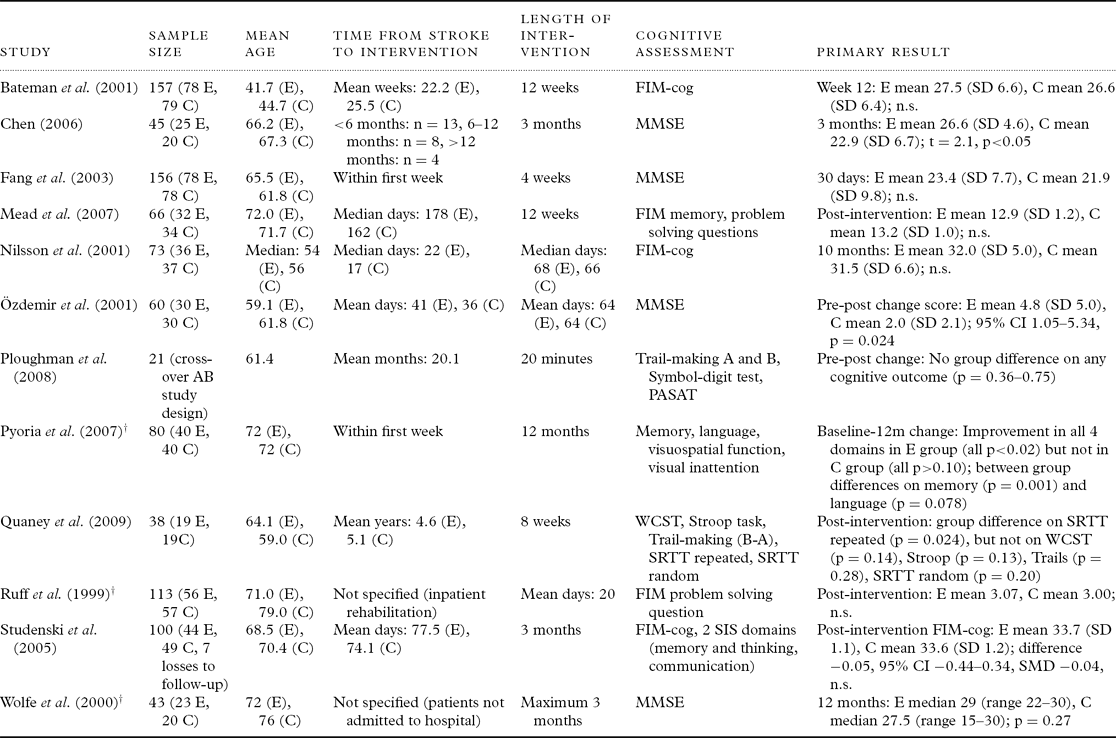
The initial 2008 search yielded 1730 studies, of which 12 satisfied review inclusion criteria (7 stroke, 4 TBI, 1 mixed brain injury). The heterogeneity of these populations precluded a meaningful meta-analysis, and a subsequent search was conducted in 2011 that excluded TBI studies. This search yielded 328 additional studies, of which four satisfied inclusion criteria. Thus, the final yield was 12 studies (7 stroke, 1 mixed brain injury from initial search; 4 stroke from subsequent search). Several studies were relevant to the research question but were excluded as they did not test interventions, reporting associations only (Heinemann et al., Reference Heinemann, Hamilton, Linacre, Wright and Granger1995; Horn et al., Reference Horn, DeJong, Smout, Gassaway, James and Conroy2005); were retrospective in design (Keith et al., Reference Keith, Wilson and Gutierrez1995); did not include a control group (Pyun et al., Reference Pyun, Yang, Lee, Yook, Kwon and Byun2009; Rand et al., Reference Rand, Eng, Liu-Ambrose and Tawashy2010); were still ongoing (MacKay-Lyons et al., Reference MacKay-Lyons2010); or did not report the cognitive aspect of the Functional Independence Measure (FIM) separately, and this information could not be ascertained from the authors directly (Katz-Leurer et al., Reference Katz-Leurer, Carmeli and Shochina2003; Wilson et al., Reference Wilson, Powell, Gorham and Childers2006). Details of the 12 included studies (Ruff et al., Reference Ruff, Yarnell and Marinos1999; Wolfe et al., Reference Wolfe, Tilling and Rudd2000; Bateman et al., Reference Bateman, Culpan, Pickering, Powell, Scott and Greenwood2001; Nilsson et al., Reference Nilsson2001; Özdemir et al., Reference Özdemir, Birtane, Tabatabaei, Kokino and Ekuklu2001; Fang et al., Reference Fang, Chen, Li, Lin, Huang and Zeng2003; Studenski et al., Reference Studenski, Duncan, Perera, Reker, Lai and Richards2005; Chen, Reference Chen2006; Mead et al., Reference Mead2007; Pyoria et al., Reference Pyoria, Talvitie, Nyrkko, Kautiainen, Pohjolainen and Kasper2007; Ploughman et al., Reference Ploughman, McCarthy, Bosse, Sullivan and Corbett2008; Quaney et al., Reference Quaney2009) are presented in Table 1. All but one of these studies included only stroke patients in their sample; Bateman et al. (Reference Bateman, Culpan, Pickering, Powell, Scott and Greenwood2001) included 157 patients with mixed brain injury (70 stroke, 44 TBI, 15 subarachnoid haemorrhage, 12 space occupying lesion, 16 other).
Details of included studies
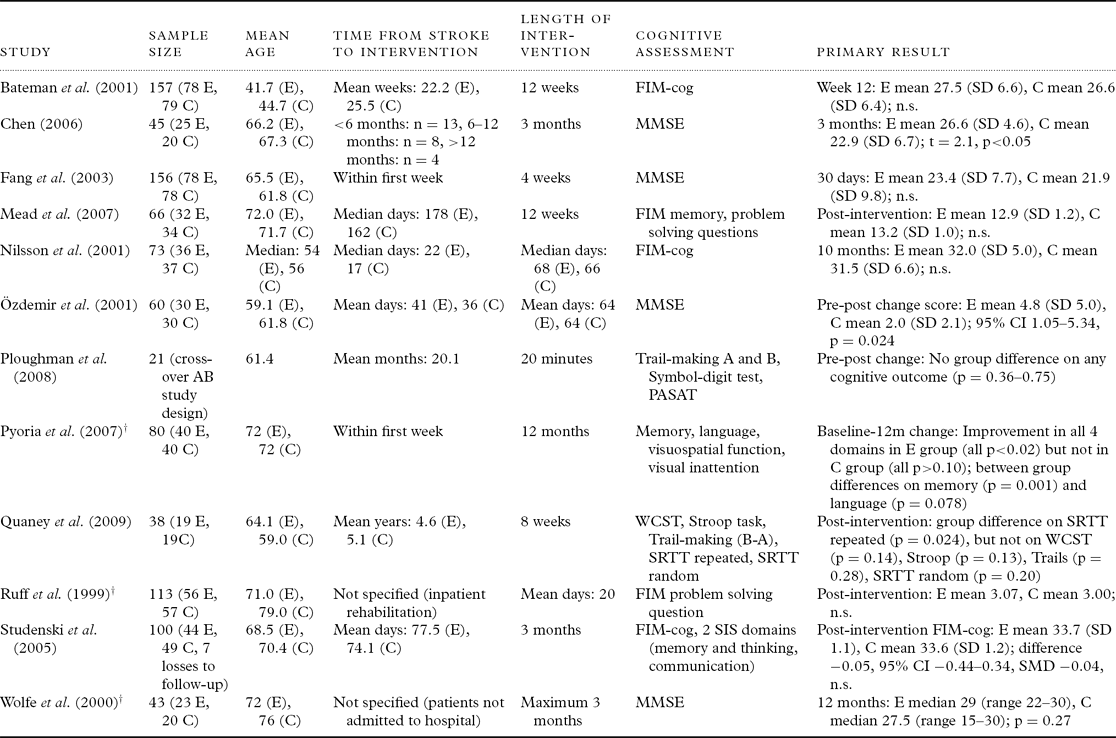
E = experimental group; C = control group; n.s. = not significant; FIM-cog = Functional Independence Measure cognitive subsection; MMSE = Mini-Mental State Examination; SIS = Stroke Impact Scale; WCST = Wisconsin Card Sorting Test; SRTT = Serial Reaction Timed Task; PASAT = Paced Auditory Serial Addition Test.
* Lower scores on FIM-cog; MMSE indicate greater impairment.
† Indicates study not included in meta-analysis.
Interventions
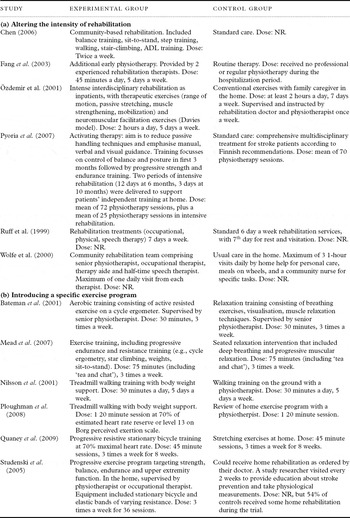
All the interventions used had some impact on level of exercise or physical activity and can be divided into two groups (Table 2). Six studies (Ruff et al., Reference Ruff, Yarnell and Marinos1999; Wolfe et al., Reference Wolfe, Tilling and Rudd2000; Özdemir et al., Reference Özdemir, Birtane, Tabatabaei, Kokino and Ekuklu2001; Fang et al., Reference Fang, Chen, Li, Lin, Huang and Zeng2003; Chen, Reference Chen2006; Pyoria et al., Reference Pyoria, Talvitie, Nyrkko, Kautiainen, Pohjolainen and Kasper2007) compared different levels and intensities of movement rehabilitation; some provided specialized community-based rehabilitation to the intervention group and standard care to the control group (Wolfe et al., Reference Wolfe, Tilling and Rudd2000; Chen, Reference Chen2006), whereas another study compared 7-days-a-week rehabilitation to 6-days-a-week rehabilitation (Ruff et al., Reference Ruff, Yarnell and Marinos1999). The second group consisted of six studies (Bateman et al., Reference Bateman, Culpan, Pickering, Powell, Scott and Greenwood2001; Nilsson et al., Reference Nilsson2001; Studenski et al., Reference Studenski, Duncan, Perera, Reker, Lai and Richards2005; Mead et al., Reference Mead2007; Ploughman et al., Reference Ploughman, McCarthy, Bosse, Sullivan and Corbett2008; Quaney et al., Reference Quaney2009) that included a specific exercise program. These studies focused mainly on aerobic training, such as treadmill walking (Nilsson et al., Reference Nilsson2001; Ploughman et al., Reference Ploughman, McCarthy, Bosse, Sullivan and Corbett2008) and cycling on a stationary bicycle (Bateman et al., Reference Bateman, Culpan, Pickering, Powell, Scott and Greenwood2001; Quaney et al., Reference Quaney2009). No standard measure of physical activity was applied across studies.
Details of interventions used, with studies sorted by type of intervention

ADL = activities of daily living; NR = not reported.
Cognitive assessments
Four studies (Wolfe et al., Reference Wolfe, Tilling and Rudd2000; Özdemir et al., Reference Özdemir, Birtane, Tabatabaei, Kokino and Ekuklu2001; Fang et al., Reference Fang, Chen, Li, Lin, Huang and Zeng2003; Chen, Reference Chen2006) employed the Mini-Mental State Examination (MMSE) and five studies (Ruff et al., Reference Ruff, Yarnell and Marinos1999; Bateman et al., Reference Bateman, Culpan, Pickering, Powell, Scott and Greenwood2001; Nilsson et al., Reference Nilsson2001; Studenski et al., Reference Studenski, Duncan, Perera, Reker, Lai and Richards2005; Mead et al., Reference Mead2007) employed cognitive questions from the FIM. One study (Studenski et al., Reference Studenski, Duncan, Perera, Reker, Lai and Richards2005) that included the FIM also incorporated the Stroke Impact Scale (SIS), which has memory/thinking and communication subscales. Other studies used more detailed cognitive measures. Pyoria et al. (Reference Pyoria, Talvitie, Nyrkko, Kautiainen, Pohjolainen and Kasper2007) administered a battery of neuropsychological tests, with either two or three individual tests being combined to generate a sum score for each of four domains: memory, language, visuospatial function and visual inattention. Quaney et al. (Reference Quaney2009) focused on executive function and included the Wisconsin Card Sorting Task, a Stroop task, Trail-Making tasks (B-A) and two Serial Reaction Timed Tasks (repeated and random). Similarly, Ploughman et al. (Reference Ploughman, McCarthy, Bosse, Sullivan and Corbett2008) concentrated on attentional and executive tasks, incorporating Trail-Making A and B, Symbol Digit Substitution and the Paced Auditory Serial Addition Test. Unfortunately, too few studies incorporated measures of individual cognitive domains to make grouping by domain feasible. In those studies that did report multiple cognitive outcomes, standardized values for each outcome were averaged to obtain a single change score.
Meta-analysis
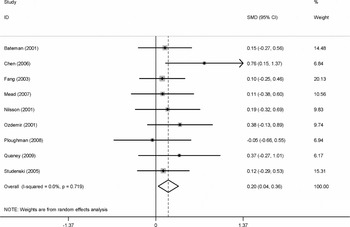
Of the 12 studies, nine contained sufficient data to allow inclusion in a meta-analysis. The test for heterogeneity among the nine included studies indicated no significant heterogeneity (χ2 = 5.36, p = 0.72; I2 = 0). There was a significant benefit favoring intervention across the nine studies (SMD = 0.20, 95% CI: 0.04–0.36; z = 2.43, p = 0.015). An effect size of 0.20 means the score of the average person in experimental groups was 0.20 standard deviations above the average person in control groups. The forest plot is presented in Figure 1. Neither Begg's test (z = 1.77, p = 0.08) nor Egger's test (t = 1.56, p = 0.16) indicated publication bias.
Forest plot of the nine studies included in meta-analysis.

Studies excluded from meta-analysis
Three studies could not be included in meta-analysis. Ruff et al. (Reference Ruff, Yarnell and Marinos1999) reported only means and no measure of variability. Wolfe et al. (Reference Wolfe, Tilling and Rudd2000) reported medians and no common measure of variance. This study did contain sufficient information to compute an effect size, using group difference at follow-up, and it favored the intervention group (θ = 0.40). Pyoria et al. (Reference Pyoria, Talvitie, Nyrkko, Kautiainen, Pohjolainen and Kasper2007) reported medians and interquartile ranges at baseline and median changes with 95% confidence intervals at 12 months for their four cognitive measures. Their between-group analysis indicated a significant treatment benefit for memory (p = 0.001), borderline for language (p = 0.078) but no difference for visuospatial function (p = 0.17) or visual inattention (p = 0.45).
Secondary outcomes
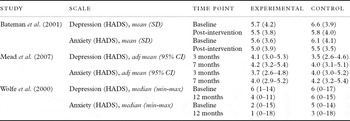
Three studies included depression or anxiety assessment, and the results are summarized in Table 3.
Secondary outcome measures: depression and anxiety

HADS = Hospital Anxiety and Depression Scale (higher scores indicate greater depression, anxiety).
*None of the differences between experimental and control groups reached significance.
Study quality
Table 4 outlines the performance of the 12 studies on each of the four specified quality criteria. Matching this to the meta-analysis results reveals that studies meeting all quality criteria reported smaller treatment benefit. The two studies with the biggest intervention effects (Özdemir et al., Reference Özdemir, Birtane, Tabatabaei, Kokino and Ekuklu2001; Chen, Reference Chen2006) both failed to report whether group allocation was concealed or whether outcome assessment was blinded.
Quality assessment results

NR = not reported; FIM-cog = Functional Independence Measure cognitive subsection.
Discussion
Despite our broad inclusion criteria, only 12 studies could be included in the review. All included studies were published in the past 12 years, reflecting the recent interest in effects of exercise on cognition after stroke. Most were relatively small trials that did not specify cognitive function as the primary outcome measure. Exercise or physical activity interventions were heterogeneous across studies, and in several cases were only one aspect of a multifaceted rehabilitation intervention. These methodological issues contributed to individual studies lacking the power to demonstrate a difference in cognitive outcome, and meta-analysis is a useful tool in this situation. We identified a significant benefit favoring intervention in the nine studies that were combined in meta-analysis, with a pattern of reasonably consistent and relatively small positive effects of exercise on cognition.
Several potential mechanisms exist that may explain why physical activity can improve cognitive performance after stroke. One possibility is that exercise enhances cognitive activity and information processing by increasing arousal and wakefulness, perhaps via increases in brain neurotransmitters such as dopamine and norepinephrine (McMorris et al., Reference McMorris, Collard, Corbett, Dicks and Swain2008). A second explanation is that exercise reduces depressive symptoms, which in turn leads to better cognitive performance. The findings of Lai et al. (Reference Lai2006), in a follow-up publication from the Studenski et al. (Reference Studenski, Duncan, Perera, Reker, Lai and Richards2005) cohort, support this explanation. Positive effects of exercise on cognition were seen only in the subgroup with depressive symptoms at baseline. Another possibility is that aerobic exercise increases cerebral blood volume and thus enhances cognitive function (Pereira et al., Reference Pereira2007); there is even evidence that exercise may increase brain volume in older adults (Colcombe et al., Reference Colcombe2006). A prominent molecular hypothesis relates to the expression of growth factors in the brain: animals that exercise show an increase in brain-derived neurotrophic factor (BDNF), a molecule that increases neuronal survival, improves learning, and protects against cognitive decline (Cotman and Engesser-Cesar, Reference Cotman and Engesser-Cesar2002). In a group of young and healthy human males, vocabulary learning was 20% faster after intense physical exercise, and this condition also elicited the strongest increases in BDNF levels (Winter et al., Reference Winter2007). There is some evidence from rats that the beneficial effects of exercise on BDNF and cognition are also evident after brain injury (Griesbach et al., Reference Griesbach, Hovda, Molteni, Wu and Gomez-Pinilla2004).
As a group, the studies included in this review had several notable limitations. Although we found no significant heterogeneity between studies and no evidence of publication bias (possibly due to cognitive measures rarely being the primary outcome), it is difficult to draw firm conclusions from a meta-analysis that includes only nine datasets. The exercise interventions varied considerably between studies in terms of type (e.g. therapeutic exercises, treadmill walking, cycle ergometer), dose (e.g. 45 minutes a day, 5 days a week for 4 weeks; 30 minutes a day, 3 days a week for 12 weeks; a single 20-minute session) and setting (e.g. community-based rehabilitation, inpatient rehabilitation, the patient's home). Details of how the dose of intervention was measured and monitored were often poorly reported. Given the variability, it was not possible to draw conclusions on the most effective type of exercise, let alone the optimal amount or timing of physical activity.
Cognitive assessment was limited in the majority of studies. The MMSE, used in four studies (Wolfe et al., Reference Wolfe, Tilling and Rudd2000; Özdemir et al., Reference Özdemir, Birtane, Tabatabaei, Kokino and Ekuklu2001; Fang et al., Reference Fang, Chen, Li, Lin, Huang and Zeng2003; Chen, Reference Chen2006), is a brief global screening tool and was not designed to be sensitive to change in specific cognitive domains. Particularly in patients with stroke, the MMSE is far from an ideal measure of cognition (Blake et al., Reference Blake, McKinney, Treece, Lee and Lincoln2002; Nys et al., Reference Nys, van Zandvoort, Kort, Jansen, Kappelle and de Haan2005). The FIM, used in five studies (Ruff et al., Reference Ruff, Yarnell and Marinos1999; Bateman et al., Reference Bateman, Culpan, Pickering, Powell, Scott and Greenwood2001; Nilsson et al., Reference Nilsson2001; Studenski et al., Reference Studenski, Duncan, Perera, Reker, Lai and Richards2005; Mead et al., Reference Mead2007), is a clinical observation scale rather than a direct test of cognitive function. As such, the sensitivity of the FIM to detect cognitive changes is highly questionable, especially given that it is subject to ceiling effects. Ideally, we would have been able to analyze different cognitive domains separately across studies, but only three studies included more targeted and sophisticated cognitive measures (Pyoria et al., Reference Pyoria, Talvitie, Nyrkko, Kautiainen, Pohjolainen and Kasper2007; Ploughman et al., Reference Ploughman, McCarthy, Bosse, Sullivan and Corbett2008; Quaney et al., Reference Quaney2009). Out of necessity, we condensed multiple cognitive measures into a single summed score for each of these three studies. It should also be noted that even the more detailed cognitive measures still often suffer from not being designed for serial testing and are therefore subject to practice effects (e.g. Trail-Making, Symbol digit test).
Study quality was evaluated on the basis of randomization, allocation concealment, blinded outcome assessment and all patients being accounted for in the outcome data. The most striking finding was that the two studies that documented the largest intervention effects in the meta-analysis (SMD = 0.76, 0.38) both failed to report whether group allocation was concealed or whether outcome assessment was blinded (Özdemir et al., Reference Özdemir, Birtane, Tabatabaei, Kokino and Ekuklu2001; Chen, Reference Chen2006). The next largest intervention effect (SMD = 0.37) was from a study with blinded outcome assessment but no reported allocation concealment (Quaney et al., Reference Quaney2009). The studies that reported concealed group allocation and blinded outcome assessment were more equivocal (SMD = 0.15, 0.10, 0.19, 0.11) in terms of exercise benefit (Bateman et al., Reference Bateman, Culpan, Pickering, Powell, Scott and Greenwood2001; Nilsson et al., Reference Nilsson2001; Fang et al., Reference Fang, Chen, Li, Lin, Huang and Zeng2003; Mead et al., Reference Mead2007). An inverse relationship between study quality and effect size has been documented in a number of areas, and continued attention to trial quality must be a priority.
In conclusion, there is some evidence that increased physical activity after stroke optimizes cognitive performance. The pool of studies identified, however, was small and methodological shortcomings were widespread. There is a need for more comprehensive randomized trials to address this key question. Given that different cognitive tests assess different cognitive skills and that each stroke impacts upon a different area of the brain and that different modes of exercise may have differential effects on brain function, we may need many studies before meaningful effects are identified. Perhaps the most important step in progressing from the studies reported here is to specify cognitive function as the primary outcome measure. The benefit of this would be two-fold: valid, reliable and repeatable cognitive assessments could be used and an appropriate power calculation could be performed to ensure adequate sample size. Many unknowns remain regarding the optimal type, timing and duration of physical activity interventions for patients with stroke. Focused dosing studies should precede a suitably randomized and controlled study with concealed allocation and blinding of outcome assessment. Such studies have the potential to increase our limited knowledge regarding the effect of physical activity on cognitive function after stroke.
Conflict of interest
None.
Description of authors' roles
T. Cumming conceived the study, assisted with the literature search, helped analyze the results and wrote the paper. K. Tyedin conducted the literature search and helped draft the paper. L. Churilov was responsible for statistical analysis and interpretation of results. M. Morris and J. Bernhardt both helped draft the inclusion criteria for the review, had input into which articles satisfied these criteria and also helped revise the paper.
Acknowledgments
This research was supported by a post-doctoral stipend to TC from the NHMRC Clinical Research Centre for Clinical Gait Analysis and Gait Rehabilitation. We thank Dr Gillian Mead and Dr Susan Lewis for providing more detailed data from their 2007 study.