Stroke is a major cause of lasting disability worldwide and a huge burden for the patients, their families, and society in general (Reference Feigin, Krishnamurthi and Parmar1). It is estimated that stroke causes direct costs of USD 78,349 (EUR 68,800) per patient in Sweden comprising diagnosis, treatment, rehabilitation, and care (Reference Ghatnekar, Persson, Asplund and Glader2). The direct and indirect costs including loss of productivity per lifetime per patient with stroke in the U.S. total USD 140,000 (Reference Ma, Chan and Carruthers3). An increasing incidence of stroke due to an aging population is expected (Reference Feigin, Norrving and George4).
Technology assisted rehabilitation including robot-assisted training has become increasingly popular in rehabilitation despite the paucity of data supporting their effectiveness (Reference Laver, Lange and George5). Virtual reality (VR) training has been introduced as a means of increasing the effectiveness of rehabilitation by providing large doses of task-related training with many repetitions and different modes of feedback (Reference Fluet and Deutsch6). Particularly, upper limb impairment after stroke is a promising field of application where VR has the potential to augment intensity and extend the range of possible training tasks (Reference Levin, Weiss and Keshner7). VR training is a broad term encompassing specially developed rehabilitation systems and off-the-shelf gaming consoles, ranging from simple 2D computer games to immersive 3D environments (Reference Levin, Weiss and Keshner7). Patients with severe upper limb impairment can engage in more intensive training as compared with conventional training (CT) (Reference Brunner, Skouen and Hofstad8). Furthermore, VR may boost the motivation of patients by adding a playful element to therapy and therapists may be able to supervise several patients (Reference Eng, Siekierka and Pyk9). Some evidence supports the use of VR for improving arm function after stroke, although a recent review could not corroborate any superiority of VR when compared with CT (Reference Laver, Lange and George5). However, this review was based on small-scale studies and one larger randomized controlled trial (RCT) examining the effect of a commercial gaming device (Reference Saposnik, Cohen and Mamdani10). The Virtual Reality for Upper Extremity in Subacute Stroke (VIRTUES) trial was the first larger RCT examining the effect of a VR system designed for rehabilitation purposes for patients in the subacute phase (Reference Brunner, Skouen and Hofstad11). In this trial, patients in both groups received the same amount of therapist contact time and training. Upper extremity motor function and independence in activities of daily living did not differ between the groups, neither post intervention nor 3 months after. Results suggest that VR training is as effective as CT when provided as an adjunct to standard rehabilitation (Reference Brunner12).
As VR is increasingly used in neurorehabilitation, cost considerations are important. Due to the same amount of therapist contact, there were no cost savings in favor of VR training in the VIRTUES. However, clinical experiences gained during the trial and evidence from home-based approaches applying VR for motor training suggest that therapist time per patient could be substantially reduced after implementing the intervention by using a VR rehabilitation system. In one study, a median 230 minutes of supporting home visits were needed to help people with stroke to conduct an 8-week daily training program (Reference Standen, Threapleton and Richardson13). Another study on home-based VR reported independent training after initial set-up (Reference Wittmann, Held and Lambercy14).
We illustrated potential cost savings of VR training with different scenarios based on data from the VIRTUES trial.
Methods
This study was based on the VIRTUES trial; a recent international randomized controlled observer-blind multicenter trial with five participating rehabilitation centers in Denmark, Norway, and Belgium. In this trial, 120 patients within the first 3 months after suffering a stroke were randomized to 4 weeks of either VR training or CT for the upper extremity.
Patients in the intervention group received VR training with the YouGrabber system (YouRehab Ltd., Switzerland), now called Bi-Manu-Trainer (Reha-Stim Medtech Ltd., Switzerland). The system comprises wearable data gloves with sensors, an infrared camera, and training software with different gaming alternatives. The VR rehabilitation games provide a graded training program of goal-oriented reaching and/or grasping exercises and other upper limb movements. The therapist can adjust the games to increasing motor abilities. Furthermore, the system itself comprises algorithms that make training automatically more challenging when patients perform well, or decrease the level of difficulty when they struggle. A training planner provides the possibility to pre-program different exercises for a training session.
Patients in the control group received individually tailored conventional upper extremity training. It consisted of task-related exercises for gross and fine motor skills, such as grasping and moving different objects, selective finger movements, and training in daily life activities. Patients in both groups received the same amount of training and therapist contact.
Cost-analysis
To conduct cost-analysis of a VR-training intervention, we required information on the costs associated with providing VR or CT. Because we adopted a societal perspective, all relevant costs are included in our analyses irrespective of who bears the cost. Hence, in our analysis the unit price of components, in particular, equalize the retail price, for example, of equipment, a drug, and so on, including value added tax (VAT), dispensing fees, and patients' co-payments.
In the VIRTUES trial, no differences in improvement of upper extremity motor function were found on any of the outcome measures, even though therapist contact was identical. However, in real-life clinical circumstances, it is reasonable to assume that less therapist contact is needed during a VR session than a CT session. Therefore, in addition to the cost-analysis based on the VIRTUES trial, exploratory cost-analyses were also conducted. We calculated different scenarios for reduced therapist supervision time during a typical rehabilitation stay to illustrate potential benefits of using VR systems.
Cost Components and Estimations
Based on actual data from recruitment for the VIRTUES trial we estimated that 120 patients in 2 years would be offered VR and CT at five different hospitals. Each hospital is equipped with a VR device and equipment for CT.
For the VR training group, cost components (converted to USD) included:
(i) Therapist salary including social security contributions:
Therapist's wage cost per hour was used to estimate the opportunity cost of the therapist. The average monthly take-home salary of an experienced physiotherapist in Norway is approximately USD 3,224. Hence, the average hourly wage is about USD 21.5. However, this is after tax salary and does not include the actual costs for the employer. We included the income tax and social security contribution costs for both the employee and the employer (around 66 percent of employees after tax income) and estimated the hourly therapist cost to be USD 35.72 in a societal perspective for treating a patient in our project.
(ii) Cost of YouGrabber (now Bi-Manu-Trainer):
The price of one YouGrabber Basic system is equivalent to USD 7,544 including VAT. The price includes a computer to run software and support. The lifespan of the YouGrabber system is at least 5 years, according to the manufacturer. Therefore, the estimated cost for five YouGrabber systems is 37,720, which is USD 7,544 annually, assuming a 5-year lifespan.
Based on the above assumptions, the total per patient per rehabilitation stay cost (only concerning additional upper extremity training as provided in the VIRTUES) was estimated as therapist wage per hour multiplied by the duration of the session and the total number of sessions required plus unit cost per rehabilitation stay. Unit costs were derived from VR system costs (USD 7,544 per yr), divided by number of patients per year (n = 60), or USD 15,088 divided by number of patients in 2 years (n = 120) respectively, to match the duration of recruitment for the VIRTUES.
For the control group, cost components included:
(i) Therapist salary with social security contributions (same as the intervention group).
(ii) Status-quo kits that would be needed for a tailored conventional upper limb training (CT) estimated around USD 595.5 per patient per year at five hospitals, or USD 1,191 for 2 years. Costs for status-quo kits are based on the budget for replacing therapy equipment from the involved hospitals, independent of the number of patients who use them.
The total estimated costs for treating a single patient with conventional treatment were calculated by multiplying the therapist wages by the duration of the session and the total number of sessions required plus the unit costs for equipment per treatment course per patient.
All exploratory calculations refer to a baseline scenario, before any VR training is implemented. In this scenario, 120 patients were treated conventionally only, requiring 15 hours of therapist supervision per patient.
Exploratory Cost-analyses
A typical rehabilitation stay at the rehabilitation institutions that participated in the VIRTUES trial was 3–4 weeks. Both groups received the same amount of training and the same amount of therapist supervision during their rehabilitation stay.
Based on the VIRTUES project data, we further assume for the involved rehabilitation hospitals
(a) Total number of patients with upper extremity impairment who can be treated in a year is 20–30 (either with CT or VR).
(b) Mean number of therapy sessions per patient per rehabilitation stay is 15.
(c) Mean therapist time needed per therapy session may differ between VR and CT.
Based on our experiences, we estimated that the therapist contact for VR could be reduced to only 25 percent of conventional therapy. This could be a potential source of cost savings because a therapist could supervise more than one patient at a time. Even if there is only one VR system at a hospital, there are other types of therapies, for example, practicing daily life activities or strength training, where a patient could be left alone for a short period while the therapist helps another patient to start and finish a VR session in the room next door. Based on this hypothesis we estimate different cost saving possibilities of the intervention in three alternative scenarios. In all scenarios, we assume that patients training conventionally require 1:1 therapist supervision, while patients training with VR requiring only 25 percent of therapist supervision time. The assumed reduced therapist time is based on clinical experience and studies where home-based VR training has been examined (Reference Standen, Threapleton and Richardson13;Reference Wittmann, Held and Lambercy14). However, reduced therapist time depends on many factors, such as system complexity and user knowledge. Therefore, a higher proportion of therapist supervision time, 50 percent and 75 percent is also depicted.
Results
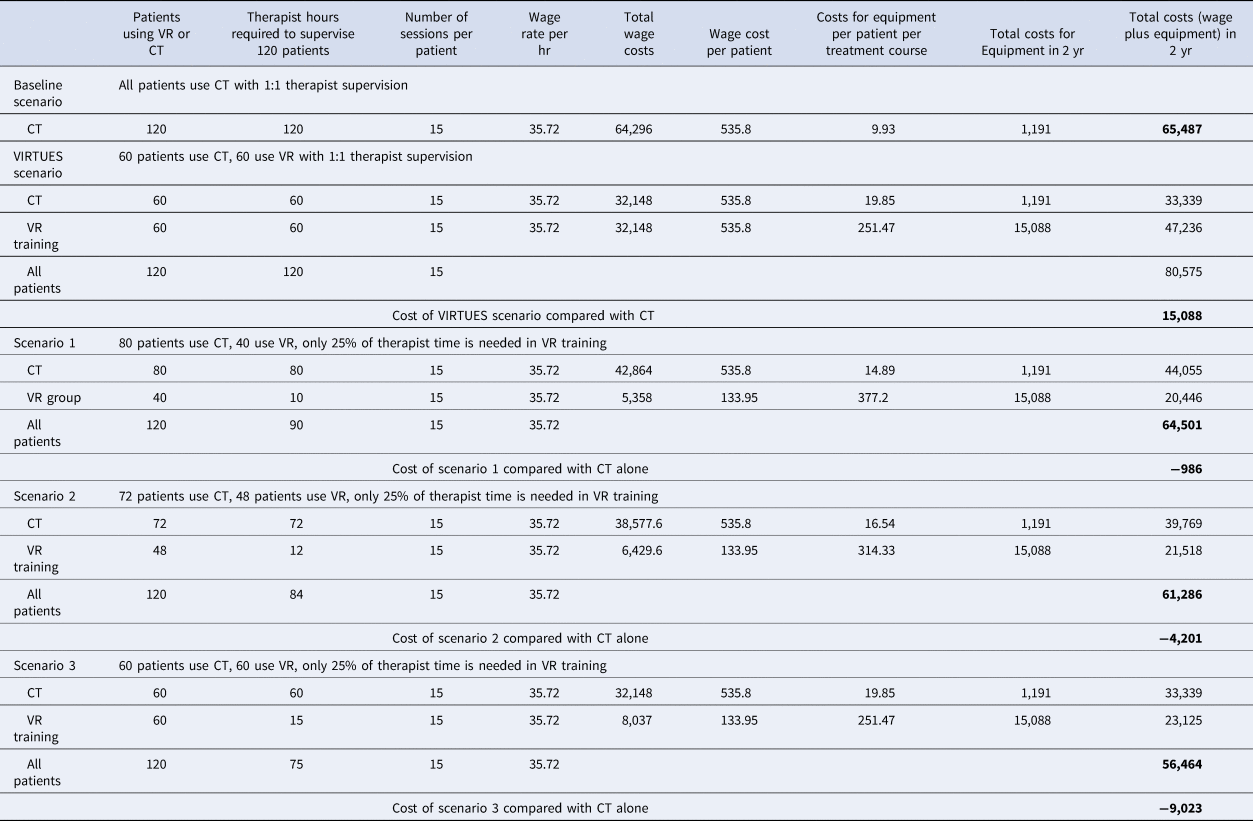
Table 1 provides the results of the cost-analysis of the intervention for the above-mentioned alternative scenarios. In the VIRTUES trial, no cost-savings for VR were achieved due to the same therapist time spent in VR and CT. When applying exploratory cost analyses under the prerequisite that less therapist supervision is needed, VR is cost saving for any of the three scenarios, see Table 1. In scenario 1, the costs for one third of patients using VR (i.e., 40) and two thirds of patients training conventionally (i.e., 80) result in USD 986 cost save for all 120 patients. In scenario 2, the costs for 48 out of 120 patients using VR are depicted, for example, a ratio of 2:3 of patients trained conventionally to patients training with VR. The increased number of patients training with VR increases the cost saving to USD 4,201. Even more cost savings of USD 9,023 occur when half of the patients is trained with the VR system, as depicted in in scenario 3.
Cost of VR training for different scenarios under the assumption that only 25% therapist supervision is required

Note: All costs in USD.
Average exchange rate in 2016, 1 USD = NOK 8.3987. Therapist wage cost per hr = NOK 300/8.3987 = USD 35.72.
Cost savings increase when more patients train with VR. However, when VR is provided with the same amount of therapist supervision, total costs for 120 patients increase due to higher equipment costs.
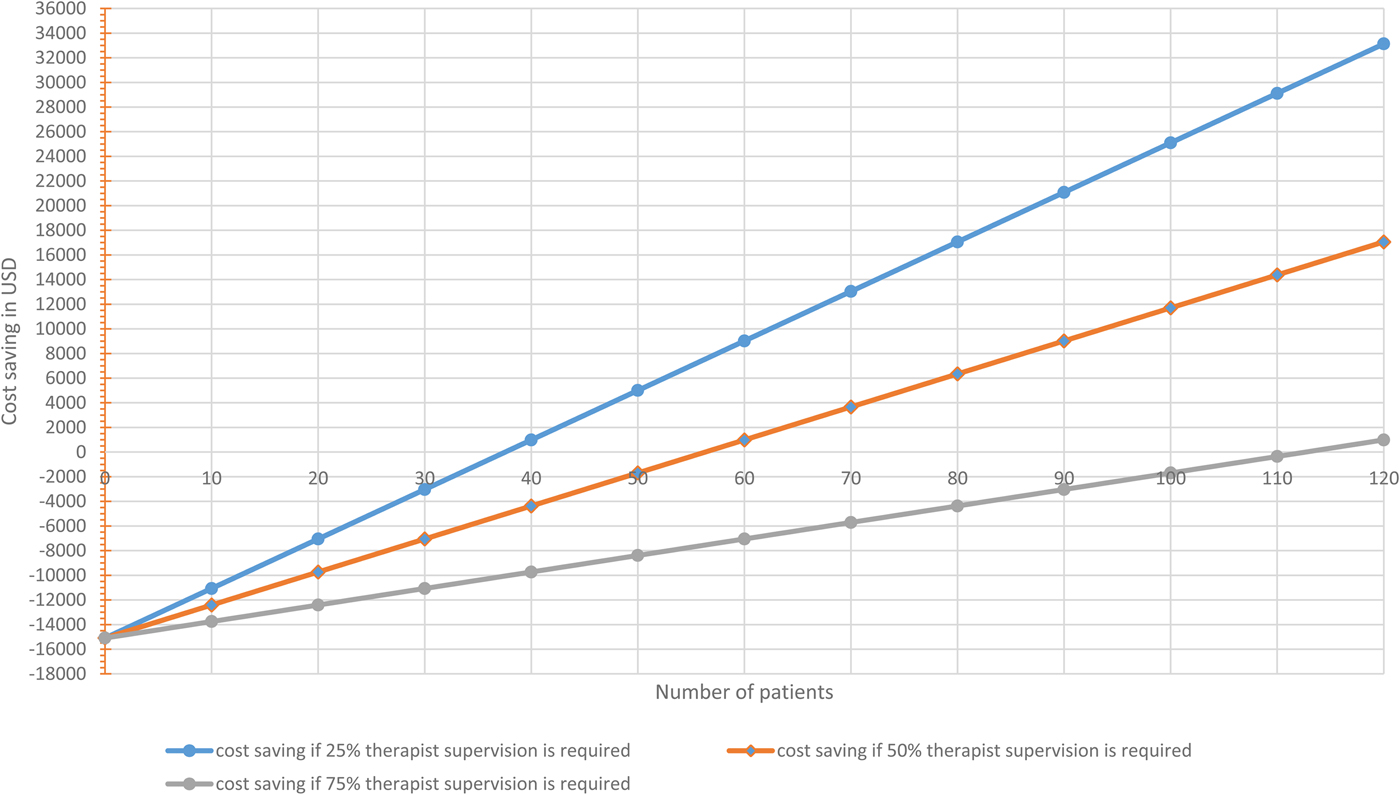
Increasing need for therapist supervision would reduce potential cost saving. In Figure 1, cost savings for therapist supervision time of 25, 50, and 75 percent are depicted. All else being unchanged, as seen in Figure 1, cost saving is higher if therapist supervision time is lower.
Cost saving by number of patients using VR with varying therapist supervision.

Discussion
VR training seems to be as equally as effective but not superior to CT (Reference Laver, Lange and George5;Reference Saposnik, Cohen and Mamdani10;Reference Brunner12). However, as an adjunct to standard rehabilitation it is a means of providing more intense training and is frequently experienced as motivating by patients and therapists (Reference Thomson, Pollock, Bugge and Brady15). Furthermore, most VR systems, including commercial gaming consoles and purpose-made rehabilitation systems, are relatively inexpensive. In the example used here based on data from the VIRTUES trial, we found potential cost savings for different clinically realistic scenarios.
However, some limitations have to be mentioned. The main limitation of our analyses is their speculative nature of the assumed reduced therapist time. While a possible reduction of therapist supervision is in accordance with our clinical experience, there are to date no studies examining the cost-benefit of VR in a hospital setting. However, research from home-based VR training suggests that independent training with the help of VR is feasible, though support seems necessary (Reference Standen, Threapleton and Richardson13;Reference Wittmann, Held and Lambercy14).
The extent to which therapist supervision can be reduced depends on several factors, including the reliability and the ease of use, which again depend on maturity and complexity of the applied VR systems. Furthermore, therapist knowledge is essential to choose the right training programs. VR training cannot replace CT because it does not cover all aspects of upper extremity training. Therefore, VR training should be regarded as an adjunct to conventional therapy and as a means of increasing intensity of training. There is some evidence for a beneficial effect of extra training. Schneider et al. (2016) found that increasing the amount of usual rehabilitation substantially resulted in better upper or lower extremity function (Reference Schneider, Lannin, Ada and Schmidt16). Likewise, a review by Lohse et al. (2014) suggested that treatment groups receiving larger doses improved more than those receiving lower doses (Reference Lohse, Lang and Boyd17).
The first weeks to months after stroke are crucial for regaining function (Reference Kwakkel and Kollen18;Reference Verheyden, Nieuwboer and De Wit19). During this early period, the brain has an increased potential to recover as compared with later stages, and increased training time has the largest effect (Reference Krakauer, Carmichael, Corbett and Wittenberg20). In several studies, it was observed that the time at a rehabilitation unit is not used effectively enough for the benefit of the patient (Reference Sjoholm, Skarin and Churilov21;Reference Bernhardt, Dewey, Thrift and Donnan22). VR and other technology assisted training could be a viable means to provide additional meaningful training without straining limited staff resources.
The fact that, so far, no impressive cost savings can be claimed for VR training could be attributed to the novelty of the field. Many devices are still under development, resulting in a design where one to one treatment is favored in many studies. This was also the case in the VIRTUES trial, and because there was no difference in outcome, the intended cost-benefit analysis could rather be regarded as a cost analysis. However, we experienced a large potential for self-training with VR during the course of the study. With pre-programed training sequences, patients could have been left alone for at least parts of the session.
Therefore, the potential of VR for autonomous and remote training has to be considered. VR interventions enable therapists to supervise several patients at the same time while providing training that is more intensive for severely impaired patients (Reference Brunner, Skouen and Hofstad8). Many systems are cloud-based allowing for training at home combined with remote therapist follow-up and assistance (Reference Levin, Weiss and Keshner7). Extra costs of providing VR training are small in relation to overall rehabilitation costs. The more patients that use VR systems, the more cost savings can be achieved. Depending on the number of patients eligible for this type of training, higher investments in equipment could be leveled out quickly. Nevertheless, any extra costs should be justified by an improvement in function, which is a limitation of the current evidence base.
Conclusions
In the VIRTUES trial, no cost savings in favor of VR were found. However, if our assumption is accurate that fewer therapist hours would be required for VR than for CT, then VR training would be cost saving if uptake is great enough so that the reduction in wages covers the capital costs of the VR system. Future research could examine the effectiveness and then cost-effectiveness in a real-world context, where therapists use VR to enable supervision of multiple patients. Several factors, such as an increasing incidence of stroke, limited personnel resources, and decreasing costs for technology assisted rehabilitation warrant further investigations of the potential of VR rehabilitation.
Conflict of interest
The authors have no conflict of interest to disclose.