Introduction
Persons with a depressive or anxiety disorder have shorter telomeres, the non-coding DNA–protein complexes that cap chromosomal ends and protect DNA from damage (Chan & Blackburn, Reference Chan and Blackburn2004). Telomere length is considered a marker of cellular age since it shortens with every cell division and is strongly related to chronological age (Muezzinler et al. Reference Muezzinler, Zaineddin and Brenner2013) and to the incidence of various aging-related somatic diseases (Haycock et al. Reference Haycock, Heydon, Kaptoge, Butterworth, Thompson and Willeit2014; Willeit et al. Reference Willeit, Raschenberger, Heydon, Tsimikas, Haun, Mayr, Weger, Witztum, Butterworth, Willeit, Kronenberg and Kiechl2014). The association between depressive and anxiety disorders with shorter leukocyte telomere length (LTL) (Verhoeven et al. Reference Verhoeven, Révész, Epel, Lin, Wolkowitz and Penninx2014a , Reference Verhoeven, Révész, Van Oppen, Epel, Wolkowitz and Penninx b ), has now been established by a large body of research, summarized in a recent meta-analysis including 25 studies with 21 040 participants (effect size: r = −0.12, p < 0.001) (Schutte & Malouff, Reference Schutte and Malouff2015). However, while several explanations have been proposed, the pathways and mechanisms underlying the association have not been systematically examined and therefore remain unclear.
One of the most frequently suggested pathways is that physiological changes associated with depression and anxiety lead to cellular damage, including shortened LTL. Persons with depression or anxiety disorder have higher levels of pro-inflammatory cytokines such as interleukin (IL)-6 and C-reactive protein (CRP) (Hoge et al. Reference Hoge, Brandstetter, Moshier, Pollack, Wong and Simon2009; Howren et al. Reference Howren, Lamkin and Suls2009; Dowlati et al. Reference Dowlati, Herrmann, Swardfager, Liu, Sham, Reim and Lanctot2010), a dysregulated hypothalamus–pituitary–adrenal (HPA) axis (O'Donovan et al. Reference O'Donovan, Hughes, Slavich, Lynch, Cronin, O'Farrelly and Malone2010; Stetler & Miller, Reference Stetler and Miller2011) and impaired autonomic nervous system (ANS) functioning (Kemp et al. Reference Kemp, Quintana, Gray, Felmingham, Brown and Gatt2010; Fisher & Newman, Reference Fisher and Newman2013). Further, depressive and anxiety disorders are associated with metabolic syndrome (MetS) alterations such as dyslipidemia and abdominal obesity (Van Reedt Dortland et al. Reference Van Reedt Dortland, Giltay, van, Zitman and Penninx2010). These alterations all together might impact LTL and have accumulative detrimental effects (Révész et al. Reference Révész, Verhoeven, Milaneschi, de Geus, Wolkowitz and Penninx2014b ). An additional possible explanation is that persons with depressive or anxiety disorders have unhealthier lifestyles: they are more likely to smoke, drink alcohol and are less physically active (Van Gool et al. Reference Van Gool, Kempen, Bosma, van Boxtel, Jolles and van Eijk2007; Luger et al. Reference Luger, Suls and Vander Weg2014), which may in turn impact LTL.
LTL correlates with several of the alterations found in persons with depression and anxiety disorder: shorter LTL was found to be associated with high levels of inflammatory markers, oxidative stress, catecholamine concentrations (Verhoeven et al. Reference Verhoeven, Révész, Wolkowitz and Penninx2014c ; Lindqvist et al. Reference Lindqvist, Epel, Mellon, Penninx, Revesz, Verhoeven, Reus, Lin, Mahan, Hough, Rosser, Bersani, Blackburn and Wolkowitz2015) and metabolic alterations (Lee et al. Reference Lee, Martin, Firpo and Demerath2011; Monickaraj et al. Reference Monickaraj, Gokulakrishnan, Prabu, Sathishkumar, Anjana, Rajkumar, Mohan and Balasubramanyam2012). Short LTL is also related to unhealthy lifestyle: several studies found cross-sectional associations with excessive alcohol consumption (Pavanello et al. Reference Pavanello, Hoxha, Dioni, Bertazzi, Snenghi, Nalesso, Ferrara, Montisci and Baccarelli2011), smoking (Valdes et al. Reference Valdes, Andrew, Gardner, Kimura, Oelsner, Cherkas, Aviv and Spector2005), physical activity and increased body weight (Weischer et al. Reference Weischer, Bojesen and Nordestgaard2014). Physiological alterations and unhealthy lifestyle factors have thus been associated with both LTL and with depressive and anxiety disorders, making them eligible candidates to be mediating variables.
To shed more light on mechanisms underlying the association between LTL and depressive and anxiety disorders, we aimed to examine whether physiological stress system markers, metabolic alterations and lifestyle factors mediated this relationship using cross-sectional data from the large-scale observational Netherlands Study of Depression and Anxiety (NESDA). Previous analyses in this sample confirmed associations between LTL and major depressive and anxiety disorder (Verhoeven et al. Reference Verhoeven, Révész, Epel, Lin, Wolkowitz and Penninx2014a , Reference Verhoeven, Révész, Van Oppen, Epel, Wolkowitz and Penninx b ), which were strongest for subjects with the most severe and chronic symptoms, indicating a dose–response effect (Verhoeven et al. Reference Verhoeven, Révész, Epel, Lin, Wolkowitz and Penninx2014a ). Other research in the NESDA showed that shorter LTL was significantly associated with physiological stress including higher CRP, IL-6, heart rate (HR), cortisol awakening response (Révész et al. Reference Révész, Verhoeven, Milaneschi, de Geus, Wolkowitz and Penninx2014b ) and MetS alterations (Révész et al. Reference Révész, Milaneschi, Verhoeven and Penninx2014a ). Other measures of the HPA axis, such as evening levels, diurnal pattern and dexamethasone suppression test, were not associated with LTL as reported before (Révész et al. Reference Révész, Verhoeven, Milaneschi, de Geus, Wolkowitz and Penninx2014b ).
In order to better understand potential mediating mechanisms that underlie increased cellular aging in persons with depression and anxiety, and to give directions to future experimental studies, the present study applied mediation analyses to test the extent to which physiological and metabolic stress markers and aspects of unhealthy lifestyle explain the association of LTL with symptom severity and depressive and anxiety disorder diagnosis.
Method
Study sample
Data are from the baseline assessment of the NESDA study, an ongoing longitudinal cohort study examining the course and consequences of depressive and anxiety disorders, as described in more detail elsewhere (Penninx et al. Reference Penninx, Beekman, Smit, Zitman, Nolen, Spinhoven, Cuijpers, de Jong, Van Marwijk, Assendelft, van der Meer, Verhaak, Wensing, de Graaf, Hoogendijk, Ormel and Van Dyck2008). The NESDA sample consists of 2981 persons between 18 and 65 years including persons with a current or remitted diagnosis of a depressive and/or anxiety disorder (74%) and healthy controls (26%). Persons were excluded when they had insufficient command of the Dutch language or a primary clinical diagnosis of other severe mental disorders, such as bipolar disorder, obsessive–compulsive disorder, post-traumatic stress disorder, severe substance use disorder or a psychotic disorder, self-reported or reported by their mental health practitioner. Participants were recruited between September 2004 and February 2007, and assessed during a 4-h clinic visit. The study was approved by the ethical review boards of participating centers, and all participants signed informed consent. For the current study, 231 subjects were excluded because of missing data on LTL, psychopathology measures or some central mediators (CRP, IL-6 or MetS components), leaving 2750 subjects for the main analysis.
LTL
Fasting blood was drawn from participants in the morning between 08.00 and 09.00 hours, and blood samples were stored in a −20 °C freezer afterwards. As described before in more detail (Révész et al. Reference Révész, Verhoeven, Milaneschi, de Geus, Wolkowitz and Penninx2014b ; Verhoeven et al. Reference Verhoeven, Révész, Epel, Lin, Wolkowitz and Penninx2014a ), LTL was determined at the laboratory of Telomere Diagnostics, Inc. (USA), using quantitative polymerase chain reaction (Cawthon, Reference Cawthon2002). Telomere sequence copy number in each subject's sample (T) was compared with a single-copy gene copy number (S), relative to a reference sample. The efficiencies of standard curve and the subject samples were similar for T and S, thereby providing a desirable precision. We converted T:S ratios to base pairs (bp) with the following formula: bp = 3274 + 2413 × T:S.
Depressive and anxiety disorder measurements
Earlier associations with LTL showed a dose–response effect, indicating that persons with the most severe symptoms of depression and anxiety had the shortest LTL (Verhoeven et al. Reference Verhoeven, Révész, Epel, Lin, Wolkowitz and Penninx2014a , Reference Verhoeven, Révész, Van Oppen, Epel, Wolkowitz and Penninx b ); therefore, our primary analyses focused on possible mediators in the relationship between LTL and symptom severity. Severity of depressive symptoms in the past week was assessed with the 30-item Inventory of Depressive Symptoms – Self Report (IDS-SR, range 0–84) (Rush et al. Reference Rush, Gullion, Basco, Jarrett and Trivedi1996). Anxiety severity was assessed with the 21-item Beck's Anxiety Inventory (BAI, range 0–63) (Beck et al. Reference Beck, Epstein, Brown and Steer1988). In addition, the mediating effects in the relationship between LTL and presence of current depressive or anxiety disorder were examined. Presence of a Diagnostic and Statistical Manual of Mental Disorders, fourth edition (DSM-IV) diagnosis of depressive (major depressive disorder, dysthymia) and/or anxiety (social phobia, generalized anxiety disorder, panic disorder, agoraphobia) disorders was ascertained using the Composite Interview Diagnostic Instrument (CIDI, version 2.1) (World Health Organization, 1997) administered by specially trained research staff. Our sample included 1569 subjects with a current (i.e. within the past 6 months) diagnosis and 608 control subjects (i.e. no lifetime history of psychiatric disorders). Previous work in the NESDA sample showed that antidepressant medication did not impact the psychopathology–LTL association; therefore medication variables were not included in the current study.
Physiological stress systems
As potential mediators, we selected physiological markers that within our sample have been shown to be associated with LTL: CRP and IL-6 as markers of inflammation, salivary cortisol awakening response as a marker of HPA axis sensitivity, and HR as a marker of autonomic tone dysregulation (Révész et al. Reference Révész, Verhoeven, Milaneschi, de Geus, Wolkowitz and Penninx2014b ). Circulating plasma levels of CRP and IL-6, from 08.00–09.00 hours blood draws, were assessed with high sensitivity enzyme-linked immunosorbent assays, as described before (Vogelzangs et al. Reference Vogelzangs, Beekman, de Jonge and Penninx2013). For the ANS measurements subjects were wearing an ambulatory electro- and impedance cardiogram system that recorded HR, an indicator of combined sympathetic and parasympathetic nervous system activity (Révész et al. Reference Révész, Verhoeven, Milaneschi, de Geus, Wolkowitz and Penninx2014b ). For 87 subjects with missing HR data at baseline, values from NESDA's 2-year follow-up assessment were used in order to maintain an optimal sample size (correlation baseline and 2-year HR: r = 0.705, p < 0.001). To examine HPA axis hyper-reactivity, subjects were instructed to collect saliva samples at home on a regular (preferably working) day at four time points: at awakening, and 30, 45 and 60 min later (Vreeburg et al. Reference Vreeburg, Kruijtzer, van Pelt, van Dyck, DeRijk, Hoogendijk, Smit, Zitman and Penninx2009). We calculated the area under the curve with respect to the increase (AUCi), a measure of the dynamic of the cortisol awakening response (Pruessner et al. Reference Pruessner, Kirschbaum, Meinlschmid and Hellhammer2003). Of the entire cohort, a subsample of 1124 subjects had missing AUCi data due to non-compliance to the data collection protocol, and therefore, analyses with AUCi as a mediator were done in a smaller sample (n = 1812).
MetS
MetS components that were associated with LTL were considered as mediators (Révész et al. Reference Révész, Milaneschi, Verhoeven and Penninx2014a ): of all five MetS components, only blood pressure showed no association with LTL and was not further considered. Waist circumference was measured with a tape measure at the central point between the lowest front rib and the highest front point of the pelvis, over light clothing. High-density lipoprotein (HDL)-cholesterol, triglyceride and fasting glucose levels were determined from fasting blood samples using routine standardized laboratory methods. According to the standards of medical care in diabetes (American Diabetes Association, 2013), antidiabetic medication aims to lower the fasting glucose level to <7.0 mmol/l. Therefore, for persons using antidiabetic medication when glucose level was <7.0 mmol/l, a value of 7.0 mmol/l was assigned. According to the average decline in triglycerides and increases in HDL-cholesterol in fibrate trials, 0.10 mmol/l was subtracted from the HDL-cholesterol level and 0.67 mmol/l was added to the triglyceride level of persons using fibrates (Packard, Reference Packard1998).
Lifestyle factors
Alcohol use was expressed in number of drinks per week. Smoking was assessed by number of cigarettes per day. Physical activity was assessed using the International Physical Activity Questionnaire (Craig et al. Reference Craig, Marshall, Sjostrom, Bauman, Booth, Ainsworth, Pratt, Ekelund, Yngve, Sallis and Oja2003), and expressed as overall energy expenditure in metabolic equivalent total (MET in h/week). Body mass index (BMI in kg/m2) was calculated as measured weight divided by height-squared.
Covariates
Sex, age and ancestry (classified as Northern-European ancestry v. other) were assessed during the interview. The number of self-reported current somatic diseases for which participants received medical treatment (i.e. heart disease, epilepsy, diabetes, osteoarthritis, stroke, cancer, chronic lung disease, thyroid disease, liver disease, intestinal disorders and ulcers) was counted.
Statistical analyses
Sample characteristics were described as means and standard deviations, or percentages. For non-normally distributed factors the median and interquartile range were calculated.
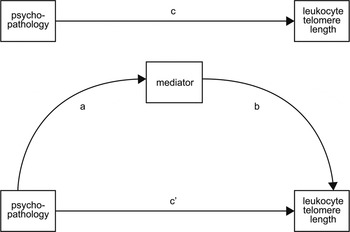
We first tested associations of LTL with symptom severity and depressive and anxiety disorders (together referred to as psychopathology) with regression analyses (c in Fig. 1). Next, we applied mediation analysis to test: (1) the total effect of psychopathology on possible mediators (a in Fig. 1); (2) the effect of mediators on LTL (b in Fig. 1); (3) the direct effect of psychopathology on LTL, corrected for a × b (c’ in Fig. 1); (4) the indirect effect of psychopathology on LTL through the mediators (a × b). All mediator variables were standardized to create comparable effect sizes. Mediation analyses were performed using the Preacher and Hayes's SPSS macro, which estimates the indirect effects of the independent variable on the dependent variable through mediator variables (Hayes & Preacher, Reference Hayes and Preacher2014). This method uses bootstrap resampling procedures, in which subjects are randomly selected, with replacement, from the original sample. For each bootstrap sample the model is estimated and the parameters saved. The indirect effect is deemed significant if the 95% bootstrap percentile confidence interval (CI) did not include zero. Number of bootstraps was set at 5000. These analyses allowed us to test whether associations between psychopathology and LTL were mediated by physiological stress systems (CRP, IL-6, AUCi and HR), MetS components (waist circumference, triglycerides, HDL-cholesterol, glucose) and lifestyle variables (alcohol use, smoking, BMI and physical activity), while adjusting for age, sex, ancestry and number of somatic diseases.
Illustration of the total effect of psychopathology on leukocyte telomere length (c) and a mediation design where psychopathology affects leukocyte telomere length directly (c’) and indirectly (a × b) through a mediator.

Mediator variables were first entered into the model separately. Subsequently, all significant mediators (p < 0.05) were entered into a multivariate model, in order to test which mediators were the main drivers in the relationship between psychopathology and LTL. We calculated the change in effect (∆B) by subtracting c’ from c, and dividing this residual by the c (e.g. ∆B = (c – c’)/c). All analyses were conducted using SPSS version 20.0 (IBM Corp., USA).
Results
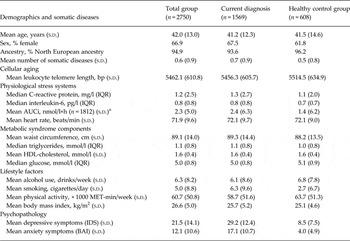
The mean age of the study sample (n = 2750) at baseline was 42.0 (s.d. = 13.0, range 18–65) years, 67% was female and the overall majority was of North-European ancestry (Table 1). Average LTL was 5462 (s.d. = 611) bp. The average IDS score was 8.5 (s.d. = 7.5) for controls and 29.2 (s.d. = 12.4) for persons with a current diagnosis. Further, controls had an average of 4.0 (s.d. = 4.9) on the BAI and those with a current diagnosis scored 17.1 (s.d. = 10.7). IDS and BAI scores were highly correlated (r = 0.78, p < 0.001) and since both severity measures yielded similar results, further analyses on the BAI are presented in online Supplementary Table S1.
Sample characteristics for the total group (n = 2750), subjects with a current diagnoses (n = 1569) and the healthy control group (n = 608)

s.d., Standard deviation; bp, base pairs; IQR, interquartile range; AUCi, area under the curve with respect to the increase; HDL, high-density lipoprotein; MET-min/week, metabolic equivalent of number of calories in min per week; IDS, Inventory of Depressive Symptoms; BAI, Beck's Anxiety Inventory.
a Non-imputed sample total n = 1812, n current diagnosis = 985, n controls = 427.
Associations between psychopathology and LTL (c)
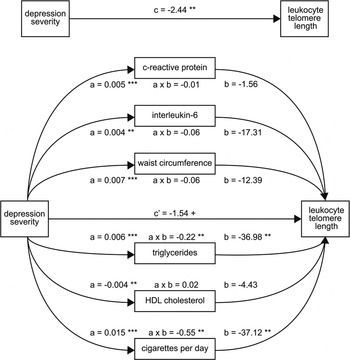
Shorter LTL was associated with higher depressive (B = −2.44, s.e. = 0.81, p = 0.002, upper part of Fig. 2) and anxiety (B = −2.81, s.e. = 1.07, p = 0.009) symptom severity scores in analyses adjusted for age, sex, ancestry and chronic diseases in 2750 subjects. Further, we selected those with a current diagnosis of depressive and/or anxiety disorders (n = 1569) and controls (n = 608). Compared with controls, those with a current diagnosis had shorter LTL (B = −63.30, s.e. = 27.95, p = 0.024), again adjusted for age, sex, ancestry and chronic diseases.
Direct and indirect effects of depression severity on leukocyte telomere length in a mediation design. + <0.10, ** p < 0.01; *** p < 0.001. c, Original effect of depression severity on leukocyte telomere length (LTL); a, effect of depression severity on mediator; b, effect of mediator on LTL; a × b, indirect effect of depression severity on LTL; c’, direct effect of depression severity on LTL in mediation design; HDL, high-density lipoprotein.

Effects of psychopathology on mediators (a)
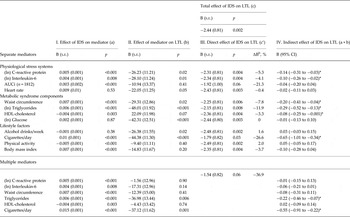
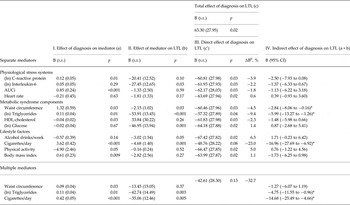
Depressive symptoms were positively associated with CRP, IL-6, AUCi, waist circumference, triglycerides, cigarette smoking and BMI, negatively associated with HDL-cholesterol and physical activity, and not associated with HR, glucose and alcohol use (column I, Table 2). Findings were similar for anxiety symptoms (online Supplementary Table S1). Further, those with a current depressive or anxiety diagnosis showed higher CRP, AUCi, waist circumference, triglycerides, cigarettes smoking, BMI and lower HDL-cholesterol and physical activity. No associations were found between current diagnosis and IL-6, HR, glucose and alcohol use (column I, Table 3).
Mediation analyses with separate and multiple mediators (per standard deviation increase) between depression severity (IDS) and LTL (n = 2750) a

IDS, Inventory of Depressive Symptoms; LTL, leukocyte telomere length; s.e., standard error; CI, confidence interval; ln, natural logarithm transformation; AUCi, area under the curve with respect to the increase; HDL, high-density lipoprotein.
a Analyses are controlled for age, sex, race and number of somatic diseases.
b Change in B was not part of mediation output, but calculated manually, as described in Statistical analyses.
* Significant based on 95% CI (p < 0.05).
Mediation analyses with separate and multiple mediators (per standard deviation increase) between depressive and/or anxiety disorder diagnosis and LTL (n = 2177) a

LTL, Leukocyte telomere length; s.e., standard error; CI, confidence interval; ln, natural logarithm transformation; AUCi, area under the curve with respect to the increase; HDL, high-density lipoprotein.
a Analyses are controlled for age, sex, race and number of somatic diseases.
b Change in B was not part of mediation output, but calculated manually, as described in Statistical analyses.
* Significant based on 95% CI (p < 0.05).
Effect of mediators on LTL (b)
Shorter LTL was associated with higher CRP, IL-6, HR, waist circumference, triglycerides, glucose, and with more drinking and smoking (column II, Table 2). This was consistent in the analyses with controls and persons with a current diagnosis, although CRP and HR were not significantly associated with shorter LTL (column II, Table 3); likely due to slightly smaller sample size as directions of effects were consistent across the two tables.
Mediation of associations between psychopathology and LTL (c’ and a × b)
When entering separate mediators into the model with depressive symptoms and LTL, we found that higher CRP (change in direct effect: ∆B = −5.3%, column III, Table 2), IL-6 (∆B = −4.1%), waist circumference (∆B = −7.8%), triglycerides (∆B = −11.9%) and cigarettes per day (∆B = −26.6%), and lower levels of HDL-cholesterol (∆B = −3.3%) were significantly mediating this association (column IV, Table 2). When these significant mediators were combined into one multivariate model, they reduced the effect size of the association between depressive symptoms and LTL with 36.9%, and the direct effect became statistically non-significant (B = −1.54, s.e. = 0.82, p = 0.06, Table 2, Fig. 2). Findings were similar for anxiety symptoms, and mediators within the multivariate model reduced the effect size of the association between anxiety symptoms and LTL with 49.1%, and rendered the direct effect of anxiety symptoms on LTL as statistically non-gnificant (B = −1.43, s.e. = 1.11, p = 0.20, online Supplementary Table S1).
In models with current diagnosis, LTL and separate mediators, we found that waist circumference (∆B = −4.5%, column III, Table 3), triglycerides (∆B = −9.4%) and cigarettes per day (∆B = −23.0%) were significant mediators (column IV, Table 3). When these mediators were entered into the multivariate model, only triglycerides and cigarette smoking remained significant, thereby reducing the effect size of the association between current diagnosis and LTL with 32.7%. The direct effect of current diagnosis and LTL was no longer statistically significant (B = −42.61, s.e. = 28.30, p = 0.13). These findings were consistent when current diagnoses of depressive or anxiety disorders were examined separately (data not shown). When the final mediation analyses were re-ran for men (n = 911) and women (n = 1839) separately, estimates of the indirect effect were in the same direction in both men and women for triglycerides (men a × b: B = −0.32, 95% CI −0.85 to −0.02; women a × b: B = −0.20, 95% CI −0.49 to −0.03) and for cigarettes per day (men a × b: B = −0.21, 95% CI −0.79 to 0.31; women a × b: B = −0.80, 95% CI −1.30 to −0.40), suggesting that sex was unlikely to moderate the effect of these mediators.
Discussion
This large psychiatric cohort study of 2750 persons showed that the association between depressive and anxiety psychopathology and LTL was mediated by higher inflammatory markers (CRP, IL-6), less favorable metabolic profile (high waist circumference and triglycerides and low HDL-cholesterol) and through increased smoking behavior. When these mediators were entered together in one model, the direct effect between symptom severity and LTL was considerably reduced.
Smoking was responsible for a substantial reduction of the direct association of LTL with psychopathology, suggesting a major role as a mediator. A relationship between smoking status and psychopathology has been well established in previous research (Ziedonis et al. Reference Ziedonis, Hitsman, Beckham, Zvolensky, Adler, Audrain-McGovern, Breslau, Brown, George, Williams, Calhoun and Riley2008; Cosci et al. Reference Cosci, Knuts, Abrams, Griez and Schruers2010) and showed that persons with a lifetime depression or anxiety disorder have a twofold increased odds of being smoker (Lasser et al. Reference Lasser, Boyd, Woolhandler, Himmelstein, McCormick and Bor2000; Strine et al. Reference Strine, Mokdad, Balluz, Gonzalez, Crider, Berry and Kroenke2008). This might be the consequence of responses to emotional states in persons with poor distress tolerance (Leventhal & Zvolensky, Reference Leventhal and Zvolensky2015) and high levels of neuroticism (Zvolensky et al. Reference Zvolensky, Taha, Bono and Goodwin2015), which could increase vulnerability to addiction to cigarettes. Smoking is, in turn, found to be associated with alterations in hormones, such as increased levels of plasma cortisol and decreased peripheral serotonin and monoamine oxidase B activity (Padmavathi et al. Reference Padmavathi, Reddy, Swarnalatha, Hymavathi and Varadacharyulu2015), thereby possibly contributing to the persistence of psychopathology (Bakhshaie et al. Reference Bakhshaie, Zvolensky and Goodwin2015). Further, cigarette smoke contains reactive oxidants that induce DNA damage and activate intracellular signaling cascades leading to secretion of inflammatory markers (e.g. IL-8 and tumor necrosis factor α) and alterations in the adaptive T-cell immune system (Lee et al. Reference Lee, Taneja and Vassallo2012). Also, toxic components, such as nicotine, change the balance of the ANS, resulting in increased sympathetic nerve activity, including an acute increase in blood pressure and HR, but decreased HR variability (Middlekauff et al. Reference Middlekauff, Park and Moheimani2014). This, in combination with increased inflammation and higher leukocyte cell turnover (Valdes et al. Reference Valdes, Andrew, Gardner, Kimura, Oelsner, Cherkas, Aviv and Spector2005), may lead to shorter telomeres. Animals models (Zhou et al. Reference Zhou, Wright, Liu, Sin and Churg2013) and in vitro research (Huang et al. Reference Huang, Okuka, Lu, Tsibris, McLean, Keefe and Lui2013) indeed showed that smoking was related to shorter LTL, which was further confirmed by epidemiological studies in humans (Valdes et al. Reference Valdes, Andrew, Gardner, Kimura, Oelsner, Cherkas, Aviv and Spector2005; Verde et al. Reference Verde, Reinoso-Barbero, Chicharro, Garatachea, Resano, Sanchez-Hernandez, Rodriguez Gonzalez-Moro, Bandres, Santiago and Gomez-Gallego2015).
Next to smoking, we found that metabolic alterations, such as abdominal obesity and dyslipidemia (high triglycerides and low HDL-cholesterol), were significant mediators of the association between psychopathology and short LTL. ‘Metabolic oversupply’, a combination of lower energy expenditure and higher energy intake, is often seen in persons with depression and anxiety disorder (Gariepy et al. Reference Gariepy, Nitka and Schmitz2010; Luppino et al. Reference Luppino, de Wit, Bouvy, Stijnen, Cuijpers, Penninx and Zitman2010), and is also shown to be associated with various measures of cellular aging (Picard & Turnbull, Reference Picard and Turnbull2013; Huzen et al. Reference Huzen, Wong, van Veldhuisen, Samani, Zwinderman, Codd, Cawthon, Benus, van der Horst, Navis, Bakker, Gansevoort, de Jong, Hillege, van Gilst, de Boer and van der Harst2014; Révész et al. Reference Révész, Milaneschi, Verhoeven, Lin and Penninx2015). Interestingly, waist circumference was a mediator, and BMI was not, suggesting that the role of abdominal fat specifically is more important than the role of total body fat (Sahakyan et al. Reference Sahakyan, Somers, Rodriguez-Escudero, Hodge, Carter, Sochor, Coutinho, Jensen, Roger, Singh and Lopez-Jimenez2015). Increased adipose tissue, especially in the abdominal area, promotes inflammation, and adipocyte hypertrophy has been associated with shorter LTL (Monickaraj et al. Reference Monickaraj, Gokulakrishnan, Prabu, Sathishkumar, Anjana, Rajkumar, Mohan and Balasubramanyam2012). On the contrary, caloric restriction, or ‘metabolic undersupply’ has been shown to lead to longer telomeres and increased lifespan (Picard & Turnbull, Reference Picard and Turnbull2013; Vera et al. Reference Vera, Bernardes de, Foronda, Flores and Blasco2013).
The association between LTL and symptom severity – but not diagnosis status – was further mediated by the inflammatory markers CRP and IL-6, although they explained a lesser part of the association than smoking and metabolic factors. Increased inflammation has often been reported in patients with depressive and anxiety disorders (Hoge et al. Reference Hoge, Brandstetter, Moshier, Pollack, Wong and Simon2009; Howren et al. Reference Howren, Lamkin and Suls2009; Dowlati et al. Reference Dowlati, Herrmann, Swardfager, Liu, Sham, Reim and Lanctot2010). This may be due to an unhealthy lifestyle, including physical inactivity, smoking and a bad diet, that in turn all promote inflammation, creating a deleterious vicious cycle for physical and mental health (Penninx et al. Reference Penninx, Milaneschi, Lamers and Vogelzangs2013). Increased adipose tissue, an active endocrine organ, might additionally release inflammatory mediators into the periphery, strengthening the notion that physiological and metabolic alterations are highly intertwined (Penninx et al. Reference Penninx, Milaneschi, Lamers and Vogelzangs2013). Further, inflammation is suggested to contribute to the progressive shortening of telomeres, both in vitro (Boyle et al. Reference Boyle, Chun, Strojny, Narayanan, Bartholomew, Sundivakkam and Alapati2014), in animal models (Jurk et al. Reference Jurk, Wilson, Passos, Oakley, Correia-Melo, Greaves, Saretzki, Fox, Lawless, Anderson, Hewitt, Pender, Fullard, Nelson, Mann, van de Sluis, Mann and von Zglinicki2014) and in longitudinal studies in humans (Damjanovic et al. Reference Damjanovic, Yang, Glaser, Kiecolt-Glaser, Nguyen, Laskowski, Zou, Beversdorf and Weng2007; Baylis et al. Reference Baylis, Ntani, Edwards, Syddall, Bartlett, Dennison, Martin-Ruiz, Von Zglinicki, Kuh, Lord, Aihie Sayer and Cooper2014; Wong et al. Reference Wong, De Vivo, Lin, Fang and Christiani2014).
In the current study, neither the HPA axis nor ANS markers were significant mediators in the association between psychopathology and short LTL. The associations of HR and AUCi with psychopathology and LTL are possibly weaker as compared with the other mediators. Although earlier studies have shown significant associations between cortisol levels and LTL (Epel et al. Reference Epel, Lin, Wilhelm, Wolkowitz, Cawthon, Adler, Dolbier, Mendes and Blackburn2006; Parks et al. Reference Parks, Miller, McCanlies, Cawthon, Andrew, DeRoo and Sandler2009; Kroenke et al. Reference Kroenke, Epel, Adler, Bush, Obradovic, Lin, Blackburn, Stamperdahl and Boyce2011; Tomiyama et al. Reference Tomiyama, O'Donovan, Lin, Puterman, Lazaro, Chan, Dhabhar, Wolkowitz, Kirschbaum, Blackburn and Epel2012; Wikgren et al. Reference Wikgren, Maripuu, Karlsson, Nordfjall, Bergdahl, Hultdin, Del-Favero, Roos, Nilsson, Adolfsson and Norrback2012), it is hard to compare findings due to the large variety in measurement methods of cortisol (i.e. 12-h nocturnal urine, first morning urine, or pre–post-test salivary samples). Furthermore, the associations between depression and ANS measures are conflicting in the literature. Some evidence points towards a higher sympathetic drive combined with lower vagal state among depressed persons, but the findings are inconsistent and possibly more complex due to antidepressant medication use in patients (Kemp et al. Reference Kemp, Quintana, Gray, Felmingham, Brown and Gatt2010; Penninx et al. Reference Penninx, Milaneschi, Lamers and Vogelzangs2013).
Apart from smoking behavior, other lifestyle factors were not found to mediate the association between depressive and anxiety disorder and LTL. However, earlier studies did find that health behaviors, e.g. physical activity, dietary intake and sleep quality, influence the relationship between psychosocial stress and shorter LTL (Puterman et al. Reference Puterman, Lin, Blackburn, O'Donovan, Adler and Epel2010, Reference Puterman, Lin, Krauss, Blackburn and Epel2014). In the current study, we did not measure dietary intake, and whether it should be considered a mediator remains to be explored in future research. Sleep duration and insomnia were not associated with LTL in the NESDA (data not shown), and were therefore not considered as potential mediators. Moreover, sleep disturbances are one of the symptoms of major depressive disorder, and it is therefore impossible to conceptually disentangle them completely from the independent variable. A possible explanation for why we did not find effects for alcohol consumption is that mainly excessive drinkers are shown to have shorter telomeres (Pavanello et al. Reference Pavanello, Hoxha, Dioni, Bertazzi, Snenghi, Nalesso, Ferrara, Montisci and Baccarelli2011), while in the NESDA persons with severe alcohol dependence were initially excluded at baseline. In the current study, no mediating effects were found for physical activity either, but waist circumference and dyslipidemia, plausible consequences of physical inactivity, were found to be mediators. Weight-loss interventions, consisting of dietary advice and/or an increase in physical activity, may be important for persons with depressive and anxiety disorders (Verhoeven et al. Reference Verhoeven, Révész, Wolkowitz and Penninx2014c ). Consequently, an important clinical implication that arises from this study is the need for implementation of smoking cessation and obesity treatment in mental health care settings (Ziedonis et al. Reference Ziedonis, Hitsman, Beckham, Zvolensky, Adler, Audrain-McGovern, Breslau, Brown, George, Williams, Calhoun and Riley2008; Ward et al. Reference Ward, White and Druss2015). Although future intervention studies are needed to prove actual impact of such lifestyle interventions on cellular aging markers, preliminary evidence suggest they might be beneficial (Verhoeven et al. Reference Verhoeven, Révész, Wolkowitz and Penninx2014c ).
Some limitations should be taken into account when interpreting our results. As the current study has a cross-sectional design, we cannot draw conclusions regarding the direction of the effects. Some mediators might be bi-directionally associated with both psychopathology and cellular aging. Future proof-of-concept studies may provide important evidence showing how treatment-induced change in depression or anxiety disorder impacts on LTL through the identified mediators. For instance, in randomized controlled trials treating depression with therapy of proven efficacy, it could be examined whether the improvement in depression determines a change in the mediators over repeated follow-up measures, and whether these changes parallel LTL lengthening. Next, since we based the inclusion of mediators on earlier associations with LTL, the HPA axis and the ANS were only represented by one measure, which may not completely capture these complex stress systems. Furthermore, telomere length has been measured only in leukocytes; however, it has been shown that telomere length is strongly correlated across different tissues (Daniali et al. Reference Daniali, Benetos, Susser, Kark, Labat, Kimura, Desai, Granick and Aviv2013). Moreover, there was no information available on dietary habits, the distribution of cell subtypes or telomerase activity. The latter would have provided valuable information regarding telomere homeostasis, as telomerase tends to lengthen the shortest telomeres more than the longer ones (Liu et al. Reference Liu, Kha, Ungrin, Robinson and Harrington2002). However, strengths of this study sample were its large size with a wide range of depressive and anxiety symptom severities and the inclusion of a variety of mediating variables.
This is the first large-scale study that tested the extent to which the association between depressive and anxiety disorders and LTL was explained by a broad range of physiological and metabolic stress markers and lifestyle factors. A substantial part of the association (33–37%) was explained by cigarette smoking, waist circumference and triglyceride levels, rendering the direct effect between psychopathology and LTL non-significant. Multifaceted interventions should target these mediators in mental health settings, in order to break the downward cycle of psychopathology and physiological and metabolic alterations, and the eventual detrimental impact on somatic health.
Supplementary material
The supplementary material for this article can be found at http://dx.doi.org/10.1017/S0033291716000891
Acknowledgements
The infrastructure for the NESDA (www.nesda.nl) is supported by participating universities and mental health care organizations: VU University Medical Center, GGZ inGeest, Arkin, Leiden University Medical Center, GGZ Rivierduinen, University Medical Center Groningen, Lentis, GGZ Friesland, GGZ Drenthe, IQ Healthcare, Netherlands Institute for Health Services Research (NIVEL) and Netherlands Institute of Mental Health and Addiction (Trimbos). The authors thank Jan Willem van Rooij for his help with the illustrations.
The work of D.R., J.E.V. and B.W.J.H.P. and telomere length assaying was supported through a NWO-VICI grant (number 91811602). The infrastructure for the NESDA is funded through the Geestkracht program of the Netherlands Organization for Health Research and Development (ZonMW, grant number 10-000-1002).
Declaration of Interest
None.