Writing is believed to have changed the course of human civilization. Yet, since its invention, writing has permeated different societies to different degrees. Among world languages, Persian is almost unparalleled in its long writing tradition: “Persian has been one of the major written languages in world history. Few, if any, other languages have enjoyed a continuous history of two and a half millennia as the primary vehicle of written communication.”Footnote 1 This long tradition of written Persian, however, is principally associated with literature, poetry, and the aesthetics of the language, which might explain why, to this day, when it comes to writing in Persian, emphasis is often placed on the literary side of writing.Footnote 2 In today’s world, writing can no longer be confined to the domain of lone, private writers relying on their imagination to create textual output that is impressive or entertaining. Writing is now seen as essential to democracy.Footnote 3 In particular, the digital revolution has affected more radical changes to people’s literacy practices than the changes brought about by the invention of printing technology. The mass writing that has become the norm in the twenty-first century has no precedent in history. In short, writing is on the rise.Footnote 4 For these reasons, the importance of a pedagogy of writing commensurate with the needs of twenty-first-century Persian speakers cannot be emphasized enough. To achieve such a pedagogy, writing has to be properly theorized and conceptualized.
Not unlike other social constructs, writing has been conceptualized in diverse ways. It has been viewed as a conduit, a thinking tool, a tyranny, and a political phenomenon.Footnote 5 How we conceptualize writing matters because what writing is determines why and how writing is taught, learned, and assessed.Footnote 6 For this reason, different writing pedagogies go beyond differences in teaching methods and techniques. As Berlin puts it, to teach writing “is to argue for a version of reality, and the best way of knowing and communicating it,” implying that metarhetorical issues of ontology, epistemology, and communication underlie different writing pedagogies.Footnote 7
Likewise, how teachers think about and what they value in writing have been theorized and researched using different heuristics, such as rhetorical stance, the nature of knowledge in writing, writing epistemology, writing theories, textual ideologies, and writing discourses.Footnote 8 These various conceptualizations of writing have been employed to study the thinking and beliefs that inform the pedagogy of writing in different contexts.Footnote 9 This body of research has furthered our understanding of writing pedagogy in significant ways. Nevertheless, the majority of these studies have had as their focus the English language, either as a first language (L1) or an additional language.
The present study adds to this literature by examining writing discourses underlying the textbooks used to teach Persian writing in Iran’s secondary education. This is of significance given the rise of writing in the digital era and the fact that composition is a “beacon of democracy.”Footnote 10 In settings with less sophisticated democratic infrastructure, the pedagogy of writing takes on even more importance because of the potential for writing to foster citizens’ agency in exercising their rights and to promote critical thinking.Footnote 11 For writing to deliver on its democratic potential, teachers of Persian writing must go beyond individual taste and the aesthetics of Persian writing by demonstrating how writing can leverage change. Writing, if comprehensively conceptualized, taught, and learned, can give voice to the voiceless, expose hidden ideological structures masked as inevitable, and contribute to addressing the multiple global, national, and local challenges facing Iran. Gone are the days when writing was the prerogative of a luxurious, creative elite. In the digital world, writing is entangled with everyday life. An effective letter crafted by a student and addressed to a school principal can instigate changes across a school. Today, writing a thoughtful, critical tweet can trigger massive social change. In a sense, writing is life literacy. Given this importance of writing, Iranian students need a Persian writing education program that is sensitive to their immediate local, cultural, political, and social circumstances. Yet, given the political upheavals of the country during the last century, a stable and steady Persian writing program has yet to be established.
In stark contrast with the previous regime’s pro-Western policies, in postrevolutionary Iran concerted efforts were made to tailor an education system in line with the ideology of revolution.Footnote 12 Therefore the country’s education system has seen some profound changes in policies and planning since the revolution. Likewise, the teaching of Persian composition (enshā) has undergone several changes, as will be detailed. In 2005, Riazi wrote that in teaching both Persian and English a reductionist approached is followed. But since then much has changed in education policy. In the most recent change, launched a decade ago, composition became a separate school subject, with its own textbook (Negāresh) for the first time. Nevertheless, little, if any, published scholarship exists on how Persian writing is conceptualized in the writing curriculum. This paper examines discourses of Persian writing in Negāresh textbooks. This warrants research because writing discourse, as a constellation of beliefs and ideologies and ways of talking about writing, does more than describe what writing is; discourses of writing constitute what writing is.Footnote 13 The next section elaborates on discourses of writing, as the theoretical lens through which this study was conducted.
Theoretical framework: Discourses of writing
Based on how writing is positioned in relation to the social world, Ivanič identifies six discourses of writing, namely skills, creativity, process, genre, social practice, and the sociopolitical.Footnote 14 In skills discourse, which is text-centered, certain generic skills that are transferable to other settings, contexts, and purposes constitute writing. Focus on accuracy, text organization, and explicit teaching characterizes skills discourse.Footnote 15
In creativity discourse, content and style are accorded value, and teaching is implicit, nondirective, and personalized.Footnote 16 The teaching of writing is closely allied with reading and appreciation of literature. In this discourse, “the motivation and inspiration for writing comes from within.”Footnote 17 Personal experience and writing about personally relevant topics are emphasized.Footnote 18 Other features characterizing creativity discourse include affording learners opportunities to explore with language, valuing the use of lively vocabulary, and a focus on the personal narrative genre.Footnote 19 Writing is not a means to an end; it has value in its own right, and other than entertaining the reader writing has no social function.Footnote 20 Effective writing arouses “the interest, imagination, or emotions of the reader.” Critics of creativity discourse charge it with being asocial, romantic, and elitist, and they believe that it “authorizes disadvantage.”
Writer-centered discourse of process places the spotlight on the writer and the cognitive processes that are engaged when writers write. Here, the emphasis shifts away from the finished product or text to what writers actually do, both mentally and practically, in producing text.Footnote 21 Peer assessment and feedback, sharing writing with others, emphasis on prewriting techniques like brainstorming and outlining, as well as producing multiple drafts, characterize teaching materials and approaches informed by process discourse.Footnote 22
Genre discourse, another text-centered discourse, focuses on identifying the linguistic features of various text types written for specific purposes. In a genre-based pedagogy, model or mentor texts are presented to students to enable them to construct, rather than to compose, similar texts.Footnote 23 A writing pedagogy based on genre discourse is “systematic, down to earth, logical, and teachable.” Opponents of genre discourse, however, counter that it is “prescriptive, and simplistic, based on a false view of text-type as unitary, static, and amenable to specification.”Footnote 24
Social practices discourse is concerned with writing beyond educational settings and other formal contexts. The writing event receives more attention as wider sociocultural issues are taken into account. This has indirect pedagogical implications, because participation and apprenticeship in a community of practice are considered the major ways through which writing is acquired.Footnote 25 Finally, sociopolitical discourse emphasizes the messiness and complexity of writing.Footnote 26 Issues of power, politics, identity, agency, representation, and historicity are all believed to be involved in writing.Footnote 27 Writing constitutes identity, and therefore learning to write is a process of becoming.Footnote 28
Ivanič maintains that these discourses are not mutually exclusive, and ideally elements of all the noted discourses should be present in a comprehensive writing program.Footnote 29 In the next section, I briefly review the use of discourses of writing in studies of different languages across diverse settings.
Review of literature
The body of literature on discourses of writing can be classified by three strands: studies on English as the mother tongue, studies on English as an additional language, and studies that have addressed writing discourses in languages other than English, such as Swedish, Norwegian, Danish, Spanish, Russian, Greek, Polish, and Cantonese.Footnote 30
Almost all studies on English as a first language that address writing discourses have focused on K-12 education. Taken together, these studies tell us that writing instruction in L1 English is characterized by a multiplicity of discourses, although skills discourse seems to be dominant. These studies also suggest that writing discourses foregrounded vary across teachers and classrooms.Footnote 31 Another common thread in all these studies is the absence of sociopolitical discourse.Footnote 32 In England and Australia, writing discourses emphasized seem to differ from each other, and from those in the United States. Whereas in England the focus is on skills and compliance discourses, in Australia, in addition to skills discourse, genre discourse is important, perhaps due to the influence of systemic functional linguistics.Footnote 33 In sum, which discourses are represented seems to depend on research context and methodology. Studies that focus on analyzing curriculum or policy documents are more likely to report uniform findings than those that are grounded in actual writing programs or classrooms.
As to research into writing discourses in English as a second language, the dominant discourses reported are skills, genre, and process. In China, in English as a foreign language (EFL) curriculum documents, genre is the predominant discourse, followed by skills and process.Footnote 34 In Hong Kong, curriculum guidelines foreground process discourse, but in actual classrooms skills discourse is dominant.Footnote 35 Likewise, in Germany, the curriculum documents in lower secondary schools emphasize skills and genre discourses.Footnote 36 Based on standards and writing tasks in textbooks, EFL writing in Uzbekistan also is primarily informed by genre discourse.Footnote 37
In the third strand of research, findings across languages are mixed and inconclusive. For instance, writing discourses emphasized in the writing curricula of Scandinavian languages, Greek, and Spanish seem to differ from those in Russian, Uzbek, Polish, English in South Africa, and Cantonese in Hong Kong. In Chile, the skills, processes, and genre discourses appear to be dominant in teaching Spanish.Footnote 38 Examining two policy documents on Greek early literacy education, Tentolouris points to the presence of social practice discourse, but maintains that the implicit and apparently tenuous relationship between social practice discourse and other discourses remains an obstacle to an effective writing curriculum.Footnote 39
In comparison, in Nordic countries there is a wider range of writing discourses in writing classes. But even in Scandinavia the picture is not homogenous. Whereas in Danish, all six writing discourses are present, in Swedish, in addition to writing to learn, skills and social practice discourses are prominent.Footnote 40 In the teaching of Norwegian, all six discourses are emphasized in educational policy documents; however in the teachers’ curriculum sociopolitical discourse appears less often than genre and social practice discourses.Footnote 41
In the languages examined in Asia, Poland, and South Africa, diversity of discourses in writing pedagogy is quite low. In curriculum standards in Uzbekistan, for both Russian and Uzbek skills discourse is the single dominant discourse.Footnote 42 In teaching Cantonese writing in Hong Kong, curriculum documents are dominated by process discourse, but skills discourse reigns in actual writing classes.Footnote 43 Finally, in Poland and South Africa, writing curricula foreground skills and genre discourses, and discourses of social practices and the sociopolitical are almost totally absent.Footnote 44
Several themes emerge from this literature. First, skills discourse seems to be the most dominant across countries and settings. The other two common discourses are process and genre. In other words, writing pedagogy continues to be either text-centered or writer-centered. Accordingly, the findings of studies with a discourses of writing framework suggest that the social turn and the postprocess movement have yet to be seriously embraced in writing pedagogy.Footnote 45 Second, methodologically, an overwhelming majority of these studies are based on an analysis of curriculum documents. Curriculum documents are known to be aspirational and are often formulated by academics or policymakers who may not be closely involved in the actual messy life of classrooms. In addition, textbooks have been found to be one of the three major “categories of influences”Footnote 46 that shape teachers’ instructional orientation. Textbooks take on even more importance in centralized education systems, such as that in Iran, in which teachers do not have agency to choose or produce their own instructional materials. The current study examines discourses of Persian writing as manifested in writing tasks and activities in secondary education writing (Negāresh) textbooks.
Context of the study
Education is known to be an inherently political phenomenon.Footnote 47 This is particularly true in postrevolutionary Iran, where the Supreme Council of Cultural Revolution is “in charge of overseeing the country’s macro educational laws and regulations.”Footnote 48 Iran’s educational system is highly centralized because “all planning and policies are designed, implemented, and evaluated by the Ministry of Education.”Footnote 49 Textbooks are produced and disseminated by the Ministry of Education. Iran’s current K-12 education system consists of three stages. After the first six years of primary school, students transition to high school, which is divided into junior high (grades 7 to 9), and senior high school (grades 10 to 12). Persian is taught as a school subject throughout primary and secondary education.
Persian has a long tradition of composition known as enshā or tarassol. In the sixteenth century and earlier, entire book volumes exclusively featured enshā. Footnote 50 In postrevolutionary Iran, teaching Persian writing has increasingly become aligned with Western and global traditions of writing pedagogy. The evolution of teaching Persian writing can be roughly divided into three historical phases. In the first phase, spanning the first fifteen years after the revolution, writing was primarily treated as composition, consistent with a neo-Platonic rhetoric; writing was assumed to be learnable but not teachable.Footnote 51 In this phase, composition was an isolated school subject with no specific syllabus, textbook, or teacher; teachers of all subjects were likely to be assigned to teach the composition class. Highly influenced by the postrevolutionary climate and the war against Iraq, teachers would often assign topics addressing ideological and traditional values for students to write about. Hardly any educated Iranian of that generation can be found who has not been asked to write on topics such as “which is better, money or knowledge?”; “blood will win over the sword”; or “why we should respect our parents.” In the absence of evidence from systematic program evaluation, it is difficult to judge the impact of this phase of composition instruction. It is difficult to imagine that this casual approach to composition brought about any lasting, collective improvement to mastery of Persian writing in Iranian students.
The second phase spans the two decades starting with the government of President Khatami, whose “projected outlook for the country was more global and less ideological.”Footnote 52 In this phase, teaching Persian writing began to be treated more seriously, and writing was accommodated within Persian textbooks. Prior to this era, there was only one Persian textbook, comprised mostly of a collection of classic literary texts, but now there was addition of another Persian textbook to the list of textbooks in both primary school and senior high school. In primary education, reading and writing were for the first time treated as two separate school subjects, each with their own textbook, Khāndāri for reading and Neveshtāri for writing.Footnote 53 Likewise, in senior high school, Persian literature was separated from Persian language, covered in two separate textbooks. In the latter, Persian language, basic linguistic aspects of Persian such as its phonology and morphology were covered. Also covered in this textbook were Negāresh tips, which constituted roughly one-third of the Persian language textbook. Again, no systematic empirical research exists regarding the impact of this historical phase of Persian writing. Yet, based on Ghasempour Moghaddam’s comparative study of Iran and Germany, this program of writing pedagogy failed to fulfill its mission because of the lack of clear educational objectives and systematic teaching methods.Footnote 54
Writing gained further recognition as a serious school subject in the third phase, beginning in 2015, under President Rouhani. Writing was further separated from both Persian literature and Persian language textbooks, and for the first time Persian writing had its own textbook. Currently, throughout the six years of secondary education, writing is taught through separate Negāresh textbooks. This initiative bears testimony to further recognition of the value and importance of writing. Nevertheless, to my knowledge, there has been no research to date that has examined how writing is conceptualized in the Negāresh textbooks. This study addresses Persian writing and its pedagogy as manifested in Negāresh textbooks. I approach the subject from a discursive perspective, because discourse not only describes its object but also brings it into being: “Liquid-like, writing takes the shape of its discursive containers.”Footnote 55
Methods of the study
To probe the discourses of writing represented in teaching Persian writing, I examined the six Negāresh textbooks, produced by the Organization of Educational Research and Planning (OERP).Footnote 56 I first studied all the textbooks from cover to cover to get a sense of their overall approach to writing. To code the writing tasks, I used the Nvivo program, for the efficiency and organization it provides for qualitative analysis.Footnote 57 Because Nvivo does not work properly with Persian text, I first translated all the writing tasks into English, and then imported them into Nvivo. When coding, I kept the original Persian text in mind, because occasionally the English translation was opaque and did not provide the full sense of the original text.
To analyze the writing tasks, deductive coding was carried out according to writing discourses.Footnote 58 The unit of analysis was the writing task or activity. A writing task referred to situations in which students were required to compose stretches of text as a paragraph or an essay. Writing activities were more abbreviated, in contexts in which there was no demand for generating large stretches of text. Rather, the focus was limited to the sentence level. The “Dorost Nevisi” section of some units included activities in which students were required to pass judgment on the correctness of a sentence or edit it for accuracy based on the focus of the unit.
When the writing task was followed by a list of assessment criteria for peer or self-assessment, each assessment criterion was coded individually. At times, however, it was not straightforward to readily assign a writing task, item, or assessment criterion to a certain single discourse. In such cases, if it was possible to tell which of the perceived associated discourses was dominant, I chose the dominant discourse. If a distinction was not possible or multiple discourses were equally present, multiple codes were assigned to the same task, a procedure common to similar studies.Footnote 59 This has been acknowledged in discourses of writing; Ivanič states that “actual texts and events may be heterogeneous, drawing on two or more discourses in complex inter-animation with one another.”Footnote 60
This issue was most salient in coding two writing tasks and one assessment criterion that were almost always prescribed for either peer or self-assessment. The first writing task was called “Sheʾr Gardāni” (literally, navigating poetry), which required students to rewrite a piece of poetry in plain Persian. This task was perceived to be a hybrid instantiation of creativity and genre, because students had to first appreciate the literary piece (creativity) and then render their appreciation using the register of modern Persian (genre). The second writing task, the proverb expansion task, which asked students to create a story that contextualized a given proverb, was coded only as creativity, because of both what it required students to do and the explicit statement in the introduction of the textbooks that this task served to foster creativity.
Focus on sentence structure and spelling was coded depending on the assessment context (a detailed example of assessment criteria is provided in the next section). If structural features were the only focus of attention, they were coded as skills discourse. In contrast, when sentence structure and spelling were a part of editing, subsequent to drafting, outlining, and writing, this represented both process and skills discourses.
A second assessment criterion, paragraph and essay structure (i.e., main idea, body, conclusion), requires explanation of coding. In studies on writing discourses, this has been coded as genre, process, or both.Footnote 61 In my analysis, however, treatment of paragraph organization was coded as skills discourse because these organizational patterns were considered universal characteristics of writing, transferable to various contexts.Footnote 62 My decision was consistent with Ivanič’s framework; she states that a focus on the correctness of text formation characterizes skills discourse.Footnote 63
Also noteworthy is that writing tasks were always coded within the context of the textbook unit and its overall topic and aim. For instance, unit 4 in Negāresh (3) Pāye-ye Davāzdahom was clearly about writing official letters, and therefore compatible with the discourse of social practice. But when it came to coding a task of writing a letter to a family member, given the explanation preceding the task, in addition to social practice, the noted task had a creativity dimension. In short, the coding process was context-bound, not a generic recipe that could be followed divorced from the content of the textbooks.
Finally, there was a writing task common to all textbooks in which students were required to write on a topic, after which they were supposed to read their writings to group members or to the whole class. Afterward they were asked to perform peer assessment according to a list of criteria, which varied from one unit to another. However, one criterion that was constant across all units in all six textbooks was the quality with which students read aloud their compositions. In addition to personal reflection, I consulted the literature and colleagues involved in writing pedagogy. I also wrote to scholars who had published papers based on discourses of writing. I could not reach a resolution on how to code this criterion. Therefore, I left it uncoded and dropped it from my final analysis. This is unlikely to have affected the overall findings of the study because, whatever discourse might be entailed in reading aloud, it was not likely to instantiate genre, social practice, or sociopolitical discourse. Given that the other three discourses were already highly represented in the textbooks, the omission of reading aloud did not hurt the net outcome of the study.
Findings
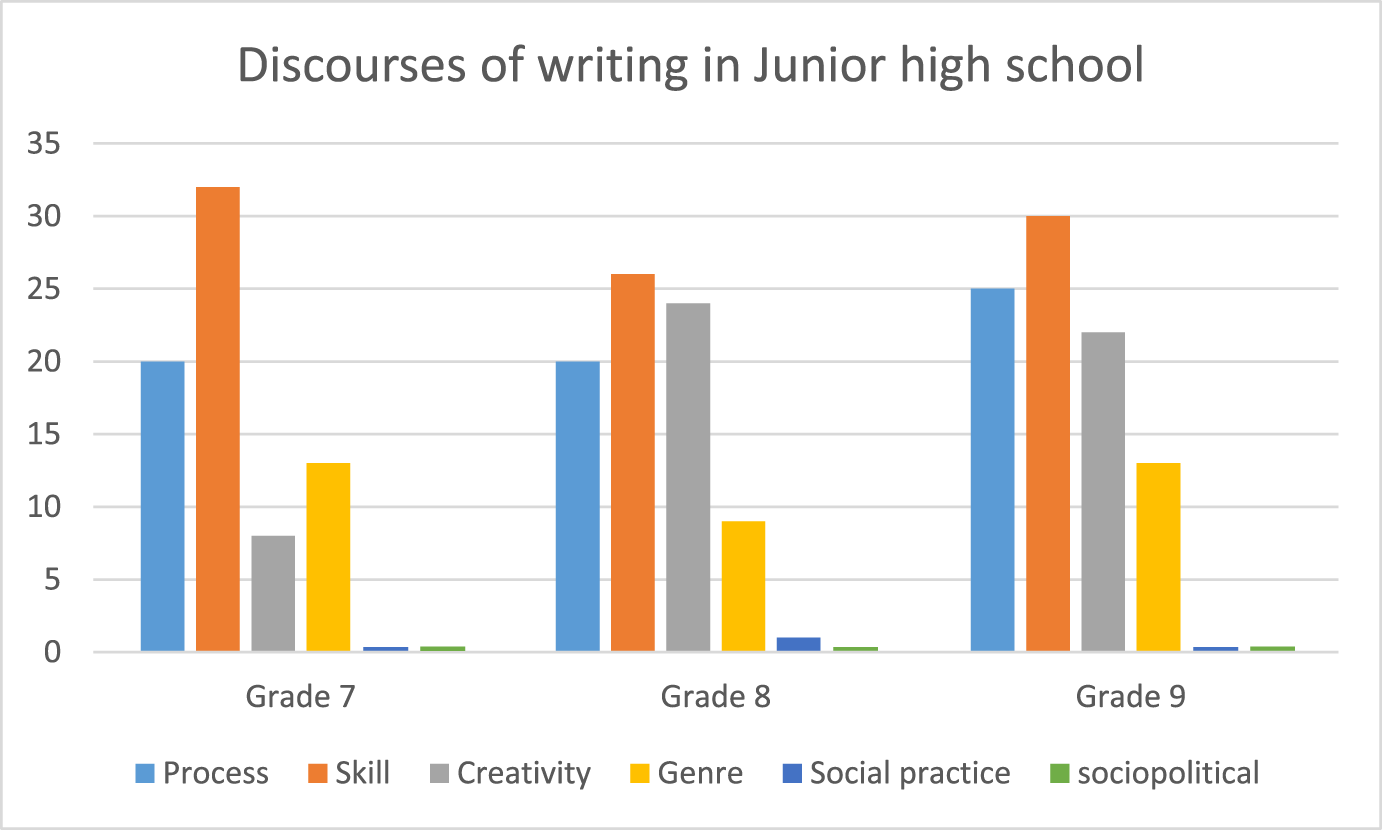
In this section, I present the main findings of the study with bar graphs and short excerpts from the textbooks. All excerpts are translated into English by the author. Figure 1 illustrates the extent to which each type of writing discourse was represented in Negāresh textbooks for grades 7, 8, and 9. As the figure shows, across the three junior high school (JHS) years, skills discourse stood out as the most represented. The next two dominant discourses were process and creativity.
Skills discourse was manifested in three ways: instruction on the components of a written text, the assessment criteria, and explicit focus on accuracy. First, emphasis on the components of writing (i.e., topic sentence, introduction, body, and conclusion) was a common theme running through all units of the textbooks. Although some assessment criteria varied according to the focus of each unit, paragraph and essay structure remained constant in the assessment criteria that students were supposed to evaluate during either peer or self-assessment. The following is an example of a writing activity aimed at helping students learn the structure of a paragraph.
Read the following text and identify its components.
Through language, we connect with others, send messages, and engage in dialogue. If you are asked how many languages we have, you would say, of course, one. But upon further reflection, we realize that there are alternative ways of talking to people and getting our messages across.
In addition to the verbal language that we use to talk to others, we have other languages too. When we see our friends from a distance and we wave to them, we communicate with them without talking to them. Or when the class president puts his or her finger on the lips and nose, he is reminding students to keep quiet and behave according to class norms.
With the aid of other body parts, we can communicate with others; through moving our head, our eyes, and eyebrows we can send messages. These ways of communicating are called body language.
If we know the language of our body well and use it in the right context, we will communicate with others more effectively.Footnote 64
Second, skills discourse was represented in assessment criteria by attention to spelling, punctuation, grammar, and handwriting. Therefore, skills discourse had a heavy presence in the criteria for both peer and self-assessment. The following is an example of how students were required to do peer assessment.
Evaluate your classmates’ writings, which are read aloud in the class, according to the following criteria.
a. Having a first draft.
b. Having a clean draft (good punctuation, lack of misspelling, accuracy, and proper margins).
c. Having a mental and written plan (introduction, body, conclusion).
d. Read-aloud quality.Footnote 65
The second and third criteria for peer assessment represented skills discourse, or the structural orientation of writing.Footnote 66 One, however, might wonder how students could judge visual features such as spelling, punctuation, and drafting based on a read-aloud.
Skills discourse was further instantiated in the “Dorost Nevisi” (literally, writing correctly) part of each unit, which had an explicit focus on accuracy. For instance, in grade 7, the accuracy sections focused on avoiding the broken or short form of verbs (unit 1), the use of pronouns (unit 2), subject-verb agreement (unit 3), using a proverb or a saying after the phrase “as it is famously said” (unit 4), proper use of coordinate conjunctions in compound sentences (unit 5), consistency of verb tense (unit 6), spelling of similar words (unit 7), and the distinction between gerunds and verbs (unit 8). Similarly, in each unit in grades 8 and 9 there was one accuracy focus, which was considered an instance of skills discourse.
Process was the next discourse consistently presented in JHS textbooks. The reliance on process discourse was evident in the introduction of the textbooks, in which the overall approach of the textbook was explained to teachers: “The main purpose of this textbook is to nurture mental discipline in students. When the mind is organized, so is speech and writing.”Footnote 67 The rest of the introduction explains that disciplined thinking happens when training students on essay structure and the stages of writing (process). Likewise, the first unit in Negāresh Pāye-ye Haftom is about planning in writing; advice is given on outlining and brainstorming. In the same section in Negāresh Pāye-ye Nohom, process discourse was evident in the emphasis placed on prewriting, writing, and post-writing. This focus on process was found throughout the textbooks in other methods of invention. Moreover, the emphasis on peer assessment, which was present for all writing tasks in all units of the three textbooks, was clear evidence of process discourse. Finally, and more importantly, process discourse was realized in the assessment criteria that were used for peer and self-assessment. Note the following example from unit 3 in Negāresh Pāye-ye Nohom.
Carefully listen to your friend’s writing being read aloud and assess it based on the following criteria: Having a first draft, having a revised draft, using proper literary or plain language, having an outline, having the introduction, body, and conclusion sections, the use of proper invention methods, and quality of reading aloud.Footnote 68
As can be seen, four of the seven assessment criteria (italicized) characterized process discourse. This process orientation in assessment criteria was evident in all units of the three Negāresh textbooks in JHS.
Except for grade 7, creativity discourse was as frequent as process discourse in JHS. Instances of creativity discourse included the following. First, sometimes the choice of writing topic was left to students. For example, in unit 2 of Negāresh Pāye-ye Haftom, the second task is, “Write an essay on a topic of your own choosing and mind the proper organization of an essay (i.e., introduction, body, and conclusion).”Footnote 69 Second, creativity discourse most often was realized in “Hekāyat Negāri” (i.e., literary narrative) tasks, which required students to rewrite a piece of literary prose from classic works in plain Persian. The following is an example of a hekāyat that students were required to rewrite in today’s Persian.
A man felt a pain in his eyes. He went to a veterinarian for treatment, and the vet prescribed to him what he would prescribe for a donkey suffering from identical eye pain. The man became blind due to animal drugs, and he took the matter to the court. The court ruled in favor of the veterinarian, arguing that if the man had not been a donkey, he would not have gone to a veterinarian for his eye pain.Footnote 70
The third type of writing task coded as creativity was “Masal Nevisi” (literally, writing with proverbs), which asked students to expand on a proverb or a saying by writing a scenario that illustrated the given proverb.
Finally, genre discourse received comparatively less space in JHS textbooks, particularly in grade 8. Genre discourse appeared principally in the “Hekāyat Negāri” task, in which students distinguished the differences between a literary piece and standard modern Persian. In addition, some units in the textbooks have an explicit focus on genre. For instance, in unit 6 of book 8, prior to writing a text based on compare and contrast discourse, students are required to read several texts and identify which characterize the compare and contrast discourse mode. Likewise, in unit 6 of Negāresh Pāye-ye Nohom, students are required to be mindful of different text genres, including informal letters, formal letters, diaries, biographies, travelogues, and stories. In the same unit, this is the assigned writing task:
Choose one of the given topics and write about it using one of the said genres: my childhood, a day in the class, exam session, the meaning of life, teenage years, the consequences of escaping from school, or flying without wings.Footnote 71
Following this task, genre discourse further appeared in peer assessment criteria, as “proper use of the genre,” alongside other process and skills–related criteria.
Finally, except for one case in which students were asked to write on social welfare in grade 8, social practice discourse was missing in JHS textbooks. The same was true for sociopolitical discourse, which received no space, and therefore is not represented in Figure 1.
Writing discourses in junior high school.

To sum up, in JHS textbooks, skills, process, and creativity were the major underlying discourses. Occasionally, marginal space was given to genre discourse, and discourses of social practice and the sociopolitical received little or no representation, respectively.
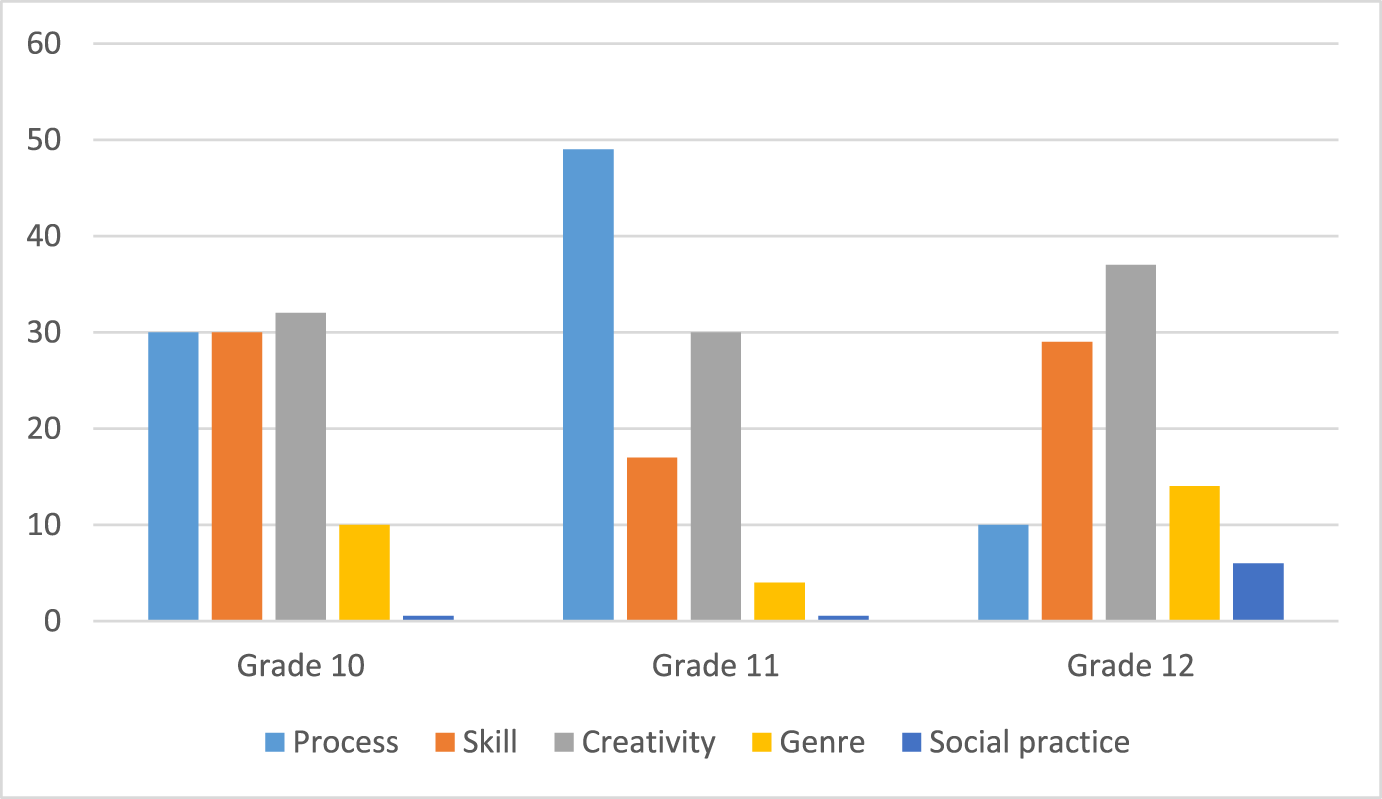
Figure 2 shows the discourses foregrounded in senior high school (SHS) textbooks. Creativity was the single discourse with consistently high representation across the SHS years. Creativity discourse was mainly realized in tasks with an explicit focus on creative writing, such as personification in unit 5 of Negāresh (1): Pāye-ye Dahom, in tasks with a literary orientation such as “Sheʾr Gardāni,” “Hekāyat Negāri,” or “Masal Nevisi.” The first task, “Sheʾr Gardāni,” which does not exist in JHS textbooks, is introduced in grade 10 and is a constant ingredient across the SHS textbooks. Tasks dealing with creativity discourse are heavily culture-laden and defy translation; I cannot provide excerpts of these tasks in English. Interested readers are referred to the Negāresh textbooks.
Writing discourses in senior high school.

Unlike creativity discourse, the representation of process and skills discourses fluctuated across the three SHS years. For instance, whereas in grade 10, process and skills were foregrounded to the same extent, skills discourse declined in grade 11 and process discourse became conspicuously dominant. In grade 12, the reverse happened, with skills discourse becoming dominant again and process discourse being less represented.
Process discourse was found in instruction on invention as well as criteria that were put forward for both peer and self-assessment. The former was treated mostly in the “Kārgāh Neveshtan” (writing workshop) part of each unit. An example follows.
Task 1. Read the following questions and determine which technique (brainstorming, if-writing, or inspiration from quotations) has been used in asking them.
What kind of creature is a mosquito? How many types of mosquitos exist? Where do mosquitoes sleep at night? Why do mosquitoes sit on our bodies? Which mosquitos are well known? Are there some mosquitos that are invisible? What happens if we swallow a mosquito? What would happen to planet Earth if there were no mosquitos? What kind of lessons does God want to teach us in creating mosquitos? How could a mere mosquito kill Nimrod, with all his power and pride?
Task 2. Choose a topic and use the asking questions technique to expand it. Then choose some of your own questions, answer them, and write a text on the topic.
Task 3. Assess both a friend’s final text as well as his or her questions and answers based on these criteria:
Formulating diverse questions using brainstorming, if-writing, and inspiration from quotations (5 points); expanding the answers (5 points); observing the principles of paragraph writing (5 points); quality of reading aloud (2 points); and spelling and grammar (3 points).Footnote 72
The first two tasks are intended to inspire students with ideas for writing, which is a major concern of process writing. In addition, two of the five assessment criteria are about the writing process. The weight given to each criterion illustrates the significance of the intended process.
Skills discourse was realized in the assessment criteria and the “Henjār-e Neveshtan” (i.e., writing norms) section, which was a consistent part of the SHS textbooks. In each unit, an accuracy point is introduced and students are expected to observe it later in their writings. In assessment criteria, skills considerations were common throughout the textbooks. The following is an example.
Listen to your friends’ questions as well as to their written reports and assess them according to these criteria: building the report on proper objective questions, organizing the questions from the most general to the most specific, using the right order of events, coherence, avoiding long sentences, diction, reading quality; grammar, spelling, and punctuation.Footnote 73
Half of the eight assessment criteria related to skills discourse.
Similar to its treatment in JHS textbooks, genre discourse had a consistently low presence across the SHS years. Finally, social practice discourse was given some space only in grade 12, and primarily in unit 4 of the textbook, which was about letter writing. Students are instructed to write formal letters to institutions and informal ones to friends and family members. For the first time, students are prompted to consider an audience, other than the teacher, for their writing. The following are two tasks requiring students to write letters to a specified audience.
Activity: Based on what you just read in this unit, write an official request asking for Roshd (Growth) magazine to be sent to the school. Afterward, assess the letters written by your peers in other class groups.Footnote 74
Activity: Write a letter inviting your school friends to your birthday party.Footnote 75
In summary, the three discourses of process, creativity, and skills were found to be dominant in senior high school textbooks. Genre discourse was underrepresented, social discourse was foregrounded only occasionally in grade 12, and sociopolitical discourse was absent.
Discussion
In this study, I examined the discourses of Persian writing in Iran’s secondary education Negāresh textbooks. I found three major themes: the salience of creativity discourse, the heavy presence of skills and process discourses, and lack of attention to discourses that conceptualize writing as social in nature. In what follows I will account for these observations, drawing on the national and global forces that come together to shape the current status of teaching Persian writing.
The heavy representation of the creativity discourse in teaching Persian writing is inconsistent with research findings in similar studies on other languages. This emphasis on creativity may not be surprising, given Iran’s historical obsession with poetry. After all, in contrast to the Western tradition in which prose has historically been the favored genre, poetry has historically been the hallmark of the Eastern traditions.Footnote 76 Moreover, Persian is known to be the language of poetry, literature, and Sufism.Footnote 77 Iranians also have an obsession with Persian literature; Chardin, a sixteenth-century French traveler to Persia, maintained that “luxury, sensuality, licentiousness on the one hand, Scholasticism and literature on the other, have made the Persian effeminate.”Footnote 78 So it should come as no surprise that ordinary Iranians revere books of Persian poetry like sacred texts, and this mindset about writing may be equally true for textbook writers and curriculum designers. Nevertheless, creativity discourse was not fully realized through expressive, reflective, and free writing. Rather, in many cases, writing prompts and topics were predetermined and recurrent across units and textbooks, such as, for instance, the two tasks of navigating poetry and expanding proverbs.
To be more precise, the approach to creativity in Negāresh textbooks is more aligned with a literature-based orientation.Footnote 79 The problem with reducing creativity to a literature-based orientation is that students’ “cultures outside the school gates are not a useful resource for teaching them to be writers.”Footnote 80 The implication is that the writing tasks assigned to students in northern Tehran are the same as those assigned to students in remote villages across the country, resulting in writing tasks that are decontextualized and divorced from students’ immediate social lives. This gives students the perception that writing is artificial and irrelevant.
The next two discourses significantly present in Negāresh textbooks are skills and process discourses. At a regional level, the dominance of the skills discourse is parallel to the situation in Uzbekistan, another country with a centralized education system similar to that of Iran.Footnote 81 Some scholars attribute the global presence of skills discourse across world languages to the global homogenization of rhetoric.Footnote 82 Comparing Chinese, Japanese, and English writing textbooks, Kubota found a “converging trend in which the ideal rhetoric conventions are converging into the idealized rhetoric of English.”Footnote 83 In other words, the global spread of English has influenced what is perceived to be ideal communication in other languages.Footnote 84 This homogenization of rhetoric poses a far more serious danger to the Persian language than the presence of English words, which seems to be the major concern of language purists in Iran, such as those at the Academy of Persian Language and Literature.
With respect to efficiency, however, skills discourse is known to be the least effective in nurturing students’ writer identity, because “teachers’ focus is solely on the written product and not the young writer who produced it.”Footnote 85 Emphasis on teaching the structural aspects of language “involves an increasing loss of creativity on the child’s part and a subordination of the child’s creative abilities” to the requirements of language structure.Footnote 86 In writing classes dominated by skills discourse, students “spend a lot of time writing without ever composing,” resulting in “children writing impeccable nonsense.”Footnote 87 Comparing composition in German and Iranian schools, Ghasempour Moghaddam goes further and maintains that even writing teachers in Iran do not engage in composing.Footnote 88
This reliance of policymakers on skills discourse may be related to their autonomous view of literacy, which promotes a view of writing as universal, context-independent, and generic across settings.Footnote 89 Unfortunately, this view holds sway in most contexts; as Ryan maintains, “too often, school writing is abstract, depersonalized and context-reduced.”Footnote 90 A further reason for the popularity of this autonomous view of literacy is that “any responsibility to improve standards of literacy is placed squarely on schools without any consideration of wider social and economic factors.”Footnote 91 This flows from top-down, managerial, and technocratic approaches to educational change, which has been shown to be flawed.Footnote 92
Process discourse also was among the three discourses featured in Negāresh textbooks. Viewing learning to write as a process, like skills discourse, appears to be a universal trend, and the dominance of process discourse in this study resonates with most studies adopting a discourses of writing framework.Footnote 93 “Process writing has, in many instances, been institutionalized as a programmatic approach to writing, which assumes all students undertake the composing process in similar ways.”Footnote 94 However, proponents of postprocess composition maintain that process is a theory that ignores the public, interpretive, and situational nature of writing.Footnote 95 When writers are challenged, the assumption of process discourse is that there is a generalized process all writers go through. Kent argues instead for the interpretability and unpredictability of the interactive event that we call writing.Footnote 96
The common denominator of the three prevalent discourses in Negāresh textbooks is that each reduces writing to the writer or the written text.Footnote 97 Creativity and skills discourses are mainly concerned with the written text, and process discourse with the writer’s mental processes. They project a picture of writing that is asocial, apolitical, and ahistorical. These writing discourses eventually result in what is called schooled literacy, which is different from personal literacy and is often politically regulated.Footnote 98 The three discourses that take writing beyond the individual writer and the text are almost neglected in Negāresh textbooks. In the remainder of this section, I account for the neglect of the three discourses underrepresented in Persian writing textbooks.
As observed, genre discourse plays a marginalized role in Persian writing curriculum, especially in senior high school. Although, according to Ivanič, a well-rounded writing program should incorporate all writing discourses, she acknowledges that genre discourse is difficult to combine with other discourses “because of the requirement for a substantial amount of linguistic input.”Footnote 99 Another possible explanation is that genre discourse, at least in its dominant version, is for the most part an Australian import that may be unfamiliar to designers of curriculum for Persian writing. Alternatively, genre discourse with its prescriptive nature does not square with a literature-based orientation, which, as noted, is a dominant force in Iranian writing culture. Nevertheless, this remains speculative and merits further inquiry.Footnote 100
As to social practice discourse, it is absent except for one unit in Negāresh Pāye-ye Hashtom and one in Negāresh (3) Pāye-ye Davāzdahom. Even in these two cases, the orientation comprises a functional approach rather than purposeful communication.Footnote 101 As described, in the only unit featuring social practice discourse, two writing tasks required of students were writing an official letter asking the school to subscribe to Roshd magazine and writing a birthday party invitation letter. Many Iranian students may have never seen a magazine. Because this writing task falls outside their repertoire of life experiences, it is very unlikely to engage them in meaningful writing. The other task is also irrelevant to most Iranian students in the country; the textbook authors, presumably middle class teachers or professors based in Tehran, have taken it for granted that birthday parties are a nationwide cultural practice. The reality is that many Iranian families do not have the luxury of remembering birthdays, throwing birthday parties, or engaging in writing invitation letters. Moreover, even middle-class Iranians who celebrate birthdays do not invite others to their birthday events by writing formal birthday invitation letters. This is done through phone calls or texting on social media. In today’s world, writing is so entangled with the practice of everyday life that we do not need to engage students in simulation writing tasks.Footnote 102 The gap between school literacy and social literacy is documented in the literature.Footnote 103 That said, for writing pedagogy to be effective it “must begin with the writer situated in personal and social experience.”Footnote 104
Finally, sociopolitical writing discourse has almost no representation in the Negāresh textbooks. This is consistent with research done in most Asian and African countries, and unlike findings in some studies of the United States and Nordic countries.Footnote 105 Lack of attention to sociopolitical discourse characterizes centralized educational systems: “Critical writing instruction associated with a sociopolitical discourse is particularly uncommon, especially in nations with frequent, high-stakes testing and mandated curricula,” as in Iran.Footnote 106 Relatedly, some believe that the reasons for different writing pedagogies are found in theories of rhetoric, which are in turn grounded in ideology.Footnote 107 Ideology determines the grammar of life. It identifies what exists, what is good, and what is possible.Footnote 108 How we define good writing is constrained by our conceptualizations of the four elements of composition: writer, reality, audience, and language. Particularly, how reality is defined determines our conception of knowledge (i.e., epistemology). This in turn influences the perceived relationship between writing and knowledge. Both process and skills discourses, those dominant in Negāresh textbooks, are grounded in current-traditional rhetoric (CTR), according to which knowledge falls outside the rhetorical realm. Therefore, writing is a mere carrier of knowledge. CTR refutes ideology by resting securely in the scientific method.Footnote 109 This claim to science is also referenced in the Negāresh textbooks, which state that “writing activities have been sequenced according to a scientific and educational logical order.”Footnote 110, Footnote 111
In contrast, social epistemic or critical literacy rhetoric holds that knowledge is inherent in communication; knowledge is discursive social practice.Footnote 112 The implication for writing pedagogy is that for as long as knowledge is seen as transcendental, and writing is relegated to the category of a carrier or conduit, a hierarchical epistemic order is likely to govern writing programs, resulting in the kind of schooled literacy that is known to be unproductive in fostering the student writer’s identity.Footnote 113 In the epistemic order, students are relegated to mere learners whose views and experiences are not worthy of knowing or being taken seriously; rather, they are immature and in need of correction. Learner agency is not recognized, and as long as this true a banking model of writing education will be reinforced, and a sociopolitical discourse of writing has little, if any, chance of taking root in writing programs.
Implications for Persian writing pedagogy
For writing pedagogy to foster the student writer’s identity, writing in Persian has to be taken out of its entrenched and constrained conception and become part of everyday social life. In today’s digitized world, this demands that writing be entangled with the material affordances of social media and artificial intelligence. Textbooks are known to be conservative and often outdated. Given the pace of change in the digital age, too much reliance on textbooks anchors writing pedagogy in entrenched traditional practices. This implies that teachers of Persian writing should have the agency to author and produce instructional materials that are compatible with the taste and needs of the current generation of students in diverse social and geographical settings.
A writing program that must be sensitive to local social practices defies centrally produced writing materials because, in principle, a nationally uniform textbook presupposes a homogenous student population across diverse settings, an assumption that has been discredited.Footnote 114 Learning in general, and specifically learning to write, is essentially ontological, related to students’ identity, being, and becoming. What pushes a student in northern Tehran to write may be redundant or irrelevant to millions of students in other cities and villages. Yet textbooks produced in a centralized education system assume a homogenous student population. Policymakers may wrongly assume that, in today’s globalized world, with the advent of social media, the earth is leveled, resulting in a classless society. This a flawed assumption. According to Bourdieu, no two persons’ habitus are the same, and the cultural capital and experiences of no two students are the same.Footnote 115 Writing is about life; it is about being in the world. Life is dynamic, unpredictable, and even chaotic. For a writing program to be compatible with the dynamism of social life, it has to enjoy the same degree of freedom and dynamism, and be responsive and sensitive to all the complexities, contingencies, and power relations of social life. No centrally authored textbook, no matter how well-written, can accommodate these diverse and changing demands.
That said, the fragmentation of Persian textbooks manifested in the separation of writing from Persian language and Persian literature textbooks is a move in the right direction. This fragmentation, however, should progress to further localization and decentralization of writing pedagogy. Otherwise, the recent move of granting Persian writing its own textbook may result in more control and regulation of writing, perpetuating an entrenched schooled literacy, and “few children [will] grow up to be writers in any significant sense of the word.”Footnote 116 After all, writing is about making a difference. To make a difference, students’ differences must be recognized and celebrated. Only through this recognition can students exercise their right to write.Footnote 117 For change in Persian writing pedagogy to happen, changes in textbooks or teaching methods are not likely to take us far. Rather, it is an awareness of the power of writing discourses that can make a difference. Discourses of Persian writing are about beliefs, mindsets, and ideologies about the Persian language, Persian writing, and learning Persian writing. At the heart of this awareness is the realization that discourses not only describe the status of writing but create what writing is or can be.
Acknowledgments
I would like to thank Dr. Davood PourMozafari for his insightful ideas on the history of changes to writing curricula in Iran.