Introduction
Hazelnut is a tree or large shrub in the Corylus genus in the Betulaceae family native to northern temperate zones; it is also known as filbert or European hazelnut. Hazelnut-enriched diets are associated with a reduction in coronary heart disease and an improved cholesterol profile (Mercanligil et al. Reference Mercanligil, Arslan, Alasalvar, Okut, Akgül, Pınar, Geyik, Tokgözoğlu and Shahidi2007), health benefits that promote its consumption. Worldwide, hazelnut farmgate value was $2.3 billion in 2016 (FAO 2019), with consumption expected to increase by 10.1% between 2020 and 2025 (Anonymous 2019). Global production was 835 millionkg in 2018, and leading producing countries include Turkey (62%), Italy (16%), Azerbaijan (6%), and the United States (6%) (FAO 2019). Hazelnuts are a traditional crop in Turkey, where the orchards are mostly grown as a multi-stemmed shrub along the hillside of the mountains, and the crop is harvested manually (Kaya-Altop et al. Reference Kaya-Altop, Haghnama, Sarıaslan, Phillippo, Mennan and Zandstra2016). The average yield in Turkey was 700 kg ha–1 of in-shell hazelnut in 2018 (FAO 2019).
Nearly all US hazelnut orchards are in the Willamette Valley of western Oregon. Hazelnut production is expanding in Oregon, with a nearly three-fold increase in hectarage in the last 10 yr to 31,800 ha in 2018; almost half of that hectarage was nonbearing or producing from plants less than 5-yr-old in the same year (USDA NASS 2019). The industry has been expanding since the early 2000s as a result of the release of new hazelnut varieties resistant to the devastating fungal disease known as eastern filbert blight, caused by the plant pathogen Anisogramma anomala (Peck) E. Müll (Molnar et al. Reference Molnar, Goffreda and Funk2010). In addition to disease-resistant varieties, hazelnut production in the United States remains economically competitive, in part because intensification and mechanization holds labor costs to 6% of total production costs (Miller et al. Reference Miller, Seavert and Olsen2013). The hazelnut varieties grown in the United States naturally drop their fruit to the orchard floor, and the crop is harvested mechanically. The average yield in the United States was close to 2,600 kg ha–1 in 2018, or 3.6 times greater than the yield reported in Turkey in the same year (FAO 2019).
The growth habit of hazelnut poses inherent challenges for mechanization. Hazelnut produces prolific basal sprouts, also known as suckers, that originate from the lower part of the trunk and roots. Left untrained, hazelnuts grow into a multi-stemmed shrub. In Oregon, hazelnut suckers are removed to promote the development of a single trunk, facilitating mechanized harvest (Mehlenbacher and Smith Reference Mehlenbacher and Smith1992). Suckers also affect mechanization and production practices in other crops. In vineyards, suckers can negatively affect operations such as tillage, herbicide sprays, harvest, pests, and disease control (Kang et al. Reference Kang, Wang, Pierce, Zhang and Wang2012).
In addition to the operational challenges of multiple stems, suckers can weaken the growth of branches by competing for resources (Tous et al. Reference Tous, Girona and Tasias1992). Hazelnut suckers reduce the growth of the primary trunk, lengthen the juvenile phase, and reduce hazelnut yield (Mehlenbacher and Smith Reference Mehlenbacher and Smith1992); multi-stemmed plants may favor disease by reducing airflow within the canopy (Tomasone et al. Reference Tomasone, Colorio, Cedrola and Pagano2008). Suckers may serve as a possible infection source of eastern filbert blight (Murray and Jepson Reference Murray and Jepson2018). Suckers cause similar problems in other crops such as grapes and tobacco. In grapes, suckers increase the foliage per plant, which may lead to substantial pathogen infestation and cause an imbalance in the fruit-to-shoot ratio (Dolci et al. Reference Dolci, Galeotti, Curir, Schellino and Gay2004). In tobacco, suckers may reduce root growth and nutrient uptake (Weeks and Seltmann Reference Weeks and Seltmann1986).
Sucker control in hazelnut is labor-intensive (Serdar and Akyuz Reference Serdar and Akyuz2018). Sucker emergence and vigor are variety-dependent (Tomasone et al. Reference Tomasone, Colorio, Cedrola and Pagano2010). Sucker growth generally initiates in spring (April) in the Willamette Valley and continues until late summer (September), requiring continuous removal during the growing season. Several methods of sucker control have been tested in hazelnut, such as disbudding the lower portion of the trunk, manual removal, thermal control, and chemical control (Dolci et al. Reference Dolci, Schellino and Radicati2000; Smith and Erdoğan Reference Smith and Erdoğan2001; Tomasone et al. Reference Tomasone, Colorio, Cedrola and Pagano2010). Manual removal of suckers during the winter is the standard practice in Turkey, Italy, Spain, and the United States, requiring 12 to 15 h of labor per hectare (Franco and Pancino Reference Franco and Pancino2008). Manual removal of suckers during the growing season is not economically feasible for most Oregon growers because of labor cost and availability. Sucker removal can be ergonomically hazardous and exhausting work. Prolonged flexing of the back muscles and repetitive pruning movements cause work-related injury in the agricultural sector (Meyers et al. Reference Meyers, Faucett, Tejeda, Kabashima, Miles, Janowitz, Duraj, Smith and Weber2000). When suckers are left uncontrolled during the growing season, they grow large and require additional exertion and stress in the hands and wrists of pruning personnel.
Alternatives to sucker removal have been investigated. Steaming and flaming were not cost-effective options, and crop safety may be a concern (Tomasone et al. Reference Tomasone, Colorio, Cedrola and Pagano2008). Mechanical sucker control has not been adopted in hazelnut because of crop damage concerns. In grape, mechanical de-suckering is common practice with commercially available equipment but can damage young grape plants (Dolci et al. Reference Dolci, Galeotti, Curir, Schellino and Gay2004). Chemical control is the most broadly adopted method because of its low cost and time consumption compared to other methods (Serdar and Akyuz Reference Serdar and Akyuz2018). Herbicides are the standard practice for sucker control in commercial hazelnut production in Oregon (Olsen and Peachy 2013). Several herbicides are labeled for sucker control in hazelnut, such as 2,4-D, paraquat, and glufosinate (Wiman et al. Reference Wiman, Pscheidt and Moretti2019). Still, effective control requires multiple applications, with reports of up to eight applications per season. However, four herbicide applications are recommended per season (Olsen and Peachey Reference Olsen and Peachey2013). Changes in this practice may reflect both new varieties under cultivation and younger orchards in Oregon, as a result of industry expansion. Available data on the efficacy of herbicide control of suckers are outdated (Reich Reference Reich1970). The objective of this study was to evaluate the efficacy of registered herbicides for sucker control in hazelnut.
Materials and Methods
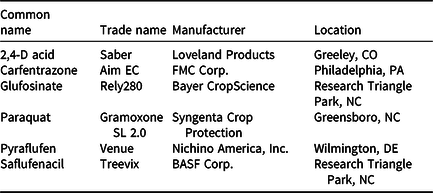
Two experiments were conducted to compare the efficacy of hazelnut sucker control using registered herbicides. The first study was a season-long management program comparing the effects of multiple applications of the same treatment in sucker control and growth. The number and frequency of applications followed local recommendations (Olsen and Peachey Reference Olsen and Peachey2013). Based on the results of the first study in 2017, a second, short-term study was carried out in 2018 to evaluate the efficacy of the treatments after a single application. Field trials were conducted following recommended herbicide rates registered for use in hazelnuts in Oregon (Table 1).
List of herbicides used in the experiments to compare efficacy of hazelnut sucker control in Oregon orchards.

Season-long Control of Hazelnut Suckers
Two studies were conducted to evaluate the efficacy of the sequential application of herbicides to hazelnut suckers (Table 2). The first study was conducted in Amity, OR (45.06° N, 123.17° W) in 2017 and repeated in 2018 in a different section of the same orchard. The research site was located in a well-drained Woodburn silt loam soil (USDA 2017). The orchard consisted of 10-yr-old ‘Jefferson’ hazelnuts planted 6 m by 6 m and irrigated with drip irrigation; standard production practices were followed (Olsen and Peachey Reference Olsen and Peachey2013). The experiment was initiated when suckers reached an average height of 15 ± 5 cm, as recommended (15 to 22 cm height) (Olsen and Peachey Reference Olsen and Peachey2013). Trees had at least 15 suckers present within a 0.5-m radius of the tree base at the beginning of the experiment. Treatments were applied using a CO2 backpack sprayer equipped with three nozzles 11002 Turbo TeeJet (TeeJet Technologies, Wheaton, IL). The sprayer was calibrated to deliver 187 L ha–1 at 275 kPa. Applications were made as a single pass to each side of the tree row. Treatments were reapplied every 28 d, from May to August, during each year of the study. Four applications of the same treatment were made per season to each plot. In 2017, applications were made on May 8, June 19, July 18, and August 15. In 2018, treatments were applied May 1, May 29, June 26, and July 24.
Hazelnut sucker biomass per tree and average sucker cross-sectional area measured 28 d after the fourth herbicide treatment in the season-long experiment conducted in a mature hazelnut orchard located in Amity, OR in 2017 and 2018 (long-term study).

a The sequential applications were made in May (first), June (second), July (third), and August (fourth) of each year. Means are the average of two field experiments (n = 8). Means followed by the same letter within columns are not significantly different at P < 0.05 using Tukey’s HSD test. The biomass reduction and cross-sectional area reduction are relative to the nontreated control. All treatments included ammonium sulfate source at 1% v/v (Bronc Max; Wilbur-Ellis, Aurora, CO) except manual removal and nontreated. Treatments with 2,4-D, carfentrazone, or paraquat included nonionic surfactant at 0.25% v/v (Rainier EA; Wilbur-Ellis, Aurora, CO).
b Herbicide rate expressed as the active ingredient, acid equivalent, or volume per volume, as appropriate.
Assessments included visual estimates of sucker control on a scale of 0 to 100%, with 0 as no control and 100% as complete control at 28 d after treatment (DAT), and visual estimates of crop injury. The height of 10 suckers from the soil surface to the tip of the shoot per plot was measured at 28 DAT. At 28 DAT after the last application, a digital caliper was used to measure the diameters of 20 suckers per plot (10 per tree) at the base of the suckers (Fisherbrand™ Traceable™ Digital Calipers; Thermo-Fischer Scientific, Waltham, WA). Sucker base caliper diameter was transformed into a cross-sectional area using the following equation:
 $$A = \pi {\left( r \right)^2}$$
where A is the cross-sectional area, r is the radius, and π is a constant (3.14159). All suckers were harvested, dried at 70 C for 4 d, and the dried biomass recorded. The cross-sectional area and biomass reduction were calculated by the difference between treated and nontreated plots divided by treated plots.
Short-Term Control of Hazelnut Suckers
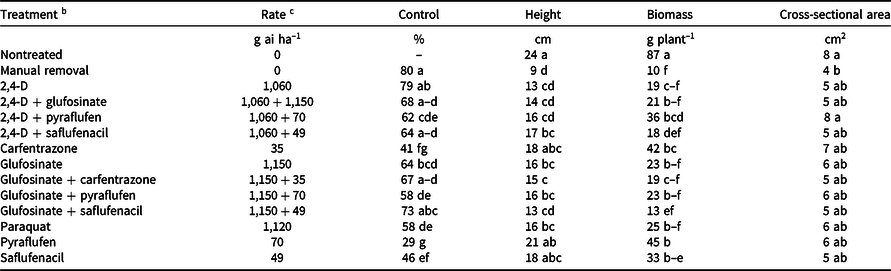
Four field trials were conducted in mature orchards in the Willamette Valley in 2018. Experiments included 13 treatments and a nontreated control and followed methods similar to those described previously, with the exception that these trials were terminated at 28 DAT. The treatments included saflufenacil at 49 g ai ha–1, 2,4-D at 1,060 g ai ha–1 in combination with saflufenacil at 49 g ha–1, glufosinate at 1,150 g ai ha–1 in combination with saflufenacil at 49 g ha–1, pyraflufen at 70 g ai ha-1, 2,4-D at 1,060 g ae ha–1 in combination with pyraflufen at 70 g ha–1, glufosinate at 1,150 g ha–1 in combination with pyraflufen at 70 g ha–1 (Table 3). Two experiments were conducted near Canby, OR (45.17° N, 122.39° W), and two near Corvallis, OR (44.29° N, 123.13° W). Soils in the Canby orchards were a Latourell loam (USDA 2017); the crop was rain-fed with trees spaced 6.1 m by 6.1 m. The first study in Canby was in a 12-yr-old ‘McDonald’ hazelnut orchard. The study was initiated on May 1, when suckers were 15 cm ± 4 cm in height. The second Canby experiment was in a 5-yr-old ‘Jefferson’ orchard and started when suckers were 16 cm ± 5 cm in height on June 11. The Corvallis experiments were conducted in a 10-yr-old ‘Jefferson’ orchard on a nonirrigated Chehalis silt loam (USDA 2017). Two different locations within the same orchard were selected. The first trial was initiated on May 1, when suckers were on average 15 ± 4 cm in height in the first trial, and the second trial was initiated on June 12, when suckers were 14 ± 6 cm in height. The average height of 10 suckers per plot was recorded at the beginning of each application. Sucker control, height, caliper diameter, biomass, and crop injury were measured 28 DAT as detailed in the previous section.
Hazelnut sucker percentage control, height, dry biomass, and cross-sectional area 28 d after treatment of the short-term experiments in Oregon orchards.a

a Means are the average of four field experiments (n = 16) conducted in hazelnut orchard located in Canby and Corvallis, OR in 2018 (short-term study).
b All treatments included ammonium sulfate source at 1% v/v (Bronc Max; Wilbur-Ellis, Aurora, CO) except manual removal and nontreated. Treatments with 2,4-D, carfentrazone, or paraquat included nonionic surfactant at 0.25%v/v (Rainier EA; Wilbur-Ellis, Aurora, CO). Means followed by the same letter within columns are not significantly different at P = 0.05 using Tukey’s HSD test.
c Herbicide rate expressed as the active ingredient, acid equivalent, or volume per volume, as appropriate.
Statistical Analysis
Season-long Control of Hazelnut Suckers
The experiment was designed as a randomized complete block with eight treatments and four replicates; the experiment was conducted twice. Each experimental unit included two hazelnut trees. The individual trees were treated as subsamples, and assessments were averaged for each plot.
Statistical analysis was performed in RStudio 1.2.5042 (R Studio Team 2020) using a generalized linear mixed model (GLMM) with the package glmmTMB version 1.01 (Brooks et al. Reference Brooks, Kristense, van Benthem, Magnusson, Berg, Nielsen, Skaug, Machler and Bolker2017). The experimental year, block, and interactions were considered random effects, as the goal was to estimate the effects of treatments over a broader scope (Moore and Dixon Reference Moore and Dixon2015). A GLMM with beta distribution was used to analyze the percentage control and crop injury data (Stroup Reference Stroup2015), using beta family and logit function in glmmTMB. This package allows the beta regression analysis with mixed effects (Douma and Weedon Reference Douma and Weedon2019). The sucker height and the cross-sectional area were analyzed using the MASS package (Venables and Ripley Reference Venables, Ripley, Chambers, Eddy, Hardle, Sheather and Tierney2002) using a GLMM with a Penalized Quasi-Likelihood estimation method to account for data overdispersion and normality issues (Bolker Reference Bolker2017). Means were compared using Tukey’s HSD test, with a 95% confidence interval using the Multcomp or Eemeans package as appropriate (Hothorn et al. Reference Hothorn, Bretz, Westfall, Heiberger, Schuetzenmeister and Scheibe2014; Lenth Reference Lenth2019).
Short-Term Control of Hazelnut Suckers
The experiments were arranged in a randomized complete block design with four replicates composed of two trees per plot. Each tree was treated as a subsample, as described for the long-term study. The statistics procedures were conducted similarly to those in the long-term study. Experimental location and application timing was considered random in the GLMM and herbicide treatment as a fixed factor.
Results and Discussion
Season-long Control of Hazelnut Suckers
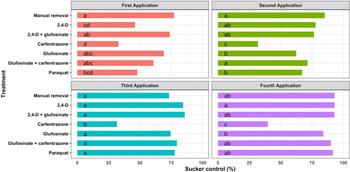
All treatments evaluated in this study had a significant effect on suckers. The effect of herbicide varied by application (P < 0.001); therefore, data were analyzed and are presented separately. In the first application, manual removal provided the highest sucker control rating (77%), and it was similar to control levels observed with glufosinate and mixtures of glufosinate with 2,4-D or carfentrazone (Figure 1). The 2,4-D-, carfentrazone-, or paraquat-alone treatments resulted in less than 50% control. The level of control for most treatments increased in the second application period, except carfentrazone. For instance, 2,4-D provided 77% control after the second application compared to 46% on the first application. In contrast, carfentrazone efficacy was 33% and 31% in the first and second applications. Following the third and fourth applications, treatments with 2,4-D, paraquat, and glufosinate resulted in sucker control levels comparable to manual removal ranging from 73% to 86% (Figure 1). Sucker control with carfentrazone was below 40% across all four application periods. No injury to the crop canopy, leaves, or trunks was observed after any sucker control treatment during the course of these trials (data not shown).
Hazelnut sucker control 28 d after treatment for each application period in a season-long sucker control program. The first (red bars), second (green bars), third (blue bars), and fourth (purple bars) evaluations were made in May, June, July, and August of each year, respectively. Data presented are means (n = 8) and standard errors of two combined experiments conducted in 2017 and 2018 in Amity, OR. Bars followed by the same letter within an application period are not statistically different based on Tukey’s HSD test (P < 0.05).

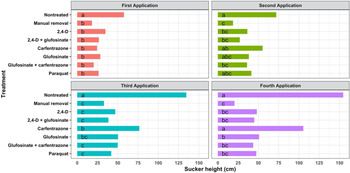
The average height of nontreated hazelnut suckers reached 57 cm 28 DAT after the first application (Figure 2). That is a 42-cm increase in growth compared to the initial 15-cm height, an average growth of 1.5 cm d–1. All treatments tested reduced sucker height (<34 cm) when compared to the nontreated plots with no differences among treatments in the first evaluation period. After the second application timing, manual removal, 2,4-D, and 2,4-D mixed with glufosinate presented a mean sucker height of 36 cm, whereas other treatments were not different from the nontreated control (Figure 2). After the third application, all the treatments resulted in a sucker height of <49 cm compared to 134 cm in the nontreated plots. Carfentrazone-treated suckers were 76 cm, and the upper part of the sucker could not be treated with subsequent applications because the boom height was kept at 50 cm. As a result, suckers treated with carfentrazone were 105 cm tall on the fourth application, or approximately twice as tall as other treatments; nontreated suckers were 155 cm tall at that time. All other treatments resulted in suckers <51 cm tall (Figure 2).
Hazelnut sucker height 28 d after treatment for each application period in a season-long sucker control program. The first (red bars), second (green bars), third (blue bars), and fourth (purple bars) evaluations were made in May, June, July, and August of each year, respectively. Data presented are means (n = 8) and standard errors of two combined experiments conducted in 2017 and 2018 in Amity, OR. Bars followed by the same letter within an application period are not statistically different based on Tukey’s HSD test (P < 0.05).

Among all treatments, those containing 2,4-D, paraquat, and glufosinate resulted in the smallest sucker biomass, with less than 139 g tree–1, a reduction of 89% to 96% compared to nontreated biomass (Table 2). Herbicide treatments, except for carfentrazone, were as effective as manual removal of suckers. All treatments also reduced the cross-sectional area of the suckers by 68% to 86%. The results indicated that 2,4-D, paraquat, and glufosinate are effective options for sucker control. In general, mixtures did not improve the efficacy of sucker control when compared to single products; however, mixtures can be a good option when considering both weed and sucker control.
Short-Term Control of Hazelnut Suckers
The results of the short-term study indicate that 2,4-D and its mixtures with carfentrazone, glufosinate, or saflufenacil controlled suckers to levels comparable to manual removal (Table 3). 2,4-D plus pyraflufen was less effective than 2,4-D alone or manual removal. The mixture of glufosinate with saflufenacil or carfentrazone with 67% and 73% control, respectively, were as effective as manual removal, but not different from glufosinate alone. Carfentrazone, saflufenacil, and pyraflufen provided less control than glufosinate. Treatments with 2,4-D, glufosinate, and paraquat suppressed sucker growth, with height 28 DAT ranging between 13 and 17 cm, compared to 24 cm in the nontreated plots. Carfentrazone, pyraflufen, and saflufenacil alone resulted in sucker height similar to nontreated. In contrast, all treatments reduced sucker biomass compared to the nontreated control. Treatments with 2,4-D, glufosinate, paraquat, and saflufenacil resulted in biomass between 13 and 36 g plant–1 compared to 87 g plant–1 of the nontreated. However, none of these treatments reduced the sucker cross-sectional area (Table 3).
The long-term and short-term studies confirm that 2,4-D, glufosinate, and paraquat are effective options for sucker control in hazelnuts. These findings agree with previous work that also reported that 2,4-D and paraquat were effective in controlling hazelnut suckers (Reich Reference Reich1970). Direct comparison across studies is difficult because of different application methods. In the Reich Reference Reich1970 study, 2,4-D and paraquat were mixed at 0.25% v/v in 378 L of water and applied to suckers to the point of run-off rather than on a per-hectare basis. This spray volume is still the recommendation on 2,4-D labels today, with a 2,4-D rate of 1,060 g ai ha–1 in 935 L ha–1 (Anonymous 1996). The present study shows excellent sucker control, with one-fifth of the spray volume (187 L ha–1); lower spray volumes can reduce application costs.
Although the literature on sucker control in hazelnut is limited, chemical control of suckers in other crops has been studied. For instance, in a peach orchard, a single application of paraquat at 1.1 kg ai ha–1 or glufosinate at 1.2 kg ai ha–1 controlled plum rootstock suckers (Muro and Luri Reference Muro and Luri1990). The authors reported that all tested herbicides were more effective than manual removal of suckers. In hazelnuts, paraquat and glufosinate were also effective, but manual removal always resulted in greater reductions in sucker height. It is important to emphasize that four consecutive treatments of the herbicide or manual removal were required to achieve the reported level of control in hazelnuts. Repetitive removal during the growing season would render manual sucker control economically unsustainable. The time required to remove suckers manually was reported to be 12 to 14.5 h ha–1 or approximately 80 to 97 s tree–1 in orchards planted at a density of 540 trees ha–1 (Franco and Pancino Reference Franco and Pancino2008). Removal of larger diameter suckers required more time. A de-suckering operation would cost between $135 and $163 ha–1 or approximately 2% to 2.4% of the total production costs based on the 2013 production costs and a minimum hourly wage of $11.25 ($6,750 ha–1 yr–1) (Miller et al. Reference Miller, Seavert and Olsen2013). As the labor wages continue to increase, the current costs are much higher. As for herbicides, multiple applications are also required, but the costs would be between three and nine times lower with glufosinate and 2,4-D, respectively, than removing suckers manually. Growers cannot rely on a single mode of action to control suckers year-round, because of maximum allowable per-season rates. In addition to sucker control, herbicide rotation is a key component of weed control programs to slow the development of selection for herbicide resistance (Norsworthy et al. Reference Norsworthy, Ward, Shaw, Llewellyn, Nichols, Webster, Bradley, Frisvold, Powles and Burgos2012).
In this study, carfentrazone and saflufenacil, in most instances, provided a similar control to glufosinate and paraquat but were not as effective as 2,4-D. The lower efficacy of these products could be attributed to sucker height influencing spray coverage and penetration. The common recommendation is to apply the herbicides when suckers average 15 cm in height. Because sucker emergence is not uniform, variability in sucker height can be substantial. Further studies evaluating application parameters are required to improve the efficacy of sucker control with herbicides.
Acknowledgments
This work was supported by the Oregon Hazelnut Commission. No conflicts of interest have been declared. The authors thank Hazelwood Orchards and Bikemeier Farms & Nursery for all the assistance provided during the execution of the project. The authors would like to acknowledge the assistance of Andre Caixeta Consonni, Lucas K. Bobadilla, Peter Sturman, David King, Arnaldo Marques Caldeira da Silva, Steve Erickson, and Emily Pat in data collection.