Introduction
The performance of activities by most adults does not vary markedly over the course of the day. Nevertheless, some adults demonstrate differences in performance that vary according to their circadian rhythms, with characteristic peaks occurring either towards the morning or towards the evening. “Morning” people tend to perform better when tested in the morning rather than later in the afternoon or evening, with the pattern being reversed for “evening” people. Hence, individual differences in circadian rhythms could be a source of variance in performance on a wide range of tasks if participants are tested at specific times of the day and are randomly selected without controlling for whether they are “morning”, or “evening” types.
This source of variance is potentially serious in studies of aging because there is evidence that more older adults tend to reach their peak performance earlier in the day, whereas more younger adults tend to function better later in the day (Kripke, Youngstedt, Elliott, Tuunainen, Rex, Hauger et al., Reference Kripke, Youngstedt, Elliott, Tuunainen, Rex and Hauger2005). Accordingly, differences in circadian rhythms could inflate age-related differences in performance if they are not controlled. In the domain of cognition, it has been shown that circadian rhythms affect age-related performance differences on memory and attention tasks (Hasher, Goldstein, & May, Reference Hasher, Goldstein, May, Izawa and Ohta2005). It is possible that the effects of circadian rhythms on cognitive performance may be related to circadian effects on sensory performance because there is a strong connection between sensory and cognitive aging, and age-related differences in sensory processes have been found to inflate age-related differences in cognitive performance on some tasks (Burke & Shafto, Reference Burke, Shafto, Craik and Salthouse2008; Schneider & Pichora-Fuller, Reference Schneider, Pichora-Fuller, Craik and Salthouse2000). Alternatively, circadian rhythms may affect age-related differences in cognitive performance directly, with little or no effect on sensory performance.
Relatively few behavioural studies of the effects of circadian rhythms on sensory detection or discrimination have been conducted (Babkoff, Zukerman, Fostick, & Ben-Artzi, Reference Babkoff, Zukerman, Fostick and Ben-Artzi2005; Lotze, Treutwein, & Roenneberg, Reference Lotze, Treutwein and Roenneberg2000; Tassi, Pellerin, Moessinger, Eschenlauer, & Muzet, Reference Tassi, Pellerin, Moessinger, Eschenlauer and Muzet2000). In these studies of circadian rhythms, extremely careful control has typically been exerted, including both careful selection of participants and strict control over testing conditions. Despite this degree of control, the effects of time of day on sensory performance, if present, have been minimal. Furthermore, to our knowledge, no previous studies have investigated age-related differences in the effects of circadian rhythms on sensory tasks.
The purpose of the present study was to examine the extent to which circadian influences on auditory perception affect younger and older adults differently. The study differed in one important aspect from experiments designed specifically to study the effects of circadian rhythms on performance. From a practical point of view, we wanted to determine whether it is necessary to control for age-related differences in circadian rhythms when participants are tested under conditions in which it is neither feasible nor practical to control for the myriad effects that may modulate circadian rhythms.
During experiments focused on the effects of circadian rhythms on performance, participants are typically constrained to strict experimental protocols, including those where sleep schedules prior to the onset of experiments are highly regulated (often for weeks), and participants are often tested under prolonged periods of constant wakefulness (Monk, Buysse, Reynolds, Berga, Jarrett, Begley et al., Reference Monk, Buysse, Reynolds, Berga, Jarrett and Begley1997) or placed under unnatural sleep-wake conditions (Wright, Hull, & Czeisler, Reference Wright, Hull and Czeisler2002). Quite often, participants are housed in experimental apartments or labs, where blood and urine samples are taken at regular intervals, and all aspects of the lab environments, including diet and social interaction, are strictly regulated.
In contrast, in typical auditory and cognitive aging experiments, participants are scheduled to be tested during regular business hours in typical office-type environments, and no physiologic measures related to circadian rhythms are taken. Thus, even if there are circadian influences on auditory performance when strict experimental protocols are used, the practical importance is whether there are circadian influences under more typical laboratory conditions. If circadian influences are so subtle that they can be detected only when highly stringent methods are employed, then the possibility that they confound typical studies of auditory aging can be dismissed.
With these practical considerations in mind, the experimental methods used in this study were less stringent than is customary in studies of circadian rhythms, but they were more controlled than is typical in auditory or cognitive experiments to reveal how time-of-day fluctuations might alter performance on a selection of representative auditory tasks.
Methods
Participants
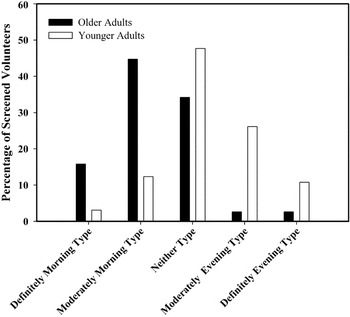
A total of 103 volunteers (65 younger and 38 older adults) were screened to determine their eligibility for the study. The distribution of their scores on the Morningness-Eveningness Questionnaire (MEQ; Horne & Ostberg, Reference Horne and Ostberg1976) is plotted in Figure 1. MEQ scores can range from 16 to 86, with five categories defined as follows: (a) Definitely Evening Type for scores of 16 to 30, (b) Moderately Evening Type for scores of 31 to 41, (c) Neither Type for scores of 42 to 58, (d) Moderately Morning Type for scores of 59 to 69, and (e) Definitely Morning Type for scores of 70 to 86 (Horne & Ostberg, Reference Horne and Ostberg1976). On average, younger adults had a mean score of 45.88 (SD = 12.01), and older adults a mean score of 59.58 (SD = 11.57). Consistent with previous studies (May, Hasher, & Stoltzfus, Reference May, Hasher and Stoltzfus1993; West, Murphy, Armilio, Craik, & Stuss, Reference West, Murphy, Armilio, Craik and Stuss2002), more than 70 per cent of younger adults fell in the Moderately Evening Type or Neutral categories, whereas over 60 per cent of older adults fell in the Moderately Morning Type and Definitely Morning Type categories. To ensure differentiation based on the MEQ for the current study, we selected younger adults with scores of 39 or lower (Moderately Evening Type), and older adults with scores of 61 or higher (Moderately Morning Type).
The distribution of MEQ scores into the MEQ categories for the 65 younger and 38 older adults screened for eligibility. MEQ scores can range from 16 to 86, with categories defined as follows: Definitely Evening Type for scores of 16 to 30, Moderately Evening Type for scores of 31 to 41, Neither Type for scores of 42 to 58, Moderately Morning Type for scores of 59 to 69, and Definitely Morning Type for scores of 70 to 86 (Horne & Ostberg, Reference Horne and Ostberg1976).

Several additional criteria had to be met to control for factors that might affect time-of-day measures. We excluded participants if they smoked, or suffered from diabetes, asthma or insomnia; or if they were taking psychiatric or steroid-containing medications, anti-convulsants, thyroid hormones, or tranquilizers. Females of reproductive age were required to have either ceased use of birth control pills, or to have been on birth control pills consistently, for at least three months prior to the experiment. Participants were ineligible if they were shift-workers or had taken a trans-meridian flight within three weeks prior to the scheduled experimental date.
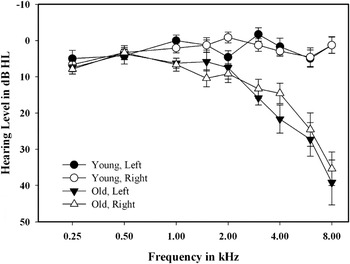
All participants spoke English as a first language, reported themselves to be in good general health, and had clinically normal hearing thresholds in the speech range (pure-tone air-conducted audiometric thresholds ≤ 25 dB HL at frequencies below 4000 Hz bilaterally; see Figure 2). A group of 12 Evening Type younger adults (M = 22.92, SD = 1.93, range = 20 to 26 years), and 12 Morning Type older adults (M = 70.83, SD = 4.28, range = 66 to 79 years) who passed all of the screening criteria were recruited from the university and local community to participate in this study. All participants provided informed consent and were paid CAN$60 for being in the study.
Average audiometric thresholds for the younger and older participants as a function of frequency. Solid symbols represent left-ear performance; open symbols represent right-ear performance. Error bars represent the standard error of the means. HL = Hearing Level.

Measures
Two physiological measurements known to be associated with circadian rhythms were taken: (a) saliva samples for cortisol concentration analysis and (b) core-body temperature. Two auditory physiological tests were also taken: (a) acoustic reflex thresholds and (b) distortion product otoacoustic emissions. In addition, four behavioural measures tapping different levels of auditory and cognitive processing were evaluated: (a) within-channel, and (b) between-channel, gap detection; (c) auditory channel capacity; and (d) memory for spoken discourse.
For the purposes of the present article, the following subset of these measures was analyzed: one physiological measure (core-body-temperature) and three behavioural measures (within-channel gap detection, absolute identification of pure-tone intensity, and memory for spoken discourse). Acoustic reflex thresholds and otoacoustic emissions were excluded because measures could not be obtained from all participants. Stable results for between-channel gap detection could not be obtained in the limited testing time. Although saliva samples were collected, they were not submitted for laboratory analysis.
Core body temperature
To obtain a physiological correlate of circadian rhythms, core body temperature (CBT) was measured at the beginning of each experimental task using a Braun ThermoScan Infrared ear thermometer (model IRT4020). Participants were familiarized with the steps necessary to obtain a temperature reading and were asked to measure their own temperature under the experimenter’s supervision. The ThermoScan readings have an error of 0.2 °C, and the procedure was repeated until three measurements were obtained that fell within 0.2 °C. The average of these three measurements was recorded prior to each task.
Within-channel auditory gap detection
The most widely used test demonstrating age-related differences in auditory temporal processing is gap detection (Schneider, Pichora-Fuller, Kowalchuk, & Lamb, Reference Schneider, Pichora-Fuller, Kowalchuk and Lamb1994). In the present study, we tested the ability of listeners to detect a gap between two 500-Hz tones, each 250 ms long (following the procedures used by Pichora-Fuller, Schneider, Benson, Hamstra, & Storzer, Reference Pichora-Fuller, Schneider, Benson, Hamstra and Storzer2006). Intact (no gap) control stimuli were of equal duration and total energy relative to the test (gap) stimuli. Stimuli were presented diotically at 75 dB SPL over Sennheiser HD 580 headphones. Presentation was controlled via MathWorks’ MatLab (version 6.5) software. All gap stimuli were presented using a Tucker Davis Technology (TDT) System III digital-to-analog converter (sampling rate, 20 kHz). Thresholds were measured using a two-interval, two-alternative, forced-choice procedure and a 3-down 1-up rule procedure to find the 79.9 per cent point on the psychometric function (Levitt, Reference Levitt1971).
At each trial, participants heard a gap stimulus in one interval and a no-gap stimulus in the other interval, with the order of presentation randomized, and decided which interval contained the gap. Two runs with 12 reversals each were completed. The estimated threshold for each individual was the average of the last eight reversals over both of these runs. Typically, gap thresholds are based on the average of the best two of three runs, and more runs are obtained if an individual’s performance improves over the initial runs; however, time constraints in the current experiment permitted only the minimal number of runs to be obtained.
Auditory channel capacity
A task measuring auditory channel capacity was used to investigate possible time-of-day influences on higher-order auditory processing. Channel capacity refers to the amount of information that can be processed by an individual sensory channel (Miller, Reference Miller1956; Murphy, Schneider, Speranza, & Moraglia, Reference Murphy, Schneider, Speranza and Moraglia2006). Previous findings have indicated that younger and older adults do not differ in their ability to identify tones differing in intensity (Murphy, Schneider, et al., Reference Murphy, Schneider, Speranza and Moraglia2006). In the present experiment, younger and older adults’ abilities to identify tones differing in intensity were examined for possible time-of-day influences using a set of four 500-ms-long 1000-Hz pure tones with intensities of 64, 70, 76, and 82 dB SPL. All stimuli were generated digitally prior to the experiment, and converted to analog during the experiment using a TDT System II digital-to-analog converter (sampling rate, 20 kHz). Stimuli were presented diotically via TDH 49 headphones. Participants identified the presented tones by pressing one of four buttons after which they were provided with feedback. Participants had two seconds to submit a response. Failure to respond within two seconds resulted in having to restart the block of trials.
Memory for spoken discourse
Time of day has been found to influence age-related differences in memory for read passages (May et al., Reference May, Hasher and Stoltzfus1993). Age-related differences have also been observed on tests of spoken discourse comprehension and memory; however, time-of-day effects on memory for speech have not been studied. In a previous study, on a10-item multiple-choice test of memory for spoken dialogues masked by multitalker babble, younger adults outperformed older adults (Murphy, Daneman, & Schneider, Reference Murphy, Daneman and Schneider2006). The same dialogue test was used in the present study.
Three dialogues were chosen from the original set of six used by Murphy, Daneman et al. (Reference Murphy, Daneman and Schneider2006). Dialogues consisted of the digitally recorded voices of two actors reading a one-act play. The plays were edited versions of Absolution (Reynolds, Reference Reynolds, Bert and Bert1993), The Lemonade Stand (Harnetiaux, Reference Harnetiaux, Bert and Bert1993), and Out of Body (Cooper, Reference Cooper1994). The dialogues were played over two loudspeakers at 61 dB SPL using a TDT System II digital-to-analog converter (sampling rate, 20 kHz). One actor’s voice was presented from a loudspeaker located 45° to the left of the participant, and the other actor’s voice was presented from a loudspeaker located 45° to the right of the participant. Babble was played over a central loudspeaker at 76 dB SPL. The dialogues’ order of presentation was counterbalanced over the three sessions in the test day. Participants heard a different dialogue during each session, and they were tested for recognition of explicit details from each dialogue using a 10-item questionnaire.
Design and conditions
Sleep, activity, and diet are known to influence daily fluctuations of cortisol. To ensure that the day of testing reflected typical conditions, participants were asked to maintain a routine consistent with their typical pattern of activities prior to and during the testing day. In addition, they were asked not to consume more than two alcoholic beverages or watch scary movies on the night prior to the experiment. During times between test sessions, participants were asked not to nap, and to stay within the laboratory area. Participants were tested at three different times on the same day for periods of approximately 1.5 hours. The first experimental session started at 9:00 a.m., the second session started at 11:30 a.m., and the last experimental session started at 3:30 p.m. Participants were served a meal chosen from a pre-determined menu at approximately 1:00 p.m.
The auditory experiments were conducted in a double-walled International Acoustics Company (IAC) sound-attenuated chamber, where there was an ambient sound-level of 20.9 dBA, light levels of approximately 11 cd/m2 (measured using a 1989 Opticon Universal Photometer), and ambient temperature of approximately 21 °C. Physiological measures and the memory questionnaire were administered outside of the sound chamber in a closed laboratory room.
Results
Core Body Temperature
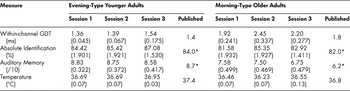
On average, younger adults had higher temperatures than older adults, and temperatures were higher at the end of the day than at the beginning of the day (see Table 1). A two-way ANOVA with age as a between-subjects factor and time of day as a within-subject factor was conducted to examine the relationship between time of day and age. Mauchly’s Test of Sphericity indicated a significant violation of sphericity, χ2df = 2 = 15.197, p = .001, thus the Greenhouse-Geisser correction was used for the ANOVA results. The ANOVA confirmed a significant effect of age, F (1, 22) = 13.690, p = .001, with older adults having significantly lower temperatures than younger adults (Mean Difference = 0.36 °C, SE = 0.09). There was also a significant effect of time of day on temperature, F (1.320, 44) = 19.584, p < .001. A Student-Newman-Keuls test of multiple comparisons showed that, on average, temperature was significantly higher during session 3 than session 2 (p < .05), or session 1 (p < .05), and temperature was higher during session 1 than it was during session 2 (p < .05). The interaction of time of day by age did not reach significance, F (1.320, 29.042) = 3.224, p = .072.
Summary of mean (standard error) results for younger and older adults tested in the three experimental sessions and in previously published studies

An asterisk (*) indicates that the value was estimated from previously published results.
Within-channel Gap Detection
Overall, younger adults’ thresholds were 0.76 ms smaller (lower values indicate better performance) than those of older adults (see Table 1). For both groups, thresholds were greater at the end, rather than at the beginning, of the day; however, although the gap-detection thresholds of the younger adults remained relatively stable across the day, the thresholds of the older adults increased from session 1 to session 2 but decreased again by session 3. These descriptions were confirmed by a two-way ANOVA, with significant effects on gap-detection thresholds of age, F (1, 22) = 6.77, p = .016; time of day, F (2, 44) = 5.992, p = .005; and the interaction of time of day and age, F (2, 22) = 4.26, p = .028. A Student-Newman-Keuls test of multiple comparisons showed that the mean gap detection thresholds of younger adults were significantly better than those of the older adults during all three sessions (p < .05). Although the thresholds of younger adults in the three sessions did not differ statistically from each other, the thresholds of the older adults were significantly better during session 1 than in sessions 2 and 3 (p < .05), while thresholds measured during sessions 2 and 3 were not significantly different from each other.
Absolute Identification
As shown in Table 1, absolute identification was similar for both age groups and was not affected by time of day. An ANOVA did not reveal a significant effect of time of day, age, or a significant interaction between these two factors.
Auditory Memory
On average, younger adults outperformed older adults by an average of 1.44 items out of a possible 10 on the questionnaires (see Table 1). An ANOVA confirmed a significant effect of age, F (1, 22) = 37.56, p = .007, but no significant effect of time of day or time of day by age.
Discussion
The potential influence of time of day on auditory perception and aging was investigated in a group of Morning Type older adults and a group of Evening Type younger adults. Participants were tested on measures of auditory processing administered at three different times between 9:00 a.m. and 5:00 p.m. The auditory measures included gap detection, absolute identification, and auditory memory for dialogues. Core body temperature was measured prior to each task to obtain time-of-day dependent changes in average temperature for each age group, and to assess the correlation between behavioural performance and body temperature for each task.
The results of the present experiments replicate previous findings of age-related differences. Specifically, age-related differences in gap-detection thresholds replicated those obtained previously by Pichora-Fuller et al. (Reference Pichora-Fuller, Schneider, Benson, Hamstra and Storzer2006). The absence of age-related differences on the measure of absolute identification and age-related differences obtained on the memory task replicated the results obtained by Murphy, Schneider et al. (Reference Murphy, Schneider, Speranza and Moraglia2006) and Murphy, Daneman et al. (Reference Murphy, Daneman and Schneider2006) respectively. There was no effect of time of day on absolute identification or memory for spoken discourse. The absence of time-of-day effects on auditory memory seemed contradictory to the findings of May et al. (Reference May, Hasher and Stoltzfus1993), who found time-of-day effects on memory for visually presented narratives. However, their participants had more extreme MEQ scores than the groups in the present study, and they were tested at more extreme times of day, either 8:00 to 9:00 a.m. or 5:00 to 6:00 p.m. Although circadian rhythms seem to have an effect when extreme sampling and testing conditions are used, they do not seem to affect results when more typical participants and test times are employed.
There was a significant effect of time of day on gap-detection thresholds, but only for the older group. Surprisingly, time of day had an effect on lower-level auditory processing but not on higher-level cognitive processing. However, both younger and older groups were at their best in the morning and at their worst in the late afternoon, with the largest age-related difference being observed mid-day. Since gap detection thresholds were based on the average of only two runs and time limits did not allow more runs to be tested to ensure that performance had stabilized, we might have seen improvement over the course of the day due to learning; however, better performance earlier than later in the day suggests that changes over the course of the day are not due to learning. Importantly, the pattern of results is not entirely consistent with the prediction that younger adults should perform better later in the day while older adults should perform better in the morning. Thus, it is unlikely that the time of day by age interaction observed here is due to an influence of circadian rhythms on auditory processing. Furthermore, these results suggest that any influence of circadian rhythms on age-related differences in higher-level cognitive tasks is unlikely to be mediated by the effects of circadian rhythms on sensory processes.
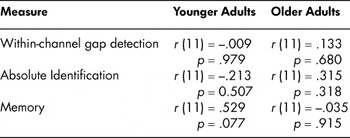
Core body temperature was lower for older adults compared to younger adults and increased across the day, suggesting that this measure was sensitive enough to detect physiological fluctuations associated with circadian rhythms; however, the observed increases over the course of the day were equivalent in both age groups. Furthermore, temperature was not significantly correlated to performance on any task (see Table 2). The lack of correlation between temperature and performance, particularly memory performance, is inconsistent with results obtained by Wright et al. (Reference Wright, Hull and Czeisler2002), who found that an increase of about 0.17 °C corresponded to better performance on memory tasks. In contrast, West et al. (Reference West, Murphy, Armilio, Craik and Stuss2002), who did not control circadian rhythms in their tasks as strictly as Wright et al., obtained findings similar to those of the current study when measuring the correlation between oral temperature and time-of-day effects on working memory and aging. Thus, it seems that the effects of circadian rhythms are not large enough to influence performance in the typical testing conditions used in most auditory and cognitive aging experiments.
Summary of Pearson-r correlation analyses between average core body-temperature and behavioural measures for younger and older adults

In conclusion, our results do not support the hypothesis that there is an effect of time of day on the performance of auditory tasks in younger or older adults. Although the present study was less stringently controlled than many studies focused on the effects of circadian rhythms, the precautions in selecting participants and the times of testing were more stringently controlled than would be typical in most auditory aging experiments. Even so, a significant effect of time of day failed to alter the results on a selection of tasks that have been reported in prior studies of aging using auditory stimuli. It is possible that the influence of circadian rhythms, without strict methodological regulation, is simply not large enough to influence performance in these types of experiments. It is also possible that circadian rhythms do have a significant effect on the performance of auditory tasks, but that these effects only alter performance during times that fall outside of when experiments are typically conducted. Whatever the case may be, on the basis of current results, time-of-day effects do not seem to be of any practical relevance to typical studies of auditory aging.